Slashdot Mirror
Domain: wired.com
Stories and comments across the archive that link to wired.com.
Comments · 12,699
-
Re:Another company bets the boat on Windows
Except dell is migrating into an enterprise solutions business. Their consumer product business is somewhat secondary to their business software.
Good move since the major enterprise players are going bespoke and whitebox. http://www.wired.com/wiredenterprise/2012/11/amazon-google-secret-servers/ Ooops...
-
Matter of opinion
I have not seen the movie yet but I believe this news article is very opinionated. Here is an article from Wired that tells a different story: The Hobbit: An Unexpected Failure
-
Re:Uh...it's still there, you know
Reminds me of a Wired article I read for a class one time. The assignment was to read the article and "summarize the directions that commercial use of technology is moving to provide content, away from the open, free web."
I slammed the article in my assignment, calling it out for what it is: bullshit. Of course, one cane make that conclusion just by knowing it's from Wired...
-
Re:"Grid Parity" ... on sunny days only
I live in an area of the northeast, where I know that my generating potential and load factor is substantially lower than the "nameplate" rating on any PV equipment I would install. That doesn't mean I couldn't do it, but I know that I would get a substantially greater ROI if I took the same array and installed it, say, on a similar home in New Mexico. There are similar situations (renters that can't or won't make capital investments in property they don't own, people in highrise condos that have power requirements far beyond what the footprint could provide using solar) where installing solar on one's own domicile juts doesn't make sense. I don't plan on moving to New Mexico, but I still want to see the widespread adoption of solar, and put my money where my mouth is.
It would be nice if there was some mechanism, other than semi-formal arrangements among friends (e.g., people I know in California and Nevada), for me to front the tab to get solar installed on their house in return for (contractual) repayment over the years. This is kinda what Elon Musk's SolarCity is doing on a grand scale. They just had an IPO yesterday, but chasing IPOs is a loser's bet in my opinion. The renewables sector more generally has been a terrible investment for years because companies have been losing money left and right - so many big players driving down costs. I'd rather not play the odds of a whole sector, but rather invest in a single project that I have some control over.
Anyone have any suggestions? -
CIA Head: We Will Spy On Americans Through Electri
CIA Head: We Will Spy On Americans Through Electrical Appliances
Global information surveillance grid being constructed; willing Americans embrace gadgets used to spy on them
Steve Watson | Prisonplanet.com | March 16, 2012
http://www.prisonplanet.com/cia-head-we-will-spy-on-americans-through-electrical-appliances.html
"CIA director David Petraeus has said that the rise of new "smart" gadgets means that Americans are effectively bugging their own homes, saving US spy agencies a job when it identifies any "persons of interest".
Speaking at a summit for In-Q-Tel, the CIA's technology investment operation, Petraeus made the comments when discussing new technologies which aim to add processors and web connections to previously 'dumb' home appliances such as fridges, ovens and lighting systems.
Wired reports the details via its Danger Room Blog[1]:
"'Transformational' is an overused word, but I do believe it properly applies to these technologies," Petraeus enthused, "particularly to their effect on clandestine tradecraft."
"Items of interest will be located, identified, monitored, and remotely controlled through technologies such as radio-frequency identification, sensor networks, tiny embedded servers, and energy harvesters - all connected to the next-generation internet using abundant, low-cost, and high-power computing," Petraeus said.
"the latter now going to cloud computing, in many areas greater and greater supercomputing, and, ultimately, heading to quantum computing." the CIA head added.
Petraeus also stated that such devices within the home "change our notions of secrecy".
Petraeus' comments come in the same week that one of the biggest microchip companies in the world, ARM, unveiled new processors that are designed to give practically every household appliance an internet connection[2], in order that they can be remote controlled and operate in tandem with applications.
ARM describes the concept as an "internet of things".
Where will all the information from such devices be sent and analyzed? It can be no coincidence that the NSA is currently building a monolithic heavily fortified $2 billion facility[3] deep in the Utah desert and surrounded by mountains. The facility is set to go fully live in September 2013.
"The Utah data center is the centerpiece of the Global Information Grid, a military project that will handle yottabytes of data, an amount so huge that there is no other data unit after it." reports Gizmodo.
"This center-with every listening post, spy satellite and NSA datacenter connected to it, will make the NSA the most powerful spy agency in the world."
Wired reports[4] that the incoming data is being mined by plugging into telecommunications companies' switches, essentially the same method the NSA infamously uses for warrantless wiretapping of domestic communications[5], as exposed six years ago.
Former intelligence analyst turned best selling author James Bamford, has penned a lengthy piece[6] on the NSA facility and warns "It is, in some measure, the realization of the 'total information awareness' program created during the first term of the Bush administration-an effort that was killed by Congress in 2003 after it caused an outcry over its potential for invading Americans' privacy."
----------------------
Steve Watson is the London based writer and editor for Alex Jones' Infowars.net[7], and Prisonplanet.com[8]. He has a Masters Degree in International Relations from the School of Politics at The University of Nottingham in England.
(C) 2012 PrisonPlanet.com is a Free Speech Systems, LLC company. All rights reserved.
[1] http://www.wired.com/dangerroom/2012/03/petraeus-tv-remote/
[2] http://www.bbc.co.uk/news/technology-17345934 -
CIA Head: We Will Spy On Americans Through Electri
CIA Head: We Will Spy On Americans Through Electrical Appliances
Global information surveillance grid being constructed; willing Americans embrace gadgets used to spy on them
Steve Watson | Prisonplanet.com | March 16, 2012
http://www.prisonplanet.com/cia-head-we-will-spy-on-americans-through-electrical-appliances.html
"CIA director David Petraeus has said that the rise of new "smart" gadgets means that Americans are effectively bugging their own homes, saving US spy agencies a job when it identifies any "persons of interest".
Speaking at a summit for In-Q-Tel, the CIA's technology investment operation, Petraeus made the comments when discussing new technologies which aim to add processors and web connections to previously 'dumb' home appliances such as fridges, ovens and lighting systems.
Wired reports the details via its Danger Room Blog[1]:
"'Transformational' is an overused word, but I do believe it properly applies to these technologies," Petraeus enthused, "particularly to their effect on clandestine tradecraft."
"Items of interest will be located, identified, monitored, and remotely controlled through technologies such as radio-frequency identification, sensor networks, tiny embedded servers, and energy harvesters - all connected to the next-generation internet using abundant, low-cost, and high-power computing," Petraeus said.
"the latter now going to cloud computing, in many areas greater and greater supercomputing, and, ultimately, heading to quantum computing." the CIA head added.
Petraeus also stated that such devices within the home "change our notions of secrecy".
Petraeus' comments come in the same week that one of the biggest microchip companies in the world, ARM, unveiled new processors that are designed to give practically every household appliance an internet connection[2], in order that they can be remote controlled and operate in tandem with applications.
ARM describes the concept as an "internet of things".
Where will all the information from such devices be sent and analyzed? It can be no coincidence that the NSA is currently building a monolithic heavily fortified $2 billion facility[3] deep in the Utah desert and surrounded by mountains. The facility is set to go fully live in September 2013.
"The Utah data center is the centerpiece of the Global Information Grid, a military project that will handle yottabytes of data, an amount so huge that there is no other data unit after it." reports Gizmodo.
"This center-with every listening post, spy satellite and NSA datacenter connected to it, will make the NSA the most powerful spy agency in the world."
Wired reports[4] that the incoming data is being mined by plugging into telecommunications companies' switches, essentially the same method the NSA infamously uses for warrantless wiretapping of domestic communications[5], as exposed six years ago.
Former intelligence analyst turned best selling author James Bamford, has penned a lengthy piece[6] on the NSA facility and warns "It is, in some measure, the realization of the 'total information awareness' program created during the first term of the Bush administration-an effort that was killed by Congress in 2003 after it caused an outcry over its potential for invading Americans' privacy."
----------------------
Steve Watson is the London based writer and editor for Alex Jones' Infowars.net[7], and Prisonplanet.com[8]. He has a Masters Degree in International Relations from the School of Politics at The University of Nottingham in England.
(C) 2012 PrisonPlanet.com is a Free Speech Systems, LLC company. All rights reserved.
[1] http://www.wired.com/dangerroom/2012/03/petraeus-tv-remote/
[2] http://www.bbc.co.uk/news/technology-17345934 -
CIA Head: We Will Spy On Americans Through Electri
CIA Head: We Will Spy On Americans Through Electrical Appliances
Global information surveillance grid being constructed; willing Americans embrace gadgets used to spy on them
Steve Watson | Prisonplanet.com | March 16, 2012
http://www.prisonplanet.com/cia-head-we-will-spy-on-americans-through-electrical-appliances.html
"CIA director David Petraeus has said that the rise of new "smart" gadgets means that Americans are effectively bugging their own homes, saving US spy agencies a job when it identifies any "persons of interest".
Speaking at a summit for In-Q-Tel, the CIAâ(TM)s technology investment operation, Petraeus made the comments when discussing new technologies which aim to add processors and web connections to previously âdumbâ(TM) home appliances such as fridges, ovens and lighting systems.
Wired reports the details via its Danger Room Blog[1]:
"âTransformationalâ(TM) is an overused word, but I do believe it properly applies to these technologies," Petraeus enthused, "particularly to their effect on clandestine tradecraft."
"Items of interest will be located, identified, monitored, and remotely controlled through technologies such as radio-frequency identification, sensor networks, tiny embedded servers, and energy harvesters - all connected to the next-generation internet using abundant, low-cost, and high-power computing," Petraeus said.
"the latter now going to cloud computing, in many areas greater and greater supercomputing, and, ultimately, heading to quantum computing." the CIA head added.
Petraeus also stated that such devices within the home "change our notions of secrecy".
Petraeusâ(TM) comments come in the same week that one of the biggest microchip companies in the world, ARM, unveiled new processors that are designed to give practically every household appliance an internet connection[2], in order that they can be remote controlled and operate in tandem with applications.
ARM describes the concept as an "internet of things".
Where will all the information from such devices be sent and analyzed? It can be no coincidence that the NSA is currently building a monolithic heavily fortified $2 billion facility[3] deep in the Utah desert and surrounded by mountains. The facility is set to go fully live in September 2013.
"The Utah data center is the centerpiece of the Global Information Grid, a military project that will handle yottabytes of data, an amount so huge that there is no other data unit after it." reports Gizmodo.
"This center-with every listening post, spy satellite and NSA datacenter connected to it, will make the NSA the most powerful spy agency in the world."
Wired reports[4] that the incoming data is being mined by plugging into telecommunications companiesâ(TM) switches, essentially the same method the NSA infamously uses for warrantless wiretapping of domestic communications[5], as exposed six years ago.
Former intelligence analyst turned best selling author James Bamford, has penned a lengthy piece[6] on the NSA facility and warns "It is, in some measure, the realization of the âtotal information awarenessâ(TM) program created during the first term of the Bush administration-an effort that was killed by Congress in 2003 after it caused an outcry over its potential for invading Americansâ(TM) privacy."
----------------------
Steve Watson is the London based writer and editor for Alex Jonesâ(TM) Infowars.net[7], and Prisonplanet.com[8]. He has a Masters Degree in International Relations from the School of Politics at The University of Nottingham in England.
© 2012 PrisonPlanet.com is a Free Speech Systems, LLC company. All rights reserved.
[1] http://www.wired.com/dangerroom/2012/03/petraeus-tv-remote/
[2] -
Re:And Internet Streaming?
Does the law encompass Hulu and other internet streaming services?
-
Re:Coercion
I'm a lot less worried about the government than I am about multinational corporations.
Yes, I understand this is a fundamental difference of perspective that liberals have with libertarians.
The government has had my "personal information" since I was born and I haven't had any problems with them.
Consider yourself fortunate. US Census data was used to enable the FBI to round up US citizens and send them to concentration camps. Before that, Census data was used to plan Sherman's March to the Sea. It's also dangerous to assess the situation as safe based on the present government, because data in databases never dies: the Nazis used religious data from the census taken by the democratic Weimar Republic in order to round up Jews & Jehovah's Witnesses.
On the other hand, private corporations have had my personal information since the 1980s and I've had numerous situations where they have misused that information or used it in a way that made me unhappy.
Your anecdotal experience is unfortunate. My experience with businesses has been countervailing to yours. I imagine there is some ubiquitous, individual cognitive bias in terms of how we would both perceive identical situations. I have a fundamental distrust of the government, with their goal of having a monopoly on violence and their use of coercion. My relatively-lower concern regarding the practices of businesses is that I can understand and predict their motivation—to extract profit from me. With the government, they are not satisfied with merely obtaining money, they also want control over the lives of their population.
So, it is a fallacy consider my position to be a paean to "noble corporations". This is more of a "lesser of two evils" perspective here.
If you're really worried that the government is going to get its hands on your Social Security number, maybe it's time for you to step away from the AM radio, you know?
Nice strawman: deftly dodging directly discussing my example. Probably not worth it for us to discuss your strawman, because our disagreement is more fundamental; I don't believe the Social Security program should exist at all, and I doubt our positions on that debate could be reconcilable. More on topic, do you adjudge the yottabyte NSA data center being built in Utah to be a concern? I perceive your perspective on the government's possession of your personal data to be very close to the "If you've got nothing to hide..." argument. Do I infer correctly?
Oooh, look everyone: I made it all the way through a political post without disparaging the counterparty in the discussion. Just doing my part to try to alter the trajectory of political discourse in this country...
-
Re:good riddance to NIF and ITER
The Navy also did some stuff on cold fusion: http://www.wired.com/dangerroom/2009/03/navy-scientists/
IMO even if "cold fusion" isn't fusion it might be worth researching as a new type of battery. The way the mainstream scientists reacted to it wasn't very scientific
Same goes for other stuff - just because it doesn't produce more energy than you put in doesn't mean it's useless. Plenty of people are looking for better batteries.
-
Stolen to order
http://www.wired.com/dangerroom/2012/09/engine-china-stealth-fighter/
A nice plane without engines is useless. Over land through Iran to China
-
Re:dumb
He DID - he dyed his hair, eyebrows, beard, and moustache black. 'Course, this brilliant disguise probably would have worked better if he had not then TOLD EVERYONE...
(of course, knowing him, most people assumed he was lying... turns out he wasn't)
-
Re:Obama has a solution:
No, he kinda kicked it up a notch.
http://www.youtube.com/watch?v=pjniYBfsX7I
"Hope. Change."
Ah, Chomsky and the Iranian news in one youtube video! The esteemed Dr. Chomsky approaches truth in an almost clinical fashion, preparing the most potent concoctions he can develop, in a homeopathic sense: the more dilute the "medicine", the more "powerful" it is. I must admit that diluting his already minimal truthfulness in the sea of lies of the Iranian news is a stroke of homeopathic genius! The result is more dilute than a needle of truth in a haystack of lies, and therefore so much more powerful. A pity the video is so short, there is obviously so much potential from that collaboration.
Pakistani General: Actually, The Drones Are Awesome
Here are words that you never thought you’d hear a Pakistani general utter about the drone strikes that batter Pakistan’s tribal areas: “A majority of those eliminated are terrorists, including foreign terrorist elements.”
That would be yawn-worthy if it came from the CIA, which never misses an opportunity to credit its drone strikes with taking out al-Qaeda and its affiliates. But it was the main message of an official briefing from Maj. Gen. Ghayur Mehmood in Miram Shah. He’s the commander of Pakistan’s Seventh Division, charged with leading troops in North Waziristan.
“Myths and rumours about US predator strikes and the casualty figures are many,” Mehmood said, according to Dawn, “but it’s a reality that many of those being killed in these strikes are hardcore elements, a sizeable number of them foreigners.”
Chomsky and the Khmer Rouge – The Observer
Noam Chomsky: The Last Totalitarian
The Sick Mind of Noam Chomsky -
Re:Use different passwords for different things
Are you going to bet that sites with that sort of SQL injection won't be exploitable in other ways? I'm just going to assume they will get pwned and thus not waste my time setting up strong "GPU-thwarting" passwords.
Also, unless they are specifically targeting you it doesn't matter if your password is cracked at that point. Because almost everyone else will be having the same problems and thus that service/site will have to deal with it. They'll notice lots of passwords are cracked, they'll ask people to change their passwords (which may just give the hackers an opportunity to get more passwords if they haven't closed all the holes
If the hackers are targeting you, and they are the sort who would invest in extra hardware just to hack you, you are probably going to get pwned whatever you do, unless you're the competent paranoid sort that doesn't do stuff like use banks that do insecure stuff like send text messages to phones as verification. And you make sure they aren't prone to social engineering and other silliness (good luck finding a bank that isn't- most banks/companies have too may stupid customers to be really secure ). Many sites use unencrypted email for password resets. That won't be good enough if you're being targeted. Hackers can divert network traffic: http://www.wired.com/threatlevel/2008/08/revealed-the-in/
-
Re:Straightjacket and RMS...
Modern distros are far more useable than Windows, and possibly Apples as well (I wouldn't know).
Until you want to do something like DVD playback, and are faced with bewildering instructions on foreign downloads (well, foreign to those of us in the U.S.) to get it to work. And it still appears illegal to do it: http://www.wired.com/threatlevel/2012/10/dmca-exemptions-rejected/
In this case, it kind of sucks really bad.
-
Re:moving parts? fragile?
The hinge on the back is built tough.
http://www.wired.com/reviews/2012/10/microsoft-surface/
"We wanted to see how easy it was to break one. It’s very possible, but you have to really try. We did manage to break off the kickstand by gradually leaning onto it, but I had to put nearly my full weight onto the tablet before the kickstand snapped off."
-
Aaaaaadriiiaaaaaaaaaannnnng!
I don't despise football or other sports which rely heavily on the physics of (human) bodies colliding, but I do think that we should have teams of robots out there instead. The real competition would then be in advancing technology instead of retarding bigger meat-sacks faster. Such competition sort of parallels the way in which car racing improves the science of automobiles, and leads to innovations like better fuel efficiency or more powerful engines, or low profile tires; Some of which wind up in common folks' vehicles... Though, it's moronic to use the low-profile tires on street cars: They're designed to be used on very smooth roads and make room for huge brake pads. Thus, street cars with tiny little brakes in their low profile wheels look ridiculous to me, esp. when your wheel (not just tire) is destroyed by a golf ball sized rock -- which those cheap wheels with more tire sidewall cope with just fine.
Where was I? Oh yes, you see, it's far too expensive to support our fragile bodies in long term space journeys. The answer is to create robotic bodies and climb another rung on the evolutionary ladder. Oh stop it, of course there'd still be romance, the bodies can look "sexy" if you like, and electronic orgasms on demand are already possible for humans. Stem cell research means we could produce egg and sperm from parent's tissue samples, then make embryos, and hook them into their robot bodies as they grow allowing not just more easy transition to sturdier bodies, but also new senses to be connected -- Thermal & x-ray vision for example, or telepathy (WIFI).
I'd much rather my city spend hundreds of millions of dollars to improve robotics, and eventually allow our minds to escape these vestigial bodies and colonize the stars (thus, ensuring some of our eggs are off planet when the next Asteroid strikes this basket) than to incentivize young people to destroy their brains with false hopes of becoming a brain-damaged millionaire sports star. I mean, screw their bodies, but we can't replace the brains.... yet.
-
FYI Current Providers
If you are interested in seeing what is currently being done:
and
http://www.wired.com/threatlevel/2011/09/cellular-customer-data/
I understand what the cops are getting at, creating a standard they can use. However they tried something like this on ISP up here and Canada, and there was a bit of row to say the least. Cops it seems in general will constantaly ask for more and more powers in order to basically make their job easier. I can't really fault them for that, or for trying. However it has to be a balance in personal rights of privacy also. Which means the public has to say "No" at a certain point when they feel it is too much. Up here in Canada I think we do a better job or that. There are a whole lot of crazy laws down in the US that will let the state pretty much arbitrarly spy on you. The usual arguement is you got nothin' to fear if you ain't got nothin' to hide.
I would prefere at least in this case to let companies set their own standards, and let the market figure it out. I know I think I would pick the one with 0 rentention if given the chance.
One could also make the arguement just like the conservatives might say, criminals don't register guns, well if I am going off someone, I think I'll encrypt it using another method if I really feel the need to text it to someone. Of course there dumb criminals also... Then again, cops shouldn't have dificulty catching those ones. Besides, most phones record the information anyway unless your purposly delete it. Get warrent, find phone, etc... Phone encrypted?
-
Re:Worlds Gone Mad
It is, according to this article, a different approach:
Most of today’s wireless chargers utilize inductive charging, which requires a charger and your gadget to be extremely close — usually touching — to do the job. So if your smartphone is capable of wireless charging (the Lumia 920, for example), it requires a wired charging base on which you place the phone to charge.
It goes on to say:
An Apple patent application published Thursday, “Wireless Power Utilization in a Local Computing Environment,” uses a different approach. Apple’s implementation would utilize a near-field magnetic resonance (NFMR) power supply to deliver juice to nearby devices that have an NFMR resonator circuit within.
Like you, I don't know enough about the field to properly judge, but it does sound like they're using a different approach (NFMR instead of induction) to produce the power, and that this NFMR device will create a charging "zone," which could possibly deliver enough power to charge/power a desktop's worth of accessories during normal use - keyboard, mouse, phone, etc. Is it "novel" enough to patent? The USPTO obviously thought so. Whether or not it's a "good" solution, it does seem to at least be *different* than what the current wireless charging techniques are using.
-
Re:~17231 years to send a probe and find if life
The probe in question is Voyager 1 and was launched in 1977. Let's not call it modern. It was designed in an era when there was no such thing as a personal computer. A high end cellphone probably has more battery-powered computing power in your pocket now than all of the compute resources of NASA back then. Imagine what those engineers could achieve with this. Materials science has progressed also. But the biggest gift of days is in our understanding the rich resources available in the space around us. Water is abundant everywhere from Mercury to the edge of the solar system. We didn't know that back then. Almost all stars have planets in the habitable zone. We didn't know that either.
It's unlikely a mission to Vega would launch any sooner than 2037, or 60 years after the launch of the first Voyager. We have learned a lot of things since Voyager 1 was launched, and will have learned more. That none have gone faster is an artifact of 30 years of neglect of space operations, but not space science. At the moment Vega is too far to a man to reach in his span of years with the science we have, though another star might be. There is no reason to expect that this will always be so.
With VASMR 200KW thrusters entering service on the ISS in a few years, and the development of suitable power plants ongoing, we still would need fuel - LOTS of fuel - on orbit or somewhere near zero-G to make a go of it. Fortunately in 26 months the NASA Dawn mission will arrive at Ceres and find there a practically unlimited supply of Xenon, Argon, Hydrogen and Oxygen ready for mining as well as a surface amenable to easily building human habitats on. You may schedule two years from now for the space Gold Rush to begin.
Ceres is not only the perfect source for interstellar fuels: it's also the perfect launchpad as it should be possible to build a railgun there 1000KM long capable of launching interstellar probes with solar system escape velocity that don't require any fuel at all. It's also the only minor planet so situated within easy reach.
Planetary Resources, SpaceX, Virgin Galactic and others are all over this. The people behind these efforts are some of the brightest, most successful minds the world has ever known. Elon Musk. Sergey Brin. Larry Page. Eric Schmidt. Richard Branson. These are but a few. They know something you don't know.
-
KGB/FSB links
But Kaspersky’s rise is particularly notable—and to some, downright troubling—given his KGB-sponsored training, his tenure as a Soviet intelligence officer, his alliance with Vladimir Putin’s regime, and his deep and ongoing relationship with Russia’s Federal Security Service, or FSB.
Any comment on these allegations?
-
$1.5 billion in marketing
That's because Microsoft is Estimated to Spend $1.5 Billion on Windows 8 Marketing. $1.5 billion will buy a lot of praise from say-for-pay pundits, astroturfers and shills. There will also be a small percentage of the mainstream public that will get pulled along.
-
Re:Psychiatry, not geekdom
Because many of us have at least been accused of having it. Or are "self-diagnosed" as having it. Or were even diagnosed by an actual psychiatrist.
There's a not-actually-diagnostic Autism Spectrum Quotient test that you can take at Wired.
It might be fun to have a Slashdot poll on the range of results.
-
Re:Even if...
They have no reason to hold him other than being suspected for a crime in the US. If they captured him, they'd let the world know how helpful they were being.
Didn't the crime in question occur in Belize?
-
Re:Oh noes! 11 mm in 20 years!
Over the full 20 years dummy. 20 years is short, 10 years is stupid.
You're claiming that ten years worth of sea level data can't show a trend? You're the stupid one.
Whether the trend will continue for the next 10 or more years is certainly a question, but no one can say for sure at the moment.
I guess you're unaware that temperatures have in fact not climbed statistically significantly since 1998.
You just don't learn, do you? 1998 was a local maxima, so in 2009, you thought could say "the last 10 years data shows cooling." But now of course you can't say that, because the last 10 years data doesn't start on a local maxima. The last 10 years data doesn't show cooling at all, but rising.*
Actually, you're wrong again. What a surprise.
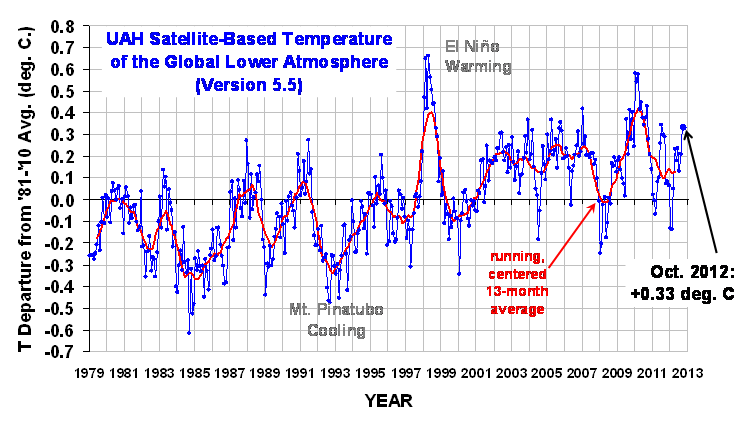
If you look at the UAH satellite temperature data, the running average in 2002 was at 0.2 C above the baseline. As of Oct. 2012, it is running about 0.12 C above the baseline. No statistically significant warming - in fact there's been cooling. (Also FYI, in 1998 the running average hit 0.4 C above the baseline.)
Link to UAH temperature chart.
So now you want to cherry pick the last 12/13 years, again starting with the local maxima of 1998. Which shows you blatantly to be cherry picking. 12/13 years? What kind of period is that to choose?
Even NOAA admits that a 15 year pause in warming represents major problems for the climate modelers:
The simulations rule out (at the 95% level) zero trends for intervals of 15 yr or more, suggesting that an observed absence of warming of this duration is needed to create a discrepancy with the expected present-day warming rate.
Source: NOAA State of the Climate 2008.
We are right at the threshold of such a fifteen year period now. As I pointed out previously, the Sun is unlikely to play along with the climate alarmists. It will certainly be devastating to them if we get any kind of cooling trend over the next 20-40 years, as I expect we will.
You're a cherry picking fraud and you just helped me to made it obvious to everyone. Thanks for playing.
(*Of course no one with shred of integrity would be trying to use 10 years, when for climate trends you need more like 30 years to start to lose the year to year noise. Hence my point about your stupid splitting of a 20 year graph of ocean levels into 2 10 year trends.)
It's interesting how the warmist alarmists are descending to name calling. It's a sign of desperation.
The beauty of this situation is we'll know soon enough who was right...just a few more years to go. Be patient, and prepared to eat a huge helping of crow.
In the meantime, let's reflect on the actual realities of CO2 concentration. What do you think the peak value will be? It seems to me that it's virtually impossible to get to the point where humanity as a whole is carbon-neutral before 2050, and even that date is very unlikely. China is currently building two large coal electric plants every week. My guess for peak CO2 concentration is between 500-600 PPM, up from the current ~400 PPM. So, you'd better hope I'm right and you're wrong.
Regardless of my thinking on the matter, I'm willing to meet you alarmists halfway. I would welcome a push for a massive buildout of next-generation nuclear for a number of reasons. That, combined with next-generation solar, could make a major difference in CO2 concentration going forward. It seems clear we're going to need a lot of high-density energy generation for the geoengineering necessary if AGW alarmism is in fact correct.
Sadly, despite the demonstrat
-
Re:It's "Survival of the Fit-enough"...
That's okay. In about a generation, everyone will be cyborgs anyway. Seriously, Intel plans on shipping 14 nanometer chips in 2013; 5 nanometer processes are under development already, and at that point we can start seriously thinking about using the 5nm process to make machines to make utility fog.
Your natural body is just a device for building a brain and a pair of gonads, at that point, and selective pressures only work on it in this scenario are those that render cyborg-you sterile, destroy your brain before it can be transplanted into a cyberbody, or make you better able to talk a partner into raising a family with you. -
To be contrasted with Kiva-powered warehouses
I just read this article about how GAP and Zappos are using Kiva robots in their warehouses which makes a nice contrast. http://www.wired.com/wiredscience/2009/01/retailrobots/
As far as I can tell the Kiva warehouses could probably be said to use some form of cahotic storage too. The advantages they cite to using robots are: much higher productivity, less walking for employees, safer and more ergonomic environment, less 'shrinkage' (theft) due to most of the warehouse being robot-only, lower power usage due to greatly reduced need for climate control and lighting (again thanks to the large robot-only area) and lack of conveyor belts running all the time.
That said the Amazon warehouse stores much more diverse merchandise in terms of format, packaging type and weight. Also it has multiple stories, much higher shelves in some areas and generally seems much larger. That may have an impact on whether the Kiva robots would be workable. Or maybe it just means some adjustments would be needed.
-
Tesla is ahead of the game. Again
Tesla plans to do OTA updates and monitoring of their cars.
In addition, if you go and talk to the salesmen, you will find that they have the ability to plug several cards, replace the main-board, and outside apps can be created, and installed. Hopefully, they will not allow just anybody to install. -
Re:Microsoft and GPL
They've added big boobs to the kernel, does that count?
-
Re:Death becomes acceptable, doesn't it?
There is no guilt.
[Citation Needed]
The available evidence suggests otherwise: http://www.wired.com/dangerroom/2012/06/drone-pilot-ptsd/ -
Probably cheaper to crowd source
I wonder how hard it would be to feed the input into an existing game engine? Gamers could identify potential targets and based on reputation / number of ids the target could be investigated further. You could use something like Amzon mechanical Turk to set challenges.
With the Army's Blimp providing more data, analysis will become increasingly more challenging.
-
SCADA and the Blackout
-
Re:Windows beats Android on crapware
I don't know what crapware the telephone companies install these days, but last I checked, the Nexus phones also had their share of unwanted software, which was impossible to remove. For third-party that included an app for Amazon MP3 Store, Facebook, a newsreader. And if you don't want to be a Google serf with a logged in account, all these apps are also simply resource hogs: GMail, Calendar, GTalk, Maps, YouTube. The last two would actually be interesting to use, and it is a shame you can't without a logged-in account. But to say that Nexus phones have no unwanted non-removable apps is demonstrably wrong.
Of course, personally I have installed the OS image I prefer, just like I've done with any other device I've ever owned where that is possible. I don't see why today's pocket PCs, aka. phones, should be any different. -
Re:No it won't
-1 Incorrect.
Forcing Defendant to Decrypt Hard Drive Is Unconstitutional, Appeals Court Rules: http://www.wired.com/threatlevel/2012/02/laptop-decryption-unconstitutional/
-
Numbers League
A friend of mine is behind a really well reviewed iPad app called Numbers League. This covers math down to simple addition and subtraction and up to multiplication, division and simple fractions.
Review: http://www.wired.com/geekdad/2011/07/the-numbers-league-app-improves-on-a-masterpiece/
App store link: https://itunes.apple.com/us/app/numbers-league/id444781544?mt=8&ls=1
The app is based on a card game with info and online store here: http://www.bentcastle.com/nl.htm
-
Re:Why is Slashdot to Hostile to Raspberry Pi?
I understand why they did it, but that doesn't change the fact that the process is not really Open, to the detriment of customers.
It's _not_ Open. They're not claiming it is.
They certainly have done. From http://www.wired.com/opinion/2012/09/raspberry-pi-insider-exclusive-sellout-to-sell-out/
"Because our remit is education in the broadest sense, we wanted – needed – to provide completely open access to the hardware."
-
Cooking with Potential Energy
I'm surprised no one has mentioned this oldie but goodie from university research labs in 1987: Cooking with Potential Energy: http://www.ohio.edu/mechanical/thermo/Intro/Chapt.1_6/energy/CookingPE.pdf.
Someone else did the math to try to figure out how high you would have to drop a turkey so it would be cooked by the time it got to the ground: http://www.wired.com/wiredscience/2010/12/cooking-a-turkey-by-dropping-it/ (answer: between 72Km and 142Km).
-
Re:The UN = Censorship
There's another issue with the UN, which is that the International Telecommunications Union, the UN organisation that would take over control of the Internet, is run by the old national telephone companies. They're extremely conservative and would be very happy to grab control and kill all innovation, or at least slow it down a lot. See Mother Earth, Mother Board for how control of the undersea cable system that ties together most of the 'net was wrested from them (and because it's an excellent read). Imagine being only allowed to connect "approved equipment" to the Internet, the way it used to be with phone networks until not that long ago. It's bureaucracy that we should be afraid of, maybe more so than censorship (after all, the US has been seizing domain names as well).
-
Re:NFC?
http://www.wired.com/threatlevel/2012/09/rfid-chip-student-monitoring/
Everything else points to these being active RFID tags.
-
Re:Alex Jones/infowars
-
Re:RFID = The Mark of Beast?
http://www.wired.com/threatlevel/2012/09/rfid-chip-student-monitoring/
The schools side of the story (that they won't say) is that this is a pilot program for 100 other schools, and if it passes there will be some massive kickbacks. If little Bobby Sue doesn't shut up it could really effect someones pocketbook.
-
Re:Property Rights
Because your posts keep getting upvoted I'll post this in every one of them
http://www.wired.com/threatlevel/2012/09/rfid-chip-student-monitoring/
Doesn't matter if they offered a different fucking school. They will all get RFID tags if this pilot program passes.
-
Re:Property Rights
Of course since this is a MAGNET school with a specialized program, they (students and parents) CHOSE to attend knowing the rules and conditions. If they find those rules so morally reprehensible, they can choose to attend their regular high school.
This is a pilot program for all the other NON-MAGNET schools in the area. If this shit continues ALL the other public schools in her district will have them, therefore your point is fucking moot.
http://www.wired.com/threatlevel/2012/09/rfid-chip-student-monitoring/
-
Re:Get homeshcooled
Yet is the key word. Its a pilot for the rest of the schools.
http://www.wired.com/threatlevel/2012/09/rfid-chip-student-monitoring/
Why fight it 'after' it's not a pilot any more?
-
merit deconstructed
The whole skin colour / gender thing is a red herring. The difference between living in America and Africa is not. If fifteen elite athletes from North America and Europe cross the finish line in a clump on their titantium carbon-fiber wonderbikes and then some Congolese kid crosses the line a few seconds later on a second-hand paper bike how do you score the merit function? The African boy has nothing but guts and determination. No world-class coaching, no decent bike. Useless.
One has to step back from merit to at least look at what a person a accomplished on the foundation of what they've been given.
I count an Ethiopian Ruby developer who writes a small Ruby application to manage the coffee trade as worthwhile diversity, even if far less competent as a Ruby specialist than other available speakers. I really don't give a damn if he or she is black or any other pigment.
The main difference between men and women has nothing to do with aptitude. It has to do with the higher willingness of men to immerse themselves in their expertise at the expense of everything else in their lives. He who sacrifices accomplishes more. And this derives directly from reproductive variance. Low status males face the worst reproductive odds. It's just not possible for a woman to squeeze other women out of the gene pool the way Ghengis Khan squeezed out a quarter of the men in all of Eurasia.
Merit-based promotion doesn't encourage balanced lifestyles. It tends to mainly reward fanatics. Women complain about this, and well they should, but it's no trivial matter to decide which man who sacrificed more should be excluded to the benefit of a women who sacrificed less, but did so within a rich and balanced lifestyle (raising children, being active in the community, etc.)
I also think that if you don't invite people from around the fringes to participate, the fringes tend to stagnate.
There are other risks run by the whip-snappers of inclusion. Statistically, small conferences run more risk than large conferences of getting busted by the diversity police.
Luck and Skill Untangled: The Science of Success
So they did something seemingly very logical â" they looked at which schools have the highest test scores. They found that the schools with the highest scores were small, which makes some intuitive sense because of smaller class sizes, etc. But this falls into a sampling trap. The next question to ask is: which schools have the lowest test scores? The answer: small schools. This is exactly what you would expect from a statistical viewpoint since small samples have large variances.
If the book is anywhere near as good as his interview, everyone rush out to buy a copy. (I'm no shill. Try to find an imperatively worded endorsement in my previous 1000 posts here. There might be one, but I can't think of such an occassion.)
Far too often social thinking is bad thinking.
-
Re:Missile Command
Um...these aren't crummy hand made rockets...they aren't some plucky underdog using baling wire and household chemicals.
And they ARE Iranian made. It's right in the news articles about the Hamas rocket attacks:
"Today, Hamas is armed with relatively sophisticated Iranian Fajr-5 rockets, firing them at Israel’s largest city, and tweeting that the rockets are causing havoc in Tel Aviv." - http://www.wired.com/dangerroom/2012/11/gaza-social-media-war/
The rocket: http://en.wikipedia.org/wiki/Fajr-5
-
Re:IANAL, butRead this interview with Josh Davis first. This is one of several he has given. From this interview:
"He is a very eccentric person; there is no question. He is a very complex person. In fact, in one instance in August, I had heard a rumor that he had in fact killed somebody, and I asked him about that. And he says, “That he actively encouraged the rumors about him.” And I said, “Why would you do that?” He said, “Because I wanted people to be scared of me.” He said, “Remember I am living here, in a place where I feel very threatened. Where I think people are trying to harm me, and I want them to be afraid of me, and if they think that I am capable of some brutality, then all the better” So clearly he is living a life that most people would never choose, never even dream of. And yet, I asked him, point blank, “Why don’t you leave? If you think people are trying to kill you, why don’t you leave?” He says, “I love it here! What do you mean?” That’s why I said he is complex; it is very hard to figure him out."
There are some other interviews with or stories by Josh Davis who has interviewed him for over 100 hours over 6 months.
http://www.npr.org/2012/11/14/165160275/anti-virus-software-pioneer-on-the-run-in-belize
http://www.wired.com/threatlevel/2012/11/threatlevel_1112_mcafee/
McAfee sounds crazy and paranoid, but that doesn't mean that people aren't out to get him.
-
Re:Android is worse
The days of Nokia having a meme associated with their quality of build are gone with their factories to china in part of Elops [continuing] cost cutting exercise.
Wat? Give me the N9/Lumia build over the plastic penny-pinching crap of the old N series, every time.
The cost cutting at Nokia did not touch as many really important things as bitter Symbian and Linux fanbois would like to believe.
As they said at Wired, the brick is back. -
Re:Well...This seems awfully risky, since there is nothing stopping netflix or amazon from licensing any particular catalogue of movies at any time. Will there still be movies available on DVD but unavailable via streaming even five years from now?
.
Moreover the business strategy of serving the long tails as you suggested requires a vast catalog, which places the fixed expense of physical media at a big immediate disadvantage.
-
Re:Cue All Conspiracy Nuts
Yeah. When it doesn't need to be "false flag".
Collateral damage to your own industrial infrastructure is enough to make the risk of escalating "cyber warfare" a lose-lose proposition.
Cyber Weapon Friendly Fire: Chevron Stuxnet Fallout
In the end, this will be used as the basis to kill your free Internet, that with all its warts and pitfalls, is far more valuable than the heavily-policed alternatives.
That sub-genius Richard Clarke has been squawking this kind of lame bullshit since Clinton was not having-sex-with-that-woman.