Slashdot Mirror
Domain: wisc.edu
Stories and comments across the archive that link to wisc.edu.
Comments · 1,436
-
I would use it as an excuse
If the BOFH excuse server told me to.
-
Re:Mac!
Actually, the price of hay is so high that some people are giving ponies away for free!
-
Re:Quote from the Future
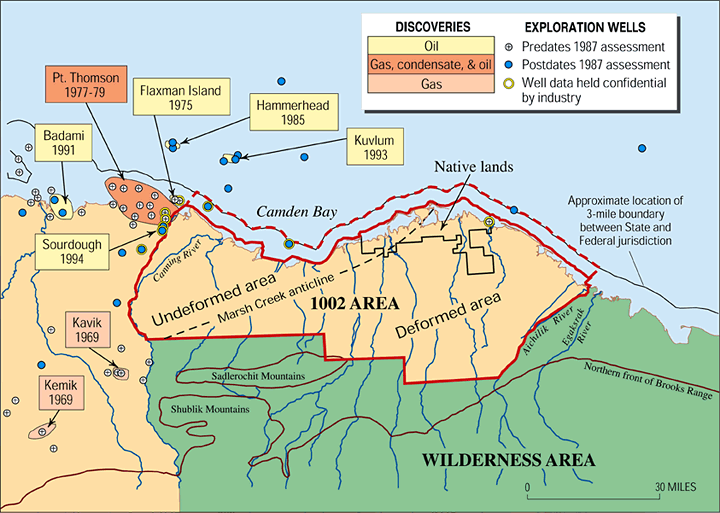
What were you trying to show with that link? Someone repeating a bunch of debunked talking points? Because that's what she's doing. For example, that "2000 acre" thing. The oil is not concentrated in one 2,000 acre area; it's in more than 30 deposits spread across 640,000 acres of Alaska's North Slope coastal plain (out of 1.5 million), which means stretching roads, pipelines, and other infrastructure that practically renders the area uninhabitable for large wildlife. Even if you only want to look at the "touching the ground" measure of how much land it takes up, the combination of oil infrastructure, drill sites, airports and roads, and gravel mines is *12,000* acres, not 2,000. No rivers in the North Slope? Um, BS. I mean, come on -- you think that all the water on the north side of Alaska drains all the way to the south? I could go on and on. This is a woman who thinks that an animal that spends most of its life hunting on ice flows isn't going to be adversely impacted by their imminent disappearance, and you're acting like she's some kind of environmentalist? Give me a break.
Actually it means horizontal drilling at safe distances below sea level.
It's not rocket science.
Department of Geology at Univ. of Wisconsin
http://www.geology.wisc.edu/courses/g115/oil/4.html
http://www.horizontaldrilling.org/Natural Gas Horizontal Drilling
http://www.greencarcongress.com/2008/01/researchers-say.html
Geothermal Conference on HD
http://www.nationaldriller.com/CDA/Articles/Industry_News/BNP_GUID_9-5-2006_A_10000000000000399698
NaturalGas.org
http://www.naturalgas.org/naturalgas/extraction_directional.asp
-
Re:Planting the Flag in the New World
It seems like it would be hard to enforce jurisdiction in space
But that's really the whole point you see; extending government jurisdiction into space. Suppose Virgin Galactic builds a space hotel, is it an independent nation? A privately owned holding not subject to any man made laws? What about 100 years from now, I'm sure the governments of Earth would prefer to have control over Lunar He3 resources. To do that they need to start slowly establishing authority in space. Next, any space hotel will be declared to be under the control of the home nation of the corporation that builds/operates it. Then that nation just expands it's sphere of influence in the name of security,exploration and manifest destiny. Really it's just a land grab.
I just want to see them get one of those Cushman vehicles into orbit let alone to the Moon. Enforcement is going to be more than a little dicey.
-
Planting the Flag in the New World
It seems like it would be hard to enforce jurisdiction in space
But that's really the whole point you see; extending government jurisdiction into space. Suppose Virgin Galactic builds a space hotel, is it an independent nation? A privately owned holding not subject to any man made laws? What about 100 years from now, I'm sure the governments of Earth would prefer to have control over Lunar He3 resources. To do that they need to start slowly establishing authority in space. Next, any space hotel will be declared to be under the control of the home nation of the corporation that builds/operates it. Then that nation just expands it's sphere of influence in the name of security,exploration and manifest destiny. Really it's just a land grab. -
Speaking of kooky...
This sounds kooky to me.
If you find this idea interesting at all, please keep in mind that you have to burn limestone at 1000 degrees just to get the lime. Limestone is not a renewable resource any more than hydrocarbons are anyway. And that only indicates a tiny part of the resources that have to go into this.]
As you might imagine, lime has a lot of other uses. If you want all those other things to be drastically more expensive (we're not also talking about spending billions of dollars and carbon fuels in building new infrastructure are we???) due to the increased demand, then I'd say you're not thinking straight.
Maybe this can make sense in terms of dollars, I dunno. I'm sure construction companies and other parts of industry would stand to make oodles of money from such a project. I do know it doesn't make sense if you look at it rationally. Reducing our CO2 input to the atmosphere is much more sensible.
Also, google the term kalkwasser (aka limewater) if you want to see discussions of actual use of lime in saltwater in laymen's terms. People who keep hobby-sized coral reefs in aquariums use this chemical, but for a slightly different purpose. Still pollution control in a way though.
My analysis: No surprise this plan comes from a management consultant. Perhaps there are environmentalists behind this as others in this thread have inferred or stated directly, but at least from their own promotional material Corven Group doesn't appear to be so - they're primarily into manufacturing and engineering (per them, not me). Please RTFA and tell me it doesn't say they're the ones behind this plan, along with Shell Oil. I have a hard time imagining anyone who does consider themselves an environmentalist advocating dumping a bunch of chemicals (on top of the waste discharges we already make into the ocean) into the ocean to fix the problems created by us pumping chemicals into the atmosphere.
Absurd. Next idea.
-Matt
-
How to eliminate your blind spot.
You can eliminate that blind spot by adjusting your driver-side side view mirror so that you can just see the side of your car when your head is against the window. See http://pages.cs.wisc.edu/~gdguo/driving/BlindSpot.htm for images.
-
Holographic Projector?
I'm wondering whether some advanced LASER show wouldn't be more useful.
I doubt though that anything like holograms could be easily used for this but who knows where we can get with the following
http://www.media.mit.edu/spi/holoVideoAll.htm
What I like about this is the idea that it doesn't have to be perfect for a fireworks display so the technology should be usable early on, and any artifacts could be declared special effects.
The problem will be that high powered lasers will be needed to get the same effect as with a normal firework.
I'm also wondering where the noise will come from, it could be replaced by music from "Disaster Area" however.
With some luck one could use the lasers to make some noise, here is a good one
http://legolas.ece.wisc.edu/current/laser/index.html
They are talking about shock waves at least.
All in all if you look at the cost you will figure out that producing the Laser will be expensive energy wise, more so than fireworks actually. Also you won't be able to develop stuff like this in China so you may have to pay some engineers locally to come up with something. With all the SUVs they are driving it won't be good for the environment either.
If you want to see a star spangled banner in the sky though, just turn off the lights and pray for good weather. That will give you a whole milky way of stars if the moon isn't out. I saw this once in Australia it was just awesome.
-
Re:Converted
An actual PS reader like GhostView is far more handy. Sciences other than programming use something besides HTML and PDF pretty often to distribute their work.
-
Nearest star is only 4 years behind
The aliens at Proxima Centurai are just settling down now for their TV coverage of the Athens Olympics 2004.
http://www.astro.wisc.edu/~dolan/constellations/extra/nearest.html
-
Condor anyone?
Add this cluster to one of the available Condor pools. The system is designed to do exactly what you want: Take unused resources and utilize them. The difference with you is that you'll be adding a *LOT of unused resources to whatever pool is lucky enough to have you.
-
Re:PDF2IMG
-
Ghostscript
Ghostscript can do the conversion from the console.
You can write a simple shell script to convert all files.
-
Re:Is that only in Pensacola?
Black = orgy more interesting.
Red = apple pie more interesting.
White = water. -
Re:You need better computer vision
You wouldn't happen to be a student of the late Prof. Sheldon Klein, would you?
http://pages.cs.wisc.edu/~sklein/sklein.html
[In one of his classes, we tried (in a very rudimentary way) to give computers a "3D imagination space" by extracting spatial information from natural language and displaying it in a virtual reality environment. (We could visualize sentences such as "the chair is behind the table"). There was also much discussion of visual/spatial metaphors that humans use to understand abstract sentences. I agree that this "3D imagination space" would be very useful in some forms of natural language processing.]
-
unix
I missed the part where MacOS was the same thing as Unix. If you want Unix behavior, use Unix.
I can, by dropping into the terminal. OS X is built on Unix, er BSD from Nextstep. Aqua is the user interface built on top of OS X. And with X11 installed I can run most any program that runs in X Windows.
Actually I'm typing this on my new, well about 10 months old, MacBook Pro. When I switched from MS Windows and bought it I was thinking I'd install Ubuntu on it as a dualboot system, but then I started wondering why, I can do almost everything on it now I could do with Ubuntu.
Falcon -
Re:Several Suggestions
Ummm, ignore that trailing slash. Retry
-
Re:Several Suggestions
The work of Clifford Pickover comes to mind: http://sprott.physics.wisc.edu/pickover/graphcp.html/
-
Re:You can lead a horse to water...
Absolutely correct. Excel does not follow accepted standards when performing decimal arithmetic.
Here are a couple of good links relevant to this issue:
http://www2.hursley.ibm.com/decimal/
http://mesa.ece.wisc.edu/publications/cp_2005-14.pdf?PHPSESSID=643d8caaab9a8736654674ed089aa4aa
http://www.cs.berkeley.edu/~wkahan/ARITH_17.pdf -
Re:Manufacturing Energy Costs?I want to compare that energy cost to the cells' projected energy contribution over their lifetime, which is about 30+ years for today's PV cells. How long would the new ones last in typical service?
Estimated cost per watt of energy for a household system is about $8-10 US. From what I could determine (Source the expected energy return currently is 10-15 times the 'energy cost of manufacture' over the life of the cell.
That's not brilliant, but I guess a 10% reinvestment of the energy would mean solar cells can power the manufacture of solar cells.
-
Re:Honestly, these problems are solveable
Have you tried xpdf for windows?
http://www.foolabs.com/xpdf/
Or Ghostscript + GSview for Windows?
http://pages.cs.wisc.edu/~ghost/gsview/ -
UW of Madison
UW of Madison has it right. Its called SWAP (Surplus With A Purpose).
UW SWAP
Basically they made a business out of recycling their hardware. The UW has a relatively short cycle for rotating out their computers so this makes them resalable for a decent price. -
Try calling UW SWAP
You may wish to try contacting the University of Wisconsin's SWAP program. I'm not sure how they have set it up, but it basically takes all of the old equipment and sells it to general public. This includes, computers, desks, oscilloscopes, incubators, etc. It is a bit like going to the best garage sale ever.
I don't know this program started, but it sounds like the kind of thing you're looking for. Trying to get in touch with some of the folks in charge may give you insights into how to get it to work.
In the end, though, I suspect that setting up something like it will take a lot of paperwork and will have to be approved by about 20 committees.
-
Re:Police State
The rumors are true, Bobby Joe redneck doesn't exist. Even 20 years ago, he didn't exist:
http://www.bus.wisc.edu/realestate/images/resources/us_density.gif
(from http://www.bus.wisc.edu/realestate/resources/resdownl.asp)
Many of the areas that show less than 10 people per square mile are federally owned land. No one lives there. Also, note that something like 80% of US citizens live in urban areas:
http://factfinder.census.gov/servlet/GCTTable?_bm=y&-geo_id=01000US&-_box_head_nbr=GCT-P1&-ds_name=DEC_2000_SF1_U&-format=US-1
Apparently, the problem is more related to people living in the little world that they made up in their heads. -
Re:Police State
The rumors are true, Bobby Joe redneck doesn't exist. Even 20 years ago, he didn't exist:
http://www.bus.wisc.edu/realestate/images/resources/us_density.gif
(from http://www.bus.wisc.edu/realestate/resources/resdownl.asp)
Many of the areas that show less than 10 people per square mile are federally owned land. No one lives there. Also, note that something like 80% of US citizens live in urban areas:
http://factfinder.census.gov/servlet/GCTTable?_bm=y&-geo_id=01000US&-_box_head_nbr=GCT-P1&-ds_name=DEC_2000_SF1_U&-format=US-1
Apparently, the problem is more related to people living in the little world that they made up in their heads. -
Re:Fake "Balance"
Demonstrable falsehoods are one thing. But more often it's not that simple. For example, there was a fascinating study about coverage of a massacre in Beirut, where the same news articles were viewed by both sides as biased towards the opposing point of view. Clearly the exact same article can't be biased in both one direction and its opposite, but yet both groups felt their point of view was being treated unfairly.
In other words, the two sides had completely different ideas of what constituted "the truth". That is a problem not with the news coverage, but with the audience.
Not only do people perceive things differently, but there it is well-known that people tend to discount information that disagrees with their previously formed opinions, especially when it comes to emotional subjects like politics (confirmation bias). -
Re:I'm trying to discover...
It's fine to play devil's advocate, but can you really argue there is no compelling national security reason to not have easily navigable and searchable street level photography of military installations, even ones which are quasi-open/public, online?
You acknowledge that secrecy and classification systems have a purpose, but then go on to say that "every scandal" in the last "7 years" (interesting choice of timeframe; poilitical much?) have used secrecy arguments as an excuse. You then seem to make the logical leap that any use of secrecy in the last 7 years has been to cover up corruption (and this has never happened at any other time in US history...?).
Consider this: gathering foreign intelligence outside of the United States on non-US Persons has ALWAYS been allowable without any form of court oversight or warrants. As it should be. Now, there are two issues:
1. Some exclusively foreign traffic between foreign individuals can now travel through equipment located physically in the United States. Why should that be off limits? Indeed, if telecommunications operators are willing to assist, we should absolutely leverage the fact that we have direct access to the traffic.
2. Capturing communications of a foreign individual outside of the US -- even if the other end of the conversation ended on US soil or was a US Person -- is also always allowable without court oversight or warrants (however, the identity and conversation content of the US Person may be masked for legal reasons). Again, since warrants protect individuals, why shouldn't telecommunications operators be allowed to voluntary assist in the interception of such traffic via much, much easier means?
Foreign intelligence is a necessity, even for free nations. It always has been. Any denial of this is the denial of reality. The Constitution only applies to US citizens or persons with a legal status within the United States. It does NOT apply to foreign persons outside of the US; any argument that it does flies in the face of the very notion of nation-states, borders, and international relationships. This is precisely why the surveillance of such persons does not require a warrant. In the past, there was no earthly reason to conduct any such surveillance within the United States. Now there is.
I'm not saying taking such surveillance of non-US Persons within the United States' physical borders isn't rife with controversy, much of it valid. But can you see how it's possible for this to not be so clear cut when you just throw out the blanket statement that it's "illegal"? Can you actually envision a scenario in which the Intelligence Community is trying to aggressively leverage all of the foreign SIGINT capability it possibly can given the circumstances? I know that certain folks can only see this as an obvious plot to destroy the Constitution, strip away civil liberties, and create a police state. However, where I live -- aka, the real world -- this was simply an aggressive attempt to make a lot of foreign intelligence collection, especially when one of the endpoints is in the US, a lot more practical. That doesn't mean it's not controversial.
And Walter Reed...I try watching the "exposés" on Walter Reed, and you know what? Kill me for saying this, but water damage on some ceiling tiles and peeling paint? Is that really affecting the level of care? This is what people are up in arms about? Granted, there are a wide variety of other problems with military medical care and facilities, but they're not classified.
This isn't to say that secrecy has never been used to cover up for corruption or illegal behavior. But you're making some sweeping statements and coming to conclusions that aren't warranted. There is a compelling national security interest to not have easy-to-use street level photography of US military installations available globally. Basic principles of operational security and defense in depth would easily validate that. Does that mean some -
Not that at all, and everything to do with OPSEC
There has been a lot of concern of late about how much information individuals are giving out online. The Air Force is particularly concerned, and the Air Force Research Laboratory (AFRL) has done a number of studies into just how much sensitive information is getting out, intentionally or no, via social media.
For me, it's kind of a mixed bag. We have people posting photos and information that are an OPSEC nightmare. Then we have the other end of the spectrum; the notion that one should never participate in any online communities or use any online "social networking" or Web 2.0 tools at all. I think there is a balance: be aware of what you are giving out, use privacy controls vigorously, and don't post anything to the internet, even "privately", that is sensitive or questionable from a security perspective. We already know that blogs, social networking, etc., are valuable tools, but it can also be a big problem. So where do we draw the line?
The key is awareness, and constant vigilance about what we're posting, and where.
Here are some great presentations and resources dealing with just this topic in a broader sense:
"Killer Keyboard" (.pps) - This short OPSEC lays out exactly an example scenario of how ignoring security directives combined with seemingly benign information posted online can be used for an influence operation.
Adversary Influence Operations Social Networking Case Study (.pdf) - This AFRL presentation is a case study of real information personnel have been giving out online, and then lays out some hypothetical scenarios. This is exactly what the Air Force is responding to. Even though there are probably better ways to handle this, this is viewed as a necessary interim solution.
There are numerous ways around any official restrictions. People act as if this is some kind of censorship. By definition as applied to personnel in their official role, it is not. I also notice the article is tagged "keepemdumb". Real nice. Shows you have pretty much no idea about the real concerns related to security and actually carrying out a mission.
Of course, if one's interest is in fundamentally crippling or limiting the military's ability to effectively carry out it's mission because one disagrees with a particular policy, I can see why such a person could not possibly see any legitimate reasons for any kind of internet restrictions on official networks, and would instead see it as either "proof" of trying to "hide" the grim realities of war, or to keep military personnel "brainwashed", neither of which are true.
I found one of the other posts in this thread amusing: that people would never support a war -- any war -- if all they saw were dead bodies and were constantly barraged with images of severed limbs and coffins. Does such a person believe it is possible for ANY military action, at any time, for any reason, to be warranted, reasonable, or necessary? If so, I wonder of that person want such a mission continually subverted by the actions of others as well?
Or would they want it to succeed? -
Not that at all, and everything to do with OPSEC
There has been a lot of concern of late about how much information individuals are giving out online. The Air Force is particularly concerned, and the Air Force Research Laboratory (AFRL) has done a number of studies into just how much sensitive information is getting out, intentionally or no, via social media.
For me, it's kind of a mixed bag. We have people posting photos and information that are an OPSEC nightmare. Then we have the other end of the spectrum; the notion that one should never participate in any online communities or use any online "social networking" or Web 2.0 tools at all. I think there is a balance: be aware of what you are giving out, use privacy controls vigorously, and don't post anything to the internet, even "privately", that is sensitive or questionable from a security perspective. We already know that blogs, social networking, etc., are valuable tools, but it can also be a big problem. So where do we draw the line?
The key is awareness, and constant vigilance about what we're posting, and where.
Here are some great presentations and resources dealing with just this topic in a broader sense:
"Killer Keyboard" (.pps) - This short OPSEC lays out exactly an example scenario of how ignoring security directives combined with seemingly benign information posted online can be used for an influence operation.
Adversary Influence Operations Social Networking Case Study (.pdf) - This AFRL presentation is a case study of real information personnel have been giving out online, and then lays out some hypothetical scenarios. This is exactly what the Air Force is responding to. Even though there are probably better ways to handle this, this is viewed as a necessary interim solution.
There are numerous ways around any official restrictions. People act as if this is some kind of censorship. By definition as applied to personnel in their official role, it is not. I also notice the article is tagged "keepemdumb". Real nice. Shows you have pretty much no idea about the real concerns related to security and actually carrying out a mission.
Of course, if one's interest is in fundamentally crippling or limiting the military's ability to effectively carry out it's mission because one disagrees with a particular policy, I can see why such a person could not possibly see any legitimate reasons for any kind of internet restrictions on official networks, and would instead see it as either "proof" of trying to "hide" the grim realities of war, or to keep military personnel "brainwashed", neither of which are true.
I found one of the other posts in this thread amusing: that people would never support a war -- any war -- if all they saw were dead bodies and were constantly barraged with images of severed limbs and coffins. Does such a person believe it is possible for ANY military action, at any time, for any reason, to be warranted, reasonable, or necessary? If so, I wonder of that person want such a mission continually subverted by the actions of others as well?
Or would they want it to succeed? -
DaveSchroeder IS "they"
He doesn't even try to hide the fact that he is in US government intelligence. Read his home page.That is why he always responds with counter propaganda in situations like this, haven't you noticed? He posts nothing until a story critical of the US, or intelligence related comes along. Then he posts the official propaganda and gets modded +5.
-
Déjà vu?
Hmm, I seem to recall this story from somewhere...it sounds somehow strangely familiar...almost as if this exact thing had occurred before...
Oh, that's right, this story was covered -- right here on slashdot, no less -- a year ago, complete with a link to the very same now-year-old blog post, which was significantly updated at the time, and caused Diebold to remove the photo in question! (A very generic key form was used.) Might want to update this post...
Archives - January 2007 should be a clue. Or at least one would hope.
While you guys are at it, can you fix your patently incorrect story about Iran being "offline", when it clearly and provably isn't, thereby negating the main premise of the story? You know, since no one seems to care about anything sent to the on-duty editor email.
Slashdot is really on fire today! -
Re:Nothing new to see here
PSO is quite closely related to genetic algorithms, and also Population Monte Carlo type of methods. In a computer simulation it probably doesn't matter all that much whether one "moves" existing particles in the search space or "generates" new ones based on the previous ones.
The choice of the objective function (for example, some kind of Bayesian posterior probability) is surely more important, and unless there is something very special in the structure of the optimization problem, I think that it's a bit silly to publish papers which test various optimization methods for a given problem and conclude that some of them perform better than the others. The results are typically dependent on a multitude of factors that cannot be controlled in the experiments (a significant one is the amount of effort one spends in finding the best optimization parameters), and do no progress science all that much, particularily if one does not have a hypothesis, and preferably also some analysis, _why_ some of the optimization methods are better than others.
By the way, here's a neat paper on the use of PMC in the global illumination (radiosity/raytracing/...) problem. -
For Research Purposes Only
-
For Research Purposes Only
-
Re:not very smrtTFA has a link to a Business Week article from 1996 that discusses smart phones. Not surprisingly, Nokia, Motorola, Philips Electronics, and other phonemakers are well aware of the device's potential as an information appliance. The Nokia Communicator was introduced in 1996, although apparently it wasn't until the next model, the 9110 at the same link, that they included removable storage. The camera also was not included in either, but I don't believe that combining a smart phone with a digital camera or camera phone is patentable. (In so much as there is a difference in receiving a patent and receiving a valid patent.)
Clearly one of the biggest reasons so many people growing up with tech hate or ignore IP is that Congress and the USPTO refuse to meaningfully fix the problems that allow these abuses.
As to better prior art than this, digital cameras didn't exist in 1996 to my knowledge and only an idiot would combine a phone and a film camera(not saying I wouldn't buy one) -
Re:Money, meet mouthI'm not defending the authors of the article, but...
1. this article wasn't written by rdbms people, but rather by column database people. There's nothing traditional or relational about their background. A column database is a particular way of implementing relational databases. David DeWitt (faculty homepage, wikipedia entry) is best known for object-relational work, which is in the traditional relational area. Michael Stonebraker, the other author, is probably the best known relational database person living today (though C.J. Date might be another candidate).Eivind.
-
Re:Alternative to DRM
If you set the printer to any Postscript printer, for example the "HP Color Laser 8500 PS" which is included in the default Windows XP installation, then you get PostScript. End of story. If you set the printer port to "file", then you simply get a PostScript file. Tadaa! If you have the PostScript all bets are of and technically it's human readable.
Add in "GhostScript" and "redmon" into the mix and you're unstoppable.
-
Re:Alternative to DRM
If you set the printer to any Postscript printer, for example the "HP Color Laser 8500 PS" which is included in the default Windows XP installation, then you get PostScript. End of story. If you set the printer port to "file", then you simply get a PostScript file. Tadaa! If you have the PostScript all bets are of and technically it's human readable.
Add in "GhostScript" and "redmon" into the mix and you're unstoppable.
-
Throbbers.Ah, I miss the throbbing "N". From the FAQ:
Q. What's up with that throbbing "N"?
A. We are in the process of having a new logo designed, and the throbbing "N" is a placeholder. It's apparent that it's not going to win any aesthetics awards, although a very vocal 2% minority really likes it a lot.
-
Re:Intrinsic Safety.Or of course, it might really have been that the wires became frayed after being struck by a missile
The center fuel tank was actually empty, and thus full of vapor. It is true that jet fuel would not have exploded, but in certain conditions the vapor can be explosive.
Here is a pretty good, if dated, analysis. From the link:The temperature inside the central fuel tank of TWA Flight 800 was unusually high, and probably played a significant role in the explosion. When fuel is heated, a greater portion of it exists as vapor, thus increasing the fuel-air ratio. NTSB officials, who originally thought that the temperature in the central fuel tank was 36C (97F), now think that the temperature was at least as high as 46C (115F) [NTSB d, 1997] and maybe as high as 53C (127F) [McKenna, 1997b]. Boeing has performed simulations that show that on a 27C (81F) day, fuel vapors in the central fuel tank of a 747 are in an explosive state for 4.5 of the 6 hours on a typical flight [Adcock, 1998].
Look up kerosene, and sure enough, the flash point is in the high 30's.
Anyway, they aren't sure exactly what the ignition source was, but one of the possibilities was a short to the fuel monitoring system that carried high currents down the low-voltage wires (IIRC). -
laws of physics
This does not defy the laws of physics. Poisson's ratio varys between
http://silver.neep.wisc.edu/~lakes/PoissonIntro.html -
GhostscriptI guess all commenters so far think everyone knows about Ghostscript and related tools, and maybe they're right, but in case you don't: Check it out. Ghostscript can render PDF (and PS) to the screen and to lots of different file formats and printer languages.
You'll probably want to get a helper app for viewing docs from the above site, too. (And there are other front-ends, like KPDF.)
-
Re:Actually....
Ok, at that point I punt. Looking at the bottom of the article, where it mentions software, I note that it shows that a Matlab function "princomp" gives the principal component. No mention of octave. I would guess that since the Octave dev's push for Matlab compatibility, they'd have inclusion of functions like that on their to-do list.
just to round out discussion, regarding opensource PCA, the wiki article points out SciLab and "the open source statistical package 'R'" as having PCA capabilities.
\ok, took a few seconds to google. Came upon this Octave Help discussion thread where the person gives what seems to be a rather simple script " to compute principal component analysis". The discussion is primarily about compiler issues, and differing PCA results with different compiles, but the discussion is from 2004.
Most recent Octave wiki matlab-compatibility page doesn't mention it at all, so no certainty there. From the same year, however, the following was also posted, giving a (seemingly) more complete PCA script: another PCA Octave thread
-
Re:Zombie ants are cooler
Doh. Something munged the url:
http://botit.botany.wisc.edu/toms_fungi/mar2000.html -
Not much faster than Colossus
Colossus according to http://www.hnf.de/Presse/Pressemitteilungen/Pressemitteilungen_Result.asp?Anzeige=Yes&Index1=337 cracked the message in three and a half hour. It was beaten by a modern day computer doing the job in just 46 seconds which thus was less than 300 times faster. 300 times faster is just the speed increase one expects in about 10 years according to http://www.neurophys.wisc.edu/ravi/docs/m122p2.pdf. The specially built for the task Colossus faster than mid 90s general purpose PC. One has to have great respect for the builders of Colossus.
-
Re:finnaly, comcast will get *I** in the **
Uhh, that is the answer dude. Comcast's problem isn't with IP Transit. Comcast's problem is the same problem faced by all cableco's -- they have a shared last mile. I don't know what speeds they offer, but I do know that my Roadrunner connection is 5.0/384. At 5.0 it takes less then nine customers to completely max out the downstream on a DOCSIS channel. The only real solution to this problem is to split the network into smaller nodes so less people are sharing the bandwidth on them.
You are in the dark if you think the problem is just the last mile. On the other end the ISP has to buy the bits and bandwidth. Fixing the last mile simply exceeds the capacity of the ISP's connection. Fixing the ISP's connection is only part of the cost. Buying the extra bits is the big expense. Who do you think Comcast peers with and how do you think they get a connection to the backbone? Do a trace to Google for example. Comcast in my area connects to Level 3 net in Seattle.
http://www.level3.com/
http://en.wikipedia.org/wiki/Level_3_Communications
If you think fixing the ISP bandwidth problem is simply upgrading the last mile, you are mistaken. The growing bill for bits from Level 3 is the problem.
Level 3's primary focus is selling service to organizations with large bandwidth requirements, such as telecom carriers, cable TV operators, universities, web hosting companies, and to other, smaller ISPs, often known as Tier 2 carriers.
They sell bandwidth to Comcast. For Comcast to buy more bandwidth without increasing revenue is poor business planning. Many people only see the last mile problem and fail to look upstream.
Great proposal. For $60/month form the subscribers, provide service that cost you $150/month per subscriber. Good answer. ISPs buy bits. Buying a bigger pipe and greater monthly traffic isn't free.
University of Oregon had to deal with just this issue in the early Napster days.
http://scout.wisc.edu/Projects/PastProjects/net-news/00-01/00-01-25/0001.html
Oregon State University became concerned
about the program before the RIAA suit, when systems
administrators noticed that Napster was consuming 5 percent of
the school's bandwidth. Napster activity could have pushed the
school over its $75,000 yearly budget for bandwidth, says Oregon
State's vice provost for information services Curt Pederson,
noting that the school's bandwidth usage would double every 90
days if not controlled.
How many times do you propose letting the annual budget of $75,0000 double every 90 days as Peer to Peer catches on.
The bill doubles regularly while not adding a single new paying customer. This is not a good business plan.
This heavy use is created by only about 20% of the population and is growing. It's chop time or die. Comcast having to buy bits is faced directly with the rising cost of exploding bandwidth use. The throttling the universities had to do to maintain IT budgets is why most universities web pages load like they are served on a dial-up connection. They buy limited bandwidth which is mostly saturated in the evenings. The RIAA when nailing college students only download a few songs from the A list from the student. The big reason for this is it would take forever to download the entire A list through a saturated edu connection to the ISP.
Check with any university student regarding the speeds they get on campus. It's nothing to write home about. -
Re:I gave several suggestions.
How is it that universities don't get killed by the hogs on their lines, with much wider guarantees on their system?
The campus buys a limited amount of bandwidth that is shared by all users. At work I have 60 meg on my desk and it make Comcast seem like dial-up. When surfing on my break, I sometimes hit a page on an
This article is a little old, but deals with the early days of P - P and the effect it had on a university budget for bandwidth.
http://scout.wisc.edu/Projects/PastProjects/net-news/00-01/00-01-25/0001.html
Oregon State University became concerned
about the program before the RIAA suit, when systems
administrators noticed that Napster was consuming 5 percent of
the school's bandwidth. Napster activity could have pushed the
school over its $75,000 yearly budget for bandwidth, says Oregon
State's vice provost for information services Curt Pederson,
noting that the school's bandwidth usage would double every 90
days if not controlled.
Comcast is dealing with this issue right now.
Believe it or not, Comcast has to pay for Bandwidth use. This is the commons that is overused by the few. Dumping high usage is in their best interest as unchecked it will rob the system to the point of no longer breaking even. -
Re:Asked a Plasma Physicist About This
Both require non equilibrium plasmas to work as advertised and that just does not work (The ions collide with electrons far more often than they fuse). In fact unless they can find a massive flaw in our current understanding of plasma physic thermodynamics neither can break even. Well the Bussard one defiantly, since its constant state.
And Bussard had responded directly to that issue:
Ions spend less than 1/1000 of their lifetime in the dense, high energy but low cross-section core region, and the ratio of Coulomb energy exchange cross-section to fusion cross-section is much less than this, thus thermalization (Maxwellianization) can not occur during a single pass of ions through the core. While some up- and down- scattering does occur in such a single pass, this is so small that edge region collisionality (where the ions are dense and "cold") anneals this out at each pass through the system, thus avoiding buildup of energy spreading in the ion population (Ref. 14).
In layman's terms, the Polywell design fuses ions faster than they maxwellianize, thanks to the ratio of time in core to time in edge. The full high level paper from Bussard can be found here [askmar.com].
You only need to maintain the non-maxwellian distribution long enough for the ions to fuse before they maxwellianize. Thermalization in the outer edge dominates the coulomb interactions from the core more than the collisions dominate the fusion rates. Those are the conditions that allow fusion to occur faster than maxwellianization. No magic, no violation of physics, just a beneficial design that Rider and Nevins both overlooked in their assumptions.
This view is the general consensus of held by physicist, not just my view.
And it's a very good thing that science isn't a democracy. There are many researchers who do not agree with the consensus. Some from MIT and University of Wisconsin-Madison. -
Actually, geekier than it sounds.After discovering that she published her papers under her birth name of Hershlag (urg, no wonder she took a stage name), I found one of them on Google Scholar:
Frontal Lobe Activation during Object Permanence: Data from Near-Infrared Spectroscopy
Definitely geekier than your average psych paper.
And it appears that her other paper, on which she was first author while in high school, was actually in chemistry:
A Simple Method To Demonstrate the Enzymatic Production of Hydrogen from Sugar
Though it's actually in a chemistry education journal, and appears to maybe have something to do with doing demonstrations in chemistry classrooms.
-
on a map
Here's a pretty good example of what this looks like on a weather map