Slashdot Mirror
Domain: wvu.edu
Stories and comments across the archive that link to wvu.edu.
Comments · 60
-
Re:I don't think so.
There's three basic problems centered around your metric of food produced per acre.
First, where is your evidence? Was there a study? It seems quite plausible that professional farmers are more efficient at using land than amatuer gardeners. A large farm also has a lack of useless dividing structures, which are needed to divide family plots. A single fence might not seem like much of a waste, but millions of fences add up. Also, small farmers are more likely to put their homes on top of limited arable land, while large farms can focus all of their land into farming.
Let's assume it's true though...the second problem is that we would have to radically restructure everyone's lives to accomodate this idea. Roughly 10% of US land is arable land. http://en.wikipedia.org/wiki/Land_use_statistics_by_country I couldn't easily find a map of arable land, but this map of livestock concentrations shows that lots of agricultural activity is happening far from current population centers. http://wvrhrc.hsc.wvu.edu/images/2009-06-02_national_livestock_density.png In particular, most people want to live along the coastlines and they would have to give that costal lifestyle up to live further inland where the farmland is. A concrete example (specific to plant agriculture) would be the Central Valley in California, which is inland but produces 8% of US agriculture on 1% of the US's total farmland. Despite its massive size is home to only 1/6th of the state's total population. http://en.wikipedia.org/wiki/Central_Valley_(California) Virtually everyone in San Fransisco and LA and their satellite cities would have to move there to farm because that's where the farmland is. It doesn't matter how efficient you are when you're trying to grow food in a desert.
Lastly, man-hours are the main bottleneck to economic growth, not acres. There's actually a surprising amount of land per person, especially in the US (over 7 acres per person and closer to 20 acres per household). More importantly, despite its importance, land actually has fairly limited usefulness. You need some for a shelter and some farmland to support yourself. Beyond that, it's needed for non-farming structures like offices, factories, hospitals, roads, power plants, schools, mines, etc. As large as most of these facilities may seem individually, they don't actually take up much space because they are split over a large number of people. Further, potentially space-intensive buildings like offices multiply their space many times over by building upward. Anyway, you need to build something on all the otherwise useless non-arable land. What else is land good for? Not much really.
On the other hand, man-hours are needed for EVERYTHING. Designing and building things, maintaining things, education, research, writing articles, reading articles, creating artwork, growing food, programming computers, everyday business activities, accounting, raising children, healing the sick and wounded, defending others, practicing for an emergency, responding to an emergency, thinking, talking with others, performances, finding resources, extracting resources, inventing new things, everyday chores, and many many more useful things. You literally can't even have fun without burning up man-hours. Worse yet, everyones' man-hours are limited by our limited lifespans (and even more limited youth-span). Man-hours are our most precious resource and devaluing them is one of the most short-sighted things you can do in life. I wouldn't go as far as saying that labor directly determines value (really it is rarity that directly determines the value of something), but due to the importance of man-hours as inputs in everything and the relatively low supply (each person can only realistically contribute 8 man-hours per day over the long term and a large percentage o
-
Re:COME ON ICE CREAM!!!
It's hard to beat liquid nitrogen frozen icecream; It produces extremely fine grained ice crystals in the icecream, resulting in superior creaminess.
Can be made in any number of delicious flavors.
-
Re:The NSA is more qualified than DHS
-
Re:Morgantown WV had a PRT
The wiki article you linked has an article from the Daily Athenaeum in 2007 that says it moves 16,000 a day with 99% being students and 2.25 million a year. That seems like a lot more than "very few locas or students" using it.
Besides, the article for this story compares these new PRTs to the Morgantown and why they are better.
-
Morgantown WV had a PRT
I grow up in Morgantown, West Virginia home of WVU and it's Personal Rapid Transport system. The Morgantown PRT was the first ever built, and it sucked. Very few locals or students used it, it was often just empty cars moving down rusting rails.
PRTs don't work. They offer the inflexibility of trains, with capacity of cars. That's not a winnings solution.
-
There's a greater harm here
This is an outrage. Apart from the obvious and genuine privacy concerns here this would do the very opposite to what the ignorant Gary Pugh is expecting. Hasn't he ever heard of a Self fulling prophecy?
There are many proven psychological reasons why this would cause a vast amount of harm to the development of these children This article especially illustrates published studies that showed the effect of positive and negative expectation has on children's academic performance -
Re:Open Standards bad
It may be possible to reconstruct fingerprints from the template data stored about them. There's no documented case of this being done in the field, but there's a paper on it at http://www.csee.wvu.edu/~ross/pubs/RossReconstruct_SPIE05.pdf
I really don't like using biometric data as passwords for anything as important as health records, since they're irrevocable. -
Re:"Censorship"?That's funny, because there have been plenty of studies concluding the exact opposite of what you are claiming too.
-A study at West Virginia University concluded that "the process of creative destruction unleashed by Wal-Mart has had no statistically significant long-run impact on the overall size and profitability of the small business sector in the United States"
-The Ludwig von Misis Institute concluded that Wal-Mart significantly contributes to the wealth of a community
-Mississippi State University concluded that there are "both positive and negative impacts" on the local stores when a Wal-Mart is built
-MIT concluded that Wal-Mart benefits the poorest segments of the population the most
-The University of Missouri concluded that a Wal-Mart does far more economic damage to neighboring towns that it didn't build in compared to the towns where they build a new store
From my recent experience driving through Hays Kansas, I tend to believe these reports more than those who claim that Wal-Mart destroys the community. -
Re:Nice way to stereotype people
Yes. Believe it or not, I actually like the insert booklets and other such packaging, along with the music that is included on the disc.
Habit. You're conditioned to associate the packaging with the enjoyment of owning and being able to listen to a new piece of music. Newer generations that grow up with mp3s will not have this response. Besides, do you enjoy having to rip it to mp3 before you can transfer it to your mp3-player as well?
First of all, it's not "guilt" to pay someone for the work they do.
Or morale. Or ethics. Or whatever.
Just letting you know that you're wrong about the reasons why people buy/don't buy cds anymore.
Most people stop buying CDs because they get older than 30.
-
Yeah, BUT,
Don't forget about unions. They are all about letting the cream rise to the top... Wait a second, no they aren't. Oh well.
Funny and insightful! Wish I had mod points. But all kidding aside, the reason for having unions is to decrease the incentive for laborers to create well-organized cellular terrorist organizations. Really! Remember the Molly McGuires? Remember the company towns and company stores? Remember the "Good Old Days" of Henry Ford funding the burning of synagogues, Andrew Carnegie funding the machine-gunning of sit-down strikers, the Coal Wars>, institutionalized rape and murder of immigrants by corporate fat cats and Pinkerton agents? The Baldwin-Felts "detective agency"'s Death Special? We don't have that shit no more because of unions. It's a matter of accepting the lesser evil, since clearly Big Government will not protect the worker unless by doing so the politicians are protecting themselves.
Remember, it's not just cream that rises to the top. Scum rises too. -
Re:Can I say "good"
Once again:
I have ADHD. I've mostly overcome my problems with dysgraphia. However to write in any fashion that is legible, I must print. I print so slowly that I cannot take handwritten notes fast enough to keep up with even the slowest of lecturers. Furthermore, when I'm writing things by hand, it requires enough concentration that I cannot keep track of what someone is saying while I am writing.
Hence, I've found that if I take notes, I tend to do very poorly in a class because I'm not listening to the lecture at all.
I generally don't take any notes during class time.
In those classes where notes have been written on the board, I've generally copied them as best as I could and lost them later.
I have a Powerbook now, and have considered trying to go back to school, because I now have a tool that I can use to keep track of my papers (I generally lose them). Further I can listen and type at the same time.
To rebut:
i) I touch type at 40wpm, which is adequate. I print at about 8wpm which is not.
ii) I have a webcam and a digital camera. I also have software which I can either a)sketch a drawing, or b) enter equations. Supplementary notes can be entered as comments, which supplant notes placed in the margin. Select some text, and choose "Comment" from the "Insert" menu.
iii) The powerbook is not loud. When I'm shuffling through the mass of papers in my bag, it's very loud and disruptive.
Highlighting is simple enough in Microsoft Word that retarded people should be able to do it. It's in the "Formatting Toolbar" and it's called "Highlighting" of all things. You can pick from multiple colors even.
Annotation is also simple in even old versions of M$ Word. In the sense of labeling for an image. From the "Insert menu" choose "Text Box" and place that on your image.
iv) I don't. I am a man, not a mass-produced object that works the same way every other object in it's class works.
Thanks to the ADA, I can get a note from my doctor attesting to these things, keeping professors like the one in the article from taking away the tools I need to do well. This will allow me to go back to school with the hope of actually getting a degree this time.
Note: check out http://www.as.wvu.edu/~scidis/dysgraphia.html . It may be somewhat enlightening.
Note: I only mentioned Microsoft Word, other programs have features that can be used to accomplish the objectives you advocate above with far better results than pen and paper (at least for me).
Note: I agree that students that are sitting in class using their laptops to play games, browse the net, chat with friends or other non-class related activity should be able to be banned from continuing with that activity. Banning the use of laptops by everyone is like banning wheelchairs. Most people who use one do so only to play around (I used to do wheelies in them when younger), however for some people they are neccesary tools. -
Re:the defects are uncommon -- some numbers
True, but repeated inbreeding increases those chances with each generation.
Here's an interesting article I found.
http://www.as.wvu.edu/~kgarbutt/QuantGen/Gen535_2_ 2004/Inbreeding_Humans.htm -
Re:There's probably some truth to this
Well, MIT doesn't grow corn.
(You're going to have to imagine this coming out of a sneering Harvard mouth.)
Strangely enough, MIT is a land-grant college, which were originally created "to teach agriculture, military tactics, and the mechanic arts as well as classical studies so that members of the working classes could obtain a liberal, practical education."
Yale? What about Yale? -
Door in the Face
I think the term is "Door in the Face" - as opposed to "Foot in the Door"
Interesting synopsis here: http://www.as.wvu.edu/~sbb/comm221/chapters/twoste p.htm -
My experiments with portability
I had to take a mandatory graduate level course CS 533 Developing portable software, taught by Dr. Mooney, who was known around school as "that portability guy".
The class went thru umpteen strategies to write portable code & culminated in a portability project, where you wrote a "Quiz Program" in C, that ran on Solaris, Windows & the Mac with minimum code changes.
All code changes had to be confided to the stdio.h & other header libraries. I see these days he has added Java to the mix.
My own experience has been that it has very limited utility in real-life ie. corporate IT. All the jobs I held since I graduated did not require an ounce of thinking portable. They were all about writing proprietary code to be run off the web, and for some 10 years, Java was the only option until C# came along. So I practised portability by default, since that was the nature of my employment in the industry. But I can see how this might be useful for somebody doing systems level programming (assuming there are still such jobs in the IT industry in the US, of course...) -
My experiments with portability
I had to take a mandatory graduate level course CS 533 Developing portable software, taught by Dr. Mooney, who was known around school as "that portability guy".
The class went thru umpteen strategies to write portable code & culminated in a portability project, where you wrote a "Quiz Program" in C, that ran on Solaris, Windows & the Mac with minimum code changes.
All code changes had to be confided to the stdio.h & other header libraries. I see these days he has added Java to the mix.
My own experience has been that it has very limited utility in real-life ie. corporate IT. All the jobs I held since I graduated did not require an ounce of thinking portable. They were all about writing proprietary code to be run off the web, and for some 10 years, Java was the only option until C# came along. So I practised portability by default, since that was the nature of my employment in the industry. But I can see how this might be useful for somebody doing systems level programming (assuming there are still such jobs in the IT industry in the US, of course...) -
My experiments with portability
I had to take a mandatory graduate level course CS 533 Developing portable software, taught by Dr. Mooney, who was known around school as "that portability guy".
The class went thru umpteen strategies to write portable code & culminated in a portability project, where you wrote a "Quiz Program" in C, that ran on Solaris, Windows & the Mac with minimum code changes.
All code changes had to be confided to the stdio.h & other header libraries. I see these days he has added Java to the mix.
My own experience has been that it has very limited utility in real-life ie. corporate IT. All the jobs I held since I graduated did not require an ounce of thinking portable. They were all about writing proprietary code to be run off the web, and for some 10 years, Java was the only option until C# came along. So I practised portability by default, since that was the nature of my employment in the industry. But I can see how this might be useful for somebody doing systems level programming (assuming there are still such jobs in the IT industry in the US, of course...) -
Re:Consumers
I think you'd better retake Econ 101.
In almost all cases, the economic cost is shared to some degree between the buyer and the seller, regardless of whether the tax is nominally paid for by the procducer or the consumer.
The ultra-hyper-simplified explanation is that not only will the price go up as a result of the tax (although not necessarily by as much as the cost of the tax), consumers will buy somewhat fewer of the item at the new, higher price. As a result, the producer gets fewer sales. Producers see less total revenue, and consumers pay more.
Whether that's worth it, or not, is more of a political issue than an economic one, of course.
http://www.rri.wvu.edu/WebBook/Garrett/chapterthre e.htm -
Job/career fair not good enough for Big BlueI recently went to a job/career fair held at the WVU coliseum. IBM was to have a table booked for this event. However, nobody from IBM even bothered to show up.
When asking about I.T. opportunities at various small local banks and hospitals (the majority of attendees) I tended to get similiar canned answers from all.- You are looking for I.T. work? You and everybody else!
- We have an I.T. department/person in another state or some 3rd party contractor.
- Do you have a resume? Yes! Well go to our website and put it in our database, where no human being will ever look at it.
On the one hand almost every accredited institution in WV (shoeless hillbilly stereotypes aside) has a Computer Science or similar program. On the other hand there are little or no opportunities unless they are in a galaxy far, far away. I am not opposed to relocation, but why hire me when you can hire someone local, from the unemployed I.T. pool?
Back to my point...- IBM must not be trying hard enough because there are plenty of talented I.T. personnel looking for work (WV or otherwise).
- I know they are not trying hard enough because they cannot deliver a couple of H.R. Represenatives somewhere where there are a large number of talented, hard-working Comp. Sci. students/graduates with no place to go.
-
Re:change taskbar icon??
never mind, found the answer. its a win98 bug.
solution (in 4th post). solution in an extension, and discussion. -
Re:reality check
http://www.csee.wvu.edu/~jdm/classes/cs258/OScat/
m icros.html
This list clearly shows that there are/were several multitasking operating systems for the 8086. The important thing is that the 8086 have timers, so that the kernel can interrupt the current process and schedule the next.
Multitasking means that the operating system multiplexes among several processes so that it appears that they are all running at the same time. This is how most operating systems today perform multitasking, even though there are pipelines and several execution units. There's still only one program running at a time, though it of course runs better with pipelines and more execution units.
And regarding QDOS and MS-DOS, yes they are quite the same, and the Q in QDOS is for 'quick-n-dirty'. And saying that a company contributes because it takes your money.. well.. -
Re:Lack of rational thinking
As a counter point to the parent poster:
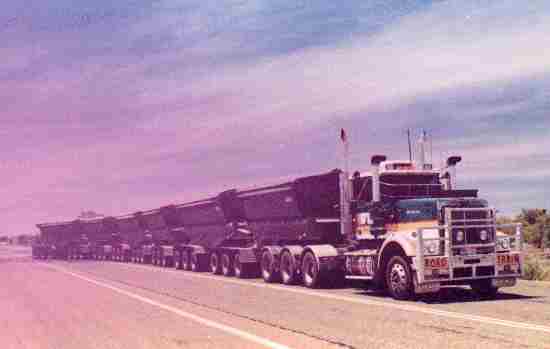
The majority of driving jobs for mining equipment (http://www.comcen.com.au/~heretic/humour/img/upsi dedown.jpg) go to women (millions of dollars of equipment, where time is money and trucks are running 24/7). Not only do they drive the trucks but support vehicles as well. Personnaly I know twice as many professional female drivers than male drivers.
Granted, driving skills around here are far above average anyway, it is an almost daily occurance that you will be sharing the road with anything from road trains http://home.tiscali.nl/~rtmeulen/rtmfotografie/fil es/reizen/aussie98/pics/road%20train.jpg,http://ww w.ausfuel.com.au/images/Volvo%20cruising.JPG,http: _ ute.jpg to APC's. The general procedure for getting people out of the way (of exceptionally wide loads) is for a cop to drive on the wrong side of the road with lights flashing. Mind you, this is on a 100km highway (where your going ~110km/h and the cop is going 40-50km/h) which doesn't leave a whole lot of time to get off the road.
I'd say women can drive just fine. -
EarthshieldB612 Foundation is an example of what I've called earth shielding entities that will exploit earth-approaching asteroidal materials before they can be used as celestial weapons of mass destruction against earth:
Before growing far toward being heliocentric, the first biorb will need to begin the defense of Earth against celestial attacks.
Kinetic energy asteroidal weapons are the most likely technology to represent the greatest threat to Earth as a result of the growing solar biorb. Once asteroid mining begins in earnest, as it will once life becomes heliocentric, asteroids can be redirected via carefully planned celestial mechanics. Within a matter of decades, a malicious interest could send a swarm of tiny asteroids toward Earth at speeds comparable to that of the Swift Tuttle comet -- a popular candidate for global disaster scenarios. Since kinetic energy goes up as the square of velocity, the important thing is to find small asteroids with the right trajectories. This would most likely be carried out on the basis of a fairly complete atlas of the trajectories of small asteroids, searching for some large number of them that could be manipulated to converge on Earth with maximum relative velocity over a fairly narrow window of time.
The most economic defense will likely be the preemptive survey, cataloging and monitoring of all celestial objects (comets as well as asteroids) large enough to survive high speed passage through Earth's atmostphere with little loss due to ablation. This means the initial prospecting for asteroidal resources will be carried out by Earth shielding entities. It is difficult to second guess the technologies that would be available for this task so far in the future, but candidate technologies are already upon us and surveys are already being done.
Perhaps the most positive aspect of this situation is that when an asteroid is identified as a threat, it is also identified as a particularly attractive source of "fuel" for space transportation. Any asteroid that has a high velocity relative to Earth, or can be easily made to have such a velocity, and which has an orbit that can be made to come near Earth, can be used as reaction mass to navigate the inner solar system. Each time this is done, however, the threat represented by such asteroids diminishes. It's as though someone had discovered a way to burn nuclear fuel in jets without pollution. The bombs would get burned up due to economic demand.
Additional global threats to Earth are most likely decreased by removing technological civilization from its biosphere. -
Re:Except Here
I should also mention that I participated in my first PRT Cram in 1980. -
Re:a.k.a. Personal Rapid Transit (PRT)
And for anyone else who would like to see a PRT system older than the hills (older than me anyway), you cancheck out the service and description manual for my hometown PRT system (also home to Mepis for anyone that cares).
-
PRT
In Morgantown, WV we have had a PRT system since 1979. Its an interesting idea and Im glad to see it finaly catching on in a larger scale. Just so you know Detroit Michigan, Irving Texas, Jacksonville Florida, Miami Florida, and Morgantown, WV where the first 5 locations to have PRTs and where all installed in the 70's.
-
Existing PRT
WVU has had a PRT for some time. News Blurb
-
Except Here
-
Sorry I couldn't get this to you...
but which I have to remind myself I will never see in operation in my life.
...before you passed away.
WVU PRT -
Re:Where have I heard this before? Whorf-Sapir ...Some languages have only a few words for color, for example. However, experiments show that this does not impair speakers of these languages from differentiating different shades of colors.
Actually, your synopsis drastically oversimplifies and mis-states the current understanding in linguistics of color terms in relation to Whorf-Sapir. One of the leading linguists in color research is Paul Kay, and in 1999 he wrote this paper (PDF) synopsizing the state of research (he's a major participant in the debates, so salt as needed...). In it, he writes:
Color is one of the very few lexical domains for which humans possess dedicated peripheral receptors. In the retina, the rods and (at least) three different families of cones are devoted to detecting variations in wavelength and luminance information. Color should be the last place where one would expect a priori for language to influence perception. That the relativists [pro-Whorfians] of the fifties and sixties chose color as their empirical battleground stands as a tribute to their self-confidence and a rebuke to their common sense. Of course, if the relativist case could be made in the domain of color, then a fortiori it should hold everywhere else.
He then summarizes both the pro-Whorfian results and the anti-Whorfian results, ending the section on intra-language research with:However, Kay and Kempton, using a non-correlational, cross-linguistic experimental procedure, showed that certain non-linguistic color similarity judgments do appear to be influenced by the lexical classification of color in a language, although others are not so influenced. The Kay and Kempton results of both Whorfian and anti-Whorfian effects in color similarity judgments have recently been replicated in unpublished work of Jules Davidoff, Ian Davies and Debi Roberson.
The paper also summarizes inter-language color research, emphasizing Kay's work on physiologically-based universals.
Note that virtually everyone has abandoned the "strong" Whorfian hypothesis, that language tends to constrain thought. The "weak" hypothesis, that language can significantly influences thought, was still vigorously argued by the lingustic faculty when I was in college ('80s) and, from Kay's remarks in his paper, was still being argued into this century... WordIQ has a nice summary, which features this provocative quote about programming languages from Alan Perlis
"a language that doesn't affect the way you think about programming, is not worth knowing".
-
Re:Yipee!!!!!This is "new" tech, in the sense that Las Vegas Monorail will be the first mass-transit application of "driverless" rail systems anywhere in the United States (BART comes close, but somebody still pushes the "close door" button).
Not exactly a rail system, but the PRT that services WVU in Morgantown, WV., has been running for about 30 years now. Driverless, electrically driven cars with rubber tires on a concrete track, powered from a 3rd rail. The tracks are steam-heated in winter. It was a pork-barrel Rockefeller project from day one, and most likely sucks up great piles of federal funds to this day. Being prone to breakdowns, the University still had to keep buses & drivers on constant standby to shuttle students between the two spread-out campuses.
I remember news stories when I was attending college there in the late 70's about how stray dogs would occasionaly manage to get onto the track. The PRT cars, being computer controlled, would soon overtake and squish the pooches without even slowing down, while the passengers watched the whole thing, unable to do anything about it.
-
Because
Sometimes it's nice to get out of the house and do things, like take a walk, read at a cafe, socialize with people, enjoy a nice spring day, go skiing, vacation, and to live life!
While the world is wired, there still is a world out there to explore and see and experience.
-
Driverless cabs? Been there, done that.
Apparently whoever researched the article didn't do too thorough a job. The "driverless cabs" idea has been around for decades, and a full-scale implementation has been in use since 1972 (!) at West Virginia University. Check out the WVU Personal Rapid Transit (PRT).
-
Re:LDPC codes (useful links to coding information)
The neat thing about Turbo codes is that they're being used in the 3G cell phone standards (along with various other codes.) Turbo codes are powerful because they are iterative: they make several approximations at the information sent across the wire (or lack of wire, heh).
This allows the system to do a good job of guessing what the original message is quickly. If you're interested in Turbo Codes, one of my former professors has done a lot of work with them, and has links to other turbo code sites on his website:
http://www.csee.wvu.edu/~mvalenti
Click on the turbo code link. -
Re:This is absurd
Absurd? I'll tell you what's absurd:
Because of the mass amount of litigation and the public perception of the legal system as the lottery, malpractice insurance has skyrocketed to the point where, in some areas, you simply cannot afford to practice.
In a county in West Virginia, not far from where I live, it got so bad that nearly all of the doctors had to move away because the cost of malpractice insurance was too high. In fact, in a couple counties there weren't any obstetricians AT ALL. So, that means if you or your significant other went into labor, you had to drive a couple hours just to find someone qualified to deliver it.
In fact, in a recent survey showed that 78% of obstetricians in West Virginia had been sued at least once in their careers. You can't tell me that they are all bad doctors. In fact, I believe that most of them are probably great doctors who are being victimized by an uneducated public and unethical, "free-if-you-lose" lawyers.
-Grym -
Re:Rivalry!I knew it was over when my fanatical, hard-core Pitt fan cousin agreed to let his daughter go to Penn State if she wanted to.
As a Pitt fan, trust me, there still is a Rivalry (at least on our side of the fence). My son is now six months old. If, when he turns 18, he decides to attend that evil school in State College, I'll write him out of my will. If he decides to attend West Virginia University, same thing.
Otherwise, he can pretty much go wherever he wants. Except for any ACC school. Those bastards.
Oh, and Pitt is ALSO a much better men's basketball team. Women's hoops? I give Penn State *some* credit. They are better in that sport.
-
Re:Dippin Dots
There's also another site that talks about the same thing and gives a bit more detailed instructions (like wearing gloves
-
Prior art on the Web with video and pictures
-
Biometrics Lab Visit
I just visited the University biometrics lab this week for a tour...
Some grad students were studying ways of countering biometric devices. They were successful in spoofing an eye scanner with a picture of an eye that had a pupil hole cut out (the scanner looks for depth or reflection from in the pupil, I believe).
They had 4 different fingerprint scanners (AC, DC, optical, something else?), and the most reliable and easiest way to fool it (ALL 4 scanners) was with a simple PlayDoh mold!
-
Re:In the future, eberything is just hunky dorey.> First off, if we ever get to the point where government is producing more than a half dozen referendums every day, I'm finding another country.
If you live in the States, Using the total calendar days of the 1988 and 1989 legislative sessions, the median U.S. legislature produced 4.7 laws per day..
That was 15 years ago, and that's just for State legislatures. You think those numbers have gone down since then?
-
Re:School
Let's pay our teachers better, put administrative power over schools back at the local level, trim the bureaucratic fat at the state and federal levels, and demand more from our kids.
What about the process of teaching itself? It's funny how that is missing from your list and the list of so many others. Sigh... Direct instruction and programmed instruction address making improvements education by focusing on making education more efficient. We've had tremendous success with Thomas McHale's programmed instruction in mathematics at West Virginia University. We found that we didn't need to bother too much with "administrations" and "beaurocracies" once we identified some deficiciences in the instructional process. -
Liquid Nitrogen Ice cream
Get some milk, some cream, some sugar, some vanilla, and any other candies you may want to add, mix it with LN2 until it's frozen, and eat!!! "Steams" a lot (the steam is actually frozen water vapor). Directions here Yum!
-
There are laws for trains
The analogy doesn't even work for trains. When the railroads were being built in the US, law was quick to change to accomadate them. For example, the law of fire negligence in West Virginia.
-
Maglev Schmaglev
WVU has had the PRT for a donkey's age. Sure it doesn't float, but it got my drunken ass around campus, to and from football games, and out to tutor engineers with ease.
Truly neat stuff.
Of course, getting stuck on one packed with students on a hot day sucked, but that's what deodorant is for anyway... -
Maglev Schmaglev
WVU has had the PRT for a donkey's age. Sure it doesn't float, but it got my drunken ass around campus, to and from football games, and out to tutor engineers with ease.
Truly neat stuff.
Of course, getting stuck on one packed with students on a hot day sucked, but that's what deodorant is for anyway... -
PRT in action at WVU
Ah, PRT, the future of transportation. West Virginia University has had it's own PRT (Personal Rapid Transit, also known by the students as Pretty Retarded Train) system since the early 1970's. The PRT serves as the primary mode of transportation between the two main campuses for thousands of students every day.
In fact, this morning I was riding the PRT to my CS lab, when I experienced first hand one of the minor glitches in the computer system that controls the PRT.
The computer system is still the original one from the 70's, housed in a warehouse-like building, mainframes with magnetic tape reels and all, running programs written in Fortran by the engineering students that built the thing, with all the processing power of the average digital watch.
Anyways, the PRT car I was in was right in the middle of the long straight stretch, having reached it's top running speed of about 40 miles per hour, when the power went out. The little electric cars are designed so that when the power goes out, the wheels lock up.
So, our PRT car goes from 40 mph to a dead stop in under 1 second. I was immediately reminded of physics class; objects in motion tend to stay in motion unless acted upon by an outside force. I was standing up at the time. Fortunately, the outside force acting upon me was the soft and squishy back of the person in front of me. The people sitting in the front had the less pleasant experience of having their faces acted upon at 40 mph by the front plexiglass window.
So, yeah, PRT all the way! -
PRT in action at WVU
Ah, PRT, the future of transportation. West Virginia University has had it's own PRT (Personal Rapid Transit, also known by the students as Pretty Retarded Train) system since the early 1970's. The PRT serves as the primary mode of transportation between the two main campuses for thousands of students every day.
In fact, this morning I was riding the PRT to my CS lab, when I experienced first hand one of the minor glitches in the computer system that controls the PRT.
The computer system is still the original one from the 70's, housed in a warehouse-like building, mainframes with magnetic tape reels and all, running programs written in Fortran by the engineering students that built the thing, with all the processing power of the average digital watch.
Anyways, the PRT car I was in was right in the middle of the long straight stretch, having reached it's top running speed of about 40 miles per hour, when the power went out. The little electric cars are designed so that when the power goes out, the wheels lock up.
So, our PRT car goes from 40 mph to a dead stop in under 1 second. I was immediately reminded of physics class; objects in motion tend to stay in motion unless acted upon by an outside force. I was standing up at the time. Fortunately, the outside force acting upon me was the soft and squishy back of the person in front of me. The people sitting in the front had the less pleasant experience of having their faces acted upon at 40 mph by the front plexiglass window.
So, yeah, PRT all the way! -
PRTHere's the WVU page describing it. Seems like a fairly clever system, though IIRC it was federal pork (WV = home of Sen. Byrd) that made this happen.
I wonder, however, whether in urban areas (where most transit trips occur) this makes sense. Where's the cost savings over more traditional services like light rail and buses? If subject to large volumes of people, this would quickly be overwhelmed, while light rail vehicles that can hold 150-200 people wouldn't have that problem.
-
Been There, Done That.... in West Virginia
West Virginia University has something that sounds awfully similar to this in their Personal Rapit Transit (PRT) system (http://www.arc.wvu.edu/transportation/PRT.html). The WVU PRT has been in service since 1975. More information (and a very nice picture) at http://www.nis.wvu.edu/Releases_Old/wvu_beats_dis
n ey.html. -
Been There, Done That.... in West Virginia
West Virginia University has something that sounds awfully similar to this in their Personal Rapit Transit (PRT) system (http://www.arc.wvu.edu/transportation/PRT.html). The WVU PRT has been in service since 1975. More information (and a very nice picture) at http://www.nis.wvu.edu/Releases_Old/wvu_beats_dis
n ey.html.