Slashdot Mirror
Domain: xbitlabs.com
Stories and comments across the archive that link to xbitlabs.com.
Comments · 384
-
Re:Digital computers are reaching the end
In the case of HP's memristors, it's almost entirely due to the chucklefucks at Hynix Semiconductor not wanting to cannibalize their current flash storage market by making massively better tech, so they've been drag-assing on making the fabs for 'business reasons'. If not for that, chips could have been on the market three years ago, and flash storage would now be a fading memory.
-
Better Tell Intel Their 4nm Process Isn't Real
Intel develops technology which doesn't doesn't make it into their plant for 5 to 10 years. Also they don't put things on their roadmap until they've proven possible.
http://www.xbitlabs.com/news/c...
Intel's 2012 roadmap shows 4nm process in 2022. Which means they have a process that has been tested to work, they are just tweaking it to reduce errors and working on the best way to outfit a plant for it. Also costs billions and time to refit a plant. -
Re:For low power? None
The article uses a bone stock FX-9590 against very heavily overclocked (around 150% of factory maximum specs) and water-cooled Intel setups, plus saddles the AMD chip with high RAM latencies even compared to the Intel chips using the same frequency of DDR3 RAM. I'm aware that the 9590 is essentially an FX-8370 that binned very well and got a clock boost from the factory because of it, but AMD has had these chips up to 8.7 GHz and HardOCP tested it at bone stock with poorly configured RAM. They could have at least given the AMD chip some overclocking, fancy cooling, and the same RAM latency figures. That would have been more apples-to-apples.
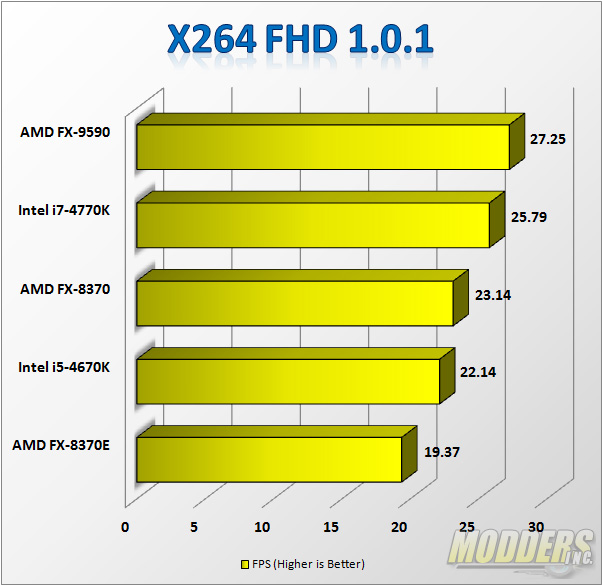
Here's a review that tested all the chips at stock settings with more typical RAM configurations. It's also the article from which the price-to-performance bar chart was derived (compared against Newegg retail prices) and is representative of what a typical system builder who is not taking the risks involved in overclocking can expect from the hardware. Here are a few more benchmarks of x264 which is what I cared about when buying a desktop CPU.
Until the stock performance numbers divided by the price come out higher on the Intel side, the AMD is the better value if you don't want to heavily overclock your chip and void your warranty. Intel has always had faster CPUs available than AMD, but they have always carried a significantly higher price tag. I'd prefer to have that money to buy something else like an SSD or more RAM. For other people, low power consumption or higher maximum performance may matter far more to them than the price tag, and I don't begrudge their choice to get Intel chips because that's what meets their needs. -
Re:Power VR sucks
Heh...if it were trash, you'd not see it being one of the primary GPUs for mobile devices.
The problem isn't PowerVR itself. It's proprietary drivers on their stuff not being available that's always been the problem. Else you'd probably be singing their praises like most do NVidia for the problem space.
Mods, lay down the damn crack pipe...this one's not "informative", nor is it even accurate. Proof:
Rockchip RX3168 uses SGX GPU
Apple uses SGX in their iPads...
Ingenic uses it with their MIPS Android SOC
MediaTek uses itAnd the list goes on and on. Unless this one uses AMD (well and now NVidia with Kepler...) or can convince Broadcom to make their top-end Videocore IV stuff available to use, they're talking out their backside out of box. It's crap because you can't easily get drivers for it and it's closed- and the only difference between them and NVidia on X86 is that NVidia makes closed drivers available, ImgTec doesn't. The same can be said for Adreno, Mali, and a few others. Now, if ImgTech could ass themselves to make available their drivers for X86 Atom boards, things would be better there.
-
Re:FUD incarnate:
They probably mean limitations on supercomputers, hence the need for silicon photonics interconnects. And we all know that NAND endurance is going down as it gets smaller.
It sounds great but they need to start selling memristors already. HP/Hynix have delayed memristors to avoid killing off Hynix's NAND too early, and that's bullshit. Now Crossbar may beat them to the post-NAND market with Crossbar RRAM.
-
Need to reconsider your hardware news sites...
According to xbitlabs, Kaveri has worse CPU performance than its predecessor.
AMD got lucky. It's found a dependable stream of revenue in game consoles. Better yet, no matter whether Microsoft or Sony wins the next generation console wars, both have AMD under the hood. Now that's hedging your bets. Whoever at AMD was in charge of negotiating these deals deserves a paid vacation to Necker Island with all the trimmings.
But lets get serious. AMD's current processors suck. And I hate saying that. A decade ago, AMD was the hero in the processor wars. If it wasn't for AMD, we'd be stuck with Rambus RAM, using Itanium processors, and have PCs running so hot we could cook breakfast on the case. But AMD's desktop processors are inefficient, almost two generations in fab technology behind Intel, and just cannot compete at any level.
Unlike 10-12 years ago, Intel's making great strides in microprocessor technology. It is thanks to AMD's competitiveness that Intel finally got its act together, and for that, I will always be thankful. If they can find a way to improve on Intel's product line, I'd be amazed at their comback. But do they really need to?
-
Re:Why are people designing cores?
Pretty sure that firing all of the hot shot CPU designers and having such algorithms design their CPUs for them is how they wound up with the Bulldozer fiasco.
-
Re: 3D chips, memristors, photonics, spintronics,
I looked up some companies by name (too bad you posted as AC and didn't mention them), and here is what I found:
Intel reveals a neuromorphic chip design based on memristors and spintronics
HP and Hynix postpone memristor-based memory to avoid cannibalizing their flash business
This pearl deserves to be quoted:
"In terms of commercialization, we will have something technologically viable by the end of next year. Our partner, Hynix, is a major producer of flash memory, and memristors will cannibalize its existing business by replacing some flash memory with a different technology. So the way we time the introduction of memristors turns out to be important," said Stan Williams, Hewlett-Packard senior fellow and director of the company's cognitive systems laboratory, during a conversation at the Kavli Foundation.
SanDisk and Toshiba are testing a ReRAM (memristor memory) chip
HP working with AMD, Intel, ARM and others to release memristor-based "nanostores".
A working memristor has already been proven in the lab by HP and they are now working with AMD, Intel, ARM and others to release what they call "nanostores". A chip that combines the memristor and logic of the CPU can prove to replace all current microprocessors and memory architectures.
A startup named "Crossbar" will try to beat HP to market with memristor-based ReRAM.
-
Re:BTRFS stable when
Whoops, sorry, meant ReRAM. Same difference
Looks like it got pushed back a bit further..
Last year an HP visionary predicted that smartphones and tablets would start utilizing ReRAM-based storage sometimes in 2014 - 2015. However, with current plans to start commercial manufacturing of ReRAM in late 2013 it looks like the first mass products featuring the technologyare only going to emerge in 2015 - 2016.
Two questions that I would like to have answered follows "Is reRAM more power consumptive during operation?" Are we therefore looking at RF radiation noise appearing as white noise?"
In my early IT years, we bought magnetic cores, 28 guage wire and we wired up and tested our own core memories. We needed some bit values to be remembered if there was a power failure. The environment was hostile to moving memory. (Circa 1070 is when I did this stuff). Finally, we bought magnetic latching relays, which turned out to be a less expensive approach, but required lots more cabinet space.
-
Re:BTRFS stable whenWhoops, sorry, meant ReRAM. Same difference
Looks like it got pushed back a bit further..Last year an HP visionary predicted that smartphones and tablets would start utilizing ReRAM-based storage sometimes in 2014 - 2015. However, with current plans to start commercial manufacturing of ReRAM in late 2013 it looks like the first mass products featuring the technologyare only going to emerge in 2015 - 2016.
-
Re:What about the manufacturers? Google?
I was wondering this as well. If the patents in question are valid under the system today, then the fees could be valid. Do we know which patents? If not, shouldn't that be public as patents are public?
If the patents in question are being used by MS then they are not trolling. They are just charging licensing fees which is very common, especially in the mobile market. Rounded corners is another story altogether...
Total Android device sales are expected to be over a billion this year.
Given MS will make $2 billion, or $2 per device. This isn't much on high end phones and tablets (under 1%, a bit higher for the Google phones and their very reasonable prices). However, $2 for a much cheaper tablet/phone would be a higher percentage.
If the patents provide utility and MS uses them, and regardless of your perspective on software patents, then the situation is fine.
I'm not really in favor of software patents, but the system is what the system is.
-
Re:A chance to start over
My desktop keyboard has 6 rows... including the function keys... what on earth are you putting on the 7th?
Count it, honkey! (consider the ESC and other keys aligned with it to be a "row") The important part here is the 3x2 text nav cluster in the top right and the F key grouping.
If its going to have a number pad and text nav area then yes, they need to be correct. But I don't necessarily want them, they force the keyboard part to the left, and make working on it less comfortable. I want the f to the left of the center of the screen, and the j to the right.
Whatever was wrong with the ultrabay keypad? Who ever uses optical drives anymore anyway?
And one thing you didn't mention... I want, nay, DEMAND, that the slash/pipe be above a wider enter key, rather than besdie a double-high-narrow enter key. I will not buy a laptop with the latter arrangement. I just end up typing / evertime i want an enter.
Forgot this one. Yes, this is absolutely critical. Those bullshit multilingual keyboards drive me to the point of homicidal fury.
Though I have to say, the worst keyboard I've ever had the displeasure of using (I work on a lot of customer machines) was an HP that put an extra column of keys along the left side as some hot keys (that no one will ever use), causing the rest of the keyboard to shifted over to the right. HP deserves an award for the most user-hostile, maldesigned piece of technology ever devised.- Stick mouse (clit mouse, whatever you want to call it) with actual buttons, not these bullshit buttons built into a trackpad Hell no on both. I want the multitouch apple trackpad thanks. No buttons at all, no sticks, just a BIG FLAT trackpad space flush with the case. Build a logitech touchpad into the laptop... that's what I want.
You like vague hardware interfaces that force you to constantly take your eyes off the screen?
I'm fine with 16:10 is that what your 5:4 is supposed to be? I don't really want 4:3.The key is vertical resolution not aspect ration... classic 4:3 is 1024x768. So 1366x768 is an improvement but 1200x720 is NOT an upgrade. I'd like 1080p resolution or better.
4:3 gets us awesome resolutions like 1400x1050 or 1600x1200.
-
Mantle API
Personally I would've gone for a mention of Mantle, the proprietary API they are introducing that sidesteps OpenGL and DirectX. I don't really know what it does yet, haven't found good coverage, but DICE's Battlefield 4 is mentioned as using it, and the description I've read said it enabled a faster rate of calling Draw calls.
-
A different technology is available
I hate to see this discussion go entirely to the "wearout" issue. Clearly there are some posters here heavily invested in spinning disk. There are more exciting flash technologies in the pipeline.
Samsung has a new flash technology for the Enterprise called 3D V-NAND. By using 24 separate layers of flash on one chip they can keep the feature size up and still keep pace with storage density. They believe they can go to hundreds of layers. There is talk of a 384GB single chip for smartphones and tablets. Not Gbit, Gigabyte.
But no, go back and forth some more about wearout rates.
-
Re:Poor premise
Actually, I'm betting that Intel wants to marginalize ARM as fast as possible and sell x86-based hardware to Apple.
[it's an URL, not an 'awful long string of letters', 90's comment spam filter]
Intel may also be betting on an inability of TSMC to provide satisfactory products for Apple. If that happens, then Apple may be forced into choosing between going back to arch rival Samsung for ARM chips or moving to x86 based SoCs then reliably produced by Intel.
-
Re:Does Intel manufacture for others?
Kudos on topping off the annoying habit of placing interrogative body text in the subject line by getting the answer wrong anyway
-
Re:Lets Compare the Surface Pro to the Google Pixe
-
Re:Looks like I better act soon
HI! I found an update to your 7-month-old news that you might find interesting. From this link:
“28nm yield and 28nm supply situation have both improved substantially. And so we feel pretty good about the balance of supply and demand at the moment,” said Jen Hsun-Huang, chief executive officer of Nvidia.
Qualcomm seems to be satisfied with TSMC’s output, but clearly points to progression that could have been made.
“We are above the high end of our previous revenue and earnings guidance as demand in 28nm supply improved as the quarter progressed. This gives us a strong base to build off of. We are looking forward to next year, we expect double-digit revenue and non-GAAP earnings growth again in fiscal 2013, said Paul Jacobs, chairman and chief executive officer at Qualcomm.
But I can see what you mean about TSMC not being able to get it right. After all, in June they had some problems, and by November, the people they were having problems supplying both indicated that they were pleased with the improvements and the results TSMC had achieved in the intervening 6 months.
This is clearly the mark of a company that is doomed to fail at producing any chip, at any volume, for any customer! I can't wait to hear more interesting prognostication from you, based on 6 month old data that has since been revised to show that the problem is largely resolved!
-
Re:nVidia
That statement isn't true at all.
For a long time nvidia may have had the FPS crown, but the how the actual graphics looked on a radeon were MUCH better.
Quality vs Quantity, as seen here:
http://www.xbitlabs.com/articles/graphics/display/quality_vs_quantity_3.html https://www.nordichardware.com/Graphics/ati-radeon-x1950xtx-part-1/Image-Quality.html
-americamatrix -
Remember 40nm at TSMC?
I couldn't possibly comment because they'd fire me.
But it is rather awesome.
Is that sarcasm? You can't comment means you won't add criticism or praise? I remember the HUGE cock-up that TSMC caused AMD when they went to the 5000 series GPUs. They had QC issues for all the rev.0 chips, and none of them would overclock. The 3 that I bought (sequentially) all needed super-cooling OR underclocking to perform consistently.
Maybe it's just me, but I'm extremely sceptical that TSMC will be able to pull this off properly. -
Headline is misleading.
I saw this rumor over here.
The way I read it is that they are going to offer BGA packaging to satisfy the large OEMs (e.g, dell, lenovo, etc). Now that most desktop PC are commodities, offering chips in BGAs reduces motherboad cost by eliminating the cost of the socket, improving yield (can sell kits of chips that just barely work together rather than requiring every component to satisfy the maximum electrical margins), and maybe reduce power (better electrical interface to memory).
My guess is that they will probably still offer a socket for servers and high-end enthusiast PCs, etc, but that means that it will be only specific enthusiast PCs that will support upgrades (e.g, you will not be able to upgrade a commodity desktop PC). So instead of outright killing the enthusiast PCs, I'm guessing Intel is simply going to make dabbling in enthusiast PCs a very expensive hobby (like it was in the old days).
In the old days, basically Intel was "forcing" all the computer vendors to have this latent ability to upgrade which enabled a custom motherboard industry that didn't need to sell-through (buy/resell) expensive CPUs. With this new change, only high-end motherboard companies will remain, and the computer vendors will just JIT motherboards the same way they purchase CPUs and memory. Undoubtly this will force even more consolidation in smaller motherboard form factors (although ATX/BTX/ITX was pretty standard, you saw some variations in the mini-ITX area) and the jellybean components on them (e.g., audio, power-regulators, etc).
What this might do, however, is kill is the desktop motherboard repair small businesses (mom/pop computer repair shops), not the enthusiast PC business. They won't be able to afford to stock motherboards anymore (since they will have CPUs mounted on them). On the other hand, the car repair business evolved around similar issues, most auto repair shops need to same-day order most of the parts need to repair cars from centralized parts distributors (they couldn't afford to stock things), so maybe mom/pop computer repair shops could evolve too... Maybe...
-
Re:What's twice a small number?
The early processors had a functional unit for translating x86 into Itanium (it was probably area-wise bigger than a 386, but it just read x86 opcodes and produced Itanium instructions). It was later removed, and x86 support was handled in software: http://www.xbitlabs.com/news/cpu/display/20060120105942.html
-
Re:OK, stick a fork in them, they're done.
It's a common misconception that Android has more marketshare than iOS.
Android has more marketshare if you count only phones.
If you count the iPhone, iPad and iPod vs Android phones and all other Android-based devices, iOS has more marketshare.
That's not even counting the marketshare of OS X(which iOS evolved from).
In Q32012, Apple shipped 50.4% of tablets in the market.
-
10 % better than Windows
10 % better than Windows if the numbers at
http://www.xbitlabs.com/articles/graphics/display/geforce-gtx-670_4.html
can be used straight away (which they possibly can to some extent as Left for Dead 2 probably isn't CPU bound) for GTX 680
Windows - 276 fps
Linux - 301.4 fps
Quite an improvement anyhow!
Congratulations to all involved!!!
-
Re:Name one Apple product that uses Sharp LCDs
-
Re:And?
Well, I also use the machine as a build server (those Common Lisp systems can take a while to rebuild if you need to nuke all of your fasls), and it's my file server (has like six drives in there now).
We pay about a dime per kwh of power because around 35% of our energy comes from a nuclear plant that the utility just finished paying off. Unfortunately, that's probably going up to around $0.15/kwh because the utility was unable to start building Units 2 and 3 on time and has to switch over to more expensive natural gas (it's amazing how cheap a nuclear plant is when you no longer have to pay the loans and it was uprated by a sweet 200MW with another 50-100MW of uprating to go before 2015, damn hippies causing global warming). In theory they are going to start building two AP1000s in 2014 so if that works out and I don't move in the next decade I should be looking at relatively low energy prices.
The old machine may or may not be saving me money, depending on how you amortize. It costs me around $130 a year to run currently (assuming 140W at the wall, $0.11/kwh). An FX-8320 system should idle around 70-90W (let's say 70W for this), an Ivybridge around 50W so $68 and $48 a year each. Pretty good savings, but given that a machine in the same class the athlonmp was looks around $900 (I'm staring at my newegg shopping cart now, and granted $100 of that is in fans because I'm a fan of positive pressure + tons of really slow fans = silent and cool)... so 10-20 years to pay off buying a new machine. The thing is that 140W is also the *peak* consumption because nothing has power management on this old hunk of junk, whereas these new machines are looking at a good 300W/220W (Piledriver/Ivybridge) peak. Just a quick googleing shows that the A10 isn't all that much better (comparable with the Ivybridge).
Yeah, they're way way faster, but
Maybe I'll change my tune the first time I do make -j10 on Guile or the Linux kernel.
-
Re:Buy AMD
They do, but it suffers many of the same problems. It's not just AMD that suffers from being a full process behind Intel either, TSMC and other fabs making ARM chips are suffering from this too. It's one of the ways that Intel is able to start making inroads into mobile phones despite their chips being less efficient; they can get away with it because of their better fab process.
As for AMD's automated designing, they may have changed their behaviour, but it was what lead to the disaster that was Bulldozer:
-
Re:Will it...
Actually it may be the case:
"According to some unofficial information, the new PlayStation 3 super-slim model (CECH-40) is powered by IBM Cell microprocessor made using 32nm process technology as well as Nvidia RSX graphics processor produced using 28nm fabrication process."
-
Power Consumption.
"Folks have been trading blows over whether Intel could compete with ARM's core power consumption. " For the mobile markets, Here's the best numbers I could find on the various processor's power output: http://www.xbitlabs.com/news/mobile/display/20110921142759_Nvidia_Unwraps_Performance_Benchmarks_of_Tegra_3_Kal_El.html The 10W Intel processor is still ~8x outside the power output of a Tegra 3 at 1GHz/Core, and ~6.662x the power output of a OMAP4 processor. While Intel is clearly working on getting down to the ~1W power range, they still have a ways to go. They may get there, but until I see silicon, I'm not holding my breath for it.
-
Re:Those upgrades don't matter so much any more
-
Re:It's like Palo Alto all over again...
The touchscreen was made by LG and the CPU was an A4, designed by Apple and manufactured by Samsung. Various components like RAM, flash RAM, etc. were engineered and manufactured by Samsung.
-
amd did better with 2 cores on a bulldozer
AMD did better with 2 cores, now I would like to see a side by side comparison of actual tasks.
-
Re:Buy a Macbook Pro, even for Windows/Linux
Counterpoint: Don't buy a MacBook Pro except if you want OS X. The EFI BIOS is a pain. I spent unreasonable amounts of time holding down magic "alt-apple-whatever" key combinations and rebooting trying to figure out WTF was wrong with the thing. It's MUCH nicer to have a computer that has a BIOS setup screen where you can just go tell it which drive to boot from and which simply gives you an error message when something is wrong. And the whole mess of conflicting partition tables... don't get me started.
I've also found the hardware to be not-so-good. All the components are great, of course, but Apple very much prefers to make the case pretty at the expense of repair. For example: on a thinkpad you open it up by removing five screws from the bottom and pulling off the palm rest and keyboard. Easy. On a MBP, I had to take out no fewer than two dozen screws and pry up a dozen little plastic clips around the edges where the metal top meets the metal side... And they never quite go back together again just right. And for documentation of the procedure? Thinkpads have a detailed service manual; the Mac has ZERO documentation and you're stuck reading online howtos which never seem to cover exactly your model. You're supposed to take it to the store if you want something fixed.
I'm also not happy with the all aluminum design. It looks good, but I'm pretty rough on laptops - I'm in a fabrication shop a lot and shit happens. My MacBook Pro was turning into a scraped and dented beater. My Thinkpad (metal frame, plastic skin) has taken just as many drops to the concrete floor and bangs into equipment, and it's in much better shape (almost like new) even after several years of abuse.
As implied above, I'm now very fond of Thinkpads. For the OP, here's the quick summary of Thinkpad models:
First character:
X - Ultralight
T - Standard size
W - WorkstationSecond:
2 - 12"
4 - 14"
5 - 15"
7 - 17"So a T5xx is a standard-frame 15" laptop.
Real Thinkpads ALWAYS have this keyboard: http://www.xbitlabs.com/images/mobile/lenovo-thinkpad-t61/keyboard.jpg . Note, seven rows counting up the left side; three volume buttons; round power button; pgup/pgdn above and below each other. Here's a fake Thinkpad: http://www.unitedgadget.com/wp-content/uploads/2010/03/ThinkPad-X100e-Keyboard.jpg - chiclet keys, six rows, no dedicated volume buttons, etc.
There are two reasons you care: 1, this keyboard is great; 2, what's underneath is built like a Thinkpad, not an Ideapad dressed up in black and sold through business channels. Lenovo has done themselves a huge disservice by diluting the Thinkpad brand this way, but fortunately the real ones are very easy to spot once you recognize the keyboard. There are a bunch of other things that change too, but this one's the easiest to spot.
-
Re:Review Roundup
X-bit Labs review.
Not much new stuff in there compared to other reviews. I miss the days when they accurately measured CPU and GPU power consumption... Now it's just meaningless "total power".
-
Re:Interesting.
Fabricating the level of density without leaking is very hard.
It's impossible. There is always leakage. Yes, as you scale, the leakage does grow, both empirically and as a signal/noise problem. But there are ways to minimize this. This has been foreseen for some time, and a lot of research goes into ways to mitigate it. Despite all the improvements made sub-surface - that is, how the semiconductor itself is altered - to allow scaling and improve efficiency, and how the tools and methods to make the devices have improved... the industry really hasn't had any radical changes in many years. It has been all planar designs that date back to the 70's. Sure, the materials have improved, and it's not entirely silicon any more... but still planar, and subject to some fundamental limits of the planar design and the substrate choice. That's why Intel is pushing into 3d designs. Do some reading on FINFETs, and the benefits of them, especially with respect to leakage and control. And that can still be silicon based, and doesn't push at all into heterogeneous semiconductor systems.
Fabs are very ex[pensive to built.
Add to the the consumer need for faster clocks has tapered off, it's not worth the expense of massive retooling.Oh, really? Why are the industry giants doing it, then? Smaller die - this improves speed and potential clock, can improve power efficiency, means more die/wafer or more advanced designs. Ability to do different etches, deposit different films, etc., to improve device characteristics.
Clockspeed isn't everything anyway, or we'd still be using the Pentium 4 chips that were pushing 4 GHz from the manufacturer, and not the 2 GHz-range Core 2/iX chips. Smart design can trump clockspeed. (I use Intel as an example here because they had the more recent significant architecture change which illustrates this point very well.) We could, y'know, go back to making Pentiums... with current manufacturing technology, we might make them, what, 1/8 the size? Could probably clock them at several GHz.
When they can get the metal well below 1 part per billion in the fabs, and create a process to minimize wafer breakage for wafer being cut so precisely, then we may see a doubling of clock speed 2 more times. Then that will be it.
What makes you think metal contaminants and wafer breakage are the limiting factors to clockspeed scaling? And from where do you get a "doubling of clock speed 2 more times" from? What are you considering the base clockspeed that you are multiplying? Seems like you're pulling it out of your ass. Think about it. We're doing 3 GHz+ already. Doubling that puts us in the 6-8 GHz range. Doubling again puts us in the 12-16 GHz range. That's what people above are claiming as the fundamental limit in a synchronous chip by the limit of the propagation of a signal in a metal. The speed of light in metal is in no way the limiting factor in clockspeed. That would be the case for a single wire in isolation. There are other effects, namely capacitive coupling, in a chip where you are wiring up billions of transistors, which are much more limiting. And we're tallking wires of non-negligible resistance here - if you want to put a bunch of small transistors close together, you need to be able to make really thin metal wires to connect to make the right connections. Assuming metal is the only interconnect, of course, and completely ignoring all the research into optical interconnects...
-
Re:This isn't nearly as bad as the division bug
Toms hardware suggests the i5-2500K (4 core, 3.7Ghz turbo) for $224.99 or i7-2600K (4 core 3.8Ghz turbo) for $324.99 as comparable.
Tomshardware never tested the FX-8120, so that's a lie. They tested the FX-8150 and found:
In the very best-case scenario, when you can throw a ton of work at the FX and fully utilize its eight integer cores, it generally falls in between Core i5-2500K and Core i7-2600K
The FX-8120 has 500 MHz lower base frequency which is far more significant than the 200 MHz lower max turbo. Not many have tested it but xbitlabs did:
I hope Tom's hardware wasn't recommending the 2500K or 2600K for virtualization. Those models are unlocked for over clocking but have the virtualization extensions disabled. I just ran into that when evaluating processors for running vmware.
-
Re:This isn't nearly as bad as the division bug
For example, I just set up a couple servers from COTS parts. They used AMD FX-8120's (8 core, 4.0Ghz turbo) for $199.99/ea. It seems the comparable Intel is the i7-980 (6 core, 3.6Ghz), which is selling at $589.99.
Modded informative? Only on slashdot... Also you compare turbo speeds (and GHz is silly anyway due to the difference in IPC), yet say:
The servers actually use as many cores as I can throw at them, so it's extremely beneficial to have more cores at high speeds.
If all cores are 100% loaded, you're not going to get anywhere close to max turbo. That's the extra boost it can give if only one core is working.
Toms hardware suggests the i5-2500K (4 core, 3.7Ghz turbo) for $224.99 or i7-2600K (4 core 3.8Ghz turbo) for $324.99 as comparable.
Tomshardware never tested the FX-8120, so that's a lie. They tested the FX-8150 and found:
In the very best-case scenario, when you can throw a ton of work at the FX and fully utilize its eight integer cores, it generally falls in between Core i5-2500K and Core i7-2600K
The FX-8120 has 500 MHz lower base frequency which is far more significant than the 200 MHz lower max turbo. Not many have tested it but xbitlabs did:
Slower eight-core modification, AMD FX-8120, looks even less convincing, because it has significantly lower clock frequencies. In terms of performance, this processor ranks even below the quad-core competitor solutions. Moreover, FX-8120 is also slower than the top previous-generation AMD CPU - Phenom II X6 1100T.
So just admit it, you use AMD because you like AMD but clearly you have no clue what the competition offers.
-
Re:vaporware
THAT is not the problem, the problem is with the chip design my 2.6GHz Thuban will most likely stomp the dogshit out of it in most of the benchmarks. You see basically AMD has their own netburst on their hands. As most remember a 3.6GHz netburst P4 can get the dogshit stomped out of it by a 2.2GHz Intel Core arch simply because of IPC, or instructions per clock.
Now what AMD did wrong as several things, first they are basically lying out their ass and trying to sell dual cores as quads, quads as octcores, so naturally the comparisons to actual quads and octacores is gonna suck, again my Thuban will stomp it simply because it has 6 ACTUAL cores as opposed to 4 real cores and 4 virtual ones. in fact if one disables every other core in a FX chip then that chip WILL get faster IPC, why? Because all the other core is is hardware assisted hyperthreading and it is sucking the shit out of problem number 2, which is they gimped the living hell out of the cache. As everyone probably knows AMD chips usually can get by with less cache than an intel chip, but only to a point, see how much more lousy a Sempron is than an Athlon simply because the cache is too gimped. because of the hardware assisted HT they have a lousy 16KB! Yes you read that right, 16KB per core of L1 cache. that means older programs or ones that don't hit the L3 are gonna be gimped right out the gate. Look up the reviews for the FX4100 and see how the reviewers are shocked that putting the new core design against the previous Deneb and even with a 1GHz speed boost it was still getting its clock cleaned and only by OCing the living shit out of the cores (over 4GHz) were they able to get it to pull ahead of Deneb, which brings me to 3, they made the pipes too long in search of speed. I guess Intel having the crown as being an OCing monster got to them because they made the pipes MUCH longer than Stars arch in the hopes of high clock speeds, but as we saw with netburst having long pipes means MUCH bigger risk of a stall and much lower IPC as a result. again this is why the BD was stomped by Stars as the longer pipes meant that only in certain specialized jobs could the chip shine.
In the end as someone who has been selling AMD exclusively since the Intel bribery and compiler rigging came out this chip is junk and i just can't sell it. they are trying to get more than quad core money for a dual core with HT thus killing AMD's "Bang for the buck" and the killing of the AM3 line when only a single chip was needed to keep the entire line shows their incredible shortsightedness and a company with no real leadership. A single 95w Thuban could have kept the entire AM3 line alive while they worked on BD/PD, all that came out perfect would be X6, any with bad cores would be Phenom X4/X3, any with bad cache would have been Athlon X4/X3. this would have kept not only the entire Am3 line alive but also would have given value hunters and the DIYers on board as they could be buying X3s and X4s and hoping to unlock an X6 and the X6 is frankly kick ass for gaming and transcoding thus giving them a good chip to keep the gamers on a budget and AMD fans happy.
You just can't get around one fundamental fact...the BD/PD core is really a server chip, it excels in server roles. the problem with this is server roles are the complete and polar opposite to what the average user of a desktop or laptop actually DOES with their machine and in the jobs that home users and SMBs have a PC or laptop for the BD/PD design is a real dog, hell I'd compare it to a Pentium 4 but sadly that wouldn't be fair to the P4, its actually more like a netburst Celeron in that lack of cache has gimped the shit out of the chip. Look up the benches for the BD folks and remember they are expecting ONLY about a 15%-20% gain. Now when the chips are having to be OCed like mad to keep up with the last gen offering, much less the Intel chips, do you REALLY think a lousy 20% increase to such a flawed design is gonna help?
-
S-PVS vs IPS Pro vs PLS Panels
"TVs are ultimately about picture quality.
First thought: Bullshit. Then I saw it's not S-PVA vs IPS Pro anymore; Samsung's doing PLS now.
http://www.xbitlabs.com/articles/monitors/display/samsung-sa850_2.htmlNeed more detail on PLS...
http://entertainment.slashdot.org/story/12/02/14/2144217/television-next-in-line-for-industry-wide-shakeup# -
meh, wrong link
Meant to paste this one.
-
Re:why phase out DVI?
I would guess it is all about bandwidth speeds and volume with Intel backing closed standard Thunderbolt, while AMD is backing the more open standard DisplayPort1.2
-
Re:Just another...
Android people tend to hate it when the iPod Touch or iPad are brought up and conflated with the iPhone (even though Apple people tend to view iPhone + iPad + iPod Touch as a single platform).
I'm not sure I'm an "Android person," but the reason I dislike it when it's brought up is because it doesn't matter all that much and it's more of a distraction.
Take Q3 2011 as an example. According to Gartner, there were 60 million Android phones shipped and 17 million iPhones shipped. "But this doesn't include iPod touches and iPads!" you shriek. Fair enough--let's include them.
According to Apple, they shipped 11 million iPads and 6.62 million iPods. Now let's assume, just for laughs, that all of those were iPod touches. That's right, Apple didn't sell a single iPod shuffle or iPod nano. That ups Apple's iOS sales to 35 million--more than double the iPhone reference. But it's still a little more than half the Android phone sales. And that's making a pretty big assumption about iPod touch sales.
Let's try to figure out Android tablet sales. According to IDC, Apple had about 61% of the market with 11 million iPads. Android had about 32%. Doing a little math, that means about 6 million Android tablets. So we have 66 million Android phone and tablet sales versus 28 million iPhone & iPad sales.
That's what I mean by a "distraction." They just use this to try to discredit the original report.
-
Re:iPad vs. all Android tablets
"But look at any individual manufacturer, and that "All Android Phone" share is sliced into so many tiny pieces that Apple dwarfs them."
Really?
Many sets of stats, like these:
http://www.mobilesplease.co.uk/news/nokia-lumia-slow-start/
and these:
http://www.bbc.co.uk/news/business-15489523
Suggests that's simply not true.
If you look at the first survey for the UK, the Galaxy S II has been outselling the iPhone 4 white, and black model combined, and it's only when you then factor in the 4S white, and black model, that the iPhone finally overtakes the Galaxy S II in sales.
What all stats coming out in the last couple of months appear to demonstrate is that you're quite wrong - the Galaxy S II as a single model, has been outselling either the iPhone 4, or the iPhone 4S as a single model. When Samsung combines all it's Smartphones, as the iPhone 3GS, 4, and 4S are lumped together as if they're equally a single offering, it's shifting over 7% more handsets than Apple.
It was a valid argument early on, but it just doesn't seem to really hold any weight anymore. This is the fundamental problem with people who feel the need to defend Apple, they originally said Android would never overtake the iPhone, then when it happened they said, no individual manufacturer will ever overtake Apple, now it's happened they're saying no individual handset is beating the iPhone, but even that seems it's almost certainly happening now. Even if it's not quite the case yet and the stats are wrong and the Galaxy S II isn't outselling a specific iPhone model, and almost even all iPhone models combined, then it's still a close enough call such that terms like "Apple dwarfs them" is laughably incorrect rhetoric.
Apple's marketshare for tablets has already declined this year, it's now down as far as 62%, having been up at around 90% last year:
This is with countless false starts (HP's tablet, RIM's playbook etc.), lacklustre Android offerings, and even some Android tablets being banned from sale in some markets. As these issues start to fade and the Android tablets pick up strength, i.e. through inclusion of things like Android 4, then the market for the iPad isn't suddenly going to grow. It's opportunity to thrive has been possibly bigger than ever with all the setbacks competitors have faced, yet it's marketshare has still declined.
I'm not talking Apple down because I have some irrational will to see them fail, I'm not that much of a fanboy - I do disagree with many of their corporate decisions, but what I do like is to see a bit of truthfulness in these sorts of discussions, because fanboys lying to themselves and agreeing with each other is a largely meaningless sport - a fanboy can spout some crap about how their pet brand is going to win some arbitrary war all they want, but it wont change reality if it then doesn't. By all means I may be wrong, and Apple may see a resurgence that allows it to grab increasing levels of marketshare, and that's fair enough if someone wants to make that point, but throwing around clear bullshit like "no individual Android tablet is going to have more than 5%" with no suggestion as to why that might be the case when it's not been the case with phones is meaningless.
There's no doubt Apple is going to continue to be a massively profitable company thanks to the iPhone and iPad in the near to medium term, but I believe they've made some serious mis-steps that has allowed Android to take the lead, and that's led to an inevitable snowballing on it's behalf - the more marketshare it gets, the more developers begin to develop for it, the more open it is, t
-
Meaningless given the Atom problems for Intel....
Intel has the Atom line (current generation is garbage) and the i3-23X7M ($100-$200 premium) that competes on the low end with AMD.
Intel Atom's next generation has no 64bit drivers or DirectX 10 for there PowerVR chipset:
http://news.softpedia.com/news/Intel-Cedar-Trail-Atom-Won-t-Receive-64-bit-Graphics-or-DirectX-10-1-Driver-232915.shtml
__________________
Fusion "2.0" was already in the works:
http://www.xbitlabs.com/news/mobile/display/20111121213529_AMD_Readies_Brazos_2_0_as_Krishna_Wichita_Get_Delayed.html
IIRC, these were scrapped because OEM's weren't going to design products around a 6-month lifecyle--hence they are skipping a generation. -
Re:Just some back-of-the-envelope numbers...
quad core arm has still nothing on 3ghz intel, not even in things that highly parallelize, with floating point things go even worse(per the semi-recent tegra benches, ).
it's kinda sad, really. there's a lot of nifty stuff that could be done realtime if per cpu-core(per thread) power went up. anyhow
http://www.xbitlabs.com/news/mobile/display/20110921142759_Nvidia_Unwraps_Performance_Benchmarks_of_Tegra_3_Kal_El.htmlsmack a lot of shitty cpu's in a small case and call it a day has been done before "supercomputer under your desk" style, there's some applications for them.
a better comparision for this case would be if someone stuck 72 cheapo dc-atoms in a box, for more meaningful x86 vs. arm.
and on the power use front I'd rather see some figures about how much power rendering some test raytrace takes on each system. -
Re:Translation, please?
I wonder if this CPU from a huge consortium of very powerful Japanese companies is finally making some progress?
Seven Japanese Companies to Develop Microprocessor to Compete Against AMD and Intel -
Before you go saying that ARM is fast enough...
OK, the idea behind ARM is that it is "fast enough" for desktop and notebook PCs. Well, if that's the case, then a P4 is also "fast enough" and you should consider not buying anything newer.
Why am I saying that? Let's look at one benchmark that *is* multi-core ready and that Nvidia kindly ran on the upcoming Kal-El quad-core systems: Linpack.
Now I know Linpack is not a perfect benchmark, but it does do a decent job of showing off number-crunching power and it is multi-core capable and there are results from a wide range of architectures.
Here's a result from a 1.7 Ghz P4 system (see: http://www.roylongbottom.org.uk/linpack%20results.htm)
CPU Mhz Opt (MFlops) Non-Opt (MFlops)
Pentium 4 1700 382.00 131.59I think (but I'm not sure) that Opt means optimized (such as using SSE) and non-Opt is a minimal x86 implementation with no optimizations.
Now, here are Nvidia's results for its not-yet-on-the-market Kal-El Quad Core ARM at 1.0 Ghz:
Multi-threaded Linpack: 309 Mflops
I'm going to assume that Nvidia will go out of its way to make sure the code is optimized for benchmarks that it posts as part of a marketing push.
So a QUAD CORE Arm architecture is still lagging behind a P4, and while the P4 has a clock speed advantage, it's a lot smaller than is justified by the difference in performance considering the Nvidia chip has 4 cores compared to a single-core P4.
Now, I'm not saying that Kal-El won't be awesome for use on tablets and smaller devices, but on a desktop or even a notebook, don't go around expecting miraculous performance.
-
Re:Sandy Bridge-E
All video games currently in existence. http://www.xbitlabs.com/articles/cpu/display/core-i5-2500-2400-2300_7.html#sect0
1100t wins in applications using 6+ threads. Which is obvious. If you're doing heavy threading then ofc the 1100t is the better CPU. At 2-4 threads, even an 1100t overclocked @ 4.2GHz loses.
-
They might be including water cooling
According to this article they are looking to include a water cooled solution instead.
-
Re:Thunderbolt = dead in two years.
Anybody else think thunderbolt is a technology looking for a solution?
USB is cheaper, almost as fast, and ubiquitous. There are probably literally millions of USB devices that work with a USB port.
Thunderbolt has one RAID box you can buy, and now VI is really stretching the bounds of credulity to come up with another use for it.
I'd bet a month's pay that Apple will start removing Thunderbolt ports from Macs in 2014
Absolutely correct. The existing version of Thunderbolt isn't even optical, so the speed benefit isn't there.
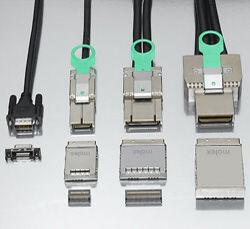
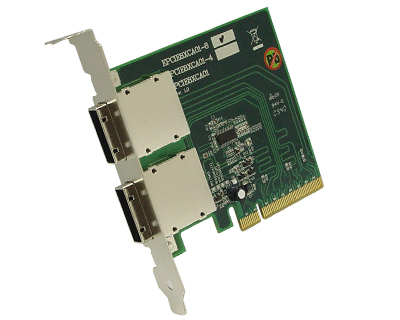
It's the senseless quest for "one cable to rule them all" as usual.If you want an external PCIe bus that you can attach all sorts of controllers to (like USB, Parallel, Serial, HDMI, Displayport, Assbadger, whatever), why not just use external PCIe?
http://www.xbitlabs.com/images/news/2008-06/ati_xgp_x8_connector.png
http://www.ixbt.com/video3/images/guide/pcie_ext.jpg
http://www.ioi.com.tw/images/products/cat_113/l_1130004_01.jpgAll Thunderbolt is is external PCIe with a controller to fold in some common protocols (USB, HDMI, DisplayPort, etc.). Yet for some reason we need a new cable, a new name, a new port, the whole 9 yards.