 Slashdot Mirror
The Dungeons and Dragons Fourth Edition Preview Books
It's a big year for tabletop gamers. In just a few months the first books for the Fourth Edition of Dungeons and Dragons (D&D) will be released by publisher Wizards of the Coast (WotC). The last major update to the game rules was released in 1999, and sparked interest in D&D not seen since the early 80s. To attempt to answer some of the biggest questions about this newest edition, WotC has learned from mistakes made in 99', and is previewing their game updates with a pair of softcover books. Called "Races and Classes" and "Worlds and Monsters", the two titles cover everything from character creation to the new default world's pantheon. More importantly, it includes a large amount of commentary from the designers about why things are going to be as they are. In short: they're must-haves for hardcore D&D fans. Read on for my impressions of these highly entertaining (and vastly overpriced) chapbooks.
Races and Classes
Compiled and Edited by Michele Carter
95 pages
Published by Wizards of the Coast
Rating: 9
ISBN: 9780786948017
From a player's perspective, "Races and Classes" is definitely the more important of these two books. Acting as a stand-in for the upcoming Player's Handbook (due out in June of this year), it shows off the player races and character classes Dungeons and Dragons players will be able to choose for their first Player Characters (PCs). The book is broken up into five sections, with two devoted to the titular character aspects. The other three outline the process of rethinking the game's core. Each section is broken up into a series of short essays on specific subtopics. Each race and class gets at least one essay, with some requiring three or more to fully explore.
As a veteran DM of the 3.0/3.5 era, their choices for which races and classes to include are at the same time surprising and reassuring. Their picks have definitely shaken up the status quo, bucking traditions that date back to the late 80's. The Gnomish race, for example, won't be in the first Player's Handbook. Half-Orcs, one of the favorite races of the current edition, won't be addressed until the Forgotten Realms sourcebook in the Fall.
Instead, standbys like the Elf, Dwarf, and Hafling have been refined and polished to clarify their place in the world. Haflings in particular have been given a fictive solidness they previously lacked: they're now a nomadic boat-people, tending to the waters in the same way the Elves tend to forests or Dwarves to hills and mountains. New additions to the racial roster fill in gaps that have been patched previously in non-core supplements. The Dragonborn race, a reptilian species, is the most obvious of these. Previous 'dragon-ish' races have fit into campaign worlds roughly compared to the core races. Tieflings (half-demons) are another example of this trend. A popular player race in 3.0/3.5, it was challenging to play a Tiefling because of restrictions at character creation.
The process of making and growing a character seems to be the element they examine most closely in the commentary sections of the book. One subheading says it all: "Expanding the Sweet Spot". 3.0/3.5, it has often been noted, follows a power curve that starts somewhat underpowered and eventually reaches a point where players are too powerful to be seriously challenged. Though there's a lot of debate on this point, personal experience suggests the sweet spot for D&D 3.5 is about 5th level to 14th. Though many campaigns will never make it that far, it's frustrating to deal with mechanical weaknesses like that over the lifespan of a game. Fourth edition is a valiant attempt to rectify that by making all levels viable for play.
For a player, viability essentially boils down to "fun". At any given moment, is the player having fun at the gaming table? The Classes they've chosen for core inclusion speak directly to the need for fun. While the Core Four (Fighter, Cleric, Rogue, Wizard) are there, they've also included a number of fun tweaks for additional classes. In 3.5 hybrid classes were rough to play; why would you want to play a Paladin (a weak fighter bolted to a weak cleric) when you could play one of the core four and do something well? Fourth edition solves this issue by looking at the roles behind the classes rather than at class particulars. The Rogue, for example, is the classic Striker. He uses stealth and guile to cause spikes of high damage at opportune times. But that's not the only interpretation you can have of that role; the Warlock (another fourth edition core class) is also a Striker, but he relies on Damage over Time spells and arcane blasts to do his job. The Cleric is the classic Leader, keeping his allies up and in the fight by tapping into a spiritual power. The Warlord does the same through discipline and sheer force of will; the same role, but with a different interpretation.
The real advance is that each class role should always have something interesting to do in a fight, because every role is defined. If you're a Defender, and you're not interposing yourself between the bad guys and the party, you're doing it wrong. That great start is expanded by the inclusion of 'powers'. Previously the domain of spellcasters only, powers are going to be a staple for every class. Instead of the Fighter being forced to dully repeat "I hit it" over and over again, every class will have unique moves and attacks that support their role in the party. And if the Warlock (with powers labeled things like hurl through hell or iron chains of misery) are a good representation, each class should be a lot of fun to play.
I've been reading information about fourth edition greedily since last year on the D&D Insider site, and I thought I had a handle on what this game was going to be like. The class book, though, has been an eye opening experience. The designers just 'get it'. Everything that gets in the way of having fun needs to be excised. This book illustrates that, fundamentally, the WotC designers understand that. In 3.5 Fighters have too few options and Wizards have too many. Fixed. In 3.5 race didn't fundamentally matter, and on top of that each race was fairly poorly defined in the core books. Fixed. In 3.5 class roles were a challenge to understand for new and old players alike. Fixed.
Reading this text read like an answer to every player frustration I've experienced in the past 9 years. The game they describe in the pages of "Races and Classes" sounds like an intrinsically different experience than Dungeons and Dragons 3.5. For some people it's not going to be what they're looking for. For me personally, it's everything I could have hoped for and more. It's always been easy to have fun roleplaying; if they can make character creation fun? If they can make combat purely fun? That's an innovation worth rebooting the system for.
My only complaint with this book is the price. For more on that, please read on.
Worlds and Monsters
Compiled and Edited by Jennifer Clarke Wilkes
95 pages
Published by Wizards of the Coast
Rating: 7
ISBN: 9780786948024
Whereas the "Races and Classes" book speaks directly to the core of the new D&D, "Worlds and Monsters" primarily deals with the frippery and window dressing associated with the new core world. The loosely defined core setting that has always existed in previous editions of the game is going to become more codified in fourth edition. This text talks a bit about that world, and the decisions that went into that choice. It also runs through some of the most well-known monsters in Dungeons and Dragons, explaining how they've been adapted for the new version of the game.
For Dungeon Masters, this is far and away the more fascinating book. This stand-in for the DMG speaks directly to the storytelling core of the game, and hints at the kinds of high-adventure tales we'll be able to craft later this year. The game world sounds quite interesting, both for its specificity and its vagueness. Races, for example, are quite specifically outlined. Tieflings, Dragonborn, Elves ... all have specific creation stories that PCs can share as a common background. Racial traits stemming from historical events will add a lot of texture to character portrayals. At the same time, much of the world is being left deliberately vague. This setting is described just enough to hang plot hooks on, but not enough so that as a DM you'll have to deal with backstory cruft.
The world they describe sounds quite interesting, too. They're calling the core concept "Points of Light". Adventurers are heroes living in a world mostly covered by the darkness of wilderness and the unknown. Small cities and villages dot the landscape, providing shelter and a bright spot in this darkness. The wilderness hides numerous ruins, leftovers from the rise and fall of ancient civilizations. The last great human empire fell about a hundred years ago, in the setting, and the result is something akin to the historical dark ages. Layered on top of this ruin-strewn landscape is a faerie realm, accessible via special holes in the world. Monsters live in the deep woods, and dark magics are hidden underground. It sounds like a great place to adventure.
The monsters section of the book clarifies a number of things about what D&D combat will be like in fourth edition, and speaks again to their goal of 'fun all the time'. 3.5 combat was balanced around the concept of a party fighting one creature of an appropriate level. It turns out? That tends to get kind of boring. Fourth edition combat, instead, is balanced around an equal number of opponents for the players. Having the concept of 'slots', where monsters oppose players on equal footing, and roles (not unlike PC roles) ensures that fights will be actually challenging. 3.5 fights tend to be either bloodbaths or total routs, with little room in-between for contesting the outcome.
That concept of roles has been applied to monsters quite deliberately. Balancing a monster party with Defenders, Skirmishers, Controllers, and Leaders will result in a mixed bag of interesting critters. Monster races that tended toward the generic have even been given a degree of specificity. Instead of Gnolls just being Orcs with Hyena masks on, they'll now apparently fight with pack tactics and cowardly tricks. Giving flavour to the opposition seems to be the basic idea: off-the-rack encounters will no longer feel so rote.
Again, the game they're describing sounds like a lot of fun. My frustration with this text was high on the price side, though. While the "Races and Classes" book speaks directly to the core of the new D&D game, and is a great book to throw at someone still griping about the lack of Gnomes, "Worlds and Monsters" seems like it's mostly a lot of set dressing. Set dressing which (I can only assume) will be reiterated in more detail in the core books. Did I enjoy reading it? Of course. It's interesting stuff. But twenty dollars for set dressing is hard to swallow, especially when we're going to have to repurchase that information in the DMG for another thirty bucks.
At a cost of forty dollars for the pair, it's hard to say if the extremely interesting content is worth the price of admission. In podcasts and commentaries WotC has said how they enjoy the 'DVD extras' model, where consumers pay a premium for 'behind-the-scenes' info. If you really enjoy that kind of content, or just can't wait the next four months for the core books, these will be easy buys for you. The ideal would have been if purchasing these books represented preorders for the core books. Pay $40 now, buy the core books for only $20 each? Anything to make this investment last past May? Instead, we're left with the reality that nothing in these books can't wait until June.
Compiled and Edited by Michele Carter
95 pages
Published by Wizards of the Coast
Rating: 9
ISBN: 9780786948017
From a player's perspective, "Races and Classes" is definitely the more important of these two books. Acting as a stand-in for the upcoming Player's Handbook (due out in June of this year), it shows off the player races and character classes Dungeons and Dragons players will be able to choose for their first Player Characters (PCs). The book is broken up into five sections, with two devoted to the titular character aspects. The other three outline the process of rethinking the game's core. Each section is broken up into a series of short essays on specific subtopics. Each race and class gets at least one essay, with some requiring three or more to fully explore.
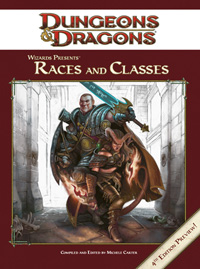
As a veteran DM of the 3.0/3.5 era, their choices for which races and classes to include are at the same time surprising and reassuring. Their picks have definitely shaken up the status quo, bucking traditions that date back to the late 80's. The Gnomish race, for example, won't be in the first Player's Handbook. Half-Orcs, one of the favorite races of the current edition, won't be addressed until the Forgotten Realms sourcebook in the Fall.
Instead, standbys like the Elf, Dwarf, and Hafling have been refined and polished to clarify their place in the world. Haflings in particular have been given a fictive solidness they previously lacked: they're now a nomadic boat-people, tending to the waters in the same way the Elves tend to forests or Dwarves to hills and mountains. New additions to the racial roster fill in gaps that have been patched previously in non-core supplements. The Dragonborn race, a reptilian species, is the most obvious of these. Previous 'dragon-ish' races have fit into campaign worlds roughly compared to the core races. Tieflings (half-demons) are another example of this trend. A popular player race in 3.0/3.5, it was challenging to play a Tiefling because of restrictions at character creation.
The process of making and growing a character seems to be the element they examine most closely in the commentary sections of the book. One subheading says it all: "Expanding the Sweet Spot". 3.0/3.5, it has often been noted, follows a power curve that starts somewhat underpowered and eventually reaches a point where players are too powerful to be seriously challenged. Though there's a lot of debate on this point, personal experience suggests the sweet spot for D&D 3.5 is about 5th level to 14th. Though many campaigns will never make it that far, it's frustrating to deal with mechanical weaknesses like that over the lifespan of a game. Fourth edition is a valiant attempt to rectify that by making all levels viable for play.
For a player, viability essentially boils down to "fun". At any given moment, is the player having fun at the gaming table? The Classes they've chosen for core inclusion speak directly to the need for fun. While the Core Four (Fighter, Cleric, Rogue, Wizard) are there, they've also included a number of fun tweaks for additional classes. In 3.5 hybrid classes were rough to play; why would you want to play a Paladin (a weak fighter bolted to a weak cleric) when you could play one of the core four and do something well? Fourth edition solves this issue by looking at the roles behind the classes rather than at class particulars. The Rogue, for example, is the classic Striker. He uses stealth and guile to cause spikes of high damage at opportune times. But that's not the only interpretation you can have of that role; the Warlock (another fourth edition core class) is also a Striker, but he relies on Damage over Time spells and arcane blasts to do his job. The Cleric is the classic Leader, keeping his allies up and in the fight by tapping into a spiritual power. The Warlord does the same through discipline and sheer force of will; the same role, but with a different interpretation.
The real advance is that each class role should always have something interesting to do in a fight, because every role is defined. If you're a Defender, and you're not interposing yourself between the bad guys and the party, you're doing it wrong. That great start is expanded by the inclusion of 'powers'. Previously the domain of spellcasters only, powers are going to be a staple for every class. Instead of the Fighter being forced to dully repeat "I hit it" over and over again, every class will have unique moves and attacks that support their role in the party. And if the Warlock (with powers labeled things like hurl through hell or iron chains of misery) are a good representation, each class should be a lot of fun to play.
I've been reading information about fourth edition greedily since last year on the D&D Insider site, and I thought I had a handle on what this game was going to be like. The class book, though, has been an eye opening experience. The designers just 'get it'. Everything that gets in the way of having fun needs to be excised. This book illustrates that, fundamentally, the WotC designers understand that. In 3.5 Fighters have too few options and Wizards have too many. Fixed. In 3.5 race didn't fundamentally matter, and on top of that each race was fairly poorly defined in the core books. Fixed. In 3.5 class roles were a challenge to understand for new and old players alike. Fixed.
Reading this text read like an answer to every player frustration I've experienced in the past 9 years. The game they describe in the pages of "Races and Classes" sounds like an intrinsically different experience than Dungeons and Dragons 3.5. For some people it's not going to be what they're looking for. For me personally, it's everything I could have hoped for and more. It's always been easy to have fun roleplaying; if they can make character creation fun? If they can make combat purely fun? That's an innovation worth rebooting the system for.
My only complaint with this book is the price. For more on that, please read on.
Worlds and Monsters
Compiled and Edited by Jennifer Clarke Wilkes
95 pages
Published by Wizards of the Coast
Rating: 7
ISBN: 9780786948024
Whereas the "Races and Classes" book speaks directly to the core of the new D&D, "Worlds and Monsters" primarily deals with the frippery and window dressing associated with the new core world. The loosely defined core setting that has always existed in previous editions of the game is going to become more codified in fourth edition. This text talks a bit about that world, and the decisions that went into that choice. It also runs through some of the most well-known monsters in Dungeons and Dragons, explaining how they've been adapted for the new version of the game.
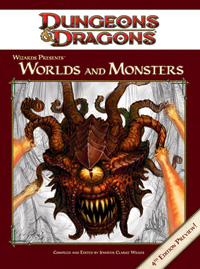
For Dungeon Masters, this is far and away the more fascinating book. This stand-in for the DMG speaks directly to the storytelling core of the game, and hints at the kinds of high-adventure tales we'll be able to craft later this year. The game world sounds quite interesting, both for its specificity and its vagueness. Races, for example, are quite specifically outlined. Tieflings, Dragonborn, Elves ... all have specific creation stories that PCs can share as a common background. Racial traits stemming from historical events will add a lot of texture to character portrayals. At the same time, much of the world is being left deliberately vague. This setting is described just enough to hang plot hooks on, but not enough so that as a DM you'll have to deal with backstory cruft.
The world they describe sounds quite interesting, too. They're calling the core concept "Points of Light". Adventurers are heroes living in a world mostly covered by the darkness of wilderness and the unknown. Small cities and villages dot the landscape, providing shelter and a bright spot in this darkness. The wilderness hides numerous ruins, leftovers from the rise and fall of ancient civilizations. The last great human empire fell about a hundred years ago, in the setting, and the result is something akin to the historical dark ages. Layered on top of this ruin-strewn landscape is a faerie realm, accessible via special holes in the world. Monsters live in the deep woods, and dark magics are hidden underground. It sounds like a great place to adventure.
The monsters section of the book clarifies a number of things about what D&D combat will be like in fourth edition, and speaks again to their goal of 'fun all the time'. 3.5 combat was balanced around the concept of a party fighting one creature of an appropriate level. It turns out? That tends to get kind of boring. Fourth edition combat, instead, is balanced around an equal number of opponents for the players. Having the concept of 'slots', where monsters oppose players on equal footing, and roles (not unlike PC roles) ensures that fights will be actually challenging. 3.5 fights tend to be either bloodbaths or total routs, with little room in-between for contesting the outcome.
That concept of roles has been applied to monsters quite deliberately. Balancing a monster party with Defenders, Skirmishers, Controllers, and Leaders will result in a mixed bag of interesting critters. Monster races that tended toward the generic have even been given a degree of specificity. Instead of Gnolls just being Orcs with Hyena masks on, they'll now apparently fight with pack tactics and cowardly tricks. Giving flavour to the opposition seems to be the basic idea: off-the-rack encounters will no longer feel so rote.
Again, the game they're describing sounds like a lot of fun. My frustration with this text was high on the price side, though. While the "Races and Classes" book speaks directly to the core of the new D&D game, and is a great book to throw at someone still griping about the lack of Gnomes, "Worlds and Monsters" seems like it's mostly a lot of set dressing. Set dressing which (I can only assume) will be reiterated in more detail in the core books. Did I enjoy reading it? Of course. It's interesting stuff. But twenty dollars for set dressing is hard to swallow, especially when we're going to have to repurchase that information in the DMG for another thirty bucks.
At a cost of forty dollars for the pair, it's hard to say if the extremely interesting content is worth the price of admission. In podcasts and commentaries WotC has said how they enjoy the 'DVD extras' model, where consumers pay a premium for 'behind-the-scenes' info. If you really enjoy that kind of content, or just can't wait the next four months for the core books, these will be easy buys for you. The ideal would have been if purchasing these books represented preorders for the core books. Pay $40 now, buy the core books for only $20 each? Anything to make this investment last past May? Instead, we're left with the reality that nothing in these books can't wait until June.
So overpriced... The joys of inflation :)
http://www.wizards.com/default.asp?x=dnd/welcome&dcmp=ILC-DND062006FP
My humor is probably your flamebait
... who feels like they may have simplified the most interesting parts clear out of the game, filled the gaps liberally with WoW, and ended up with a game that, admittedly, has a much lower barrier to entry but is also not particularly interesting?
I mean, you can make Monopoly a lot easier to play and simpler to learn if you ditch hotel and house building, the rent for each property is the same, and instead of rolling the dice to move you move one space each time on your turn, but would it be fun?
3/3.5E's not perfect by a long shot to me either, but what we've seen of 4E so far is honestly just not interesting to me.
If I wanted the annotated versions, to explain just what people were thinking when they designed the game, I'd either wait for that version or read their blog. So far I still havn't read anything to impress me about this system; nothing as drastic, experimental and "fun" (rtfa) as say, the player's option books were to 2nd ed.
Yes, we understand these tags always apply: fud, dupe, typo, slashdotted, topic name
I used to play D&D (and AD&D) a lot when I was in junior high (I'm a crusty old 38 years now). I had a lot of fun. Occasionally I browse through the computer games at the box store and see things that look D&D-ish. But, I think I really would like to have something that feels like the old "pen-and-graph-paper" game rather than the most awesome 3d graphics.
Is there a computer game out there that can give me that nostalgic experience? Or will I have to buy the books and get a group of like-minded geeks together for old times sake?
Tieflings are not half-anything, they are humans with a distant fiendish ancestor, showing only one or two traits of demonic heritage.
In 3.5 hybrid classes were rough to play; why would you want to play a Paladin (a weak fighter bolted to a weak cleric) when you could play one of the core four and do something well?
Are you -crazy-? Paladins are probably the most powerful class in DnD! Oft ridiculed for being the choice of people wanting to play "easymode", both RP and combat-wise.
I'm sorry, I could read no further. You claim to be a DnD vet in this beginning of this article, but obviously have no clue as to the intricacies of the game.
Caffeine is my anti-drug!
Duranin - A NWN2 Roleplaying Persistent World
Want D&D to run smoothly again?
1: The keywords here are "simple" and "straightforward". The current grapple rules are painful, many conditions make no sense (can a construct be nauseated? the answer may surprise you), and what exactly does polymorph do these days? You don't know. No one knows. It's been errata'd like eight times. If a rule takes longer than two or three sentences to explain, people have already stopped caring.
2: Fix stacking and inherited bonuses. The days of sixteen different kinds of bonus all adding up to push a character WAY off the random number generator have to end; at the same time, feats that provide an advantage so small you frequently forget about it also must end. Feats and abilities need to provide meaningful options without turning rolls into "no lose" situations.
3: Get rid of gold = power. The 3.5 conceit of assuming characters of level X would have Y gp worth of Magical Stuff ruined a lot of flavor and a lot of system. Let the GM handle the distribution of magic items, and let the PCs spend their gold the way it was intended: on ale and whores.
4: Fix the phrase "level appropriate ability" firmly in mind. At every level, every character should gain new abilities appropriate to that level. Every one. It's WAY too easy in 3.5 to fall off the level appropriate ability train for life.
5: Want to playtest? Recruit the twinkiest, most outrageous powergamers you can find. They're the ones that spot inane bullshit like Balor mining, chain-binding djinni, and the truly stupid amount of awesome that 3.5 clerics and druids bring to the table.
Since based on what I've heard so far, not one of these is actually happening (with the possible exception of #1), I am not optimistic.
"I have spread my dreams under your feet, Tread softly, because you tread on my dreams." - W. B. Yeats.
Minor correction - D&D 3e came out in 2000, not 1999. Thus it's been eight years since the last major revision, not nine.
I have thus far only ever been to one GenCon, and it was in 2000, and there was a big rush for the new edition. I remember it well. Scarred Lands was released to capitalize on this, and Exalted was postponed for another year because White Wolf didn't want to release their new fantasy game in direct competition with D&D.
Soylens viridis homines es
Many moons ago, I spent some time trying to write up some tools to generate characters in dungeons and dragons, to generate realistic sounding names. Shameless plug http://www.kirith.com/
I really thought back then that the online community would kind of take over. Have something like a wiki setup for role playing rules.
I've had experience with the various releases of D&D rule sets over the years. So I say if this one doesn't improve the game in any meaningful way for you, just play with you're favorite rule set or even modify your favorite edition. It is a game of imagination after all.
But on a slightly different note I have always found the core problem of the game, wasn't pacing or power curves or sweet spots. It was finding a competent DM. I grew up in a small dairy community on the Oregon Coast... So let's just say the pool of available and likable D&D players was quite small. And even smaller still were those willing to DM. I've often pondered why no one has made a software program that could DM once certain parameters were established. It seems AI in gaming has advanced to the point where this is at least feasible. Of course it wouldn't be anything as great as a competent human DM, but for those of us outside large urban centers it would of been a god send. Unfortunately for WoTC that is a chapter in my past that has long since been closed. I moved on to other endeavors, I'm just glad to have experiance the legendary D&D first hand as part of my adolescent life.
All that being said, Baldur's Gate 1, 2 & ToB was the pinnacle of electronic D&D experiance thus far. IMHO
I'm sick of following my dreams. I'm just going to ask where they're goin' and hook up with 'em later.
Although off-topic, strangely appropriate this appears just as GenCon badge/housing registration opens. Today housing for GenCon openned up and as always....server crawled and good housing disappeared in seconds. Good thing my wife and I both were hitting the site at the same time and finally got someplace to stay! Can hardly wait for the fiasco that will be event registration.
On topic: Although I purchased the 3.5 books, I never could really warm up to them. My style of GM'ing was to paint a verbal picture and allow players to make broad, heroic statements for actions and results. I thought 3.0 and 3.5 added way too much overhead in movement, combat, and feats that took away from some of heroic flair.
So, I'm looking forward to taking V4 for a test drive this August at GenCon just to see if anything gets me excited again about the game! Based on early reading from fans, maybe not. However, I'll give it a chance.
I love the sound of distortion in the morning -- webcommando
D&D --> Diku/CircleMUD --> Everquest --> World of Warcraft --> D&D
Adventurer 1: I spend my reward on new spells and potions how about you?
Adventurer 2: I spend mine on ale and whores...So you know cure disease?
I don't care the version, you won't lose some of the best "non-battle conversation"
Ask not what you can do for your country. Ask what your country did to you
The last update of the rules was released in 2000, not 1999. As for the review of the preview books, they give an interesting behind the scenes look at the process of development and why they're changing SOME of the things they're changing. But really, you should just wait until the game comes out and judge it in it's entirety. You may read about one change you don't like, and miss the 99 you would like, but weren't highly publicized.
"Teach a man to build a fire, and he's warm for a day. Set a man on fire and he's warm for the rest of his life."
What happened to "Ask The Designers of D&D Fourth Edition" that was posted back in January? Are we ever going to see a follow-up to this? Did they not like all the questions? Guess I shouldn't hold my breath...
Actually that's not really that bad. I still have every single 1st edition AD&D book, including the reprints with different covers, so I'm a bit of a hardcore D&D nut. If your into the collection of this kind of thing, the price is actually fairly cheap. Even if you are far in the poverty level, and unless you have some MAJOR debt issues in which case you shouldn't be buying toys anyways, 20 bucks a pop is nothing these days. Even with the growing recession. Until recently I made a whopping 9 grand a year. Woo. I only worked 20 hours a week at minimum wage, and yes I had bills to pay. I'd still be able to afford to get these things without saving for them. Now unless I misunderstood, the main gripe is that the same info is going to be in the core books. So your just choosing between the 'collector's edition' and the 'regular' version. It's a bit strange that they're releasing just the 'collector's edition' before the regular version I'll admit. But look at the price for these rulebooks in the past. They're always around 20 bucks at stores, and online purchases are a recent option. Bah, ramblign now. Little distracted at the moment, but I just have problems seeing the price as a problem. It's pretty much a standard price, and not too expensive. Especially considering the other things that cost 20 bucks (eg movies) and how much value this has over them (to me at least). Oh, and having multiple copies of rulebooks is always good. Around here, I've yet to talk to people with a gaming group that each person has their own copy of everything.
"why would you want to play a Paladin (a weak fighter bolted to a weak cleric) when you could play one of the core four and do something well?"
Because you're ROLE-PLAYING. Aren't you? You aren't just rolling dice and putting the business end of a sword into randomly-generated monsters to acquire their gold and +2 swords (+4 vs. randomly-generated monsters), are you?
In short: they're must-haves for hardcore D&D fans.
I'll bet there isn't anything worth justifying the price of the new books in there if you look at it honestly.
Called "Races and Classes" and "Worlds and Monsters", the two titles cover everything from character creation to the new default world's pantheon.
They've done that dozens of times. Races and Classes was originally called Player's Manual back when I was a kid. The pantheon book was Deities and Demigods, or optionally Greyhawk. It's been done and done and done.
This is what WotC does. Take it out, polish it, change things just enough to be incompatible with the last version, and resell. Expensively. Look at Magic the Gathering for another example. Each expansion came out with something that would absolutely devastate the previous versions - to stay current you HAD to keep buying it. And for tournament play you weren't allowed to use older sets either. That's why they called MtG Cardboard Crack.
This is just the latest round of "buy this update we need another injection of cash" from WotC. I'll pass.
Weaselmancer
rediculous.
I only started playing D&D seriously in 2006, so I missed the whole conversion from 2.0 to 3.0, but I have to ask. How many of the complaints about 4.0 were also made about 3.0 between its announcement and release? (MMORPG references naturally aside)
Technoli
Why do some people think that you can only RP if you pick a sub-optimal character?
If it's for-profit but free, you're not the customer -- you're the product (e.g., the Slashdot Beta's "audience").
Points of Light is a design ethos, not a campaign setting.. All the proper names and histories mentioned in the book are like menu items for you to pick and choose. There are no maps, no geographies, no time lines. They're all just things to inspire you, detailed vaguely enough for you to run with or ignore as you desire.
I often think that D&D should have a basic character generation book, a world book, and a monster manual. No real rules...no dice. Just stuff for ideas and basic gauging of relative strength. We'd have D&D sessions at recess (yes...in the 6th grade) just walking around the athletic field. That being said, I can see how MMORPGs are going to affect a DM:
DM: You are running down the middle of the street. A team of wild black horses pulling a demonic carriage is heading right for you.
Player: I dive out of the way onto the sidewalk and draw my sword as they pass by!
DM: You can't clear the curb with a jump. Do you want to think of something else?
Player: I spin to the side as the horses dash past and hamstring the lead, hoping to take them all down.
DM: You can't "spin". Do you want to attack the carriage or not?
Player: I attack carriage.
DM: You hit for 10 points of damage. The carriage hits you for 8 points of damage. You have 5 hit points left. Attack again?
Player: Sure.
This article needs a getoffmylawn tag. I know that this is hard for a lot of vets to understand but things change. The mentality of "they're just trying to make more money off of me" is accurate but that is the nature of business. If you want to turn a blind eye to the myriad flaws in the 3.X series feel free, but don't try to bring the rest of us down with you. This will probably be marked for trolling but the truth is the people who are complaining about 4.0 haven't played it yet and have only seen a sample of what it will have to offer and already are complaining. Change is often hard to accept, fortunately if they don't like it they still have their beloved 3.X(or AD&D even...). I just don't see the need to try to ruin it for the rest of us who actually are excited for/curious about it.
Uh... I hate to tell you this, but paladins *are* one of the weakest classes, statistically. While you're right that they're very easy mechanically to play, there's just no end-game benefit to them.
The druid and cleric are by far the best classes in the game, combining strong melee with decent to strong spellcasting. But let us examine the paladin in detail:
Full base attack bonus, great saves, large hit die. Sounds fantastic. Throw in some limited healing and smite evil, and it sounds pretty great. But, lets take it level by level.
For the first 4-5 levels, you're a below fighter, though above most casting classes, as martial classes are strong in this range. Sure, you have great saves and some limited healing, but needing to split your stats to have strong cha and wis too means that your con will be lower than the fighter's, so your healing just makes up for lower hp. Furthermore, at that level, adding your level to damage once a day isn't that great, as in DnD you are supposed to have 4 encounters per day. The fighter, meanwhile, is getting his way up to power attack, cleave, weapon focus, and weapon specialisation in this range. that's +4 to damage (if he power attacks with his 1 point of weapon focus) on *every attack*, which is what the paladin gets to add once. Sure, the paladin is slightly more accurate on that one hit, adding his cha to attack, but that just doesn't stack up.
Move on from there to the sweet spot, level 6-13. At this point, the casters start coming into their own. The clerics are getting their protections from evil, their searing lights, and all that jazz. The druids are getting into wild shape, turning into something that can beat you in a straight fight, while still having spellcasting on their side. The sorcerer is getting fireball. At this point, the fighter is probably hunting a prestige class, but is not yet feeling the hurt of the martial character. If he multiclasses well, he can keep par in power with the casters. Not so for the paladin. Sure, his smite is up to doing a decent amount of damage. Hey, he can even use it almost once per encounter. His healing is starting to get useful, but the cleric pretty much has that covered. More and more, he's hurting for feats as the fighter's build is nearing completion, and he still has just 3-4 feats to his name, leaving him to power attack with a greatsword, at best, for an average of maybe 15 damage or so (7 from the weapon, 4 from strength, 4 from a decent power attack), and probably 33 smiting (8 more from power attack, he's going to throw the cha in there, and another 10 from level), something that the wizard at this point can reliable get out of scorching ray, a second level spell. The fighter isn't doing much better, but at least with his huge number of feats, he's probably doing something cool. Leap attacks, maybe, which increases his power attack multiplier to x3, letting him do a lot more damage for the effort.
Then, you leave the sweet spot. The casters are so far beyond the melee characters that most of them feel useless, except occasionally the fighter, who may have found the right prestige classes to be exquisitely optimized into some sort of godless killing machine. Not so for the paladin, who would need to spare one of his precious few feats to multiclass, and even still, it'd kill his two big class features. His smite looks less and less relevant with each passing level as the monsters get exponentially tougher, gaining 10-20 hit points for each 1 extra damage he can do. That healing of his is starting to make him harder to kill than the fighter, but he can't back it up enough damage for it to ever really come up.
Over all, the paladin is crippled by having his special abilities have the per day usage issues of high-end spellcasting, but at a power level that puts it below or on
Haven't read the comments, and maybe this has already been said, but:
If you need specific instructions to tell you that one race might act/fight differently than another race, remind me not to game with you.
Vintage computer games and RPG books available. Email me if you're interested.
What the hell is Karl Rove doing on Slashdot?
Is it the best of the AD&D-inspired RPGs? I don't know, but I don't like what I've read so far. Besiders it will be hard to beat Hackmaster.
Seeing the price of the books, what I would recommend to a beginner is the following: Go to a used book store and buy a set of the excellent hardcover AD&D books by Gary Gygax. Why play immitations when you can play the real thing? I can buy them locally in excellent condition for $10 each. For the DMG, PH, MM1&2 and Unearthed Arcana you will pay $50, but you'll walk away with something substantial, historical and cannonical. You'll also learn about the real spirit of AD&D, which has since been emasculated by various marketeers who tried to cash in on the game (by targeting 11-year-olds). Also, the binding is built to last for decades, unlike the modern glue crap.
Many people are realizing the value of the AD&D, and several game cons are now hosting AD&D tables.
Did they bring back weapon speed factors and "vs. armor type" modifiers? And are there crude b/w drawings of bare-chested female monsters?
You see? You see? Your stupid minds! Stupid! Stupid!
The price does sound pretty high for what sounds like basically a pair of ads for the upcoming new core books.
Will the contents of these two books be worth much once the core books are out and I pay good money for them as well? (If I do that is...The system sounds a lot like a CRPG. Don't get me wrong; I play and enjoy WoW...it's just not what I'm seeking in a table top game.)
Personally, I'm going to wait until the first scans hit usenet and check them thoroughly before laying down my pair of twenties.
That much hasn't changed. To be fair however, that only counts as a flaw due to my personal preference. If I want hard skill levels, I'll just play an RPG on the computer. I like to do table top because of the drama involved in the characters and story. For that reason, I've always been a fan of Vampire: the Masquerade (and even Vampire: the Requiem nowadays). The character is more important than the character's stats.
"He who can destroy a thing, controls a thing." --Paul Atreides, Dune
Way too much of 4ed seems to be change for the sake of change, and little else. 3.5ed wasn't perfect, and could use some polishing; I like their idea of rolling related skills together and making skills either "trained" or "untrained" instead of putting points into them at every level. I also like that spellcasters won't run out of power after a few encounters. I like the fact that saving throws have a simple value like armor class, and you don't have to roll saves. I like the elimination of CRs. I like the elimination of critical hit confirmation rolls. Those are nice changes that streamline things without drastically overhauling the gameplay.
But why the needless changes? I liked bards as a base class. I liked gnomes (forgive me). Why bother changing the nature of Tieflings and Halflings? Why bother adding new base classes and, when the old ones were varied and useful? Why complicate things with the additions of "Power Sources," and replacing the long-standing magic schools with "Foci"? What's the point of these changes besides change for the sake of change?
And what's with all of the freaking WoW-like changes? Bizarre WoW-like "on hit" effects, talent trees, WoW-like racial feats... are they trying to market towards WoW kiddies? I doubt they're going to shell out tons of money for books and sit down, learn the rules and play with a pen and paper.
But maybe I'm just a curmudgeon.
still no sig
For those curious, the Tome of Magic and the Tome of Battle (aka Book of Nine Swords aka Bo9S) and the Warlock from Complete Arcane, and the Dragon Shaman from PHBII were draft 4e rules that were modified for 3.5ed.
If you can get past the balance issues with those books and the rest of 3.5ed, you can see the basic mechanics and approach that 4e is moving towards. (For those who haven't seen them, the Tome of Magic classes tended to be weak while the Bo9S classes are quite potent, at least compared to their "core rules" 3.5 equivalents)
I'll say that many players love the heck out of the 4e-type classes; they are generally easier to play and tend to always have something useful to do. The warrior classes have some high-damage attacks and special moves that make up for their innate lack of spells. The "magic users" have a smaller list of mostly unlimited use powers that tend to be useful in many circumstances.
The downside is that the magic-using classes are constrained in many ways compared to the traditional wizard or cleric, and that drives some people nuts. The arguement tends to boil down to "warlocks/binders/shadowcasters have less than a dozen powers available compared to the hundreds of spells a caster can prepare." On the other hand, I've never seen someone playing a warlock freeze with indecision the way a mage/cleric player might when staring at a couple dozen prepared spells.
DMs are much more divided but they are also concerned with making those classes work with 3.x games, so there are other factors influencing their opinions. I don't like the ToM and Bo9S in comparison to 3.x but as sample mechanics I'm pleased with them, just so you know where I stand.
I've been on slashdot so long I'm starting to get out of touch with the cool stuff if it ain't on slashdot.
What they really need to do is get rid of that stupid 20 sided die of pure chaos. Go to something like 3d6 for anything that d20 would be used. I and several of my friends quit D&D because of the absurdity of a single random fight with an archlich which we spent 5 sessions building up to. We run up and everyone hits it and both the fighter and the ranger roll their threat range and do double damage, so we kill it in a single round. After all the planning on both our side and the DMs side it turns out to be nothing. So the DM laughs and says "So I see you have killed my doppelganger..." which everyone knew was a joke and we fight it again. This time the DM makes things a little tougher and then the stupid fighter can't hit for 4 random rounds in a row. The lich ends up killing the entire party almost on accident. Afterwards we all just gave up on any game that uses d20, it is just too hard to plan a good fight when every single thing is so purely unpredictable.
Instead of Gnolls just being Orcs with Hyena masks on, they'll now apparently fight with pack tactics and cowardly tricks. Giving flavour to the opposition seems to be the basic idea: off-the-rack encounters will no longer feel so rote.
Do your monsters just stand there while adventurers come by with a wagon to take their stuff? If that's the case then you fail as a GM.
Tip: Doing some research on monsters you add to a campaign will give you a better idea about how to use them in fights. Even then there is nothing wrong with monsters using guerilla tactics and *gasp* cowardly tricks. There is also nothing wrong with your adventurers parlaying as opposed to fighting to avoid encounters.
It's called an imagination, use it.
-Reed
Anyone here played AGOT RPG? I got the book for Christmas last year and haven't really done much with it.
Any word one way or the other?
I played AD&D 2nd Edition when it was all I knew. After my introduction to GURPS, I never bought another D&D rule book.
Don't get me wrong. There is some really nice creative fodder that comes out of WotC; adventures ("modules"), campaign settings, and other color. I'll happily buy any of these (used, if possible) and convert them for play under GURPS rules.
I just recently (two days ago) picked up the 4th edition books, after being away from role-playing for almost 10 years. I think Steve Jackson Games hired a bunch of mind readers over there, because absolutely everything that bugged my old group about GURPS 3rd Edition (missile spell caps, concentrate maneuver delay, lack of real tactical combat options beyond feint [don't even get me started on the epic battles that boiled down to 'stab the bad guy in the eyes']) was corrected in the 4th Edition. It's a beautiful update to the best RPG ever.
Try it instead of D&D 4th; you won't be disappointed.
I couldn't agree more. I've complained to friends about this in the past. The 3.5 rules encouraged far too much micro-management. This level of rule building is great when it's applied to a computer game (NWN for example), which can handle this sort of thing quickly and seamlessly. For pen-and-paper playing, these rules are in my opinion nearly un-DM-able. How many tables do you have to reference when one of your guys is taking a swing at a monster? I certainly couldn't handle it.
Here are my concerns with 4e:
1. WotC has not responded to the "Ask the developers questions" that have been posted for over a month.... Not a single question.
2. WotC claims to still be playtesting and running into some major issues (War-Forged Palidins are nigh invincable). However, they are preparing to mass produce the books in order to ready for launch in June.
3. WotC wants ~$14.00 subsciption fee to continue to get online updates and erratas.
...a. It will also allow for "virtual tabletop" but from what I have seen, there are open source "virtual tabletop" systems that CURRENTLY offer more flexability... and are FREE!!!
.
4. 4e will introduce "level specific" items. The playtesting reports indicate that at 11th level, a NON-combative character (wizard) is ASSUMED to have +5 bonus to thier armour class....
5. You have to be 11th level BEFORE you can use a ring!!!! You need to be level 21 before you can use a second ring
6. WotC seems to be creating a "digital devide".... The virtual tabletop will contain/replace miniatures... But they want us to buy miniatures as well. To my knowledge, these are mutually exclusive in the 4e gaming environment.
7. Supposedly, WotC will be releasing a NEW Dungeon Master Guide and Players Handbook ONCE A YEAR!!! (however, maybe these will elminiate the need for online errata's???? Not a good deal either way, IMHO)
8. If this is a preview, why do we have to pay for it??? And, to the author, how is that "valuable"?
9. Now we need a new tag for "Hack and Slash-vertisement"
P.S. Please don't use the Gandalf quote of "There are many magic rings in this world, Bilbo Baggins, and none of them should be used lightly." to justify the level dependent rings... unless Bilbo was 11th level or higher at the time. ; )
If they died 20 years ago, why do I belong to a couple of extremely active mailing lists dedicated to specific roleplaying games, and why does my own Play-by-Email game have eight active players and a mailing list with an average of 70 posts per month?
What the fuck does the global economy have to do with anything? There was a major recession going on when some of the more famous games like Robotech came out.
The world's burning. Moped Jesus spotted on I50. Details at 11.
A recession is when tabletop games have a small surge because people can't afford luxuries like computers and game consoles and have to make due sharing 1 phb and dmg between 8 people.
"You can now flame me, I am full of love,"
There's a game I've been enjoying that feels like a D&D mass combat game to me. It's called Dominions 3 - there's a downloadable demo:
http://www.shrapnelgames.com/Illwinter/Dom3/6.htm
Wouldn't necessarily help if you wanted that more personal experience of adventuring with a small group, but if you like the idea of a turn-based fantasy conquer your neighbor kind of thing it's a lot fun.
The graphics are very basic, but the game itself is very involved, with many different types of units representing everything from Norse mythology to that of various Mediterranean & Greek cultures to monsters and creatures from Indian and Japanese fairy/folk tales.
As another poster mentioned, I don't think you'll find anything that feels quite like those old classic D&D tabletop sessions. The trouble with any video game is that it's almost impossible to allow you the freedom that a good DM gives you to go with your impulses and explore. Most videogames have a fairly linear storyline. Those that don't can be fun (eg. the Morrowind, Oblivion series), but no video game will ever have the freedom and versatility of a good tabletop campaign with a creative DM and fun players. If roleplaying is cooperative communal story telling, than no game developer can achieve that cooperative aspect without being able to talk to you and get a ton of feedback while the game is being developed.
...warlocks.
I tinkered with D&D back in the day, but never really managed to find the time or people to play with. When the first Neverwinter Nights came out, I had a great time making modules. It was a treat to use all my programming skills, entertain others, and generally have a good time playing with the setting and the technology.
These days I'm working on a new campaign for NWN2. The new engine is more challenging to work with, but it's quite pretty. I'm able to give my new computer quite a workout with all the new graphics features.
Ironically I'm 38 too, occasionally feeling old as well.
I tried this out with a small circle of LAN gaming friends for a while. We got networked together as usual, loaded up NWN, and I played the DM on some pre-made campaigns for the online version of this. The nice thing about it is I was able to add the actual role-playing interaction of impersonating various characters to the fast combat dynamics of NWN.
IMHO, one of the worst things about pen and paper is the sheer amount of time it takes to get through battles. With NWN most encounters are over in seconds. However, as the DM I have the power to adjust the difficulty of the battles on the fly. Either add more monsters if things are too easy for the PCs, or make up an excuse for some allies to show up or place some extra healing loot if the PCs are getting hammered.
That being said things got out of hand sometimes. I think the NWN DM interface is rather clunky even with some rather hackish script additions by players to give the DM more power. One time the players accidentally attacked a key NPC (unfortunately very easy to do in NWN) and no matter what I did, I could not make this NPC's faction neutral or friendly to the PCs. I had to inhabit that particular NPCs' body every time the players came to talk to her so that she would not attack on sight. Another time one of the players had managed to swipe a suit of armor that made him nearly invulnerable to everything in the campaign. This pretty much ruined all of the battles, and I didn't really have a plausible method for rectifying the situation.
I still think this is a great way to run a campaign. Real DM + computer gameworld and combat + actual roleplaying. I think there just needs to be better tools for accomplishing such a game.
Has anyone else ever tried anything like this?
Fascism should more properly be called corporatism because it is the merger of state and corporate power. -- Mussolini
Confucius say, "Find worm in apple - bad. Find half a worm - worse."
Or just download OSRIC for free, since it's specifically designed to consist of all the same rules as first edition.
http://www.rpgnow.com/product_info.php?products_id=29401&it=1&filters=0_0_10094
Space game using normal deck of cards: http://BattleCards.org
I noticed that the 'nerds' tag has made its appearance. I believe that there is some irony in that, but I have not worked it out yet.
Fascism should more properly be called corporatism because it is the merger of state and corporate power. -- Mussolini
Obviously I am not a DnD afficionado by any means, but...
It seems for the review that in order for a GM to think about a specific character class that he has to think about and understand the concepts behind the characters. Striker? Leader?
So not only does a GM have to think about:
The Campaign World
The campaign story arc
The existing player characters (and playing style)
forthcoming monsters, encounters, roleplaying opportunities, etc.
We are now introducing the concept of meta character classes?
No way!!! Its too much to expect a GM to work that hard for a part time game (How many GM's work at gaming full time?!?)
And Players... People see Lord of the Rings trilogy and say, I want to play a Halfling living in a hill.
GM: I'm sorry, Halflings are River people. Its a game balance thing. Dwarves live in mountains, and hills...
WTF?
Everything I hear about DnD seems like another step in the wrong direction.
I wont be playing it.
We'll have to wait and see about DnD 4.5....
Now I can go and spend money on prerelease books, before I go out and spend money on the real rulebooks when they're released? This is a new low.
They named a book "Races & Classes"? If I were an outsider who didn't play AD&D in Jr. High School back in the day, I would seriously wonder about what exactly was in a book entitled "Races & Classes."
Clearly my logical side is shouting them out, but my two reactionary brain cells are screaming something in a knee-jerk fashion about encouraging divisiveness in our society.
Well, I was the first to get D&D in my circle of friends. It was a basic set that came with chits. You'd draw a chit from a hat or something instead of rolling dice. The all inclusive manual was about 30-40 pages of 8.5x11 center stapled glory, with a blue and black on white drawing of a dragon on the cover. It came with a dungeon module, B1 - Keep it to the Borderlands (or something). I haven't played since the 80s. I gather things have changed a little.
When our name is on the back of your car, we're behind you all the way!
... I'm waiting for Hackmaster 5th Edition!
What wouldn't Jesus do?!
...how does 4.0 stack up? Will I be totally lost? What do I need to know?
Thanks,
-S
Trolling.
I see your informative link, and raise you a pithy comment.
But I was thinking the exact same thing. I played 1st Edition through to 3.5 and didn't really see the point in the third edition. I'll give this one a miss. I was reading the article and thinking, are they trying to make WoW? Isn't there already a D20 version of WoW? I feel like they're just trying to sell more books.
Read my short stories - You won't regret it.
Well, stop being ruled by the dice. A DM/GM should be assertive enough to say "You know what, that roll is absolutely nuts, so this is what happens". I have absolutely no problem ignoring dice rolls that create this level of uncertainty, and in many such situations, I will be ruled by common sense, or in short, I won't roll the dice at all.
The world's burning. Moped Jesus spotted on I50. Details at 11.
Here's a good starting point to minmax a druid. Poke around on the charop boards - druids really are far beyond non-caster classes for raw combat and at least in the running compared to clerics and wizards for batman-grade utility.
http://forums.gleemax.com/showthread.php?t=733400
Why I'd even want to play D&D.
I played a lot of AD&D2, then left it behind in university. Last year I played a 3.5e campaign with a good group of adults--they took it seriously enough to have fun, but not so seriously it turned into a room of rules lawyers arguing hypothetical physics. We also had figures on a large map, and a good DM who kept everything moving. Even then, it was a slow, tedious process of rolling dice and resolving game mechanics more often than character development or plot excitement.
Compare this to WoW, where the archetypes described in the review have been established for years. Seriously, it's strange to read the reviewer talking like 'tanks' and 'nukers' are some new invention by WOTC. The game mechanics are nearly flawless in comparison, just as detailed if you're into comparative spreadsheeting, and the complaints of the community about balance and game logic are actually resolved in free patches every few months.
In comparison, playing D&D seems like a crack addiction with WOTC continually churning out expensive books in bogus generations, with followup expansions that cost still more and don't resolve basic issues in gameplay because they're too busy introducing new races/classes/skilltrees.
In short, D&D seems seriously past its time with MMOs providing a much cleaner, more fun experience. What does D&D still have that I can't get for less money online?
Anyone who loves or hates any language, platform, or manufacturer, doesn't know what they're talking about.
Someone gave a chubby-chaser a set of colored pencils and he has gone all out.
The book is worth reading (in a store, do not for the love of God give them any money) for quotes like "Strong, sensual, earthy and feminine, with an exotic beauty no one would think to splash a beard on."
It's funny *on purpose*.
There are other glimpses of humor that let you know the people who wrote this book know just how lame a bunch of the other stuff actually is.
The good and new comes from no quarter where it is looked for, and is always something different from what is expected.
(d&d3 + earthdawn + wow) / 7 = d&d4, I see.
... not even "first time is free" to get them hooked
"Preview"+20USD = yay, open beta for pay
Anyone else notice parent used the term '2D6' to flame someone over dnd. Busted :o
Addendum: I have no complaints about this, the GM wears the viking hat and his rule is the rule of the table. But please, please, please tell your players when the game starts that this is the intention.
As someone who has played and run both no-powergaming, story-centric games with frequent dice-fudging, and twinked-to-hell, whatever you can get away with games where the dice are LAW, very little breeds more ill will at the table then expecting one kind of game and getting another.
"I have spread my dreams under your feet, Tread softly, because you tread on my dreams." - W. B. Yeats.
[insert witty quote here]
You know, I had a discalimer that I was kidding, but I thought, no, the rash of people taking my silly posts (and themselves) WAY to fucking seriously must have been an anomoly, so I deleted it.
Guess I was wrong. The dumbass brigade is here to stay. The geek community never used to be so anchored by ideology. Used to be everyone was open for a good potshot. Ah well, the world moves on... and downward...
It's "halfling", with two Ls.
Am I the only one who is a little worried and/or sad that D&D 4th Ed seems to be written entirely by combat wonks, and seems to be pressing firmly further and further from any world-modeling aspects at all, further and further into the realm of pure mechanics.
I see the Warblade as the symptom of this: powerful, fun in combat, and yet, without any real connection to modeling any sort of real or even imaginable ability or scenario.
D&D has always been on the far abstract end of the realism ... abstraction continuum, but this is going a little overboard; now, the fighter will only be able to do THE NON-MAGICAL THING HE LEARNED HOW TO DO three times per day? Or four per encounter?
I feel that D&D has jumped the metaphorical shark. It is no longer a useful modeling system for pretend games, and instead is merely a mechanic system for the next generation of D&D based videogames.
Those are great suggestions, thanks!
I never have frustrations, the reason is, to wit:
If at first I don't succeed, I quit!
I don't know GURPS being the "bigger" thing, and between 3rd and 4th editions I have enough books to choke a donkey. Each system has its own philosophy of character growth. I differentiate the two saying that D&D is designed to get characters moving relatively quickly up through power levels. Even though characters only beef up their skills when they pass that invisible "level" limit, it is the "epic" system in which characters will more quickly change their role within their environment.
Meanwhile, GURPS character growth tends to be much slower, and the bolting on of brand new abilities ("feats," if you will) is a rarity. GURPS is the "flat" system, which is better suited to characters who may improve more slowly over time, and who occasionally change their station significantly (when they get enough points saved up for a major purchase).
I won't say they're apples and oranges, but each is suited to its own style of play, which makes comparison less meaningful. Personally, I prefer GURPS too, but that may just be my prejudice against level-based systems talking. It is possible for both systems to coexist because they fill different niches.
As for play style, the "dungeon crawl" is a stereotype. Some people are realizing that it's as much fun fighting on the way to the fortified underground complex as it is fighting within it. And other pastimes are available. That was one of my complaints about Traveller, originally: some gamers wouldn't think past ship-to-ship combat, shipboard combat, and working starports looking for cargo. Then I realized: it's not the game's problem, it's an issue the players have. Same with the "dungeon crawl:" it's not the game that fences them into it, it's just what many players do with it.
And there are other systems, too; D&D and GURPS only take up two bookshelves of the seven or so I need to hold all my gaming books. Many do enough differently that direct comparison between them is futile.
I'm nowhere near Greater Boston, but that sounds refreshing. My current group is getting a bit hidebound, and I've no other places to turn.
You cannot truly appreciate Dilbert until you read it in the original Klingon.
Or to save you a trip to the shopping cart (plus I think you have to register at rpgnow first) you can also download OSRIC here.
I wanted the real AD&D rulebooks so I headed off to paizo.com to buy the some PDF rulebooks. At $4 a pop, I got the PHB, DMG, MMs I&II, Unearthed Arcana, Oriental Adventures, for a total of $24. Not bad. The scans are decent, but nothing beats the real thing. Can't seem to find Hackmaster though.
They've managed to turn it into a MMORPG, a Massively Mangled Offline Role Playing Game. Because the D&D Online worked so well... *sigh*
Anyone else notice that if you roll 2d6 you can't POSSIBLY get a 1 and you rolled a fumble on the joke spot check?
Layne
I've been wanting to play for a long time but never have (until recently). The stars finally aligned recently. My friends seemed mildly interested and I found some books that apparently fell off a truck or something (**cough** torrent **cough**) so I managed to read a little of each of the core 3 and downloaded and printed out a short module for 1st level PCs. It was a hit so I got the real books (I find pdfs made from scanned jpegs hard to read, but they did the trick for finding out that the group really was interested).
Anyway... I've read like a hundred pages or so into the PHB and DMG (3.5) and am a bit daunted by how many little rules there are. That first session went pretty well, but I had to BS my way through most of it... mostly calling on vague memories of how things worked in Neverwinter Nights.
The same time I got the books, I picked up the Dungeons & Dragons Basic Game. That was fun but was too limiting and I wasn't comfortable modifying it too much.
I'm getting the idea that my players want a whole game world I create, but that seems a daunting task and generic settings will probably suffice for a time while getting used to the rules. I'm just worried that might take too long and they'll lose interest.
So, that's some background. I'm just looking for some tips. What pages should I have memorized? Any tricks for simplifying the more complex systems (I haven't even looked at grappling rules)? I've googled a bit, but mostly find stuff for experienced DMs... got any links more useful to newbies?
I'm guessing there's nothing but experience that will help me get familiar with the rules but any other tips would help.
Grow a dick, faggot.
You don't have to buy these books to see what 4th is like. They are collectors items, fanboyish treatises... But, there is some cool stuff in these books. My solution was to have one member of our (Large) gaming group buy the books, and then we passed it around for a few weeks and all got a good look.
But, really, there isn't anything in the books you can't find either on ENworld or the official website (And, for a few months, D&D insider is free and you can see everything they post on.)
Alot of the issues commenters are bringing up have also been addressed, directly, by the R&D staff mixed in with the Gleemax Staff blogs.
So, here's where you ought to go if you're on the fence or curious. Then you can come back and contribute to the 4th ed discussion... because most of these comments have been dealt with by -someone- in R&D.
http://www.enworld.org/index.php?page=4e Huge dump for 4th edition facts and rumors. http://preview.tinyurl.com/2fe6br Gleemax R&D Staff blogs. Alot of playtesting. http://www.wizards.com/default.asp?x=dnd The official page. Design and Development and Ampersand are really the informative columns. You need to sign up, but it's free, and wizzards forum accounts / Gleemax transfer over cleanly.
Gurps is DIFFERENT. Gurps is better for a more human scale game. D&D is better for a mythic/heroic feel.
Utilizing the synergization of benchmark e-solutions to pre-workaround action items!
Luckily, you only need one of the party with specialist skill - detect irony ;-)
The fixes sound intersting - my background is 2.0 and up, though 3.0 sucked so bad we dropped it.
Some of my issues with 3.x:
Experience curves - you'd be level 20 in like 3 months. That's just silly. Apparently today's ADD claiming youth can't handle a game that doesn't 'ding' them ever few days. Wonder if this is in 4.0 (and yes I immediately changed the xp tables)
Death of multi-class. There was little point in being a 10th level x and a 10th level y - the 20th level x in the party would make you useless. Prestige classes just as bad. Why bother.
No more hobbits. Apparently all the years of Gygax (when he is sober) claiming that LOTR had no effect on the development of D&D caused them to make halfing simply minature people - that or the 'short fat' people in the world bitched until they were gone. I liked having hobbits in the game. (yes yes I promptly changed this too...)
I could go on and on but blah...bottom line is the d20 system sucks. I HATE that they snapped up so many franchises for it.
On to 4.x...from this article...
Sooooo will we be denying the WOW affect on this for the next 20 years as well? This thing reads like a dice version of WOW. Not a bad thing perhaps, but I'm starting to wonder why they are calling this D&D. I suppose the 1.0 people thought the same thing when 2.0 came out, but at least you could identify 3.0 as D&D.
All this aside, it would be nice if they come up with something cool. I was burned so bad by 3.x, I can't help but be skeptical. Time will tell.
EK
It sounds like they've tacked on mechanics from WoW to D&D. Sad...
There's some interesting comments I've read regarding the change to fourth edition. As a GM of long experience, I'm very curious to see where they'll go with the rules. The decision to model talent trees or ability trees, similar to both WoW and FFX I'm guessing, is one based on expedience - one problem with the feat system was that Joe the player could pick and choose, either going for the min/max/munchkin status, or making some really really bad choices (You want +4 to your SCULPTING skill?). The 'tree' system allows an entire tree of abilities to be balanced as opposed to a "gravel quarry" of abilities. I see the logic here, I really do. I'll just have to see how the things work out.
Now to you silly people who think pallys are 'sub-par' - it's all in how you play the game isn't it? Most Paladins are going to have high levels of charisma, somewhere on a level with social rogues or bards. Of course that bonus will get added into saving throws, blah blah blah. If you're in a game where saving throws are REALLY important, then play a guy that has ten first level classes. Paladins are holy knights - taking ten levels of cleric may be awesome from a rules mechanic viewpoint, but your church, your god, and possibly your country know what a lvl 15 Pally looks like - and what a lvl 5 pal/lvl 10 cleric look like. A level 15 paladin has a lot of things going for him - he hasn't fallen and that demands some respect - he's probably known to the local rulers and kings on a first name basis. I've played a couple of paladins in 3.0 and 3.5 - in one campaign, the pc pally needed a big S on his chest as he was everything you expect out of Superman. In the other campaign, the pc pally was part of a religion that believed in working hard and playing hard, so his entry into the campaign was interesting - the pc pally was 'entertaining' a lady of the evening at the time (Viking Paladins ftw - it was a very NSFW campaign).
Like all characters in D&D 3.0-3.5, it's all about the combination of game mechanics and NPC/PC interaction. Your game mechanics can let you kill a monster - your PC/NPC interactions can raise armies, rule a kingdom, or anything else.
He didn't miss the joke, you missed the point.
Because I'm not a power gamer. Because I think a flawed character can be more interesting.
Two of the most interesting (and fun!) characters I've played have had serious problems. Without getting into a whole "No shit, there I was..." thread -- One was a Gnome Illusionist/Fighter. He had a high INT, but a low-average STR. Unfortunately, he didn't want to be an Illusionist, he wanted to be a Fighter. So he had the biggest sword and heaviest armor he could use, and was completely incapable of casting spells dressed like that. The other character was a Jester, a class I wrote for a Dragon Magazine April Fools issue back in the mid-80s. I rolled okay for INT, low (<10) for everything else. I rolled a miserable 5 for STR. He couldn't lift a sword, much less swing one. The DM declared the character hopeless and told me to roll a new one. But I decided to play him as-is. On the whole he was detrimental to the party, but we all had a lot of fun in that campaign.
In both these cases I intentionally played characters much less powerful than they could have been. Why? Because sometimes you get tired of playing Generic Badass #13, min-maxing your abilities to within an inch of the rules. Sometimes you get an interesting character concept and just want to run with it.
Chelloveck
I give up on debugging. From now on, SIGSEGV is a feature.
to that! A post-apocalypse without mutants and magic - ah what a welcome change that was to D&D.
damaged by dogma
I'm surprised it took so long for someone to suggest Dungeons and Dragons Online. I played for around 6 months (aka as long as my marriage could take it) and found it was a lot of fun and had many players who know PnP and were into the game because of the similarities, especially as compared to WoW. Admittedly, I hadn't played PnP in 20 years but I've looked for computer versions of DnD before and nothing else came close. I actually think that the combination of "real-time" action, in-game voice chat and single-click action improves game flow dramatically over PnP, while the developers have done a great job of mixing up challenges and limitations so as not to make the game a simple click-fest. Just to mention a few of the thoughts expressed in this thread, there are many great non-damaging spells (sleep, web, rays to lower most monster attributes) and the quests are set up to require the skills sets of several character classes after a while. I'm not a great or very frequent gamer, and I imagine that many have valid criticisms of DDO, but I for one heartily recommend it.
Also, the lich was damn stupid if he didn't have half a dozen defensive spells up to punish you for getting that close to him. He had it coming.
Karma: Terrifying (mostly affected by atrocities you've committed)
May I suggest another roleplaying system? If your focus is on storytelling and social combat, you're better off with a combat-light system (such as a White Wolf game, Dogs in the Vineyard, or a random Steve Jackson RPG)
As for me, I am reserving judgement. I happen to *like* combat, and though I usually streamline stuff (grappling) I like to play it straight; I usually find that once we know all the rules, then we can go to town and throw out encounters that would normally take 2 hours because of all the errata (except we either know it, or we know enough to fake it quickly)
The point being what? Is it that D&D uses a percentile system, or that it's impossible to get laid playing D&D? Because, if I knew, I wouldn't be carping about it.
It wasn't funny though. To the point where it was hard to see what you thought would be funny.
Monopoly, Karl Marx style? She's playing this on the campaign trail?
You just mean she's a socialist? Thanks for the update.
Having just read the review, 4.0 sounds like it smacks of officious, erudite pedantry, and abject sophistry regarding game mechanics. It appears as if it addresses some endemic lack of player imagination, and goes on to describe things using corporate phrases. I half expect to see "Mission Statement", "Goals and Objectives", and "Roles and Responsibilities" appear somewhere in the manuals.
And talent trees? Maybe I should whip out my old WHFRP character generator I wrote in LISP years and years ago?
Tieflings? Lilith babies and Lebens...sorry...Dargonsborn? It feels almost Second Life-ish.
"Defenders, Skirmishers, Controllers, and Leaders" ?! New buzzwords? Marketing? How about, "Druid, use your +2 Blackberry, while I use my Sprint Boots to traverse the Dell and gather some Intel!" What happened to role-playing, and going with the flow?
The rules are not legal rules. They are guidelines. They're there to ensure - mostly - that given the same kind of events, a player may have reasonable expection of the range of results for a chosen course of action. That's all. It's to prevent brats from saying, "But I, Pez the Flatulent, hit the dragon with my butter knife. I should cause the same amount of damage as Findik the Regular, with his Chainsaw of Mad Cutting!"
Instead of debating how the system will lock you into a particular style of play - it's still not an Online-Only game, where you can move only where the cursor goes - why not just use the parts you like, and run your own, fun, happy campaigns?
-v.
"Hobbit. Hafling is racist."
After all, this /is/ about D&D. Everyone loves trolls (either playing or fighting them) in D&D.
Christopher S. 'coldacid' Charabaruk -- coldacid.net