Slashdot Mirror
Domain: aaas.org
Stories and comments across the archive that link to aaas.org.
Comments · 151
-
Re:Sounds like an excellent reason...
Cutting our military budget by 90% would put us down near Ghana and Nigeria. U.S. military spending is huge simply because the U.S. economy is huge.
Calls to slash military spending made sense in the 1950s and 1960s. But currently it's just slightly above the world average. If you account for Japan and NATO (whom we're obligated to defend by treaty), it's pretty much at the world average.
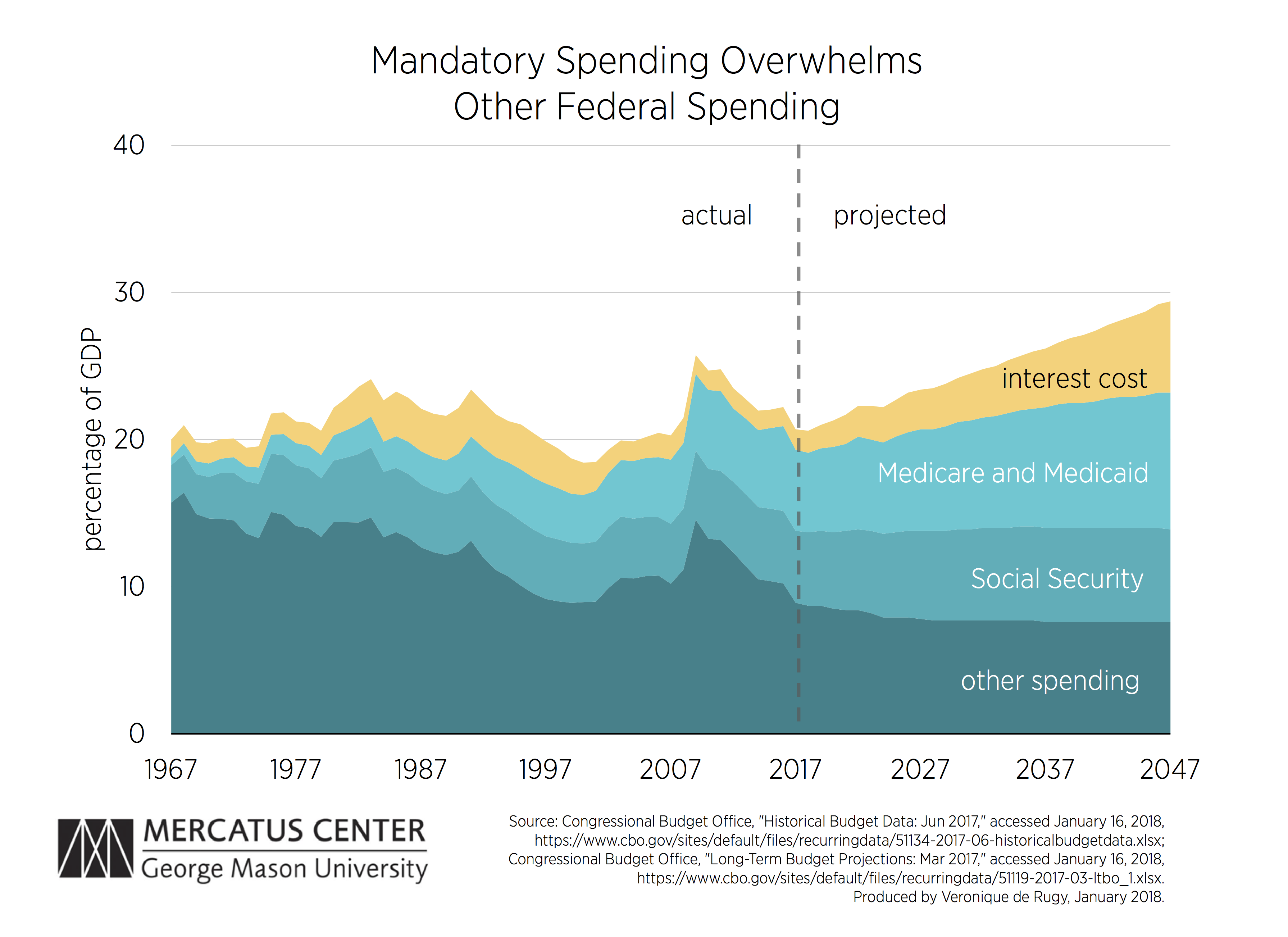
BTW, the biggest budget items are Social Security, and Medicare/Medicaid. They're the programs whose growth is bursting our budget, and what we need to get under control if you want to pay for everyone to go to college. Even if you completely eliminated 100% of military spending, entitlement growth in the next 20 years or so would eat up all that savings. Like it has already eaten up the savings from cutting the military budget from the 1950s/1960s.
I highly recommend you read the CBO long-term budget projections to understand what exactly is causing excessive growth in government spending. -
Re:Dude, it's been 30 years
Um, where do you think a lot of basic research money comes from? NSF funding is tiny compared to what DOD spends. That MOAB funded a lot of basic science researchers.
-
Re:I'm not surprisedCongratulations. You got everything wrong. Even by randomly guessing, you should've gotten half your statements right.
we keep cutting funding to education and research.
Spending on education is up.
Non-defense R&D spending is up.Companies don't innovate. There's not enough money on the table to make it worth while. Aside from the occasional bored aristocrat it's mostly been the government that financed innovation; usually through the public university system. But nobody wants to pay the taxes for that.
Corporations spend roughly twice as much money on R&D as the government.
Heck, we just borrowed $1.5 trillion over 10 years to finance massive tax cuts
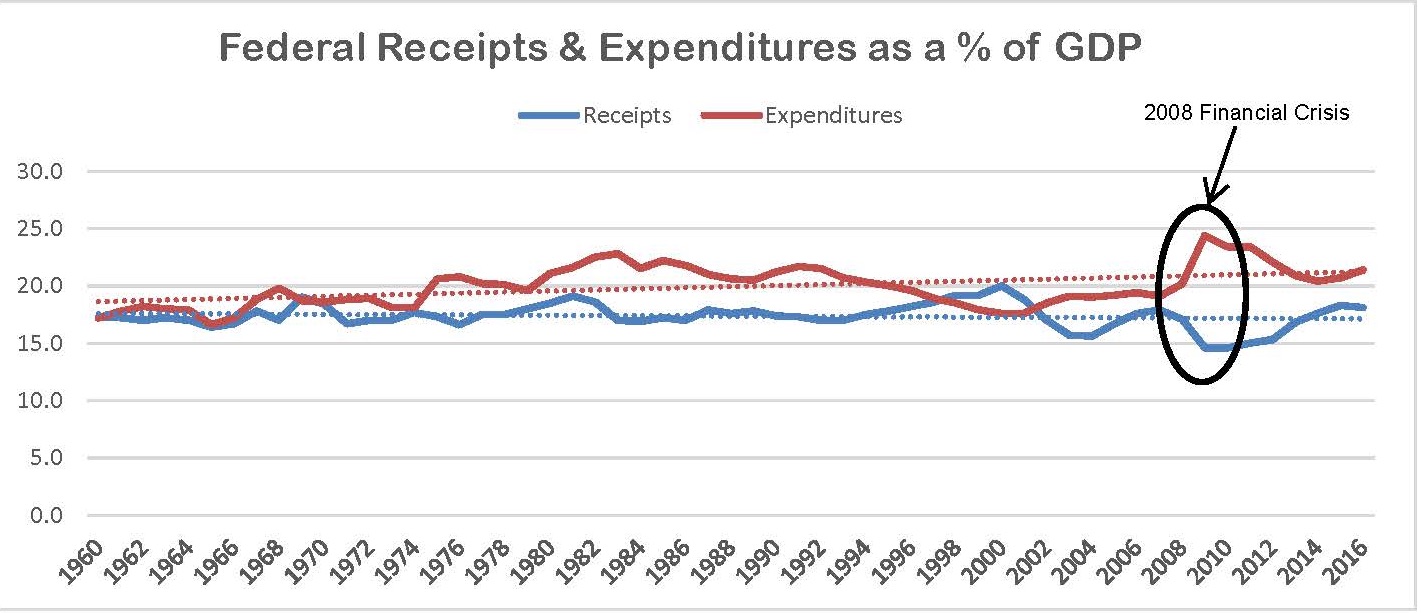
The last major tax cut was 15 years ago. The drop in tax revenue in the last decade was due to the recession following the collapse of the housing bubble. Currently, tax revenue is back up to "normal" levels (if you define the highest it's ever been historically as "normal").
What's busting the budget is a refusal to cut spending to match revenue (notice the trendline for tax receipts is flat, while the trendline for spending is climbing). This is primarily driven by growth of entitlement programs. The CBO has been warning us about that since at least 1998 (when I started reading the CBO reports).
And before you claim we should balance the budget by paying more taxes, consider that the tax burden in the U.S. is already among the highest in the world. People claiming U.S. taxes are low usually only look at Federal taxes, and fail to account for state and local taxes. U.S. tax burden is the third highest of the 20 largest economies in the world (only France and Italy have a higher tax burden). That's right, Americans pay more taxes (as percent of GDP) than socialist countries like Canada, the UK, Germany.
Summary even states that the main reason the U.S. dropped was because of low percentage of STEM college graduates. -
Re:News flash, that's how it works
Historically, contributions by the communications industry has favored Democrats (every year since 1990, except '98 when they were equal). 3/4 of the top recipients are Democrats. That's even more incredible when you consider that the party in power usually gets more lobbying contributions. The Republicans control the House, the Senate, and the Presidency, and the Democrats are still receiving more lobbying money from the communications industry. (You can drill down to the cable or telecom subsets if you want. The general trend is still the same - Democrats receive more lobbying dollars from these industries. Telephone utilities are one of the few subsets whose lobbying contributions consistently favor Republicans.)
The notion that Republicans are in the pockets of corporations in these industries while Democrats are not doesn't correlate to the lobbying money trail, suggesting that it's a narrative that's been manufactured by the media (i.e. fake news). The same thing happened with science funding during Bush 2's term. The media so badly misportrayed his science policies (excessively focusing on killing the Superconducting Super Collider and his ban on fetal stem cell research) that most of the public still think his administration was anti-science. Ask yourself - based on what you heard on the news, do you think Bush was pro- or anti-science funding? In fact his administration enacted the biggest increase in Federal science R&D funding since Bush 1 and the 1960s space race.
You can even see when this started to happen. Up until 2000, contributions by the print, publishing, and newspaper industries only slightly favored Democrats. But from 2000 onwards, it's skewed to wildly favor Democrats, by about a 5:1 margin today. Around 2000, the media stopped trying to remain unbiased, and skewed unabashedly towards the left. (My guess would be the appearance of Fox News favoring the Right meant the rest of the media felt they no longer had to try to restrain their bias favoring the Left.)
Health care is more of a mixed bag.
Don't believe everything the media spoon-feeds you just because it confirms your pre-existing biases. Do your own research to see where the money is flowing (to and from). The Open Secrets website is a great tool that's organized to be very easy to use. -
Re:As long as education doesn't take a back seat..
It's interesting to note the organization you mention chose to turn 'Military Industrial Complex' into the phrase 'Educational Industrial Complex' when in the same farewell speech where Eisenhower coined the phrase 'Military Industrial Complex' he also warned of the risks of the rise of a scientific-technological elite. Which has always been soft-pedaled or ignored by the pundits who carry on incessantly about the M.I.C.
-
Re:And what's the point?
Because unfortunately, most people are wired to give more weight to a few standout examples rather than to the overall trend. e.g.
Actually, what's really unfortunate is that people such as yourself seem to be wired to mislead and deceive people with deceptive statements that are at best, a carefully contorted truth, at worst, an utter lie.
What makes you behave that way? I think you'd lie even when the truth would be more persuasive.
Planes are safer than cars, but many people are afraid of flying when they don't think twice about getting into a car.
I don't know anyone who I consider responsible that doesn't think about the caution needed for driving. It is, in fact, a serious issue, for which millions of dollars are spent. Why do you concoct such a fabricated story? Why do you ignore people's real efforts for automotive safety?
People oppose nuclear power because of Fukushima and Chernobyl, when statistically it's the safest power source man has invented. (Yes, safer than solar and wind. They kill more people per unit of energy delivered. The only reason they don't kill many people is because they don't generate much electricity, and when they do it's scattered one here and one there, instead of all concentrated in one place.)
Nope. People oppose nuclear power because Fukushima and Chernobyl demonstrate the incompetence and the potential pitfalls for it to cause catastrophic levels of harm. Nobody wants that hanging over their heads, and the people who run the nuclear plants show they can't be trusted to behave even remotely sensibly.
And of course, the excessive costs are a problem. Despite all the promises, they still manage to demand more and more money being poured into their coffers.
We would indeed be much safer with a dispersed and less harmful system, where we don't have to worry about one entity with no sense of caution or consideration blowing us all up. But even without that, at least we won't be their money tap.
The general belief that child abductions by a stranger are a serious problem, when in fact they represent only 0.01% of missing children cases.
Child abductions by a stranger are a serious problem. You must be confusing "serious" with "widespread" as it seems you don't know how to express yourself properly, or you'd not be dismissing what is a real concern.
Bush Jr. being perceived as anti-science because of his opposition to fetal stem cell research and killing the superconduction super collider, when he's actually responsible for the biggest increase in Federal non-defense R&D spending since the space race.
Wow, money poured into R&D. That makes up for his complete lack of interest or understanding in actual science. No wait, it doesn't. It just means he turned on the federal tap, which usually conservatives find to be a bad thing. Now you're trying to make hay over it? Whatever happened to fiscal responsibility? Oh wait, Bush Jr. was the same guy who funded Solyndra and dozens of other failed companies, then acted like he was innocent and it was all Obama's plan. A good way to take credit and pass the blame to somebody else.
And what about your failure in history? Who would blame Bush Jr. for something cancelled when he wasn't even holding public office? Now Bush Sr., he should be criticized for letting a plan be promulgated which spiraled out of cost estimates, but he was out of office himself when it was cancelled, due to the efforts of actually fiscally responsible individuals.
Clinton's only mistake was not prosecuting the scammers who had already defrauded the government out of billions.
If you want to lead people to a conclusion opposite of the facts, presenting a fe
-
Re:And what's the point?Because unfortunately, most people are wired to give more weight to a few standout examples rather than to the overall trend. e.g.
- Planes are safer than cars, but many people are afraid of flying when they don't think twice about getting into a car.
- People oppose nuclear power because of Fukushima and Chernobyl, when statistically it's the safest power source man has invented. (Yes, safer than solar and wind. They kill more people per unit of energy delivered. The only reason they don't kill many people is because they don't generate much electricity, and when they do it's scattered one here and one there, instead of all concentrated in one place.)
- The general belief that child abductions by a stranger are a serious problem, when in fact they represent only 0.01% of missing children cases.
- Bush Jr. being perceived as anti-science because of his opposition to fetal stem cell research and killing the superconduction super collider, when he's actually responsible for the biggest increase in Federal non-defense R&D spending since the space race.
If you want to lead people to a conclusion opposite of the facts, presenting a few contrary examples is a great way to do it. That's why people are obsessed with assigning credit or blame for specific incidents. Kudos to you for seeing the forest despite the trees.
-
Re:Steve McIntyre of Climate Audit Will Be Happy
Great, more podcast deliberate misinformation bullshit is just what the world needs. Please take a look at this graph from the American Association for the Advancement of Science, follow the yellow line (=all of environmental science spendings) and tell me again where those mystical $1.5 trillion in research grants came from. They are all just in your delusional head. The Iraq war is supposed to have cost around $2.4 trillion in total by now, but that's only possible because the US spends way more on its military than on science in total and we're looking at the cumulative spendings.
-
Re:Justice.
It's gone up and down, but mostly up.
http://www.aaas.org/sites/default/files/Agencies%3B.jpg
Without spending time to do anything other than a quick eyeballing of that graph, it seems largely static when you exclude the DOD & NIH.
-
Re:Justice.
It's gone up and down, but mostly up. http://www.aaas.org/sites/default/files/Agencies%3B.jpg
-
Re:Yeah.
Bush said that in January 2004, towards the end of his first term. Despite all the flak he gets from the left, he is responsible for the biggest increase in science R&D in the last half-century.
-
$140B now.. How much more?
It's been down since the Great R but we're at $140B for FY2016, how much more should we spend there billy? Under Dubya it was up to was about $20B more.
-
Re:scientific consensus
Wikipedia, Merriam-Webster, and American Association for the Advancement of Science, among others, disagree with the claim you just made, and that's just picking some of the hits from using Google.
-
Re:NIH increase == keep the lights on
NIH got a massive budget increase under Bush, nearly doubling their budget. Obama has been more or less holding it constant (slight decrease) at that higher spending level (nearly half of all Federal research spending).
If a decade after a huge budget increase, maintaining that level of high spending is considered "keeping the lights on," then it's no wonder we have a massive budget deficit. Perhaps NIH should have its budget reduced to Clinton-era levels for one year so they can once again appreciate just how much more money they've been receiving. -
Re:Acronym AAAS means what?
AAAS = American Association for the Advancement of Science
-
Re:Does it matter?
Well, I got it from this XKCD. And he got it from this report by the American Association for the Advancement of Science. The trouble is, the AAAS seems to have changed around their website since then and the report is either no longer available or is just no longer findable by me.
So there you are. I'm willing to trust the XKCD guy, he's always been pretty diligent, but you can go hunting for the original document if you'd like. -
Jane/Lonny Eachus goes Sky Dragon Slayer
If you have actual, direct evidence, why did you not link to THAT, rather than somebody else's claim? [Jane Q. Public, 2014-12-14]
I linked to reviews of actual, direct evidence by the U.S. National Academy of Sciences and The Royal Society (U.K.) in their joint publication (PDF), and another review of evidence by the American Association for the Advancement of Science, which publishes the journal Science.
While Jane is reading those reviews, he should also consider addressing this issue with his basic thermodynamics:
Your own insistence that power in = power out (assuming perfect conversion and no entropic losses) belies this argument. You are arguing against yourself and you refuse to see that. If power in = power out (your own stipulation)
I'm not the only one insisting that power in = power out through any boundary where nothing inside is changing. Once again, that's a fundamental principle called "conservation of energy". Here are some introductions: example (backup), example (backup), example (backup).
As you can tell, conservation of energy is a fundamental physics principle. Assumptions of "perfect conversion and no entropic losses" aren't applicable, and anyone who mistakenly thinks they are should read through those examples to learn about conservation of energy.
If power in = power out (your own stipulation), and the only NET power INTO a defined spherical region is electrical, and the only NET power OUT of that region is radiative, then net radiative power out at steady-state must therefore be equal to the net electrical power consumed. [Jane Q. Public, 2014-12-14]
Jane seems to be saying that at steady-state:
net electrical power consumed = net radiative power out
But net radiative power out of a boundary around the source = "radiative power out" minus "radiative power in", so the equation Jane just described also says:
net electrical power consumed = "radiative power out" minus "radiative power in"
However, this new equation doesn't match Jane's earlier equation:
My energy conservation equation is this: electrical power in = (epsilon * sigma) * T^4 * area = radiant power out [Jane Q. Public, 2014-10-08]
Notice that Jane's earlier equation doesn't describe net radiative power out, which is why it violates conservation of energy. Is Jane retracting his earlier incorrect equation, or does Jane dispute the definition of the word "net"?
-
Re:More cooling, then?
I'm getting plain fed up with all these cockamamie "CO2-based disaster" predictions. It's nothing but speculation run amok, and all the more baneful because it's politically- and money-driven. Fact: we have no real, objective evidence that CO2 is going to cause us any real problems. [Jane Q. Public, 2014-12-14]
Really? Then why did over a dozen national science academies say with one voice that "the need for urgent action to address climate change is now indisputable"?
The scientific evidence has been stacking up against the idea for at least 10 years. It isn't happening, it isn't going to happen. And even if it did, it would probably benefit us more than hurt us. [Jane Q. Public, 2014-12-14]
Even if CO2 causes us real problems, it would probably benefit us more than hurt us? Really? In 2014, the U.S. National Academy of Sciences and The Royal Society (U.K.) wrote a joint publication (PDF).
Here's another 2014 publication by the American Association for the Advancement of Science, which publishes the journal Science.
Those scientific reports don't agree with Jane, nor do statements made by all these large scientific societies.
-
Re:Mind boggling
Look at Edison Labs, the Xerox PARC, Bell Labs...Do you actually believe that wall st today would support these kinds of long-term research projects, or shitcan them so fast it'd give a snowball in hell whiplash after they refused to promise "new deliverables that increase synergy and shareholder value" in time for the quarterly report?
Would they? They do! Examine the screen of your smartphone — is it not drastically better, than what was available 15 years ago? How much is Intel spending on further reducing the element sizes of their chips? Companies are doing the research — including long-term research — that they think, they need. That some people disagree with their opinion on what ought to be researched, that's a different story.
There are two other problems, that might be contributing to the problem you are talking about — not that we have any way of measuring anything. First is with the public's attitude — so often demonstrated on this very web-site — towards intellectual property in general and patents in particular. A lot of people believe, intellectual property — be it blueprints for some gizmo, or a dress-design, or a song, or a video-compression algorithm — is an "evil" concept, that, quite paradoxically, only cripples innovation.
People claiming: "Wait a minute! That was my idea!!" are immediately dismissed as "patent trolls" until proven otherwise — and those, who purchased an idea from the original inventor are almost never able to do the proving (not in the court of public opinion anyway) — an unfortunate state of affairs, that puts a heavy discount on active methodical research (though spontaneous innovations can still occur, of course). This removes the incentive from spending on research — you spend real tangible dollars, but the result is something, that can be stolen by others, who will not even risk being labeled (much less prosecuted) as thieves.
And the second problem is the research done by tax-funded universities. The corporations — as well as you and me — are taxed (and rather heavily) and then not us, and not the corporations, but "wise" men decide, how to spend that money. And on the occasion such public grants do result in a useful invention, the hitherto publicly-funded scientists open up their own company to exploit it...
We get the worst of both worlds: unlike a Socialist country, we don't get to force these public servants to share their invention with the rest of us, but, unlike a Capitalist country, we were forced to pay them and are still forced to pay others like them. And, to put us back on topic, none of that research counts as "corporate" leading the short-sighted public to accuse the (invariably "evil") corporations of being myopic themselves.
-
Re:Mind boggling
Look at Edison Labs, the Xerox PARC, Bell Labs...Do you actually believe that wall st today would support these kinds of long-term research projects, or shitcan them so fast it'd give a snowball in hell whiplash after they refused to promise "new deliverables that increase synergy and shareholder value" in time for the quarterly report?
Would they? They do! Examine the screen of your smartphone — is it not drastically better, than what was available 15 years ago? How much is Intel spending on further reducing the element sizes of their chips? Companies are doing the research — including long-term research — that they think, they need. That some people disagree with their opinion on what ought to be researched, that's a different story.
There are two other problems, that might be contributing to the problem you are talking about — not that we have any way of measuring anything. First is with the public's attitude — so often demonstrated on this very web-site — towards intellectual property in general and patents in particular. A lot of people believe, intellectual property — be it blueprints for some gizmo, or a dress-design, or a song, or a video-compression algorithm — is an "evil" concept, that, quite paradoxically, only cripples innovation.
People claiming: "Wait a minute! That was my idea!!" are immediately dismissed as "patent trolls" until proven otherwise — and those, who purchased an idea from the original inventor are almost never able to do the proving (not in the court of public opinion anyway) — an unfortunate state of affairs, that puts a heavy discount on active methodical research (though spontaneous innovations can still occur, of course). This removes the incentive from spending on research — you spend real tangible dollars, but the result is something, that can be stolen by others, who will not even risk being labeled (much less prosecuted) as thieves.
And the second problem is the research done by tax-funded universities. The corporations — as well as you and me — are taxed (and rather heavily) and then not us, and not the corporations, but "wise" men decide, how to spend that money. And on the occasion such public grants do result in a useful invention, the hitherto publicly-funded scientists open up their own company to exploit it...
We get the worst of both worlds: unlike a Socialist country, we don't get to force these public servants to share their invention with the rest of us, but, unlike a Capitalist country, we were forced to pay them and are still forced to pay others like them. And, to put us back on topic, none of that research counts as "corporate" leading the short-sighted public to accuse the (invariably "evil") corporations of being myopic themselves.
-
Way to cherry pick the data
"Federal funding for biomedical research has declined by more than 20 percent in the past decade."
Way to cherry pick the data. Bush was responsible for the biggest increase in federal R&D funding for science in 30 years (the biggest increase prior to that was under the elder Bush). The vast majority of that increase was for biomedical research. So it's not at all surprising their funding has dropped a bit in the last decade. Their funding was more than doubled (in nominal dollars) between 2000-2004. The federal government has been concentrating on shoring up other scientific fields in the decade since then.
-
Way to cherry pick the data
"Federal funding for biomedical research has declined by more than 20 percent in the past decade."
Way to cherry pick the data. Bush was responsible for the biggest increase in federal R&D funding for science in 30 years (the biggest increase prior to that was under the elder Bush). The vast majority of that increase was for biomedical research. So it's not at all surprising their funding has dropped a bit in the last decade. Their funding was more than doubled (in nominal dollars) between 2000-2004. The federal government has been concentrating on shoring up other scientific fields in the decade since then.
-
Re:Lack of basic research
First off, Federal R&D spending has not declined strongly, or not at all for that matter in both total amounts as well as inflation-adjusted amounts. At worst it has been flat
That's bullshit. Here's a direct quote: In historical terms, when adjusted for inflation, these figures put federal R&D investment at its lowest point since FY 2002, and more than $25 billion in constant dollars below the all-time peak in 2010. This represents a 17.1 percent decline in just three years. Source? AAAS, doesn't get more reputable than that. http://www.aaas.org/news/congr...
I assume that you don't really understand how the Federal budget process [house.gov] works, do you?
No, you apparently don't understand the budget process: budgets are about tradeoffs, and Obama's tradeoffs are clear: crony capitalism and vote buying have the highest priority, and he is refusing to budget from that one iota.
Then certain people who seem to outsource their critical thinking skills to one or two talking heads on the radio or TV for political analysis find a way to blame the President for not doing Congress's job as mandated in the Constitution.
Congress has been trying to do its job, which is to stop the debt from spiraling out of control and for the country to go bankrupt. You know, like Obama likes to say "every civilized country..."; well, in this case, every civilized country (like all European ones) have strong limits on their debt and deficit. But there is a limit how much Congress can do when faced by a president who is willing to break laws seemingly without limit.
The President submits his budget, the Senate praises it for strengthening our commitment to the future, and the House eviscerates the President as a liar, bully, and idiot who wastes money on pseudo-science issues like climate change and "green" energy.
FTFY
-
Re:Translation...
You mean like the overall long-term increase in Antarctic ice mass, despite breakups in the Western sheet?
False. Antarctic land ice mass is decreasing, and reliable estimates of Antarctic sea ice volume (or mass) aren't available.
Even if you meant to refer to Antarctic sea ice extent (not mass), you already ignored me when I told you that this is consistent with Manabe et al. 1991 page 811: " sea surface temperature hardly changes and sea ice slightly increases near the Antarctic Continent in response to the increase of atmospheric carbon dioxide."
But maybe you'll listen to the National Academy of Sciences, if you honestly don't think the National Academy of Sciences is "alarmist". Again, their recent report is educational. They address Antarctic sea ice in question 12.
The gradual, long-term non-warming that has occurred over the last 15-17 years, depending on who you ask?
Jane and Lonny Eacus have repeatedly ignored me whenever I've told you that there's been no statistically significant change in the surface warming rate. But if you honestly doesn't think the NAS is alarmist, you might learn something from their answers to questions 9 and 10. This point is particularly relevant: "More than 90% of the heat added to Earth is absorbed by the oceans and penetrates only slowly into deep water. A faster rate of heat penetration into the deeper ocean will slow the warming seen at the surface and in the atmosphere, but by itself will not change the long-term warming that will occur from a given amount of CO2."
I agree: science is a wonderful thing. You can appear to "prove" almost anything you want if you restrict your study to relatively isolated phenomena, and ignore the bigger picture.
No, that's not science the way it's practiced by the National Academy of Sciences, the National Center for Atmospheric Research, the American Geophysical Union, the American Institute of Physics, the American Physical Society, the American Meteorological Society, the American Statistical Association, the American Association for the Advancement of Science, the Federation of American Scientists, the American Quaternary Association, the American Society of Agronomy, the
-
AAAS report released about the same time
The day before this article came out, the AAAS released a report on The Reality, Risks and Response to Climate Change, and seems to be starting a publicity push on the topic.
Here's what I see -- the majority of scientists believe that there are real problems with global warming, even if there may be some cyclic effects (heat kills off all the humans, they stop causing problems, everything cools back down).
So instead we have groups trying to sow disinformation with questions about the incidence of some severe weather events (are we just monitoring better and catching more, in part because humans are in more places, or are they actually increasing), and are the increases in intensity statistically significant?
And at this point, I've seen some data that might've been tainted (eg, temperature monitors that have had buildings encroach), but the general concensus is that yes, storms are getting worse.
I'm not going to say his results are completely bunk, as he's likely right in that some of the problems can be explained by how and where people build (eg, in the flood plain -- but the flood plain was resurveyed and is growing in my area
Where I do fault the article is for referencing a 'recent' UN report that hasn't been released yet (website says "The Summary for Policymakers will be released on 31 March 2014"), so we can't actually get to the underlying data that he's basing his claims on.
-
Re:Austerity
Austerity driven stupidity intentionally trying to destabilize this country. It's too bad we can't be strict constitutionalists and call up the militia to put down the insurrection or the far right fanatics, anti-science, anti-education, anti-Christian right. It really is simple: stupidity doesn't lead to innovation.
Take a good look at the graph in TFA. The biggest increase in investigators was during Clinton's second term (peak of the tech bubble) and Bush's first term (onset of recession). i.e. Bush increased science spending despite the country dropping into recession. A look at historical budgets bears this out. The biggest increase in federal funding for non-defense R&D happened during Bush's two terms.
Obama tried to continue that upward trend during his first term, but reality has set in and he's been scaling it back. We are still above the funding levels when he took office though. -
Re:Ghost of GWB
The biggest increase (in raw dollars) in R&D spending in recent years (both defense and non-defense) happened under Bush's administration. Obama has more or less been holding non-defense R&D spending steady until it spiked last year, while cutting defense R&D.
In my book, holding a past increase steady warrants credit too (Obama resisted the urge to cut it back down to save money). But credit for bringing us up to current levels has to go to Bush. (Lots more pretty graphs to look at.) -
Re:Ghost of GWB
The biggest increase (in raw dollars) in R&D spending in recent years (both defense and non-defense) happened under Bush's administration. Obama has more or less been holding non-defense R&D spending steady until it spiked last year, while cutting defense R&D.
In my book, holding a past increase steady warrants credit too (Obama resisted the urge to cut it back down to save money). But credit for bringing us up to current levels has to go to Bush. (Lots more pretty graphs to look at.) -
Re:What the heck has happened to the West ?
http://www.aaas.org/spp/rd/fy2013/hist13pAgy.png
During Reagan and Bush, science funding increased while during Clinton and Obama it decreased.The graphic you reference notably includes "DOD" as more than half of the R&D budget. Most people, when talking about government funded research, mean civilian research agencies like NIH, NSF, and NASA. In fact, if you look closely at your graphic, you will see during the Bush and particularly the Reagan years, that the rise in total spending is accompanied by an even sharper rise in the ratio of DOD:non-DOD spending. This is essentially what the GP said: in order to pay for military spending, the US sharply cut its (civilian) research programs
The main reason people distinguish between DOD and non-DOD research is that DOD is much more application-driven Development than non-DOD, basic science Research. The DOD tends to build on the esoteric discoveries made by NSF and NASA projects. DOD gets us better planes, boats, and bombs in the next 5 years, but non-DOD research gets us basic science that forms the basis of economic growth for the next 20-50 years.
-
completely wrong
The US has been *reducing* the amount spent on "trying to fix social problems" (or anything that primarily benefits everyday citizens, for that matter) for at least 3 decades now, not increasing it!
That's completely wrong. In fact, we are spending a larger and larger portion of our budget on social programs:
http://www.aaas.org/spp/rd/Hist/BudGDP.jpg
Science, infrastructure, and other spending that benefits everyday citizens is being squeezed out by ineffective welfare programs.
-
Re:What the heck has happened to the West ?
To start, the US de-funded scientific research. It had to, in part, because Ronald Raygun privatized many government functions.
Nice theory, but doesn't agree with reality.
http://www.aaas.org/spp/rd/fy2013/hist13pAgy.png
During Reagan and Bush, science funding increased while during Clinton and Obama it decreased. The decrease in the Obama years has been particularly sharp, mostly because Obama wasted so much money on politically popular social programs and bailouts. It's the welfare state that's killing public funding for science, not privatization.
-
Re:In before
That fact that there are billions of dollars in grants to be had from gullible tax payers to institutions and NGOs researching this coming "catastrophe"
How many billions?
US Federal science spending is around 30 billion: http://www.aaas.org/spp/rd/fy2014/BasicRes.jpg
Half of that is the NIH, so we're talking about 15 billion for the rest.
(roughly 5 billion for the NSF, 4 for DOE, 2, for DOD, the rest shared between NASA, USDA and "other").
-
Re: I suspect he's wrong.
While that's a plausible hypothesis, that's not at all what happened recently. Bush's science research budget increases focused on medicine, and NIH specifically. NASA's research budget actually shrank under Bush (though their overall budget went up slightly once you factor in the D in R&D).
The whole idea that budget trends can be tied to a Presidential administration is flawed anyway. Much of the science budget cuts under Clinton were done at the behest of a Republican Congress who insisted on balancing the budget (yup, the budget surplus under Cliton's administration was the Republicans' doing, not Clinton's, though Clinton to his credit went along with their budget cuts). Likewise, the Democrats in Congress went along with Bush's science budget increases. The President simply says what he wants; it's up to Congress to make it happen (or not happen). If in addition to the Presidential administration, you include which party controls the House and Senate, most of these party-correlated "patterns" in the budget simply vanish. -
Re: I suspect he's wrong.
While that's a plausible hypothesis, that's not at all what happened recently. Bush's science research budget increases focused on medicine, and NIH specifically. NASA's research budget actually shrank under Bush (though their overall budget went up slightly once you factor in the D in R&D).
The whole idea that budget trends can be tied to a Presidential administration is flawed anyway. Much of the science budget cuts under Clinton were done at the behest of a Republican Congress who insisted on balancing the budget (yup, the budget surplus under Cliton's administration was the Republicans' doing, not Clinton's, though Clinton to his credit went along with their budget cuts). Likewise, the Democrats in Congress went along with Bush's science budget increases. The President simply says what he wants; it's up to Congress to make it happen (or not happen). If in addition to the Presidential administration, you include which party controls the House and Senate, most of these party-correlated "patterns" in the budget simply vanish. -
Re:So.
Does anyone actually care about these other planets besides the folks who are trying to get more grant money from the tax paying middle class?
Yes, and there are a lot of reasons for this. Before I get to them, let me quickly note that the entire US budget on all research as a percent of GDP is generally around 3% http://www.aaas.org/spp/rd/guitotal.shtml, and space research fraction of that. The NASA budget is slightly less than a half of 1% of the federal budget http://en.wikipedia.org/wiki/Budget_of_NASA, and only a small fraction of that is devoted to planet searching. The cost of Kepler for its entire life is around 600 million dollars http://en.wikipedia.org/wiki/Kepler_(spacecraft), which spread out over the course of its lifetime through the whole US population is about 25 cents a year per a person.
Now, let's examine why we care. The zeroth reason we care because its freaking awesome. Let me tell you how awesome this. In the early 1990s, one of the best computer games ever made was Masters of Orion II. In that game, in order to find out what planets were around other stars, you had to send probes to them. Now, we can see extrasolar planets from the comfort of Earth orbit. That's how far our technology has gone: that we can do this when it was considered implausible even for science fiction. Now, what other reasons are there? First, basic research is important. We don't know in advance how helpful any form of scientific research will be. But for much of the basic research, since there's always a massive set of steps between basic research and applied things, it isn't in the interest of any private enterprise to do such research. Basic research is what economists call a public good http://en.wikipedia.org/wiki/Public_good, and those need to be funded by the government in order for them to happen. Second, there's a concern about the Great Filter http://en.wikipedia.org/wiki/Great_Filter, a variant answer to Fermi's famous question. It is possible that there's something which wipes civilizations out just as they are getting advanced. If so, we need to figure that out before we trigger it, whatever it is. That means that there's a long term, but definitely practical goal in trying to find other planets and seeing what they are like.
-
Re:Been Raped By Companies Too Many Times to Count
Can you tell me how much testing is done to verify these things are safe?
How long and how numerous are the human trials?
Why don't you tell me why they are necessary. Okay, a corn has a cspB gene, or a cotton has a Cry1Ab gene, or a soy has C4 epsps gene, or a papaya has prsv cp gene, or an apple has an antisense PPO gene. Why should that bother me, especially considering all the other mandatory testing?
I would be suspicious that anything developed in the past ten years or less is completely guaranteed to be safe for the duration of a human life.
You should be suspicious of things that you have reason to be suspicious of, not things that could potentially have an unknown unknown, which is pretty much everything. You can't prove that something won't be dangerous because you can't prove a negative, but there is neither reason to suspect that GE crops are dangerous nor is there evidence suggesting that GE crops are dangerous, unless you count Wakefield grade rubbish like the Séralini study. It irks me that when people say that some stuff about wifi or cell phones they are mocked but saying it about biotechnology is enlightened.
If you can convince me not to worry about that, I'm all ears!
Read these studies, and statements from various organizations like the WHO, FDA, EFSA, FSANZ,NAP, ANBIO, AAAS, ect. The scientific consensus on genetic engineering is pretty solid. You can hate on Monsanto all you want (although you should be aware that the business end, like the science end, is often fought with misconceptions, half truths, and downright FUD), and I'm not saying there are not nuances that should be rationally discussed (such as herbicide resistant weeds and resistance breakdown, although those are larger issues that have affected non-GE crops as well) but the science behind genetically engineered crops is solid. In many ways, the controversy over genetically engineered crops is the agricultural equivalent to the controversies surrounding evolution, climate change, and vaccines.
-
Re:Great job from commercial publishers
This is the biggest problem with commercial scientific publishing, they have no incentive to publish correct science, only incentives to publish science that get them in the newpapers.
Science is not a commercial publication; it is produced by the American Association for the Advancement of Science, a non-profit organization. Many people have made the argument that the problem is with high-profile, "prestige" journals, who do frequently seem to favor publicity and high citation counts over sound science. However, the problem has absolutely nothing to do with commercial versus non-profit or open-access. Academics are just as hungry for publicity and trendiness as anyone else; we're certainly not in it for the money.
-
Re:I was surprised for a minute
Hmmmmmmmm...who to trust?
On one hand I see that cpu6502 suspects that our current warming spike is entirely natural.
On the other hand I see that the U.S. National Academies and the science academies of Canada, France, Germany, Italy, Japan, Russian, the UK, Brazil, China, India, Mexico and South Africa, the National Oceanic and Atmospheric Administration, the American Association for the Advancement of Science, NASA, the American Physical Society, the American Geophysical Union, the American Chemical Society, the American Meteorological Society, the Geological Society of America, the European Academy of Sciences and Arts, the Australian Institute of Physics and the International Union of Geodesy and Geophysics think cpu6502 is wrong.
http://www8.nationalacademies.org/onpinews/newsitem.aspx?RecordID=05192010
http://www.nationalacademies.org/includes/G8+5energy-climate09.pdf
http://www.noaanews.noaa.gov/stories2010/20100728_stateoftheclimate.html
http://www.aaas.org/news/press_room/climate_change/mtg_200702/aaas_climate_statement.pdf
http://climate.nasa.gov/evidence/
http://www.ucsusa.org/assets/documents/ssi/american-physical-society.pdf
http://www.agu.org/sci_pol/positions/climate_change2008.shtml
http://portal.acs.org/portal/acs/corg/content?_nfpb=true&_pageLabel=PP_SUPERARTICLE&node_id=1907&use_sec=false&sec_url_var=region1
http://www.ametsoc.org/policy/2007climatechange.pdf
http://www.geosociety.org/positions/position10.htm
http://www.euro-acad.eu/downloads/memorandas/lets_be_honest_-_festplenum_03.03.07_-_final2.pdf
http://www.aip.org.au/scipolicy/Science%20Policy.pdf
http://www.iugg.org/resolutions/perugia07.pdf
http://planet3.org/2012/03/11/a-brief-guide-to-the-scientific-consensus-on-climate-change/ -
Re:Bush did what?
Picking and choosing one department whose funding profile fits your predetermined beliefs? Science spending encompasses lots of departments, not just the NSF. You have NIH, NASA, DOE, even the DoD has science-related projects they fund. (My apologies for using the same graphic in my other post - I can't find a GIF of more recent graphs on the AAAS website - they're all in PDFs.)
-
Re:Bush did what?
Well, for starters, he only asked to increase the budget for science in his last year in office. In previous years he had been cutting it.
He was only cutting it in later years because in his early years he raised it more than any other president in modern history. You see that huge spike from 2001-2004? That was Bush's doing (Obama is doing his best to maintain Bush's level of science spending). The ruckus over killing the superconducting super-collider and ban on embryonic stem cell research were just flash points those politically opposed to him used to mischaracterize his overall stance on science spending. Apparently they did their job really well on you.
The Republicans are very much anti-intellectual. You can pretend otherwise if that helps you sleep at night, but you are fooling yourself.
So in light of the facts I've just presented, care to reassess whether it's you who is fooling yourself? I despised Bush. Voted for the Democrat against him in both elections despite being a fiscal conservative. But his budgets were very much pro-science and research. Even adjusting for growth of the economy (federal science R&D spending as percent of GDP), Bush's science spending was significant increases. Do you want to know who cut science spending the most? Clinton. But I'm guessing you're one of those people who give Clinton all the credit for balancing the budget, while giving the Republicans who controlled the House and Senate at the same time all the blame for cutting science spending.
-
Re:Bush did what?
Well, for starters, he only asked to increase the budget for science in his last year in office. In previous years he had been cutting it.
He was only cutting it in later years because in his early years he raised it more than any other president in modern history. You see that huge spike from 2001-2004? That was Bush's doing (Obama is doing his best to maintain Bush's level of science spending). The ruckus over killing the superconducting super-collider and ban on embryonic stem cell research were just flash points those politically opposed to him used to mischaracterize his overall stance on science spending. Apparently they did their job really well on you.
The Republicans are very much anti-intellectual. You can pretend otherwise if that helps you sleep at night, but you are fooling yourself.
So in light of the facts I've just presented, care to reassess whether it's you who is fooling yourself? I despised Bush. Voted for the Democrat against him in both elections despite being a fiscal conservative. But his budgets were very much pro-science and research. Even adjusting for growth of the economy (federal science R&D spending as percent of GDP), Bush's science spending was significant increases. Do you want to know who cut science spending the most? Clinton. But I'm guessing you're one of those people who give Clinton all the credit for balancing the budget, while giving the Republicans who controlled the House and Senate at the same time all the blame for cutting science spending.
-
Re:Propaganda?
Perhaps you should look up what a shift from 70% to 57% from 1980 means. That is, when you compare the amount provided by private sector research investment and what happened to that research. So just throwing off a smug comment about statistics that actually contributes nothing to the conversation is at best dilatory, you might want to bother digging a little deeper into the facts behind the conversation.
Here are some interesting questions whose answers would be most illuminating;
1. What was the total spending on research per year for the United States since 1980?
2. By dollars spent or GDP%, what was the amount spent by the US government vs Corporate sources?
3. What percentage of that research was made available for public consumption vs what was bound up in corporate patents per year?
4. What was the breakdown of investment dollars or GDP%, tending over the 30 years in question?For the most part, the government spent significantly less on research over the last 30 years. Moreover, though the total spending on research per year leading up to 2005 wavered between 2 and 3 percent of the GDP, we are currently in something of a research slump. Research spending for the last 6 years has remained virtually constant, except for defense based research which increased markedly. In short, those with whom we are competing, are substantially outspending us in research, which every viable source tells us is one of Governments best investments (extremely high return on investment), with the exception of military research which has for the most part, a rather low return on investment. Finally, corporate research tends to get tied up in patents (I hope you're not surprised) meaning that government research often but not always has more public value. There is a current push to have University research that has been government funded released to public access. Of course the Universities are complaining, but if the research was paid for by tax dollars, all Americans should receive the benefit.
If you'd like to evaluate some of the source reference for these observations I suggest The Congressional Budget Office and perhaps this document by the AASS. There are plenty of other sources if you'd bother to research the issue. Other iInteresting sources put us in global context and point at how we've degenerated into our current political, economic and sociological state. If it weren't so worrisome, it would be fascinating.
-
Re:Statistics Please!
-
Re:If only...
But American conservatives (and Republicans in particular) are about as far as it gets from "dealing in facts" these days and are more anti-science than the far left.
This is one of the myths created by the left. The actual facts are, the recent Bush administration massively increased Federal funding for science, with the vast majority of the increase being non-defense. It's just that the left blew the SSC cancellation, embryonic stem cell research ban, and some purported fiddling with climate research completely out of proportion, and used them to paint Bush as anti-science. A false stigma which survives to this day because it continues to be parroted by those on the left who don't check facts themselves
The latest version of the graph is in this PDF if you want to see how Obama is doing. He's holding steady with Bush in dollars spent. If you go to the next chart, it shows science R&D funding as percent of GDP since 1976. You'll see it was highest during Carter and Reagan but dipped towards the end, more or less held steady on that low note with Bush Sr., but dropped massively under Clinton, Rose massively under Bush, and is dropping again under Obama. I'll let the reader conclude which party is more friendly to science. -
Re:If only...
But American conservatives (and Republicans in particular) are about as far as it gets from "dealing in facts" these days and are more anti-science than the far left.
This is one of the myths created by the left. The actual facts are, the recent Bush administration massively increased Federal funding for science, with the vast majority of the increase being non-defense. It's just that the left blew the SSC cancellation, embryonic stem cell research ban, and some purported fiddling with climate research completely out of proportion, and used them to paint Bush as anti-science. A false stigma which survives to this day because it continues to be parroted by those on the left who don't check facts themselves
The latest version of the graph is in this PDF if you want to see how Obama is doing. He's holding steady with Bush in dollars spent. If you go to the next chart, it shows science R&D funding as percent of GDP since 1976. You'll see it was highest during Carter and Reagan but dipped towards the end, more or less held steady on that low note with Bush Sr., but dropped massively under Clinton, Rose massively under Bush, and is dropping again under Obama. I'll let the reader conclude which party is more friendly to science. -
Re:More Good Money After Bad!
From AAAS: "After declines in the NSF budget in the mid-1990's resulting from
pressure to balance the federal budget, support for NSF surged in the late
1990's. The growing support for NSF was demonstrated when Congress
passed and the President signed the NSF Authorization Act of 2002 (P.L.
107-368) that authorized a doubling of funding for NSF from its FY
2002 level of $4.8 billion to $9.8 billion in FY 2007. Despite high hopes,
a dramatically changed federal fiscal environment-characterized by
increasing budget deficits and costs associated with the war on terrorismresulted
in NSF funding well below the authorized levels in those years."Full report chapter: http://www.aaas.org/spp/rd/rdreport2010/ch06.pdf
SSC was killed in 1993, and the rebound didn't happen till much later. You're using a window that doesn't give the real picture.
I saw too many groups lose funding in the mid 90s to begin to swallow what you're selling for a minute.
-
Re:Which is worse
In America, climatologists get sued and harassed for making public statements about global warming.
Weren't they sued because they were public employees refusing to provide the public with all their data? The public paid for the data and the research. Seems reasonable the public should get to see what they bought.
There's where you go wrong - expecting reason to prevail upon either side in any climatology debate.
And don't anyone DARE to claim reason stands with "man is causing global warming". Anyone who labels mere skeptics with derogatory labels such as "denier" is more into religion than reason. You might as well say "heretic".
-
Re:Which is worse
In America, climatologists get sued and harassed for making public statements about global warming.
Weren't they sued because they were public employees refusing to provide the public with all their data? The public paid for the data and the research. Seems reasonable the public should get to see what they bought.
-
Which is worse
In America, climatologists get sued and harassed for making public statements about global warming.
-
Re:Not entirely the fault of the Journal Science
You could become an AAAS member. http://www.aaas.org/membership/