Slashdot Mirror
Domain: aerospaceweb.org
Stories and comments across the archive that link to aerospaceweb.org.
Comments · 158
-
Re:Good Design
Taking a step back? Of course we're taking a step back.
Your argument appears to be that because it's bigger it's better. The Russians stayed with the original in-line rocket concept, and now we're admitting they were right. The Shuttle has not lived up to any of it's promises, and has proved to be a death-trap. I wonder how many years we have to wait before all those involved leave the scene, and we can finally admit that the Shuttle was a large mistake, instead of pretending that it was the best space vehicle ever designed.
Incidentally, I suspect that wings can be used to slow a spacecraft down safely, so long as you take a bit of time about it and go a few times round the world. The Space Shuttle was designed for a comparatively steep reentry, so as not to overfly hostile cold war countries and stay within the bounds of the continental US. If we look at the Sanger machine ( http://www.luft46.com/misc/sanger.html - see the flight profile, or http://forums.x-plane.org/lofiversion/index.php/t1 1159.html ) or the work of Terence Nonweiler ( http://www.aerospaceweb.org/design/waverider/waver ider.shtml ) we can see that skipping on the surface of the atmosphere is a credible braking manoever. -
They could have picked a smaller airplane ...The Bumble Bee II (scroll down to the bottom.)
Wing span of only 1.7 meters. (Of course, I'll assume that we're looking only at planes that carry people. Not that R/C or free-flight planes aren't `real planes'
There's birds alive now with wing spans larger than 1.7 meters
-
Re:"restart" buttons
One version I've read...
That version seems to be a gross simplification (at best) compared to most descriptions I've seen (e.g. from RussianSpaceWeb.com, Encyclopedia Astronautica (though that is one of the early accounts of the disaster by a westerner, with little detail on the cause), Aerospaceweb.org, and Wikipedia).
After the rocket failed to fire, Nedelin ordered technicians to go service the rocket and try again. As he stood by the pad watching, someone re-cycled the launch sequence. The launch clock had meanwhile counted from T-Minus to T-Plus, so the rocket's (perfectly functioning) second stage ignited, ending Marshal Nedelin and many others. -
It is capable of more than twice "that"
For certain definitions of that.
From aerospaceweb.org:The Concorde was designed to carry about 100 passengers, though it was certified to carry as many as 128. The theoretical maximum that the aircraft could accommodate was 144, though the cabin would be quite cramped in this configuration.
-
Re:Shuttle type transport not economically effecti
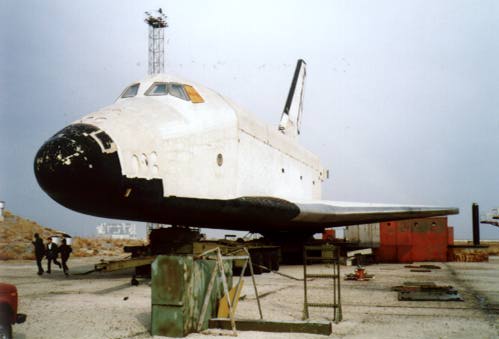
The Russians already had a clone of the Shuttle - the "Buran" - which successfully took off, orbited the earth, and landed without losing a single heat tile.. all unmanned. The project was then scrapped due to lack of further funding.
If they are copying anything here it's not the shuttle, but the next-gen NASA design which is back to a "lauched on the tip of a rocket" type design... but the timing, if anything, more suggests NASA copying Russia rather than vice versa.
http://www.aeronautics.ru/archive/space/russia/rsc e/energia-buran/page_01.htm
http://www.aerospaceweb.org/question/spacecraft/q0 153.shtml
http://liftoff.msfc.nasa.gov/rsa/pics.html -
Re:There's a lot more to a rocket engine...
A concise explanation of shock diamonds(mach diamonds) here.
-
Re:*Sigh*
Except, you know, the Russian Buran Shuttle with 20 tons return capacity vs the shuttle's 15 - and 30 tons of launch cargo capacity vs the Shuttle's 25.
Not bad. Not bad at all.
Best of all, the Buran could fly to orbit and back on autopilot without a human crew if needed (as it successfully did on a test flight).
From the Wiki article, the final version of the Buran has a single, solitary flight and this flight was unmanned. Hardly an impressive record, no?
The best thing that NASA could have done at the time to replace their shuttle fleet would have been to fund or buy Buran from the Russians when they ran out of money. the Russians built an amazing robot spaceplane in the 80's, something that NASA still has not achieved.
Again, from the Wiki article: "The U.S shuttles landings are also mostly automated (there has only been one manually flown re-entry so far), but deployment of the landing gear requires a human to physically press the button. The manual step was added at the insistence of the astronauts, who claim that early deployment of the landing gear due to a computer error would be fatal." Geee... which flag are you waving?
NASA's shuttle is a bastard design created from political compromise: the military wanted it, the scientists wanted it, the politicians wanted it. As a result it works for almost nobody and is a 30-year old deathtrap. I'm suprised the loss rate has been so low - I have no idea what drugs NASA is ingesting, I'll be very suprised if this one isn't lost as well. The shuttle should be killed and replaced ASAP, preferably taking some serious clues from bulletproof no-compromise brute simplicity Russian space engineering - which is currently the best in the history of the world (until the Chinese or commercial sector catches up and passes them).
Reading this is funny (in a dark way) in light of a recent article over at MoFi concerning the R-16 accident. Possibly the worst rocket accident in history and it was caused by... political and symbolic concerns trumping scientific ability.
If the shuttle's re-entry angle is wrong, EVEN WITH NO DAMAGE, airframe stress becomes critical, it breaks up and everybody dies.
If a Russian space capsule's re-entry angle is wrong, they experience slightly higher G-forces and the pickup helicopter takes a couple of minutes longer to reach them after parachuting to earth.
You've switched gears and are comparing a shuttle to a capsule. What happens if a US capsule's angle is wrong? What happens if the Buran's angle is wrong?
Modern metal alloys are tough enough to survive re-entry without protection from heat tiles. Get that? In a modern design, NO HEAT TILES ARE NEEDED. Which completely eliminates the cause of one shuttle disaster (when the heat tiles failed).
I'm hardly an expert, but I thought the purpose of the tiles wasn't to simply survive heat but to prevent its conduction. Can you take a modern alloy of similar weight and thickness, heat one side with a torch and hold your hand on the other? Then you have a fair argument.
-
Re:Did you just hear a "thump"?!!!
Sorry to burst your American superiority bubble, but so far you have lost 14 astronauts in flight, while Russians have lost 4 cosmonauts. So, whoose record looks pure as driven snow now?
That's not an accurate view of the safety situation. The Soviet safety record was attrocious, and I suggest you do some reading about the two programs instead of just parroting one meaningless measure. Start here for their worst aerospace disaster and here for information on their disastrous moon program. -
Re:Excuses, excuses ...
If craft is launching: Rain + moving at thousands of meters per second, turning each drop into an impactor = Very Bad
The shuttle is not going to move that fast where rain is an issue. If I didn't seriously misread this graph here, it goes about 400m/s at 10km. Okay, pretty fast...
-
Re:The thing is
From the parent post:
Supersonic jets in the past used real jets, not turbofans, afterburners if you like. Basically just burning raw jet fuel and using the hot gas to accelerate the plane. Fast, but VERY inefficient. Normal jets get theri efficiency from their turbofan engines.
Turbofans are "real" jets. Turbojets can be thought of as turbofans with zero bypass air. The overall layout of both is the same, and they have the same components. Turbofans can have afterburners also - that's really a separate part of the engine (conceptually speaking).
This page has a good explanation of the various types of "jet" engines. -
Re:The thing is
>Fans, like all propellors, drastically lose efficiency...
Not quite true - the engines for the F-22 Raptor are F119 Turbofans (http://www.pratt-whitney.com/prod_mil_f119.asp)
A turbofan and turbojet are both turbine engines with a set of fan blades as the first thing the incoming air "sees" after the inlet. These aren't like propeller blades - the solidity ratio is much higher for the turbofan (unless you are talking about the unducted fans, which were really super-turboprops, and still didn't have that many blades compared to a typical turbofan).
The difference between a turbofan and a turbojet is that a turbofan has some air that bypasses the "core" of the engine (the combustors and turbine section). This (generally) results in a more efficient design, depending on altitude, conditions, etc. Overall, turbofans and turbojets are very similar in concept - the turbojet is really a turbofan with zero bypass air.
Don't take my word for it - here's a good explanation of the differences (with illustrations). -
Dulce Et Decorum Est, pro patria mori
That all sounds rather nice, but is really rather hollow, reactionary thinking. Space-borne weapons might offer a way to fight conflicts with precision and minimal loss of life to both sides.
Or they might not - hasn't this been the excuse for ever more destructive weapons since time immemorial 'they'll save more lives than they destroy'? It has never turned out to be true. The aim of war is never minimal loss of lives to both sides.
The agressive militarisation of a domain which all space-capable countries have explicitly agreed not to militarise is an insane, hubristic waste of money which will backfire when China, Europe, India et al decide they can't tolerate a US with space weapons and start to arm their satellites. Why not press for ratification of a treaty which explicitly bans all weapons in space? You could then pour funding into the civilian related technologies directly.
The science involved will invariable trickle down. Do you have objections to the fact that airplanes benefitted from military research? Hell, we got the jet engine from the Nazis for the most part.
Why don't they spend the money on the science instead then? As an aside the Nazis were not the only ones developing a jet engine.
Sometimes the hippy dippy shit that sounds so good is just a gloss coat on reality that makes you feel smug. But it comes at the cost of the complexity of the real world.
Sometimes that jingoistic talk is just a varnish on a primitive desire to dominate driven by fear. An attempt at cooperation with other nation states would go a lot further than unfounded paranoia about possible future threats.
The complex reality is that war always kills thousands, maims hundreds of thousands, and sends the countries invaded back to the stone age. It is not something to be sought out or justified, even if it is, very rarely, a necessary evil. I'd be interested in an example of a war that has been fought with 'precision' - in Iraq they're not even counting the civilian casualties.
The US has no need of a bigger, better, weapon - they already spend more on weapons than any other nation, almost 10 times more. -
Re:CoolBoeing wanted to relocate its headquarters anyway; they went to Chicago, not because they'd go out of business if they didn't get a break on the new HQ, but because the city and state governments there voluntarily offered a carrot. This is not the same as a subsidy.
That is an interesting definition of what happened. According to Webster.com, this is the definition of a subsidy. In other words, the governments of Chicago, Dallas and Saint Louis were all willing to give millions of dollar in tax breaks for somewhere around 500 jobs. That was a subsidy, at least according to Webster's dictionary.
If local citizens pressure the government to give them goodies then that's between the government and the citizens. When the government BUYS SOMETHING from Boeing, it isn't a subsidy.True, but the development of weapons systems does not occur in a vaccuum. The military and Boeing sit in a room together and design the weapons systems together. The military then provides seed money to Boeing and the company uses that money to develop prototypes. For example, the cost of the new Join Strike Figher(see here and here, is on such a long timeline--starting about 1994--and is so expensive that neither Boeing or Lockheed could afford to develop a simple prototype without a government subsidy. Both Boeing and Lockheed spent millions of dollars (both their own and government subsidies) to develop the prototypes over the course of years. In 2001, the military awarded the contract to Lockheed. Note that today, the only two major military aircraft builders are Lockheed and Boeing. It was rumored that if the government didn't provide the contract to Lockheed, it was highly likely that Lockheed would have gone out of business, leaving the US with one manufacturer of military aircraft.
Airbus gets money from the European governments and provides nothing in return.Really? Are they that much different from the Chicago's, Seattle's and San Diego's? All of those cities have provided millions in subsidies for jobs. Are not the national governments of Europe just providing money for Airbus jobs? And, according to some of the articles on a A380, about 40% of the material in the A380 is purchased in the United States. In effect, the Europeans are subsidizing some communities here in the States.
(Note that I am NOT personally in favor of subsidies by any government, I am just pointing out that both Boeing and Airbus are subsidized).
-
Re:Heads up!
Mmmh... Forgive the metricness, but assuming that: the supporting structure weighs as much as its payload (not sure about this estimate); it has the same drag coefficient as a Boeing 747; its cross-sectional area is a 44.20*26.52 meter rectangle (probably overestimated?); a constant air density of 1.2 kg/m^3 (sea-level, conservative); a gravitational acceleration of 9.72 m/s^2 (troposphere level, conservative)...
The thing should come down at a terminal velocity of 35.12 m/s, corresponding to a kinetic energy of roughly 1,678,399.48 J or 4.11e-10 megatons. For comparison, a
Not much of a WMD even if it weighs ten times as much as I've supposed, anyhow, but still I wouldn't like it to fall on my home... Especially because that 3,000 lbs. payload should be pretty dense.
I hope someone can check this since I'm tired and I haven't been playing armchair physics for a long time...
-
Re:Why?
> How about the C-130 transport aircraft? It still uses fricking props!
You say that as if propellors are less desirable than jet propulsion for aircraft. (Of course, after typing out this long reply, I now see that you and I are largely making the same point, but why waste such a good explanation?) This is true only if we are talking about props powered by internal combustion engines--but the C-130 is powered by turbo-prop engines.
It is really a matter of different strengths and weaknesses. In the case of the C-130, a turbo-prop engine was "the best tool for the job". In a way, it is already a jet aircraft--except that the propulsion comes from the propellor rather than from the exhaust.
And in order to stay on topic... a random comment about STS
The most flawed aspect of the STS is the Solid Rocket Boosters(SRBs). The soviet shuttle system (Often called Buran, after the name of the first soviet orbiter) recognized this and did away with solid propellant altogether.
It was in my opinion a superior launch system and orbiter, even if it was a blatant rip-off. Buran also looked cooler too. Too bad it is now scrap. The one intact Buran shuttle that survived the fall of the soviet union did not survive the fall of the ceiling in the building it was housed in. So sad.
But eh. Yeah. Props still have their place. -
Shame about the refueling
The fastest jet plane in the world is still the SR71 Blackbird. It flew at Mach 3.35 or 2,275 mph (3,660 km/h). The circumference of the earth is 24,859.82 miles (40,008 km). So that means the Blackbird would do a flight around the world in 11 hours. Unfortunately it only had a range of 2,590 nm (4,800 km), so it would have to refuel at least 9 times. In a way, it's amazing that someone can build a plane that can carry enough fuel and still do the trip in less than 8x the time.
-
I've always thought the linear aerospike
...would be a good choice for engine on the next gen space shuttle. Here's a brief introduction.
-
Re:It's actually worseNo they didn't [decide to go for speed], they decided to go for efficiency and to take the safer gamble that airlines (and airports) didn't want a super-jumbo jet. The Sonic Cruiser never got off the drawing board. They're building the 7E7 instead.
This web page http://www.aerospaceweb.org/aircraft/jetliner/son
i c_cruiser/ outlines the sequence of Boeing's decisions. Here's a quick summary:* Boeing cancels 747X super jumbo (similar to the Airbus A380) due to lack of interest from airlines
* Boeing announces Sonic Cruiser as next major project
* Boeing cancels Sonic Cruiser project after airlines enter financial free fall post 9/11
* The more economically efficient 7E7 Dreamliner is now Boeings current development project. The 7E7 employs some technology envisioned for the Sonic Cruiser.Therefore, at the time the 747X was canceled, Boeing did decide to go for speed. Subsequent events lead to the 7E7. It's conceivable -- likely or not -- that a Sonic Cruiser will be Boeing's next development project.
-
Ok here you go
From this page-
Sound barrier:
"The term sound barrier is often associated with supersonic flight. In particular, "breaking the sound barrier" is the process of accelerating through Mach 1 and going from subsonic to supersonic speeds. The term originated in the 1940s when researchers discovered a large increase in drag that seemed to indicate that an infinite amount of thrust would be needed to fly at the speed of sound. In other words, some believed that a physical barrier existed that would prevent an aircraft from ever being able to travel at supersonic speeds. Since there obviously is no such barrier, the term sound barrier is outdated and really should not be used any more. Nevertheless, it has become a popular part of the human language, and continues in use."
Obviously the people who believed this were using flawed methods of reasoning. However, claiming there were none who thought this way is simply denying history. The Wikipedia article has a good synopsis. Yes the fact that bullets were known to travel at supersonic velocities should have clued these people in as to the errors in their equations. Unfortunately, as I mentioned in another reply, scientists sometimes choose to ignore factual data that contradicts their preferred theories. -
Re:They had bugs...
To say that the lightning strike spooked the astronauts is a bit of an understatement. The strike scrambled one of the navigation systems, killed telemetry to the ground, and generally wreaked havoc with everything electrical on board. Fortunately there was enough redundancy in the systems, and nothing was actually destroyed, that the mission was not harmed.
Details are here. It must have been an awfully exciting few seconds. -
Re:Speed comparison question
A related question, how does this (and the speed of orbital rockets) compare to the fastest man-made object (whatever that may be)?
I thought the fastest man-made object was Pioneer or Viking at around 45k mph. However, a quick Google indicates that Helios supposedly traveled at 150,000 mph.
I'm positing that the particles in particle accelerators are not "man-made" in this context. -
X-43A design theory
- Waverider theory
- More Waverider theory
- My God, Hardware! - the experience of a Scottish Astronautics research group (I suggest reading the whole piece, the link points to the middle of the story, 'cos of the great quote!)
The NASA design is example 4 on the summary page and is quoted there as having a theoretical top speed of Mach 20.
The BBC has some good pics and information too. - Waverider theory
-
X-43A design theory
- Waverider theory
- More Waverider theory
- My God, Hardware! - the experience of a Scottish Astronautics research group (I suggest reading the whole piece, the link points to the middle of the story, 'cos of the great quote!)
The NASA design is example 4 on the summary page and is quoted there as having a theoretical top speed of Mach 20.
The BBC has some good pics and information too. - Waverider theory
-
Re:What is the Speed of Sound?
Precisely - Mach 1 is the local speed of sound. Specifically, it's the velocity at which shockwaves propagate. If you are flying at Mach 1 (plus delta) you are encountering a medium which is uninfluenced by your motion until you encounter it - it doesn't have time to get out of the way. That makes a huge difference to the behavior, a little like the difference between swimming in water and swimming in concrete!
There is, of course, a FAQ on this Frequently Asked Question.
-
Re:Sneaking In
I would guess Databass is referring to the Intermediate-Range Nuclear Forces (INF) Treaty which forbids ground-launched cruise missiles which serve as a weapon delivery device and are capable of travelling over 500km.
A review of the treaty concluded that predators with hellfire missiles were not in violation. From what I understand their reasoning was that the UAVs are not missiles delivering a weapon, but rather an unmanned aeroplane carrying a missile. -
Re:This is fine and well, but...
Try Mach 20...
Mach 25 for the space shuttle
Mach 36 for a capsule
see here -
Re:linux powered weather balloon
-
Re:You are a fool
I'll repeat that you are an idiot.
I don't know whare you are getting your "facts" from but they are completely incorrect. Ballot measures signed into law in Texas were not used because Texas law does not apply to Florida. The Florida election was held according to Florida law. I just can't understand how anyone with even an iota of a brain could not know something as simple as that.
Paid signature gatherers are not exactly what the recall provision had in mind. That's the mechanism by which the recall was bought, by a Republican millionaire's private efforts. I grant that it was run according to the letter of the state constitution. It is still fundamentally undemocratic.
Paid signature gatherers are a form of free speech. You seem to be focusing on the fact that the people collecting the signatures were paid to do so to gloss over the fact that a majority of people in California voted to oust Gray Davis. It does not matter whether the signature gatherers were paid or not. Are you denying the fact that the majority of people in California voted to oust Gray Davis? The only travesty of democracy would have been if the will of the majority of Californians had been thwarted. Typical liberal idiot. "Democracy is good except when the people don't agree with me."
And your defense of G.W.'s Guard service - when he bothered to show up - is deeply, deeply pathetic. It has to be among the dumbest things you've ever read. Dangerous missions? Defending Texas against Oklahoma? You should be embarassed.
You should educate yourself about some facts before you believe all the lies the Democrats tell you. That way you don't expose yourself as an idiot. The Texas Air National Guard was involved in combat missions in Vietnam at the time that Bush enlisted there. It is an interesting contrast to the fact that the Swift Boat crew that Kerry enlisted in was not involved in active combat missions at the time that Kerry enlisted there. -
Shoulders of giants
"If it is that I have seen far, it is because I have stood on the shoulders of giants" Einstein
Let's give credit where credit is due. Newton said this not Einstein. see http://www.aerospaceweb.org/question/history/q0162 b.shtml -
Nitpick: That's "Areostationary"
Satellites which are stationary relative to an observer on Mars should oughta be called "Areostationary", not "Aerostationary".
This is because the Greek name for Mars is Ares, and conventionally, greek names are used for the roots of these sorts of things.
See, e.g., here
I know, I know, English is a living language and the spelling error didn't change the meaning, so I should shut up. Pendants like me are domed to definately loose this rediculus fite. -
Re:It's not smart to play with fire.
Do you know when the SR 71 started flying?
It began flying in December, 1964. However, it had already been announced by President Johnson in February of 1964! It was in this speech that the President "accidentally" switched the name from RS-71 to SR-71. A little more digging shows that the USAF Chief of Staff had intentionally switched the letters in the President's speech because he liked SR-71 better than RS-71.
B When did they start flying the "Stealth Bomber"?
Similarly, the B-2 bomber was on public display on November 22, 1988, but its first flight wasn't until July 17, 1989. The final product wasn't delivered until 1993, and it didn't see combat until 1999.
Allow me to reiterate my previous point. The government is lousy at keeping secrets! And with this constant Myth of an Aurora out there somewhere, the government would have an extremely difficult time keeping such a craft under wraps. They'd be far more likely to just announce its existence and get it over with. It's not like they'd tell the public anything useful anyway. They'd simply confirm or deny the craft's propulsion method, stealth features, and approximate cruising speed. It's real ceiling of operation would remain classified until it went out of service.
-
Re:Round trip time
I googled for "speed of 747". About halfway down it says the cruising speed, at 35,000 feet, is 570 mph.
-
Re:now i can...
now i can... attempt to win the x prize
Yes, you can attempt, but unfortunately you're going to fail....Both jet and rocket engines combine fuel with an oxidizer to make thrust. Jet engines, however, use oxygen from the air while rocket engines use another source of oxygen (liquid, compressed, or solid in some compound that'd burned to produce O2).
The upshot is that you can't use a jet engine to get into outer space, only a rocket engine, because there's not oxygen up there for a jet engine to burn enough fuel to make enough thrust. Your jet engine will come crashing down.
(A simplified explanation of the difference between jet and rocket engines can be found here.)
-
Changing wing shapes, eh?
They're not fish scales, but I Think it's been done before. Granted that doesn't help efficiency, but I think these do.
-
Re:Mach Freakin' 5 - make that mach freakin' 7-10
Don't pay too much attention to that Google conversion from Mach to speed. It only works if the temperature is 15 deg C (i.e. sea level under the International Standard Atmosphere). The speed of sound varies with the square root of the temperature, and it is a lot colder up where the X-43 was flying than it is at sea level, so the speed of sound is slower.
Mach 7 at sea level is about 8575 km/h, but Mach 7 at 100,000 ft it is only about 7615 km/h ( assuming the mythical day with standard temperature at both altitudes).
-
Re:Mach Freakin' 5Some of us didn't take fluid mechanics and/or thermodynamic classes, but we still know that:
- Mach at sea level is about 761mph
- At 50,000 ft, it's about 660mph
- At 100,000 ft it's about 775mph
- At 150,000 ft it's about 703mph
- At 400,000 ft at the edge of the thermosphere, it's 681mph.
All those numbers are in the same ballpark.
Some of us remember that the speed of sound is affected chiefly by temperature and not pressure.
It's easier to go to higher mach speeds at higher elevation becauset here is less resistance due to friction.... not because the speed of sound is significantly slower.
Cheers - Mach at sea level is about 761mph
-
Re:how does it keep from being shot down, exactly?
-
Re:Assembly AND Military Experience RequiredI didn't say it was an arbitrary unit... Nautical miles per hour was measured by counting knots on a piece of rope as it dragged behind... What's strange with that? Haven't you ever read Jules Verne? Even in one of his books this fact gets a reference. The young "captain" accidentally loses is parakete(sp?) and his ability to measure his speed is lost. Then some evil guy puts a magnet under his navigational compass and he ends up in Africa instead of America. More adventure follows. It's a shame I can't remember the book's name.
Necessary google search result describing what a knot is and guess who's right.
-
Re:The problem with Scramjets is...
A scamjet running at mach ten is going to be experiencing much less drag than a regular airliner, because it will be much higher.
I don't think so. The drag on any cruising airplane is an indirect result of the lift the airplane needs to stay aloft: for a given cruising speed and altitude, you try to find a wing shape that will give you an optimal lift-to-drag ratio, and then that ratio and the weight of your plane determines how much drag you have to fight (which, for a trip of constant distance, determines how much work you have to do fighting drag).
And unfortunately, attainable lift to drag ratios get worse the faster you go. See the chart on this page for examples, and for comparison keep in mind that for subsonic aircraft lift to drag ratios of 16-20 are common. If you want to fly at Mach 4 with C_L/C_D = 8, instead, then you should need roughly twice as much fuel (per mile traveled) to do so.
Concorde's massive costs were mostly maintenance, not fuel.
This is probably true, though. I recall reading that jet fuel accounts for less than a third of an airlines budget, so no amount of high speed fuel inefficiency shouldn't do much for your ticket price. I'd be more worried about the additional complexity of hypersonic aircraft affecting those maintenance costs instead. -
Re:Aerospace analysts are always too optimistic
I just checked, it just says over mach 3.0... clearly it's the fastest over long distances.
Go back to the FAS article I linked to before, and scroll down to the section titled Specifications. It clearly says Speed: over Mach 3.2 / 2,000 mph (3,200 kph).
Not so much any more. The operating manual limits it to mach 3.2; you should download it and check it out. So far as I know, the highest measured speed of the SR-71 is below that of the Mig-25 foxbat; but the two are very close.
You mean this? First, it lists the status of pages 4-150 through 4-160: Still classified. Second, according to the cover, it's for the SR-71A. In addition, the forward says it applies to the SR-71B as well (which is merely a 2-seat version of the A model). This doesn't cover the latest C model, let alone the A-12 or YF-12. Finally, the page for Airspeed in the Operating Limitations section lists Mach 3.2 as the design Mach number, while recommending Mach 3.17 not be exceeded in normal operations. However, it specifically allows flight at Mach 3.3 when authorized by the commander, as long as a Compressor Inlet Temperature of 427 degrees F is not exceeded.
Of course, the SR-71 can cruise at mach 3, so over long distance it easily trounces the Mig, but over short distances it seems that the Mig just edges it; by a precious few miles per hour. I think that Guinness didn't know which one was faster, but I'm not aware of any evidence that the SR-71 was actually faster. There are plenty of rumours of course...
You must not have read my links to the FAI. They gave the record breaking airspeeds by both aircraft, although not the Mach numbers. I'll repeat them here:- E-266 (i.e. Mig-25 with bigger engines): 2605.10 km/h (1618.73 mph)
- SR-71: 3367.22 km/h (2092.29 mph)
- E-266 (i.e. Mig-25 with bigger engines): 2605.10 km/h (1618.73 mph)
-
Re:Damn those Aerospace EngineersAlso what you are describing is NOTAR.
But regardless all helos (tip-jet or no) must have a way to counter the torque caused by the main rotor generating lift. Some (like a couple of Russian companies) do it by having two main rotor counter-rotating each on the same shaft. Or you can have two separated counter-rotating rotors on apart from each other (VH-22, CH-47, and CH-46 do this), NOTAR eliminated it by using bleed air feed though slats on the tail boom.
-
0.5 Mach
According to Aerospaceweb, the speed of sound at sea level is 1225 km/h. This train is approaching half that.
Dude. It'd be awesome to be standing at the train station and have it arrive about the time you heard the whistle it gave on the horizon, assuming it didn't Doppler up to a frequency you couldn't hear.
Neato. -
Re:So sad about Boeing
Yeah. Stodgy. -
Aerospike introduction
If you're not a rocket scientist, here's a very readable introduction to aerospike engines.
Caution: It is rocket science, and a little bit of maths is required to appreciate even this introduction. -
Re:Assumption is the mother of all f**k-ups...
in fact Argentina put Skyhawks up against the Sea Harriers in the Falklands war and they're not supersonic.
Here are the Skyhawk Tech Specs - top speed 675 mph - and to jog you memory the Speed of Sound is 761 mph (1,223 km/h).
Here is a link to Skyhawks in Argentina and in the Argentine Forces during the Falklands war.
They did field four Super Etendard Fighters which are supersonic - but not against the Sea Harriers. The Sea Harriers were lost mainly through accidents, SAMs and small arms fire! British Aircraft Lost.
Here's a breakdown of Argentine Aircraft Lost - you'll see they were shot down mainly by missiles - some from ships others by Sea Harriers. The Sea Harrier can thus be seen as a platform for missiles - and can not really be lauded as a performance aircraft - though the VTOL ability is amazing.
I'm no war or fighter nut - these links above were found on Google over a 10 minute period - it's called research - something I don't think you actually did
Just the facts Man!
-
Not on Earth, he wouldn't.
Now would he have jumped out at 30km height, he would have broken the sound barrier and then, slowed down to 220kph.
Mach I at 30 km (18.6 miles) is about 675 mph. He was travelling, at his fastest, at 360 kmh (200 mph), nowhere near the sound barrier at any altitude. The sound barrier increases and decreases even as altitude increases, but it never goes lower than about 660 mph. Here's a chart of Mach 1 at different altitudes.
(On an entirely different note, has anyone besides me noticed that the quality of Slashdot moderation has degraded over the last year or so? I haven't been "assigned" mod points since the great move West, but I know I used to do a better job than what passes for moderation these days. The mod system needs something way much more effective than the current M2 system which does absolutely nothing. I mean, we're talking about something fundamental as the speed of sound.)
-
Re:can I make my own plane?
I'm not an X-Plane user myself, so I don't know how difficult it is to build a model that actually flies. If the physics are really realistic, that'd be quite a challenge. The plane building program will probably lend you a hand, though...
I am an X-Plane user, and have built a few biplanes, flying wings, and a delta wing jet. Two things:
a) The tools that X-Plane gives you could be dramatically improved without a whole lot of effort. Defining the fuselage is a bit of a pain, and positioning of wings, elevators, stabilizers, and gears are all very much unintuitive - no such thing as direct manipulation of the pieces to where you want them.
b) It's difficult to make something that actually flies. Center-of-gravity is usually for me the single-most difficult thing. I'll either have my ass dragging down the runway, or have so much weight up front that I can't rotate into the air in allotted runway space.
c) Once you have a working model, it's difficult to get a model that flies WELL, eg, responsive to controls, zero yaw, can land.
d) Once you get a model that works well, it's extremely difficult to get that model to go supersonic. After some research, I discovered the area rule.
e) Items b through d have nothing to do with X-Plane, and are damned challenging (and to my mind, enjoyable) to overcome. I have oodles more respect for aerospace engineers now.Nothing's stopping you from downloading the X-Plane distribution - you can use all the plane maker and landscape maker programs without the CD, and test it out 5 minutes at a time.
sloth jr
-
Re:No sound! Whaaa!
Yes. The projectile doesn't produce any sound, hence no sound waves can accumulate.
Okay, this was just nonsense. See here for details.
-
Re:Bzzzzzzzt. You're all wrong.
Search google for "shuttle max Q" - that's the maximum aerodynamic pressure exerted on the shuttle during launch.. and it's about 60 or seconds after liftoff.
Actually - look at the chart here which shows the typical pressures on the shuttle during lift-off. At 80 seconds, they're still only a little below max q. Still would be awfully windy outside at that point -
More info