Slashdot Mirror
Domain: amd.com
Stories and comments across the archive that link to amd.com.
Comments · 1,178
-
Re:Great
Many phones, tablets, and PCs have hardware acceleration for VP9. AMD, Nvidia, and Intel support it. By default, Microsoft Edge turns on VP9 support when hardware acceleration is available (you can override it to turn VP9 on all the time).
The "no hardware acceleration" argument is tired. Things have moved on.
-
Re:Poor tact but right reaction
BTW, what did you need mesa-git for?
I think you might be OK using just the packages from here, and they also provide some info on getting Vulkan up and running.
-
Re:Marissa Mayer's legacy is at stake
A glamorous woman who would be popular in the media as she's an icon of 'You can be a feminist and pretty and have a high-powered job. Girl power!' clickbait fluff.
Contrast with the 'less glamorous' female CEO of AMD Lisa Su who appears to be performing quite well but gets almost zero mainstream press coverage.
-
Intel needs more pci-e lanes or amd will kill them
Intel needs more pci-e lanes or amd will kill them with zen.
Intel top end Kaby Lake cpus only have 16+4(DMI) 3.0 lanes off of the cpu and the chip set has 20-24 3.0 + LAN + USB + SATA stacked off of the X4 DMI link.
http://www.amd.com/en-us/innov...
The initial “Zen” cores for “Summit Ridge”-powered desktops will utilize the AMD AM4 socket, a new unified socket infrastructure that is compatible with 7th Generation AMD A-Series desktop processors. With dedicated PCIe® lanes for cutting-edge USB, graphics, data and other I/O, the AMD AM4 platform will not steal lanes from other devices and components. This allows users to enjoy systems with improved responsiveness and the future looking technologies that the AM4 platform provides, resulting in a powerful, scalable and reliable computing solution for all their needs.
-
Even some x86 CPUs contain ARM
AMD's new x86 Zen CPUs contain an ARM based coprocessor.
Zen added the support for AMD's Secure Memory Encryption (SME) and AMD's Secure Encrypted Virtualization (SEV). Secure Memory Encryption is real time memory encryption done per page table entry. This is done utilizing the onboard "Security" Processor (ARM Cortex-A5) at boot time to encrypt each page, allowing any DDR-4 memory (including nonvolatile varieties) to be encrypted. AMD SME also makes the contents of the memory more resistant to memory snooping and cold boot attacks.
https://en.wikipedia.org/wiki/...
Then there are the new ARM-based Opterons.
http://www.amd.com/en-us/produ... -
Re:Which is recommended for Linux gaming?
Now I'm left to wonder if the infamous Radeon mouse cursor corruption bug also exists on Linux.
Fixed last year. Catalyst bug, I have been running the open source driver for the last few years so I never saw it.
-
Re:Imagine it as a coprocessor
HBM is the answer to your memory bandwidth issue. Especially since it allows for die stacking.
-
Re:Just as well
FUD the ONLY chips that have the ARM core are the 4 that were based on the consoles, even the AMD page on the subject hasn't been updated since 2013, why? Because they only bought the ARM DRM for the consoles that demanded it and never bothered to do anything else with it.
So its only there if you buy one of the 4 ULV chips based on Jaguar, and even then there is no known software in the wild that can even access it. Its a leftover from their deal with the consoles and the only chips you can buy with it are ones that didn't pass muster to be included in the consoles.
Now that said I've built a couple HTPCs using the Jag and they run just fine, one is running Win 8 (the only place Metro makes sense, a 10 foot UI) and the other is running OpenELEC Linux and both run great, if all you are needing is an ULV HTPC for 1080P video or a media server you can stuff in a closet? Works good for that purpose, but the ARM chip isn't an issue.
-
Re:Hello firewall
First I've heard of it
Not my problem.
If anyone is going to complain it's the ones filling thousands of sockets at a time, but for some reason they are not complaining.
In my experience, it's going to be people that are security oriented, particularly those that specialize in security at low-levels. Fortunately, errata issues are commonly solved by microcode updates instead of hardware replacements.
I think it's time for some sort of citation
Sure, you can find out about AMD's errata here.
-
Re:Life Support
Maybe you should take a look at their financials. This is a company that hasn't had positive net income since 2011. Zen needs to be at least somewhat competitive with Intel's offerings (or they need their GPU business to take a chunk out of NV) or AMD will eventually go bankrupt.
Their stock price is so low right now that the entire company could be bought for a little over $2 billion if someone were so inclined. Intel makes more quarterly profit than AMD is worth as a company. From a certain perspective they're likely worth more if they closed shop entirely and just collected Intel's licensing fees, but Intel clearly doesn't want it to come to that. -
Re:Supercomputing
So insightful! I'm sure the leadership at AMD would love to hear more about your ideas.
You could start here: http://www.amd.com/en-us/who-we-are/careers
-
Re:Personally, I don't care.
OS: FreeBSD
Card: Radeon 7870
Meanwhile my old Nvidia cards are still cranking away with working drivers (with acceleration!)
It's like I paid Nvidia money and they delivered a product I could use.
Unless you're volunteering to read through AMD's spec sheets and writing me a driver for free.
Additionally under Linux AMD has a 'bug' (Feature?) where you can't even use them under OpenCL without a device attached. There is a way to fake it with a resistor but if you're going to bank on headless GPU computing you'd think you'd make a driver that could work with no head.
-
Re:They don't need to be up there
AMD has a technology they call dual graphics so their APUs could work in conjunction with a discrete GPU, similar to how you can Crossfire two discrete GPUs together already. It's probably more geared towards notebooks where the APU can get by driving the display and the GPU can sit idle. One review found that it could give substantial performance increases for some games, but it depends on driver support as well as where the performance bottleneck is at.
-
Re:Only X8 pci-e?
NV-Link just sounds like an Nvidia copy of Hypertransport.
-
Re:Permanently disabling?
If I were AMD, I'd devote effort and resources to GCC development. (Maybe they have?)
-
Re:So...
Since Linux users make up 1% of the market share (I'm not sure the % for gamers, but could be lower), I'll doubt they'll lose sleep over it.
The question is, if they get really rock-solid drivers for Linux desktops, would the effort carry over towards entering the market for graphics chips in other things that run Linux like Android tablets and phones?
There is no market for graphics chips in those things, only SoCs which converge graphics with the CPU core. nVidia has an ARM SoC product like that, but AMD doesn't. AMD is sampling ARM server chips but has not even announced a mobile part. Meanwhile, nVidia is on what, their third or fourth Tegra? ATI actually used to make graphics chips for cellphones back when they did use separate GPUs; I used to find their cute little chips inside of Motorola phones, like V-series and RAZR. But now they don't, because they have nothing to offer.
I've been a proponent of AMD for many years, but what we're seeing now is the middle of the end. (The beginning was when they revealed their new architecture and it was... meh.)
-
Re:I want stability
I have games from Win9X through 2015 and I have no issues playing them on my R9 280, in fact the only issues I have playing older games is I often have to bypass the shitastic DRM they used them like Starfuck and SecuSUC which will if you aren't careful try to shoehorn a 32bit kernel driver into a 64bit kernel and fuck the OS. Luckily most of the companies making that shit were so damned cheap they kept their piss poor 16bit installers way into the 32bit era and thus won't be able to run the installer.
But since they switched away from VLIW to GCN things have been nothing but candy and puppies and say what you will but you have to give 'em credit, when they EOLed the old VLIW cards and APUs when they released Crimson? They were at least decent enough to release a beta of Crimson specifically for these older chips that not only gives them any Crimson features that those chips will support but also runs on Win 7-10 so any of the older chips that didn't have Win 10 drivers? Well they do now. I installed it on my E350 netbook from 2011, runs great and even improved my hardware video acceleration.
-
Re:Is Windows10 a thing?I've had mixed success with that: most hardware will indeed work, but you may run into problems. For instance, for some reason older webcam drivers will work on Windows 10 in desktop applications, but won't work with Modern applications (you get a black picture or a “camera is busy” error). Display drivers are also problematic: I had a kind of netbook with an AMD APU, bought just two years ago, for which AMD have stated that they won't release a proper driver for Windows 10, and that I'm not supposed to use the one for Windows 8.1. In other cases I have solved the problem as you say by forcing a specific driver in place of the one that Windows had selected automatically, but it has happened to me that some time later Windows Update replaced the driver that I had installed with a newer version of the one that doesn't work. I can live fixing that each time it happens but I wouldn't recommend my aunt to have a machine in this situation.
Come to think of it, my biggest source of trouble with the Windows 10 update have been AMD drivers: I can report a laptop which can't adjust the brightness level, another one that pauses for 60s on startup and resume, and another one which isn't able to play videos without stuttering.
-
Re:Is Windows10 a thing?I've had mixed success with that: most hardware will indeed work, but you may run into problems. For instance, for some reason older webcam drivers will work on Windows 10 in desktop applications, but won't work with Modern applications (you get a black picture or a “camera is busy” error). Display drivers are also problematic: I had a kind of netbook with an AMD APU, bought just two years ago, for which AMD have stated that they won't release a proper driver for Windows 10, and that I'm not supposed to use the one for Windows 8.1. In other cases I have solved the problem as you say by forcing a specific driver in place of the one that Windows had selected automatically, but it has happened to me that some time later Windows Update replaced the driver that I had installed with a newer version of the one that doesn't work. I can live fixing that each time it happens but I wouldn't recommend my aunt to have a machine in this situation.
Come to think of it, my biggest source of trouble with the Windows 10 update have been AMD drivers: I can report a laptop which can't adjust the brightness level, another one that pauses for 60s on startup and resume, and another one which isn't able to play videos without stuttering.
-
Re:So AMD called their Hyperthreading a CPU core?
So, I actually have an AMD FX 8320E eight core as the processor on my personal desktop.
This is what AMD says:
"The industry's only 8-core desktop processor", or "The industry's first and only native 8-core desktop processor for unmatched multitasking and pure core performance with "Bulldozer" architecture".Now, I bought it knowing there was likely some behind the scenes tricks, and because I don't strictly need a high-level of sustained CPU intensive tasks. For me it was as much about letting multiple programs run without too much contention.
However, AMD isn't exactly jumping up and down to point out how this isn't quite 8 full cores.
So, me I bought it knowing that it wasn't likely to be a full 8-core CPU like the 8-core Xeons we have at work in some of the servers. But I think it's a little much to claim it's purely retailers making this claim. AMDs own marketing material isn't suggesting anything different.
For my purposes, having bought it knowing it wasn't "really" 8 cores, I'm still happy with the performance. But if you bought something thinking you could have sustained 8-core performance for specific tasks, I can see you'd be unhappy.
-
Re:So AMD called their Hyperthreading a CPU core?
They're not upfront about it now
Have a look at their website
The FX series is "The industry's only 8-core desktop processor" and "The industry's first and only native 8-core desktop processor for unmatched multitasking and pure core performance with "Bulldozer" architecture"http://www.amd.com/en-us/produ...
Trying searching their website for information on Bulldozer. There's bugger-all.
-
No, just limited audienceNo wonder you're posting anonymously.
First off, games that are optimized for pure eye candy strain current cards, yes. But you don't have to have teh bezt pozzible grafix for everything. Take Alien: Isolation - looked really good, but ran at excellent framerates even on older cards. And even has some vr support. Tradeoffs can be made to crank framerate, and not horrible tradeoffs. I can handle 2010 graphics on VR, it's not like those games looked bad.
And no, a $4000 PC isn't necessary. The official specs are more like $1K these days. In fact, definitely $1K.
And no, 120fps/eye isn't necessary. You need low latency, definitely, but not that low. The DK2 peaks at 76fps, and yet few people report sickness at that rate.
-
Re:All 5 Linux gamers outraged!
http://support.amd.com/en-us/d...
Sure they do. It's just that their closed driver is shit too.
-
Re:What's the story on releasing hardware specs?
Is the hardware so complex that the open source community couldn't figure it out even if they did have the specs?
AMD releases a lot of specs for their CPUs and GPUs, down to info on register-level initialization and such. Writing something that gets the graphics to the screen is comparatively easy, but getting it there with any kind of impressive speed is more difficult. There are compilers included in the drivers that need to be optimized for the hardware and the expected workload, need to cover a ton of corner cases, etc. There are recompilers for older API versions that aren't directly supported by the hardware anymore (fixed function graphics APIs), state trackers for all of the supported APIs, etc.
In the official closed drivers, there's likely to be patent-encumbered code, optimizations that the vendor wants to keep as trade secrets rather than patenting, code licensed from other vendors, etc. Releasing the specs for the hardware means that they can keep the legally-fraught stuff pretty closed. -
Re:DGEMM without ECC?
Like every other Hawaii based professional card, it does.
-
Response to AMD's LiquidVR?
AMD's pioneering Virtual Reality technology is poised to bring better content, comfort, and compatibility to VR applications – from simulations, gaming, entertainment, education, social media, travel and medicine to real estate, ecommerce and more – for a whole new level of presence.
-
It's great and all...
I think AMD is going to beat them to the punch with HBM and module stacking and is coming out on their next gen videocards, especially since DDR5 is just starting to roll out to the PC market for generic modules. It'll be a hard slog for them to push it in anywhere unless it's price competitive, or it's in highly specialized devices at least in the short term. I'd say 10 years before it rolls out to the general public, for public use. And they'll probably be bought up by someone else in the short term.
-
Re:Mac/Linux support removed... mildly surprised
-
Re:ATI/AMD has had shitty drivers for 20 years
CUDA was released to the public a year and a half before the OpenCL specification was published.
Yes. And is it open? No.
SLI hit the market ages before CrossFire.
I don't really have a problem with those two being closed, as I imagine they're inherently quite vendor-specific in their workings.
G-Sync is commercially available now and has been for some time, while FreeSync is not.
True. A recurring theme here is that Nvidia tends to be the first to innovate, with the open technologies playing catch-up.
FreeSync and Crossfire are not any more open than G-Sync and SLI respectively.
Apparently FreeSync really is open.
In particular, it's worth noting there's nothing *stopping* AMD from writing their own CUDA compiler for their GPUs -- for instance, the Portland Group has an x86 compiler for CUDA.
True, but unlike OpenCL it's controlled entirely by Nvidia, and I presume only OpenCL is documented for both the user and the implementer (though as you say, independent reimplementation is certainly possible anyway).
Lastly, most people making this argument tend to gloss over the fact that AMD/ATI has also tried (and usually failed) to make proprietary technologies.
Yep. Mantle is the obvious one. ATi Stream was ATi's proprietary CUDA competitor, which iiuc went nowhere.
The reason ATI is more "friendly" to open technologies is that their attempts at closed, vendor lock-in technologies have a nasty history of failing miserably, while some of nVidia's (CUDA, PhysX) are still going strong.
I agree. Personally I suspect it's because AMD just don't seem as good at innovating as Nvidia do. Nvidia seem to be much better at coming up with new ideas: see SLI, CUDA, G-Sync. I suspect that if AMD were as good, they too would make their solutions proprietary.
-
Also released for Linux
Thankfully this also included a new Linux driver. The current one was many months old. Hopefully there are some good improvements! http://support.amd.com/en-us/k...
-
Re:Drop?
It is released. The last line in TFA pointed right to the driver download page, from which you just have to pick your platform. For example http://support.amd.com/en-us/d... shows Revision Number Omega (14.12)
-
Re:For low power? None
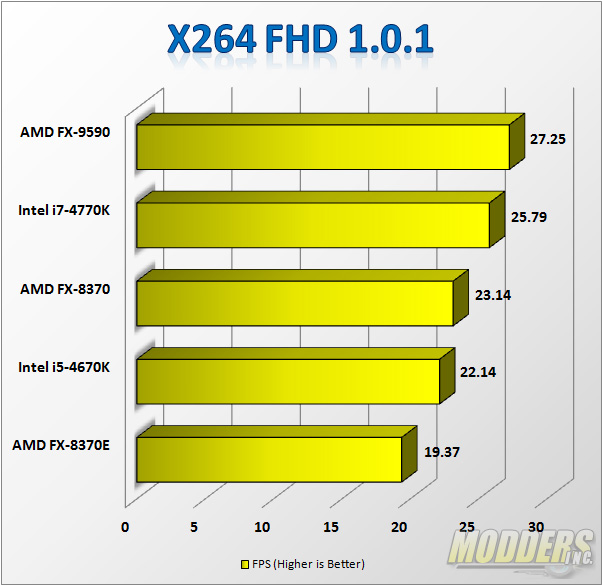
The article uses a bone stock FX-9590 against very heavily overclocked (around 150% of factory maximum specs) and water-cooled Intel setups, plus saddles the AMD chip with high RAM latencies even compared to the Intel chips using the same frequency of DDR3 RAM. I'm aware that the 9590 is essentially an FX-8370 that binned very well and got a clock boost from the factory because of it, but AMD has had these chips up to 8.7 GHz and HardOCP tested it at bone stock with poorly configured RAM. They could have at least given the AMD chip some overclocking, fancy cooling, and the same RAM latency figures. That would have been more apples-to-apples.
Here's a review that tested all the chips at stock settings with more typical RAM configurations. It's also the article from which the price-to-performance bar chart was derived (compared against Newegg retail prices) and is representative of what a typical system builder who is not taking the risks involved in overclocking can expect from the hardware. Here are a few more benchmarks of x264 which is what I cared about when buying a desktop CPU.
Until the stock performance numbers divided by the price come out higher on the Intel side, the AMD is the better value if you don't want to heavily overclock your chip and void your warranty. Intel has always had faster CPUs available than AMD, but they have always carried a significantly higher price tag. I'd prefer to have that money to buy something else like an SSD or more RAM. For other people, low power consumption or higher maximum performance may matter far more to them than the price tag, and I don't begrudge their choice to get Intel chips because that's what meets their needs. -
Re:Any AMD equivalents out there?
AMD has spend a lot of time and money building low power SoCs. Tablets use low-power SoCs. That they can't make money in that market is a pretty clear admission they've bet on the wrong horse. High end desktops and servers died with the FX line and you know their laptop line is in trouble when they have to advertise this: Introducing mobile systems with AMD's highest performing APUs, exclusively at Best Buy. It can't be long until they're waving the white flag and pulling out of mainstream x86 processors altogether, they're losing on all fronts. They got lucky in "graphics" for a while with AMD card being far superior for cryptocurrency mining, but that's over and nVidia is now selling as many graphics chips as AMD does total, including the APUs. I expect the Q4 numbers to be worse as nVidia launched the GTX 980/970 and AMD isn't due for a new production until 2015. What's carrying AMD is now the console business, if they didn't have that to prop up volume they'd be done for. The way things are going they need to find money in the ARM business and fast.
-
Re:Any AMD equivalents out there?
AMD theoretically has parts that target reasonably similar power envelopes (lower-powered 'Kabini' APUs, 'Temash' APUs, and 'Mullins' APUs, go here and play with the wattage filter if you want the actual model-number-soup); but design wins appear to be..sparse...at best.
Zotac put an A6-1450 into a little fanless desktop/HTPC thing; but AMD parts seem to be damn rare outside cheap desktops and the churn of big-n'-awful 15ish inch Best Buy shelfwarmer laptops.
I'm not familiar enough with the benchmarks, and definitely not familiar enough with what OEMs actually pay, to say how much of this is due to objective inferiority, and how much is due to Intel's rather 'generous' pricing of their low-end, low-TDP parts to break into the tablet game.
Compared with something like the J1900 ('Bay Trail' celeron ~10w) the A6-1450 can hold its own, and likely has a punchier GPU; but reports are that Intel is practically giving Bay Trails away, while AMD just doesn't have anything that matches Haswell parts. -
Re:Mac Pro 2013?
http://www.amd.com/en-us/produ...
AMD FirePro Graphics for Desktop Workstations
Sorry, but they are desktop GPUs no matter that they are in a custom form factor. Not a single laptop on the planet comes with FirePro GPUs.
-
Re:I PC game, and have zero reason to upgrade
Not to mention, the entire point of the AMD APUs (including the Jaguar-core ones the GP disparages) is that the GPU and CPU are the same damn chip, so they use the same damn memory. At this point, if it's slow then it's not even the fault of the hardware; it's the fault of the driver or API. If you're trying to get data from host to device using an APU and it's actually moving bits around, then you're doing it wrong.
-
Re:Not all that surprising...
There's all these issues too.. http://support.amd.com/TechDoc...
And these ones http://support.amd.com/TechDoc...
And these http://support.amd.com/TechDoc...
Any probably many more, but these are just the first 3 Google hits
All chip manufactures have problems with their chips, Opterons are no exception.
-
Re:Not all that surprising...
There's all these issues too.. http://support.amd.com/TechDoc...
And these ones http://support.amd.com/TechDoc...
And these http://support.amd.com/TechDoc...
Any probably many more, but these are just the first 3 Google hits
All chip manufactures have problems with their chips, Opterons are no exception.
-
Re:Not all that surprising...
There's all these issues too.. http://support.amd.com/TechDoc...
And these ones http://support.amd.com/TechDoc...
And these http://support.amd.com/TechDoc...
Any probably many more, but these are just the first 3 Google hits
All chip manufactures have problems with their chips, Opterons are no exception.
-
Re:Not all that surprising...
I know this was a troll, but I feel compelled to reply in case someone doesn't know.
ALL CPUs have errata. Some of it more significant than others.
A quick Google for "AMD errata" revealed Revision Guide for AMD Family 16h Models 00h-0Fh, published June 2013, and applying to AMD's Mobile A,E, and G series, and Opteron X1100/X2100 (These are modern CPUs)
There are 21 entries, with descriptions, system impact, and suggested workaround (if any)
Haswell's errata has 131 entries
-
Re:Who has the market share?
Not sure if I get what you are asking. But I'll try:
AMD: http://developer.amd.com/resou...
NVidia: https://developer.nvidia.com/n...
https://developer.nvidia.com/o... -
HSA decoder
AMD recently presented HSA-enabled jpeg decoding. That would also be an interesting addition. Make these shaders work a little...
-
Re:Just like Bulldozer?
Instruction set, the set of instructions. ISA, the part of the architecture which handles the instruction set.
Who, other than you, uses that definition of ISA? Intel doesn't, as per my previous post. IBM doesn't, either, and neither does ARM, nor does AMD, nor does Sun^WOracle, for example; they're all using "instruction set architecture" as "instruction set", with "architecture" perhaps given to signify that the instruction set is not just a characteristic of a particular processor, it's something that's specified separately from particular implementations of the instruction set.
Just the decode and encode stages of the CPU
So what does the "encode" stage of a CPU do? Take various internal chip signals and write out instructions to memory?
But originally, the ISA was defined by the very architecture of the processor, and it related directly to the architecture of the underlying processor.
If you mean "in the very early days of computers, the connection between the instruction set and the design of the CPU was straightforward", that might be true, but, dating at least back to the IBM System/360, the same instruction set was implemented by extremely different internal processor designs in many families of computers.
-
Mantle not limited to one vendor's hardware
Like AMD's Mantle API, it promises reduced CPU overhead and lower-level access to graphics hardware. But DirectX 12 won't be limited to one vendor's hardware.
Mantle will work on this hardware as well, and won't be limited to one vendor's operating system. From AMD's Mantle FAQ
-
Re:Linus gets results
What are you smoking? *ATI* released 900 pages of register specifications back in 2007 (http://www.phoronix.com/scan.php?page=news_item&px=NjA1Mw). AMD never releases complete register specifications for their hardware. (Yes, I'm familiar with http://developer.amd.com/resou..., which is just scratching the surface with the public registers.) I thank the few AMD employees (Michel Dänzer, Alex Deucher, Christian König, Marek Olák and Tom Stellard, sorry if I missed anyone) actually working on the open source drivers for AMD, I'm sure they're restricted in what they can do as are the rest of us, but the reality is that the drivers are slow and support neither brand new nor legacy hardware, just some mix of cards of middling age. AMD's binary drivers need to be uninstalled, recompiled and reinstalled with every kernel release. Quite the experience.
-
Re:Acronyms
Still wondering here what AMD or GPUs have to do with Health Savings Accounts.
Heterogeneous System Architecture (HSA) http://developer.amd.com/resou...
This complaint might be annoying when you see it on every thread, but that doesn't mean it's wrong.
-
Re:Looked into it for a friend's build
And they have spoken a bit of using both the integrated GPU and a discrete graphics card in tandem, similar to using two GPUs in Crossfire, but they haven't released the drivers for it, nor listed which cards will work, and the card they chose to demo it with was their bottom-end graphics card.
That's not very truthy:
http://www.amd.com/us/products/technologies/dual-graphics/pages/dual-graphics.aspx#3 -
Just 'Appzone'
not too sure why this is a surprise, and the actual approach a mystery. Back around the launch of windows 8, AMD announced a tie-up with bluestacks to add support for android apps into windows via appzone. http://www.amd.com/us/vision/shop/cool-apps/Pages/androidapps.aspx
If anyone's expecting booting to android, or even a virtual machine to run a tablet in a window, then I expect they'll be wrong. It seems apparent that this will just run android apps alongside other RT apps. I don't know if this will be via appzone (which doesn't seem to require an amd processor) or another similar suite
-
Re:Do the kids still chase the newest video card?
All of the 7xxx series required PCIe 3.0: http://www.amd.com/US/PRODUCTS/DESKTOP/GRAPHICS/7000/7730/Pages/radeon-7730.aspx#2
The new cards are rebranded 7xxx. -
Re:Clinging to the boat anchor
Here's what I'm referring to, from AMD's press release:
Seattle
"Seattle" will be the industry's only 64-bit ARM-based server SoC from a proven server processor supplier. "Seattle" is an 8- and then 16-core CPU based on the ARM Cortex-A57 core and is expected to run at or greater than 2 GHz. The "Seattle" processor is expected to offer 2-4X the performance of AMD's recently announced AMD Opteron X-Series processor with significant improvement in compute-per-watt. It will deliver 128GB DRAM support, extensive offload engines for better power efficiency and reduced CPU loading, server caliber encryption, and compression and legacy networking including integrated 10GbE. It will be the first processor from AMD to integrate AMD's advanced Freedom(TM) Fabric for dense compute systems directly onto the chip. AMD plans to sample "Seattle" in the first quarter of 2014 with production in the second half of the year.
Note that this is a FULL processor plus peripherals, not a coprocessor. I don't see any resemblance between this and what you describe.