Slashdot Mirror
Domain: anandtech.com
Stories and comments across the archive that link to anandtech.com.
Comments · 3,318
-
Re:Dear AMD.....
Give us real 8 cores with 8 FPU's. none of this cheap ass corner cutting. Intel has lost their way and you have a chance to become a real contender once again.
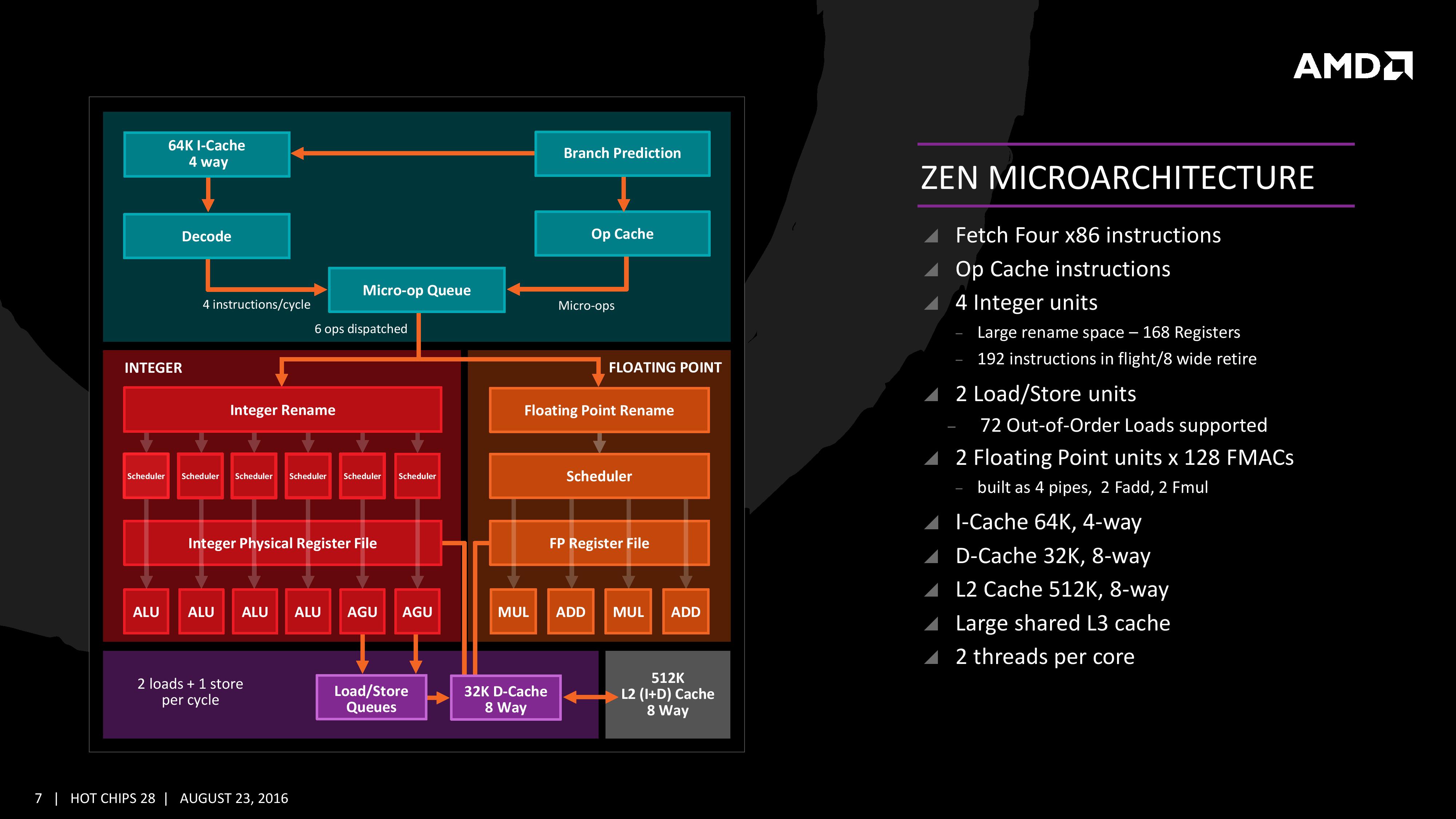
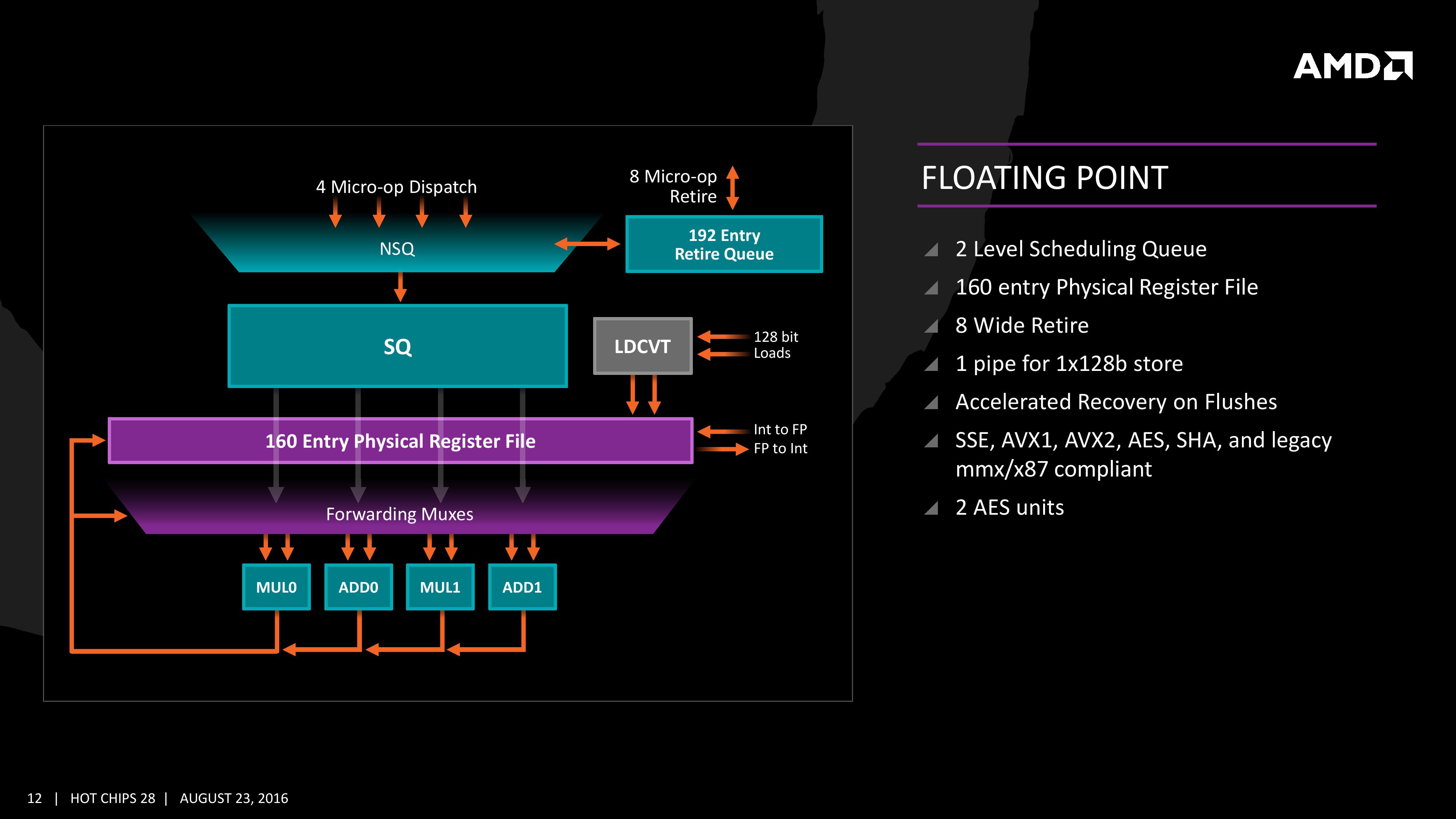
Your FPU wish is granted (sort of?). Two complete FPUs per core, implemented as two each parallel Fadd and Fmul units, capable of simultaneous scheduling and simultaneous floating point register access, per the detailed diagram here. The loader is 128 bits wide, so it does look like it can suck in, calculate, and shove out two 64 bit floating point instructions simultaneously, indefinitely, no bottleneck, with fancy dedicated instruction scheduling of its own.
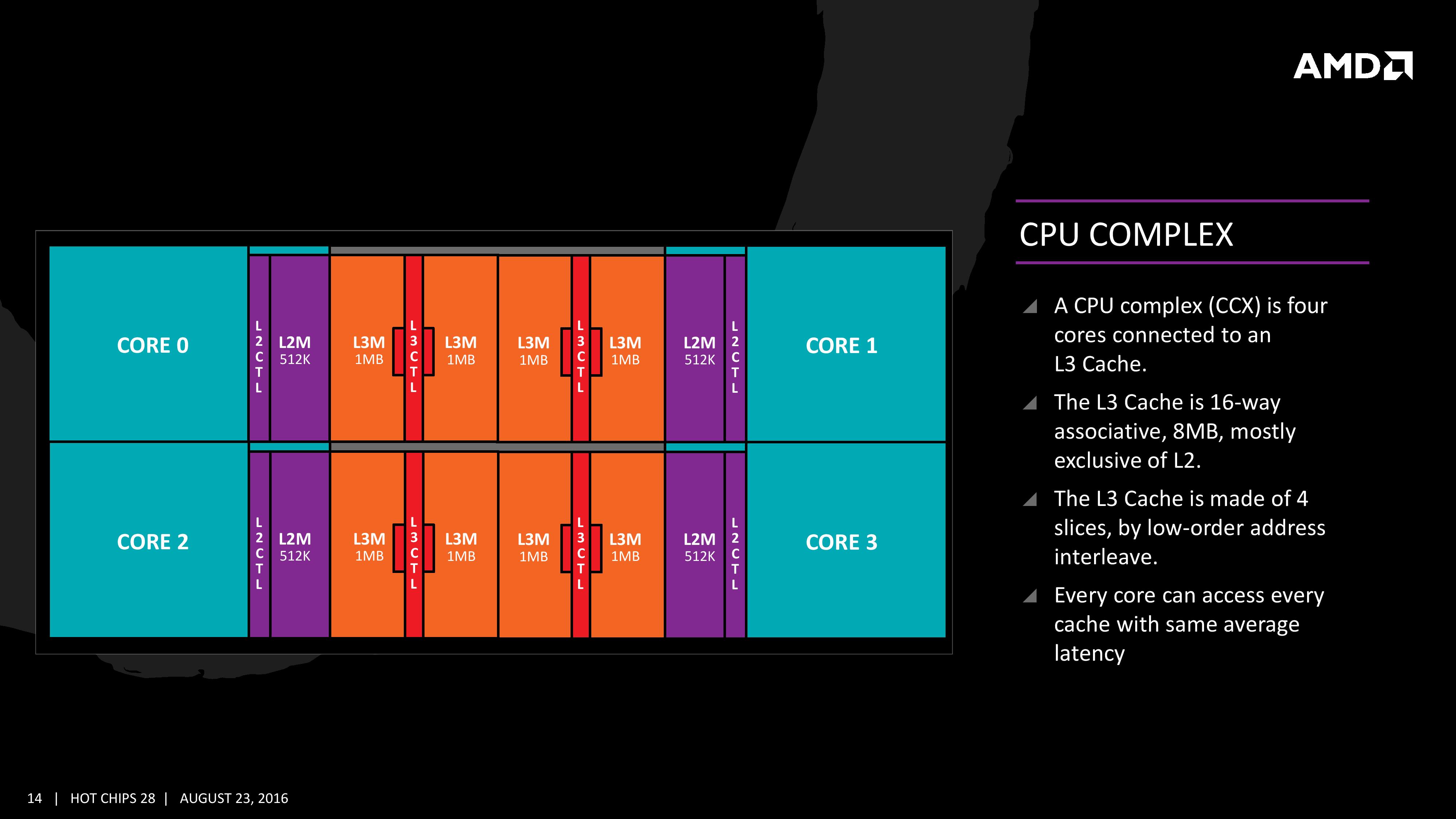
As for 8 "real" cores (whatever a "real" core is these days), this makes mention of a "CPU Complex" of 4 cores. The implication being, you might see more than one CPU complex on the same chip. But that diagram should be telling you why Intel has been reluctant to give you 8 "real" cores. With four cores, your L3 cache already has to be 16-way associative to behave reasonably. You want to jam 4 more cores into that diagram. Looks like there's room, top and bottom, right? And double the cache size, to 16 MB. If you want it to behave as efficiently as the 4 core version, you're wanting 64-way associativity. Which is ridiculous, and probably doesn't scale as well as you'd hoped. What it sounds like AMD will be doing is plunking two of those CPU Complexes down side by side, then linking them to each other via the modern version of HyperTransport. The CPUs become ccNUMA within a single chip.
I'm afraid you're doomed to disappointment with Intel and AMD both. Without sandwich stacked circuits, building an L3 cache for 8 cores is just infeasible. You can fit all the transistors you need, but hooking them all together in a useful arrangement requires an absurd number of paths.
-
Re:Dear AMD.....
Give us real 8 cores with 8 FPU's. none of this cheap ass corner cutting. Intel has lost their way and you have a chance to become a real contender once again.
Your FPU wish is granted (sort of?). Two complete FPUs per core, implemented as two each parallel Fadd and Fmul units, capable of simultaneous scheduling and simultaneous floating point register access, per the detailed diagram here. The loader is 128 bits wide, so it does look like it can suck in, calculate, and shove out two 64 bit floating point instructions simultaneously, indefinitely, no bottleneck, with fancy dedicated instruction scheduling of its own.
As for 8 "real" cores (whatever a "real" core is these days), this makes mention of a "CPU Complex" of 4 cores. The implication being, you might see more than one CPU complex on the same chip. But that diagram should be telling you why Intel has been reluctant to give you 8 "real" cores. With four cores, your L3 cache already has to be 16-way associative to behave reasonably. You want to jam 4 more cores into that diagram. Looks like there's room, top and bottom, right? And double the cache size, to 16 MB. If you want it to behave as efficiently as the 4 core version, you're wanting 64-way associativity. Which is ridiculous, and probably doesn't scale as well as you'd hoped. What it sounds like AMD will be doing is plunking two of those CPU Complexes down side by side, then linking them to each other via the modern version of HyperTransport. The CPUs become ccNUMA within a single chip.
I'm afraid you're doomed to disappointment with Intel and AMD both. Without sandwich stacked circuits, building an L3 cache for 8 cores is just infeasible. You can fit all the transistors you need, but hooking them all together in a useful arrangement requires an absurd number of paths.
-
Re:Dear AMD.....
Give us real 8 cores with 8 FPU's. none of this cheap ass corner cutting. Intel has lost their way and you have a chance to become a real contender once again.
Your FPU wish is granted (sort of?). Two complete FPUs per core, implemented as two each parallel Fadd and Fmul units, capable of simultaneous scheduling and simultaneous floating point register access, per the detailed diagram here. The loader is 128 bits wide, so it does look like it can suck in, calculate, and shove out two 64 bit floating point instructions simultaneously, indefinitely, no bottleneck, with fancy dedicated instruction scheduling of its own.
As for 8 "real" cores (whatever a "real" core is these days), this makes mention of a "CPU Complex" of 4 cores. The implication being, you might see more than one CPU complex on the same chip. But that diagram should be telling you why Intel has been reluctant to give you 8 "real" cores. With four cores, your L3 cache already has to be 16-way associative to behave reasonably. You want to jam 4 more cores into that diagram. Looks like there's room, top and bottom, right? And double the cache size, to 16 MB. If you want it to behave as efficiently as the 4 core version, you're wanting 64-way associativity. Which is ridiculous, and probably doesn't scale as well as you'd hoped. What it sounds like AMD will be doing is plunking two of those CPU Complexes down side by side, then linking them to each other via the modern version of HyperTransport. The CPUs become ccNUMA within a single chip.
I'm afraid you're doomed to disappointment with Intel and AMD both. Without sandwich stacked circuits, building an L3 cache for 8 cores is just infeasible. You can fit all the transistors you need, but hooking them all together in a useful arrangement requires an absurd number of paths.
-
Re:512TB of address space means nothing
Pretty much all of it. I'm having a hard time finding out the number of addressing bits supported by, say, an Arctic Lake (4xx) GPU, but considering that AMD's GCN offered unified memory on the entire 64 bit space since 2011 and nVidia offers 49 bits of unified address space since CUDA 5 it surprises me that someone tried to make a selling point out of this feature.
They went as far as comparing a CPU render against their new GPU. WTF.
The only reason i can imagine someone would try to push this feature is that 512TB sounds like a huge number. There's no practical application for it in the near future, and any benefit of such a large addressing space you already got on previous architectures, both from AMD and its competition.
-
Re:Seems overwrought to me
Sigh. Apple does not have battery battery technology. Heck, they don't even make the Macbooks. Quanta does, and Quanta also makes laptops for all the other major brands.
Apple's battery life advantage is because of the limited number of hardware configurations they have to support. They can fine-tune OS X to run on a few dozen models with minimal power use. Windows has to support millions if not billiions of possible hardware combinations, so a lot of times has to sacrifice power-thriftiness in order to maintain compatibility.
And you can't just straight out compare battery life between laptops. Different laptops place a different priority on battery life. So some laptops simply come with smaller batteries since they're aimed at customers who don't care as much about battery life. But if you did want to compare how power-thrifty laptops are, historically several models outlast the Macbooks in terms of minutes per Wh of battery. Topping the list is, not surprisingly, the Microsoft Surface Pro. Like the Macbooks, putting the OS-maker in charge of picking the hardware allows Microsoft to fine-tune Windows to work best with the hardware. -
Re:na, that can't be it
Um, the bending issue with the iPhone is a manufacturing defect. They made the phone too thin with no support, therefore it bent easily, leading to touch disease. It is not caused by dropping in any way, which you would know if you looked into the electrical cause of the issue. You would almost think that Apple never had any issues with BGA packages.
http://www.anandtech.com/show/...
But yeah, I am sure that every manufacturer has design defects causing BGA chips to pop off the board because the phone doesn't have sufficient support of the circuitboard.
Despite your snarky response, the bending issue with the iPhone 6 is not a manufacturing defect. If, as you say, they made the phone "too thin with no support", that would be a design defect. And the fact that the "bendgate" meme came and went so fast tells me that it was almost assuredly a "fake news story".
I have looked into the "electrical" cause of the issue, and it can be, and is, caused by repeated drops to a hard surface, which breaks the solder ball connections on large BGA packages.
And yes, Apple (like many others) have had occasional problems with BGA packages in the past, caused by bad solder-balls, warped chip packages, warped PCBs, and all other manner of "co-planarity" issues. If you looked at the insides of pretty much any smartphone, you would not try to pin (no pun) the problem on "insufficient support of the circuitboard". There simply isn't enough free-air-space in a typical smartphone for a board to flex much at all. Not saying it can't happen; but I'd put that particular cause on the "less-probable" end of the spectrum.
Oh, and yes, nearly every OEM at one time or another has had issues with BGAs. Several years ago, NVidia had a couple of YEAR'S worth of BGA problems with their GPUs and Video Cards, that affected nearly every product they were a part of. But don't believe me, do your own damned research.
Sorry. Apple is just held to a higher standard, and so when their stuff breaks, people tend to bitch. Loudly. Then the Haters pick it up, and the Meme begins... -
Re:na, that can't be it
Um, the bending issue with the iPhone is a manufacturing defect. They made the phone too thin with no support, therefore it bent easily, leading to touch disease. It is not caused by dropping in any way, which you would know if you looked into the electrical cause of the issue. You would almost think that Apple never had any issues with BGA packages.
http://www.anandtech.com/show/...
But yeah, I am sure that every manufacturer has design defects causing BGA chips to pop off the board because the phone doesn't have sufficient support of the circuitboard.
-
Re:Qualcomm doesn't make chips
You're entirely right that the memory subsystem is 90% of the battle for most server workloads once you exceed ten cores.
For integer workloads with unreasonable parallelism and unreasonable cache locality (that Intel's AVX doesn't already handle almost ideally), I'm sure this design will smoke Intel on the thermal management envelope, a nice niche to gain Qualcomm some traction in the server mix, but hardly a shot heard around the world.
And Qualcomm better be good, because Intel will soon respond with Omni-Path Knights Hill—perhaps also larded with HBM—that could probably take on the same workload between power sprints (less power efficiency in the CPU itself—which isn't always the main power draw—and probably more flexible as part of a tidy one-vendor-rules-them-all server mix).
I'm all for vendor diversity, but let's not get ahead of ourselves thinking that 10 nm levels the playing field, sucking down the data aquifer through a double-wide handful of drinking straws.
Yes, core count matters, but size matters even more when it comes to the hose.
—
Looky looky, the bow moveth:
Intel announcements for AI: Nervana 100x faster than GPU, Knights Crest & Mill 4x faster, SKL mid-17
Kx Streaming Analytics Crunches 1.2 Billion NYC Taxi Data Points using Intel Xeon Phi
-
Re:Aren't they too power-hungry?
From TFA:
"the launch of the Atom E3900 series brings with it Intel’s first custom silicon targeting the roughly 6W to 12W market of more powerful IoT devices...
For the ultra-low power, they offer this:
http://www.anandtech.com/show/...
Different applications, different requirements, different configurations and hence power needed...
-
Re:non-news is non-news
All modern NAND flash memory does "quasi-RAID". Writes are split across all chips in parallel, so the larger the capacity, the more chips, the faster the write speed. Check out any USB thumb drive with various capacities - larger models of the same line will be faster.
Bingo. One NAND die is not all that fast; it's when you put multiple dies together - either via multiple packages or, in the case of the iPhone, layering - that you get the absurdly high transfer rates solid state NAND storage is known for.
AnandTech's SSD Anthology even 7 years later is still the single best primer on the subject of flash storage: http://www.anandtech.com/show/2738/6. It goes over how this concept works in greater detail.
That said, 128GB should only be 4 times faster than 32GB, so if these figures are correct then the 32GB units are also using lower spec memory.
The one thing you won't find in there though, but is similarly important for understanding smartphone storage, is SLC caching. Most phones these days are using Triple Level (TLC) storage, which means storing 3 bits in a single cell. This greatly brings down the cost per byte of NAND, however it makes it slower to program and erase. As a result the iPhone (and most other phones) have an area of NAND that is pseudo-single level (SLC), which only stores 1 bit per cell. The purpose of the pseudo-SLC area is to serve as a cache; quickly absorb and coalesce writes, and then write them out to the slower TLC NAND transparently to the user.
The size of the pseudo-TLC area is generally proportional to the size of the total NAND. That means the larger iPhones have a larger pseudo-SLC area. And if you understand caching, then you understand what happens when you exceed that cache size. Most likely some of the tests in TFA were big enough to overflow the pseudo-SLC on the 32GB phone, but not on the larger model. Which is why there's such a large performance difference on some tests, but not in other things like transferring files.
-
Re:I Built My Workstation in 2010
It seems to vary a lot. Some benchmarks it's as high as 70% while other it's as low as 23%
-
Re:$$$ Workstations
>> I just spent $33k for a dual Xeon, 512 GB, and 4 Telsa K40
That was stupid, the P100 will be available any moment.
http://www.anandtech.com/show/...K40 (@ $2900)
P100 (@ $5899) * 2 = 9.4 Tflops $11798
. -
Re:iPhone 7 = the new pet rock
The processor benchmarks are pointless, what matters is how fast stuff actually happens and Android is generally faster at opening the same app etc. Probably because Samsung flash memory is quicker or something, or maybe it's just the massive amount of RAM in high end models. Having a dual core CPU probably doesn't help either.
Wow, what a bold lie. Android is NOT generally faster at opening the same app. As you can clearly see, the iPhone 6s, which is a year old, laps the brand new Note 7 when opening the same apps.
https://www.youtube.com/watch?...
As for Samsung "flash memory" being quicker? I'd love to know which Samsung shills are modding you up... Here's a quote from the Anandtech iPhone 6s and 6s Plus Review:
The other truly impressive aspect of the iPhone 6s’ this generation is the storage solution. The iPhone’s storage solution here is ahead of everything else in the industry for three clear reasons. The first is the use of more advanced NAND organization. Although TLC NAND alone is going to be clearly worse for performance than SLC or MLC NAND, the iPhone 6s’ use SLC caching in conjunction with TLC NAND to improve storage performance in the situations that matter. The second is the use of PCI-Express to enable much higher bandwidths, which means that the SLC cache can really stretch its legs to reach the high levels of bandwidth that it’s capable of. The third is the use of a custom storage controller with NVM Express, which helps to realize the full benefits of PCI-Express. Overall, all of these things come together to make noticeable differences in user experience.
http://www.anandtech.com/show/...
Apple's silicon dominance is reflected by a superior real world user experience, and that matters since what actually happens when you use a Note 7, is an "embarrassing level of real world performance".
The same lag carries onto scrolling performance in many applications, and infrequently in every application after heavy continuous usage. The phone does not get too hot, mind you, but we do notice that after continuous sessions, it progressively begins misbehaving. Scrolling behavior in particular is behind what you’d expect out of an $850 device, especially after this has been one of Samsung’s weak points for years. When compared to the OnePlus 3, we find that the Note 7 often neglects using its four cores as opposed to the OnePlus 3, which efficiently mixes up its core utilization when handling the same task. GPU profiling on the Note 7 makes it extremely clear that the phone leaks frames on several actions, even minor animations throughout the UI such as a WiFi network spinning circle animation. In some instances, we found outright damning displays of the Note 7’s occasionally-pitiful fluidity accompanied by the walls of green bars denoting serious difficulties pushing the frames through. But this is not just a matter of opening or returning to your application sooner than on other devices, Samsung’s software is noticeably slower than that of competing devices in almost every action. The stock keyboard still sees issues with split-second lockups, and the sharing menu on the Note 7 often leaves you waiting for options to load. The notorious TouchWiz Launcher has earned itself a reputation for slow speed and stutters throughout the years, and while it is not as bad as it used to be, it can still miss clear frames while switching through homescreens, and despite years of integration, Flipboard still remains the most jerky leftmost homescreen panel ever introduced by an OEM.
-
Please use a good tech site.
Hot hardware? Seriously, if it the posting is from them (and it is) always link in Anandtech and Techreport if available. http://www.anandtech.com/show/... http://techreport.com/review/3...
-
Re:USB to sata dongle plus 2TB SSD
--Umm, you do realize that SSDs are:
a) WAY expensive for backing things up to, and
b) An un-powered SSD drive will eventually degrade and LOSE ITS DATA in a fairly short amount of time (for Backup purposes)? This gets worse with Triple-level-and-up (TLC) Cell structures, BTW. They basically need an electric refresh to keep the cell structure from flipping to another position.
--Depending on the temperature/humidity it's stored in, SSD degradation could be detected in as low as several months or - if you're lucky - possibly as much as a couple of years. But if you don't fire it up every so often and run a data-consistency check, how would you know if your files are succumbing to bit-rot?
--There are many, many more options for backups that don't cost *nearly* as much as SSDs - that's not really what they're intended for. I can see buying an SSD if you want faster startup times on your PC, are into gaming, or you do a lot of virtualization suspending/resuming (R/W multiple gigabytes) every day. SSD's are designed to be faster than spinning disks, NOT necessarily long-lasting without power.
--For now, it looks like the best thing to do is keep your data online, have multiple rotating backups, store some stuff off-site, and copy data from old-drive to new-drive before it breaks. (I would even say real-time Mirroring or RAIDing is getting to be essential for any disk over 1-2TB.) But if you're storing your main backups on SSD media, you're over-spending *and* may be risking data loss if you don't power up the drive every so often.
--JMHO, but I would look into something like M-DISC for reasonable amounts of long-term archival storage. 4.7GB DVD M-Discs were made to the highest standard; 51% sure about the 25GB Blu-Ray M-Discs, not sure about the 100GB BD-R multi-layer discs. (Cloud backup is OK I guess as long as you don't mind 3-letter-agency snooping and you don't have a slow Internet with data caps, but encryption is definitely recommended before uploading.)
Refs:
http://www.makeuseof.com/tag/h... -
Re:I'm getting old.
Has anyone heard of NAS or SAN devices that now feature rows of M.2 slots instead of SATA sleds? I like the idea, I just don't see anyone making them at this point.
QNAP announced one earlier this year, although they couldn't seem to come up with a precise use for one. "SSDs are quiet! You could use it for presentations or karaoke!" is about the best they could come up with. I'm sure some people will find reasons to need the speed of M.2 drives, but aside from that I'm not sure why SATA SSDs wouldn't suffice, it's not like there is a lot of demand for NAS boxes to be teeny.
-
Re:Apple just has temporary advantageYou are comparing a brand new processor to a 3 year old one. A 2 year old iPhone 6 is substantially faster than a brand new Galaxy Note 7. You can of course buy a 2 year old iPhone for much less than a Galaxy Note 7. In in so doing, one would additionally get better user experience, OS, customer support, and resale value. I'm sure you've observed people in your daily life who are completely happy with their 6 year old iPhone 4. Because of their durability and the quality of the materials they are made from, ancient iPhones will often look almost new.
There's no comparison between Apple phones and their Google knock-offs when it comes to performance. People clearly buy the latter for emotional reasons rather than rational ones. In order to feel different, or special, perhaps. Nothing wrong with that. What matters is what makes people happy.
It sounds like you're on the Google bandwagon. Good for you. The important thing is that what you do makes you happy. Don't try to tell people that there is something wrong with wanting the technically superior phone, though. Or mislead them by trying to compare the performance of your brand new phone with an iPhone from early 2013.
-
Re:Slashvertisement
You seem awfully hung up on the initial characterization of Intel's announcement. They are not discontinuing existing SKUs. They are not discontinuing the Atom microarchitecture. They are not discontinuing the Celeron and Pentium lines that are already used in sub-$200 devices. They are not even discontinuing the Atom brand as it turns out; they just demoed the new line at the Developer conference this week: http://www.anandtech.com/show/10576/more-details-on-broxton-quad-core-ecc-up-to-18-eus-of-gen9
And while Microsoft may or may not decide there is enough market for a cheaper Apollo Lake based Surface, HP has already leaked details about an Apollo Lake based Pavilion x360.
-
Re:Downclocked
Consider this benchmark. http://www.anandtech.com/bench... wherin the 6900k K beaks the same clocked and cored Piledriver by about 300%. So what is proven in this benchmark -Zen has a 50% IPC improvement for CineBench, and that it's SMT (symmetric multi-threading) solution scales quite well in the benchmark.
-
Re:Wait..what?
Uh, no.
http://www.anandtech.com/show/...
On most benchmarks, the iPhone is faster. The iPhone SE, in fact, seems to be the top performer among iPhones, and it's the cheapest of the current generation.
Samsung's phones (and anything using the Qualcomm chips) tend to outperform the A-series chips when it comes to multi-threaded tasks, so you'll see physics simulations on high-end Android devices run better than iPhones. But honestly, that's not much of what most people do on their phones. On any real-world (ish) benchmark to do with browsing, IO or framerate, the iPhone is in the same ballpark or much faster.
Dollar-for-dollar, the iPhone is basically the best bet in town, even with 11-month-old silicon. Given that they're going to be announcing the next generation next month, this is only going to get better for Apple.
Look, there are lots of reasons to complain about both Apple and iPhones, and their SoCs have never been one of them. They produce power-efficient, highly integrated SoCs with great I/O throughput.
-
Re:Better-binned Titan X?
According to Anandtech, the GPU is the GP102 which is the same as in the recently announced top-end consumer card "Titan X" (note: not "GTX Titan X".. confusing? yes)
The Titan X has 3584 shader processors while the Quadro P6000 has 3840 and twice the memory. I assume that this means that the Titan X has a lower-binned chip.
Previous generation of Nvidia GPUs ("Maxwell" architecture) has a GPU called GTX 980 Ti, which was a lower-binned GTX Titan X with half the memory. Now when the 10-series Titan X is already the lower-binned GPU, I suppose this means that there will not be any "GTX 1080 Ti".If there is a 1080ti, it will probably use the same GP102 from the Titan X, but with only 8GB of vRAM. Heck they might even use the GP102 from the P6000. The first Titan came out during the 700 series and the 780ti had a higher-binned GK110 than the Titan, even though the Titan had more vRAM and FP64 support, and a much higher price tag.
Honestly though, it's not all that necessary. The 1080 is a beast of a card. A 1080 ti might not be enough to justify the extra cost this generation. I'd rather they concentrate on getting more 1080's out so I can actually buy one.... at MSRP.
The 1080 maybe a beast of a GPU but it is only ok for 4K60hz gaming. It fails to maintain a 60 fps minimum in Doom and it is only a matter of time before games come out with higher requirements. A 1080ti maybe enough for good 4K60hz gaming. What has really screwed over everyone is that the 1080 was released at the "ti" price point and the 1070 released at the "x80" price point. If Nvidia releases a "ti" card then they will either have to drop the prices of the 1080 and 1070 (annoying those who bought them) or put the "ti" at a price point where Nvidia will get very few sales. Either way Nvidia loses...
-
Re:Better-binned Titan X?
According to Anandtech, the GPU is the GP102 which is the same as in the recently announced top-end consumer card "Titan X" (note: not "GTX Titan X".. confusing? yes)
The Titan X has 3584 shader processors while the Quadro P6000 has 3840 and twice the memory. I assume that this means that the Titan X has a lower-binned chip. Previous generation of Nvidia GPUs ("Maxwell" architecture) has a GPU called GTX 980 Ti, which was a lower-binned GTX Titan X with half the memory. Now when the 10-series Titan X is already the lower-binned GPU, I suppose this means that there will not be any "GTX 1080 Ti".
If there is a 1080ti, it will probably use the same GP102 from the Titan X, but with only 8GB of vRAM. Heck they might even use the GP102 from the P6000. The first Titan came out during the 700 series and the 780ti had a higher-binned GK110 than the Titan, even though the Titan had more vRAM and FP64 support, and a much higher price tag.
Honestly though, it's not all that necessary. The 1080 is a beast of a card. A 1080 ti might not be enough to justify the extra cost this generation. I'd rather they concentrate on getting more 1080's out so I can actually buy one.... at MSRP. -
Better-binned Titan X?
According to Anandtech, the GPU is the GP102 which is the same as in the recently announced top-end consumer card "Titan X" (note: not "GTX Titan X".. confusing? yes)
The Titan X has 3584 shader processors while the Quadro P6000 has 3840 and twice the memory. I assume that this means that the Titan X has a lower-binned chip.
Previous generation of Nvidia GPUs ("Maxwell" architecture) has a GPU called GTX 980 Ti, which was a lower-binned GTX Titan X with half the memory. Now when the 10-series Titan X is already the lower-binned GPU, I suppose this means that there will not be any "GTX 1080 Ti". -
Re: But...
It's little brother the GTX 1080 can run Crysis 3 at highest settings quite well. http://www.anandtech.com/show/... 3840x2160: 35.6 fps 2560x1440: 71.5 fps Both with FXAA enabled.
-
Re:We want WebM not just WebP, Apple...
Many. The Samsung Galaxy S6 for example has hardware accelerated VP9 video. Hardware accelerated VP9 encoding and decoding is now a standard feature in ARM's video platform.
-
APK System 2015 to present
ASUS B85-E Motherboard
Intel Core I7 4790k CPU (vs. my last CPU Core I7 920 -> http://www.anandtech.com/bench... )
EVGA/NVidia GeForce 970 GTX video OC stock-oem (+140mhz) 4gb GDDR5 RAM (vs. my last vidcard 470 GTX -> http://www.anandtech.com/bench... )
Intel 530 240gb Flash SSD (SATA 6) - strictly OS & Program disk - latest 3.32 firmware & trim tools (vs. my WD Velociraptor -> http://www.anandtech.com/bench... )
Western Digital 10,000 rpm 8mb buffer Velociraptor 150gb (SATA II) - strictly for backup & programming data
Promise Ex-8350 128mb ECC ram caching raid sata 1/2 controller (SATA 1/2) - for backup WD Velociraptor
GigaByte IRAM 4gb DDR2-Ram based SSD (SATA I) - strictly for PageFile placement
Western Digital 7,200 rpm 8mb buffer 1tb (SATA 6) - strictly for downloads
HP DVD+-RW Dvd 1265i Burner (SATA 3)
8gb Kingston DDR-3 RAM (1gb for 64-bit NTFS Compressed Software RamDrive = webbrowser cache, hosts file location, print spooler, %TEMP% ops, + %COMSPEC% location)
APK
P.S.=> As to software for more speed, security, reliability & anonymity-> https://news.slashdot.org/comm...
-
APK System 2015 to present
ASUS B85-E Motherboard
Intel Core I7 4790k CPU (vs. my last CPU Core I7 920 -> http://www.anandtech.com/bench... )
EVGA/NVidia GeForce 970 GTX video OC stock-oem (+140mhz) 4gb GDDR5 RAM (vs. my last vidcard 470 GTX -> http://www.anandtech.com/bench... )
Intel 530 240gb Flash SSD (SATA 6) - strictly OS & Program disk - latest 3.32 firmware & trim tools (vs. my WD Velociraptor -> http://www.anandtech.com/bench... )
Western Digital 10,000 rpm 8mb buffer Velociraptor 150gb (SATA II) - strictly for backup & programming data
Promise Ex-8350 128mb ECC ram caching raid sata 1/2 controller (SATA 1/2) - for backup WD Velociraptor
GigaByte IRAM 4gb DDR2-Ram based SSD (SATA I) - strictly for PageFile placement
Western Digital 7,200 rpm 8mb buffer 1tb (SATA 6) - strictly for downloads
HP DVD+-RW Dvd 1265i Burner (SATA 3)
8gb Kingston DDR-3 RAM (1gb for 64-bit NTFS Compressed Software RamDrive = webbrowser cache, hosts file location, print spooler, %TEMP% ops, + %COMSPEC% location)
APK
P.S.=> As to software for more speed, security, reliability & anonymity-> https://news.slashdot.org/comm...
-
APK System 2015 to present
ASUS B85-E Motherboard
Intel Core I7 4790k CPU (vs. my last CPU Core I7 920 -> http://www.anandtech.com/bench... )
EVGA/NVidia GeForce 970 GTX video OC stock-oem (+140mhz) 4gb GDDR5 RAM (vs. my last vidcard 470 GTX -> http://www.anandtech.com/bench... )
Intel 530 240gb Flash SSD (SATA 6) - strictly OS & Program disk - latest 3.32 firmware & trim tools (vs. my WD Velociraptor -> http://www.anandtech.com/bench... )
Western Digital 10,000 rpm 8mb buffer Velociraptor 150gb (SATA II) - strictly for backup & programming data
Promise Ex-8350 128mb ECC ram caching raid sata 1/2 controller (SATA 1/2) - for backup WD Velociraptor
GigaByte IRAM 4gb DDR2-Ram based SSD (SATA I) - strictly for PageFile placement
Western Digital 7,200 rpm 8mb buffer 1tb (SATA 6) - strictly for downloads
HP DVD+-RW Dvd 1265i Burner (SATA 3)
8gb Kingston DDR-3 RAM (1gb for 64-bit NTFS Compressed Software RamDrive = webbrowser cache, hosts file location, print spooler, %TEMP% ops, + %COMSPEC% location)
APK
P.S.=> As to software for more speed, security, reliability & anonymity-> https://news.slashdot.org/comm...
-
Re:I don't think that's enough
No, you certainly are not a graphics expert. I am not either, but at least I know that scenes are not composed and rendered for each pixel. So, when you go from 1080p to 720p which has 2.25 times less pixels, you never get 2.25 times more frame rate.
Probably because there's some kind of setup time/synchronization between different types of rendering passes. But if you think of a 3840x2160 image as four 1920x1080 quadrants you'd think each step would take roughly 4x to do with the same level of detail. Just grabbing a few benchmarks from Anandtech, Dirt Rally (DX11):
1920*1080*132 = 274 million pixels/s
2560*1440*91 = 335 million pixels/s
3840*2160*49 = 406 million pixels/sClearly there's some scaling here, if it can render four quadrants at 49 fps ideally it should be able to render one at 49*4 = 196 fps. So if we take 132/196 = 2/3 as a rough number for the scaling benefit it should probably take around 4*2/3 = 2.7 times the horsepower to go from 1080p60 to 2160p60. Same setup/synchronization overhead, 4x runtime on each part, I'm sure you could try doing a linear regression and use Amdahl's law to see if this makes sense. Now I'm making a ton of assumptions here, but from my napkin calculations it doesn't look all that bad.
-
Re:Yawn
The problem with removable SD cards is the performance.
Samsung's latest EVO Plus 256 GB microSDXC card is capable of 95 MB/s read and 90 MB/s write (Class 10 U3 rating). Compare that to their PM971-NVMe which can store up to 512 GB of data and offers up to 1500 MB/s read and 900 MB/s write. 10-15 times faster. Only catch is it must be soldered on; due to the high pin count BGA. -
Re:Just as well
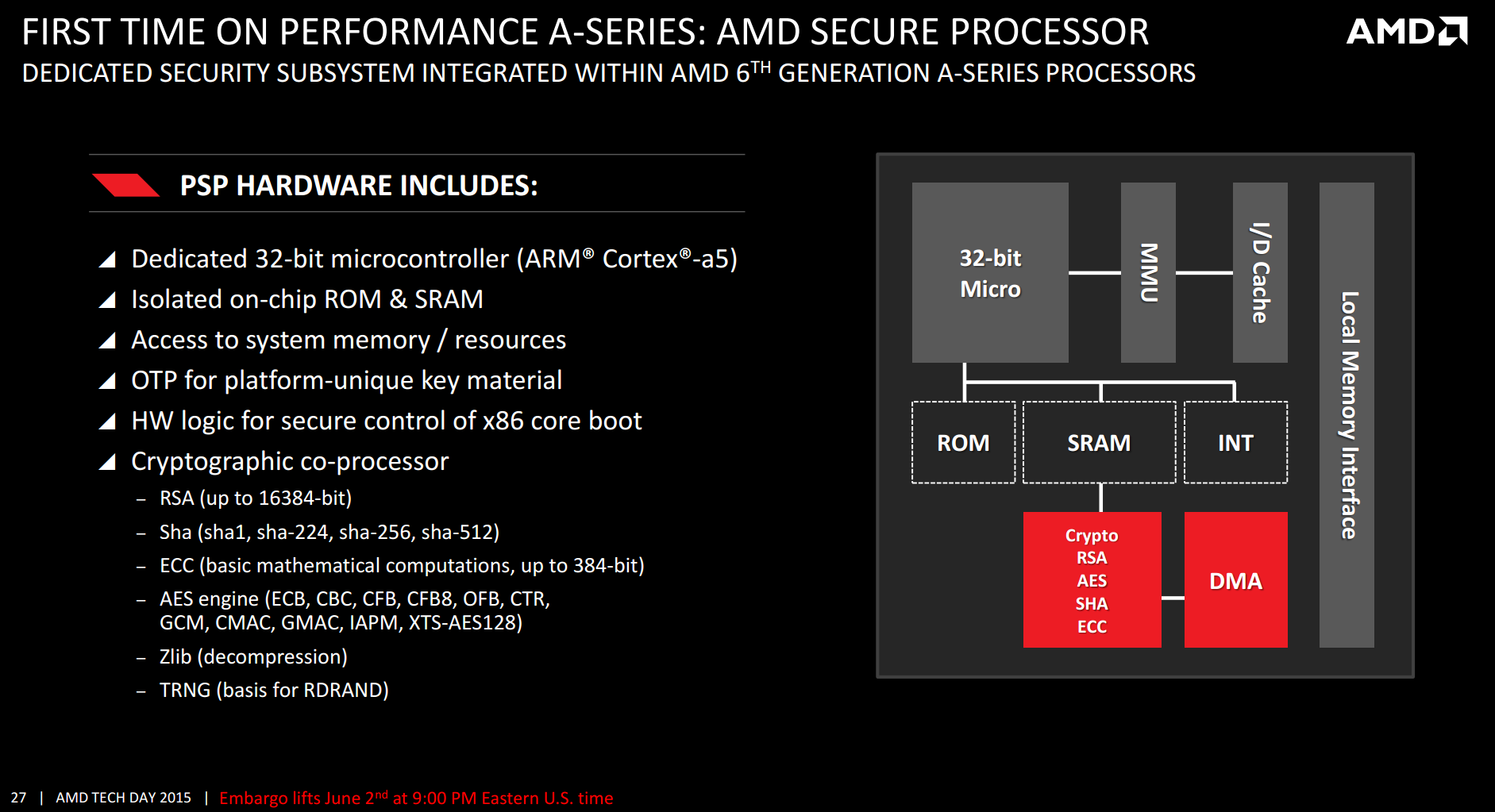
The ARM has nothing to do with game consoles. The PS4 and the Xbox One don't even use the ARM for their secure boot/DRM, they use something else (the PS4 uses the SAMU which is an LM32 derivative core inside the GPU portion, and I think the Xbox One uses more custom stuff). Read this libreboot page; the ARM is required to boot any modern AMD chip. Or this if you want a reference from AMD from last year. The PSP is very much alive and well and required to boot modern AMD chips.
-
Re:Screw the 6GB of RAM
Maybe I'm being naive here, but I see little reason why we don't have SSD class storage in our phones at this point. Can someone please explain it to me? Does it require too much power? It doesn't seem unreasonable to me to have a phone with a 120 GB SSD in it. Maybe the phone would be a bit thicker, but I think it's a feature a lot of people would like to have. I really hope Samsung can find a way to put this SSD in their next phone.
Some phones do. I mean, they don't use eMMC like the rest of them, or UFS, the successor to eMMC. They use a real SSD controller.
Apple's iPhone 6s uses a PCI-E/NVMe based controller using a TLC+SLC flash combination to give fairly impressive speeds for the storage system.
Supposedly the SSD controller is similar to what Apple uses for their laptops, though it's single channel which limits the speed you can get since you can't parallelize across multiple NAND dice.
-
Re:Performance characteristics
-
Re:Apple has an insane amount of money
Guess this is delayed until Intel decides to go back to doing their 'we will have amobile processor that will take over the world and should be available next year' thing that they've been doing for the past 15 years or so and have finally decided to stop doing it...
http://www.anandtech.com/show/10288/intel-broxton-sofia-smartphone-socs-cancelled -
Re:Time to
Sent from my Mac that has user-replaceable RAM that isn't soldered in.
Your Mac doesn't have soldered RAM. Though it's only officially upgradeable to 8GB, It's actually upgradeable to 16GB. I would know. I upgraded the RAM in both a 2009 Mac mini and a 2011 Mac mini. I also installed an SSD alongside the HDD in the 2011 one and was able to configure the two drives to act as a Fusion Drive. Between those upgrades and the discrete GPU (which is a feature that unfortunately hasn't shown up in any of subsequent models), it's kept chugging along like a champ.
Moreover, while it's trivial to put together a parts list for a PC build that beats a Mac, you'd be hard-pressed to find manufacturers with comparable parts at comparable or better prices at the time that a Mac is released. Part of that is because Macs generally have a good bang for the buck at the time that they're released (albeit, with some notable exceptions), but the caveat is that that's only true if you actually intend to use all of the features built into the device. For most people, they'd be perfectly content to cut features they have no intention of using, but they have no way to do so with Apple's take-it-or-leave-it products. Apple will have just a handful of SKUs that assume you want everything included, and you'll like it, damn it, whereas their competition will have 100s of SKUs with every combination under the sun, that way the customers can pick and choose exactly which features matter to them.
Eventually the competition catches up, and because Apple is slow to release new products their price advantage evaporates, but, once again, it was only there to begin with if you're one of the customers who actually wants to use everything that's included, which isn't true of most people. Of course, there are also the intangibles that work in Apple's favor (e.g. OS X, app/device ecosystem, perceived build quality, social status, "saving the environment", etc.), but I'm not taking any of those into account here, because the people who care about those things generally don't care about whether there's a price advantage or not.
-
Re:AMD just crapped themselves
> That's some major bullshit - the Titan X is an expensive piece of shit compared to the 980 Ti.
Whoa, hold on. Context is extremely important.
For gaming yup, that's some serious shenanigans(*) ! BUT for rendering the Titan X is faster then the 980 Ti.
(*) Obviously, many people don't feel the Price/Performance of the Titan X vs 980 Ti is worth it, myself included. Words along Over-priced, Greedy bastards come to mind, but if performance is king and money is no object then for rendering + scientific computing, the Titan X was the previous crown holder.
It all depends on context.
-
Re:This is just HDCP for Audio
Yeah, it's not like "Add support for HDCP" is listed as a feature in intel's slides.
Oh, wait. -
Casual PC gamers will be happy
Don't know about you, but my Windows machine is still on 7. I play games, I value performance, compatibility, stability, and my damn privacy. Supposedly it still is supported as I use it on an Ivy Bridge CPU (as it now depends on CPU architecture... yeah). Unfortunately, I'm sure Sony will argue it's all about Miracast not existing per say in 7, to which I say: "F*CK YOU", I have a Widi or whatever you call it now-compatible GPU, which is exactly the same fkin thing as Miracast. I'm gonna go ahead and call bull on both MS and Sony wanting to drive the consumer base to worse products, which have "THAT hardware degradation upgrade" or "THAT version-restricted upgrade which costs us 1 line of code to retro-support but it's your problem" written all over. And I'm not one for such conspiracy theories - I like innovation, and I now it takes a toll on hardware, but it sure as FCK isn't by using 10 over 8, 8.1 or 7, and to a lesser degree it also isn't going from Ivy Bridge to Skylake, as we all know Moore's Law is breaking harshly. Even Intel is admitting it in a way, and they make business from forcing people to upgrade. Current CPU benefits over 4 year-ago machines is close to none in most consumer-centric scopes, especially when compared to secondary memory advancements (read: SSD reliability & performance). And the only things I don't see working on 7 are things Microsoft has 0 technological basis not to launch them on 7. Or even 8.x for that matter. To me its pretty clear: this feature is just bells and whistles for the casual guy who was on the fence for a PS4 because he mostly spent time on the PC while the missus was watching E on the big screen. Or the husband, let's not be sexist.
-
Re:Arguably WORSE colors
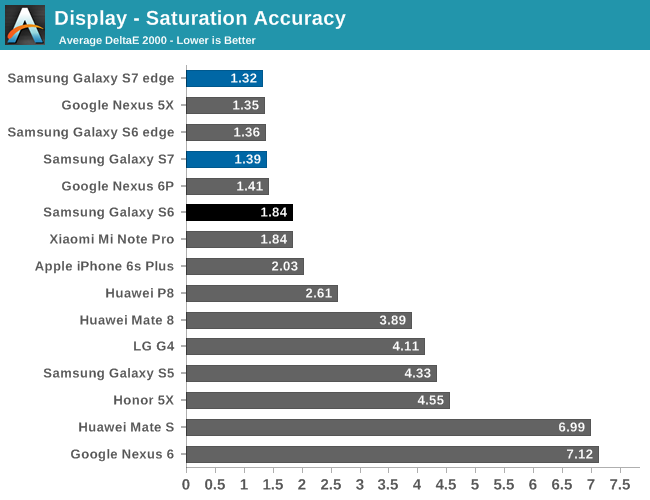
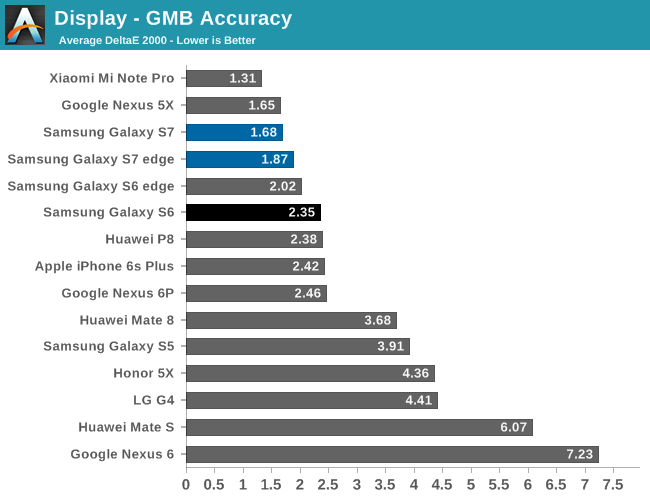
Color saturation of AMOLED screens is off the charts - which looks really colorful but ends up with screens where the colors are simply WRONG.
Yeah, just look at how horrible the saturated and GMB accuracy is for the AMOLED screen in the Galaxy S7... Oh, wait.
It's funny that people are constantly harassing Apple about being style over substance when it's plainly every Android phone maker that exhibits that behavior.
I think it's funny how cult members are able to flat out deny reality when it collides with their narrative.
-
Re:Arguably WORSE colors
Color saturation of AMOLED screens is off the charts - which looks really colorful but ends up with screens where the colors are simply WRONG.
Yeah, just look at how horrible the saturated and GMB accuracy is for the AMOLED screen in the Galaxy S7... Oh, wait.
It's funny that people are constantly harassing Apple about being style over substance when it's plainly every Android phone maker that exhibits that behavior.
I think it's funny how cult members are able to flat out deny reality when it collides with their narrative.
-
Re:Can't wait to see the performance comparisons
I don't really get the need for the attitude, if there existed zero evidence for it then I wouldn't mention it, however as you said in my case "don't believe that's intentional" maybe the same can be said about the harshness in your comment. But I assume it was, but you kinda covered it up by kinda stating being too harsh may not be valid because my "lies" wasn't intentional so whatever.
Over to the posts.
The stuff I've seen HAS BEEN lower performance on SteamOS. As for WHY that's is the case I don't really care. The main reason reason people would be against switching OS would likely be lack of applications, in this case the games they are or want to be playing, the second reason for gamers would likely be for lower performance if they switched. Lower performance may cut it for some ideologists but it won't cut it for the majority which focus about THE GAMES and not the operating system.There's what is now old tests of early versions of SteamOS, maybe I really shouldn't use those.
Here's one on Arstechnica from 13th November 2015, it shows performance for ValveÂs own Source-based games:
http://arstechnica.com/gaming/...
SteamOS 2.0 vs Windows 10:
Portal: 107.1 vs 146.2 FPS
Team Fortress 2: 89.2 vs 114.3 FPS
Left for Dead 2: 49.1 vs 50.1 FPS
DOTA 2 (Source 2 version?): 60.0 vs 70.6 FPS.They also cover Metro: Last Light Redux:
Min settings, SteamOS 2 vs Windows 10: 40.0 vs 50.5 FPS
Max settings, SteamOS 2 vs Windows 10: 4.2 vs 9.5 FPS
and Middle-earth: Shadow of Mordor:
Lowest, SteamOS 2 vs Windows 10: 61 vs 95.5 FPS
Low, SteamOS 2 vs Windows 10: 55.3 vs 87.0 FPS
Medium, SteamOS 2 vs Windows 10: 42.1 vs 63.3 FPS
High, SteamOS 2 vs Windows 10: 39.2 vs 50.7 FPS
Very high, SteamOS 2 vs Windows 10: 35.9 vs 46.9 FPS
Ultra, SteamOS 2 vs Windows 10: 14.6 vs 34.5 FPSPhoronix, 6th August 2015, test performance of Ubuntu OpenGL vs Windows 10, http://www.phoronix.com/scan.p...:
OpenArena, slight lead for Ubuntu, at most by 12.4%.
Xonotic, massive lead for Windows, at most 344.9% faster.Arma III about the same in the clip you pointed out I'd say, but maybe I would had preferred the Linux version anyway because it's the slowest parts of the game-play which matter the most.
Googled for Total War on Steam OS and Windows and found this of TW: Attila which shows better performance on SteamOS: https://www.youtube.com/watch?...16th November 2015, SteamOS vs Windows 10:
https://www.youtube.com/watch?...
Geekbench: Winner Windows 10.
Unigine Heaven: Winner Windows 10 (46.5 vs 48.8 FPS.)
Borderlands 2: Winner Windows 10 (34.1 vs 38.6 FPS.)
Metro: LL: Winner Windows 10 (37.5 vs 42.3 FPS.)
Alien: Isolation: Winner Windows 10 (46.8 vs 54.2 FPS.)
Shadow of Mordor: Winner Windows 10 (~42 vs ~47 FPS.)8 February 2015, CS:GO:
https://www.youtube.com/watch?...
Kinda a wash, either side leads at times.As for Vulkan:
17 February 2016: http://www.anandtech.com/show/...
Fury X:
OpenGL: 51.8 FPS
Vulkan: 56.9 FPS (beta)
DX11: 97.8 FPS
980Ti:
OpenGL: 62.6 FPS
Vulkan: 65.8 FPS
DX11: 91 FPSNot on topic but somewhat related I think the performance using DX12 in Gears of wars was worse too? Or was it just that AMD cards performed worse with that version? (It is a GameWorks title.)
As I said with completely new games and engines from people who know what they are doing that may change but as is anyone who owns The Talos Principle who were exited about Vulkan support and who hopped for even bet
-
Re:16GB storage
And comparing an iPhone with an Android phone on specs is pointless. We all know that you can get more for cheaper with Android, but you won't get an iPhone.
Well I'd say Apple gave itself a pretty damn huge bump here. It's hard to find benchmarks with the 5s, 6s and Sony Xperia Z5 compact (the only other mini-flagship, really) on one page but here and here and here combined gives some:
Basemark OS II:
iPhone 5s: 1180
Z5 compact: 1350
iPhone 6s: 2619T-rex HD (offscreen):
iPhone 5s: 28.7
Z5 compact: ~55 (approximated from graph)
iPhone 6s: 80.3Manhattan (offscreen):
iPhone 5s: 13.1
Z5 compact: ~25 (approximated from graph)
iPhone 6s: 40.1Considering the 5se will have the same CPU, same GPU and hopefully same RAM as the 6s the 5se should be pretty close and that seems like an awful lot of power in a really small phone. Maybe even overkill to drive a 1136x640 display, but it should give applications a lot of leg room to work with and hopefully keep it performing well even on iOS 10-11-12 and unlike my low-end Android phone it'll actually get updates. Now there's rumors of a Samsung Galaxy S7 mini, but right now I'd say the iPhone 5SE looks to become the undisputed champion - if only in a particular niche. And for giving up the screen real estate a 5se is $150 cheaper than a 6s for the same storage, it's not cheap but it fits the lineup. Pretty sure this is my next phone...
-
There is one already, by Sony, 800$
13.3", 800$ price tag, built by Sony (that, sadly, quit 6-9" e-reader market thati has actually pioneered)
http://www.anandtech.com/show/... -
Faster? No, not even close
Okay, so graphics and Multithreaded are faster. But watching videos and web browsing are for more typical usecases for most people, and the Samsung loses heavily.
Look at the browser benchmarks in the page here:
http://anandtech.com/show/1012...
The iPhone 6s is almost twice as fast as every other phone out there, and it came out nearly 6 months ago. I don't view the S7 as competitive, let alone faster. Other companies need to prioritize single-core performance as much as Apple. Multi-threaded performance isn't that big of a deal. This is a phone, not a server*.
-Android Fanboi and proud owner of a Nexus 6
*Yes, I know some power users out there utilize >2 cores on a regular basis. But most users (including myself) do not. -
Re:So what type of Windows PC do you need.
That makes no sense. It would be stupid to cripple a device that costs a premium. It's a matter of optimizing for different tasks. For example, double-precision floating-point is useless for games, and there's a huge performance hit. But when it comes to scientific programs, medical imaging, engineering, movie special effects... you can't afford the risk of rounding errors that come with using single-precision, because they will pile up and fuck your shit up.
-
Re:Latency?
You get it the wrong way: the cable is used into a "Alternate Mode" http://www.displayport.org/pr/...
The video signals inside a USB type C cable are just plain Displayport signals without any modification. On the host side there is a multiplexer chip that can switch the source of the signals injected into the USB type C cable from either the USB host controller USB signals or from the GPU Displayport signals.
More clear explaination here: http://www.anandtech.com/show/...
-
Re:Interesting, but not that impressive
I like to run my systems hot: cooling is more efficient the hotter you run. If it is specked for it, you might as well use it.
Yup, great idea.
-
Re:Samsung vs Nexus
Maybe having thermal vision on a smartphone will be the next thing?
http://www.anandtech.com/show/...
This is designed for architectural consultants to measure heat loss of buildings, but it can also be used to watch cats playing in the dark
I guess there might also be market for trying to find lost pets at night as well. -
Re:They don't need to be up there
Also read this Anandtech article from 2005.
-
Nope, never saw it till now &... apk
See subject: Thanks again - I never knew you did! Personally? I think that the version I put out is well, "OK" & does the job - but I am about making it BETTER by far & so far, so good.
However, my persona can be as nice as the next person's UNTIL I am attacked. That's all. Only human (as I said to others here in this very thread, & I have limits is all)...
See - There IS a LOT of trolls around here, you have to admit that (others here have, tepples being the most recent to state it to me when I asked him the same albeit he called them "miscreants", lol) - they can "get under your skin"... so I sometimes do the same in return but I wait until they fuck up big to do it. Then yes, I will toss their bullshit back in their faces to humiliate them. They can downmod me ALL DAY, & I'll keep coming.. do unto others as they did to you is all I can say, but I do it purely in defense of myself... I don't post with bogus fake names and have a reputation of a REAL name & WORK WITH IT TO DEFEND IS WHY. It was my career. Bad press can affect it adversely & I will NOT have that even though I am largely "semi-retired".
Man - some are REAL idiots & those I WILL RIDE STRAIGHT INTO HELL when they tell lies about me (I mean wtf: Calling me child molester? Yes, it's happened AND I AM NOT ONE - in fact,& I don't like hating? I HATE THAT KIND OF ANIMAL, a real pig, scumbag that hurts innocents...) OR saying other less than nice stuff about me... why?
I, 99% of the time, don't start crap. I know better. I've seen what happens if you do. It's not worth it. I also know that if you sit back and take shit, you will be shit on the rest of your days... screw that. Defend yourself, IF you're righteous in it, that is.
Anyhow/anyways: CRUZAN aged Rum (not "the captain" as I said earlier, but I thought the commercials would be "common rum ground" is all) - it's good (not $100++ a bottle, around $25 iirc, but good) - mixed with (of all things) Mountain Dew VOLTAGE (it's really tasty).
APK
P.S.=> No, wasn't you... I haven't taken a drink in months, but when it gets that "WET COLD" (snow doesn't happen in way, Way, WAY subzero or near zero, don't know if you know that or not) during night snows like tonite? I figured "What the hell! Why not!" - glad I did. Going to play Doom 4 now on (yes it's old but still fun, original DOOM I/II maps ported to it too, very cool nostalgia) MODERN hardware:
Intel Core I7 4790k CPU (vs. my last CPU Core I7 920 -> http://www.anandtech.com/bench... )
EVGA/NVidia GeForce 970 GTX video OC stock-oem (+140mhz) 4gb GDDR5 RAM (vs. my last vidcard 470 GTX -> http://www.anandtech.com/bench... )
Loading up off Intel 530 240gb Flash SSD (SATA 6) - strictly OS & Program disk - latest 3.32 firmware & trim tools (vs. my WD Velociraptor -> http://www.anandtech.com/bench... )
Temp ops coming up off that GigaByte IRAM 4gb I noted too (fully tuned rig with it all).
IT FLIES ON MODERN STUFF & is some fun so... I haven't done that in a bit either. Should be fun a bit 'buzzed'... apk