Slashdot Mirror
Domain: anl.gov
Stories and comments across the archive that link to anl.gov.
Comments · 464
-
Re:multithreaded merge
Check this out.. The generalization is here..
http://www-unix.mcs.anl.gov/dbpp/text/node123.html
http://www-unix.mcs.anl.gov/dbpp/text/node127.html -
Re:multithreaded merge
Check this out.. The generalization is here..
http://www-unix.mcs.anl.gov/dbpp/text/node123.html
http://www-unix.mcs.anl.gov/dbpp/text/node127.html -
Why So Uninformed?Why are so many commenters speculating on claims that have already been thoroughly investigated?
1. "The grid will collapse."
Electrical grid could handle millions of plug-in hybridsA new study, conducted by the Pacific Northwest National Laboratories and sponsored by the federal agency, predicts that off-peak electricity production is adequate for keeping 185 million plug-in hybrids on the road.
2. "Electric cars will increase pollution."
Plug-In Hybrids Are Cleaner (Even on a Coal Grid)The "well-to-wheel" emissions of electric vehicles are lower than those from gasoline internal combustion vehicles. California Air Resources Board studies show that battery electric vehicles emit at least 67% lower greenhouse gases than gasoline cars -- even more assuming renewables. A PHEV with only a 20-mile all-electric range is 62% lower(http://www.arb.ca.gov/regact/grnhsgas/isor.
p df)
Nationally, two government studies have found PHEVs would result in large reductions even on the national grid (50% coal). The GREET 1.6 model in 2001(http://www.transportation.anl.gov/pdfs/TA/153 .pdf) by the DOE's Argonne National Lab estimates hybrids reduce greenhouse gases by 22%, and plug-in hybrids by 36% (see table 2). An Argonne researcher reached consensus with researchers from other national labs, universities, the Air Resources Board, automakers, utilities and AD Little to estimate in July 2002 that PHEVs using nighttime power reduce greenhouse gases by 46 to 61 percent. -
Not Invented Here syndrome
I worked for a company, that wrote its own distributed computing system (in Java/XML). It sucked awfully by all measures (latency, CPU-load, memory requirements, bandwidth), but they would not dump it in favor of PVM or one of the MPI implementations because:
- We don't know, who wrote that PVM thing and how to support it.
- The guys, who wrote our own system are both really nice and dumping their work would offend them...
This is such a common problem, there is a term for it...
-
MPI?
Can we use MPI http://www-unix.mcs.anl.gov/mpi/ on these new multicore processor architectures?
-
Re:Is electric really better?http://www.calcars.org/vehicles.html#2
The "well-to-wheel" emissions of electric vehicles are lower than those from gasoline internal combustion vehicles. California Air Resources Board studies show that battery electric vehicles emit at least 67% lower greenhouse gases than gasoline cars -- even more assuming renewables. A PHEV with only a 20-mile all-electric range is 62% lower (see printed page 95 in the 2004 study).
http://www.arb.ca.gov/regact/grnhsgas/isor.pdf
Nationally, two government studies have found PHEVs would result in large reductions even on the national grid (50% coal). The GREET 1.6 model in 2001 by the DOE's Argonne National Lab estimates hybrids reduce greenhouse gases by 22%, and plug-in hybrids by 36% (see table 2). An Argonne researcher reached consensus with researchers from other national labs, universities, the Air Resources Board, automakers, utilities and AD Little to estimate in July 2002 that PHEVs using nighttime power reduce greenhouse gases by 46 to 61 percent. This is summarized in slide 11 at the November 2003 presentation by EPRI. For more in the media on this, see also the May 2, 2005 followup to the April 11 Business Week story.
http://www.transportation.anl.gov/pdfs/TA/153.pdf
I know that the actual benefit is not nearly as much as the perceived benefit. How do you know that? Have you conducted detailed studies that contradict those from two Department of Energy labs, 4 universities, and the Air Resource Board? -
Wait a minnit - this is a Grid how?
I know Grid is the buzzword of the day, but this isn't a grid. It's a cluster, or perhaps a beowulf, but it is not a grid. Buying a bunch of identical boxes and installing identical software on them doesn't make a grid.
One of the key features of a grid is that it "coordinates features that are not subject to centralized control". (What Is The Grid, Ian Foster, ANL). Grids by definition cross organizational or management boundaries. You can't buy a grid any more than you can buy an Internet. You can buy a network. You can buy a cluster. You can't buy a grid. -
Right, this is not a grid!Nowadays, in the CS research community, the most widely used definition of a grid is A Three Point Checklist by Ian Foster, stating that:
- There's no central control over resources.
- System uses open standards.
- System provides non-trivial quality of service.
-
Re:Electronic paper is the future.
I would agree, though I certainly hope they get past using plastic circuits. Wouldn't it be better to use something like this stuff? Or maybe something else?
-
Re:My results
i doubt anyone will see this because you posted AC, but i'll put this here for historical reasons:
http://www.newton.dep.anl.gov/askasci/eng99/eng99
1 58.htmPolarized plugs are used to connect the most exposed part of an appliance to the ground wire so that if you are touching a ground (like a pipe, bathtub, faucet, etc.) and the exposed part of an appliance (the case, the threaded part of a light bulb socket, etc) you will not get an electrical shock. Many appliances, such as electrical drills, are now "doubly insulated" so the probability of any exposed part of the appliance being connected, by a short or other problem in the appliance, to either wire is very small. Such devices often use unpolarized plugs where the two prongs of the plug are identical. On a polarized plug, the ground prong is larger.
i hope you read this.
-
Re:Poor mice...
Maybe they don't like mice?
Quite right too. Nasty, scurrying creatures that spread disease. And you can't eat them either. -
Re:100% efficiencyThe GP isn't exactly correct which also creates some errors in your post. No gas heater is ventless. All gas heaters are vented, even the near 100% efficient ones. They have to be to vent the burner chamber. Heat is wicked off of the burner chamber through a heat exchanges with a blower (usually) but there is always some form of venting. Even gas hot water heaters and gas furnaces are vented.
That said, no home is completely air tight. Without enough oxygen to fully burn fuels CO is produced (that's carbon monoxide). Here is a good article. A 100% air-tight home is not feaible and dangerous.
-
Re:Where is the reactor?
The radon-222 decay chain contains Po-218, Po-214, and Po-210. Link (PDF).
There is a small gamma component to Po-210 decays, but only something like
The United Nuclear sources are 0.1 uCi. Antistatic brushes are available with up to 500 uCi, and industrial ionizers can contain up to 40 mCi. -
Re:True, but only to some extent
U = I * R, or I = U / R. There's a direct and linear proportionality between the two, so "it's current that kills" vs "it's voltage that kills" is just splitting hairs.
Direct and linear porotionality? You neglect the dimensions. Resistance is not a dimensionless constant. In more practical terms the V in Ohm's law is across a load, but the current I is flux through it. Very Very diffrent. A bird can perch on a high tension wire and be at thousands of volts with respect to ground, but have no current through it, therefore it doesn't die. Nor is this merely an issue of picking arbitrary measuring points. The impedence of the human body is not a simple resistor. You can have high frequency high voltages running across you as a surface charge, the so called skin effect, with no harm.
So in another way you could say it's not current either, but _charge_ that kills you. (As in Q = I * T.)
Lets pick a supposed lethal current. Off the first page of a google search, http://www.newton.dep.anl.gov/askasci/phy00/phy002 93.htm gives an example of 0.07 amps. It doesn't say how long, but lets assume a few heartbeats worth and call it 10 seconds. So that would mean that you consider 0.7 columbs lethal.
But then if I were to take a 10 microamps, and course it through you for 28 hours, you'd have had more than a whole columb go through you.
Think you'd die? -
More scary then cyanide
United Nuclear sells 0.1 microcuries. Polonium 210 emits 4500 curies per gram [1], so that is about
-
Time to update...
It might be time to update the Mars Scorecard.... although we got some good work out of the MGS, it might be time to mark this one up for the green guys.
-
Re:The two rubs
While occupational regulations are complex and depend on what type of radiation, they are the equivalent of 5 rem/year.
Either your information is out of date or is for a specific state (in which case it is trumped by the federal limit). The federal limit is 100 mrem (1 mSev) per year (not the actual legislation but references the federal limit, I believe the number was last changed in 1998). If you know anything about radiation then you know that the federally imposed limit is absolutely ridiculous, it is equivalent to approximately how much radiation you are exposed to by sleeping with your significant other over the course of a year. -
Re:C'mon, COMMON SENSE!
>Why do people even waste their time on this idea. WHY DO WE NEED SPACE ELEVATORS?
Why do people waste their time trying to make a 10GHz processor? Why do we *NEED* computers that fast?
>For all the engineers here: why would you want to build a cable tens of thousands of miles long out of
>currently UNAVAILABLE materials (unobtanium) to slowly ratchet up one payload at a time?
As another poster said, we research unobtanium to make it obtanium. Carbon fiber was once unobtainium.
>It's a horrid idea, and it STILL takes just as much actual energy to put anything in orbit...just it does
>so pathetically slowly.
Negative. Assuming 100% effiency in converting electricity to kinetic energy, it takes ~4KWhrs to accelerate a kg to orbital velocity. If you have to take your fuel with you, you have to accellerate the fuel as well leading to an exponentially increasing ammount of fuel required to move the final mass. Using the space elevator and electromechanical "lifters" you don't take any fuel and electric motors are ~85% efficient.
>The plan is to use PHOTOVOLTAIC PANELS to receive the energy being beamed from the ground. That is a
>patheticaly slow method of energy conversion considering the payload still has to receive the equivalent
>energy of being accelerated to several miles/second!
Speed of energy conversion really doesn't have anything to do with... anything really. All they need is a sufficient area of Photovoltaic panels somewhere that the energy can be reliably transmitted to the lifter.
>There's a simple and really OBVIOUS idea that has been on the drawing board for at least a decade. It would
>involve a heck of a lot less work, be likely much simpler and cheaper, and be flat out cool.
>Instead of building just a few lasers to beam the energy, lets make a whole bunch of them and use the
>latest electrically powered pulse laser technology being developed for the joint strike fighter. Our
>spacecraft is just a payload module with stabiliers BOLTED to a block of inert material. A very short and
>simple linear accelerator kicks the spacecraft about half a mile into the air, high enough for all the
>lasers spread across the industrial plant infrastructure to 'see' it.
Space elevators have been on the drawing board for longer and neither of us is truely qualified to judge simplicty and cost of the competing schemes. If this is truely simpler/cheaper where are the groups trying to *DO* it? Also, the efficiency of the best lasers available is ~30% http://www.newton.dep.anl.gov/askasci/eng99/eng992 13.htm ignoring obvious constraints such as the proper frequency to go though the atmosphere and be absorbed at the recieving end. There is no such thing as a *SIMPLE* linear accelerator that can kick something up a half mile into the air and deal with weather. Tracking the craft is probably solvable, but focusing several thousand high power lasers through the atmosphere *AND* dealing with the distortions from other lasers probably isn't.
>Pulses of light vaporize the fuel in a sequence such that the shock wave of superheated vaporized gas is
>planar : basically a rocket engine without needing
Taking your fuel (or more properly reaction mass) negates much of the benefit of leaving your energy source on the ground.
>A nozzle pumps, combustion chambers, volatile fuel, electrical systems, elaborate control systems and
>sensors, just enormouse amounts of hardware gets taken out of the spacecraft and left sitting on the
>ground. Sure, there's a LOT more delicate hardware left sitting on the ground...WHERE IT BELONGS. The laser
>launch system would be designed for almost continuous duty, launching one capsule after another all day
>long. Spacecraft would be MUCH simpler, and with a lower cost of launch could be made MUCH more cheaply as
>well. After all, why bo -
Re:Not another space accident!?
Here it is.
-
Re:Catholics believe in evolution, fossil record,
Indeed. Trailing forward slash screwed those up, as well as this one:
http://www.newton.dep.anl.gov/newton/askasci/1993/ biology/bio039.htm
Thanks.
Marc -
Re:Catholics believe in evolution, fossil record,
How is the world do fossils prove evolution? Where are the intermediate forms? What?! What do you mean there aren't any?
Of course there are - you just choose to put your head in the sand to ignore them. In fact, they are being discovered all the time... here's one just last week:
http://www.sciencedaily.com/upi/index.php?feed=Sci ence&article=UPI-1-20061102-12453000-bc-us-missing link.xml
Read on, if you dare to actually learn something:
http://www.skepticwiki.org/wiki/index.php/Intermed iate_Forms/
http://en.wikipedia.org/wiki/List_of_transitional_ fossils/Then stop saying the fossil record "proves" evolution because it doesn't. It proves there were dinosaurs. It doesn't prove evolution at all.
Actually, it doesn't even prove there were dinosaurs. All we know is that we find bones in the ground. The evidence indicates that there were dinosaurs. "Proof" in science is a misnomer.
http://www.newton.dep.anl.gov/newton/askasci/1993/ biology/bio039.htm/
It's really about evidence:
http://www.space.com/searchforlife/seti_devore_the ory_050303.html/
Note that I carefully avoided talk.origin's to keep you from claiming that that everyone refers you to the same source. The vast majority of the scientific community is in agreement about the vast majority of the conclusions drawn from the vast evidence that has been discovered thus far: evolution is a fact. -
Clinton had sex with Argonne Labs IFR
Clinton seems to have had sex with Argonne Labs Integral Fast Reactor... and next we'll be hearing he didn't have sex with the energy fund. He just created the problem.
It was the Clinton Administration that shut down the Argonne Lab's IFR development program in 1994. This reactor design will do more to solve the coming world energy crisis than anything else...and Clinton did have sex with it!
Read the congressional report: Nov. 6, 1997 (Senate) Page S11890-S11891 here: http://www.anl.gov/Media_Center/Argonne_News/news9 7/crtill.html
Quote:
Unfortunately, this program was canceled just 2 short years before the proof of concept. I assure my colleagues someday our Nation will regret and reverse this shortsighted decision.
If anyone wants to read the PBS interview with Dr. Charles Till - look here: http://www.pbs.org/wgbh/pages/frontline/shows/reac tion/interviews/till.html
Quote from the PBS interview:
The Clinton administration, I think, firmed up quite an anti-nuclear power position....
Q: What will be our energy source, then?
A:I think that many engineers would agree that there is limited, additional gain to be had from conservation. After all, what does one mean by "conservation?" One simply means using less and using less more efficiently. And there have been considerable gains wrung out of the energy supply and energy usage over the past couple of decades. We can probably go somewhat further. But you're talking, you know, 10% or 20%. Whereas over the next 50 years, it can be confidently predicted that with the energy growth in this country alone, and much more so around the world, it would be 100%, 200%, or some very large number.
And so what energy source steps in? There is only one. It's fossil fuel. It's coal. It's oil. It's natural gas. Some limited additional use of the more exotic forms of things, like solar and wind. But they are, after all, very limited in what they can do. So it will be fossil.
Now the question, of course, immediately becomes, well, how long can that last? And everyone has a different opinion on that. One thing that is certain, and that is that the increase in the use of fossil fuels will sharply increase the amount of carbon dioxide in the atmosphere. Another thing is certain. You will put a lot more pollutants into the atmosphere as well, in addition to carbon dioxide, which one could argue the greenhouse effect exists or doesn't exist.
So it is very clear that the consequences of short sighted anti-nuclear policies of the Clinton Adminitration were well understood in the early 90's. The lack of solutions to the problems we face now are a direct result of Clinton's administration.
----------
Note the Integral Fast Reactor burns nuclear wastes and will extend the existing uranium fuel stockpile (called Depleated Uranium, spent fuel, and nuclear waste) to over 60,000 years for the existing fleet of over 100 reactors in the Gigawatt range.... and this without mining any more uranium.
The IFR burns all actinides and hense there are no long term wastes... only light isotopes with 1/2 lives of a few decades at most, and which are used industrially for things like pipe line xrays.
See http://en.wikipedia.org/wiki/Integral_Fast_Reactor
When we are in the throws of the worst energy crisis mankind has ever seen, then I want everyone to look and Clinton's contribution to the problem. I think the quote from the congressional report (above) sums it up nicely.
The short of it is that its prefectly clear we need alternatives to fossil fuels and the issue is that we needed to start developing these alternatives 15 and 20 years ago. It -
Re:equivelent MPG
A common system for evaluating advanced technology vehicle energy sources (hybrids, fuel cells, etc.) uses the "GREET" model developed by Argonne National Labs. This model considers the 'well-to-wheels' efficiency, which gives the most accurate picture of how a particular fuel or energy source is used. In the end, you get a measurement of miles per equivalent gallon of gasoline, or MPEGG.
http://www.transportation.anl.gov/software/GREET/i ndex.html -
Re:Fair point but...
After double-checking my numbers, it turns out I didn't remember the numbers quite right. But a quick google gives this:
Driving or Flying?
But you're still going to choke to death on a chunk of insufficiently-chewed beef. -
Re:Why I can't switch yet
There are also Ubuntu DVD iso's available, full of 3.6Gb of packages. (If you can burn and install from DVD's, that is...)
http://mirror.mcs.anl.gov/pub/ubuntu-iso/DVDs/ubun tu/6.06/release/ -
You are incorrect - google "well-to-wheel"
Mechanical Engineering Power did a study that came up with much the same results as the white paper already linked -- see here. (gas engine for comparison -- about half the well-to-wheel efficiency.)
In general, your back-of-the-envelope numbers are mostly wrong. Generating plants often exceed 50% efficiency), transmission loss is about 7%, switching chargers lose in the range of 5-20%, and overall drivetrain loss is around 55% for an electric motor, for a total of about 22% (as above).
That huge drivetrain loss is known as the "tank-to-wheel" efficiency, and it's what really kills the gas car -- those have about 14% efficiency for that process, giving them 11-12% overall efficiency (also known as "well-to-wheel" efficiency). So in general a gas-powered car takes about twice the energy to run that an all-electric car does, with hybrids somewhere in the middle. Google "well-to-wheel" and you'll find a great deal more on this.
Manufacturing costs play some role in overall energy requirements, but it's pretty minor. A typical car in the US fleet will see about 160,000 miles; at 22mph (average), that's about $22,000 of gas (at $3/gallon), which totally dwarfs the energy costs involved in constructing the car in the first place. Careful about total-lifespan costs, though -- there was a deeply bogus study that came out a few months ago that used nonsensical assumptions (e.g., "cars last for 100,000 miles, trucks for 250,000" even though the figure as measured for the US fleet is 150,000 vs. 170,000), so there's some false claims floating about. -
Range, speed, efficiency
> That 250 mile range estimate is probably at significantly lower speeds.
"The LiIon tzero will drive 250 miles in left lane traffic, in LA that means 75-80 mph.
Alan Cocconi (AC Propulsion founder and chief engineer) drove it to San Diego and back
without charging. On any type of standardized drive cycle it will go over 300 miles." link
> If I remember right, electric motor efficiency and power typically increase with load,
> but fall off with speed
"Efficiency: 90% average, 80% at peak power" torque chart
> 1000 pounds of batteries...are equivalent to about 1.5 gallons of gas (6.3 pounds/gal).
> Divide that by an efficiency of around 30% and you've got a 32:1 energy density ratio
> in favor of gasoline.
Internal combustion vehicles are about 15% tank-to-wheel energy-efficient. link
An all-electric vehicle is about 44% tank-to-wheels energy-efficient. link
The car's web site puts its efficiency at 2.2km/MJ, vs. 0.6km/MJ for the gas cars (see here).
So an electric vehicle needs to carry about 30% the energy of a gas vehicle.
Another way to look at this is to compare to the Lotus Elise, which consensus is saying is the closest regular car on the market. The Elise gets 25mpg, and so would need 10 gallons -- 63 pounds -- to travel 250 miles, giving us a ratio of 16-to-1 in required weight.
The fuel tanks on this Peterbilt model range from 40 to 150 gallons, with an apparent midpoint of 83 gallons, giving us 525 pounds of gas or 8320 pounds of batteries. The suspensions seem to cluster around 40,000 pounds, suggesting that batteries would need to replace about 20% of the max weight capacity of a truck in order to get the same mileage as a tank of gas (although that's not taking into account weight savings in the engine and similar components).
That's a lot -- it's probably 25-30% of the freight capacity of the truck. Batteries are dense, though, so it'll take up little of the truck's volume, potentially making the result feasible for cargo that is more limited by volume than by weight. Still, I think it offers a good argument that long-haul trucking is likely to stay a liquid-fuelled activity for the forseeable future. -
Re:Peak Oil and Grasping at Straws
Ethanol, or any biofuel, will be hard pressed to replace oil. Petroleum is essentially very old and dirty, but efficient biofuel, stockpiled underground. A year's worth of [insert favorite biofuel source plant(s) here] will be hard pressed to replace an eon's worth of petroleum.
Here is some back-of-the-napkin stuff - mostly unit conversions. Nothing fancy. If you trust my math skills, feel free to skip to the surprise ending.
My sources are just whatever came up first on Google.
So here goes:
According to this link, there were 598 million metric tons of corn produced globally in 2002. (That was the first year I came across. Let's assume it's typical.)
598 million metric tons * (2204.6 lbs/metric ton)
...converts to 1.3 billion lbs of corn.A bushel of corn is currently defined as 56 lbs.
1.3 billion lbs * (1 bushel/56 lbs)
...converts to about 23.5 million bushels of corn.According to this article, a bushel of corn can produce 2.7 gallons of ethanol.
23.5 million bushels * (2.7 gallons/bushel)
...tells us that 63.5 million gallons of ethanol could theoretically be made from all the corn grown globally in one year.According to this, a barrel of petroleum has 42 gallons. After refining, it could be made into about 19.5 gallons of gasoline.
So if we say that 1 gallon of ethanol can replace one gallon of gasoline, then
63.5 million gallons * (1 barrel / 19.5 gallons)
...comes to 3.2 million barrels.(The 1-to-1 ethanol-to-gasoline ratio is a falacy, as ethanol will only take your car 0.8 miles for every 1 mile gas will, but this is getting too complicated. Let's just say 1-to-1.)
According to this source, the United States currently uses 20 million barrels of oil per day.
3.2 million barrels * (1 day / 20 million barrels)
...amounts to 0.16 days.So if we can stop using corn for livestock feed, corn starch, corn syrup, corn oil, corn chips, corn stoves, corn bread, popcorn, candy corn*, corn on the cob, corn dogs, creamed corn... er... sorry, I was channeling Forrest Gump for a second...
If we use all of the corn grown in one year for making ethanol, and production is still propped up by using current (petroleum-heavy) farming practices, it would keep the U.S. running for just about four hours. Or, if you prefer, Argentina could last almost a week. Or we could supply Togo with their fuel needs for the entire year.
"Your math is wrong!" you exclaim. Not unlikely. But show me where. Am I off by an order of magnitude? Let's take it from 4 hours to 40 hours. That's almost two days! Woohoo!
"Corn is the wrong source!" you shout. Let switch to sugar. Or switchgrass. Or anything you want. Let's imagine the Fubar tree, which is 100 times more efficient for making ethanol. So now we've gone from 3 hours to almost 17 days. Woohoo!
Let's dare to dream, and combine the last two! I'm off by an order of magnitude, and there's a massive switch to Fubar tree farming. The U.S. now has over 5 months of petroleum replacement. Sorry Argentina and Togo...
Feel free to check my math. I'm sure this must be due to rounding error.
--
* - I checked. Corn syrup is an ingredient in Candy Corn -
Re:Heather Has Two Mommies
There are no YYs in human history.
True, but there are some cases of XYY. -
sources and the calculation I did
Assuming the charts are relatively accurate
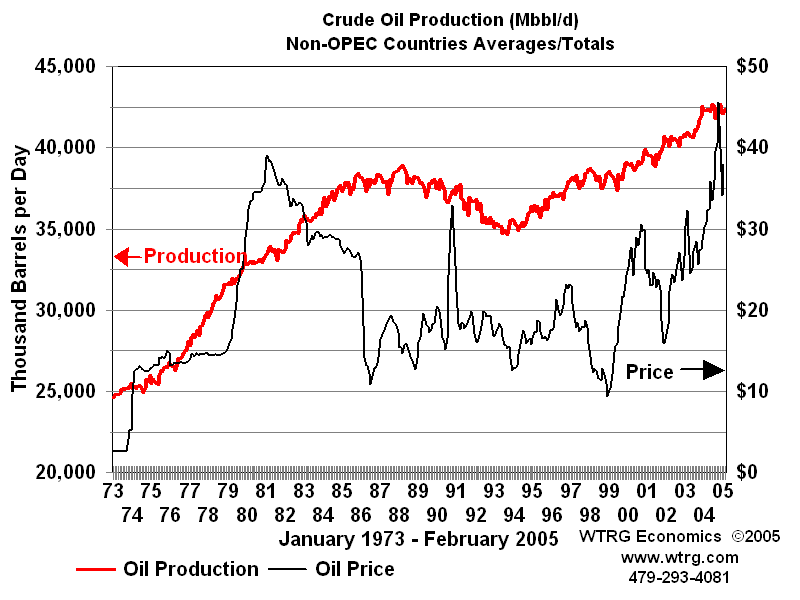
Non-OPEC production:
http://www.wtrg.com/oil_graphs/PAPRPNT.gif
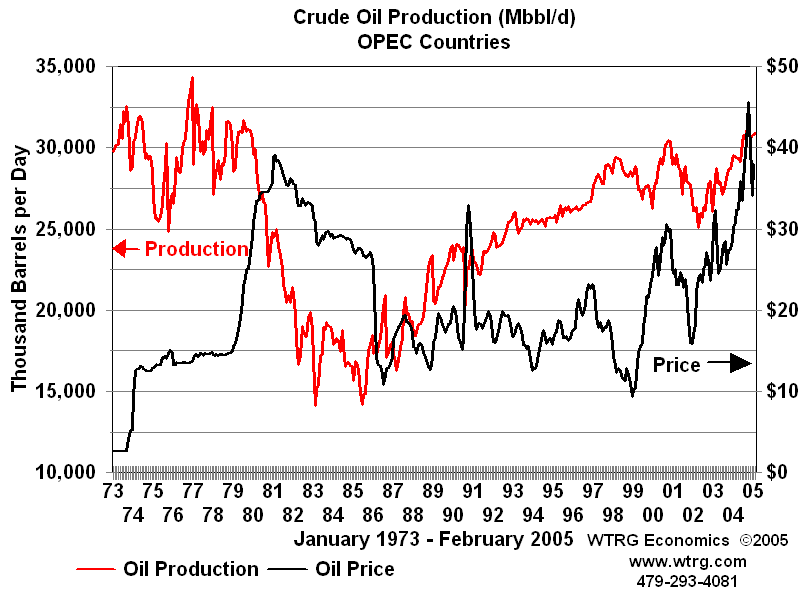
OPEC production:
http://www.wtrg.com/oil_graphs/PAPRPOP.gif
Gallons of gas in a barrel of oil:
http://www.newton.dep.anl.gov/askasci/eng99/eng992 88.htm
CO2 (and H20) in a gallon of gas:
http://www.terrapass.com/terrablog/posts/000181.ht ml
I just shot an average on the productions and added them together, using 60,000,000 barrels per day total production. Multiply by 365 days a year, 30 years, 19.5 gallons of gas in a barrel, 20 pounds of CO2 in a gallon of gas. Divide that by 2000 lbs in a ton and you get somewhere around 130 billion tons of CO2. If you use the same source for CO2 in a gallon of gas, which says roughly 8 pounds of water come from burning a gallon of gas, then you're talking about around 50 billion tons of water vapor. Add those together and (with the figures from Phase Shifter) and you're talking about 3.6% of the existing mass we've produced in the last 30 years alone. I tried to dig up some figures on the deforestation but didn't have much luck, but trees (which we're cutting) and grass (which we're paving over) are large consumers of CO2 and H20, so losing them is compounding the effect. -
Re:Linux
The i/o nodes and service nodes run Linux. Compute nodes run a custom kernel called CNK.
(See http://www-unix.mcs.anl.gov/~beckman/bluegene/SSW- Utah-2005/BGL-SSW03-CNK-CIOD.pdf)
One of the problems with running Linux on the compute nodes is that the normal mechanism of loading applications using demand paging doesn't fit well. I worked in the MPP supercomputing business 15 years ago and we tried running a full Unix kernel (Linux was just coming into being.) and the users ended having to run they apps twice. The first time to get all the memory warmed up with the pages loaded.
We were working to fix it, but then end of the cold war killed the business. -
Not batteries
Note the bright white flash, and light colored smoke. That is not a battery fire (don't ask how I know) The metal is magnesium http://www.hydro.com/en/about/history/1946_1977/1
9 50.html International challenges Despite Hydro's leading role in developing magnesium technology, the company decided in 2002 to close its production plant at Porsgrunn and instead concentrate on further developments of its facility in Becancour, Canada, built in the early 1990s. It also established access to metal in China. http://www.newton.dep.anl.gov/askasci/chem03/chem0 3547.htm www.cabrillo.edu/~rroland//CHEM1A/JoshLabManual/11 -HeatofCombustion(Magnesium).doc Bet it was nearly this model: http://laptopmag.com/Review/Dell-Latitude-D620.htm Magnesium, a silvery white metal of atomic weight 24.32, ignites at 632C and burns at 1982C, with magnesium oxide (MgO) as its combustion product. In an exothermic reaction, metallic magnesium can ignite to produce magnesium dihydroxide (ie, Mg(OH)2) and hydrogen. Magnesium is used in either powdered or solid form as an incendiary agent for both illumination and antipersonnel purposes. Various alloys of magnesium (eg, aluminum/zinc/magnesium alloy found in US M126 round) are mechanically sturdier but also can be ignited easily. Thermite is a mixture of powdered or granular aluminum and powdered iron oxide. When combined with other substances, such as binders, the material is termed a "thermate." All such materials react vigorously when heated to the combustion temperature of aluminum. This reaction produces aluminum oxide, elemental iron, and sufficient heat to melt the iron. The reaction temperature is approximately 2200C. -
See "Future Truck" program
http://www.transportation.anl.gov/research/compet
i tions/futuretruck/2004_futuretruck_results.html
These take stock vehicles and modify them. The 2004 competition used a Ford Explorer as the baseline and the vehicles competed on vehicle safety, fuel efficiency, emissions, off-road performance and towing performance performance (2,000lb trailer on 7% grade). The winning team reached 25mpg (yeah, still crappy but a 33% improvement), passed all the tests, and the emissions were below the Ultra Low Emissions Vehicle (ULEV) requirements.
Those high schoolers from the "unrealistic" project move on to colleges that take part in Future Truck and eventually become the next round of automotive engineers. They need motivation, the opportunity to get their hands dirty and to see some results. Anyone who competed came up with a very high efficiency vehicle and some real skills to be proud of, skills that benefit us tomorrow, if not today.
FYI, China produces roughly 2 million one-cylinder diesel rural vehicles each year. They have a max speed of 50km/hr, max payload of 500kg and use 12-15 hp engines (many of them look like ATVs). They are also pollution machines that are environmental nightmares. If you want something more real-world, sponsor a project to design a low-emission, fuel-efficient, small diesel vehicle. -
Re:You _almost_ got a point...
You mean like this?
http://www.transportation.anl.gov/research/competi tions/futuretruck/index.html
Looks like the project ended in 2004, and there are no 1000+ mpg vehicles - but Wisconsin increased the fuel efficiency of an Explorer by 33% (to 25mpg) -
Re:Argonne and Fermilab
As long as they don't mess with the cool white deer or muck up the Advanced Photon Source, maybe I'm myopic but I don't see how a management shakeup of Argonne would be a big deal to the wider scientific community. I've been to Argonne West a few times, and one of the things that I remember is thinking man was it dilapidated...except for APS. APS is fuckin' sweet for us x-ray crystallographers, IIRC the second hottest source of xrays in the solar system after the sun. Even get some exercise racing tricycles around the ring at 3am if it's your shift for data collection (the synchrotron ring's over 1 km in circumference, those suckers are necessary for the engineering staff). If a management shakeup results in the rest of Argonne doing as well as the APS, well, kick ass.
-
Re:Argonne and Fermilab
As long as they don't mess with the cool white deer or muck up the Advanced Photon Source, maybe I'm myopic but I don't see how a management shakeup of Argonne would be a big deal to the wider scientific community. I've been to Argonne West a few times, and one of the things that I remember is thinking man was it dilapidated...except for APS. APS is fuckin' sweet for us x-ray crystallographers, IIRC the second hottest source of xrays in the solar system after the sun. Even get some exercise racing tricycles around the ring at 3am if it's your shift for data collection (the synchrotron ring's over 1 km in circumference, those suckers are necessary for the engineering staff). If a management shakeup results in the rest of Argonne doing as well as the APS, well, kick ass.
-
Pore-based seperation of gases
They are already doing this with diesel engines to increase oxygen intake.
http://www.transportation.anl.gov/pdfs/TA/99.pdf -
Re:Hmmm
Much safer travel, no massive acceleration or high speeds on either the way up or down. On that note going down doesn't require being a few feet from fiery death. The structure has nicer failure conditions and less mass that can impact if it fails, and is basically impossible to take out. The construction is simpler in many ways if the correct material is found, both in the elevator itself and the actual "construction".
But your shortfall there is that we have not and may never have the neccessary materials. Maybe they will be designed next week, maybe (and more probably) in four or five centuries. The space elevator as it stands is not a viable option; we literally can't do it. If it was a viable option, I would definetely favour it over tower launches. But its not, so I am aiming to get us there within my lifetime.
Shit happens, having that shit mean a 5km/s object to ripping through an 11km structure is never a good idea.
Well we may as well shelve the whole space program then, in case "shit happens". And just to belabour the point a little, would you consider it more or less risky than blasting into orbit strapped to many tons of blazing rocket fuel?
I wouldn't consider that reasonable myself, the shuttle and soyuz are 3 to 4 G for example.
The early manned-space flight program used to launch astronauts at 9 Gs, the Mercury, Gemini, and Apollo programs. Also the amount of acceleration you can take depends on how long it is applied for. As the linked article shows, you can take accelerations of a hundred Gs for a very short period. The period of launch here would be no more than a few seconds, so yes, I would call that reasonable. -
Re:Absolutely amazing
-
Re:No Shit, Sherlock!
It's electrolysis that is 70% efficient. Electrical generation is only about 30% efficient. Net efficiency -- 25%. And then you've got an 80% electical to mechanical ration. Grand total, ideally around 20% efficiency -- no better than gas. http://www.cmt.anl.gov/science-technology/lowtemp
t hermochemical.shtml -
Re:Where are the downloads?
Just go to one of the mirrors that has 5.10, take the "5.10" off the end of the URL, and you go up a directory to say http://mirror.mcs.anl.gov/pub/ubuntu-iso/CDs/rele
a ses/
Then just go into the 6.06 directory from there -
Re:what to do with 48T/yr of nuclear waste per plaHmm, because this says:
High energy means a small volume of used fuel Every 12-24 months, U.S. plants are shut down and the oldest fuel assemblies are removed and replaced. All of the country's nuclear power plants together produce about 2,000 metric tons of used fuel annually. To put this in perspective, all the used fuel produced to date by the U.S. nuclear energy industry in more than 40 years of operation--some 40,000 metric tons--would cover an area the size of a football field to a depth of about five yards, if the fuel assemblies were stacked side by side and laid end to end.
And anyway, the only reason the only solution the industry has right now is because Carter banned reprocessing of the used fuel.If we'd just get them going, Department of Energy laboratories could pretty much eliminate the problem, but anytime someone proposes doing that, who do you think blocks it? But then, if you let them create a way to eliminate the waste, you couldn't block nuclear plants by complaining there's nothing to do with the waste.
-
EHL link
Expensive Hardware Lobbing
Venus had a commanding lead early on, but has now fallen behind. -
Re:Not habitable?What do you think keeps the Earth as warm as it is? Reactor waste.
The primary energy source of Earth is radioactive decay. The sun, gravity, and meteorite impacts all contribute some energy, as well, but not nearly as much as that provided by radioactive decay (estimated for the bulk Earth at around 6.18x10⁻¹² watts/kilogram).
-
Oh? You want a book?This book is great and if you can't install Unbuntu yourself; go and buy the book. But here is what I did:
I wanted to migrate away from Windows.
I am sorta tech savvy - I know the different parts of a computer, I can trouble shoot some basic problems, and I can type "getting your printer to work in ubuntu' into google.
My point is, instead of paying 40 dollars for a book, here is what you do:
1.Go download the Ubuntu ISO
http://mirror.mcs.anl.gov/pub/ubuntu-iso/CDs/5.10/ ubuntu-5.10-install-i386.iso
2.Go get some burning software, I had to download a few free ones off downloads.com to find that actually worked burning isos as they claimed to, but you probably have some installed, I'm sure.
http://www.download.com/Click-N-Burn-CD-DVD/3000-2 646_4-10461707.html?tag=lst-0-5
http://www.download.com/3120-20_4-0-2-0.html?qt=bu rning&author=&titlename=&desc=&li=49&os=&swlink=&g filetype=
I installed slackware a few years ago and my friend spent like 5 hours helping me configure it to get everything to work and it still gave me problems.
It was a pain, or else one of us just overcomplicated it.
Once Ubuntu was installed... it just worked wonderfully. I sometimes forget I'm not using windows and any non GPL software. The install went like this: insert CD, boot off cd, go through install process, Ubuntu won't start up, switch to boot of IDE-0 in bios - Everything is perfect
I also installed automatix, and Auto Packages
http://www.ubuntuforums.org/showthread.php?t=13840 5
http://autopackage.org/docs/howto-install/index.ht ml
I don't like computers particularly, I'm not a poweruser or a nerd, and I don't really game. Ubuntu provides me near full functionality for what I need - more than windows ever did.
CentOS provides other options too, but why use Windows if you don't have to?
I feel like such a subversive.
So do what works for you. -
I started with the installer.
I feel that making a clean well preconfigured install is the first step in configuration management. It is also crucial to your backup plan, as it relieves you from making complete system backups. This is not to say that you shouldn't be tracking your installed files via IDS, but the actual files should be already in your repository. I use debian with apt-repositories, but the general idea should be universal. This method lets me make more selective (and smaller) backups.
I started with FAI - http://www.informatik.uni-koeln.de/fai/
which is really good. FAI shares its configuration style with cfengine. You can even use fai and cfengine in tandem with some sort of install/update strategy. I would highly recommend taking a good look at both of these systems.
Both fai and cfengine are written in perl. I can't stand perl, and since I have desperate need of similar tools, I decided to roll my own in python. The project is here -> http://paella.berlios.de/ . This code is still immature and isn't fit to be used for any activites deemed to be critical.
Another method I am using is simple tracking of changes in the
This program really shines a little more if you have multiple similar hosts, because you can manage some config files with a working copy, patch the corresponding files in the relevant host config directories, commit the changes, and then restore/update the config on those hosts. Its really nothing more than a simple tool to keep your
I am currently looking at bcfg2 http://www.mcs.anl.gov/cobalt/bcfg2/, as a replacement for cfengine. I just found out about it recently, but it's also written in python and has limited client-side dependencies.
Probably the most important thing is to be prepared to spend a great deal of time in planning, implementing and testing your system. Every tool I have seen so far makes assumptions, or has requirements, that don't match yours. Mine do too, and there is really no way to get around this.
As a general rule, you will want to look for a system that stores the configuration in a manner that you can deal with it the easiest, regardless of the configuration that it exports. The mechanics of the configuration processing should be implemented by a language that you are comfortable enough with to make the changes necessary for future strategies. -
Catching up?
Let's see if we can catch up with the little red martians... Mars Scorecard
-
Reduce by 8% or do nothing?
From the article: "Research by the SDC suggests that even if the UK's existing nuclear capacity was doubled, it would only provide an 8% cut on CO2 emissions by 2035 (and nothing before 2010)."
So if the nuclear capacity was doubled, it would indeed cut CO2 emissions. What if it were quadrupled? Increased tenfold? (There are 12 operational reactor sites, each with multiple nuclear units)
With this added nuclear power, CO2 emissions may be reduced 8% by 2035. And there is a forecast that the UK will exceed by 8% its 2010 goal.
So is it better to reduce CO2 emissions or not? Does the study mention how much radioactive material must be released by coal plants in order to equal the power which could be created by nuclear plants?
-
Re:Not aliasing but multiple command multiple serv
You could install and set up mpich2 (http://www-unix.mcs.anl.gov/mpi/mpich2/) and use it to run the same program on each computer seperately and output the results on the terminal that you entered the command.
ex. (get the hostname from 4 different computers)
#mpiexec -n 4
fred
frank
fluffy
twirl
This is most likely very overkill for what the author wants tho. -
Re:Integral Fast ReactorWhile radon gas may kill many people each year, it is not due to Uranium mining, it is due to naturally occuring radon in the ground which accumulates in people's homes.
So radon gas kills 20000 people per year, they are still dead. Over here where they DO mine uranium it pollutes the water table. These are two points not one. Uranium mining STILL releases Radon gas, and radon gas STILL kills people.
This is entirely false. Light water reactors used in the west do not have this capability. In order to get weapons grade plutonium from a reactor, the fuel must be removed and the Pu-239 extracted before too much of it becomes Pu-240.
Yes, but heavy water reactors do. We could argue forever about the economic and political reasons the current generation of nuclear reactors were engineered and how much heavy water and light water reactors contribute to nuclear weapons production but it still would'nt change that fact that light water reactor produce huge amounts of transuranics and are grossly inefficient. That's not that ludicrous is it?
You say you are worried about plutonium production, yet you want to build breeder reactors? Huh? What do you think breeders do? They intentionally turn uranium-238 into plutonium-239 to burn for power.
Just because it's a fast reactor dosen't mean it's a breeder reactor. IFR is in fact the opposite it uses the TRANSURANICS for energy production.
They would still require uranium mining to operate, as they require uranium-235 to run and this must still be optained from the earth.
No, they can use the waste of the current generation of reactors as fuel. Yes they CAN use U-235 as a fuel, but they don't need to use U-235. They can also use weapons grade Pu as a fuel. That is why they are so appealing.
They are no more closed-system then current U.S. reactors, which store all of the waste they produce on-site.
You seem to be missing the point, IFR does not need to store the same volume of waste as it uses 99% of the element. It simply does not produce the transuranics that the Cold-War reactors produce. Put it this way, if 100 grams of element goes into a cold war reactor 97 grams of element is waste, if 100 grams of element goes into an IFR 1 gram is waste and that waste has a maximum half life of 500 years as opposed to 97 grams for 25000 years.
They are just as suseptible to terrorism as current reactors as well.
No,no,no,no they are not
The IFR pyroprocess was designed to be 'proliferation resistant'. Simply put, this means that fuel recycled with IFR technology can't be easily used as material for nuclear weapons. Attempts to extract material to produce a nuclear weapon would require a huge, easily detectable, investment in the same type of facilities and equipment that would be required to produce the material directly from spent fuel from any type of reactor.It's highly radioactive. It's highly heat producing. It has all of the characteristics that make it extremely, well, make it impossible for someone to make a weapon.
Read this http://www.anlw.anl.gov/anlw_history/reactors/ifr. html also this is from on of the inventors of IFR who can explain things a lot better than I can http://www.pbs.org/wgbh/pages/frontline/shows/reac tion/interviews/till.html
Don't get me wrong, I'm all in favor of using breeder reactors, but not for the same reasons as you espouse.While I commend your pro-nuclear attitude, you do need to get your facts straight.
I am not pro-nuclear in the form you are describing as there is no future in the inefficient fuel cycle that throws away the most usable part of the element(s) calls it "Waste" and leaves it for the next 25000 years of future generations to deal with. I am pro-evolution, I am pro-susta