Slashdot Mirror
Domain: aol.com
Stories and comments across the archive that link to aol.com.
Stories · 794
-
Ballmer Scorns Apple As a $500 Logo
theodp writes "Speaking at a conference in NYC, Microsoft CEO Steve Ballmer did his best to refan the flames of the Mac vs. PC rivalry: 'Now I think the tide has really turned back the other direction [against Apple],' Ballmer said. 'The economy is helpful. Paying an extra $500 for a computer in this environment — same piece of hardware — paying $500 more to get a logo on it? I think that's a more challenging proposition for the average person than it used to be.'" -
DC Fires Tech Contractors, Puts Employees On Leave
theodp writes "After Gov. Tim Kaine intervened on his behalf, Vivek Kundra was quietly reinstated to his Federal CIO post on Tuesday after a brief leave following an FBI raid on Kundra's former DC office (Kundra was not implicated). Now, the Washington Post reports that the City of DC plans to fire 23 Technology Office contractors and place 4 employees on leave in the aftermath of the arrests of a Security manager and contractor on bribery charges last week. Another government employee has since been arrested for his role in the scam, and the mayor has promised that the tech office will undergo a 'full and formal review.'" -
"Bridge To Microsoft" Gets Federal Stimulus Funds
theodp writes "Among the first to benefit from the investment in roads and bridges from Obama's stimulus plan is Microsoft, which has $20B in the bank. Local planners have allotted $11M to help pay for a highway overpass to connect one part of Microsoft's wooded campus with another. Microsoft will contribute almost half of the $36.5M cost; other federal and local money will pay the rest. 'Steve Ballmer or Bill Gates could finance this out of pocket change,' griped Steve Ellis of the Taxpayers for Common Sense. 'Subsidizing an overpass to one of the richest companies in the country certainly isn't going to be the best use of our precious dollars.' Ellis called the project 'a bridge to Microsoft,' alluding to Alaska's infamous 'Bridge to Nowhere.'" A White House spokesman said this bridge project is still under review. -
Data Mining Moves To Human Resources
theodp writes "Just when you thought annual reviews couldn't get worse, BusinessWeek reports that HR departments at companies like Microsoft and IBM are starting to use mathematical analysis to determine the value of each employee. At an undisclosed Internet company, analysis of (non-verbal) communications was used to produce a circle to represent each employee — those determined to generate or pass along valuable info were portrayed as large and dark-colored circles ('thought leaders' and 'networked curators'), while those with small and pale circles were written off as not adding a hell of a lot. 'You have to bring the same rigor you bring to operations and finance to the analysis of people,' explains Microsoft's Rupert Bader. Hey, who could argue with what Quants did for finance?" -
iPod Shuffle Finds Its Voice
theodp writes "Steve Jobs wasn't around to convince you that you should be impressed, but on Wednesday Apple unveiled a 4GB Shuffle that's half the size of its predecessor. Holding up to 1,000 songs, the pre-shrunk Shuffle sports a 10-hour battery life and also adds a new VoiceOver feature that can recite song titles, artists, and playlist names, as well as provide status information. Even without a show from Steve, the new player is generally leaving folks dazzled, although there are some complaints." Update: 3/14 at 14:10 by SS: Reader Mike points out some disturbing news that the new Shuffle contains DRM which, according to a review at iLounge, prevents it from fully working with any headphones that don't have an Apple "authentication chip." -
IBM Wants Patent For Lotus Notes-Free Meetings
theodp writes "Over at IBM, the Lotus Notes team has 'invented' preventing the use of their own product during meetings. Self-described patent reformer Big Blue has asked the USPTO for a patent covering Suppressing De-Focusing Activities During Selective Scheduled Meetings by forcing meeting attendees to 'submit to the computing system suspension requirements.' What's next — a patent for Verizon for blocking cellphone usage during movies?" -
Why TV Lost
theodp writes "Over the past 20 years, there's been much speculation about what the convergence of computers and TV would ultimately look like. Paul Graham says that we now know the answer: computers. 'Convergence' is turning out to essentially be 'replacement.' Why did TV lose? Graham identifies four forces: 1. The Internet's open platform fosters innovation at hacker speeds instead of big company speeds. 2. Moore's Law worked its magic on Internet bandwidth. 3. Piracy taught a new generation of users it's more convenient to watch shows on a computer screen. 4. Social applications made everybody from grandmas to 14-year-old girls want computers — in a three-word-nutshell, Facebook killed TV." -
America's New CIO Loves Google
theodp writes "On Thursday, Barack Obama tapped Vivek Kundra for the post of Federal CIO, giving him responsibility for establishing and overseeing enterprise architecture across the federal government. So what might that look like? Well, little more than a month ago Kundra was slated to sing the praises of Google Apps to government officials in a webcast. A Kundra quote from the presentation slides: 'Why should I spend millions on enterprise apps when I can do it [with Google] at one-tenth cost and ten times the speed? It's a win-win for me.' You can follow Kundra's love affair with Google on YouTube, from his announcement of the Google-Washington DC partnership he brokered through a co-starring role with a Google attorney on a video pitching Google-enabled technology for the Obama Administration. Not surprisingly, some say Obama's choice of a Google-party-goer who worships Google could cause big headaches for Microsoft." -
Why Doctors Hate Science
theodp writes "A 2004 study found some 10 million women lacking a cervix were still getting Pap tests. Only problem is, a Pap test screens for cervical cancer — no cervix, no cancer. With this tale, Newsweek's Sharon Begley makes her case for comparative-effectiveness research (CER), which is receiving $1 billion under the stimulus bill for studies to determine which treatments, including drugs, are more medically sound and cost-effective than others for a given ailment. Physicians, Begley says, must stop treatments that are rooted more in local medical culture than in medical science, embrace practices that have been shown scientifically to be superior to others, and ignore critics who paint CER as government control of doctors' decision-making." -
Volt Asks Temps To 'Vote" For Microsoft Pay Cut
theodp writes "In an email sent Friday evening to its Microsoft temp workers, Volt Workforce Solutions asked the techies to 'vote' to agree to a 10% pay cut. From the email: 'We want to support you in continuing your assignment at Microsoft and respectfully ask that you respond by going to the upper left hand corner of this email under the "Vote" response option and select, "Accept'" by close of business Tuesday, March 3, 2009. By accepting you agree to the [-10%] pay adjustment in your pay rate.' Microsoft managed to keep the Feb. 20 email detailing plans to slash rates from leaking while it pitched its Elevate America initiative at the 2009 Winter Meeting of the National Governors Association, touting Microsoft skills as just the ticket to economic recovery." -
Spectrum Fees May Preclude US Low-Cost Cellular
theodp writes "Not to apologize for an industry that charges $27,000 to catch a Chicago Bears game, but will the huge spectrum fees charged by the government block the emergence of low-cost cellular service? In the most recent FCC spectrum auction, carriers paid nearly $20 billion to grab a swath of the 700MHz spectrum. And now under President Obama's proposed budget, wireless carriers would be hit with huge annual fees — eventually reaching $550 million per carrier per year — for the right to hold a spectrum license. Critics say the carriers will simply pass these fees through to consumers." -
Jurassic Web
theodp writes "It wasn't so long ago, but Slate's Farhad Manjoo notes that The Internet of 1996 is almost unrecognizable compared with what we have today. No YouTube, Digg, Huffington Post, Gawker, Google, Twitter, Facebook, or Wikipedia. In 1996, Americans with Internet access spent fewer than 30 minutes a month surfing the Web and were paying for the Internet by the hour. Today, Nielsen says we spend about 27 hours a month online (present company excepted, of course!)." I thought in 1996 all we did was idle in IRC channels while we wrote code in other terminals. -
1-Click Smacked Down Again, While Reexam Languishes
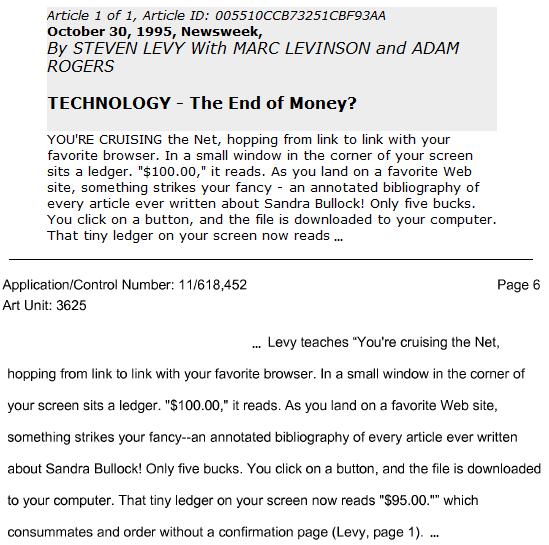
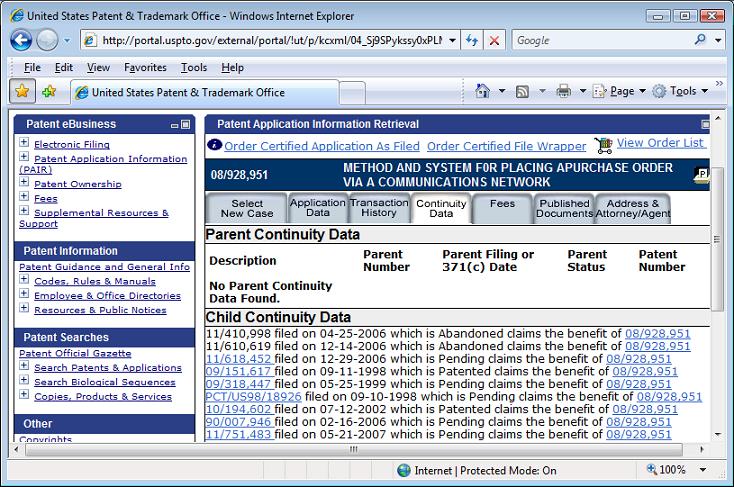
theodp writes "Pressed on Amazon's 1-Click patent, then-USPTO Chief Q. Todd Dickinson got testy: "I make this challenge all the time. If you're aware of prior art out there that invalidates a patent that is existing, file a re-examination. We'll be happy to take a look at it." Really? It's been 3+ years since unemployed actor Peter Calveley submitted prior art that triggered a USPTO reexamination of the 1-Click patent. Still no 'final answer' from the USPTO. To put things in perspective, 1-Click inventor Jeff Bezos once proposed a three-year lifespan for patents (later retracted), let alone patent reexams. In the meantime, other patent examiners have repeatedly smacked down 1-Click — the latest (non-final) rejection was issued on Feb. 10th with Sandra Bullock's help." -
In-Game Web Browser Round-Up
theodp writes "CNET takes a look at Web browsers you can run inside of the latest video games, offering mini-reviews of PlayXpert, Steam, Rogue, and Xfire. Why run these instead of your standard browser? Well, these browsers run lean and mean, play nice with full-screen apps, provide hot keys that can make them appear or disappear in an instant, and offer transparency so you can continue to play a game in full screen while chatting, reading e-mail or looking up cheat codes. So how much longer before we see a variation of this on our real-world car windshields?" -
High Tech Misery In China
theodp writes "Think you've got a bad job? Think again. You could be making keyboards for IBM, Microsoft, Dell, Lenovo and HP at Meitai Plastic and Electronics, a Chinese hardware factory. Prompted by the release of High Tech Misery in China by a human-rights group, a self-regulating body set up by tech companies will conduct an audit of working conditions at the factory. In return for take-home pay of 41 cents per hour, workers reportedly sit on hard wooden stools for 12-hour shifts, seven days a week. Overtime is mandatory, with workers being given on average two days off per month. While on the production line, workers are not allowed to raise their hands or heads, are given 1.1 seconds to snap each key into place, and are encouraged to 'actively monitor each other' to see if any company rules are being transgressed. They are also monitored by guards. Workers are fined if they break the rules, locked in the factory for four days per week, and sleep in crowded dormitories. Okay, it's not all bad news — they're hiring." -
Internet Killed the Satellite Radio Star
theodp writes "As Sirius XM faces bankruptcy, Slate's Farhad Manjoo reports that the company has bigger problems than just the end of cheap credit. While it has what seems like a pretty great service — the world's best radio programming for just a small monthly fee — Sirius XM has been eclipsed by something far cheaper and more convenient: the Internet. Load up Pandora or the Public Radio Tuner on your iPhone, and you've got access to a wider stream of music than you'll ever get through satellite. So forget the satellites, the special radios, and the huge customer acquisition costs, advises Manjoo, and instead focus on getting Howard Stern, Oprah, the NFL, and MLB on every Internet-connected device on the market at very low prices." -
I'm a PC and I'm 4-1/2
theodp writes "Microsoft's new Windows ad made its debut during the Grammy Awards on Sunday. It stars a 4-year-old cutie named Kylie (Silverlight required) showing how easy it is to use Windows Live Photo Gallery to edit and share photos. And while it's impressive that little Kylie is able to transfer a snapshot of her pet fish from her camera to a PC, color-correct it, and e-mail it to her family, what's truly amazing is that the toddler was also apparently able to read, understand, and accept Windows Live's Terms of Use and Privacy Policy. (But minors can't legally execute contracts, can they?)" -
The Deceptive Perfection of Auto-Tune
theodp writes "For a medium in which mediocre singing has never been a bar to entry, a lot of pop vocals suddenly sound better than great — they're note- and pitch-perfect. It's all thanks to Auto-Tune, the brainchild of Andy Hildebrand, who realized that the wonders of autocorrelation — which he once used to map drilling sites for the oil industry — could also be used to bestow perfect pitch upon the Britney Spears of the world. While Auto-Tune was intended to be used unnoticed, musicians are growing fond of adjusting the program's retune speed to eliminate the natural transition between notes, which yield jumpy and automated-sounding vocals. 'I never figured anyone in their right mind would want to do that,' says Hildebrand." As these techniques improve and become more popular, it makes me wonder what music produced twenty or fifty years from now will sound like, and how much authenticity will be left. -
A Gates Foundation Education Initiative Fizzles
theodp writes "Three years ago, Sarah-Palin-bogeyman William Ayers published a paper questioning the direction the small school movement was taking (PDF) with the involvement of would-be education reformers like the Bill and Melinda Gates Foundation. And now, after $2 billion in grants, Bill Gates concedes that in most cases his foundation's efforts in that area fell short. 'Many of the small schools that we invested in did not improve students' achievement in any significant way,' said Gates. Bill does cite High Tech High as one of the few success stories, but even there has to limit his atta-boys to the San Diego branch — the Gates-backed Silicon Valley High Tech High closed its doors abruptly due to financial woes (concerns about the sustainability of Gates-initiated small schools were voiced in 2005). Not surprisingly, some parents are upset about the capital that school districts wasted following Bill's lead." -
Rescued Banks Sought Foreign Help During Meltdown
theodp writes "An AP review of visa applications has found that major US banks sought permission to bring thousands of foreign workers into the country under the H-1B visa program, even as the banking system was melting down and Americans were being laid off. The dozen banks now receiving the biggest rescue packages, totaling more than $150 billion, requested visas for more than 21,800 foreign workers over the past six years. (It's not known how many of these were granted; the article notes 'The actual number is likely a fraction of the... workers the banks sought to hire because the government only grants 85,000 such visas each year among all US employers.') The American Bankers Association blamed the US talent pool for forcing the move, saying they couldn't find enough Americans capable of handling sales, lending, and bank administration. The AP has filed FOIA requests to force the US Customs and Immigration Service to disclose further details on the bailed-out banks' foreign hires." -
IBM Hides the Bodies, Eyes US Government Billions
theodp writes "As his company was striving to hide the bodies of its laid-off North American workers, IBM CEO Sam Palmisano stood beside President Barack Obama and waxed patriotic: 'We need to reignite growth in our country,' Palmisano said. 'We need to undertake projects that actually will create jobs.' While Sam positions IBM to get a slice of the $825 billion stimulus pie, Big Blue is quietly cutting thousands of jobs and refusing to release the numbers or locations, arguing that SEC disclosure rules don't apply since the US job cuts are immaterial in its big global picture. The layoffs included hundreds in East Fishkill, coming early in the year after NY taxpayers paid IBM $45 million not to cut additional jobs in East Fishkill in 2008. Some are questioning whether IBM incentives are worth the cost." -
Learning To Read With Click and Jane
theodp writes "While earlier generations learned to Read with Dick and Jane, the NYT Magazine reports that today's tykes are getting their reading chops at online sites like Starfall (free) and One More Story (subscription). Quoting the Times Magazine: 'In their book "Freakonomics," Stephen J. Dubner and Steven D. Levitt write that kids who grow up in houses packed with books fare better on school tests than those who grow up with fewer books.' So how will kids who learn to read online fare when they grow up?" -
Comrade, You Are So Not Getting a Dell
theodp writes "At the World Economic Forum, Michael Dell's pitch to help Russia with its computers got the cold-as-Siberia shoulder from Prime Minister Vladimir Putin. 'We don't need help,' shot back Putin. 'We are not invalids. We don't have limited mental capacity' (video — rant starts at 1:24). 'Our programmers are some of the best in the world,' Putin continued. 'No one would contest that here — not even our Indian colleagues.'" -
Bickering Blocks US Mobile Phone Payments
theodp writes "Imagine a technology that lets you pay for products just by waving your cellphone over a reader. You wouldn't have to if you lived in Japan, where people have been using it for the last five years to pay for everything from train tickets to groceries to candy in vending machines. While nearly everyone who's tried it has liked this form of payment, consumers in the United States won't be able to wave-and-pay anytime soon: The companies that must work together to give the technology to the masses can't agree on how to split the resulting revenue." -
Bill Gates' Plan To Destroy Music, Note By Note
theodp writes "Remember Mr. Microphone? If you thought music couldn't get worse, think again. Perhaps with the help of R&D tax credits, Microsoft Research has spawned Songsmith, software that automatically creates a tinny, childish background track for your singing. And as bad as the pseudo-infomercial was, the use of the product in the wild is likely to be even scarier, as evidenced by these Songsmith'ed remakes of music by The Beatles, The Police, and The Notorious B.I.G.." -
PwC Auditors Arrested In Satyam Fraud Inquiry
theodp writes "Indian police arrested two employees from the affiliate of PricewaterhouseCoopers who audited Satyam Computer Services, the IT outsourcing giant at the center of the nation's largest fraud inquiry. The move comes after Satyam founder Ramalinga Raju said he had fabricated $1 billion of assets and confessed to making up more than 10,000 employees to siphon money from the software company. State Farm Insurance has severed its ties with Satyam, citing uncertainty about the company's future as 'the only factor responsible for the termination of the contract,' which will reportedly affect at least 400 on-site Satyam employees. Other customers, including GE, are standing by Satyam, one of the top recipients of H-1B and L visas (so much for those $500 Fraud Prevention and Detection fees!)." -
What, Me Worry? MAD Magazine Going Quarterly
theodp writes "MAD Magazine is about to put out its 500th issue, but starting with its April publication, the mag is cutting down to only four issues per year. The feedback we've gotten from readers,' quipped Editor John Ficarra, 'is that only every third issue of MAD is funny, so we've decided to just publish those.' MAD Kids and MAD Classics are ceasing publication entirely. Keep up the what-me-worry game face, Alfred!" -
Obama Staffers Followed Palin's Email Lead On Inauguration Day
theodp writes "Using Yahoo's free e-mail service to conduct government business was good enough for Sarah Palin. And now the Washington Times reports that Obama staffers turned to Gmail on Inauguration Day to conduct their business. Those wishing to contact members of the incoming Obama administration were instructed to contact staffers at wh.LASTNAME@gmail.com until official White House e-mail addresses became available." -
US CTO Choice Down To a Two-Horse Race
theodp writes "Barack Obama apparently didn't return CmdrTaco's call. BusinessWeek reports that the choices for the first US CTO have narrowed, and it's now a two-horse race between Padmasree Warrior, Cisco's CTO, and Vivek Kundra, who holds the same title for the Government of the District of Columbia. Two very different resumes — which would you advise Obama to pick?" I just know I was #3 on the list. -
GAO Reports Bailout and Tech Firms Love Tax Havens
theodp writes "Most of America's largest publicly traded corporations and Federal contractors — including those receiving billions of dollars from US taxpayers to finance their recovery — have set up offshore operations that could help them avoid paying US taxes, according to a GAO study released yesterday. Of the 100 largest public companies, 83 do business in tax-haven hot-spots like the Cayman Islands, Bermuda, and the British Virgin Islands. The report found that Citigroup, a recipient of $45B in bailout funds so far, has set up 427 subsidiaries in tax-haven countries, including 91 in Luxembourg, 90 in the Cayman Islands, and 35 in the British Virgin Islands. Household names on the lists from the tech sector include Apple (1 tax haven subsidiary), Cisco (38), Dell (29), HP (14), Intel (6), IBM (10), Microsoft (8), Motorola (4), and Oracle (77)." -
Google Challenging Proposition 8
theodp writes "Coming the day after it announced layoffs and office closures, Google's California Supreme Court filing arguing for the overturn of Proposition 8, which asks the Court not to harm its ability to recruit and retain employees, certainly could have been better timed. Google's support of same-sex marriage puts it on the same page with Dan'l Lewin, Microsoft's man in Silicon-Valley, who joined other tech leaders last October to denounce Prop 8 in a full-page newspaper ad. But oddly, Microsoft HR Chief Mike Murray cited religious beliefs for his decision to contribute $100,000 to 'Yes On 8', surprising coming from the guy who had been charged with diversity and sensitivity training during his ten-year Microsoft stint. " -
30th Anniversary of the (No Good) Spreadsheet
theodp writes "PC Magazine's John C. Dvorak offers his curmudgeonly take on the 30th anniversary of the spreadsheet, which Dvorak blames for elevating once lowly bean counters to the executive suite and enabling them to make some truly horrible decisions. But even if you believe that VisiCalc was the root-of-all-evil, as Dvorak claims, your geek side still has to admire it for the programming tour-de-force that it was, implemented in 32KB memory using the look-Ma-no-multiply-or-divide instruction set of the 1MHz 8-bit 6502 processor that powered the Apple II." On the brighter side, one of my favorite things about Visicalc is the widely repeated story that it was snuck into businesses on Apple machines bought under the guise of word processors, but covertly used for accounting instead. -
New Google Favicon Deja Vu All Over Again?
theodp writes "Last June, Google rolled out a new favicon, the small branding icon that graces your URL bar when you visit Google. Which, as it turned out, bore a striking similarity to Garth Brooks' Circle-G logo. Well, Google went back to the drawing board and has come back with a new favicon, which it says was inspired by — not copied from, mind you — its users' submitted ideas. Some are also seeing inspiration elsewhere for the new favicon, which consists of white 'g' on a background of four color swatches. Take the AVG antivirus icon, for instance. Or everybody's favorite memory toy, Simon. Or — in perhaps the unkindest cut of all — the four-color Microsoft Windows logo, shown here with a superimposed white '7'. Anything else come to mind?" What comes to mind for me is just how obsessed many people are with the Google favicon. -
The Scope of US E-Waste
theodp writes "Every day, Americans toss out more than 350,000 cell phones and 130,000 computers, making electronic waste the fastest-growing part of the US garbage stream. A lot of the world's e-waste is exported to Guiyu, China, where peasants heat circuit boards over coal fires to recover lead (a 15" computer monitor can pack up to 7 lbs. of Pb), while others use acid to burn off bits of gold. Guiyu's willingness to deal with lead, mercury and other toxic materials generates $75 million a year for the village, but as a result. Guiyu is slowly poisoning itself with the highest level of cancer-causing dioxins in the world. The village experiences elevated rates of miscarriages, and its children suffer from an extremely high rate of lead poisoning. TIME suggests checking out recycling brokers and accredited e-stewards the next time you're ready to toss a gizmo." -
My Genome, My Self?
theodp writes "After baring his DNA for the world to see, Steven Pinker follows up in the NYT Magazine with his take on the coming era of consumer genetics. Pinker comes away less wide-eyed than Time Magazine about the current predictive ability of $399 genetic tests, but is convinced enough to opt out of learning whether he has a gene that increases the risk of Alzheimer's and believes that genetic-testing-for-the-masses may hasten the arrival of national health insurance ('piecemeal insurance is not viable in a world in which insurers can cherry-pick the most risk-free customers'). Pinker believes that personal genomics is just too much fun to ban, but for now suggests: 'if you want to know whether you are at risk for high cholesterol, have your cholesterol measured; if you want to know whether you are good at math, take a math test.'" -
How Long Should Companies Make E-Bills Available?
theodp writes "If you say goodbye to paper and hello to green, you may learn first-hand that no good deed goes unpunished. Try to pay your final Verizon Wireless bill online after switching carriers, for example, and don't be surprised if you get a sorry-Dave-I'm-afraid-I-can't-do-that reply. Other vendors may curtail e-Bill services 30 days after you end service. And a promise of access to up to seven years of paperless statements is somewhat empty if you'll be cutoff as soon as you no longer have an account. With more-and-more companies enticing consumers to go paperless, how long a period of time should the records be made available online? Should it extend beyond the life of an account?" -
The Perils of Simplifying Risk To a Single Number
A few weeks back we discussed the perspective that the economic meltdown could be viewed as a global computer crash. In the NYTimes magazine, Joe Nocera writes in much more depth about one aspect of the over-reliance on computer models in the ongoing unpleasantness: the use of a single number to assess risk. Reader theodp writes: "Relying on Value at Risk (VaR) and other mathematical models to manage risk was a no-brainer for the Wall Street crowd, at least until it became obvious that the risks taken by the largest banks and investment firms were so excessive and foolhardy that they threatened to bring down the financial system itself. Nocera explores the age-old debate between those who assert that the best decisions are based on quantification and numbers, and those who base their decisions on more subjective degrees of belief about the uncertain future. Reliance on models created a 'false sense of security among senior managers and watchdogs,' argues Nassim Nicholas Taleb, who likens VaR to 'an air bag that works all the time, except when you have a car accident.'" -
Universities Patenting More Student Ideas
theodp writes "Working as a NASA intern, grad student Erez Lieberman had a eureka moment, resulting in an algorithm that detects whether a person is standing correctly or is off balance. Unfortunately, MIT liked it so much they decided to patent it. Seeking permission to use his own idea for his iShoe startup, which develops products like insoles to address the problems of seniors, Lieberman was told no problem — as long as he promised a hefty royalty and forked over a $75,000 upfront payment. Whether or not students are aware of it, the NYTimes reports that most universities own inventions created by students that were developed using a 'significant' amount of schools resources. Colleges and universities once obtained fewer than 250 patents a year, but that was before the Bayh-Dole Act gave them ownership of inventions developed through federally financed research. Now they acquire about 3,000 a year, and in 2006 licensing fees and equity in spinoff companies totaled at least $45B — research powerhouses like Stanford and NYU pocketed $61M and $157M, respectively." -
Google Wants You To Be Its Unpaid Muse
theodp writes "So where do you turn to for great ideas when tough times force you to abort your engineers' brainchildren? If you're Google, reports Nicholas Carlson, you simply outsource brainstorming to your users. Google's launched a new Google Product Ideas blog as well as a Product Ideas for Google Mobile site where users can submit feature and product ideas and vote on others. So what's in it for you if you come up with Google's next billion-dollar-idea? 'If you post an idea or suggestion and we put it into action, we may give you a shout out on our Product Ideas blog,' explains Google, 'but we won't be compensating users for their ideas.' Lucky thing don't-be-evil Googlers don't have to live up to the IEEE Code of Ethics, or they might have to credit properly the contributions of others." So what's wrong with a shout out among consenting adults? -
Microsoft Uses WGA To Obtain Record Jail Sentences
theodp writes "According to Microsoft, 'No information is collected during the [Genuine Advantage Program] validation process that can be used to identify or contact a user.' That's little comfort to the software counterfeiters who were just handed jail sentences ranging from 1.5-6.5 years by the Futian People's Court in China, especially since Microsoft contends that much of the estimated $2B in bogus software was detected by its Windows Genuine Advantage program. 'Software piracy negatively impacts local economic growth,' explained Microsoft VP Fengming Liu in a celebratory New Year's Eve press release. But then again, so does transferring $16B of assets and $9B in annual profit to an Irish tax haven, doesn't it?" -
Microsoft Invents $1.15/Hour Homework Fee For Kids
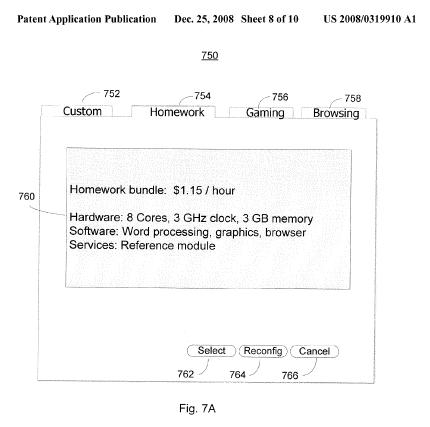
theodp writes "Microsoft's vision of your computing future is on display in its just-published patent application for the Metered Pay-As-You-Go Computing Experience. The plan, as Microsoft explains it, involves charging students $1.15 an hour to do their homework, making an Office bundle available for $1/hour, and billing gamers $1.25 for each hour of fun. In addition to your PC, Microsoft also discloses plans to bring the chargeback scheme to your cellphone and automobile — GPS, satellite radio, backseat video entertainment system. 'Both users and suppliers benefit from this new business model,' concludes Microsoft, while conceding that 'the supplier can develop a revenue stream business that may actually have higher value than the one-time purchase model currently practiced.' But don't worry kids, that's only if you do more than 52 hours of homework a year!" -
RIM Accuses Motorola of Blocking Job Offers
theodp writes "Taking a page from the insanely-jealous-husband-playbook, Motorola management has adopted an if-I-can't-have-you-nobody-can stance on its fired employees, reportedly blocking RIM from offering jobs to laid-off workers. In a complaint filed in state court, Motorola is charged with improperly trying to expand a previous agreement 'to prevent the RIM entities from hiring any Motorola employees, including the thousands of employees Motorola has already fired or will fire.' Through its Compete America membership, Motorola has repeatedly warned Congress that failing to accommodate the lobbying group members' 'principled' demand for timely access to talent would not be in the United States' economic interest and would make the US second-rate in education and basic research." -
Amazon 1-Click Lawyers Make USPTO Work Xmas Eve
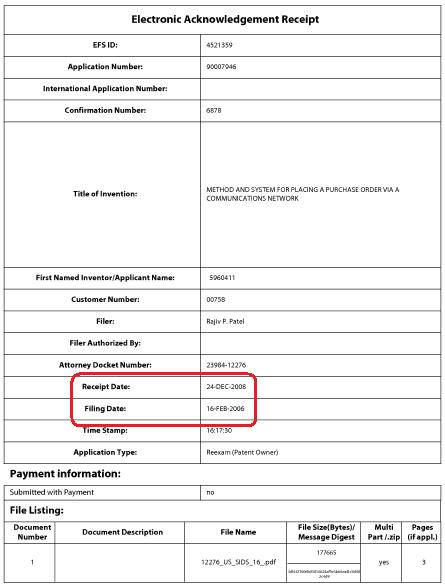
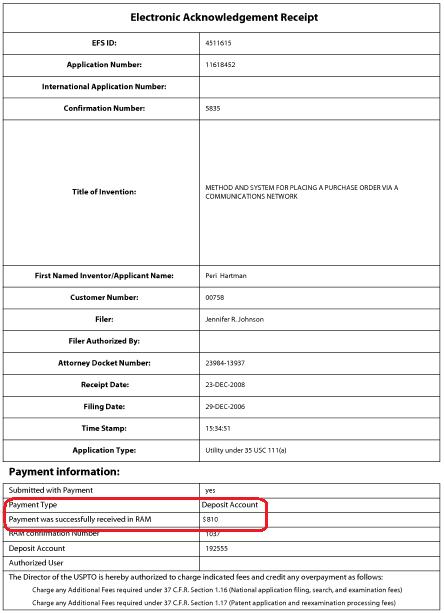
theodp writes "In a move that would do pre-makeover Ebenezer proud, Amazon.com's 1-Click lawyers put the USPTO to work on Christmas Eve. On Dec. 24th, the USPTO acknowledged receipt of yet another round of paperwork submitted by Amazon's high-priced legal muscle, the latest salvo in Amazon's 3-year battle to fend off a patent reexamination triggered by the do-it-yourself legal effort of actor Peter Calveley. Amazon CEO Jeff Bezos' 1-Click patent is also under attack on another front — on Dec. 23rd, the USPTO received $810 from Amazon's attorneys together with a request that the agency invalidate Patent Examiner Mark A. Fadok's final rejection of 1-Click patent claims on the grounds of obviousness. On the bright side, patent clerks — unlike Bob Cratchit — get the day after Christmas off!" -
As Christmas Bonus, Google Hands Out "Dogfood"
theodp writes "You know times are tough when the best place to work in America replaces holiday bonuses with a request for unpaid labor. Blaming the economic crisis, Google management has canceled the traditional cash holiday bonus — reportedly as much as $20K-$30K per Googler — and substituted an unlocked Google Android cell phone, retail price $400. An accompanying email calls for employees to celebrate the 'chance for us to once again dogfood a product and make it even better!'" Update: 12/23 01:09 GMT by KD : A reader pointed out that comments to the article note a couple of inaccuracies: the Android phone being offered is an unlocked dev model, which goes for $400; and the reporter may have confused holiday bonuses with performance bonuses. The former have traditionally been in the range of $1,000, according to two comments. -
Obama's "ZuneGate"
theodp writes "Barack Obama supporters were left shaking their heads after a report surfaced that the president-elect was using a Zune at the gym instead of an iPod. So why would Mac-user Obama be Zune-ing out? Could be one of those special-edition preloaded Zunes that Microsoft bestowed on Democratic National Convention attendees, suggests TechFlash, nixing the idea that the soon-to-be Leader of the Free World would waste time loading Parallels or Boot Camp in OS X just to use a Zune." -
Avoiding Mistakes Can Be a Huge Mistake
theodp writes "No doubt many will nod knowingly as they read Paul Graham's The Other Half of 'Artists Ship', which delves into the downside of procedures developed by Big Companies to protect themselves against mistakes. Because every check you put on your programmers has a cost, Graham warns: 'And just as the greatest danger of being hard to sell to is not that you overpay but that the best suppliers won't even sell to you, the greatest danger of applying too many checks to your programmers is not that you'll make them unproductive, but that good programmers won't even want to work for you.' Sound familiar, anyone?" -
Ninth Anniversary of Amazon 1-Click Injunction
theodp writes "Nine years ago Monday, Amazon kicked off the Holiday Season by slapping Barnes and Noble with a court injunction barring BN from using a checkout feature that Amazon said represented illegal copying of its patented 1-Click technology. 'We're pleased that Judge Pechman recognized the innovation underlying our 1-Click feature,' said Jeff Bezos in a press release. But an Appellate Court wasn't quite as impressed with Amazon's innovation. Nor were USPTO Examiners who were asked to take another look at the merits of Amazon's 1-Click patent claims. Still, 1-Click lives on, although Amazon's lawyers are currently fighting two separate rejections by USPTO Examiners, burying USPTO Examiners in paper, and employing canceling-and-refiling tactics that some may find reminiscent of Eddie Haskell's chess end-game strategy. So much for Amazon-led patent reform." -
Should Taxpayers Back Cars Only the Rich Can Afford?
theodp writes "The NY Times questions the $400M in low-interest federal loans requested by Tesla Motors as part of the $25B loan package for the auto industry passed by Congress last year. 'The program is intended to encourage automakers to improve fuel efficiency, but should it be used for a purpose like this, as the 2008 Bailout of Very, Very High-Net-Worth Individuals Who Invested in Tesla Motors Act?' Tesla says it is assembling about 15 cars a week and has delivered about 80 of its $109,000 base-price Roadsters to date, many of which have gone to the Valley's billionaires and centimillionaires who are Tesla investors as well as early customers. We discussed the company's financial difficulties last month." -
Google's Gatekeepers
theodp writes "With control of 63% of the world's Internet searches, as well as ownership of YouTube, the NY Times reports that Google is the most powerful and protean of the Internet gatekeepers, exerting enormous influence over who can find an audience on the Web around the world. Deciding what controversial material does and doesn't appear on the local search engines Google maintains in many countries — as well as on Google.com, YouTube, Blogger, Picasa, and Orkut — falls on the shoulders of Nicole Wong and her colleagues, who have arguably been given more influence over online expression than anyone else on the planet. Some find Google's gatekeeper role worrisome: 'If your whole game is to increase market share,' says Lawrence Lessig, 'it's hard to do good, and to gather data in ways that don't raise privacy concerns or that might help repressive governments to block controversial content.'" -
IBM's But-I-Only-Got-The-Soup Patent
theodp writes "In an Onion-worthy move, the USPTO has decided that IBM inventors deserve a patent for splitting a restaurant bill. Ending an 8+ year battle with the USPTO, self-anointed patent system savior IBM got a less-than-impressed USPTO Examiner's final rejection overruled in June and snagged US Patent No. 7,457,767 Tuesday for its Pay at the Table System. From the patent: 'Though US Pat. No. 5,933,812 to Meyer, et al. discussed previously provides for an entire table of patrons to pay the total bill using a credit card, including the gratuity, it does not provide an ability for the check to be split among the various patrons, and for those individual patrons to then pay their desired portion of the bill. This deficiency is addressed by the present invention.'"