Slashdot Mirror
Domain: aopa.org
Stories and comments across the archive that link to aopa.org.
Comments · 126
-
Re:Breaking news links
One last time, see rule # 1.
https://www.pea.com/blog/posts...
Or from the AOPA https://www.aopa.org/news-and-...
OR gives practical examples of what happens when you don't http://iflyamerica.org/safety_...
Even NASA agrees with me, and I'm no rocket scientist. https://ntrs.nasa.gov/archive/...
Pay close attention to the conclusions in the PDF where it clearly indicates that ATC conversations are a hindrance to task management, not a help, and clearly justifies my reluctance to engage them in conversation when struggling to come to terms with how to keep my aircraft safe.
Again, I'm no great pilot, never claimed to be one, in fact I'm a pretty poor one having very little experience. The guys in that Boeing went from about 7,000 Feet to the ground in less than two min. They had their hands full of airplane. The publicly available flight data shows a rapid descent with a pretty healthy heading change to the right. They didn't have TIME to communicate and if you where in the cockpit you'd not either. This wasn't some gentle lazy maneuver as they lost control this was a sudden change into unusual attitude which I'm sure they where struggling to correct, while trying diagnose the reasons it was happening. 120 to 180 seconds is all they apparently had, and it wasn't enough. And you think they should have had time to get out a mayday call or two? Then there is my original point, that they MAY have tried, but on a congested approach frequency in an unusual attitude it may be nobody heard them. So there are many reasons other than a major structural or even electrical failure to account for the lack of a mayday call.
But at this point, we are both guessing. So Call me back when the NTSB publishes their final report and you where right... Until then, I'm done debating basic pilot training with you.
-
Re: Danger?
But this is the problem -- it's not the same thing:
1. The test is on a general aviation aircraft wing, a Mooney M20, not a commercial jet aircraft, which is much more rugged
2. The speed used was 238 mph, while the Mooney M20c has a do-not-exceed speed of 164 kt (190 mph), and takeoff and climbing is typically at something more like 88-105 KIAS. 238 mph would have to assume that the drone was headed into the plane at 48 mph when the plane was doing its top speed -- and it's unlikely the plane could do that speed at an altitude the drone could reach.A more realistic test would be the wing of a 737 at its takeoff speed of 130 kt. Has that test ever been done?
-
Re:Also the kind of people who buy them
Not only am I trolling you, I am now directly implying that you are a marginally competent pilot, based on all the above. A well implemented ADS-B system presents traffic almost identically to TCAS - which is very good at "making the vehicle sending the data visible" - at least visible enough to avoid a collision. TCAS has been around a very long time.
Your glass panel is likely a G1000 that you barely know how to use, resulting in your head always being down in the cockpit, unable to efficiently translate all that data into useful situational awareness.
Cockpit clutter devices - usually things that pilots carry into the cockpit such as phones, tablets, and ADS-B "in" devices - but also includes glass panel cockpits themselves, depending on how they are used.
Go spend some time at the AOPA tent in Oshkosh next time you fly in to the airshow. You'll notice their new fleet of 'reimagined' trainers have steam gauges - because training with a glass panel is incredibly inefficient and leads to pilots with real skill 'gaps', and glass panels needlessly add great cost and many hours to obtain a rating.
I'll fly whatever, but I don't see the glass panels as all that much of a cockpit enhancement. The AHRS that usually go along with glass panels are a nice way to ditch crappy vacuum pumps and all the associated maintenance, and they seem to be comforting to the current generation of touch-screen addicted youngsters.
You'll likely have some issues with the above and are on the verge of popping a vessel, so here's a nice airplane picture to help you calm down. Notice the nice panel:
-
Re:Real Pilots train in them...
Pilot here. Can say the same. But remember that natural-born pilots fly with the guts, literally. You feel the flight in your stomach.
That's what got John F. Kennedy Junior killed, Anonymous Coward. He 'felt' the flight instead of using his instruments - his gut wrongly told him he was in a level descent, when he was in fact in a spiral. Had he used his artificial horizon, he would have realized his mistake.
The graveyard spiral is a likely scenario in this accident. "An observed loss of altitude during a coordinated constant-rate turn that has ceased stimulating the motion-sensing system can create the illusion of being in a descent with the wings level. The disoriented pilot will pull back on the controls, tightening the spiral and increasing the loss of altitude."
https://www.aopa.org/news-and-...
Totally unrelated to what I said. May I call it "straw man"? Or maybe "hand waving"? I stand by my words.
-
Re:Real Pilots train in them...
Pilot here. Can say the same. But remember that natural-born pilots fly with the guts, literally. You feel the flight in your stomach.
That's what got John F. Kennedy Junior killed, Anonymous Coward. He 'felt' the flight instead of using his instruments - his gut wrongly told him he was in a level descent, when he was in fact in a spiral. Had he used his artificial horizon, he would have realized his mistake.
The graveyard spiral is a likely scenario in this accident. "An observed loss of altitude during a coordinated constant-rate turn that has ceased stimulating the motion-sensing system can create the illusion of being in a descent with the wings level. The disoriented pilot will pull back on the controls, tightening the spiral and increasing the loss of altitude."
https://www.aopa.org/news-and-... -
an artificial shortage
I just visited with a former US Navy pilot who's been flying for Frontier for the last 20 years. He hates it. Even in some major airlines, pilots are often treated poorly, have poor schedules, and are expected to have no life. This leads to a high rate of "AIDS" - Aviation Induced Divorce Syndrome. Pay has been increasing, but quality of life isn't.
If you work for an airline, regional or major, you have to establish 'seniority' before you can gain any sense of a normal schedule or choose a base of operations. Until you've establish seniority, a pilot is at the whim of the company. If you change companies, you give up seniority and start at the bottom all over again.
Federally Regulated Indentured Servitude. What a rewarding career choice. Not.
The real issues are the MBA mentality, and innovation and competition limiting FAA regulations. The airline industry and the FAA have been in bed together for decades to create regulations that go far beyond safety, and in reality limit competition and innovation. Profit and protecting the status quo comes first, everything else comes second. As a result, the US has seen a real decline in the pace of innovation in aviation. Other markets have seen dramatic increases in innovation, service, and safety. Aviation, not so much (except in safety). Yes, we have more efficient engines, better avionics, and more advanced materials (787 Dreamliner, etc.), but these innovations are in increasingly niche markets.
General aviation special interest groups like EAA and AOPA are starting to chip away at the FAA/Airline industry monster: Basic Med is helping hobbyist pilots keep their medicals and continue flying smaller aircraft safely. And, the recent FAA Part 23 regulation re-write is helping revive general aviation engineering and production in the United States. These are drops in the bucket, but hopefully this trend continues.
-
an artificial shortage
I just visited with a former US Navy pilot who's been flying for Frontier for the last 20 years. He hates it. Even in some major airlines, pilots are often treated poorly, have poor schedules, and are expected to have no life. This leads to a high rate of "AIDS" - Aviation Induced Divorce Syndrome. Pay has been increasing, but quality of life isn't.
If you work for an airline, regional or major, you have to establish 'seniority' before you can gain any sense of a normal schedule or choose a base of operations. Until you've establish seniority, a pilot is at the whim of the company. If you change companies, you give up seniority and start at the bottom all over again.
Federally Regulated Indentured Servitude. What a rewarding career choice. Not.
The real issues are the MBA mentality, and innovation and competition limiting FAA regulations. The airline industry and the FAA have been in bed together for decades to create regulations that go far beyond safety, and in reality limit competition and innovation. Profit and protecting the status quo comes first, everything else comes second. As a result, the US has seen a real decline in the pace of innovation in aviation. Other markets have seen dramatic increases in innovation, service, and safety. Aviation, not so much (except in safety). Yes, we have more efficient engines, better avionics, and more advanced materials (787 Dreamliner, etc.), but these innovations are in increasingly niche markets.
General aviation special interest groups like EAA and AOPA are starting to chip away at the FAA/Airline industry monster: Basic Med is helping hobbyist pilots keep their medicals and continue flying smaller aircraft safely. And, the recent FAA Part 23 regulation re-write is helping revive general aviation engineering and production in the United States. These are drops in the bucket, but hopefully this trend continues.
-
Re:lawyers killed the private small plane industry
They killed all the small private aircraft companies that made small planes with the active help of NTSB.
Baloney. Here's a list that includes nearly five dozen small private aircraft companies that make small planes.
Boeing liked small pesky competitors being killed off.
Not only are the above companies not "killed off," they're not even competitors given that Boeing doesn't make small planes. (Unless you somehow consider private versions of Boeing's 7x7 models "small.")
-
Re:No, There Aren't "A Couple of Parachutes"
I haven't found any diagrams or pictures of a Volocopter parachute deployment, however:
- According to the specifications (https://www.volocopter.com/assets/pdf/2017_04_Design_specifications_2X.pdf) it's just labelled as a "full aircraft emergency parachute."
- The overhead picture on this 2013 article shows a hump on top of the craft that is probably the stowed parachute - but this hump isn't present on the models being demonstrated in Dubai at the moment.
-
Re:Mumble mumbleACARS is a telex link used to send data to the aircraft and back -- point to point. You mean ADS-B, specifically ADS-B out, a broadcast system.
Given that people can build their own from parts, you're going to create a huge mess by shoehorning drones into the ADS-B system. (My drone identifies as Air Force One! Haaaaaa! haa!) You'll be creating a costly mess by creating a new ADS-B system for drones.
-
Re:DJI is very confused, or they intentionally lie
You are incorrect. Transponders (including ADS-B in 2020) are only required for - Operations within Class A, Class B, and Class C airspace. - Operations within 30 nautical miles of the primary airport within Class B airspace from the surface to 10,000 feet msl (see airports listed below). - Operations above the ceiling and within the lateral boundaries of Class B and C airspace. - Operations above 10,000 feet msl in the contiguous 48 states, excluding the airspace at and below 2,500 feet agl. See https://www.aopa.org/training-.... They are not required in the vast majority (like 98%) of airspace under 10,000 ft MSL. I routinely fly across the country without a transponder.
-
Re:No, *physics* killed it
a 20 mile tether doesn't sound practical
It's not just impractical; it's downright dangerous, even with much shorter lengths. If tether breaks at the ground end, interesting things can happen.
-
Re: Sonic Boom
The idea of someone (technically a household, most 1% households are two income) earning only 400K and flying private is ridiculous.
You're thinking "private luxury jet", but that is not the only way to fly privately, so it's not as ridiculous as you think. The numbers on that page are for a low-end plane (an older Cessna), but $400k/year is the low end of the 1% so it seems appropriate. The highest number on that page, $32k/year, is well within the reach of someone making $400k/year if they want it.
-
Same for small plane crashes
The media are all over small plane crashes much the same way, giving a highly distorted view of just how safe aviation is. Aviation organizations like AOPA have started to get on the media's case about this.
If they reported car crashes with the same enthusiasm the "news" would be nothing but car crashes.
...laura
-
Regulations are written in blood
Yes, this is an extremely common use case. Tesla will likely fix it. But it does suggest that they have not put the appropriate thought into the thousands of less common use cases that will creep up when this product gets into the hands of more people.
I've said it before but I'll say it again. This is a case of "Regulations are written in blood" in the sense that there will be a human cost involved in figuring out what works and what doesn't and fixing it so it doesn't happen again. Automated driving technologies are going to cost some number of lives and injuries to develop. I don't know how many, I just know the number will be greater than zero. There will be innumerable corner cases to work out before the technology meets its full potential and we will only learn about some of these by someone getting injured.
People bitch about regulations but they tend to forget the human cost that led to the regulation in the first place. New technologies rarely come without a human cost involved. Even something as seemingly innocuous as text messaging has resulted in fatalities because we didn't fully anticipate the degree of distraction it caused to drivers.
-
Re:In other news..
Why bother? Siemens admitted their electric motors for aircraft are unsafe and unsuitable for flights over water.
So you can use it over land only, and you don't need a big extension cord when you can land and charge right up again...
-
Bill wasn't as inflammatory as the summary
Wow!
There are already racing series that encourage fuel efficiency. Formula E is all electric, and is growing in popularity. It has HUGE sponsors.
A mix of fuel efficient and aviation could be some flavor of aircraft racing. Aircraft can actually be fuel efficient. Quickie aircraft will get about 80MPG while going over 150MHP.
http://www.aviastar.org/air/us...
Two seaters can get 45 MPG (or go 180mph):
http://www.planeandpilotmag.co...
This guy tweaked his airplane to get 100mpg
http://blog.aopa.org/blog/?p=7...
There are *LOTS* of aircraft that will get these fuel efficiencies.
If you count seat miles per gallon, most modern jet liners will get about 100mpg
-
Re:What happens when video is lost?
In good visibility, it's very low priority (aircraft can see each other anyway)
Oh they can, can they?
-
How about answering the question?
So what happens when the capsule springs a leak and you cannot bre .
I think it is long past time someone addressed the problem of evacuation seriously.
The passenger mask aboard an aircraft has a ten minute supply of oxygen. The Time of Useful Consciousness (TUC) in a near-vacuum is measured in seconds. Oxygen Use in Aviation
Death comes quickly.
As originally conceived, a Hyperloop capsule would pack in 28 people in a space about four feet wide and four feet tall. Beyond the hype of Hyperloop: An analysis of Elon Musk's proposed transit system
It would be difficult to imagine a space more claustrophobic and an invitation to panic and offering less room for maneuver this side of the Hunley .
-
Re:Watchout for statistics
The BD-5 will always be there, even when the last one is scrapped or hung-up in a museum, as inspiration to the young future aerospace engineer. RIP Jim Bede. Not a perfect airplane guy, but always pushing to make things better for aviators while others went with the mainstream flow.
Well, don't despair - others have taken inspiration from the BD-5J and created their own version.
The only difference is it might actually be flyable.
-
A near miss is defined as 500 feet
A near miss is defined as 500 feet:
http://flighttraining.aopa.org...
According to the American Helicopter Services & Aerial Firefighting Association, airtankers fly between 150 and 200 feet:
http://www.ahsafa.org/?page_id...
The article reports a drone altitude of 800-900 feet. Let's take the most pessimal separation from these numbers: 800 - 200 = 600. That gives them a buffer of 100 feet in which this was *NOT* even classifiable as a near miss; there was no danger of a drone to aircraft collision, unless you are claiming that the drone pilot intended to fly the drone into the DC-10 airtanker.
You will find elsewhere on the AHSAFA site that the aircraft do not "dive-bomb" the fires; a fully loaded airtanker had a heck of a lot of inertia, and it's not really an option; they are long, low runs. I refer you to the site however, because I doubt you'd trust my (anecdotal) personal experience with U.S. Forest Service airtankers.
-
Re:FCC and FAA
Short answer: no. But if you're on the ground they probably don't need to, strictly speaking.
Much better to be in the plane and refuse to land. Don't be like this guy and cooperate. Though if he didn't land, apparently Sgt. Yosemite Sam was going to start firing his handgun at the glider 3000 feet in the air (and hoping the bullets went... where, exactly, when they missed?) so take that with a grain of salt.
There are two powers that can compel a plane to land: 1) the FAA and 2) a military intercept (which itself only works because they'll just shoot you down if you don't obey). Well they're really the same because if you don't comply with #1 they'll just use #2. Local, state, or even federal law enforcement cannot compel an aircraft to land - the FAA has sole authority for the country's airspace.
Now if you're on the ground, of course, they can put their hands on you regardless of whether they're technically allowed to. If the drone pilot was licensed appropriately then you'd have a serious case on your hands, but there's like 20 of those in the country at the moment so odds are this will be nabbing people violating the regs to begin with and the FAA will probably not bother to get involved.
-
Re:The US government
Prohibited areas are few and far between, and don't include power plants as you suggest,despite what some obedient naive security person might proclaim to an even more naive reporter.
The data center is wide open, and this was a peaceful protest. It is not possible from the picture to tell if the flight was conducted at a legal altitude or not. http://www.aopa.org/News-and-V... ==the law enforcement community proved itself to be a bunch of incompetent, fragile personality types.
People like to believe anything that gives a sense of urgency or authority to what they feel they have to say.
If the government truly wanted to protect the data center, they wouldn't have placed their chiller stations on the perimeter with no barriers,or their transformer service stations, etc. The place would be disabled for months at a minimum if they were affected. An airplane flying overhead? It would barely mess up the paint. There is no reason to shut down the airspace there.
-
Re:um...
The stats for non-commercial flying do not support your assertion that flying is somehow safer than driving. GA Flying vs driving uses 2004 numbers, but you can see the updated data with similar numbers over at AOPA
-
Re:Personal ID policy
Maybe you do not have a US pilot certificate but US ones do not have photographs. http://www.aopa.org/Advocacy/Regulatory-,-a-,-Certification-Policy/Regulatory-Brief-Photo-Pilot-Certificates.aspx "The terrorist acts in 2001 prompted passage of the Aviation and Transportation Security Act (ATSA), enacted on Nov. 19, 2001, which called for the under secretary of Transportation to consider a requirement for a photo ID pilot certificate. In order to provide a simple, inexpensive, timely means to positively identify pilots, AOPA asked the FAA to change the rules to require pilots to carry a government-issued photo ID along with their pilot certificate. As a result, the FAA changed 14 CFR 61.3(a): Requirement for Certificates, Ratings, and Authorizations, which requires all flight crewmembers of an aircraft to carry a pilot certificate and government-issued photo identification."
-
Re: And the pilot?
"possibly had a stroke"
"had a history of cardiac problems"
"was shot in the head"
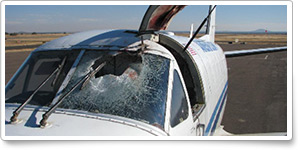
"was struck by a bird through the cockpit window"Any of those little blurbs, even if not the actual cause of death, would have been very useful.
And yes, a bird strike on a small plane can be catastrophic.
http://download.aopa.org/images/epilot/120427bird_strike.jpg
http://www.aopa.org/asf/publications/inst_reports2.cfm?article=3712
-
Re: And the pilot?
"possibly had a stroke"
"had a history of cardiac problems"
"was shot in the head"
"was struck by a bird through the cockpit window"Any of those little blurbs, even if not the actual cause of death, would have been very useful.
And yes, a bird strike on a small plane can be catastrophic.
http://download.aopa.org/images/epilot/120427bird_strike.jpg
http://www.aopa.org/asf/publications/inst_reports2.cfm?article=3712
-
Re:A radar?
Where, pray tell, is all of this closed air space?
Anywhere the sectional chart says P-. Also, R- is Restricted, which isn't entirely closed, but may be closed part-time, and MOAs (Military Operations Areas), which are open to civilian pilots, but with the advice that special use occurs there, including military flight training that may make "see and avoid" somewhat more challenging than elsewhere.
Here, have a helpful map.
-
Re:Analog hole
Though I have said all along, if there was an airline I could walk on with my bag, go through no security checkpoint at all, sit down in a seat, and pay cash right then and there for the ride, with no id. I would fly it every time, and not worry the least bit about it.
Well, you'll probably need ID, but you can do that right now today. The flight might take longer and be a bit less comfortable (very rarely will you get even bathroom facilities), and it will cost more, but you can do that.
How? You can learn to fly a small aircraft. Takes a few weeks if you concentrate, maybe a couple of years if you're a weekend flyer. And without modifications, you can pretty much fly through the entire continental US, Alaska, Canada, Mexico, and continental South America.
Or, if you want, you can have someone else do all the hassles for you and charter a small aircraft to take you to your destination.
It costs a lot more, is a lot slower, and is subject to weather delays, and is a lot less comfortable, but it makes the journey fun. And for the most part, you just show up at the FBO, say hello, pay your fare and hop on. You can do it at your own convenience, too - very rarely are these flights scheduled. As long as it's reasonable, you can book anytime that's available.
. They probably have to shut down the scanner, remove the disk then attach it to a regular PC.
They probably upload the images to the cloud.
So if a technician needs to review the image; they have to login to a certain Dropbox account.....
Except taking out the hard drive shuts down the scanner. So now you have a huge lineup of people waiting to pass through security and the technician shut down the scanner (because without said hard drive, no new scans can be saved).
Of course, then comes the issue of credibility - and traceability. After all, if it was some no-name person, there isn't much to go on (the guys seeing the scans are separate and have no clue who is walking through). So a technician really has to be on the ball to note when some celebrity walked through. Else they have scans of people who could be fat, thin, ugly, or beautiful, or trans or whatever. Remember, all they have to go by is an illustration - the actual scan is not viewable until the drive is removed.
It's what separates the old scanners from the new - no one sees the scans - just a generic human body illustration.
-
Re:Damned if they do, damned if they don't...
No, ATC services are paid from the Department of Transportation general fund, authorized by the US House budget, and allocated by the US Senate budget (when they bother to pass one, lately we've been using the last passed budget plus automatic increases....).
A very large chunk of the FAA is offset by the gasoline (100LL and JetA) taxes around $0.20 per gallon (although jet fuel used on commercial aircraft is usually measured in LBS [1 gallon of JetA =~ 6.79lbs] a 737 may use up to 20,000lbs per hour depending on flight phase) which goes to the FAA general fund and also to the Aviation Trust Fund, an mythical entity pushed by the General Aviation caucus to prevent raids on the money to be used for airport improvement (physical assets).
Currently there are no "per-segment" Air Traffic Control fees, and hopefully there never will be, to understand this issue in depth there are competing sides, I prefer the AOPA's briefing available at: http://www.aopa.org/whatsnew/userfees.html
-
No authority
I hate to bring this up... but city councils / local municipalities, etc have no authority over airspace. That would belong to the FAA. As evidenced in a recent case: http://www.aopa.org/aircraft/articles/2013/130117lessons-learned-from-glider-arrest.html
-
Re:"Tens of metres"
GPS approaches are getting better http://www.aopa.org/flightplanning/articles/2012/120209faa-marks-gps-approach-milestone.html but still lack decent altitude information. GPS uses a stepped approach method ie: at position X,Y you need to be at Z altitude as read from the approach plate ( or indicated on the GPS device ) whereas with the more tradition ILS approach providing a glide slope, you fly a standard 3 degree slope and are guided by the signal until decision height is reached.
-
Re:That's not today!
OTOH depending on how close the walls are to the rotors, they might encounter rotor wash backfilling the the rotors on the periphery which should have a negative effect on lift and lateral stability. Winglets are increasingly common solution to this effect of spillover on fixed-wing, but have more complicated aerodynamic issues on rotary wings when forward motion is involved. http://blog.aopa.org/helicopter/?m=201106/
-
Re:Kits planes are heavily regulated by FAA
My understanding is that kit airplanes fall under the category of experimental aircraft and a different large body of regulations do apply. Including regulations limiting where an experimental aircraft can be flown.
The limitations on where you can fly have been eliminated, at least once you are out of the flight-test phase (7 hours for E-LSA, 25 for E-AB with certified engines, 40 for E-AB with non-certified engines). The prohibition on flying for commercial purposes is still in place.
When googling around last night I found that regional FAA officials can and have prohibited normal operations in certain areas.
"The Van Nuys Flight Standards District Office (FSDO) has prohibited experimental flight tests and normal operations (Phase 1 and Phase 2 flights) at Burbank, Van Nuys, Whiteman, and Santa Barbara airports."
http://www.aopa.org/whatsnew/newsitems/2006/060118experimental.html -
FAA bureaucrats have restricted experimental craft
Nope.
Basically, when you complete a kit plane, you get it certified by the FAA as an experimental aircraft. Those can be flown anywhere that's permitted by their equipment and your licensing; for instance, the plane has to have its minimum equipment list to fly at all and navigational aids to fly in IFC. The major restriction on an experimental aircraft special airworthiness certificate is that it can't be used for commercial cargo or passenger operations.
Unless an FAA bureaucrat feels otherwise:
"The Van Nuys Flight Standards District Office (FSDO) has prohibited experimental flight tests and normal operations (Phase 1 and Phase 2 flights) at Burbank, Van Nuys, Whiteman, and Santa Barbara airports."
http://www.aopa.org/whatsnew/newsitems/2006/060118experimental.html -
Re:Still a thrill for me...
All good questions... while I'm not much impressed with the latest leadership of AOPA, they have a website that may answer some of the questions you pose.
http://www.aopa.org/letsgoflying/
Many of the items are "unanswerable" because while there may be regulatory minimums, say on how much one has to fly to maintain currency to carry passengers, the rules may be completely different if one is by oneself in the aircraft. Aviation is mired in regulation but most of them track back to something that makes sense, like... higher standards if you're flying passengers other than yourself.
It's not cheap, and it's not always convenient... it's more a lifestyle than a replacement for the airlines for everyone. But for the few who enjoy the challenge, it's pretty sweet to just open the hangar door with a key and head off somewhere.
Like a lot of things in life, the resources to do it must be taken from somewhere else, so not too many active pilots are driving new cars, buying the latest gadgets, etc... sure there's always some in any group that are wealthy enough to do that, but most sacrifice significant things to do it. Same thing with race car aficionados, computer geeks who need the latest-and-greatest, campers who buy house-sized motorhomes and the fuel to operate them, etc. Similar fiscal discipline required.
-
Re:confluence of effects
http://blog.aopa.org/blog/?p=3729
Effectively this is a storm with nearly hurricane force winds but no rotation. I'm a weather Nerd too.
-
Re:Not definitive evidence so farHave you seen the photograph that 'shows' this airplane? It's a joke. The Loch Ness Monster photos are more convincing.
-
Good reason to keep VORs and omnis.
In the US, the FAA is planning to discontinue VORs and omnirange stations, the non-satellite navigational aids that have run aerial navigation for decades. The Coast Guard discontinued LORAN C in 2010. This was done with the concurrence of the Department of Homeland Security, which said it was "not needed for GPS backup."
GPS is a very weak signal, and easy to jam. Satellites put out only 500 watts, spread over half the surface of the planet. LORAN C was transmitted at power levels from 100KW to 4MW, with huge antenna farms. That kind of power is difficult to jam at any distance. VORs and omnis aren't as powerful, but they're usually located at airports, so that when you're close to an airport and need to find the runway, the signal is at its strongest.
-
Private vs. Commercial Pilot
I don't know which flights require TSA screening, but from the FAA's point of view, accepting any money for a plane ride makes the pilot a commercial pilot, which is a whole different licensing category. To get a commercial pilot's license for carrying paying passengers, a private pilot would have to go through additional training, testing, medical examination, drug screening, etc.
In one case, a pilot killed a passenger when he snagged some power lines and plunged his plane into a river. While that was an unfortunate accident, the FAA decided to throw the book at him in part because the pilot had accepted a token payment of $8 from the passenger.
-
Re:Blamed F16 Pilots Too
Seriously? You, my friend, are very likely under-studied and dangerously over-confident. If you are newly minted private pilot, there's a chance that you just might -- maybe, if your CFI was reasonably conscientious -- have received enough IMC training recently enough to keep yourself from entering a graveyard spiral if you inadvertently penetrate instrument meteorological conditions..assuming that VFR into IMC is the *only* emergency you face and that you've got the wisdom to get your butt out of IMC ASAP.
However, I guarantee you that your average non-instrument rated private pilot does not even remotely have the skills to operate in the IFR system. For that matter, your average instrument rated but not instrument current pilot (such as myself) doesn't have those skills either. IFR flight requires consistent, recent practice. I've been instrument rated since 1994, and I've logged plenty of actual IMC. But there's no way on God's green earth that I'd spend any longer than necessary in IMC right now because I haven't kept my IFR skills current and I'm smart enough to know that my lack of proficiency in IFR flight makes me unsafe in the IFR system. And, if you think that the biggest difference between IFR and VFR pilots is the ability to shoot an approach, then I humbly submit that you don't have a clue what you're talking about. How about the ability to recognize a vacuum system/gyroscopic instrument failure (hint: gyros don't fail suddenly, they slowly drift out of alignment while you think you are still getting good data from them), or the ability to fly partial panel after recognizing such a failure, or recovering from unusual attitudes solely by reference to instruments (it makes a difference if you change your pitch, your bank or your power first, and if you make the wrong choice, you could end up in a spin or your wings might depart formation with your airplane...and the procedure is different depending upon whether or not your nose is above or below the horizon), or flying a holding pattern, or understanding the difference between MEA, MOCA, etc. </rant>
Anyway, you requested citations. For your reading pleasure (some more on topic than others; I still recommend you at least skim most, if not all, of them, based upon your comments above):
178 Seconds to Live This isn't the actual study itself, but it is based upon that study. It should give you enough information to find the study yourself, if you are so inclined.
VFR into IMC leads to in-flight breakup. Case study of a pilot who didn't make it out of his inadvertent flight into IMC.
Searching AOPA/Air Safety Foundation's accident database for "VFR into IMC" returned 1739 results (I don't know how far back the database goes, so that number alone doesn't provide a great deal of information on how pervasive this problem is).
StudentPilot.com thread on IMC fatality statistics
Do yourself -- and your passengers -- a favor and get your instrument ticket. Even if you don't keep current, you'll at least have an idea how much more there is to know about flying safely in instrument conditions. I don't know you, but I nevertheless, I really don't want to read about you in an NTSB report. -
Re:Blamed F16 Pilots Too
Seriously? You, my friend, are very likely under-studied and dangerously over-confident. If you are newly minted private pilot, there's a chance that you just might -- maybe, if your CFI was reasonably conscientious -- have received enough IMC training recently enough to keep yourself from entering a graveyard spiral if you inadvertently penetrate instrument meteorological conditions..assuming that VFR into IMC is the *only* emergency you face and that you've got the wisdom to get your butt out of IMC ASAP.
However, I guarantee you that your average non-instrument rated private pilot does not even remotely have the skills to operate in the IFR system. For that matter, your average instrument rated but not instrument current pilot (such as myself) doesn't have those skills either. IFR flight requires consistent, recent practice. I've been instrument rated since 1994, and I've logged plenty of actual IMC. But there's no way on God's green earth that I'd spend any longer than necessary in IMC right now because I haven't kept my IFR skills current and I'm smart enough to know that my lack of proficiency in IFR flight makes me unsafe in the IFR system. And, if you think that the biggest difference between IFR and VFR pilots is the ability to shoot an approach, then I humbly submit that you don't have a clue what you're talking about. How about the ability to recognize a vacuum system/gyroscopic instrument failure (hint: gyros don't fail suddenly, they slowly drift out of alignment while you think you are still getting good data from them), or the ability to fly partial panel after recognizing such a failure, or recovering from unusual attitudes solely by reference to instruments (it makes a difference if you change your pitch, your bank or your power first, and if you make the wrong choice, you could end up in a spin or your wings might depart formation with your airplane...and the procedure is different depending upon whether or not your nose is above or below the horizon), or flying a holding pattern, or understanding the difference between MEA, MOCA, etc. </rant>
Anyway, you requested citations. For your reading pleasure (some more on topic than others; I still recommend you at least skim most, if not all, of them, based upon your comments above):
178 Seconds to Live This isn't the actual study itself, but it is based upon that study. It should give you enough information to find the study yourself, if you are so inclined.
VFR into IMC leads to in-flight breakup. Case study of a pilot who didn't make it out of his inadvertent flight into IMC.
Searching AOPA/Air Safety Foundation's accident database for "VFR into IMC" returned 1739 results (I don't know how far back the database goes, so that number alone doesn't provide a great deal of information on how pervasive this problem is).
StudentPilot.com thread on IMC fatality statistics
Do yourself -- and your passengers -- a favor and get your instrument ticket. Even if you don't keep current, you'll at least have an idea how much more there is to know about flying safely in instrument conditions. I don't know you, but I nevertheless, I really don't want to read about you in an NTSB report. -
Re:If only
So you think it's ok for people to be allowed to bring weapons onto planes?
Yes, honestly, I do.
1) I own my own airplane. It's not a private jet, like what Steve Jobs was trying to board, but nevertheless, it is an airplane. Since I live in Alaska, and in 15 minutes flying time (even in a sloooow airplane like mine), you can be in the remote wilderness, I carry typically carry a gun and a knife when I fly. There are bears in those woods that think people are yummy, so I almost always bring a shotgun with me when I fly. Even without worrying about bears, if my engine quits (it's a two-stroke, so it's possible...) and I'm not within a few miles of a road, I might be camping for a few days until someone tracks down my ELT. Since I tend to get hungry every few hours, I equip myself for the possibility that I might need to shoot a grouse or a rabbit for food, if I am forced to land "off-airport." So yes, a gun of some kind is a part of the survival gear I regularly carry in an airplane.
2) Even if we limit our discussion to commercial airplanes (which only tangentially applies to this story, since this was a private jet that was boarding through a commercial gate at an airport) then I still think at least *some* weapons should be allowed. Maybe the aforementioned shotgun is a bit much on a commercial airliner, but I'd certainly like to be able to carry a pocket knife again. I'd even go so far as to say that I wish that the airlines would issue tasers to all adults on the airplane. The big argument is that weapons in the hands of passengers on the airplane would allow "the terrists" to hijack another airplane. As Norman Schwarzkopf once said,bovine scatology (that's B.S., for short). http://en.wikipedia.org/wiki/United_Airlines_Flight_93" target="Flight 93">Flight 93 proved that the days of a hijacker taking over an airplane while the passengers sit like sheep are over. IMHO, the *best* defense for airplanes is making sure every able-bodied adult on the airplane is armed and willing to take down anyone who ever tries that crap again. Far better, in my opinion, to just drop the expense -- and pretense -- of security theatre, and instead give the people who have the most to lose -- the passengers on the airplane -- the right and the ability to protect themselves from terrorists and hijackers. -
Re:Uh, yeah
Ummmm...
According to AOPA in 2007, The majority of civilian aircraft are piston driven prop planes.
Single Piston - 145,036 (65%)
Multi Piston - 18,708 (8%)
Turbo Prop - 8,063 (3%)
Turbo Jet - 10,379 (4%)
Rotor - 9,159 (4%)
Experimental - 23,047 (10%)
Other 7,551 (3%)So, the odds are pretty good you're suggesting a single engine prop plane carrying weapons and countermeasures. No matter what you do to it, all it takes is a fast close flyby of a jet to send it into the ground. It doesn't even take firing weapons, but a civilian aircraft in military controlled airspace who refuses commands to land does run the risk of being invited to land in most ungraceful ways. I've never heard of it happening over American Airspace (Flight 93 conspiracy aside), but for the most part a civilian aircraft shootdown over controlled airspace could easily disappear and explained as an accident.
-
Re:Say what?
Not really, landing is one of the safest parts of the flight. See http://www.aopa.org/asf/publications/nall.html for a good analysis of aircraft accidents.
-
Re:Too expensive, and impractical
Good old fashioned air raid sirens would be much cheaper and a hell of a lot more effective at getting the information to the people most likely to be in harm's way during a tsunami.
Which, in fact, is what's used in some areas. Sirens today are usually loudspeakers, so they can broadcast messages too. Here's a test.
There is one deployed laser beam warning system. This is deployed around Washington, and aims laser at intruding aircraft, flashing red-red-green. This is intended to warn off lost VFR pilots, after two incidents where the Capitol was evacuated because someone in a light plane wandered into the Washington area. It won't work through clouds, but it's the VFR pilots on clear days who create these problems. IFR pilots are in contact with air traffic control at all times, have better nav gear, and tend not to wander into restricted airspace.
-
Re:Oh, look!
I'm sure it depends on your area, but it also depends on what licenses you need. Figure $3-5000 for a visual-only license, give or take a grand or so. Definitely not the same as getting a car license.
It's a matter of personal opinion whether you feel that a drivers license SHOULD cost more than it does. It would certainly cut down the number of idiots I have to deal with on my daily commute. Yes, elitist comment, but probably fair; a drivers license is FAR too easy to get in the USA. It was a lot more difficult when I took my driving test in the UK than when I took it in the USA... I was actually shocked at how easy it was.
I am a GA pilot as well... VFR only... and GP is right in a lot of ways. GA has really become FAR more appealing to me in recent years with this security theatre, and the more people getting into GA the better (so long as they also consider joining the Aircraft Owners and Pilots Association which is working really hard to ensure stupid rules don't get as far as General Aviation). I stopped flying a few years ago simply because the cost became prohibitive and my lifestyle changed to the point that I no longer could justify it. However, in recent months I have been considering taking it up again because the ridiculous security theatre has meant that a 90 minute flight from St. Louis to Chicago becomes a 6 hour ordeal of finding parking, horrible check in lines, ridiculous "security" and awful coffee. Hell, I can DRIVE it in a little under 5 hours and park closer to where I wanted to go. If I were flying a GA aircraft I could cut that down to about a 3 hour trip door to door. Given the ever increasing cost of flying commercially, where's my drive to do it any more?
GA aircraft are expensive, yes... but you can pick up a good instrument certified used Cessna 172 for little more than a Lexus... and they last a hell of a lot longer than cars do. In fact, they tend to appreciate in value like a home rather than depreciate, and if you use it for business you can usually write off a portion of the expenses on taxes. And even with that 172, the entire lower 48 is pretty much your playground, because if you live in the Midwest there's nowhere you can't go in a day.
Of course, YMMV but I am seriously considering going into a partnership with a couple of friends to pick up a good used IFR Cessna or older Cirrus (depending on how much we all put in). Since we're all small business owners we can also use it as a business expense since we'd be using it for sales and technical meetings as well as for pleasure.
-
Re:Luck not shot down
No flares, no afterburners. Intercept procedures are well-established and are part of basic pilot training.
The intercepting aircraft will perform a closing pass, starting from one side and overtaking (generally on the left since this is where the senior pilot usually sits). If the intercepting craft cannot slow enough, it will make a crossing overtake pass in front of and below the intercepted aircraft (to avoid inducing turbulence on the intercepted craft), repeating as necessary until radio contact has been made or the intercepted aircraft waggles its wings to acknowledge presence (or eye contact is made between the two pilots if both aircraft can fly at the same speed).
A second intercept aircraft flies behind and above the intercepted craft, watching for wing waggle and/or any other signs the pilot of the intercepted craft may give. If you're going to be shot down, that's his job too. But to my knowledge that's never been done.
There is a clearly-established set of hand signals AND aircraft signals that may be used to indicate what the interceptor wants the intercepted pilot to do. The VERY first thing is to acknowledge to the interceptor that you see and are aware of them (waggle the wings), then the intercepted pilot gets on the emergency frequency at 121.5 and identifies himself as an intercepted aircraft, if a radio is available and working. From there, the interceptor has a series of very visible signals to indicate that you should follow them, or you are free to go about your business, or you are to land at the airport they are headed toward, or whatever they want you to do.
The AOPA does a big campaign to get these cards in the hands of every pilot several times a year. If you know a pilot and they don't carry one of these, print out one and glue it to their lapboard: http://www.aopa.org/asf/publications/intercept.pdf
-
Re:Try the slow down method
-
Re:Ineptitude
That's what's usally called ineptitude, but those FAA guys like to spin it round so someone else, or circumstances beyond their control, are the problem.
Their not happy until your not happy! You can't blame them for living their moto.
In all seriousness, the FAA is in the middle of a huge political game right now, which is actually very complex to explain. They are working overtime trying to get out from under Congressional oversight. I wouldn't be surprised if they're looking the other way in an attempt to juice their lobbying. Obviously they can't secure things if their budget isn't drastically increased. And the only way they can do that is to be empowered to both raises taxes and collect them any means they see fit while endangering the skies for everyone. Basically everyone credible (both Rs and Ds) has stepped forward and stated the FAA's proposal is bad for everyone and they can't even make their current funding with their proposal. Only the FAA and *cough* the major carriers support the FAA's plan.
http://www.aopa.org/advocacy/articles/2008/081002faa.html
http://www.aopa.org/advocacy/articles/2009/090507trustfund.htmlDo some searches. Its actually pretty scary. The FAA is working hard to become their own taxing authority, independent of Congressional oversight, while becoming buddy-buddy with the major carriers. Mmmmm....isn't that a good recipe for safety. And did I mention every year they are unable to account for millions even with oversight. Even worse, Obama is demanding legislation be put forward which supports this disastrous model. And worse yet, such legislation would be horrific to our economy; more accidents: fewer fliers; cost to fly, from drastically higher taxes, goes through the roof: less revenue at airports; less revenue at airports means fewer jobs; fewer jobs: loss of up to hundreds of millions to local economies (even loss of hundreds of thousands to millions at smaller airports) all over the country.