Slashdot Mirror
Domain: arstechnica.com
Stories and comments across the archive that link to arstechnica.com.
Stories · 4,420
-
Apple Announces New iMacs With Better Screens And Modern Processors; Refreshes MacBook Lineup (arstechnica.com)
Apple today announced updates to its iMac line and MacBook lineups at WWDC, giving its all-in-one desktop, and laptop series more powerful specifications and the latest Intel chips. From a report: Apple is bringing Intel's 7th generation Kaby Lake processors to the new iMac, along with what Apple calls "the best Mac display ever," offering 500 nits of brightness, or 43 percent brighter than the previous generation. The 21.5-inch model now can be configured up to 32GB of RAM, while the 27-inch goes up to 64GB, twice what had previously been offered. The new iMacs also are getting two Thunderbolt 3 USB-C ports, making it Apple's first desktop computer to embrace the port standard. Graphics cards are getting a spec boost in the updated iMacs, too. The entry level 21.5-inch model will have an Intel Iris Plus 640 GPU, while the 4K 21.5-inch models will get Radeon Pro 555 and 560 graphics cards. Meanwhile, the 27-inch 5K model will have a choice of Radeon Pro 570, 575, and 580 graphics cards, topping out at 8GB of VRAM. The 21.5-inch iMac will start at $1099 and the 4K 21.5-inch model at $1299. As expected, Apple also refreshed the MacBook lineup. From a report: Today Apple provided a minor but wide-ranging refresh to its modern MacBooks and MacBook Pros, adding new processors from Intel and making a handful of other tweaks. The new processors are from Intel's "Kaby Lake" family, and some of them have been available for the better part of a year. Compared to the outgoing Skylake architecture, Kaby Lake introduces a gently tweaked version of Intel's 14nm manufacturing process, provides small boosts to CPU clock speeds, and supports native acceleration for decoding and encoding some kinds of 4K video streams. -
FCC Seeks To Increase ISP Competition In Apartment Buildings (arstechnica.com)
An anonymous reader quotes a report from Ars Technica: Exclusive deals between broadband providers and landlords have long been a problem for Internet users, despite rules that are supposed to prevent or at least limit such arrangements. The Federal Communications Commission is starting to ask questions about whether it can do more to stop deals that impede broadband competition inside apartment and condominium buildings. FCC Chairman Ajit Pai yesterday released a draft Notice of Inquiry (NOI) that seeks public comment "on ways to facilitate greater consumer choice and to enhance broadband deployment in multiple tenant environments (MTEs)." The commission is scheduled to vote on the NOI at its June 22 meeting, and it would then take public comments before deciding whether to issue new rules or take any other action. The NOI discusses preempting local rules "that may expressly prohibit or have the effect of prohibiting the provision of telecommunications services" in multi-unit buildings. But one San Francisco regulation that could be preempted was designed to boost competition by expanding access to wires inside buildings. It's too early to tell whether the FCC really wants to preempt any state or city rules or what authority the FCC would use to do so. The NOI could also lead to an expansion of FCC rules, as it seeks comment on whether the commission should impose new restrictions on exclusive marketing and bulk billing arrangements between companies and building owners. The NOI further seeks comment on how "revenue sharing agreements and exclusive wiring arrangements between MTE owners and broadband providers may affect broadband competition" and "other contractual provisions and non-contractual practices that may impact the ability of broadband providers to compete in MTEs." The NOI also asks whether the commission should encourage cities and states to adopt model codes that promote competition in multi-unit buildings, and the document asks what practices those model codes should prohibit or mandate. -
YouTube Clarifies 'Hate Speech' Definition and Which Videos Won't Be Monetized (arstechnica.com)
An anonymous reader quotes a report from Ars Technica: In a blog post, YouTube outlined more specific definitions of hate speech and what kinds of incendiary content wouldn't be eligible for monetization. Three categories are classified as hate speech, with the broadest one being "hateful content." YouTube is defining this as anything that "promotes discrimination or disparages or humiliates an individual or group of people on the basis of the individual's or group's race, ethnicity, or ethnic origin, nationality, religion, disability, age, veteran status, sexual orientation, gender identity, or other characteristic associated with systematic discrimination or marginalization." The second category is "inappropriate use of family entertainment characters," which means content showing kid-friendly characters in "violent, sexual, vile, or otherwise inappropriate behavior," no matter if the content is satirical or a parody. The final category is somewhat broad: "incendiary and demeaning content" means that anything "gratuitously" demeaning or shameful toward an individual or group is prohibited. The updated guidelines are a response to creators asking YouTube to clarify what will and will not be deemed advertiser-friendly. YouTube acknowledges that its systems still aren't perfect, but it says it's doing its best to inform creators while maintaining support for advertisers. YouTube also launched a new course in its Creator Academy that creators can take to learn more about how to make "content appealing for a broad range of advertisers." -
SpaceX To Refly a Dragon Cargo Spacecraft (arstechnica.com)
Thelasko writes: Tomorrow's scheduled resupply mission to the International Space Station will mark the second time its Dragon capsule has visited the station. Ars Technica reports: "This particular Dragon spacecraft was sent to the International Space Station in September 2014, and it delivered nearly 2.5 tons of cargo to the orbiting laboratory. The Dragon returned to Earth about a month later, splashing down into the ocean. It is not clear how much processing SpaceX has had to undertake to ready the spacecraft for its second flight to the station, nor has the company released a cost estimate. It also had to manufacture a new 'trunk,' the unpressurized rear section of the vehicle, and solar panels." -
Qualcomm, Microsoft Announce Snapdragon 835 PCs With Gigabit LTE (arstechnica.com)
Microsoft and Qualcomm have announced that Windows 10 is coming to devices made by Asus, HP and Lenovo that will run on the Snapdragon 835 platform. "The Snapdragon 835 chip, incorporating Qualcomm's latest X16 LTE modem, forms the basis of the Snapdragon Mobile PC Platform," reports Ars Technica. "Qualcomm claims that using the Snapdragon platform will offer a combination of the PC form factor and breadth of software with features that are standard in smartphones: on-the-go connectivity, light weight, silent operation, long battery life, and no fan." From the report: Qualcomm says that PCs built using the new chips will offer up to 50 percent more battery life than x86 systems, with four- to five-times longer standby times. They'll take the Connected Standby capability already found in some Windows PCs -- this allows the system to do things like sync mail and receive notifications even when "sleeping" -- and make it better, thanks to their LTE connectivity. With a Snapdragon inside your PC, you'll no longer need Wi-Fi to fetch your latest e-mail and catch up on Twitter. Instead, you'll be able to get online wherever there's cellular connectivity. The X16 modem supports up to gigabit LTE connections, too. So as long as your network operator is cooperative and has embraced the cutting edge, this mobile connection will be fast, too. Asus, HP, and Lenovo are all planning to introduce Snapdragon Mobile PC systems at some unspecified time in the future, for some unspecified price. These machines will be laptop-style systems, just without the traditional x86 processor on the inside. Snapdragon 835 has a higher level of integration than Intel's mobile chips, enabling smaller motherboards. This in turn should tend to increase the space available for battery, or reduce the size and weight of machines, or perhaps even both. -
Apple, Amazon, Microsoft, and Google Lobby Against Texas 'Bathroom' Bill (arstechnica.com)
An anonymous reader quotes a report from Ars Technica: Executives from some of the globe's leading technology firms are demanding that Texas not adopt "discriminatory" bathroom legislation. On the table in Texas is a law similar to one enacted -- and later partially repealed -- in North Carolina. The tech companies have aligned themselves with critics of the bill who believe the legislation is unfair to the transgender community. "As large employers in the state, we are gravely concerned that any such legislation would deeply tarnish Texas' reputation as open and friendly to businesses and families," the companies wrote Texas Gov. Greg Abbott. "Our ability to attract, recruit and retain top talent, encourage new business relocations, expansions and investment, and maintain our economic competitiveness would all be negatively affected." Pending Texas Senate legislation would prohibit transgender people in Texas from using restrooms matching their gender identities. The House on Sunday passed its own bill that would apply the bathroom limitations solely at schools. The tech companies, however, aren't threatening to pull out of Texas, like some did over the same issue in North Carolina. The letter sent to Gov. Abbott was signed by Facebook founder Mark Zuckerberg, Apple CEO Tim Cook, Amazon chief Jeff Wilke, IBM head Ginni Rometty, Microsoft President Brad Smith, and Google's Sundar Pichai. There were 14 companies -- including Dell, Hewlett-Packard, Cisco, Silicon Labs, Celanese Corp., GSD&M, Salesforce, and Gearbox Software -- signing on to the letter. "Discrimination is wrong and it has no place in Texas or anywhere in our country," the companies wrote. -
Wormable Code-Execution Bug Lurked In Samba For 7 Years (arstechnica.com)
Long-time Slashdot reader williamyf was the first to share news of "a wormable bug [that] has remained undetected for seven years in Samba verions 3.5.0 onwards." Ars Technica reports: Researchers with security firm Rapid7...said they detected 110,000 devices exposed on the internet that appeared to run vulnerable versions of Samba. 92,500 of them appeared to run unsupported versions of Samba for which no patch was available... Those who are unable to patch immediately can work around the vulnerability by adding the line nt pipe support = no to their Samba configuration file and restart the network's SMB daemon. The change will prevent clients from fully accessing some network computers and may disable some expected functions for connected Windows machines.
The U.S. Department of Homeland Security's CERT group issued an anouncement urging sys-admins to update their systems, though SC Magazine cites a security researcher arguing this attack surface is much smaller than that of the Wannacry ransomware, partly because Samba is just "not as common as Windows architectures." But the original submission also points out that while the patch came in fast, "the 'Many eyes' took seven years to 'make the bug shallow'." -
A New Amiga Arrives On the Scene -- the A-EON Amiga X5000 (arstechnica.com)
dryriver writes: It is 2017 and the long dead Amiga platform has suddenly been resurrected. The new Amiga X5000 costs about $1,800 and is an exotic mix of PC parts and completely new custom chips, including "Xena," an XMOS 16-core programmable 32-bit 500 MHz coprocessor that can be configured by software to act as any type of custom chip imaginable. It is connected to a special "Xorro" slot that has the same physical connection as a PCIe x8 expansion card, but it is dedicated to adding more Xena chips as desired. Amiga X5000 can run all legacy Amiga software, including software written for later PowerPC Amigas. It boots from a U-Boot BIOS. The OS is AmigaOS 4.1, but the X5000 can also boot into MorphOS or Linux. The test system used by Ars came with a ATI Radeon R9 270X video card. -
Hackers Have Targeted Both the Trump Organization And Democrat Election Data (arstechnica.com)
An anonymous reader writes: Two recent news stories give new prominence to politically-motivated data breaches. Friday the Wall Street Journal reported that last year Guccifer 2.0 sent 2.5 gigabytes of Democratic Congressional Campaign Committee election data to a Republican operative in Florida, including their critical voter turnout projections. At the same time ABC News is reporting that the FBI is investigating "an attempted overseas cyberattack against the Trump Organization," adding that such an attack would make his network a high priority for government monitoring.
"In the course of its investigation," they add, "the FBI could get access to the Trump Organization's computer network, meaning FBI agents could possibly find records connected to other investigations." A senior FBI official (now retired) concedes to ABC that "There could be stuff in there that they [the Trump organization] do not want to become part of a separate criminal investigation."
It seems like everyone's talking about the privacy of their communications. Tonight the Washington Post writes that Trump's son-in-law/senior advisor Jared Kushner "discussed the possibility of setting up a secret and secure communications channel between Trump's transition team and the Kremlin, using Russian diplomatic facilities in an apparent move to shield their pre-inauguration discussions from monitoring, according to U.S. officials briefed on intelligence reports." And Friday Hillary Clinton was even quoted as saying, "I would have won had I not been subjected to the unprecedented attacks by Comey and the Russians..." -
Comcast Customer Satisfaction Drops 6% After TV Price Hikes, ACSI Says (arstechnica.com)
An anonymous reader quotes a report from Ars Technica: Comcast's customer satisfaction score for subscription TV service fell 6 percent in a new survey, putting the company near the bottom of rankings published by the American Customer Satisfaction Index (ACSI). Comcast's score fell from 62 to 58 on ACSI's 100-point scale, a drop of more than 6 percent between 2016 and 2017. The ACSI's 2017 report on telecommunications released this week attributed the decrease to "price hikes for Xfinity (Comcast) subscriptions." Satisfaction with pay-TV providers dropped industry-wide, tying the segment with Internet service (a product offered by the same companies) for last place in the ACSI's rankings. The ACSI summarized the trend as follows: "Customer satisfaction with subscription television service slips 1.5 percent to 64, tied with Internet service providers for last place among 43 industries tracked by the ACSI. Many of the same large companies offer service for Internet, television, and voice via bundling. The threat of competition from streaming services has done little to spur improvement for pay TV. Customer service remains poor, and cord-cutting continues to accelerate. More than half a million subscribers defected from cable and satellite TV providers during the first quarter of 2017 -- the largest loss in the history of the industry. Customers still prefer fiber optic and satellite to cable, putting FiOS (Verizon Communications) in first place with a 1 percent uptick to 71. AT&T takes the next two spots with its fiber optic and satellite services." -
In a Throwback To the '90s, NTFS Bug Lets Anyone Hang Or Crash Windows 7, 8.1 (arstechnica.com)
Windows 7 and 8.1 (and also Windows Vista) have a bug that is reminiscent of Windows 98 age, when a certain specially crafted filename could make the operating system crash (think of file:///c:/con/con). From an ArsTechnica report: The new bug, which fortunately doesn't appear to afflict Windows 10, uses another special filename. This time around, the special filename of choice is $MFT. $MFT is the name given to one of the special metadata files that are used by Windows' NTFS filesystem. The file exists in the root directory of each NTFS volume, but the NTFS driver handles it in special ways, and it's hidden from view and inaccessible to most software. Attempts to open the file are normally blocked, but in a move reminiscent of the Windows 9x flaw, if the filename is used as if it were a directory name -- for example, trying to open the file c:\$MFT\123 -- then the NTFS driver takes out a lock on the file and never releases it. Every subsequent operation sits around waiting for the lock to be released. Forever. This blocks any and all other attempts to access the file system, and so every program will start to hang, rendering the machine unusable until it is rebooted. -
T-Mobile's 'Digits' Program Revamps the Phone Number (arstechnica.com)
An anonymous reader quotes a report from Ars Technica: T-Mobile has announced the launch of its "Digits" program, coming May 31. Digits is a revamp of how T-Mobile phone numbers work, virtualizing customer numbers so they can work across multiple devices. It sounds a lot like Google Voice -- rather than having a phone number tied to a single SIM card or a device, numbers are now account-based, and you can "log in" to your phone number on several devices. T-Mobile says the new phone number system will work "across virtually all connected devices," allowing multiple phones, tablets, and PCs to get texts and calls. This means T-Mobile needs apps across all those platforms, with the press release citing "native seamless integration" in Samsung Android phones, Android and iOS apps, and a browser interface for PCs. The new phone number system is free to all T-Mobile customers. Customers can also buy an extra phone number for $10 or by signing up to the $5-per-month "T-Mobile One Plus" package, which is a bundle of extra features like a mobile hotspot and in-flight Wi-Fi. -
Windows Switch To Git Almost Complete: 8,500 Commits and 1,760 Builds Each Day (arstechnica.com)
An anonymous reader quotes a report from Ars Technica: Back in February, Microsoft made the surprising announcement that the Windows development team was going to move to using the open source Git version control system for Windows development. A little over three months after that first revelation, and about 90 percent of the Windows engineering team has made the switch. The Windows repository now has about 4,400 active branches, with 8,500 code pushes made per day and 6,600 code reviews each day. An astonishing 1,760 different Windows builds are made every single day -- more than even the most excitable Windows Insider can handle. -
Researchers Find Dozens of Genes Associated With Measures of Intelligence (arstechnica.com)
An anonymous reader quotes a report from Ars Technica: We don't know a lot about the biological basis of our mental abilities -- we can't even consistently agree on how best to test them -- but a few things seem clear. One is that performance on a number of standardized tests that purport to measure intelligence tends to correlate with outcomes we'd associate with intelligence, like educational achievement. A second is that this performance seems to have a large genetic component. But initial studies clearly indicated that the effect of any individual gene on intelligence is small. As a result, the first genetics studies found very little, since you needed to look at a large number of people in order to see these small effects. Now, a new study has combined much of the previous work and has turned up 40 new genetic regions associated with intelligence test scores. But again, the effect of any individual gene is pretty minor. The team behind the new work took advantage of open data to pull together information from 13 different studies, which cumulatively looked through the genomes of over 78,000 individuals. While those individuals had been given a variety of tests, the authors focused on measures of general intelligence or fluid intelligence (the two seem to measure similar things). The genomes of these individuals had been scanned for single base pair differences, allowing the authors to look for correlations between regions of the genome and test scores. Two separate analyses were done. The first simply looked at each base difference individually. That turned up 336 individual bases, which clustered into 22 different genes. Half of these had not been associated with intelligence previously. To provide a separate validation of these results, the authors did a similar analysis with educational achievement. They found that nearly all of the sites they identified also correlated with that. In a second analysis, the authors tracked base differences that cluster in a single gene. Since there are more markers for each gene, this tends to be a more sensitive way of looking for effects. And in fact, it produced 47 genes associated with the intelligence test scores. Seventeen of those had been identified in the earlier analysis, which brought the total genes identified to 52, only 12 of which had been previously associated with intelligence test scores. -
Engineer At Boeing Admits Trying To Sell Space Secrets To Russians (arstechnica.com)
An anonymous reader shares an ArsTechnica report: Gregory Allen Justice, a 49-year-old engineer living in Culver City, Calif., has pleaded guilty to charges of attempted economic espionage and attempted violation of the Export Control Act. Justice, who according to his father worked for Boeing Satellite Systems in El Segundo, Calif., was arrested last July after selling technical documents about satellite systems to someone he believed to be a Russian intelligence agent. Instead, he sold the docs to an undercover Federal Bureau of Investigation employee. The sting was part of a joint operation by the FBI and the US Air Force Office of Special Investigations. The documents provided by Justice to the undercover agent included information on technology on the US Munitions List, meaning they were regulated by government International Trade in Arms regulations (ITAR). "In exchange for providing these materials during a series of meeting between February and July of 2016, Justice sought and received thousands of dollars in cash payments," a Justice Department spokesperson said in a statement. "During one meeting, Justice and the undercover agent discussed developing a relationship like one depicted on the television show 'The Americans.'" -
Remote Pacific Island Is the Most Plastic-Contaminated Spot Yet Surveyed (arstechnica.com)
An anonymous reader quotes a report from Ars Technica: Plastic is durable -- very, very durable -- which is why we like it. Since it started being mass-produced in the 1950s, annual production has increased 300-fold. Because plastic is so durable, when our kids grow up and we purge our toy chests, or even just when we finish a bottle of laundry detergent or shampoo, it doesn't actually go away. While we're recycling increasing amounts of plastic, a lot of it still ends up in the oceans. Floating garbage patches have brought some attention to the issue of our contamination of the seas. But it's not just the waters themselves that have ended up cluttered with plastic. A recent survey shows that a staggering amount of our stuff is coming ashore on the extremely remote Henderson Island. Henderson Island is a UNESCO World Heritage site in the Pitcairn Group of Islands in the South Pacific, roughly half way between New Zealand and Peru. According to UNESCO, Henderson is one of the best examples we have of an elevated coral atoll ecosystem. It was colonized by Polynesians between the 12th and 15th centuries but has been uninhabited by humans since then. It is of interest to evolutionary biologists because it has 10 plant species and four bird species that are only found there. Despite its uninhabited status and its extremely remote location, a recent survey of beach plastic on Henderson Island revealed that the island has the highest density of debris reported anywhere in the world: an estimated minimum of 37.7 million items weighing 17.6 tons. This represents the total amount of plastic that is produced in the world every 1.98 seconds. Further reading: Here And Now -
Baking Soda Shortage Has Hospitals Frantic, Delaying Treatments and Surgeries (arstechnica.com)
An anonymous reader quotes a report from Ars Technica: Amid a national shortage of a critical medicine, US hospitals are hoarding vials, delaying surgeries, and turning away patients, The New York Times reports. The medicine in short supply: solutions of sodium bicarbonate -- aka, baking soda. The simple drug is used in all sorts of treatments, from chemotherapies to those for organ failure. It can help correct the pH of blood and ease the pain of stitches. It is used in open-heart surgery, can help reverse poisonings, and is kept on emergency crash carts. But, however basic and life-saving, the drug has been in short supply since around February. The country's two suppliers, Pfizer and Amphastar, ran low following an issue with one of Pfizer's suppliers -- the issue was undisclosed due to confidentiality agreements. Amphastar's supplies took a hit with a spike in demand from desperate Pfizer customers. Both companies told the NYT that they don't know when exactly supplies will be restored. They speculate that it will be no earlier than June or August. With the shortage of sodium bicarbonate, hospitals are postponing surgeries and chemotherapy treatments. A hospital in Mobile, Alabama, for example, postponed seven open-heart surgeries and sent one critically ill patient to another hospital due to the shortage. -
New SMB Worm Uses Seven NSA Hacking Tools. WannaCry Used Just Two (bleepingcomputer.com)
An anonymous reader writes: Researchers have detected a new worm that is spreading via SMB, but unlike the worm component of the WannaCry ransomware, this one is using seven NSA tools instead of two. Named EternalRocks, the worm seems to be in a phase where it is infecting victims and building its botnet, but not delivering any malware payload.
EternalRocks is far more complex than WannaCry's SMB worm. For starters, it uses a delayed installation process that waits 24 hours before completing the install, as a way to evade sandbox environments. Further, the worm also uses the exact same filenames as WannaCry in an attempt to fool researchers of its true origin, a reason why the worm has evaded researchers almost all week, despite the attention WannaCry payloads have received.
Last but not least, the worm does not have a killswitch domain, which means the worm can't be stopped unless its author desires so. Because of the way it was designed, it is trivial for the worm's owner to deliver any type of malware to any of the infected computers. Unfortunately, because of the way he used the DOUBLEPULSAR implant, one of the seven NSA hacking tools, other attackers can hijack its botnet and deliver their own malware as well. IOCs are available in a GitHub repo.
Ars Technica quotes security researchers who say "there are at least three different groups that have been leveraging the NSA exploit to infect enterprise networks since late April... These attacks demonstrate that many endpoints may still be compromised despite having installed the latest security patch." -
Windows XP PCs Infected By WannaCry Can Be Decrypted Without Paying Ransom (arstechnica.com)
An anonymous reader quotes a report from Ars Technica: Owners of some Windows XP computers infected by the WCry ransomware may be able to decrypt their data without making the $300 to $600 payment demand, a researcher said Thursday. Adrien Guinet, a researcher with France-based Quarkslab, has released software that he said allowed him to recover the secret decryption key required to restore an infected XP computer in his lab. The software has not yet been tested to see if it works reliably on a large variety of XP computers, and even when it does work, there are limitations. The recovery technique is also of limited value because Windows XP computers weren't affected by last week's major outbreak of WCry. Still, it may be helpful to XP users hit in other campaigns. "This software has only been tested and known to work under Windows XP," he wrote in a readme note accompanying his app, which he calls Wannakey. "In order to work, your computer must not have been rebooted after being infected. Please also note that you need some luck for this to work (see below), and so it might not work in every case!" -
Net Neutrality Goes Down in Flames as FCC Votes To Kill Title II Rules (arstechnica.com)
As we feared yesterday, the rollback of net neutrality rules officially began today. The FCC voted along party lines today to formally consider Chairman Ajit Pai's plan to scrap the legal foundation for the rules and to ask the public for comments on the future of prohibitions on blocking, throttling and paid prioritization. ArsTechnica adds: The Federal Communications Commission voted 2-1 today to start the process of eliminating net neutrality rules and the classification of home and mobile Internet service providers as common carriers under Title II of the Communications Act. The Notice of Proposed Rulemaking (NPRM) proposes eliminating the Title II classification and seeks comment on what, if anything, should replace the current net neutrality rules. But Chairman Ajit Pai is making no promises about reinstating the two-year-old net neutrality rules that forbid ISPs from blocking or throttling lawful Internet content, or prioritizing content in exchange for payment. Pai's proposal argues that throttling websites and applications might somehow help Internet users. -
The Older the Doctor, the Higher the Patient Mortality Rate, Study Finds (arstechnica.com)
An anonymous reader quotes a report from Ars Technica: The age of your doctor may impact the quality of the care you receive -- and even cut your chances of survival -- researchers report in the British Medical Journal. Harvard researchers looked over data on more than 700,000 hospital admissions of elderly patients cared for by nearly 19,000 physicians between 2011 and 2014. They found that mortality rates crept up in step with physician age. Patients with doctors under the age of 40 had a 30-day mortality rate of 10.8 percent. With doctors aged 40 to 49, mortality rates inched up to 11.1 percent, then to 11.3 percent with doctors 50 to 59, and 12.1 percent with doctors aged 60 or above. The stats are adjusted for a variety of variables, such as hospital mortality rates and severity of patients' illnesses. All the patients were aged 65 or older and on Medicare. Though the age-related mortality trend was significant overall, it broke down when researchers sorted doctors by caseloads. Older doctors who saw high volumes of patients didn't see their patients' mortality rates increase. -
Judge's Order Bars Uber Engineer From LiDAR Work, Demands Returns of Stolen Files (arstechnica.com)
An anonymous reader quotes a report from Ars Technica: A U.S. federal judge has ordered Uber to bar its top self-driving car engineer from any work on LiDAR, and return stolen files to Google's self-driving car unit Waymo. Today's order by U.S. District Judge William Alsup demands Uber do "whatever it can to ensure that its employees return 14,000-plus pilfered files to their rightful owner." The files must be returned by May 31. The order was granted last week, but just made public in an unsealed document this morning. U.S. District Judge William Alsup found that Uber "likely knew or at least should have known" that the man it hired as its top self-driving car engineer, Anthony Levandowski, took and kept more than 14,000 Waymo files. Those files "likely contain at least some trade secrets," making some "provisional relief" for Waymo appropriate. Levandowski has previously asserted his Fifth Amendment rights with respect to his possession of the files. "If Uber were to threaten Levandowski with termination for noncompliance, that threat would be backed up by only Uber's power as a private employer, and Levandowski would remain free to forfeit his private employment to preserve his Fifth Amendment privilege," Alsup wrote. Several factors limit the amount of relief Waymo might receive. First of all, in the judge's view, not all of the 121 elements that Waymo defines as "trade secrets" are really trade secrets. Additionally, the judge has slapped aside Waymo's patent infringement accusations as "meritless." -
Judge's Order Bars Uber Engineer From LiDAR Work, Demands Returns of Stolen Files (arstechnica.com)
An anonymous reader quotes a report from Ars Technica: A U.S. federal judge has ordered Uber to bar its top self-driving car engineer from any work on LiDAR, and return stolen files to Google's self-driving car unit Waymo. Today's order by U.S. District Judge William Alsup demands Uber do "whatever it can to ensure that its employees return 14,000-plus pilfered files to their rightful owner." The files must be returned by May 31. The order was granted last week, but just made public in an unsealed document this morning. U.S. District Judge William Alsup found that Uber "likely knew or at least should have known" that the man it hired as its top self-driving car engineer, Anthony Levandowski, took and kept more than 14,000 Waymo files. Those files "likely contain at least some trade secrets," making some "provisional relief" for Waymo appropriate. Levandowski has previously asserted his Fifth Amendment rights with respect to his possession of the files. "If Uber were to threaten Levandowski with termination for noncompliance, that threat would be backed up by only Uber's power as a private employer, and Levandowski would remain free to forfeit his private employment to preserve his Fifth Amendment privilege," Alsup wrote. Several factors limit the amount of relief Waymo might receive. First of all, in the judge's view, not all of the 121 elements that Waymo defines as "trade secrets" are really trade secrets. Additionally, the judge has slapped aside Waymo's patent infringement accusations as "meritless." -
Gizmodo Went Phishing With the Trump Team -- Will They Catch a Charge? (arstechnica.com)
Earlier this month, technology publication Gizmodo published a report on how it "phished" members of the administration and campaign teams of President Donald Trump. The blog said it identified 15 prominent figures on Trump's team and sent e-mails to each posing as friends, family members, or associates containing a faked Google Docs link. But did the publication inadvertently break the law? ArsTechnica reports: "This was a test of how public officials in an administration whose president has been highly critical of the security failures of the DNC stand up to the sort of techniques that hackers use to penetrate networks," said John Cook, executive editor of Gizmodo's Special Projects Desk, in an e-mail conversation with Ars. Gizmodo targeted some marquee names connected to the Trump administration, including Newt Gingrich, Peter Thiel, (now-ex) FBI director James Comey, FCC chairman Ajit Pai, White House press secretary Sean Spicer, presidential advisor Sebastian Gorka, and the administration's chief policymakers for cybersecurity. The test didn't appear to prove much. Gingrich and Comey responded to the e-mail questioning its provenance. And while about half of the targeted officials may have clicked the link -- eight devices' IP addresses were recorded accessing the linked test page -- none entered their login credentials. The test could not determine whose devices clicked on the link. What the test did manage to do is raise the eyebrows of security experts and some legal experts. That's because despite their efforts to make it "reasonably" apparent that this was a test, Gizmodo's phishing campaign may have violated several laws, ignoring many of the restrictions usually placed on similar tests by penetration-testing and security firms. At a minimum, Gizmodo danced along the edges of the Computer Fraud and Abuse Act (CFAA). -
Google's 'Project Treble' Could Lead To Faster Android Updates (arstechnica.com)
Thelasko quotes a report from Ars Technica: Ahead of Google I/O, Google has just dropped a bombshell of a blog post that promises, for real this time, that it is finally doing something about Android's update problems. "Project Treble" is a plan to modularize the Android OS, separating the OS framework code from "vendor specific" hardware code. In theory, this change would allow for a new Android update to be flashed on a device without any involvement from the silicon vendor. Google calls it "the biggest change to the low-level system architecture of Android to date," and it's already live on the Google Pixel's Android O Developer Preview. This is not a magic bullet that will solve all of Android's update problems, however. After an update is released, Google lists three steps to creating an Android update:
1. Silicon manufacturers (Qualcomm, Samsung Exynos, etc) "modify the new release for their specific hardware" and do things like make sure drivers and power management will still work.
2. OEMs (Samsung, LG, HTC) step in and "modify the new release again as needed for their devices." This means making sure all the hardware works, rebranding Android with a custom skin, adding OEM apps, and modifying core parts of the Android OS to add special features like (before 7.0) multi-window support.
3. Carriers add more apps, more branding, and "test and certify the new release." -
Intel's Itanium CPUs, Once a Play For 64-bit Servers And Desktops, Are Dead (arstechnica.com)
Reader WheezyJoe writes: Four new 9700-series Itanium CPUs will be the last and final Itaniums Intel will ship. For those who might have forgotten, Itanium and its IA-64 architecture was intended to be Intel's successor to 32-bit i386 architecture back in the early 2000's. Developed in conjunction with HP, IA-64 used a new architecture developed at HP that, while capable as a server platform, was not backward-compatible with i386 and required emulation to run i386-compiled software. With the release of AMD's Opteron in 2003 featuring their alternative, fully backward-compatible X86-64 architecture, interest in Itanium fell, and Intel eventually adopted AMD's technology for its own chips and X86-64 is now dominant today. In spite of this, Itanium continued to be made and sold for the server market, supported in part by an agreement with HP. With that deal expiring this year, these new Itaniums will be Intel's last. -
New Windows Look and Feel, Neon, Is Officially the 'Microsoft Fluent Design System' (arstechnica.com)
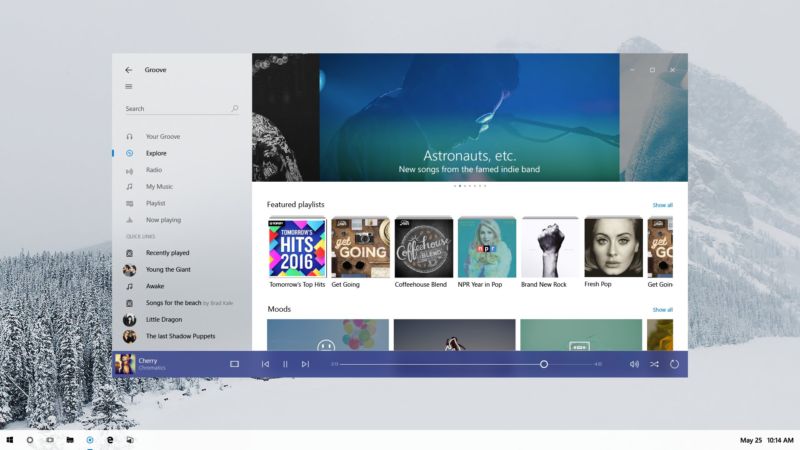
An anonymous reader quotes a report from Ars Technica: Earlier this year, pictures of a new Windows look and feel leaked. Codenamed Project Neon, the new look builds on Microsoft Design Language 2 (MDL2), the styling currently used in Windows 10, to add elements of translucency and animation. Neon has now been officially announced, and it has an official new name: the Microsoft Fluent Design System. The switch from "design language" to "design system" is deliberate; Fluent is intended to define more than just the appearance, but also the interactivity. Though visually there are common elements, the system is designed to work across virtual/augmented reality, phones, tablets, desktop PCs, games consoles, using mice, keyboards, motion controllers, voice, gestures, touch, and pen, with the interactivity and input optimized to each particular form factor. Fluent is described as having five "fundamentals": light, depth, motion, material, and scale. "Light" means that the interface should avoid distracting and strive to ensure that attention is drawn to where it needs to be. With "depth," Fluent apps will make greater use of layering and the relationships between objects and interface elements. Fluent will use "motion" to indicate relationships and connections between elements, establishing context. Microsoft is using "Material" to mean making best use of the screen space and giving room to content. "Scale" means building interfaces that can go beyond two dimensions, and go beyond the size of a screen, to embrace new form factors and input methods as they arrive. -
Azure Goes Database Crazy With One New NoSQL, Two New SQL Services (arstechnica.com)
An anonymous reader quotes a report from Ars Technica: In its continued efforts to make Azure a platform that appeals to the widest range of developers possible, Microsoft announced a range of new features at Build, its annual developer conference. Many of the features shown today had a data theme to them. The most novel feature was the release of Cosmos DB, a replacement for, or upgrade to, Microsoft's Document DB NoSQL database. Cosmos DB is designed for "planet-scale" applications, giving developers fine control over the replication policies and reliability. Replicated, distributed systems offer trade-offs between latency and consistency; systems with strong consistency wait until data is fully replicated before a write is deemed to be complete, which offers consistency at the expense of latency. Systems with eventual consistency mark operations as complete before data is fully replicated, promising only that the full replication will occur eventually. This improves latency but risks delivering stale data to applications. Document DB offered four different options for the replication behavior; Cosmos DB ups that to five. The database scales to span multiple regions, with Microsoft offering service level agreements (SLAs) for uptime, performance, latency, and consistency. There are financial penalties if Microsoft misses the SLA requirements. Many applications still call for traditional relational databases. For those, Microsoft is adding both a MySQL and a PostgreSQL service; these provide the familiar open source databases in a platform-as-a-service style, removing the administrative overhead that comes of using them and making it easier to move workloads using them into Azure. The company is also offering a preview of a database-migration service that takes data from on-premises SQL Server and Oracle databases and migrates it to Azure SQL Database. Azure SQL Database has a new feature in preview called "Managed Instances" that offers greater compatibility between on-premises SQL Server and the cloud variant, again to make workload migration easier. -
The Intelligent Intersection Could Banish Traffic Lights Forever (arstechnica.com)
Jonathan M. Gitlin reports via Ars Technica: With a degree of coordination -- between vehicles, and with traffic infrastructure -- traffic chaos should theoretically be banished, and less congestion means fewer pollutants. Clemson researcher Ali Reza Fayazi has provided a tantalizing glimpse at that future, a proof-of-concept study showing that a fully autonomous four-way traffic intersection is a hundred times more efficient at letting traffic flow than the intersections you and I currently navigate. Because cars don't sit idling at the lights, Fayazi calculated it would also deliver a 19 percent fuel saving. Fayazi designed an intersection controller for a four-way junction that tracks vehicles and then uses an algorithm to control their speeds such that they can all pass safely through the junction with as few coming to a halt as possible. What makes the study particularly interesting is that Fayazi demonstrated it by interspersing his own physical car among the simulated traffic -- the first use of a vehicle-in-the-loop simulator for this kind of problem. Fayazi drove his real car at the International Transportation Innovation Center in Greenville, South Carolina, where a geofenced area was set up to use as the simulated intersection. Using GPS sensors, his car was just as visible to the intersection controller as the virtual autonomous vehicles that were also populating its memory banks. Ideally, Fayazi says he'd like to have tested it with an autonomous vehicle, but they are hard to come by, particularly in South Carolina. Instead, the intersection controller directly governed his speed in the study (as it did with the simulated vehicles), and this controller sent him a speed to maintain in order to safely cross the junction. Over the course of an hour, the intelligent intersection only required 11 vehicles to come to a complete halt. By contrast, when the simulation was run with a traffic light instead, more than 1,100 vehicles had to stop at the junction over the course of an hour. -
Opinion: Even if You Hate the Idea, Windows Users Should Want Windows 10 S To Succeed (arstechnica.com)
Last week, Microsoft unveiled Windows 10 S, a new variant of its desktop operating system aimed largely at the education space. While time will tell how this new edition of Windows fares, if early reactions from enthusiasts are anything to go by, Windows 10 S is in for a tough ride ahead. For one, Windows 10 S only permits installation of applications from the Windows Store. If that wasn't a deal-breaker, several popular applications including Google's Chrome are missing from the Store. Amid all of this, reporter and columnist Peter Bright has an op-ed up on ArsTechnica in which he argues that despite the walled-garden offering, people should want Windows 10 S to succeed as it could make Windows better for everyone else. From his article: This [forbidding execution of any program that wasn't downloaded from the Windows Store] positions Microsoft as a gatekeeper -- although its criteria for entry within the store is for the most part not stringent, it does reserve the right to remove software that it deems undesirable -- and means that the vast majority of extant Windows software can't be used. This means that PC mainstays, from Adobe Photoshop to Valve's Steam, can't be used on Windows 10 S. [...] Some of the arguments against this are bizarre. Notably, the complaint that Microsoft has now erected a paywall -- "you have to pay $50 to run Steam!" -- is very peculiar when one considers that, in general, Windows licenses have never been free. [...] The Windows Store makes bad parts of Windows better: I'd argue, however, that Windows users should want Windows 10 S to succeed. Windows 10 S isn't for everybody, and Windows 10 S may not be for you, but if Windows 10 S succeeds, it will make Windows 10 better for everyone. The Store in Windows RT required developers to write their apps from scratch. With negligible numbers of users, developers were uninterested in doing this work. The Store in Windows 10 has Centennial. In principle, Centennial should make it easy to package existing Win32 apps and sell them through the Store, and if developers of Windows apps adopt Centennial en masse then the Store restriction shouldn't be particularly restrictive. Widespread adoption will be good for Windows users of all stripes. -
Comcast and Charter Agree Not To Compete Against Each Other In Wireless (arstechnica.com)
Comcast and Charter announced an agreement to cooperate in their plans to sell mobile phone service, an agreement that also forbids each company from making wireless mergers and acquisitions without the other's consent for one year. "That agreement could stoke Wall Street speculation among investors and analysts that the two largest U.S. cable companies together could decide to make a play for a carrier like T-Mobile U.S. Inc. or Sprint Corp.," wrote The Wall Street Journal. Ars Technica reports: The deal could violate antitrust law, said Harold Feld, an attorney and senior VP of consumer advocacy group Public Knowledge. "One of the basic ideas of antitrust law is that when companies that compete with each other, or could compete with each other, make an explicit agreement to not compete with each other, that violates the antitrust laws," Feld told Ars today. "Agreeing to coordinate with each other to avoid competition is expressly a violation of the antitrust laws." But that doesn't mean Comcast and Charter won't be able to follow through with their plan. It's impossible to say with absolute certainty whether any specific agreement violates antitrust law, and "both Comcast and Charter have very good lawyers," Feld said. Comcast and Charter have a combined 47 million internet subscribers, dominating the US market for high-speed broadband, but they do not compete against each other in any city or town. The Comcast/Charter cooperation agreement fits in nicely with Comcast's mobile plans, because the company intends to sell smartphone data plans only to customers who also have Comcast home Internet service. Comcast's mobile service is scheduled to be available by the end of June, while Charter has said it intends to offer similar service in 2018. -
Google's Upcoming 'Fuchsia' Smartphone OS Dumps Linux, Has a Wild New UI (arstechnica.com)
More details have emerged about Fuchsia, the new mobile OS Google has been working on. ArsTechnica reports that Fuchsia is not based on Linux (unlike Android and Chrome OS). Instead, the OS uses a new, Google-developed microkernel called "Magenta." From the article: With Fuchsia, Google would not only be dumping the Linux kernel, but also the GPL: the OS is licensed under a mix of BSD 3 clause, MIT, and Apache 2.0. Dumping Linux might come as a bit of a shock, but the Android ecosystem seems to have no desire to keep up with upstream Linux releases. Even the Google Pixel is still stuck on Linux Kernel 3.18, which was first released at the end of 2014. [...] The interface and apps are written using Google's Flutter SDK, a project that actually produces cross-platform code that runs on Android and iOS. Flutter apps are written in Dart, Google's reboot of JavaScript which, on mobile, has a focus on high-performance, 120fps apps. It also has a Vulkan-based graphics renderer called "Escher" that lists "Volumetric soft shadows" as one of its features, which seems custom-built to run Google's shadow-heavy "Material Design" interface guidelines. The publication put the Flutter SDK to test on an Android device to get a sneak peek into the user interface of Fuchsia. "The home screen is a giant vertically scrolling list. In the center you'll see a (placeholder) profile picture, the date, a city name, and a battery icon," the author wrote. "Above the are 'Story' cards -- basically Recent Apps -- and below it is a scrolling list of suggestions, sort of like a Google Now placeholder. Leave the main screen and you'll see a Fuchsia 'home' button pop up on the bottom of the screen, which is just a single white circle." -
Google's Upcoming 'Fuchsia' Smartphone OS Dumps Linux, Has a Wild New UI (arstechnica.com)
More details have emerged about Fuchsia, the new mobile OS Google has been working on. ArsTechnica reports that Fuchsia is not based on Linux (unlike Android and Chrome OS). Instead, the OS uses a new, Google-developed microkernel called "Magenta." From the article: With Fuchsia, Google would not only be dumping the Linux kernel, but also the GPL: the OS is licensed under a mix of BSD 3 clause, MIT, and Apache 2.0. Dumping Linux might come as a bit of a shock, but the Android ecosystem seems to have no desire to keep up with upstream Linux releases. Even the Google Pixel is still stuck on Linux Kernel 3.18, which was first released at the end of 2014. [...] The interface and apps are written using Google's Flutter SDK, a project that actually produces cross-platform code that runs on Android and iOS. Flutter apps are written in Dart, Google's reboot of JavaScript which, on mobile, has a focus on high-performance, 120fps apps. It also has a Vulkan-based graphics renderer called "Escher" that lists "Volumetric soft shadows" as one of its features, which seems custom-built to run Google's shadow-heavy "Material Design" interface guidelines. The publication put the Flutter SDK to test on an Android device to get a sneak peek into the user interface of Fuchsia. "The home screen is a giant vertically scrolling list. In the center you'll see a (placeholder) profile picture, the date, a city name, and a battery icon," the author wrote. "Above the are 'Story' cards -- basically Recent Apps -- and below it is a scrolling list of suggestions, sort of like a Google Now placeholder. Leave the main screen and you'll see a Fuchsia 'home' button pop up on the bottom of the screen, which is just a single white circle." -
Intel's Remote Hijacking Flaw Was 'Worse Than Anyone Thought' (arstechnica.com)
An anonymous reader quotes Ars Technica: A remote hijacking flaw that lurked in Intel chips for seven years was more severe than many people imagined, because it allowed hackers to remotely gain administrative control over huge fleets of computers without entering a password. This is according to technical analyses published Friday... AMT makes it possible to log into a computer and exercise the same control enjoyed by administrators with physical access [and] was set up to require a password before it could be remotely accessed over a Web browser interface. But, remarkably, that authentication mechanism can be bypassed by entering any text string -- or no text at all...
"Authentication still worked" even when the wrong hash was entered, Tenable Director of Reverse Engineering Carlos Perez wrote. "We had discovered a complete bypass of the authentication scheme." A separate technical analysis from Embedi, the security firm Intel credited with first disclosing the vulnerability, arrived at the same conclusion... Making matters worse, unauthorized accesses typically aren't logged by the PC because AMT has direct access to the computer's network hardware... The packets bypass the OS completely.
The article adds that Intel officials "said they expect PC makers to release a patch next week." And in the meantime? "Intel is urging customers to download and run this discovery tool to diagnose potentially vulnerable computers."
Saturday Ars Technica found more than 8,500 systems with an AMT interface exposed to the internet using the Shodan search engine -- over 2,000 in the United States -- adding that "many others may be accessible via organizational networks." -
Cop Fakes Body Cam Footage, Prosecutors Drop Drug Charges (arstechnica.com)
An anonymous reader quotes a report from Ars Technica: Prosecutors in Pueblo, Colorado are dropping felony drug and weapon-possession charges after an officer involved in the case said he staged body cam footage so he could walk "the courts through" the vehicle search that led to the arrest. The development means that defendant Joseph Cajar, 36, won't be prosecuted on allegations of heroin possession and of unlawful possession of a handgun. The evidence of the contraband was allegedly found during a search of Cajar's vehicle, which was towed after he couldn't provide an officer registration or insurance during a traffic stop. Officer Seth Jensen said he found about seven grams of heroin and a .357 Magnum in the vehicle at the tow yard. But the actual footage of the search that he produced in court was a reenactment of the search, the officer told prosecutors. -
California Seeks To Tax Rocket Launches, Which Are Already Taxed (arstechnica.com)
The state of California is looking into taxing its thriving rocket industry. The Franchise Tax Board has issued a proposed regulation for public comment that would require companies that launch spacecraft to pay a tax based upon "mileage" traveled by that spacecraft from California. Ars Technica reports: The proposal says that California-based companies that launch spacecraft will have to pay a tax based upon "mileage" traveled by that spacecraft from California. (No, we're not exactly sure what this means, either). The proposed regulations were first reported by the San Francisco Chronicle, and Thomas Lo Grossman, a tax attorney at the Franchise Tax Board, told the newspaper that the rules are designed to mirror the ways taxes are levied on terrestrial transportation and logistics firms operating in California, like trucking or train companies. The tax board is seeking public input from now until June 16, when it is expected to vote on the proposed tax. The federal government already has its own taxes for commercial space companies, and until now no other state has proposed taxing commercial spaceflight. In fact most other states, including places like Florida, Texas, and Georgia, offer launch providers tax incentives to move business into their areas. -
Trump Administration Rolls Back Obama-Era Nutrition Standards For School Lunches (arstechnica.com)
An anonymous reader quotes a report from Ars Technica: Just a week into his position, U.S. Secretary of Agriculture Sonny Perdue announced Monday a rollback of nutrition standards for school meals, previously championed by former First Lady Michelle Obama as part of a larger initiative to improve the health of America's children. Under Perdue's new rollback, schools across the country can now delay a requirement to reduce sodium levels, can serve kids fewer whole grains, and can provide one percent flavored milk in addition to flavored skim, unflavored skim, and unflavored one percent. In a news release that declared the move would "make school meals great again," Perdue said: "This announcement is the result of years of feedback from students, schools, and food service experts about the challenges they are facing in meeting the final regulations for school meals. If kids aren't eating the food, and it's ending up in the trash, they aren't getting any nutrition -- thus undermining the intent of the program." Specifically, under Obama-era nutrition rules, schools were supposed to decrease sodium from meals in three phases. For instance, 2012 school lunches had average sodium levels between roughly 1,400mg to 1,600mg, with elementary school lunches on the lower end. Federal dietary guidelines, which schools must follow, recommend kids get 1,900mg to 2,300mg or less of sodium per day (depending on age). Currently, schools have dropped down to "Target 1," which is a range of about 1,200mg to 1,400mg or less. Schools were supposed to get that down to about 900mg to 1,000mg this year ("Target 2") and then to between 600mg and 700mg by 2022 ("Final Target"). The USDA will now waive the requirement to reach Target 2 until 2020. The USDA will also grant exemptions from the current requirement for schools to serve only whole-grain-rich foods. -
Carbon Intensity is Falling in Industrial, Electric Power Sectors (arstechnica.com)
Over the last seven years, the electrical power sector has gone from being one of the most carbon-emitting sectors of the American economy per unit of fuel consumed to one of the least carbon-emitting sectors. From a report on ArsTechnica: That's according to new data from the US Energy Information Administration (EIA). Despite the good news, the EIA's numbers show that, since 1975, the carbon emissions of the US transportation sector per unit of fuel used has hardly changed at all. The EIA measured relative emissions across the US economy as "carbon intensity -- an average of the amount of carbon any sector gives off as it consumes different kinds of fuel. The measurements were applied to five sectors of the US economy: transportation, commercial, residential, electric, and industrial. -
Modern 'Hackintoshes' Show That Apple Should Probably Just Build a Mac Tower (arstechnica.com)
An anonymous reader shares an excerpt from a report written by Andrew Cunningham via Ars Technica: Apple is working on new desktop Macs, including a ground-up redesign of the tiny-but-controversial 2013 Mac Pro. We're also due for some new iMacs, which Apple says will include some features that will make less-demanding pro users happy. But we don't know when they're coming, and the Mac Pro in particular is going to take at least a year to get here. Apple's reassurances are nice, but it's a small comfort to anyone who wants high-end processing power in a Mac right now. Apple hasn't put out a new desktop since it refreshed the iMacs in October of 2015, and the older, slower components in these computers keeps Apple out of new high-end fields like VR. This is a problem for people who prefer or need macOS, since Apple's operating system is only really designed to work on Apple's hardware. But for the truly adventurous and desperate, there's another place to turn: fake Macs built with standard PC components, popularly known as "Hackintoshes." They've been around for a long time, but the state of Apple's desktop lineup is making them feel newly relevant these days. So we spoke with people who currently rely on Hackintoshes to see how the computers are being used -- and what they'd like to see from Apple. -
SpaceX Successfully Launches Its First Spy Satellite (arstechnica.com)
SpaceX successfully launched NROL-76, a classified U.S. intelligence mission, from NASA's Kennedy Space Center Monday. Sunday's launch attempt was scrubbed due to a sensor issue. From a report: Not much is known about the National Reconnaissance Office's NROL-76 satellite, a classified payload, which will liftoff into low Earth orbit from Launch Complex 39A at NASA's Kennedy Space Center in Florida. -
A Sophisticated Grey Hat Vigilante Protects Insecure IoT Devices (arstechnica.com)
Ars Technica reports on Hajime, a sophisticated "vigilante botnet that infects IoT devices before blackhats can hijack them." Once Hajime infects an Internet-connected camera, DVR, and other Internet-of-things device, the malware blocks access to four ports known to be the most widely used vectors for infecting IoT devices. It also displays a cryptographically signed message on infected device terminals that describes its creator as "just a white hat, securing some systems." But unlike the bare-bones functionality found in Mirai, Hajime is a full-featured package that gives the botnet reliability, stealth, and reliance that's largely unparalleled in the IoT landscape...
Hajime doesn't rashly cycle through a preset list of the most commonly used user name-password combinations when trying to hijack a vulnerable device. Instead, it parses information displayed on the login screen to identify the device manufacturer and then tries combinations the manufacturer uses by default... Also, in stark contrast to Mirai and its blackhat botnet competitors, Hajime goes to great lengths to maintain resiliency. It uses a BitTorrent-based peer-to-peer network to issue commands and updates. It also encrypts node-to-node communications. The encryption and decentralized design make Hajime more resistant to takedowns by ISPs and Internet backbone providers.
Pascal Geenens, a researcher at security firm Radware, watched the botnet attempt 14,348 hijacks from 12,000 unique IP addresses around the world, and says "If Hajime is a glimpse into what the future of IoT botnets looks like, I certainly hope the IoT industry gets its act together and starts seriously considering securing existing and new products. If not, our connected hopes and futures might depend on...grey hat vigilantes to purge the threat the hard way."
And long-time Slashdot reader The_Other_Kelly asks a good question. "While those with the ability and time can roll their own solutions, what off-the-shelf home security products are there, for non-technical people to use to protect their home/IoT networks?" -
A Sophisticated Grey Hat Vigilante Protects Insecure IoT Devices (arstechnica.com)
Ars Technica reports on Hajime, a sophisticated "vigilante botnet that infects IoT devices before blackhats can hijack them." Once Hajime infects an Internet-connected camera, DVR, and other Internet-of-things device, the malware blocks access to four ports known to be the most widely used vectors for infecting IoT devices. It also displays a cryptographically signed message on infected device terminals that describes its creator as "just a white hat, securing some systems." But unlike the bare-bones functionality found in Mirai, Hajime is a full-featured package that gives the botnet reliability, stealth, and reliance that's largely unparalleled in the IoT landscape...
Hajime doesn't rashly cycle through a preset list of the most commonly used user name-password combinations when trying to hijack a vulnerable device. Instead, it parses information displayed on the login screen to identify the device manufacturer and then tries combinations the manufacturer uses by default... Also, in stark contrast to Mirai and its blackhat botnet competitors, Hajime goes to great lengths to maintain resiliency. It uses a BitTorrent-based peer-to-peer network to issue commands and updates. It also encrypts node-to-node communications. The encryption and decentralized design make Hajime more resistant to takedowns by ISPs and Internet backbone providers.
Pascal Geenens, a researcher at security firm Radware, watched the botnet attempt 14,348 hijacks from 12,000 unique IP addresses around the world, and says "If Hajime is a glimpse into what the future of IoT botnets looks like, I certainly hope the IoT industry gets its act together and starts seriously considering securing existing and new products. If not, our connected hopes and futures might depend on...grey hat vigilantes to purge the threat the hard way."
And long-time Slashdot reader The_Other_Kelly asks a good question. "While those with the ability and time can roll their own solutions, what off-the-shelf home security products are there, for non-technical people to use to protect their home/IoT networks?" -
Russian-Controlled Telecom Hijacks Traffic For Mastercard, Visa, And 22 Other Services (arstechnica.com)
An anonymous reader quotes the security editor at Ars Technica: On Wednesday, large chunks of network traffic belonging to MasterCard, Visa, and more than two dozen other financial services companies were briefly routed through a Russian government-controlled telecom under unexplained circumstances that renew lingering questions about the trust and reliability of some of the most sensitive Internet communications.
Anomalies in the border gateway protocol -- which routes large-scale amounts of traffic among Internet backbones, ISPs, and other large networks -- are common and usually the result of human error. While it's possible Wednesday's five- to seven-minute hijack of 36 large network blocks may also have been inadvertent, the high concentration of technology and financial services companies affected made the incident "curious" to engineers at network monitoring service BGPmon. What's more, the way some of the affected networks were redirected indicated their underlying prefixes had been manually inserted into BGP tables, most likely by someone at Rostelecom, the Russian government-controlled telecom that improperly announced ownership of the blocks. -
Trump Order Helps Offshore Drilling, Stops Marine Sanctuary Expansion (arstechnica.com)
An anonymous reader quotes a report from Ars Technica: In an executive order signed on Friday, President Trump directed his secretary of the interior to review current rules on offshore drilling and exploration. This review is likely to result in a relaxation of the strict protections the previous administration put on offshore oil drilling in the Atlantic and in the Arctic. According to the Washington Post, a review of the rules is likely to "make millions of acres of federal waters eligible for oil and gas leasing." At the same time, Trump's executive order directed the secretary of commerce to cease designating new marine sanctuaries or expanding any that already exist. According to USA Today, Commerce Secretary Wilbur Ross is also "directed to review all designations and expansions of marine monuments or sanctuaries designated under the Antiquities Act within the last 10 years." The Post says this "includes Hawaii's Papahanaumokuakea Marine National Monument, which Obama quadrupled in size last year, and the Northeast Canyons and Seamounts off Massachusetts." Although these reviews could take some time to complete, they put in motion a bid to favor extraction industries like oil and gas mining. "Today, we're unleashing American energy and clearing the way for thousands and thousands of high-paying energy jobs," Trump reportedly told the Associated Press. -
Lawsuit: Fox News Group Hacked, Surveilled, and Stalked Ex-Host Andrea Tantaros (arstechnica.com)
An anonymous reader quotes a report from Ars Technica: Comparing their actions to the plot this season on the Showtime series Homeland, an attorney for former Fox News host Andrea Tantaros has filed a complaint in federal court against Fox News, current and former Fox executives, Peter Snyder and his financial firm Disruptor Inc., and 50 "John Doe" defendants. The suit alleges that collective participated in a hacking and surveillance campaign against her. Tantaros filed a sexual harassment suit against Roger Ailes and Fox News in August of 2016, after filing internal complaints with the company about harassment dating back to February of 2015. She was fired by the network in April of 2016, as Tantaros continued to press complaints against Fox News' then-Chairman and CEO Roger Ailes, Bill O'Reilly, and others. Tantaros had informed Fox that she would be filing a lawsuit over the alleged sexual harassment. Tantaros claims that as early as February of 2015, a group run out of a "black room" at Fox News engaged in surveillance and electronic harassment of her, including the use of "sock puppet" social media accounts to electronically stalk her. Tantaros' suit identifies Peter Snyder and Disruptor Inc. as the operators of a social influence operation using "sock puppet" accounts on Twitter and other social media. -
NASA Delays First Flight of New SLS Rocket Until 2019 (arstechnica.com)
schwit1 writes: Despite spending almost $19 billion and more than thirteen years of development, NASA today admitted that it will have to delay the first test flight of the SLS rocket from late 2018 to sometime in 2019. "We agree with the GAO that maintaining a November 2018 launch readiness date is not in the best interest of the program, and we are in the process of establishing a new target in 2019," wrote William Gerstenmaier, chief of NASA's human spaceflight program. "Caution should be used in referencing the report on the specific technical issues, but the overall conclusions are valid." The competition between the big government SLS/Orion program and private commercial space is downright embarrassing to the government. While SLS continues to be delayed, even after more than a decade of work and billions of wasted dollars, SpaceX is gearing up for the first flight of Falcon Heavy this year. And they will be doing it despite the fact that Congress took money from the commercial private space effort, delaying its progress, in order to throw more money at SLS/Orion. -
Early Nintendo Programmer Worked Without a Keyboard (arstechnica.com)
Much like IT guys, every programmer has a horror story about the extreme work environments that forced them to hack together things. But as ArsTechnica points out, not many of them can beat the keyboard-free coding environment that Masahiro Sakurai apparently used to create the first Kirby's Dream Land. From the story: The tidbit comes from a talk Sakurai gave ahead of a Japanese orchestral performance celebrating the 25th anniversary of the original Game Boy release of Kirby's Dream Land in 1992. Sakurai recalled how HAL Laboratory was using a Twin Famicom as a development kit at the time. Trying to program on the hardware, which combined a cartridge-based Famicom and the disk-based Famicom Disk System, was "like using a lunchbox to make lunch," Sakurai said. As if the limited power wasn't bad enough, Sakurai revealed that the Twin Famicom testbed they were using "didn't even have keyboard support, meaning values had to be input using a trackball and an on-screen keyboard." -
NASA Inspector Says Agency Wasted $80 Million On An Inferior Spacesuit (arstechnica.com)
An anonymous reader quotes a report from Ars Technica: When NASA began developing a rocket and spacecraft to return humans to the Moon a decade ago as part of the Constellation Program, the space agency started to think about the kinds of spacesuits astronauts would need in deep space and on the lunar surface. After this consideration, NASA awarded a $148 million contract to Oceaneering International, Inc. in 2009 to develop and produce such a spacesuit. However, President Obama canceled the Constellation program just a year later, in early 2010. Later that year, senior officials at the Johnson Space Center recommended canceling the Constellation spacesuit contract because the agency had its own engineers working on a new spacesuit and, well, NASA no longer had a clear need for deep-space spacesuits. However, the Houston officials were overruled by agency leaders at NASA's headquarters in Washington, DC. A new report released Wednesday by NASA Inspector General Paul Martin sharply criticizes this decision. "The continuation of this contract did not serve the best interests of the agency's spacesuit technology development efforts," the report states. In fact, the report found that NASA essentially squandered $80.6 million on the Oceaneering contract before it was finally ended last year. -
Mylan's Epic EpiPen Price Hike Wasn't About Greed -- It's Worse, Lawsuit Claims (arstechnica.com)
Mylan engaged in a campaign to squash a rival to its EpiPen allergy treatment and artificially inflate the price of the drug to maintain a market monopoly, French drugmaker Sanofi said in a lawsuit. From a report: With the lofty prices and near-monopoly over the market, Mylan could dangle deep discounts to drug suppliers -- with the condition that they turn their backs on Sanofi's Auvi-Q -- the lawsuit alleges. Suppliers wouldn't dare ditch EpiPens, the most popular auto-injector. And with the high prices, the rebates wouldn't put a dent in Mylan's hefty profits, Sanofi speculates. Coupled with a smear campaign and other underhanded practices, Mylan effectively pushed Sanofi out of the US epinephrine auto-injector market, Sanofi alleges. The lawsuit, filed Monday in a federal court in New Jersey, seeks damages under US Antitrust laws. -
Five Years Later, Legal Megaupload Data Is Still Trapped On Dead Servers (arstechnica.com)
An anonymous reader quotes a report from Ars Technica: It's been more than five years since the government accused Megaupload and its founder Kim Dotcom of criminal copyright infringement. While Dotcom himself was arrested in New Zealand, U.S. government agents executed search warrants and grabbed a group of more than 1,000 servers owned by Carpathia Hosting. That meant that a lot of users with gigabytes of perfectly legal content lost access to it. Two months after the Dotcom raid and arrest, the Electronic Frontier Foundation filed a motion in court asking to get back data belonging to one of those users, Kyle Goodwin, whom the EFF took on as a client. Years have passed. The U.S. criminal prosecution of Dotcom and other Megaupload executives is on hold while New Zealand continues with years of extradition hearings. Meanwhile, Carpathia's servers were powered down and are kept in storage by QTS Realty Trust, which acquired Carpathia in 2015. Now the EFF has taken the extraordinary step of asking an appeals court to step in and effectively force the hand of the district court judge. Yesterday, Goodwin's lawyers filed a petition for a writ of mandamus (PDF) with the U.S. Court of Appeals for the 4th Circuit, which oversees Virginia federal courts. "We've been asking the court for help since 2012," said EFF attorney Mitch Stolz in a statement about the petition. "It's deeply unfair for him to still be in limbo after all this time."