Slashdot Mirror
Domain: cnbc.com
Stories and comments across the archive that link to cnbc.com.
Stories · 631
-
Bitcoin Boosted by Safe-Haven Demand After Trump Victory (cnbc.com)
Donald Trump's historic victory in the U.S. presidential elections has pushed up prices for the digital currency bitcoin. As the results for the election began to trickle in, the cryptocurrency quickly began to rise at around 2 a.m. London time. From a report on CNBC: The price for bitcoin was around 3.5 percent higher at 11:00 a.m. London time Wednesday at $733.84. Since November 4, the cryptocurrency has been stuck around the $700-709 trading band. The weakening dollar may have added to the rise, but the digital currency is also higher when priced in other currencies like the Chinese yuan, sterling and the euro. Charles Hayter, CEO and founder of Crypto Compare, said that the price is rising on safe-haven demand in reaction to the uncertainty created as a result of Trump's victory. -
Tesla Crash Won't Stop Driverless Car Progress: Renault-Nissan CEO (cnbc.com)
Problems Issues with Tesla's self-driving software that were linked to the death of a driver this year would not block the development of autonomous vehicles, Carlos Ghosn, the chief executive of Renault-Nissan, said on Tuesday. From a report on CNBC: In September, Tesla revealed the death of a man in one of its cars in a crash in the Netherlands and said that the "autopilot" software's role in the accident was being investigated. "In the moments leading up to the collision, there is no evidence to suggest that Autopilot was not operating as designed and as described to users: specifically, as a driver assistance system that maintains a vehicle's position in lane and adjusts the vehicle's speed to match surrounding traffic," Tesla said in a blog post at the time. This incident shone a spotlight on autonomous driving features currently in cars as automakers are in a race to bring fully driverless cars on the road. During an interview at the Web Summit technology conference in Lisbon, Ghosn said that the teething problems with Tesla's autonomous software would not derail the industry's push. -
Elon Musk Predicts Automation Will Lead To A Universal Basic Income (mashable.com)
An anonymous reader quotes Mashable's new article about Tesla/SpaceX founder Elon Musk: Tech innovators in the self-driving car and AI industries talk a lot about how many human jobs will be innovated out of existence, but they rarely explain what will happen to all those newly jobless humans. In an interview with CNBC on Friday, Musk said that he believes the solution to taking care of human workers who are displaced by robots and software is creating a (presumably government-backed) universal basic income for all. "There's a pretty good chance we end up with a universal basic income, or something like that, due to automation," said Musk. "I'm not sure what else one would do. That's what I think would happen."
And what will this world look like? "People will have time to do other things, more complex things, more interesting things," Musk told CNBC's interviewer. "Certainly more leisure time." President Obama has also talked about "redesigning the social compact" with MIT Media Lab director Joi Ito, and in August predicted the question of whether there's support for the Universal Basic Income is "a debate that we'll be having over the next 10 or 20 years." -
White House, 35 States To Boost Electric Vehicle Charging Stations (cnbc.com)
An anonymous reader quotes a report from CNBC: The White House said on Thursday it will establish 48 national electric-vehicle (EV) charging networks on nearly 25,000 miles of highways in 35 U.S. states. The Obama administration said 28 states, utilities and vehicle manufactures, including General Motors, BMW and Nissan Motor, and EV charging firms have agreed to work together to jump-start the additional charging stations. The corridors were required to be established by December under a 2015 highway law. The White House said 24 state and local governments have agreed to buy hundreds of additional electric vehicles for government fleets and add new EV charging stations. California will buy at least 150 zero-emission vehicles and provide EV charging at a minimum of 5 percent of state-owned parking spaces by 2020. The city of Atlanta will add 300 charging stations at Hartsfield-Jackson International Airport by the end of 2017. Los Angeles agreed to nearly triple the city's current plug-in electric fleet to 555 vehicles from about 200 by the end of 2017. Of those, 200 will be for the police department. The city is also adding another 500 stations by 2017. One hurdle to the mass adoption of EVs has been the difficulty in finding places to recharge vehicles. In July, the White House said it was expanding a federal loan guarantee program to include companies building EV charging stations. The U.S. Energy Department said in July that charging facilities are now an eligible technology for the program that can provide up to $4.5 billion in loan guarantees. -
The Next President Will Face a Cybercrisis Within 100 Days, Predicts Report (cnbc.com)
The next president of the United States will face a cybercrisis within 100 days, predicts report from analysts at Forrester. The crisis could come as a result of hostile actions from another country or internal conflict over privacy and security legislation, said Forrester analyst Amy DeMartine, lead author of the firm's top cybersecurity risks for 2017 report, due to be made public Tuesday. From a report on CNBC:History grades a president's first 100 days as the mark of how their four-year term will unfold, so those early days are particularly precarious, said DeMartine. The new commander in chief will face pressure from foreign entities looking to embarrass them early on, just as U.S. government agencies jockey for position within the new administration, she said. Cyberwarfare between Russia and the U.S. will escalate, and the U.S. government will respond in 2017, said DeMartine. [...] Chinese government hacking will continue in 2017, despite a joint agreement not to conduct cybertheft of intellectual property. The massive U.S. Office of Personnel Management breach, which exposed the records of millions of U.S government workers, has strained diplomatic relations between the U.S. and China, since the U.S. believes Chinese spies carried out the attack. Countries like North Korea and Iran have been building capabilities for offensive purposes and will likely try to hack public and private databases, said DeMartine. -
HackerOne CEO: Every Computer System is Subject To Vulnerabilities (cnbc.com)
An anonymous reader writes: Every computer system in the world is vulnerable to hackers and criminals, according to Marten Mickos, CEO of HackerOne. That's nothing new with major data breaches at Yahoo and the federal government. But not to worry, teams of ethical hackers could be an answer to the growing cybersecurity concerns. "There are far more ethical hackers, white hat hackers, in the world than criminals," Mickos told CNBC's "Squawk Alley" on Thursday. "So when you just invite the good guys to help you, you will always be safe. It's like a neighborhood watch. You're asking the good guys around you to help you see what's wrong with your system and help you fix it." Mickos has assembled 70,000 white hat hackers in his venture-backed company HackerOne. He explains the intent of white hat hackers is to hack for good and not for exploitation. -
Will The iPhone 8 Include Augmented Reality? (bgr.com)
Earlier this month Mashable wrote "it's now even more obvious what [Apple] is working to bring to the masses, and it's probably not, as some rumors have indicated, virtual reality." They cited CEO Tim Cook's recent predictions that augmented reality "is going to become really big" -- he said it again on Thursday -- and BuzzFeed noted that Apple "has quietly put into place the components of what could prove to be an AR ecosystem: The iPhone 7 Plus has...a two-camera system capable of gathering stereoscopic data and generating image depth maps... In Apple Watch, the company has a spatially-aware, wearable device outfitted with an accelerometer and GPS. In its new AirPod wireless earphones, Apple essentially has a pair of diminutive, spatially-aware microcomputers -- each one with an Apple W1 wireless chip (the company's first), two accelerometers, two optical sensors, beam-forming microphones, and an antenna... And sources tell BuzzFeed News that the company has recently been taking meetings with immersive content companies like Jaunt.
Their article also lists AR companies that Apple's bought over the last three years -- plus their patents for a "head-mounted display" and a "peripheral treatment for head-mounted displays." BGR adds that Tim Cook "likes to tease future products," and points out that Cook has even said Apple is working on AR features "behind the curtain". This casts a new light on those rumors of an all-glass case for next year's iPhone 8. Will the whole body of the phone become part of an Augmented Reality display system? (And could AR also explain Apple's aggressive push for wireless headphones?) -
Apple CEO Tim Cook On Virtual Reality: There's No Substitute For Human Contact (cnbc.com)
As major tech companies ramp up their efforts to develop new technologies to make sense of virtual and augmented reality spaces, one company is noticeably off the game. We're talking about Apple. And it may have something to do with how it perceives these nascent technology spaces. From an article on CNBC:"There's no substitute for human contact," Apple CEO Tim Cook told BuzzFeed News. "And so you want the technology to encourage that." It's not the first time Cook has indicated that Apple might favor AR. "We are high on AR for the long run," Cook said during an earnings call this past summer. "I think AR can be huge." Huge, indeed -- one could look to the sudden and explosive success of Pokemon Go to see an immediate real-world example. -
Verizon Believes Yahoo Email Hacking 'Material,' Could Affect Deal (cnbc.com)
In the aftermath of disclosure of a mega-breach at Yahoo which affects over 500 million users, Verizon may be looking at a way out of Yahoo's $4.83 billion acquisition deal. From a Reuters report: The company has a "reasonable basis" to believe that Yahoo's massive data breach of at least 500 million email accounts represents a material impact that could allow Verizon to withdraw from its $4.83 billion deal to buy Yahoo. Silliman told reporters that the data breach could trigger a clause that could allow Verizon to withdraw from the deal. "I think we have a reasonable basis to believe right now that the impact is material and we're looking to Yahoo to demonstrate to us the full impact. If they believe that it's not then they'll need to show us that," he said. -
Tesla's Sales Increase - But Next Will We Need Smart Roads? (backchannel.com)
Elon Musk says Tesla's autopilot has now driven over 222 million miles, and the company is now selling twice as many electric cars as it did in 2015. (Despite complaints from a coal-mining CEO that Tesla "is a fraud" because it receives tax-payer subsidies.)
But Slashdot reader mirandakatz writes, "It's not enough to build self-driving cars: we have to build the roads to accompany them. Roadside sensors might have once seemed a pipe dream, but with the advent of 5G internet infrastructure, they're not out of reach at all. And their implications span far beyond road safety, GMU researcher Brent Skorup explains at Backchannel: Cities could use sensor data for conducting traffic studies, pushing out real-time public bus alerts, increasing parking space occupancy, metering commercial loading times to prevent congestion, and enhancing pedestrian safety. There are also commercial applications for sensor data: How many cars drive by a billboard? How many people walk by a storefront per day? How many of those people have dogs? These are all questions we could easily answer with roadside sensors. -
Theranos To Shut Down Its Blood-Testing Facilities, Shrink Workforce By 40% (wsj.com)
tripleevenfall quotes a report from The Wall Street Journal: Theranos Inc. said it will shut down its blood-testing facilities and shrink its workforce by more than 40% (Warning: may be paywalled; alternate source). The company said it had 790 full-time employees as of August 1. The moves mark a dramatic retreat by the Palo Alto, Calif., company and founder Elizabeth Holmes from their core strategy of offering a long menu of low-price blood tests directly to consumers. Those ambitions already were endangered by crippling regulatory sanctions that followed revelations by The Wall Street Journal of shortcomings in Theranos's technology and operations. Theranos later voided all results from its proprietary device for 2014 and 2015, though the company said it wasn't aware of any patient harm resulting form its tests. Ms. Holmes said in a statement: "We will return our undivided attention to our miniLab platform. Our ultimate goal is to commercialize miniaturized, automated laboratories capable of small-volume sample testing, with an emphasis on vulnerable patient populations, including oncology, pediatrics, and intensive care." -
Apple, Google, Microsoft: We Have No Government Email Scanning Program Like Yahoo's (vocativ.com)
Apple, Google and Microsoft -- three of the largest technology companies in the U.S. -- have each said they don't scan all incoming messages for the U.S. government, which is exactly what Yahoo does. According to Reuters, Yahoo secretly built a custom software program last year to search all of its customers' incoming emails for specific information provided by U.S. intelligence officials. The company complied with a classified U.S. government directive, scanning hundreds of millions of Yahoo Mail accounts at the behest of the National Security Agency or FBI. Vocativ reports: In a statement, a Microsoft spokesperson told Vocativ that "We have never engaged in the secret scanning of email traffic like what has been reported today about Yahoo." While Apple declined to give a statement on the record, a representative for the company did, in response to Vocativ's question, refer to CEO Tim Cook's official letter on consumer privacy, which reads in part: "I want to be absolutely clear that we have never worked with any government agency from any country to create a backdoor in any of our products or services. We have also never allowed access to our servers. And we never will." The fact that both the companies declined further statement means it's not yet known if the NSA or FBI approached them to request they build a program like Yahoo's. Meanwhile, a spokesperson from Alphabet's Google issued a statement to CNBC: "We've never received such a request, but if we did, our response would be simple: 'no way.'" [The spokesperson later clarified that the company has not received a "directive" or "order" to that effect, either, according to The Intercept.] But the question is whether or not you believe them. With Yahoo's case, only a handful of employees knew about the program. The same could be true with Apple, Google, Microsoft or any other large tech company. Edward Snowden tweeted not too long after Reuters' report surfaced: "Heads up: Any major email service not clearly, categorically denying this tomorrow -- without careful phrasing -- is as guilty as Yahoo." -
Pennsylvania's Voting Machines Are Running Windows XP (cbsnews.com)
Slashdot reader rmurph04 writes: As reported by CBS News, the battleground state of Pennsylvania might as well have a target on its back as Election Day nears, the cybersecurity company Carbon Black warned in a new report released Thursday. Across the state, most Pennsylvania counties use particularly high-risk electronic voting machines that leave behind zero paper trails, which could be useful to audit the integrity of votes cast. In addition, many of these machines -- called "direct-recording electronic" machines -- are running on severely outdated operating systems like Windows XP, which has not been patched by Microsoft since 2014.
According to the survey more than one in five registered U.S. voters may stay home on Election Day because of fears about cybersecurity and vote tampering. Respondents believe a U.S. insider threat poses the most risk (28%), followed by Russian hackers (17%) and then the candidates themselves (15%). -
Pennsylvania's Voting Machines Are Running Windows XP (cbsnews.com)
Slashdot reader rmurph04 writes: As reported by CBS News, the battleground state of Pennsylvania might as well have a target on its back as Election Day nears, the cybersecurity company Carbon Black warned in a new report released Thursday. Across the state, most Pennsylvania counties use particularly high-risk electronic voting machines that leave behind zero paper trails, which could be useful to audit the integrity of votes cast. In addition, many of these machines -- called "direct-recording electronic" machines -- are running on severely outdated operating systems like Windows XP, which has not been patched by Microsoft since 2014.
According to the survey more than one in five registered U.S. voters may stay home on Election Day because of fears about cybersecurity and vote tampering. Respondents believe a U.S. insider threat poses the most risk (28%), followed by Russian hackers (17%) and then the candidates themselves (15%). -
Yahoo Insiders Believe Hackers Could Have Stolen Over 1 Billion Accounts (businessinsider.com)
An anonymous reader quotes a report from Business Insider: The actual tally of stolen user accounts from the hack Yahoo experienced could be much larger than 500 million, according to a former Yahoo executive familiar with its security practices. The former Yahoo insider says the architecture of Yahoo's back-end systems is organized in such a way that the type of breach that was reported would have exposed a much larger group of user account information. To be sure, Yahoo has said that the breach affected at least 500 million users. But the former Yahoo exec estimated the number of accounts that could have potentially been stolen could be anywhere between 1 billion and 3 billion. According to this executive, all of Yahoo's products use one main user database, or UDB, to authenticate users. So people who log into products such as Yahoo Mail, Finance, or Sports all enter their usernames and passwords, which then goes to this one central place to ensure they are legitimate, allowing them access. That database is huge, the executive said. At the time of the hack in 2014, inside were credentials for roughly 700 million to 1 billion active users accessing Yahoo products every month, along with many other inactive accounts that hadn't been deleted. In late 2013, Yahoo CEO Marissa Mayer said the company had 800 million monthly active users globally. It currently has more than 1 billion. -
Feds Go After Mylan For Scamming Medicaid Out of Millions On EpiPen Pricing (arstechnica.com)
An anonymous reader quotes a report from Ars Technica: Over the nine or so years that Mylan, Inc. has been selling -- and hiking the price -- of EpiPens, the drug company has been misclassifying the life-saving device and stiffing Medicaid out of full rebate payments, federal regulators told Ars. Under the Medicaid Drug Rebate Program, drug manufacturers, such as Mylan, can get their products covered by Medicaid if they agree to offer rebates to the government to offset costs. With a brand-name drug such as the EpiPen, which currently has no generic versions and has patent protection, Mylan was supposed to classify the drug as a "single source," or brand name drug. That would mean Mylan is required to offer Medicaid a rebate of 23.1 percent of the costs, plus an "inflation rebate" any time Mylan raises the price of the brand-name drug at a rate higher than inflation. Mylan has opted for such price increases -- a lot. Since Mylan bought the rights to EpiPen in 2007, it has raised the price on 15 separate occasions, bringing the current list price to $608 for a two-pack up from about $50 a pen in 2007. That's an increase of more than 500 percent, which easily beats inflation. But instead of classifying EpiPen as a "single source" drug, Mylan told regulators that it's a "non-innovator multiple source," or generic drug. Under that classification, Mylan is only required to offer a rebate of 13 percent and no inflation rebates. It's unclear how much money Mylan has skipped out on paying in total to state and federal governments. But according to the state health department of Minnesota, as reported by CNBC, the misclassification cost that state $4.3 million this year alone. -
Salesforce, Google, Microsoft, Verizon Are In Talks With Twitter For a Potential Acquisition (cnbc.com)
Twitter is in conversation with a number of tech companies for a potential sale. The social company is in talks with Google and cloud computing company Salesforce (which also wanted to purchase LinkedIn), and may receive a formal offer soon, reports CNBC. TechCrunch corroborating on the report adds that Microsoft and Verizon are also in talks, albeit separately, with Twitter for the same. From CNBC report: Shares of Twitter were up 20 percent Friday. Twitter's board of directors is said to be largely desirous of a deal, according to people close to the situation, but no sale is imminent. There's no assurance a deal will materialize, but one source close to the conversations said that they are picking up momentum and could result in a deal before year-end. Suitors are said to be interested as much in the data that Twitter generates as its place as a media company. -
Web Security CEO Warns About Control Of Internet Falling Into Few Hands (cnbc.com)
The idea behind the internet was to make a massive, decentralized system that wasn't under control of anyone, but that is increasingly changing, according to Matthew Prince, CEO of web security company CloudFlare. His statements come at a time when Google and Facebook and other companies are increasingly building new products and services and locking in users to their respective walled gardens. From a CNBC report: "More and more of the internet is sitting behind fewer and fewer players, and there are benefits of that, but there are also real risks," said Matthew Prince, chief executive officer of web security company CloudFlare, in an interview with CNBC. His comments came at CloudFlare's Internet Summit -- a conference featuring tech executives and government security experts -- on Tuesday in San Francisco. "If everything sits behind Facebook and you can't publish pictures like that, is the world a better place? Probably not," said Prince. "Before you know it, you could wake up and find more of the internet sits behind a small number of gate-keepers," said Prince. Putting that sort of power in the hands of a small number of people and companies "might not be the best thing," he said. Still, the wave of consolidation among the major internet companies is likely to continue, at least for now, he said. -
Tesla Is Suing An Oil-Company Executive For Impersonating Elon Musk (businessinsider.com)
An anonymous reader quotes a report from Business Insider: Tesla is suing an oil executive under suspicion of impersonating Elon Musk to dig up confidential financial information from the company, Forbes reported on Wednesday. The lawsuit, reportedly filed Wednesday in the Superior Court of Santa Clara County, claimed that Todd Katz, the chief financial officer for Quest Integrity Group, emailed Tesla's chief financial officer using a similar email address as Musk's looking to gain information that wasn't disclosed in an earnings call with investors. Quest Integrity Group has partnerships with BP, Chevron, and ExxonMobil, the Forbes report said. According to the lawsuit, Katz used "elontesla@yahoo.com" to send an email to Tesla CFO Jason Wheeler asking about the company's sales and financial projections. The email named in the suit reads: "why you so cautious w Q3/4 gm guidance on call? also what are your thoughts on disclosing M3 res#? Pros/cons from ir pov? what is your best guess as to where we actually come in on q3/4 deliverables. honest guess? no bs. thx 4 hard work prepping 4 today. em." Tesla is seeking "undisclosed financial compensation," as well as compensation for the cost of the investigation and legal fees, according to Forbes. -
Google To Take On Uber With New Ride-Share Service (cnbc.com)
Finally, a major company is planning to compete with Uber in the ride-sharing service space. The Wall Street Journal reports today that Google is planning to debut its own ride-hailing service in San Francisco at "far cheaper rates." (Editor's note: the link could be paywalled, here's an alternate source.) The Mountain View-based company began a pilot program around its California headquarters in May, and enabled several thousand area workers at specific firms to use the Waze navigation app to connect with fellow commuters. Expect Google's service in the coming weeks, says the report. One key difference in Google's approach is that it aims to connect riders with drivers who are already headed in the same direction. The project is in compliance with Waze's aims to "make fares low enough to discourage drivers from operating as taxi drivers." From the report: Still, Google's push into ride-sharing could portend a clash with Uber, a seven-year-old firm valued at roughly $68 billion that largely invented the concept of summoning a car with a smartphone app. Google and Uber were once allies -- Google invested $258 million in Uber in 2013 -- but increasingly see each other as rivals. Alphabet executive David Drummond said Monday that he resigned from Uber's board because of the increasing competition between the companies. Uber, which has long used Google's mapping software for its ride-hailing service, recently began developing its own maps.Game on, Uber. -
Google's Close To Beating Amazon, Microsoft For a Major Cloud Client: Sources (cnbc.com)
An anonymous reader shares a CNBC report: Google's aggressive push into cloud computing, where it trails Amazon.com and Microsoft, has put the internet giant in the lead position to land a marquee client: PayPal. While Google is the front-runner, according to people familiar with the matter, PayPal is evaluating the other leading providers and hasn't made any final decisions. PayPal is unlikely to move its technology infrastructure in the fourth quarter, the peak period for online commerce, said the sources, who asked not to be named because the talks are confidential. Under the leadership of VMware co-founder Diane Greene, Google is out to prove that it's a legitimate player in the rapidly expanding cloud infrastructure market. -
Grumpy Cat Wants $600K From 'Pirating' Coffee Maker (torrentfreak.com)
Eloking quotes a report from TorrentFreak: Grumpy Cat is not pleased, yet. Her owners have asked a California federal court to issue a $600,000 judgment against a coffee maker which allegedly exploited their copyrights (PDF). In addition, they want damages for trademark and contract breach, and a ban on the company in question from selling any associated Grumpy Cat merchandise. There are dozens of celebrity cats on the internet, but Grumpy Cat probably tops them all. The cat's owners have made millions thanks to their pet's unique facial expression, which turned her into an overnight internet star. Part of this revenue comes from successful merchandise lines, including the Grumpy Cat "Grumppuccino" iced coffee beverage, sold by the California company Grenade Beverage. The company licensed the copyright and trademarks to sell the iced coffee, but is otherwise not affiliated with the cat and its owners. Initially this partnership went well, but after the coffee maker started to sell other "Grumpy Cat" products, things turned bad. TorrentFreak adds: "The cat's owners, incorporated as Grumpy Cat LLC, took the matter to court last year with demands for the coffee maker to stop infringing associated copyrights and trademarks. After Grenade Beverage failed to properly respond to the allegations, Grumpy Cat's owners moved for a default, which a court clerk entered in early June. A few days ago they went ahead and submitted a motion for default judgement." -
Cisco Reports Fourth-Quarter 2016 Earnings (cnbc.com)
Cisco has reported its fiscal fourth-quarter earnings and they have exceeded analysts' expectations. CRN reported yesterday that the company will be laying off about 14,000 employees, representing nearly 20 percent of the company's global workforce, according to multiple sources close to the company. Instead, the company will be cutting only 5,500 positions, representing roughly 7 percent of its global workforce, beginning in the fiscal first quarter of 2017. CNBC reports: "The company reported fiscal fourth-quarter earnings of 63 cents a share on revenues of $12.64 billion, beating analyst expectations for 60 cents per share on revenues of $12.57 billion, according to a Thomson Reuters consensus estimate. The company said that 'today's market requires Cisco and our customers to be decisive, move with greater speed and drive more innovation than we've seen in our history.' Cisco said it expects to reinvest the cost savings from its restructuring plan into 'key priority areas such as security, IoT, collaboration, next generation data center and cloud.'" -
Man Says Tesla Autopilot Saved His Life By Driving Him To the Hospital (cnbc.com)
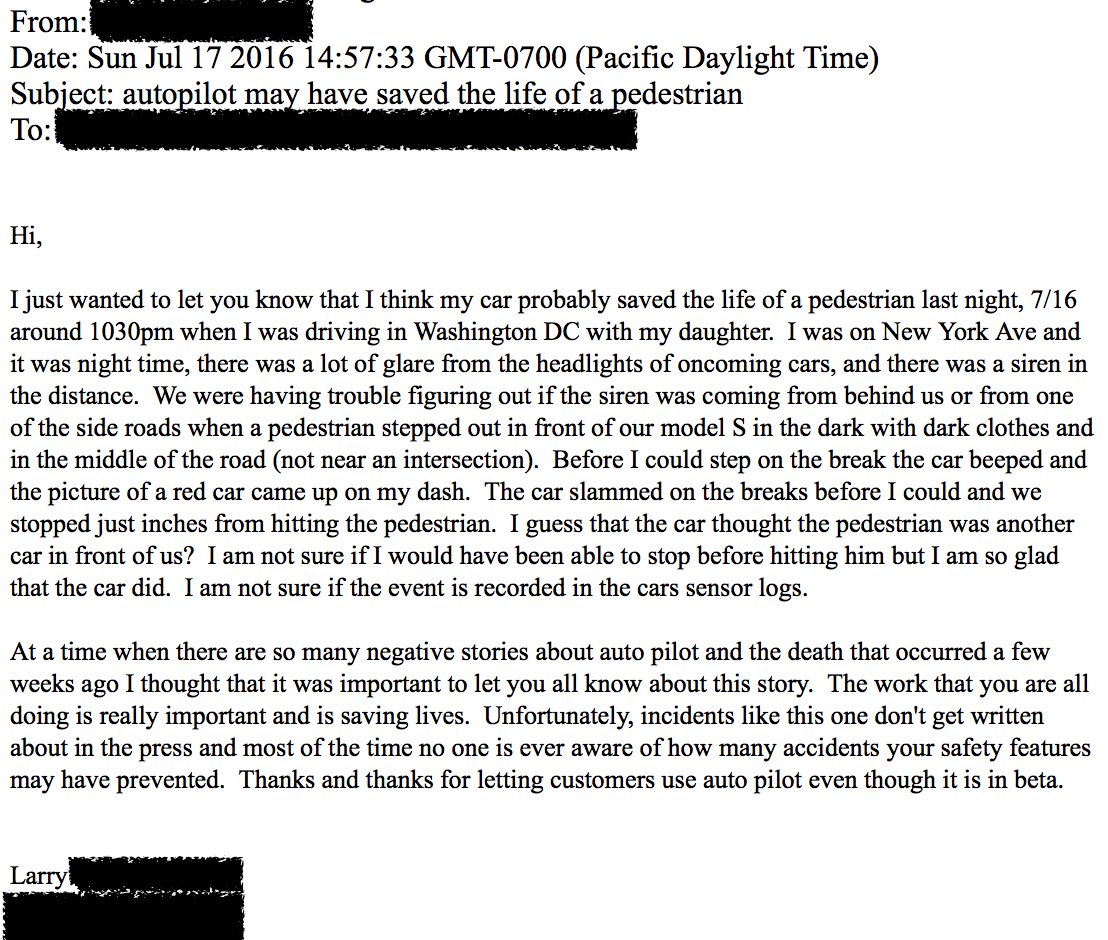
An anonymous reader writes: Last month a man sent an email to Elon Musk explaining how his Tesla Model S with Autopilot activated may have saved a pedestrian's life. Now, it appears Autopilot may have saved the life of a Tesla Model X driver. CNBC reports: "A Missouri man says his Tesla helped saved his life by driving him to the hospital during a life-threatening emergency. Joshua Neally is a lawyer and Tesla owner from Springfield, Missouri, who often uses the semi-autonomous driving system called Autopilot on his Tesla Model X. The system has come under fire after it was involved in a fatal Florida crash in May, but Neally told online magazine Slate that Autopilot drove him 20 miles down a freeway to a hospital, while Neally suffered a potentially fatal blood vessel blockage in his lung, known as a pulmonary embolism. The hospital was right off the freeway exit, and Neally was able to steer the car the last few meters and check himself into the emergency room, the report said." -
Elizabeth Holmes Finally Releases Theranos Data, Including A 'miniLab' (cnbc.com)
An anonymous reader quotes a report from CNBC: Theranos CEO Elizabeth Holmes Monday outlined the steps she will take to increase transparency regarding the efficacy of the company's testing methods. Speaking at the conference of the American Association for Clinical Chemistry, Holmes said that Theranos will partner with other institutions "to validate and publish our results." And Holmes' planned presentation includes research conducted under Institutional Review Board-approved protocols. The company also said it intends to submit its results to a publication for peer-review. Holmes' presentation includes a slate of new products such as its miniLab, a robot that can process samples that normally require manual processing in traditional protocols. Theranos seems to be going back to the research and development drawing board, focusing on these new products instead of its much-debated small-volume blood collection technology. Theranos' miniLab is a self-contained laboratory that allows a robot to run a number of tests on samples. The miniLab contains different modules that allow it to conduct a series of tasks that traditionally would require multiple, separate machines. Theranos used its miniLab to run its Zika nucleic acid-amplification-based assay using finger-prick samples the company collected, some in the Dominican Republic. The samples were shipped back to Palo Alto, California, for analysis. Holmes said the results "demonstrate the miniLab's ability to perform automated, integrated molecular testing comparable to methods that require highly-trained personnel." -
Britain's Scientists Are 'Freaking Out' Over Brexit (washingtonpost.com)
"To use a nonscientific term, the scientists in the country are freaking out," reports the Washington Post. An anonymous Slashdot reader quotes their report: The researchers worry that Britain will not replace funding it loses when it leaves the E.U., which has supplied about $1.2 billion a year to support British science, approximately 10 percent of the total spent by government-funded research councils. There is a whiff of panic in the labs.
Worse than a possible dip in funding is the research community's fear that collaborators abroad will slink away and the country's universities will find themselves isolated. British research today is networked, expensive, competitive and global. Being part of a pan-European consortium has helped put Britain in the top handful of countries, based on the frequency of citations of its scientific papers... Anecdotal evidence suggests that headhunters may already be circling.
Meanwhile, NPR reports that Britain's vote to leave the EU "has depressed the value of the British pound," prompting many Britons to vacation at home rather than abroad -- while "Americans will find their dollars go further in Britain these days." And an anonymous Slashdot reader quotes a report from CNBC that Ford "is considering closing plants in the UK and across Europe in response to Britain's vote to leave the EU, as it forecast a $1 billion hit to its business over the next two years." -
US Military Using $600K 'Drone Buggies' To Patrol Camps In Africa (cnbc.com)
An anonymous reader quotes a report from CNBC: The U.S. military is using an unmanned robotic vehicle to patrol around its camps in the Horn of Africa. The remote controlled vehicle is the result of a 30-year plan after military chiefs approved the concept of a robotic security system in 1985. Now the Mobile Detection Assessment and Response System, known as MDARS, are carrying out patrols in the east African country of Djibouti, under the control of the Combined Joint Task Force-Horn of Africa. The area is known as home to a number of hostile militant groups including the al-Qaeda-affiliated al-Shabaab. An operator sits in a remote location away from the vehicle watching the terrain via a camera link which is fixed to the chassis. U.S. military software engineer Joshua Kordanai said in a video presentation that the vehicle drives itself, freeing the remote operator to monitor video. "The vehicle has an intruder detection payload, consisting of radar, a night vision camera, a PTZ [pan-tilt-zoom] camera and two-way audio, so the system will be able to detect motion," he added. One report prices the cost of an earlier version of the military 'drone buggy' at $600,000 each. -
Once Valued at $125B, Yahoo's Web Assets To Be Sold To Verizon For $4.83B, Companies Confirm
The reports were spot on. Verizon Communications on Monday announced that it plans to purchase Yahoo's Web assets for a sum of $4.83 billion in cash. The multi-billion dollars deal will get Verizon Yahoo's core internet business and some real estate. The announcement also marks a remarkable fall for the Silicon Valley web pioneer, which once had a market capitalization of more than $125 billion. For Verizon, the deal adds another piece to the mammoth digital media and advertising empire it owns. The deal is expected to close early 2017. CNBC reports: The transaction is seen boosting Verizon's AOL internet business, which the company acquired last year for $4.4 billion, by giving it access to Yahoo's advertising technology tools, as well as other assets such as search, mail, messenger and real estate. It also marks the end of Yahoo as an operating company, leaving it only as the owner of a 35.5 percent stake in Yahoo Japan, as well as its 15 percent interest in Chinese e-commerce company Alibaba. In December, Yahoo scrapped plans to spin off its Alibaba stake after investors worried about whether that transaction could have been carried out on a tax-free basis. It instead decided to explore a sale of its core assets, spurred on by activist hedge fund Starboard Value. Forbes has called it one of the "saddest $5B deals in tech history."Yahoo CEO Marissa Mayer, who was expected to leave -- or get fired -- said she intends to stay. "For me personally, I'm planning to stay," Mayer said in a note on Yahoo's Tumblr page. "I love Yahoo, and I believe in all of you. It's important to me to see Yahoo into its next chapter." -
Verizon Nears Deal to Acquire Yahoo (bloomberg.com)
Verizon Communications is nearing a deal to buy Yahoo, Bloomberg reports, citing people familiar with the matter. While nothing is official yet, the publication claims that Verizon is discussing a price close to $5 billion for Yahoo's core Internet business. The report adds that Yahoo's patents are not part of the discussion, and it's unclear whether the two companies are considering Yahoo's real estate. "The companies may be ready to announce the deal in the coming days, the people said," the report adds. Interestingly, CNBC, citing its own sources, is independently reporting the same thing. -
Amazon Loses Huge Footwear Company Because Of Fake Products, a Problem It Denies Is Happening (cnbc.com)
Several sellers on Amazon had noted earlier this month that the platform is riddled with counterfeit products and that things have gotten worse after Chinese manufacturers were allowed to sell goods to the consumers in the United States. Amid the report, the German footwear company Birkenstock has announced it will no longer sell its sandals on Amazon. The company added that it will also ban any sales of its products by third-party sellers on Amazon, effectively making its products unavailable on the world's largest online store, according to a report on CNBC. From the report: "The Amazon marketplace, which operates as an 'open market,' creates an environment where we experience unacceptable business practices which we believe jeopardize our brand," Birkenstock USA CEO David Kahan wrote from the company's U.S. headquarters in Novato, California. "Policing this activity internally and in partnership with Amazon.com has proven impossible." -
RNC Is Preparing For Cyberattacks (cnbc.com)
An anonymous reader writes from a report via CNBC: The Republican National Convention will be a popular target for cyberattacks. An official in charge of securing the network has said the RNC already had to fend off a wave of cyberattacks before the convention opened. Many more attacks are expected throughout the convention ranging from "nation-states hunting for intelligence or protesters trying to disrupt the network at the convention," said the consulting chief information officer for the RNC, Max Everett. Donald Trump's campaign appears to only fuel attackers, security experts said. The convention opens Monday afternoon and will attract roughly 50,000 people in addition to a global audience watching from afar. "A successful attack could impact physical security on the ground, for example, by taking connected security scanners offline. It could also affect online activity, for example, by hijacking the livestream and derailing the GOP's message," reports CNBC. The Secret Service has designated the conventions "national special security events." Everett and his team of 70 IT specialists will be using Microsoft and ForeScout software to monitor the network in real time, working with ATT and Cisco on securing external access to the network and a firm called Dark Cubed to share real-time threat information among the firms trying to defend against cyberattacks. -
Why So Much Coverage Of Amazon Prime Day? The Incentives, Of Course (theguardian.com)
Olivia Solon, writing for The Guardian: In July 2015, Amazon declared its own annual holiday: Amazon Prime Day. The retail giant promised deals on a wide range of products for customers signed up to its membership program, Amazon Prime. This is the second Amazon Prime Day, and it's pretty hard to miss. At the time of writing, the #PrimeDay hashtag was one of Twitter's top 10 worldwide trends. Media outlets including the Daily Mail, USA Today, the Telegraph, PC World and CNet are publishing numerous stories about the discounts on offer, and urging readers to sign up for an Amazon Prime trial. What many of those readers won't realise is that publishers are financially incentivised by Amazon to write about Prime Day. By signing up to the retail giant's affiliate programme, Amazon Associates, publishers can earn commissions from linking to products on Amazon.com.In some other news, Amazon announced on Wednesday that the self-created holiday was its biggest sales day ever, with worldwide orders rising more than 60% compared with the previous Prime Day. -
Amazon's Chinese Counterfeit Problem Is Getting Worse (cnbc.com)
A report on CNBC, citing sellers, says that counterfeit problem on the platform has gotten worse after it made it easier for Chinese manufacturers to sell goods to U.S. consumers. The report gives an example of a seller Jamie Whaley who started a bedding business on Amazon that reached $700,000 in annual sales within three years. Her patented product called BedBand consists of a set of shock cords, clamps and locks designed to keep fitted bed sheets in place. Whaley found quite an audience, selling up to 200 units a day for $13.99 a set. BedBand climbed into the top 200 selling products in the home and kitchen category. That was 2013. By mid-2015, the business was in a tailspin. Revenue plummeted by half and Whaley was forced to lay off eight employees. Her sheet fastener had been copied by a legion of mostly Chinese knockoffs that undercut BedBand on price and jumped the seller ranks by obtaining scores of reviews that watchdog site Fakespot.com determined were inauthentic and "harmful for real consumers." The report adds:Spend any time surveying Amazon sellers and Whaley's narrative will start sounding like the norm. In Amazon's quest to be the low-cost provider of everything on the planet, the website has morphed into the world's largest flea market -- a chaotic, somewhat lawless, bazaar with unlimited inventory. Always a problem, the counterfeiting issue has exploded this year, sellers say, following Amazon's effort to openly court Chinese manufacturers, weaving them intimately into the company's expansive logistics operation. Merchants are perpetually unsure of who or what may kill their sales on any given day and how much time they'll have to spend hunting down fakers. -
Apple To Encourage Organ Donation With Health App (cnet.com)
An anonymous reader writes: Apple announced today that its updated Health app, which will be available as part of iOS 10, will allow people to sign-up to be organ donors. The app will use its Medical ID feature, which has been used in the past to keep track of medical and health information, to include the ability to register as a donor of organs, eyes and tissues. The registrations will be forwarded to the National Donate Life Registry, an organization managed by Donate Life of America. All you need to do is tap the registration button in the Health app to volunteer as an organ donor. That adds your status as a donor to an "emergency information" screen that can appear even when the phone is locked. Tapping another button brings up information on organ donation. The demand for organs greatly exceeds the supply, as more than 120,000 Americans are currently waiting for a transplant -- every 10 minutes a new person is added to that waiting list, according to Apple. The feature is currently available for developers, but will be rolling out to the public in the public beta soon. -
US Regulators Investigating Tesla Over Use of 'Autopilot' Mode Linked To Fatal Crash (cnbc.com)
An anonymous reader quotes a report from CNBC: The U.S. National Highway Traffic Safety Administration said on Thursday it is opening a preliminary investigation into 25,000 Tesla Motors Model S cars after a fatal crash involving a vehicle using the "Autopilot" mode. The agency said the crash came in a 2015 Model S operating with automated driving systems engaged, and "calls for an examination of the design and performance of any driving aids in use at the time of the crash." It is the first step before the agency could seek to order a recall if it believed the vehicles were unsafe. Tesla said Thursday the death was "the first known fatality in just over 130 million miles where Autopilot was activated," while a fatality happens once every 60 million miles worldwide. The electric automaker said it "informed NHTSA about the incident immediately after it occurred." The May crash occurred when a tractor trailer drove across a divided highway, where a Tesla in autopilot mode was driving. The Model S passed under the tractor trailer, and the bottom of the trailer hit the Tesla vehicle's windshield. Tesla quietly settled a lawsuit with a Model X owner who claims his car's doors would open and close unpredictably, smashing into his wife and other cars, and that the Model X's Auto-Pilot feature poses a danger in the rain. -
Austin Is Conducting Sting Operations Against Ride-Sharing Drivers (examiner.com)
Since the Uber and Lyft ride-sharing apps stopped service in Austin, drunk driving has increased, riders are hunting for alternatives, and the police are conducting undercover sting operations against unauthorized ride-sharing drivers. With Chicago also considering new restrictions on ride-sharing apps, Slashdot reader MarkWhittington shares this report from Austin: With thousands of drivers and tens of thousands of riders who once depended on ride-sharing services in a lurch, a group called Arcade City has tried to fill the void with a person-to-person site to link up drivers and riders who then negotiate a fare. Of course, according to a story on KVUE, the Austin city government, and the police are on the case. The Austin Police Department has diverted detectives and resources to conduct sting operations on ride-sharing drivers who attempt to operate without official sanction. Undercover operatives will arrange for a ride with an Arcade City driver and then bust them, impounding their vehicle and imposing a fine.
"The first Friday and Saturday after Uber was gone, we were joking that it was like the zombie apocalypse of drunk people," one former ride-sharing driver told Vocative.com. Earlier this month the site compared this year's drunk driving arrests to last years -- and discovered that in the three weeks since Uber and Lyft left Austin, 7.5% more people have been arrested for drunk driving. -
Google To Offer Better Medical Advice When You Search Your Symptoms (cnbc.com)
An anonymous reader writes from a report via CNBC: Google said Monday that it will be improving its catalog of searched Googled health symptoms by adding information on related health conditions that have been vetted by the Mayo Clinic and Harvard Medical School. For example, if you type "headache on one side," Google will offer up a list of associated conditions like "migraine," "common cold" or "tension headache." When it comes to general searches like "headache," the company will also give an overview description along with information on self-treatment options or symptoms that warrant a doctor's visit. In Google's official blog post, the company said roughly 1 percent of the searches on Google, which equates to millions of searches, are related to symptoms users are researching. However, search results can be confusing, and result in "unnecessary anxiety and stress," Google said. It plans to use its Knowledge Graph feature, which contains high-quality medical information collected from doctors, to enhance search results. -
Report: People Are Spending Much Less Time On Social Media (cnbc.com)
An anonymous reader writes from a report via CNBC: According to a new study from marketing intelligence firm SimilarWeb, people are spending less time on social media apps like Facebook, Instagram, Twitter and Snapchat. The company analyzed Android users' daily time spent on these social networks from January to March 2016 with the same period in 2015, which included data from the U.S., UK, Germany, Spain, Australia, India, South Africa, Brazil and Spain. Instagram usage was down 23.7 percent this year, Twitter usage was down 23.4 percent, Snapchat usage was down 15.7 percent, and Facebook usage was down 8 percent. Daily usage was down even more in the U.S. for most of the apps. In the U.S., Instagram usage was down 36.2 percent, Twitter was down 27.9 percent, Snapchat was down 19.2 percent but Facebook only fell 6.7 percent. Current installs for the four big social networks were down nine percent year over year. Meanwhile, Facebook's messaging apps, WhatsApp and Messenger increased their installs by 15 percent and 2 percent respectively. -
We Need To Build Industrial Zones In Space In Order To Save Earth, Says Jeff Bezos (cnbc.com)
Onstage at the Code Conference, Amazon founder and CEO Jeff Bezos said that we have to start bringing parts of the industrial economy to space in order to "save Earth." Bezos also said that we must protect our planet, adding that we don't want to live in a retrograde world where "we have to freeze population growth." From the report: Bezos says tasks that require lots of energy shouldn't be handled on Earth. Instead, we should perform them in space, and that will happen within the next few hundred years. "Energy is limited here. In at least a few hundred years... all of our heavy industry will be moved off-planet," Bezos added. "Earth will be zoned residential and light industrial. You shouldn't be doing heavy energy on earth. We can build gigantic chip factories in space." Solar energy, for instance, is more practical for factories in space, he said. "We don't have to actually build them here," he said. "The Earth shades itself, [whereas] in space you can get solar power 24/7. ... The problem with other planets ... people will visit Mars, and we will settle Mars, and people should because it's cool, but for heavy industry, I would actually put it in space." -
Mark Zuckerberg Is Dictator Of Facebook Nation; There's No Democracy Online: The Pirate Bay Founder (cnbc.com)
Facebook CEO and co-founder Mark Zuckerberg is the "dictator" of "the biggest nation in the world," says Peter Sunde, co-founder of the controversial website The Pirate Bay. Sunde, who appeared at The Next Web conference on Friday, added that there is "no democracy" online. From a CNBC report: "People in the tech industry have a lot of responsibilities but they never really discuss these things... Facebook is the biggest nation in the world and we have a dictator, if you look at it from a democracy standpoint, Mark Zuckerberg is a dictator. I did not elect him. He sets the rules," Sunde said. "And really you can't opt out of Facebook. I'm not on Facebook but there are a lot of drawbacks in my offline world. No party invitations, no updates from my friends, people stop talking to you, because you're not on Facebook. So it has real life implications." -
US Military Uses 8-Inch Floppy Disks To Coordinate Nuclear Force Operations (cnbc.com)
An anonymous reader writes from a report via CNBC: A new report reveals the U.S. Defense Department is still using 8-inch floppy disks in a computer system that coordinates the operational functions of the nation's nuclear forces. The Defense Department's 1970s-era IBM Series/1 Computer and long-outdated floppy disks handle functions related to intercontinental ballistic missiles, nuclear bombers and tanker support aircraft, according to the new Governmental Accountability Office report. The report shows how outdated IT systems are being used to handle important functions related to the nation's taxpayers, federal prisoners and military veterans, as well as to the America's nuclear umbrella. "Federal legacy IT systems are becoming increasingly obsolete: Many use outdated software languages and hardware parts that are unsupported," the report found. "Agencies reported using several systems that have components that are, in some cases, at least 50 years old." From the report: "GAO pointed out that aging systems include the Treasury Department's 'individual master file,' which is the authoritative data source for individual taxpayers. It's used to assess taxes and generates refunds. That file 'is written in assembly language code -- a low-level computer code that is difficult to write and maintain -- and operates on an IBM mainframe,' the report said." The report also mentioned that several other departments, such as the departments of Treasury, Commerce, Health and Human Services and the Veterans' Administration, "reported using 1980s and 1990s Microsoft operating systems that stopped being supported by the vendor more than a decade ago." -
Theranos Withdraws Two Years of Blood Test Results (cnbc.com)
Reader Major Blud writes: Theranos, the company valued at $9 billion that promised to revolutionize the way blood testing is done, has just announced that it has withdrawn all of the test done using its Edison machine performed in 2014 and 2015. The company recently come under fire from the Centers for Medicare and Medicaid Services for the inaccuracy and unreliability of the machine, and threatened to revoke the company's license as well as ban CEO and founder Elizabeth Holmes, and its president and COO, Sunny Balwani, from blood testing. -
Amazon Beats Microsoft In 'The Battle of Seattle' (usatoday.com)
An anonymous reader writes: Yesterday Amazon CEO Jeff Bezos earned $5 billion in one afternoon when the company's stock price jumped 9.6%. Amazon reported an actual profit of $513 million (nearly double the amount expected), and next year Amazon's sales are projected by analysts to be 63% higher than Microsoft's, which USA Today calls "a good illustration of how growth in the sector has moved from hardware, software and chip companies to Internet firms selling goods or advertising online... [W]hile Bill Gates helped put Seattle area on the map as a U.S. tech hub, Bezos now runs the largest tech company in the State of Washington, by far, in terms of sales."
Amazon's Echo and Alexa devices are believed to be outselling their Kindles (and Alexa will soon make her first appearance on a non-Amazon device). But Amazon attributed their surprise jump in revenue to a 51% annual increase in the "tens of millions" of subscribers paying for their Amazon Prime shipping service (which in San Francisco now even includes delivery from restaurants), as well as a 64% increase from their AWS cloud service, which recently announced a new automated security assessment tool.
Amazon ultimately reported more than twice as much new business as Google and three times as much as Facebook, according to USA Today, which notes that now of all the tech companies, only Apple has more revenue than Amazon, and because of the jump in their stock price, Jeff Bezos is now the fourth-richest person in the world. But with all that money floating around, Seattle tech blogger Jeff Reifman is now wondering why Amazon's local home delivery vehicles in Seattle seem to be operating with out of state plates. -
Apple Is Outdated, Says Chinese Conglomerate LeEco CEO (cnbc.com)
An anonymous reader shares an article on CNBC: Apple is "outdated" and losing momentum in China, billionaire entrepreneur Jia Yueting told CNBC in his first international television interview. "Apple only has individual apps. This was the right choice during the first generation of mobile net, when CPUs [central processing units] and the mobile network speeds were not fast enough," Jia said. "However now we're moving into the next era of mobile internet, these problems no longer exist. Moreover, having separate apps just means great obstacles in the user experience. We hope to break down these obstacles. One of the most important reasons [for slowing sales] is that Apple's innovation has become extremely slow," he said. "For example, a month ago Apple launched the iPhone SE. From an industry insider's perspective, this is a product with a very low level of technology... We think this is something they just shouldn't have done. [...] The Watch hasn't cut it. And they're looking at content on the services side, on the iTunes side. We'll see how that works out. But definitely they need something to drive the next leg of growth." In some other Apple news, the company is expected to announce its first quarterly year-over-year revenue decline since 2003 later today. -
Tesla Recalls 2,700 Model X Cars, Highlighting Risk of Massive Model 3 Rollout (bgr.com)
An anonymous reader writes: Tesla has recalled 2,700 Model X cars due to a design flaw affecting the vehicle's third row of seats. Specifically, a faulty locking hinge on the last row of seats could potentially cause the seats to collapse forward during a crash. "Despite [15] prior successful tests and no reports of a third row seat slipping in any customer vehicles," Tesla said in an email to affected owners, "we have decided to conduct a voluntary recall as a precautionary measure and will be replacing all affected third row seat backs." Even though the Model X recall is small, it brings to mind the Model 3 and what possible manufacturing issues will pertain to it. BGR writes, "The current number of Model 3 reservations is absolutely staggering and Tesla will have no choice but to get as many Model 3s manufactured and out on the road as soon as humanly possible. So even in a best-case scenario where the rollout of the Model 3 goes swimmingly, Tesla will need to do all it can to ensure that the Model 3s rolling off the line in late 2018 and early 2019 are flawless." Recalling 2,700 vehicles is one thing, but a recall affecting the Model 3 could be a logistical and publicity nightmare. -
Tesla May Need Cash To Deliver On the Model 3, Says Analysts (cnbc.com)
An anonymous reader writes: After receiving more than 198,000 Model 3 preorders in the first 24 hours, Tesla may need more cash if it hopes to deliver their new electric vehicle to customers on time, analysts said. Elon Musk plans to launch the Model 3 in late 2017, eventually boosting the company's annual production tenfold to 500,000 by 2020. Many analysts believe some customers making early reservations may not receive their vehicle until 2019 or 2020. Morgan Stanley analyst Adam Jonas, predicted Tesla's sales will hit under 250,000 in 2020. Barclays analyst Brian Johnson, believes the surge of Model 3 reservations could reach 300,000 by the end of June. Some analysts expect the first cars will sell for an average of $50,000-$60,000, but Tesla prices its current models in several "tiers," depending on content and optional features. RBC analyst Joseph Spak said strong initial orders for the Model 3 could help Tesla achieve positive free cash flow. In February, the company said it expected to be cash-flow positive in March. Spak said Tesla may not be able to fulfill many of the early orders before 2019: "Demand was never really our concern, it is more about execution and getting production up to meet demand." -
US Military Invests in $320M 'Smart Fabric' Project (cnbc.com)
The U.S. Department of Defense is investing in a $320 million project to create "smart garments" that can protect soldiers while monitoring their environment -- for example, uniforms that can change color or become invisible to night-vision goggles. Other possibilities include tents which generate electricity, uniforms which detect chemical or nuclear contamination, and parachutes that can detect tearing, according to Phys.org. "Key to the plan is a technical ingredient: embedding a variety of tiny semiconductors and sensors into fabrics that can see, hear, communicate, store energy, warm or cool a person or monitor the wearer's health," reports the New York Times, calling it "a new frontier for the Internet of Things." The Pentagon is joining more than 30 universities, 49 companies (including Intel) and the state governments of Massachusetts and Georgia, and they're hoping the "Advanced Functional Fabrics of America" project establishes two dozen incubators for startups and creates 50,000 jobs over the next 10 years by streamlining the implementation of the smart fabrics in America's textile mills. -
Kentucky Hospital Calls State of Emergency In Hack Attack (cnbc.com)
An anonymous reader quotes a report from CNBC: A Kentucky hospital is operating in an internal state of emergency following an attack by cybercriminals on its computer network, Krebs on Security reported. Methodist Hospital, based in Henderson, Kentucky, is the victim of a ransomware attack in which hackers infiltrated its computer network, encrypted files and are now holding the data hostage, Krebs reported Tuesday. The criminals reportedly used new strain of malware known as Locky to encrypt important files. The malware spread from the initial infected machine to the entire internal network and several other systems, the hospital's information systems director, Jamie Reid, told Krebs. The hospital is reportedly considering paying hackers the ransom money of four bitcoins, about $1,600 at the current exchange rate, for the key to unlock the files. -
Could You Fall In Love With This Robot? (cnbc.com)
Hanson Robotics and Hiroshi Ishiguro Laboratories are working on developing the most humanlike robots on the planet. While they may appear creepy, many roboticists believe they are key for humans and super-intelligent machines to coexist. Sophia is the most intelligent and lifelike android the team is working on. She can reply to basic questions and comments and she will even tell you when she was activated if asked. The most "creepy" element about her is the fact that she has lifelike skin crafted with patented silicon that can emulate more than 62 facial expressions. Cameras in her "eyes" work with computer algorithms that allow her to "see," track faces, make eye contact and recognize individuals. Google Chrome voice-recognition technology along with some other tools enable Sophia to process speech, talk and get smarter over time. "Our goal is that she will be as conscious, creative and capable as any human," said Hanson, CEO of Hanson Robotics. "We are designing these robots to serve in health care, therapy, education and customer service applications." -
Transmission BitTorrent App Contained Malware (cnbc.com)
An anonymous reader writes: Apple users were targeted in the first known Mac ransomware campaign. Hackers targeted Transmission, which is one of the most popular Mac applications used to download software, videos, music, and other data from the BitTorrent peer-to-peer information sharing network. As per this forum post (English screenshot of warning), OS X detected malware called OSX.KeRanger.A. This is the first one in the wild that is functional as it encrypts your files and seeks a ransom. An Apple representative said the company had taken steps over the weekend to prevent attacks by revoking a digital certificate from a legitimate Apple developer that enabled the rogue software to install on Macs.