Slashdot Mirror
Domain: cnbc.com
Stories and comments across the archive that link to cnbc.com.
Stories · 631
-
Google, Yahoo Cry About Ad-Blocking (cnbc.com)
JustAnotherOldGuy writes: Google and Yahoo have accused ad-blocking software Shine of "destroying the relationship" between advertisers and consumers, after an executive from the company called its solution a "nuclear weapon" threatening the industry. Ad blocking software use grew 41 percent in the 12 months to August 2015 and there are now 198 million active adblock users around the world, according PageFair. Benjamin Faes, managing director of media and platforms at Google, called Shine's technology a "blunt" solution that punishes users and good advertisers, and said, "Blocking all ads I think it's diminishing my experience of advertising and in that case we see an issue for the user themselves." It appears that these advertising executives still don't "get it", and are disingenuously tone-deaf to the legitimate complaints raised about ads. -
Scientists Ponder the Prospect of Contagious Cancer (cnbc.com)
Cancer causes many deaths each year, and anyone that's lost someone to cancer knows how painful and grueling it can be. The one saving grace is that it ultimately only kills the host. But is this changing? According to several recent papers, scientists have suggested that cancer could become contagious. Cancer cells could have the ability to metastasize, not just from organ to organ, but from person to person. While this is not an imminent threat, it has already happened in unusual circumstances. -
Facebook Celebrates Turning 12 Today (cnbc.com)
12 years ago today, Mark Zuckerberg launched Facebook, and since then the site has grown at a nearly unbelievable pace. Now, with about 1.6 billion monthly active users, Facebook makes an average of $3.73 in revenue per user worldwide. And as the company continues to grow, engagement is only getting higher. According to an analysis by CNBC, users spend an aggregate of 10.5 billion minutes per day on the social media platform -- that's around $3.5 trillion in squandered productivity, by their estimate. Facebook is celebrating its birthday by marking today "Friends Day" and adding personalized videos to each user's account showing their best moments with friends, or at least what Facebook's algorithms think are the best moments. (Users can opt to share the video or keep it private.) The company's also announced an updated degrees-of-separation metric to make it easier to connect with other users. -
Hospitals Can 3D Print a Patient's Vasculature For Aneurysm Pre-Op Practice (computerworld.com)
Lucas123 writes: University of Buffalo physicians and researchers from two institutes working with 3D printer maker Stratasys have successfully 3D-printed anatomically correct models of patients' vascular systems — from their femoral artery to their brain — in order to test various surgical techniques prior to an actual operation. The new 3D printed models not only precisely replicate blood vessels' geometry, but the texture and tissue tension, allowing surgeons a realistic preoperative experience when using catheterization techniques. The printed models are also being used by physicians in training. -
Slowing Wind Energy Production Suffers From Lack of Wind
HughPickens.com writes: Gregory Meyer reports at the Financial Times that electricity generated by U.S. wind farms fell 6 per cent in the first half of the year, even as the nation expanded wind generation capacity by 9 per cent. The reason was some of the softest air currents in 40 years, cutting power sales from wind farms to utilities. The situation is likely to intensify into the first quarter of 2016 as the El Niño weather phenomenon holds back wind speeds around much of the U.S. "We never anticipated a drop-off in the wind resource as we have witnessed over the past six months," says David Crane. Wind generated 4.4 per cent of US electricity last year, up from 0.4 per cent a decade earlier. But this year U.S. wind plants' "capacity factor" has averaged just a third of their total generating capacity, down from 38 per cent in 2014.
EIA noted that slightly slower wind speeds can reduce output by a disproportionately large amount. "Capacity factors for wind turbines are largely determined by wind resources," says a report from the Energy Information Administration. "Because the output from a turbine varies nonlinearly with wind speed, small decreases in wind speeds can result in much larger changes in output and, in turn, capacity factors." In January of 2015, wind speeds remained 20 to 45 percent below normal on areas of the west coast, but it was especially bad in California, Oregon, and Washington, where those levels dropped to 50 percent below normal during the month of January. -
Company Testing Standardized Salaries Is Struggling
jmcbain writes: In April 2015, Dan Price, the CEO of online payments company Gravity Payments based in Seattle, announced that all employees would have their salary bumped up to a minimum $70,000. Slashdot covered this news. Since that time, however, things have not gone well. Some employees quit because they felt it was unfair to double the pay of some new hires while the longest-serving staff members got small or no raises. Furthermore, after reducing his own salary from $1M to $70K, Mr. Price is now renting a house 'to make ends meet'. On an unrelated note, Mr. Price's brother, who is a co-founder of the company, is suing him. -
NBC Report: Russian Hackers Behind Attack On Pentagon Mail System
New submitter packetspike alerts us to a story at CNBC, according to which U.S. officials have told NBC News that Russian hackers are behind a "sophisticated cyberattack" against the unclassified email system used by the Pentagon's Joint Staff , which has since been shut down and taken off line. "According to the officials, the "sophisticated cyber intrusion" occurred sometime around July 25 and affected some 4,000 military and civilian personnel work for the Joint Chiefs of Staff." The story claims that it's unclear whether the mail-system's attackers were backed by the Russian government. (Expect more to come on this story.) -
Toshiba CEO, 8 Others, Resign Over $1.2 Billion Accounting Cover-Up
The BBC reports that Toshiba president and chief executive Hisao Tanaka, along with vice-chairman Norio Sasaki, former chief executive Atsutoshi Niched, and six other executives, has resigned from the company in the wake of an accounting scandal: On Monday, an independent panel appointed by Toshiba said the firm had overstated its operating profit by a total of 151.8bn yen ($1.22bn, £780m). The overstatement was roughly triple an initial estimate by Toshiba. Asia Times has an article that delves into the pressure which drove Tanaka and others to misstate their revenue figures so drastically. From that piece: Top management and the heads of in-house companies acted on “the shared goal of padding nominal profits,” the report said. President Hisao Tanaka and immediate predecessor Norio Sasaki, now vice chairman, denied intentionally delaying loss-booking, but those who worked below them thought they were being instructed to do so, according to the report. Top management would assign “challenges,” or earnings improvement targets, at monthly meetings with the heads of in-house companies and subsidiaries. These targets were especially aggressive in fiscal 2011 and fiscal 2012, when Sasaki was president. In-house company chiefs felt enormous pressure to meet the goals, the committee concluded. After the announcement of Tanaka's resignation, the company's stock actually rose six percent. CNBC explains: Getting the bad news out appears to have eased investors' concerns about the stock. "The total problem has been quantified and there's a likely chance the CEO will have to quit. That's been seen as the end of that," said Amir Anvarzadeh, director of Japan equity sales at BGC Securities. -
EPA Says No Evidence That Fracking Has "Widespread" Impact On Drinking Water
sycodon writes: A long-awaited EPA report on hydraulic fracturing concludes that the extraction process has "not led to widespread, systemic impacts on drinking water resources." The report also cautions of potential contamination of water supplies if safeguards are not maintained. "The study was undertaken over several years and we worked very closely with industry throughout the process," Tom Burke, EPA's science advisor and deputy assistant administrator of EPA's Office of Research and Development, said on a conference call hosted by the agency. -
US Office of Personnel Management Hacked Again
tranquilidad writes: According to a story in the Washington Post, China hacked into the computer system of the United States' Office of Personnel Management last December. This was the second major intrusion in less than a year. Personally identifiable information of approximately 4 million individuals may have been compromised. The compromised information was related to security clearances and employee records. "The FBI is working with our interagency partners to investigate this matter. We take all potential threats to public and private sector systems seriously, and will continue to investigate and hold accountable those who pose a threat in cyberspace," an FBI spokesman said. -
Tech Bubble? What Tech Bubble?
HughPickens.com writes: Conor Dougherty writes in the NYT that the tech industry's venture capitalists — the financiers who bet on companies when they are little more than an idea — are going out of their way to avoid the one word that could describe what is happening around them: Bubble. "I guess it is a scary word because in some sense no one wants it to stop," says Tomasz Tunguz. "And so if you utter it, do you pop it?" In 2000, tech stocks crashed, venture capital dried up and many young companies were vaporized. Today, people see shades of 2000 in the enormous valuations assigned to private companies like Uber, with a valuation of $41 billion, and Slack, the corporate messaging service that is about a year old and valued at $2.8 billion in its latest funding round. A few years ago private companies worth more than $1 billion were rare enough that venture capitalists called them "unicorns." Today, there are 107 unicorns and while nobody doubts that many of tech's unicorns are indeed real businesses, valuations are inflating, leading some people to worry that investment decisions are being guided by something venture capitalists call FOMO — the fear of missing out.
With interest rates at historic lows, excess capital causes investment bubbles. The result is too much money chasing too few great deals. Unfortunately, overcapitalizing startups with easy money results in superfluous spending and dangerously high burn rates and investors are happy to admit that this torrid pace of investment has started to worry them. "Do I think companies are overvalued as a whole? No," says Sam Altman, president of Y Combinator. "Do I think too much money can kill good companies? Yes. And that is an important difference." -
Robots Step Into the Backbreaking Agricultural Work That Immigrants Won't Do
HughPickens.com writes: Ilan Brat reports at the WSJ that technological advances are making it possible for robots to handle the backbreaking job of gently plucking ripe strawberries from below deep-green leaves, just as the shrinking supply of available fruit pickers has made the technology more financially attractive. "It's no longer a problem of how much does a strawberry harvester cost," says Juan Bravo, inventor of Agrobot, the picking machine. "Now it's about how much does it cost to leave a field unpicked, and that's a lot more expensive." The Agrobot costs about $100,000 and Bravo has a second, larger prototype in development. Other devices similarly are starting to assume delicate tasks in different parts of the fresh-produce industry, from planting vegetable seedlings to harvesting lettuce to transplanting roses. While farmers of corn and other commodity crops replaced most of their workers decades ago with giant combines, growers of produce and plants have largely stuck with human pickers—partly to avoid maladroit machines marring the blemish-free appearance of items that consumers see on store shelves. With workers in short supply, "the only way to get more out of the sunshine we have is to elevate the technology," says Soren Bjorn.
American farmers have in recent years resorted to bringing hundreds of thousands of workers in from Mexico on costly, temporary visas for such work. But the decades-old system needs to be replaced because "we don't have the unlimited labor supply we once did," says Rick Antle. "Americans themselves don't seem willing to take the harder farming jobs," says Charles Trauger, who has a farm in Nebraska. "Nobody's taking them. People want to live in the city instead of the farm. Hispanics who usually do that work are going to higher paying jobs in packing plants and other industrial areas." The labor shortage spurred Tanimura & Antle Fresh Foods, one of the country's largest vegetable farmers, to buy a Spanish startup called Plant Tape, whose system transplants vegetable seedlings from greenhouse to field using strips of biodegradable material fed through a tractor-pulled planting device. "This is the least desirable job in the entire company," says Becky Drumright. With machines, "there are no complaints whatsoever. The robots don't have workers' compensation, they don't take breaks." -
With H-1B Cap Hit, Zuckerberg and Ballmer-Led Groups Press For More Tech Visas
theodp writes: With the FY2016 H-1B visa cap reached in the first week of April (only the USCIS knows how many applications were submitted by outsourcing companies and from Bentonville, AR), it's no surprise that groups like Mark Zuckerberg's FWD.us PAC and Steve Ballmer's Partnership for a New American Economy Action Fund are pooh-poohing Jesse Jackson's claims that foreign high-tech workers are taking American jobs, and promoting the idea that what's really holding back Americans from jobs is a lack of foreign tech workers with H-1B visas. -
Mass Surveillance: Can We Blame It All On the Government?
Nicola Hahn writes Yet another news report has emerged detailing how the CIA is actively subverting low-level encryption features in mainstream hi-tech products. Responding to the story, an unnamed intelligence official essentially shrugged his shoulders and commented that "there's a whole world of devices out there, and that's what we're going to do." Perhaps this sort of cavalier dismissal isn't surprising given that leaked classified documents indicate that government intelligence officers view iPhone users as 'Zombies' who pay for their own surveillance.
The past year or so of revelations paints a pretty damning portrait of the NSA and CIA. But if you read the Intercept's coverage of the CIA's subversion projects carefully you'll notice mention of Lockheed Martin. And this raises a question that hasn't received much attention: what role does corporate America play in all of this? Are American companies simply hapless pawns of a runaway national security state? Ed Snowden has stated that mass surveillance is "about economic spying, social control, and diplomatic manipulation. They're about power." A sentiment which has been echoed by others. Who, then, stands to gain from mass surveillance? -
Billionaire Teams Up With NASA To Mine the Moon
schwit1 writes: Moon Express, a Mountain View, California-based company that's aiming to send the first commercial robotic spacecraft to the moon next year, just took another step closer toward that lofty goal. Earlier this year, it became the first company to successfully test a prototype of a lunar lander at the Kennedy Space Center in Florida. The success of this test—and a series of others that will take place later this year—paves the way for Moon Express to send its lander to the moon in 2016. Moon Express conducted its tests with the support of NASA engineers, who are sharing with the company their deep well of lunar know-how. The NASA lunar initiative—known as Catalyst—is designed to spur new commercial U.S. capabilities to reach the moon and tap into its considerable resources. -
MH370 Beacon Battery May Have Been Expired
New submitter Limekiller42 writes Malaysia's transport ministry released its preliminary report on the disappearance of MH370 that disappeared almost a year ago during flight and has yet to be located. The report states that the maintenance records for the solid state flight data recorder underwater locater beacon [indicate that its battery] expired in December of 2012 and there is no evidence it was replaced prior to aircraft going missing. -
Microsoft Closing Two Phone Factories In China
randomErr writes: Microsoft is closing two factories in China by the end of March. About 9,000 people worked in these factories, and those jobs were cut a while back as part of the company's major restructuring after its Nokia purchase. Much of the equipment located in these factories from Beijing and the southeastern city of Dongguan is being shipped to Vietnam. -
De-escalating the Android Patent War
In 2011, a consortium formed from Microsoft, Apple, Sony, BlackBerry, and others spent $4.5 billion acquiring Nortel's patent portfolio, which contained a great deal of ammunition that could be used against Android. That threat has now been reduced. Today, 4,000 of the patents were purchased by a corporation called RPX, which has licensing agreements from Google, Cisco, and dozens more companies. [RPX is] a company that collects a bunch of patents with the goal of using those patents for member companies for defensive purposes. Even though RPX has generally been "good," the business model basically lives because of patent trolling. Its very existence is because of all the patent trolling and abuse out there. In this case, though, it's making sure that basically anyone can license these patents under FRAND (fair and reasonable, non-discriminatory) rates. The price being paid is approximately $900 million. While that article points out that this is considerably less than the $4.5 billion Microsoft and Apple paid originally, again, this is only 4,000 of the 6,000 patents, and you have to assume the 2,000 the other companies kept were the really valuable patents. In short, this is basically Google and Cisco (with some help from a few others) licensing these patents to stop the majority of the lawsuits -- while also making sure that others can pay in as well should they feel threatened. Of course, Microsoft, Apple and the others still have control over the really good patents they kept for themselves, rather than give to Rockstar. And the whole thing does nothing for innovation other than shift around some money. -
Google's Lease of NASA Airfield Criticized By Consumer Group
Spy Handler writes Yesterday's announcement that Google will lease Moffett Field from NASA for 60 years drew criticism from a group called Consumer Watchdog, which stated "This is like giving the keys to your car to the guy who has been siphoning gas from your tank. It is unfairly rewarding unethical and wrongful behavior. These Google guys seem to think they can do whatever they want and get away with it – and, sadly, it looks like that is true.” -
Apple Pay Competitor CurrentC Breached
tranquilidad writes "As previously discussed on Slashdot, CurrentC is a consortium of merchants attempting to create a "more secure" payment system. Some controversy surrounds CurrentC's requirements regarding the personal information required, their purchase-tracking intentions and retail stores blocking NFC in apparent support of CurrentC. Now news breaks that CurrentC has already been breached. CurrentC has issued the standard response, "We take the security of our users' information extremely seriously." -
The Cult of Elon Musk Shines With Steve Jobs' Aura
HughPickens.com writes Alan Boyle writes that over the years, Elon Musk's showmanship, straight-ahead smarts and far-out ideas have earned him a following that spans the geek spectrum — to the point that some observers see glimmers of the aura that once surrounded Apple's Steve Jobs. "To me, it feels like he's the most obvious inheritor of Steve Jobs' mantle," says Ashlee Vance, who's writing a biography of Musk that at one time had the working title The Iron Man. "Obviously, Steve Jobs' products changed the world ... [But] if Elon's right about all these things that he's after, his products should ultimately be more meaningful than what Jobs came up with. He's the guy doing the most concrete stuff about global warming." So what is Musk's vision? What motivates Musk at the deepest level? "It's his Mars thing," says Vance. Inspired in part by the novels of Isaac Asimov and Robert Heinlein, Musk has come around to the view that humanity's long-term future depends on extending its reach beyond Earth, starting with colonies on Mars. Other notables like physicist Stephen Hawking have laid out similar scenarios — but Musk is actually doing something to turn those interplanetary dreams into a reality. Vance thinks that Musk is on the verge of breaking out from geek guru status to a level of mass-market recognition that's truly on a par with the late Steve Jobs. Additions to the Tesla automotive line, plus the multibillion-dollar promise of Tesla's battery-producing "gigafactory" in Nevada, could push Musk over the edge. "Tesla, as a brand, really does seem to have captured the public's imagination. ... All of a sudden he's got a hip product that looks great, and it's creating jobs. The next level feels like it's got to be that third-generation, blockbuster mainstream product. The story is not done." -
Ebola Has Made It To the United States
An anonymous reader sends news that the CDC has confirmed the first case of Ebola diagnosed on U.S. soil. An unnamed patient at Texas Health Presbyterian Hospital of Dallas was placed in isolation while awaiting test results for the dreaded virus. Apparently, the patient had traveled recently to a West African country, where the disease is spreading, and later developed symptoms that suggested Ebola. A blood specimen from the patient was sent to Centers for Disease Control and Prevention in Atlanta, a testing process that can take 24 to 48 hours to confirm an Ebola infection — or not. The results came back about 3:32 p.m. In other Ebola news, outbreaks in Nigeria and Senegal appear to be completely contained. -
Former GM Product Czar: Tesla a "Fringe Brand"
cartechboy writes There's been plenty of skepticism when it comes to Tesla. The Silicon Valley startup unveiled an all-electric car that stunned the world and had many other automakers rolling their eyes. Fast forward to 2014 and Tesla's preparing to launch its third model, the Model X. Production of the Model S sedan is humming along, and this new automaker continues to make headlines multiple times a week. Industry veteran Bob Lutz was the champion behind the Chevrolet Volt, and has been quite vocal about Tesla from the beginning. So what's his view on the company now? He said Tesla will remain a "fringe brand" until it launches its next generation of vehicles and the smaller, less expensive Model 3. Speaking Wednesday on CNBC's "Squawk Alley" finance show he said that Tesla's stock price was "kinda high" at the moment. -
Google Partners With HTC For Latest Nexus Tablet
Rambo Tribble writes The Wall Street Journal is reporting that Google is partnering with HTC for its upcoming 9-inch Nexus tablet. Shunning larger manufacturers like Samsung, speculation is that Google is trying to mitigate the effects of market dominance by one firm. When asked for comment, a Google spokesperson only responded, "There's room for many partners to do well and to innovate with Android." -
Solar Powered Technology Enhances Oil Recovery
mdsolar writes with this story of a company that uses solar energy to recover crude oil. Royal Dutch Shell has teamed with a sovereign investment fund from Oman to invest $53 million in a company that manufactures solar power equipment designed for increasing oil production. Glasspoint Solar Inc. installs aluminum mirrors near oil fields that concentrate solar radiation on insulated tubes containing water. The steam generated from heating the water is injected into oil fields to recover heavy crude oil. This concept of enhanced oil recovery. involves high pressure injection of hot fluids to recover heavy crude oil. The use of renewable energy like solar power makes great economic sense, as the fuel cost associated with this enhanced oil recovery technology is practically zero. Shell hopes to employ this technology in its oil fields in Oman. The company hopes to reduce greenhouse gas emissions associated with enhanced oil recovery operations. A large-scale successful implementation of this technology could be a game changer for major consumers like India and the U.S.. Both have substantial oil reserves, but are unable to tap them due to high costs involved in heavy oil recovery. -
Reno Selected For Tesla Motors Battery Factory
First time accepted submitter Mikenan writes Tesla has finally decided that it will build its battery "gigafactory" in Nevada, sources say. "That's a go, but they are still negotiating the specifics of the contract," a source within the Nevada's governor's office told CNBC Wednesday afternoon. The source noted that it could be a week before the deal is official. Nevada is planning a press conference Thursday in Carson City. -
F.C.C., In Net Neutrality Turnaround, Plans To Allow Fast Lane
Dega704 (1454673) writes in with news of the latest FCC plan which seems to put another dagger in the heart of net neutrality. "The Federal Communications Commission will propose new rules that allow Internet service providers to offer a faster lane through which to send video and other content to consumers, as long as a content company is willing to pay for it, according to people briefed on the proposals. The proposed rules are a complete turnaround for the F.C.C. on the subject of so-called net neutrality, the principle that Internet users should have equal ability to see any content they choose, and that no content providers should be discriminated against in providing their offerings to consumers." -
Tesla's Fight With Car Dealers Could Help Decide the Next Presidential Election
Hugh Pickens DOT Com (2995471) writes "Marcus Wohlsen writes that the most recent ban against Tesla selling cars directly from the company instead of through third-party dealers was enacted in New Jersey with the support of Gov. Chris Christie, a possible contender for the GOP nomination. That prompted Florida Sen. Marco Rubio, a Christie rival, to heartily defend Tesla's direct sales model. 'Customers should be allowed to buy products that fit their need,' says Rubio, 'especially a product that we know is safe and has consumer confidence beneath it.' Perhaps even more surprising is the love shown by Texas Gov. Rick Perry, the once and possibly future presidential hopeful whose oil-rich state bars employees in Tesla's two showrooms from even telling potential customers how much the Model S costs. 'I think it's time for Texans to have an open conversation about this,' says Perry, 'the pros and the cons. I'm gonna think the pros of allowing this to happen outweigh the cons.' The sudden GOP embrace of an electric car company once reviled as a symbol of Northern California enivro-weenies might seem ironic says Wohlsen, but the real irony is that conservative politicians ever opposed Tesla at all.
'The widespread franchise rules giving car dealers virtual monopolies in their territories epitomize the government-controlled marketplace Republicans purportedly despise,' writes Wohlsen adding that possible presidential contenders realize there may be political capital to be gained in supporting Tesla. But the real winner is Tesla. If the company can manage to associate its brand with all the positive qualities Rubio and Perry hope rub off on them, few politicians will want to take the risk to stand against them. Mitt Romney called Tesla Motors a 'loser' company during his 2012 run for president. In 2016 running against Tesla might seem about as smart as running against Apple." -
How 3D Printer Maker Aleph Objects Pushes the Open Source Envelope
Lemeowski (3017099) writes "In a time where there's a 'gold rush' for 3D printing patents, there's one company that's doing everything it can to keep its 3D printers as open as possible. Jeff Moe, CEO of Aleph Objects, said in an interview with Opensource.com that his company's strategy is 'to not patent anything, but to establish prior art as soon as we can. So when we develop things we try to push it out there as soon as possible and hope to establish prior art if there isn't prior art already. That allows us to develop a lot more quickly.' The company makes the Lulzbot 3D printers, and goes to the extreme of publishing every last detail about its printers, Moe said, including syncing its internal file system that it uses to share files on the development of the machine to the public every hour so you can see what they're doing." -
Apple To Unveil Its 'iOS In the Car' Project Next Week
An anonymous reader tips news that Apple's efforts to bring iOS to cars will be shown at the Geneva Motor Show next week. 'Drivers will be able to use Apple Maps as in-car navigation, as well as listen to music and watch films. Calls can be made through the system, which will tie into the Siri voice recognition platform so that messages can be read to the driver who can respond by dictating a reply.' Apple's partners in the automotive industry will be Volvo, Ferrari, and Mercedes Benz to start. Apple first said they were working on this system at last year's WWDC. -
Comcast To Buy Time Warner Cable In $44.2 Billion All-Stock Deal
symbolset writes "CNBC and many others report Time Warner Cable has agreed to be acquired by Comcast for $44.2 billion. From the article: 'The agreement comes more than eight months after Charter Communictions and Liberty Media made their first foray to try and negotiate a deal to acquire Time Warner Cable (a story broken by CNBC) and follows months of conversations between Time Warner Cable and Comcast about the prospect of a Comcast acquisition of the company. '" -
Target Confirms Point-of-Sale Malware Was Used In Attack
wiredmikey writes "According to Target Chairman and CEO Gregg Steinhafel, point-of-sale (POS) malware was used in the recent attack that compromised millions of credit and debit card account numbers of customers across the country. Steinfhafel told CNBC's Becky Quick in an interview that malware was used in attacks that compromised the company's point of sale registers. According to a report from Reuters, Target and Neiman Marcus may not be alone, as other popular U.S. retailers may have been breached during the busy the holiday shopping season. According sources who spoke to Reuters, attackers used RAM scraper, or Memory parser malware to steal sensitive data from Target and other retail victims. Visa issued alerts about attacks utilizing these types of malware in April 2013 and again in August 2013. Memory parser malware targets payment card data being processed 'in the clear' (unencrypted) in a system's random access memory (RAM). 'The malware is configured to hook into a payment application binary responsible for processing payment transactions and extracts the systems memory for full track data,' Visa explained in a security advisory." -
A Rebuttal To Charles Stross About Bitcoin
New submitter buddha379 writes "Over the holidays we discussed a story from SF author Charles Stross called 'Why I Want Bitcoin to Die in a Fire,' just as Bitcoin's price collapsed on news of the Chinese government's cautious approach to the fledgling internet currency. Well known economist Paul Krugman quoted the piece in a NY Times blog post called 'Bitcoin is Evil'. Now, with U.S. regulators reaffirming their hands off approach, U.S. companies embracing it and prices surging again, Bitcoin Magazine returns with a rebuttal called 'Why Charles Stross Doesn't Know a Thing about Bitcoin.' The article notes that like many other popular pieces, Stross' story seems to 'completely miss the point on why Bitcoin is a revolutionary concept.'" -
Overstock.com Plans To Accept Bitcoin
SonicSpike writes "Overstock plans to become the first big U.S. online retailer to accept Bitcoin, as Patrick Byrne, the company's libertarian chief executive, warms to the virtual currency as a refuge from government control. Mr Byrne told the Financial Times that Overstock planned to start accepting Bitcoin next year – possibly by the end of the second quarter – a decision that he said was driven mainly by his own political philosophy. 'I think a healthy monetary system at the end of the day isn't an upside down pyramid based on the whim of a government official, but is based on something that they can't control,' Mr Byrne said." -
Hotel Tycoon Seeks Property Rights On the Moon
SonicSpike writes "The founder of Bigelow Aerospace, Robert Bigelow, made a fortune in the hotel and real estate businesses, and he's pouring hundreds of millions of dollars into an enterprise that will create inflatable habitats designed for life beyond Earth. He entered into an agreement with NASA to provide a report on how ventures like his could help NASA get back to the moon, and even Mars, faster and cheaper. Bigelow is applying to the Federal Aviation Administration's Office of Commercial Space Transportation to amend a 1967 international agreement on the moon so that a system of private property rights can be established there. 'When there isn't law and order,' he said, 'there's chaos.' Bigelow said he believes the right to own what one discovers on the moon is the incentive needed for private enterprise to commit massive amounts of capital and risk lives. 'It provides a foundational security to investors,' he said. Bigelow does not feel that any one nation should own the moon. 'No one anything should own the moon,' he said. 'But, yes, multiple entities, groups, individuals, yes, they should have the opportunity to own the moon.'" -
Bill Gates: Internet Will Not Save the World
quantr points out an interview with Bill Gates in which he talks about setting priorities for making a difference in the world. Quoting: "The internet is not going to save the world, says the Microsoft co-founder, whatever Mark Zuckerberg and Silicon Valley's tech billionaires believe. But eradicating disease just might. Bill Gates describes himself as a technocrat. But he does not believe that technology will save the world. Or, to be more precise, he does not believe it can solve a tangle of entrenched and interrelated problems that afflict humanity's most vulnerable: the spread of diseases in the developing world and the poverty, lack of opportunity and despair they engender. 'I certainly love the IT thing,' he says. 'But when we want to improve lives, you've got to deal with more basic things like child survival, child nutrition.' These days, it seems that every West Coast billionaire has a vision for how technology can make the world a better place. A central part of this new consensus is that the internet is an inevitable force for social and economic improvement; that connectivity is a social good in itself. It was a view that recently led Mark Zuckerberg to outline a plan for getting the world's unconnected 5 billion people online, an effort the Facebook boss called 'one of the greatest challenges of our generation.' But asked whether giving the planet an internet connection is more important than finding a vaccination for malaria, the co-founder of Microsoft and world's second-richest man does not hide his irritation: 'As a priority? It's a joke.'" -
Hardware Is Now Open (sourced) For Business
ptorrone writes "CNBC has an interesting article about the growing trend of hardware companies going open-source. 'The open-source hardware movement is migrating from the garage to the marketplace. Companies that follow an open-source philosophy make their physical designs and software code available to the public. By doing so, these companies engage a wave of makers, hobbyists and designers who don't just want to buy products, but have a hand in developing them.'" -
Teachers Get 1 Week To Test Tech Giants' Hour of Code
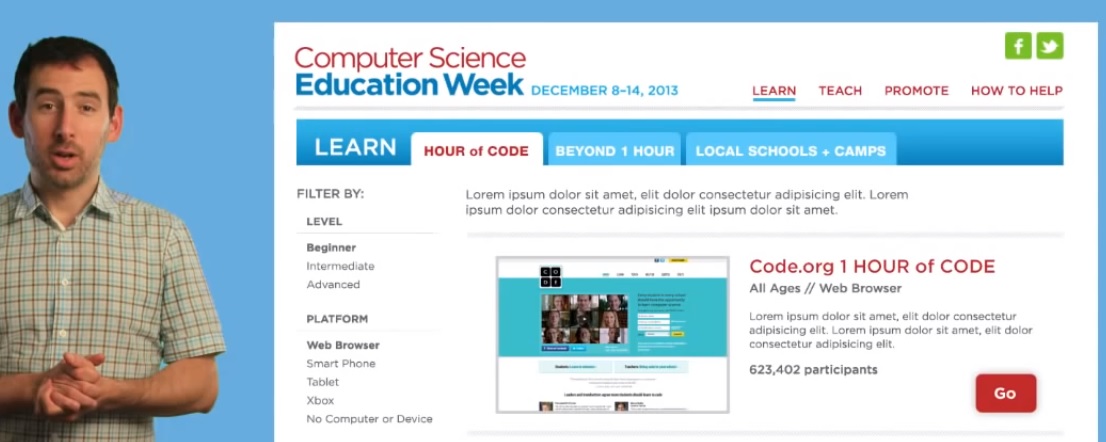
theodp writes "In a move straight out of Healthcare.gov's playbook, teachers won't get to preview the final lessons they're being asked to roll out to 10 million U.S. students until a week before the Dec. 9th launch of the Hour of Code nation-wide learn-to-code initiative, according to a video explaining the project, which is backed by the nation's tech giants, including Facebook, Microsoft, Apple, Google, and Amazon. The Hour of Code tutorial page showcased to the press sports Lorem Ipsum pseudo-Latin text instead of real content, promised tutorial software is still being developed by Microsoft and Google, and celebrity tutorials by Bill Gates and Mark Zuckerberg are still a work-in-progress. With their vast resources and deep pockets, the companies involved can still probably pull something off, but why risk disaster for such a high-stakes effort with a last-minute rush? One possible explanation is that CS Education Week, a heretofore little-recognized event, is coming up soon. Then again, tech immigration reform is back on the front burner, an initiative that's also near-and-dear to many of same players behind Hour of Code, including Microsoft Chief Counsel Brad Smith who, during the Hour of Code kickoff press conference, boasted that Microsoft's more-high-tech-visas-for-U.S.-kids-computer-science-education deal found its way into the Senate Immigration Bill, but minutes later joined his fellow FWD.us panelists to dismiss a questioner's suggestion that Hour of Code might somehow be part of a larger self-serving tech industry interest." -
Somebody Stole 7 Milliseconds From the Federal Reserve
An anonymous reader writes "Three to seven milliseconds before the fed moved interest rates, billions of dollars of trades were input that took advantage of the changed rates, reaping huge profits. According to a report at Mother Jones, 'Last Wednesday, the Fed announced that it would not be tapering its bond buying program. This news was released at precisely 2 pm in Washington 'as measured by the national atomic clock.' It takes 7 milliseconds for this information to get to Chicago. However, several huge orders that were based on the Fed's decision were placed on Chicago exchanges 2-3 milliseconds after 2 pm. How did this happen?'" -
Apple Launches iPhone Trade-In Program
An anonymous reader writes "Today Apple announced the launch of a trade-in program for iPhones. Users will be able to send in their older devices and get credit toward new ones. The announcement precedes an event on Sept. 10th at which Apple is expected to announce a new iPhone model. The trade-in program is being managed by a company named Brightstar, with whom trade-in value maxes out at $336 for a 16GB iPhone 5. The 16GB iPhone 4S, 4, and 3GS max out at $221, $151, and $52, respectively. (The value drops depending on the device's condition, of course.) 'With its new program, Apple steps into a crowded field of competing programs offered by companies such as Gazelle, Best Buy, GameStop, Amazon and others, all of whom accept older iPhones for money. The broader market for used smartphones has been estimated to bring in as much as $5 billion in sales by 2015. With Apple participating as well, more smartphone users may opt for the trade-in option, and could potentially send that estimate even higher. Running its own program would give Apple a way to drive more iPhone sales within its own stores rather than seeing sales from carrier partners, and drive more traffic through its retail stores as well.'" -
NSA Still Funded To Spy On US Phone Records
Reader turp182 notes that the Amash Amendment (#100) to HR 2397 (DOD appropriations bill) failed to pass the House of Representatives, meaning it will not be added to the appropriations bill. turp182 writes "The amendment would have specifically defunded the bulk collection of American phone records." Americans can see how their representatives voted here. -
Maneuvering Continues For Control of Dell
An anonymous reader writes "Just as Carl Icahn's months-long, high-profile bid for control of Dell seemed to have run its course, came the announcement that Dell's board had postponed a shareholder's vote on the bid from Michael Dell and investment firm Silver Lake Partners, to take private the company that Dell had started in a University of Texas dorm room twenty nine years ago. The postponement indicated that Dell was not confident that their $24.4 billion ($13.65 per share) deal had the necessary votes. Icahn and his main ally, Southeastern Asset Management, claim that the proposed deal undervalues the company and its upside potential; Icahn's latest proposal is to keep the company public, but to offer $14 per share plus upside warrants, for every share tendered by stockholders. The latest wrinkle is apparent tension within the Dell/Silver Lake team; Silver Lake reportedly feels entitled to the $450 million buyout fee specified in the deal's language, if any alternative bid from Icahn succeeds within a year; Dell and the board feel that Silver Lake would only be entitled to expenses in that case, perhaps amounting to a few tens of millions USD. The Bloomberg story also reports that Michael Dell has at times been unable to reach his Silver Lake counterpart (a longtime friend) on the phone to discuss possibly sweetening the bid." -
Google Glass Banned At Google Shareholder Meeting
larry bagina writes "You can't make this stuff up — 'Cameras, recording devices, and other electronic devices, such as smart phones, will not be permitted at the [2013 annual shareholder] meeting.' Maybe it runs afoul of their rules on sexually explicit material?" -
TSA Finishes Removing "Virtual Nude" X-Ray Devices From US Airports
dsinc writes "The Transportation Security Administration announced it has finished removing from all airports the X-ray technology that produced graphic and controversial images of passengers passing through security screening checkpoints. The machines, which the TSA first deployed in 2008, provoked public outrage as the technology, better able than traditional X-rays to detect hidden contraband, also created images that appeared as if they were 'virtual nudes.' Critics called this an invasion of privacy and questioned whether the scanning devices truly lacked the ability to save the images, as the TSA claimed." -
Tweet From Hacked AP Account Causes High Freq. Traders To Drop DOW 150 Points
New submitter Mike Lape writes "Stocks plunged and recovered within minutes after the hacked AP Twitter account sent out a tweet that indicated that the White House had been the victim of an explosion and that President Obama had been injured. '...the Dow Jones Industrial Average took a quick 143-point plunge, before recovering most of its losses within minutes. The three-minute plunge triggered by the tweet briefly wiped out $136.5 billion of the S&P 500 index's value, according to Reuters data. Interestingly, Tuesday has been the best day of the week for the blue-chip this year with an average return of 0.46 percent. If the index closes in the black today, it will have been up for the 15th consecutive Tuesday. The last time the Dow rose for 15 straight Tuesdays was in 1927.' An analyst said, 'That goes to show you how algorithms read headlines and create these automatic orders – you don't even have time to react as a human being.'" -
Tweet From Hacked AP Account Causes High Freq. Traders To Drop DOW 150 Points
New submitter Mike Lape writes "Stocks plunged and recovered within minutes after the hacked AP Twitter account sent out a tweet that indicated that the White House had been the victim of an explosion and that President Obama had been injured. '...the Dow Jones Industrial Average took a quick 143-point plunge, before recovering most of its losses within minutes. The three-minute plunge triggered by the tweet briefly wiped out $136.5 billion of the S&P 500 index's value, according to Reuters data. Interestingly, Tuesday has been the best day of the week for the blue-chip this year with an average return of 0.46 percent. If the index closes in the black today, it will have been up for the 15th consecutive Tuesday. The last time the Dow rose for 15 straight Tuesdays was in 1927.' An analyst said, 'That goes to show you how algorithms read headlines and create these automatic orders – you don't even have time to react as a human being.'" -
Tesla Motors Battles the New York Times
redletterdave writes "Days after the New York Times released a brutal review of Tesla's electric Model S sedan, Tesla CEO Elon Musk has fired back, claiming the Times article was completely bogus and misleading. In the article in question, Times writer John Broder took the Tesla Model S on a test drive from Washington to Boston, stopping at various service plazas in Delaware and Connecticut well within the projected 265-mile range of the car, as rated by the EPA. However, Broder's Tesla Model S, despite a heftier 85 kilowatt-hour battery for an extra 100 miles of range in 'ideal conditions,' died shortly before reaching its final destination. Broder blames the cold weather and heating issues for his abridged trip; Musk, however, claims the driver did not follow Tesla's instructions, which is why his trip was cut so short. 'We've taken great pains to ensure that the car works very well in the cold, which is why we're so incensed by this ridiculous article,' Musk said." -
Microsoft May Invest $1B-$3B In Dell Buyout
alexander_686 writes "We heard that Dell is in buyout talks with private equity firms. Now, the word is that Microsoft may invest one to three billion dollars in that buyout. For that amount of money, Microsoft isn't going for majority ownership, but it would be a significant stake. Dell is worth around $22-25 billion. Speculation is that investors would put up $5-7 billion in equity, borrowing the rest. As a point of reference, Michael Dell's stock is worth $3.6 billion." -
How Do YOU Establish a Secure Computing Environment?
sneakyimp writes "We've seen increasingly creative ways for bad guys to compromise your system like infected pen drives, computers preloaded with malware, mobile phone apps with malware, and a $300 app that can sniff out your encryption keys. On top of these obvious risks, there are lingering questions about the integrity of common operating systems and cloud computing services. Do Windows, OSX, and Linux have security holes? Does Windows supply a backdoor for the U.S. or other governments? Should you really trust your Linux multiverse repository? Do Google and Apple data mine your private mobile phone data for private information? Does Ubuntu's sharing of my data with Amazon compromise my privacy? Can the U.S. Government seize your cloud data without a warrant? Can McAfee or Kaspersky really be trusted? Naturally, the question arises of how to establish and maintain an ironclad workstation or laptop for the purpose of handling sensitive information or doing security research. DARPA has approached the problem by awarding a $21.4M contract to Invincea to create a secure version of Android. What should we do if we don't have $21.4M USD? Is it safe to buy a PC from any manufacturer? Is it even safe to buy individual computer components and assemble one's own machine? Or might the motherboard firmware be compromised? What steps can one take to ensure a truly secure computing environment? Is this even possible? Can anyone recommend a through checklist or suggest best practices?" -
City of Heroes Reaches Sunset, NCsoft Paying the Price
KingSkippus writes "At midnight Pacific on Saturday, December 1, NCsoft shut down the City of Heroes servers for the final time. Since announcing the closure, a group of players has been working hard to revive the game by getting attention from the gaming press, recognition from celebrities such as Sean Astin, Neil Gaiman, and Felicia Day, and assistance from fantasy author Mercedes Lackey. Meanwhile, NCsoft has been drawing negative publicity, including a scathing article about the shutdown from local news site The Korea Times, noting that the game was earning $2.76 million per quarter and that 'it is hard to comprehend what NCsoft means when they say they closed it for strategic reasons.' NCsoft's stock price has fallen over 43% since the announcement in August, almost 30% below its previous 52-week low, right when investors were counting on the success of the recently launched Guild Wars 2 to help boost the company."