Slashdot Mirror
Domain: cornell.edu
Stories and comments across the archive that link to cornell.edu.
Comments · 7,647
-
Re:Because of Steven Mnuchin
It's not that weak. The law in question is 26 USC 6103(f) and it's pretty straightforward. In short, the chairs of three committees can request, and the Secretary of the Treasury "shall furnish such committee with any return or return information specified in such request." Returns with identifying information have to be reviewed in closed session unless the taxpayer agrees in writing otherwise. While the Chair of the House Ways and Means Committee provided a reason, there's nothing in the law stating that he had to.
The challenge the White House is bringing is one of separation of powers. They're fully aware that Chairman Neal can, under the Constitution, put the entire set of returns into the record and face no discipline other than whatever the House may choose to bring on him, which won't be much, if anything, under the current majority. It's an interesting approach, but I'm not sure it has the teeth necessary to get the courts (ultimately SCOTUS) to block the transfer. They may punt and not block the transfer but not force it, calling it a political question they're not willing to wade into. They may agree with the White House in part and say that Trump's returns while president must be turned over (since the stated reason is understanding how the IRS audits sitting presidents) but those previous are protected. They may go with the letter of the law and order the transfer. I expect a 5-4 decision with either Roberts or Cavanaugh (he's turning out to be less predictable than expected) casting the deciding vote if it goes against the president in some fashion.
-
Is it still a cavity?
If it's caused by the immune system is it still a cavity, or is it tooth resorption?
-
This a violation of US law
https://www.law.cornell.edu/us...
This is already illegal, in the US. I wonder where this company is based and we can just charge, and try in absence their executives.
-
Re: Don't believe it for a second
It does look a bit odd that after that, once the U.S. decides it wants to 'talk with him', suddenly the dead accusation comes back to life and requires extradition.
The court document were filed in secret March 6th 2018 and unsealed on the same day of the arrest according to the press release from the DOJ which also has a link to the seven page charge sheet at the end of the release (which doesn't allow a direct link).
Accordingly Assange has been charged:
18 U.S. Code 371. Conspiracy to commit offense or to defraud United States
18 U.S. Code 1030. Fraud and related activity in connection with computers sections (a)(1), (a)(2), (c)(2)(B)(ii).
Maximum penalty 5 years jail so I would suspect that they will press further charges later.
-
Re: Don't believe it for a second
It does look a bit odd that after that, once the U.S. decides it wants to 'talk with him', suddenly the dead accusation comes back to life and requires extradition.
The court document were filed in secret March 6th 2018 and unsealed on the same day of the arrest according to the press release from the DOJ which also has a link to the seven page charge sheet at the end of the release (which doesn't allow a direct link).
Accordingly Assange has been charged:
18 U.S. Code 371. Conspiracy to commit offense or to defraud United States
18 U.S. Code 1030. Fraud and related activity in connection with computers sections (a)(1), (a)(2), (c)(2)(B)(ii).
Maximum penalty 5 years jail so I would suspect that they will press further charges later.
-
Re:I hope they just let him go
The usual boilerplate about "innocent until proven guilty" is in there, of course, but also the maximum sentence they are pushing for, which seems like a rather light five years before any time off for good behaviour and other considerations.
Except the section they're possibly using is this and has varying degrees of potential maximum punishment from a fine to five years to a maximum of any number of years to life depending on the severity of the intentions of the parties involved. Specifically, "(F) if the offender attempts to cause or knowingly or recklessly causes death from conduct in violation of subsection (a)(5)(A), a fine under this title, imprisonment for any term of years or for life, or both;" seems to be the scope of discussion when it comes to divulging military secrets.
That's not to say they won't add extra charges (or arrange an "accident", if that's your view) between now and any potential trial, but that's still considerably less than I would have expected as a starting point given all the FUD from Assange and his supporters,
If you want to extradite someone to the US to face a death sentence, you low ball the offense to whatever minimal that still would clearly warrant extradition. Yes, this could hurt further extraditions because it's clearly false representation, but I totally see the US not only doing it but the UK courts generally being okay with it given if the reverse were true the UK would definitely want to be able to extradite a US person divulging UK military secrets. Seriously, given all the talk up to this point about how the US couldn't and wouldn't attempt extradition and this is all about bail of the case in Sweden and how it was all paranoia trying to avoid rape charges, how is this not an example of the shoe dropping? I await for the other shoe to drop.
-
Re:I hope they just let him go
Manning & Snowden were both charged under the Espionage Act.
You also mis-inderstand the signing bit. That's not a requirement for legal jeopardy, it just makes any transgression unequivocally "knowing" should prosecutors need to make such a case in the future.
-
Re:Oh, good Lord...
No.
Section 230 of the Communications Decency Act of 1996 (47 U.S.C. 230(c)) states:
(c) Protection for “Good Samaritan” blocking and screening of offensive material
(1) Treatment of publisher or speaker:
No provider or user of an interactive computer service shall be treated as the publisher or speaker of any information provided by another information content provider.
(2) Civil liability:
No provider or user of an interactive computer service shall be held liable on account of —
(A) any action voluntarily taken in good faith to restrict access to or availability of material that the provider or user considers to be obscene, lewd, lascivious, filthy, excessively violent, harassing, or otherwise objectionable, whether or not such material is constitutionally protected; or
(B) any action taken to enable or make available to information content providers or others the technical means to restrict access to material described in paragraph (1).
There is no exception to subsection 2 a because you think they are a "public square" -they are defined by law as a platform.
The EFF has an analysis and explanation of the law as well.
-
Re: Censorship isn't a violation of 1st Amendment
The law is clear.
Section 230 of the Communications Decency Act of 1996 (47 U.S.C. 230(c)) states:
(c) Protection for “Good Samaritan” blocking and screening of offensive material
(1) Treatment of publisher or speaker:
No provider or user of an interactive computer service shall be treated as the publisher or speaker of any information provided by another information content provider.
(2) Civil liability:
No provider or user of an interactive computer service shall be held liable on account of —
(A) any action voluntarily taken in good faith to restrict access to or availability of material that the provider or user considers to be obscene, lewd, lascivious, filthy, excessively violent, harassing, or otherwise objectionable, whether or not such material is constitutionally protected; or
(B) any action taken to enable or make available to information content providers or others the technical means to restrict access to material described in paragraph (1).
1. They are not liable for what you post.
2. They can censor you if they want to.
-
Interesting point. A word for that
Interesting point.
You said "If Walmart, etc., was only speaking by saying how great something was". I think there is a word for that. "Speaking on television about how great the product is" is normally called "advertising".
There have been several cases pitting Sherman anti-trust vs the First Amendment, where established media players colluded to keep new companies out.
Justice Black wrote:
"It would be strange indeed, however, if the grave concern for freedom of the press which prompted adoption of the First Amendment should be read as a command that the government was without power to protect that freedom. The First Amendment, far from providing an argument against application of the Sherman Act, here provides powerful reasons to the contrary. That Amendment rests on the assumption that the widest possible dissemination of information from diverse and antagonistic sources is essential to the welfare of the public, that a free press is a condition of a free society. Surely a command that the government itself shall not impede the free flow of ideas does not afford non-governmental combinations a refuge if they impose restraints upon that constitutionally guaranteed freedom. Freedom to publish means freedom for all and not for some. Freedom to publish is guaranteed by the Constitution, but freedom to combine to keep others from publishing is not.â
-
Re:How can this be anti-trust?
It seems like award shows should be free to chose whatever they like as criteria to base awards on - just as the public can feel free to ignore award shows that choose to slide into irrelevancy... not justice department needed I should say.
It can be because the Sherman Antitrust Act says:
Every contract, combination in the form of trust or otherwise, or conspiracy, in restraint of trade or commerce among the several States, or with foreign nations, is declared to be illegal. Every person who shall make any contract or engage in any combination or conspiracy hereby declared to be illegal shall be deemed guilty of a felony, and, on conviction thereof, shall be punished by fine not exceeding $100,000,000 if a corporation, or, if any other person, $1,000,000, or by imprisonment not exceeding 10 years, or by both said punishments, in the discretion of the court.
This award show is run via written and oral agreements -- i.e., contracts -- amongst members who are competitors and effectively operates as a trade organization. The Sherman Act does not include an "award show" exception, and I see no need for a snap amateur opinion on whether the Justice Department is needed in lieu of a professional opinion by persons qualified to practice antitrust law, i.e., the DOJ antitrust division.
-
Re:Fiduciary duties
-
Re:Right to repair != easy to repair
I don't think technological progress should be slowed down by right to repair laws.
I don't think technological progress should be slowed down by prohibition to repair laws.
-
Re:Jesus they're getting as desperate
Sorry, you can not illegally download. By law, the uploader, is claiming copyright, illegally, you are not responsible for their actions as a downloader
The first exclusive right given to copyright holders is reproduction, not distribution. Recording TV and radio broadcasts is fair use, but downloading illegally uploaded files is not. Though they have to prove you actually saved it and not simply streamed it, it is not illegal to watch.
-
Re:FUD
The second amendment does not permit you to carry gun to defend yourself from violent crime.
DC v. Heller explicitly states that carrying a firearm for self-defense is a purpose of the 2nd Amendment; the Supreme Court held that 1. The Second Amendment protects an individual right to possess a firearm unconnected with service in a militia, and to use that arm for traditionally lawful purposes, such as self-defense within the home. Pp. 2–53.
-
Re:Why is this place against sovereignty?
WTF?
Ninth Amendment: The enumeration in the Constitution, of certain rights, shall not be construed to deny or disparage others retained by the people.
The Ninth is all about rights; the 10th explicitly reserves any powers not enumerated in the Constitution for the States and the People - NOT the Federal Government. It says nothing about the preceding 9 rights... Once again, you are proving that most ACs are idiots.
-
Re:Colorspace?
This is complete bollocks.
(A) No person shall circumvent a technological measure that effectively controls access to a work protected under this title. (...)
At least bother to read relevant material before you go off correcting others.
https://www.law.cornell.edu/us... -
Re:quotemining? You fail.
There is no copyright protection in place for personal use of a copyrighted work
Read it again. The DMCA access control mechanism language is not about enforcing copyright, it's about preventing copying and controlling access.
And yes, copyright protection is in place for personal use of a copyrighted work, it's just normally fair use is available as legal protection for those who violate copyright in those instances. But regardless, this isn't about copyright, it's about access controls.
That law also specifically allows the parent poster. You just cut out the bit that fits. Quote mined.
Liar. Quote it. You can't.
Here, I'll help you. Show how my summary was in any way inaccurate.
You won't be able to because you're making shit up. The OP at least is merely repeating some commonly believed bullshit, but you're actually accusing me of quotemining, which is something you've not heard anywhere else.
-
What law?
Unlike the EU, the right of the accused to know the exact nature and cause of the accusation against them is enshrined in the U.S. Constitution. The EU never told Google what they thought Google was doing wrong. Just that it was "anti-competitive." The way the EU handles these cases is they inform Google that they're facing an anti-trust judgement, but never state exactly what the problem behavior is. Google had to come up with a proposed solution, present it to the EU, and the EU rejected it without explaining why. Google then had to come up with a different proposal, present it to the EU, and the EU rejected that. Repeat until the deadline passed.
Don't misunderstand me Google probably did need to be taken down a peg or two. And this is the same crappy way Google treats people with their YouTube demonitization and account revocation. They'll punish you without ever explaining why you're being punished, pointing you to their generic list of suggested guidelines without bothering to explain which one you ran afoul of. But it's wrong when Google does it, and it's wrong when the EU does it. If you think someone or some company did something wrong, you need to tell them exactly what they did wrong so they can correct that behavior. You don't just say "you're wrong" and punish them. -
Re:How Were The Real Victims
This isn't a civil offense in the US. I am not a lawyer, but I suspect the following applies: 18 U.S. Code 1030(a)(5)(A) and 18 U.S. Code 1030(a)(6)(A): https://www.law.cornell.edu/us...
-
Re:I guess the incredibly obvious question is...
I think you're mixing up fly-by-wire with the previous technology. Fly by wire is what we have: the pilot tells the computer what they want to happen (through the controls) and the computer tells the control surfaces what to do. I have to say that I don't like the idea of a FBW system without a manual reversion mode. Software is just too difficult to get right. The manufacturers are worrying about a bunch of stuff, safety is one of them, but economics is what sells airplanes so there are tradeoffs Airbus and Boeing make that you and I might not agree with.
BTW, split flaps: https://www.law.cornell.edu/cf...
As for training for the impossible... it comes down to pragmatism. Yes, the "impossible" can happen, but do you really want to spend time training people for the impossible? If the goal is to reduce the overall accident rate you're much better off spending additional training effort on things that are more likely to happen than the "impossible" ones like United 232... I heard a talk by Al Haynes about that accident and it was very impressive that they got the airplane (mostly) on the ground... but it probably doesn't make sense to train people for that kind of thing - better to improve the mechanical systems to make it even more impossible.
Bell had a terrible crash in 2016 testing their FBW 525 helicopter - they lost the crew. It reinforced my fears about software flying the aircraft (and now, automobiles). It's a tricky thing to get right. Arguably Boeing and Airbus (and Embraer and Bombardier) and probably some of the top organizations in the world for writing reliable code, but obviously even they have a hard time getting it right 100% of the time...
-
Re: Coming soon to the USA
Being an asshole isn't a protected class.
Funny, I can't find the "Doesn't apply to assholes" when I research natural rights or read the First Amendment.
I guess you pulled that out of your asshole, asshole.
Why do "progressives" crave victimhood so damn much? (Oh, I know - because Marxism clings viciously to its facile, shallow, and fossilized 19th-century "Everything comes from the oppressor/oppressed dyanamic" bullshit. Funny how the "oppressors" are always white, Christian, European, and male. Barbaric Muslims murdering gays and forcing cliterectomies on women are "oppressed"...)
-
Providing "sanctuary" is a felony
align themselves with CA for sanctuary cities
Anything "sanctuary" — for people breaking a Federal law — is in itself a Federal crime:
Whoever, knowing that an offense against the United States has been committed, receives, relieves, comforts or assists the offender in order to hinder or prevent his apprehension, trial or punishment, is an accessory after the fact.
Except as otherwise expressly provided by any Act of Congress, an accessory after the fact shall be imprisoned not more than one-half the maximum term of imprisonment or (notwithstanding section 3571) fined not more than one-half the maximum fine prescribed for the punishment of the principal, or both; or if the principal is punishable by life imprisonment or death, the accessory shall be imprisoned not more than 15 years.
Providing sanctuary to illegal immigrants is a crime. Doubting federally-employed scientists is not.
-
Re:Patent == monopoly
No. The purpose of patents is to encourage dissemination of information, to discourage trade secrets, by offering a limited-time legal monopoly in return for full disclosure of the invention.
In other words, . . . to promote the Progress of Science and useful Arts, by securing for limited Times to Authors and Inventors the exclusive Right to their respective Writings and Discoveries -
This is why change needn't be doom and gloom
We have absolutely got to do something about climate change. Most of what we've got to do would also make the world a lot better in sundry other ways.
If we helped the landscape keep multiple stories of vegetation, and worked out ways to scale orchards designed the same way, it would make for great resistance to drought and a stable food supply, and over time, correct for this spike in greenhouse gasses.
Entire horticultural and early agriculture civilizations have been founded not on controlling the landscape's entire harvest, but on enriching it and reaping the surplus. In this way of life, economy and environment are not at all at odds. In fact, they are interdependent. You can look at terra preta and its history in the Amazon basin for an example of a long-term, large-scale win-win scenario. http://news.cornell.edu/storie...
If you want to see what is happening in China, watch this video, "The Lessons of the Loess Plateau": https://www.youtube.com/watch?...
Even if you don't exactly agree with *how* they got it done, the results for the landscape and the prosperity of the people there speak for themselves. Start asking how your local economic and political systems can start to do right by the soil too.
-
Clear 1st amendment violation
Prior restraint much?
-
Re:No standard on testing - wild wild west
You're just waving your hands when you say it isn't direct damages.
If the person isn't suing for contract violations, that doesn't even matter.
https://en.wikipedia.org/wiki/...No sense waving your hand at a $50 damage limit, that's has as much weight as if it wasn't even written down. And irrelevant, since it isn't a contract dispute.
We don't know the details, and you can't rule out that the harm happened but for a wrongful recording.
https://www.law.cornell.edu/we...
See also:
https://www.law.cornell.edu/we...
And:
https://www.law.cornell.edu/we...It seems hard to argue that it wasn't a proximate cause without knowing the (as yet unknown) facts of the case. We don't know even know what facts are in dispute.
-
Re:No standard on testing - wild wild west
You're just waving your hands when you say it isn't direct damages.
If the person isn't suing for contract violations, that doesn't even matter.
https://en.wikipedia.org/wiki/...No sense waving your hand at a $50 damage limit, that's has as much weight as if it wasn't even written down. And irrelevant, since it isn't a contract dispute.
We don't know the details, and you can't rule out that the harm happened but for a wrongful recording.
https://www.law.cornell.edu/we...
See also:
https://www.law.cornell.edu/we...
And:
https://www.law.cornell.edu/we...It seems hard to argue that it wasn't a proximate cause without knowing the (as yet unknown) facts of the case. We don't know even know what facts are in dispute.
-
Re:No standard on testing - wild wild west
You're just waving your hands when you say it isn't direct damages.
If the person isn't suing for contract violations, that doesn't even matter.
https://en.wikipedia.org/wiki/...No sense waving your hand at a $50 damage limit, that's has as much weight as if it wasn't even written down. And irrelevant, since it isn't a contract dispute.
We don't know the details, and you can't rule out that the harm happened but for a wrongful recording.
https://www.law.cornell.edu/we...
See also:
https://www.law.cornell.edu/we...
And:
https://www.law.cornell.edu/we...It seems hard to argue that it wasn't a proximate cause without knowing the (as yet unknown) facts of the case. We don't know even know what facts are in dispute.
-
Re:Thanks for the ...
That falls under 17 U.S. Code 1201 - Circumvention of copyright protection systems. Notice the jurisdiction.
-
Re:Stocks
No, the legal definition of gambling specifically excludes any activity governed by the securities laws (as that term is defined in section 3(a)(47) of the Securities Exchange Act of 1934[1] for the purchase or sale of securities (as that term is defined in section 3(a)(10) of that Act); or any over-the-counter derivative instrument; as well as insurance contracts
-
Re: yawn
It is when that 10% is more than 500 people. This layoff meets the legal definition of a mass layoff, and has specific actions the company must take related to the mass layoff.
-
Re:yawn
SpaceX is not hugely successful though. They just failed their capital raise and are in pretty bad shape. Companies experiencing growth do not have mass layoffs.
10% is a mass layoff?
Yes, it is. This meets the legal requirement to be deemed a mass layoff. More than 500 people is a mass layoff, and brings with it specific legal requirements for the company - which includes announcing said mass layoff publicly, and at least 60 days prior to the layoff.
-
Re:TSA will quit.
Airports aren't mandated to use TSA. Some airports (San Francisco International for example) have private organizations performing the passenger screening.
Only under TSA supervision. https://www.law.cornell.edu/us...
-
Re:Title
You talking about something in here? I'm not finding it.
-
Re:so $500 refund - 25K legal fees = big loss for
so $500 refund - 25K legal fees = big loss for him
He'll probably get legal fees back plus punitive damages.
They were involved in attempting to deprive him of first amendment free speech rights under color of statute, A violation of 42 U.S. Code 1983 - Civil action for deprivation of rights -
Every person who, under color of any statute, ordinance, regulation, custom, or usage, of any State or Territory or the District of Columbia, subjects, or causes to be subjected, any citizen of the United States or other person within the jurisdiction thereof to the deprivation of any rights, privileges, or immunities secured by the Constitution and laws, shall be liable to the party injured in an action at law, suit in equity, or other proper proceeding for redressCivil Rights Attorney's Fees Awards Act of 1976 provides attorney's fees for:
"any action or proceeding to enforce a provision of sections 1981, 1981a, 1982, 1983, 1985, and 1986 of this title, title IX of Public Law 92–318 [20 U.S.C. 1681 et seq.], the Religious Freedom Restoration Act of 1993 [42 U.S.C. 2000bb et seq.], the Religious Land Use and Institutionalized Persons Act of 2000 [42 U.S.C. 2000cc et seq.], title VI of the Civil Rights Act of 1964 [42 U.S.C. 2000d et seq.], or section 12361 of title 34" -
Re:Other interesting statistics
They can examine that phrase all they like; it doesn't have any bearing whatsoever on the actual restriction placed on the government, which is simply that "the right of the people to keep and bear Arms, shall not be infringed".
Even if it were restricted to the Militia, that wouldn't do much: the Militia includes every able-bodied male citizen between 17 and 45 years of age, plus females who are members of the National Guard. Trying to restrict firearm ownership to the Militia is basically equivalent to barring older male citizens and all females who are not in the Guard from owning weapons. I'm sure that would go over real well...
That is your interpretation, and other people have other interpretations... hence my point it comes down to the interpretation of whoever is in the supreme court. Many people would interpret the law as meaning, that whereas they intended to allow guns, they also intended the use of them to be regulated and not just for lone-wolf ownership and application.
-
Re:Other interesting statistics
I think gun-control proponents are more likely to get their way by examining the phrase "A well regulated Militia".
They can examine that phrase all they like; it doesn't have any bearing whatsoever on the actual restriction placed on the government, which is simply that "the right of the people to keep and bear Arms, shall not be infringed".
Even if it were restricted to the Militia, that wouldn't do much: the Militia includes every able-bodied male citizen between 17 and 45 years of age, plus females who are members of the National Guard. Trying to restrict firearm ownership to the Militia is basically equivalent to barring older male citizens and all females who are not in the Guard from owning weapons. I'm sure that would go over real well...
-
Re:Whatever
Where does this end exactly ?
If it can be proven that a company willingly gives service to banned terrorist organizations such as the Palestinians while denying service to, say, people who think God Hates Fags, then it ideally ends with the company's executives meeting a military firing squad and the new executives adopting a policy of content neutrality.
-
Re:You knew it when you bought it.
It's not a monopoly. It's a duopoly.
The Sherman act doesn't care. The question is whether Apple has monopolized, attempted to monopolize or conspired to monopolize any part of trade or commerce.
Case law goes on to define a coercive monopoly as "a firm that is able to raise prices, and make production decisions, without risk of competition arising to draw away their customers." Sounds like Apple? You betcha.
-
Re:Going to succeed
antitrust laws exist to prevent the monopoly abuses of the past, but they affect companies regardless of whether the company is a monopoly
Right. Let's go straight to the source. The Sherman defines "every person who shall monopolize, or attempt to monopolize, or combine or conspire with any other person or persons, to monopolize any part of the trade or commerce among the several States, or with foreign nations" as a criminal needing punishment. In fact, that's almost the entire thing. Very short, very broad. (Of course it's backed up by a huge body of case law.)
Nothing about monopolies there, it's about monopolists and what they do or attempt to do. The usual mob of deniers ought to keep that in mind, instead of wanking on about what is and is not a monopoly.
-
Re:Before everyone goes crazy again...
You might want to take your refresher briefings, then.
The things you describe usually fall into a lot of nice labels like "violations", "infractions", "procedural errors", and the like, but they very rarely end up as "felonies", because the applicable statute is one that includes that high bar of intent, by stipulating that the perpetrator must "knowingly" commit the act.
Indeed, that "felony" label is typically only reserved for someone who's about to be indicted for a lot of other related crimes, and for good reason: The security community has worked hard over the last hundred years or so to develop a culture of forgiving loyalty. Honest mistakes are usually forgiven, and written off with a minor warning, removal of access, or removal of clearance, but usually no attempt to pursue criminal charges or other long-lasting ramifications. The system intentionally errs on the side of caution, preferring to let even the most egregious violations pass rather than risk prosecuting an innocent mistake and creating a potential traitor. In doing so, there's a much greater chance that someone will come forward and report violations, rather than hide in fear that they might be held liable.
I spent a good number of years working in the defense industry, and I've seen plenty (probably a 3-digit number) of "spills", "slips", and "mistakes". I've only seen one person actually be accused of having that criminal level of intent, though... and that was mostly due to him leaving the country immediately after committing several violations. If he ever comes back, I'm sure there will be plenty of interesting discussions including that "felony" label.
Justice is a funny thing, in that the reality usually matters less than the perception. In matters that are necessarily kept secret, there will seldom be satisfaction that justice was actually served. Justice is only assured when there is faith that the judicial process is always applied consistently. That's precisely why I think Mrs. Trump's server should also be subject to a full investigation, with all the same review, and the same fussing over the implications of whatever dozen problems are actually found. I'd expect the same process if a Pentagon official were found to run his own email server, too, or even a lowly base commander in the field. Like it or not, a precedent has been set, and it must now be applied evenly.
That said, I'd also prefer to do without the media circus that surrounded the Clinton investigation. This is now routine. A personal email server was found that might hold sensitive or classified information, so we go through the process. It's not newsworthy, it's not political, and it's not something that should skew public perception. Fix the problems, give a good stern warning to whatever moron approved the idea, and let's get on with running the country, shall we?
-
Re:Before everyone goes crazy again...
Usually, any criminal statutes require knowledge and intent of the crime being committed.
Usually... yes, however the statutes Hillary violated has no mens rea requirement: https://www.law.cornell.edu/us...
So nice of you to try to move the goal posts.
What's next? Screams of "but they weren't classified at the time"?
-
Re:He's not a US citizen...
He's not a US citizen, he owes no fucking allegiance to the US. He has no duty to protect US secrets or to the US government.
52 U.S. Code  30121 is a Federal law that makes it a felony for any foreign national to attempt to influence a U.S. election, and a felony for any U.S. citizen to help them do it.
The DOJ appears to be trying to get Assange for conspiracy with Russians or Americans to influence the 2016 U.S. election. There is public information that Roger Stone, a long-time Trump associate, was in contact with Assange during the campaign, discussing how to handle the stolen DNC emails. Maybe that plays out, maybe it doesn't. In any case we'll know more when Mueller wraps things up.
Uh oh, left wing dilemma here then
Prepare for heads to explode like a 60s sci fi robot caught in a contradiction!
-
Re:He's not a US citizen...
He's not a US citizen, he owes no fucking allegiance to the US. He has no duty to protect US secrets or to the US government.
52 U.S. Code  30121 is a Federal law that makes it a felony for any foreign national to attempt to influence a U.S. election, and a felony for any U.S. citizen to help them do it.
The DOJ appears to be trying to get Assange for conspiracy with Russians or Americans to influence the 2016 U.S. election. There is public information that Roger Stone, a long-time Trump associate, was in contact with Assange during the campaign, discussing how to handle the stolen DNC emails. Maybe that plays out, maybe it doesn't. In any case we'll know more when Mueller wraps things up.
-
Backwards
See for example Campbell v. Acuff-Rose Music, 510 U.S. 569 (1994) regarding transformative fair use. Also many earlier rulings.
http://www.law.cornell.edu/sup...There is a big difference between criticism and parody in fair use law. One can criticize something without copying it. Parody by it's very nature requires the characteristic elements of the work. Therefore, a criticism does not necessarily have a fair reason to copy; a parody does because the parody cannot exist without copying.
-
Re:Executive order to amend the Constitution ?
Did he seriously tell a journalist and the entire world that he would sign an executive order to effectively repel the 14th amendement (sic) of the Constitution of the United States ?
My guess is that he is trying to set up a court case to challenge the previous interpretation of the 14th Amendment. The full text of the citizenship clause reads as follows:
All person born or naturalized in the United States, and subject to the jurisdiction thereof, are citizens of the United States and of the State wherein they reside.
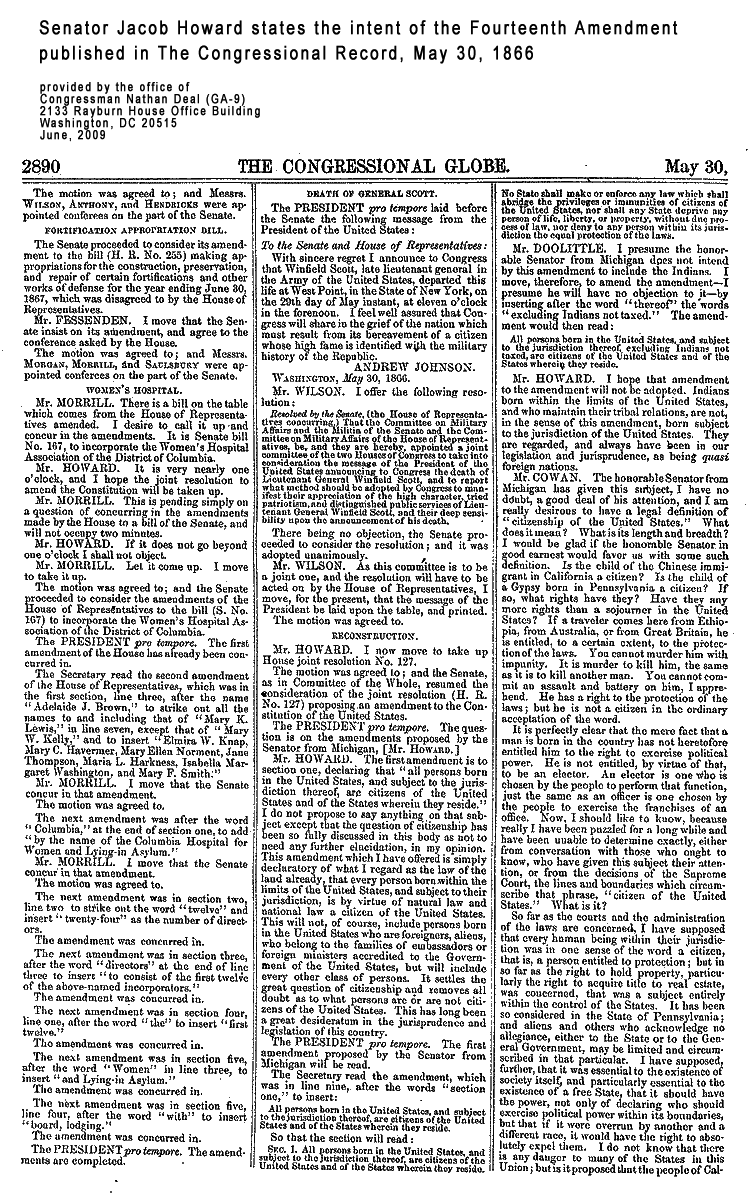
The Dred Scott case ruled that slaves were not citizens of the U.S., but they were still under the jurisdiction of the U.S. So when the 14th amendment was written, this was taken into consideration. The argument Trump could make is that illegal aliens are not under the jurisdiction of the U.S. The author of this clause, Senator Jacob Howard is on the Congressional record, stating
The first amendment is to section one, declaring that all "persons born in the United States and Subject to the jurisdiction thereof, are citizens of the United States and of the States wherein they reside. I do not propose to say anything on that subject except that the question of citizenship has been fully discussed in this body as not to need any further elucidation, in my opinion. This amendment which I have offered is simply declaratory of what I regard as the law of the land already, that every person born within the limits of the United States, and subject to their jurisdiction, is by virtue of natural law and national law a citizen of the United States. This will not, of course, include persons born in the United States who are foreigners, aliens, who belong to the families of ambassadors or foreign ministers accredited to the Government of the United States, but will include every other class of persons. It settles the great question of citizenship and removes all doubt as to what persons are or are not citizens of the United States. This has long been a great desideratum in the jurisprudence and legislation of this country.
So if the court were to use original intent (emphasized above) as opposed to relying on precedence, there's a good chance it could be overturned.
-
Re:So?
Are they a publisher? They they get 100% control of content, and are 100% legally responsible for what they allow.
They're an interactive computer service, and get reasonable control of content on a good faith basis with 0% responsibility for what they allow.
CDA section 230(c):
(c) Protection for âoeGood Samaritanâ blocking and screening of offensive material
(1) Treatment of publisher or speaker
No provider or user of an interactive computer service shall be treated as the publisher or speaker of any information provided by another information content provider.(2) Civil liabilityNo provider or user of an interactive computer service shall be held liable on account of--
(A) any action voluntarily taken in good faith to restrict access to or availability of material that the provider or user considers to be obscene, lewd, lascivious, filthy, excessively violent, harassing, or otherwise objectionable, whether or not such material is constitutionally protected; or
(B) any action taken to enable or make available to information content providers or others the technical means to restrict access to material described in paragraph (1) -
Re:So?
Doesn't actually matter if they're not a government entity. Twitter has testified that they consider themselves the "new public square" for political discussion. They promoted that as well. There's been a whole assload of cases on this whereby a company presents itself as a public square, 1st amendment rules apply.
Pretty sure they've revoked that policy at this point. Just because they promoted that at one time does not mean that they're locked into it for all eternity.
ls down to this: Either the 1st amendment rules apply, in which case they're far more broadly protected and so are people. Or it doesn't, in which case they're not only curating content, but the people allowed to post there. In which case CDA S.230 no longer apply and they become liable for anything posted there.
No. The CDA expressly says otherwise. 48 USC 230(c)(2):
No provider or user of an interactive computer service shall be held liable on account of --
(A) any action voluntarily taken in good faith to restrict access to or availability of material that the provider or user considers to be obscene, lewd, lascivious, filthy, excessively violent, harassing, or otherwise objectionable, whether or not such material is constitutionally protected.The "reasonable" defense section only applies if they allow access but don't actively curate, something they stopped doing a few years ago, when they made the change of how people become verified and in turn stated that they support the views of the people who are verified.
Pure fiction.
-
Re:So?
Yes, they can, but they can't have the safe harbor provision as they show to be checking for every post with a system, so they should be liable for every single copyright infringement on the platform.
Prove it. Show me anything in the CDA or DMCA that conditions the safe harbors upon a lack of "bias" in the material that a service carries.
I'll even give you the links to the relevant CDA and DMCA provisions because you're not going to find them.
-IP/Technology Attorney