Slashdot Mirror
Domain: digibarn.com
Stories and comments across the archive that link to digibarn.com.
Comments · 142
-
This is gonna be interesting.
Here's an example of a TEMPEST-sheilded computer - the TEMPEST-shielded Mac SE/30.
-
Re:Which is the invention
"I actually met him once at a University of Maryland talk during the height of the dot-com era -- have you ever met Douglas Engelbart?"
No.
"As far as I'm aware, his NLS didn't feature windows, drop-down menus, icons, and a desktop representation of a file system -- while arguably less important than the networked hypertext that NLS did have, they were the defining features of the Xerox Star and Mac."
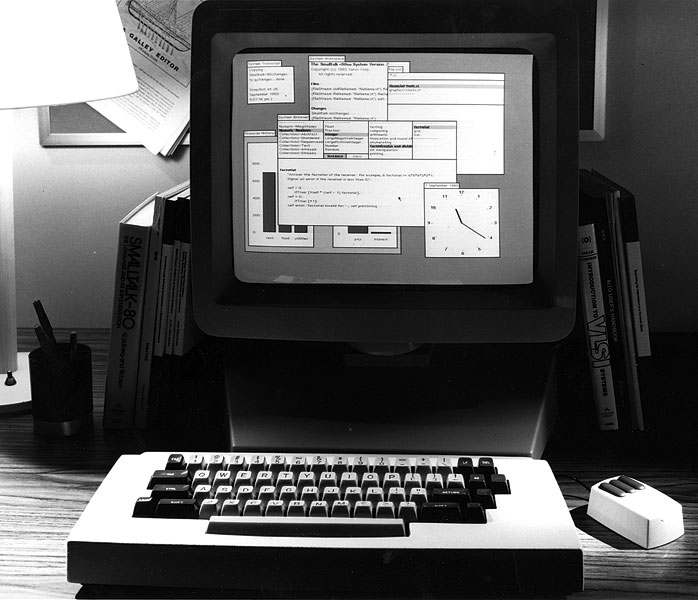
NLS had windows, and it had a sort of icon capability in that graphics could be linked to command sets (and lots of other things) which would be invoked when they were clicked with the mouse (NLS could do things with graphics that few if any of today's systems are capable of). NLS didn't have menus, but then neither the Star: a lot of people think that it had them because they were present in Smalltalk (although Smalltalk's menus were pop-up rather than pull-down), but despite rumours to the contrary, the Star's OS and software weren't written in Smalltalk, so while there were some similarities, there were also a number of notable differences.
There's an excellent article about the Star at: http://www.digibarn.com/friends/curbow/star/retrospect/ -
Re:Next up:Delusion_ wrote:
Next up:
the Lisa II
sorry, already done. The Lisa II (or Lisa 2 or Mac XL) was the follow on to the original Lisa. It replaced the Lisa's dual 5.25-inch "Twiggy" floppies with a single 400KB 3.5-inch floppy and came bundled with a Macintosh emulation program (MacWorks XL: basically Mac ROM code adapted to run on the Lisa hardware). It was released around the same time as the original Mac and cost slightly more, but had a larger display, hard disk drive, expandable memory (up to 2MB) and an internal I/O expansion bus. The processor was slower (6MHz for the Lisa vs. 8MHz for the Macintosh) but there was a custom memory protection/memory management chip that was, unfortunately, never used in Macintosh mode.
What you're looking for is the (dreaded) Lisa -
Re:Woz, Gates or neither of them?Oh I know, but my point is that it's the "came up with" that's important here, not "made popular".
I would argue that both are equally important - without coming up with stuff, you have nothing to make popular, and stuff you come up with and don't make popular is basically worthless. Either way, Apple did a lot of both. Maybe more of the "making popular" than the "coming up with," but they definitely originated a lot of the concepts that we still use to this day.
By all means give credit for what Apple came up with first - but it's hard to know what they did come up with first, because you usually only hear from people who seem to think that Apple created the GUI as a whole (or people who only ever go on about "Apple made it popular").I think if you take a Lisa or an original Mac and subtract everything that is also in the Xerox systems, you get a pretty good idea of what Apple came up with.
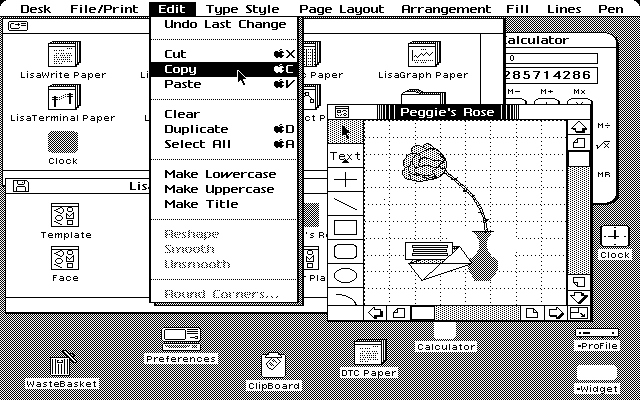
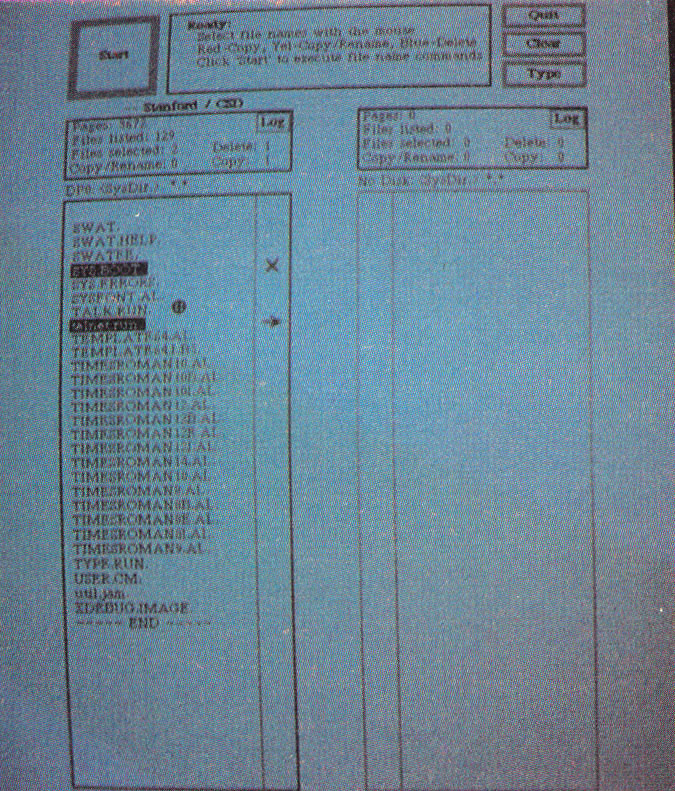
Here's a screenshot of the Alto (if the link doesn't work, googling for images of xerox alto returns a bunch of screenshots). Doesn't look a whole lot like a modern Windows, Mac or Linux system. Here's the Lisa. The parallels to modern systems are very, very obvious.
As I say, other operating systems followed quickly after Apple, each introducing new bits here and there.Sure, everyone contributed, and everyone copied. All I'm saying is that the people who claim that Apple copied Xerox wholesale and added nothing are wrong. Of all the companies involved, Apple probably contributed most of the concepts we use in today's grahical computer user interfaces.
-
Re:Gah.
only 3 Editions?
http://www.digibarn.com/stories/dankottke/Image03.jpg -
ASCII Art pr0n!The Computer Lib/Dream Machines link contains a naked lady rendered in ASCII art! Woo hoo!!!!
Please slashdot, can we have more stories like this?
-
Re:In case you didn't notice
I was pretty curious about the "iPod prototype" as well. I was able to find a little more info, but not enough to satisfy my curiosity. Link to more info
-
Re:Why no link to the actual museum?Because they have a wish list http://www.digibarn.com/help/index.html of *junk they want. My last move, I tossed a lot of old computer stuff like WORM drive, Diablo daisy wheel printer, paper tape reader, teletype, monochrome monitors, Rockwell AIM-65, manuals, old operating systems, and the list goes on.
But I kept my first computer, a Geniac, for no good reason. Ah, the memories when you turn 0100 (octal).
*Junk = the **stuff you throw away.
**Stuff = the *junk you keep.
-
Why no link to the actual museum?
Is it that hard to put a link to the actual museum instead of to page 2 of an article that talks about said museum? Are the mods asleep today?
-
Re:I'm the laughing gnome, - SGI Octane Songs
This reminds me of the ill-fated SGI Octane promotional songs from the mid-to-late 90's.
http://www.digibarn.com/collections/songs/sgi/inde x.html
I'm going to avoid a direct link to the MP3s just to be nice to the host, but here's the first stanza of one of the songs:
"I Have a Dream"
I have a dream
and its two CPUs
What this will mean
Is no more desktop blues
Modeling and rendering
Designing analyzing
Just pick any two
I have a dream
and its two CPUs
As an SGI fan, I got a kick out of these. -
1981
Here you go:
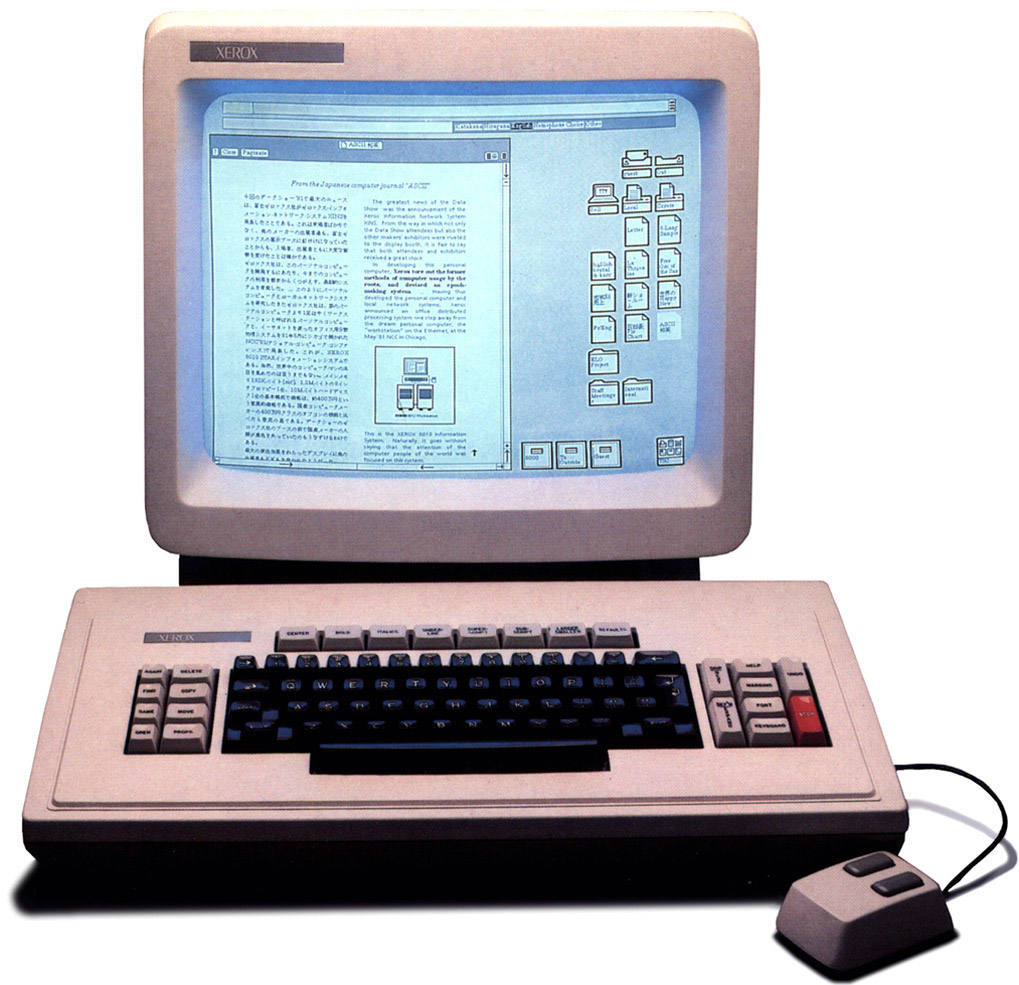
The Xerox Star 8010
Sold in 1981. Features:
Menu-driven, icons, mouse, high-resolution graphics on a 17 inch monitor, built in and external storage devices, Ethernet
Expensive as all hell at $16,595 but impressive.
So yes you could in fact buy one but no it really wasn't a home computer. -
Re:Obsolyte!
Of course, should you have an original Altair in your basement, that's another story entirely.
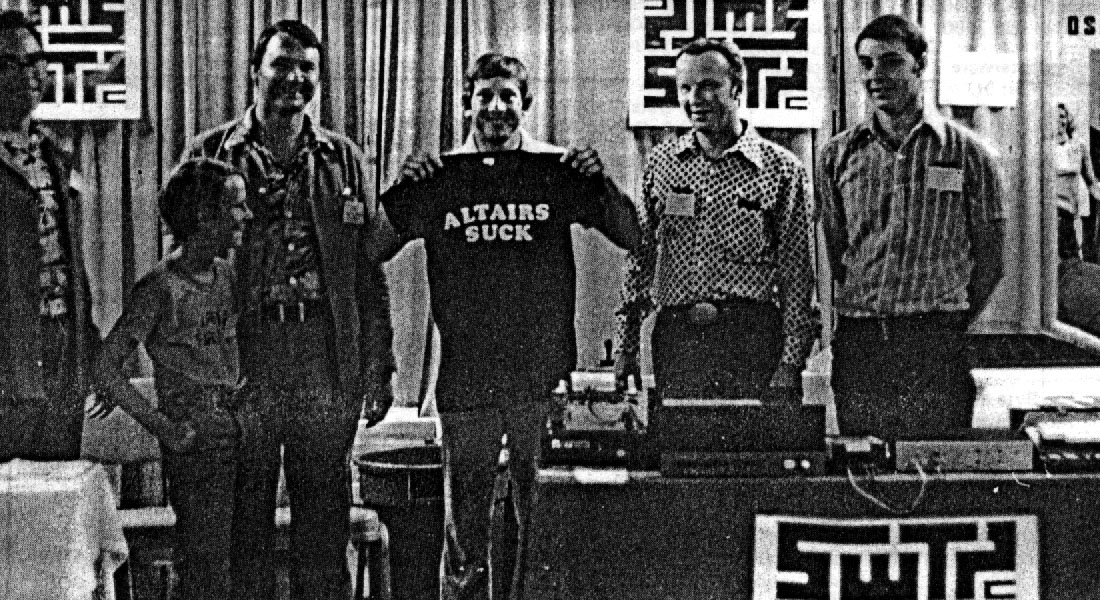
Altairs suck. I have an IMSAI. -
If You Need A Manual . . .
Long ago, in a virtual software galaxy far away, one of the developers involved in the design of the Xerox Star told me, "if you need a manual to figure out how to use a computing environment, it wasn't properly designed."
-
Re:Oh, for Pete's Sake
Apple didn't invent the WIMP interface, the people at Xerox's PARC did.
The PARC folks did WIP, the Mac group added the M after they licensed the tech from Xerox. See here, here, and here. They did have something like a right-click context menu in the videos I've seen, but that's not the M the M in WIMP means. -
Re:Oh, for Pete's Sake
Apple didn't invent the WIMP interface, the people at Xerox's PARC did.
The PARC folks did WIP, the Mac group added the M after they licensed the tech from Xerox. See here, here, and here. They did have something like a right-click context menu in the videos I've seen, but that's not the M the M in WIMP means. -
Re:Oh, for Pete's Sake
Apple didn't invent the WIMP interface, the people at Xerox's PARC did.
The PARC folks did WIP, the Mac group added the M after they licensed the tech from Xerox. See here, here, and here. They did have something like a right-click context menu in the videos I've seen, but that's not the M the M in WIMP means. -
Re:I keep all my old electronics
You do realize that most of the world isn't interested in starting an antique electronics museum. Besides, you're just procrastinating. Someday, someone will want to dump the stuff.
A couple of weeks ago I helped a local antique computer museam put its exhibit in storage for the winter. Even the owner was trying to get rid of some parts; he offered me a 600lb component for a Cray power supply.
-
Re:pfft
Apple made black Apple II's back in the 1970s. I don't think SGI was around then.
-
Re:"word processors"????
Hi! I'm gonna do a do-over of the other guys post, with HTML enabled! My way of recycling.
A lot of history.
Before the PC, was the Wang Word Processor.
The link shows some of the later ones. I remember one, in the Air Force, the size of an old keypunch machine.
Some of us started coding on keypunch. . . then some rich kid brought some fad called an IBM PC into the dorm. 4.77 Mhz. 16 K of RAM. No graphics whatsoever.
We figured it would never last. Guess we were wrong. .
-
Re:*shakes head*
-
Re:The Xerox Alto / Macintosh comparison
Some more Alto screenshots in this document - more of a GUI evident here. http://www.digibarn.com/collections/books/xerox-p
a rc-1970-80/alto-article/index.html -
Your sig (there is):
If only there were a girl that was like this OS [apple.com] in my life..
http://www.digibarn.com/collections/screenshots/S
c reenshots%20Funstuff/apple_weed.jpg -
Re:maybe just a new placement?
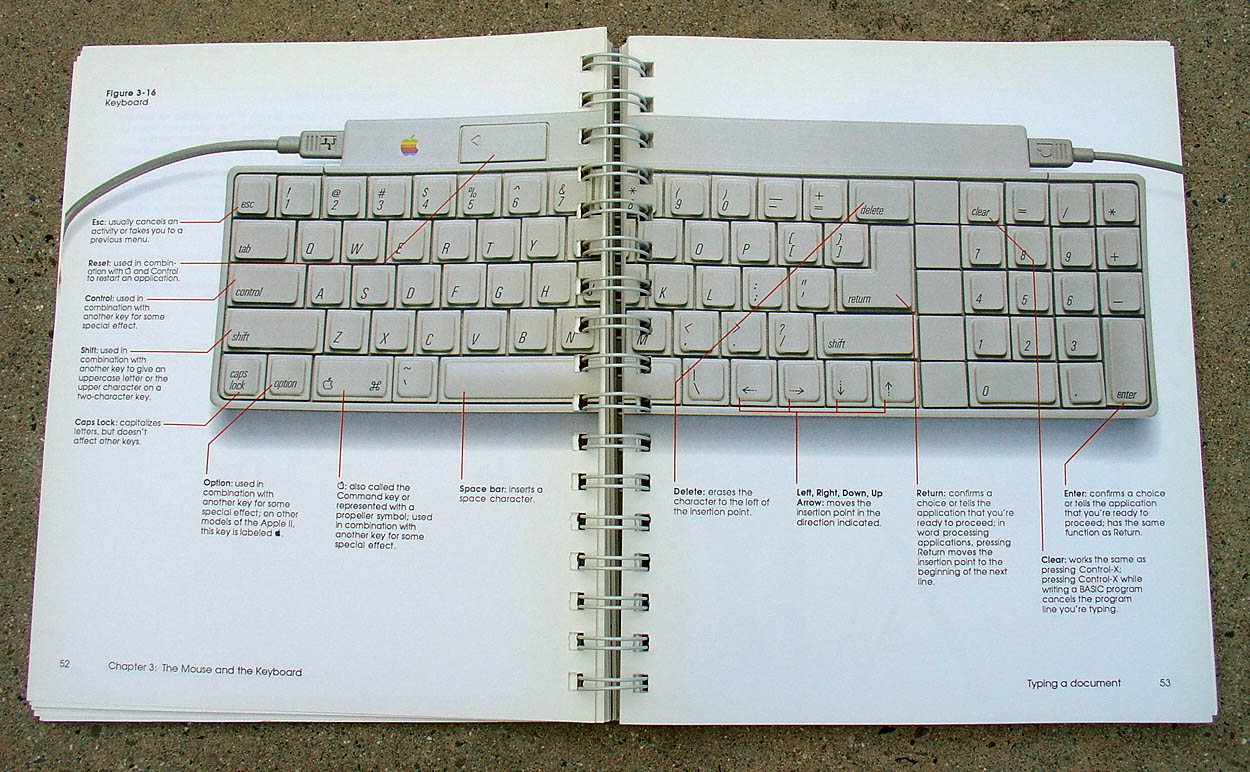
the old Apple IIgs keybard had caps lock & control switched. caps lock ended up being a regular-sized key.
http://www.digibarn.com/collections/systems/appleI Igs-wozedition/appleIIgs-literature/DSC08706.JPG -
MacOS != Xerox Star
The Xerox Alto never made it past the research project stage, as the Information Week article points out, but the Macintosh OS was a pale imitation of the Xerox Star, which was indeed a commercial product -- albeit for large corporations and the federal government, not individual consumers. I can't imagine that anyone who ever used both Star and MacOS could fail to appreciate the superior functionality, sophistication, and attention to detail of the former. Like the original Mac, the Xerox Star was an integral bundle of hardware and software (see http://www.digibarn.com/friends/curbow/star/retro
s pect/ for a concise description), but it was a lot more than a detached box: it was part of an integrated pre-IP distributed computing environment that included a collection of network services (directory, mail, filing, printing) as well as a bundle of seamlessly integrated apps, including what arguably was the finest word processor -- Xerox called it a "document editor" -- ever designed. Admittedly, it wasn't sufficiently successful in the market to survive the onslaught of the WIntel PC and the ineptitude of Xerox's general management. More's the pity: we may have cycles to burn these days (although what Intel and AMD giveth, Microsoft inevitably taketh away), but for fit and finish Star has never been surpassed. -
Some more links and info
Here are some more links.
IBM has an intro piece which leads into a short but interesting set of pages with specifics, genealogy and original press release of the model 5150 and subsequent IBM PC offerings (including the PS/2s).
News.com also has a feature that starts with a Michael Dell interview but frankly it is rather dull.
Much better is the linked previous piece published for the 20th anniversary of the PC.
Digibarn has also a page with a feature and some movies.
They also show the cover of the original brochure for the IBM PC which had a Chaplin lookalike.Unfortunately it's just the cover but I managed to scan the internal pages from my copy and put them on Flickr.
Oh, and... happy birthday, PC! -
30 years?
30 years is a bit long though... Didn't Windows version 1 arrive in 1985?
-
Re:Bob by any other name is still Bob.
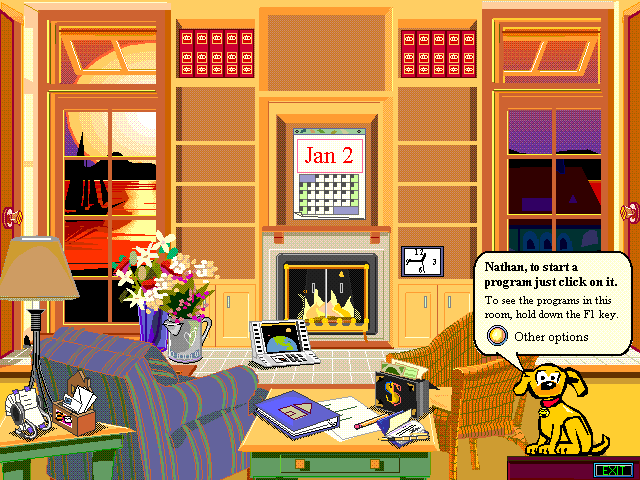
no, bob was an attempt to make a computer interface more room-like:
http://www.digibarn.com/collections/screenshots/MS %20Bob%20v1-00/bobhome1.gif
It sucked for a whole bunch of reasons. The chief problem was an overabundance of agents like clippy who wouldn't leave you the fuck alone. Making the interface more desktop-like was pretty far down on the 'reasons Bob sucked' list. -
Re:I'm rooting for Google
Google seems like a very young Microsoft
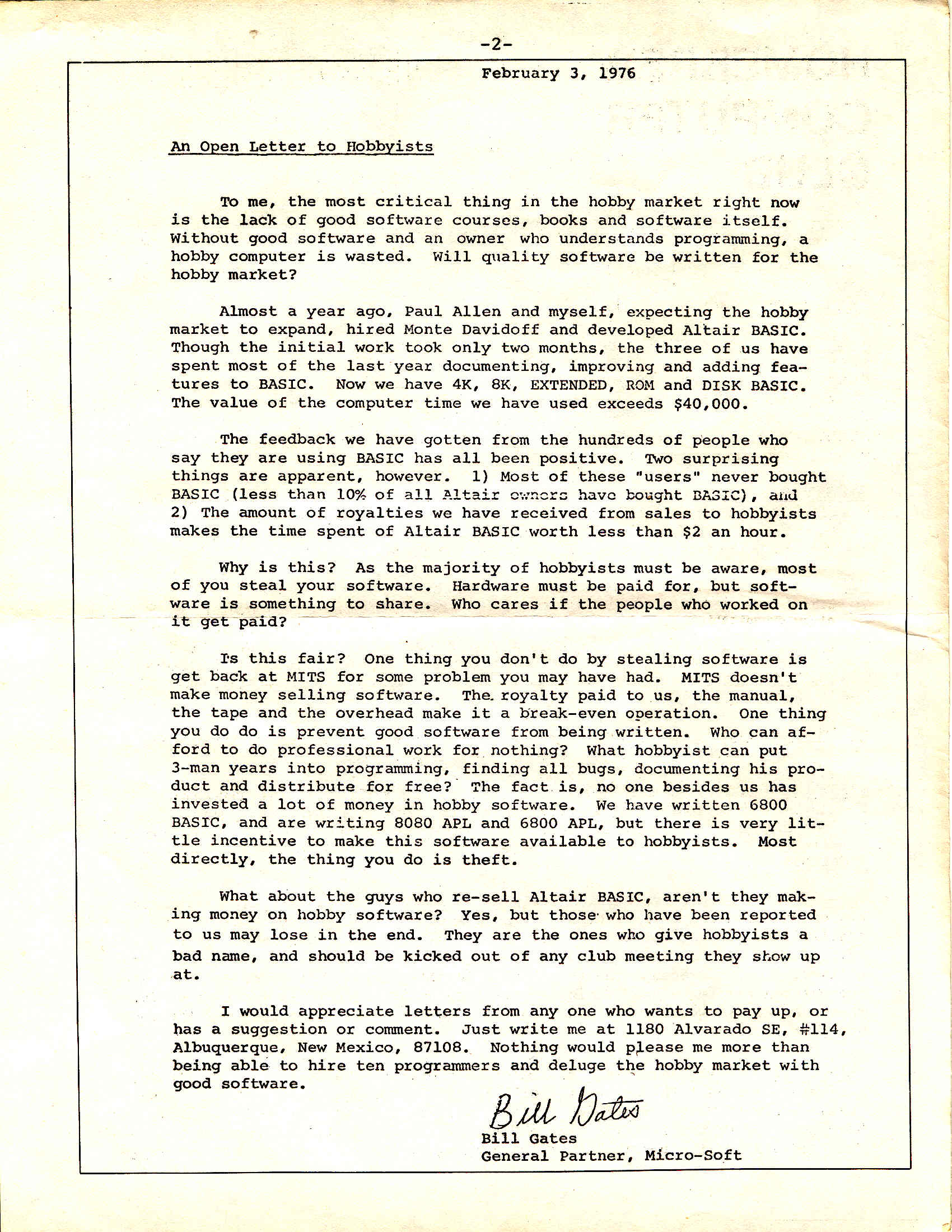
No, a very young Micro-Soft sent cease-and-desist letters (containing typos, mind you, that's professionalism) to college clubs (who thought it was ridiculous to pay the price of a PS3 just for the software to run basic), and claimed that the hobbyist community would never be able to develop their own software, so they must rely on corporations...
Google has donated hundreds of thousands of dollars (if not more) to open source. That's different. -
SolProcessor Technology's Sol, obviously. The first prebuilt personal computer -- yes, before the Apple II. Can't think of many microcomputers more historic than that.
Also, for the love of God, don't put them behind glass. These things were meant to be hacked with.
-
Next up: Wordstar
Yup. Now all we need is Michael Shrayer, the original author of The Electric Pencil, to write a decent wordprocessor / text editor for Wiki and we'll have an online Office replacement with wiki capabilities....
Oh how I love all the recent computing innovation! -
The first Radio Shack home computer
Before the CoCo; before the Trash-80; we had this home computer. You programmed it by wire wrapping, more or less. The keyboard consisted of 10 sliding switches. The monitor was a set of 10 flashlight bulbs. RAM, what's that?
-
Re:Exidy Sorcerer
My mother had a business in the 80s selling these, specifically the Sorcerer II. She gave me one for my birthday when I was in seventh grade. I started with a RF modulator kit I had to install on the motherboard and an external cassette tape recorder, but eventually I got the optional DDS (Disk Display System) with a green monochrome monitor and dual 5 1/4" Micropolis double side drives. I also had the Exidy branded Daisy Wheel printer, the "fast one" 45cps vs 25cps. The system ran CPM, or you could boot off of the cartridges. They had taken 8-Track tapes and replaced the guts with an eprom board with an edge card connector. I had Basic, M$ Word (whatever it was called back then), and even a development cartridge with a hole for the ultraviolet light to erase the eprom. The whole system was made out of blow molded plastic, unlike the sexier Apple II. Unfortunately the system crashed frequently, likely due to lack of cooling. I spent most of my programming effort on Apple II and Commodore Pets in the classroom at Egan Jr High in Los Altos, CA. I recently donated both my Sourcers to http://digibarn.com/ in Boulder Creek, CA.
-
Re:TRS-80 Model I
Same here! When I was in 2nd grade (1982) my dad bought it for me from one of his friends right before we moved to Taiwan. Model I, with expansion board (I have the whole thing in a box still somewhere) and a "stringy floppy" tape drive . I had a regular tape drive also, but the stringy floppy was really neat, even if it did eat half of the tapes.
I then got a clone 808x system (Taiwan was the king of clones back then) and started playing all those cool cga games on my green screen monitor. I remember editing my characters in Ultima III with edlin (don't ask me how, but i did) but then discovering debug and all it's hex editing goodness.
I have been through every processor generation since then, except for the most recent. Haven't felt the need to upgrade for the past couple of years in my old age, lol. -
Re:Right back atcha!
On this page you can see the some early motivation for open source. Another user got annoyed at Gate's comments and decided to write his own, to be freely shared:
http://www.digibarn.com/collections/newsletters/ho mebrew/V2_04/homebrew_V2_04_p9.jpg/ -
Re:Right back atcha!
On this page in the 4th issue you can see someone else coming in with open source style motivation after seeing Bill Gate's letter. Basically he got annoyed and decided to code his own:
http://www.digibarn.com/collections/newsletters/ho mebrew/V2_04/homebrew_V2_04_p9.jpg: -
There was a reply to the letter in the next issue
http://www.digibarn.com/collections/newsletters/h
o mebrew/V2_02/homebrew_V2_02_p2.jpg
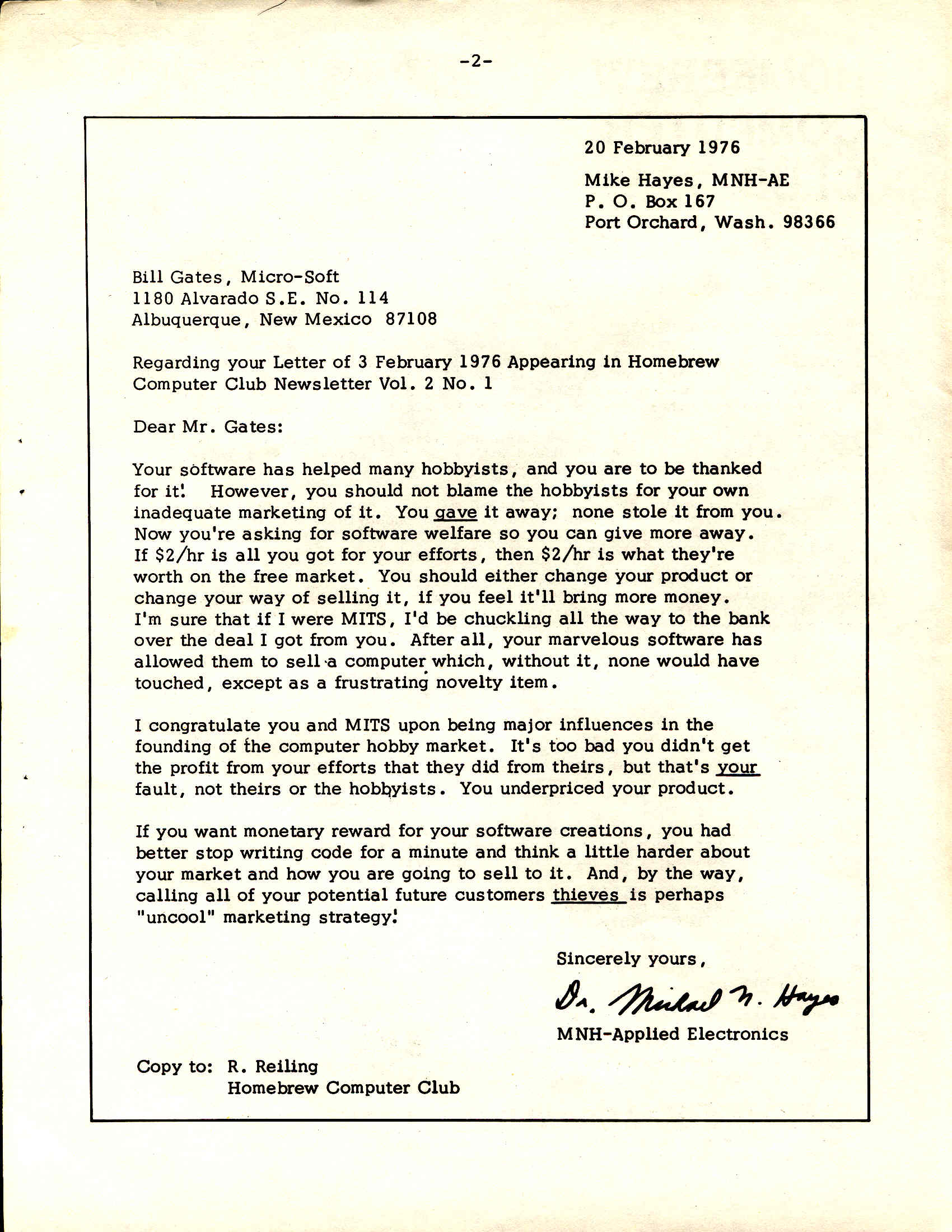
Very much worth reading - somewhat articulate. Essentially the author blames Gates poor business decisions, then points out that it might not be wise to alienate potential future customers. -
Right back atcha!
Below is a reply in the subsequent issue from the "hobbyists". Interesting to see what things was like back then -- same discussions, arguments etc. The more things change, the more things stay the same.
Your software has helped many hobbyists, and you are to be thanked for it! However, you should not blame the hobbyists for your own inadequete marketing of it. You gave it away; none stole it from you. Now you're asking for software welfare so you can give more away. If $2/hr is all you got for your efforts, then $2/hr is what they're worth on the free market. You should either change your product or change your way of selling it, if you feel it'll bring more money. I'm sure that if I were MITS, I'd be chuckling all the way to the bank over the deal I got from you. After all, your marvelous software has allowed them to sell a computer which, without it, none would have touched, except as a frustrating novelty item.
I congratulate you and MITS upon being major influences in the founding of the computer hobby market. It's too bad you didn't get the profit from your efforts that they did from theirs, but that's your fault, not theirs or the hobbyists. You underpriced your product.
If you want monetary reward for your software creations, you had better stop writing code for a minute and think a little harder about your market and how are you going to sell to it. And, by the way, calling all of your potential future customers thieves is perhaps "uncool" marketing strategy!
Man, it feels good to blaze away on the keyboard once in a while. If only I can code this fast! Any errors are solely mine of course. Please check originals for identity of poster, additional context regarding this letter, and to verify any typos.
-
First FPS?
To be fair, it was another id game, Wolfenstein 3D, that in 1992 introduced gamers to the concept of the first-person shooter.
Except that it wasn't. Even if you don't count Maze War (and its successor, MIDI Maze) for some reason, you still have id's own Catacomb 3D.
Rob -
Re:My predictions...
MacTV looks likely, or at least some sort of update to Front Row to add PVR functionality or flesch out the feature set a bit.
However, I think they'll pick a new name...
Is it just me, or does it seem like apple's becoming complacent? The last few macworlds have been somewhat disappointing. Front Row is great and all, but it certainly could be improved a lot. Likewise for the iPod Video, Pages, and Aperture.... maybe they're just waiting for the X86 transition nightmare to be over (still a bad decision in my mind...) -
Re:ah the original powerbook
Found a link to that classic luggable Compaq, from back in the day when real men used laptops.
http://www.digibarn.com/collections/systems/compaq / -
Re:Comprehensive Lisa info at guidebookgallery.org
Yeah, but has he got a looong video of a demonstration of the Lisa GUI?
-
Re:Besides...
Let's turn on the wayback machine properly. The term PDA ("Personal Digital Assistant") was coined by John Scully, CEO of Apple, to describe how the Newton MessagePad was going to fulfill his dream of the Knowledge Navigator. By definition, PDAs first came out when the Newton came out.Remember when PDAs first came out? We were paying $300+ for something with 8MB RAM and a black-and-white LCD.
Actually, I do remember when PDAs first came out. I even bought a second-generation Palm Pilot Personal (back when they were still "U.S. Robotics"). US$200...The first Newton MessagePad was $800.
Also, the first Palm device, the Pilot, was shipped by a company called Palm Computing, Inc., whose CEO was Jeff Hawkins. The company started in 1992 developing software for the GRiDPad, then later for the Newton and also for the Zoomer. Only rather later did they decide to go it on their own, after Apple kept going for more advanced machines rather than smaller, simpler, cheaper ones. At that point they got a $44 million stock infusion from US Robotics to put out the Pilot.
The Pilot cost $300.
-
Re:What?
You mean the "Stringy Floppy" ?
I remember seeing this thing at the West Coast Computer Fair back in the 80's. That used to be so much fun. Always something new. Often stupid, but always new. -
Re:Blew it out of proportion?
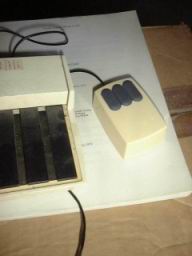
I love how they claim that in the beginning there was one button when in fact there were three http://www.digibarn.com/collections/devices/alto-
m ouse/TN_Image36.JPG I don't get the obsession with bluetooth. Batteries are a PITA to deal with and a cable coming out of my mouse really doesn't ruin my quality of life. -
Star was $16K; also Lisp machines and PERQAccording to here, the Star was $16500 at first release. They were great machines for their time, but not really at their best unless connected to a network with file servers and printers - stand-alone support was minimal. I can attest to that from my time at Xerox AI Systems (1986-88) - our stand-alone customers had to make do with Epson dot-matrix printers that sort-of worked, and we sent them system image updates on huge stacks of 5 1/4" floppies whose reliability was questionable on a good day.
Also, I know of two other windowing workstations that were commercially available in 1981:The PERQ
Lisp machines from LMI and Symbolics
The Lisa was not the first commercial GUI machine, though it probably does hold the title for the first commercial machine under $10K. -
Re:Not the first....
It was $16,595. (About $33,000 in today's money.) The Digibarn has some good info and screenshots.
-
The coolest part
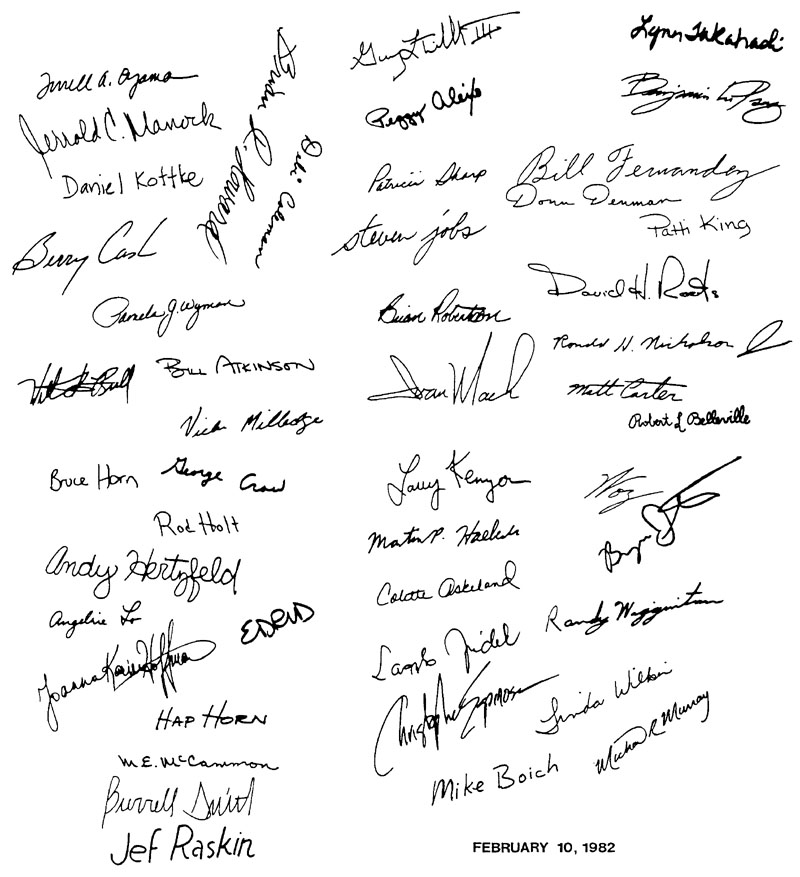
The coolest part of the Mac 128k isn't the computer itself, but rather what's on the inside of the case.
-
It was 1984, I was a poor junior elisted slob,and I wanted a Mac SOOOO BAD. I test-drove one at a computer store in Oklahoma City in the evening of one of my days on a temporary assignment at Tinker Air Force Base, where I was doing system design documentation on a Xerox Alto. It was so karmic and wonderful, getting my first exposure to really cool UI stuff for desktop publishing during the day, and then playing in the evening with a machine which was obviously the wave of that particular future.
I couldn't afford a Mac, of course. I just jonesed for it. A lot.
-
Re:Loose women ???
Everyone knows that the loose women are using Apple
-
Re:AppleDoc rehashed?Don't forget the Xerox PARC Alto before ALL of those. Alto was highly document-centric.
Integrated applications -- This industry buzzword has been used to describe many things; here it means that text, graphics, tables, and mathematical formulae are all edited inside documents. In many other systems, different types of content are edited in separate application windows and then cut/pasted together. For example: a MacDraw drawing put into a Microsoft Word or Aldus PageMaker document can no longer be edited; rather, the original must be re-edited with MacDraw and then substituted for the old drawing in the document.
Not even Star is fully integrated in the sense used here. For example, though the original structured graphics editor, the new one (see History of Star Development, below), and the table and formula editors all operate inside text files, spreadsheets and freehand drawings are currently edited in separate application windows and transferred into documents, where they are no longer fully editable.