Slashdot Mirror
Domain: discovermagazine.com
Stories and comments across the archive that link to discovermagazine.com.
Stories · 195
-
Acupuncture May Trigger a Natural Painkiller
Pickens writes "USNWR is reporting that the needle pricks involved in acupuncture may help relieve pain by triggering the natural painkilling chemical adenosine. There are also indications that acupuncture's effectiveness can be enhanced by coupling the process with a well-known cancer drug — deoxycoformycin — that maintains adenosine levels longer than usual. Dr. Maiken Nedergaard of the University of Rochester Medical Center and her colleagues administered half-hour acupuncture treatments to a group of mice with paw discomfort. The investigators found adenosine levels in tissue near the needle insertion points was 24 times greater after treatment, and those mice with normal adenosine function experienced a two-thirds drop in paw pain. By contrast, mice that were genetically engineered to have no adenosine function gained no benefit from the treatment." Read below for some acupuncture skepticism engendered by other recent studies.
However, many remain skeptical of acupuncture claims. Ed Tong writes in Discover Magazine that previous clinical trials have used sophisticated methods to measure the benefits of acupuncture, including 'sham needles' (where the needle's point retracts back into the shaft like the blade of a movie knife) to determine if the benefits of acupuncture are really only due to the placebo effect. 'Last year, one such trial (which was widely misreported) found that acupuncture does help to relieve chronic back pain and outperformed "usual care". However, it didn't matter whether the needles actually pierce the skin [paper here with annoying interstitial], because sham needles were just as effective,' writes Tong. 'Nor did it matter where the needles were placed, contrary to what acupuncturists would have us believe.'" -
A Genetically Engineered Fly That Can Smell Light
An anonymous reader writes "It sounds like a cool — if somewhat pointless — super-powered insect: a fly that can smell light! Researchers added a light-sensitive protein to a fruit fly's olfactory neurons, which caused the neurons to fire when the fly was exposed to a certain wavelength of blue light. Adding the protein specifically to neurons that respond to good smells, like bananas, makes for a light-seeking fly." -
Physicists Do What Einstein Thought Impossible
An anonymous reader writes "Einstein worked on Brownian motion (the movement of small particles in a fluid as they collide with the fluid's molecules) in 1905, but said it would be 'impossible' to determine the speed and direction of a single particle during this dance. Now researchers have gone and done it, by suspending a dust-sized glass sphere in air (which slowed down its dance moves, since it had fewer collisions with spaced-out air molecules than it would have had with water molecules). The researchers held the sphere in place with 'laser chopsticks,' and then watched how the glass bead bounced around to determine its direction and speed (abstract)." -
"Argonaut" Octopus Sucks Air Into Shell As Ballast
audiovideodisco writes "Even among octopuses, the Argonaut must be one of the coolest. It gets its nickname — 'paper nautilus' — from the fragile shell the female assembles around herself after mating with the tiny male (whose tentacle/penis breaks off and remains in the female). For millennia, people have wondered what the shell was for; Aristotle thought the octopus used it as a boat and its tentacles as oars and sails. Now scientists who managed to study Argonauts in the wild confirm a different hypothesis: that the octopus sucks air into its shell and uses it for ballast as it weaves its way through the ocean like a tiny submarine. The researchers' beautiful video and photographs show just how the Argonaut pulls off this trick. The regular (non-paper) nautilus also uses its shell for ballast, but the distant relationship between it and all octopuses suggests this is a case of convergent evolution." -
Cannibal Galaxy the Biggest In the Near Universe
The Bad Astronomer writes "Astronomers have found the most massive galaxy in the near universe: an obese, bloated monster that may tip the cosmic scales at 13 trillion times the mass of the Sun, 20 times the mass of the entire Milky Way. The galaxy, called ESO 146-IG 005, sits at the center of a dense cluster of other (but much more lightweight) galaxies, and grew to its present size by eating the galaxies around it. In fact, the so-far undigested cores of at least five other galaxies are still easily seen in the cannibal's nucleus. Astronomers are having difficulty pinning down the galaxy's exact mass, but it's clearly the biggest bruiser within 1.5 billion light years of home." -
Record-Breaking Galaxy Cluster Found
The Bad Astronomer writes "Astronomers are reporting that they have detected the most distant cluster of galaxies ever seen: a mind-smashing 9.6 billion light years away, 400 million light years more distant than the previous record holder. The cluster, handily named SXDF-XCLJ0218-0510, was seen in infrared images by the giant Subaru telescope, and confirmed with spectroscopy and the X-ray detection of million-degree gas (a smoking gun of clusters). Every time astronomers push back the record for clusters, they learn more about the early conditions of the universe, so this cluster will provide insight into how the universe itself changed over the first few billion years after the Big Bang." -
Martian Gullies Explained By ... Sand
eldavojohn writes "There's a lot of evidence that a very long time ago some fluid once flowed on Mars, but the primary evidence of water today — gullies inside craters — is explainable by a much less exotic reason: flowing dust and sand. It would now seem that the news from 2006 that NASA had found definitive evidence of flowing water on today's Mars needs to be comprehensively reexamined. The Bad Astronomer lays claim that flowing sand and dust doesn't explain all recent hi-res imagery from the red planet, but it certainly does seem more plausible, considering what we know about Mars." -
Aral Sea May Recover; Dead Sea Needs a Lifeline
An anonymous reader writes "It's a tale of two seas. The drying up of the Aral Sea is considered one of the greatest environmental catastrophes in history, but the northern sector of the sea, at least, is showing signs of life. A dam completed in 2005 has increased the North Aral's span by 20 percent, and birds, fish, and people are all returning to the area. Meanwhile, the Dead Sea is still in the midst of precipitous decline, since too much water is being drawn out of the Jordan River for thirsty populations and crops. To keep the sea from shrinking more, scientists are pushing an ambitious scheme called the 'Red-Dead conduit,' which would channel huge amounts of water from the Red Sea to the Dead Sea. However, the environmental consequences of such a project may be troubling." -
Obama Outlines Bold Space Policy ... But No Moon
The Bad Astronomer writes "In front of a mostly enthusiastic audience at NASA's Kennedy Space Center today, President Obama outlined a bold, new space policy. It's a change from his previous policy; the Constellation rockets are still dead, but a new heavy-lift rocket system is funded. He specifically talked of manned asteroid and Mars missions, but also stated there would be no return to the Moon. This is a major step in the right direction, but still needs some tweaking." -
Genetic Disorder Removes Racial Bias and Social Fear
People who suffer from a rare genetic disorder called Williams Syndrome have a complete lack of social fear. They experience no anxiety or concerns about meeting new people or being put into any social situation, and a new study by Andreia Santos suggests that they also don't have any racial bias. From the article: "Typically, children start overtly gravitating towards their own ethnic groups from the tender age of three. Groups of people from all over the globe and all sorts of cultures show these biases. Even autistic children, who can have severe difficulties with social relationships, show signs of racial stereotypes. But Santos says that the Williams syndrome kids are the first group of humans devoid of such racial bias, although, as we’ll see, not everyone agrees." -
90% of the Universe Found Hiding In Plain View
The Bad Astronomer writes "As much as 90% of previously hidden galaxies in the distant Universe have been found by astronomers using the Very Large Telescope in Chile. Previous surveys had looked for distant (10 billion light years away) galaxies by searching in a wavelength of ultraviolet light emitted by hydrogen atoms — distant young galaxies should be blasting out this light, but very few were detected. The problem is that the ultraviolet light never gets out of the galaxies, so we never see them. In this new study, astronomers searched a different wavelength emitted by hydrogen, and voila, ten times as many galaxies could be seen, meaning 90% of them had been missed before." -
Girl Without Vagina Gets Pregnant Via Oral Sex and Stabbing
According to a report in the British Journal of Obstetrics and Gynaecology, a 15-year-old girl without a vagina was impregnated via stabbing after performing oral sex on her boyfriend. The girl had been performing the sex act when an ex-lover appeared and stabbed her. She was taken to the hospital where two holes in her abdominal wall were flushed out and repaired. 278 days later the she was admitted again to hospital with abdominal pain. An examination revealed she was pregnant and that she had no vagina. Doctors theorized that spermatozoa gained access to the reproductive organs via the injured gastrointestinal tract. -
Give Space a Chance, Says Phil Plait
The Bad Astronomer writes "A lot of pundits, scientists, and people who should know better are decrying the demise of NASA, saying that the President's budget cutting the Constellation program and the Ares rockets will sound the death knell of manned space exploration. This simply is not true. The budget will call for a new rocket design, and a lot of money will go toward private space companies, who may be able to launch people into orbit years ahead of Ares being ready anyway." -
The 9 Most Tested Lab Animals
An anonymous reader writes "Discover Magazine has this odd photo gallery in which they explain why certain animals are used in scientific research. Why are high-tech contact lenses always tried out in rabbits? Why do we study monogamy in prairie voles? Etc. They say of the 9 animals: 'Taken (or stitched) together, they form a kind of laboratory doppelganger for humans.'" -
Scientists Postulate Extinct Hominid With 150 IQ
Hugh Pickens writes "Neuroscientists Gary Lynch and Richard Granger have an interesting article in Discover Magazine about the Boskops, an extinct hominid that had big eyes, child-like faces, and forebrains roughly 50% larger than modern man indicating they may have had an average intelligence of around 150, making them geniuses among Homo sapiens. The combination of a large cranium and immature face would look decidedly unusual to modern eyes, but not entirely unfamiliar. Such faces peer out from the covers of countless science fiction books and are often attached to 'alien abductors' in movies. Naturalist Loren Eiseley wrote: 'Back there in the past, ten thousand years ago. The man of the future, with the big brain, the small teeth. He lived in Africa. His brain was bigger than your brain.' The history of evolutionary studies has been dogged by the almost irresistible idea that evolution leads to greater complexity, to animals that are more advanced than their predecessor, yet the existence of the Boskops argues otherwise — that humans with big brains, and perhaps great intelligence, occupied a substantial piece of southern Africa in the not very distant past, and that they eventually gave way to smaller-brained, possibly less advanced Homo sapiens — that is, ourselves. 'With 30 percent larger brains than ours now, we can readily calculate that a population with a mean brain size of 1,750 cc would be expected to have an average IQ of 149,' write Lynch and Granger. But why did they go extinct? 'Maybe all that thoughtfulness was of no particular survival value in 10,000 BC. Lacking the external hard drive of a literate society, the Boskops were unable to exploit the vast potential locked up in their expanded cortex,' write Lynch and Granger. 'They were born just a few millennia too soon.'" -
Fifth Anniversary of a Cosmic Onslaught
The Bad Astronomer writes "Five years ago today (December 27, 2004), a vast wave of high-energy gamma and X-rays washed over the Earth, blinding satellites and partially ionizing the Earth's atmosphere. The culprit was a superflare from the magnetar SGR 1806-20, located 50,000 light years away. The energy released was mind-numbing: in one-fifth of a second, this supercharged magnetic neutron star blasted out as much energy as the Sun does in 250,000 years!" -
Lake On Titan Winks From a Billion Kilometers Away
The Bad Astronomer writes "NASA's Cassini spacecraft took an image of Saturn's giant moon Titan earlier this year that serendipitously provides proof of liquid (probably methane) on its surface. The picture shows a glint of reflected sunlight off of a monster lake called Kraken Mare (larger than the Caspian Sea!). Scientists have been getting better and better evidence of liquid methane on Titan, but this is the first direct proof." -
Gigantic Spiral of Light Observed Over Norway; Rocket To Blame?
Ch_Omega writes "A mysterious light display appearing over Norway last night (more pictures) has left thousands of residents in the north of the country baffled. Witnesses from Trøndelag to Finnmark compared the amazing display to anything from a Russian rocket to a meteor to a shock wave — although no one appears to have mentioned UFOs yet. The phenomenon began when what appeared to be a blue light seemed to soar up from behind a mountain. It stopped mid-air, then began to circulate. Within seconds a giant spiral had covered the entire sky. Then a green-blue beam of light shot out from its center — lasting for ten to twelve minutes before disappearing completely. The Norwegian Meteorological Institute was flooded with telephone calls after the light storm — which astronomers have said did not appear to have been connected to the aurora, or Northern Lights, so common in that area of the world." The Bad Astronomer makes the case that a malfunctioning rocket spewing fuel is a parsimonious explanation, backed up by witnesses to similar events and a cool simulation (on video). An anonymous reader suggests that this Proton-M Carrier Rocket might be responsible for the display. -
A Skeptical Reaction To IBM's Cat Brain Simulation Claims
kreyszig writes "The recent story of a cat brain simulation from IBM had me wondering if this was really possible as described. Now a senior researcher in the same field has publicly denounced IBM's claims." More optimisticaly, dontmakemethink points out an "astounding article about new 'Neurogrid' computer chips which offer brain-like computing with extremely low power consumption. In a simulation of 55 million neurons on a traditional supercomputer, 320,000 watts of power was required, while a 1-million neuron Neurogrid chip array is expected to consume less than one watt." -
Obama Kicks Off Massive Science Education Effort
In a speech at the White House today, President Obama launched a new campaign, "Educate to Innovate," designed to get American students fired up about science, technology, engineering, and math (STEM). The full text of the speech is also available on whitehouse.gov. "The new campaign builds on the President's Inaugural Address, which included a vow to put science 'in its rightful place.' One of those rightful places, of course, is the classroom. Yet too often our schools lack support for teachers or the other resources needed to convey the practical utility and remarkable beauty of science and engineering. As a result, students become overwhelmed in their classes and ultimately disengaged. They lose, and our nation loses too. The partnerships launched today aim to change that. They respond to a challenge made by the President in April, when he spoke at the annual meeting of the National Academy of Sciences and asked the nation's philanthropists, professional and educational societies, corporations, and individuals to collaborate and innovate with the goal of reinvigorating America's STEM educational enterprise. The partnerships announced today — dramatic commitments in the hundreds of millions of dollars, generated through novel collaborations and creative outreach activities — are just the first wave of commitments anticipated in response to his call." -
Nearby, Recent Interplanetary Collision Inferred
The Bad Astronomer writes about a new discovery by the Spitzer Space Telescope, which detected signs of an interplanetary smashup only 100 light-years from here, and only a few thousand years ago. There's a NASA-produced animation of the collision between a Mercury-sized planet and a moon-sized impactor. The collision's aftermath was detected by the presence of what are essentially glass shards in orbit around the star. Here's NASA's writeup. -
Strange New Objects Seen In Saturn's Rings
Every 15 Earth years, Saturn has its equinox — the time during which its rotational axis is perpendicular to the rays from the sun, so that the sun is always directly "overhead" of Saturn's equator. This is significant because Saturn's rings orbit over the equator, so during the equinox, light from the sun hits them edge-on. This means that any objects wider than the rings, or orbiting above or below them, cast long shadows and are much easier to see. For the first time, we're able to get detailed images of these objects, thanks to Cassini. A moonlet, perhaps 1,300 feet in diameter, has been discovered in the B-ring, and the Bad Astronomy blog points out another object that seems to be bursting through the F-ring. Quoting: "The upward-angled structure is definitely real, as witnessed by the shadow it's casting on the ring material to the lower left. And what's with the bright patch right where this object seems to have slammed into the rings? Did it shatter millions of icy particles, revealing their shinier interior material, making them brighter? Clearly, something awesome and amazing happened here. -
Something May Have Just Hit Jupiter
The blog of Anthony Wesley, an Australian amateur astronomer, has what may be the first photos of a recent comet or asteroid impact on Jupiter, near the south pole. These photos are 11 hours old. The ones at the bottom of the page show three small dark spots in addition to the main dark mark. The Bad Astronomy blog picked up the story a few hours later — but cautions that what we're seeing may not be an impact event. This is all reminiscent of the closely watched impact of comet Shoemaker-Levy on Jupiter in 1994. -
Med Students Get Training In Second Life Hospitals
Hugh Pickens writes "Discover Magazine reports that although medical simulations have been around for a long time, medical schools like Imperial College London are starting to use virtual hospitals in Second Life so students can learn their way around an O.R. before they enter the real thing. The students can also test their knowledge in the Virtual Respiratory Ward by interviewing patient avatars, ordering tests, diagnosing problems, and recommending treatment. 'The real innovation in SL clinical simulations is that they bring people together in a clinical space — you are standing next to an avatar who is a real patient, and the doctor avatar to your right is a resident at Massachusetts General Hospital and the nurse to your left is at the University of Pennsylvania hospital,' says John Lester, the Education and Healthcare Market Developer at Linden Labs. The most significant benefit of SL training may be the cost. Real-life training facilities require thousands, and sometimes millions of dollars to build and maintain, while SL simulation rooms can be created for minimal costs, and accessed from anywhere in the world for the price of an internet connection. SL can also expose students to situations that a standard academic program can't duplicate: 'You can take risks that aren't safe in the real world and teach more complex subjects in three dimensions,' says Colleen Lin. 'When you're resuscitating a dummy in real life, it looks like a dummy. But you can program an avatar to look like it's choking or having a heart attack, and it looks more real to the student responsible for resuscitating it.'" -
Could a Meteor Have Brought Down Air France 447?
niktemadur writes "In light of an Air Comet pilot's report to Air France, Airbus, and the Spanish civil aviation authority that, during a Monday flight from Lima to Lisbon, 'Suddenly, we saw in the distance a strong and intense flash of white light, which followed a descending and vertical trajectory and which broke up in six seconds,' the Cosmic Variance blog team on the Discover Magazine website muses on the question 'What is the probability that, for all flights in history, one or more could have been downed by a meteor?' Taking into account total flight hours and the rate of meteoric activity with the requisite mass to impact on Earth (approximately 3,000 a day), some quick math suggests there may be one in twenty odds of a plane being brought down in the period from 1989 to 2009. Intriguingly, in the aftermath of TWA flight 800's crash in 1996, the New York Times published a letter by Columbia professors Charles Hailey (physics) and David Helfand (astronomy), in which they stated the odds of a meteor-airplane collision for aviation history up to that point: one in ten." -
Towards Artificial Consciousness
jzoom555 writes "In an interview with Discover Magazine, Gerald Edelman, Nobel laureate and founder/director of The Neurosciences Institute, discusses the quality of consciousness and progress in building brain-based-devices. His lab recently published details on a brain model that is self-sustaining and 'has beta waves and gamma waves just like the regular cortex.'" Edelman's latest BBD contains a million simulated neurons and almost half a billion synapses, and is modeled on a cat's brain. -
Finally, Sadomasochism Gets Its Own Scientific Study
TaeKwonDood writes "You might think throwing out the occasional titillating article title is part of some grand media strategy. Discover is famous for whoring themselves out for page views with articles like Bizarre Aquatic Creatures Are Secretly Lesbian Necrophiliacs and Scientific American gets into the act with Rough Sex at 40,000 Leagues Under the Sea, which got them additionally ridiculed because that is about 30X greater than the radius of the Earth, but there are occasionally real articles that aren't all tramped up and just happen to deal with sex; some of it even kinky. All of it involving cortisol. The difficulty? Kinky people are okay with being monitored and they don't always realize what 'control' means in a scientific context, but they sure don't like to stick within the study parameters." -
Is Your IM Buddy Really a Computer?
audiovideodisco writes "Every year the Loebner Prize goes to the chatbot (and the corresponding human companion) that fares best on a Turing test administered by a panel of judges. Discover talked to Kevin Warwick, the professor who runs the competition, to get pointers on how one would go about detecting a bot. While there are some general approaches you can use, nothing is foolproof — and asking about Sarah Palin can be downright deceptive. One judge concluded an interlocutor was a bot because it didn't recognize Palin's name ... but it turned out the chatter was a French librarian who'd simply never heard of her." The chat transcripts show how difficult picking bot from non-bot is getting. -
Amateur Astronomer Grabs Amazing ISS Picture
The Bad Astronomer writes "Ralf Vandebergh is an amateur astronomer, and using a simple telescope with a video camera attached to it, he took an incredibly detailed picture of the International Space Station. You can easily see the recently-installed truss and solar panels, as well as the Space Shuttle Discovery docked to the station." -
Want a Science Degree In Creationism?
The Bad Astronomer writes "In Texas, a state legislator wants the ironically-named Institute for Creation Research to be able to grant a Masters degree in science. In fact, the bill submitted to the Texas congress would make it legal for any private group calling themselves educational to be able to grant advanced degrees in science. So, now's your chance: that lack of a PhD in Astrology and Alchemy won't hold you back any longer." The Institute for Creation Research made a similar request to the Texas Higher Education Coordinating Board last year, but were shot down. -
Illinois Declares Pluto a Planet
The Bad Astronomer writes "The legislators in Illinois, always on the lookout for more places to find voters, have passed a resolution declaring Pluto is a planet. I'm not sure what else can be said here, except that — besides overstepping their jurisdiction just a wee bit — they make a couple of scientific howlers in the resolution itself." -
Meteorite Hunters Find the West Texas Fireball
An anonymous reader writes "A fireball streaked over Austin, Texas on February 15 producing sonic booms and startling people for hundreds of miles. The video of the event was shown on national television and viewed by thousands of people on the Net. The first news reports speculated that the fireball might have been debris from a February 13th collision between two satellites over Siberia but space experts said that the object was probably a meteor. Now this has been confirmed: experienced meteorite hunters located a strewnfield about 120 miles north of the filming site of the Austin cameraman and have recovered over 100 freshly fallen meteorites." -
The 300 Million Year Old Brain
Pickens writes "Paleontologists recently discovered the world's oldest brain nestled within a 300-million-year-old fish fossil of one of the extinct relatives of modern ratfishes, also known as 'host sharks' or chimaeras. These chimaera relatives, called iniopterygians, represented bizarre beasts that sported massive skulls with huge eye sockets, shark-like teeth in rows, tails with clubs, huge pectoral fins that were placed almost on their backs, and bone-like spikes or hooks tipping the fins. The brain shows details such as a large vision lobe and optic nerve stretching to the proper place on the braincase, which fits with the fish's large eye sockets. The ear canals of the extinct fish only exist on a horizontal plane so the fish could only detect side-to-side movements, and not up or down. 'There is nothing like this known today; it is really bizarre,' said John Maisey, paleontologist at the American Museum of Natural History in New York City. 'But now that we know that brains might be preserved in such ancient fossils, we can start looking for others. We are limited in information about early vertebrate brains, and the evolution of the brain lies at the core of vertebrate history.'" -
Collided Satellite Debris Coming Down?
Jamie found this Bad Astronomy blog on the many reports beginning about 7 hours ago of one or more fireballs in the sky across Texas. That blog's proprietor first doubted that the phenomena could be due to the satellites that collided in orbit last week, but later left the possibility open. The National Weather Service for Jackson, KY put out an announcement about possible explosions and earthquakes across the area and blamed the defunct satellites. "These pieces of debris have been causing sonic booms...resulting in the vibrations being felt by some residents...as well as flashes of light across the sky. The cloud of debris is likely the result of the recent in orbit collision of two satellites on Tuesday...February 10th when Kosmos 2251 crashed into Iridium 33." An Austin TV station has more reports. -
Sizzling Weather On a Dive-Bombing Planet
The Bad Astronomer writes "A massive planet orbiting the star HD 80606 is on a roller-coaster orbit: it dive bombs the star, in just 55 days dropping from over 120 million km to just 4 million km from the star's surface! Astronomers used the Spitzer Space Telescope to observe the heat from the planet as it gets blasted by its star, and used that data to make a beautiful computer-modeled image of what the planet must look like. Their results: an ube-rviolent storm that acts as if a bomb were exploded in the planet's atmosphere." -
First Earth-Sized Exoplanet May Have Been Found
Adam Korbitz writes "New Scientist is reporting the extrasolar planet MOA-2007-BLG-192Lb — whose discovery was announced just last summer — may actually be the first truly Earth-sized exoplanet to be identified. A new analysis suggests the planet weighs less than half the original estimate of 3.3 Earth masses; the new estimate pegs the planet's size at 1.4 Earth masses. The planet orbits a small red dwarf star, some 3,000 light-years from here, at an orbital distance of 0.62 astronomical units, about the same distance as Venus from our sun. One significance of the planet's discovery is that it points to the probable ubiquity of smaller terrestrial planets in somewhat Earth-like orbits around red dwarf stars, the oldest and most numerous stars in the galaxy. Here is a video report from the discoverers." -
Science's Alternative To an Intelligent Creator
Hugh Pickens writes "Discover magazine has an interesting article on the multiverse theory — a synthesis of string theory and the anthropic principle that explains why our universe seems perfectly tailored for life without invoking an intelligent creator. Our universe may be but one of perhaps infinitely many universes in an inconceivably vast multiverse. While most of those universes are barren, some, like ours, have conditions suitable for life. The idea that the universe was made just for us — known as the anthropic principle — debuted in 1973 when Brandon Carter proposed that a purely random assortment of laws would have left the universe dead and dark, and that life limits the values that physical constants can have. The anthropic principle languished on the fringes of science for years, but in 2000, new theoretical work threatened to unravel string theory when researchers calculated that the basic equations of string theory have an astronomical number of different possible solutions, perhaps as many as 101,000, with each solution representing a unique way to describe the universe. The latest iteration of string theory provides a natural explanation for the anthropic principle. If there are vast numbers of other universes, all with different properties, at least one of them ought to have the right combination of conditions to bring forth stars, planets, and living things." So far xkcd is simulating just one single universe. -
Hubble's Exoplanet Pics Outshined by Keck's
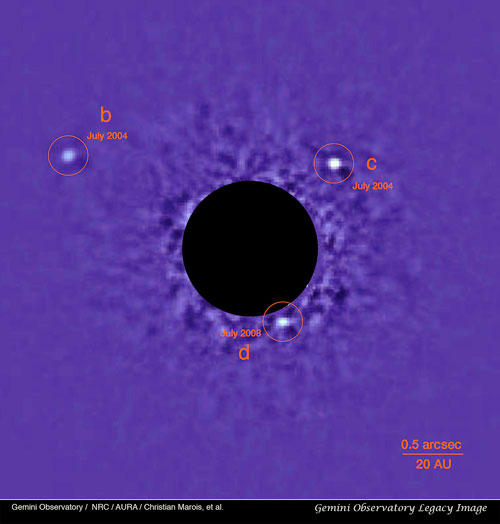
dtolman writes "Scientists at the Keck and Gemini telescopes stole the thunder of Hubble scientists announcing the first picture of an extrasolar world orbiting a star. Hubble scientists announced today that they were able to discover an extrasolar world for the first time by taking an actual image of the newly discovered exoplanet orbiting Fomalhaut — previous discoveries have always been made by detecting changes in the parent star's movement, or by watching the planet momentarily eclipse the star — not by detecting them in images. Hubble's time to shine was overshadowed though by the Keck and Gemini observatories announcing that they had taken pictures of not just one planet, but an entire alien solar system. The images show multiple planets orbiting the star HR 8799 — 3 have been imaged so far." -
Looking For Earth-Like Exoplanets
Discover Magazine is running a story detailing the search for planets like Earth orbiting other stars. While we've been able to locate a few "super earths" so far, none of them really compare in size or the potential for habitability with our own world. Fortunately, advances in data analysis and new space-based telescopes — such as Kepler, the James Webb Space Telescope, and the already-launched CoRoT (PDF) — have some astronomers predicting we'll find such an exoplanet by 2010, and a habitable one by 2012. Earth-based telescopes are also in the hunt, though the article notes, "even if a habitable Earth-like world is found first from the ground, it will most likely take a space observatory to search for the chemical signals that tell us what we really want to know: Is anything living out there? If the planet is one that can be observed transiting, it just might be possible to provide a hint of an answer in the next few years." -
Fungus Fire Spores With 180,000 G Acceleration
Hugh Pickens writes "Although a variety of spore discharge processes have evolved among the fungi, those with the longest ranges are powered by hydrostatic pressure and include 'squirt guns' that are most common in the Ascomycota and Zygomycota. In these fungi, fluid-filled stalks that support single spores or spore-filled sporangia, or cells called asci that contain multiple spores, are pressurized by osmosis. Because spores are discharged at such high speeds, most of the information on launch processes from previous studies has been inferred from mathematical models and is subject to a number of errors, but now Nicholas Money, an expert on fungi at Miami University, has recorded the discharges with high-speed cameras at 250,000 frames-a-second and discovered that fungi fire their spores with accelerations up to 180,000 g, calling it 'the fastest flight in nature.' Money and his students, in a justified fit of ecstasy, have created a video of the first fungus opera." -
Military Uses Virtual Iraq To Treat PTSD
Hugh Pickens writes "Traditionally the best treatment for post-traumatic stress disorder [PTSD] — being raped, narrowly escaping the collapse of the Twin Towers, or witnessing a buddy die on the battlefield — is to have the person relive the trauma using his or her imagination. Repeated exposure to the horror can desensitize individuals and help them stay calm enough to reprocess what happened and get beyond it. Now Clinical Psychologist Albert "Skip" Rizzo has developed a program that has had great success in treating returning troops from Iraq. A soldier with PTSD recounts what happened, and a therapist seated before a computer then creates an environment in the program Virtual Iraq that captures the essential elements of the episode. By donning special goggles, the soldier can see a reenactment and while the simulation starts off relatively tame over the course of several weeks, the therapist monitors the patient 's response and more elements of the episode are introduced until the individual can finally go through an intensely vivid recreation of it without being overpowered by terror. Other programs offered to treat PTSD include Virtual Airplane, Virtual Audiences, Virtual Heights, Virtual Storm, and Virtual Vietnam." -
Life May Have Evolved In Ice
Philip Bailey writes "An article in this month's Discover Magazine claims that some of the fundamental organic molecules required for the development of life could have spontaneously arisen within ice. Scientist Stanley Miller was responsible for seminal experiments in the 1950s in this area. He used sparks and a mixture of inorganic chemicals to test his theories, but turned to low temperature experiments in later years. He was able to create the constituents of RNA and proteins from a mixture of cyanide, ammonia and ice in trials lasting up to 25 years. A process known as eutectic freezing is thought to be the basis of these results: small pockets of liquid water, in which foreign molecules are concentrated enormously, increases the reaction rates, and more than compensates for temperature-related slowing." -
Long Live Closed-Source Software?
EvilRyry writes "In an article for Discover Magazine, Jaron Lanier writes about his belief that open source produces nothing interesting because of a hide-bound mentality. 'Open wisdom-of-crowds software movements have become influential, but they haven't promoted the kind of radical creativity I love most in computer science. If anything, they've been hindrances. Some of the youngest, brightest minds have been trapped in a 1970s intellectual framework because they are hypnotized into accepting old software designs as if they were facts of nature. Linux is a superbly polished copy of an antique, shinier than the original, perhaps, but still defined by it.'" -
String Theory in Two Minutes
An anonymous reader writes "Most of us have heard of string theory, many of us know what it is and some of us may even be experts in the field. But could you explain it in two minutes? Discover Magazine recently had a contest to do precisely that: create a two minute or less video of everything you need to know about string theory. You can view some of the best entries (video) as well as the winning video: String Ducky!" -
Mapping the Blogosphere
dominique_cimafranca writes "Discover Magazine has an interesting article on mapping the blogosphere, reporting on the work of Matthew Hurst. Hurst put together a 3D map of the blogosphere, with bright spots represent sites with the highest number of links and isolated islands represent closed communities like LiveJournal. The study also identifies other islands like sociopolitical commentary, gadget hounds, sports fans, and, um, porn blogs."