Slashdot Mirror
Domain: don-lindsay-archive.org
Stories and comments across the archive that link to don-lindsay-archive.org.
Comments · 61
-
Re:There has to be a better way
The lying, misogyny, insensitivity, bellicosity, narcissism and over-compensated inferiority complex have nothing to do with intelligence.
You just described every single person who has ever been in Congress or the White House.
Excellent demonstration of The Golden Rationalization or Two Wrongs make a Right. However I would like to believe that there's been some representatives who just wanted to do the right thing. The trick is trying to distinguish the baby from the bath water.
I assure you just because some people put on a public face which seems nice and comfortable to you does not mean they are like that in private.
Agreed. I would go so far as to say "
-
From a list of Fallacious Arguments ..
@DerekLyon: "Regular readers are also well aware of the extreme and longstanding bias
"Poisoning The Wells: discrediting the sources used by your opponent. This is a variation of Ad Hominem." -
From a list of Fallacious Arguments ..
@DerekLyon: "Regular readers are also well aware of the extreme and longstanding bias
"Poisoning The Wells: discrediting the sources used by your opponent. This is a variation of Ad Hominem." -
Re:Scientology is the truth
http://www.don-lindsay-archive.org/scientology/start.a.religion.html
Go down to the bit about Ted Sturgeon.
From what I heard at LASFS, there were other witnesses, too.
-
Re:Why is 'church' in quotes?
-
Re:Astronomers are so funny
http://www.don-lindsay-archive.org/creation/constant_evidence.html It seems it wasn't as distant as I remembered, only 170.000 light years.
-
Fallacious Arguments
As has been stated here on Slashdot many times by slashdotters...
1. There are numerous comments by...
2. There are articles and numerous comments complaining about...
3. Are you don't making a fool of yourself yet?1-2: Burden Of Proof
3: Ad Hominem
http://www.don-lindsay-archive.org/skeptic/arguments.html -
Fallacy
tell me, how many would gelman have killed if he had a gun instead of a knife? understand yet?
Just to weigh in on this facet of the debate, I would like to point out that you have here committed a logical fallacy often referred to as Moving the Goalposts.
-
Re:What scientists...
"No, one or a few of Behe's claims may have been demolished, but I know many physicists, engineers and biologists that can not "demolish" the idea of IC, even in their own minds."
Irreducibly complex systems in biology were first predicted by H. J. Muller in 1918 to be a consequence of evolution. See talk.origins for a quick summary, or a review of Behe's "Darwin's Black Box" from 1997. There's a (lot of) reasons why Behe wasn't taken seriously back when "Darwin's Black Box" was published in 1996 and the criticism has only deepened since then. If you're interested in the evolution of the heart a quick search turns up many articles on pubmed, for instance I learned something new today: crocodilians have a four-chambered heart! -
Re:I'm sure the book is great n all, but...
Its a blatant appeal to authority argument which is a oft repeated and believed fallacy.
The understanding of fallacies should be required to get a license to internet forums.
-
Correcting The Truth
tBA writes: "A lot of pundits, scientists, and people who should know better are decrying the demise of NASA, saying that the President's budget cutting the Constellation program and the Ares rockets will sound the death knell of manned space exploration. This simply is not true."
You are quite correct. It is simply not true that "A lot of pundits, scientists, and people who should know better are decrying the demise of NASA, saying that the President's budget cutting the Constellation program and the Ares rockets will sound the death knell of manned space exploration." Very few people of any stripe, and virtually none who 'know better' are saying that. A large number are reporting the budget cuts. A small number are claiming any sort of implications headed towards eliminating manned space projects, and most of those are reprinting the same article. Most are correctly reporting that the intention behind the budget cuts was to promote 'private sector' orbital projects.
If you need to set up a straw man for you to sucker punch in order to get your point across, then either your confidence in the importance of the material, and/or your confidence in your journalistic skills are lacking. Look up 'fallacy of extension' and 'argument from adverse consequences' at http://www.don-lindsay-archive.org/skeptic/arguments.html Given that you rarely decry demises and death knells ('prestigous jargon' on that list) in your columns, it seems the problem here is more of skills issue.
-
Re:No, he wasn't.
As an exercise that may be helpful to you in future, see if you can identify the flaw in your comment from this list of fallacious arguments: http://www.don-lindsay-archive.org/skeptic/arguments.html.
Then get off my lawn.
-
So What What?
So exactly what is this organization going to do to rectify the situation of 80% (their measure) of adults age 20-50 (my estimate) being deficient in education regarding reproductive biology and optics/physics?
Put up a web site? That's all? There way more than plenty out there, and books, and other sources. The events and web sites you link to were there before too. How are you going to get the message to these people you've specified where others have failed by simply 'making available' and 'raising awareness'?
By singling out those people and humiliating them in the press? Smooth move.
Are you going to stick with your assumption that they don't know despite the fact that your data collection method (word of mouth reports of recollections of past events, asked with leading questions in order to set your context but which they'll tend to answer in such a way as to satisfy your implied preferred response) is fatally flawed? That was just a few of the errors among the many listed in places such as http://www.don-lindsay-archive.org/skeptic/arguments.html that you fall prey to. That's a pretty good example of bad scientific reasoning, hardly the PR you'd want.
You're doing nothing other than this website and publicity? That's pretty irresponsible when all those people are so deficient, by their admission and your conclusion. Who's going to save them from this sad state you've discovered they're stuck in?
You're doing nothing else? So then maybe things aren't so bad for them. So you've done them a disservice, insulted them, and presented yourself under false pretense. That would seem to beg apologies as well as discrediting yourself in exactly the field you seek to promote. That reflects on the entire field, especially those sites and events you link to on your site. More apologies.
Your presentation, creating an artificial problem in order to justify your existence and intentions, is just one sort of the things we science educators who seek to promote science solely by its own value and benefits, have to constantly strive to overcome. Thanks, we appreciate that. We could use you as a bad example in our work if we were to use your tactics and so redeem you a bit by making our job a bit easier. But I for one don't intend to stoop to it. Science education doesn't need that.
Public awareness, however, is a gateway to education, and it requires cleaning from time to time. It's the venue you've chosen to promote yourself, and I'm glad to be able to help you call attention to you in this context as you are, ask Shakespear said, hoist by your own petard. An apt analogy here, and one that could lead to consideration of the actual force needed to hoist you and whether your petard carried enough power in order to do so, as well as how far and on what ballistic trajectory. But the 'laws' (including calculations of F = ma), the calculus (for the ballistics) as well as the force your petard had to work to overcome (F = G * (m1 * m2 / r^2)) were to come from a man born a quarter century after Shakespear died. So we'll leave this as a history lesson, a criticism from a science educator of your presentation and its effects offered sincerely if emphatically, and my own effort to compartmentalize these while letting the science lesson take care of itself without needing all this to validate or promote itself.
-
Re:Not a Loss
By 2100, copyright as we know it will have been abolished. That sounds impossible, but it's going to happen.
This statement can best be summed up as an Argument to the Future http://www.don-lindsay-archive.org/skeptic/arguments.html#future
Nope. It's called "a prediction based on current evidence." By your measure, all scientific theories until proven would be arguments to the future. If I were making an argument to the future I would be saying that X is not happening now, and you can't see any evidence of it happening yet, but it will happen in the future because I believe it should do because I think that's the right way it should happen.
There is, I hope you will see, rather a large difference.
-
Re:Not a Loss
By 2100, copyright as we know it will have been abolished. That sounds impossible, but it's going to happen.
This statement can best be summed up as an Argument to the Future http://www.don-lindsay-archive.org/skeptic/arguments.html#future
-
Re:Hell yeah - R2-45
R2-45 may go a long way to allow others to conclude Hubbard thought his religion was a joke.
Actually it appears that he thought it was a great way to make money.
http://www.don-lindsay-archive.org/scientology/start.a.religion.html
-
Re:A Strawman for the Symptom
Because the marginal cost of making another car is non-zero. Therefore the scarcity is real. The marginal cost of making another MP3 is zero. Therefore any scarcity is artificial. Did you have trouble in economics?
I had no trouble in economics. In fact, in economics class I learned the difference between production costs and reproduction costs. The difference between the two is what you are confusing, and the difference between the two is greater for digital media than the cars, thanks to the Intarwebz. But the point remains the same.
Read up - you might find it enlightening!
If you can't grasp the concept of scarcity, you're going to be incoherent when discussing economics.
I think we can agree on this point. There are two links above where your road to discovery begins!
Scribes found other ways to make a living. Music publishers will too. The digital-copying genie is out of the bottle, the business model is fundamentally broken. The only question is how much time, effort, resources, and lives we will waste trying to go backwards.
Another concept you may want to consider reading on is the fallacy of argument by scenario. The legitimacy of copy rights have nothing to do with scribes. You might also look up "non sequitur" on the same page...
But, in any event, I guess that you are asserting that anybody who produces copyrighted material should just give up now and hurry along, right? Programmers, have no rights to their works anymore, right? On a side note: this would make the GNU GPL worthless, since it's based on copyrights...
So programmers have no rights to their works, anymore. Neither do authors, music writers, photographers, font creators, video-game writers, technical manual writers, database designers, website coordinators, architects, lawyers, hardware engineers, chipset designers, and advertising agents, right?
Hell, the majority of our modern economy needs to get with the program, give up their day jobs - they need to adapt, like scribes, Roman foot soldiers, and town cryers, right?
Methinks you are confusing your front side with your back side when you talk about going backwards...
-
Re:The worst part is
In a list like this the writer upgrades the commas in the names to semicolons. You do respect the comma and use them in their more important role as list separators. It's not pretty, but it's right. It's not easy being an English Major.
I call shenanigans. Yeah, I have a writing degree too, and what you're saying contradicts Strunk and White, and just about every other style guide I've ever read. And it contradicts every English textbook I've ever read. I can't find a decent copy of The Elements of Style online -- the only versions I can find are the original written by William Strunk, before E. B. White jumped in and expanded the book. However, I found plenty of other grammar-related sites online that agree with me:
- Wikipedia (yes, I know, but bear with me): Use a semicolon between items in a series containing internal punctuation: "There are several Waffle Houses in Atlanta, Georgia; Greenville, South Carolina; Gainesville, Florida; and Mobile, Alabama."
- From Grammar Monster's English Grammar Lessons: "Items in lists are usually separated with commas (as in the first example below). However, if the list items themselves contain commas, then semicolons can be used as separators."
Interestingly enough, this article does discuss "promoting" commas to semicolons, but indicates clearly that the commas being promoted are the ones in between the list items and not the ones inside the list items themselves. - Grammar Girl's blog: "I don't want to confuse you, but there is one situation where you use semicolons with coordinating conjunctions, and that's when you are writing a list of items and commas just don't do the job of separating them all. Here's an example: 'This week's book winners are Herbie in Milligan College, Tennessee; Matt in Irvine, California; and Jan in Oklahoma City, Oklahoma.' Those are the real winners in this week's special Scott Sigler book giveaway, and they've each won a copy of his novel Earthcore, but the list also provides a great example of using semicolons in a list. Because each item in the list requires a comma to separate the city from the state, you have to use a semicolon to separate the items themselves."
- How to use the semicolon properly: "When you have a series of three or more items that normally would be separated by commas except that each individual item already has a comma in it, you use the semicolon between items."
- The University Writing Center at UCF: "Semicolons also separate elements of a list, if those elements contain internal commas. Semicolons replace commas in a list if using commas would make the list more ambiguous."
- And finally, this terse guide from LEO at St. Cloud State University.
So since you're hiding behind Anonymous Coward, either (a) you're not really an English Major, or (b) you are one, but apparently lack the conviction of certitude in your answer to sign your "name" to it. And that list I gave above isn't even comprehensive, it's just what I managed to find after a few minutes of searching with Google. I will, however, point out that at least two of the citations I gave are from respected educational institutions.
You, on the other hand, indirectly claim to be an authority when it's not at all clear whether you're truly an expert or not.
-
Re:Toasty.
Argumentum ad verecundiam doesn't impress me very much.
http://www.don-lindsay-archive.org/skeptic/arguments.html#authorityAppealing to the authority of an obscure website to make an argument against an appeal to authority is either terribly clever or terribly obtuse. Well done!
-
Re:Toasty.
Yet another clueless idiot babbling about stuff real scientists have devoted their lives to investigating.
Argumentum ad verecundiam doesn't impress me very much.
http://www.don-lindsay-archive.org/skeptic/arguments.html#authority -
Re:yes, well...
The irony is, you're declining because they aren't "inclusive", and yet using wording that is also not "inclusive". So, you're free to say those things, but you are being illogical and hypocritical.
You're confusing irony (admittedly a difficult concept for many people) with liberty. They're free to refuse anyone they like, for any reason they like. I'm free to do the same. They are doing so. I am doing so. Nothing ironic about it at all.
What is confusing you is the deeply mistaken idea that I am somehow obligated to remain silent in the face of a request that I find problematic. I didn't ask them if I could help. They did the asking. That's my answer.
As for my being illogical and hypocritical, you'll have to make your case. Straight ad hominem won't do it.
-
Re:Three levels of truth (maybe more...)
"The Catholic church that chose the four stories to make up the new testament out of the sixteen or so there were"
There were actually something like 200 gospels, a large number of which have disappeared, although I would hesitate to say that this is a permanent state of affairs, because some of them turn up in unexpected places now and then (albeit often in the form of fragments from which key parts are missing). Note also that various New Testament apocrypha, despite not having the same deuterocanonical status as some old testament apocrypha, have influenced the beliefs of many Catholics, and indeed non-Catholic Christians (e.g. the idea that three kings with specific names brought gifts, when neither the official cannon gospels or the Church say how many there were, or that they were kings, or give any of them names).
"Religious has someone telling you something or reading a 2,000 year old book written by people that are long dead and that contradicts itself in many places and says to assume that it is all true and go from there."
Only a small minority of Christians are fundamentalists who take everything in the Bible literally, and most of them seem to live in the US. Ranged against them are Catholics, Anglicans, Baptists, Presbyterians, Quakers, and bunch of others who accept the general scientific consensus about the age of the universe and the Earth, evolution, and are in many cases just as concerned and disturbed as atheists about attempts to get Creationism taught in school science classes. If you doubt that this is so, then check out this link, which is the official position of Presbyterians on what's currently going on: http://www.don-lindsay-archive.org/creation/voices/RELIGIOU/PRES82.htm
"Religion has therefore changed instead of being abandoned, as recent popes' concessions that evolution is not incompatible with religion and Pope Gregory XIII in 1580 saying that the earth was created in 5199 BCE."
It wasn't an unreasonable thing to say in 1580, when much of what passed for "science" was silly balderdash that made some of the things religios believed look like the last word in rationalism.
"So religion must change in light of newly discovered facts to avoid having its followers choose between leaving or looking like an idiot."
Two observations:
1) Religious fundamentalism has experienced massive growth in the US during the 20th and early 21st centuries. This is also the period when the US moved from being a technological, political, and economic also-ran to a world superpower in all of these areas, largely as a result of its scientific and technological excellence.
2) Bishops wouldn't walk around in funny hats and dresses if religious people really cared whether others thought they looked like idiots.
NB: before you make any unwarranted assumptions about me, I am an agnostic, not a Christian. -
Questions vs. assertions
One of the strengths of science is that there are always people asking weird questions.
Yes, but asking them by way of sloppy logic and weird assertions is not a good way to do it.
Consider, for example, this excerpt from p.8:One of the mysteries of our world is how every photon of light, every electron and quark, and indeed every point of space itself, seems to just "know" what to do at each moment. The mystery is that these tiniest parts of the universe have no mechanisms or structures by which to make such decisions. Yet if the world is a virtual reality, this problem disappears.
His argument is nonsensical. It's like asking how a hammer "knows" to fall if you lift it up and then let go of it. The standard explanation of this "mystery" is simply that the innate nature of objects makes them behave in a manner we characterize as physical laws. They don't "know" what to do, they simply do, and we describe the result.
He's mixing up causality; particles follow the laws of nature because the laws of nature are defined by their ability to describe the actions of particles.Other examples of how a VR approach could illuminate current physics issues include:
1. Virtual reality creation. A virtual reality usually arises from "nothing", as the big bang
theory proposes our universe did (see next section).Contrary to his claim, this solves nothing - it just shifts the "where did everything come from?" out of the simulation and into the real universe around it.
2. Maximum processing rate. The maximum speed a pixel in a virtual reality game can cross a screen is limited by the processing capacity of the computer running it. In general, a virtual world's maximum event rate is fixed by the allocated processing capacity. In our world, the fixed maximum that comes to mind is the speed of light. That there is an absolute maximum speed could reflect a maximum information processing rate
Argument from spurious similarity fallacy. It's like saying "the universe has a speed limit, and highways in my state have a speed limit, so maybe my state government is responsible for the universe's speed limit."
Besides, how does it "illuminate current physics issues" like he claims? His list doesn't "illuminate" anything - he's just listing in a vague, handwavy kind of way how computers and the universe might be similar. Putting that kind of list under the heading "A prima facie case that the physical world is a virtual reality" is nothing short of misleading.Individually none of the above short points is convincing, but taken together they constitute what a court might call circumstantial evidence
And a scientist might call it data dredging. If you compare two huge lists (of properties, in this case), eventually you'll find similarities by sheer chance.
More powerful evidence is provided by cases which a VR theory explains easily but which OR approaches have great difficulty with. Two such cases are now given in more detail.
He should, at the very least, cover this - his real argument - first, before launching into his little "look at all the similarities!1!" diatribe. Or just leave out the latter part entirely, and stick to the regular scientific practice of seeing how theories handle problems and predictions.
Unfortunately, his arguments on these two points are simply wrong. He claims that "VR theory" explains where the universe came from, but all he's doing is explaining where the simulation came from, and his theory offers nothing on how the entire universe (simulation+outside) came from. He's not solving anything - all he's -
Re:Blurring different from twirling...
Sorry, you are on the wrong end of this argument on a couple of accounts:
1) Ad hominem attack, invoking the OP's "set aside their emotions and have a rational discussion on this topic", as well as the first response (possibly not you, but definitely sympathetic) invoking a religious bias that was not in evidence - no invocation to God was made, and "evil's advocate" has been a thoroughly secular phrase for hundreds of years.
2) You are attempting to invoke the spectre of censorship of discussion when teh discussion has no bearing on the topic. "the fascination discussion around the actual origins of consent and rape laws" really has no bearing on the topic at hand. There are pictures of an obviously adult make (pushing middle age) engaging in sexual acts with individuals who are obviously pre-pubescent. Such young individuals CANNOT, under any modern (or even archaic, to my knowledge) legal theory, give consent to a sexual act. Those photos are prima facie evidence that a rape has occurred, unless we want to wander off into NAMBLA land. Now, if they find this guy, and he can show that the pictures were faked, he had a gun to his head, they were actually 40 year old midgets, then he could argue his case. But to a reasonable person, those pictures show a rape occurring.
3) You are picking the wrong example to argue your case. If indeed the subject had been having sex with pubescent or older youths, one might argue that consent was given, etc. There are indeed gray area in law and morality. This is not one of them. You are proposing a classic slippery slope arguement: because some young people might be able to consent to sexual activity, ALL young people might be able to consent http://www.don-lindsay-archive.org/skeptic/arguments.html#slippery I could just as easily take the convers: because the very young cannot give consent, than no one under the age of 21 can give consent. You reject that argument, butit is just as specious as the one you are making.
In short, you've picked a loser. You intend your arguments to make you appear reasoned and rational; instead you come off as hair splitting and equivocating.
Come back with a better subject next time. Good day to you. -
Re:But... but...
I'm not sure if it's exactly what you wanted, but here's a few links I have handy:
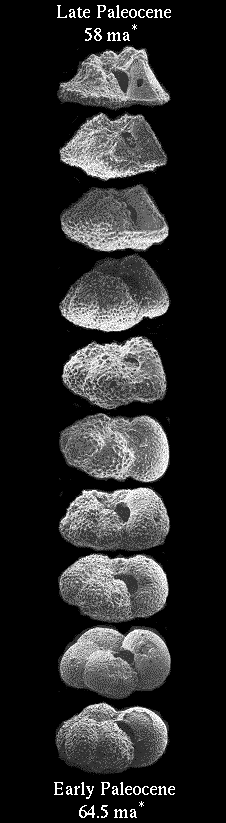
Drs. Tony Arnold (Ph.D., Harvard) and Bill Parker (Ph.D., Chicago) are the developers of what reportedly is the largest, most complete set of data ever compiled on the evolutionary history of an organism. The two scientists have painstakingly pieced together a virtually unbroken fossil record that shows in stunning detail how a single-celled marine organism has evolved during the past 66 million years.
A pic of a small piece of that 66 million year line, in ~700,000 year steps.
A great piece from the Florida State University interviewing PhDs Arnold and Parker about it.
A sample common decent transitional sequence. Image 1 and image 15 are two currently living species and image 7 is their 15-million-year-old ancestor. Imagine it in a V shape in time, 1 and 15 are the two top tips of the V and the lines converge back in time to pic 7 at the bottom of the V in the past.
The time resolution we get from seafloor sediment fossils is actually much better than the 700,000 year step size used in that first pic. This shows how we can see in fine detail the process of a species population stretching out and then splitting into two child species (one smaller one larger). Each horizontal line in that diagram represents a sampling of probably hundreds of individuals from the population at each given point in time. As noted in the interview above they have been able to follow and examine foraminifera branching through literally hundreds of speciation events. A branching tree of increasing diversity.
The oldest Foraminifera weren't able to grow their own mineral shells... they made their shells by gluing together specs of mineral-dirt collected floating in the ocean. Modern Foraminifera are extremely diverse, herbivorous and omnivours and carnivours... some have even invented FARMING protecting growing and eating algae farms inside their shells... modern Foraminifera are extremely diverse living in almost every ecological niche in almost every wet habitat on earth from the shoreline to the abyssal seafloor to floating near the sea surface from the arctic sea to the equator and in freshwater lakes and ponds and even Foraminifera species that have managed to adapt to moist soil land life. Most are near-microscopic, but the largest can be over half a foot across.
If you were looking for something more specific, let me know and I'll see if I can Google it up.
I wish I could find one good webpage with all the Foraminifera info in one place. There's lots more cool info and technical science papers, but I only find them scattered piecemeal.
- -
Re:But... but...
I'm not sure if it's exactly what you wanted, but here's a few links I have handy:
Drs. Tony Arnold (Ph.D., Harvard) and Bill Parker (Ph.D., Chicago) are the developers of what reportedly is the largest, most complete set of data ever compiled on the evolutionary history of an organism. The two scientists have painstakingly pieced together a virtually unbroken fossil record that shows in stunning detail how a single-celled marine organism has evolved during the past 66 million years.
A pic of a small piece of that 66 million year line, in ~700,000 year steps.
A great piece from the Florida State University interviewing PhDs Arnold and Parker about it.
A sample common decent transitional sequence. Image 1 and image 15 are two currently living species and image 7 is their 15-million-year-old ancestor. Imagine it in a V shape in time, 1 and 15 are the two top tips of the V and the lines converge back in time to pic 7 at the bottom of the V in the past.
The time resolution we get from seafloor sediment fossils is actually much better than the 700,000 year step size used in that first pic. This shows how we can see in fine detail the process of a species population stretching out and then splitting into two child species (one smaller one larger). Each horizontal line in that diagram represents a sampling of probably hundreds of individuals from the population at each given point in time. As noted in the interview above they have been able to follow and examine foraminifera branching through literally hundreds of speciation events. A branching tree of increasing diversity.
The oldest Foraminifera weren't able to grow their own mineral shells... they made their shells by gluing together specs of mineral-dirt collected floating in the ocean. Modern Foraminifera are extremely diverse, herbivorous and omnivours and carnivours... some have even invented FARMING protecting growing and eating algae farms inside their shells... modern Foraminifera are extremely diverse living in almost every ecological niche in almost every wet habitat on earth from the shoreline to the abyssal seafloor to floating near the sea surface from the arctic sea to the equator and in freshwater lakes and ponds and even Foraminifera species that have managed to adapt to moist soil land life. Most are near-microscopic, but the largest can be over half a foot across.
If you were looking for something more specific, let me know and I'll see if I can Google it up.
I wish I could find one good webpage with all the Foraminifera info in one place. There's lots more cool info and technical science papers, but I only find them scattered piecemeal.
- -
Re:But... but...
I'm not sure if it's exactly what you wanted, but here's a few links I have handy:
Drs. Tony Arnold (Ph.D., Harvard) and Bill Parker (Ph.D., Chicago) are the developers of what reportedly is the largest, most complete set of data ever compiled on the evolutionary history of an organism. The two scientists have painstakingly pieced together a virtually unbroken fossil record that shows in stunning detail how a single-celled marine organism has evolved during the past 66 million years.
A pic of a small piece of that 66 million year line, in ~700,000 year steps.
A great piece from the Florida State University interviewing PhDs Arnold and Parker about it.
A sample common decent transitional sequence. Image 1 and image 15 are two currently living species and image 7 is their 15-million-year-old ancestor. Imagine it in a V shape in time, 1 and 15 are the two top tips of the V and the lines converge back in time to pic 7 at the bottom of the V in the past.
The time resolution we get from seafloor sediment fossils is actually much better than the 700,000 year step size used in that first pic. This shows how we can see in fine detail the process of a species population stretching out and then splitting into two child species (one smaller one larger). Each horizontal line in that diagram represents a sampling of probably hundreds of individuals from the population at each given point in time. As noted in the interview above they have been able to follow and examine foraminifera branching through literally hundreds of speciation events. A branching tree of increasing diversity.
The oldest Foraminifera weren't able to grow their own mineral shells... they made their shells by gluing together specs of mineral-dirt collected floating in the ocean. Modern Foraminifera are extremely diverse, herbivorous and omnivours and carnivours... some have even invented FARMING protecting growing and eating algae farms inside their shells... modern Foraminifera are extremely diverse living in almost every ecological niche in almost every wet habitat on earth from the shoreline to the abyssal seafloor to floating near the sea surface from the arctic sea to the equator and in freshwater lakes and ponds and even Foraminifera species that have managed to adapt to moist soil land life. Most are near-microscopic, but the largest can be over half a foot across.
If you were looking for something more specific, let me know and I'll see if I can Google it up.
I wish I could find one good webpage with all the Foraminifera info in one place. There's lots more cool info and technical science papers, but I only find them scattered piecemeal.
- -
Re:hmmm.
http://www.don-lindsay-archive.org/skeptic/argume
n ts.html
"Burden Of Proof" the claim that whatever has not yet been proved false must be true (or vice versa). Essentially the arguer claims that he should win by default if his opponent can't make a strong enough case.
FYI: In debate there is zero need to site sources until a specific clam has been called into question. Failing to specify which if any assertions you disagree with implies you have zero counter arguments ("Failure To State") and generally speaking you would loose a debate a this point.
PS: "At least make a feeble attempt to become educated before you go spewing your biases and opinions -- because without supporting data, that's all you have." is a nice use of Ad Hominem (Argument To The Man). -
Re:The Famous MothsI did take some time to read that document, and I also took some time to look into its author. To quote this page: Rev. Wells decided in 1976 to "devote my life to destroying Darwinism" since it is incompatible with the beliefs of the Unification Church (the "Moonies"). He subsequently earned two Ph.D.'s (in theology and in biology) as a preparation for battle. Wells has indicated elsewhere that he is an "old-earth" creationist. He agrees that speciation has happened, but disputes common descent, and wants an ongoing role for God. Please read some of the reviews and rebuttals of of Reverend Wells other book, and see for yourself how its possible for someone to have a PhD in biology and yet still not understand how science works. I'm not a biologist, so I won't attempt to rebut the page you linked to - but you owe us all the favor of continuing to research what he writes, if you're going to cite it as cannon.
-
Re:An indefensible decision.
Second, we all know that Wikipedia is often an excellent first source of basic information on a topic. Me, I've got a Ph.D. and a book published with a university press, and I constantly refer to Wikipedia to ground myself in things.
Someone as educated as you claim to be should be aware of logical fallacy of Argument From Authority. Your education is impressive, but your endorsement of Wikipedia is about as useful as $CELEBRITY shilling for $CONSUMER_PRODUCT. -
Re:Miraculously..
Your argument against impeachment is an argument from adverse consequence.
That does not preclude impeachment. -
Re:Why bother?
That's the fallacious argument known as "Appeal to authority".
http://www.don-lindsay-archive.org/skeptic/argumen ts.html#authority
If you want to argue the toss, then step up to the plate and make your argument. But mentioning the first name that comes up in Wikipedia when you search for "Civil Disobedience" doesn't impress anyone. -
Re:Yeah, yeah, familiar with that one...
There is, however, a stupendous amount of ground to cover between a photosensitive patch and anything remotely resembling the eye (of an octopus, cat or person) and the very weakest of unintelligent forces working, hah, blindly along that path. Given a generational time of (reaches down, pulls out figure) one week, you only have about twenty (american) trillion generations to get the transition done in.
There are a few fundamental misunderstanding here. First, you are almost certainly greatly overestimating the number of changes required for evolution of the eye. Certain types of mutations, typically in developmental genes, can produce relatively large morphological changes. One somewhat simplistic model of eye evolution, simply assuming that mutations alter existing traits by 1%, within the range of variation, came up with 1829 mutations. Another error is imagining that these mutations have to occur in series. In fact, they occur in parallel across the population. The notion that the mutational distance between homologous genes is much larger than is consistent with rates of mutational change is an old objection that has pretty much collapsed now that the genomes are available and it is trivial to measure the actual mutational distances. The arguments that evolution of such features requires massive numbers of mutations turns out to be clearly wrong.
Oh, and you are also wrong in imagining that octopus eyes share the "unintelligent" backwards design of our retinas. -
Re:Bias in academiaYou may want to read this...
I am afraid the facts disagree with you. Sure there are educated conservatives but the majority of people with degrees as liberals by a long shot.
Poltical views range across a spectrum. From centrist, to moderate left/right to extremes at both ends. MOST people are somewhere in the middle... And I think you'll get very few arugments that there is a pretty harsh slant in academia...
We, as a society, REALLY need to re-learn the TRUE backbone of our nation -- COMPROMISE. If it wasn't our "Founders" -- those with extreme views on either side of the spectrum -- ability to COMPROMISE, America would have died in commity at the constitutional convention.
Ben Franklin, IIRC, interupted a particuarly heated argument during the creation of our Constitution -- he said something to the effect that "We have several planks of wood and we need to build a table. The pieces of wood are all uneven -- so to build a STRONG table, we must shave some bits off of each so they fit together and bare weight".
The left doesn't have *ALL* the answers... It's certain the right doesnt either. -
God of the Gaps
As we see more and understand more of how our world works, that means (logically) that god is less and less powerful. Right now (according to ID), god is directly responsible for "X" amount of the world around us, where "X" is everything we don't understand, or haven't observed directly. As we are constantly learning, that means that god is less and less responsible for the world around us, up until the point where we understand everything, and hence god (to quote Douglas Adams) disappears in a puff of logic.
FYI, this is a common argument from the creationists, known as the God of the Gaps. -
Re:apples and oranges
The original statement stands: an application can indeed be left in an "invalid state" following a communication and the verifier cannot catch these sorts of bugs.
Wrong again. It cannot catch all of these sorts of bugs, and nobody has said that it could. I even provided some counterexamples four days before this thread started. Your statement, though, was that a verifier can do nothing about such bugs. "Nothing" is an absolute negation. Since you're being such an ass about this, I'll reduce it to purely logical terms. Let X be the set of algorithmic errors, Y the subset of protocol errors (according to the definition used by myself and the Singularity team), and Z the set of errors that can be caught by a verifier. Your statement was that the intersection of X and Z is empty - not small, but empty. The Singularity paper shows that the set of Y and Z is not empty. Because Y is a subset of X, that means your claim must be false. It doesn't matter one bit whether there are bugs that are members of X but not Z, i.e. other kinds of algorithmic errors. No matter how many times you come back to it, that remains a red herring.
Only a system programmed fully with verification proofs can make guarantees about total correctness in the face of changing state.
That is not in dispute but, again, you are confusing "not all" with "none" and are guilty of moving the goalposts. We're not talking all or nothing; we're talking about zero vs. non-zero.
perhaps you can clarify what you mean by HTTP being an "external protocol". Do you only mean that it does not use the platform's built-in protocol mechanisms? Hate to break it to you, but most of the world is composed of protocols of this nature.
Either you're the stupidest person on Slashdot (quite an achievement) or you're playing dumb to red herring to distract from your previous dishonesty. An external protocol is, quite obviously, one that is used to communicate with an external entity - i.e. on another box, running a different OS image, accessed via an external network interface. You can look on the back of your machine and see one of those if you're still confused. The world is not, in fact, composed only of such protocols, but many think so because they generally only hear the word used in that context. What you're unaware of is that there are protocols running within your system as well. There are CPU/memory-bus protocols and I/O-bus protocols which can actually be quite complex and are often studied using the exact same tools as are used for the more familiar kind of network protocols. There are also protocols within software that are often not recognized as such but can be treated that way for purposes of verification. "Call open() to get a file descriptor and then pass that to read()" is a protocol, and automated tools can check e.g. that you don't call read() before calling open() or free() before calling malloc() etc. almost ad infinitum. Protocols are actually all around you, and only your own narrowness of vision prevents you from seeing that.
I'm sure you agree that every quote is a selective quote.
It's selective in the sense of argument by selective observation. I realize you're not fluent in English, but please at least try to understand people before you disagree with them.
-
Re:apples and oranges
The original statement stands: an application can indeed be left in an "invalid state" following a communication and the verifier cannot catch these sorts of bugs.
Wrong again. It cannot catch all of these sorts of bugs, and nobody has said that it could. I even provided some counterexamples four days before this thread started. Your statement, though, was that a verifier can do nothing about such bugs. "Nothing" is an absolute negation. Since you're being such an ass about this, I'll reduce it to purely logical terms. Let X be the set of algorithmic errors, Y the subset of protocol errors (according to the definition used by myself and the Singularity team), and Z the set of errors that can be caught by a verifier. Your statement was that the intersection of X and Z is empty - not small, but empty. The Singularity paper shows that the set of Y and Z is not empty. Because Y is a subset of X, that means your claim must be false. It doesn't matter one bit whether there are bugs that are members of X but not Z, i.e. other kinds of algorithmic errors. No matter how many times you come back to it, that remains a red herring.
Only a system programmed fully with verification proofs can make guarantees about total correctness in the face of changing state.
That is not in dispute but, again, you are confusing "not all" with "none" and are guilty of moving the goalposts. We're not talking all or nothing; we're talking about zero vs. non-zero.
perhaps you can clarify what you mean by HTTP being an "external protocol". Do you only mean that it does not use the platform's built-in protocol mechanisms? Hate to break it to you, but most of the world is composed of protocols of this nature.
Either you're the stupidest person on Slashdot (quite an achievement) or you're playing dumb to red herring to distract from your previous dishonesty. An external protocol is, quite obviously, one that is used to communicate with an external entity - i.e. on another box, running a different OS image, accessed via an external network interface. You can look on the back of your machine and see one of those if you're still confused. The world is not, in fact, composed only of such protocols, but many think so because they generally only hear the word used in that context. What you're unaware of is that there are protocols running within your system as well. There are CPU/memory-bus protocols and I/O-bus protocols which can actually be quite complex and are often studied using the exact same tools as are used for the more familiar kind of network protocols. There are also protocols within software that are often not recognized as such but can be treated that way for purposes of verification. "Call open() to get a file descriptor and then pass that to read()" is a protocol, and automated tools can check e.g. that you don't call read() before calling open() or free() before calling malloc() etc. almost ad infinitum. Protocols are actually all around you, and only your own narrowness of vision prevents you from seeing that.
I'm sure you agree that every quote is a selective quote.
It's selective in the sense of argument by selective observation. I realize you're not fluent in English, but please at least try to understand people before you disagree with them.
-
Re:Is The U.S. Becoming Anti-Science?When I look at the molecular biological paradoxes inherent in the evolution of the bacterial cilia into a flagellum, I think evolutionary biology involves more faith than belief in a god, even if that god is a "flying spaghetti monster".
Here's a nice discussion debunking the watchmaker/flagellin arguement
-
Re:Summary = [-1, Flamebait]
-
Re:Undersea volcanoes
Dude, I'm not retarded. I wasn't tricked into believing creationism by some fundie. I merely said that I do not think that evolutionary theory, as explained by science, tells the whole story. I believe that the truth lies somewhere between engineered and evolved.
So in other words, you think that evolutionary theory is incomplete, rather than incorrect. It's fine to think that. Now maybe you can go into research (biology, genetics, paleontology, etc) and help other researchers fill in the gaps.
Hopefully you're not just basing this on a "hunch" of some sort, without having considered the evidence.
Be careful not to fall into the God of the Gaps trap.
No scientific theory is ever fully complete... otherwise, there would be no job opportunities for researchers.
-
Re:Blocking Child Porn
Congratulations! You've just argued a fallacy!
See "Slippery Slope Fallacy" in the list of Fallacious Arguments -
God of the gaps
You are falling for the god of the gaps fallacy.
You claim that someplace or something isnt known then it must be the work of the gods. This argument keeps getting killed everytime a rational/scientific explanation comes about for such things as the weather, evolution, gravity, etc.
Now your just taking the god of the gaps to a friggin mountain. Not terribly convicing.
So today its a mountain, will your grandchildren be telling us that its in a far off galaxy (just interpret the ark as being a spaceship) when this is debunked/explained? When will the "gappers" stand-down and not take some ancient script as fact, but as interpration of events through the eyes of highly religious and uneducated peoples? -
Re:Star Trek: Enterprise to be cancelled?
the storylines are almost entirely incompatible with the rest of theStar Trek universe (Klingons that look like TNG/DS9/Voyager rather than TOS, etc).
My awareness of ST mythology is about a decade out of date, but are you suggesting that this change in appearance for Klingons is part of the story now? Was there some kind of cataclysmic Chernobyl event that caused the whole Klingon species to mutate from some kind of vaguely Fu Manchu types into the grotesque Motorhead roadies that they were to become in the movies & later television series?
If so, then this event, whatever it was, must have happened some time in the small handful of years between the end of the first series and the transfer of that crew, slightly older now, to a new ship. How much time was supposed to have elapsed there -- a decade or so, if that?
I think Spock would have some droll comment about logic or the lack thereof here, but I'll just switch genres and exclaim "holy punctuated equilibrium, Batman!"
Seriously though, if there's some kind of canonical explanation for this, I'd be happy to read it -- I thought it was just an inconsistency that had been swept under the rug and happily ignored, which makes explaining the current ST series easier to swallow. But then, like I say, I haven't watched any of these shows in about a decade now...
-
Re:I like the sound of it.
Who has simulated the development of the eye and found the results you describe? What were the conditions of the simulation?
See "A Pessimistic Estimate Of The Time Required For An Eye To Evolve", D.-E. Nilsson and S. Pelger, Proceedings of the Royal Society London B, 1994, 256
Or a summary here. -
God of the Gaps
This argument has the form
There is a gap in scientific knowledge.
Therefore, the things in this gap are best explained as acts of God.
This is not based in logic. It is simply a statement of pessimism about the future progress of science.
Down through the centuries, science has eliminated a great many of its gaps. People who had used the Gap argument were embarrassed, since their God shrank in power with each new scientific advance. For example, after the work of Galileo and Newton, it was no longer thought that angels pushed the planets across the heavens.
A more recent example is the argument by some Creationists that complex molecules (such as amino acids) could not have arisen by natural processes on the early earth. Hence, life could not have arisen by natural means, and God must have miraculously created these chemicals while creating life. The chemicals were part of a Purpose.
The basis of this argument was a gap in scientific knowledge. This basis fell apart when molecules (including organic molecules) were detected in interstellar space by astronomers. The argument came further apart when amino acids were found inside the Murchison meteorite. Apparently the basic molecules of life form naturally in some quite harsh places, and there is a way for vast quantities to have arrived intact on the early earth. So, their existence has Purpose only to the extent that the entire galaxy does.
Taken from here. -
Re:Er heh
According to version 0.6 of The
-
Re:liberal
Will you guys please stop playing semantic games and remember that "A rose by any other name would smell as sweet"
Also just because something is a gateway that doesn't mean it should be avoided. This is known as the Slippery Slope Fallacy. For example being born is a gateway to death, so should we avoid being born? Driving a car is a gateway to being a getaway car driver. Having a drink is a gateway to becoming an alchoholic. -
Ah, yes, good ol' Don Lindsay
Everyone knows who he is, don't they?
Besides, you ruined your own point by immediately coming up with said snappy answer.
It can be easily inferred that the reason we went to war with Iraq was mainly to make citizens of the US everywhere safer. Liberation of Iraq was secondary, as well it should be (and they don't really appear to be that damn thankful).
"Do you feel safer" is an honest question based on the reasons Bush gave us for going to war. You say you feel safer, hooray for you. I don't, reference this post, elsewhere in this thread for part of the reason why (so many new pissed-off potential terrorists created because of this action).
And I don't hate Bush because I'm partisan, I hate him because he's a simpleton, a liar and a sop for the oil industry. I wasn't a big fan of his dad's, but he did an excellent job in building a world-wide coalition in GW I (something Dubya failed miserably at) and the reasons he gave for the it 'resignated' (to use a GWB word) with the world community. -
Re:But that's not why we went in
Do I feel safer? What a ridiculous Argument by Question. I guess, though, there is a snappy answer for that. The answer is, "yeah, a little." I wonder what you'd be saying if we hadn't gone to war, and a year from now terrorists exploded a nuke in NYC, which they obtained from Saddam. In 1937, nobody thought Hitler would start a world war. If only somebody had the GUTS to take him out then. But, if somebody had, whiny bitches like you would have screamed bloody murder.
Is it worth the money? Yes. At least we got some use out of all those years of training and weapons' research.
Is it worth 148 American lives? Yes. Any loss of life is a tragedy. But, we sent over 300,000 troops, and we lost 148. That's a pretty damn good ratio. I wonder how many of those people would have died anyway from random violence, car accidents, etc. At least they died for something.
Is it worth a few thousand Iraqi lives? Yes. A few thousand died, and now 5 million are free. Saddam murdered hundreds of thousands. If a few thousand had to die to prevent hundreds of thousands more from dying, that's worthwhile.
Absence of proof is not proof of absence. It's not like Saddam didn't have plenty of time to hide, destroy, or move his WMD. Remember, you're talking about an area the size of California here. We assumed Saddam had something like 20,000 gallons of chemical weapons. That would fit in a swimming pool. How are you going to find that if he has it buried in the desert, and then kills all the workers? Give it time. And, if Clinton had done it, I would be all for it, just like I was with Bosnia and Kosovo. I'm a Libertarian...I hate the democrats just as much as I hate the Republicans. It's you whose blinded by partisanship. You're so filled with hate of George Bush, that you'll make up any excuse, even to the point of supporting a maniac like Hussein, just so you can be against George Bush. Sad. -
Re:patheticYou're very funny. Let me directly quote the great-grandparent which you wrote:
Peta should be advocating the fact that animals are sentient beings, not a renewable resource. And for those pathetic scientists who even created such a device should deserve death at the least, using their own stupid machines.
Where did you use the "=" sign there? You said scientists who create a technology should be put to death "at the least" (I'm wondering what your "most" would be...). You did not say the users of the machines should be put to death, you said the creators. That's like suing Ford for a drunk driver killing your relative. (Pssst... it's not equal.)
I didn't insult your education, call you a fool, or discuss your drug use or lack thereof. I merely said you were being hypocritical, and you didn't answer my question: do you eat vegetables for which you must kill the organism in order to produce the food? (Carrots, potatoes, beets?)
Unlike animals, if an apple is broken off the tree, first, it doesn't feel pain (no nervous system) and second, it can REGROW the apple i.e. regenerate.
But carrots, potatoes and beets cannot regenerate; you kill them by harvesting them.
And just because a plant doesn't have a nervous system doesn't mean that you're not removing a life force from the Earth when you kill plants. They have a Kirlian aura which you're snuffing out. And check out PEVA, who argue that plants and even single-celled organisms can feel pain ("Some single cell organisms are known to react and withdraw (run!) from heat. Is this not a single-cell pain reaction without a complex human-like nervous system? How can a single cell make this determination without having a 'brain'?")
Oh, and as for religious references? Let's take Genesis:
"26": And God said, Let us make man in our image, after our likeness: and let them have dominion over the fish of the sea, and over the fowl of the air, and over the cattle, and over all the earth, and over every creeping thing that creepeth upon the earth.
Now, from Dictionary.com, dominion is:
1. Sovereign or supreme authority; the power of governing and controlling; independent right of possession, use, and control; sovereignty; supremacy.
Combining the two: God gave us supremacy over the animals. The power to govern, control, possess, and use them for our purposes.
And if you follow a more scientific track, we evolved as omnivores and the few people who I have seen attempt a vegan lifestyle ended up emaciated, weak, pale, and short. (Yes, this is anecdotal evidence.)
I'm not trying to pick a fight -- but you obviously are, given the wording in the great-grandparent post:
Go ahead, FLAME ME. But it's the truth.
Calling something the truth without providing references is a Fallacious Argument. There's lots on that page; take your pick.