Slashdot Mirror
Domain: epa.gov
Stories and comments across the archive that link to epa.gov.
Comments · 1,291
-
This is not Chernobyl
I seem to notice that there is a lot of FUD and misinformation out there (not just from mdsolar and Beyond Nuclear) regarding nuclear power. This is helped in part because of ignorance by the general public. It's important to understand that there is a wide range of radioactive sources. Most of them are naturally occurring, or occur is such small amounts that they present no health hazard.
Radiation exposure is usually measured in Rem (or mRem). Let's take a look at some common activities and see how they compare.
One chest X ray (8 mRem)
One mammogram (70 mRem)
One X ray of the abdomen (300 mRem)
One renal nuclear medicine procedure (310 mRem)
One CT head scan (3000 mRem)
CAT scan of whole body (5000 mRem)
As you can see, there is a wide variance of radiation sources. Most people in the US receive approximately 300 mRem / year from natural background radiation sources (primarily from radon and sun exposure.) So, how much radiation exposure do you need to cause bodily damage?
There is no agreed-upon level which is considered "safe", however there is relatively clear agreement on thresholds where radiation has noticeable effects on the human body. (NOTE: These are listed in Rem, not mRem)
Changes in blood chemistry (5-10 Rem)
Nausea (50 Rem)
Fatigue (55 Rem)
Vomiting (70 Rem)
Hair loss (75 Rem)
Diarrhea (90 Rem)
Hemorrhage (100 Rem)
Possible death (400 Rem)
Death within 1-2 weeks (1000 Rem)
Damage to central nervous system (2000 Rem)
Death within days (2000 Rem)
But what about cancer? The risk for cancer can be increased by radiation exposure, which resulted in increased mutation rates of cell growth. The EPA estimates that in a group of 10,000 people 2,000 of them will die from cancer. If each person received 1 Rem (not mRem) of non-natural ionizing radiation exposure accumulated over their lifetime, 2,006 people would die from cancer.
So, now that we have an idea of just how bad different levels of radiation exposure are, what about these tritium leaks that have got certain people so upset? The highest reading that these monitoring wells have read was 2.45 microcuries / liter. This translates into roughly 425 mRem / year (assuming it was not diluted). 425 mRem is substantially higher than the current NRC limits, but still much too low to present a health hazard.
When people hear words like "nuclear reactor piping leak" they naturally assume that high-level radioactive particulates are getting out to the environment. The fact is that the incident at Vermont Yankee represents a very small health hazard to the public.
-
This is not Chernobyl
I seem to notice that there is a lot of FUD and misinformation out there (not just from mdsolar and Beyond Nuclear) regarding nuclear power. This is helped in part because of ignorance by the general public. It's important to understand that there is a wide range of radioactive sources. Most of them are naturally occurring, or occur is such small amounts that they present no health hazard.
Radiation exposure is usually measured in Rem (or mRem). Let's take a look at some common activities and see how they compare.
One chest X ray (8 mRem)
One mammogram (70 mRem)
One X ray of the abdomen (300 mRem)
One renal nuclear medicine procedure (310 mRem)
One CT head scan (3000 mRem)
CAT scan of whole body (5000 mRem)
As you can see, there is a wide variance of radiation sources. Most people in the US receive approximately 300 mRem / year from natural background radiation sources (primarily from radon and sun exposure.) So, how much radiation exposure do you need to cause bodily damage?
There is no agreed-upon level which is considered "safe", however there is relatively clear agreement on thresholds where radiation has noticeable effects on the human body. (NOTE: These are listed in Rem, not mRem)
Changes in blood chemistry (5-10 Rem)
Nausea (50 Rem)
Fatigue (55 Rem)
Vomiting (70 Rem)
Hair loss (75 Rem)
Diarrhea (90 Rem)
Hemorrhage (100 Rem)
Possible death (400 Rem)
Death within 1-2 weeks (1000 Rem)
Damage to central nervous system (2000 Rem)
Death within days (2000 Rem)
But what about cancer? The risk for cancer can be increased by radiation exposure, which resulted in increased mutation rates of cell growth. The EPA estimates that in a group of 10,000 people 2,000 of them will die from cancer. If each person received 1 Rem (not mRem) of non-natural ionizing radiation exposure accumulated over their lifetime, 2,006 people would die from cancer.
So, now that we have an idea of just how bad different levels of radiation exposure are, what about these tritium leaks that have got certain people so upset? The highest reading that these monitoring wells have read was 2.45 microcuries / liter. This translates into roughly 425 mRem / year (assuming it was not diluted). 425 mRem is substantially higher than the current NRC limits, but still much too low to present a health hazard.
When people hear words like "nuclear reactor piping leak" they naturally assume that high-level radioactive particulates are getting out to the environment. The fact is that the incident at Vermont Yankee represents a very small health hazard to the public.
-
methane, more food, etc? A greenwash.
This is just a distractionary greenwash.
- The livestock industry is already the largest source of methane. This would no doubt result in more methane.
- Cattle already require enormous amounts of feed to produce the same amount of caloric food value (ie, it's much more efficient to eat bread and vegetables in terms of how much food grown makes it to you, by the calorie.) This will make them consume more food.
It's kind of staggering to realize that there are almost 100 million cows in the US.
-
Re:A telescreen in my pocket
Here's some pics that I should have linked to in above post. 30 years ago these things were the size of a car. Now they look like overgrown weather stations.
-
Re:Just to head this off...
The distinction is ionizing vs non-ionizing radiation.
Linky-poo, just for you. -
Re:not getting it here
It's a poor measure of performance. It has been picked because it's something people can relate to. For gas cars, all four variables are linear with each other (I.E., double the gas used per mile, double the CO2 production). Cost MPG, when used, is even worse - because the cost of gasoline varies. With electric cars, those parameters are not linear with each other, or vary randomly. For example, suppose we plug the electron guzzling hummer in to a solar panel, and plug the smartkart into a coal powerplant. What's better? Now the pollution MPG measure is completely broken.
People have been proposing a system where electric vehicles are rated in terms of kilowatt-hours per hundred miles. One thing good about this system is that it uses kilowatt-hours, so we can easily calculate the other figures (cost of electricity is known, emissions data can be found). The problem with this scheme is that it is the inverse of the current scheme, so bigger = worse. In the current scheme bigger = better. You could rate cars in terms of miles per kilowatt-hour, or MPK, but then you get really small values (Tesla Roadster = 4 MPK). When you add in plug-in hybrids, you just make the even worse. -
Re:nothing to see here.
For the last time, climate is not weather.
-
Re:bleach is great but focus on antibiotics
You can drink it when highly diluted as a water purifier.
At a dilution of 8 drops of bleach to 3.8 liters (1 gallon) of water, that ratio should give you some idea of how 'harmless' it is, for us organics at least. -- http://www.epa.gov/ogwdw000/faq/emerg.html
-
Re:Binding authority
Sir —
A few notes.
International treaties and laws don't become binding on US citizens automatically, or just because the president signed them. All international agreements must be approved by congress and signed by the president before the agreement becomes binding on Americans.
This is called ratification. Many countries have such a two-step process. Incidentally, it is the Senate that ratifies treaties signed by the President of the United States (with a 2/3rds majority).
Congress cannot give up law making power to any other body. For example, Congress couldn't pass a law that says "from now on, the UN can make laws for the US." It would be unconstitutional. Laws cannot be constructed so as to bypass either/both houses because of the bicameralism principle. For example, congress passed a bill which gave power over deportation to the inspector general, but retained a veto over his actions for one house of congress. The issue came up to the Supreme Court, and a one house veto was considered unconstitutional because of bicameralism. Laws cannot be constructed to pass the president either, because of the presentment principle. US diplomats and negotiators have agreed to countless international laws, only to have the proposed laws killed or modified beyond recognition in congress.
Congress delegates authority to create laws to all sorts of regulatory authorities, ranging from the U.S. Treasury through the Environmental Protection Agency. There is nothing wrong with such delegation. The Senate can delegate to foreign authorities as well. For example, when the Senate ratified NAFTA they created an extra-national binational arbitral authority that can strike down or read into U.S. laws (Congress reacted poorly to this authority, but the U.S. Courts have upheld it, as I understand it), notably Chapter 19 (Anti-dumping and countervailing duties).
For the specific fears of the person I was talking with, SCOTUS has already held handgun bans unconstitutional. Even if somehow a gun ban got past congress & the president, the Supreme Court would strike it down immediately. Ditto for free speech, the Supreme Court has long pushed free speech jurisprudence beyond what was popular at the time. It was the Supreme Court striking down libel suits, media shutdowns, and restrictive speech laws. The Supreme Court has demonstrated ability and willingness to strike down unconstitutional laws & actions
It is unconstitutional for the U.S. federal government to create laws that would prevent gun ownership laws within states. States still have the sovereign right to ban guns, as I understand it.
The Supreme Court has two relevant powers with respect to free speech. First, they can read out or modify state and federal laws that are unconstitutional (thus protecting citizens from the state). Second, they can overturn any decision by lower courts in a civil dispute between two private people so as to uphold each individual's constitutional rights.
The Supreme Court had the power to review any law or action binding on a US citizen.
This statement is incorrect for a number of reasons. First, the Supreme Court of the United State can only hear two types of disputes:
1. those between the federation and states and between states (e.g. New York and California); and
2. appeals from the highest Court in any state, which appeals involve federal or constitutional questions.Second, SCOTUS cannot directly review any decision made by foreign courts or arbitrators, whether those decisions apply to US citizens or not (they could, however, review lower-court decisions involving arbitrations and/or decisions of foreign courts- namely in the comity/enforcement context). Citizenship is irrelevant.
Third, SCOTUS can review any law or action th
-
Blame neurotoxins in food and environment
The food that most kids eat often contains flavor enhancers such as aspartame, sucralose, splenda, and MSG (aka 'autolyzed plant protein,' 'hydrolyzed plant protein') that have powerful neurological effects (that's why they are effective in stimulating the tongue nerve cells). Unfortunately, though, many of these substances also have toxic effects on nerve cells due to overstimulation or other means. Other neurotoxins in widespread use (compared with 1938) include solvents, lead, cell phone radiation, mercury, drugs, and high blood sugar (diabetes and pre-diabetes are much more widespread due in part to increased sugar consumption). It's likely that the increased environmental exposure of children to neurotoxins since 1938 has caused much of the increase in mental illness.
-
Re:On Hybrid Vehicles
Diesels also tend to last longer and any engine is dwarfed by the size of a ship or train. Most smaller boats are gasoline, unless they are displacement hulls (like sailboats). Diesel fuel itself is more dense and heavier - and also takes more crude to make.
Don't make the mistake of comparing MPG with diesel and gasoline. Distance-per-dollar is much more useful from a practical standpoint - though that is volatile. If you are trying to be environmentally friendly, you'd have to look at Distance-per-pound of carbon. Those numbers are:
Gasoline carbon content per gallon: 2,421 grams
Diesel carbon content per gallon: 2,778 grams
(source)So a gasoline car that gets 35 MPG (14.46 miles per kilogram of carbon) is roughly equivalent to a diesel car that gets 40 MPG (14.40 miles per kilogram of carbon).
-
Re:I am very sceptical...
You are so full of false assumptions you smell like manure.
B.S., and no I'm not saying you've got a bachelor's of science. lol.
Assumptions? How about THIS assumption:
EPA and nine other federal agencies this week officially awarded $5.5 million dollars in climate change study grants to 27 developing countries. These nations will use the money to develop greenhouse gas inventories and action plans for reducing global warming emissions.
Hmmm... Maybe you would like to read my assumptions from the EPA:
On February 17, 2009, President Obama signed the American Recovery and Reinvestment Act of 2009 (Recovery Act). The Recovery Act seeks in part to spur technological advances in science and health and to invest in environmental protection and other infrastructure that will provide long-term economic benefits. EPA manages over $7 billion in projects and programs that will help achieve these goals, offers resources to help other agencies “green” a much larger set of Recovery investments, and administers environmental laws that will govern Recovery activities.
How much of this money do you think goes to AGW skeptics?
Yeah, I smell manure too. Maybe you should provide some sources... Hell, even some opinions of your own instead of just hurling insults. You need something more than, "you're wrong" to make a point.
-
Re:I am very sceptical...
You are so full of false assumptions you smell like manure.
B.S., and no I'm not saying you've got a bachelor's of science. lol.
Assumptions? How about THIS assumption:
EPA and nine other federal agencies this week officially awarded $5.5 million dollars in climate change study grants to 27 developing countries. These nations will use the money to develop greenhouse gas inventories and action plans for reducing global warming emissions.
Hmmm... Maybe you would like to read my assumptions from the EPA:
On February 17, 2009, President Obama signed the American Recovery and Reinvestment Act of 2009 (Recovery Act). The Recovery Act seeks in part to spur technological advances in science and health and to invest in environmental protection and other infrastructure that will provide long-term economic benefits. EPA manages over $7 billion in projects and programs that will help achieve these goals, offers resources to help other agencies “green” a much larger set of Recovery investments, and administers environmental laws that will govern Recovery activities.
How much of this money do you think goes to AGW skeptics?
Yeah, I smell manure too. Maybe you should provide some sources... Hell, even some opinions of your own instead of just hurling insults. You need something more than, "you're wrong" to make a point.
-
Re:Quick! We need some fundings!
Obviously the solution is to genetically engineer the bacteria in ruminant stomachs to produce no methane....
The largest single source of methane is decomposing wetlands.
Save the world - pave a swamp! And make damn sure you blame humanity for everything!
-
You can help Makers, teachers, students & your
Consider that the average inkjet has:
2 stepper motors with drive gears, drive belts and spring tensioned end pully.
A rotary encoder (probably 360 deg/ rev.) and linear encoder with encoder tape .
2 or more optical switches with wire harness prepared and the "little swinging door thing" to close the signal.
2 ground steel rods, possibly with brass bushings Ample surface mount components that no one cares about roasting while practicing their surface mount soldering skills. (Data sheets are easy to google and if you desolder well you have free robot IC's)
Assorted gears, wheels, springs, standard sheet metal screws, and more.
If you're concerned about giving it away on Craigs list to someone who will try to resell it to people who don't understand the cost of ink, rip off the useless (non hazmat) plastic covers, take a picture, and label the add "free robot parts."
We teachers, engineering students, and "Makers" know good project parts when we see them. The trick is just knowing where to find us!
Or, if you just want to be done with it check the EPA’s E-cycling resource page:
http://www.epa.gov/osw/conserve/materials/ecycling/pubs.htm -
Re:LED lighting vs. CFL question
First generation CFLs contained a level of mercury that today would be considered excessive (25-50 mg / bulb), and the broken bulbs of early adopters are what spawned the big "EPA cleanup" panic with CFLs a couple of years ago. Since 2007, the mercury level in today's generation of CFLs (3mg) is "mostly harmless", i.e. broom-sweepable.
Individual Fluorescent Bulbs - About 60 percent of all fluorescent lamps sold in the U.S. in 2004 contained 10 mg of mercury or less. The remaining 40 percent contained more than 10 mg and up to 100 mg of mercury. Four-foot linear fluorescent lamps contained an average of 13.3 mg, with a high of 70 mg and a low of 2.5 mg. Compact fluorescents (CFLs) had the least amount of mercury per lamp in 2004; two-thirds of CFLs contained 5 mg of mercury or less, while 96 percent contained 10 mg or less. --Consumer and Commercial Products | Mercury | US EPA
-
Re:Hg
I'm not sure what you mean by "passively" eat - eating is eating.
Fish have mercury in them, some more than others, from pollution and the way the food chain works. Eating fish containing mercury can be dangerous if you eat too much.
-
Re:Zero Emissions are worse??
This isn't as simple as you're thinking. Nickel Metal Hydride batteries are manufactured as a paste and rolled or turned into prismatic cells. It's difficult to recover the elements put into the pack.
Replying directly to your request for a citation, the EPA has a nice page here describing all of the wonderful sickness you can enjoy when you have nickel in your water: http://www.epa.gov/ttn/atw/hlthef/nickel.html
Sounds like a great waste of energy to recover the batteries anyways;
"The recycling process starts by removing the combustible material, such as plastics and insulation, with a gas fired thermal oxidizer. Gases from the thermal oxidizer are sent to the plant's scrubber where they are neutralized to remove pollutants. The process leaves the clean, naked cells, which contain valuable metal content.
The cells are then chopped into small pieces, which are heated until the metal liquefies. Non-metallic substances are burned off; leaving a black slag on top that is removed with a slag arm. The different alloys settle according to their weights and are skimmed off like cream from raw milk.
Cadmium is relatively light and vaporizes at high temperatures. In a process that appears like a pan boiling over, a fan blows the cadmium vapor into a large tube, which is cooled with water mist. This causes the vapors to condense and produces cadmium that is 99.95 percent pure.
Some recyclers do not separate the metals on site but pour the liquid metals directly into what the industry refers to as 'pigs' (65 pounds) or 'hogs' (2000 pounds). The pigs and hogs are then shipped to metal recovery plants. Here, the material is used to produce nickel, chromium and iron re-melt alloy for the manufacturing of stainless steel and other high-end products.
Current battery recycling methods requires a high amount of energy. It takes six to ten times the amount of energy to reclaim metals from recycled batteries than it would through other means. "
http://www.batteryuniversity.com/partone-20.htm -
polluted air
Plus, if you're ever going to sell your house, taking it outside is a good idea. Buyers can smell it, and you can't get that smell out without replacing every soft surface (carpets, etc.) and fresh paint in every room.
Guess what? The vapors from that paint may be toxic as well. Is Apple refusing to repair Macs when it was in a room that was painted? Actually many things outgas Volatile Organic Compounds, including Macs.
Falcon
-
Re:MOD parent down, uninformed
It may be more of a danger to children, but to dismiss an environment that is coated with poison dust as harmless without further study is absurd.
http://www.scientificamerican.com/article.cfm?id=what-is-third-hand-smoke
First, let's change the rhetoric to "chemicals" instead of the FUD "poison." Virtually the same chemicals exist in wood smoke that exist in cigarette smoke--unsurprising since they're both combustion byproducts of plant matter. If you want some pretty reliable numbers on amounts resulting from combustion, I refer you to the EPA's AP-42 for wood combustion (scroll down to Ch. 1.6). Pretty much every scary-sounding chemical in cigarette smoke is also in your friendly campfire. Dioxins, arsenic, mercury, lead, etc. The difference is people actively breathe in the smoke from a cigarette, which leads me to...
Second, how a chemical enters your body and in what quantities is equally important. Just as you haven't died from your first exposure to a campfire, so too will you not die from incidental exposure to cigarette residue. Inhalation and injection are efficient ways to get chemicals into your body, but absorption through undamaged skin is pretty damn inefficient for most.
All this to say that "third hand smoke" is a FUD buzzword. It's nothing more than the microscopic particulate traces (i.e. ash) containing the same compounds you'd find from standing near a campfire. Back to the topic at hand--that incidental exposure to a surface stained by cigarette smoke is unlikely to cause anything other than personal discomfort as long as you wash your hand afterwards.
-
Re:susceptible cities
Wrong on both counts.
The Ninth Ward dates back to the early 19th century, and many of the areas that were hard-hit were just or nearly as old as the high-and-dry French Quarter.Compare:
Historical NOLA Maps
http://alabamamaps.ua.edu/historicalmaps/us_states/louisiana/NewOrleans.htm
Katrina Flood Maps
http://www.katrina.noaa.gov/maps/images/katrina-flood-depth-estimation-08-31-2005.jpgRegardless, the question is sort of moot- inhabited areas have become radically more flood-prone in the last 100 years due to federal and Army Corp damming and canaling projects, which have decimated Louisiana's wetlands, the best defense against large-scale flooding. Ask the EPA: http://www.epa.gov/owow/wetlands/pdf/Flooding.pdf
-
Re:Do or do not: There is no moderation.
First, because farmers can't use certain very safe and developed pesticides, they have to use older and much more toxic varieties. Not to mention the actual amount of pesticides residue you eat a year has less cancerogenic substances than a cup of coffee. The thing is, the human body is very resilient and such exposure just doesn't matter.
Care to provide any supporting information for your assertion that organic farmers use "older and much more toxic" pesticides? Talk about pure bullshit...
Here's what the EPA has to say about it.
As for the issue of pesticide residue, I'm sure that the amount of pesticide residue for a given piece of produce usually falls below some FDA threshold, and I'm sure that washing produce helps even more. The point I was trying to make, though, was not that pesticides are eeeeevil. They have their place in agriculture, but there is growing evidence that they are being overused. In short, heavy use of pesticides (and fertilizers) is not sustainable agriculture.
When you need to dose the shit out of your plants (killing pollenating insects and doing other harm to the biosphere) to keep them from being eaten alive, you're doing it wrong. Your crops are too dense. When you need to pour on the fertilizer to make up for the fact that you've pulled all the nutrients out of the soil, you're doing it wrong. It's not sustainable. You're reliant on Monsanto for your engineered seed + RoundUp and Saudi Arabia for your petro-based fertilizers.
My concern is not based in some wooly-headed "o noes chemicals" fear. I would sign up to have a neighborhood-sized pebble-bed nuke plant next to my backyard if I could. I just believe that we can choose better ways to do things.
As ever, the Wikipedia article on the subject provides the much needed citation. Some of the substances they use a really poisonous, and to add insult to injury, not effective enough. Yeah, as you may have heard "organically grown food" is more expensive because there is less of it, one of the reasons is that the "biopesticides" are just not effective enough.
Actually, organic foods would definitely taste better when you're feeling morally superior. However you cannot taste the difference in a double-blinded test. Especially because YMMV, and the big problem to discerning the difference in taste is that when you *know* you're getting organic you attribute any goodness as organic, and when you *know* you're getting non-organic for all untastyness you blame the non-organic origin of the food. You don't get better nutritional value, and especially for your money it's quite a bummer. Just buy better beef without regard of it being free-range or not.
If you don't eat junk food, then you'll get 99% of the health benefits of any food switch. Last 1% you can get if you have a local farmer that supplies you with good food every day, but that's practically impossible.
As I thought I made clear in my original post, my motivation for buying Organic food is not specifically for a perceived superiority in taste. High-quality produce is high-quality produce regardless of whether or not it's Organic.
Yeah, you should totally do that, it's a damn shame that whole organic-food charade. When the whole point should have been "we want better food" we're being f*cked organically when no proof of health benefits have been discovered yet.
Meat, on the other hand, is a whole other ball of wax.
As an example, the "free range" chicken breasts I buy are far and away superior in taste and texture to the premium conventional breasts I buy every once in a while (depending on which grocery I get to). I usually make a chicken vindaloo several times
-
Re:Do or do not: There is no moderation.
First, because farmers can't use certain very safe and developed pesticides, they have to use older and much more toxic varieties. Not to mention the actual amount of pesticides residue you eat a year has less cancerogenic substances than a cup of coffee. The thing is, the human body is very resilient and such exposure just doesn't matter.
Care to provide any supporting information for your assertion that organic farmers use "older and much more toxic" pesticides? Talk about pure bullshit...
Here's what the EPA has to say about it.
As for the issue of pesticide residue, I'm sure that the amount of pesticide residue for a given piece of produce usually falls below some FDA threshold, and I'm sure that washing produce helps even more. The point I was trying to make, though, was not that pesticides are eeeeevil. They have their place in agriculture, but there is growing evidence that they are being overused. In short, heavy use of pesticides (and fertilizers) is not sustainable agriculture.
When you need to dose the shit out of your plants (killing pollenating insects and doing other harm to the biosphere) to keep them from being eaten alive, you're doing it wrong. Your crops are too dense. When you need to pour on the fertilizer to make up for the fact that you've pulled all the nutrients out of the soil, you're doing it wrong. It's not sustainable. You're reliant on Monsanto for your engineered seed + RoundUp and Saudi Arabia for your petro-based fertilizers.
My concern is not based in some wooly-headed "o noes chemicals" fear. I would sign up to have a neighborhood-sized pebble-bed nuke plant next to my backyard if I could. I just believe that we can choose better ways to do things.
Actually, organic foods would definitely taste better when you're feeling morally superior. However you cannot taste the difference in a double-blinded test. Especially because YMMV, and the big problem to discerning the difference in taste is that when you *know* you're getting organic you attribute any goodness as organic, and when you *know* you're getting non-organic for all untastyness ou blame the non-organic origin of the food. You don't get better nutritional value, and especially for your money it's quite a bummer. Just buy better beef without regard of it being free-range or not.
If you don't eat junk food, then you'll get 99% of the health benefits of any food switch. Last 1% you can get if you have a local farmer that supplies you with good food every day, but that's practically impossible.
As I thought I made clear in my original post, my motivation for buying Organic food is not specifically for a perceived superiority in taste. High-quality produce is high-quality produce regardless of whether or not it's Organic. Meat, on the other hand, is a whole other ball of wax.
As an example, the "free range" chicken breasts I buy are far and away superior in taste and texture to the premium conventional breasts I buy every once in a while (depending on which grocery I get to). I usually make a chicken vindaloo several times a month (sometimes twice a week if we're fixated), and my wife can always tell when I've bought the Perdue chicken. I'd be willing to believe that it's simply a matter of freshness, but given the consistent discrepancy I'm not so sure. I know that often the factory chicken producers inject their meat with saline to plump it up, so maybe that's it... Or maybe it has something to do with the fact that one set of chickens is crammed into a pen so small they can't turn around and fed growth hormones their whole (short) lives, and the others are allowed to develop somewhat normally. I dunno. I don't really care -- I'm willing to pay more for chicken that tastes good.
As for steak... Have you ever had real grass-fed steak? The marbling is totally different. There's tons more flavor without needing to dress up the meat. If you haven't
-
Re:Is the g'ment paying pre-housing bust prices?
http://www.epa.gov/mercury/spills/#thermometer/
You trying to make me feel old? 8^)
-
Re:To be fair?
I think EVs need to be more strictly regulated in their mileage claims. Let them go on the same treadmill as they gasoline/diesel cars must ride.
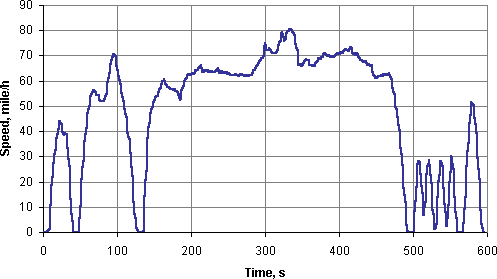
That's part of the problem, actually. They *do* go on the same treadmill that gasoline/diesel cars must ride. However, gasoline cars are most efficient at around 55mph. On the contrary, the Tesla Roadster, like most EVs, is most efficient at low speeds -- in its case, about 18 miles per hour. Plus, it regens from stop and start, while conventional gasoline cars don't. The net result is that they ace their city mileage, and due to the fact that the US06 highway cycle still has lower speed sections and stops and starts, they do better than they would if you're driving long distances on an interstate (the US06 cycle is more like taking a highway from your home to work than driving from state to state). So out of pure coincidence, our current cycles tend to overstate EV ranges.
Some EVs are even worse than Tesla. The Nissan Leaf's 100 miles range is on the LA-4 city cycle, which is even gentler than the FTP-75 cycle that our cars' city mpg rating is based on. And the Mitsubishi MiEV's 100 mile range is based on the Japanese 10-15 cycle, which is also exceedingly gentle.
I like Aptera's approach for stating range. The Aptera 2e is a composite 2-seater with a large payload area and a ridiculously low drag coefficient. They only give their vehicle a 100 mile range, but that's for 75mph, two passengers, a full payload, and AC and headlights on.
-
The truth is available with high school physicsI am always interested in the CO2 output of these pure electric vehicles. After all, right now we power most of the electric grid with coal and until that changes it dosen't make sense to wish or just assert what things out to be instead of just doing some simple research and high school physics calculations.
Let's look at the real data from the real sources...
According to Tesla motors official specifications the motor has a output of 248 peak horsepower (185kW) and 276 ft/lbs (375 Nm) of torque. Also, for full charge it takes "3.5 hours using the Tesla Motors Home Connector at 240 Volts and 70 amps" which for simplicity and because they have neglected to disclose the actual kwh of full empty to full charge at room temperature (capacity will degrade with use) lets assume is 3.5hrs * (240V * 70A) = 58.8 kwh. Most likely this is an overly conservative estimate because of the constant current constant voltage nature of charging lithium batteries. This is more important than battery capacity because it is the load the power plant feels to charge your car and is the important quantity of interest. This will take you 244 miles on average (from same site) of course flat straight stretches will get better but it is the average that is most important. Total is 58.8 kwh/ 244 miles or about
Now go look at EPA official website for determining CO2 emissions (in the US) and you can see that generating one kwh gives you 7.18x10^-4 metric tons of CO2. In addition, they also state on the same page you generate 8.81*10-3 metric tons of CO2 per gallon gasoline.
Lets do some simple math. At
Note that this is bested by emissions from diesel vehicles at this point. Untill fission or fusion or solar or whatever comes on line, and given the cost of these vehicles, it dosent make sense. Even if the battery were somehow cheap *now* it still wouldn't make much enviornental sense over a efficent chemical fuel based design.
-
Re:CO2 cutbacks cannot stop climate change
There were reports at the time, that the recent Station Fire (the one that threatened Mount Wilson Observatory) put our more CO2 every two to three days as all the cars in the US do in a year.
Lets do an estimate of how much CO2 was released and compare to the CO2 released by the transport part of the economy. For the amount of biomass in a forest I get from 44 metric tons per acre for dry biomass in Montana up to 200 tons for all biomass including roots in tropical rainforest. If we take the mean and assume 122 tons per acre and 50% of dry wood is made of carbon. 336,000 acres was destroyed in the 2009 California wildfires. From this I get 20.5 million metric tons of carbon dioxide released, which I believe is an over-estimate. In comparison the USA released 1887 million metric tons of carbon dioxide equivalent in 2007. Cars and light duty trucks account for two-thirds of the total or 1258. That's at least 60 times more than the fire released over 3+ months.
Of course, the AGW people either ignore or deny this because it doesn't fit their dogma.
Practise what you preach my friend.
-
Repurposing toxic waste sitesAbout a month ago, my girlfriend and I rode our bikes on the Cour D'Alene Bike Trail, that crosses the Idaho panhandle. The whole site is a toxic waste dump -- it was the old railway from a mine to a mill, and the entire length of it was contaminated with all sorts of nasty things. It's 130 km long, and it wasn't an option to just dig up a 130km long by 3 meter wide by 3 meter deep chunk of land. So what they did was they poured a bunch of clay on the top, and then put a nice fat layer of concrete and asphalt over that, and called it a bike trail. It's a fantastic bike trail, all out in the middle of nowhere, incredibly beautiful. It's a great use of land that was messed up a hundred years ago.
Because I'm a malcontent, I've done some research on other toxic waste sites (before we found out about the CDA trail) and found that in the city where I live, Denver, there are almost a dozen EPA Superfund sites, so I have a training ride I call the Toxic Waste Ride that goes through five of them. Again, it's a great ride, out in the middle of nowhere. But the fun part is all the houses that have been built on/over several remediated Superfund sites: it's enjoyable, in a sick way, to tell people that they're living beside a radioactive waste dump, for instance. I do go on to explain why it's safe to live next to a carefully contained radioactive waste dump, but it's still funny.
-
Re:Interesting Idea
These brown sites will by nature of them be farther way from existing infrastructure resulting in higher costs to send both materials and labor to the location.
Actually, there are quite a lot of urban sites as well. In fact, I drove past one just last week. Remember, too, that infrastructure spreads to follow and/or lead suburban sprawl. Yesterday's isolated dumping ground is today's fashionable gated community.
-
Re:What you don't know
Nice try, but squalene and other adjuvants are forbidden in U.S. vaccines by the FDA.
Yes, but they are not in Europe. It is still a concern.
Given that the article was about a U.S. hospital, and the bulk of the concerns in the comments were about U.S. vaccination policy, the fact that adjuvants are allowed in Europe really didn't warrant comment. Those vaccines aren't coming here unless the pandemic worsens significantly and there is no way to manufacture additional adjuvant-free vaccine.
With regards to the mercury, if it's that big of a concern to you, I hope you are on a tuna-free diet because there is more mercury in a tuna sandwich than in the thiomersal of any vaccine available in the U.S..
Sure about that? First of it's a ridiculous argument, indeed the level of mercury in tuna are alarmingly high, it doesn't make it right. And regardless, you would have to eat a heck of a lot of tuna to equal even one flu shot.
The FDA lists the mean methylmercury content of canned albacore tuna to be
The point IS salient becuase despite that level, the FDA has indicated that tuna is safe for children to eat up to 6 ounces per week.
Let me demonstrate and I will give references. The Flu vaccine contains 25mcg of mercury (http://www.cdc.gov/flu/professionals/acip/dosage.htm) this is the seasonal flu link, the h1n1 contains the same amount. Oh sure , you can request the single dose without the mercury, but unless you do, your probably getting the multi-dose. The safe level of mercury is 0.1 mcg per kg body weight, (http://www.gotmercury.org/article.php?id=1169) So a 68kg (~150lb) person safe limit is 6.8mcg per day.
Kind of. What you're quoting is a reference dose, and it's a rate with a time component, not just a simple level. The RfD that you're quoting is the EPA's reference dose, and yes, it's
It's also worth noting that there are several reference doses issued by different agencies; the EPA's is the most conservative. The World Health Organization has the highest reference dose of 1.6mcg/kg/week of body weight.
So you just shot almost 4 times the safe limit for an average adult directly into your blood stream.
As a point of clarification, vaccines are injected into the muscle, not directly into the blood stream.
Worse the age group for fluzone is 6months or older... a large 6-7m infant might be 10kg as a high avg, that 1mcg safe limit... great you just shot up your infant with 25 times the safe levels.
Of course, that concern is why they also make the vaccine available in preservative-free doses. It's also why pediatricians will discuss the risks and benefits with parents.
This is on top most people already being near or above the safe daily limits taken in from water and foods. Looking at (http://www.csgnetwork.com/hgqtycalc.html) , eating a can of tuna for the same 150lb person a week is just slightly higher than what is considered safe levels. Don't forget children are to get 3 shots, 1 seasonal and 2 h1n1...
With the exception of broken lightbulbs, thermometers, and dental fillings, you've just outlined the major vectors f
-
incomplete combustion, environmentalism aims
Combustion of air and oil, whether it's a fossil fuel or algae-based, through incomplete combustion produces nitrogen oxides, which are greenhouse gases. Also produced are carbon monoxide and soot.
How completely do gasoline and biofuels burn? How much nitrous oxide (the nitrogen oxide that is most a greenhouse gas) is acceptable? If we used carbon-neutral fuels but didn't reduce emission of nitrous oxide, what is the believed effect on the climate over the next few hundred years? Is it okay to overlook the possible effects of carbon monoxide and soot, also produced by incomplete combustion?
The US EPA indicates agricultural soil management emits 4-5 times more nitrous oxides than mobile and stationary combustion sources combined for a given year. This ratio appears to be growing over time, so perhaps all this hand-wringing over the woes of combustion's nitrous oxide is unmerited as agricultural sources increasingly dominate nitrous oxide emission over time. That said, it might be lower-cost to not have to change from algae-based fuels to something else in the foreseeable future.
What of the role of soot, which may account for 18% of global warming, and what of glacial melting when it settles near the poles? Are soot and global dimming useful or not in keeping Earth a livable place? The trend in global dimming has apparently reversed recently. Do we want more or less of this? Is a more "dim" and cooler Earth for "counteracting" "global warming" desirable? Breathing soot is probably unhealthy.
It's great to consider a new algae-based fuel, but perhaps it would be less costly for us to transition to a new fuel that mitigates as much risk as possible (climate change, health hazards), rather than doing a few transitions, e.g. fossil fuels to green fossil fuel substitutes to a fuel that gives us the most chance to return to pre-Industrial era conditions, assuming that maintaining said pre-Industrial era conditions are "safe". Granted, such a return is probably infeasible, so how close should our approximation be?
The underlying problem could be that we keep adding "stuff" to the atmosphere without taking it back out. Combustion adds water vapor, carbon dioxide, nitrous oxide, soot, and other materials to the atmosphere. Algae-based fuels give us carbon-neutrality, but to what effect? Can we cost-effectively transition to a fuel that doesn't use combustion, then being nitrogen-, soot-, and carbon-neutral? We might use "metal slurries" to contain hydrogen, such as aluminum or magnesium hydrides, and work the hydrogen economy angle.
Ignoring how cost-effective a hydrogen economy might be, if we start using hydrogen fuels, how much more water vapor will we release into the atmosphere? Water vapor is a greenhouse gas. Will it rain more? Will this amount to climate change, and on what scale? Do we use solar, wind, and nuclear, then use batteries instead of these metal slurries and hydrogen? What of the associated waste in nuclear fission, manufacturing semiconductors, and manufacturing batteries?
Is there some lite
-
One area: Prison population.
"The US government does have issues with corruption, but it's not any worse that most places."
I guess that you are not someone who reads books. I suggest that anyone who loves the U.S. do some serious research.
The U.S. has more people in prison than farmers. The U.S. has 6 times the percentage of its citizens in prison as European countries.
In the U.S., prisons are a big business.
Those who are not willing to do research cannot say they love the United States. Can you say you love a woman if you aren't interested in anything about her? Can you say you love a woman if you don't want to know anything about her that you don't like? Can you say you love a woman if you live in a fantasy world about who she really is? -
Re:hehehehe
70 years ago we didn't pollute ANYWHERE as much as we do today
(citation needed)
(I'm not saying it isn't true, but in the west at least it seems we have been trying to cut down on our emissions, and I don't have any data comparing emissions from power plants, factories, cars, shuttle launches etc etc over the last century).
In the 1940s, air pollution received greater attention in the United States when smog was noticed in Los Angeles. Visibility was only three blocks and people suffered from smarting eyes, respiratory discomfort, nausea, and vomiting. California passed the first state air pollution law in 1947, and the first National Air Pollution Symposium in the United States was held in 1949. Initially, municipal governments were responsible for the passage and enforcement of such legislation.
(from http://www.epa.gov/apti/course422/apc1.html ).
Might also want to look into the Industrial Revolution of the 1800s (see here for pretty pictures).
-
Re:CA also has a history of unconstitutional laws.
The EPA's CO2 emissions by state disagrees. California produces about 3.5x as much CO2, for example, as Virginia. It does produce less per capita, though, as it has slightly more than 4x as many people.
-
Re:Well, duh.
I do know that in some cases even severed spinal cords could grow back correctly enough for partial function if treated soon enough with a particular substance. That substance is a common food additive, so phase 1 clinical trials might be skipped.
You may have ethical reasons for being vague about what exactly this "substance" is, but given what you've said here, I'd wager you're talking about glutamate?
Glutamate is a transmitter precursor, not a growth promoter.
I didn't know whether the news was out about this stuff or not so I had to find out first. Turns out I'm way late in catching up on my son's work. The Wikipedia page on this stuff references a 2001 study done at Purdue; that was the lab he worked in as an undergrad.
Polyethylene glycol. Since 2006 it's been allowed as a direct additive http://www.epa.gov/EPA-IMPACT/2006/March/Day-13/i2354.htm
Go to PubMed http://www.ncbi.nlm.nih.gov/sites/entrez and put in "polyethylene glycol spinal cord" as search terms.
-
Re:Light bulb as a service
Aye. The EPA itself has some reasonable guidelines for cleaning up CFL's. The main point is the ventilate, and don't use a vacuum or anything that will put the dust into the air until you've picked and cleaned up everything else that you possibly can. Really, common sense shit.
-
Re:Light bulb as a service
Of course, "The RfC [300ng/m3] is an estimate (with uncertainty spanning perhaps an order of magnitude) of a continuous inhalation exposure to the human population (including sensitive subgroups) that is likely to be without appreciable risk of deleterious noncancer effects during a lifetime." From the MAAG. So, you could either pay $3000 to clean up the 4 mg of Hg, or you could open a window and try not to break a bulb every week.
-
Re:17mpg?
FOR HYBRIDS.
Before the rating changes, diesel cars got slightly better than sticker, gas cars got about sticker, and gas/electric hybrids got worse than sticker.
Now, gas/electric hybrids get about sticker, gas cars get better than sticker, and diesel cars get significantly better than sticker.
Source: http://www.epa.gov/fueleconomy/420r06017.pdf Page 16 of the PDF. Current label is the pre-change, MPG-based label is post-change.
-
Re:Fuel + Electric
1. General Form of the PEF Equation
The general form of the PEF equation is:PEF = Eg * 1/0.15 * AF * DPF
where:
Eg = Gasoline-equivalent energy content of electricity
factor
1/0.15 = ``Fuel content'' factor
AF = Petroleum-fueled accessory factor
DPF = Driving pattern factor
Electric and Hybrid Vehicle Research, Development, and Demonstration Program; Petroleum-Equivalent Fuel Economy CalculationThat is how they should have done it. This vehicle isn't at all impressive, the Aptera 2h gets 96 watt-hours/mi and 130 miles per US gallon (1.8 l/100 km) on gasoline.
Aptera Motors quotes 300 miles per US gallon (0.8 l/100 km), which applies to a 120 mile trip after a full charge. They justify this by stating that 99% of Americans drive less than 120 miles daily. Aptera 2 Series
The Volt supposedly gets 232MPG on a 40 mile basis, and the Aptera gets 300 MPG on a 120 Mi basis, GM still has a way to go to get to the cutting edge.
-
Re:Nuclear power is blue power
We're supposed to take you seriously when you Randomly capitalize words and can't even figure out how to form plurals in the English language?
This is truly petty, any "errors" are intentional. Clearly this is another demonstration of the weakness of your argument.
Your thinking is mired deep in the environmental's fallacy. You fail to consider relative badness.
And your parroting of Nuclear industry propaganda indicates a serious lack of independent thought. Also demonstrates that you are quite happy that the Nuclear industry won't take responsibility for it's externalities. Your ridiculous argument of 'relative badness' doesn't allow the type of thinking required to move the technology forward because it isn't critical of the flaws, it just accepts that nothing can be done to improve it. Your flawed thinking falls into the economist's trap that trades Natural Capital for Manufactured capital and imposes Nuclear Industry externalities as a tax on future generations the same way CO2 externalities have been imposed on our generation. Pathetic.
Still projecting, huh? My science is perfectly valid. We've already demonstrated that you are willing to lie and exaggerate your unsourced figures. (A "million" pounds --- right.)
*sigh*, The data is available to anyone who has the intelligence to look for it. You haven't presented any science, only rhetoric. So what's your scientific method to assess 'Relative Badness'?
In amounts small enough to be negligible, in one obsolete plant that's due for retirement. It's not an intrinsic part of enrichment.
Wrong again. The evidence is that 93% of US emissions of CFC-114 is from the enrichment of Uranium. The word for that is significant. That is the official, government recognised, industrially measured FACT of a facility that has been DUE for retirement for at least 10 years. I'll leave it as an excercise for you to establish why Ultracentrifuge is so difficult to establish on a industrial scale. As for your claim that CFC114 is 'not an intrinsic part of enrichment' you are wrong, yet again. The method of enrichment is called 'Gaseous Diffusion', and if CFC114 wasn't an intrinsic part of the process it would not be used. But since it is, clearly *you* do not know what your are talking about.
That won't satisfy people like you. You'll complain about possible contamination of the water table or somesuch.
What part of "Absolutely I think it is possible to design a reactor facility that is a quantum leap ahead in safety." do you not understand.
After all, if storing waste underground isn't good enough for you, a full-fledged reactor certainly won't be.
Now you're just being belligerent. My first post to you displayed the type of waste containment facility that is an acceptable construction. Again you demonstrate your 'fanboi' attitude as opposed to critical thought or the capability to evolve your thought.
Besides: building underground would make the reactor prohibitively expensive for very little additional safety.
Well the NRC industry panel I referred to (Westinghouse, et al) disagree. What you are saying is 'safety and technological advancement costs too much to implement in the Nuclear Industry. *IF* the Nuclear Industry was financially viable these advancements would be affordable and the Nuclear Industry would be able to produce a financial and energetic return without subsidies.
At least we were forward-looking in the 1950. You, by contrast, are mired in 1812.
You could have just said 'ner ner'. You are a dogmatic skeptic, no proof is possibl
-
Re:Kind of Creepy and Absurd
I think you are confusing beef and veal. Normal beef cows are not confined to a tiny pen.
People unfamiliar with farming underestimate the degree to which the comfort of animals is taken into account. Stressed steers are less healthy. Dairy cows produce significantly less milk when stressed or uncomfortable. Some dairies play music all day because they've found it has a calming effect and increases production.
Like anything, it's all about money. But comfortable animals help the bottom line.
I wish that were true. from wikipedia: The number of farms has also decreased, and their ownership is more concentrated. In the U.S., four companies produce 81 percent of cows, 73 percent of sheep, 57 percent of pigs and 50 percent of chickens.[24] In 1967, there were one million pig farms in America; as of 2002, there were 114,000,[25] with 80 million pigs (out of 95 million) killed each year on factory farms as of 2002, according to the U.S. National Pork Producers Council.[23] According to the Worldwatch Institute, 74 percent of the world's poultry, 43 percent of beef, and 68 percent of eggs are produced this way.[14] and what the EPA has to say about it http://www.epa.gov/region7/water/cafo/index.htm http://cfpub.epa.gov/npdes/home.cfm?program_id=7
-
Re:Kind of Creepy and Absurd
I think you are confusing beef and veal. Normal beef cows are not confined to a tiny pen.
People unfamiliar with farming underestimate the degree to which the comfort of animals is taken into account. Stressed steers are less healthy. Dairy cows produce significantly less milk when stressed or uncomfortable. Some dairies play music all day because they've found it has a calming effect and increases production.
Like anything, it's all about money. But comfortable animals help the bottom line.
I wish that were true. from wikipedia: The number of farms has also decreased, and their ownership is more concentrated. In the U.S., four companies produce 81 percent of cows, 73 percent of sheep, 57 percent of pigs and 50 percent of chickens.[24] In 1967, there were one million pig farms in America; as of 2002, there were 114,000,[25] with 80 million pigs (out of 95 million) killed each year on factory farms as of 2002, according to the U.S. National Pork Producers Council.[23] According to the Worldwatch Institute, 74 percent of the world's poultry, 43 percent of beef, and 68 percent of eggs are produced this way.[14] and what the EPA has to say about it http://www.epa.gov/region7/water/cafo/index.htm http://cfpub.epa.gov/npdes/home.cfm?program_id=7
-
Re:Bad science
I think everyone would vote to go ahead and take the slight amount of radioactive dust spread over the whole planet, raising our radiation exposure rate by 0.01% or whatever, to go ahead and prevent the Earth from getting smacked by Texas. Ooooo fun:
http://www.epa.gov/rpdweb00/understand/calculate.html -
Most corn is grown as livestock feed (Re:Duh)
The United States is, by far, the largest producer of corn in the world. Corn is grown on over 400,000 U.S. farms. In 2000, the U.S. produced almost ten billion bushels of the world's total 23 billion bushel crop. Corn grown for grain accounts for almost one quarter of the harvested crop acres in this country. Corn grown for silage accounts for about two percent of the total harvested cropland or about 6 million acres. The amount of land dedicated to corn silage production varies based on growing conditions. In years that produce weather unfavorable to high corn grain yields, corn can be "salvaged" by harvesting the entire plant as silage. According to the National Corn Growers Association, about eighty percent of all corn grown in the U.S. is consumed by domestic and overseas livestock, poultry, and fish production. The crop is fed as ground grain, silage, high-moisture, and high-oil corn. About 12% of the U.S. corn crop ends up in foods that are either consumed directly (e.g. corn chips) or indirectly (e.g. high fructose corn syrup). It also has a wide array of industrial uses including ethanol, a popular oxygenate in cleaner burning auto fuels.
-
Re:Flushed down the toilet?
The FDA and EPA are aware of the problem of powerful drugs entering the water supply, see http://www.epa.gov/ppcp/ and http://www.fda.gov/ForConsumers/ConsumerUpdates/ucm101653.htm. Aside from certain classes and types of drugs, the FDA recommends that most drugs be mixed with regular solid waste for disposal, not flushed down the toilet (the mixing with solid waste is to prevent children and pets from accidently ingesting the drugs by rendering them unpalatable). The FDA had list of classes of drugs that should be flushed (I can't find it now). Most of them were either opiates that represented a theft and abuse problem (think junkies going through your trash for a fix), or were powerful antiviral or anticancer drugs that you probably don't want sitting around in your trash.
A number of communities and private companies have set up drug takeback programs, either through pharmacies, hospitals, or household hazardous waste programs. They collect the drugs and recycle them or dispose of them properly. See http://www.takebacknetwork.com/monthly_feature_06_09.html for some basic links to drug takeback sites, or you can Google for them.
-
Re:No...
So the only question worth asking is, "How much is the climate changing, and what can we do about it?" It could be that the climate isn't changing at all, and we can just do nothing. I suspect that there's sufficient evidence that that's not the case. It could be that the changes are all naturally induced, and there is something we can do about it to mitigate the effects. In that case, we're really stupid to say, "Not my fault!" and do nothing, because whatever the cause, when low-lying areas get inundated and crop failures start, it doesn't matter whose fault it is, it's going to be a mess.
There's also the question, "Are all climate changes bad and can there be more positive change than negative change?"
Think about it, warmer temperatures could mean that areas that were previously too cold for crops could now be farmable. The warmer areas would also mean that people would have less need to spend energy and resources in keeping warm. Increased carbon dioxide boosts growth in many plants, allowing crops and wild plants to thrive. A wetter climate might lead to more water available for irrigation and consumption. Changes in weather patterns might change deserts to livable land. Yes, there are also possible negative effects but right now can we really say which effects would be greater?
We need to tread lightly until we can get a better grasp on what climate change means, the mechanisms for how it occurs, and just what the TOTAL effects might be. Nothing is worse than knee-jerk reactions to incomplete data and unverified theories. Also remember that scientists are people too, they are susceptible to bias and short-sightedness. Sometimes you need an independent review of all the theories and data in order to separate wishful thinking from true science.
Some reading:
United Nations Framework Convention on Climate Change
EPA: Climate Change - Agriculture and Food Supply -
Re:They are NOT Denying Global Warming
It would classify CO2 under the same classification as Asbestos, Chloroform, and other dangerous toxic chemicals, attempting to effectively limit emissions by orders of magnitude. That's not cutting it in half, or even a third. It's cutting it down by a factor of TEN.
Why is this modded informative when it contains no information? It's just making a wild and inaccurate assertion without any evidence.
If you bother to actually read anything on the topic, Start Here, you'll notice that this only concerns greenhouse emissions of new motor vehicles and engines. And that the EPA is bound by Massachusetts v. EPA to regulate tailpipe greenhouse gases if they are found to contribute to global warming. And that this endangerment finding itself imposes no requirements on industry or any other entity, much less your ridiculous claim of an order of magnitude cut in emissions.
-
Re:Olde News?
There's a site near where I live where for 40 years, the Ward Transformer Company was contaminating the surrounding area with PCBs. They've been cleaning the dirt for over a year, with an estimated cost of $6,130,000. That's not a cost I'd want to buy. Good thing your friend was warned away from buying. Of course I think I'm paying for this $6 million cleanup with my taxes.
-
Re:Since when is methanol "clean"?> if you are looking to use a carbon based fuel
I don't think we're looking for that these days.
> methane or methanol are the best you can hope for
Methane? Seriously? From the US EPA:Methane (CH4) is a greenhouse gas that remains in the atmosphere for approximately 9-15 years. Methane is over 20 times more effective in trapping heat in the atmosphere than carbon dioxide (CO2)
-
Re:Strength?
No mention in the article of the strength of the new material. How would this compare to regular concrete?
Not only no mention of the strengths, or the weight of absorption, but also no mention of the huge body of knowledge of cement that the building industry has amassed over time.
There is a cement for every purpose, using formulas worked out over hundreds of years, virtually every aspect of it is well understood.
Who knows about the new stuff?
Who builds the first bridge, or sky scraper that will get heavier (by 2/3rds according to the article) as it ages?
And what about the fossil fuels used to make the cement? Do they remain the same?
People are going nuts looking for CO2 emission sources in all the wrong places. Look at the chart of CO2 emission sources. Soda Ash production (the category that includes cement) is WAY down the list. Microscopic.
http://www.epa.gov/climatechange/emissions/co2_human.htmlThe effort would be better spent building Nuclear generation plants and figuring out what to do with spent nuclear fuels, because a 10% reduction in CO2 emission from fossil fuels would totally swamp any reduction due to cement manufacturing.
Of course the same scare tacticians who see the CO2 boogie man under every bed also won't let us build Nukes. So we cast our hopes in cement, literally and figuratively.