Slashdot Mirror
Domain: epa.gov
Stories and comments across the archive that link to epa.gov.
Comments · 1,291
-
Re:Article is manipulative
The EDF spews nothing but self-serving crap. The precise figure for methane warming potential, from your LEAD report (first link) among others, is 23 times CO2. This report gives land and water usage as the main impacts of cattle production.To make belching a significant source of methane, the report has to add in all ruminants.
Our own EPA puts it in better perspective: https://www.epa.gov/ghgemissio...
with total methane at 10% of greenhouse gases. Cattle have to share this methane fraction with waste emissions from natural gas production and emission from landfills and wetlands.But yes, to minimize the total impact of cattle production, let's all support vat meat development.
-
Re:Bullshit gesture, is bullshit.
The kneejerk America bashing gets so tiresome. Asbestos was originally banned in the US in 1989. Your joke is 28 years out of date. Get some new material.
No shit it was banned long ago. Clearly you failed to get the fucking joke that a 3-day celebration is about as relevant as France's 1-percent-impact announcement.
-
Re:Bullshit gesture, is bullshit.
The kneejerk America bashing gets so tiresome. Asbestos was originally banned in the US in 1989. Your joke is 28 years out of date. Get some new material.
-
Re:The Coal Board
Citation needed.
They're all over the place: https://www.epa.gov/sites/prod...
https://www.amazon.com/dp/B015...
http://www.ucsusa.org/clean-ve...You can search up to power plants very easily as Australia found out. Not only that but you can build a 1GW NG plant for less then $400m
-
Re:Some guy on the internet
Termites - who just *love* to feed on dead trees (including timber houses), collectively release a *lot* of methane and CO2.
http://www.ghgonline.org/metha...
https://www3.epa.gov/ttnchie1/...
http://www.nytimes.com/1982/10...Termites are a major vector for converting trees back into greenhouse gases.
-
Re:kids dying in the middle East the biggest subsi
The *ultimate* subsidy is the US sending our kids to die in the middle East, due to oil. There's no way gulf war I happened if some sub Saharan country invaded another resource poor country.
[...]if musk can show we might be able to wean the US offa oil, I'd much rather subsidize that then our children getting killed by an IED.Here's the problem: we already have the technology to replace 100% of our transportation fuels with biofuels from algae. You use solar thermal heat pipes to move seawater into the desert, and then grow algae on thermal raceways with solar paddlewheels. The lipids become green diesel and the remainder is processed for Butanol. Unfortunately, green diesel use actually went down due to the EPA's reduction of the renewable fuel requirement in 2014 (and through to today) although the EPA blamed it on "Limitations in the ability of the industry to produce suffcient volumes of qualifying renewable fuel, particularly non-ethanol fuels" — though this is a completely transparent lie, since they were making more before the EPA cut back the target. As for Butanol, we would have been able to buy it already if not for a patent dispute between Gevo and Butamax. The patent in question was developed in part at a public university, therefore it was developed in part with our money, but it is held by BP and DuPont's shell company Butamax who has been suing Gevo for years to prevent them from selling us Butanol fuel.
So yeah, go Musk, go EVs, but we are not using petrochemicals to fuel our vehicles because we have to. We are doing it because Big Oil is a branch of government, lying betwixt Congress and the rest of society.
-
Re:EPA Evidence the United States is not the probl
More information, China has double our emissions:
https://en.wikipedia.org/wiki/...
Chinese emissions are going up, United States emissions are going down:
https://www.epa.gov/ghgemissio...
Send this petition to the Chinese folks. -
EPA Evidence the United States is not the problem
https://www.epa.gov/ghgemissio...
Our carbon dioxide emissions have been declining since 2005 and continue to do so. Direct your bitching to the rest of the world. -
Re:CO2 ppm - next target
Humanity could fix the CO2 global warming issue as well, faster than expected, if united in focus on changing the current status quo.
Unlikely. The ozone layer was badly affected by a few chemicals for which we found alternatives. The vast majority of our energy production comes from fossil fuels and there's more people who want a higher standard of living every day. Even with a massive increase in renewable energy, green technology etc. total emissions are going up and will likely continue to rise as a billion Indians follow China, they're now roughly where China was 25 years ago. You can get a big report here (PDF) that'll break it down in more detail, long story short bringing the rest of the world up to western standards of living is another +50-100% added to CO2 emissions. Those who want to make cuts just draw lines downwards and ignore that there are huge structural reasons for increases that need to be offset before we're even stable.
-
Re:..and the deniers will keep on denying.
Those improvements are great. Yet, there is still pollution, whether it's the noxious kind or the stuff that leads to global warming and climate change, if you want to picky about which is which. One study recently pointed out that current estimates of pollution from traffic may be too low. My point really thought is that while the improvements have slightly reduced the impact, it's too little, too late and not enough people are that concerned with using the currently available solutions to try to get ahead of the problem.
-
Electric Cars don't "emit" any carbon...
Electric Cars don't "emit" any greenhouse gases. That's why there's no tailpipe. However, their powersources may emit carbon and that is extremely variable per vehicle, not just per region.
For context: https://www.epa.gov/energy/egr...
That map divides the nation up into various regions as determined by their emissions profile for electricity generation. But the profile isn't uniform throughout the region. While I live in CAMX where it's estimated that each MWh is responsible for X metric tons of carbon, there's a big variation between customers of Southern California Edison and Pacific Gas & Electric. Moreover, there's a large amount of rooftop solar here. One of my former employees has 2 electric cars would get paid ~$11/month by SCE because of the electricity he was sending into the grid. Thus, his two EVs were responsible for ZERO carbon emissions.
Moral of the story: you can't compare apples to oranges. Just as the MPGe figure is a horrible way to describe EV "fuel efficiency", saying that an EVs "emit 50% less greenhouse gas" is a really bad statement. -
HyperboleThe headline is rather stretching. They are not "establishing new guidelines".
The discussion is about a few statements buried deep inside the pamphlet, "Protective Action Questions & Answers for Radiological and Nuclear Emergencies", which is not a "guideline" or any kind of regulation setting radiation standards: https://www.epa.gov/sites/prod...
The statement is on page 18, in the section "55. What are millirem (mrem) and millisieverts (mSv)?"
"According to radiation safety experts, radiation exposures of 5–10 rem (5,000–10,000 mrem or 50–100 mSv) usually result in no harmful health effects, because radiation below these levels is a minor contributor to our overall cancer risk.".. followed by repeating the same statement in the same words on the next page, in section 57. Will people who have been exposed to the radiation get cancer?
"There is clear evidence that high doses of radiation can raise your risk of cancer. Although cancer has been associated with high doses of radiation received over short periods of time, the cancers usually do not appear for many years, even decades.
According to radiation safety experts, radiation exposures of 5–10 rem (5,000–10,000 mrem or 50–100 mSv) usually result in no harmful health effects, because radiation below these levels is a minor contributor to our overall cancer risk.And then repeating it in exactly the same words in the next page over again: 60. Are people at risk for radiation poisoning or sickness?
Radiation sickness is an illness from short-term exposure to a large amount of radiation. In the United States, dose is measured in units called millirem (mrem). The international unit is the millisievert (mSv). According to radiation safety experts, radiation exposures of 5–10 rem (5,000–10,000 mrem or 50–100 mSv) usually result in no harmful health effects, because radiation below these levels is a minor contributor to our overall cancer risk.
Safety recommendations are designed to keep your dose as low as possible.
It takes a large dose of radiation—more than 75 rem (75,000 mrem or 750 mSv)—in a short amount of time (usually minutes to hours) to cause immediate health effects, such as acute radiation sickness.But these are not guidelines, and not even proposed guidelines. The numbers seem to be consistent with health effects stated in other sources, e.g., http://www.radiationanswers.or... or http://www.radiationanswers.or... :
* 10 rem received in a short period or over a long period is safe—we don’t expect immediate observable health effects, although your chances of getting cancer might be very slightly increased.
* 100 rem received in a short time can cause observable health effects from which your body will likely recover, and 100 rem received in a short time or over many years will increase your chances of getting cancer. -
Re:re-read
I was not specific - I said under most situations. I was NOT specifically referring to water. Actually, I was thinking paint and then gasoline both which took way too long to catch up with expert opinion (which should be enough when health and safety are involved... except profit $$$ so then it has to be 100% scientific consensus...)
I can only gather from your previous post and this one that you believe that unleaded gasoline and lead-free paint all have 0 parts per billion of lead in them, correct?
I'm not sure how else to read your claim that there is NO safe acceptable level under most situations, and that you have no specifically listed gasoline and paint as examples. Of course you still provide no citations, so let me include another of my own. In addition to the lead standards on water, here is the canadian standards for lead in unleaded gasoline and the EPA standard for lead in paint. These are just the first google results to come up, but they each demonstrate set levels of greater than 0 bpp.
http://www.ec.gc.ca/lcpe-cepa/...
https://www.epa.gov/lead/hazar...
You see, the thing is that at such a detailed level, you can measure the amount of toilet water that gets onto your toothbrush everyday. You can pick a small enough quantity of arsenic or plutonium to consume everyday that you'll be fine, even if that numbers is something like 0.001 pbb. You don't seem to know what your talking about and your failure to provide any references is reinforcing that impression.
-
Re:What is the threshold dosage?
I'm gonna leave the rest of your rambling as sufficiently contradictory to discredit itself. You did make a very specific claim though to try and underline your whole train:
Remember when Pb was not a problem? Then we had various levels of acceptable Pb under different situations and finally after a REALLY LONG TIME the conclusion that there really is NO safe acceptable level Pb under most situations.
Here's the EPA's current position on Pb in drinking water. Water treatment systems that maintain under 15 parts per billion of Pb are deemed good enough. They also have standards for safe levels of lead in pipes, because that's the largest source of it now. Your wearing your tinfoil hat too tight.
-
Re:Making EVs solves only half the problem
Claiming electric cars don't really solve anything while nuclear does is ridiculous. Over a quarter of current emissions come from the transportation sector, second only to electrical generation. Electric cars bridge the gap; sure, if they're fueled primarily by coal they're not an orders of magnitude improvement, but as coal is replaced, they get cleaner without upgrades as their source of power gets cleaner. In the Pacific NW, they're way lower emission (because half the power is hydro), and across the U.S. they've been getting cleaner for years (as coal plants are replaced with natural gas, plus the incremental moves to wind and solar).
Despite your optimism, all commercially viable, scalable forms of biofuels to date have been at best marginal improvements (and often required engine replacements anyway; E85 ethanol destroys engines not designed to handle it); in practice, a gas engine doesn't get cleaner without replacing it, and that's tons of upgrades applied to every car. An electric engine becomes instantly cleaner the moment a coal plant is turned off, and anything else is turned on.
There is nothing terribly wrong with nuclear, but it works best in tandem with electric cars, and electric cars work well with any improvement on electrical generation, not just nuclear.
-
Re: #MAGA = kill solar to support clean coal
"No, because coal ash is a pain in the butt to deal with. So that costs money just to move it out of the plant."
You mean yes, pollution is a cost. When the cost of dealing with coal ash is factored in, the cost goes up.
"Coal ash is one of the largest types of industrial waste generated in the United States
-
Re:Whaaaaaat?
I'm always surprised that Americans love the free market, except when it effects them.
What ever happened to "Well you agree a contract when you buy an iPhone. If you don't like it's terms, such as repair provisions then don't buy it. That's the free market. If enough people don't like it, they won't buy it, demand goes down, there's too much supply and they'll have to change the contract."
I think that this is a stupid viewpoint but I laugh when I hear the cognitive disassociation from Americans who love free enterprise and free market but want more regulation.
Several points: I agree with you in that most of us Americans have an idealistic view of the market and govt. regulations and protections.
Unfortunately we Americans are pretty much forced to attend K-12, but I never had 1 day of economics education. In college I opted for 3 economics courses (did very well). I understand all of it, but sheeple would rather buy the shiny new awesome braggable thing.
Advertising has a great effect. Of course that only works if people are dumb sheep, but no matter what you do, some people will make poor choices.
Generally the American Colonies had little economic regulation. During the 1800s there were extremes of "Robber Barons" https://en.wikipedia.org/wiki/Robber_baron_(industrialist) and huge monopolies. The govt. had to crack down, and ever since we've had some degree of protection from shoddy products, bully tactics, etc. I forget when, but decades ago the US Fed. Govt. had to pass laws mandating that car companies had to produce parts for at least 10 years. They also mandated that anything emissions related had to be fully warrantied for 2 years (I thought it had been 6) and some things 8 years. https://www.epa.gov/air-pollution-transportation/frequent-questions-epas-office-transportation-and-air-quality
My point is, Americans think they're being protected, and sometimes eventually the govt. sees fit to pass regulations, but it's often years of struggle, if it ever happens.
It seems to me, in the computer world, manufacturers have a huge advantage over consumers.
Remember the "shrink wrap license"? http://whatis.techtarget.com/definition/shrink-wrap-license Seems like an obvious violation of common-sense and should be illegal, but to some extent they seem to continue.
It's been deeply researched analysed that there is too strong a connection and mechanism between govt. and corporations.
-
Re:The article is bullshit
As usual, you can't just assume it's that simple. PM2.5 particles can also be formed by chemical processes from precursor NOx emissions, adding to the levels from direct emissions.
In fact, according to this study, secondary formation of PM2.5 from NOx emissions can be surprisingly high:
Based on an analysis of the composition of the PM2.5 measured in the United States, the percentages of the PM2.5 formed by precursor NOx and VOC compounds is quite variable. The portion of PM2.5 comprised of all secondary components (sulfates, nitrates, ammonium, organic carbon) varies anywhere from 30% to 90% of all PM2.5.
-
Re:Political Science
The greatest contributor to CO2 is carbon monoxide. Here's how we are doing on that front according to the EPA:
https://www.epa.gov/air-trends...
Between 1980 and 2016 we've had an 85% decrease. 85%! These numbers are from the EPA.
Here's a nice collection of quotes from experts:
http://www.c3headlines.com/glo...
This is why some people are skeptical. -
Re: After 2021
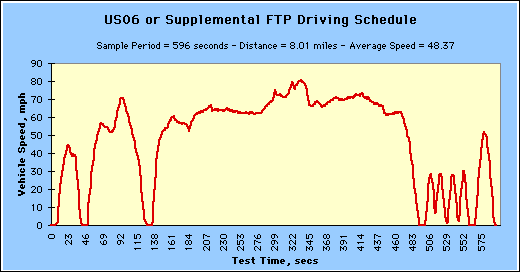
Not true. EPA range figures are based on the 5-cycle, which is actually a pretty good representation of how people drive on the highway. Some people drive faster, others slower, but on average it's about right (including accessory loads like climate control). EV manufacturers can also approximate the five-cycle by taking the US06 cycle and multiplying the resultant range by 0.7.
-
Re:We're not getting hotter
-
Re: We're not getting hotter
Because global extrapolation isn't need - it is the same. You reference an EPA study, perhaps you should also look at this one. Specifically:
1. Since 1901, the average surface temperature across the contiguous 48 states has risen at an average rate of 0.14F per decade
2. Global average surface temperature has risen at an average rate of 0.15F per decade since 1901 (see Figure 2), similar to the rate of warming within the contiguous 48 states
3. Since the late 1970s, however, the United States has warmed faster than the global rate.
Meaning, on the long scale we're essentially lock-step with the rest of the world; on the short scale, we're warming FASTER. And the record shows that the warming we're getting is NOT from highs getting higher, but lows not getting so low. The average (they just add max and min and divide by two)is increasing because the limits are converging, with the lower limit rising faster than the upper limit is falling.
The US is analogous to the rest of the world long-term, and is slightly worse than the rest of the world short-term. And we're not heating, we're not cooling as much. That would be convergence of the highs and lows. Any time you have less dramatic swings, people would tend to call that a calming down, not an acceleration of extreme behavior. Add in the slowing down of cyclones and hurricanes and tornadoes and we are litereally seeing less extreme weather events - even though we can see any event better than ever (due to satellites, remote monitoring, number of people, etc). I know it's not a popular position - but the data tends to be pretty unambiguous.
-
Re: We're not getting hotter
You keep citing US diurnal data and extrapolating globally. The paper I cited not only identifies the trend you see for the US, but also shows that the trend for the rest of the world is different. The rest of the world has rising diurnal highs and lows, not just rising lows.
That paper explains the trend on page 287 of the climate report and puts it into the context of the global trends. The global climate system is not calming down, and your EPA link is showing sharp temperature rises for average global and US temperature.
You can look elsewhere on the EPA page to see that within the US there has been a rise in heat waves (see figure 2 here: https://www.epa.gov/climate-in...). Extreme weather (at least heat waves) are increasing, and other metrics certainly aren't decreasing (look elsewhere on that EPA page).
-
Re: We're not getting hotter
As reponded above, the EPA says otherwise, that the US and the world are within 0.1 deg F (about 0.05 deg C) per decade, from 1901 and on. So they are the same - what happens in the US pretty much happens worldwide. And I would expect that, given it dominates the temperate region of the 3rd largest continent, and sits between the two largest bodies of water on the planet.
-
Re: We're not getting hotter
EPA says they are about the same, 0.14 degF per decade for the US, 0.15 degF for the world. That's long-term. So I stand by my claim - the US is pretty much like the rest of the world, definitely well within the error bars... Daytime temps have been dropping, and nighttime temps have been rising faster. So the average is increasing. You do know the average is simply the min + max / 2? They don't average each hour/minute/second throughout the day...
-
Re:Libraries of Congress?
I don't know, but the summary mis-characterizes what Okin wrote ("[dog and cat] feces would be equivalent to the total garbage produced by 6.63 million Americans, or approximately the population of Massachusetts"), which is in turn wrong. According to the Massachusetts government, household waste was about 3.5 million tons in 2006 (about 2.98 pounds per capita, versus 4.4 pounds per capita in the EPA numbers for 2013).
However, that household waste number is a pretty small fraction of the total solid garbage that gets generated. MA's 2006 numbers show 3.49 MT of household waste, 5.66 MT of business waste, and 4.65 MT of construction and demolition debris. The household waste number is only 25(-ish)% of the total.
On top of that, the 4.4 pounds per capita per day number is before recycling, composting, and incineration for energy generation are considered, which combined account for almost half (47%) of the total mass that was generated (according to the EPA report that Okin cited).
-
Re:I'm torn
On the other hand, I find unregulated ecological engineering by a private company to be quite creepy.
You have a strange definition of "unregulated." If the EPA issues a permit after notice and public comment, issues a press release, and nine months later the permitted activity takes place, it is unregulated?
I didn't realize that society had to get your personal approval through the posting of Slashdot articles...
-
Re:Why would he stand up for consumers?
Furthermore the gun manufacturing industry has its own organization called the National Shooting Sports Foundation. The NRA is a civil rights organization much like the ALCU, or any number of other non-profit organizations advancing the interests of liberty, yet I don't see paranoid claims that the ACLU is the puppet of big news corporations. For some reason it's politically correct to defend any part of the constitution except the second amendment.
I also looked into Chlorpyrifos and it appears that it is only dangerous in high doses but never the less the EPA has banned, or limited, its use on certain plants and all crops using it are required to have a buffer zone away from populated or recreational areas, particularly until more well designed and credible research is available for or against its use. If Dow Chemical was as all powerful as your claim I doubt there would be these restrictions in place.
I'd also like to point out to the paranoid OP that the United States is not a democratic government; it's a constitutional republic and that alone is a huge difference.
-
Re:Carbon output
https://www.epa.gov/climate-in...
US carbon emission is the fat green area in the chart. Yes, we will eventually grow our back to in erased carbon again if we coast on natural gas, but the replacement of coal by gas buys us time to build the long-term reactor fleet that going carbon free will require.
-
Re:Denier trolls will spam this article
Bullshit. CO2 has more than three times the impact of methane, because there is over 200x more CO2 in the atmosphere (403ppm vs 1.84ppm). The US emits eight times as much CO2 each every year.
-
Re:Construction costs aren't the problem
it's land, man, land. Ain't gonna get anything right unless there is more land. Inherent problem is limited amounts of land unless govt sells Moffett Field, gets rid of the runways which will provide lots of land for new housing, oh wait maybe want to review this https://yosemite.epa.gov/r9/sf...
Someone buys a house in Silicon Valley, they completely remodel with new landscape (the land is the expensive part). You can see in comparison of original owner from 1970s still in same house, lawn is crummy, chipped paint, roof in need of repair, old cars in driveway as garage filled with useless junk.
-
Re: This just in
The percentage of CO2 in the atmosphere is a rounding error compared to water vapor and should have a negligible effect unless it somehow behaves differently than water vapor. I honestly would like to know is C02 that much more potent than water vapor or does it somehow behave differently?
Yes, different gasses have different levels of greenhouse effects. This EPA site shows the relative effect of some of them but doesn't mention water vapor. They call it GHP, or Global Warming Potential. CO2 is the baseline by definition at 1. I think water vapor is excluded because its effects are transient as the amount of water vapor itself fluctuates a lot. It looks like some consider the changes in water vapor a side effect of the other GHGs and that it functions more as a mechanism of warming rather than a cause (that is, change in other GHGs drive changes in water vapor as part of the warming mechanism).
https://www.epa.gov/ghgemissio...
That at least gives you a place to start.
-
Re:Not *entirely* symbolic
(And the US is already one of the least polluting nation
I keep hearing that we are one of the worst, or at least the worst per-capita. But maybe that depends on how you define pollution. In regards to the Paris agreement, CO2 is the relevant pollutant. The EPA claims that we are second to China which probably matches the worst per-capita statement, since we have a way lower population than China. Wikipedia has some good charts too.
-
Re:I used to work at Hanford Site...
Except that they are intended to just be thrown away.
There are no special disposal instructions for ionization smoke detectors. They may be thrown away with household trash, however your community may have a separate recycling program.
The alpha from Am241 will not be detectable at any distance from the detector even if the metallic/ceramic enclosure is breached. The mean free path of an alpha particle in air is very small - about 5 cm.
-
Re:Relevance?
Given that domestic power consumption is insignificant compared to industrial and commercial use, how relevant is this? How is power consumption overall affected?
Insignificant? Domestic power consumption is 37% of total power consumption (source). That's more that industrial or commercial consumption, how is it insignificant?
-
Re:Great.. Methane..
"Methane's lifetime in the atmosphere is much shorter than carbon dioxide (CO2), but CH4 is more efficient at trapping radiation than CO2. Pound for pound, the comparative impact of CH4 is more than 25 times greater than CO2 over a 100-year period."
-
Re:This bothers me
The U.S. “hybrid-electric car fleet” was not obtained without any government interference. There were tax credits and other incentives. For example, California encouraged buyers by granting access to carpool lanes to hybrid as well as electric vehicles. Gasoline taxation (by federal and state governments) also plays a significant role in fostering consumer desire for more fuel-efficient vehicles. Higher fuel economy standards, mandated by governments, have also played a role by preventing vehicle manufacturers from flooding the market with cheap gas guzzlers against which comparatively more expensive hybrid vehicles could not easily compete. If there had been no government involvement, if only the market had been speaking, we’d all be driving large yet inexpensive cars. And if foreign competition had been thwarted through protectionist policies, those cars would likely be sporting 1960’s technology (and fuel-efficiency) to boot, but that’s another story.
In regard to greenhouse gas emissions reduction, that hybrid-electric fleet is unfortunately still a drop in the bucket, for several reasons.
Transportation only contributes about 27% of airborne pollution contributing to climate change. The remaining 73% come from electric power generation, industrial production, commercial and residential activities and agriculture. (source: EPA) This is for U.S. emissions, by the way; globally, transportation only contributes about 14% of emissions. (source: IPCC, cited by EPA). Even within the U.S., figures vary significantly between states.
Further, light-duty vehicles contribute about 60% of transportation-related emissions. (source: EPA), therefore about 17% of total emissions (in the U.S.). The remainder of transportation-related emissions comes from medium- and heavy-duty road vehicles, as well as aircraft, trains, ships and boats, pipelines, etc. Those can be particularly noxious. For example, “aircraft not only emit 12 percent of CO2 emissions from U.S. transportation sources — they also emit nitrogen oxides other than nitrous oxide, causing warming when emitted at high elevation. And ships, besides releasing almost 3 percent of the world’s CO2 (about as much as all of Canada emits), are also a main source of nitrous oxide and black carbon (soot).” (source: Center for biological diversity).
Finally, the pool of hybrid-electric cars has been growing but it is still much too small (around 2% of passenger cars) to make a significant difference. (Actually, lower gasoline prices in 2014-2015 led to decreased sales of hybrid-electric cars; source: DOT/BTS). Not to mention that, in the end, it only improves fuel efficiency, but it is still largely relying on an internal combustion engine.
My point is this: with all the goodwill displayed by a small minority of pollution-conscious consumers, even if you discounted the governmental initiatives that actually convinced those consumers to adopt a hybrid-electric vehicle, the impact on greenhouse gas emissions is minimal. And it will remain so because the largest share of those emissions is caused by factors that are well outside the reach of consumers (commercial and industrial), factors that are controlled by cost considerations, and can only be durably and significantly modified by government regulations or incentives issued on a massive scale.
-
Re:This bothers me
The U.S. “hybrid-electric car fleet” was not obtained without any government interference. There were tax credits and other incentives. For example, California encouraged buyers by granting access to carpool lanes to hybrid as well as electric vehicles. Gasoline taxation (by federal and state governments) also plays a significant role in fostering consumer desire for more fuel-efficient vehicles. Higher fuel economy standards, mandated by governments, have also played a role by preventing vehicle manufacturers from flooding the market with cheap gas guzzlers against which comparatively more expensive hybrid vehicles could not easily compete. If there had been no government involvement, if only the market had been speaking, we’d all be driving large yet inexpensive cars. And if foreign competition had been thwarted through protectionist policies, those cars would likely be sporting 1960’s technology (and fuel-efficiency) to boot, but that’s another story.
In regard to greenhouse gas emissions reduction, that hybrid-electric fleet is unfortunately still a drop in the bucket, for several reasons.
Transportation only contributes about 27% of airborne pollution contributing to climate change. The remaining 73% come from electric power generation, industrial production, commercial and residential activities and agriculture. (source: EPA) This is for U.S. emissions, by the way; globally, transportation only contributes about 14% of emissions. (source: IPCC, cited by EPA). Even within the U.S., figures vary significantly between states.
Further, light-duty vehicles contribute about 60% of transportation-related emissions. (source: EPA), therefore about 17% of total emissions (in the U.S.). The remainder of transportation-related emissions comes from medium- and heavy-duty road vehicles, as well as aircraft, trains, ships and boats, pipelines, etc. Those can be particularly noxious. For example, “aircraft not only emit 12 percent of CO2 emissions from U.S. transportation sources — they also emit nitrogen oxides other than nitrous oxide, causing warming when emitted at high elevation. And ships, besides releasing almost 3 percent of the world’s CO2 (about as much as all of Canada emits), are also a main source of nitrous oxide and black carbon (soot).” (source: Center for biological diversity).
Finally, the pool of hybrid-electric cars has been growing but it is still much too small (around 2% of passenger cars) to make a significant difference. (Actually, lower gasoline prices in 2014-2015 led to decreased sales of hybrid-electric cars; source: DOT/BTS). Not to mention that, in the end, it only improves fuel efficiency, but it is still largely relying on an internal combustion engine.
My point is this: with all the goodwill displayed by a small minority of pollution-conscious consumers, even if you discounted the governmental initiatives that actually convinced those consumers to adopt a hybrid-electric vehicle, the impact on greenhouse gas emissions is minimal. And it will remain so because the largest share of those emissions is caused by factors that are well outside the reach of consumers (commercial and industrial), factors that are controlled by cost considerations, and can only be durably and significantly modified by government regulations or incentives issued on a massive scale.
-
Re:This bothers me
The U.S. “hybrid-electric car fleet” was not obtained without any government interference. There were tax credits and other incentives. For example, California encouraged buyers by granting access to carpool lanes to hybrid as well as electric vehicles. Gasoline taxation (by federal and state governments) also plays a significant role in fostering consumer desire for more fuel-efficient vehicles. Higher fuel economy standards, mandated by governments, have also played a role by preventing vehicle manufacturers from flooding the market with cheap gas guzzlers against which comparatively more expensive hybrid vehicles could not easily compete. If there had been no government involvement, if only the market had been speaking, we’d all be driving large yet inexpensive cars. And if foreign competition had been thwarted through protectionist policies, those cars would likely be sporting 1960’s technology (and fuel-efficiency) to boot, but that’s another story.
In regard to greenhouse gas emissions reduction, that hybrid-electric fleet is unfortunately still a drop in the bucket, for several reasons.
Transportation only contributes about 27% of airborne pollution contributing to climate change. The remaining 73% come from electric power generation, industrial production, commercial and residential activities and agriculture. (source: EPA) This is for U.S. emissions, by the way; globally, transportation only contributes about 14% of emissions. (source: IPCC, cited by EPA). Even within the U.S., figures vary significantly between states.
Further, light-duty vehicles contribute about 60% of transportation-related emissions. (source: EPA), therefore about 17% of total emissions (in the U.S.). The remainder of transportation-related emissions comes from medium- and heavy-duty road vehicles, as well as aircraft, trains, ships and boats, pipelines, etc. Those can be particularly noxious. For example, “aircraft not only emit 12 percent of CO2 emissions from U.S. transportation sources — they also emit nitrogen oxides other than nitrous oxide, causing warming when emitted at high elevation. And ships, besides releasing almost 3 percent of the world’s CO2 (about as much as all of Canada emits), are also a main source of nitrous oxide and black carbon (soot).” (source: Center for biological diversity).
Finally, the pool of hybrid-electric cars has been growing but it is still much too small (around 2% of passenger cars) to make a significant difference. (Actually, lower gasoline prices in 2014-2015 led to decreased sales of hybrid-electric cars; source: DOT/BTS). Not to mention that, in the end, it only improves fuel efficiency, but it is still largely relying on an internal combustion engine.
My point is this: with all the goodwill displayed by a small minority of pollution-conscious consumers, even if you discounted the governmental initiatives that actually convinced those consumers to adopt a hybrid-electric vehicle, the impact on greenhouse gas emissions is minimal. And it will remain so because the largest share of those emissions is caused by factors that are well outside the reach of consumers (commercial and industrial), factors that are controlled by cost considerations, and can only be durably and significantly modified by government regulations or incentives issued on a massive scale.
-
Re:EPAAAWWWWWWHHHHHThe EPA is directly involved with the Hanford cleanup operation. The work is being done under the direct management of the DOE, but their results are reviewed by the EPA.
CERCLA 121(c) requires five-year reviews on remedial actions when hazardous substances, pollutants, or contaminants will remain on site above levels that allow for “unlimited use and unrestricted exposure”. A general overview of the review process can be found in this presentation. The first Five-Year Review was completed in 2001 by EPA staff. The Department of Energy (DOE) chose to conduct the second Five-Year Review which had draft 0 completed in 2006. When DOE performs the review, as in 2006, EPA is still required to review the report and provide comments/concurrence in a letter of review.
Given how poorly the Hanford cleanup has gone under the leadership of the DOE, more involvment by the EPA might lead to a better result. If you carefully read the preceding paragraph, you will note that the DOE took over the review process from the EPA after the first report. Having a department review it'sown work is not exactly the best way to insure that they are doing a good job. After this latest failure, it is obvious that the DOE is not doing a very good job.
There is a cosmic irony in the juxtaposition of this problem at Hanford and the shutdown of scientific advisory panels at the EPA and the Department of the Interior. Inevitably some of these efforts involve the Hanford site. It is a stark reminder that ignoring science is always a bad idea.
By the way, why are you picking on the EPA in the first place? I detect the stench of a right wing troll.
-
Re:Not political?
I went and poked around their website. From what I can tell they are very concerned about ethics and backing up their advice with good solid science. The membership is listed here and should include those not being renewed.
https://yosemite.epa.gov/sab/s...
Some pretty solid people serving on that board! -
Re:Federal Juvenile Lunch Police Stand Down
Turns out that the regulations is on the businesses and organizations, not the kids
Any excuse or evasion to justify unlimited meddling in every person's daily life, I guess.
Thanks for another example of your inane babble, as you try to dismiss a matter of significant importance with a false and misleading objection, as bad as when you tried to claim that these regulations were on individual kids.
Turns out that the integrity of the food supply is a very convincing and significant reason for regulation, and it turns out the regulations we're talking about are on...the schools and the providers of food at them.
You know, the people who the government employs.
So you have to ask who holds them responsible.
The local and state voters.
Unfortunately, Michigan being a hotbed of gerrymandering, means further protections are necessary beyond mere voting. Which is obvious, even the Constitution of Michigan provides for that, though not as expressly as some states.
See the 14th Amendment and Article IV.
Flint residents are welcome to sue and get a remedy from courts.
Yes and they did so however, Courts aren't the only source of enforcement, as in fact, Congress has authorized and required other, subsidiary, entities in the Executive, to act, not just courts in the form of lawsuits.
See how it works yet?
Yeah, any excuse for unlimited meddling by distant self-dealing busybodies.
Ah once again, you offer your vacuous sophistry, but you couldn't even come up with a non-repetitive one.
Too bad you even tried to ignore international law, making the Federal government inherently bound up in this decision.
Yes, I noticed you doing that. It's the real fly in your ointment, no amount of desperate haranguing can get you over the Supremacy Clause. That bothers you, your usual evasions can't get you past black letter law.
-
Re:Federal Juvenile Lunch Police Stand Down
Turns out that the regulations is on the businesses and organizations, not the kids
Any excuse or evasion to justify unlimited meddling in every person's daily life, I guess.
Thanks for another example of your inane babble, as you try to dismiss a matter of significant importance with a false and misleading objection, as bad as when you tried to claim that these regulations were on individual kids.
Turns out that the integrity of the food supply is a very convincing and significant reason for regulation, and it turns out the regulations we're talking about are on...the schools and the providers of food at them.
You know, the people who the government employs.
So you have to ask who holds them responsible.
The local and state voters.
Unfortunately, Michigan being a hotbed of gerrymandering, means further protections are necessary beyond mere voting. Which is obvious, even the Constitution of Michigan provides for that, though not as expressly as some states.
See the 14th Amendment and Article IV.
Flint residents are welcome to sue and get a remedy from courts.
Yes and they did so however, Courts aren't the only source of enforcement, as in fact, Congress has authorized and required other, subsidiary, entities in the Executive, to act, not just courts in the form of lawsuits.
See how it works yet?
Yeah, any excuse for unlimited meddling by distant self-dealing busybodies.
Ah once again, you offer your vacuous sophistry, but you couldn't even come up with a non-repetitive one.
Too bad you even tried to ignore international law, making the Federal government inherently bound up in this decision.
Yes, I noticed you doing that. It's the real fly in your ointment, no amount of desperate haranguing can get you over the Supremacy Clause. That bothers you, your usual evasions can't get you past black letter law.
-
Re:Smartway would be better to cut
https://www.epa.gov/smartway Smartway certifications is basically energy-star for trucking companies and the railroads, you fillout an application, and they if it's good you get a certificate in the mail and you can claim your Smartway certified. I've seen companies that love to tell everyone they are certified, in reality, no one really cares.
-
Re:Reckless Endagerment
Criminal penalties for a CEO
Yes, criminal and civil penalties. It happens all the time. Like these:
- Bernard Ebbers — and ultimate collapse of MCI
- Ever heard of Mr. Madoff?
- ... or Martha Stewart?
- Or this guy: "The former CEO of drug company Inyx Inc has been charged in connection with a fraud scheme".
Now you list the folks prosecuted for anything in relation to space-related disasters — such as the Challenger Shuttle explosion... Oh, wait — evidence is not really your thing, is it? You still owe me a list of successful predictions made by Climate Scientists — though, having exposed you as a bona-fide liar, I understand your reluctance to come back to that thread...
-
Re:Oh, this is going to be great
Well:
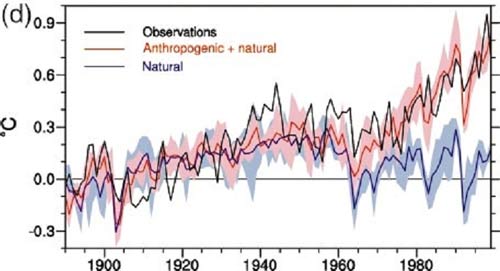
1) If you measure all the sources of radiative forcing, you see that the natural ones are pretty much negligible with respect to the current warming, where as the "human-caused" ones are large.
2) There have been papers that split the warming into the warming that would have happened from natural forcing, and that which would have happened from anthropogenic forcing. ((paper). Satisfyingly, the warming that has happened from the sum of the forcings, is approximately the sum of the warmings from each forcing. So it's nice and additive, therefore statements like "x% of the warming of the past y years is anthropogenic" are meaningful. Such as "80% of the warming of the past 100 years is anthropogenic" or "110% of the warming of the past 50 years is anthropogenic". -
Re:Your plan?Molecules in the atmosphere don't care about policy positions. Despite any strong policy changes, US greenhouse gas emissions are declining. Total emissions have declined 7%since 2005, largely as a result of conversion to natural gas. Emissions per capita and emissions per GDP have even more sharply declined.
-
Abolish EPA
Who do you think should be punished?
I, actually, didn't say, somebody should be. What I said was, since no one was, there is nothing to hold the EPA in check...
The scientists? They were saying at the beginning of the War on Fat that the science was inconclusive.
Not according to Guardian:
Ancel Keys was brilliant, charismatic, and combative. A friendly colleague at the University of Minnesota described him as, “direct to the point of bluntness, critical to the point of skewering”; others were less charitable. He exuded conviction at a time when confidence was most welcome. The president, the physician and the scientist formed a reassuring chain of male authority, and the notion that fatty foods were unhealthy started to take hold with doctors, and the public. (Eisenhower himself cut saturated fats and cholesterol from his diet altogether, right up until his death, in 1969, from heart disease.)
But as I said, the problem wasn't with the scientists. It was the politicians pushing the agenda
Stipulating for a second, the scientists were innocent and it were all the politicians at fault at the FDA, how is the EPA different? That is, what did happen at the FDA, that does not and will not happen at the EPA?
It was the politicians pushing the agenda, and the sugar industry funding it
Wrong. First of all, your link describes (with the weaselese "may have" rather than firm "has") such efforts, which ended in 1967 — USDA's "dietary guidelines" denouncing fat were published only in 1980ies. And second, the "sugar industry", according to your link, didn't lobby the politicians — instead, they paid scientists. And it was hardly a massive bribe — the three scientists from Harvard were paid an equivalent of today's $50,000 to publish a paper, which the believed to be valid.
In other words, the smart assholes at NYTimes realized what massive egg is on the Big Government's face and wanted to create some smokescreen for it to shift the blame towards the Greedy KKKapitali$t$, but failed. Well, almost failed — you fell for it...
In the case of fat, there was heavy industry lobbying in favor of a position that scientists said was unsupported by current research
You aren't citing any sources and I call bullshit. Why would industry lobby — heavily! — for a major overhaul of its production lines? The "fat free" stuff is not any cheaper, the margins on it aren't specifically higher, while developing it requires work and brings about uncertainty. No. Once the demand was there, the industry responded to satisfy it — praise be to Capitalism — but it made no sense for anyone to lobby for it...
the suggestion that if the EPA isn't perfect, the solution is not to fix it but to abolish it. [...] a lot easier to destroy programs that benefit society
My argument is, the EPA does not "benefit society". If only for this reason — they can ban and banish anything they please willy-nilly... We already have toilets, that don't flush (even the EPA themselves admit such problems "in earlier models") and dishwashing machines, that do not wash dishes. In a rush for "renewable energy", we
-
Methane [Re: No complaints here][ in reply to the question "Name one other factor in climate change that's even close to CO2."]:
Source Not sure if source is valid, but numbers are close to what I have seen before.
Equal to CO2? No
Methane 25x
N2O 298xYes, but that's the effect per unit mass emitted. The effect on climate change will be the warming potential multiplied by the amount emitted, and in that respect, carbon dioxide-- from fuel burned in billion ton quantities-- is the clear leader. Amounts emitted are there a different tab on the site you linked as your source: https://climatechangeconnectio...
Or, look here: https://www.epa.gov/ghgemissio...But you can't tax cows,
Sure you could.
and farmers are a big lobby for Congress, so you ignore the methane. If you really cared you would be working on methane more than CO2.
methane emissions are also important, and people looking at responses to greenhouse emissions do, in fact, also look at how to reduce methane emissions.
The fact that you go after CO2 gives away your political agenda and shows that you don't really care about the science.
No it doesn't. It shows that people are looking most closely at the largest effect.
In fact I bet you didn't even know about methane. Gotta wonder when a "denier" knows more about the science than you do. According to you all I haven't ever looked at the science even half as much as you, but here I am giving facts you didn't know about.
Wrong on all counts. If you would actually read some of the literature, you'd see methane discussed in great detail. Including in the sites you list.
-
Re:if it were cheaper, yes.
one of the greatest contributors to Climate Change
According to this pie chart, agriculture (which includes meat, but also rice production) is only responsible for 9% of the greenhouse gases.