Slashdot Mirror
Domain: epa.gov
Stories and comments across the archive that link to epa.gov.
Comments · 1,291
-
Re:Science Disagrees...
This is the evaluation by IARC that opened up for the lawsuits:
IARC Monographs Volume 112: evaluation of five organophosphate insecticides and herbicides, International Agency for Research on Cancer, 2015:
The herbicide glyphosate and the insecticides malathion and diazinon were classified as probably carcinogenic to humans (Group 2A).
[...]
For the herbicide glyphosate, there was limited evidence of carcinogenicity in humans for non-Hodgkin lymphoma. The evidence in humans is from studies of exposures, mostly agricultural, in the USA, Canada, and Sweden published since 2001. In addition, there is convincing evidence that glyphosate also can cause cancer in laboratory animals.That IARC evaluation was subsequently criticized, and other high-profile papers and agencies were unable to reach the same conclusions:
A regulatory perspective on the potential carcinogenicity of glyphosate, Journal of Toxicology and Health, 2015:
It appears that IARC has overreached in its conclusion by failing to consider the vast body of literature supporting the notion that glyphosate is not a carcinogen. Besides, IARC has failed to place potential hazard into a context of actual risk. When the conditions of glyphosate use in Egypt is rationally analyzed, it appears that exposure of the public to glyphosate is order of magnitudes far below the zero-risk dose.
The BfR has finalised its draft report for the re-evaluation of glyphosate - BfR, German Federal Institute for Risk Assessment, 2015:
In conclusion of this re-evaluation process of the active substance glyphosate by BfR the available data do not show carcinogenic or mutagenic properties of glyphosate nor that glyphosate is toxic to fertility, reproduction or embryonal/fetal development in laboratory animals.
Systematic review and meta-analysis of glyphosate exposure and risk of lymphohematopoietic cancers, Journal of Environmental Science and Health, 2016:
Bias and confounding may account for observed associations. Meta-analysis is constrained by few studies and a crude exposure metric, while the overall body of literature is methodologically limited and findings are not strong or consistent. Thus, a causal relationship has not been established between glyphosate exposure and risk of any type of LHC.
EPA Releases Draft Risk Assessments for Glyphosate, Environmental Protection Agency, 2017:
The draft human health risk assessment concludes that glyphosate is not likely to be carcinogenic to humans. The Agency’s assessment found no other meaningful risks to human health when the product is used according to the pesticide label. The Agency’s scientific findings are consistent with the conclusions of science reviews by a number of other countries as well as the 2017 National Institute of Health Agricultural Health Survey.
Glyphosate toxicity and carcinogenicity: a review of the scientific basis of the European Union assessment and its differences with IARC, Archives of Toxicology, 2017:
Since glyphosate was introduced in 1974, all regulatory assessments have established that glyphosate has low hazard potential to mammals, however, the International Agency for Research on Cancer (IARC) concluded in March 2015 that it is p
-
Re:Mod parent up please.
A herbicide is by many considered a type of pesticide. This includes the EPA. Calling glyphosate a pesticide isn't wrong; its just less specific.
https://www.beyondpesticides.o....
https://www.epa.gov/minimum-ri...
Otherwise, I wholeheartedly agree.
-
Re:In before Republicans lie.The report is an analysis of data that power companies were required to publish in March 2018.
EPA in 2015 finalized the first federal regulation for the disposal of coal ash â" often called the âoeCoal Ash Rule.â Among other things, the Coal Ash Rule established groundwater monitoring requirements for coal ash dumps, and it required power companies to make the data available to the public starting in March 2018.
The nonprofit Environmental Integrity Project (EIP), in collaboration with Earthjustice, the Sierra Club, Prairie Rivers Network, and other organizations, obtained and analyzed all of the groundwater monitoring data that power companies posted on their websites in 2018.Unless your claim is that the entirety of this contamination happened in just the 13 months from Feb 2017 to Mar 2018, Trump's EPA appointments and policies have nothing to do with this. Coal ash has always been toxic sludge, and containing it safely has always been a problem.
IMHO, the real culprit here is the environmental movement. They opposed transitioning from coal to nuclear power in the late 20th century, instead trying to use coal's terrible nature as leverage for switching to renewables. Nuclear provided an alternative to coal, so needed to be vilified to preserve the narrative. In 2016 we burned about 728 million tons of coal per year and generated about 130 million tons of coal ash. (The rest of the mass gets discharged into the air, where lucky you and me get to breathe it.) Coal ash has a density of about 1.6 kg/liter, so this is enough coal ash generated every year to fill roughly 230 oil tankers (at 320,000 m^3).
The nuclear reactors in the U.S. generate about 2200 tons of spent fuel each year, or about 104 cubic meters. Nuclear generates about 20% of our electricity vs about 30% for coal, so replacing coal with nuclear would've generated about 156 cubic meters of spent fuel. That's about enough to fill two tractor trailers (though you don't want to pack it that closely or it would start fissioning again).
230 oil tankers of coal ash vs 2 tractor trailers of spent nuclear fuel per year. That's the choice we had, and the environmental movement made us pick the 230 oil tankers of coal ash by forcing nuclear off the table.
The sum total of nuclear waste the U.S. has produced in 60 years of nuclear power is only about 80,000 tons. About one and a half olympic-sized swimming pools by volume. That's why the nuclear power industry isn't panicking over the lack of a long-term waste storage site. There's so little waste that they're just storing decades worth of it in pools at the plants themselves. And this waste still has most of its energy in it. The U.S. banned reprocessing in the 1970s (one of the byproducts is weapons grade plutonium). As a consequence, our "spent fuel" still has about 97% of uranium's energy still in it. That's why it stays dangerous for tens of thousands of years. Reprocessing can get that energy utilization from 3% to over 60%, resulting in spent fuel which only stays dangerous for centuries. We just have to figure a way to safely control or dispose of the weapons grade plutonium. -
Re:Why is Slashdot posting a PR campaign?
You've ruined your solid detective work with an overly partisan rant. Why does a claim that those glaciers will melt have to be partisan? Why does their claim not being properly peer reviewed mean horrible leftist conspiracy?
Then your post proceeds to go even more down hill from here.
"Want to stop global warming? Well first stop flying around the world in jet planes, the biggest per-mile contributor to upper atmosphere pollution."
Planes contribute to a total of 3% of US green house gas emissions and 12% percent of all US transportation emissions, https://www.epa.gov/regulation... . What are you even going on about with this rant?
Still though, thanks for the solid detective work.
-
Re:Quick news brief
Over the last 300m years the ocean PH has averaged around 8.2
Today it is 8.1
ref: https://www.nationalgeographic...the EPA recommends municipal drinking water be kept between 6.5 and 8.5
Ref: https://www.epa.gov/dwregdev/d...
If we continue this break-neck pace, the oceans will leave the EPA recommended range for municipal drinking water shortly before the earth is consumed by the sun.
(300m*16=4.8b Red Giant ~10b - current age(4.6b) = 5.4b giving us roughly 600m years between ocean ph dropping below 6.5 before the sun is a full-sized red giant) -
Re:LEDs are great but not perfect
Arsenic is often used for semiconductor doping (for GaAs junctions) because of its electron properties.
Of course. Lots of toxic chemicals are used for very practical purposes. And this can be fine as long as they are handled responsibly. Problem is that they very often are not handled responsibly and no care is taken for the proper disposal of the end product. I'm not worried about getting arsenic poisoning from my smartphone but there are serious issues when we talk about manufacturing and disposal and recycling.
Lead is used for soldering, which you'll find, surprise surprise, in pretty much all electronic and electric devices.
That once was true but far less so today. A vast and increasing amount of electronics now are ROHS compliant which means they don't use lead, mercury, cadmium and an assortment of other toxic substances including in solder. My company basically has stopped using leaded solder altogether. The lead has some practical benefits for some use cases but the toxicity problems it causes means that it really shouldn't be used and doesn't need to be used for the majority of soldering applications.
But the (un)scientificamerican article is about the same kind of stupid like people claiming that flu vaccines contain Thiomersal which contains mercury and will lead to authism.
Sigh... I picked one article from a recognized source. There are thousands of other sources saying exactly the same thing if you don't like that one and your analogy to vaccines is wildly wrong. There is a difference between falsified psuedo-science and the proven fact that there are toxic chemicals used and released by manufacture, use, and disposal of electronics. We inappropriately dispose of millions of tons of electronics each year and the environmental effects of this are a proven fact. You don't have to take my word for it - plenty of credible evidence available with a single simple google search.
Suffice to say that this arsenic is in pretty solid from inside of the semiconductors. It won't escape them easily.
You are making it out to be far simpler than it really is. Arsenic is a problem in various parts of the supply chain, not just the finished product.
Unless you grind those LEDs up and then spread them around in the environment
You are aware that lots of electronics are ground up as well as spread around the environment in a variety of ways, right?
-
Re:In that case, you radically disagree with the E
You're guessing the benefits are several thousand times higher than what the EPA analysis predicted. Do you have any evidence, any reason to think that?
From EPAs own website:
In 2016, these proposed rules would avoid:
6,800 â" 17,000 premature deaths
4,500 cases of chronic bronchitis
11,000 nonfatal heart attacks
12,200 hospital and emergency room visits
11,000 cases of acute bronchitis
220,000 cases of respiratory symptoms
850,000 days when people miss work
120,000 cases of aggravated asthma, and 5.1 million days when people must restrict their activitiesEPA estimates the health benefits associated with reduced exposure to fine particles are $59 billion to $140 billion in 2016 (2007$).
-
Re:Toxicity of that smoke is pretty much a given
Transformers don't contain heavy metals
What? Transformers are made almost entirely out of heavy metals.
and even old transformers only have trace amounts of PCBs thanks to them being banned in the 70s
Completely false, there are still old transformers with PCBs in them in the USA, and some of them are in the New York power system.
But this is NYC we're talking about. Even if it were PCBs, heavy metals, and your tinfoil hat which were vapourised it's probably an improvement over the air there anyway.
PCBs being pretty much the most toxic thing that we have in our cities, I'm guessing not.
-
Re:Air Pollution is still a Concern
Then why does the EPA itself state that the same new emissions standards that Trump's puppet masters now want to roll back will prevent
* 40,000 premature deaths
* 34,000 avoided hospitalizations
* 4.8 million work days lostevery year?
-
Re:Where is the Data?
Ok, 9 inches since 1880.
And this from the tide gauge near Charleston, SC shows an average rate of 3.25 mm/year +/0 0.19 mm. That's 1.07 feet/100 years:
Relative Sea Level Trend - 8665530 Charleston, South Carolina
-
Re:Thereâ(TM)s just one problem
The NOAA seems to disagree with you:
-
Re:UN also says that the ozone layer ...
Life wouldn't be doing so hot in the oceans either. Most life in the ocean is dependent, directly or indirectly, on life that must live near the surface to absorb energy from sunlight, and being that close means they'd be heavily damaged by UVB radiation. Per the EPA:
Phytoplankton form the foundation of aquatic food webs. Phytoplankton productivity is limited to the euphotic zone, the upper layer of the water column in which there is sufficient sunlight to support net productivity. Exposure to solar UVB radiation has been shown to affect both orientation and motility in phytoplankton, resulting in reduced survival rates for these organisms. Scientists have demonstrated a direct reduction in phytoplankton production due to ozone depletion-related increases in UVB.
UVB radiation has been found to cause damage to early developmental stages of fish, shrimp, crab, amphibians, and other marine animals. The most severe effects are decreased reproductive capacity and impaired larval development. Small increases in UVB exposure could result in population reductions for small marine organisms with implications for the whole marine food chain.
Summarizing:
- Plankton would die off in huge numbers, which would both reduce the food supply for everything in the ocean, and dramatically reduce the ability of the oceans to absorb CO2, speeding up global warming and cooking the surface even faster.
- Even for animals with scales and shells, they'd reproduce less successfully
Point is, you're not going to see dolphins taking over the world if the ozone layer disappeared; life would continue, but in dramatically reduced amounts, and most large marine animals would likely die off for lack of sufficiently concentrated food sources.
-
Re: Sounds like aluminum refining
I did not realize that iron processing was such a big contributor to overall emissions. The EPA has an interesting breakdown: https://www.epa.gov/ghgemissio...
-
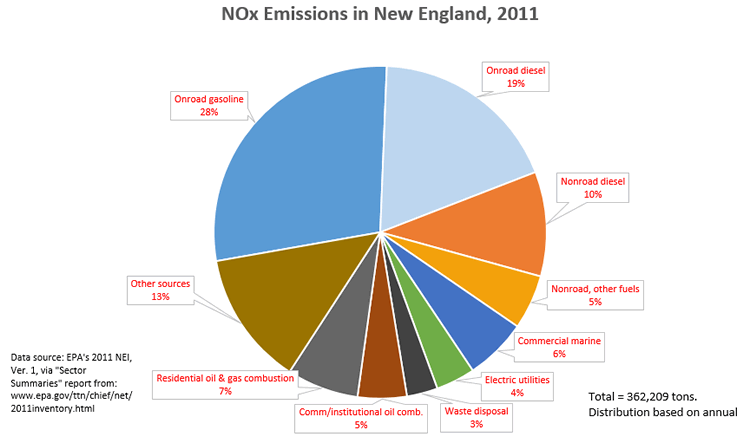
Sources of atmospheric nitrogen dioxide
Sources of atmospheric nitrogen dioxide:
https://www3.epa.gov/region1/airquality/images/nox.gif -
Re:This makes no sense.
Depends on whether our pollution standards happen to target the chemicals
They do. Catalytic converters specifically target nitrogen oxides, and NO2 levels have fallen dramatically over the last 20 years.
Has there been a corresponding decrease in childhood obesity? No.
To be fair, older cars produce much more NO2 than newer models, so kids in low income neighborhoods are more likely to have higher NO2 exposure, and are more likely to be obese. But even in low income areas, NO2 levels have fallen, with no corresponding decrease in childhood obesity.
-
Re:Never Happen
Seems you have alternate facts or maybe you just picked ones that supported your position
http://www.arborenvironmentala...
100 metric tons of CO2 can accumulate in one acre of forest over time.
Each person generates approximately 2.3 tons of CO2 per year.
The carbon footprints of 18 average Americans can be neutralized by one acre of hardwood trees.https://www3.epa.gov/climatech...
Method for
Calculating Carbon Sequestration by Trees in
Urban and Suburban Settings -
Re:NOOOOOO\
Us. Human civilisation is harmed. So are a lot of animal and plant species. If you want a full list of the main ways in which things on the Earth are harmed (and occasionally benefited) by greenhouse gases, see here.
Nitric oxide is present in human blood at concentrations of around 2 ppm - but exposure above 25 ppm is considered dangerous, and above 100 ppm will harm you in minutes. Also undesirable is how contact with water forms nitric acid, i.e. acid rain. And particulates are just as bad. Air pollution in general is still responsible for nearly a third of lung cancers and other respiratory diseases - we have a lot more improving to do.
-
Re:'Clean energy'
rickb928 claimed:
In Maine, at least, some legislation was enacted to discourage using wood in a variety of systems to heat homes. IT seems that some of those were pretty dirty. Gasifiers were pretty large scale, and usually used a lot of otherwise unused biomass. And were, as mentioned elsewhere, mot often located where the biomass was. One I knew of was located at the chip and lumber mill it served to power.
Not exactly.
In 2015, the EPA published rules regarding emissions standards and suggested supplemental state legislation regulating residential wood heating systems. Main's own EPA essentially xeroxed the EPA's regulations.
Other states (most notably California and Washington) enacted stricter standards, and certain individual cities and counties within California have adopted even less permissive regulations. Most of those localities already experience high levels of air pollution, and their tough laws were specifically intended to reduce or eliminate residential wood smoke emissions.
As is universally the case in the USA, the new standards don't apply to systems that were compliant with emissions standards at the time they were installed. (Essentially, if your home already had a wood fireplace, wood stove, wood pellet stove, or wood boiler system, the new laws don't apply to you. However, you may not be permitted to operate existing wood-based heating systems in some of those localities, because, while the systems themselves are grandfathered, their emissions are still subject to the new regulations.)
In extremely rural areas - and especially in montane ones - residential wood heating is still the technology of choice. I know for a fact that 50% or more of the single-family homes in Mariposa County, CA still use wood stoves or pellet stoves for heat. Many of them are fueled by deadfall wood harvested from state forests with the blessing of the California Department of Forestry and Fire Prevention.
CAL-FIRE has learned the painful lessons that the U.S Forest Service's long-standing policy of extinguishing every fire on National Park and National Forest land taught them: Forests evolved to burn. Humans can only delay that. We can't entirely prevent it - and the longer a forest goes between fires, the more ground-level fuel (mostly in the form of deadfalls and underbrush) accumulates. When a fire does occur in such "protected" forests - especially during a drought - and the winds are high, it frequently turns into a holocaust that burns that forest to the ground. If, on the other hand, naturally-occuring forest fires are permitted to burn themselves out, with firefighting efforts limited to protecting inhabited structures, they tend only to consume that ground-level fuel and thinner, more readily-combustible branches. More importantly, they don't usually burn hot enough to entirely econsume healthy trees. As a result, when the fire passes, the forest remains standing.
And it grows like a motherfucker afterward, because of all the "biochar" fertilizer such a fire leaves in its wake.)
Sorry about the digression into wildfire management policy, but it's a subject about which I am passionate, because I used to live in Mariposa County, and I've seen what can happen when forests the Fire Service has "protected" for over a century burn. It's pretty damned scary shit
(Posting as AC only so as not to undo prior upmods in this thread.)
--
Check out my novel
-
Re:An Enemy Not Seen
This sounds logical, but it's not necessarily true. US carbon emissions have been about constant for the last 20 years even as the economy has grown.
(Posting anonymously because I already modded.)
-
Re:Hormesis
Well... the full implications could be easily tested by purchasing some uranium glass beads on ebay, grinding them to powder, pouring said powder into an envelope and mailing it to Andrew at Environmental Protection Agency, Office of the Administrator, 1101A, 1200 Pennsylvania Avenue, N.W., Washington, DC 20460.
After all, it's not like the Trump EPA ever freaked out about chemicals surrounding their boss.
-
Re:do I just hang out on lefty sites
I'm just pointing out that your assertions above don't match up with what you claimed from the article. This is correct as you admitted in a response, they come from a different source.
I went back and explicitly checked for the things you claimed above. You're incorrect on your initial assertions, that the levels were lower than Americans were exposed to prior to 1995 (the last year that levels were higher than 1.5 micrograms on average was 1990) and that the general air quality has been at or near the new level since 2010. It should also be noted that the article also states that the smelter was the primary source of lead for 1 of 2 areas in the US that failed to meet the 1.5 micrograms limit. That's not surprising since the soil in a relatively large area around the plant is so polluted with lead that it is a superfund site and that repeated removal and replacement of soil has been done in an attempt to clean up at least 700 residences. And failed.
Regarding your second claim, that it was lower than what everyone was exposed to prior to 1995, where are your exposure numbers? The only thing I could find was that previously referenced generic chart going back to 1980 that does not list the meager 6 locations tested, and some references to a 1965 study that showed that modern air levels of lead were 100s of times higher than those from before the industrial revolution.
Your follow up misses the actual date of the lead banning legislation as 1978, although you do get the 1990 extension through 1995 correct. It should also be noted that lead toxicity in children did drop 80% from 1980 as compared to 1999. That can mostly be attributed to the banning of leaded gas.
This has nothing to do with being confrontational unless your ego is so fragile that you take any correction of your now obviously incorrect statements as an affront instead of educational opportunity. You're being more than a little disingenuous with your liberal heaping of backdoor confrontation yourself: "grandstanding", "poor behavior", and other derogatory allusions to character, intelligence, etc.
Wait, you're trolling, aren't you?
-
Re:Umm - 4 counties? Perspective...
Given the previous O3 levels have changed historically, we may well have been above the current limit - but it wasn't newsworthy because the limit was higher.
-
Re:Trivial solution
Nice to see somebody sincere and not just a troll here.
Ok, actually, it IS an engineering plan. The plan is how to determine all CO2 levels, normalize if, and then to get all nations to address their OWN CO2 sources.
In particular, the solutions needed for America are NOT the same as what Denmark or Finland used. That is why I said that we needed to get down to THEIR LEVELS. I never said that we need to be like them. Denmark does not measure their levels. I suspect that they will turn out to have much higher levels, but in spite of that, we still need to get to what they advertise to IPCC (let OCO2/OCO3 show the facts on all this).
Ok, I think that you looked at this all wrong. You simply looked at our electricity and nothing else. Instead, lets look at where CO2 comes from. Electricity USED to be our main source. Now, it and Transportation are tied.
Transportation emissions is about about to take a huge drop over the next 2-4 years, as long as Tesla keeps going. They will very likely kill ICE sales. Even now, the Model 3 has gone up to #8 in sales in America, and this month, should be around #3-4. This is going to force all western carmakers to address lack of ICE sales. So, IOW, Transportation will take care of itself, assuming Tesla does not die.
That brings us to electricity.
You went through pointing out to the top 3, but ignored the other low ones. In addition, you made it solely about emissions, which I think is a HORRIBLE mistake.
Instead, for national security reasons, we need to assume that China/Russia will attack or that Yellowstone will erupt. As such, we need at least a good chunk of our power to come from on-demand systems. IOW, Perry is correct when he speaks of needing these kinds of systems.
As such, 2/3 of it should be from on-demand systems.
That means that 1/3 could come from wind/solar, but the other 2/3 really needs to come from hydro, nukes, geo-thermal, since these are all on-demand.
Geo-thermal is CHEAP to add, and we can add a lot of it.
Hydro is not as cheap, but more importantly, it is limited. IIRC, America has enough potential in hydro to provide up to 15-20%, but, in particular, the 12-20% is EXPENSIVE and damaging. IOW, we can add more, but we can not even double it.
SO, yeah, like you, I am a huge fan of nuke power. In fact, I think that we need to get a number of companies going that build gen 4 reactors. At least 1 should be capable of burning the 'waste'. In fact, I would like to see us use the money for 'waste' storage to build up reactors to burn the current waste. Likewise, we need to install some NuScale or similar SMRs in our territories. It is insane that we continue to send either oil or coal to islands. Just insane. SHould have a mix of wind/solar as well as nuke or geo-thermal if possible.
I would like to suggest that we also need to lower our energy use. A major burner for America is building HVACs and lighting. One of the easiest ways to solve this is to modify CA's recent regulation. In particular, if we require that all new buildings have enough on-site unsubsidized AE to => HVAC energy, it will encourage builders to build with maximum insulation and best available HVAC (i.e. geo-thermal for much of America).
In addition, for lighting, require > 70 lumens / watt and that residential buildings not have harmful elements in the bulb. This is to be applied to all homes that are sold (new
The last saver that we should do, is require that all landlords pay the HVAC. Yes, they can include it in the rent. The smart landlord will insulate, possibly switch furnace/AC to geo-thermal and then take a lot of profit for themselves.
This is obviously for America. For other nations, they need other approaches. -
Re:Zero emisions?
Automotive CO2 is a substantial part of greenhouse gas emissions. Light vehicles make up around 17% of total emissions. Switching to electric would have a huge impact
-
Re: Huh?
So...much...mistake...in so...few..words......can't resist...
It is basically a cult. Rei is a huge cult member.
A little exaggeration here? May I help you with the definition of a cult?
It makes no sense to be so devoted to a company
Let's see...
So, yeah, it really doesn't make any sense that folks here like the guys and his companies.
especially one that makes toys for the 1%
I see you failed to recognize the pattern. Let me draw this for you :
2008 : Roadster were released. Now ~2,500 Roadsters at ~100,000$
2012 : Model S were released. Now ~200,000 Model at an ~90,000$ average
2018 : ~60,000 Model 3 made already at a ~50,000$. And I've read that there's about 500,000 reservation.Now come on. You can do it. Read the number.
If they were concerned about the environment they wouldn't be "investing" in a company that makes $60,000 cars!
Considering that transportation is the main source of greenhouse gas, I would say it help "pretty much".
These people are out of touch with reality.
Yeah....or maybe that you are out of touch with the reality of about everyone here (except maybe a few AC).
-
The EPA Formaldehyde guidelines
Formaldehyde oxidizes to Formic Acid in atmosphere.
It has a half-life of about 1-2 hours unless hydroxyl ions are present, then it lasts around 12 hours."Formaldehyde is an essential metabolic intermediate in all cells. It is produced during the normal metabolism of serine, glycine, methionine, and choline and also by the demethylation of N-, S-, and O-methyl compounds. As such, it is a normal metabolite, and enters into the chain of biochemical events in humans and other animals to give rise to essential cellular substances.
The EPA simple guidelines for exposure are here:
https://www.epa.gov/aegl/forma...
The units are ppm or mg/m^3. For most food products Formaldehyde concentrations are in micro-grams/Kg.
The complete 71 page EPA report is here, and explains AEGL:
https://www.epa.gov/sites/prod...
Most individuals will notice the distinct, pungent odor of formaldehyde at the AEGL-1, less than 1ppm, and experience eye irritation. At AEGL-2 formaldehyde causes mild lacrimation (like a tear gas), at 14ppm. At AEGL-3 death occurs at100ppm for 10 minutes or in 8 hours at 35ppm. -
The EPA Formaldehyde guidelines
Formaldehyde oxidizes to Formic Acid in atmosphere.
It has a half-life of about 1-2 hours unless hydroxyl ions are present, then it lasts around 12 hours."Formaldehyde is an essential metabolic intermediate in all cells. It is produced during the normal metabolism of serine, glycine, methionine, and choline and also by the demethylation of N-, S-, and O-methyl compounds. As such, it is a normal metabolite, and enters into the chain of biochemical events in humans and other animals to give rise to essential cellular substances.
The EPA simple guidelines for exposure are here:
https://www.epa.gov/aegl/forma...
The units are ppm or mg/m^3. For most food products Formaldehyde concentrations are in micro-grams/Kg.
The complete 71 page EPA report is here, and explains AEGL:
https://www.epa.gov/sites/prod...
Most individuals will notice the distinct, pungent odor of formaldehyde at the AEGL-1, less than 1ppm, and experience eye irritation. At AEGL-2 formaldehyde causes mild lacrimation (like a tear gas), at 14ppm. At AEGL-3 death occurs at100ppm for 10 minutes or in 8 hours at 35ppm. -
Re:Too early
According to the EPA:
"Twenty-seven percent of U.S. greenhouse gas (GHG) emissions is from transportation. Transportation is the second leading source of GHG emissions in the United States, just behind electricity. Between 1990 and 2015, GHG emissions in the transportation sector increased more in absolute terms than any other sector."
Two things:
1) Transportation is only 27% of GHG, so at best you're solving 27% of the problem by limiting yourself to this sector.
2) Electricity is the biggest GHG emitter, so it's even more important that electricity be produced in a clean way. -
Re:Do you believe in global warming from CO2 or no
The claims are wrong because the number of hurricanes is dropping.
-
Re:Jobs not important?
Maybe you should link to it, rather than flatly contradicting published reports of the EPA's determination in December that Racine county was in nonattainment.
This is the December letter that your sources incorrectly described as saying that Racine County was in nonattainment.
-
Re:Jobs not important?
Racine is in non-attainment
Says who? The EPA didn't list Racine County under the 2008 standards, didn't list it under the initial list of nonattainment areas for the 2015 standards, and didn't list it under the additional areas list that was just published. Well after the Foxconn plant was announced, the EPA told Wisconsin they expected to list Racine County as a nonattainment area, but later changed their mind.
Since Madigan apparently missed the lecture on Chevron deference during law school, I'll point out here that courts are extremely deferential to regulatory agency decisions. The EPA described their process and the factors they consider in determining which areas are in nonattainment. The EPA is not required to make that determination based only on whatever measurements you think support your case. "If you don't like the way the Clear Air Act works, then build the political coalition necessary to change it."
-
Re:Jobs not important?
Racine is in non-attainment
Says who? The EPA didn't list Racine County under the 2008 standards, didn't list it under the initial list of nonattainment areas for the 2015 standards, and didn't list it under the additional areas list that was just published. Well after the Foxconn plant was announced, the EPA told Wisconsin they expected to list Racine County as a nonattainment area, but later changed their mind.
Since Madigan apparently missed the lecture on Chevron deference during law school, I'll point out here that courts are extremely deferential to regulatory agency decisions. The EPA described their process and the factors they consider in determining which areas are in nonattainment. The EPA is not required to make that determination based only on whatever measurements you think support your case. "If you don't like the way the Clear Air Act works, then build the political coalition necessary to change it."
-
Re:inb4
There are two categories of sunscreens - absorbers and blockers.
Blockers physically block sunlight from penetrating. They are by far more effective, and don't need to be reapplied. But their big drawback is that they're visible when applied to the skin, so people don't want to use them. Zinc oxide and titanium dioxide are the most common ones.
Absorbers absorb the energy of UV light and change chemically, instead of letting the UV light get through to your skin and change your DNA chemically. So they "wear out" with exposure to sunlight, and need to be reapplied every 2 hours or so. Oxybenzone and octinoxate fall into this category. Oxybenzone is one of the more effective chemical absorbers at absorbing the most harmful UV rays (UVB, short UVA). And it functions as a photostabilizer, allowing other ingredients to last longer. Without it, you may need to reapply the sunscreen every 30-60 minutes to remain protected, instead of 2 hours.
So no, it's not a matter of using the cheapest ingredient, screw the reefs. It's a trade-off between using a potentially more harmful chemical, or having more people get skin cancer because they forgot to reapply their sunscreen every hour instead of every 2 hours. If we were to approach this strictly from a standpoint of environmental and health safety, absorbing type sunscreens would be banned and only blockers would be allowed. And people would just have to get used to everyone having white powder on their skin when at the beach. -
Re: Insignificant
Educate yourself about what is restricted from all wastewater emissions...
-
Re:Manufacturing
The Clean Water Act would be a good place to start... Anything on the banned list is, well, banned. And it's often true that discharged wastewater is actually cleaner than the original intake water.
Ask the residents of Flint, Michigan how those EPA rules worked out, and how well they were enforced.
-
Re:Manufacturing
The Clean Water Act would be a good place to start... Anything on the banned list is, well, banned. And it's often true that discharged wastewater is actually cleaner than the original intake water.
-
Re:peaking plants
They solve the spin up time problem by just running the plants all the time whether power is needed or not, then selling the power they don't need to their neighbors over the grid. That is nonsense. We have no strange spin up times where coal can not handle it.
Coal plants have lots of issues with starting up quickly. 23% of all coal plant cold start-up events fail (produce no electricity). These failed start-ups persist for a median of 4 hours before being retried, though the average is 8 hours (i.e. a substantial number persist much longer). Of the start-ups that succeed the average start-up time from the beginning of combustion to producing power is about 8 hours.
Coal plants are strictly base load plants, unable to deal with load fluctuation on a scale significantly shorter than a day.
OTOH, natural gas peaking plants start-up in a matter of minutes.
And: coal is down ot 40% of our power mix.
And: we still produce 10%-12% of oir power by nuclear.
Eh? No. In 2017 it coal power production was 30%, nuclear was 20%.
Get a damn clue and stop spreading FUD.
Maybe you should start looking up actual data and providing citations.
-
Re: not a problem
Without Tesla no electric vehicles, just like without Apple there would be no mobiles phones. Clearly the same level of bullshit. China was investing in electric vehicles the same time as Tesla and others.
You will have to admit with your track record, and supplying no links to back up all your claims it's all looking quite hollow.
Energy isn't even the biggest sector, thats transportation. So coal is less and less relevant. Increases in gas and petroleum almost cancel them out. And coal is predicted to be flat in the US for the next few decades, not continually decreasing like you claim with no evidence.
And then there is the fact transportation has increased for the last 5 years that have numbers 2012-2016 1,665.8 1,681.6 1,721.2 1,739.2 1,786.1
And are predicted to keep on rising even with electric vehicles.The largest sources of transportation CO2 emissions in 2016 were passenger cars (42.0 percent), medium- and heavyduty trucks (23.4 percent), light-duty trucks, which include sport utility vehicles, pickup trucks, and minivans (17.3 percent), commercial aircraft (6.7 percent), other aircraft (2.6 percent), rail (2.3 percent), pipelines (2.2 percent), and ships and boats (2.2 percent).
So passenger cars, SUV's pickup trucks etc, produced more than twice medium and heavy trucks, and nearly 60% of the total...
Makes your claim 'questionable'. Let's check back of a napkin, Transport is 28% of the total, medium and heavy trucks are 23.4% of that , for about 7% of the total CO2. Using your lowest estimate, there are no trucks left to change after 4 years as the CO2 for trucking is already zero... Is it even remotely plausible that the US only has 20,000 Trucks...You are clearly just pulling numbers out of your arse.
-
Re:Idiotic
"Land of fruits and nuts" indeed.
Indeed!!
And yet...we STILL allow CA to dictate so much about what happens and what is allowed across the US.
They have waaaaay too much power over what the rest of us have to deal with in our lives...from gas mileage, to restrictions on what you can/can't buy or manufacture, etc.
Hell we give Californial Special Waivers all the time it seems from Federal laws.
If you wanna live in the land of flakes and nuts, ok, but we shouldn't allow it all to spread across the nation of states that have very different populations, geographic needs and environments.
-
Re:Water shipped in plastic contains...plastics?
The only way that water form the Flint River should ever have been put into their water system would be if the entire water distribution infrastructure was changed. But that wouldn't have happened, because it would have cost too much money.
Here's one thing you're not getting Flint's entire water distribution infrastructure is not significantly different from any city built before 1986; if your city was built before 1986, there is lead in your water.
In 1986 Congress Amended the Safe Drinking Water Act, prohibiting the use of pipes, solder or flux that were not “lead free” in public water systems or plumbing in facilities providing water for human consumption. Use of Lead Free Pipes, Fittings, Fixtures, Solder and Flux for Drinking Water
If your home was built before 1986, there is lead in your water. The amount of lead depends on the chloride to phosphate ration in the water and the temperature of the water. you will get more lead in the summer when the water is warmer and less in the winter when the water is colder. Never, ever drink or cook with hot tap water.
The only reason Flint had a lead problem in the first place is because the incompetents at their water treatment plant. Flint's water treatment plant when conntected to the DWSD was superfluous.
The water treatment plants used the technologies of "pre-chlorination, rapid mix, flocculation, sedimentation, filtration and chlorine disinfection".[5] At this time, the five water treatment plants were Waterworks Park, Springwells, Northeast, Southwest and Lake Huron. Detroit Water and Sewerage Department
the Lake Huron plant being the operative plant. ( located between Brice and Metcalf roads and Lakeshore and state roads). It didn't matter if the staff at the Flint Water Treatment plant was corrupt with cronyism and nepotism because Detroit had their asses covered (Detroit even added unnecessary corrosion inhibiting phosphates prophylactically). When Flint changed over to the Flint River, all of a sudden the incompetents had to do their jobs for real, and we saw the results of that.
In 1963, Flint moved to build a pipeline from Lake Huron to Flint, but a profiteering scandal derailed that pipeline. This led the city to sign a contract to purchase water for 30 years from the Detroit Water and Sewerage Department on June 6, 1964.[fj 4]
For years, the City of Flint purchased Lake Huron water from the Detroit Water and Sewerage Department (Detroit Water)[fj 3] under a now expired 30-year contract.[fj 5] Flint resold the water to the Genesee County Drain Commissioner who then sold it to municipalities in the county. Genesee County officials had disliked the high cost and usually high percentage increases of the Detroit Water, as the Department's formula penalized the area for its elevation and distance from Detroit.[fj 3] Detroit Water avoided direct rate discussions with Genesee County, working only with the city of Flint.Karegnondi Water Authority
See it was all about money, cronyism (profiteering scandal ) and bureaucratic territorialism.
-
Re: Oh, say can you see?
According to EPA
Methane (CH4) is estimated to have a GWP of 28â"36 over 100 years (Learn why EPA's U.S. Inventory of Greenhouse Gas Emissions and Sinks uses a different value.). CH4 emitted today lasts about a decade on average, which is much less time than CO2. But CH4 also absorbs much more energy than CO2. The net effect of the shorter lifetime and higher energy absorption is reflected in the GWP. The CH4 GWP also accounts for some indirect effects, such as the fact that CH4 is a precursor to ozone, and ozone is itself a GHG.
https://www.epa.gov/ghgemissio... -
Re:Oh, say can you see?
2012 did not see EV outselling ICE at any point, even today. "Clean energy" is still a mere fraction of total power output, especially for long term 365/24/7 reliability.
No expect predicted that EVs would outsells ICE cars in 2012, but the fraction of cars which are electric has been steadily climbing. In 2017, more electric cars were sold than the previous year which sold more than the year before that, and that occurred even as overall car sales *went down* https://arstechnica.com/cars/2018/01/2017-was-the-best-year-ever-for-electric-vehicle-sales-in-the-us/. It is likely going to be a long time until electric cars outsell internal combustion cars, but that's a distinct issue.
As for the idea that clean energy is only a fraction of total electric power, that's true, but the size of that fraction which is wind and solar or geotherma has been growing. It is true that the overall percentage did initially trend downwards as the US reduced the amount of hydroelectric power (in part because of its other environmental issues) but the percentage has been going up in the last few years even given that https://en.wikipedia.org/wiki/Renewable_energy_in_the_United_States#/media/File:USRenewableElectricity.jpg. Moreover, total US CO2 production has trended down the last few years https://www.epa.gov/ghgemissions/us-greenhouse-gas-inventory-report-1990-2014. And while CO2 emission worldwide did likely go up slightly in 2017, that was after three years of it being flat https://www.carbonbrief.org/analysis-global-co2-emissions-set-to-rise-2-percent-in-2017-following-three-year-plateau.
All of that said, it is true that we're not moving fast enough. So what can you as an individual due to help out? Well, there are the basic things you can do personally, such as use more public transit, eat less meat, and keep your house well insulated. Moreover, all those are things which will pay you back, since you will save money from them. However, small personal changes aren't enough. So what else can you do?
If one wants to help directly with helping reducing CO2 production then donating to solar and wind charities is the best bet. For solar, the best two seem to be Everybody Solar https://www.everybodysolar.org/ (which gets solar panels for non-profits like museums and homeless shelters), and the Solar Electric Light Fund https://self.org/ which gets solar panels for people in developing countries. Right now, the best specific wind charity in the US, the best one seems to be the New England Wind Fund https://www.massenergy.org/the-wind-fund. Finally, if one wants to directly reduce CO2 in the short-term, then the best bet is simply directly donating to Cool Earth https://www.coolearth.org/. Every little bit helps.
-
What extreme weather?
It is obvious these articles usual coincide with some extreme weather event. But in truth weather across the US has been mostly tame the last few years. There is less snow fall for example:
https://www.epa.gov/climate-in...
Weather isn't an indicator of global warming. When people use it it always blows up in their faces and makes people question its existance. Stop doing that! The caps could melt, we could be ten feet under water, but it may be a sunny day.
-
Re:What does this translate to price per gallon?
linky Download the report. Very first paragraph of section 1.
"new personal vehicle[s]", not passenger cars. -
Mercury in the air?
Probably a reference to known by products when burning coal, oil or wood
The Earth isn't flat either, sorry if that comes as a shock.
-
Re: OK...and...
Since you don't seem to be able to use the Google, I'll get you started,. https://phys.org/news/2015-09-... https://www.epa.gov/no2-pollut... http://www.nejm.org/doi/full/1...
Nice links--none of which show or even claim to show a correlation between Volkswagens specifically and the death rate.
-
Re: OK...and...
Since you don't seem to be able to use the Google, I'll get you started,.
https://phys.org/news/2015-09-...
https://www.epa.gov/no2-pollut...
http://www.nejm.org/doi/full/1... -
Re: Easy to do for Net Energy Exporting countries
Transportation related CO2 emissions are the greatest single source of climate change. Makes sense to tax fossil fuel cars and subsidize EVs. (The rest of you comment is irrelevant to this discussion.)
Transportation is not the greatest single source in the US. https://www.epa.gov/ghgemissio...
That's a bit of a misleading breakdown it seems. Transportation is both its own industry and counted in the "industry" category as well. When you use a carbon calculator to see what your choices influence the amount of carbon you create, you will see that individual transportation causes most of your carbon output. Generally its about 1/3 air transport (1 cross country flight a year), 1/3 transport (about 30 mi/day) and 1/3 everything else combined. That mostly stems from the fact that centralized power and industrial utilization of that power are quite efficient. Your ICE car's engine on the other hand is a hugely inefficient as the economies of scale just aren't present to make it practical to create an engine that runs as cleanly. And as cars are so ubiquitous its a hard sector to clean up from a green POV. Subsidies on electric cars make sense as they: 1) work as this article shows, 2) have a high effect, 3) re-balance the market to take into account all the externalized costs created by burning fossil fuels.
Also, on a side note, ICE cars suck, seriously you like having a slow car that handles like shit? Enjoy eating my dust.
-
Re: Easy to do for Net Energy Exporting countries
Transportation related CO2 emissions are the greatest single source of climate change. Makes sense to tax fossil fuel cars and subsidize EVs.
(The rest of you comment is irrelevant to this discussion.)Transportation is not the greatest single source in the US.
https://www.epa.gov/ghgemissio... -
Re: Point?
You may want to read about the Hanford superfund sites. This is just one of four: