Slashdot Mirror
Domain: epfl.ch
Stories and comments across the archive that link to epfl.ch.
Comments · 279
-
Re:it supposedly involves "quantum dots"Yeah, it's a shame that quantum technology is so expensive
These crazy ivory-tower intellectuals should try living in the real world.
-
Re:dual boot
I (and my 5 year old son) play Tux Racer all the time my Windows XP box. It's on the GNUWin II CD.
Might want to check out those statements of fact before you make them -
Games, 3d support, and platform-agnosticism
You could try GamesKnoppix This has ATI 3d support (and NVIDIA, and IntelExtreme); also gamepad support. For cross-platform stuff, check out gnuwin ; quite a reasonable Windows TuxRacer and Celestia.
-
GNUWIN II: Open Your Windows
This sounds like it would go hand in hand with the GNUWin II Project, which puts out an ISO image full of free software for Windoze.
-
Free, Clean, and OPEN SOURCE!http://gnuwin.epfl.ch//
Don't forget about GNUWIN II!
All your favorite OSS stuff, but get them there for windows. All SPYWARE FREE!
You will also find a few apps that are *gasp* Windows Only! (Like Miranda IM which I wish would go cross platform.)
Anyway, its always great to find more sources for clean software.
-
Multimedia: EAC
EAC is an audio grabber for CD-ROM drives
Anything from Systernals
Anything from AnalogX
Anything from GNU Win II
Anything from TheOpenCD
-
a good question deserves a good answer.I'd like to recommend the very exellent GNUWin project. They are a great collection (consisting entirely of GNU software) of applications for not only scientific computing, but also just basic general computing on the Windows platform. Check out the list of applications on the two CD set as well as the current wishlist. It includes many of the programs already named. Latest ISO is the Nov 30 release package.
P.S. I think they're looking for new leadership to continue to project. Please help if you can.
-
a good question deserves a good answer.I'd like to recommend the very exellent GNUWin project. They are a great collection (consisting entirely of GNU software) of applications for not only scientific computing, but also just basic general computing on the Windows platform. Check out the list of applications on the two CD set as well as the current wishlist. It includes many of the programs already named. Latest ISO is the Nov 30 release package.
P.S. I think they're looking for new leadership to continue to project. Please help if you can.
-
Gnuwin proyect
Do not forget gnuwin proyect which are searching for people for continuing it.
-
GNUWin
GNUWin II is a free software compilation for Windows. You will find three main features on it
* Software
Software GNUWin II includes numerous programs, completely free, which cover a wide spectrum of uses. The complete application list, sorted by type, is available here.
The software included in GNUWin II is not shareware nor freeware, but original free software and Open Source software, for which the source code is available, and that is and will always be free (free both as in "free speech", and as in "free beer").
-
GNUWin
GNUWin II is a free software compilation for Windows. You will find three main features on it
* Software
Software GNUWin II includes numerous programs, completely free, which cover a wide spectrum of uses. The complete application list, sorted by type, is available here.
The software included in GNUWin II is not shareware nor freeware, but original free software and Open Source software, for which the source code is available, and that is and will always be free (free both as in "free speech", and as in "free beer").
-
GNUWin
GNUWin II is a free software compilation for Windows. You will find three main features on it
* Software
Software GNUWin II includes numerous programs, completely free, which cover a wide spectrum of uses. The complete application list, sorted by type, is available here.
The software included in GNUWin II is not shareware nor freeware, but original free software and Open Source software, for which the source code is available, and that is and will always be free (free both as in "free speech", and as in "free beer").
-
GNUWin
GNUWin II is a free software compilation for Windows. You will find three main features on it
* Software
Software GNUWin II includes numerous programs, completely free, which cover a wide spectrum of uses. The complete application list, sorted by type, is available here.
The software included in GNUWin II is not shareware nor freeware, but original free software and Open Source software, for which the source code is available, and that is and will always be free (free both as in "free speech", and as in "free beer").
-
Re:What is OpenCD?Well, the site is hopelessly slashdotted, so what is OpenCD?
From memory, it is a CD of Open Source programs (like the ones mentioned in the blurb) for Windows. It's a bit like gnuwin, which probably isn't
-
Willful IgnoranceDiggins makes absurd statements like:
- "As a programmer for over 20 years, I have never been concerned with what a 'type system' is."
- "Every programming language I am familiar with has the same basic concept: values and expressions may or may not have a type."
- "The concept of "term" is irrelevant to the implementation, design and use of programming languages."
See Lambda The Ultimate.
I'm not sure how Heron is going to emerge from the mess of C++ish languages that includes Java (and variants like HyperJ and AspectJ), C#, the also new (but much more active) Scala, the well-grounded Nice, and the nearly complete Aldor.
And there's no way I'm downloading and installing Kylix just to try it out. - "As a programmer for over 20 years, I have never been concerned with what a 'type system' is."
-
Re:Interesting....
Does that make my system GNU/Windows?
Why, yes it does.
And also:
open source != GNU
I'm a newb my self, but i wouldn't mention GNU (free software) and open source in the same coment.
"Microsoft/Windows" would be redundant.
I'm afraid you don't know the significance of GNU.
www.gnu.org
Not american, not even human. -
Re:What we need more (from a member of OOo Marketi
-
For total newbies - GNUwin is better
A more effective way of spreading opensource for windows users, especially those who have *never* used linux, is to not have them try linux at all. Rather, give them a gnuwin CD. GNUwin rulez. Example apps include putty, VideoLan Client, Gimp, OpenOffice, mplayer, audacity, winLAME, ghostscript, Cdex, Octave, gnuplot and TightVNC just to name my faves. No new commands to learn. All in the same, familiar MS Windows environment they are comfortable with. Just point and click and before they know it, they're hooked on open source.
Take audacity+Lame for example... I have used it to record some foreign language vocabulary words to a wav file, and then used winLAME to convert it to mp3 to listen on my mp3 player. Ghostscript to convert *any* document to pdf. CDex is the *most* straightforward CD ripper, period. Gimp works great for me as a Photoshop substitute. I use gnuplot for automated plot generation that leaves Excel in the dust. For math/engineering students that use matlab but can't afford a (legal) copy - octave is a formidable replacement which can use many scripts with little alteration. When you look at the software that these applications can replace - you are looking at a very useful, valuable gift that requires minimal time investment to learn. Live distros are cute, but I haven't found much use for them. -
For total newbies - GNUwin is better
A more effective way of spreading opensource for windows users, especially those who have *never* used linux, is to not have them try linux at all. Rather, give them a gnuwin CD. GNUwin rulez. Example apps include putty, VideoLan Client, Gimp, OpenOffice, mplayer, audacity, winLAME, ghostscript, Cdex, Octave, gnuplot and TightVNC just to name my faves. No new commands to learn. All in the same, familiar MS Windows environment they are comfortable with. Just point and click and before they know it, they're hooked on open source.
Take audacity+Lame for example... I have used it to record some foreign language vocabulary words to a wav file, and then used winLAME to convert it to mp3 to listen on my mp3 player. Ghostscript to convert *any* document to pdf. CDex is the *most* straightforward CD ripper, period. Gimp works great for me as a Photoshop substitute. I use gnuplot for automated plot generation that leaves Excel in the dust. For math/engineering students that use matlab but can't afford a (legal) copy - octave is a formidable replacement which can use many scripts with little alteration. When you look at the software that these applications can replace - you are looking at a very useful, valuable gift that requires minimal time investment to learn. Live distros are cute, but I haven't found much use for them. -
Start small
Give out a CD with OSS Windows apps, first.
If somebody's already tried and approved OOo and Firefox, it'll be a lot easier to transition to a whole new OS. -
modeling cortical circuits
The Brain-Mind Institute http://bmi.epfl.ch/ at EPFL (Lausanne, Swiss) is about to aquire one for modeling cortical circuits (or brain modules). This requires simulation of 100,000 neurons, each one is composed of a couple of differential equations. You need a lot of computer power (both speed and memory) just to get results for 1 second of real time. What will be learn from this kind of project is still a open question
-
Microsoftie says use passphrases
There is an interesting entry in Robert Hensing's Incident Response blog about using passphrases to avoid using the NTLM hash. He is a microsoftie but what he says makes sense. I've since switched to using passphrases over 14 characters and so far have not be able to crack them with rainbow tables.
if your interested in a rainbow table demo one can be found here -
Re:Canonical link
Argh, borked the link. It should be http://vrlab.epfl.ch/Projects/lifeplus.html
-
Java:JVM != .NET:C#
-
Cult of Prior Art
Many of you talk a good game of prior art, providing oodles of weblinks that supposedly prove your searching brilliance and the Patent Office's ineptitude. However, after looking over the "prior art" references cited in this thread, I fail to see any that would actually fully read on Xybernaut's claimed subject matter.
For instance, both the Nomadic Radio and Smart Cow Collar lack a display controller, and from all appearances also lack any computer components enclosed in the collar that can movably extend outside the collar adjacent to the user's face.
Simply mentioning that the Gumstix computer is small enough to fit under a collar doesn't remotely cover the myriad of claimed limitations in Xybernaut's patent.
This Hewlett-Packard paper merely states, "A collar mounted near-field transceiver allows connection to head-mounted peripherals." Again, nothing about a display controller (or any other computer components) movably extending from inside to outside the collar.
The Invisible Computer talks optimistically about a future when, "Computers will be in your collar, so you can whisper when you talk with them and hear without bothering others." The specific operational structure of Xybernaut's claimed invention is not here either.
Levi's Industrial Clothing apparently comes, "Armed with a remote, [so] you can switch between [an MP3] player and [a mobile] phone, while earphones and microphones are concealed in the jacket collar." No mention of display control. No mention of collar component extension.
This 'Enter the Cyborg' article further describes Levi's Industrial Clothing as having, "a microphone hidden in the collar, and retractable earphones [that] extend out from the shoulders for listening to both music and phone calls." So we have computer component extension -- but from the shoulders, not from the collar. And still, mind you, no display controller enclosed in the collar.
This Carnegie Mellon University paper reveals, "The general areas we have found to be the most unobtrusive for wearable objects are: (a) collar area..." Okay, great. But yet again, no display controller and no collar extension.
The closest prior art comes from Accenture's Personal Awareness Assistant. However, the earliest mention of the Personal Awareness Assistant on Accenture's website appears to be January 2002. And Xybernaut's invention was filed on January 2, 2001. Besides that, saying Accenture's mini digital camera constitutes a "display controller" would be a bit of a stretch. Regardless, Accenture also fails to say anything about "input/output connectors" or "peripheral ports" -- as claimed by Xybernaut. So another dead end here.
Now you may well make the argument that Xybernaut's invention is an obvious variant (where "obviousness" is completely subjective and easily disputable) of the above prior art. But that position is dramatically different from declaring Xybernaut's invention not to be novel. For Xybernaut's invention not to be novel, you would have to find a piece of prior art dated before 2001 that contains each and every limitation recited in claims 1, 11, 20, or 22 (a -
Re:I use it everywhere...
It's actually a shame it isn't part of the OpenCD
But it is on GNUWin, which is, in my opinion, slightly better that OpenCD (which itself is very good). It's how I got started converting my Windows box to only open source programs (except Windows, of course). -
Re:Technology behind it...
If that is difficult to track the RFID tags "geographically", it is however possible to track them "in the time". I mean you can put a reader in a given place and then determine when your targeted tag is present. That's a kind of "traceability". There are several works on this topic i.e. traceability of the tags, for example for the banknotes, for the lirairies, etc.
There is an interesting webpage about RFID here:
http://www.rsasecurity.com/rsalabs/node.asp?id=211 5
And also here:
http://lasecwww.epfl.ch/~gavoine/rfid/
-
M2
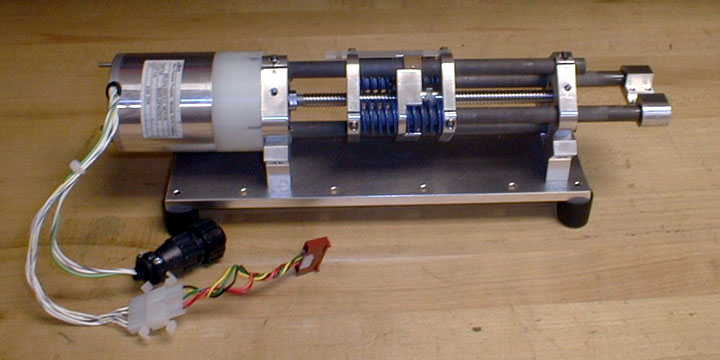
I actually spent this last summer working on M2, so I can tell you a little about how it works. M2 was designed to make use of two nifty ideas, the first being Series-Elastic Actuators (photo)and the other being Virtual Model Control link to pdf journal article).
The series elastic actuators are meant to simulate the interaction of a human muscle-tendon-bone system, and to allow for the design of a low-impedance system. M2 is designed to actually mimic the inherent low-impedence (low-stiffness) mechanical system that people represent. People are really awful at position based/high-impedance control, which is what most traditional robots use. This is useful for manufacturing, when you want the robot arm to always put the bolts in the same place, but leads to stereotypical "robot" movement (like the guy spastically jerking around on the dance floor). People are pretty good at force control though (there are all sorts of biological reasons for this). So M2 was built to be low-impedance like a person by using these S-A Actuators.
Virtual Model Control is supposed to allow more a more intuitive control of a robot by simulating it as a mechanical system. VMC lets you basically define springs and dampers at different points which are then simulated by the actuators. So to keep M2 standing, you might make a granny-walker out of springs, and to make it walk you could "attach" a spring to its chest pulling it forward. VMC has been implemented in simulation (where it works great), but it's not quite ready in real life.
The really cool thing about M2 is its potential. It already moves much more fluidly and naturally than any other robot out there, and its not nearly done yet. Once its working properly, it'll be able to walk essentially blindly (becuase its low impedance) like a person, rather than needing to know exactly where to place each foot (*cough*ASIMO*cough*) to keep from shattering itself.
If anyone has any other questions about how M2 actually works, I'd be happy to answer them.
-Zach -
I do wonder ...I really do wonder, why are all those people crazy about those 5.1, 6.0, AC-3 whatever systems.
It *is* possible to get 3D sound with just two speakers/headphones. Headphones are of course much preferable. Finally, humans have just two ears, not five or six. Trick is in the processing - the feeling of space is achieved not only by using intensity but also phase of the sound. The algorithms to do that are known, just Google for HRTF (head-related transfer function) - e.g. here.
If you have a good HRTF and a geometrical model of the space, you can recreate very accurate sound reproduction, with just two speakers/headphones.
EAX and DirectSound took a very rough approximation of HRTF and some rough approximation of the space (e.g. concert hall, church, etc.) and give you list of filters. The effects have nothing to do with reality and you will not get better spatial feeling using even twenty speakers. You do not take into account reflections, material on the walls, standing wave effects etc.
For people interested in accoustic, have a look here. I had a short course with prof. Rindel, who is one of the authors of the ODEON software (there is a free demo on the page) and the stuff is really impressive. It beats things like EAX or very expensive 5.1 setups hands down. If modelling of this sort was supported by hardware, that would be the real revolution in computer audio. BTW, this technology was used as a part of CAHRISMA EU project, which we participated in (for the virtual reality part), the stuff is pretty much usable in real time already ( CAHRISMA at DTU, CAHRISMA at our lab, Something on the VR aspects of the project
-
I do wonder ...I really do wonder, why are all those people crazy about those 5.1, 6.0, AC-3 whatever systems.
It *is* possible to get 3D sound with just two speakers/headphones. Headphones are of course much preferable. Finally, humans have just two ears, not five or six. Trick is in the processing - the feeling of space is achieved not only by using intensity but also phase of the sound. The algorithms to do that are known, just Google for HRTF (head-related transfer function) - e.g. here.
If you have a good HRTF and a geometrical model of the space, you can recreate very accurate sound reproduction, with just two speakers/headphones.
EAX and DirectSound took a very rough approximation of HRTF and some rough approximation of the space (e.g. concert hall, church, etc.) and give you list of filters. The effects have nothing to do with reality and you will not get better spatial feeling using even twenty speakers. You do not take into account reflections, material on the walls, standing wave effects etc.
For people interested in accoustic, have a look here. I had a short course with prof. Rindel, who is one of the authors of the ODEON software (there is a free demo on the page) and the stuff is really impressive. It beats things like EAX or very expensive 5.1 setups hands down. If modelling of this sort was supported by hardware, that would be the real revolution in computer audio. BTW, this technology was used as a part of CAHRISMA EU project, which we participated in (for the virtual reality part), the stuff is pretty much usable in real time already ( CAHRISMA at DTU, CAHRISMA at our lab, Something on the VR aspects of the project
-
mirror of binary
mirror of xchat windows binary.
404219: dc ab ab b7 15 61 fsubrl 0x6115b7ab(%ebx)
40421f: a3 5f 3c 68 03 mov %eax,0x3683c5f
404224: fb sti
404225: 48 dec %eax
404226: 54 push %esp
404227: 59 pop %ecx
404228: 58 pop %eax
404229: 63 d7 arpl %dx,%di
40422b: 9b fwait -
Re:Don't hate it
the human eye cannot distinguish between that many shades (particularly in the blue region)
While it may seem counterintuitive, the human eye is much better at discriminating between shades of blue than between red or green (where it is worst by far). There's a nice graph showing the MacAdam ellipses that represent the amount of variation in chromaticity where no difference can be percieved in this paper. This is obviously different from the responsiveness to brightness.
16 bit color representaion usually has the 6 bits for green.
For most people, 8 bit per RGB component on an linear scale, as used in almost all computers, is not enough - you can still see some banding. A logarithmic scale or 10 bit color can fix this. -
Coolness == AbstractionEnterprise-grade apps and "coolness" may be inapproriate bedfellows. Besides, does any language offer both?
That'd be Erlang.
The FA missed the point rather badly, IMO - what makes Java 'uncool' is its lack of support for abstraction. When a programmer finds himself doing the same thing again and again, his first thought is "can I abstract this pattern?". In Java, the answer is all too frequently "no", and the programmer is forced to type in several lines of code to express one conceptual construct.
Sun's big mistake was in not separating the ideas of Java and the JVM more cleanly when marketing it - there are some very cool, hacker-friendly JVM languages (most notably Scala), all of which share Java's virtue of "compile once, run anywhere", but which have got practically no mindshare.
-
Re:Depends ...
If you want all the nice Java libraries, strong static type-checking, and compilation to JVM bytecode, why not try Nice or Scala? Both provide everything Java has, including the ability just to use arbitrary Java classes and APIs completely transparently - and they add many of the best features of functional programming, and have terser syntaxes than Java too.
Worth considering, anyway. -
Obedience to authority
You have to read Milgram's "Obedience to authority" more than any other book. You can read this online article too.
-
Re:Strongly Typed Container Classes
If you liked Pizza, maybe you'll like Scala, a functional, multiparadigm language developped by the same author, Martin Odersky. I have him as a programming teacher, and we learnt functional programming with Scala. It was a great course, and the language is really elegant and powerful.
It has bindings with Java and -
Re:Unix Tools and Shells.. that's what windows lac
Ditto. Cygwin and perl are usually among the first few things I load on a windows workstation. Some other folks have put together a nice collection of unix/gnu software for windows. In particular, the grandparent may be interested in these nicely packaged Unix Utils.
-
FreeducTry Freeduc. It's a linux based distribution especially designed for education. So you get both a free operating system and lots of educational software. I think it was financed by UNESCO or some similar organisation.
If you go the windows route (which frankly I don't recommend) I'd go with OpenOffice, TheOpenCD and Gnuwin II for lots of free software.
Dave.
-
Yes, you *can* program sh#t in bare MSWin
you can't program sh*t on a windows install without buying separate software.
You're wrong. If that isn't a sheeyite programming language, I don't know what is.
On a more serious note, all that you've listed is but a download away, plus trhere are convenient ISOs available of some things.
The real advantages for Linux lie in several areas:
- TECHNICAL - things that are difficult-to-impossible for MS-Windows without "special equipment". Stuff like Xnest and User Mode Linux, which are boons for testing end-user and kiosk style applications, or the so-called Backstreet Ruby console project, which allows multiple independent users on one piece of hardware (e.g. two users on a multihead Radeon card). Stuff like "Terminal Services" and DAVfs being intrinsic to the system.
- POLITICAL - things like the absence of spyware, a licence agreement which says "if you break it you own both pieces" rather than one which says "your computer is now My Computer", being invented everywhere rather than in [insert name of favourite foreign imperialist infidel country here] - if The Boss drives a Citroën, start with "Where does it come from? France, Finland, Australia, [blah blah long list of places blah]. Oh, and did I mention France?" You can update piecemeal, or more or less at your own speed; since you have all of the pieces, a sizeable organisation could easily afford to settle on a distro and maintain it themselves ad infinitum by updating versions or patching at their discretion.
- FINANCIAL - Pretty dang obvious. Pay per user, per cpu, per port, or just for the support you need? Hmmm... let me think, this is a toughie...
- ANYTHING BUT MICROSOFT - sad but true. Probably 10% of conversions have this as their primary justification.
- CUSTOMISABLE - dislike a feature? Don't just disable it (only to have a user figure out a bypass later), get out your handy-dandy software saw and lop that horrid thing right off!
- TECHNICAL - things that are difficult-to-impossible for MS-Windows without "special equipment". Stuff like Xnest and User Mode Linux, which are boons for testing end-user and kiosk style applications, or the so-called Backstreet Ruby console project, which allows multiple independent users on one piece of hardware (e.g. two users on a multihead Radeon card). Stuff like "Terminal Services" and DAVfs being intrinsic to the system.
-
Re:Seriously, I'm not trying to be an ass...
GNUWin. For all your Win32 OSS needs.
-
Re:Best of both worlds is Windows+Cygwin
-
Re:I doubt it.Good comments, for the most part. You might be interested to look at the Scala language, it seems to have some nice higher-level (and functional) features. At least it shows that very interesting things can be built on top of the Java foundation.
My main problem with Java is verbosity, which is simply a function of the veryExplicitVariableNamesAreGood meme. Foolish consistency, perhaps?
For me, personally, I think programming languages should evolve more in the direction of mathematical notation, and extensibility is important. Mathematics is the tool (evolved over centuries) we've created to deal with the most complex concepts ever invented. Two observations about math notation - first it is minimalist, so complex concepts may be grasped with a minimum amount of notation. Second, it is extensible, so that new concepts may be expressed concisely. Interesting how this contrasts with modern programming language design... My feeling is that more power is better, damn the torpedoes...and all that power should ultimately translate to very tight, efficient, realtime-capable code. Interestingly, my current language for most development is Java...sigh.
To address one of your points:
Look at the size of the Java APIs. How many packages are there? How many classes? How many methods? This is making our lives, as programmers, easier... how?
By allowing us to not have to implement the underlying code ourselves, of course.
That said, some of the library (*cough* Java I/O system) is pretty brain-dead. In that sense, though, Java is extensible enough to fix things.
-
More info
Here's a more informative description of some of the technology being used by Konarka. Looks pretty interesting to me.
-
Yes, it is encryption
It's not the encryption per se that use quantum mechanics.
But the un-interceptable channel produced by quantum mechanics is used to exchange the encryption keys used in the encryption itself.
So, YES, the quantum mechanics are used in encryption.
Research is currently done on this subject here in switzerland
Principle
- according to quantum mechanics, you cannot split light in smaller element than photons.
- Quantum encryption transmits information (keys) using one single photon at a time (per bit of information).
- If any one attemps to steal the information, they'll "eat" the photon (no way to split photo. Either they go to receiver, or they go to the spy, they cannot go to both place at the same time), and the photon will be lost, just like it happens with other transmission errors.
- Using some error correction-like method both receiver and sender agrees which bits aren't lost and will be used.
- It doesn't matter whether the lost bit where lost due to poor quality of transmission or because of a spy listening : they won't be used any way.
- The "error correction-like" (= agreeing which photon they'll use) can be done on a basic non encrypted channel. Even if the spy get this information, it doesn't help him : because they'll agree on photon that arrived correctly, i.e.: photons the spy hasn't captured. All other photon he did manage to capture will be discarded.
-
Re:A great idea
That's the general idea of these CDs:
k12wincd
The OpenCD
Gnuwin II
Burn copies, share them with your friends, tell them to make copies.
Get People familiar with the software first, then the migration to linux is easy.
-
Also take a look..
..at GNUWin II, a similar project.
-
Re:A list
I use 7-zip instead of Winzip. It compresses into more formats and doesn't ask you to buy it every time you use it. It's free (as in beer) and small enough to fit on a floppy.
I use SciTE (Scintilla Text Editor) for CSS (as well as HTML, SVG, etc). Not only does it color-code your syntax, but it knows valid HTML and CSS and will alert you when you use a nonstandard element or attribute. It's really handy. I wish it knew SVG as well. It knows a bunch of other languages, but I'm not a programmer so I never use it for more than web development. It is available for Win32 and Linux (but not as a native cocoa app in OS X, unfortunately) and is distributed under a license similar to the Python license.
Someone already mentioned Filezilla, so I won't bother. Except to say that it rocks.
I learned about all of these applications from the GNUWin CD. I usually look there first when I'm looking for Free software to do something on Windows. Have a look around their software lists and you'll probably find a few interesting things to try.
-
Re:Great Blog
Would the following link be helpful?
GNUWin II -
Re:JPEG, JPEG2000, and frivolous lawsuits.As it happens there are two reference implementations specified in part 5 of the standard - one in C called Jasper and one in java called JJ2000 Source code is freely available for download in both cases.
As to the patent encumberedness, yes there are some patents governing JPEG2000, however it would appear the ISO/IEC have done their homework in this regard. From the last page of the standard, after listing people who hold patents related to the standard:
"The holders of these patent rights have assured the ISO and IEC that they are willing to negotiate licences under reasonable and non-discriminatory terms and conditions with applicants throughout the world. In this respect, the statements of the holders of these patents right are registered with the ISO and IEC."
I am not aware that any patent holder has sued over patent rights related issues in JPEG2000, and some of them (look at the JJ2000 copyright notice) agree not to mess with you over IP issues if you use their stuff in a JPEG2000 implementation. I'd like to think that they've become a little more wise about this sort of thing in the wake of the JPEG/GIF fiascoes.
-
Re:Cool. Reminds me of the Logidules, 30+ years ag
These things are still used! These homebrew logic blocks aren't equipped with output devices beyond LEDs or small numerical displays, but they're incredibly useful when it comes to practicing what you're learning in a logic systems course.
The Logic Systems Laboratory of the SFIT/EPFL has a lab full of logidules. The Computer Science and Communication Systems students in their first year there are lucky enough to play with this geeky toy on a weekly basis...
I'm wondering how many generations of nerds have drooled over those blocks. Even if they're almost 30 years old, they're still incredibly addictive to use.
- Hadriven