Slashdot Mirror
Domain: esa.int
Stories and comments across the archive that link to esa.int.
Comments · 950
-
Don't forget Mars Express...
Beagle2 was only 'the lander' of Mars Express.
On the website we can read:
The Mars Express Orbiter will:
image the entire surface at high resolution (10 m/pixel) and selected areas at super resolution (2 m/pixel)
produce a map of the mineral composition of the surface at 100 m resolution
map the composition of the atmosphere and determine its global circulation
determine the structure of the sub-surface to a depth of a few kilometres
determine the effect of the atmosphere on the surface
determine the interaction of the atmosphere with the solar wind
All of that sounds really cool. -
Re:Let me condense the relevant info furthercool down: who said that the mission fails when beagle fails?
check ESA Mars Express Orbiter Details to see how much more scientific data the european mission will return, even though some 20% of the mission failed.
- 3D imaging will reveal the topography of Mars in full colour
- build up a map of surface composition in 100 m squares, also measure aspects of atmospheric composition
- build up measurements of ozone and water vapour over the total surface of the planet for the different seasons
- measure the vertical pressure and temperature profile of carbon dioxide which makes up 95% of the martian atmosphere, and look for minor constituents including water, carbon monoxide, methane and formaldehyde
- measure ions, electrons and energetic neutral atoms in the outer atmosphere to reveal the numbers of oxygen and hydrogen atoms
- probe the planet's ionosphere, atmosphere, surface and even the interior
- map the sub-surface structure to a depth of a few kilometres
a lander just creeps around, poking holes in things. orbiter looks closely at the whole planet.
why not let the science results decide who succeeded.
-
Re:I'm European...and I'm sad it is down...
cheer up, my european friend - afaik, the beagle part of the european mars mission makes up for only 20% - the rest of the mission, mars orbiter, probes the planet from a depth of several kilometers up to the rim of the atmosphere for signs of water and other characteristics. the mission alltogether is thus more likely to produce data thats more than a "pinpoint sample" as compared to the nasa mission
see the link above for an overview of the data the orbiter will gather and compare that to the fancy rubble images... -
Re:Installers
I heard they contracted ESA for the Linux port.
-
Re:This has been done beforeThe mission is important due to the sample return. There is no Solar Electric propulsion according to the mission website, it was performed by a standard monopropellant.
Perhaps you are thinking of the SMART-1 mission?
-
Re:QuestionDoes anyone know the different purposes they have?
Quick list, by no means meant to be complete, just to give an impression of the differences between the missions:
Beagle 2: Lander, search for signs of past or present life on the planet surface
Mars Express: Orbiter, study atmosphere and surface with radar and spectrometers
Mars Rovers: 2 Landers, search for signs of past or present water (NASA's Follow The Water strategy)
Nozomi: Orbiter, study atmoshpere and interaction with solar wind. Mission failed. -
Celestia?
-
Wait for Mars Express contact
Mars Express has not yet tempted to contact the Beagle 2. Seems it's the only one that has been specially designed and tested to transmit and receive signals from Beagle 2.
More in the ESA news item. -
The Brits enjoy failing?
Funny how the Reuters UK article considers this a British failure (the title is "Major Setback for Britain's Mars Probe Mission"), when in fact it is a European Space Agency mission (with American involvement too, i think).
-
More InformationAll have fairly up-to-date news and status of attempts to contact Beagle 2 and the Mars Express orbiter.
Beagle 2's official site.
Space.com's Mars Rover section.
European Space Agency's Mars Express website.
-
More news on ESA Mars effortsESA is also planning long term Aurora programme for eventual manned mission to Mars.
Aurora roadmap:
- 2007 - an entry vehicle demonstrator mission to validate and demonstrate high-speed re-entry technology
- 2009 - ExoMars, an exobiology mission to send a rover to Mars in order to search for traces of life - past or present - and characterise the nature of the surface environment.
- 2011 / 2014 - Mars sample return, a split mission to bring back to Earth the first samples of Martian material
- 2014 - Human mission technologies demonstrator(s) to validate technologies for orbital assembly and docking, life support and human habitation
- 2018 - a technology precursor mission to demonstrate aerobraking/aerocapture, solar electric propulsion and soft landing (formerly envisaged as a smaller Arrow-class mission to be launched in 2010)
- 2024 - a human mission to the Moon to demonstrate key life support and habitation technologies, as well as aspects of crew performance and adaptation and in situ resources utilisation technologies
- 2026 - an automatic mission to Mars to test the main phases of a human mission to Mars
- 2030 / 2033 - a split mission that will culminate in the first human landing on Mars
More information: ESA or Spacedaily.
-
Re:NASA's Record
...The beagle is EU's first real robotic mission...
Erm, Beagle may be the first European lander but certainly not the first robotic mission (addmitedly depending on your definition of robotic). Additionally, Huygens was launched long before Beagle 2. So whilst Beagle 2 may be the first ESA lander to actually land, it certainly wasn't the first to be launched.
(and anyway, most of these missions have substantial elements from other countries, both ESA member statues, the US, and other countries. I hardly think that ESA and NASA seriously think that they are competing with each other.) -
Re:On the subject of Mars...Don't forget that on Dec. 19th we have the very important separation of Beagle2 and Mars Express. Make or break time for the mission!
At 9:31 CET, ESA's ground control team at Darmstadt (Germany) will send the command for the Beagle 2 lander to separate from Mars Express. A pyrotechnic device will be fired to slowly release a loaded spring, which will gently push Beagle 2 away from the mother spacecraft.
Data on the spacecraft's position and speed will be used by mission engineers to assess whether the lander was successfully released. In addition, the onboard Visual Monitoring Camera (VMC) should provide an image showing the lander slowly moving away. The image is expected to be available mid-afternoon.
-
On the subject of Mars...
...lets not forget that the European Space Agency's Mars Express mission has almost reached the red planet, and that the British-built Beagle 2 probe onboard will be touching down on Christmas Day, to begin its search for life. I for one am very excited!
-
On the subject of Mars...
...lets not forget that the European Space Agency's Mars Express mission has almost reached the red planet, and that the British-built Beagle 2 probe onboard will be touching down on Christmas Day, to begin its search for life. I for one am very excited!
-
On the subject of Mars...
...lets not forget that the European Space Agency's Mars Express mission has almost reached the red planet, and that the British-built Beagle 2 probe onboard will be touching down on Christmas Day, to begin its search for life. I for one am very excited!
-
Where's a Map?!
So man redundant links and not a one has a picture of where the tunnel will be located.
Can anyone find one? This is the best detail I could find.
(Does anyone else get the impression that almost the only maps available online are all stolen from the CIA World Factbook? Information Superhighway my ass...)
-
Re:Article is flamebait
Let's hope that Galileo supports the maximum accuracy for everyday civilian use. If it doean't there's very little point.
Promised by ESA: Galileo will deliver real-time positioning accuracy down to the metre range, which is unprecedented for a publicly available system. It will guarantee availability of the service under all but the most extreme circumstances and will inform users within seconds of a failure of any satellite. This will make it suitable for applications where safety is crucial, such as running trains, guiding cars and landing aircraft. -
Still fingers crossed for Mars ExpressMars Express has to perform one VERY important maneuvre. On December 19th it must eject the Beagle 2 lander whilst still travelling at interplanetary velocity.
If Mars Express fails to shoot Beagle 2 into space, the retro-engine will not have enough thrust to brake Mars Express into Martian orbit. Both probes would then fly past the planet and into solar orbit.
Beagle 2 then travels through space for six days before hitting the Martian atmosphere at interplanetary velocity. Beagle 2's onboard transmitter will not come to life until the probe impacts the surface, so you can imagine that those six days will be pretty tense for the ESA teams.
All being well, Beagle 2 and Mars Express should arrive at their destinations safe and well in the small hours of Christmas morning. By the time we're opening our presents here in the UK, they should have received a signal from the Martian surface.
So, here's hoping!
Best wishes,
Mike. -
Solar electric propulsion
If you use chemical rockets, it would take quite a bit of fuel to boost Hubble. But with solar electric, as for example is being used by Smart-1's ion engine, you wouldn't need much fuel at all. NASA doesn't seem to like doing innovative things like solar electric though (well, they did use it on Deep Space 1, but that was just once so far).
-
When's the replacement?This site (sorry I couldn't find a better one!) says the replacement will ready by 2008. I take this to mean around 2012, realistically, ie cynically.
They should just keep Hubble up long enough until the replacement is up and working. Otherwise, we will suffer a significant lapse in astronomical research.
As for what do with it once it's deactivated? I say we try scavenging it for parts and drop the rest into the Pacific. The UV/IR sensors and whatever else is on board must be worth something to someone...
-
Re:I've been wrong before, but ...
With all due respect, we europeans might not have made it to the moon and back, but space travel ain't alien to us. In fact, we have plenty of experience with it!
Granted, some of them very pretty bad, but hey...that's how you learn, innit....
-
Re:I've been wrong before, but ...
With all due respect, we europeans might not have made it to the moon and back, but space travel ain't alien to us. In fact, we have plenty of experience with it!
Granted, some of them very pretty bad, but hey...that's how you learn, innit....
-
Re:America needs to rethink some priorities
ESA has launched more probes before the SMART-1 moon mission. e.g.: Mars Express, Giotto, click on the 'Missions' button in that page and see the list.
-
Re:America needs to rethink some priorities
ESA has launched more probes before the SMART-1 moon mission. e.g.: Mars Express, Giotto, click on the 'Missions' button in that page and see the list.
-
Re:Why is NASA...
-
Re:Ion drive is cool, but...
Yes, Deep Space 1 did use an ion engine. This craft also uses tricky orbits on its way to the moon, under a massive one postcard of thrust.
-
Re:Ion drive is cool, but...
Yes, Deep Space 1 did use an ion engine. This craft also uses tricky orbits on its way to the moon, under a massive one postcard of thrust.
-
Re:Very Dangerous Legislation
I wonder how big a space station you could build for $87 Billion Bucks?
Something around the same size as the one that is currently being built. The cost of the ISS is estimated at 100 billion Euros by the ESA. -
Re:One thing that scares me
As soon as it is mandatory for cars to have transmitting GPS recievers to track their movements on highways, then it will become standard issue in cities and other areas. Call me paranoid, but I don't WANT the government tracking me like that.
You're definitely right. It baffles me that an ESA press release says that vehicles "will be tracked by satellites". The Galileo system will have a "Search A Rescue" function, but this doesn't seem feasible for tracking every EU car. Was it written by some clueless marketdroid, or did I lose my clue?
Anyway, the system is implementable with no vehicle tracking - what is needed is a black box logging fees payable. (It could log position as well, but doesn't need to.) -
Re:Interesting...
Actually, comets are considered building blocks of the solar system. That's why there's a large push from NASA and the ESA to send spacecraft to comets and land on them and/or gather samples from them. Here are a few links:
Stardust
Contour (failed)
Rosetta (to be launched)
-
Re:Sooo....
-
Aibo in Space?
For a moment, I thought that an Aibo was launched into space with some new European earth observation satellite. And I was thinking, what the HELL kind of publicity stunt is THIS???
-
Most of them have appeared
videophones have been around for a while in the UK and in other countries(seems to be broken?). The quality still isn't brilliant but Orange(I think) have started to offer Soccer highlights over the latest phones.
moon colonies, ok, we chose to put a space station up there first, and then realised it costs a lot of money for little (commercial or military) value. Moon colonies are sadly not as sexy as say a Mars colony, or even a Mars mission, which ESA has planned in 25 years, NASA tried and continues to test methods of producing enough food,air and water, other countries,notably India and China have planned Moon landings so we are going back. Space is unfortunately used as a pissing contest between nuclear neighbours, when this stops then some more science can get done(e.g. Hubble, Galileo, Beagle 2)
food in pills. You can get food in pills, just not the calories, vitamins will give you nearly all of the trace elements you need to live. Calories are a lot harder, to get 500 Calories into a pill means eating something with 40 times the energy concentration of sugar or twenty times the concentration of fats, I doubt the human body would have much success digesting such complicated food. You can however get protein and creatine supplements which are in tablet/powder form, and sugar sweets( those silly energy sweets which taste of really sour orange) have more calories than their equivalent weight in sugar. (The protein supplements also tend to taste bad and are fed to animals instead. )
cars that drive themselves; power steering has been around for a while, as has ABS and cruise control, that is about as much as the current laws will allow on the public roads. intelligent cars have been developed, which, when combined with other intelligent cars, are actually safe. It's the human drivers who freak out at the sight of a driverless car that's the problem
jet packs; Jet packs appeared in Thunderball (James Bond). You can buy them if you have enough money, or you can build them if you want. They're not used much because, much like the Segway, there are easier and cheaper way of getting around.
moving sidewalk's are in most airports now, as well as some metro stations. There have also been "moving stairs" around for just as long.
--This post brought to you by Google.com, paid for by Google For America, Inc.
-
Re:Europe is in Space for DecadesFor those who think that Europe is a developing country as far as spaceflight is concerned:
From the ESA site:
During its working life, Ariane 4 captured 50% of the market in launching commercial satellites, showing that Europe can more than hold its own in the commercial launch market.
I've heard elsewhere (but can't find a link to confirm now) that the Ariane systems lifted about 50% by mass of all the sattelites currently in orbit.
-
Some info on current space missions...Will the future of space exploration be dominated by names other than Russia and the USA?
This question implies that space exploration in the past was dominated by the two superpowers. From a manned spaceflight perspective, this implication is quite correct; but from an unmanned perspective, it is rather inaccurate. Over the last three decades, a large proportion of the activity in unmanned space exploration has been undertaken by countries other than two superpowers. And let's not forget that, unlike most unmanned misisons, the moon race was about politics, not science.
Looking towards the future, quite a bit of the exploration of our solar system involves both USA/Russia and other countries, either in collaboration or in competition. Particular missions to keep an eye on include:
- Beagle 2 , the probe onboard the European Space Agency's Mars Express mission. Beagle 2 is scheduled to touch down on Mars this December, and amongst its tasks it will be searching for life, using techniques far more accurate than the previous tests by the Viking Lander probes. Mars Express, the spacecraft carring Beagle 2, blasted off from Baikonur Cosmodrome on a Russian-built rocket earlier this year; movies of the launch can be found here
- Two Mars Exploration Rovers , which are robots based on NASA's very successful 1997 Pathfinder mission. The two rovers are due for touchdown in January 2004; they are targeted at analysing the geology of Mars.
- Cassini , a NASA probe destined for Saturn. Apart from flybys by deep-space probes, we've never had a decent look at Saturn and its satellites. On-board Cassini is the Huygens probe, which will be dropped through the thick hydrocarbon atmosphere of Titan. Titan is the largest of Saturn's moons, and the only satellite in the solar system to have an atmosphere.
- MESSENGER , a NASA mission to Mercury due for launch next year, which will arrive in orbit around the innermost planet in 2009. Amongst other things, MESSENGER will ascertain whether Mercury has deposits of water ice deep within high-walled impact craters near its poles.
- Venus Express , the European Space Agency's sister misison to Mars Express, will depart for Venus in December 2005, arriving at the planet the following summer. It will analyse the atmosphere and the surface of the planet, and hopefully explain the anomalous chemical compositions within the atmosphere, which some have suggested are due to microbial life.
So, we can see that there is a lot going on at the moment in the field of space exploration. Over the past few days, I've been watching HBO's "From the Earth to the Moon", and its made me regret that I wasn't alive during the space race. But, on reflection, there is plenty going on right now to get excited about!
-
Some info on current space missions...Will the future of space exploration be dominated by names other than Russia and the USA?
This question implies that space exploration in the past was dominated by the two superpowers. From a manned spaceflight perspective, this implication is quite correct; but from an unmanned perspective, it is rather inaccurate. Over the last three decades, a large proportion of the activity in unmanned space exploration has been undertaken by countries other than two superpowers. And let's not forget that, unlike most unmanned misisons, the moon race was about politics, not science.
Looking towards the future, quite a bit of the exploration of our solar system involves both USA/Russia and other countries, either in collaboration or in competition. Particular missions to keep an eye on include:
- Beagle 2 , the probe onboard the European Space Agency's Mars Express mission. Beagle 2 is scheduled to touch down on Mars this December, and amongst its tasks it will be searching for life, using techniques far more accurate than the previous tests by the Viking Lander probes. Mars Express, the spacecraft carring Beagle 2, blasted off from Baikonur Cosmodrome on a Russian-built rocket earlier this year; movies of the launch can be found here
- Two Mars Exploration Rovers , which are robots based on NASA's very successful 1997 Pathfinder mission. The two rovers are due for touchdown in January 2004; they are targeted at analysing the geology of Mars.
- Cassini , a NASA probe destined for Saturn. Apart from flybys by deep-space probes, we've never had a decent look at Saturn and its satellites. On-board Cassini is the Huygens probe, which will be dropped through the thick hydrocarbon atmosphere of Titan. Titan is the largest of Saturn's moons, and the only satellite in the solar system to have an atmosphere.
- MESSENGER , a NASA mission to Mercury due for launch next year, which will arrive in orbit around the innermost planet in 2009. Amongst other things, MESSENGER will ascertain whether Mercury has deposits of water ice deep within high-walled impact craters near its poles.
- Venus Express , the European Space Agency's sister misison to Mars Express, will depart for Venus in December 2005, arriving at the planet the following summer. It will analyse the atmosphere and the surface of the planet, and hopefully explain the anomalous chemical compositions within the atmosphere, which some have suggested are due to microbial life.
So, we can see that there is a lot going on at the moment in the field of space exploration. Over the past few days, I've been watching HBO's "From the Earth to the Moon", and its made me regret that I wasn't alive during the space race. But, on reflection, there is plenty going on right now to get excited about!
-
Some info on current space missions...Will the future of space exploration be dominated by names other than Russia and the USA?
This question implies that space exploration in the past was dominated by the two superpowers. From a manned spaceflight perspective, this implication is quite correct; but from an unmanned perspective, it is rather inaccurate. Over the last three decades, a large proportion of the activity in unmanned space exploration has been undertaken by countries other than two superpowers. And let's not forget that, unlike most unmanned misisons, the moon race was about politics, not science.
Looking towards the future, quite a bit of the exploration of our solar system involves both USA/Russia and other countries, either in collaboration or in competition. Particular missions to keep an eye on include:
- Beagle 2 , the probe onboard the European Space Agency's Mars Express mission. Beagle 2 is scheduled to touch down on Mars this December, and amongst its tasks it will be searching for life, using techniques far more accurate than the previous tests by the Viking Lander probes. Mars Express, the spacecraft carring Beagle 2, blasted off from Baikonur Cosmodrome on a Russian-built rocket earlier this year; movies of the launch can be found here
- Two Mars Exploration Rovers , which are robots based on NASA's very successful 1997 Pathfinder mission. The two rovers are due for touchdown in January 2004; they are targeted at analysing the geology of Mars.
- Cassini , a NASA probe destined for Saturn. Apart from flybys by deep-space probes, we've never had a decent look at Saturn and its satellites. On-board Cassini is the Huygens probe, which will be dropped through the thick hydrocarbon atmosphere of Titan. Titan is the largest of Saturn's moons, and the only satellite in the solar system to have an atmosphere.
- MESSENGER , a NASA mission to Mercury due for launch next year, which will arrive in orbit around the innermost planet in 2009. Amongst other things, MESSENGER will ascertain whether Mercury has deposits of water ice deep within high-walled impact craters near its poles.
- Venus Express , the European Space Agency's sister misison to Mars Express, will depart for Venus in December 2005, arriving at the planet the following summer. It will analyse the atmosphere and the surface of the planet, and hopefully explain the anomalous chemical compositions within the atmosphere, which some have suggested are due to microbial life.
So, we can see that there is a lot going on at the moment in the field of space exploration. Over the past few days, I've been watching HBO's "From the Earth to the Moon", and its made me regret that I wasn't alive during the space race. But, on reflection, there is plenty going on right now to get excited about!
-
Europe is in Space for DecadesEurope is not one of many countries getting involved. It is a continent and union of countries with a very successfull commercial space program: ESA. Ariane 1 started in 1979; Ariane 4 was just discontinued after 113 (out of 116) successfull launches with payloads up to 4700 kg. 19 percent of customers for Ariane 4 were from the US. Brazil is trying to get into a business (satellite launches) in which the US, Russia, and Europe are for decades.
-
Europe is not getting involved
They are involved for quite long time now. ever heard of ESA?
But yeah, please, you are welcome to compare Chinese, Japanese and Brazilian space programs with the European one. Americans.... -
Re:Europe is a continent
You may not be aware of the EUROPEAN SPACE AGENCY.
Pretty safe to assume that they are Europeans from Europe. -
Re:Since when...
Well, most of the effort from European Union countries comes through the European Space Agency. This is why it's probably okay to classify them as "the europeans". They've not done any solo manned stuff yet, but have done a lot with space probes and unmanned missions.
Although they don't have manned launch vehicles of their own, they work with the Soviets and with NASA. Their highest profile manned project is their work on the International Space Station - both in terms of supplying space hardware and astronauts. Their most notable unmanned project is the groundbreaking joint-NASA SOHO sun observation probe.
Upcoming projects of note: a manned Mars mission is in the (very) early planning stages.
It seems as though international cooperation should be the *only* way to go when it comes to grand plans such as reaching Mars. If NASA, ESA, China, India and the Soviets all put their differences aside and pulled together - humanity could become a truly spacefaring species within our lifetimes (graduating from a "type 0" to a "type 1" species that has mastered interplanetary travel [where type 2,3 = extra-solar and galactic travel). -
Re:Since when...
Well, most of the effort from European Union countries comes through the European Space Agency. This is why it's probably okay to classify them as "the europeans". They've not done any solo manned stuff yet, but have done a lot with space probes and unmanned missions.
Although they don't have manned launch vehicles of their own, they work with the Soviets and with NASA. Their highest profile manned project is their work on the International Space Station - both in terms of supplying space hardware and astronauts. Their most notable unmanned project is the groundbreaking joint-NASA SOHO sun observation probe.
Upcoming projects of note: a manned Mars mission is in the (very) early planning stages.
It seems as though international cooperation should be the *only* way to go when it comes to grand plans such as reaching Mars. If NASA, ESA, China, India and the Soviets all put their differences aside and pulled together - humanity could become a truly spacefaring species within our lifetimes (graduating from a "type 0" to a "type 1" species that has mastered interplanetary travel [where type 2,3 = extra-solar and galactic travel). -
Re:Since when...
Well, most of the effort from European Union countries comes through the European Space Agency. This is why it's probably okay to classify them as "the europeans". They've not done any solo manned stuff yet, but have done a lot with space probes and unmanned missions.
Although they don't have manned launch vehicles of their own, they work with the Soviets and with NASA. Their highest profile manned project is their work on the International Space Station - both in terms of supplying space hardware and astronauts. Their most notable unmanned project is the groundbreaking joint-NASA SOHO sun observation probe.
Upcoming projects of note: a manned Mars mission is in the (very) early planning stages.
It seems as though international cooperation should be the *only* way to go when it comes to grand plans such as reaching Mars. If NASA, ESA, China, India and the Soviets all put their differences aside and pulled together - humanity could become a truly spacefaring species within our lifetimes (graduating from a "type 0" to a "type 1" species that has mastered interplanetary travel [where type 2,3 = extra-solar and galactic travel). -
Re:Since when...
But as far as I know none of the countries has its own space program, they cooperate in the European Space Agency.
-
Re:Confused
it's likely the organization will continue with both aggressive games-as-free-speech lobbying and similarly aggressive copyright enforcement
And they start off by stealing someone's name?
European Space Agency
Yeah, I have a great idea for my company, I'll call it NASA. -
And their relationship to space travel is?
I wonder what the European Space Agency thinks. I expect, like most of us they don't care.
-
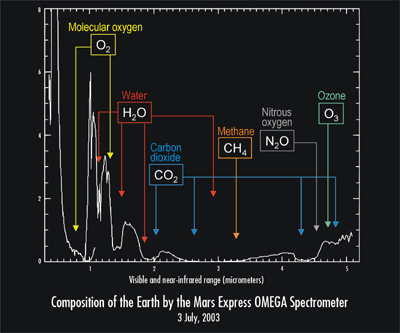
Methane..
According to this chart, earth has enough methane to show up on this orbiters sensors. Ok
-
Re:good to see nasa doing some serious science
Re: Venus, ESA are planning a Venus Express mission, re-using most of the spare components of Mars Express, to be launched in 2005. More details are at http://sci.esa.int/science-e/www/area/index.cfm?f
a reaid=64. -
Re:fuel?See, for example: this ESA article: Solar-electric propulsion is ESA's new spacecraft engine. It does not burn fuel as chemical rockets do; instead the technique converts sunlight into electricity via solar panels and uses it to electrically charge heavy gas atoms, which accelerate from the spacecraft at high velocity. This drives the spacecraft forwards. In a chemical rocket, burning the fuel creates gas that is expelled relatively slowly compared to electric thrusters. However, in an ion engine, the gas is ejected at large velocities, which makes it generally much more efficient, so less fuel is required.
Because propulasion works by conservation of momentum, if you can fire the ions out the back fast enough you don't need too many of them. The problem with normal jet propulsion is that the jets aren't very high velocity.