Slashdot Mirror
Domain: faa.gov
Stories and comments across the archive that link to faa.gov.
Comments · 513
-
Re:Terrible plane
The FAA doesn't investigate aircraft accidents. That's the job of the NTSB.
You'd best tell these guys then: https://www.faa.gov/about/offi...
-
Re:One in 100,000 WHAT?
One in a hundred thousand WHAT?
In cases like this, flight hours. See AC 25.1309-1A, specifically paragraph 10.b, for more information.
-
Re:How can the Trumpists blame Obama for this?
So I checked the schedule for the certification of the 737 MAX and confirmed that it happened in 2017, but early enough to blame on REAL president Obama.
You could blame it on the Obama administration or the Trump administration, but it goes back a long time.
The Federal Aviation Act of 1958 was the original statute allowing FAA to delegate activities, as the agency thinks necessary, to approved private people employed by aircraft manufacturers. Although paid by the manufacturers, these designees act as surrogates for FAA in examining aircraft designs, production quality, and airworthiness. The FAA is responsible for overseeing the designees' work and determining whether the designs meet FAA requirements for safety.
-
Drone Pilots Read Your NOTAM's
A pilot should always read their respective NOTAMS, because after the Jack Stone event there is nothing better to do for FBI folks.
-
FAA: I am altering the deal...
According to the FAA's own UAS guidelines:
Flying drones in and around stadiums is prohibited starting one hour before and ending one hour after the scheduled time of any of the following events:
Major League Baseball
National Football League
NCAA Division One Football
NASCAR Sprint Cup, Indy Car, and Champ Series racesSpecifically, UAS operations are prohibited within a radius of three nautical miles of the stadium or venue.
The part the FAA left out is that this is all subject to change, depending on how much security theater they deem is necessary for a specific sportsball event. Granted, drone pilots are supposed to check NOTAMs before flying, but it's a little unreasonable to expect any restrictions to be active days before an event.
-
Re:Self driving car terror act
THIS.
The manner in which all forms of transportation are leaning toward total dependence on GPS is concerning to me.
We're embarking on a whole generation that can't read a map, but it's not just people in their cars with Google Maps and Waze.
Huge pieces of mass-transit (e.g. aviation) are leaning hard on GPS-based navigation, and they're ripping out the backup system.
So even after "the day of" where people may get hurt or killed, you then are left with a world that can't navigate anywhere. -
Re:math seems off.
The US ADS-B mandate doesn't take effect until next year. Many aircraft are not yet equipped; as of 1 December 2018, the FAA shows 68,743 US aircraft equipped with ADS-B (62,142 good installs), estimated to be between 40% and 65% of the total number of US aircraft (just about all international aircraft in US airspace are equipped). Also, the Iridium constellation update is not yet complete, so there may not be full geographic coverage at all times. It isn't clear from the article how well the satellite-mounted receivers perform and it will likely take time to properly evaluate this performance.
-
Re: Not really a big deal anymore
Bluetooth and WiFi have been allowed on US flights since 2013:
https://www.faa.gov/news/press... -
Re:Not really a big deal anymore
You CAN use Bluetooth on airplanes. I do it all the time. When I enable flight mode on my phone (S9+), it disables WiFi and Cellular radio but not Bluetooth.
Also, the FAA permits Bluetooth: https://www.faa.gov/news/press... Excerpt: "Devices must be used in airplane mode or with the cellular connection disabled. You may use the WiFi connection on your device if the plane has an installed WiFi system and the airline allows its use. You can also continue to use short-range Bluetooth accessories, like wireless keyboards." -
ADS-B transponders for drones
The FAA actually has a pretty decent infrastructure and plan for this, it's called ADS-B. By the end of 2019 all manned aircraft that fly in US airspace are to have these transponders.
If drones had these then anyone would be able to get the registration data directly from nearby drones, so you could see who the peeping toms flying around your neighborhood are, in real-time, on a map.
It's just a matter of time before any drone capable of interacting with the national airspace system will be required to have such a transponder. Along with that expect inspection and compliance requirements - just like for manned aircraft. You want to take to the sky outside of class G airspace - then prove your craft is compliant. Manned aircraft are inspected at least once per year, commercial craft more often, based on hourly inspection requirements. Hobbyist drone operators should probably also be trained, tested, and required to show competency at least, oh, once every two years, to prove you even know what class G airspace is, and maybe a certificate of training of some kind.
Take your drone to class G airspace and stay there and below 400 feet - do whatever you want. With a functioning transponder. Enjoy the sky, but please realize you aren't alone up there.
-
ADS-B transponders for drones
The FAA actually has a pretty decent infrastructure and plan for this, it's called ADS-B. By the end of 2019 all manned aircraft that fly in US airspace are to have these transponders.
If drones had these then anyone would be able to get the registration data directly from nearby drones, so you could see who the peeping toms flying around your neighborhood are, in real-time, on a map.
It's just a matter of time before any drone capable of interacting with the national airspace system will be required to have such a transponder. Along with that expect inspection and compliance requirements - just like for manned aircraft. You want to take to the sky outside of class G airspace - then prove your craft is compliant. Manned aircraft are inspected at least once per year, commercial craft more often, based on hourly inspection requirements. Hobbyist drone operators should probably also be trained, tested, and required to show competency at least, oh, once every two years, to prove you even know what class G airspace is, and maybe a certificate of training of some kind.
Take your drone to class G airspace and stay there and below 400 feet - do whatever you want. With a functioning transponder. Enjoy the sky, but please realize you aren't alone up there.
-
Re:anyone can receive and decode ADS-B data, not T
Hey bro, I understand your frustration. Aviation is expensive, especially as a hobby, and nobody likes Uncle Sam breathing down their neck.
And I hate to break it to you, but ADS-B is also required in class E airspace at various altitudes depending on where you are: FAA Nextgen info. These requirements are subject to change, and we all know the FAA regulatory process is pretty much one way, unless congress gets involved. The FAA grounds planes all the time. Every time an FAA licensed IA mechanic inspects an airplane and determines that the airplane isn't airworthy (like, not having required equipment), it's grounded until it's fixed. And don't think you'll be able to squeak through some airspace undetected. If you knew the capabilities available to track and assign target IDs to anything moving, in the air or on the ground, being tracked by ADS-B would be the least of your worries.
There are much cheaper options for ADS-B than a $5000 radio. However, some use your existing mode C transponder or require an external GPS source, so they have a bit of extra complexity and will be a bit more expensive to install and maintain.
These cheaper options are not more expensive than the mode C mandate was years ago due to inflation. $500 in 1960 is equivalent to over $4000 today. $500 in 1970 is equivalent to over $3000 today: Inflation calculator
And sadly, your $20,000 dollar airplane has a $20,000 engine. It's going to need to be rebuilt or replaced eventually, and your friends will only be able to kick the can down the road for so long by replacing a valve or cylinder here and there. Also, your exhaust components don't last beyond a thousand hours or so, so you'll need new stainless steel exhaust parts. And that muffler! You inspect that flame tube frequently, right? No cracks, hasn't broken off and fallen out, right? Mufflers only last a few hundred hours, and they are around $500 to replace. And those aging Marvel Shebler carburetors, not cheap!
The point is that if you or your friends can't afford to drop $1k every now and then (an aviation standard monetary unit), once or twice a year on maintenance and safety items, then you should probably pick a different hobby. In the grand scheme of things, this isn't terribly different than a nice -ish car that is out of warranty. Timing belts and clutches add up.
And as for ADS-B allowing the FAA to track everything about who, what, and where you go when you fly: yep, it's kinda creepy. And have you seen what it takes to sign up a new student for flight training?! They almost strip-search new students to prove they are US Citizens or are here legally and have a good reason to learn to fly. 911 changed things bro, in a big way.
I do not wish planes to be grounded or pilots to not fly as any form of elitism. In fact, I am rather fond of folks flying anything, even drones and quadcopters, as more people responsibly participating in aviation is a good thing.
And lastly, I am not going to return your ill sentiment, but I will tell you this: you do not have any more of a right to fly or occupy an airspace than you have the right to drive. Flying, just like driving, is a privilege, not a right. Violate that privilege and you'll hurt someone and/or go to jail. And please don't be one of the pilots described in A Darker
-
Re:So what you're saying is....
Yes, exactly. This is why airport security has been desperately trying to come up with a strategy for handling these ubiquitous items. FAA says they are not allowed in checked luggage at all in the USA. And they limit how big the batteries can be and how many an individual can carry. There have been security problems with them since at least the Galaxy smartphones started shorting out. It's a real problem... I've seen several FAA proposals to ban all items that have these batteries. That (obviously) meets a lot of pushback, but the folks worried about air security worry about these a lot.
-
Re:Really Bad luck
The FAA already issued an airworthiness directive (essentially the aircraft version of a mandatory recall) for these engines because of this type of failure. So either the airline didn't comply with the requirement, it wasn't sufficient to address this known defect, or the FAA gave too much leniency in the timeline (sometimes these are phased in over time to avoid grounding too many planes at once).
Unless the FAA hasn't kept their website up-to-date, that airworthiness directive hasn't gone into effect yet. They proposed it back in late August.
So yes, this is, at least to some degree, a regulatory failure.
-
Re:Ripe for disruption
It is not oversensationalizing, it is risk vs reward. They aren't allowed on commercial airlines, too risky. LiON batteries have been forbidden on US submarines for YEARS, well before the Galaxy S series premiered.
Not allowed on commercial airlines? Since when? That's news to me. It also appears to be news to the FAA, so you might want to give them a heads up: https://www.faa.gov/about/init...
-
Re:5-10 years after the technology has proven itse
It's illegal to take money for flights in private planes.
I think you are confusing license/certification types with aircraft types. Taking money or other payment for providing the service of flying requires a commercial pilot or airline transport pilot license. There are multiple types of licenses from sport pilot, recreational pilot, private pilot, to airline transport pilot and a couple obscure ones in-between.
It is possible to accept payment for transporting a passenger in a Cessna single-prop aircraft. However, the licensing and certification requirements (commercial pilot) would be excessive for the type of person who would own and fly such an airplane. That is why it is rarely ever done in practice.
-
Re:Frustrating from several angles ....
Regulations cannot be tailor-made to everyone, and while you inspecting your roof with a drone 20 miles from the nearest airport is in reality a so-what deal...
It's actually 5 miles from an airport.
More importantly, if he is flying low over his own property (possibly as high as 500 feet AGL), FAA may not have any legal standing to regulate his use of it. At least according to the Supreme Court, such airspace is considered private property, not navigable airspace, and the government cannot interfere with "their possession and enjoyment of it or with any use they might conceivably make of it". -
The software vendor holds some culpability too
DJI’s “GEO” system did offer some guidance on TFRs, but it was problematic; according to the NTSB, DJI responded by disabling the TFR features in GEO some time in August 2017, not restoring it until October. Thus, “relying on the app” was of limited use in September, when Tantashov made his flight. In any event, DJI stresses that GEO is only an “advisory” system and that drone pilots are responsible for knowing what restrictions exist in their areas.
Classic idiot software problem: There is a function called IsItSafe() and when the system does not know, it returned TRUE instead of FALSE. *facepalm* If it did not know for certain that there were no flight restrictions in place, it should have assumed that it was not safe! Better yet, it should display the message "Service temporarily disabled, check https://notams.aim.faa.gov/not... for up-to-date flight restrictions."
-
Re: We'll see what happens
Considering the complexity of the FAR-AIM designating minimums it's adequate enough when discussing powered flight by real aircraft with the general public.
However for the curious:
https://www.faa.gov/air_traffi...
Chapter 3 is the section on 'airspace'
Combine that reading with real-time aircharts with NOTAMS and ATIS :
-
Re: Saw it coming
Not under the current rules if it is under 55 pounds in weight, which I'm guessing it is.
https://www.faa.gov/uas/gettin... [faa.gov]
Hey, great! That means we just build a bunch of mini-drones each under the registration weight limit which can dock together in flight and form a huge drone weighing hundreds of pounds and capable of carrying serious payloads.
Strat
-
Only part that matters, and this is still dumb.
I'm no legal expert, but to me, below is the only part that matters.
They explicitly state, 'FPV' (First Person View) assistance, precludes the statue, of which it then falling under the accepted 'hobby' definition outlined in the 'Special Rule for Model Aircraft'.
I.e., if 'FPV' is used, then it does not meet the accepted criteria outlined as 'model aircraft' for hobby activity.
They could have simply stated use of any model aircraft, beyond 'visual operator' and 'maintaining line of sight', using other implementation and manner, if under the 55lb limit, is now requiring registration.
Instead, they're being lazy and anything from a $20 'quad-copter' on up, is now the required registration.
This is a poorly conceived over-reach, and does more harm to those doing this anything with model aircraft as a 'hobby'.They also fail to take into account 'drone' definition, meaning programmable flight path model aircraft, vs. that which isn't programmable. As well as explicit definition of use for 'model aircraft' with 'First Person View' capability.
This group of 'aircraft' (a term used loosely...) should be an explicit class requiring FAA registration.Again, poorly conceived, they're being lazy, and does not account for future hobbyist avenues of recreation.
From the faa site on this...
By definition, a model aircraft must be “flown within visual line of sight of the
person operating the aircraft.” P.L. 112-95, section 336(c)(2).
1 Based on the plain
language of the statute, the FAA interprets this requirement to mean that: (1) the aircraft
must be visible at all times to the operator; (2) that the operator must use his or her own
natural vision (which includes vision corrected by standard eyeglasses or contact lenses)
to observe the aircraft; and (3) people other than the operator may not be used in lieu of
the operator for maintaining visual line of sight. Under the criteria above, visual line of
sight would mean that the operator has an unobstructed view of the model aircraft. To
ensure that the operator has the best view of the aircraft, the statutory requirement would
preclude the use of vision-enhancing devices, such as binoculars, night vision goggles,
powered vision magnifying devices, and goggles designed to provide a “first-person
view” from the model. Such devices would limit the operator’s field of view thereby
reducing his or her ability to see-and-avoid other aircraft in the area. Additionally, some
of these devices could dramatically increase the distance at which an operator could see
the aircraft, rendering the statutory visual-line-of-sight requirements meaningless.
Finally, based on the plain language of the statute, which says that aircraft must be
“flown within the visual line of sight of the person operating the aircraft,” an operator
could not rely on another person to satisfy the visual line of sight requirement. See id.
(emphasis added). While the statute would not preclude using an observer to augment the
safety of the operation, the operator must be able to view the aircraft at all times
2Sub-note 2 is:
2 The FAA is aware that at least one community-based organization permits “first person view” (FPV)
operations during which the hobbyist controls the aircraft while wearing goggles that display images
transmitted from a camera mounted in the front of the model aircraft. While the intent of FPV is to provide
a simulation of what a pilot would see from the flight deck of a manned aircraft, the goggles may obstruct an operator’s
vision, thereby preventing the operator from keeping the model aircraft within his or her visual line of sight at all times. -
Re: Saw it coming
Not under the current rules if it is under 55 pounds in weight, which I'm guessing it is.
-
Bad reporting
Almost every report I've read about this has a comment that it is illegal to fly within 5 miles of an airport which is simply untrue. You can fly within 5 miles of any airport. If the airport is not in Class B airspace then you are required to *notify* the operator and, if there is a control tower, the tower of your operational plans. Within Class B airspace, which does not cover either stadium as they are not within 5 miles of San Francisco International, you need permission and must coordinate with the controllers.
But it *is* illegal to fly within 3 miles of a NFL stadium from one hour before to one hour after a scheduled game. Similar restrictions apply to certain other sporting events like NASCAR and NCAA division one football.
And the miles are *nautical* miles which are roughly 15% greater than statute miles. The reporters never make that distinction, either.
-
TFR
Regardless of the proximity to the airport, all stadiums are under a TFR up to 3000 AGL above and around a stadium during NFL games. See https://www.faa.gov/uas/where_...
-
Re:This is absolute bullshit
I expect it to happen if drone operators continue to do stupid stuff that interferes with aircraft. I'm sorry, but there are too many stupid people playing with drones to have forced this because they clearly can't regulate themselves. Imagine the outcry when people die because of some stupid drone operator hitting an aircraft at some critical point. They have already caused mid-air collisions and have interfered with emergency responders.
Here's a case that resulted in damage to the helicopter:
https://www.bloomberg.com/news...
Here's a possible hit with an A320:
https://www.theverge.com/2016/...
There have also been hundreds of close calls:
https://www.washingtonpost.com...Interfering with firefighters:
http://wildfiretoday.com/2017/...
http://www.mercurynews.com/201...
http://www.npr.org/2015/07/23/... -
Re:There's a flight restriction, drones not allowe
Oh. That would be this TFR (7/8422) instead, from 3:30pm Thursday through 5:30PM Friday. The other was 7/8426.
(There's been a lot of TFRs.)
-
Re: Helicopter crashed into DroneSorry, but no. From the link:
Helicopter operations may be conducted below the minimum altitudes set for fixed-wing aircraft. The reason? The helicopter's unique operating characteristics, the most important of which is its ability to execute pinpoint emergency landings during power failure. Further, the helicopter's increased use by law enforcement and emergency medical service agencies requires added flexibility in the application of many FAA provisions.
-
Re: What's more disturbing.. the drone or the chop
Why the hell is my post at -1? From the FAA's site (https://www.faa.gov/uas/getting_started/fly_for_fun/), it says:
the aircraft is operated in a manner that does not interfere with and gives way to any manned aircraft
The helicopter was a manned aircraft. The drone was required to give way to the helicopter. Regardless of whether the helicopter should or should not have been operating there, the drone operator was violating FAA rules.
I get it that some Slashdot readers might be drone hobbyists and would want to defend their hobby. More likely, many of the readers here are generally opposed to government regulation that they see infringes upon their freedom, and therefore will support the drone operator over a military helicopter. Moderation isn't the place to be pushing those biases. It isn't a like/dislike or an agree/disagree button, nor was it ever intended to be. Why bother posting the relevant FAA rules if they're simply going to be modded down to -1 by a single moderator because he or she disagrees with the post?
I actually am involved with flying fkxed-wing drones for atmospheric research. It's not for recreational purposes, so the rules are slightly different, and we have obtained COAs to allow us to fly higher than 400 feet. However, many of the rules still apply. We have to keep the drone in sight and we have to yield to manned aircraft. If another a manned aircraft like a helicopter enters the area, we either fly out of that area or land the drone. It's inconvenient, for sure, but demonstrating that we can operate safely and follow the current rules probably works in our favor (and that of other drone operators) when we ask the FAA for more flexibility with new COAs.
I, too, would like the FAA to reduce the restrictions on drones, to give drone operators more flexibility on where and how they can operate. But that's not going to happen if drone operators don't follow the current see-and-avoid rules. Furthermore, even if the helicopter pilot shouldn't have been there, and the details aren't entirely clear, it doesn't change the fact that the drone operator was breaking some rules. I agree that current FAA rules are somewhat draconian, and I'd like to change them. But the best way to do that is to follow them now and then request additional privileges based on a safe operating record. Reckless drone operators are counterproductive. The relevant FAA rules cover drones weighing up to 55 pounds. A collision between a 55 pound drone and a commercial aircraft would quite possibly cause serious damage to both, and quite possibly endanger lives. Disobeying the rules isn't the way to get them changed in our favor.
Agree or disagree? Great, there's a tool to express that. It's the reply button. Don't moderate based on whether you agree or disagree.
-
Re: What's more disturbing.. the drone or the chop
You'll see a lot of people talking about rule 107 saying 400 feet, but they tend to omit that it's 400 feet above the ground OR WITHIN 400 feet of a structure. So it depends very much on the area where this happened...but as a residential area, it's very possible there was no height violation.
Although I support the drone operator in this, it may be the time of day that kills him. You can't fly drones after dark according to the same rule set.
The relevant pages are:
https://www.faa.gov/uas/media/...
https://www.faa.gov/uas/media/... -
Re: What's more disturbing.. the drone or the chop
You'll see a lot of people talking about rule 107 saying 400 feet, but they tend to omit that it's 400 feet above the ground OR WITHIN 400 feet of a structure. So it depends very much on the area where this happened...but as a residential area, it's very possible there was no height violation.
Although I support the drone operator in this, it may be the time of day that kills him. You can't fly drones after dark according to the same rule set.
The relevant pages are:
https://www.faa.gov/uas/media/...
https://www.faa.gov/uas/media/... -
Re: What's more disturbing.. the drone or the chop
The FAA has the special rule for model aircraft, which says you must adhere to community-based safety guidelines: https://www.faa.gov/uas/getting_started/fly_for_fun/
Those safety guidelines clearly say that you can't fly higher than 400 feet, and are listed here: https://www.faa.gov/uas/getting_started/fly_for_fun/
Those guidelines aren't optional. They're a requirement, and the rule says that you have to adhere to the safety guidelines. I don't know where you're getting the 500 feet number from, either. The limit is definitely 400 feet.
-
Re: What's more disturbing.. the drone or the chop
The FAA has the special rule for model aircraft, which says you must adhere to community-based safety guidelines: https://www.faa.gov/uas/getting_started/fly_for_fun/
Those safety guidelines clearly say that you can't fly higher than 400 feet, and are listed here: https://www.faa.gov/uas/getting_started/fly_for_fun/
Those guidelines aren't optional. They're a requirement, and the rule says that you have to adhere to the safety guidelines. I don't know where you're getting the 500 feet number from, either. The limit is definitely 400 feet.
-
There's a flight restriction, drones not allowed
Due to President Trump spending (yet another) weekend at his golf course in Bedminster NJ, there was a 30NM temporary flight restriction from 0-18,000FT: here from Friday night through ~5PM Sunday. Staten Island is wholly included.
The drone pilot should have gotten a flight briefing. The standard restriction for VIP TFRs, which this one shares, is:
C. The following operations are not authorized within this TFR: flight training, practice instrument approaches, aerobatic flight, glider operations, seaplane operations, parachute operations, ultralight, hang gliding, balloon operations, agriculture/crop dusting, animal population control flight operations, banner towing operations, sightseeing operations, maintenance test flights, model aircraft operations, model rocketry, unmanned aircraft systems (UAS), and utility and pipeline survey operations.
My emphasis. That's why the Blackhawk was around, by the way - obviously it's allowed in the flight restriction in support of the Secret Service. All non-military aircraft have to be outside the 10NM inner ring, on a flight plan talking to ATC and with a transponder code uniquely identifying them on radar, and even then there's a ton of restrictions over permissible activites - basically you can leave directly, or enter and land directly, or you can maybe get permission to fly though.
-
Re:Why so low?
I've said it above, but I'll say it again: do you have a reference on that 400' ceiling for drones? All I'm seeing is that it's a "safety guideline": https://www.faa.gov/uas/gettin...
-
Re: What's more disturbing.. the drone or the chop
Got a reference on that ceiling requirement?
All I've seen is a "safety guideline" that suggests model aircraft be flown under 500'. No absolute ceiling was provided: https://www.faa.gov/uas/gettin...
-
FCC Grants ... Approval To Launch
Wait a minute, since when does FCC grant an approval to launch anything? I thought this was FAA's jurisdiction?
-
Nearly all the "drone regulation" is from states
According to this overview of unmanned aircraft law, drone use is largely being regulated by the states. Aside from the FAA's widely anticipated and vetted operational rules, there really isn't much more that can be done at the Federal level. The FAA can add restrictions to operators. It cannot prevent states from putting on additional reasonable restrictions, which many have.
So I'm not exactly sure what Trump imagines he is going to do to "help" these companies.
But I'm sure he will. After all, it's not like he already has a reputation for making grandiose promises that he has no intention of keeping, or bullshitting about things he is laughably ignorant about. Nope. Never seen that happen.
-
Re:Insurance
it is NOT illegal to transport batteries if they are either
*protected from damage and short circuit
*installed in a device such as a laptop/tablet/camera that is protected from accidental activation -
Re:Can't Check Either
The big catch here is that you aren't allowed to check li-ion batteries.
Yes you are providing they are within a device. You're not allowed to check spare li-ion batteries. There's an FAA Q&A here:
https://www.faa.gov/about/offi... -
Re:FTFY
Sure about this?
http://tfmlearning.faa.gov/Pub...According to this document, knots are used for aircraft (optionally Mach numbers above certain flight level).
USSR used km/h, though. I think Russia still partially uses km/h because on Soviet built aircraft this is what flight instruments show. -
Re:Sucked out of an airplane? Not likely
Mythbusters tested a small bullet hole in a pressurized fuselage. The thing about pressure is it's a force per unit of area. So the larger the opening, the larger the forces involved (until the pressure is equalized). So something as small as a bullet hole doesn't result in large forces.
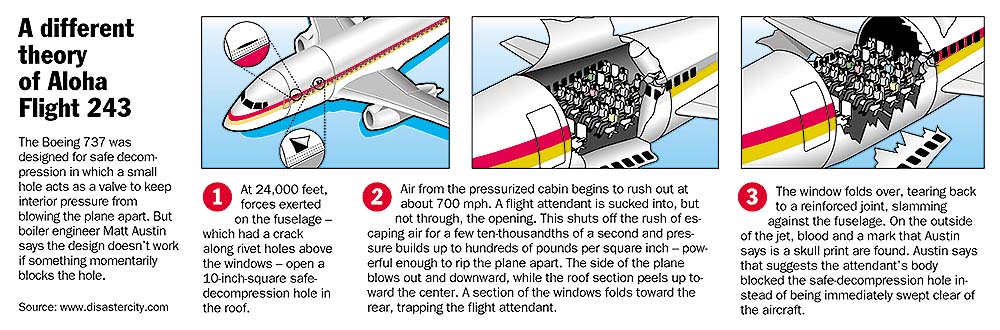
Aloha Airlines flight 243 lost the forward section of its fuselage. The flight attendant standing in row 2 near the front of the failed section was hit in the head by debris and fell to the floor. The flight attendant standing in row 5 near the rear of the failed section, with all the force of the cabin air behind her, was blown out by the decompression.
Airline fuselages are designed to suffer decompression only in a small section. You literally design weak sections surrounded by a lattice of strong sections, so a crack or failure cannot unzip the skin around the entire plane as it did in Aloha 243. The failure aboard Aloha is suspected to have started on the left side (one of the passengers noticed a crack by the door while boarding). And the theory is the crack failed producing a small hole. The flight attendant was blown towards the hole by outrushing air, and her body momentarily plugged the initial hole. This caused a pressure hammer from the air behind her rushing forward towards that hole blew out the entire forward cabin overhead. -
FAA: Waivers to be granted if done safely
As noted in the FAA Summary of UAS Rule ( https://www.faa.gov/uas/media/... ), most of the requirements can be waived if the operator shows that the intended flight can be done safely, with the waiver specifying compensating conditions.
More information on waiver can be found here:
https://www.faa.gov/uas/beyond...The complete text of the rule can be found here:
https://www.federalregister.go... -
FAA: Waivers to be granted if done safely
As noted in the FAA Summary of UAS Rule ( https://www.faa.gov/uas/media/... ), most of the requirements can be waived if the operator shows that the intended flight can be done safely, with the waiver specifying compensating conditions.
More information on waiver can be found here:
https://www.faa.gov/uas/beyond...The complete text of the rule can be found here:
https://www.federalregister.go... -
Re:It's scary that they can't figure out the cause
I'll post my reply here, but there are a few other sibling posters asking similar questions.
This report collates historical data on in-flight fires. From the report: "Fire in the air is one of the most hazardous situations that a flight crew can be faced with. Without aggressive intervention by the flight crew, a fire on board an aircraft can lead to the catastrophic loss of that aircraft within a very short space of time. Once a fire has become established, it is unlikely that the crew will be able to extinguish it. The following table from a UK CAA report in 2002 supports the generally held view that, from the first indication that there is a fire onboard the aircraft, the crew has on average approximately 17 minutes to get the aircraft on the ground."
It's not all doom and gloom, here is a more moderate report from the FAA.
I'll agree entirely with the observations that most cabin materials are fire retardant, and this is a very good thing. However, we are considering a very dense energy source that can spontaneously combust. In addition, have you noticed that airlines won't let you fly with a spare laptop battery in your checked luggage? They are very concerned about a spontaneous fire in the luggage hold, where most of the material is certainly not fire proof.
Safe travels everyone.
-
Re:Sigh not more of this bullshit"Your on a flight, you have to have flight mode enabled. At that point wireless headphones are not an option."
That's not correct. While "flight mode" on some phones may also turn off Bluetooth, there is no issue with using Bluetooth (or WiFi) on a plane. My phone disables cellular/BT/WiFi when I switch to airplane mode, but I can then turn Bluetooth back on.If your air carrier provides Wi-Fi service during flight, you may use those services. You can also continue to use short-range Bluetooth accessories, like wireless keyboards.
Source: FAA
-
Re:Toys
No one is "invadin muh privassy" with drones.
From this, the registered drones are from 0.25kg to 25kg (0.55lbs to 55lbs). The lower weight limit is, as you said, not an issue right now. The upper weight limit definitely would be. The FAA is supposed to take reasonable evolution of technologies into account when setting regulations, so the lowest weight which can have a suitable camera will probably decline.
-
Re:It's already known
-
Re:For very specific hard to reach areas
-
Re:just one thing to say
Can you read English and do some basic fucking googling?!
You're either a shill or an absolute moron. -
Re:New Technologies...
5. Devices must be used in airplane mode or with the cellular connection disabled. You may use the WiFi connection on your device if the plane has an installed WiFi system and the airline allows its use. You can also continue to use short-range Bluetooth accessories, like wireless keyboards.
https://www.faa.gov/news/press...
Now you know better.