Slashdot Mirror
Domain: fnal.gov
Stories and comments across the archive that link to fnal.gov.
Comments · 289
-
Re:Don't forget the "anti-red-eye" feature!
-
Before/after children's drawings of scientists
The Fermilab particle accelerator facility has an amusing set of children's drawings and descriptions of scientists before and after a visit to Fermilab.
-
Re:DuhI was working at Fermilab many moons ago and heard a funny story about de-ionized water.
They have a ring of electro-magnets, (well over a mile long, IIRC) that were all cooled with de-ionized water. The magnets were wound with very thick copper wire and the wire had a hole down the middle for the water to flow through.
When they were first getting the thing up and running, they noticed that every few days the number of ions in the water would shoot up drastically and then gradually go down as the de-ionizers did there job.
Turns out that the drain from the floor in one of the bathrooms was incorrectly routed into the de-ionized water supply. Even worse, one of the urinals was backed up and would start to stink after a couple of days so the janitor would wash the room out with bleach which then drained into the de-ionized water supply.
-
Re:Would it be fit for human travel?
Well I'm sitting over a 4.2 Tesla field so hopefully none.
On a side note, when you start losing magnetic field integrity in CDFs tracker, the twilight zone theme starts playing as an alarm. Never thought much of it (apart from really freaking me out the first time I heard it late at night) but after reading this article, perhaps its meant to warn you that you may be that you may be entering another dimension where time and space have no meaning... -
Fermilab computer scientist here...
According to this guy's bio, he's retired.
And with that, we can conclude he is crazy, as clearly evidenced by his outright ideas.
(and yes, I actually work at Fermilab) -
Balanced signals..
Do what real audio engineers do, run balanced signal lines. You can buy really good, pre-packaged "balun" transformers for $30 bucks/line or so, or you can by cheap isolation transformers and adaptors at RadioShack or such like, and build your own for cheap. With something like this; You should be able to run balanced audio for both the left and right channels on a cat-5 line, and build some boxes with cat-5 jacks, a cheap isolation transformers, and a stereo audio jack, and daisy chain as many speaker boxes together as you'd like. Hook the driver box to your computer, and hook an amplified speaker to each other one.
-
What to do?Actually, there are folks out there showing teachers how to use computers in the classroom effectively; so one thing the teachers could do is use the computers first, and take some classes to learn how to integrate the internet into their classes.
Or just use them to look things up in wikipedia, etc. since the third world classrooms don't have books either, and a couple of computers of this stripe are actually cheaper than a decent school library full of books.
-
What features do you need?
"... I always come up against limitations that I can't live with..."
May I ask, what features do you need that aren't in SQLite or PostgreSQL?
Another question: I wonder if the free version of Oracle will work with Compiere ERP + CRM, at least for testing?
Here is a Comparison of Oracle, MySQL and PostgreSQL DBMS.
ZDNet article: Oracle to offer free database.
I was not able to find the list of limitations on the Oracle web site. Anyone? -
Re:Paul Noel responds to Slashdot
I would advise Mr. Noel that the "green" is definitely not from Cerenkov radiation. I refer him to this, which explains how the sky's blue color is not due to Cerenkov emission (which peaks in the blue-UV region). Cerenkov is very well understood. If Mr. Noel feels strongly that the "green" arises from New Physics, then it cannot be Cerenkov, a phenomenon explained by classical electromagnetism.
He may also find this green thunderstorm investigation of interest. -
Slightly off-topic...Well, not entirely. To start, he'll be lecturing (scroll about half-way down) on November 10th, 5:00 PM at the Michigan Theater in Ann Arbor, MI. If you can make it, go see him. You'll not be disappointed.
A couple of other links from the page above:- Andersen Shares His Unique Vision of Quantum Universe
- Jan-Henrik Andersen - Industrial Designer
- Perception of the Extreme Unseen
- Subatomic particles: An art form
The rest is slightly off-topic.
I actually had Jan-Henrick as a professor in college for Introduction to Industrial Design. One of the top five classes I had there. Not only is he an incredibly smart guy, he's also very well rounded, with knowledge and background in all manner of subjects and interests, some well-known, others quite obscure. And he's absolutely one of the nicest people you'll ever meet. It only makes sense that he was hired there when they were just starting to implement the new curriculum, which has a much greater emphasis on diversity of learning. -
Re:Qmail!!
Qmail is most likely the best option, since it is very scalable.
the web site for qmail is :
http://www.qmail.org/top.html
you are going to have to add this patch for more than 256+ connection ( which you will need for safety's sake and scalability )
http://www.qmail.org/big-concurrency.patch
You are going to need to add preventive measure
there are tons of patch's and how - too's for spam reductions.
read this http://www.lifewithqmail.org/ldap/
to get some better understanding of qmail
Now onto the server side
next don't forget that no mater what, each user gets 3 pieces of e-mail per day ( that's my number that I use for configuring the server )
File server... that's open, my thinking would be a true raid 5 system, hot swappable, build it yourself. here is a link to a do it yourself terrabyte server for under 10K way back from 2002 and posted at that time on slashdot http://home.fnal.gov/~yocum/storageServerTechnical Note.html or http://www.accs.com/p_and_p/TeraByte/index.html that should help you along the way
best of luck and enjoy
Onepoint -
Blue Book?
I've googled for PS / EPS tutorials a few times and I either find really basic documentation or overly detailed low level documentation.
Have you looked at the blue book, PostScript Language Tutorial & Cookbook [pdf]. -
Re:One more evidence..
Call me crazy, but maybe because this stuff is fairly new and far from mainstream? The government has given money to the Fermi Accelerators for years: http://www.fnal.gov/ Try not to troll your blood for oil BS, it'll just cause a flame war and has nothing to do with science or this article.
-
Re:hard to make
I wanted to add this.
-
I'm jealous.
When i tried this at my accelerator, i burnt a hole through it and started a radioactive fire.
-
Re:Goverment not very advanced
I work for Fermi National Accelerator Laboratory, and I know we've got some amazing computing systems. I think its not supercomputers, but massive clusters. http://computing.fnal.gov/cd/
FNAL is owned by the Department of Energy, which is quite definitely gov't. That might be one ace... And I'm sure there are many others at, for example, Los Alamos, Argonne, Jefferson Labs, etc. Not to mention military installations... -
Re:Fermilab...or Four From Fermilab?
My pleasure. BTW, and you can be the first to know -- while i was flaming, we set a new "world" record for antimatter production of 16.2e10 antiprotons/hour http://www-bd.fnal.gov/notifyservlet/www. Not that anyone else around here will see it.
-
MySQL vs PostgreSQL
what about postgresql?
That is a very good question, I don't know why has it been moderated as off-topic. Naturally it is useless to compare MySQL performance to MySQL performance ignoring any other options. (It is essentially the same tactic Micro$oft is doing all the time! Do we really want to parrot them?) First of all, there are MySQL gotchas and PostgreSQL gotchas, so you have to know whether the particular glitches are acceptable for you before you decide to use either RDBMS. Understanding the relational algebra, set theory and predicate calculus is essential to understand what the relational model is all about. Lack of this knowledge often leads to confusing tuples with OOP-style objects and other stupidity, so you will save a lot of time learning it first.
Now, the performance. Generally speaking MySQL is faster for a heavy load of simple read-only queries (like Slashdot) while PostgreSQL is faster for complex read-write queries (like a bank). Once you turn on the ACID support in MySQL it is no longer so fast, and it can really crawl because of row or even table (sic!) locking, a mistake avoided for decades by any advanced database. Here is another comparison. See also this recent thread on Slashdot. One of the best comparisons of Oracle, MySQL and PostgreSQL was done by the Computer division of Fermilab (Fermi National Accelerator Laboratory), this is a must-read.
There is a lot to read about it if you need more comarisons, but the general rule of thumb is that if you want lots of very simple read-only and very few read-write queries when the integrity of your data is not critical, you should probably choose MySQL. When you need that (or better) speed but the data is critical and you need ACID transactions which would severly slow down MySQL, try SQLite, the easiest choice there is, especially using Perl where you don't even need to install it (but just like with every other database, there are SQLite gotchas too, you need to be aware of them). If you need full ANSI SQL compatibility, ACID transactions, scalability and your data integrity is important, you should probably choose Oracle or PostgreSQL. There are also licensing issues. Oracle is proprietary. MySQL is GPL so you need to pay if you want to use it in any non-GPL software. PostgreSQL is released under a free-for-all BSD license. SQLite is public domain.
As you can see, there is no one-size-fits-all database. Every one has its strengths and weaknesses. The correct choice is a matter of trade-offs and finding out which database is optimal for your particular niche. Good luck.
-
MySQL vs PostgreSQL
what about postgresql?
That is a very good question, I don't know why has it been moderated as off-topic. Naturally it is useless to compare MySQL performance to MySQL performance ignoring any other options. (It is essentially the same tactic Micro$oft is doing all the time! Do we really want to parrot them?) First of all, there are MySQL gotchas and PostgreSQL gotchas, so you have to know whether the particular glitches are acceptable for you before you decide to use either RDBMS. Understanding the relational algebra, set theory and predicate calculus is essential to understand what the relational model is all about. Lack of this knowledge often leads to confusing tuples with OOP-style objects and other stupidity, so you will save a lot of time learning it first.
Now, the performance. Generally speaking MySQL is faster for a heavy load of simple read-only queries (like Slashdot) while PostgreSQL is faster for complex read-write queries (like a bank). Once you turn on the ACID support in MySQL it is no longer so fast, and it can really crawl because of row or even table (sic!) locking, a mistake avoided for decades by any advanced database. Here is another comparison. See also this recent thread on Slashdot. One of the best comparisons of Oracle, MySQL and PostgreSQL was done by the Computer division of Fermilab (Fermi National Accelerator Laboratory), this is a must-read.
There is a lot to read about it if you need more comarisons, but the general rule of thumb is that if you want lots of very simple read-only and very few read-write queries when the integrity of your data is not critical, you should probably choose MySQL. When you need that (or better) speed but the data is critical and you need ACID transactions which would severly slow down MySQL, try SQLite, the easiest choice there is, especially using Perl where you don't even need to install it (but just like with every other database, there are SQLite gotchas too, you need to be aware of them). If you need full ANSI SQL compatibility, ACID transactions, scalability and your data integrity is important, you should probably choose Oracle or PostgreSQL. There are also licensing issues. Oracle is proprietary. MySQL is GPL so you need to pay if you want to use it in any non-GPL software. PostgreSQL is released under a free-for-all BSD license. SQLite is public domain.
As you can see, there is no one-size-fits-all database. Every one has its strengths and weaknesses. The correct choice is a matter of trade-offs and finding out which database is optimal for your particular niche. Good luck.
-
Re:These people....
Here's a good talk about "The Big Questions in Cosmology" http://vmsstreamer1.fnal.gov/VMS_Site_03/Lectures
/ Colloquium/041208Turner/index.htm
where you can both view the streaming video and/or get a PDF of the presentation materials. -
Re:SBC story from Illinois
Here's a talk ("Bringing True Broadband to America") about the efforts. http://vmsstreamer1.fnal.gov/VMS_Site_03/Lectures
/ Colloquium/040721Baller/index.htm -
Re:Editor incoherence
In physics and mathematics, I assure you it is e.
How odd. Are you a physicist? Are you a mathematician? IANA physicist... Yet. I am in my third year of undergrad work for a degree in physics, and currently I work for the Collider Detector at Fermilab experimental collaboration. And yet, I have never heard of anyone refer to an order of magnitude as anything other than a factor of 10.
For the mathematics side, check out wolfram's mathworld site. In the parentheses, in the line of text after the first expression, we see that the exponent used in scientific notation (which has a base of 10) is called the "order of magnitude." -
Re:For a streaming video talk on this subject...
which now has a properly formatted URL... a properly formatted url link to a talk on this subject and another link to a group of people who tried to bring municipal cooperative broadband to their communities and lost told here
-
Re:For a streaming video talk on this subject...
-
Re:Not a surprise?We get a http://web.mit.edu/loginname/ directory, and the already extant directory
When I got to MIT in 1996, you had to use MH to check your mail. It didn't matter if your major was computer science or music--if you wanted to check your e-mail, you had to to inc, scan, show, repl, rmm, and comp from a bash shell. (This was a most humbling experience for me, as a college freshman who had worked as a part-time IT helpdesk technician since I was 12 years old.)
The day MIT offers an "easy interface" for students to set up a personal web page, I will shed a nostalgic tear.
-
Re:Possibly but...
-
Re:The only people capable of producing antimatterCERN has been producing antihydrogen with their Antimater Factory. To be fair, Fermilab has been making antihydrogen too.
Folks around the world have been producing antiparticles for quite some time. They're also created by natural processes, but don't last long in high matter density environments.
-
Re:The only people capable of producing antimatterCERN has been producing antihydrogen with their Antimater Factory. To be fair, Fermilab has been making antihydrogen too.
Folks around the world have been producing antiparticles for quite some time. They're also created by natural processes, but don't last long in high matter density environments.
-
Re:About inheritance and the API
The average programmer doesn't care the the hierarchy is 10 or 11 levels deep (well at least until the next avalon release comes out). But Microsoft should care, and Ximian also cares. Very deep inheritance hierarchies are tough to maintain. Inheritance is a pretty intimate binding of two classes and changes higher up in the hierarchy sometimes have disasterous changes down the line. From a talk that I heard Stroustrup give, he doesn't care for them much either. (I didn't attend this one, but I imagine it is the same based on the slides.)
In this day and age, the commonly accepted wisdom is that you break functionality into interfaces and you write shallow helper classes to degalate to for common implementations of those interfaces. (C# is quite possibly the best language there is for supporting this architecture.) This way you don't force the user to use implementations they don't want when they want to program to a particular interface in your system.
If you look at the code for eclipse, you'll see a good example of this design in action.
-
Re:Get back to work!!Hahaha.
For anyone who happens to be reading this, my original rant was about people who go crazy trying to obfuscate their email addresses and have them fill out web-forms to contact them. I said I wasn't afraid to just put my email address (menscher@uiuc.edu) online. (You may also reach me at: menscher@fnal.gov, dmenscher@yahoo.com, and, if you want to bypass SpamAssassin/ClamAV, at menscher@mail.physics.uiuc.edu. )
Or, if you really like webforms, go to http://www.itg.uiuc.edu/people/ and click the "send email" link by my name.
SpamAssassin and ClamAV are free and work well. Speaking of which, there's a release candidate for SA-3.0.0 available now. Go test it!
-
MS has SILLY amounts of bandwidth
I just pulled SP2 down from MS's site at a steady 1060 KB/sec. Yes, those are correct units. No, that is not an extra zero. 4m18s total download time
Connections at government research facilities are amazing -
I got one of these slime todayA scammer tried to get me today to send him $4000. The first email I got was a reply to a classified I placed for a used car I am selling. It was odd to say the least, looked like a template email with a "(CAR)" search and replaced. (Yes just like that with parens and ALL CAPS of course) Did not make much sense and the fact that the time was GMT+8 and I am selling the car in a time zone GMT-7 was another give-away. Anyway I kept stringing him along making it look like I was incredibly stupid and I finally got him to send me this:
THANKS FOR THE EMAIL ME AM OK WITH U THIS IS THE INFORMATION FOR THE SHIPPING COMPANY FUNDS THE NAME AND ADDRESS IS HERE...
COLE JOHN
23 MARYLAND ROAD
MARYLAND
LAGOS STATE
NIGERIA
23401
SO GET BACK TO WITH THE INFORMATION FOR THE FUNDS TODAY...
Oh yeah! He has NO info on me. Now what do I do? Any suggestions? Should I send a tip to the FBI or file a complaint with the IFCC? Anyone have any suggestions of what I could do to dupe this con?
Well, what the hey. If anyone in the Chicagoland area wants to buy '93 Mazda MPV with 95K miles, check-out this ad or email me. Maybe at least something good like my selling the car will come-out of all of this, since no law agency will care about this most likely
-
Re:What, no pictures?From the article:
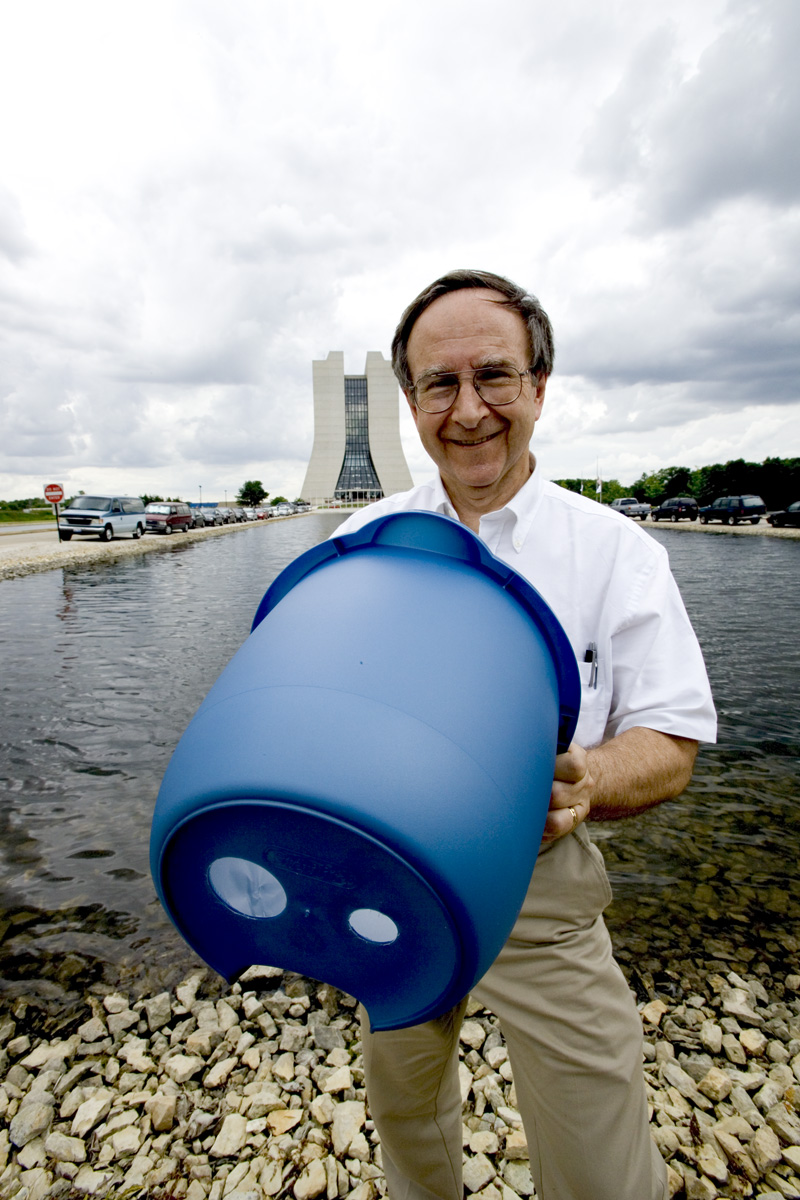
Something unusual must be going on inside the bucket.
I think it's Jim Russ' right hand doing it.
-
Somebody's having a lot of fun at work...I don't know what to think of the DsJ+(2632)->Ds(eta)+ and D0K+" meson, but I can tell you these guys have a pretty good thing going for them at their cafetaria.
Look at what they had for lunch on 06/17:
Aztec Tortilla Soup
Hot Italian Sub $4.75
Chicken Picata $3.75
Thai Beef $3.75
Roast Beef Cheddar on Kaiser Roll $4.75
Beef Strombolis $2.85
Marinated or Cajun Chicken Caesar Salads $4.75It's a wonder they got any work done that day...
-
A good quoteI was just reading my copy of Fermilab Today (I am writing this from the lab) and saw this article. Then it appears on slashdot!
The best description of this phenomenon comes from James Ross in the official press release:
- "It's like watching a water bucket with a large hole and small hole in the bottom," Russ said. "For some reason, the water is pouring out the small hole six times faster than it's coming out of the large one. Something unusual must be going on inside the bucket."
-
when it strikes sensitive equipmentI'm in the control room of one of the detectors at Fermilab where there's a fairly intense storm going on. About 20 minutes ago, a particularly large lightning strike caused the protons and the antiprotons circling the accelerator to alter their orbits enough that we had to shut down parts of the detector while we waited for the beam to settle.
by pure coincidence I opened my browser to
-
Re:Filesize?
It turns out it is cheaper (and faster) to put it on magnetic storage and fly it from London to Los Angeles than it is to try and move it over the Internet.
When you have your own wavelengths across the Atlantic, as from, say, Geneva CH to Chicago US, and can light them up at 10Gb/s, you're going to be far faster than a Concorde with that Terabyte!
Fermilab is moving dozens of terabytes a day into and out of mass storage. It's the perfect place to handle this camera's output.
-
Re:Filesize?
There's no mention of color filtration so grayscale is a safe assumption.
Not in the article, but in their submission of proposal to Fermilab PAC, they state
The total number of images over all bandpasses is 35.
So, not more data per image, just more images. -
Re:I'd hate to be the guy...
Yeah.. presumably this machine probably uses something like a megawatt of electricity.
But there are much bigger users out there. Fermilab takes around 40-50 MW. Some industrial sites use considerably more than that, even. Some aluminum processing facilities require hundreds of megawatts of power. -
Red Hat Enterprise Linux and derivativesIn my shop where we've been running Linux servers for several years without any need for support we are going to migrate our boxes to a RHEL derivative based on the terms of the RHEL EULA which allow recompilation of the sources to create a Linux distro as long as it does not use the name or image of Red Hat.
I know at least four projects of this kind, namely CentOS, White Box Linux, Tao Linux and Fermi Linux LTS from Fermilab.
As they are all based on RHEL 3 we will factor lots of stuff, the admin will be very similar, so will the automated install using kickstart.
And to boot we will not have to worry about some critical components like a JVM being only available on RHEL for example, if it runs on RHEL it has a 0.9999999 probability of doing so too on one of the clones.
And for some apps like Oracle we will go with RHEL since they impose it to us. But in the end we will not get commercial supports for the 70 or so servers we've been running on 6.1, 6.2 and 7.3 without support for all those years.
Anybody else going for this strategy? -
Re:Funding for this project.
Sorry i must learn to post links properly, here it is
-
Finally!Finally the development "A Liquid That Won't Get Things Wet" is complete and it can join the ranks of the pedigree of advanced fluids such as Liquid that you can immerse running computers in and Liquid you can breathe in
But when will we have "Liquid you can drink and not be accused of modding on crack"?
-
Re:why does programming stinks today, an opinion
As a student at a major Big Ten University (tm) I can easily tell that your perception is a bit skewed. The old cliche "you get what you put into it" applies to many things in life, and computer science is no different.
My school's core computer science curriculum is in Java. Language of instruction is a moot point to a rather great extent. You can learn as much from a data structures class taugh in Java as you can from one taught in $language_of_choice. The idea is to learn how things work fundamentally, and then apply those ideas practically. A linked list in Java works the same as a linked list in C. Its not about Java being the "industry standard" as you call it, its about Java being a perfectly modern and capable programming language. The idea
Your next analogy of the cable repairmen almost prompted me to moderate your post as +1 Funny, but when I found out you were not joking I decided to write this reply instead. To even equate a cable repair person with a computer scientist is pure madness. Even if they were programmers, how is getting the cable modem working a good metric of "computer stuff in general" being "a lot less like a science or craft and more like a factory job", or even relevant to the discussion of computer programmers vs. computer scientists at all?
None of your points even remotely explain what you consider the fundamental problem: "why software sucks...why the programming "trade" sucks...why companies can send the jobs abroad to work for peanuts" The fact is not all software sucks, many people love their jobs in the industry, and these people are getting paid well to do their jobs. Most of the computer scientists you speak of don't work in the private sector, you can find them at government research institutions.
To say that these type of people don't currently exist, and that current CS curriculums can't produce scientists of this caliber is nothing short of ignorant. -
Re:Uhhh... They're Picking on the UC Regents...
Interesting.... I guess that would explain why they're not going after various other national labs that have beowulf clusters.
-
Re:Uhhh... They're Picking on the UC Regents...
Interesting.... I guess that would explain why they're not going after various other national labs that have beowulf clusters.
-
Re:Uhhh... They're Picking on the UC Regents...
Interesting.... I guess that would explain why they're not going after various other national labs that have beowulf clusters.
-
fermi does this too..
Granted much of the software isn't as user-oriented, but that's not the point. The point is it is another government institution that has put real effort into making free software available to the public.
http://fermitools.fnal.gov/
This is just one example I personally know of. Is this common at all? I'm too lazy to sift through every *.gov domain hunting for a software page. -
Re:This is dangerous.
I read through all the computer policy crap that Fermilab has when I got my computer account there (worked on the CDF experiment a tad). It is their policy that no computers that control systems which could cause personal or environmental harm are connected to the internet. Further, any computer being used to write software that controls these systems can not be connected to the internet.
As others have already pointed out, there is no classified information at Fermilab. It is research done to expand human knowledge, and everything learned there is made public. -
Fermilab has had a similar robot for years
Check here.
Although it's used for fetching data tapes instead of books, the principle is very similar. I've seen it in action, it's very fast and accurate. The system is very helpful for scientists. Let's say a scientist wants to see results of an experiment on a given date; he just plugs this info into the program, robot gets the proper tape, loads it into the reader, and the scientist can view the results. The whole process only takes seconds. Compare it to older scenario where the scientist had to check out the tapes manually from the depository. If the tape was misfiled it would be almost impossible to find it. Robot, on the other hand, always puts it back on the right place. -
Stone Age MedicineBeam therapy, chemotherapy, and radiation therapy are all nothing more than stone-age attempts at medicine. They are essentially high-tech versions of "Let's beat it with a big stick until it goes away". Their success rates are not great. Since they don't address the fundamental problem, there's no guarantee that the cancer won't recur. I have much more hope for genetic and other biologic treatments that are upcoming.
Fermilab has had a neutron beam therapy very similar to the CERN anti-proton therapy since 1976. Neutrons are radioactive by themselves with a half life of about 14 minutes. Once deposited in some tissue they will either decay or combine with an atom to form a radioactive isotope (which then decays).
There are other unique radio therapies including Brachytherapy (place radioactive isotopes in the tumor) and Radioimmunotherapy (attach a radioactive isotope to a nonoclonal antibody). The latter sounds very neat and targeted. But none address the fundamental problem -- why do cells turn cancerous.
-- Bob