Slashdot Mirror
Domain: ftc.gov
Stories and comments across the archive that link to ftc.gov.
Comments · 1,118
-
FTC sharing its info with the FBI?
Since the FTC (not the FBI) is the US government body that gets most UCE/spam complaints, (FBI seems interested only in some types of fraud -- and then only if there are victims, not just attempts) I'll be curious to see if the two bodies are able to cooperate enough for the FBI to actually make use of the FTC's data, of which ther must by now be a mind-blowingly huge amount.
-
FTC sharing its info with the FBI?
Since the FTC (not the FBI) is the US government body that gets most UCE/spam complaints, (FBI seems interested only in some types of fraud -- and then only if there are victims, not just attempts) I'll be curious to see if the two bodies are able to cooperate enough for the FBI to actually make use of the FTC's data, of which ther must by now be a mind-blowingly huge amount.
-
TASK FORCE
There is a task force made up of Federal and state law enforcement agencies addressing many of the concerns or problems that slashdotters have brought up today. I believe one of the most important aspects of this task force is not the prosecution of spammers, but rather the educational efforts by these agencies for consumers and businesses. On another note: The American Teleservices Association filed a petition asking the U.S. Supreme Court to review the constitutionality of the National Do Not Call Registry. It the Court takes the case, I do not believe that they will over turn the 10th Circuit's decision.
-
Re:Anywhere in the subject line?
No. See page 7, section ii - "Placement of the Mark in the Subject Line" of this PDF which is linked from the FTC page. The mark has to be in the beginning of the subject line.
-
report "phishing" scams to the FTC
FTC Consumer Alert: Is Someone "Phishing" for Your Information? Not that I have any clue how often they prosecute.
-
Re:Chicken Little
I work for a company that does email marketing, and our server has had the same IP address for over a year, and all of our emails come from the same domain, with clear opt-out instructions (in addition, you had to have opted in directly to have received it to begin with)
No, your company is sending spam. This is according to the Federal Trade commission (for example you can find it really quick at "Unsolicited Commercial Email").
Unless I tell you "hey, send me email" by default I am BORN as Opted-Out. Spammers, such as your company, believe that the mere sake of my walking on this Earth means somehow I have "Opted-In". That is such bullshit. I don't have to tell you jack.
Perhaps next you will "assume" that I want you to take my car, my watch, my bank account and my identity? After all I didn't fucking "opt-out"?
-
Re:Is 1-800 really 1-900
1800 or 1888 are not always free.
Mostly free, Not always free.
In the US at least, you can be charged "Presubscription" fees legally, under certain conditions.
http://www.ftc.gov/bcp/conline/pubs/tmarkg/tollfre e.htm tells more.
On a related note, I've been billed for things like "web hosting" for ~100$ after being cold-called by some sales-drone in India (With a terrible accent and noisy phone line) and agreeing to a fax. The bill arrived in my phone bill.
Needless to say, I was a cl00less fkcutard and did everything an automated system told me to do, instead of getting wise when they started asking me my name and if I approved it or not.
I don't recall them telling me I would be automagically signed up for the service. So, borderline unethical and possibly even illegal. Needless to say, a halfhour call to the phone company refusing to pay got the charges cancelled.
-
Here is an FTC link clarifying this...
800 number scams
Seems you need to agree beforehand to a billing arrangement or provide a CC # before you begin recieving 'services'. -
Re:It is not MS vs. Linux, it is Patents vs. Linux
Let's look at those costs and see how many of them are actually required and how many could be done by the applicants/OSS community:
EPO Fees: 4300 - Required by the EPO
Professional Representation: 5500 - Optional, the cases could be filed pro se for freeThis is extremely discouraged. Even someone from the European Commission whom I talked to (the person who is handling the software patents directive in the Commission) admitted you have very little chance to get your application approved if you don't have any experience with patent law.
These people are programmers, not lawyers!
Translation: 11500 - Optional, could easily be done by bilungual volunteers
Not optional, it must be translated into all official languages of the countries where you want your patent to be valid. And you don't have to be just a "bilingual volunteer", you have to be a "bilingual volunteer with lots of time and who knows the patent jargon in both languages".
National Renewel Fees: 8500 - Required by the EPO
So, in the end with a little work the cost of a patent for a 10 year term becomes EUR 12800 or EUR 1600 per country. I really don't think this is excessively high for anyone serious about OSS projects, epecially since it could be raised by funding drives.
A "little work"? EUR 12800 not excessively high? And why on Earth should only "serious" OSS projects be allowed to be viable? It's like saying that only people who write for a living should be allowed to publish; the rest only does it as a hobby and thus should put up or shut up.
FWIW, I personally work on an open source project, which exists already for about 13 years (see url in my info). We have over 10GiB of downloads per day on our main ftp site alone (I don't have statistics on the mirrors). It's used by several companies and universities all over the world.
We do not have EUR 12800 or even EUR 1000. Why should we and other people start to have to pay and spend time on learning patent jargon and translating it so that we can continue our hobby project (which happens to be useful for other people)? What does society as a whole gain from this extra burden?
And what can you do with a single patent when a company like IBM or even Microsoft attacks you? Make paper planes to throw at them in a the court room, in a lawsuit that costs another EUR 50,000 ($1 500 000 if you're unlucky and sued in the US), and which requires time which you would normally spend doing your day job earning money that allows you to spend time on your hobbies?
Besides, there's much more than open source projects. If you take an SME, then there are even no imaginary volunteers which are ready to do whatever you ask. They have to pay all those things by themselves. It's them who will be hit the worst. They most certainly do not have EUR 12800 to spare, much less EUR 30000 (or EUR 50000 according to the European Commission -- google cache because original site seems to be down).
Since you didn't bother to link to whatever FTC study it is you are talking about, I can't really respond to it. Although just on the basis of what you said I'd question if they were studying the national effects of patents on the economy or the individual effects on a company/inventor.
That's indeed what they were studying. The original study and an extract of all software patents related stuff (it's on a page of FFII UK, but page numbers are given and if you compare it to the original, you'll see it's uncommented and really does contain all software
-
What does the government think?
Read the government's view on this here.
-
WANTED - James Lin and Daniel J. LinThe FTC press release is more informative than the Department of Justice press release. (The CNN story is basically the DOJ press release.) The DOJ press release says "The Lins have not been arrested at this time." The FTC is more explicit. They're wanted.
- Arrest warrants are outstanding for defendants James Lin and Daniel J. Lin. In a criminal complaint issued by the U.S. Attorney's Office, these individuals have been charged with violations of the federal mail fraud laws as well as with criminal violations of the CAN-SPAM Act.
The FTC also credits Spamhaus in assisting with the investigation.
-
Agreed - Re: Good.
This simply a case for the Federal Trade Commission. The inclusion of CAN-SPAM law into the criminal charges is merely an after thought (as I mentioned before):
From the Article:
Investigators said they consulted Dr. Michael D. Jensen, a medical professor at the Mayo Medical School, who confirmed that ingredients in the weight-loss product sold in the disputed e-mails wouldn't work.
By this, as well as the FTC's involvement (see FTC link above), this is a simple case of fraud. The CAN SPAM sentancing guidelines provide for tacking an extra couple of years to the sentance in such a case.
The addition to CAN-SPAM in this case will only serve to attract more attention to the problem of E-mail fraud. My previous statement remains, "an extra 1 to 3 years tacked onto a felony conviction is nothing compared to the sentance that is already being faced."
-
Re:Its a good start.....The EFF page links to FTC and NAS recommendations, which are much too mild. The overriding problem is patent law--everything else is quibbling over details. The fight against software patents in Europe may be the most important battle, right now. This is one area in which the rest of the world should not "harmonize" with the U.S.
As for the details, the most important reform is a change in the incentive structure. It seems like it's easier to get a patent than a municipal parking permit, because the office subsists on application fees. If there were a reapplication fee for every rejected application, the office would change overnight from a Walmart greeter to a Viper Club bouncer.
James Gleick's "Patently Absurd" is a decent post-one-click overview of the topic.
-
FTC conference on patent reform starts todayPatent thickets need cutting
By INQUIRER staff : Donnerstag 15 April 2004, 14:03
*A CONFERENCE* chaired by the Federal Trade Commission, the National Academy of Sciences and the Berkeley Center for Law and Technology kicks off in California in a few hours time.
The idea is reform the patent system without stopping innovation, but the industry is along there in the shape of giants Intel, Microsoft, Symantec and others, and we're sure they'll try to pursue their own agenda.
There will also be representatives from the European Patent Office and the US Patent and Trademark Office.
Luckily, they are counterbalanced by legal organisations and academics.
The agenda for the workshop is here http://www.ftc.gov/bcp/workshops/patentsystem/pat
e ntsystemagenda.pdf, and there's a very lengthy discussion document about proposed reform on the FTC site, here http://www.ftc.gov/os/2003/10/innovationrpt.pdf.The FTC document proposes a number of changes to the current system including a new admin procedure to challenge a patent's validity without having to go to law, allowing courts to find patents invalid on the preponderance of evidence rather than clear and convincing evidence, and the limiting of awards of "treble" damages.
It's pretty clear that for many large companies, patent actions have become a wing of marketing. Kicking off big patent cases can tie a smaller competitor up for years as the painful battle continues through the courts. Let's hope sanity prevails. But don't hold your breath for that.
Day 1: Thursday, April 15, 2004 at the Bancroft Hotel
1. 12:00 - 1:00 pm, Press Conference
- Mark Myers: NAS & Xerox Corporation
- Commissioner Mozelle Thompson: FTC
1:30 - 3:00 pm
Overview of the Patent System and FTC Proposal for Reform
- Susan DeSanti: Senior Policy Analyst, FTC
- Prof. Peter Menell: BCLT & Boalt Hall School of Law
- Prof. Robert Merges: BCLT & Boalt Hall School of Law
Day 2: Friday, April 16, 2004 at the Bancroft Hotel
8:00 - 8:30 am
Opening Remarks
- Dean Designate Chris Edley: Boalt Hall School of Law
- Robert Merges of BCLT and Boalt Hall School of Law
- Mark Myers: NAS & Xerox Corporation
- Commissioner Mozelle Thompson: FTC
8:30 - 9:40 am, Non-obviousness Panel (Reinvigorating the Non-obviousness Standard)
- Rochelle Dreyfuss: New York University
- Rebecca Eisenberg: University of Michigan
- Ron Laurie: Inflexion Point Strategy, LLC
9:45-11:00 am, Opposition and Post-Grant Review Panel
- Robert Blackburn: Chiron Corporation
- Prof. Joe Farrell: Economics, UC Berkeley (CPC)
- Bronwyn Hall: Economics, UC Berkeley
- Dietmar Harhoff: European Patent Office
- Steve Kunin: Patent and Trademark Office
- Prof. Robert Merges: BCLT & Boalt Hall School of Law
- Douglas Norman: Eli Lilly
11:00 - 11:15 am, Break
11:15 am - 12:45 pm, Litigation Panel (Including Presumption of Validity)
- Mark Janis: University of Iowa
- Mark Lemley: BCLT & Boalt Hall School of Law
- Lynn Pasahow: Fenwick & West
- James Pooley: Milbank, Tweed, Hadley & McCloy
- Matthew Powers: Weil Gotshal & Manges
- Arti Rai: Duke University
12:45-2:00 pm., Lunch
2:00 - 3:45 pm, Industry/Institutional Issues Panel
- Carl Shapiro: Haas School of Business, UC Berkeley (co-moderator)
- Commissioner Mozelle Thompson: FTC (co-moderator)
- Robert Baechtold: Fitzpatrick Cella Harper and Scinto & AIPLA
- Robert Barr: CISCO
- Bart Eppenauer: Microsoft
- Sean Johnston: Genentech
- Jay Monahan: eBay
- Ron Myrick: Finnegan, Henderson, Farabow, Garrett & Dunner
- Kulpreet Rana: Google
- Robert Sacoff: Pattishall, McAuliffe & ABA IP Section
- David Simon: Intel Corporation
- Herb Wamsley: Intellectual Property Owners
3:45-4:00 p.m., Concluding Remarks
Commissioner Mozelle Thompson -
FTC conference on patent reform starts todayPatent thickets need cutting
By INQUIRER staff : Donnerstag 15 April 2004, 14:03
*A CONFERENCE* chaired by the Federal Trade Commission, the National Academy of Sciences and the Berkeley Center for Law and Technology kicks off in California in a few hours time.
The idea is reform the patent system without stopping innovation, but the industry is along there in the shape of giants Intel, Microsoft, Symantec and others, and we're sure they'll try to pursue their own agenda.
There will also be representatives from the European Patent Office and the US Patent and Trademark Office.
Luckily, they are counterbalanced by legal organisations and academics.
The agenda for the workshop is here http://www.ftc.gov/bcp/workshops/patentsystem/pat
e ntsystemagenda.pdf, and there's a very lengthy discussion document about proposed reform on the FTC site, here http://www.ftc.gov/os/2003/10/innovationrpt.pdf.The FTC document proposes a number of changes to the current system including a new admin procedure to challenge a patent's validity without having to go to law, allowing courts to find patents invalid on the preponderance of evidence rather than clear and convincing evidence, and the limiting of awards of "treble" damages.
It's pretty clear that for many large companies, patent actions have become a wing of marketing. Kicking off big patent cases can tie a smaller competitor up for years as the painful battle continues through the courts. Let's hope sanity prevails. But don't hold your breath for that.
Day 1: Thursday, April 15, 2004 at the Bancroft Hotel
1. 12:00 - 1:00 pm, Press Conference
- Mark Myers: NAS & Xerox Corporation
- Commissioner Mozelle Thompson: FTC
1:30 - 3:00 pm
Overview of the Patent System and FTC Proposal for Reform
- Susan DeSanti: Senior Policy Analyst, FTC
- Prof. Peter Menell: BCLT & Boalt Hall School of Law
- Prof. Robert Merges: BCLT & Boalt Hall School of Law
Day 2: Friday, April 16, 2004 at the Bancroft Hotel
8:00 - 8:30 am
Opening Remarks
- Dean Designate Chris Edley: Boalt Hall School of Law
- Robert Merges of BCLT and Boalt Hall School of Law
- Mark Myers: NAS & Xerox Corporation
- Commissioner Mozelle Thompson: FTC
8:30 - 9:40 am, Non-obviousness Panel (Reinvigorating the Non-obviousness Standard)
- Rochelle Dreyfuss: New York University
- Rebecca Eisenberg: University of Michigan
- Ron Laurie: Inflexion Point Strategy, LLC
9:45-11:00 am, Opposition and Post-Grant Review Panel
- Robert Blackburn: Chiron Corporation
- Prof. Joe Farrell: Economics, UC Berkeley (CPC)
- Bronwyn Hall: Economics, UC Berkeley
- Dietmar Harhoff: European Patent Office
- Steve Kunin: Patent and Trademark Office
- Prof. Robert Merges: BCLT & Boalt Hall School of Law
- Douglas Norman: Eli Lilly
11:00 - 11:15 am, Break
11:15 am - 12:45 pm, Litigation Panel (Including Presumption of Validity)
- Mark Janis: University of Iowa
- Mark Lemley: BCLT & Boalt Hall School of Law
- Lynn Pasahow: Fenwick & West
- James Pooley: Milbank, Tweed, Hadley & McCloy
- Matthew Powers: Weil Gotshal & Manges
- Arti Rai: Duke University
12:45-2:00 pm., Lunch
2:00 - 3:45 pm, Industry/Institutional Issues Panel
- Carl Shapiro: Haas School of Business, UC Berkeley (co-moderator)
- Commissioner Mozelle Thompson: FTC (co-moderator)
- Robert Baechtold: Fitzpatrick Cella Harper and Scinto & AIPLA
- Robert Barr: CISCO
- Bart Eppenauer: Microsoft
- Sean Johnston: Genentech
- Jay Monahan: eBay
- Ron Myrick: Finnegan, Henderson, Farabow, Garrett & Dunner
- Kulpreet Rana: Google
- Robert Sacoff: Pattishall, McAuliffe & ABA IP Section
- David Simon: Intel Corporation
- Herb Wamsley: Intellectual Property Owners
3:45-4:00 p.m., Concluding Remarks
Commissioner Mozelle Thompson -
uh?!
enforcer999 writes "As you know, the CAN SPAM ACT preempted many state laws that were tougher on spammers. For instance, many of the laws that were enacted by states included a requirement that sexually explicit SPAM be labeled as such. The FTC, in charge of adopting rules, came up with a new rule that will require sexually explicit SPAM to be labeled as such. Hmm? I think the states were already trying to do this before the Federal government preempted them. Anyway, I wonder if it will work?"
I highlighted in bold a point I am not sure I understood, is it willingly redundant or did the submitter write it twice because it went from the states laws to the ftc requirement ? -
Re:My favorite arguement against is...
-
Re:Like requiring thieves to pay taxes on thier lo
You're talking about viruses, and of course anyone who wants to break the law can do so. Right now though, there is a large class of software created by companies that say what they are doing is perfectly legal. They claim that by having a user click OK on a dialog box they can do pretty much anything they want on that user's PC. And they are doing this brazenly, out in the open, and in the clear view of the governing agencies. LOP.COM is one of the most-despised pieces of spyware around and still the guy from C2/LOP has the ballz to file a comment for the upcoming FTC spyware conference saying LOP is the future of Internet advertising!
Most spyware/adware makers feel the same way, they don't have to hide because they are not breaking any laws. And if you download the software directly from their web sites you will be presented with various screens and buttons you have to click to agree. However, the details of what you are agreeing to is anything but clear. The Claria license is 20 pages for example, and to paraphrase: "Once you click YES we can automatically download and install new software, even new versions of other vendor's software like Media Player or Flash if we need it to display ads. We can even send back an list of all the software installed on your system."
Should it be legal to bury that in a 20-page document and then say that clicking YES on a dialog box is legally binding? -
Re:The best ads
What I cannot fathom is why marketing people seem to all believe that people have to be tricked. Ad agencies are tripping over themselves to come up with the next "killer" stealth technique. Why?
I have often wondered about the same thing - my conclusion is that the biggest reason is the profit motive - especially for sales people who work on commission (where they are rated on number of items sold). Obviously, there is a tradeoff, do it too much (and get caught) and the repurcussions are there (just see here. On the other hand, Internet based advertising is new and carries its own myths - checkout #9 on the FTC's list. The list isn't that dated but has anything changed since then? Aren't all what they describe just variations of age-old scams?
-
MS-Passport is inherently insecureMS Passport is inherently insecure and cannot be made secure, even in theory. To claim otherwise would be false advertising. Not to mention that in the terms of service you hand over any privacy you once had, see the FTC link above again for an example of abuse.
I'd be especially wary of sites locked into ASP or
There are ways to do secure, platform independent, centralized authentication for web and other services, but MS-Passport isn't one of them. See Kerberos + LDAP instead. If you don't wish to experiment on *BSD or something else, all the major Linux distros include both clients and servers. There are even ways of scaling enourmously. Universities and libraries with electronic subscriptions should be able to get the most mileage out of Kerberos.
-
Re:OK, I am paranoid - BUT
-
Re:Whats his email?
You should forward all of your spam to uce@ftc.gov.
-
Re:Whats his email?
You should forward all of your spam to uce@ftc.gov.
-
Send A Public Comment to the FTCGot an idea on how to make them Spyware laws better?
Turns out the FTC is gonna be hosting Spyware workshop here in DC in April. FTC Workshop Information
The workshop is titled Monitoring Software on Your PC: Spyware, Adware, and Other Software and will take place on April 19, 2004. It is open to the public and there is no attendance fee.
On the site is information on how to submit a public comment to the records of the event.
-
FTC
It's good that SEC is investigating them, although it is not clear whether they will find anything. This is really as much or more FTC's arena. Specifically, it would be beneficial if a large number of people filled out FTC's complaint form to maybe get some action about false advertising, slander, unfair competition, and so on. It is comparatively easy to show that SCO has directly lied on a large number of occasions. There is probably enough for SCO to convict it of false advertising on the Linux license front.
-
Magnuson-Moss Warranty Actcodeonezero (540302) said:
"... she said that the damage was probably caused by our use of third party wax ink cartridges.
The Magnuson-Moss Warranty Act (15 U.S.C. 2302(C)) states:
"No warrantor of a consumer product may condition his written or implied warranty of such product on the consumers using, in connection with such product, any article or service (other than article or service provided without charge under the terms of the warranty) which is identified by brand, trade or corporate nameSimply put, the warrantor can not void a warranty because of the use of an aftermarket part. Furthermore the warrantor must show that an aftermarket part caused the damage in question that they wish to void the warranty over. While this act was passed to protect automotive aftermarket part manufacturers I'm guessing it could be applied to this situation. Maybe someone with Westlaw access could check.
Check out "Understanding the Magnuson-Moss Warranty Act" for some more information.
Of course getting a manufacturer to obey the law and not try to weasel out of their obligations is something completely different.
-
Federal Trade Commission
Speaking of spyware, the Federal Trade Commission is offering a workshop on spyware that needs comments. I think it would be highly appreciated if some of you guys would comment.
-
Re:Yes, it is extortion
>Taking something away from someone else and threatening not to return it until they give you money. It doesn't matter if they OWE you money anyway, that's extortion.
Unless, of course, you are a collection agency and the thing you are taking away is a car, in which case it is called repossession. Note how the existence of a contract or applicable state law makes all the difference in the world. Also note that the government will also take your property for non-payment of taxes and threaten not to return it until you pay up. -
Re:Only a Volvo mechanic? *snicker*
Not in the United States. The Magnuson-Moss Warranty Act prohibits voiding a warranty on those grounds.
-
Re:Too Bad About RambusI will repost the comment below under my name since the AC isn't going to be seen and he makes a very valid point (if not clearly). For those who like to froth at the mouth about rambus, I strongly suggest reading the Judges decision (made after the longest and most fully documented trial in FTC history.) It can be found here. Otherwise you run the risk of sounding like every other know-nothing who spouts off on the subject. Incidently, it is this case the has provided much of the discovery, including specific smoking gun e-mails that is feeding this price fixing investigation.
"The judge determined that the allegations against Rambus were fraudulent [rather, without merit]. Rambus circulated its patent portfolio among the DRAM manufacturers [both BEFORE and during its' JEDEC participation] and made them aware of its intent to enforce it. The DRAM manufacturers then incorporated Rambus technology knowingly and conspired to get it without paying Rambus [ie. they stated, in presentations to each other - this stuff works great, let's find a way to use it without paying rmbs - the judge found this troubling]. They [the Memory Manufacturers] duped us into believing Rambus were the bad guys [you may feel they are bad guys for other reasons, in which case you weren't duped] when in fact Rambus was playing fair [that may overstate it, but certainly they were playing much more fairly then the memory makers] and they were attempting to steal Rambus' IP. If you read the antitrust judgement, it is very inequivocal in saying this.
-
rules for using "cards"
At least in America, we have this neat thing called the Fair Credit Billing Act. It protects us from unauthorized charges. It doesn't work very well with ATM and Debit cards unfortunately, so the smart consumer does NOT use ATM or Debit cards (or does so very sparingly). Banks are heavily pushing ATM and Debit cards when they are unquestionably in the consumers' worst interests. When you are a victim of a fraudulent charge with an ATM or debit card, the burden is on you to seek justice in order to collect your lost money. With traditional credit cards (at least in the U.S.) the burden is on the merchant - if they can't prove it's a legit transaction, you don't have to pay - BIG DIFFERENCE. Most consumers don't know that the "fraud protection" most credit card companies promote is actually mandated by Federal Law.
The moral of this story: Don't use ATM and Debit cards. Use a traditional credit/charge card and you are much better protected in cases of fraud. -
Re:What about the US?
-
Re:hrm, I disagree.
The job sites kept sending me nothing but "work at home" jobs (probably stuffing envelopes or telemarketing or something else distasteful.)
If it was just distasteful work that wouldn't be so bad. But if you get an "job offer" that refuses to clairify the nature of the work and is work at home, you can pretty much assume that it's a scam. Federal Trade Commission's warning on Work-at-Home schemes. Cockeyed.com investigated the Work-at-Home signs that often litter neighborhoods.
-
Re:geeks at work!
And lawyers! Three cheers for lawyers everyone - specifically, state attorney's in New York and Florida as well as the Federal Trade Commission.
Geeks and Attorneys! Together, we're unstoppable. -
Magnusson Moss Warranty Act
warn of burning out your engine with bad code, and voiding your warranty
Car manufacturers can be such bullies sometimes. Luckily, there are things such as the Magnusson Moss Warranty Act to help protect consumers. -
Potential coppa violations, tooIf the kids were under 13yo, the programmer could have violated COPPA, the Children's Online Privacy Protection Rule.
In other words, this guy could not only have given a black-eye to the county, but he could even go to jail for it.
If the information lost can be linked to a crime against one of the kids (no matter what age), he better have a good attorney. Gross Negligence and Reckless Endangerment come to mind.
-
I find this idea fascinating
Having correct registry information would allow me to track down a criminal who hit my credit card recently. It is the first time I've been had by fraud and thankfully it was only for $9.95.
Somehow, somewhere, someone used my credit information to try and sneak past a small charge on my bank statement. The charge of $9.95 came from DAVWEBSOFT. Searching the web for DavWebSoft turns up a very suspicious web site. It appears "professionally" designed, but on closer inspection, many links simply do not work and news items are stolen from other sources.
WebDavSoft's is a near exact duplicate of these web sites: SBC Web Solutions, Stewart's Precision Web Design, Eadens Enterprises, Fleming Software LLC, Global WebLine LLC, Studio A Design, Prosoftware Inc, Luministic Technologies, Kazland Software Corp, Bailey Consulting Group LLC, International Web Design, GToolboxes Technology INC., Tanya Web Design, Andersoft Inc, Panaginip Salohin Corp, Web Pages Made Easy LLC, E Software Tech Inc., Webtemp Solutions, Inc, and Resourcepdc Inc. Each site lists different fake addresses and phone numbers. Try contacting the phone number listed on any of the pages and you're dumped into anonymous voice mail.
Besides stolen copy, links that aren't links, and duplicate web sites, the most obviously fraudulent element is that each main page has a link to "Don't Recognize a Charge?" which then asks for credit and other personal information. Gah! What sort of company prominently displays "Don't Recognize a Charge?" on their main page?! None, except fraudsters.
If you happen to be a victim of fraud, report it to the FTC and the IFCC.
I would love to catch the criminal behind these web sites before they strike anyone else and correct Whois information would rock my vigilante world.
-
Re:Law-abiding citizens - Er.. McCarthism?
Anybody who thinks that this next little step is harmless, has a poor grasp of history. True, in and of itself, it may be mostly useless, but it is not in and of itself. It is a tool that augments a larger collection of tools to provide a "data" or "statistical" picture of a person, their habits and their wanderings.
What happens in the future when a person is in the same location as a terrorist, has a friend with a suspect background, and espouses unpopular (but legal) ideas. You can now arrest them. Circumstantial evidence links them to the terrorist (you can not avoid whom you do not know), they are saying "anti-government" ideals (not necessarily separatist or violent), and through enough weeding, the rest of the case will be found.
McCarthy destroyed many people who opposed him by using innuendo, circumstantial evidence and (lying) witnesses. Almost no one was able to beat him at his game because he had such an effective information collection and management system. That is where we are slowly headed, good intentions or not.
Right now, those in power would benefit immensely from this system. It makes it that much easier to stay in power if your potential enemies' weaknesses are that much easier to find. Do not think that this information system will not be abused. The RIAA has just provided us with many beautiful example of how this is abused by prosecuting minors. Children are not able to enter into legal agreements because it is agreed that they are incapable of understanding what the legal consequences are, let alone to be able to distinguish right from wrong (true, to some degree, most children know basic rights and wrongs, but more complicated ones are hard if not impossible for most children to grasp.) Other forms of this are profiling, poorly managed data at credit reporting agencies (Experian, Equifax and Trans Union required The Fair Credit Reporting Act to get them to do some things better) and so on
Oh, and for those of you who point to the police not being able to find criminals because they did not bother to look at the system, human error will always exist. This system allows a much different use of the data than what the typical police system has. Those tend to be much less complete, and the officers themselves often recieve little training and have even less support and experience doing this kind of research. The people to worry about with the systems being made today are in a different world from "on the street" law enforcement. They thrive on this kind of data mining. Most of the informarion McCarthy had on people was never used. He had it there just in case. It was how he controlled votes in the government and kept even his dark secrets out of the light. I am not worried that this will be used to arrest some innocent people nearly as much as I am worried that a smart person with a "bad" bent will learn how to gather and abuse this information to further corrupt the process in their favor. I do not think this is an if thing, but a when thing. Every tool gets abused. The more powerful the tool, the more powerful the abuse and the abuser.
The problems with my arguments are things like this abduction at Fox News. You would have to be a heartless bastard to not want a safer world for our children, our parents and our friends. With crime against innocents and defenseless individuals so rampant, it is very difficult to argue against this type of tool. It is a very similar to what McCarthy had with the Soviets and Cuba when he was in power.
-
Is this a TRUTH IN ADVERTISING issue?Seems like a possible FTC issue. Heres the FAQ with some info for businesses: truth-in-advertising rules.
Snip!According to the FTC's Deception Policy Statement, an ad is deceptive if it contains a statement - or omits information - that:
Emphasis mine. Sounds like Comcasts legal team broke into the nitrous oxide again.* is likely to mislead consumers acting reasonably under the circumstances; and
* is "material" - that is, important to a consumer's decision to buy or use the product. -
Some thoughts from a Cyberlaw professor
As someone who teaches Cyberlaw and runs a program on law and technology, I'd urge you to consider broadening your horizons a bit, and to focus on practical rather than theoretical discussions. As relevant as IP law is to the technology industries, it is only one small part of the whole picture. Contract law, corporate structure finance (yes, even in this post-bubble era!), privacy law and especially international law are also crucial subjects to learn.
I'd echo the sentiments of those who said to take a look at casebooks and other law school texts in a local library. You can also go to the sources for IP law: the U.S. Copyright Office and Patent and Trademark Office have some good basic info, as does the Federal Trade Commission on privacy rules. This site has a good list of info. on doing e-business throughout the world. Finally, for an introduction to Internet-related business legal issues, you can always find my book in a local library.
Finally, you'll need to decide if you actually want to be a lawyer. Law school is rather expensive these days, even for state schools, and the loan burden for many of our students is severe. Feel free to e-mail me if you'd like to ponder this further. {Professor Jonathan Ezor} -
Silver? Toothpaste? Who cares?
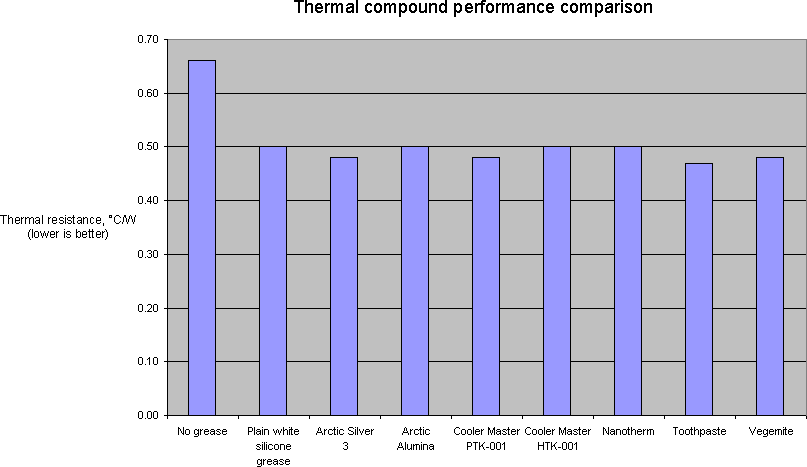
Which is exactly why you want [the thermal transfer compound] to contain silver, silver is one of the best conducters of heat there is.
Have you checked out Dan's Data on thermal greases? He does a very nice comparison between Artic Silver 3, Cooler Master PTK-001 and HTK-001, Nanotherm "Ice" and "Blue", and... Toothpaste and Vegimite. While Dan may be quite mad, even for an Aussie, there is definitely method to his madness. After measuring the effects on cooling with his usual methods... the difference amounts to diddly-squat. And yes, that includes the difference between Artic Silver 3 and Toothpaste. (Actually, toothpaste was marginally superior.)
So, yeah, there may not be much point to getting too upset if you've gotten thus screwed-- it probably won't make jack-all difference in your system.
On the other hand, it is definitely immoral and almost certainly illegal to claiming "99.9% silver content" when you mean "99.9% silver free". While it was probably a harmless scam (and probably saved this disreputable company some chump change in manufacturing their overpriced goop), whatever Three-Letter-Agency has jurisdiction should probably come down on these folk like a ton of old hard drives on the principle of the matter.
-
Re:So....
Try the FTC or your state's Attorney General.
-
Most spam is already actionableThe FTC's study of false claims in spam has already established that most spam is legally actionable under current law. Adding a copyrighted haiku doesn't help much.
Under the CAN-SPAM act, ISPs can sue. If you read the definition of an "ISP" in the act, it's clear that a mail processing service like SpamCop would qualify. What's needed is a paid service like SpamCop that files at least one high-profile lawsuit a month, increasing to one a week as volume builds up. That would make a dent.
-
Attack of Haiku-Resistant Killer Spam
It just illustrates the lengths the spammers will go to, including taking on Habeas' proven legal capabilities, to distribute their spam.
It is interesting that they tout their proven legal capabilities rather than "proven" technology. Will it be enough to stop the Attack of Haiku-Resistant Killer Spam. RIAA and SCO are trail blazers in using the legal system to stopOur patent-pending Sender Warranted Email(TM) service vets messages for legitimacy, guaranteeing that they're not spam.
Guaranteeing? Sounds like a pretty tall claim now. Not to say what should happen to the pending-patent - a review of the claims perhaps ?Adding the IP addresses to the HIL (aka Habeas Blacklist) should not impact the legitimate mailing activities of the owners of the compromised PCs.
It would be nice if it works well, but I am curious as to how they are going to distinguish from a single IP address whether the email was sent from the compromised PC when it was "alert" or when it was in a "zombie" state.Your reporting here of spam you've received with the Habeas Warrant Mark will help us track down and prosecute the responsible parties.
Habeas - Welcome to the Party. In addition to the call for rounding up a posse, if you need some help from the Feds, write in to the FTC at uce@ftc.gov. Despite having the Federal powers to kick a**, I am not really sure how successful they have been.What Can I Do With the Spam in my In-Box? Report it to the Federal Trade Commission. Send a copy of unwanted or deceptive messages to uce@ftc.gov. The FTC uses the unsolicited emails stored in this database to pursue law enforcement actions against people who send deceptive spam email.
Hey, and I forgot - What happened to the CAN-SPAM ? How long before we have Attacks of the CAN-SPAM-Resistant Killer Spam.
-
Too bad the FTC can't get involvedTo bad the FTC can't get involved. They sued Toysmart.com to prevent Toysmart from disclosing consumer information against their privacy statement. This was settled by a consent decree. From the consent decree:
The Complaint alleges that Toysmart engaged in deceptive acts or practices in violation of Section 5 of the Federal Trade Commission Act ("FTC Act"), 15 U.S.C. 45(a), by disclosing, selling or offering for sale personal customer information, contrary to the terms of its privacy policy that personal information would never be disclosed to third parties. [link added]
Note that under 15 USC 45(a), common carriers and air carriers are exempt. Even if they weren't, I'm sure the reality is that the FTC wouldn't pursue it.
-
more info
More information is available at this link.
Viva la GNAA -
Network Solutions in Another Battle?
This witll be the 2nd time in 6 months Network Solutions will be in a legal battle. Seems the Federal Trade Commission had an issue with them recently too. Check it out.
-
FTC Investigating Apple
As you've probably noticed, Apple and now HP are more or less going to be dominating the online music industry, and someone else has also apparently noticed, the Federal Trade Comission. The FTC is launching an investigation into possible antitrust violations by Apple, and now is looking into HPs dealings with them as well. Interesting read, I think they may have a case, and I'm an Apple zealot.
-
Apple, HP, and the FTC
In case you haven't noticed, Apple and now HP are more or less going to be dominating the online music industry, and someone else has also apparently noticed, the Federal Trade Comission. The FTC is launching an investigation into possible antitrust violations by Apple, and now is looking into HPs dealings with them as well. And the funny thing? It stems from the whole iPod battery fiasco.
-
Hidden email addresses on FTC.GOV
Have a look at the front page of ftc.gov
If you highlight the section just below Last Updated: Thursday, January 8, 2004 10:05 AM you'll see two "hidden" email addresses (font color set to white.)
Anyone know what this is about? Spam trap?