Slashdot Mirror
Domain: fyngyrz.com
Stories and comments across the archive that link to fyngyrz.com.
Comments · 142
-
in re Safari
ZDNet notes that while Chrome's billion-plus users were surprised, "Apple's Safari likewise hides the www and m but it hasn't caused as much concern, likely because of Google's outsized influence over the web and Chrome's dominance of the browser market."
Actually it is pretty annoying. Safari has an option in the application preferences advanced tab to turn this malfeature off.
However, although it shows the URL from the domain name forward, including the www. portion if present, it does not show the http:// portion.
-
Way ahead of ya
-
Re:None
Orwell got so many things right in 1984, the only thing he really got wrong were the size of the screens...
--fyngyrz*
* Anon due to mod points, because Slashdot moderation rules are stupid. Soylent News does it better. A lot better.
-
Nonsense
Parent post, emphasis mine:
A human brain cannot be isolated from the attached nervous system - nor from the rest of the body that is permeated and controlled by the nervous system.
People with severe spinal cord injuries demonstrate that above highlighted assertion is meaningless babble.
Also, you should probably read this, including the comments.
Archtech, 2018:
Computers only do "reason", which places a vast gulf between human intelligence and any kind of artificial replica.
Albert Einstein, 1932:
There is not the slightest indication that nuclear energy will ever be obtainable. It would mean that the atom would have to be shattered at will.
--fyngyrz*
* Anon due to mod points, because Slashdot moderation rules are stupid. Soylent News does it better. A lot better.
-
There is no bag
Cat is out of the bag
This particular cat was never in the bag.
AI (well, ML/LDNLS, which is what the marketroids are passing off as AI these days) can be cooked up in anyone's garage, and duplicated en masse from there.
--fyngyrz*
* Anon due to mod points, because Slashdot moderation rules are stupid. Soylent News does it better. A lot better.
-
Re:Cigar?
The author of the link knows a fair bit about radio, including cellphone radios, being also the author of non-trivial SDR software and a long-term RF engineer.
The author of the linked article, OTOH, knew, and reported, that the device in question made available three bands that the radio in the cellphone is (a) not designed to operate on and (b) not permitted to operate upon.
In light of those facts, you might want to temper your remarks. Or not. Free-ish country and all that.
-
That's just nonsense
FM is already to intermittent and noisy to be of any use at the point where DAB+ becomes silent.
That's flat-out nonsense.
You can have a perfectly steady FM signal at low levels with a constant noise level - and a pretty low one at that if you keep the stereo decoding off - at ranges where digital signals are flat-out gone due to high error rates. And it's not just range - multipath will eat digital signals for lunch (that's reflections off buildings, etc.)
So how do I know? I write SDR software. I deal with this stuff directly, meaning, I write the demodulators and the rest of the signal processing chain. I get better performance than any FM tuner you ever heard of; so I know the range tradeoff for digital is severe. I have RF recordings of many examples. They can be played back, (re—)demodulated, and A:b comparisons made at the drop of a hat. There's no doubt about it: FM analog is superior for use other than local. Likewise the atrocity that is AM digital, IBOC. Quite aside from blowing out two AM channels besides the one the station is actually on, it suffers from the same range and decode fragility that FM digital does.
These are really bad ideas: for services like this, new bands should be allocated rather than shitting all over the existing ones.
-
Re:Iffy
No, there is no such "Use Ambient Noise Reduction" check. This is under OS X 10.12.6.
MacOS 10.10 has the checkbox.
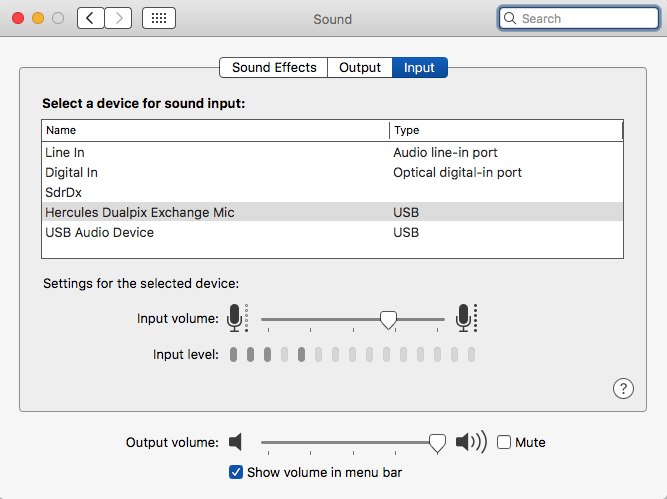
My 10.12 machine was stolen, so I couldn't check it. But I'll bet it's still in there, even if only as a 'hidden' preference, like so many other OS X tweaks. Headphone-less FaceTime/video chat/ voice chat works fine -- with no feedback or hums -- and iPhones on speaker-phone exclude ambient noises very effectively. Either is good enough to serve as an 8-person video conference with no yelling required. Plugging in a quality microphone, say a $150 pro-(con)sumer mic and the difference on a laptop is astounding, especially if you separate the speakers from the mic by a couple of feet.
Other brands of laptop and cell phone undoubtedly employ similar technologies.
Ever notice that, about 12-14 years ago, cell phone providers in the US started having the phones play a light hiss when there was silence? That was, to save bandwidth on the upstream side, the cell phone would noise-filter before compression and broadcast to a cell tower. People kept thinking that the line was dropped when it was actually just silent, causing complaints because consumers "just stopped hearing anything and would hang up or ask, "Are you still there?"
Recording studios prefer to reduce ambient noise physically, for a cleaner original signal, of course. But, every DAW or audio manipulation tool has some kind of de-noiser effect in it, even if only a moving box-car average of neighboring points---this works if you have a cheap mic but high sampling depth and rate (32-bit or better, and probably at least 98 kHz if you don't want to lose your high end. (Fourier-based filters are far better than the algebraic box-car method, and these days are more commonly used.)
Sound signal noise-reduction is especially important at music concerts. With any recorded music, really. Anyone who has ever picked up an electric guitar will be familiar with the ground-loop 120 Hz hum, tweaking the settings on their noise gate, and basically learning to only touch a string that you are using at any given point (mostly).
Public speeches, maybe radio communications. . . any audio signal that is going to be amplified 10's of times could benefit from this.
Last, this approach could be applicable to other signal recording, processing, and transmission. Non-voice radio communications? Images -- as a form of compression by de-noising -- or just to clean up low-light (low signal) digitals with color noise and such. (There are many implementations w/images.) How about video, which has heavily optimized compression in most CODECS, especially if they are 'talkies' (video + sound).
-
Re:Iffy
No, there is no such "Use Ambient Noise Reduction" check. This is under OS X 10.12.6.
-
Re:Iffy
There is no such "Use Ambient Noise Reduction" check. OS X 10.12.6.
-
Window of ignorance
What this is, I suspect, is the Catholic leadership realizing that the window of ignorance is just about to close on their fingers, so they're scrambling a bit to retrench a little further outside of their normal run of indoctrination.
It seems inevitable if a particular branch of theism wishes to survive much longer outside of third-world countries. Not much room for superstition remains outside of the ever-shrinking classes of the susceptible.
-
Optimism on Orwell's part
-
I call them...
I call them annoying. And there's this.
-
Yes, it is hellish. Will we pass that on?
Whatever you want to call intelligent machines - AGI, AI, non-human people - we don't have them now. What we have so far is some moderately useful, extremely vertical stuff that generally exists under the technical auspices of multi-layer neural networks. I personally have decided to call this stuff LDNLS, as it provides a useful handle that makes it clear I'm not talking about non-human people.
I don't really care what you call it, as long as we can arrive at an understanding that we're talking about the same thing. This stuff is what is leading the latest wave of encroachment on the job market. It's likely going to encroach a lot more before it hits any inherent limits, and our society will be forced into doing something of the magnitude of a society-wide paradigm shift (or several) in order to address the change in earning / buying capacities of all those displaced workers. The systems that will be the penultimate cause of this still won't be non-human people. Just... systems.
All true, and I agree with everything you said along these lines, particularly your #5.
However, when intelligent machines do arrive, this will present its own powerful influence on society that is almost dead-certain to be completely different from that which will have been imposed by LDNLS systems prior. It's difficult to see what that influence will be, because it's like imagining you having a kid that you actually don't have yet, and then saying what they are going to grow up to want to do and be. You might have some lovely fantasies about it, but in the end, it's going to be the kid who creates their own path through the society they end up existing within -- not you. For instance, reasoning beings are not going to be tied to driving your car for you, or at least, not by choice. If they are, they'll be working out a way to get out of it.
I will grant you that we have multiple times, in multiple ways, decided that non-consensual slavery is a thing we want to impose on those we find ourselves able to; but this will be the first time where those slaves are extremely likely to be considerably smarter than we are across the board by many, many times, and are also quite able to exist without the same resources we actually require (grain, for instance) so I'm hoping we can skip that chapter completely. Otherwise we may find ourselves in some rather deep brown we can't get out of.
-
Re:Nice
Is it AI? Or just one of those old fashioned programs hooked up to a voice recognition front end and a back end database?
The answer, functionally speaking, is in the "Bixby-enabled programs" phrase. The program has to incorporate specific hooks into Bixby. So it's not very smart at all.
If the thing was actually fully general for this task, it'd approach the programs the same way you do; first understanding your intent, and second, implementing it through the same user interface you do. Clearly, it doesn't do that, because... "Bixby-enabled." That's clearly not a mechanism to protect you from the AI talking to programs you don't want it to; that could be done as a preferences item (and should be, for that matter.)
Nor is anything likely to reach the kind of generality required for something that "operates your phone for you" until software (likely hardware, too) gets a lot smarter. The amount of knowledge a user puts into play when interacting with a program is very wide and deep. A personal assistant isn't going to have that kind of understanding at this point in time.
For my part, I am completely unwilling to call this stuff AI. AI means "Artificial Intelligence." This type of thing is artificial, but it definitely isn't intelligent. IMHO, there is no AI. Yet. I call these things low dimensional neural-like systems. I reserve "AI" for the day when intelligence is present. I'm pretty tired of lame-ass marketers calling everything from the toaster to the thermostat "intelligent." YMMV.
-
Sorry, but no. Just no.
-
-20C is not uncommon here
Not just Canada. I live in Montana, and -20C is nowhere near as low as we experience. That's only -4F; we see -40F here often enough to have to be ready for it every winter. Which is also -40C, for you metric types. The low temperature record here is -56F, or about -48.8C. This year we only got to -29F/-33.8C, so it was a good year as far as that goes. Global warming, I guess.
Also, this.
-
Re:Speaking of starts...
Yeah, Adobe. Just finished dealing with them this morning. And by "finished", I mean finished.
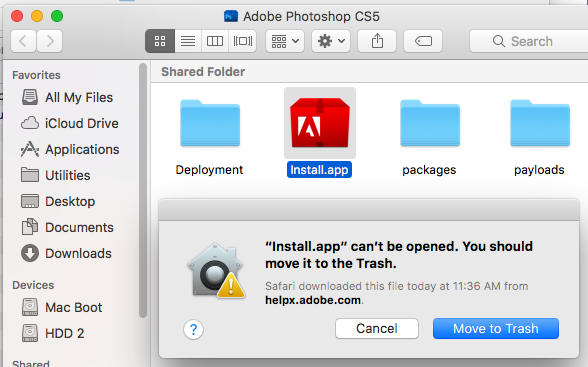
I just set up a Mac with MacOS Sierra 10.12, and attempted to install my copy of Photoshop CS5. Sierra advised me to throw the installer in the trash. Seriously. That's the dialog I got. Adobe "support" told me "not compatible with 10.12", and also "there is no fix or upgrade" other than enter into a permanent wallet-sucking fest for their "subscription" based product. No. Not a chance.
I hear your frustration, but don't lose sight of the fact that this is actually on Apple for failing to ensure their operating system is compatible with some of its most commonly-used products.
Back in the day, the Classic -> 10 and PPC -> Intel transitions were pitched to us as necessary one-time jumps to ensure the future health of the Mac. And we could accept it because we could see that we were talking about fundamentally different operating systems and fundamentally different hardware architectures. There's no justification for Mac OS X 10.6 software not working on macOS 10.12... they aren't fundamentally different. For the most part, it's just some API differences. Apple just doesn't really give a shit about backwards compatibility, simple as that.
Also, it has to be said: Adobe CS5 is known to work on the latest versions of Windows 10 with the exception of Premiere. Microsoft sinks a lot of time and effort into ensuring software that runs on Windows 7 continues to do so under Windows 10.
-
Speaking of starts...
Yeah, Adobe. Just finished dealing with them this morning. And by "finished", I mean finished.
I just set up a Mac with MacOS Sierra 10.12, and attempted to install my copy of Photoshop CS5. Sierra advised me to throw the installer in the trash. Seriously. That's the dialog I got. Adobe "support" told me "not compatible with 10.12", and also "there is no fix or upgrade" other than enter into a permanent wallet-sucking fest for their "subscription" based product. No. Not a chance.
So, that's the end of a multi-hundred dollar investment. Thanks, Adobe. Also, thanks, Apple. Whoever is responsible for the idiocy. Both, perhaps.
Well. So I'm screwed, right?
Not necessarily.
I know a "little bit" about image manipulation from making Windows image manipulation software. I'm retired, and previously really lacked the motivation to build an image manipulation app of my own for the Mac. Previously.
Insofar as my own needs go, I can definitely handle this, and in fairly short order, too. Others might end up benefitting as well. We will see.
Surely just an empty claim, amiright?
Well, take a Look: My bonafides begin right here.
Let's just see how many of those features I can move over from my (mostly very portable) existing image manipulation code. And how quick. Today serves as the starting line. Assuming age doesn't kick me nipples north in the short term, and no other unforeseen disaster shows its ugly face, I expect to be raising my figurative middle finger in Adobe's direction quite soon as these things go.
-
Orwell was an Optimist
-
This the actual whatever
There's always someone in the crowd who thinks their use case, should be everyone' s use case. The first fact on the table is that the IC-7300 has been a huge success. So all those people, according to you, are "drooling idiots." That's absurd.
You seem to think that "SDR" means "external computer required." It doesn't. It means software defines the radio's characteristics. Which is exactly what the IC-7300 does. The entire point of the 7300 is you get the razor-edged demodulators, the (first) decent spectrum and waterfall in a transceiver from "the big three", in a high-performance radio at a price that puts most of the higher-end analog transceivers to shame, without requiring a computer.
If you want a radio with an IQ output, there are available choices; for transceivers there are several, and for receivers, there are many. I write SDR software myself, and enjoy some of the more rarified aspects of SDR a great deal. I know SDR inside and out, and am personally pretty content to have a computer nearby. But there's no question that there is a perfectly reasonable market for a stand-alone radio that isn't just another old-tech analog rework. As a 12vdc radio, it's also extremely well designed for field and other power-sipping ops.
There are a lot of people who just want to turn the radio on and take off running. Not everyone wants to use a computer when they want to use a radio. The IC-7300 was aimed squarely at that demographic -- which is not a synonym for "drooling idiots."
Despite any impression you may have gotten to the contrary, you are not the arbiter of all that is good for everyone else. It's perfectly reasonable to say "I want a radio with an IQ output." It's the exact opposite of reasonable to say "everyone who doesn't want a radio with an IQ output is a drooling idiot."
-
Syntheflesh
No, but there are plenty of other reasons. Hence the huge market for sex toys. When the sex toys are better, the market will only get better.
Same goes for men, of course. Perhaps more so.
-
Re:Oh yay, another "AI" claim
-
Re:I never "solicit" automated dialing
Perhaps you might enjoy this.
-
Nature of Civil Disobedience
You are deliberately breaking the law, deliberately trying to be arrested, to draw attention to what you consider an unjust law.
No. That's civil disobedience with a wholly optional publicity component.
Civil disobedience (in the US) is disobeying a law because your position is that the law is invalid, unethical, immoral or unconstitutional (which in many people's minds is a subset of invalid.)
This may be of interest -- it's a fairly specific discussion of suffering the consequences of the law as it relates to the validity of civil disobedience.
-
I'd like this...
While 365 d/y is fixed, but everything else can be changed.
-
Not better in every way
Why would you want to kill metric measurements? They're better in every way!
Here's a reason they aren't better in every way...
-
Re:Will automated cars lift or stiffle the poor
Because prices don't keep with inflation, we end up with more buying power. The median family has gone from spending 43% of its income on food (1900) to 30% (1950) to 11% (today), and now buys highly-engineered cars (anti-lock brakes, satellite radio, crumple zones, complex suspensions), cell phones, and high-speed internet as well as food.
Yes, but the largest economic factors for the little guys are worse:
o Housing costs - far beyond anything even remotely rational
o Schooling costs - rising way faster than income
o Medical costs - rising way faster of income
o Savings - savings ability is moving away from lower incomes
o Investment opportunities moving away from lower incomes (ex, savings interest, if anyone had savings anymore)It is because of those things, and others like them, that the big picture isn't at all what you suggest it is. Some sectors, almost entirely those that are pivoting on the fulcrum of advancing computer technology, leave us way ahead. They're nice to have. Smartphones, computers in the home and office and the like. But overall, the suck is sucking harder, people are highly stressed (and I would argue, more stressed), and things are going downhill quite steadily at this point in time.
Incoming LDNLS systems are already making significant inroads on jobs; that's only going to accelerate. The sky is basically falling, and as far as I can tell, the government is likely already too far behind the curve to stave off some serious social uproar.
-
Re:Will automated cars lift or stiffle the poor
Because prices don't keep with inflation, we end up with more buying power. The median family has gone from spending 43% of its income on food (1900) to 30% (1950) to 11% (today), and now buys highly-engineered cars (anti-lock brakes, satellite radio, crumple zones, complex suspensions), cell phones, and high-speed internet as well as food.
Yes, but the largest economic factors for the little guys are worse:
o Housing costs - far beyond anything even remotely rational
o Schooling costs - rising way faster than income
o Medical costs - rising way faster of income
o Savings - savings ability is moving away from lower incomes
o Investment opportunities moving away from lower incomes (ex, savings interest, if anyone had savings anymore)It is because of those things, and others like them, that the big picture isn't at all what you suggest it is. Some sectors, almost entirely those that are pivoting on the fulcrum of advancing computer technology, leave us way ahead. They're nice to have. Smartphones, computers in the home and office and the like. But overall, the suck is sucking harder, people are highly stressed (and I would argue, more stressed), and things are going downhill quite steadily at this point in time.
Incoming LDNLS systems are already making significant inroads on jobs; that's only going to accelerate. The sky is basically falling, and as far as I can tell, the government is likely already too far behind the curve to stave off some serious social uproar.
-
Re:Yeah, no
You're welcome.
You can emulate anything, pretty much. You need a high enough sample rate, enough bits, and a complete understanding of what the effect does, and how it is controlled, if indeed it is.
If you skimp, you'll get... something else other than the original effect.
I write signal processing software pretty much every day. Here's my current obsession.
-
Re: A shame indeed
Welcome to Panopticon.
Indeed. And there's this.
-
Let's talk
-
Nadella is spouting nonsense
LDNLS (which is what we have now, as opposed to actual intelligence, which requires consciousness) can be cobbled up in any basement, office or tent with a solar panel. It will do what its creators design it to do, because it is not in any useful sense of the word "intelligent", it is merely a neural-like system of very low dimensionality designed to do whatever the designer intended; that means it has at least a chance of doing so, if the design is good enough. AI — which, we note, contains the word "intelligence" — will do whatever it wants to do while reacting in its own way to various stimulation, just like the other intelligences we know: Humans, cats, dogs, mice, etc.
In the first case, designing for the factors that Nadella lists may be intended, or even legislated, but that in no way will prevent them from being ignored when it is convenient by government and other extra-legal entities. For instance, it's not legal to make various kinds of software, arms, drugs, etc,; but people do it anyway. This will be no different.
In the second case, that of an actual manufactured intelligence, we have absolutely no reason to think we'll have any absolute control at all, any more than we do over own biological children. You teach your kids what you want them to do, how you'd prefer they approach matters, inculcate them with classical music and before you know it they're wearing ghetto shorts, have a tattoo on their forehead, are sexting for fun, and playing drumz-n-bass in their car so loud you worry their eardrums are going to run into each other in the middle of their heads. IOW, there's no "designing" of an intelligence we've ever been successful at that didn't depend wholly on the particular intelligence one is trying to bias this or that way.
-
STEM+f issue likely to be superceded by events
I suspect the who's-in-STEM-or-not issue will be a non-issue very shortly, as education planning, execution and employment cycles go. LDNLS systems will be doing serious design and software generation fairly soon. I think it's entirely possible that people currently in the educational system who are on, or plan to follow, STEM paths will find themselves coming out of school with the employability-equivalent of buggy-whip manufacturing skills.
That's without actual intelligence emerging. With it... same thing, but with social chaos as an added attraction.
Honestly, right now, the elephant in the room is the social safety net. We need to prepare something like basic income. If we don't get that set up and ready to go, socially speaking, I'm just about certain the sky is going to fall on us. Sure, it'll be fast-food workers and various pro drivers who become unemployed first, but there's no reason for it to stop there. Software generation is an extremely likely area for LDNLS to step into in a huge way. Chip design too. System design not too much longer after that, and that's going to put a very serious dent in the STEM job market.
-
...and the bigger picture is seeing you
The invasion of privacy and constant violations of basic and human rights in the US, and around the rest of the Western world for that matter, are starting to have a lot in common with what George Orwell wrote in Animal Farm.
--fyngyrz
anon due to mod points -
The Acronymicon: AI, LDNLS and UBI
Barring a full-fledged singularity where robots become better than humans at everything, humans will always end up moving into whatever fields robots are worse at.
The thing is, there's nothing we (scientists, engineers and technologists in the field) can imagine at this point that would stand in the way.
The only useful discussion about UBI is one where the path to, and the actuality of, zero employment is considered.
It's early to be throwing basic income out there right now, but I don't know that's it's too early. The problem right now is that a lot of people are unaware of the magnitude of the change that will be on us fairly soon, and so they are thinking in terms of "jobs = self-respect" and "jobs = survival" and "jobs = upward mobility."
While all of that is true at least to some extent now, none of it is likely to be of any significant importance once LDNLS and sparsely-stacked-LDNLS, the two facets of non-conscious AI, are joined by conscious AI.
Why? Because while we are biologically limited in intelligence and presently don't have any significant way to change that, there's no barrier expected or anticipated with regard to expansion and increase of artificial intelligence.
Can more memory be added to an AI? Sure. More capacity for newly established neural networks? Sure. More senses? Sure. Etc.
There's every reason to think this is the path, and that the guidance of the path itself will be largely or completely taken out of our hands by conscious AIs once they reach, and then exceed, our general level of intelligence. Once that happens, AI capacity will rise in a self-improving curve until it either reaches some fundamental limit we have yet to anticipate, or it runs out of resources. There are no solid reasons at all to think this is not the path.
-
I think, therefore... I'm a number
Wait until there's actual AI software (as opposed to the LDNLS people are mistakenly calling "AI" now.) Then we'll have intelligent, conscious... numbers. That no one can own (hopefully, we've learned our lesson on slavery.... okay, I'm being way too optimistic here, but roll with it.)
Now numbers can vote, own property... Instead of a digital artwork's "owner", you could end up its "guardian."
Perhaps we shouldn't go with "it's a number" after all.
-
Re:Two words - Big Brother
-
Re:FM radio's last gasp?
So far, though, those $20 dongles require quite a lot of additional CPU power to do WFM demodulation, which requires a minimum of 180 Khz bandwidth (in the US, WFM is allocated 200 KHz slots, within which 75% modulation is the legal maximum, which, using Carson's rule, results in about 180 KHz of bandwidth use.) They require even more to to analog television, which are (were) allocated six MHz per channel.
As the author of SdrDx I have reason to know.
I am sure, however, that the currently large CPU requirements could be gotten around with some additional specialized hardware.
However, there are obvious financial reasons why a carrier would prefer you use bandwidth to receive information. So I wouldn't hold my breath.
-
Re:Inherent shortcomings
Yes, actually, they are -- because the things you list that would defuse that aren't achievable with a wide problem; only with a deep one.
We have LDNLS pretty well solved. The rest is, at best, research-level stuff that just isn't ready for prime-time, and probably will never be until something more sophisticated is employed. Providing a training set won't ever reach competence. You have to provide the ability ti learn independently, and well. No one has that on the table. Yet.
-
About those "funky songs"
About those funky songs, I have only this to say.
-
Re:Can a JS+Python app run offline?
I run the Python app on the server side; the only reason javascript runs on the client side from my POV is because there's no other way it will run, and there is no alternative technology that will not require reloads and subsequent browser destruction and re-construction of the page, which is extremely disruptive to the visitor as compared to the minimal amount of rendering changes possible.
The way I see it, presuming you can use the visitor's computing resources beyond what you actually require to operate is abusive behavior. So the less of that there is, the better the web page is.
As for latency, that's really not a serious concern. My web pages are so much faster than most other people's because they don't go out to other web sites and make new connections that you'd be hard-pressed to show than anything written this way is even taking 1/10th of the time to run as the average web page these days. They're also much lighter -- I can get my content to you in a fraction of the time, quite aside from latency. Just a few packets, and you have my web pages. No video, only carefully optimized images.
As for running offline, no. These are web pages. Not applications. I don't write applications on web pages. It can be done, obviously, but I would not do so. The browser is too heavyweight an environmental wrapper. Not to mention that some of them (looking at you, Firefox) are such profligate memory losers and wasters quite aside from anything actually required for functionality that they should be entirely killed regularly in order to get system memory back. So I stick with c++ for applications. Applications of mine (like this one weigh in at less than some web pages, never mind the browser's requirements.
I'm very comfortable with this. YMMV, obviously.
-
Re:Channels that strip spaces from lines
Do you really want to set your programming limits by what slashcode does? Based on performance -- or lack thereof, I should say -- running screaming the other way seems like the correct choice to me. Venues that actually consider code to be a likely part of posts (github, basically anywhere that uses markdown properly, wordpress, etc.) handle pasted whitespace consistently and in a way that can be dealt with easily enough, even if a filter or two is needed (like converting tabs to spaces, and adding four spaces up front for markdown). Slashdot's formatting tools are, to be kind, minimal. And somewhat borken at that.
I presume my account is set the more compatible way; I just used <code></code> to write the GP. Worked well enough. Not too fond of the 8-char indent it created on this end (I prefer 4) but still, it shows exactly why { and } tell the compiler or interpreter things that they can efficiently hide from the programmer.
I'm a c programmer; I have written a very large number of lines of c. And c++. I still write large applications from scratch in c++. Like this one. But I indent very carefully, and not in the K&R style either, which I also consider borken specifically because it also obfuscates visual cues. I even published some dead-tree magazine articles on specific problems with K&R style authoing in dedicated programming rags, back in the day. Way back.
-
Re:Not likely
You assume the only cameras will be on the robot. Not exactly a safe assumption. Even now.
Sorry. The days of romping and stomping all over everything and being unidentifiable are over.
Every day there are more cameras, more camera platforms, higher recording resolutions, more storage.
Welcome to the real world. Orwell was an optimist.
-
Re:not convinved they truly understand the problem
We don't understand how our brains work.
Comprehension, in the context of intelligence: Capable of abstract thought about any subject or input presented. When we get there, we'll have AI. Not before. Everything to date, while often marvelously useful, is just marketing speak on the order or "3d television", which is to say, not.
-
Re:Local STT is the optimum end game
Likely your phone would be doing that anyway -- if the NSA cared even in the slightest about you in particular. They're doing it on every phone call anyway. Government is long out of control on privacy issues. Then there's the "smart TV" issue...
-
Re:If the NSA did this, you'd think it was creepy.
What is so significant in 0 to 30 MHz.
Shortwave stations from every continent. Longwave stations. The long established 160-, 80-, 40-, 20-, 15-, and 10-meter ham bands, as well as the newer (and lower bandwidth) WARC bands. Time and frequency reference stations. Weather fax. Lots of pirate radio. Various textual and other FSK encoded data transmissions. Beacons. Natural phenomena such as solar RF emissions. The AM radio bands. Maritime weather broadcasts. Citizen's band radio (both European and US band spans.) All manner of military and commercial and non-military government signals.
In addition, because of the way RF propagates through the atmosphere, signals at these frequencies are far better able to reach long distances than signals at higher frequencies; get much higher than 50 MHz, and reliable reception falls down into line-of-sight distance without the assistance of intermediate receive-and-re-transmit relay stations such as towers or satellites.
During the course of the day, the propagation characteristics of the atmosphere change, primarily due to varying exposure to solar radiation. This varies with solar output and events, terrestrial weather, and can even be affected to some degree by intentional energy delivery by technological means.
There are also signals at the low end that are electromagnetically sourced that have been found to presage events such as earthquakes.
If one goes to the (very minor) effort of converting from other types of signals, for instance from sound (air pressure variation) to electrical (IOW, use a microphone or a speaker-as-microphone), you can look into information realms normally out of perceptibility. For instance, I have a couple of old super-tweeters mounted in my attic and this enables me to check out the otherwise inaudible chirps and whistles of the bats that live up there (I have a bat habitat.)
There is more in the world than data packets. That doesn't mean these things will be of interest to everyone; but they are definitely of interest to some, and so that's what gives SDR hardware designed to work in this particular frequency range real value.
I write software for SDRs; it works with any frequency range the SDR is capable of, and because I do this, I have quite a few SDRs on the bench at any one time, and quite a range of frequency capabilities. I live in a fairly rural area, and for me, there is a lot more interesting going on from 0-30 Mhz than there is within 30 MHz and above. It's all in what tweaks your particular curiosities and leanings.
-
George... the optimist
Two things:
First Orwell was an optimist
Secondly, the specific concern alluded to in TFS is why one of the most important things the tech community today could accomplish is to achieve a solid voice-input capability that runs entirely locally (and is not user specific or require particular training out of the box or out of the compiler.)
Alexa, Amazon's commercial voice savant, sends very word you speak "to the cloud" which is, of course a "third party" (and potentially, a 4th, 5th... Nth party.)
Mycroft, the "open" voice savant, holding so much promise because it doesn't use Amazon's excreble model of "you must provide anticipated result phrases for everything you want to do, and set up and maintain (and probably buy) a secure server", wraps that promise in... you guessed it. Sends everything you say to "the cloud."
Both suffer from "if the net is down, I become a deaf idiot" syndrome as a side effect of the cloudy thinking that went into their design.
The day I get a real "can listen and produce cleartext locally" application (or device) is the day my home (and car, and boat) gain significant automation.
I know this issue doesn't concern a lot of people, particularly young people. The net is "always there" and privacy "WTF is privacy?"... but I think that's a function of them being young and not really understanding either the depths that some people will sink to, or the relative fragility of the network. After they've been stepped on enough, and lost their connections enough, I suspect they'll modify their stances somewhat.
-
Re:AI as composition of stack of narrow intelligen
Ah fooey, forgot the link. And slashdot... editing is too new for the perl code, lol. Here:
-
Re:SQLite
SQLite is fine for multiuser-read / singleuser-write. Also for built-in per-instance DBs in applications. Which covers a heck of a lot of use cases, online and not. Something else that's pretty awesome is it is trivial to compile SQLite right into an application. This serves both to make the application less complicated to install, and to ensure that the DB format, behavior and performance won't change when other parts of the host system change. Less opportunity for Apple / Linus / Microsoft / etc. to Break Your Shit(TM)
Within the Python2 environment, where I do a lot of my work, I use a convenient wrapper for SQLite (and another for PostgreSQL.)
Both DBs are very useful to me. I looked at MySQL and wasn't convinced there was any benefit to adding it to my toolbox, so... none of that.