Slashdot Mirror
Domain: gamasutra.com
Stories and comments across the archive that link to gamasutra.com.
Stories · 954
-
Behind the Scenes At Gamestop's Private Expo
Gamasutra has a look behind the curtain, at a game expo few people even know exist. The annual Gamestop expo has a lot of the air of old-E3, with a greater focus on business deals, swag, and benefits for the hard working Gamestopper. "What did the show accomplish? In some sense, it seemed almost to be a reward for the store managers -- who work long hours on the front lines -- to listen to the show-floor scuttlebutt. While the official line was that the show was all business, bringing the managers to Las Vegas, loading their arms with swag, and letting them play pre-release games is obviously a big draw for these 'professional gamers'. They were so enthusiastic, in fact, that a huge number stayed beyond the 9 PM closing time; kiosks had to be deactivated before the die-hard crowd filtered away." -
Academics Speak On 'Life After World Of Warcraft'
simoniker writes "Are MMO populations 'tribal', and if so, what's the next tribal shift after World of Warcraft? At Gamasutra, academics including MIT's Henry Jenkins and Ludium's Edward Castronova discuss what's next for the MMO market, based on their research and play patterns. Jenkins states that WoW is getting _too_ much analysis from researchers right now: 'WoW deserves attention because it has so captured the imagination of gamers over the past few years. That said, I don't think it is healthy for the field of games studies, which is still emerging, to be so fixated on a single game franchise — no matter what the franchise. A few years ago, it might have been The Sims or GTA, now it's WoW.'" For more on this topic MMOG industry veteran Gordon Walton spoke on this topic last week at GDC Austin, and notes from that event are also available at Gamasutra. -
Academics Speak On 'Life After World Of Warcraft'
simoniker writes "Are MMO populations 'tribal', and if so, what's the next tribal shift after World of Warcraft? At Gamasutra, academics including MIT's Henry Jenkins and Ludium's Edward Castronova discuss what's next for the MMO market, based on their research and play patterns. Jenkins states that WoW is getting _too_ much analysis from researchers right now: 'WoW deserves attention because it has so captured the imagination of gamers over the past few years. That said, I don't think it is healthy for the field of games studies, which is still emerging, to be so fixated on a single game franchise — no matter what the franchise. A few years ago, it might have been The Sims or GTA, now it's WoW.'" For more on this topic MMOG industry veteran Gordon Walton spoke on this topic last week at GDC Austin, and notes from that event are also available at Gamasutra. -
Study Finds That 'M'-Rated Games Sell Best
Gamasutra is reporting on information from a new research firm called Electronic Entertainment Design and Research, which has recently released a number of papers looking into trends in the gaming industry. One (perhaps surprising) finding: M-rated titles sell better than any other rating group. "The study, titled 'Console Intelligence Brief 2007' examines the PlayStation 3, Wii and Xbox 360 since each consoles' release through June 1, 2007, and comprises some 219 retail and 187 downloadable games made available on the new platforms, examined by genre, ESRB rating, gross sales in the United States, MetaCritic scores, online functionalities, multiplayer capability and other core game features. Among the sample results made available, the study found that critics' favorite list and the blockbuster charts have a lot in common, with highly-rated titles selling up to five times better than titles with lower scoring reviews. Despite online connectivity being a marketing cornerstone for all new consoles, the study concluded that 45 percent of retail games are not utilizing it in any way -- 98 percent of Nintendo Wii games have no online functionality at all." -
Defending Sony Against the Church Of England
Ian Bogost writes at Gamasutra about the (now quiet) controversy between Sony and the Church of England. You may recall the religious organization's objection to the use of the Manchester cathedral in Insomniac's alternate history WWII shooter Resistance. The result of this objection was a weak-kneed apology from Sony, and an attempt to push the whole thing under a rug. Bogost notes that never once did the company try to defend itself on artistic merit, simply capitulating to the objections of the church. That, he has decided, leaves the job up to him: "For my part, I think the cathedral creates one of the only significant experiences in the whole game, one steeped in reverence for the cathedral and the church, rather than desecration. Resistance is not a game richly imbued with wisdom. It's a first-person shooter, and it is a pretty good one. It's beautifully rendered, taking apparent advantage of the advanced graphical capabilities of the PlayStation 3. The game is very linear, both in its plot and the paths through each level, but that linearity allows it to focus the player on a smaller, more tightly crafted environment. Resistance takes up a common theme in science fiction: an ultimate test of humankind against the Other." -
Would You Pay Pennies For Game Features?
Friday at GDC Austin saw the day starting with a keynote that may seem unusual to players unfamiliar with the Asian online gaming market. Nexon is a major player from the country of South Korea, boasting a handful of titles that see more users in a month than many well-known online games made here in the US. All of the company's titles, regardless of genre, have one thing in common: they're free to play, sort of. Microtransactions, the practice of paying a very small amount of money for an object or service, is what provides Nexon its revenue ... and plenty of revenue it is. Nexon America's director Min Kim gave a discussion on the realities of rolling Microtransaction-based titles out in the states, with a case study of the success of Maple Story's launch in our country. -
How Habbo Succeeded
The other keynote on Thursday at GDC Austin homed in on the growing collusion between Web 2.0 site and online gaming, with an examination of the wildly successful Habbo Hotel by world creator Sulka Haro. Habbo is more of an online hang-out space than a game, thought it does have many game elements. The service grew from humble origins to now offer a home to almost 7.5 Million unique users per month. From Gamasutra's coverage: "Globally, the game attracts around 51% boys and 49% girls. '13-16 seems to be the predominant age group we're getting.' But in different territories the story may be different. For example, in Japan there are a lot of younger kids playing, but there's also a hardcore cadre of housewives who play in their own cliques. When it comes to the U.S., Haro posited, 'I guess in the States the tipping point is when you get your driver's license and you can actually go somewhere to meet people.' A big concern of Habbo players is to create a private space where their parents don't know what's going on -- and this extends to when they get in trouble." -
Analysts See 80GB PS3 Dropping To $499 For Holidays
Gamsasutra reports on analyst predictions of another PS3 price drop in time for the holidays. This time, the 80GB sku would take the place of the now fully-cleared-out 60GB unit. "Jesse Divnich from fantasy video game prediction market simExchange has said much the same, adding that 'after examining more closely the hardware sales of the PS3 over the last 6 months we have come to the conclusion that the PS3 cannot remain competitive in the current North American environment at its current retail offering at $499 and $599 ... To remain competitive against the other consoles, the Sony PS3 would have to reduce its 80GB SKU by $100 down to $499. Other options, besides a price drop, could be the bundling of more free software titles, which has always been a popular option during the Holiday season.'" -
PAX 2007 In A Nutshell
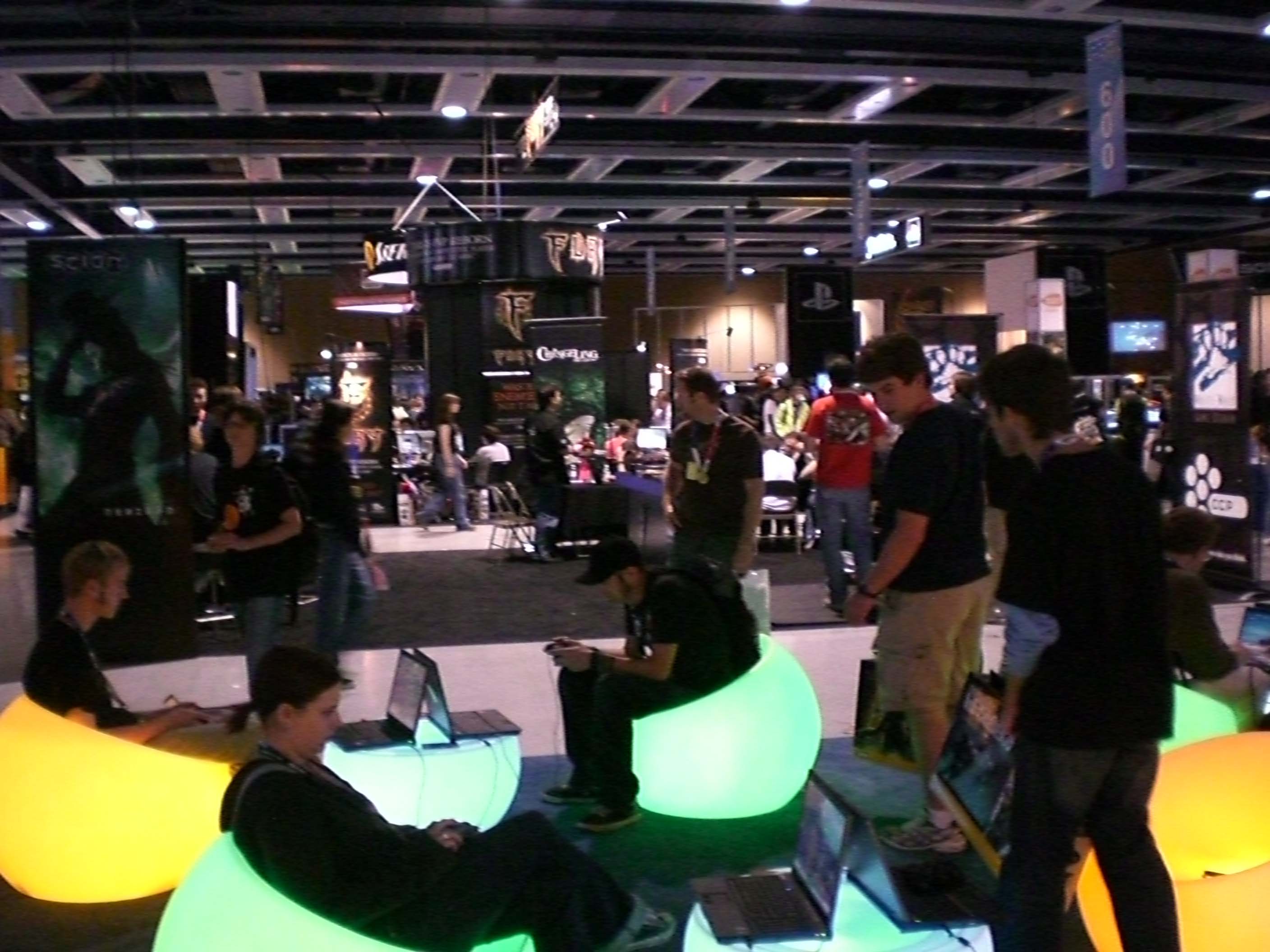
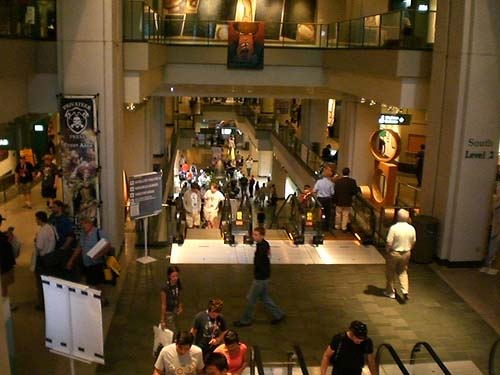
Last weekend the dark horde of nerddom descended on Seattle, entering the heart of the 'Emerald City' to gorge itself on the music, culture, and humor of gaming. The Penny Arcade Expo (PAX) once again brought together fans of the influential webcomic for a festival that, without even trying, seems to be taking the place of old E3. Though they were expecting around 30,000 people, the word was that by early Sunday they'd already gone through some 40,000 badges. There were DSes everywhere, concerts at night, a packed exhibit hall, and benchmark comic strips created by Mike Krahulik and Jerry Holkins adorned almost every wall. Despite all the people and the noise, somehow the event had a community feel to it that was hard to understand ... and even harder to describe. I'll try, though, along with impressions from games on the show floor and the incredible music of folks like Jonathan Coulton and the Minibosses. Read on, and All Hail Ball. The Early Weekend
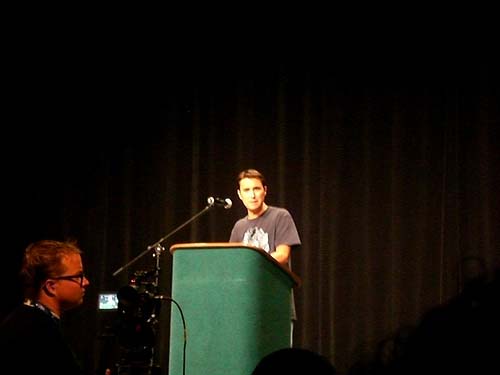
If you missed my discussion of Friday's events, it's understandable; it went up this past Saturday. Suffice it to say that Wil Wheaton's keynote speech was the highlight of the evening. His praise of social gaming, and the relationship-building power of the PAX-goer's favorite pastime resonated incredibly well with the packed theatre. The after-action report on his blog says it all: "My keynote went perfectly, and the audience (and the gaming press online) responded to it in ways I never dreamed possible. I didn't think there would be slightly more than 5000 people in the room when I spoke ..."
The first Penny Arcade Panel featured a lot of middlin' questions, highlighted by the incredible singing power of Jerry Holkins. A description of his performance is in my weekend update, but the real surprise didn't come until after the questions were done. The end of the panel turned ugly when the PA gents left the stage for Uwe Boll to have a chance at the mike. Gabe said later that weekend that he was surprised by the crowd reaction. "You can tell when a crowd is angry, and this was the first time I've felt that at at PAX." The unapologetic Boll was screamed at fairly mercilessly by the attendees.
Other events from the early weekend included a discussion of modern storytelling in videogames. Luminaries Ron Gilbert (Monkey Island), Dave Grossman (Sam and Max) and Nate Fox (Sly Cooper) came together to jaw on a topic near to their hearts. The group discussed linear stories vs. sandbox-style gameplay, user-created content, kids games, and the importance of theme even if your core story isn't all that great: "Grossman [said], 'Well, story isn't just about dialogue and narrative, right - I mean really you want to learn something about the human experience. I think that if I weren't doing adventure games I wouldn't think of myself as a narrator, but rather as the hand of fate. I'm going to kind of let you run around and do what you want and everything. Just to let the player go around and do what they want - they can feel like it's the good hand of fate or the bad hand of fate, but not that they're completely being controlled.'"
The Rain-Slick Precipice of Darkness, the Penny Arcade videogame currently in development, was a visible presence at the show all weekend. The Friday unveiling of a new game demo to the media at a special Q&A event was followed by a weekend's worth of running through the game for attendees on the show floor. Most everyone got to see the title, and hear the news that it will be coming to Xbox Live alongside its PC distribution avenues. The opening, grim, text still makes me smile: "Four gods wait on the windowsill / Where once eight gods did war and will / And if the gods themselves may die / What does that say for you and I?"
PA Panel II
While the first PA Q&A panel was entertaining just to hear Holkins and Krahulik talk, the second panel actually had a number of insightful questions, touching statements, and funny moments. And, thankfully, there were no stoned guys rambling about their paranoid fantasies at the microphone; always a plus. Long queues formed at the two microphones to question the gents, and here are some highlights:- Paul Barnett, Design Manager for the Warhammer Online Massively Multiplayer game, drew applause for his short advertisement during a trailers reel before the event started. He used his clipped British wit to compare Warhammer to World of Warcraft like so: If you're going up against the Beatles, don't try to be the Beatles. You'll end up looking like the Monkees. Instead, we're going to be Led Zeppelin.
- A question about the changes to the primary characters over the year led Mike Krahulik to discuss his influences, such as Stan Sakai. He's essentially 'never finished' with the characters, and we can expect to see further changes to his art style in the coming years.
- Drawings of Gabe and Tycho in ping pong outfits prompted readers to ask if we would ever see that as a project down the road. They're enthusiastic about it and would love to do it, as up until now readers have just seen a few simple images. To further tease us, they described the backstory to the piece: Set in the 80s, a cold war US is still facing down Russia. A little-known clause in the UN charter states that table tennis can be used to decide grudges; the loser forfeits their country. The US table tennis team is slain, and so a group of four people at ping pong camp (including our protagonists) are drawn into international excitement.
- A question about the appeal of the Halo franchise has the gents noting that the series has grown on them considerably.
- In negotiating the price for the XBLA version of the Rain-Slick Precipice of Darkness, they feel they'll have a good deal of leverage as regards pricing (and content as well).
- Several great ideas for projects and future PAX ideas are mentioned, including support of a nerdcore show currently touring the area and an Indie Games FreePlay area.
- When asked about origins of the hobos in Precipice of Darkness, Tycho notes that the game is a 'hobage' of different sources. The Achievement for 100 hobo kills? Hobicide.
- A reader challenges the two to a thumb war, which Jerry wins quite promptly by kicking Gabe in the nuts. He declines to continue, saying he 'values his beanbag.'
- When asked to endorse some games on the exhibit show floor, both gentlemen put their weight behind Eye of Judgement and Sega Rally.
- Someone notes that the current in-the-works game is very much a 'Tycho' game ... lots of words. He wonders what kind of 'Gabe' game they'd like to make. Mike ponders the concept of a brawler, or perhaps something not unlike Turtles in Time.
- The idea of making sure the ball comes back to PAX every year, 'to recharge' is brought up. It could then be sold on eBay to help fund the annual Child's Play charity. They both really like this idea.
- A reader asks what the 'worst thing' either of them have ever done is. Mike tells the story of a time when he set a trap for his family's cat in the backyard, and ended up stringing up the pet by the neck into a tree. It survived, but he has always felt terribly. Jerry, on the other hand, equivocates. When Mike gets tired of it, he tells a story of Jerry drinking a glass of Chai and finding a bug near the bottom of his glass ... which he then upended and finished after fishing out the bug.
Having had a good look at the game at Gen Con, I used my PAX chance to talk to the folks at EA Mythic to dig a little bit deeper on one of the game's claims to fame: Realm vs. Realm combat. Just hours before I spoke to the folks at EA, a team from their company had announced professions from the High Elf and Dark Elf factions for the very first time. I tried to glean just a little bit more PvP-specific information about these races for you, but it was not to be.
Just the same Ryan Barnard (game designer) and Eric Correll (producer on the game) were very forthcoming. The pair was happy to discuss different elements of their signature game feature. For example, new players will have the PvP-focused game introduced to them gradually at low levels. There's a soft introduction, beginning that portion of the title's seamless integration into the overall gameplay. Open-world PvP in specific parts of the starting zones will most likely be their first exposure. Quests will lead them to RvR areas, and eventually will direct them to the instanced 'Scenario'-style missions. Throughout the game, the portion of land that is focused on these activities starts small, but eventually dominates gameplay; the RvR 'city capture' system is Warhammer's 'end game'.
Warhammer Online's unique systems, like the Tome of Knowledge and the Public Quest, also touch on RvR. The Tome will explain elements of Player vs. Player combat, and will record your successes in battle. RvR Public Quests, meanwhile, are currently undergoing retooling. They want them 'right', and currently have taken them all out of the game to make sure they're just so; they hope to have them back into the game by launch.
This feel of 'rightness' is something they're aiming for in their scenarios as well, with the goal of integrating these instances not only into PvP progression, but the ongoing story of the game as well. Each is themed to the area they're in, and tells the tale of a specific conflict between the Order and Chaos armies.
Introducing players who might not otherwise participate in RvR into the fundamentals of that gameplay style is also something the team is focusing on. While they acknowledge that some people just don't want to play against other players, they see folks who are hard and fast about that rule as the minority. They're looking to make PvP a core part of the game, and as such they'll be approaching it differently than a primarily PvE focused game might. This affects multiple game design elements, all the way down to the 'hook' of Public Quests, which gets folks who might not even ever group thinking more favorably about gaming with others. Racial pride is also a factor; by priming characters from low levels to be 'pro-Dwarf', or whatever, players will be more likely to come to their society's aid. They're all steps in a chain, the team hopes, to changing outlooks soured by less focused titles.
On the other side of the equation, the end-game city capture system sees factions sacking the racial homes of their opponents. Though reluctant to use the term 'end game' specifically, the team members were happy to admit that it will be the focus at max-levels. RvR combat will funnel players towards the opposing side, hoping to push the 'antagonists' back to their city walls. They also pointed out, however, that there are other elements in play at that high level. PvE content and public quests are still around, though diminished, and they have plans to further expand both sides of the max-level content once the game is released.
Organized Play, as featured in Guild Wars and now World of Warcraft, is not something they're currently planning for. They'd love to eventually do tournaments for RvR teams at some point, but they're so focused on getting it out the door in a timely fashion that it's not particularly on their radar. As they put it, "we hope we have that problem".
The cutting edge of their work is, obviously, on the Elves at the moment. They're still working to tune the scenarios and open-world play for the Elven areas, and are always working to ensure that classes are balanced and the 'fun' is present.
This cutting edge blends well with some of the surprises that the team had in store for them when masses of people finally entered the Beta. Probably the most surprising for the RvR team: their carefully crafted points of control battlefield objective system, which requires holding targets in open-world PvP, are almost completely being ignored. While they worked hard on this mechanic, the players are more interested in the actual act of combat when in an open-world environment. Scenario tactics are welcomed, but outside of those instances the two sides really just want to enter the fray. The team hopes to have them in the game in some capacity, but they're going to undergo heavy retooling before that happens.
As we wrapped things up, we discussed the reflection this decision has on their overall attitude towards the game: if it's not working, it needs to go/be fixed/tuned/rehashed/whatever. Killing what you thought was going to be the end-all be-all is not outside the realm of possibility, even this late in the game. RvR, and the game in general, has to be fun. No exceptions.
Fury
I'll be honest: Fury came at me from nowhere. I'd read about it before coming to the show, knew that it was approaching an Open Beta, and that it was a free-to-play PvP title. That was just about all I knew when I sat down to play and chat with Fury's lead designer Adam Carpenter.
When you're trying to quantify Fury's gameplay type, it's better to think less about online RPGs and more about first-person shooters. Fury has essentially taken the swords and sorcery milieu and dropped that whole cloth into an FPS schema. In each match, players spawn in, rush out, and slam into each other in extremely fast altercations. Everything is fast; from character creation to combat can be just a few minutes.
This is the underpinning of developer Auran's outlook: fun, fast, and free. Instead of grinding through a PvE component, Fury characters are built entirely around a series of abilities and equipment available at character creation. Each character can play whatever role you want them to in a given match, and their role can be changed freely between altercations. Want to act as a support class in one match? You put on your gear that aids healing type abilities, load those healing abilities into your hotbar , and go. Want to act as a ranged DPS class? Swap those healing bits out for the appropriate gear and powers. Players will never have to whine about not having the right class for a fight, as everyone has flexibility.
Gameplay itself, character abilities, focuses on colors. Your ability bar is full of various attacks, and they are themed around different colors. Each player has a small gauge on their screen to help ascertain how many color points they have built up. These points are gained by using 'low level' colored abilities. A basic blue attack, for example, might give you one blue point. As you move through combat, your gauge will fill with colored points. Higher points unlock the use of more powerful abilities on your hotbar, which in turn use up your points. Fascinatingly, each ability color has a diametric opposite; red points counter blue points and players with red points in their bar will actually be less effective with blue abilities. This led the designers to create special point-manipulating abilities; in the middle of the fight you can switch a player's point colors. You can also steal points, leading to the 'change-their-color-steal-their-points' combo move, leaving your opponent defenseless and cold in the world.
Each color has a sort of 'theme', with green abilities having a sort of nature-y feel to it, while blue abilities being sort of icey. There are ranged and melee abilities in all colors, so there won't be any particular demanded role for a color ability. For most players the only real constraint will be up to what abilities you have on hand as a result of previous accomplishments. While most common abilities will be available by default when you purchase the game, new powers will be unlocked via achievements as you succeed in combat. Achievements include everything from taking the most objectives during a match, to killing the most people, to healing the most ... and your rewards are appropriate for what you accomplish.
Rewards on the equipment side are a bit more random. After completing a match, random loot is generated for the party, and people /roll for it. That's pretty much 'the way it is', going right around the usual sort of arguments at pick up group might have when dealing with looted gear. Gold is equally distributed, of course, and both items and gold are commensurate with your success in the just-completed mission.
It's worth noting here that Fury will have a for-pay option, allowing you to slap down a subscription fee if you want ... but it will have nothing to do with the quality of your in-game items. Money is only given to the Auran folks for the addition of convenience and depth. I should say there is some overlap with items: one of the for-pay conveniences is the ability to roll on three items instead of two. A for-pay player has a bit more in the way of item space, some options for purchasing things from vendors, and other simple things that makes the game just a little bit easier for having forked over your cash. Depth, in this case, is all about in-game ladders. While free players will compete on ladders of various types, paying players will have a long list of different ladder types to participate in. Server, guild, and individual progress will all be tracked for various rewards and bragging rights.
Those bragging rights will come in the form of an online representation of your character's escapades. Kill counts, 'flag' steals, and other metrics will be tracked on an official page for your character, and viewable by anyone. Guilds with an interest in going deeper into min-maxing can make use of the human-readable stats that will be generated locally by the client in a text file. Officers can collect these document to see which builds are working, which aren't, and where the group as a whole needs to focus.
The game build playable on the PAX show floor was already five months old, and showed it. There were server problems a few times, and the game looked more than a little bit jaggy. Even through the cruft, though, there was a lot of promise showing through. The settings were gorgeous despite the outdated rendering model, and the fun factor of actual play was very high. Fury is a simple, brutal combat game, and it makes no pretensions about it. With the promise of free online play for the price of a PC game title, this seems like a pretty nice package. It's definitely not going to be for everyone; there's none of the painstaking polish of Guild Wars, or the deep PvE experience of World of Warcraft. For folks looking for a quick, focused good time Fury may just be what you're looking for.
Jonathan Coulton, Frontalot, Minibosses Concert
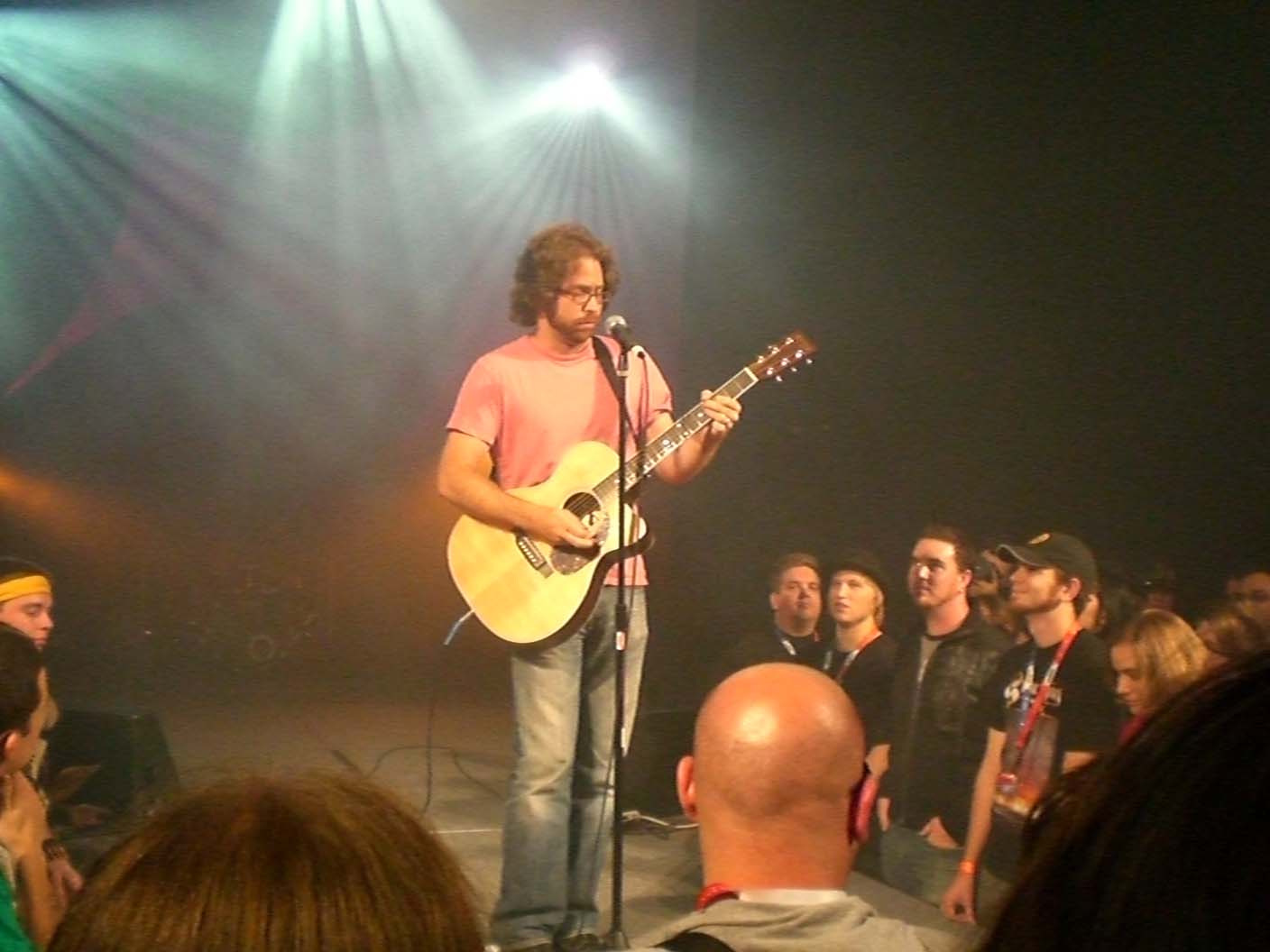
I'm sure many of you could have told me how transcendent Jonathan Coulton's music is, but when I entered the theatre on Saturday night for the triple-headed mega-show I was something of a Coulton newb. I'd heard Code Monkey, of course, but I'd never made much of an effort to seek out his music. Whether it was his intent to really reach the audience that night or not, he made a convert out of me. His haunting lyrics about superficiality, squid, cybernetics, robotics, technology, programming, and zombies were funny, touching, and thought provoking. I asked a friend who followed his music to confirm for me that he usually doesn't play terribly large venues. I had to ask because it was only really apparent during the few moments when he paused to take in the size of the audience. He was really, very good. Coulton had easily the largest crowd of the night, with his mass dwarfing even the groups on hand later for MC Frontalot and the Minibosses. His final song for the night, re: Your Brains was tremendous to experience in the midst of thousands of hand-waving flesh-craving growl/singing faux undead. Both Frontalot and the Minibosses put on amazing shows as well, of course, showing off their polished shows and firm grasp of their material. Frontalot was in rare form, with several new songs of his most recent album. Just the same ... Coulton was the show of the night for me, and it was a privilege to be able to see such a great act in person.
The Games And Panels of PAX
There were so many events and games, demos and panels, at the event that I couldn't make it to every interesting experience. Thankfully, other sites can pick up the slack.
The panel on licensed games explored the pros and cons of using someone else's IP to make a title. "Too many cooks in the kitchen" was seen as the primary problem, with the high cost associated with such a deal a close second.
"Pitch Your Game Idea" is always a very well-attended panel, and this year was no exception. Dozens and dozens of people lined up to present their game ideas to a panel of industry veterans. They were then 'cut', American Idol style, working through less solid game ideas towards the pearly center. There were apparently a surprising number of women there, and the contestant that won was one of them. Her simple, Pong-like concept had a graphical background that became more complicated as the game went on.
That showing would have been a relief to the folks at the very well attended "Women in Games" panel. The event focused around the challenges of entering the industry, and the issues associated with working the day to day grind once you're in.
A number of folks had hands-on time with titles I didn't get to, including Haze, Tabula Rasa -
PAX 2007 In A Nutshell
Last weekend the dark horde of nerddom descended on Seattle, entering the heart of the 'Emerald City' to gorge itself on the music, culture, and humor of gaming. The Penny Arcade Expo (PAX) once again brought together fans of the influential webcomic for a festival that, without even trying, seems to be taking the place of old E3. Though they were expecting around 30,000 people, the word was that by early Sunday they'd already gone through some 40,000 badges. There were DSes everywhere, concerts at night, a packed exhibit hall, and benchmark comic strips created by Mike Krahulik and Jerry Holkins adorned almost every wall. Despite all the people and the noise, somehow the event had a community feel to it that was hard to understand ... and even harder to describe. I'll try, though, along with impressions from games on the show floor and the incredible music of folks like Jonathan Coulton and the Minibosses. Read on, and All Hail Ball. The Early Weekend
If you missed my discussion of Friday's events, it's understandable; it went up this past Saturday. Suffice it to say that Wil Wheaton's keynote speech was the highlight of the evening. His praise of social gaming, and the relationship-building power of the PAX-goer's favorite pastime resonated incredibly well with the packed theatre. The after-action report on his blog says it all: "My keynote went perfectly, and the audience (and the gaming press online) responded to it in ways I never dreamed possible. I didn't think there would be slightly more than 5000 people in the room when I spoke ..."
The first Penny Arcade Panel featured a lot of middlin' questions, highlighted by the incredible singing power of Jerry Holkins. A description of his performance is in my weekend update, but the real surprise didn't come until after the questions were done. The end of the panel turned ugly when the PA gents left the stage for Uwe Boll to have a chance at the mike. Gabe said later that weekend that he was surprised by the crowd reaction. "You can tell when a crowd is angry, and this was the first time I've felt that at at PAX." The unapologetic Boll was screamed at fairly mercilessly by the attendees.
Other events from the early weekend included a discussion of modern storytelling in videogames. Luminaries Ron Gilbert (Monkey Island), Dave Grossman (Sam and Max) and Nate Fox (Sly Cooper) came together to jaw on a topic near to their hearts. The group discussed linear stories vs. sandbox-style gameplay, user-created content, kids games, and the importance of theme even if your core story isn't all that great: "Grossman [said], 'Well, story isn't just about dialogue and narrative, right - I mean really you want to learn something about the human experience. I think that if I weren't doing adventure games I wouldn't think of myself as a narrator, but rather as the hand of fate. I'm going to kind of let you run around and do what you want and everything. Just to let the player go around and do what they want - they can feel like it's the good hand of fate or the bad hand of fate, but not that they're completely being controlled.'"
The Rain-Slick Precipice of Darkness, the Penny Arcade videogame currently in development, was a visible presence at the show all weekend. The Friday unveiling of a new game demo to the media at a special Q&A event was followed by a weekend's worth of running through the game for attendees on the show floor. Most everyone got to see the title, and hear the news that it will be coming to Xbox Live alongside its PC distribution avenues. The opening, grim, text still makes me smile: "Four gods wait on the windowsill / Where once eight gods did war and will / And if the gods themselves may die / What does that say for you and I?"
PA Panel II
While the first PA Q&A panel was entertaining just to hear Holkins and Krahulik talk, the second panel actually had a number of insightful questions, touching statements, and funny moments. And, thankfully, there were no stoned guys rambling about their paranoid fantasies at the microphone; always a plus. Long queues formed at the two microphones to question the gents, and here are some highlights:- Paul Barnett, Design Manager for the Warhammer Online Massively Multiplayer game, drew applause for his short advertisement during a trailers reel before the event started. He used his clipped British wit to compare Warhammer to World of Warcraft like so: If you're going up against the Beatles, don't try to be the Beatles. You'll end up looking like the Monkees. Instead, we're going to be Led Zeppelin.
- A question about the changes to the primary characters over the year led Mike Krahulik to discuss his influences, such as Stan Sakai. He's essentially 'never finished' with the characters, and we can expect to see further changes to his art style in the coming years.
- Drawings of Gabe and Tycho in ping pong outfits prompted readers to ask if we would ever see that as a project down the road. They're enthusiastic about it and would love to do it, as up until now readers have just seen a few simple images. To further tease us, they described the backstory to the piece: Set in the 80s, a cold war US is still facing down Russia. A little-known clause in the UN charter states that table tennis can be used to decide grudges; the loser forfeits their country. The US table tennis team is slain, and so a group of four people at ping pong camp (including our protagonists) are drawn into international excitement.
- A question about the appeal of the Halo franchise has the gents noting that the series has grown on them considerably.
- In negotiating the price for the XBLA version of the Rain-Slick Precipice of Darkness, they feel they'll have a good deal of leverage as regards pricing (and content as well).
- Several great ideas for projects and future PAX ideas are mentioned, including support of a nerdcore show currently touring the area and an Indie Games FreePlay area.
- When asked about origins of the hobos in Precipice of Darkness, Tycho notes that the game is a 'hobage' of different sources. The Achievement for 100 hobo kills? Hobicide.
- A reader challenges the two to a thumb war, which Jerry wins quite promptly by kicking Gabe in the nuts. He declines to continue, saying he 'values his beanbag.'
- When asked to endorse some games on the exhibit show floor, both gentlemen put their weight behind Eye of Judgement and Sega Rally.
- Someone notes that the current in-the-works game is very much a 'Tycho' game ... lots of words. He wonders what kind of 'Gabe' game they'd like to make. Mike ponders the concept of a brawler, or perhaps something not unlike Turtles in Time.
- The idea of making sure the ball comes back to PAX every year, 'to recharge' is brought up. It could then be sold on eBay to help fund the annual Child's Play charity. They both really like this idea.
- A reader asks what the 'worst thing' either of them have ever done is. Mike tells the story of a time when he set a trap for his family's cat in the backyard, and ended up stringing up the pet by the neck into a tree. It survived, but he has always felt terribly. Jerry, on the other hand, equivocates. When Mike gets tired of it, he tells a story of Jerry drinking a glass of Chai and finding a bug near the bottom of his glass ... which he then upended and finished after fishing out the bug.
Having had a good look at the game at Gen Con, I used my PAX chance to talk to the folks at EA Mythic to dig a little bit deeper on one of the game's claims to fame: Realm vs. Realm combat. Just hours before I spoke to the folks at EA, a team from their company had announced professions from the High Elf and Dark Elf factions for the very first time. I tried to glean just a little bit more PvP-specific information about these races for you, but it was not to be.
Just the same Ryan Barnard (game designer) and Eric Correll (producer on the game) were very forthcoming. The pair was happy to discuss different elements of their signature game feature. For example, new players will have the PvP-focused game introduced to them gradually at low levels. There's a soft introduction, beginning that portion of the title's seamless integration into the overall gameplay. Open-world PvP in specific parts of the starting zones will most likely be their first exposure. Quests will lead them to RvR areas, and eventually will direct them to the instanced 'Scenario'-style missions. Throughout the game, the portion of land that is focused on these activities starts small, but eventually dominates gameplay; the RvR 'city capture' system is Warhammer's 'end game'.
Warhammer Online's unique systems, like the Tome of Knowledge and the Public Quest, also touch on RvR. The Tome will explain elements of Player vs. Player combat, and will record your successes in battle. RvR Public Quests, meanwhile, are currently undergoing retooling. They want them 'right', and currently have taken them all out of the game to make sure they're just so; they hope to have them back into the game by launch.
This feel of 'rightness' is something they're aiming for in their scenarios as well, with the goal of integrating these instances not only into PvP progression, but the ongoing story of the game as well. Each is themed to the area they're in, and tells the tale of a specific conflict between the Order and Chaos armies.
Introducing players who might not otherwise participate in RvR into the fundamentals of that gameplay style is also something the team is focusing on. While they acknowledge that some people just don't want to play against other players, they see folks who are hard and fast about that rule as the minority. They're looking to make PvP a core part of the game, and as such they'll be approaching it differently than a primarily PvE focused game might. This affects multiple game design elements, all the way down to the 'hook' of Public Quests, which gets folks who might not even ever group thinking more favorably about gaming with others. Racial pride is also a factor; by priming characters from low levels to be 'pro-Dwarf', or whatever, players will be more likely to come to their society's aid. They're all steps in a chain, the team hopes, to changing outlooks soured by less focused titles.
On the other side of the equation, the end-game city capture system sees factions sacking the racial homes of their opponents. Though reluctant to use the term 'end game' specifically, the team members were happy to admit that it will be the focus at max-levels. RvR combat will funnel players towards the opposing side, hoping to push the 'antagonists' back to their city walls. They also pointed out, however, that there are other elements in play at that high level. PvE content and public quests are still around, though diminished, and they have plans to further expand both sides of the max-level content once the game is released.
Organized Play, as featured in Guild Wars and now World of Warcraft, is not something they're currently planning for. They'd love to eventually do tournaments for RvR teams at some point, but they're so focused on getting it out the door in a timely fashion that it's not particularly on their radar. As they put it, "we hope we have that problem".
The cutting edge of their work is, obviously, on the Elves at the moment. They're still working to tune the scenarios and open-world play for the Elven areas, and are always working to ensure that classes are balanced and the 'fun' is present.
This cutting edge blends well with some of the surprises that the team had in store for them when masses of people finally entered the Beta. Probably the most surprising for the RvR team: their carefully crafted points of control battlefield objective system, which requires holding targets in open-world PvP, are almost completely being ignored. While they worked hard on this mechanic, the players are more interested in the actual act of combat when in an open-world environment. Scenario tactics are welcomed, but outside of those instances the two sides really just want to enter the fray. The team hopes to have them in the game in some capacity, but they're going to undergo heavy retooling before that happens.
As we wrapped things up, we discussed the reflection this decision has on their overall attitude towards the game: if it's not working, it needs to go/be fixed/tuned/rehashed/whatever. Killing what you thought was going to be the end-all be-all is not outside the realm of possibility, even this late in the game. RvR, and the game in general, has to be fun. No exceptions.
Fury
I'll be honest: Fury came at me from nowhere. I'd read about it before coming to the show, knew that it was approaching an Open Beta, and that it was a free-to-play PvP title. That was just about all I knew when I sat down to play and chat with Fury's lead designer Adam Carpenter.
When you're trying to quantify Fury's gameplay type, it's better to think less about online RPGs and more about first-person shooters. Fury has essentially taken the swords and sorcery milieu and dropped that whole cloth into an FPS schema. In each match, players spawn in, rush out, and slam into each other in extremely fast altercations. Everything is fast; from character creation to combat can be just a few minutes.
This is the underpinning of developer Auran's outlook: fun, fast, and free. Instead of grinding through a PvE component, Fury characters are built entirely around a series of abilities and equipment available at character creation. Each character can play whatever role you want them to in a given match, and their role can be changed freely between altercations. Want to act as a support class in one match? You put on your gear that aids healing type abilities, load those healing abilities into your hotbar , and go. Want to act as a ranged DPS class? Swap those healing bits out for the appropriate gear and powers. Players will never have to whine about not having the right class for a fight, as everyone has flexibility.
Gameplay itself, character abilities, focuses on colors. Your ability bar is full of various attacks, and they are themed around different colors. Each player has a small gauge on their screen to help ascertain how many color points they have built up. These points are gained by using 'low level' colored abilities. A basic blue attack, for example, might give you one blue point. As you move through combat, your gauge will fill with colored points. Higher points unlock the use of more powerful abilities on your hotbar, which in turn use up your points. Fascinatingly, each ability color has a diametric opposite; red points counter blue points and players with red points in their bar will actually be less effective with blue abilities. This led the designers to create special point-manipulating abilities; in the middle of the fight you can switch a player's point colors. You can also steal points, leading to the 'change-their-color-steal-their-points' combo move, leaving your opponent defenseless and cold in the world.
Each color has a sort of 'theme', with green abilities having a sort of nature-y feel to it, while blue abilities being sort of icey. There are ranged and melee abilities in all colors, so there won't be any particular demanded role for a color ability. For most players the only real constraint will be up to what abilities you have on hand as a result of previous accomplishments. While most common abilities will be available by default when you purchase the game, new powers will be unlocked via achievements as you succeed in combat. Achievements include everything from taking the most objectives during a match, to killing the most people, to healing the most ... and your rewards are appropriate for what you accomplish.
Rewards on the equipment side are a bit more random. After completing a match, random loot is generated for the party, and people /roll for it. That's pretty much 'the way it is', going right around the usual sort of arguments at pick up group might have when dealing with looted gear. Gold is equally distributed, of course, and both items and gold are commensurate with your success in the just-completed mission.
It's worth noting here that Fury will have a for-pay option, allowing you to slap down a subscription fee if you want ... but it will have nothing to do with the quality of your in-game items. Money is only given to the Auran folks for the addition of convenience and depth. I should say there is some overlap with items: one of the for-pay conveniences is the ability to roll on three items instead of two. A for-pay player has a bit more in the way of item space, some options for purchasing things from vendors, and other simple things that makes the game just a little bit easier for having forked over your cash. Depth, in this case, is all about in-game ladders. While free players will compete on ladders of various types, paying players will have a long list of different ladder types to participate in. Server, guild, and individual progress will all be tracked for various rewards and bragging rights.
Those bragging rights will come in the form of an online representation of your character's escapades. Kill counts, 'flag' steals, and other metrics will be tracked on an official page for your character, and viewable by anyone. Guilds with an interest in going deeper into min-maxing can make use of the human-readable stats that will be generated locally by the client in a text file. Officers can collect these document to see which builds are working, which aren't, and where the group as a whole needs to focus.
The game build playable on the PAX show floor was already five months old, and showed it. There were server problems a few times, and the game looked more than a little bit jaggy. Even through the cruft, though, there was a lot of promise showing through. The settings were gorgeous despite the outdated rendering model, and the fun factor of actual play was very high. Fury is a simple, brutal combat game, and it makes no pretensions about it. With the promise of free online play for the price of a PC game title, this seems like a pretty nice package. It's definitely not going to be for everyone; there's none of the painstaking polish of Guild Wars, or the deep PvE experience of World of Warcraft. For folks looking for a quick, focused good time Fury may just be what you're looking for.
Jonathan Coulton, Frontalot, Minibosses Concert
I'm sure many of you could have told me how transcendent Jonathan Coulton's music is, but when I entered the theatre on Saturday night for the triple-headed mega-show I was something of a Coulton newb. I'd heard Code Monkey, of course, but I'd never made much of an effort to seek out his music. Whether it was his intent to really reach the audience that night or not, he made a convert out of me. His haunting lyrics about superficiality, squid, cybernetics, robotics, technology, programming, and zombies were funny, touching, and thought provoking. I asked a friend who followed his music to confirm for me that he usually doesn't play terribly large venues. I had to ask because it was only really apparent during the few moments when he paused to take in the size of the audience. He was really, very good. Coulton had easily the largest crowd of the night, with his mass dwarfing even the groups on hand later for MC Frontalot and the Minibosses. His final song for the night, re: Your Brains was tremendous to experience in the midst of thousands of hand-waving flesh-craving growl/singing faux undead. Both Frontalot and the Minibosses put on amazing shows as well, of course, showing off their polished shows and firm grasp of their material. Frontalot was in rare form, with several new songs of his most recent album. Just the same ... Coulton was the show of the night for me, and it was a privilege to be able to see such a great act in person.
The Games And Panels of PAX
There were so many events and games, demos and panels, at the event that I couldn't make it to every interesting experience. Thankfully, other sites can pick up the slack.
The panel on licensed games explored the pros and cons of using someone else's IP to make a title. "Too many cooks in the kitchen" was seen as the primary problem, with the high cost associated with such a deal a close second.
"Pitch Your Game Idea" is always a very well-attended panel, and this year was no exception. Dozens and dozens of people lined up to present their game ideas to a panel of industry veterans. They were then 'cut', American Idol style, working through less solid game ideas towards the pearly center. There were apparently a surprising number of women there, and the contestant that won was one of them. Her simple, Pong-like concept had a graphical background that became more complicated as the game went on.
That showing would have been a relief to the folks at the very well attended "Women in Games" panel. The event focused around the challenges of entering the industry, and the issues associated with working the day to day grind once you're in.
A number of folks had hands-on time with titles I didn't get to, including Haze, Tabula Rasa -
PAX 2007 In A Nutshell
Last weekend the dark horde of nerddom descended on Seattle, entering the heart of the 'Emerald City' to gorge itself on the music, culture, and humor of gaming. The Penny Arcade Expo (PAX) once again brought together fans of the influential webcomic for a festival that, without even trying, seems to be taking the place of old E3. Though they were expecting around 30,000 people, the word was that by early Sunday they'd already gone through some 40,000 badges. There were DSes everywhere, concerts at night, a packed exhibit hall, and benchmark comic strips created by Mike Krahulik and Jerry Holkins adorned almost every wall. Despite all the people and the noise, somehow the event had a community feel to it that was hard to understand ... and even harder to describe. I'll try, though, along with impressions from games on the show floor and the incredible music of folks like Jonathan Coulton and the Minibosses. Read on, and All Hail Ball. The Early Weekend
If you missed my discussion of Friday's events, it's understandable; it went up this past Saturday. Suffice it to say that Wil Wheaton's keynote speech was the highlight of the evening. His praise of social gaming, and the relationship-building power of the PAX-goer's favorite pastime resonated incredibly well with the packed theatre. The after-action report on his blog says it all: "My keynote went perfectly, and the audience (and the gaming press online) responded to it in ways I never dreamed possible. I didn't think there would be slightly more than 5000 people in the room when I spoke ..."
The first Penny Arcade Panel featured a lot of middlin' questions, highlighted by the incredible singing power of Jerry Holkins. A description of his performance is in my weekend update, but the real surprise didn't come until after the questions were done. The end of the panel turned ugly when the PA gents left the stage for Uwe Boll to have a chance at the mike. Gabe said later that weekend that he was surprised by the crowd reaction. "You can tell when a crowd is angry, and this was the first time I've felt that at at PAX." The unapologetic Boll was screamed at fairly mercilessly by the attendees.
Other events from the early weekend included a discussion of modern storytelling in videogames. Luminaries Ron Gilbert (Monkey Island), Dave Grossman (Sam and Max) and Nate Fox (Sly Cooper) came together to jaw on a topic near to their hearts. The group discussed linear stories vs. sandbox-style gameplay, user-created content, kids games, and the importance of theme even if your core story isn't all that great: "Grossman [said], 'Well, story isn't just about dialogue and narrative, right - I mean really you want to learn something about the human experience. I think that if I weren't doing adventure games I wouldn't think of myself as a narrator, but rather as the hand of fate. I'm going to kind of let you run around and do what you want and everything. Just to let the player go around and do what they want - they can feel like it's the good hand of fate or the bad hand of fate, but not that they're completely being controlled.'"
The Rain-Slick Precipice of Darkness, the Penny Arcade videogame currently in development, was a visible presence at the show all weekend. The Friday unveiling of a new game demo to the media at a special Q&A event was followed by a weekend's worth of running through the game for attendees on the show floor. Most everyone got to see the title, and hear the news that it will be coming to Xbox Live alongside its PC distribution avenues. The opening, grim, text still makes me smile: "Four gods wait on the windowsill / Where once eight gods did war and will / And if the gods themselves may die / What does that say for you and I?"
PA Panel II
While the first PA Q&A panel was entertaining just to hear Holkins and Krahulik talk, the second panel actually had a number of insightful questions, touching statements, and funny moments. And, thankfully, there were no stoned guys rambling about their paranoid fantasies at the microphone; always a plus. Long queues formed at the two microphones to question the gents, and here are some highlights:- Paul Barnett, Design Manager for the Warhammer Online Massively Multiplayer game, drew applause for his short advertisement during a trailers reel before the event started. He used his clipped British wit to compare Warhammer to World of Warcraft like so: If you're going up against the Beatles, don't try to be the Beatles. You'll end up looking like the Monkees. Instead, we're going to be Led Zeppelin.
- A question about the changes to the primary characters over the year led Mike Krahulik to discuss his influences, such as Stan Sakai. He's essentially 'never finished' with the characters, and we can expect to see further changes to his art style in the coming years.
- Drawings of Gabe and Tycho in ping pong outfits prompted readers to ask if we would ever see that as a project down the road. They're enthusiastic about it and would love to do it, as up until now readers have just seen a few simple images. To further tease us, they described the backstory to the piece: Set in the 80s, a cold war US is still facing down Russia. A little-known clause in the UN charter states that table tennis can be used to decide grudges; the loser forfeits their country. The US table tennis team is slain, and so a group of four people at ping pong camp (including our protagonists) are drawn into international excitement.
- A question about the appeal of the Halo franchise has the gents noting that the series has grown on them considerably.
- In negotiating the price for the XBLA version of the Rain-Slick Precipice of Darkness, they feel they'll have a good deal of leverage as regards pricing (and content as well).
- Several great ideas for projects and future PAX ideas are mentioned, including support of a nerdcore show currently touring the area and an Indie Games FreePlay area.
- When asked about origins of the hobos in Precipice of Darkness, Tycho notes that the game is a 'hobage' of different sources. The Achievement for 100 hobo kills? Hobicide.
- A reader challenges the two to a thumb war, which Jerry wins quite promptly by kicking Gabe in the nuts. He declines to continue, saying he 'values his beanbag.'
- When asked to endorse some games on the exhibit show floor, both gentlemen put their weight behind Eye of Judgement and Sega Rally.
- Someone notes that the current in-the-works game is very much a 'Tycho' game ... lots of words. He wonders what kind of 'Gabe' game they'd like to make. Mike ponders the concept of a brawler, or perhaps something not unlike Turtles in Time.
- The idea of making sure the ball comes back to PAX every year, 'to recharge' is brought up. It could then be sold on eBay to help fund the annual Child's Play charity. They both really like this idea.
- A reader asks what the 'worst thing' either of them have ever done is. Mike tells the story of a time when he set a trap for his family's cat in the backyard, and ended up stringing up the pet by the neck into a tree. It survived, but he has always felt terribly. Jerry, on the other hand, equivocates. When Mike gets tired of it, he tells a story of Jerry drinking a glass of Chai and finding a bug near the bottom of his glass ... which he then upended and finished after fishing out the bug.
Having had a good look at the game at Gen Con, I used my PAX chance to talk to the folks at EA Mythic to dig a little bit deeper on one of the game's claims to fame: Realm vs. Realm combat. Just hours before I spoke to the folks at EA, a team from their company had announced professions from the High Elf and Dark Elf factions for the very first time. I tried to glean just a little bit more PvP-specific information about these races for you, but it was not to be.
Just the same Ryan Barnard (game designer) and Eric Correll (producer on the game) were very forthcoming. The pair was happy to discuss different elements of their signature game feature. For example, new players will have the PvP-focused game introduced to them gradually at low levels. There's a soft introduction, beginning that portion of the title's seamless integration into the overall gameplay. Open-world PvP in specific parts of the starting zones will most likely be their first exposure. Quests will lead them to RvR areas, and eventually will direct them to the instanced 'Scenario'-style missions. Throughout the game, the portion of land that is focused on these activities starts small, but eventually dominates gameplay; the RvR 'city capture' system is Warhammer's 'end game'.
Warhammer Online's unique systems, like the Tome of Knowledge and the Public Quest, also touch on RvR. The Tome will explain elements of Player vs. Player combat, and will record your successes in battle. RvR Public Quests, meanwhile, are currently undergoing retooling. They want them 'right', and currently have taken them all out of the game to make sure they're just so; they hope to have them back into the game by launch.
This feel of 'rightness' is something they're aiming for in their scenarios as well, with the goal of integrating these instances not only into PvP progression, but the ongoing story of the game as well. Each is themed to the area they're in, and tells the tale of a specific conflict between the Order and Chaos armies.
Introducing players who might not otherwise participate in RvR into the fundamentals of that gameplay style is also something the team is focusing on. While they acknowledge that some people just don't want to play against other players, they see folks who are hard and fast about that rule as the minority. They're looking to make PvP a core part of the game, and as such they'll be approaching it differently than a primarily PvE focused game might. This affects multiple game design elements, all the way down to the 'hook' of Public Quests, which gets folks who might not even ever group thinking more favorably about gaming with others. Racial pride is also a factor; by priming characters from low levels to be 'pro-Dwarf', or whatever, players will be more likely to come to their society's aid. They're all steps in a chain, the team hopes, to changing outlooks soured by less focused titles.
On the other side of the equation, the end-game city capture system sees factions sacking the racial homes of their opponents. Though reluctant to use the term 'end game' specifically, the team members were happy to admit that it will be the focus at max-levels. RvR combat will funnel players towards the opposing side, hoping to push the 'antagonists' back to their city walls. They also pointed out, however, that there are other elements in play at that high level. PvE content and public quests are still around, though diminished, and they have plans to further expand both sides of the max-level content once the game is released.
Organized Play, as featured in Guild Wars and now World of Warcraft, is not something they're currently planning for. They'd love to eventually do tournaments for RvR teams at some point, but they're so focused on getting it out the door in a timely fashion that it's not particularly on their radar. As they put it, "we hope we have that problem".
The cutting edge of their work is, obviously, on the Elves at the moment. They're still working to tune the scenarios and open-world play for the Elven areas, and are always working to ensure that classes are balanced and the 'fun' is present.
This cutting edge blends well with some of the surprises that the team had in store for them when masses of people finally entered the Beta. Probably the most surprising for the RvR team: their carefully crafted points of control battlefield objective system, which requires holding targets in open-world PvP, are almost completely being ignored. While they worked hard on this mechanic, the players are more interested in the actual act of combat when in an open-world environment. Scenario tactics are welcomed, but outside of those instances the two sides really just want to enter the fray. The team hopes to have them in the game in some capacity, but they're going to undergo heavy retooling before that happens.
As we wrapped things up, we discussed the reflection this decision has on their overall attitude towards the game: if it's not working, it needs to go/be fixed/tuned/rehashed/whatever. Killing what you thought was going to be the end-all be-all is not outside the realm of possibility, even this late in the game. RvR, and the game in general, has to be fun. No exceptions.
Fury
I'll be honest: Fury came at me from nowhere. I'd read about it before coming to the show, knew that it was approaching an Open Beta, and that it was a free-to-play PvP title. That was just about all I knew when I sat down to play and chat with Fury's lead designer Adam Carpenter.
When you're trying to quantify Fury's gameplay type, it's better to think less about online RPGs and more about first-person shooters. Fury has essentially taken the swords and sorcery milieu and dropped that whole cloth into an FPS schema. In each match, players spawn in, rush out, and slam into each other in extremely fast altercations. Everything is fast; from character creation to combat can be just a few minutes.
This is the underpinning of developer Auran's outlook: fun, fast, and free. Instead of grinding through a PvE component, Fury characters are built entirely around a series of abilities and equipment available at character creation. Each character can play whatever role you want them to in a given match, and their role can be changed freely between altercations. Want to act as a support class in one match? You put on your gear that aids healing type abilities, load those healing abilities into your hotbar , and go. Want to act as a ranged DPS class? Swap those healing bits out for the appropriate gear and powers. Players will never have to whine about not having the right class for a fight, as everyone has flexibility.
Gameplay itself, character abilities, focuses on colors. Your ability bar is full of various attacks, and they are themed around different colors. Each player has a small gauge on their screen to help ascertain how many color points they have built up. These points are gained by using 'low level' colored abilities. A basic blue attack, for example, might give you one blue point. As you move through combat, your gauge will fill with colored points. Higher points unlock the use of more powerful abilities on your hotbar, which in turn use up your points. Fascinatingly, each ability color has a diametric opposite; red points counter blue points and players with red points in their bar will actually be less effective with blue abilities. This led the designers to create special point-manipulating abilities; in the middle of the fight you can switch a player's point colors. You can also steal points, leading to the 'change-their-color-steal-their-points' combo move, leaving your opponent defenseless and cold in the world.
Each color has a sort of 'theme', with green abilities having a sort of nature-y feel to it, while blue abilities being sort of icey. There are ranged and melee abilities in all colors, so there won't be any particular demanded role for a color ability. For most players the only real constraint will be up to what abilities you have on hand as a result of previous accomplishments. While most common abilities will be available by default when you purchase the game, new powers will be unlocked via achievements as you succeed in combat. Achievements include everything from taking the most objectives during a match, to killing the most people, to healing the most ... and your rewards are appropriate for what you accomplish.
Rewards on the equipment side are a bit more random. After completing a match, random loot is generated for the party, and people /roll for it. That's pretty much 'the way it is', going right around the usual sort of arguments at pick up group might have when dealing with looted gear. Gold is equally distributed, of course, and both items and gold are commensurate with your success in the just-completed mission.
It's worth noting here that Fury will have a for-pay option, allowing you to slap down a subscription fee if you want ... but it will have nothing to do with the quality of your in-game items. Money is only given to the Auran folks for the addition of convenience and depth. I should say there is some overlap with items: one of the for-pay conveniences is the ability to roll on three items instead of two. A for-pay player has a bit more in the way of item space, some options for purchasing things from vendors, and other simple things that makes the game just a little bit easier for having forked over your cash. Depth, in this case, is all about in-game ladders. While free players will compete on ladders of various types, paying players will have a long list of different ladder types to participate in. Server, guild, and individual progress will all be tracked for various rewards and bragging rights.
Those bragging rights will come in the form of an online representation of your character's escapades. Kill counts, 'flag' steals, and other metrics will be tracked on an official page for your character, and viewable by anyone. Guilds with an interest in going deeper into min-maxing can make use of the human-readable stats that will be generated locally by the client in a text file. Officers can collect these document to see which builds are working, which aren't, and where the group as a whole needs to focus.
The game build playable on the PAX show floor was already five months old, and showed it. There were server problems a few times, and the game looked more than a little bit jaggy. Even through the cruft, though, there was a lot of promise showing through. The settings were gorgeous despite the outdated rendering model, and the fun factor of actual play was very high. Fury is a simple, brutal combat game, and it makes no pretensions about it. With the promise of free online play for the price of a PC game title, this seems like a pretty nice package. It's definitely not going to be for everyone; there's none of the painstaking polish of Guild Wars, or the deep PvE experience of World of Warcraft. For folks looking for a quick, focused good time Fury may just be what you're looking for.
Jonathan Coulton, Frontalot, Minibosses Concert
I'm sure many of you could have told me how transcendent Jonathan Coulton's music is, but when I entered the theatre on Saturday night for the triple-headed mega-show I was something of a Coulton newb. I'd heard Code Monkey, of course, but I'd never made much of an effort to seek out his music. Whether it was his intent to really reach the audience that night or not, he made a convert out of me. His haunting lyrics about superficiality, squid, cybernetics, robotics, technology, programming, and zombies were funny, touching, and thought provoking. I asked a friend who followed his music to confirm for me that he usually doesn't play terribly large venues. I had to ask because it was only really apparent during the few moments when he paused to take in the size of the audience. He was really, very good. Coulton had easily the largest crowd of the night, with his mass dwarfing even the groups on hand later for MC Frontalot and the Minibosses. His final song for the night, re: Your Brains was tremendous to experience in the midst of thousands of hand-waving flesh-craving growl/singing faux undead. Both Frontalot and the Minibosses put on amazing shows as well, of course, showing off their polished shows and firm grasp of their material. Frontalot was in rare form, with several new songs of his most recent album. Just the same ... Coulton was the show of the night for me, and it was a privilege to be able to see such a great act in person.
The Games And Panels of PAX
There were so many events and games, demos and panels, at the event that I couldn't make it to every interesting experience. Thankfully, other sites can pick up the slack.
The panel on licensed games explored the pros and cons of using someone else's IP to make a title. "Too many cooks in the kitchen" was seen as the primary problem, with the high cost associated with such a deal a close second.
"Pitch Your Game Idea" is always a very well-attended panel, and this year was no exception. Dozens and dozens of people lined up to present their game ideas to a panel of industry veterans. They were then 'cut', American Idol style, working through less solid game ideas towards the pearly center. There were apparently a surprising number of women there, and the contestant that won was one of them. Her simple, Pong-like concept had a graphical background that became more complicated as the game went on.
That showing would have been a relief to the folks at the very well attended "Women in Games" panel. The event focused around the challenges of entering the industry, and the issues associated with working the day to day grind once you're in.
A number of folks had hands-on time with titles I didn't get to, including Haze, Tabula Rasa -
Are Game Publishers Late To the (Wii and DS) Game?
simoniker writes "A new 'Analyze This' feature on Gamasutra examines analysts' views on the rise of Nintendo's Wii and DS, and how well game publishers have reacted to it, with Wedbush Morgan's Michael Pachter commenting: 'It's hard to criticize anyone for putting too much faith in the PS3, as most [publishers] haven't created "cutting edge" titles yet for that platform. Most of the PS3 titles so far have been perennial titles, like Madden, Tony Hawk, etc ... I'd say that most failed to capitalize on the DS and Wii opportunity. The exception on the DS side is THQ, which has made every game it can for the platform. On the Wii side, Ubisoft took a big chance by making ten games for the [Wii] launch window, and it has performed very well, so far. I think that the others will catch up no later than early next year.'" -
July NPDs Show PS3 Didn't Pull Ahead of 360
Despite last month's price drop, Sony's PlayStation 3 console just couldn't pull ahead of the Microsoft Xbox 360. Both, according to the latest NPD results, are still dwarfed by the continued domination of Nintendo's Wii console. 1up has the numbers for July: 'PlayStation 2 - 222k, PlayStation 3 - 159k, PSP - 214k, Xbox 360 - 170k, Wii - 425k, Nintendo DS - 405k, Game Boy Advance -- 87k.' For further commentary we can turn to Gamasutra, which offers a further breakdown on the numbers and some big picture perspective for this year: "Total industry revenue for 2007 presently stands at $7.0 billion. If there is no year-on-year growth for any month until the end of 2007, then the industry will finish the year with $14.5 billion in revenue, an increase in 16% over 2006. That's a reasonably pessimistic scenario ... If we start with our current $7.0 billion as of the end of July and continue at a rate of 40% growth through the end of the year, then we arrive at a total of $17.5 billion for all of 2007 ... If Wii supply constraints are eased, Halo 3 sells as well as expected, Sony's first-party software attracts more PS3 buyers, and Rock Band and Guitar Hero III are both hits, it seems likely that revenues may go above $18 billion. In this optimistic scenario, industry revenues during the single month of December 2007 would equal or surpass the total annual revenue from all of 1997." -
Game Essentials - 20 Difficult Games
Last week, in a discussion of the essentials of game design by John Harris, Gamasutra posted a list of twenty really difficult games. It's interesting not only for the purposes of the article (examining the concept of challenge in game creation) but also simply as a personal scorecard for your own gaming career. My personal albatross: "8. Monkey Ball, a.k.a. Super Monkey Ball. Putting that monkey in the ball may have been a whimsical masterstroke, but don't let it fool you. This game is hard. Design lesson: If you're going to make a super hard game, make it fair. No one thinks Monkey Ball is unfair. There is no randomness. Everything that happens is a direct result of the player's actions, and there are no hidden portions of the level waiting to destroy the player. It's not like a boss enemy with secret attacks the player couldn't possibly survive the first time seeing it. It's not only possible to reach and finish Monkey Ball's Master levels, but it could be done on one's first try. Winning the lottery is more likely, but it's possible." How many have you mastered? -
PAX 2007 Firsthand - Day One
For the fourth year running Gabe and Tycho are throwing the mother of all gamer parties. This year it's located in the downtown area of the Emerald City, and though just one of the three days of panels, game demos, and nerdcore is completed, there's much to discuss. Read on for impressions from a first-time PAX-goer of the best nerd ticket in the city, with details on the Wil Wheaton Keynote, the first PA Q&A session, and a plenty of information on the duo's game On the Rain-Slick Precipice of Darkness: Episode One. Wizards of the Coast
The makers of Dungeons and Dragons are Seattle locals, and as such it should be no surprise that they have a visible presence at the convention. Not only are they running the tabletop gaming / card gaming areas on lower floors, but they're showing off their online efforts in the exhibit hall. Standing shoulder to shoulder with Magic: the Gathering Online this year is Gleemax, the company's answer to the social networking craze.
While the line between Gleemax and D&D Insider isn't very clear right now, that will quickly be addressed once more a more complete version of the social site goes live. An alpha version will be available to muck around with by the end of September, exposing tabletop gamers to the personal blogs and friend list features video gamers take for granted on a number of different sites. Gleemax is also free, and will remain so; D&D Insider will have that pesky fee once it becomes the fully featured content site Wizards envisions.
WotC representatives were also eager to talk about some of the subsites that will tie into Gleemax. They intend to offer a number of services aimed at giving gamers something to do once they've 'found' each other. The Avalon Hill library of boardgames will be made available via one of these sites, using simple graphics to allow gamers to relive classics like Acquire at any time of the day or night. Another site is going to feature independent games, pointing tabletop players at the newest games that might have otherwise slipped under the radar. A third will feature electronic games from the braintrust of tabletop designers Wizards keeps hidden in their vaults. These original games (like most of the other games on offer) will offer unique strategic experiences aimed at a very niche type of gamer.
As the Wizards folks put it, though, "it may be niche, but it's our niche." The company feels very strongly that they know how best to serve the community of tabletop players that participates in Dungeons and Dragons, and attends events like Gen Con. In their view, these players are undeserved by current online communities and most video game publishers. To some extent, they're even looking to invite 3rd parties into the picture. They hope to offer players the ability to show off characters from non Wizards RPGs, making this a cohesive 'MySpace for gamers'.
The idea of Gleemax aside (and despite having the name explained to me it's still kind of unlovable to outsiders), the gaming portals seem like a good idea. While 'yet another site offering blogs and forums' can only inherently be a certain level of interesting, the online board games / indie games / original content seems to perfectly compliment the D&D Insider game table. With the capability to play strategy games, traditional board games, and RPGs all via the web, Wizards feels like they're trying to set up a sort of perpetual online games convention. Conventions like Gen Con are a great thing, not so much for the swag and the new games, as for the chance to see other gamers. Some folks who go to conventions do so because they're quite literally the only time all year they can 'excuse' gaming. Whether they have busy lives or unapproving spouses, their homes are just not places conducive to gaming. Offerings like Wizard's initiative would seem to be an attempt to bring more games directly into peoples' lives. Barring the appearance of a great many folks falling under John Gabriel's Greater Internet F&($wad Theory, this would seem to have a lot of potential.
WoW TCG
This weekend Upper Deck, the makers of the World of Warcraft Trading Card Game, is releasing the second expansion set for the game. Originally released at Gen Con last year, and with the Dark Portal expansion hot on its heels in February, The Fires of Outlands follows on a (now regular) six month cycle. For those who haven't had a chance to play: Each player fields a hero with a race/class combination that will be very familiar to anyone who has played the Massively Multiplayer Online Game. Classes 'theme' your deck's abilities, with Warriors having extremely aggressive attack moves (based on WoW's abilities) and Priests having various healing spells. Shadow Priests can, of course, still melt faces. There are items and equipment to outfit your hero, just as in the MMOG, and special rare cards are available in expensive 'raid decks'. Resources in the game are quests, cards that can be 'completed' during the course of play to draw more cards from the deck. There are also Ally cards, folks you can invite to your party to aid you in taking out the opposing faction opponent. Together these elements combine to form a TCG with some layers, depth, and a very recognizable flow. There's nothing here that won't be familiar to veteran TCG players, but it's done with a level of polish that will (again) be familiar to Blizzard game players.
The Fires of Outlands series, the newest expansion, continues the trends started in the first set (Heroes of Azeroth) and on Through the Dark Portal. Upper Deck is definitely trying to add some overarching themes with this new set of cards, which further add wrinkles to the already nuanced gameplay. One example of their theming is an effort to tie Ally cards further into specific deck Archetypes. Previously the only cards that relied on a hero's class were Abilities. Now certain allies are most helpful if they appear in a certain class's deck, supporting class abilities like totems for Shaman or Combo Points for Rogues. New class abilities are being added as well, adding to the stable of MMOG powers that have added to the game and further tying the two together. Most interesting are a new series of weapons that aim to allow heroes to attack as often as possible, changing the subtext of the game even further.
Wheaton Keynote
Writer, blogger, and voice actor Wil Wheaton (clevernickname to us) was the keynote speaker at PAX this year, and kicked off Friday evening with a tremendous roar of applause. Wil's impassioned speech ranged the gamut from thoughtful scene-evoking memories of his childhood, to bitter rants about opportunistic game-bashing politicians. Through it all Wil weaved a few themes that resonated very strongly with the enthusiastic crowd. He spoke often of the social nature of games, reminiscing about time spent in arcades in his youth and hours spend playing the Nintendo Entertainment System with his brother. He spoke of the different 'Generations' of gamers in the audience Friday night, rattling off various game catch-phrases to identify what group of games audience members were familiar with. Taking us back with a story of a fateful trip to a corner liquor store for potato chips, he recounted an experience most gamers can probably related to: their very first time playing a video game.
These shared experiences, the implications of social gaming, were the overall message of Wil's speech. The crowd ate it up, on their feet at several times through the event cheering at the author's words. The biggest reactions came from his accounts of his experiences playing games with his children, and the powerful bond that video games can form between family members. Especially Guitar Hero. One anecdote particularly stuck out. Wil related how he was in Vegas for a poker tournament, and received a call from his son Ryan. Having just turned 17, Ryan was interested in finally having the chance to play Grand Theft Auto: Vice City, a game Wil admitted had seen a lot of playtime in his house - after his kids had gone to bed. Seated at a table with a group of other writers, Wil said "Hold on a minute", and turned to the assembled group. He explained the situation, and asked if they thought it was okay. One member of the group spoke up and said, "Does he know that it's not okay to have sex with a hooker, and then kill them to get his money back?" On-stage, Wil paused and put on a thoughtful air. "Hmm," he said. "That's a good question." He mimed putting the phone back to his ear. "Ryan, do you know that if you get a hooker in real life, it's not okay to kill her after she gets out of the car to get your money back?" He paused. The response came: "Well, since hookers are empty shells and not real people ... " The crowd went nuts as Wil beamed proudly across the stage.
Wil closed by coming back to the point that everyone assembled there was, indeed, a gamer. That with every large group there's always some that will make the rest look bad, be they lawyers, doctors, or sports enthusiasts. His message on that point: "Have fun playing games online - but please don't be a dick." His last statements railed against politicians like Hillary Clinton and ambulance-chasers like Jack Thompson that seek to turn the gaming hobby into an opportunity to score political points. His passion was obvious, and at one point someone in the crowd shouted 'Testify!' as Wil paused to draw a breath. It didn't seem entirely out of place. His conclusion was met with thundering applause and a theatre-wide standing ovation. He paused for a long moment to enjoy the applause before departing backstage, obviously pleased that a speech he was sweating fairly hard just a week ago had gone so well.
This was my first opportunity to see Wil speak publicly, and it was immediately obvious why Mike and Jerry had chosen him for the role. He's may not have 'hardcore' geek cred nowadays (time in a Starfleet uniform aside), but then he's also a parent. Parents who game at all get a lot of slack in my eyes. No, Wil was here to speak to us on Friday because he's exactly the kind of gamer that this industry needs more of: well-spoken, confident people who are not only passionate about games but can eloquently get across why games are so very important. It was an amazing experience, and I've heard quite a few people speaking highly of the event in the hallways since.
PA Q&A 1
The keynote was only minutes over when fog began to billow from backstage. The thumping bassline of "Every Day of Hustlin" reverberated through the audience as Mike 'Gabe' Krahulik and Jerry 'Tycho' Holkins strode onstage to huge applause. Their first comment: "If you can arrange it, I recommend you do that at least once in your life." The queue lines formed on both sides of the stage for questions that ranged from the surreal to the hilarious.
Some highlights:- A hopeful pinball player was a bit taken aback by Jerry's gameface and smack-talk. The Digipen student was obviously unprepared for the statement "Bring a coffin. Bring one per person."
- Between the tracklists of Guitar Hero and Guitar Hero 2, they tend to feel that the first game is more enduring.
- Jerry will likely never write a stand-alone artless novel as he's 'too lazy'.
- There will never be a PAX 2006 DVD, as most of the footage has been lost.
- When asked how they 'deal with' the popularity of the comic and their success in life, both stated that they essentially don't. Said Jerry, "I don't think we're equipped to handle it."
- The question, "In Bioshock are you saving the Little Sisters or killing them" elicited big smiles. Gabe is doing the right thing, while Jerry has no regrets about his actions.
- They reiterated that the "Rain-slick Precipice" series is very much their version of an animated series.
- The highlight of the event: Jerry was talked into singing the ballad "My Belruel" (which you can hear on Wired's massive piece about the duo). Through the course of the song, which was surprisingly beautiful, engineers behind the scenes added some after-effects. The slight reverb added an otherworldly quality to the melody, which echoed across a dead-silent crowd. Near the end of the performance the crowd took matters into their own hands, and soon the place was full of raised hands filled with glowing DSes, PSPs, and cell phones. Jerry initially didn't notice, as he was primarily singing with his eyes closed. When he finally did register the outpouring of affection he was momentarily taken aback, but didn't allow it to slow his singing. When the song of loss and elf roleplaying ended, he was met with yet another round of huge applause. Obviously moved, he took a moment to wipe some moisture from his eyes as he returned to his cohort at the center of the stage.
- Comics (webcomics in specific) may be a more important component to PAX in the future. Now that they have the space, it's something they want to look into.
- To the question, "Which games would you shove inside Roger Ebert to convince him of gaming's artistic merit", they responded with Bioshock,, Ico, and Shadow of the Colossus.
- Apparently recreating a moment from last year's PAX, an attendee asks for the chance to come onstage with the entrance Gabe and Tycho were allowed. They're amiable, and the man is escorted backstage. After a long moment getting things ready, he returns to thumping bass and smoke; the applause equal the laughter from the audience.
- They discuss criticism from their first trailer, which many viewed as poor looking. Essentially they learned why developers so often fall prey to releasing assets early; they're incredibly excited about what they've done. As Gabe put it, "We remember when it was just grey blocks. It looks way better than grey blocks now."
- The event ended with the announcement of a special guess, Uwe Boll, who would take some time to answer questions from the audience. Gamasutra has a detailed writeup of that exchange.
Hothead Games Q&A
A media-only demo and question session with Hothead Games closed out the first day of the Penny Arcade Expo. The developers behind The Rain-Slick Precipice of Darkness: Episode One, they were onhand to show even more gameplay, story elements, and some excellent 2D animations.
An eerie voice began the event, and set the tone for the Cthulu-noir setting : ""Four gods wait on the windowsill / Where once eight gods did war and will / And if the gods themselves may die / What does that say for you and I?"
The demo showed off the character creation engine, which was available on the show floor yesterday for attendees to play with. These 3D Krahulik-esque avatars will be the player's representation in the game. They're endlessly customizable and, surprisingly, will show up fully realized in the 2D animations along with Gabe and Tycho. The main character's home smashed by FF Prime, your rake-weilding persona takes off after the giant robot with the intent of exacting revenge ... or finding a new place to live. Either way. Gameplay itself consisted of a stretch fighting through hobos on some dirty city streets, a humor-rich discussion of a roach-infested apartment complex, and a boss battle with a golden-maned Slum Lord and his bag o' hobos.
Combat is turn-based strategy, with each character having a distinct fighting style. Tycho wields a mini-gun, while you swing with a rake and Gabe leads with his fists. There are many roleplaying elements to the game, with characters gaining experience after every fight as well as new abilities at various levels. Special attacks allow for an impressive amount of damage and over-the-top violent destruction of opponents. These attacks are mini-games unto themselves, requiring you to variously button-mash, time your keypresses, or pattern-match your way to victory. There's also a team-up option that has the characters combining forces to do even larger amounts of damage. There's humor throughout the game, even within the fighting portion of the game. NPC attacks include holding up a sign begging for money, and the disturbing FF robots are your opponents throughout the game.
The Penny Arcade style of comedy is most evident, though, in the dialogue-heavy sections of the game. The example given had the characters exploring a disgusting slum, variously opening doors into disturbing apartments. Much like the Sam and Max games, the fun comes in the excellent commentary by the PA characters, as well as their polished interchanges. It was obvious even from the short demo, though, that the player is going to feel much more a part of the experience in the Precipice series; being represented by an avatar onscreen changes the dynamic from a buddy flick to a party-based road show. Gloriously, your avatar even gets to have a few funny lines as well. They're not all reserved for the comic's creators. The final boss battle outlined a few more elements of combat, showing us again the team-ups and special attacks, but overall it did not go well for the heroes. They were slain by the Slum Lord's vicious 'Sack Attack', and left to the tender ministrations of the hordes of tiny FF robots scuttling around the apartment complex.
With the demo complete, they opened up the floor to questions:- The PA gents have been involved in every step of the process, with Jerry providing almost every single line of dialogue and Mike assisting heavily with the art assets.
- The game will be available on Windows, Mac OS X, and Linux at launch. They're really hoping to get more platforms out there as well, such as Xbox Live and the PlayStation Store. They're going to be offering it themselves from their website, but are also considering other digital distribution methods like Steam.
- They're very much not interested in heavy DRM, and their attitude was that if people pirate their game heavily ... then that's the way of things. They're more interested in making sure their paying customers have a good experience.
- Rob Gilbert, the mind behind classics like the Monkey Island series of games, was in attendance at the panel and has been involved heavily in the title's development. He's been working with them on puzzle creation, dialogue tree tweaking, and other core aspects of gameplay. He viewed the highly collaborative nature of the game as not only a good working experience, but comparable to other successful projects he has worked on.
- Future episodes are already in the planning stages, with Episode Two already in development now that Episode One is near completion.
- They're aiming for something in between TellTale games' extremely rapid release schedule, and the epicly long pauses between chapters in Valve's 'episodic' series of Half-Life titles.
-
PR And The Game Media, The Rockstar Way
simoniker writes "Discussing PR and the media, former Rockstar Games PR rep Todd Zuniga discusses how the company tried to manipulate the game press as part of an in-depth article on how the two forces interact: "In part, it's a numbers game... Otherwise, it's history. Who wrote negatively about the games, and who hasn't? We never worked with [gaming website] GameSpot while I was there because 'they just didn't get it.'... Hilariously, we even had a list of journalist preferences: 'Likes cake, married, went to school at Indiana U'."" -
BioWare On Tracking Player Feedback
simoniker writes "BioWare's QA director Phillip DeRosa has written a piece called 'Tracking Player Feedback To Improve Game Design' over at Gamasutra, which deals with how game developers can use statistics, even before a game is released, to improve gameplay. DeRosa "...explains how the Mass Effect creator has set up and executed code-based monitoring of key metrics to test, analyze, and refine its projects through playtesting." Is this approach sensible, or could it be more like movie producers 'pandering' to test audiences?" -
PS3 Issues Caused GTA IV Delay?
Dr. Eggman writes "According to statements made by Michael Pachter on Gamasutra, 'The Rockstar team had difficulty in building an exceptionally complicated game for the PS3, and failed to recognize how far away from completion the game truly was until recently.' The article goes on to describe an agreement between Rockstar and Sony not to favor the 360 by releasing their version first, necessitating the delay on the 360 as well. Pachter's comments are interesting, because all Take-Two has been willing to say is that 'technological issues' were causing the hold-up. " -
Bethesda To Have An MMO-Dev Sibling
Gamasutra is reporting the exciting news that Bethesda's parent company ZeniMax has just announced they are opening a new studio dedicated to online games. It's going to be headed by Matt Firor, formerly of Mythic Entertainment. "Firor worked for Mythic for 10 years, serving as the producer for the company's popular MMO Dark Age of Camelot, as well as taking a lead role on all of the studio's other projects. Since leaving Mythic in 2006, Firor has worked as a consultant in the online gaming industry, advising publishers interested in entering the online market ... The studio is expected to continue to take on staff over the next 18 months in order to establish 'an entire MMO-sized team,' according to Firor. Specifics on planned subject and platform for ZeniMax's MMO have not yet been revealed." Fallout's MMOG rights are still firmly held by Activision so ... Elder Scrolls Online, perhaps? -
The State of Korean PC Gaming
Gamasutra has up a feature on the world of PC gaming in South Korea, a country well-known for their love of online play. Nick Rumas, the author of the piece, takes us further behind the scenes of a country stereotyped by swarms of screaming StarCraft fans. He looks at what is hot on store shelves, discusses the reality of illegal game downloading there, and walks through the ten most popular online games in the country (StarCraft isn't even #1). From the article: "That, in a nutshell, is where the PC gaming industry in Korea currently finds itself. Physical retail is dead, and while that isn't going to change any time soon, it's a rather insignificant issue, because the online market is the only one that really matters here ... The world of PC gaming in Korea may massively dwarf that of consoles, but Sony, Nintendo and Microsoft are engaged in their own little war on the peninsula, as well." -
Molyneux on the Vanity of Gamers
Fable 2 is turning out to be a fantasy game unlike any other, with a new feature announced almost every time Molyneux opens his mouth. At a games industry event in Brighton, he sat down for a chat with Gamasutra to discuss using vanity as an incentive. "Fable 2 will take a similar dramatic approach to the concept. Drained of health points and laid out on the ground, players will have the choice of losing experience points - the game's key method of building up a selection of fearsome fighting moves - and immediately jumping up to regain the action, or letting the enemy close in and work them over with stabs, kicks and punches ... Worse than that, when you eventually get up again to fight another day, the marks of your beating will remain for all to see." These scars will be important, somehow, in Fable 2 online mode, a topic they still aren't discussing in detail. -
'Lost', 'Heroes' Videogames Debuted at Comic-Con
GameDaily reports that yesterday saw the debut of a trailer for the official Lost videogame. The game is slated for early next year, to coincide with the beginning of the fourth (and newly abbreviated) season of the show. Ubisoft Montreal is developing the game, and has apparently been working closely with the show's production staff. "Players will assume the role of a passenger on the ill-fated Oceanic flight 815 who survives the crash and is stranded on the uncharted island in the Pacific Ocean. As the player begins to unravel mysteries of the island, new secrets about your character are revealed. Players will have to understand their character's past mistakes in order to survive and find their way home. The game will incorporate familiar locations and will feature main characters from the show. Gameplay will involve solving puzzles, outsmarting enemies, battling the smoke monster, and overcoming many other challenges to survive the island and ultimately come out alive." Game|Life has some fleeting impressions of the trailer. There are also some scant details of a videogame version of the show Heroes , currently in pre-production by Ubisoft as well. -
PS3 Firmware Update, Heavenly Sword Demo This Week
PlayStation 3 owners are getting a couple of new toys this week. The official Sony blog has announced that the US will see firmware update 1.90 within the next few days. Gamasutra has further details on the patch, which includes a number of functionality improvements: "Ability to rearrange games on the XMB, Option menu now includes 'eject disk', Press triangle to eject games/CDs/movies in the XMB, XMB backgrounds, Change the folder classification, Emoticons, Change CD output to 44.1/88.2/176.4kHz, Force 24Hz output for Blu-ray over HDMI, Change PS3 video settings in-game, 'Bit Mapping' in the 'Music Setting', Save AVCHD type animations from a Memory Stick, Change settings like upscaling while playing PS and PS2 games, Add bookmarks, Web browser security function in the browser's tool section." Indications are also that a demo for Heavenly Sword will be coming soon. Europe is getting it this Thursday, with no firm word on a US date yet. -
Too Human's Absence From E3, Silicon Knights Suit
GameDaily points out something I didn't even notice: Too Human wasn't at E3 this year. Denis Dyack's histrionics in the year since the game's terrible E3 2006 showing may have had something to do with that. According to the site, Dyack said: "We made the decision not to show Too Human at the press conference some time ago. The reason for this decision was that we have another event planned in the future for Too Human that we thought would be more appropriate ... Not attending the show and setting appointments with the press was due to Silicon Knights being extremely busy finalizing the game and we simply could not spare the time." Of course, today's announcement of a pending lawsuit between Silicon Knights and Epic may have something to do with it as well. Too Human is using Epic's Unreal engine to get the job done ... perhaps they've run into a snag? -
The History of Civilization
You may recall back in March, when a group of smart folks got together to form a game canon. They essentially nominated the ten most important games, ever. Gamasutra has begun a series of articles which will explore the storied history of each of these titles, and they've started with Sim Meier's Civilization series. Benj Edwards' history of Civilization begins with a rundown on the series itself, and wraps with a lengthy Sid Meier interview. Required reading, essentially. "Meier [is] comfortable with a legacy inextricably tied to Civilization: 'I think that if that's what's on my epitaph, "Did Civilization," that would be fine.' In musing about the fate of his beloved series, Meier finds himself satisfied with what the future might hold for the franchise: 'There's probably somebody getting ready for their first day of college that's probably going to be a part of Civilization in ten to fifteen years from now. I think it'll be around for quite a while.'" -
E3 - So, How Did It Go?
With all of the journalists at last week's E3 event home and rested, the post-game analysis is definitely something to take note of. The elbow room at Barker hanger was appreciated, but many folks were frustrated that the hotel and hanger format was hell on shoe leather. Despite that, everyone seemed to appreciate the ability to actually hear and play the games, even if it meant that they couldn't make it around to every single title this year. The only person I saw saying that the event was an unqualified failure was Michael Pachter, the well-known games industry analyst. Calling the event 'a terrible disappointment', Pachter lamented the almost complete lack of coverage from the mainstream press; a result of the removal of the public and consumer-focused elements of the show. For the views of industry heavyweights, Kotaku put the question to Sony's Jack Tretton, Microsoft's Peter Moore, and Nintendo's Shigeru Miyamoto. Their quote from Tretton summed it up nicely, I think: 'From a personal standpoint I think we need to figure out why we're doing E3.' -
Miyamoto Speaks, Nintendo Ditching the Hardcore?
After Nintendo's very ... different ... press conference, you may be wondering what's going on. In a roundtable discussion with Nintendo, folks like Eiji Aonuma and Shigeru Miyamoto discussed Zelda, Mario Galaxy and WiiFit , giving some context to the message the company had on Wednesday. The balance board begged the question from the people there, is Nintendo ditching the hardcore? According to the Nintendo folks, not at all: "Aonuma believes that control can be pick-up-and-play, but that doesn't necessarily mean a game overall has to be easier. But he still states that his 'goal was always to appeal to...a vast audience.' One attendee pushed the issue further, asking if all Zelda games from now on are going to cater to the more casual crowd--will we ever again need a strategy guide to complete a Zelda game? Aonuma says that judging by Japanese sales so far, accessible 'stream-lined play has been effective,' but he wants to see how Western audiences react to the new Zelda before making a final decision on future games' difficulty levels. Aunoma also hopes to venture into new territory and create a wholly original game at some point in his career." For a lengthy treat, check out Kotaku's series of interview clips with Mr. Miyamoto. -
Hardcore to Be Pushed Aside This Console Generation?
Gamasutra asks questions directly of analysts on a semi-regular basis, in a feature they call 'Analyze This'. This week they quiz analysts about the rising influence of casual players, and what this means for the dedicated hardcore gamer. The ubiquitous Michael Pachter: "I think some portion of family growth will come from aging of original Xbox owners, who will have families of their own and will likely play games with their children. I also think that newer features on the Elite, like the 80GB hard drive, will encourage more family activities, like downloading TV shows and movies. In essence, I don't see [Microsoft] trying to cannibalize the Wii audience, so much as to trying to offer an alternative with the Xbox 360 as the home media center. I don't think that there is any real threat to the long-term survival of the Xbox 360." -
Microsoft Readies Cheaper 360
Officially Microsoft is putting on a brave face, saying they won't drop the 360's price even in the console's weakest market: Japan. Just the same (probably in anticipation of Sony's PS3 price drop), the San Jose Mercury news says the company is secretly working on preparing a lower cost Xbox 360 SKU. Called 'Falcon', it's a cost-reduced system using 65nm chips instead of the at-launch 90nm electronics. This ties right into Michael Pachter's expectation of such a cut; it should be noted he doesn't see the DS or Wii prices moving any time soon. Related to all of this, Newsweek's LevelUp blog has two great interviews today: a Peter Moore discussion harkening back to last week's warranty announcement, and a chat with Jack Tretton about the price cut and the 360's hardware issues. -
Xbox Warranty To Cost $1 Billion, Customer Good Will
An anonymous reader writes "The Financial Times reports that Microsoft will take a charge against profits of more than $1bn as it tries to limit the potential damage to its videogames business from a design flaw in the Xbox 360 games console leading to units failing." It's bigger even than that, though. Early this week the news was about Xbox Live's growth, but since yesterday the headlines have taken a turn. Peter Moore has admitted the company is shy of their goal, some 400,000 units short of the 12 million Xboxes they'd planned to ship. These facts combined have made for some grim questions, including the San Jose Merc's Nooch asking why you'd want to buy an Xbox in the first place. -
Microsoft Acknowledges 360 Issues, Extends Warranty to 3 Years
RamblinLonghorn writes "Microsoft has announced that they are extending the warranty for all Xbox 360s to 3 years. This appears to be entirely retroactive and that 'those who have already paid for such repair charges can expect reimbursement checks for the amount of their console repair.' It seems as though Microsoft is accepting the blame for the hardware malfunctions, but it is worth noting that this warranty modification only applies in the 'Red Rings of Death' situation." -
Why Bill Roper Left Blizzard
Last week Gamasutra put up an interview with Bill Roper all about Flagship Studios' projects and history. Along with some details on their Massive game Mythos and a reiteration of the Hellgate pricing scheme, Roper talks about the reasons he left Blizzard in the first place: "Our original intention back in 2003 was not to leave Blizzard. We wanted some level of participation and direct communication with Vivendi's home office in order to offer our insight, knowledge and desires as to their plans at the time in terms of a possible sale or IPO of the games unit. The level of uncertainty back then made it extremely difficult to plan for our futures, as well as the futures of our team members. And with no long-term compensation or employment contracts in place, we wanted to be able to interact directly with the people making the key decisions that could drastically affect our lives and workplace. In the end, Vivendi chose not to make that opportunity available and accepted our resignations over the matter. The next day, David Brevik, Erich Schaefer, Max Schaefer and I started Flagship Studios." -
Download Services Have Missiles, Dolphins
This week both Nintendo and Microsoft's downloadable game services have some great titles to offer. The Wii will soon be playing host to Super Mario Bros. 2, Ecco: Tides of Time, and Dragon Spirit . Xbox Live Arcade, meanwhile, has up an update of Missile Command . This latest follows on the heels of Pac-Man: CE , a worthy and well-received updating of the arcade classic. Ars' comment about Ecco is dead on: "I used to love this game, just swimming around and doing those flips out of the water as Ecco was pretty calming. Then you tried to actually play the game and found out just how excruciatingly difficult it could be. While the Dreamcast update lost some of the magic, the original Ecco is still a neat twist on 2D games. Who knew that taking a platformer and setting it underwater would be so much fun?" -
Serious Games - World of Borecraft?
Slate has up a piece right now talking, in a somewhat frustrated tone, about the mixed message that serious or education games can pass on. The article recognizes that serious games have a great deal of power, and can be useful ... but do they have to be boring? "The basic issue here is that it's easier to make a fun game educational than it is to inject fun into an educational game. In his 2005 book, Everything Bad Is Good for You, Steven Johnson argues that games like The Sims and Grand Theft Auto make us smarter by training the mind in adaptive behavior and problem-solving. Most overtly educational software, though, ignores the complexities that make games riveting and enriching. The serious-gaming types think they can create educational software from whole cloth. In reality, they have a lot to learn from Grand Theft Auto." Coincidentally, Gamasutra is running an article entitled Who Says Videogames Have to be Fun?, which looks at the same issue from a slightly different point of view. -
Lost, Heroes, And Videogames
At the Hollywood and Games Summit this week Jesse Alexander, the executive producer for TV shows like Heroes and Lost, spoke on a panel dedicated to the connection between television and games. "The conversation started by looking at how Lost ... has really used websites and online [Alternate Reality Game (ARG)]-like structures to draw people into the show - Moledina suggested that the TV show has deep problem-solving skills like in games. Alexander noted in response: 'Yeah, that was part of what we wanted to make. Alias came out in 2001, the same time that Neil Young was doing [early subscription-based ARG] Majestic. That was very inspiring to us. His keynote at GDC where he talked about that, was similar to us with Alias, in terms of serialized narrative.'" For full notes from the event, Alice and the Wonderland blog have you covered. -
The History and Future of Zork
Matt Barton writes "I thought folks might be interested in my History of Zork feature on Gamasutra. I interviewed three of the original 'imps' for the piece (you can read the full interviews online) as well as Nick Montfort (author of Twisty Little Passages) and Howard Sherman (president of Malinche Entertainment). The article covers the original trilogy, as well as Enchanter and the later Activision games such as Zork: Grand Inquisitor." -
Legend of the Syndicate
In the world of Massively Multiplayer Online Games, guilds live and die like generations of fruit flies. In the time it takes you to read this review, another group of friends will probably have decided to go their separate ways. Due to what is commonly referred to as 'drama', and the nature of the currently most popular online game, the modern MMOG guild tends to be a short-lived affair. A book published about a single guild, then, has to be discussing a singular organization. And indeed, The Syndicate has lasted for over a decade. Well known in both Ultima Online and EverQuest, and going strong into the days of World of Warcraft, they've had numerous public successes and some notorious failures. Their tale is a strange, and utterly personal view of the history of Massive games. It's also highly self-aggrandizing and probably contentious, but that's to be expected. Legend of the Syndicate is a publication worth reading by anyone interested in the history of the Massive genre, or the future of social networks online. Legend of the Syndicate author Sean Stalzer pages 224 publisher Avari Press rating 6/10 reviewer Zonk ISBN 978-1-933770-02-4 summary A concise history of one of the longest-lived guilds in gaming. To hear Sean Stalzer tell it, The Syndicate is the noblest, most amazing online community ever formed. Guildleader of the organization, founder, and head of the guild's social network via a 'benevolent dictatorship', Stalzer is also the author of this title. The book primarily consists of written descriptions of the guild's history interspersed with fictionalized accounts of in-game events. On the page, guild actions become larger than life; at over 500 members, the guild itself seems the same way.
At first blush, it's hard not to see the whole thing as a little silly. Massive games are an incredibly important part of the future of gaming. Outside of guilds who compete in pro gaming events, though, I think most gamers see guilds as a convenient way to make friends and play the game. Organizations to be taken seriously, for sure, but not something you really consider being a part of your life ten years from now.
The Syndicate, just the same, is a very different outfit. What Stalzer has set up, and what the book is 'selling', is a group hundreds strong that operates under the slogan "In Friendship We Conquer." Over the years the organization has trademarked its name and logo, has beta tested over a dozen Massively Multiplayer games, and consults with a game guide publisher. The Syndicate now seems as much a business arrangement, or fraternal organization, as a gaming guild. They have a yearly conference that regularly draws more than hundred people, with game company representatives attending to brief them on in-development titles.
As a history of the guild, it actually works very well as a reflection of the Massively Multiplayer genre. The group moves with the trials and tribulations of Ultima Online, through to EverQuest, and then on to World of Warcraft, as I imagine many other individual players and guilds have done. By examining and discussing the guild's successes as an organization, Seltzer does a surprisingly insightful job of highlighting their good points. Though they've been decried as elitist and single-minded, The Syndicate can honestly make many claims to success.
What marrs the good story (the fictional one) and the inspiring tale (of real-life camaraderie) is the propagandist tone of the work. It is to be expected that Seltzer would feel pride at what he's put together, but likely as a result of this being a first published offering the book sometimes reads a lot like a recruiting pamphlet. Another 'first effort' sign is the lack of polish in phrasing and (unfortunately), spelling. The list of games that they've tested is riddled with errors. Further runs of the book, one would hope, will correct these fundamental errors.
Ultimately the audience for this book is somewhat narrow; folks interested in the history of the Massive genre will find this interesting, and avid players of EverQuest or UO have probably at least heard of the guild. Certainly, for members of The Syndicate, they now have something guaranteed to wig out their family members. "There's a book about your little club?" Outside of novelty value, I'm not sure there's a lot of other people who might find this text enlightening. For those few, though, a peak behind the curtain at The Syndicate will be fascinating. Propaganda aside, you have to hand it to a group that's kept it together for over a decade. The chance to see how that worked out is a unique one, and well worth taking.
If you're in any way interested in the book, Gamasutra has a full chapter of the book available online. The offered text, Chapter One in the book, takes a look at the guild's formation.
You can purchase Legend of the Syndicate from amazon.com. Slashdot welcomes readers' book reviews -- to see your own review here, read the book review guidelines, then visit the submission page. -
ESRB Now Enforcing Game Trailer Ratings
Gamasutra has the news that the ESRB is beginning to enforce rating-related audience restrictions on game trailers. D3 Publisher's trailer for Dark Sector was judged AO by the ESRB, and demanded in correspondence to the company that it be removed from the internet. Take-Two, meanwhile, has been handed a letter saying their trailer for The Darkness needs to be 'age-gated' if it is to be seen online. Update: 06/26 14:20 GMT by Z : The Gamasutra post has been updated to clarify the situation: "ESRB president Patricia Vance has responded to Gamasutra with a prepared statement that claims today's notices are routine ESRB Advertising Review Council procedure followed since 2005. According to Vance, the appearance of both publisher emails today are simply reminders that mature rated trailers must be age-gated, and that if a trailer's content is found to be in violation of the ESRB's trailer requirements, it must be removed or replaced with an edited version." -
Lara Croft's Episodic Adventures
The Tomb Raider is having a few adventures in episodic space these days. On the game side of things, the Tomb Raider: Anniversary title will be released to the Xbox 360 in two chunks of content. It will feature updated graphics, and the same updated gameplay from the PS2 and PC versions. A copy of Tomb Raider: Legend, released early last year, will be required to play. Meanwhile, in another medium, episodes of an animated Tomb Raider web-based show will be made available on GameTap starting in July. The series is making use of Peter Chung's artistic style (the gent behind Aeon Flux), and will see contributions from names like Jim Lee, Warren Ellis, Cully Hamner, Gail Simone, David Alvarez, Michael Stackpole, Brian Pulido, and Christos Gage. -
Pokemon Leads Game Sales Up 31% in May
Gamasutra has several coverage elements about last month's NPD figures, which unsurprisingly show Nintendo's continued dominance of console sales numbers. A combined 569,000 units sold for Pokemon Diamond and Pearl probably helped some. "According to official sources and a number of independent reports, total industry sales were up 49 percent to $815 million for the month, with hardware sales up 79 percent to $221 million, and the Nintendo DS selling an impressive 423,000 units for the month. The rest of the hardware sales revealed that the Wii sold an impressive 338,000 units for the month, with the Xbox 360's sales down somewhat at around 155,000 units and the PlayStation 3 sold just 82,000 during May in the U.S. On the handheld side of things, the PSP trailed the DS but still sold around 221,000 units, and the Game Boy Advance sold just 80,000 units for the month. Rounding off the major players, the PlayStation 2 sold 188,000 units during May." Those DS sales are nothing to sneeze at, as an analyst group estimates that by 2011 there will be some 112 Million DS units sold ... with an 89% install base in Japan. The site has a further breakdown of last month's numbers, analyzing the dip in overall console sales and the potentials of each platform. The Curmudgeon Gamer is the mind behind that analysis, and he had two further points to make about the numbers on his site. -
Pokemon Leads Game Sales Up 31% in May
Gamasutra has several coverage elements about last month's NPD figures, which unsurprisingly show Nintendo's continued dominance of console sales numbers. A combined 569,000 units sold for Pokemon Diamond and Pearl probably helped some. "According to official sources and a number of independent reports, total industry sales were up 49 percent to $815 million for the month, with hardware sales up 79 percent to $221 million, and the Nintendo DS selling an impressive 423,000 units for the month. The rest of the hardware sales revealed that the Wii sold an impressive 338,000 units for the month, with the Xbox 360's sales down somewhat at around 155,000 units and the PlayStation 3 sold just 82,000 during May in the U.S. On the handheld side of things, the PSP trailed the DS but still sold around 221,000 units, and the Game Boy Advance sold just 80,000 units for the month. Rounding off the major players, the PlayStation 2 sold 188,000 units during May." Those DS sales are nothing to sneeze at, as an analyst group estimates that by 2011 there will be some 112 Million DS units sold ... with an 89% install base in Japan. The site has a further breakdown of last month's numbers, analyzing the dip in overall console sales and the potentials of each platform. The Curmudgeon Gamer is the mind behind that analysis, and he had two further points to make about the numbers on his site. -
Pokemon Leads Game Sales Up 31% in May
Gamasutra has several coverage elements about last month's NPD figures, which unsurprisingly show Nintendo's continued dominance of console sales numbers. A combined 569,000 units sold for Pokemon Diamond and Pearl probably helped some. "According to official sources and a number of independent reports, total industry sales were up 49 percent to $815 million for the month, with hardware sales up 79 percent to $221 million, and the Nintendo DS selling an impressive 423,000 units for the month. The rest of the hardware sales revealed that the Wii sold an impressive 338,000 units for the month, with the Xbox 360's sales down somewhat at around 155,000 units and the PlayStation 3 sold just 82,000 during May in the U.S. On the handheld side of things, the PSP trailed the DS but still sold around 221,000 units, and the Game Boy Advance sold just 80,000 units for the month. Rounding off the major players, the PlayStation 2 sold 188,000 units during May." Those DS sales are nothing to sneeze at, as an analyst group estimates that by 2011 there will be some 112 Million DS units sold ... with an 89% install base in Japan. The site has a further breakdown of last month's numbers, analyzing the dip in overall console sales and the potentials of each platform. The Curmudgeon Gamer is the mind behind that analysis, and he had two further points to make about the numbers on his site. -
SOE Officially Announces The Agency, FreeRealms
Today the embargo ended for news on Sony Online Entertainment's two newest Massively Multiplayer Online Games. One, entitled The Agency is slated for the PS3 and PC formats, and will feature a spies and mercenaries theme so far unseen in the Massive genre. The other is FreeRealms, a fantasy title deliberately aimed at non-traditional gamers. It will feature whimsical gameplay and offer users the ability to create their own content, another first for a Massive title. Gamasutra has an interview with Matt Wilson, the studio director of SOE-Seattle, discussing the inspiration behind The Agency . "I think our big inspiration to develop this game actually came from watching movies. If you pay attention to all of the summer blockbusters there are lot of movies that come out around the spy/espionage genre. Whether it's James Bond, or the Bourne series all the way from Mission Impossible or even TV shows like 24 or Alias, it is a really big genre of information that is out there." -
Establishing A Beachhead In A Crowded Genre
simoniker writes "How do you make a game that will stand apart from countless similar titles? Harmonix designer Chris Canfield (Guitar Hero II) thinks he knows, and is talking about it in a new editorial, 'Establishing A Beachhead In A Crowded Genre'. He comments that one of the key things you can do is to 'Gut key elements of the design': "Examples of this in your genre might include: sniper rifles in an FPS, powerslides in a racing game, minigames in a Wii title, healing crates, bosses, rocket jumps, or any other big or small element. Of course, the really good features shouldn't be the only ones on the chopping block. Not only will this free up time in the schedule that would otherwise be occupied by been-done features, but it creates space for genuinely new solutions and makes producers very, very happy."" -
WoW, Habbo Leaders to Keynote GDC Austin
Gamasutra reports that this year's GDC Austin (formerly the Austin Games Conference) will feature a pair of distinguished and very different speakers. "World of Warcraft father Michael Morhaime and creative leader behind Habbo Hotel Sulka Haro will each present a keynote lecture for the Online Games Track at the 2007 Austin Game Developers Conference. The two online entertainment innovators will draw on their experiences revolutionizing the way people interact in virtual worlds to motivate the online game development community to break boundaries and strive to create better games." The online-focused event is slated for early September this year, and the inclusion of a gent from Habbo indicates that titles other than just the AAAs are likely to be under scrutiny. -
On Game AI In The Uncanny Valley
An anonymous reader writes "Normally, the Uncanny Valley theory is used to critique graphical realism in games, but it also applies to AI. Therefore, designer David Hayward examines AI's Uncanny Valley over at Gamasutra, citing games from Valve's Half-Life 2 to the interactive drama Façade." From the article: 'There's a small minority of people who are consistently strange in particular ways... I don't mean to pick on them as a group; nearly all of us dip into such behavior sometimes, perhaps when we're upset, out of sorts, or drunk. Relative and variable as our social skills are, AI is nowhere near such a sophisticated level of interactive ability. It is, however, robotic. Monstrous and sometimes unintentionally comedic; the intersection of broken AI and spooky people is coming.'" -
Wii's Longevity, Competition Questioned
Gamasutra reports that, despite the Wii's breakaway sales success, some analysts are skeptical of the Wii's staying power. Other analysts are, of course, pointing out that many of the 'hardcore' titles are expected later this year. "[They] not[ed] that 31% of Wii owners surveyed in March said they expected to play the Wii more often a year from now, compared to 21% of Xbox 360 owners." At the same time, Nintendo of America's George Harrison is questioning the staying power of Sony and Microsoft. According to Harrison, the two larger companies 'lack the DNA' to move with the industry, and keep with the the demand for casual, more family-friendly titles. "'They're really good at reaching a certain customer, and have a real difficulty understanding how we succeed with the customers that we have,' said the senior vice president of marketing and communications. With the sales of Wii and DS hardware crushing the competition in the US, Harrison is confident that Nintendo could take up to as much as 50 per cent of the market for this latest 'next-gen' cycle." -
Steam Reaches 13 Million Users
Gamasutra is reporting that Valve's PC game download service Steam has reached 13 million users. The company's offering has 150 movies and games on offer. "Looking further at its stats, Valve says Steam sees over 7 billion player minutes a month, and has served over 2,500 updates to its titles since its first release. Valve also says that summer will see new announcements from more publishers bringing their games to Steam ... Said Valve president Gabe Newell, 'We've approached the development of Steam the same way we treat our online games; we release something we've tested, we internalize the feedback, and then we release new features and functionality based upon the feedback received. In the past year, we've added over 100 new titles from third parties ... This growth has taught us a lot and inspired many additional features and services that we'll be releasing later this year.'" -
Should Games Be More Boring?
An anonymous reader writes "At Gamasutra, serious games creator Ian Bogost is making the case that video games should be more mundane, particularly discussing of Nintendo' Brain Age: 'It's certainly a very different kind of game from Halo or even Miyamoto's own Zelda series, games that allow the player to inhabit complex fantasy worlds. Instead, much of Brain Age's success seems to come precisely from the ordinariness of its demands.' Would games become more accessible if they tapped into everyday things a little bit more, as opposed to spiralling off into fictional realities?" -
Guitar Hero III, 80s Tracks Announced
claudia martinez writes "The Guitar Hero franchise is spreading its wings today with the announcement of Guitar Hero III, due to released across four platforms. This time around the title will feature boss battles and a new online multiplayer mode with world-wide leaderboards. Wireless controllers based on the Gibson guitar should be available for all platforms, and some of the titles already slated for the game have been announced. Tracks will include: "Paint It Black" (by The Rolling Stones), "Cherub Rock" (by Smashing Pumpkins), "The Metal" (by Tenacious D), "My Name is Jonas" (by Weezer), "Rock And Roll All Nite" (as made famous by Kiss), "School's Out" (as made famous by Alice Cooper), "Slow Ride" (as made famous by Fog Hat), and "Cult of Personality" (by Living Colour). More tracks from the 80s version of the title have also been announced with Poison, Skid Row, and Billy Squier rounding out the already impressive set list."