Slashdot Mirror
Domain: hpmuseum.org
Stories and comments across the archive that link to hpmuseum.org.
Comments · 124
-
Re:She did great!
If you had to name the two most popular HP products, I think you'd say these:
Uh, no. The first thing that comes to my mind is their calculators. After that, their test instruments, and then maybe their printers.
Schwab
-
Re:wtf?
TRY to run a company with engineers, and see what happens. Engineers build products, not businesses. - yeah, you get the original HP.
It's not the engineers that decide features like weight, batteries, screen... that's what the marketing department should be doing. They determine what the customers want and balance market demand and operating budget with the engineer's estimate of what it takes to build these features and how they impact each other. - the original HP hand held calculators was an engineering idea and the marketing department saw it as a useless one before they started selling as hotcakes. -
Oooh, that's far...The first thing I ever programmed was an HP-25 pocket calculator, locked on one of those ornate desktop displays with a mini-slide projector showing a demo, in a huge department store, back in 1975.
Then, I worked through a whole summer to buy myself a Texas Instruments SR-56, which was half the price of a HP-25... Eventually, after going through an TI-58 and an HP-29C, I got myself my first computer, a hand-made wire-wrapped motorola 6809 system running UNIX in 168K of RAM and two 8 inch floppies. Yes, sir, nothing less than UNIX!!!
It was not until 1986 that I got myself a PC compatible machine. And the rest is history...
-
Re:Old HP stuff...
wow, here's some great stuff on the 9830. I didn't know it had 15K of memory, or that it could support a 1.5M hard drive. I remember the audio tape storage, though, and recording a program in the middle of a tape of Handel's Messiah and putting it in the stereo to play. This page calls it the first Personal Computer ever, but says it was actually released in late 1972, not 1971, as I remember. (Of course, I was like two at the time...) It also has a good picture of a segment of the display, which was a 7x5 not a 9x5. When it ran for a while it always filled the room with that old HP smell, of hot circuit boards but specifically HP boards. Other companies smelled different.
-
HP 9830AI'd previously had snail-mail access to a mainframe 100 miles away: fill in a coding sheet, post it off, hope the punch girls didn't get 0's and O's and 2's and Z's and 1's and I's and l' confused, get the punched cards back a week later, rinse, lather, repeat. Calculating PI to several hundred digits was a good program to write, since it didn't require any data input that could be typo'd. My school then had a HP 9830A for half a term a year, and I pretty much monopolised it.
Year: 1972
Display: 32 character alphanumeric LED
Price: $6000+
RAM: 7616 bytes
Programming language: Extended basic -
Some do ...Some don't.
I'd guess that writing did. After all, now you could learn from dead white males (or dead Chinese|et cetera males). That lets you develop more of your natural abilities than you would if you never talked to anyone but the dolts in your village. When you read, you can use you brain.
I'd guess that TV didn't increase intelligence. You can't use your brain while you watch. You have all those pictures flooding your mind, and they come much too fast to sort, consider and file away. You might have facts driven into your head (e.g., Sesame street), but you haven't had a conversation with another mind, and you haven't learned to reason.
I think that the sliderule added a bit to intelligence, for those who mastered it. It requires that you keep track of the decimal point in your head, and gives you an answer to three (or four) significant digits. It encourages estimation and back-of-the-envelope thinking. It really requires that you use your brain.
I think that the graphing calculator has reduced intelligence, for those who have been mastered by it. I've watched students whose TI-83 had aced AP calculus in high school flunk university calculus. They'd wasted years learning which buttons to push, and had never learned problem solving or basic principles. They were not only missing basic principles of calculus, but also basic principles of arithmatic, like 1/2=0.5 (yes, I really saw a student turn on a calculator to solve that!).
-
HP-11C
I got my HP-11C in 1987. I still use it.
-
Re:HP calculators
What the heck is an RPL calculator? Do you mean RPN?
No, he means RPL; RPN is something else and doesn't by itself make a calculator great. -
Re:So what does this say?
I once taught myself to program an HP RPN calculator (which is a computer of sorts, I suppose) to do some low-level stuff but I hardly consider myself to be a programmer.
But since then, I've successfully modified Javascript in webpages...so wait, maybe I are a programmer now! -
And You Guys Thought Working The Help Desk Sucked
This sounds like a demeaning, brutal job. Almost like a factory for addition. Can you imagine what these folks talked about when they went home at night?
"Had a bunch of sevens at the plant today. Thought we never add them all up."
There's a slide-rule connection here. Oddly enough, numbers that couldn't be computed on a slide rule were deemed irrational. For those interested in slide rules, Here's a short history of the slide rule and here's a guy's collection of slide rules
Microsoft Taken To Task On Hiring Practices -
Re:I'll agree with what Steve says
-
DHS Out of Luck
Further proof that Dubya's DHS is going to have to switch back to slide rules. At least they won't get hacked.
-
HP-65: the first portable computer
Programmable calculators, especially the gems created by HP in its calculator hey-day, do below on the list. The HP-65, introduced in 1974, was billed as the "smallest programmable computer ever" It had mass storage (magnetic cards), assembly language, a stack, registers, everything you need for basic computing.
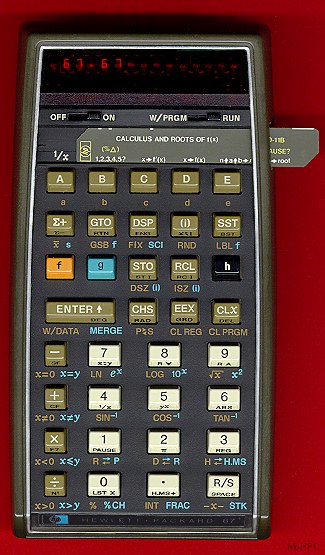
Early programmable calculators were surprisingly powerful for their day and you could learn all the basics of computing from them. (Plus on ones like the HP-67 and HP-25 you could write a program that flashed "ShELL.OiL" "SELLS" "BOILED.OIL" when you held the calculator upside down) -
Reverse Polish Notation - HP-11c
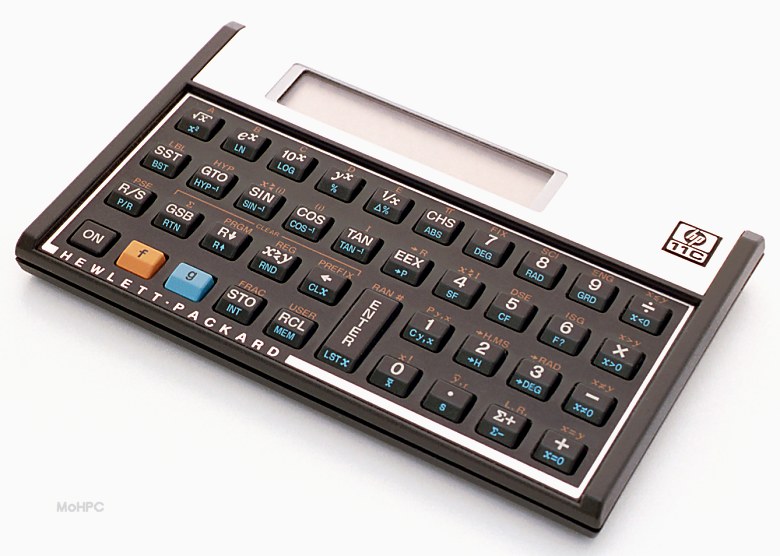
Bring back the HP-11c (1981-1989)! [this link is a good picture of it]
Add more features and memory (but don't overdo it) and keep it in the US$100 range. DON'T change the appearance, key layout/feel or display.
I know lots of mechanical, civil and electrical engineers that loved this little mid-range beauty and are frustrated that they cannot buy a new one (I'm on my second now, they are very sturdy). -
Re:wait
At the expense of shops who were using no computer at all. Or abacuses.
I would laugh if the situation weren't so serious for my company. We are on the verge of a disaster.
Chisembop manual sales have been flat for 5 years.
Adding machine sales are down 38%.
Calculator sales are down 52%, including the newest hand held models.
Slide rule sales are down 79%.
Analytical engine sales are down 93%.
Tabulator sales are down 98%.
Our abacus miniaturization project is running into problems with prior art by a "major" competitor.
To top it off, our hope for a Multitronic breakthrough appears to have dangerous side effects after four models that were outright failures.
Unless we can pump up our mentat outsourcing service, or complete development of our Make me a Rainman! kit, we're doomed! Doomed I tell you!
-
Hurray!The wicked old witch at last is dead! Hail to Dorothy! Carly brought nothing but trouble to the good name HP. HP used to mean top quality laboratory instruments and computers.
I first learned to program on HP-45 and HP-67 calculators which my father brought home from the university Mathematics Department. The HP-67 featured a card reader which could store programs on small 3-inch magnetic strips. HP was a true innovator in the pocket calculator world. HP also gave us the LaserJet II, the first reliable laser printer.
I expect to see new innovations from this company as employee morale improves.
-
FOCALI can remember going to a university interview for a place on a computing degree, circa 1975. A group of us were sitting around waiting for our turn, and were told that if we wanted to play on a computer, there was a PDP-8 running FOCAL[1] in the corner of the room. I was the only one that had ever used a computer before[2] or who showed any interest in playing with it, and by the time my turn came for the face-to-face with the lecturers, I had written a trivial prime number printer.
Googling for "FOCAL" turned up this interesting page on the taxonomy of computer languages
[1]
http://www.faqs.org/faqs/dec-faq/pdp8/section-11.h tml
http://hopl.murdoch.edu.au/showlanguage.prx?exp=40 6&language=FOCAL[2] my school had use of a HP 9830 for half a term a year, and I was the one usually found in front of it after school.
-
Re:Horrible, just horrible
I mean, damn near every other keypad in existance begins with 1 at the top left and works its way down to 9 at the bottom right (think telephone, ATM, eftpos terminal, security keypad).
-
Re:Not only is it faster
As always, Hewlett Packard got there first and better. (Yes, HP was once a great company, before the current management took over.) The very first hand-held scientific calculator, the HP35 in 1972, calculated exp(ln(2.02))=2. reference.
-
1977: programable calculators & teletype in la
A friend in high school had an HP-45 and his dad had an HP-65 programmable calculator. This got me interested in computers. I bought an HP-25 at the end of sophomore year, learned to program (49 steps of assembly language memory!) and then moved upward.
Our high school also had a "math lab" with a paper teletype with 110 baud dial-up time-share access to the local university's computers (a Dec 10 and a CDC 6600/6400). A bunch of us proto-geeks spent before-school and after-school time mucking about on this. Using the TTY and a bit of help from another friend, I learned BASIC. When I outgrew BASIC, I latched on to APL which was a seriously cool language. Some of my friends had computers (if a 6502 with 16k of RAM, dual cassette tape drives, can be considered a computer).
I think "learning computers" means something very very different these days. In the early days, everything was programming and nobody used canned applications. If you wanted a computer to anything, you wrote the program yourself. Moreover, the operating systems of that day (especially for hobbyist systems) were extremely simple. One could understand what everything did both in software and in hardware.
These days, "learning computers" means more learning to use 3rd-party applications and learning to manage the OS. I'd wager that, -
Re:HP 65
According to http://www.hpmuseum.org/hp65.htm, the HP 65 was introduced in 1974, far too late to participate in any of the moon missions, but it did fly on Apollo-Soyuz and got some use doing course corrections there.
-
Calculator
-
do something useful
The best way to honor the memory of "NASA's golden age" would be to top it.
NASA does excellent unmanned science, but the moon shot, cool as it was, wasn't good science or space policy.
Good thing private efforts are starting to pick up the slack.
I must add that the most awe-inspiring thing to me is that all the construction, design and launch was done on slide rules. -
Re:Not a doubt it should be banned by the LPIAAWhy put the acronym followed by the full name when the standard is the other way around?
Because a 100+ years ago we did not have post-fix notation, the HP-35 calculator, or Yoda.
-
Re:This is not a computer....
The early HP calculators used programs that were stored in ROMs to implement the functions of the calculator. A brief overview of their architecture can be found here. The fact that the software was stored in ROMs shouldn't disqualify them from being considered computers.
-
square roots mechanically
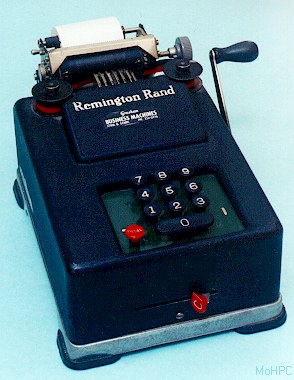
My dad was selling those newfangled electronic Friden calculators back in the mid sixties when I was a little kid. Once in a while, he'd bring home one of the old mechanical machines that had been traded in, like this one. I'd love to have one of those babies now.
-
Re:From the Jargon File
Not really. BASIC was popular at the time, and if not for them, someone else would have done it. (And some might say that someone else did in 1972.)
-
Re:Developers ?
I am new to PalmOS development (possibly just in time for the finale?). I went to the Palm Developer Conference in February, and here is my perspective on some of your questions.
(1) If you're referring to Usenet mailing lists: I perused the comp.sys.* newgroups that pertained to Palm development a while back (I don't recall the specific newsgroups). I concur, they have become stale. I think this is one of the weaknesses of Usenet as opposed to the way Slashdot keeps things interesting. In Usenet, you troll through so many newbie questions and bitter, irrelevant flamewars and just give up. At least I did.
(2) I think there are some weaknesses in the way Palm 3rd party software is marketed. It seems as though everything is marketed almost like shareware instead of the way it is sold in the PC world. Given the very low prices, that probably makes sense. But I suspect things would be better if there were some consolidation: some big boys should probably just buy out some of the crapware vendors to clear the decks and increase the signal to noise ratio. Just my perception, but I think there are a lot of basically sameware that makes the market worse.
I think that Cobalt may result in some interesting new categories of software coming out. Path graphics, multitasking, better security, schema databases, and better multimedia support are coming. Some basic info is here.
(3) PalmSource reorganized the developer documentation recently. Try it again and see if you think it's better. Here it is.
(4) I get the impression that a lot of developers still like PRC-tools. But there is a new Eclipse-based developer suite now. I haven't used it, because I think it is Windows only (ah, the lack of Mac support... sigh). Here is the link.
(5) I don't know. I was able to get a ROM by registering on the PalmSource site, and after clicking on a few legal agreements (eternal soul, first-born child, etc). Then again, ROMs are under the control of the PalmOS "licensees" (device makers). So it might be more difficult if you want a ROM for some specific device. I don't know.
As a new developer, I saw some reasons to be optimistic but also I have a lot of doubts.
Optimism:
1. The Palm Developer Conference was apparently well attended, according to people who had attended previous ones.
2. There are lots of interesting devices out there. Sony, Tapwave, Garmin and PalmOne have built some slick devices that I think are very impressive. While Slashdotters find it easy to yawn at gadgets, when I compare my HP-11C calculator (ca. 1981) with my Sony Clie TJ37, I'm not sure which is more impressive: the longevity of the HP, or the amazing level of technology integration in the Clie. Take your pick... I may still be using the HP in 20 years, but the Clie will be long gone. (These two devices are about the same size and weight by the way).
3. The new OS. I don't know if it will put them at parity with MS, or ahead, but right now they are behind, so this is absolutely necessary.
Pessimism:
1. I heard some of the same arguments from PalmSource execs that I used to hear from Apple in the mid 1990s: we're better than MS. I trust that these execs understand that they are whistling past the graveyard.
2. Hand-waving about sales stats. PalmSource execs said that handheld sales figures don't tell the whole story -- that they omit smartphones, which are splitting the market. OK, maybe. I haven't seen the sales figures for smart phones.
3. I think the biggest question is the value equation. One post referred to the paucity of storage on PDAs as a problem. I have to agree, though there i -
Re:Funny, was talking about this yesterdayThat is exactly right. In high school (~1991 for me) the teacher told everyone to go out and buy a TI (85?) graphing calculator. I told my dad, an engineer, and he kinda laughed it off and handed me this bad boy. He showed me how you could blow through an algebra equation with the thing and I was hooked.
Oh, sure, the other kids laughed at it, but who was done every quiz first while they struggled with parentheses?
In college I regressed to a $20 Casio since Drexel was so fixated on Maple and Matlab, but I bought a 48GX senior year and found myself wishing I had it throughout school. There's one guy at work that pretends to hate it ("Stupid RPN!"), but whenever I need to use it I have to get it back from him first!
-
Re:Stylish...
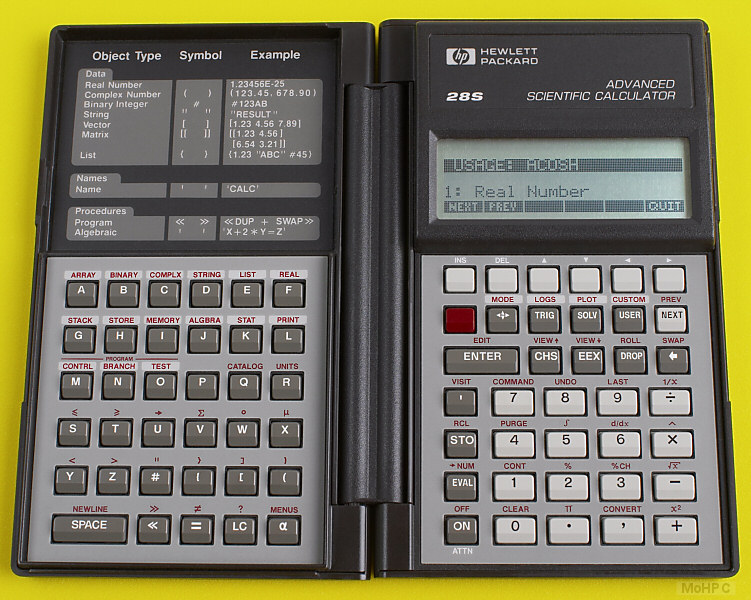
In Soviet Russia, the HP 28S pwns me.
-
Re:Complaints.
4-bit bus
Actually, the Saturn processor is a lot more complicated than that. Just about everything in it is a different size:
- 4-bit addressable word size
- variable instruction sizes (very cisc)
- 20-bit address
- four 64-bit registers that can be addressed in a number of ways (example: you can manipulate just the exponent portion of the register, not the mantissa)
- Physically, the HP48 interfaced to 8-bit-wide memory, but this is invisible to the programmer
I'd be tempted to call it a 64-bit processor because that's the register size, but that is a generalization. It is fundamently a low-power design specifically for BCD math. -
HP-41C Synthetic Programming
Back in college, I used to love synthetic programming in an HP-41C. When it was first discovered, one had to use various evil processes (yanking a memory modules, corrupting a magnetic card). The result was programming instructions that HP never intended. With synthetic programming, one could access hidden memory locations, display strange characters, and emit unusual sounds (just be careful with "STO c"). I spent way to much time exploring all of the tricks and documenting what did what.
My favorite little synthetic program made the machine tick ominously like a Geiger counter.
Thanks for bringing back fond memories from 20 years ago. -
Symantec Sym-1, Sharp PC-1500, and on and onOne of my first computers was the Symantec Sym-1. This was a wonderful single board computer with a 6502 CPU and 1K of sram. The hex rom had a routine which let you hook it up to an oscilloscope (set to x-y mode) to output letters and numbers. I used this for class projects in my digital electronics class. I implemented algorithmic state machines, and little controllers using the breadboard attached to the board.
I also had an SDK-85, the Intel single board computer which showcased the 8085 chip. This was about like the Sym-1, but less neat-o hobby-oriented stuff in the rom. It actually had a proper area to which I could attach a breadboard, so projects on this looked a little less kludgy. Since I never really took a shine to the Intel chips, this collected more dust than the Sym.
Then, there were my portables: First an HP-41c, then a Sharp PC-1500 (also known as the TRS-80 PC2). The Sharp was a hand held, calculator sized (like a 10 inch long chunk of 2x4), basic programmable calculator. Its basic was almost entirely comaptible with the MS GWBasic which was shipping with PC-DOS at that time (1982 or so), so I could develope programs on it, then retype them on the PC. The little CMOS CPU on the Sharp ran at a slower clock speed than did the IBM PC's CPU, but the programs were still nearly as fast. I had the plotter/cassette interface, which let me print out circuit diagrams and so on in class, for tests. Since there weren't enough PCs in the classroom for everyone to use at once on tests, I got a big advantage out of this.
Of course, before I owned any of these, there was the Honeywell mainframe (lousy link, that'll give you an idea of how obscure Honeybucket computers were and are) I used at UAF.
Then, there were some that I worked on, but never owned:
The Otrona Attache. These were wonderful little CPM machines, with a Z80 CPU and a TI screen controller chip which I was never able to find a source for (Not sure about the TI part, but definitely sure about the hard-to-get part.). I never owned one, unfortunately, because none of the people who owned them would ever part with them, including the owner of the one with the chip I couldn't replace.
Then there were the various models of Altos and Vector Graphics machines. Both of these were multi-user, multi-CPU CPM machines.
-
Best calculator I ever had ran on Palm Pilot
It ran on my US Robotics' Pilot 5000. It was RPN, offered drag-and-drop on the stack, and you could download function libraries to suit your taste -- and there were many. Very neat. I did not miss my HP.
My last calculator (the one I went through engineering school with) was an HP 27S . Now that is rare (try to find one on ebay)! It was *algebraic*, and neither scientific nor financial, but both. The most remarkable thing for me, though, was that it did not do complex number operations ! Even cheaper/simpler TIs at the time did that. That was one serious handicap in Electrical Engineering. A couple of guys had 48Gs, which not only did complex, they did matrix. How unfair.
My grandmother, which knew not much about calculators, except that HP was a good brand, bought the 27-S for me as a gift. So it had emotional value. I probably would have chosen another. Today it is at my parent's, where my father uses it occasionaly.
Speaking of that, my father was also an engineer, graduated in the sixties. His fond memories are not of HP calculators, but of slide rules. Does he get to get one with IrDA, USB and SD memory too ? -
HP: Where's the updated 16c?
Screw all those nice graphics and algebraic equation solvers, what I want is an HP 16c". They're on e-bay for $140 or so, which is a little expenseive for a at least 14 year old calculator. HP, bring back an improved 16c!
-
original hp-35 calculator
Read about it here It had trig and RPN and cost $399 in the 1970s.
-
HP Calculator Museum
You may want to visit The Museum of HP Calculators!
-
Re:Real Soon NowUIL calculator? Do they still do that? Always struck me as an incredibly silly contest, though that didn't stop me from taking a few tests (and doing.)
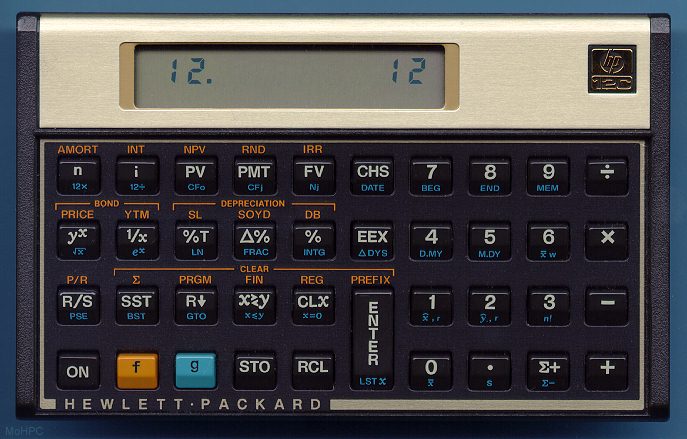
Back when I was in high school ('87), the HP 12C reigned supreme. RPN and fast.
The HP 48S and 48G's are much slower than the 12C was for simple arithmetic, which is mostly what those tests were. The slowness for simple arithmetic is probably due to the bit mapped display. Still, they're faster than you can mash the keys
But once you start using the calculator's symbolic and graphing functions, you'll realize just how slow they really are.
Still, they're awesome calculators, and I love mine. (I've also got a HP 28C, the predecesor to the HP 48 line. God, I love these calculators!)
If somebody needs one, check the local Goodwills, Usenet, newspaper classifieds and if you're desperate, Ebay. (Ebay will cost a good deal more, but will get you one quickly.)
-
Re:Real Soon NowUIL calculator? Do they still do that? Always struck me as an incredibly silly contest, though that didn't stop me from taking a few tests (and doing.)
Back when I was in high school ('87), the HP 12C reigned supreme. RPN and fast.
The HP 48S and 48G's are much slower than the 12C was for simple arithmetic, which is mostly what those tests were. The slowness for simple arithmetic is probably due to the bit mapped display. Still, they're faster than you can mash the keys
But once you start using the calculator's symbolic and graphing functions, you'll realize just how slow they really are.
Still, they're awesome calculators, and I love mine. (I've also got a HP 28C, the predecesor to the HP 48 line. God, I love these calculators!)
If somebody needs one, check the local Goodwills, Usenet, newspaper classifieds and if you're desperate, Ebay. (Ebay will cost a good deal more, but will get you one quickly.)
-
HP-75C
The HP-75C, introduced 1982, had a LCD, an alarm clock for appointments, you could create text databases, and activate password protection. And you could attach a second display and almost everything else via HP-IL. It's successor, the HP-71 (1984), had the size of a Palm.
-
HP-75C
The HP-75C, introduced 1982, had a LCD, an alarm clock for appointments, you could create text databases, and activate password protection. And you could attach a second display and almost everything else via HP-IL. It's successor, the HP-71 (1984), had the size of a Palm.
-
Re:Reliability?
I have never had a problem with an HP calculator, in spite of heaps of abuse.
My dad, who by coincidence is also an electrical engineer, owns an HP-21 that is roughly as old as I am. Just for laughs, I dig that thing out of his closet every once in a while and fool around with it; it still works fine. -
Re:Is there a market still?
Nothing beats a good HP calculator. PDA's are for management weenies. Purposely designed calc's are for engineers.
-
Re:Time to upgrade?
28S ??? You should get yourself the 67CX
-
Re:Does this mean I have to replace my 48GX?
That is still the ultimate "nerd" calculator.
Maybe for you youngins, but for my generation the ultimate nerd calculator is the HP-28S.And yes, if a calculator doesn't have RPN and a stack, I just don't like using it.
-
Re:Why a PDA won't replace the calc...
Interestingly the HP Calculator Museum has some information and software from an unreleased HP Calc which runs on pocketPC. An HP Calc on your PPC?
-
Re: in Sowjet Russia
-
Re:Cheating in Exams?I don't know. I never had trouble getting my HP28s into exams.
Of course, it's IR port was output only, and strictly for printing.
-
Time to upgrade?When I was younger, the rule I followed was to always upgrade to the next generation of calculator after I'd understood all of the functions of the previous one.
Is it time to go to this one yet?
No... I'm still doing fine with my old 28S
-
Re:Sounds like a profit model to me...
It was 1975. The HP25. There are images and links to a simulator if you feel nostalgic. The lunar landing game is there too. (Correction to my post: it has 49 lines for programs, 8 registers for variables.)