Slashdot Mirror
Domain: ibiblio.org
Stories and comments across the archive that link to ibiblio.org.
Comments · 1,708
-
Re:Well...
GRASS GIS: http://grass.ibiblio.org
-
Re:You've got to be kidding me...
That is the i18n of the GRASS GIS software.
http://grass.ibiblio.org/devel/i18n.php -
Re:It's a difficult thing for a geek to accept, buEducation is one of the places where computers don't really belong.
Some times yes, some times no.
At the FE college I work at computers are a very useful tool. I've been teaching a module on statistics and computers have been a very useful tool. Perhaps the two leasons the students really undersood the best were workshop sesions where we did some stats using excel. Typeing =stdev(A1:A10) helped them understand the meaning of standard deviation much better than an hour long session on the subject with board work and exercises.
Maybe it depends on the learners perfered way of working. Some students can handle abstractions like integration well (indeed its one of the marks of a good mathematician). However for many students filling the board with symbols will do nothing but confuse. For these students seeing direct feedback from their work will provide motivation and aid understanding.
Another important question is what are the aims of the teaching process. Are these just narrow aims like the Reading, Writing and Arithmatic mentioned in the article or preparing students for the world. Education today is far more than just this very narrow set of criteria.
Of course computers should not be a replacement for teachers. They are just another tool in a teachers toolkit to be used when appropriate. Its still early days as the education sector learns how best to use them. Electronic whiteboards are appearing everywhere, but I've rarely seem them used well, (the most fun I've had with a white board was displaying 3D models mathematical surfaces which allowed you to rotate them which your hand. True tactile computing).
I'd love to see a move towards better computer resources for teaching. So much is posible but so littles been done. Perhaps open-source/open content ideas could work in education with some schemes to combine teachers talents and really aid teaching.
-
An Excellent Text
How to think like a computer scientist
Dive into Python
And have you considered illegitimately downloading texts off of filesharing networks? I don't anyone will really care... -
Re:Only partially correct
And for those of us who find mice inconvenient and prefer to use the terminal? What about our 'ease of use'?
I don't give a flying fuck about whether "Aunt Tillie" can use Linux or not. This focus some people have on Linux (or any other OS, frankly) becoming dominant is quixotic and pointless -- Linux cannot really compete with Windows without sacrificing what makes it worthwhile. -
Re:Next up for the XBOX2
Knight Commander...
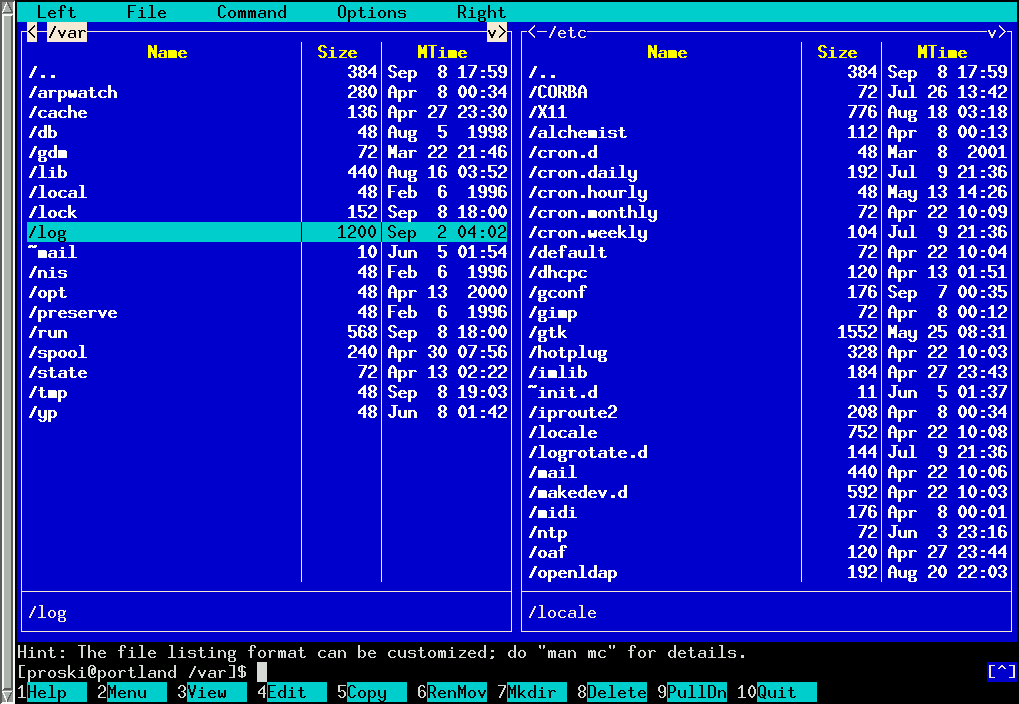
Shouldn't that be Midnight Commander? Oh, I guess that would be the title that Linus would get. -
Good Old Rusty
This book appeart to be for people who already know XML, but need to work on their technique. (I refuse to use that vague term "advanced users".) If you're an XML newbie, you probably need to buy The XML Bible from the same author, Yeah, the title is dumb (computer book publishers have a thing for dumb titles) and the CD is screwed up. But I know of no other book that will allow your typical HTML hacker to make the transition to XML so easily.
-
The Ghost of Usenet Postings Past
-
Re:The new Hypertext
When George Bush's great-grandfather first invented hypertext, it didn't catch on either.
-
Re:I wonder if they will help Gutenburg?
Ibiblio is already doing a pretty good job with that. Considering that they're on The University of North Carolina's network, which is about as close a hop as you can be to the backbone, bandwidth is pretty solid. Last I checked, ibiblio has 5+ terabytes of disk space and a super kick-ass LVS cluster that should be able to handle just about anything you throw at it.
I think gutenberg's gonna be just fine. -
Re:I wonder if they will help Gutenburg?
Ibiblio is already doing a pretty good job with that. Considering that they're on The University of North Carolina's network, which is about as close a hop as you can be to the backbone, bandwidth is pretty solid. Last I checked, ibiblio has 5+ terabytes of disk space and a super kick-ass LVS cluster that should be able to handle just about anything you throw at it.
I think gutenberg's gonna be just fine. -
Re:I wonder if they will help Gutenburg?
Ibiblio is already doing a pretty good job with that. Considering that they're on The University of North Carolina's network, which is about as close a hop as you can be to the backbone, bandwidth is pretty solid. Last I checked, ibiblio has 5+ terabytes of disk space and a super kick-ass LVS cluster that should be able to handle just about anything you throw at it.
I think gutenberg's gonna be just fine. -
Re:I wonder if they will help Gutenburg?
Ibiblio is already doing a pretty good job with that. Considering that they're on The University of North Carolina's network, which is about as close a hop as you can be to the backbone, bandwidth is pretty solid. Last I checked, ibiblio has 5+ terabytes of disk space and a super kick-ass LVS cluster that should be able to handle just about anything you throw at it.
I think gutenberg's gonna be just fine. -
Re:fix the file selection
Yep, no one uses split pane file managers.
-
Get it here
-
Computer-generated Chopin
Douglas Hofstadter describes how a computer program by David Cope generates fake "Chopin" and "Bach" good enough to fool music students.
-
Photo of the cover!
-
Re:OT, but you DID mention college radio
-
Re:Dumbest. Editor. Evar.
Is there really any reason they couldn't have flayed a corpse, though?
It's quite easy for a skilled forensic pathologist to distinguish bruises and weals caused by flogging a dead corpse - and flogging a living, bleeding human being. No forensic expert so far questioned anything about the realism of wounds, weals, bruises, haemorrages, joints dislocations etc. on this body.
And also, artists have been doing amazing things for a long time, some people can just visualize things a certain way that most of us cannot. The greates painter of that era was Giotto di Bondone. Just check how he pictured human body. Painters of late Middle Ages/early Renaissance had a very naive understanding of human body proportions or perspective. -
Andreessens Resume
Andreessen Biography : http://www.ibiblio.org/pioneers/andreesen.html
His career:
Beginnings at the University of Illinois
.
.
Netscape
.
.
What happened to Netscape? -
P2P = Internet
P2P is nothing new, it's just a buzzword. The Internet itself is fundamentally one big peer-to-peer network, so they should start by indicting these folks who are, after all, responsible for the greatest copyright violation vehicle in history.
-
Re:what's your point?
Make that 6.4 Billion. But I guess it's like the deficit; what's a billion and a half in the scheme of things.
-
More
This is really encouraging to see the the public service broadcasters 'getting' open source and trying to contribute to the community. If this could take off it could be a great boost to the entire copyleft/open-source ideas.
However I would warn that in the UK the content industry is sharpening its knives over The BBC Creative Archive. I attended a conference given at Westminster Media Forum where the representatives of the content industry where rabid about copyright and patent law and extremely hysterical about 'idea theft' as it was colourfully termed. When they heard about the Creative Archive plan... Phew! Some scary people were there... And they are not impressed with Creative Commons - who were shouted at, verbally attacked and generally given a very very frosty reception...
Strangest contribution (and it was a difficult choice considering the crazy assertions and unsubstantiated nonsense spoken) has to be the Arlene McCarthy MEP linking copyright, patent and 'idea' theft with 'Organised Crime', 'Paedophilia', 'Pornography', 'Terrorism' and 'Paramilitary Organisations'... She was truly loopy, and more worryingly serious!
John Naughton was fantastic castigating the dangers from 'slavish legislaters' (she didn't like that!) and gave a really excellent and balanced presentation calling for caution against listening to only the interests of the media corporations and content industry.
Most scary person (again a difficult choice) was Lavinia Carey, Director of FACT who told us that '65% of people didn't think it was a problem to share stuff' and that 'consumers have to be protected from themselves' and those who didn't were 'gonna get a shock'. To get a feeling for the balanced tone see the campaign to link copyright 'theft' and terrorism... Scary!
-
Re:Karma
I too am that position, and I just started to read A Buddhist Bible and Buddhism, a Way of Life and Thought which I found via the Zen FAQ. So here's some more possible reading material.
-
webdav/https
I've used apache with webdav over https on several occasions for remote file sharing. Works great on 2000 & XP through webfolders without additional software. Users can just browse using windows explorer as if working with local files. OSX needs a special app (goliath). tuning apache to user webdav with XP is the hardest part (but there's an manual here and here.
-
Re:PythonDoes anyone have ideas on how Ruby would fare vs. Python as a first language?
Either language would be a fine choice for a first language.
I think Python has a few small advantages. First, there are many tutorials for Python that are aimed at new programmers. Examples include:
- How to Think Like a Computer Scientist
- Python 101
- Learning to Program
- Non-Programmers Tutorial For Python
- The Python tutorial that ships with Python itself (not really for absolute beginners, but this is where I learned Python)
- Plus many others, and I haven't even mentioned printed books.
The other advantange Python has over Ruby is the interactive Python interpreter. I can't explain how fantastic this is. With many other interpreted languages (Ruby, Perl), you really should write your program in a text editor and then run it through the interpreter. This is because the commands you type don't execute until you stop entering your program. The interpreter is not interactive. So every time you want to try something, you have make the change in your text editor and then run it through the interpreter.
Python's interpreter is much nicer to work with. You type in commands, and each command executes immediately. This is very useful when you want to experiment with the language, and is ideal for beginners. I don't know why Ruby's creator didn't include this feature.
Anyway, you'll be happy no matter which language you choose. They are both very nice. You might also consider learning PHP as a first languages. It's nice to be able to view the results of your work in a web browser, and PHP is probably the quickest way to do that. Another good choice for first language is Scheme. Check out the free online book Structure and Interpretation of Computer Programs (SICP). If you like video, there are also some video lectures available.
-
Re:Emulators?
An emulator already exists. It has been released as free software under the GPL. It supports Linux and Windows.
-
Re:What about elvis.
Right, didn't lookup crippleware, but anyways...
I based the 50 years on nothing more solid than a quick google and the Berne Copyright Treaty
I've now found this. -
Public schematics for the C64.
I love this story, but I have to wonder something here... Didn't the C64 come with schematics? I don't remember for sure, but I know that computers of that era commonly came with them or had them available. If that is the case, did she really reverse engineer it or was it most of a... "hmm.. I have schematics, I can understand them, how about I just translate them to an FPGA and see if I can make it go?"
Even if that was the case, she still deserves props for thinking of doing it in the first place and then making it happen. I don't mean to make light of her accomplishments or anything.
Consults Google... Yep, there were schematics available. here is one place to see them. -
Fractals easy...
You can do l-system fractals with pen and paper.
You can also do q-tree and r-trees and show how they can be used for fractal compression, and you don't even need a calculator. -
Re:Unless youre making a tight embedded system....
LFS uses modules, I believe. When you 'make menuconfig' on your kernel source, you have a choice of either 'n', 'y'' or 'm' for each desired feature of driver. If you say 'y', the feature gets compiled into the kernel, 'm' means you want that feature to be a module.
If all your features and drivers get configured with 'y', then you no longer need the mod utilities or a
There used to be a Kernel Howto at Linux Documentation Project, but it is missing now for some sort of updating. -
Re:And there's no real science going on...
Mir...
We've got all the long-term data we need on the effects of weightlessness. It's bad and we should avoid it. -
Re:Great...Actually, if you do Hebrew, I think that you'd almost get Yiddish as a freebie.
Well, sort of. You can write Yiddish given Hebrew the same way that you can write French given English. There are minor differences that might not hinder understanding, but they change style.
There are some two-letter ligatures that are treated in Yiddish as single characters, see for example this virtual Yiddish Keyboard. Note the line above the "feh" glyph, and the patach-yod-yod, which are distinctly Yiddish.
For info on rendering Yiddish on computers, see Understanding Yiddish Information Processing.
Re: the idea that Yiddish is comparable to Klingon in terms of its obscurity, before the nazis murdered most of the Yiddish speakers and caused the survivors to want to forget their Yiddish roots, Yiddish was culturally vibrant, with great creativity in literature, theater, music, newspapers, movies, etc. Most of this vitality disppeared in the latter half of the 20th century, but there is a small strong willed group of people working to keep Yiddish secular culture alive, and another group of religious Yiddish speakers who keep Yiddish alive as the spoken language of their Jewish heritage. No offense to the fans of Klingon (nuqneH!), but the situations of Yiddish and Klingon aren't that similar.
btw, I do have a Yiddish-Esperanto dictionary at home, there's a combination that inspired someone enough to product a fully fledged hardcover bound dictionary.
-
Re:I found an old dropcloth in my shed
Or they could use Pollock's titles, as most of them have the dates in them
For example, Number 8, 1949
-
Re:Stuff on the groundSure you do. Yesterday I saw this Apache on my my to work.
-
Re:does it still suck to install and configure?
without a doubt, solaris has been the biggest pain to set up out of ANY unix i've installed
I agree. I spent a week fighting with Solaris 10 preview for all the wrong reasons. It was basically an experiment to see how much GNU software I could pack into it. To my horror, once I finally got the thing installed I learned that it doesn't even come with a compiler. Sure you can add GCC to it, but there must be some art to making GNU's tools work properly with Sun's libc that is beyond me. The biggest problem I had was libtool seems to be completely broken with respect to shared libraries on Solaris.
The good news is there are lots of repositories for Solaris binaries:
Sun Freeware (Sun sponsored - mostly GNU in Solaris package manager form, can be installed with pkgadd)
OpenPKG RPM OpenPKG Solaris 10 RPM's (Lots missing from here and needs to be compiled via the SRPMS)
OpenPKG SRPMSAlmost everything I use, I found here and compiled without problems
IbiblioThere's a bunch of binary packages here for x86 and SPARC Solaris, I didn't use any of them
Anyone else looking to venture down this road, you should be warned that Solaris is really no fun to try to use as a desktop. Out of the box, Gnome is at version 2.2 or something, and has many many bugs (like Nautilus crashes when you try to drag desktop icons for example).
Summary: Solaris is not ready for the desktop.
-
Teaching to Code
Teaching simple coding skills, using a simple scripted language like Python or Lisp, is way better in an Open Source environment. Not only most Open Unixes like Linux and BSD already come with most common compilers and interpreters, but it also encourages the time honored tradition of opening stuff up and looking at it's innards, then learning about how it works (Looking at the source code for common software, or even looking at ELisp code). A few comments about the subject are at http://www.ibiblio.org/obp/thinkCSpy/preface.htm ---
-
Re:For Real This Time?If you want to learn Linux and know (enough) about computers. (That is partitioning, a bit of Unix commands, how to use a command line), I would recommend not to use a "mainstream" distribution. Not Mandrake, Not SuSE, not Red Hat.
Personally, I started off on a Slackware derivate, that didn't come with a compiler and was a quite useful desktop (at least for the P120/32Meg RAM it ran). During installation I had to make the filesystem myself (mkext2), mount disks. XFree was also a joy (because it was on a laptop...) to get to work right. All in all, it took a lot of time to get it to run... The distribution was Peanut Linux , but that was back in the 8.1 days. A great many things may have changed. Perhaps you can scavenge a older PC somewhere to try it out, instead of trashing your config.
Still, I would recommend it simply because if you want to *learn* Linux, you better jump in head first. This also helped me a lot when I later learned a BSD. (OpenBSD to be specific)If you want to *use* Linux, then go mainstream distribution. However, don't expect to stay on it. You'll be back to Windows before you know it. No killer app, you see...
-
Re:Report them to Microsoft
So, do we cheer while Microsoft does that, or should be like this guy?
-
Re:Dressed like what?Unfortunately, when there are both movies and computer games about something, bad things happen. People dress up as characters and eventually you wind up with very bad things happening...
Like this.
-
Other Ogg Vorbis streams
Cool, now it's up there with the classical station WCPE!
Does anyone know of any other Ogg Vorbis streams? The only other one I know is a police scanner.
-
This is to counter the FreeBSD booth chicks
With the FreeBSD folks having the demon babes, with the flag, NetBSD can go now to something in the bare breasts line of this Painting
-
At least it wasn't this guy
Just thank god that it wasn't this guy again
http://www.ibiblio.org/jmaynard/TRONcostume/ -
here ya go, lazy man
Nothing like doing a little cursory research at the more prominent documentation sites for topics on this matter.
In summary:
How stable is the current RAID 5 support in Linux? Quite. It's really the only way to go, and performs about as well as hardware raid.
How hard is it to rebuild an array? It's not. At all.
How well does the hot spare work? Seamlessly. Be sure to use LVM, as it makes things all the more seamless.
Will it rebuild using the spare automatically if it detects a drive has failed? Yes. -
Re:Exceptional programming
I actually was wondering if this was a troll while I was reading it... parts of it read like text generated by a Markov chains... syntactically correct but semantically nonsense. There used to be (still are?) crapflooders on IMDb whose reviews were very similar in comprehensibility to this.
But then I realised it's Baldrson, and the penny dropped. Most trolls are indistinguishable from idiots, but Baldrson is a genius who's indistinguishable from a troll. I think he comes from a parallel universe where his beard is considered normal.
Someone needs to get Baldrson and ESR alone in a room together. I'm intrigued to know whether they'd fight or make out. But what if the combined comedy facial hair reached critical mass? Is it worth the risk? -
Vint Cerf says he did.
I can't find the email message now because I'm supposed to be working, but Vint Cerf told me that, before Al Gore, the ARPANET was a private utility. Al Gore decided it should be a public service, and provided considerable support from the U.S. Congress to turn the ARPANET into the Internet.
Many people did the work. Many people should have some of the credit. But, according to Vint Cerf, Al Gore was the first public official to decide that there should be a public utility called the Internet.
It shocks me how little people know about the activities of their government. It shocks me that, after all this time, people are still believing the disinformation written by Republican marketing writers.
Don't believe the sound bites, read books. No one who read the more than 35 books about the Bush administration would vote for George W. Bush, that is clear.
Even those who read magazines would know more than most U.S. citizens. For example:
100 Facts and 1 Opinion -- The Non-Arguable Case Against the Bush Administration. -
On the other hand
-
Re:Ya, I got oneYou can't dump it on the people who would want it, because you are presumably in the USA, and shipping it to a 3rd world country would cost way more than $20.
basiclinux should work nicely on the box though
I wonder if it is fast enough to act as a NAT? For speeds of up to 1Mbps - probably. No moving parts for the cpu means it should last forever too. Give it a new life as a customisable nat?
-
Re:Do Real Programmers write in Ruby? Or in PythonIf you aren't Ed Nather, you ought to Cite your sources. Like 500 Mile Email, it's a good story, but not YOUR good story.
-
Bulging Spandesticles.
And we all remember how bulging spandesticles look, right? Right?
--grendel drago