Slashdot Mirror
Domain: independent.org
Stories and comments across the archive that link to independent.org.
Comments · 75
-
Re:California is failing
CA is dead last (50th out of 50) in economic freedom.
"Not only does California rank 49th out of all 50 U.S. states"
-
California is failing
California is currently failing in many respects.
The national economy is up around 3%, and California revenues are also up about 2.9 %.
That's about a 1:1 ratio, but CA grew at twice the rate of the economy in 2016. Their growth is significantly slowed since about two years ago. Also, that 2.9% increase in revenues is offset by about 2% increase in expenses, so it's not going to reduce their deficit a lot.
The CA population has lost about 930,000 people(*) according to census data (linked in the article), mostly middle class. The middle-class in CA have moved away to Arizona, Washington, and Texas leaving the poor and ultra-rich behind. Not completely, of course, but losing that much middle class has gotta put stress on the CA economy.
Their labor force shrank from 62.1% to 59.1% in that same time - a huge decrease to happen in just over a year.
CA is dead last (50th out of 50) in economic freedom.
Some analysts are suggesting that CA is already in a recession.
So... yeah. It's entirely reasonable to predict that California is facing very bad times in the near future.
And by extension, the California management.
(*) Don't bitch about linking to Breitbart. The link to the census bureau report is right there in the linked article.
-
Re: Liability
Or a libertarian think tank:
-
Re:This is quite possibly the photo of the year
Guevara murdered or oversaw the executions in summary trials of scores of peopleâ"proven enemies, suspected enemies, and those who happened to be in the wrong place at the wrong time.
In January 1957, as his diary from the Sierra Maestra indicates, Guevara shot Eutimio Guerra because he suspected him of passing on information: âoeI ended the problem with a
the great jazz musician Paquito Dâ(TM)Rivera castigated Santana for his costume at the Oscars, and added: âoeOne of those Cubans [at La Cabaña] was my cousin Bebo, who was imprisoned there precisely for being a Christian. He recounts to me with infinite bitterness how he could hear from his cell in the early hours of dawn the executions, without trial or process of law, of the many who died shouting, âLong live Christ the King!â(TM)â
-
Re:The language in the old west
I'm not fantasizing.
Yes you are. There is plenty of evidence that the American frontier was no where near as violent as portrayed in Hollywood, and was probably less violent than modern American cities. Most people led boring lives on remote homesteads where the most exciting activity was gathering enough cow chips to cook the evening meal.
-
Re:No taxation without representation?
you can't require an out of state business be a collection agency.
- unfortunately that is not true, the government illegally forced businesses to be collection agencies around 1942-43 by introducing withholding tax as a special war time measure that never went away.
-
Re:The real issue
That does raise a question... "Do countries with available and affordable prostitution have lower incidents of rape?".
Research suggests it would lower some incidences of rape http://www.independent.org/publications/working_papers/article.asp?id=1300 , but I don't see any other information about it.
So in theory, your statement would be correct.
-
Re:Enemy #1
This has been bugging me all day. It really pisses me off when people try to tell me what I mean. I know what I mean. I say what I mean.
Well, then, we have common ground, as it pisses me off when assholes try to tell me what and how I think, because of where I'm from. So, you know, dose of your own medicine and all...
The fact that "patriotic Americans" don't like it is their problem.
I never said it wasn't my problem, get over yourself - I merely pointed out that blaming the people who live here is wrong; you should, as we Americans do, be directing your rage at the more-appointed-than-many-realize government that feels they have the right to do things their citizens don't agree with. FYI, so you know, the American Congress, who is chiefly responsible for a lot of the policies that are obviously pissing you off, has an approval rating of less than 20%.
You are the very DEFINITION of a fascist country which engenders and encourages blind, national fervour and faith in the waving flag of the nation above all else.
You... watch entirely too much television. Take it from someone who actually lives in the nation you're making assumptions about - the propaganda you see in media is far from the norm here. Most of the population are regular folks, just like you, trying to scrape by day to day without getting on the wrong side of assholes who would do us harm. Working full time jobs (sometimes multiple ones) and contributing to society doesn't leave a lot of time for flag waving.
But apparently there aren't enough of them VOTING.
-
Re:No
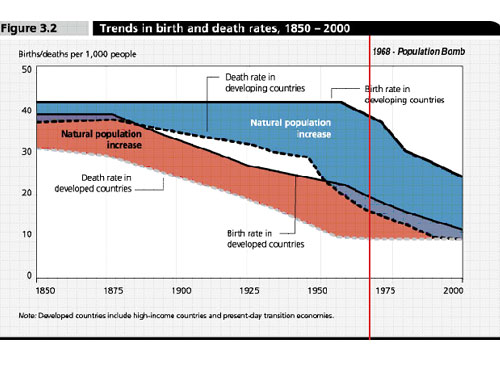
Over population is definitely something that we need to be concerned with. But in practice that problem tends to take care of itself when the population gets adequate, food, education and support in old age. Few people genuinely want to have more than 3 kids, the number is small enough that if a few people choose to have more it's probably not even worth worrying about.
This. I would like to add some data here to back this up. Word birth rates are falling in developed an developing countries. It's not "Children of Men" by any means, but I feel it makes concerns about over-population moot. http://www.independent.org/images/events/crichton/image016.jpg Notice the vertical line drawn at the release of The Population Bomb, an archetypal book about overpopulation.
Offtopic (or maybe it's not; I heard the word "sustainability" in the article's title, and that's a word on the EPA's bingo sheet), but I just had a thought. If we accept as given that man-made C02 will lead to runaway heating scenarios in the future, then why does it seem that our *only idea* to fight this is to scrap the massive capital cots of our carbon economy with something "green" (that, and less noticeable measures, like banning CFCs). If our 20-odd years of climate research study doesn't have enough of a complete view of the Earth's climate to be able to come up with some less painful, less expensive, and more elegant way of avoid possible climate change disaster cases than gutting our way of industrial life, I have trouble believing they really understand the climate to any useful degree. I thought scientists were supposed to be about individual pursuits, ingenuity and and building on/discrediting your colleagues, especially when one's colleagues (not necessary climate scientists) spend a disturbing about of time polling each other to find how many "believers" and "deniers" there are. -
Re:attorneys
Bringing in business interests, US or other, is exactly what Iraq needs. This will do more good than any other thing we could possibly come up with now. I know that people like to bash the "evil capitalist", but it's the entrepreneurs that make the world a better place for all.
Of course. Let's ask a few workers worldwide that have been aided by such charitable entrepreneurs:
http://www.commondreams.org/headlines01/1020-01.htm
In 1995 Nike said it thought it had tied up with responsible factories in Sialkot, in Pakistan, that would manufacture well-made footballs and provide good conditions for workers. Instead, the work was sub-contracted round local villages, and children were drawn into the production process.
http://www.independent.org/publications/working_papers/article.asp?id=1369
Hourly wage in US$
Bangladesh $0.13
China 0.44
Costa Rica 2.38
Dominican Republic 1.62
El Salvador 1.38
Haiti 0.49
Honduras 1.31
Indonesia 0.34
Nicaragua 0.76
Vietnam 0.26But then again, TVs, iPads and whatnot will probably become even cheaper, so that's sort of "making a better place for all", isn't it?
-
Re:I've 75% sure that 50% chance is voodoo science
That alone would solve our pollution problem,
What population problem?
(See attached graph) -
Re:global warming as a tool
Parent makes a good point. Since a centralized system of carbon-credit rationing and trading is so so SO ripe for abuse, we should consider that to be one of the last-ditch, desperate options to tackling anthropogenic climate change.
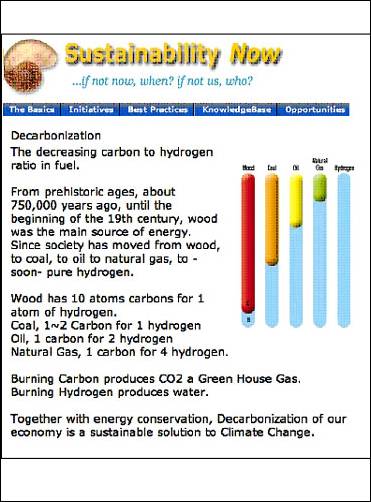
Personally, I think that man's CO2 emissions are causing (overstated) damage to the environment, and that something needs to be done. What is my favored strategy for fixing it, you ask? Doing nothing. Letting it fix itself. And before you label me a "denier" and accuse me of watching Faux News, I feel I should mention that Sustainability Now is on my side. Check out the linked image and you'll see that humanity has been steadily de-carbonizing its energy sources since the 1850s when we moved from wood to coal. And then we moved from coal to oil, and now we're moving from oil to natural gas. Pretty soon we'll mostly be using electricity from nuclear/wind/solar/geothermal/tidal/(your-favorite-renewable-here) either directly or to make hydrogen from water. It's my hunch that "anthropogenic global warming" will be laughed at down the road as a manufactured crisis similar to Malthus' population explosion or the FDA's fraudulent second-hand smoke studies (inquire for details).
I think that letting a cadre of state-sponsored experts tell everyone how to use fossil fuels sets a bad precedent. Since it's an action provoked by extreme anxiety, there will be confirmation bias taking place. I am an anxious person by nature, and I have plenty of experience with confirmation bias. It's the mindset that if you are trying to prevent a bad outcome and do SOMETHING to address it and there is no resulting calamity, that that something you did is definitely what saved you. I know there are some good reasons to be afraid of CO2 emissions and to favor gov't intervention, but consider the possibility (however small you think it is) that global warming does not need any action on our part and will go away by itself. If we surrender to a cap-and-trade system that we don't need, we'll all be celebrating how those economic/environmental wizards saved us, and we'll be more receptive to further control, because hey they were right the first time, eh? -
Re:Two Wrongs. . .
I don't expect perfection. I do, however, expect things to get better - but they don't.
Actually they did get better.
"Perhaps most impressive is Somalia's change in life expectancy. During the last five years of government rule, life expectancy fell by two years but since state collapse, it actually has increased by five years. Only three African countries, Guinea, Gambia, and Rwanda, can claim a bigger improvement. Telecommunications is another major area of success. With a variety of companies operating without burdensome government regulation, Somalia ranks high among African countries in the number of phone lines, mobile phone usage, and access to the Internet. According to The Economist, a mobile phone call in Somalia is 'generally cheaper and clearer than a call from anywhere else in Africa.'"
Source: http://www.independent.org/newsroom/article.asp?id=1880
Of course, your argument is still bullshit. Somalia cannot be used as an example of how anarchism would succeed in an otherwise prosperous geographical region. If the U.S. government were slowly dismantled peacefully with the majority of citizens supporting it, there would be quite a different story. Of course, don't let reality cloud your judgment. Think with your gut, always. -
Re:Exploitation for the win!
You are recommending Somalia-style warlord fueled violence and chaos?
If the only two choices are their previous State structure and their 'anarchy' structure, the evidence is strongly in favor of the latter. See here:
http://www.independent.org/publications/working_papers/article.asp?id=1861
-
Re:Alternate solutionWhat no one seems to have mentioned is that there is a symbiotic political relationship between farm/rural representatives and urban representatives in Congress. Urban, mostly liberal, reps want food subsidy programs for the poor. They need rural votes to get those subsidies. The price is expensive crop subsidy programs demanded by rural, mostly conservative, reps. Thus without farm subsidies, we would not have food stamp programs.
Nutrition Programs. The largest subsidy in the farm bill is the outlay for subsidized nutrition programs, including food stamps, and school lunches and breakfasts. Subsidized food programs--with an outlay of some $60 billion in 2008--account for about three-fifths of total USDA spending.
The original purpose of these programs, when begun in the 1930s, was to facilitate the operation of price-support programs for farm commodities. The U.S. government had acquired large stocks of butter, cheese, and other products in operating price supports for farm products, and these products initially were used in food distribution programs to low-income consumers. The subsidized food programs provided a politically acceptable way to dispose of costly surpluses.
It should not be surprising that the major constituency for subsidized food programs is no longer commercial agriculture. Instead, it is urban interests benefiting from and advocating "poverty programs." In congressional negotiations on the 2008 farm bill, legislators from farm districts were able to maintain conventional farm-commodity programs and related subsidies in the face of record-high farm product prices by forming an alliance with legislators from urban districts who sought and obtained increased food subsidies.Source. The article has a good breakdown of what kinds of ag subsidies the US has today (e.g. water and other inputs, ethanol, export, etc.).
-
Re:The problem is not an efficient algorithm
Why not go to the fountain of sputum itself?
Here's a link to a place you can buy some hard copy if you want it.
And here's another source for you: Carl Menger and the Origins of Austrian Economics, by Max Alter. Westview Press, Boulder, CO, 1990. Pp. viii, 256. $74.00. ISBN 0-8133-0945-X. -
Re:Too late FBI
Your example would never happen.
Apparently you have never heard of the RICO Act, a law passed to fight organized crime.
http://www.independent.org/publications/tir/article.asp?a=215
RICO has metastasized from its original intent, which was to deal more effectively with the perceived problem of organized crime. Federal prosecutors have discovered that RICO is a powerful weapon that can be wielded against most business owners, should the feds choose to target them. Rudy Guiliani's prosecution of Michael Milken and other Wall Street luminaries in the 1980s--the springboard from which Guiliani rose to become first the mayor of New York City and ultimately a popular public speaker collecting $75,000 per speech--involved some of the early attempts to expand criminal RICO provisions to prosecute private business figures who clearly were not mafiosi. Today, federal prosecutors use RICO routinely to win easy convictions and prison terms for individuals who in the course of business run afoul of federal regulations. For every John Gotti who is brought down by RICO, many obscure business owners and managers are also successfully prosecuted under this law.
In tracing the development of RICO, we find that the law was little more than a "bait-and-switch" statute that has had little or no effect in stopping or inhibiting the crimes--murder, rape, robbery, and so forth--that most concerned the public in 1970. Instead, RICO has enabled federal prosecutors in effect to circumvent the constitutional separation of powers between the national and the state governments. Since RICO's passage, the once-clear jurisdictional boundaries between state and federal law enforcement have been erased as more and more individuals find themselves in the federal dock with almost no chance of acquittal.
The idea for the acronym RICO came from the character Rico played by Edward G. Robinson in the 1930s gangster movie Little Caesar. Nixon signed the bill into law on October 15, 1970, declaring that the new law would "launch a total war against organized crime, and we will end this war" (qtd. in "Nixon" 1970). Indeed, the new law empowered federal law enforcement authorities to engage in activities that seemingly deprived defendants of due process of law as guaranteed by the Constitution. Writes Daniel Fischel:
To achieve its objective of preventing the infiltration of legitimate businesses by organized crime, RICO gave the government sweeping new powers, including the power to freeze a defendant's assets at the time of indictment and confiscate them after conviction. Traditionally, criminal defendants are presumed to be innocent and face punishment only after conviction. RICO, by allowing the government to seize entire businesses connected even indirectly with a defendant at the time of indictment, before any proof of guilt, is a major exception to this general principle. The government is authorized, in effect, to act as prosecutor, judge, and jury in the same case. The government under RICO is also able to make it more difficult for the accused to wage a defense by, for example, seizing the funds that a defendant would have used to hire an attorney. And if a defendant is convicted, RICO provides for onerous criminal penalties. (1995, 122-23)
In answer to your statement that it "could never happen" you should know that RICO is used at least 10,000 times a year in the US, mostly against ordinary citizens like you and me. Most raids are made on the basis of information from jail house snitches who are trying to make a "deal".
Like the infamous "PATRIOT ACT", the RICO ACT is an abomination to the Constitution. With its expansive vagueness prosecutors can use it to criminalize any activity for any reason or no reason and be fairly sure of a conviction. As Justice Robert Jackson [warned], few things are as dangerous as a prosecutor who finds a target, the
-
Re:Subject
Even more basic than ROE...
Where the hell are they going to get all this money from for all these programs?It is printed out of thin air [1] That is why the USD has a beautiful long term slide [2]
Why does this happen? (A) Because It is a tax you cannot see or calculate into your yearly salary - purchasing power is lost without your noticing - so you do not complain. and (B) The money flows right off the printing press into the pockets of whatever industry the Government happens to favor at the time, which is usually the Military Industrial Complex but sometimes large scale social programs. The first one get the money hot off the printing press get the most value out of it.If your really interested see the links in [3] for some more...
[1] http://www.econlib.org/library/Enc/MoneySupply.html
[2] Decline in the U.S. dollar's purchasing power (1800-2005) Source: Barron's
http://seekingalpha.com/wp-content/seekingalpha/images/cash.gif[3] Economist Rober Higss (of the ratchet effect theory):
http://en.wikipedia.org/wiki/Robert_Higgs
Banking Act of 1935 + Fedâ(TM)s Exercise of This Authority = New Deal Policy
http://www.independent.org/blog/?p=633
http://www.independent.org/blog/?p=201 -
Re:Subject
Even more basic than ROE...
Where the hell are they going to get all this money from for all these programs?It is printed out of thin air [1] That is why the USD has a beautiful long term slide [2]
Why does this happen? (A) Because It is a tax you cannot see or calculate into your yearly salary - purchasing power is lost without your noticing - so you do not complain. and (B) The money flows right off the printing press into the pockets of whatever industry the Government happens to favor at the time, which is usually the Military Industrial Complex but sometimes large scale social programs. The first one get the money hot off the printing press get the most value out of it.If your really interested see the links in [3] for some more...
[1] http://www.econlib.org/library/Enc/MoneySupply.html
[2] Decline in the U.S. dollar's purchasing power (1800-2005) Source: Barron's
http://seekingalpha.com/wp-content/seekingalpha/images/cash.gif[3] Economist Rober Higss (of the ratchet effect theory):
http://en.wikipedia.org/wiki/Robert_Higgs
Banking Act of 1935 + Fedâ(TM)s Exercise of This Authority = New Deal Policy
http://www.independent.org/blog/?p=633
http://www.independent.org/blog/?p=201 -
Re:Time
That was the reason for all the various alphabet soup agencies -- to do something about the surplus labor.
Of course the NRA did not suck up surplus labor, it cartelized industry and labor to try to artificially raise wages and prices (which pretty much failed, and was also found unconstitutional). Perhaps investors were scared of the regime uncertainty of the rapidly expanding role of government in the market, reducing their confidence in the durability of private property rights.
-
Re:As if the New Deal was successful, it wasn't
WW2 was the New Deal on steroids. The Government quite literally quadrupled spending and took full control of the economy, even to the point of regulating wages and dictating output.
WW2 "fixed" the unemployment problem by putting millions of American men to work at gunpoint (the draft).
WW2 also enhanced the US export market by destroying the main competition, Western Europe (of course, pre-war trade was destroyed by the Depression-era global trade war).
WW2 ended "regime uncertainty" in the United States with the death of FDR and the realization that Communism was the enemy, and not a good potential idea for the US. Pre-war polls of businesspeople revealed that they were very worried of a fascist/communist regime coming to power in the US, which probably reduced US private investment.
Private spending did not return to pre-1929 levels until several years after WW2 was over, mind you.
FDR did one thing right - ending the contractionary "speculation busting" Fed monetary policy of 1929-1933 (through the gold clause ban and dollar devalution). Much of the rest of his efforts were anti-growth, as revealed by the recession of 1937-1938 after the initial recovery began slowly in 1933.
-
Re:*sigh*
Yes, we are.
We are all minutemen. We are all charged with preventing tyrants and dictators from creating run away government. We are also given this right for self defense. The right for each of us to bear arms to protect and enforce the will and rule of "We, The People" is outlined in the second amendment. To have to defend your freedom, even on our own soil, against our own government, may be an unthinkable think for you to consider. Or you may not care. This matters not.
The people who created our Awesome country had the foresight to make this law.. a law so important, that it is the 2ND AMENDMENT. The 2nd law our forefathers put down on paper in laying out our rights when they created America.Wikiopedia
http://en.wikipedia.org/wiki/Second_Amendment_to_the_United_States_Constitution"The Second Amendment (Amendment II) to the United States Constitution is the part of the United States Bill of Rights that protects the pre-existing individual right to possess and carry weapons (i.e., "keep and bear arms") in case of confrontation.[1] Codification of the right to keep and bear arms into the Bill of Rights was influenced by a fear that the federal government would disarm the people in order to impose rule through a standing army or select militia,[2] since history had shown taking away the people's arms and making it an offense for people to keep them was the way tyrants eliminated resistance to suppression of political opponents. [3] In District of Columbia v. Heller (June 26, 2008), the Supreme Court ruled that self-defense is a central component of the right.[4]
Before the Heller decision, there was much disagreement as to whether it protected a collective right or an individual right, because the amendment begins with a prefatory clause that refers to a "well regulated militia."[5][6] Previously, the Supreme Court had not directly addressed the amendment, or had only done so in limited or ambiguous terms.[7]
A minority have argued that because the District of Columbia, which is not a state, was the only government involved in Heller, uncertainty remains concerning whether the Second Amendment applies to state and local jurisdictions by way of incorporation through the Fourteenth Amendment. However, the Court's unambiguous declaration that the right to bear arms is an individual privilege, taken with the Fourteenth Amendment's clear stricture that, "[n]o State shall make or enforce any law which shall abridge the privileges or immunities of citizens of the United States," appears to conclusively support incorporation.[8][9]"
ALSO;
Studies have shown that communities, and Nations, with the highest degree of gun ownership are also the lowest in crime. Criminals can be stupid, but not many are stupid enough to break into any home or business where the folks inside are very likely to be packing heat.http://www.independent.org/issues/article.asp?id=482
"Rising Gun Ownership Has Helped Cut Murder Rates for Americans Over 25, New Study Says
Guns' Deterrence Effect on Crime Usually Ignored by Other ReportsOAKLAND, Calif. - Although the murder rate for adults under 25 years old has doubled in the past two decades (largely due to the drug war), for most of the population it has fallen significantly - nearly 19 percent for those 25 years old and older. Yet in America's highly politicized gun-control debates, this and other crime trends are often ignored or misrepresented, leading many to underestimate gun ownership's significant role in deterring crime, according to a new report published by the Independent Institute.
The 30-page study, Firearms and Crime, by Daniel D. Polsby (Professor of Law at Northwestern University and Research Fellow at the Independent Institute), takes aim at several recent reports claiming that gun ownership increases the gun-related crime rate and that g
-
Re:Ok..how about taxes?
I've never known a libertarian or real conservative republican that didn't think corporate bailouts were good.
Where are you living? What you describe sounds more like a neocon to me. I don't know *any* libertarian or "real conservative" republicans that thought the corporate bailouts were anything but institutionalized doom. And I know a lot of them. Many that are working to get Eric Cantor booted from the House for supporting the bailout (and being a traitor), in spite of the fact that doing so would likely give his Democratic opponent the seat instead.
Here are a few examples:
- Virginia Liberty Defense railing against the bailout
- How about the Independent Institute?
- Or the Cato Institute
- Or the Campaign for Liberty
Maybe you think the reporters on Fox news are "real conservatives"?
-
Re:What a joke
You may want to read this report.
I don't think there was any "one cause" of the housing bubble, but certainly the way the CRA (combined with the Home Mortgage Disclosure Act, the Equal Credit Opportunity Act, and the Fair Housing Act) were modified and interpreted over time may have encouraged additional "creative underwriting". Here is an excerpt from Closing the Gap: A Guide to Equal Opportunity Lending from the Boston Fed:
"Credit scores. While credit scores can be an analytical tool with conforming loans, their effectiveness is limited with CRA loans. Unfortunately, CRA loans do not fit neatly into the standard credit score framework . . . Do we automatically exclude or severely discount . .
I think CRA/HMDA/ECOA/FHA were a minor part of the bubble compared with the GSEs (and Congress pushing them into sub-prime), the mortgage interest deduction, the capital gains reduction on home sales, and good old bubble mentality in the private sector, but it all added up.
-
Re:Credit crunch my butt
Something I've never understood is how the government got the money to pay for the war machines, bombs, and bullets. I mean, you hear all the time how that got us out of the depression, but it just doesn't add up.
The Implications of WWII Spending for Local Economic Activity, 1939-1958
"Studies of the development of local economies often point to large-scale World War II military spending as a source of long-term economic growth, even though the spending declined sharply after the demobilization. We examine the longer term impact of the temporary war spending on county economies using a variety of measures of socioeconomic activity: including per capita retail sales, the extent of manufacturing, population growth, the share of women in the work force, housing values and ownership, and per capita savings over the period 1940-1950. We find that in the longer term counties receiving more war spending per capita during the war experienced extensive growth due to increases in population but not intensive growth, as the war spending had very small impacts on per capita measures of economic activity."
So if it wasn't that, what caused the "Great Escape" from the Great Depression?
"In 1945 the death of Roosevelt
and the succession of Harry S Truman and his administration completed the
shift from a political regime investors perceived as full of uncertainty to one in
which they felt much more confident about the security of their private prop-
erty rights. Sufficiently sanguine for the first time since 1929, and finally
freed from government restraints on private investment for civilian purposes,
investors set in motion the postwar investment boom that powered the
economy's return to sustained prosperity notwithstanding the drastic reduc-
tion of federal government spending from its extraordinarily elevated war-
time levels." -
Re:We Can Only Hope the Same Happens to Obama
Too bad that idea ends up taking the economy completely out.
I don't believe you.
I'm a subscriber to the DownsizeDC.org mailing list. Here's a link to the dispatch that they sent me today. A large chunk of the text follows. I am not an economist, but the data looks pretty straightforward to me. It's not going to be a good year no matter how you slice it, but none of the actions taken will do anything except further distort the markets and exacerbate the problem. The US government is broke, and if they continue to print money for stuff like this, they will eventually break the dollar and then we may indeed be eating dog food (or just dogs) in the streets.
There's a lot of evidence that we've been scammed. Treasury Secretary Paulson and Federal Reserve Chairman Bernanke told us they needed to spend $700 billion of your money to buy supposedly toxic assets that were crippling major firms and for which there was no immediate market. This was a lie even when they said it, because . . .
Merrill Lynch was able to sell it's most troubled assets back in July.
If Merrill could do it, other firms could do it too. They might not have liked the price they got, but it could have been done. The Big Bailout was purposely designed to give favored firms a better deal than they could have gotten in the market.
We've also been told, constantly, that credit markets are frozen. We're still being told that today, constantly, around the clock, on the cable business channels. It wasn't true before, and it isn't true now. We could point you to many places for the evidence, but here's one great graph from the blog Carpe Diem to give you the evidence in one pretty picture.
The hysteria mongers would tell you that even if consumer credit is okay (and you would have to hammer them with the evidence to get them to admit it), commercial credit is still in big trouble. But that isn't true either. Here's a good summary from the great scholar Robert Higgs, at the Independent Institute . .
"Looking at the data for the first four business days of the past week, I find that firms sold from $179 billion to $205 billion of commercial paper per day; the number of separate issuances per day ranged from 6,761 to 7,298. Both the total amount borrowed and the number of issuances per day increased steadily throughout the week (data for Friday have not yet been reported)."
Higgs goes on to compare the current numbers with past periods and finds NO CREDIT FREEZE!
But what about the stock market? Doesn't its fall tell us there's a crisis? Perhaps, until you consider what's causing stocks to fall.
The really big drops began when Paulson and Bernanke began peddling their fear to Congress. And since then, nearly every time some government official has opened his or her mouth, with some new claim or some new plan, the stock market has taken another nose dive. A good chunk of the decline appears to be driven by fear mongering.
-
Re:Openoffice? no thanks.
You may be referring to the 'Qwerty was designed to slow typists down' story which is a popular myth which seems to persist despite reason. The mythology alleges that the qwerty keyboard layout prevented typewriter jams because it slowed typists down. In reality, it avoided placing letters which are commonly used consecutively too close together on the keyboard, which if anything speeds typing up because commonly used letters are placed near the stronger fingers. The myth also alleges that scientific studies have proven Dvorak's speed or efficiency is better than Qwerty. This is mostly hype; conclusions are varied and there has been no clear sign of a significant benefit in efficiency in real world tests.
I think the bottom line is that Dvorak Simplified is a good keyboard layout but the extent of its benefit over Qwerty, or Qwerty's deficiencies, have been greatly exaggerated.
Here is the notable article from The Economist on the story, published in 1999. Make of it what you will: http://www.independent.org/newsroom/article.asp?id=356
-
Re:Keyhole career.
the dimmer / less educated members of society (those currently saying things like "Why are we paying billions to bankers when small businesses don't get bailed out?)
My education taught me about the ad hominem attack in grade school, and hopefully exempted me from this one somewhere between the Bachelor's and the Ph.D. Or does the Ph.D. need to be in economics to count? I can find a few of them who agree with me too.
So rather than slandering the question, would you care to propose your idea of the "brighter / more educated" answer? Make sure it covers the followup question, "Instead of rewarding failed decision makers, why don't we let them go bankrupt so that their more responsible competitors can take over?"
-
Re:Disagree with a lib and you are evil
Show me one example where a bank was forced to loan out money to someone and where they instead couldn't have said "... I am not lending any more money with these kind of unprofitable regulations."
Here you go: Anatomy of a Train Wreck: Causes of the Mortgage Meltdown, by Stan J. Liebowitz.
The thing is, it wasn't unprofitable so long as house prices continued to increase. As the article points out, no one is going to default on their mortgage when they can sell or refinance instead, and that's generally an easy option when the home's price has increased significantly since it was purchased. The widespread foreclosures began less than one quarter -- effectively immediately -- after prices stopped rising.
Add to said short-term incentive a reasonable confidence that the powerful entity that push for lower lending standards wouldn't allow major creditors to go under for following its recommendations and the path to our current situation isn't so difficult to understand.
-
Re:when you fill your SUV
Argue for energy independence. I'm on board.
You might find this interesting. -
Economics is more important than Technology
I think the best TED talks have been Steven Levitt talking about crack dealer business, and Paul Collier on the Bottom Billion.
All the technology in the world isn't going to fix developing countries where the laws, regulations, and corruption will keep the economies from growing to the point where the technology can be used efficiently. Once those barriers are gone, it isn't like people are stupid, they'll immediately use the appropriate needed technologies.
I suggest:
Michael Walker talking about his work on the Economic Freedom of the World index, and how economic freedom correlates with GDP, life expectancy, and other variables.
Karol Boudreaux from GMU's Mercatus Center talking about African governments bear much responsibility for driving formal-sector entrepreneurs out of the housing market and for driving their citizens into slums.
Robert Anderson on his book Just Get Out of the Way: How Government Can Help Business in Poor Countries.
Tyler Cowen form GMU on almost anything in economics: the future of culture in a globalized world, How to Use Incentives to Fall in Love, Survive Your Next Meeting, and Motivate Your Dentist, and much more.
Don Boudreaux from GMU about the issues he has interviewed people for on Econtalk: car salesmen, signaling through educational diplomas, whether the gold standard is a good idea, challenges in health care, and much more.
Arnold Kling on Crisis of Abundance: Rethinking How We Pay for Health Care
Or a Nicholas Stern versus William Nordhaus debate on global warming costs versus benefits and their viewpoints on appropriate discount rates for the calculation?
-
Re:Never any real change in a two party system
You think that the a Democratic president would have invaded Iraq?
Something like that is conceivable.
Imprisoned and tortured innocent people?
Pushed for telecom immunity in the first place?
Who do you think is pushing for it now?
Undermined the military?
There's a reason why even Bush used to be against nation-building before he was for it.
Don't get me wrong, it's obvious that on average the Democrats are doing a lot better than the Republicans lately. But you can't just say "a [party I like] President" wouldn't have done such bad things; that kind of tribalism valuing affiliation over actions is at the root of how the Republican Party self-destructed, and the Democrats aren't immune from the same human impulses.
To get down to specific examples, I think it's pretty clear by now that Gore wouldn't have made most of the mistakes Bush did, but I don't think it's clear that the privacy issues we're discussing right now aren't an exception.
-
Re:Hillary, anyone?I agree. Cut spending!!!
Too bad your republican buds don't agree with you. The least amount of total spending growth was Clinton in his first term, so a democrat wins! You should vote Hillary if you really think you believe what you just said. But my guess is that you are just completely full of shit and vote republican because of your staunch, murderous, religious convictions.
But always remember what God said before you vote for another murderous leader: "Thou shalt not kill." That's in the 10 commandments and its also in the bible. By God's own law, your murderous president is going to hell because he has ordered many people dead. Religious wacko conservatives like yourself should read the 10 commandments some time--they don't include "except" clauses as you will see if you read them carefully.
-
Re:What do you know
I wasn't talking about Chirac, but about the UN. A quick google for UN pedophile and rapist yields plenty of urls including this one:
http://www.independent.org/newsroom/article.asp?id =1471 -
Re:Government?
Yes, and if you notice their condition has improved quite a bit since the UN stopped trying to force a government on them after the civil war.
http://www.independent.org/newsroom/article.asp?id =1880
"...Telecommunications is another major area of success. With a variety of companies operating without burdensome government regulation, Somalia ranks high among African countries in the number of phone lines, mobile phone usage, and access to the Internet. According to The Economist, a mobile phone call in Somalia is "generally cheaper and clearer than a call from anywhere else in Africa."
And there ya go.. After what government did to them the people there don't want any such thing anymore.
--
However that is their land... and we need to fix the land of the free.. Change wont happen over night but we can start by reducing the government we have to its original form.. Then the people of the states themselves can decided if they need such a union anymore.. or indeed any government at all.
Yeah, I believe all people of the earth should throw down their governments, but what about small government? Hea, I'll take a small victory any day. -
Re:Thoughtcrime
Now correct me if I'm wrong but nobody screams "censorship" when an incompetent doctor is kicked out of the AMA.
Doctors RARELY have their licenses revoked these days, but that's beside the point.
Doctors are "kicked out" for felonies and acts of malice, such as intentional mal-practice. They're never kicked out for what they believe, even if it's more obviously false than global warming denial.
Doctors can believe ALL KINDS of crazy crap from homeopathy to astral projection. That's why if you ever see a doctor on TV ranting about a product, feel free to call them full of it. They're just people with fancy degrees.
I'm pre-med myself, but I have no illusions about the profession.
Besides, there's plenty of evidence to show global warming isn't doing what was advertised. Doctors claiming magnet therapy works have much less of a leg to stand on. -
Re:The Price of Industry & Economics
There are many studies, although most lump all the companies together under the title of "multinational corporations". For instance, this one:
http://www.independent.org/publications/working_pa pers/article.asp?id=1369
You may be right about the US corporations being the worst of the bunch, although I sincerely doubt it. Japanese sweatshops often don't treat workers well even within their own nation, AND they're some of the most xenophobic people in the world, so I find it difficult to believe they'd be acting like angels of mercy in the third world.
However, I don't have any specific figures that break down the corporations by nationality, so I can't say with certainty. My only defence is that when I said "US corporations" I was using it as a generic term to encompass all modern corporations operating in foreign nations. -
Re:QWERTY...
-
Re:Psssh.
Regarding 'equivalent' I did just what you suggest, and got this. Look at 1b. "Having similar or identical effects."
Where we have two words, their is normally such a subtle difference in their meaning. Yes, there's a lot of overlap, but it's not normally exact. Wrong, for instance, is more emphatic than incorrect, and can carry moral judgements, which incorrect does not. Anyhow...
No two acts are ever equivelant in the exact sense you are using. But all acts of murder are essentially equivelant, in the meaning I am using.
As for Roosevelt, amazingly enough, John T. Flynn basically saw through the game even at the time. See The Final Secret of Pearl Harbor, written in 1945. But it was the massive declassification of archives in the 90s that allowed Robert Stinnet, a decorated veteran of the Pacific War himself, to progress beyond the informed guess-work of Flynn and really document what happened. It's really quite shocking, and nefarious above even what Flynn could bring himself to believe. Here is a short article he wrote on it, and I highly recommend his book, which sadly is not available online, but is very worth ordering.
-
Re:Converts don't matter, logic does...
The whole long argument you put forth boils down to the idea that governments get to kill innocent people because of the clothes they wear (a uniform). I suspect it matters very little to the relatives of a dead family (say in Lebanon) whether their murderers were wearing the uniform of the military of a state (say Israel), gang colors (another sort of uniform), or a tee shirt. Further it probably matters very little to them as well if the decsion to kill was made by a small band of people or a Republic in which leaders are elected from a small pool of rich men who use extensive propaganda to get elected and then are COMPLETLY unaccountable once elected. Dead is dead to the family of the victims.
Please note also that most of the things you responded to were written by Libertarian scholar Murray Rothbard, I'd ask you to respond to him but alas he's dead, the closest you might be able to come to is to write his biographer Justin Raimondo at the Libertarian web site, antiwar.com .
Here is another thing to keep in mind, the state ALWAYS claims it's under attack and often lies about this fact for example Nazi Germany for example claimed it was under attack by Polish "terrorists." The U.S. in the Gulf of Tonken incident lied that it was under attack by the Vietnamese:
http://www.fair.org/index.php?page=2261
Further the U.S. most likely allowed the Japanese to attack us at Pearl Harbor to get us into WWII despite already having broken Japan's Naval code.
http://www.independent.org/newsroom/article.asp?id =127
Regardless of whether we should have entered WWII or not the repeated use of deceit by the government regarding WWII and Vietnam is certainly damning in trying to decipher whether the governments estimate of the terror danger ought to be trusted. Anyone who believes the state when it says it's under attack is an utter fool who is most likely buying lies from the one institution in human history that it is known for certain has killed tens of millions of people. Our government alone for example killed AT LEAST two million people based on a fraudulent casus belli in Vietnam alone:
"The lowest casualty estimates, based on North Vietnamese statements (now discounted by Vietnam), are around 1.5 million Vietnamese killed. Vietnam's Ministry of Labor, War Invalids and Social Affairs released figures on April 3, 1995, reporting that 1.1 million fighters--Viet Cong guerrillas and North Vietnamese soldiers--and nearly 2 million civilians in the north and 2 million in the south were killed between 1954 and 1975. Robert McNamara, in his regretful memoir of the war, references a figure of 3.2 million. The number of wounded fighters was put at 600,000. It remains even more unclear how many Vietnamese civilians were wounded."
http://en.wikipedia.org/wiki/Vietnam_War#Casualtie s
Considering how often governments lie I'll take my chance with chances with the rag tag band of people with boxes of box cutters and I'll take back the bill of rights, 400 billion dollars, 30,000 + dead Iraqi civilians, and 2500 hundred dead Iraqis all so we could create a civil war that far from fighting terrorism is in fact acting as training ground for car bombers and other killers of innocents.
The terrorists scare me very little, certainly less than taking a drive in my car, or eating a cheese sandwich with mayonnaise. A president who uses singing statements that blatantly disregard Congress's intentions in passing laws based on the (false) idea that we are at war, on the other hand terrifies me. -
Re:Spying on you is good m'kay
Your ignorance of history astounds me. Name ONE time pre-911 when a aircraft hijacking (where everyone cooperated) lead to the deaths of all passangers and crew. Off the top of my head I can't think of ANY even though I can tell you about a dozen hijackings which ended well. THAT is why flight crews have historicaly been instructed to cooperate with hijackers. All of that changed after 9/11. If you're too ignorant to understand that, I don't see how you can expect to understand anything that came after.
Could you make your criteria even more restrictive? Off the top of my head, I'm certain, as you are, that there was no such case where everybody cooperated, the governments yielded to all demands, and then the terrorists killed everybody. What happened to not negotiating with terrorists, eh?
There is no point in trying to answer that question, since once somebody attempts to hijack a plane, you can be damn sure the results aren't likely to be positive, whether by having passengers dying, or simply succumbing to demands, and releasing prisoners (probably fellow terrorists, which in turn, will come back and hit you later on).
Read a little bit about EgyptAir Flight 648, and since you already declared that you didn't do any research, why not check out this out. Another interesting item on that list is Malaysia Airlines Flight 653: from the description of what happened in the cockpit it seems to me that the guy calmly executed the two pilots, and then shot himself -- I guess that shows you how far "co-operation" got them.I've been determined to take on terrorism since the early 90's. After the truck-bomb attack on the WTC, a member of my unit predicted we'd be at war with militant islam by mid 2000. At the time I thought he war right out of 'er - I didn't see it going past limited actions simply because I didn't think the politicial will would ever be there. So when 9/11 happened, one of my first thoughts was "....holy fuck....he was right...".
In WW2 you would have been telling us that it's not our business to be helping out Europe, and that we'd be responsible for any of our people killed by Germany.
I didn't know that reading the minds of others was one of your skills.
If it were up to me, I would say that the US should've joined the war in 1939, instead of waiting and having to provoke the Japanese to attack Pearl Harbor first (check this and this). Problem was that the US was disconnected from the rest of the world back then, and people probably didn't care; combine that with pro-nazi sentiment in the US, with prominent figures like Henry Ford admiring Hitler for his "achivements", and you end up with inaction. You probably didn't know that the Nazi branch in the US held meetings at the Madison Square Garden in NYC.
That disconnect with the rest of the world still continues, even after 9/11. One good example of this is how people talk of a pre/post-9/11 world, as if everything revoles around what happens in the US. A more accurate depiction would be pre/post-9/11 US Foreign Policy, which used to be ignore'em, and now is bomb'em.
This disconnect manifests itself with how life keeps on going as usual here, as if there isn't active fighting in Iraq. All you see on TV is reporters asking inane questions like "do you support our troops?", and it's right back why Star Jones quit, or what's happening with Britney Spear's baby. It's pretty sad when you see Jay Leno trying to throw in some history or world affairs news into his monologue, yet the crowd doesn't get it (and then it's back to -
Re:stop propogating mythsdemon411 wrote:
"In 1874 a company called Sholes and Glidden developed the QWERTY keyboard layout for their typewriters in order to decrease the frequency of mechanical failure."
What are you talking about? According an article referenced from your first link:The first typewriter had its letters on the end of rods called "typebars." The typebars hung in a circle. The roller which held the paper sat over this circle, and when a key was pressed, a typebar would swing up to hit the paper from underneath. If two typebars were near each other in the circle, they would tend to clash into each other when typed in succession. So, Sholes figured he had to take the most common letter pairs such as "TH" and make sure their typebars hung at safe distances.
He did this using a study of letter-pair frequency prepared by educator Amos Densmore, brother of James Densmore, who was Sholes' chief financial backer. The QWERTY keyboard itself was determined by the existing mechanical linkages of the typebars inside the machine to the keys on the outside. Sholes' solution did not eliminate the problem completely, but it was greatly reduced.
The keyboard arrangement was considered important enough to be included on Sholes' patent granted in 1878 (see drawing), some years after the machine was into production. QWERTY's effect, by reducing those annoying clashes, was to speed up typing rather than slow it down.
This indicates that the QWERTY layout is a direct result of the inventor attempting to prevent mechanical jams in the device. The submitter of the article wrote:In 1874 a company called Sholes and Glidden developed the QWERTY keyboard layout for their typewriters in order to decrease the frequency of mechanical failure.
The myth to which you are alluding, however, is that Sholes developed the QWERTY layout to decrease the speed of typists (admittedly, to prevent the same jamming of typebars), when, in fact, the QWERTY layout acheived exactly the opposite effect (it allowed typists to type faster because jamming was less likely). The submitter is not claiming that Sholes was trying to slow down the typists (a myth) but that he was trying to reduce typebar jams (the truth). -
stop propogating mythsIn 1874 a company called Sholes and Glidden developed the QWERTY keyboard layout for their typewriters in order to decrease the frequency of mechanical failure.
-
Re:Try 31 times higher.
Note, the grandparent said "military budget" not "DoD budget".
For an interesting comparison between the two read this article about the budget in 2002.
Conclusion for the lazy:
Department of Defense budget 2002: 344.4 billion
Total Military Budget 2002: 596.1 billion
"Although I have arrived at my conclusions honestly and carefully, I may have left out items that should have been included--the federal budget is a gargantuan, complex, and confusing document. If I have done so, however, the left-out items are not likely to be relatively large ones. Therefore, I propose that in considering future defense budgetary costs, a well-founded rule of thumb is to take the Pentagon's (always well publicized) basic budget total and double it. You may overstate the truth, but if so, you'll not do so by much."
As allways, the devil is in the details. -
Re:Why are these people so attracted to the Nazis?
"I fail to see"
http://www.independent.org/newsroom/article.asp?id =1535
Not anyomore you won't.
Now the question is, will you admit what CHe really was, or make lame excuses for his slaughter and butchery?
And don't change the subject, address what Che is known to have done, not what the conspiracists think. -
Re:America has a choice..
Excuse me while I interpret your post as a load of BS. As another poster said, Christianity has been a strong force throughout the history of the US. Every President the US has ever had has claimed to be a Christian.[1] Yet you've conveniently ignored that fact, made an unsubstantiated opinion, then presented it as fact. Is that the scientific process?[2]
The truth of the matter is that the United States has been a Wartime economy since World War II.[3] The thing propping up such an economy? The Cold War, of course![4] The US outspent the Soviet Union at every turn, eventually causing the USSR to go bankrupt. The wartime economy then began to taper off, slowly reducing the amount of private and government funded research. By the end of the 90's, science was already in trouble, but no one noticed because of the technology boom.[5] (Itself an artificial boom caused by overspending.) The tech boom crashes, and suddenly the true state of things is revealed.
The entire Stem Cell issue, and ID issue are irrelevant to the US's technology bottom line. We simply can't afford the level of progress that was achieved in the Post WWII economy. We had one last "Hurrah" in the 80's and early 90's, then everything petered out after that. It's not sexy, it's not pretty, and there's no good place to put the blame. But that's the way it is.
[1]
[2]
[3]
[4]
[5] -
Re:Certainly not a Military Budget
2004 Defense budget was officially 401 billions.
But it does not include homeland security department, veteran benefits, iraq "struggle", etc...
Total runs up to $754 billion for 2004 fiscal year according to the following article.
That's over 2 billons / day.
Link: http://www.independent.org/newsroom/article.asp?id =1253 -
Re:Only going to work if it became standardother World's Fastest Typist uses a qwerty
(oh, and the other other uses the Qwerty Smartboard!!)
Contrary to popular belief, qwerty wasn't invented to slow typists down, but to ensure the most often used keys are evenly distributed around the keyboard, thereby avoiding jams and speeding typists up.
From http://www.independent.org/newsroom/article.asp?i
d =356 :"In 1956 a carefully designed study by the General Services Administration found that QWERTY typists were about as fast as Dvorak typists, or faster."
Dvorak himself played a large part perpetuating the myth that qwerty was designed to slow typists down, as he had a lot to gain from his Dvorak patent.
-
Re:Really?
Are you serious? QWERTY was designed for old manual typewriters to slow typist down - otherwise when they went too quickly the metal would run into each other and jam up the machine.
That's a myth.
-
Hum...
Lets see as little as 2 years ago we had the highest incarceration rate in the world, we have put to death innocent people, and if you look you can find more ugly stories about the failed war on drugs than you can shake a stick at.
And after all this I'm supposed to care about a few prisoners who make websites? Ooookkkk.
Oh, and all you right wing guys feel free to start flaming me............now.