Slashdot Mirror
Domain: indexmundi.com
Stories and comments across the archive that link to indexmundi.com.
Comments · 436
-
Re:Theft isn't good
The amount of money a government can create "out of thin air" is limited by the productivity of the country. That's why the U.S, Germany, UK, etc. have been able to go into heavy deficit spending without serious economic consequences - they're still keeping government spending to a relatively small percentage of total GDP. But once the government starts creating more money than the country's productivity, the economy responds by devaluing the currency (basically lowering the value of the currency to keep spending equal to or less than productivity). That's what's crippled Venezuela's Bolivar - the socialist government there keeps trying to hand out more value in services than their economy is producing, resulting in massive inflation.
North Korea is in a situation similar to Venezuela. They have very little domestic productivity (and the largest chunk of it is put into the military). The only realistic way they can make more money (aside from ditching their system of government, which is unlikely to happen), is to steal it. -
Re:Idle speculation
planes can fly faster and use less fuel when they can go with the air stream.
Planes seem to have to go at a given rpm to be efficient, which seems to be cruising speed (close to max) for a commercial airline flight.
I would bet airlines don't slow down the planes because it would be less efficient and jet fuel cost money.
Heck! Maybe they could even run out of fuel if they flew slower to meet the timetable like most other transportation modes do.
Here is what I found so far:
efficiency:
http://www.thermopedia.com/con...fuel reserve:
https://science.howstuffworks....fuel cost:
https://www.indexmundi.com/com... -
Re:Sounds like an excellent reason...
Cutting our military budget by 90% would put us down near Ghana and Nigeria. U.S. military spending is huge simply because the U.S. economy is huge.
Calls to slash military spending made sense in the 1950s and 1960s. But currently it's just slightly above the world average. If you account for Japan and NATO (whom we're obligated to defend by treaty), it's pretty much at the world average.
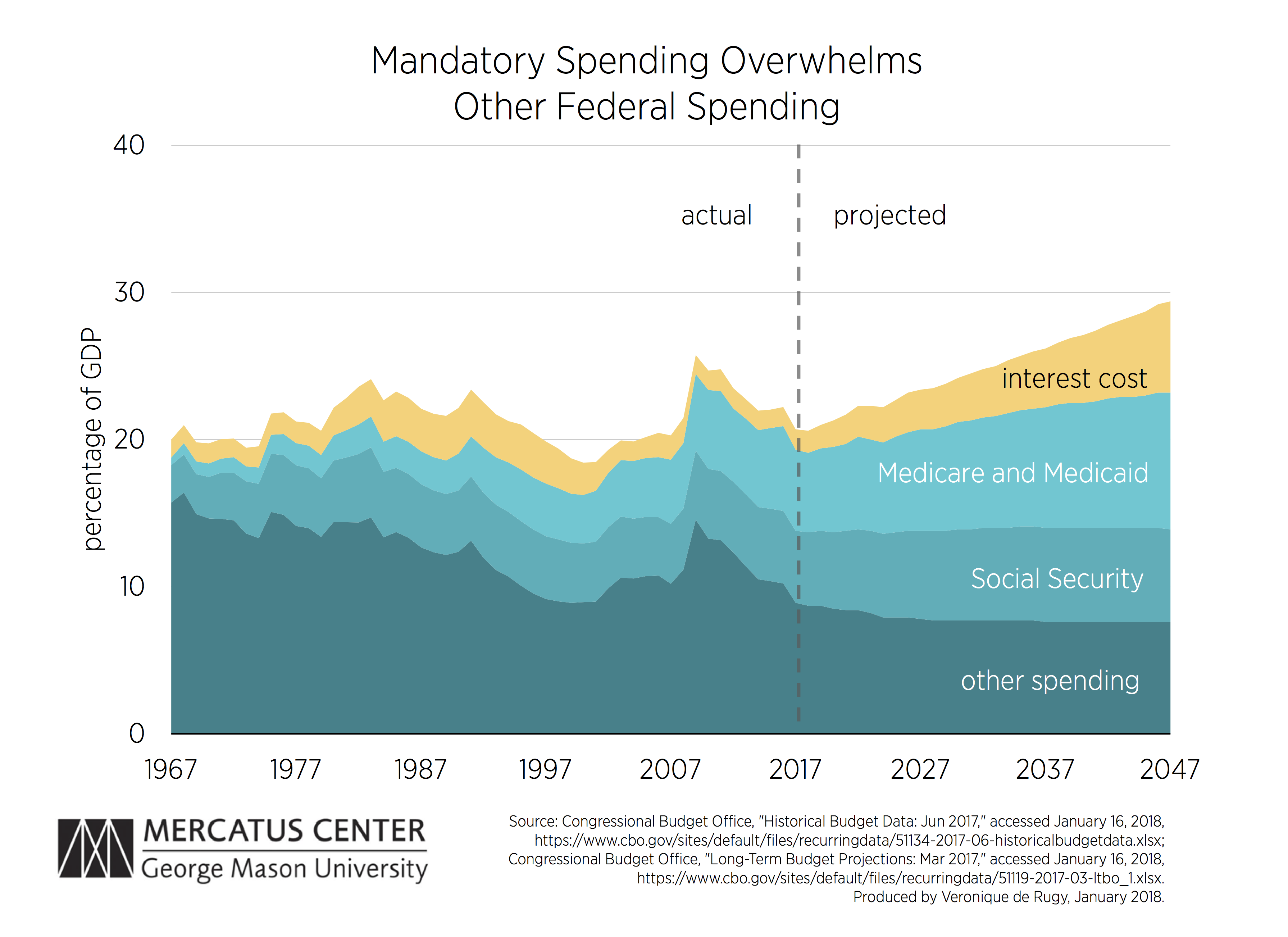
BTW, the biggest budget items are Social Security, and Medicare/Medicaid. They're the programs whose growth is bursting our budget, and what we need to get under control if you want to pay for everyone to go to college. Even if you completely eliminated 100% of military spending, entitlement growth in the next 20 years or so would eat up all that savings. Like it has already eaten up the savings from cutting the military budget from the 1950s/1960s.
I highly recommend you read the CBO long-term budget projections to understand what exactly is causing excessive growth in government spending. -
Re:Math Seems Very Odd
Yes, and 17% swings in price aren't really a big deal if you look at historic prices:
-
Re:$320 billion wasted
U.S. military spending is huge only because the U.S. economy is huge. As percent of GDP, the U.S. doesn't even make the top 25. It only spends about 3.5% of its GDP on military spending, slightly above the world average of about 2.3%. If you factor in that the U.S. is bound by the peace treaties ending WWII to provide for Japan's national defense, U.S. military spending drops to 2.8% of the combined Japan + U.S. GDP. Add in NATO (which allows European countries to underspend on their militaries - the U.S. really should've withdrawn from it at the end of the Cold War) and it's pretty much right at the world average.
Complaining that U.S. military spending is huge on the basis of its raw dollar amount is like complaining that a city of 10 million consumes 10x as much food as a city of 1 million. -
They should fix their system first
Greece is deluding itself if it thinks it can tax its way out of its economic problems.
The per capita GDP of Greece is less than every state in the US. Until you fix that you are just rearranging the deck chairs on a sinking ship. And with a population growth rate of less than 0 things will only get worse.
-
Re:The missing question:
"Unfortunately they failed to predict that population would grow as expected so the younger generation may be saddled with more cost than they could tolerate."
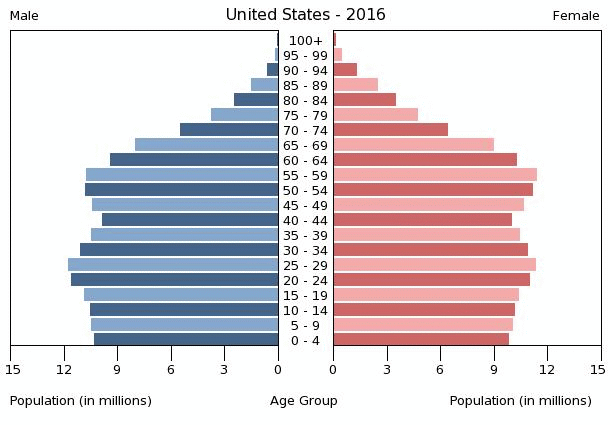
Which it's still a shit truck upon a shit load. The one on the hyperlink below is USA's population pyramid. You sum up the bars between 20 to 64 and then you sum up the bars over 64. Make all the projections you want... the end result is the same: there is NO fucking problem population-wise. Much less when you compound it with the per-capita productivity increase involved along all these years.
No man: the problem is not -and it has never been, population, so you can start looking in other places.
-
Re:$135000
Evaluating a country's military spending in absolute dollars makes as little sense as evaluating the food budget of a household while ignoring their income and how many people live there. If you want to compare expenditures properly, it has to be as a percentage of GDP.
The U.S. isn't even in the top 20 in military spending as a percent of GDP. Cutting the U.S. military budget in half would actually put us (currently 3.3%) below the world average (2.2%). And if you factor in that the U.S. is obligated by the treaties ending WWII to provide for Japan's national defense, our military spending as percent of the combined GDP drops to 2.6% - not much higher than the world average. Subtract NATO and we'd probably be right around the world average. -
Shitty measurement
India's stands at over 1.3 billion while the U.S. is around 320 million
That shows that it means nothing. It is like saying "China has more schools than Luxemburg".
What you need is at least comparing it per capita. and then we see the US in place 118 and India in place 158. -
Re:Why?
Chad's official urbanization rate is 22.5%...coincidence? http://www.indexmundi.com/chad...
The question is: What % of revenue goes to paying for tower security and paying off the local kleptocrats?
Cell towers in the country would likely be dismantled and sold for scrap, unless guarded 24x7. Payoffs to the locals are required on top of the payoffs to the national government. It can quickly become a deal breaker when all the potential customers are poor.
-
Re:I did
Because every other country has active measures in society to combat that pressure from companies. And in the others they are at least partially successful. Not entirely - much of Europe is having the exact same problem as Japan though at an earlier stage and not as severe yet. That's one reason it's ridiculous of Europe not to welcome the refugees with open arms - they desperately need an influx of able-bodied young people to keep their economies working.
Every other country... That sounds like a sweeping generalization without any knowledge or data to support it. Let's have a look at working hours to see how far along Japan is. Here, https://stats.oecd.org/Index.a...
Turns out Japan is more lenient on working hours than USA, on par with Italy, and far nicer than Greece or Mexico. So, your hypothesis would mean birthrates in the US should be below that of Japan, birthrates in Italy should be on par, and birthrates in Greece/Mexico should be much lower than Japan.
How does that play out? Let's check http://www.indexmundi.com/g/r.... or more directly https://www.cia.gov/library/pu... . The US is above Japan, so that didn't align, Italy is even, so that's correct, Greece is even, so that's wrong, and Mexico is way higher, which is again, wrong. Your hypothesis was highly inconsistent with the data.
Japan is the furthest along that road, and thus gets to serve as the great big warning sign of where that road leads, but you're an idiot if you think those other places aren't on the exact same road and measurably moving forward on it. They are moving slower because of policies designed to combat this corporate pressure. Those policies, however, are being steadily eroded - which will accelerate the trip.
Or, perhaps the idiot is the one that makes absurd claims that contradict the known data?
They need to be significantly strengthened if you want to change course. That means things like paid family leave, maternity leave with job protection, paternity leave with job protection, good (and affordable) childcare options - so that people don't have to choose between life and work.
A healthy society needs people who work to live. When everybody lives to work - that society is doomed.Sweden and Norway both have all of those and more, along with some of the lowest working hours in the world. And where are they on the fertility graph? Below Mexico, which is not known as a champion of employee protections.
At this point we should entertain the notion that you are incorrect, and that the numbers we see fit much much much better to the graph of economic development and wellbeing, i.e. rich people have fewer babies while poor people have more.
-
Re:instrumentally homogeneous temperature records
Russia exporting LNG to the US Please, that's just stupid talk, while Russia is the #1 exporter, we're #7, and we just keep finding more and more; we just found 20 billion barrels of oil, 16 trillion cubic feet of associated natural gas, and 1.6 billion barrels of natural gas liquids, in the Midland Basin Wolfcamp shale.
What gives Putin nightmares is Qatar, the #2 exporter building the Qatar-Turkey pipeline. I'd say Russian export are more of an existential thing than a imperialistic thing; and people are more dangerous when you threaten their existence than they are for the ambitions. -
Small calculation
Maybe I'm just bored to death, but I just wanted to do simple ballpark estimation on CO2.
The current world oil consumption is 90 billion barrels a day. Burning the processed products of a barrel of crude oil releases about 300kg of CO2. Which means we release about 1e13kg of CO2 each year (10 billion tons).
Now the mass of the total atmosphere is about 5e18kg, which puts our production of CO2 (for oil alone!) at about 2e-6 of the total mass or 2ppm. In comparison the concentration of CO2 is currently of 400ppm. So if every CO2 kg we produce from oil were to go into the atmosphere, we would be inducing a 0.5% change per year. That definitely at significant man made change.
Now, not all of the CO2 stays into the atmosphere (some dissolve into the ocean causing acidification) which should lower our figure. But we didn't take into account gas and coal. All in all, in this ballpark estimate, we can say that man made CO2 should be in the order of 1ppm (probably less than 5, probably more than 0.5).
Now guess what, CO2 level in the atmosphere have been rising by about 2ppm per year in the last few years, which means that all of it is probably due to us burning things. It's frightening to see we are changing the atmosphere of our planet so quickly.
now, a second calculation. If we were to try to trap this CO2 in plants, how much area would be needed? Well corn or oat have a pretty good biomass per square meter, around 1 kg per m^2. If we were able to perform direct conversion of CO2 mass into corn, we would need 1e13 m^2 or equivalently 10 million square kilometers. To put into perspective, that's about the size of Canada entirely covered with corn, no city, no road, no tree. And that's without taking into account the other elements needed to make a plant, only the CO2. So yeah, we're not going to trap these anywhere.
-
Re: we were just heading back into an ice age.
Take a look at a graph of coal production. Coal use grows at an exponential pace.
A quick search shows the graphs linked to below. Coal use is grows exponentially but only becomes significant around 1850. Coal production in the 18th C was minimal in comparison to that extracted and used in 1850, and close to insignificant to today.
https://ourfiniteworld.com/201...
http://www.rmi.org/RFGraph-Fos...
The comparison to volcanos was not coal production in the year 2000 but coal production in the year 1850.
Coal production before 1850 was in the 30-50 million tons / year. Today it is 8,000 - 10,000 tons / year.
Coal production was approximately 0.003 of what it is today. So you can see that it is comparable to volcanic activity.
http://www.indexmundi.com/ener... -
Re:I hate Apple, but no
Looking at the two economies, it seems that - if your figures of 7 and 55 billion Euros are accurate - Ireland collects a lot more corporate income tax per GDP than the UK. It's the UK that's giving breaks via much lower tax-per-GDP ratio...
-
Re: Recession is really a depression
4 years ago I could buy a lbs of beef for $1.99, it's around $5.99-7.30lbs these days.
Maybe you're not a very good shopper. The actual data - http://www.indexmundi.com/comm... or http://www.ers.usda.gov/datafi... - disagrees with your personal experience.
-
I think you misread the acronym...
How about 100% indoor plumbing first?
Toilets? Starvation?
Worse. Government. Ever.
North Korea has a higher GDP per capita!
(India is 168th, Best Korea is 196th.)
GDP doesn't stand for "Gross Domestic Product" in this context.
It stands for "God Damn Plumbing".
-
Re:How about 100% indoor plumbing first?
(India is 168th, Best Korea is 196th.)
-
Re:You underestimate the power of greed
Aside from the obvious logical fallacy you're engaging in (i.e. pointing out that someone, such as a third-world nation, does something does not mean that the something is unique to them), your insinuation isn't even backed up by the facts of the matter, since meat exports are largely the domain of developed nations. To use your own examples...
Countries ordered by rank:
Beef Exports: Brazil, Australia, the US, New Zealand, Canada, and the EU account for almost 60%
Chicken Exports: Netherlands, Germany, France, the Czech Republic, Belgium, and the US account for about 65%
Pork Exports: The EU, the US, Canada, Brazil, China, and Australia account for almost 95%In all three cases, you can account for over 50% of the annual global exports market just by looking at the developed nations in the top 10 rankings. No need to even consider the long tail on the graph (I didn't; I listed no nations beyond the top 10). I included Brazil in my lists, since by your own admission it's not a third-world country (even though it actually is, if we're going by the strict definition for what a third-world country is), but if you want to exclude it, the only list it would significantly impact would be beef, since it accounts for roughly 20% of the world's supply.
Sources:
http://beef2live.com/story-wor...
http://www.indexmundi.com/agri...
https://rankingamerica.wordpre...
http://www.indexmundi.com/agri... -
Re:You underestimate the power of greed
Aside from the obvious logical fallacy you're engaging in (i.e. pointing out that someone, such as a third-world nation, does something does not mean that the something is unique to them), your insinuation isn't even backed up by the facts of the matter, since meat exports are largely the domain of developed nations. To use your own examples...
Countries ordered by rank:
Beef Exports: Brazil, Australia, the US, New Zealand, Canada, and the EU account for almost 60%
Chicken Exports: Netherlands, Germany, France, the Czech Republic, Belgium, and the US account for about 65%
Pork Exports: The EU, the US, Canada, Brazil, China, and Australia account for almost 95%In all three cases, you can account for over 50% of the annual global exports market just by looking at the developed nations in the top 10 rankings. No need to even consider the long tail on the graph (I didn't; I listed no nations beyond the top 10). I included Brazil in my lists, since by your own admission it's not a third-world country (even though it actually is, if we're going by the strict definition for what a third-world country is), but if you want to exclude it, the only list it would significantly impact would be beef, since it accounts for roughly 20% of the world's supply.
Sources:
http://beef2live.com/story-wor...
http://www.indexmundi.com/agri...
https://rankingamerica.wordpre...
http://www.indexmundi.com/agri... -
Re:SO when you pay people...
None of the Scandinavian countries (including Denmark) are socialist. They have socialized some specific things, but their economies still have significant private sector contributions. The term you're looking for is mixed market.
-
Re:Wow
You missed the headline, or the article or the summary or all of it. Solar energy is now the cheapest energy on the planet.
The headline, article, and summary say nothing of the sort. You fail basic reading comprehension.
What it actually says is that Texas is building a lot of solar power without state subsidies.
Oil will not run out in 20 years.
With current usage, it will. That is a no brainer. With replacement of current cars by electric cars it, won't. That is a no brainer, too. So try to comprehend what I write instead of jumping to knee jerk reactions and making a fool of yourself.
We are 10 years beyond "peak oil"
See this graph?
10 years ago is 2005. Now which year in the graph has the highest oil production?
If you are unable to comprehend basic English, and do not know relevant facts, why should anyone care what you say on this topic?
Did it? Any proof of that? Over what course of years?
Too lazy to do your own basic research?
I'm sorry you find it mentally difficult to look up Wikipedia. I'm afraid you're not going to find a safe space here on Slashdot, however.
-
Re:I've said it before
Fertility rate in the US is 1.87, below replacement rate.
http://www.indexmundi.com/fact... -
Re:A long time coming...
USA 320MM people and 10MMkm2 (Rounded)
China is about the same size and has 1360MM people.So to compare, you must imagine that there are 4.25 times as many people living in the USofA.
http://www.indexmundi.com/fact...
When you compare it, they are pretty similar, except for the number of people living in each country. -
Re:Look at the UK housing marketWe're already negative (1.89). Replacement rate is 2.1.
-
Re:And it's not even an election year
More Americans emigrate than non-Americans immigrate?
And I can't imagine the chart takes illegal/undocumented immigration into account, that is much harder to quantify. -
Re:India is murder on women
> Yes the child mortality rate in India is high, but it is not gender specific as you are trying to imply.
Yes it is. According to the 2011 census, For every 1000 boys 6 and under, there are only 919 girls. If you don't think that is proof of gender specific child mortality, where do you think those 81 other girls are?
In 2011, the population was nearly 1.2B. The birthrate was nearly 21/1000. That's over 2 million girls "missing" in 2011 alone and that's with infant mortality and birth rate that's been declining for well over a decade. The AC's estimate of 50 million missing girls seems entirely plausible.
-
Re:India is murder on women
> Yes the child mortality rate in India is high, but it is not gender specific as you are trying to imply.
Yes it is. According to the 2011 census, For every 1000 boys 6 and under, there are only 919 girls. If you don't think that is proof of gender specific child mortality, where do you think those 81 other girls are?
In 2011, the population was nearly 1.2B. The birthrate was nearly 21/1000. That's over 2 million girls "missing" in 2011 alone and that's with infant mortality and birth rate that's been declining for well over a decade. The AC's estimate of 50 million missing girls seems entirely plausible.
-
Re:India is murder on women
> Yes the child mortality rate in India is high, but it is not gender specific as you are trying to imply.
Yes it is. According to the 2011 census, For every 1000 boys 6 and under, there are only 919 girls. If you don't think that is proof of gender specific child mortality, where do you think those 81 other girls are?
In 2011, the population was nearly 1.2B. The birthrate was nearly 21/1000. That's over 2 million girls "missing" in 2011 alone and that's with infant mortality and birth rate that's been declining for well over a decade. The AC's estimate of 50 million missing girls seems entirely plausible.
-
Re:Helping Castro
Argentina, where the President just had someone assassinated?
Seriously??! Argentine, where a recently-elected President has just been publicly indicted over one assassination, is, in your opinion, worse than Cuba, where the decades-long dictator an his secret police have been assassinating and imprisoning hundreds for all of those decades — without any publicly-expressed disapproval?
Pakistan, where there is still a major Taliban presence?
So?..
Israel [...] keep Palestinians in a borderline starvation situation?
Is that why those Arabs — both in Gaza and in West Bank — live better, than Egyptians and Jordanians across their respective borders? Marrying a Gazan is a major win for a Egyptian bride.
Yes, Israel, under whose "occupation" the population of the supposedly "borderline starved" Arabs is growing faster, than Israel's own (even among the Muslim Israelis), is certainly a nicer country than Cuba.
-
Re:Government Intervention
That's part of it. The other part of it is just plain population density. Most of Southern California has access to more or less inexpensive high speed fiber service through FIOS or UVerse. Head out into the desert and you're lucky if you're on ADSL, though. But that's part of the problem with having one of the least dense countries in the world. You'll note that Canada is near the end of that list and they suffer worse than we do with Shaw and Rogers.
-
Re:Health Insurance
Fucking idiot.
Wait times are directly proportional to medical need.
Those that are "sickest" get seen immediately.
Those with chronic but survivable issues are seen last.
You want to talk concrete statistics buddy? Go and plot infant mortality against GDP on a country by country basis. You dickheads in the US kill more babies than any developed nation. Oh, they're poor people are they? For fuck sake. You all make me so sick...fuck off!!!
-
Re:More than one reason the coverage is biased
Going quite a bit off topic here, but I'll bite:
Build a border that can be enforced
I hope you're not talking about building a wall. A wall is one of those ideas that seems pleasant, simple, and realistic at a quick glance, but when you get into details it starts to break down. Even the Great Wall of China failed many times.
Rather than trying to go back to Isolationist policies, we should be looking at A) why they come here, and B) what steps we can take to diminish A. In the long run, removing their need/desire to come to America illegally will have far more benefit for everyone than simply trying to hide the problem behind a chain-link fence.
A isn't easy; a lot of people will claim "because America is the greatest country in the world!" Except we aren't turning back a tide of Canadians at our northern border, so far as I'm aware, meaning either America and Canada are roughly equivalent in greatness or there are other reasons that Mexicans are risking quite a bit to come to the U.S. While I'm no expert on Hispanic relations, it seems to me that what is happening is not so much Mexicans wanting to come to the US, but Mexicans wanting to leave Mexico and the US being the most natural choice. (I'm not aware of Guatemala offering a lot, and in fact Mexico is facing its own illegal immigrant problem with Guatemalans)
The main cause that I'm aware of is the Mexican Cartels, who mainly use drugs as their source of revenue. The surging movement in America to legalize weed is having a growing impact on that. They still have crack and heroine, of course, but these are far more destructive drugs that will result in fewer return users.
There are likely other other factors, such as poverty, especially in the border towns (driving along the highway by the border in El Paso, TX gives you an eerie comparison between Juarez and El Paso, especially when you consider that much of the El Paso side is still lower class.) Government corruption might be a factor.
For B, I already mentioned the legalizing of weed in America. If we can change the discussion of our "War on Drugs" from punishment to rehabilitation, we could lower the demand for drugs from Mexico (and other countries dealing with the same thing) even further.
For poverty, I don't have a good plan. But let's consider that fence again. It could cost $22.4 Billion to build (though the full cost is hard to figure out, apparently). A quick search tells me that the estimated population amongst the six Mexican border states was 12,246,99... in 1990. So that number's a bit old, we'll bump it up to 20M (another source says 24M by 2020, but that's for both sides of the border.) With about 27.9% being kids, that's about 14M adults, giving us $1600/Mexican adult (more, actually, as the "kids" only includes up to age 14). The average yearly income for Mexico is about $13K, so that's significant but not huge.
What if, instead of spending that money on the border, we use it to improve the cities on the Mexican side of the border? They would give at least a small economical boost, though short-term, and while improving those cities we could have US law enforcement work with Mexican law enforcement to further route the gang
-
Re:What?
What indeed!
http://www.indexmundi.com/energy.aspx?product=oil&graph=production
Oil consumption has not increased much in last 10 years, it's no where near "almost 50% more"!
Ten year (2002-2012) increase was about 15% (64943.32 in 2002 and 74643.65 in 2012).
-
Re:Oy You!
Renewable are nice, but they cannot provide base load
I have nothing against nukes and you raise some good points. However the "base load" thing is absolute bullshit, a modern city does not have a flat demand curve, so why would you want a flat supply curve? Coal and Nuclear cannot work by providing a flat supply they must have supplemental technology to meet fluctuating demand. They must store energy (say in a hydro dam) when it's output is running above demand and it must have a bunch of gas powered generators to prevent brown-outs during the daily peaks. I don't know what the maintenance requirements are for a reactor but with coal fired "base load" you will need to build seven plants to get the advertised base load of six.
In some specific situations solar is much better at meeting the demand curve than "base load" generation, for example air-conditioners are at peak consumption at precisely the same time as solar is at peak output. The answer is not a binary choice, it's a combination of different low/zero emissions technologies that are tailored to suit local resources and demand. It would be economically foolish for Arizona not to take advantage of it's sunshine, it would be economically foolish for Chicago not to take advantage of it's famous winds. It would be environmentally foolish to stick with coal in Wyoming. I don't know much about Wyoming but if it doesn't have a lot of sun or wind then that's where nukes may make the most economical/environmental sense under these rules. Outside of the US, nations such as Japan with a high density industrialized population and very few natural resources may have no other choice than to go nuclear.
As for economic viability of coal over renewables, the proposed coal mines in Queensland's Galilee basin are currently uneconomical to develop. Demand for coal from China has dropped quite dramatically as they push ahead with their well funded renewables program. This hasn't stopped our far-right government from pushing ahead with dredging for the "world's biggest coal port" at Abbot point to serve said mines. However HSBC bank, the royal bank of Scotland and other large financiers of the port project have all walked away citing economic and environmental concerns as the reason.
It really does not help the Australian economy when the PM goes around saying things like "It would be a crime to leave our coal in the ground". If the rest of the world is busy trying to make it worthless via renewables then acting like a stubborn buggy whip manufacturer will significantly harm our economy in the not too distant future. -
Re:The science behind GMOs show they are safe.
Question:
Which country is nicknamed the "bread basket of Europe"?Don't know. Why should there be a single "bread basket" anyway? But perhaps http://www.indexmundi.com/agriculture/?commodity=wheat&graph=exports/ gives some perspective?
-
Re:Progenitors?
It's only a fallacious argument if you assume no other technology besides rockets will actually work in getting people off-planet. If $10 billion a year into anti-grav research for five years creates something like the Grav Plates of Honor Harrington then going to space will basically be free. Same with a Space Elevator, the amount of power provided by a Dilithium equivalent, etc. Hell a $$150 Billion a year rocket program would probably find a bunch of economies of scale that we don't have now to reduce the cost of going to Venus or Mars significantly.
That would be some technology, friend! With ~136,000,000 births per yearwe'd have to continuously send ~370,000 people a day on their way to outer space.
How many space elevators would that take? Let's assume that each elevator car travels at an average of 929 miles/hour. Which would be quite a feat in itself. That would mean it would take one day (24 hours) for each elevator car to reach the elevator's space terminus and one day to return to earth.
Assuming we could fit 1,000 people (that's one big elevator car!) in each elevator car, and have five cars on each elevator, that's 5,000 people per elevator, per day. To just *match* current birth rates, we would need 74 of these space elevators operating continuously.
This, of course, assumes that we can make a space elevator car travel at supersonic speeds and does not include any materials, supplies or luggage for all those people. It would be quite the undertaking. Theoretically possible, I guess, but highly unlikely -- as you'd need to find almost 400,000 people every day who want to colonize elsewhere. Good luck with that.
-
Re:Good.
... the world has already passed peak oil, which means every country thats currently selling oil will likely be dry within our lifetimes...
Passed peak oil? Really? Based on actual statistics (Here) is clearly hasn't peaked. With the fracking revolution now gathering steam it's unlikely to peak until a widely available lower cost substitute arrives.
-
Re:Environmentalists eat your heart out.
In the short term. We should construct incentive networks that slowly migrate off fossil fuels while the costs are reasonable. We are not doing that, and it's going to be hazardous to our entire system.
Actually we very much are doing that, we've been doing it for a long time. If you look at the US consumption of oil over the last four decades, it has changed very little:
http://www.indexmundi.com/ener...
So why do I say we are doing the opposite of what you're saying we're doing? Simple, look at the population growth over that same period; it grows exponentially while the oil consumption remains relatively flat. Furthermore, as an overall consumption of oil based goods and services, we've been dropping them heavily:
-
Re:sigh
Your chart does show a dip, not a stop. It matches demand dropping off in the 2005 world recession, but it picks right back up.
Dip in demand, thus a dip in production. No "All the while demand is increasing exponentially.". you do know what an exponential curve looks like right? A hockey stick.
No hockey stick here:
http://www.indexmundi.com/ener... -
Re:Guesses as to end effect?
> Has the manipulation of currencies masked the real changes in our currencies vs gold?
The main currencies (dollar and euro) have been relatively stable to each other and to a basket of commodities, while gold has not. The result is what counts.
As for there being manipulation: Central banks exist to manipulate currency prices to be stable. That is a feature, not a bug - stability is good. But the US Central bank's manipulation has actually had the goal weakening the dollar (by printing more) compared to doing nothing, not strengthening it. There is no reason to believe that the US Central Reserve has been manipulating the US dollar in a dangerous way - if the dollar was to begin falling, it could sell of some of the many assets it has been buying for newly printed dollars, thereby unprinting those dollars again (reducing the money supply), which would make the remaining dollars worth more.
> http://www.indexmundi.com/commodities/?commodity=food-price-index&months=120
On your food price chart: I remember a number of global food crisises caused by crop failures in recent years, such as the drought in Russia. That food prices have been swinging a lot says something about the wheat market, but doesn't necessarity say anything about the dollar. To get a fuller picture of combined dollar price swings, you have to average the price swings of all commodities. Such an averaged price index is called an inflation index, and shows the dollar to be stable (and the price of gold not to be stable).
-
Re:Guesses as to end effect?
I'd be a fool to disagree with you since I'm not overly knowledgeable in economics, I have but a passing interest only.
But I still have an suspicion that the recent (2003 - 2011) volatility/instability in gold is a symptom of market manipulation, QE, baseless currencies et al. Could it be that trust in cash and stocks have had some swings and a lot of speculation moved to gold causing its instability - this coupled with the belief that gold is a safer haven for one's wealth in these times of uncertainty has at least contributed to the instability of the gold price. If cash was backed by gold (ignoring other issues) would these same patterns have emerged? It's hard to guess at, there are so many variables and it's almost impossible to determine what are the causes and what are the symptoms.
Has the manipulation of currencies masked the real changes in our currencies vs gold?
This chart doesn't look too dissimilar to the gold chart: http://www.indexmundi.com/commodities/?commodity=food-price-index&months=120 - that is just a random chart, and I'm sure that for every chart I find that shows food going up, there will be one showing it going down - I think it all depends on what the author wanted to show.
I'm not saying that gold is stable. I question whether we can even tell - there's too many variables and too much manipulation in all markets to make any real sense of it all.
-
Re:Islam
Three possibilities come to mind: Excessive youth unemployment, general tendencies to rebel against their parents, and regression to mean. The parents may be exceptionally free thinkers for their country of origin, but their children probably won't be. I would bet that 20% support you mentioned is higher in the populace that actually lives in a theocratic country. The youth unemployment rate in France is apparently about 22 percent, but I suppose it's a matter of opinion as to whether that's excessive or not.
-
Re:Socialism
Venezuela, where life expectancy at birth has risen from 60.2 to 77.4 years between 1960 and 2011, compared to a change from 70.0 to 78.6 over the same period for the United States? Also, rising literacy rates, declining poverty, etc. For a country not starting from the top of the economic ladder, Venezuela seems to be doing pretty well under socialism --- just about every indicator I can find shows improving standard of living under Socialist rule. Where's your basis for Venezuelan Socialism being a net negative to "the people it's purported to help," rather than the positive improvement indicated by available facts?
-
Re:Socialism
Venezuela, where life expectancy at birth has risen from 60.2 to 77.4 years between 1960 and 2011, compared to a change from 70.0 to 78.6 over the same period for the United States? Also, rising literacy rates, declining poverty, etc. For a country not starting from the top of the economic ladder, Venezuela seems to be doing pretty well under socialism --- just about every indicator I can find shows improving standard of living under Socialist rule. Where's your basis for Venezuelan Socialism being a net negative to "the people it's purported to help," rather than the positive improvement indicated by available facts?
-
Re:Ethanol is simply not good enough
True, but that doesn't mean that (certain) food isn't more expensive than it otherwise would be, but for so much corn going to ethanol production. For example, as to corn itself, while the commodity price has dropped dramatically over the last year, it's still twice as high as it was in the early 2000's.
http://www.indexmundi.com/commodities/?commodity=corn&months=240
Moreover, the cost of corn is the primary cattle feed in the U.S. As a result, the price of beef largely tracks that of corn, and has likewise more than doubled since 2000.
http://www.indexmundi.com/commodities/?commodity=beef&months=240
-
Re:Ethanol is simply not good enough
True, but that doesn't mean that (certain) food isn't more expensive than it otherwise would be, but for so much corn going to ethanol production. For example, as to corn itself, while the commodity price has dropped dramatically over the last year, it's still twice as high as it was in the early 2000's.
http://www.indexmundi.com/commodities/?commodity=corn&months=240
Moreover, the cost of corn is the primary cattle feed in the U.S. As a result, the price of beef largely tracks that of corn, and has likewise more than doubled since 2000.
http://www.indexmundi.com/commodities/?commodity=beef&months=240
-
Re:HFC would be a better start
Sugar used to be cheap. It hasn't been for quite some time. Why?
Because we insist on holding a grudge against the Cuban people.
You really enjoy spouting nonsense, don't you?
http://www.indexmundi.com/agriculture/?commodity=centrifugal-sugar&graph=cane-sugar-production
-
Re:Good outcome
[citation needed]
According to http://www.eia.gov/dnav/pet/hist/LeafHandler.ashx?n=PET&s=MCRIMUS1&f=A and http://www.indexmundi.com/energy.aspx?country=us&product=oil&graph=consumption , the US imported about 48% of the oil it used in both 2011 and 2006.
Calculation for 2011:
3261422000 barrels imported / (18989000 barrels consumed per day * 365 days per year) = 0.47 fraction imported
for 2006:
3693081000 barrels imported / (20687000 barrels consumed per day * 365 days per year) = 0.49 fraction imported
-
Re: Equal rights
Try telling that to Swedish women. http://www.indexmundi.com/g/g.aspx?c=sw&v=31 Total fertility rate = 1.67 children per woman. Now you understand why the paid leave benefit for having a child is so extreme in Sweden.