Slashdot Mirror
Domain: judithcurry.com
Stories and comments across the archive that link to judithcurry.com.
Comments · 116
-
Your link is Fake News
Nice try but your last link was already debunked.
-
Re:Remember, Remember, The 5th of NovemberThe Graph is the before, and the worse than we thought panic is from the error in the 2018 study. It didn't provide anything substantively new other than another method of calculating the same results as before, and the mag knows this. The Error made it look worse, and gave the study traction. But it was an error and has since had corrections issued.
To also quote the person who found and documented the error
However, after correction, the Resplandy et al. results do not suggest a larger increase in ocean heat content than previously thought.
-
Re:Theory vs. data
Here are two revealing reports about the "ocean heat" paper.
Author Resplandy has responded and thanked Mr Lewis for catching the mistakes.
A Major Problem With The Resplandy Paper
Resplandy et al. Part 2 -
Re:Theory vs. data
Here are two revealing reports about the "ocean heat" paper.
Author Resplandy has responded and thanked Mr Lewis for catching the mistakes.
A Major Problem With The Resplandy Paper
Resplandy et al. Part 2 -
Re:It's Called Science
This is the issue with the "subtle nuances". The authors have acknowledged the error in uncertainty. However, they have not explicitly addressed the other issue Nic found, which that their central estimate is biased high. Those that are interested should really read both posts from Nic.
And for those that are defending peer review, you should understand the method Nic used to find that the paper might contain as error. The claim was that a change of 23.2 over a 25 year period yielded a trend of 1.16 per year, instead of something closer to 0.9.
-
Re:It's Called Science
This is the issue with the "subtle nuances". The authors have acknowledged the error in uncertainty. However, they have not explicitly addressed the other issue Nic found, which that their central estimate is biased high. Those that are interested should really read both posts from Nic.
And for those that are defending peer review, you should understand the method Nic used to find that the paper might contain as error. The claim was that a change of 23.2 over a 25 year period yielded a trend of 1.16 per year, instead of something closer to 0.9.
-
Re: Cannot be climate change
I'm debating so that is provable false. Why were sea levels 10 meters higher than they are now 10,000 years ago.
They weren't.
https://judithcurry.com/2011/0...
From the IPCC AR4
Global sea level rose by about 120 m during the several millennia that followed the end of the last ice age (approximately 21,000 years ago), and stabilised between 3,000 and 2,000 years ago. Sea level indicators suggest that global sea level did not change significantly from then until the late 19th century.
Sea levels were lower 10,000 years ago, but about 40m. That is why there are (slightly younger), towns underwater across the world.
-
Re:Proof that CO2 does not cause warming
Those graphs all over-estimate climate sensitivity by a factor of 2 or 3; recent peer-reviewed data points to 1.3 to 1.6 deg K for doubling of CO2, not the 3+ deg K as used by all the IPCC models. Perhaps that's why the models don't match the data, and run quite a bit hotter than actual data.
-
Re:Thinking Things Through
Recall that the 1930's were arguably the warmest decade on record. Something like half the record temperatures set by state in the United States date from the 30's. There was something of a peak in the early 40's, and then it actually cooled for around 30 years.
Or at least, that's what the temperature record showed until the late 1990s, when it was serially "adjusted" to cool the past relative to the present and emphasize the warming of the 80s (another warm decade) through early 90's.
So it isn't all that surprising that the permafrost DID thaw back then. There is substantial evidence that the entire Arctic underwent a substantial period of warming. And nobody disagrees that there was locally a great deal of warming in the Arctic in the period from 1920 to 1940 -- what argument there is is whether or not it was widespread or regionally constrained, and how the hell we would know either way since the Arctic was at that time still largely inaccessible both on the shores and (especially) over almost all of its interior. An interesting article on the subject: https://judithcurry.com/2013/0...
This sort of uncertainty exist, amplified, over almost all of the pre-1945 climate record. The arctic was "well-known" compared to the Antarctic, for example. El Nino wasn't even named until the very late 19th century, and reliable temperature observations simply don't exist for most of the Pacific ocean and much of the Atlantic off of the sea lanes for a lot of this period. Central Asia, Siberia, much of the Canadian Arctic, central South American, central Africa -- we overstate our knowledge of the global temperature anomaly at every turn, and even now the uncertainty in the global average temperature is around 1 C -- to the extent that anyone can even agree how it should be defined.
The sad truth is that there is an absolute mountain of money on the table as we try to run and extend a civilization that is defined precisely by its utilization of energy. Everybody -- everybody -- has interests, vested and otherwise, in the issue. You can watch Bill Nye's shows in which he tells the world how coffee and chocolate production are already suffering from global warming and go straight onto the internet and access the actual statistics for both that demonstrate that this is simply not true. The fact that Bill Nye is spokesperson for a number of energy companies -- some of them with rather dicey offerings -- catering to the global-warming-means-we-need-clean-energy-at-any-cost publicly subsidized demand obviously has nothing to do with this. With the media regularly selectively reporting climate "noise" (every extreme in climate variation) as "warming signal" without regard to historical accuracy or retraction when dire predictions routinely fail to come true, it is actually very difficult to ascertain anything like "truth" regarding the climate.
-
Re:What precentage caused by man?
Yes, and I want to emphasize again, that there was no reason to believe that they were purposely deceiving the public, or trying to do bad science, or scientific malpractice. I am certainly not accusing them of that, and we agree.
It is however clear that they were not the best statisticians, and if you're doing complex statistical work (which of course, global temperature measurements are), you need to have at least on statistician on your team otherwise your work is going to be inaccurate. That is what happened with this group of scientists, as the investigation found.
This is perhaps best exhibited in the "hide the decline" controversy (good overview here). Because of poor statistics they never dealt with the divergence problem. In other words, if tree rings don't accurately match modern thermometer readings, how can we expect to rely on them for historical temperature measurements? -
Re:It's not that we deny climate change
First off, that's a horrible chart to be referencing, as it's a prediction output from a simple climate model. But let's look at it anyway. At 2000Gt of CO2, we have about 1.2C. double the output to 4000Gt (although I don't know if that will double the concentration in the atmosphere) and we get around 2.4C. Double that agian to 8000Gt, and that puts us up around the 4C mark. So even though this chart is talking about human CO2 output and not the concentration in the atmosphere, it is still giving us roughly 1.2C per doubling.
There are numerous sources for this value, including the IPCC. They give a value of 3.7W/m^2 for a doubling of CO2. You can derive the Stefan-Boltzmann equation and calculate the temperature increase.
References to 1.2C per doubling found using a quick google search:
http://www.nuceng.ca/refer/cli...
http://www.climate-skeptic.com...
https://judithcurry.com/2010/1...
https://climateaudit.org/2008/...
https://www.theguardian.com/en...
http://www.thegwpf.com/matt-ri... -
Re:Not even a debate
Maldives, Kiribati, Tuvalu and the Marshall Islands suffer from high surface erosion + sea level rise. But sea level has been rising for hundreds if not thousands of years - pretty much with the same trend throughout. If you're going to blame man for that I'm going to call BS on it because, you know, it's completely ridiculous.
You're making a blanket statement there. Yes, sea levels vary. During the peak of the ice age they were quite a bit lower than they are now. However, over the past 50 years, the levels have been rising faster than they have previously, in fact, there's debate whether the levels were largely stable since Roman times and perhaps earlier. In any case, it seems the last major rise related to the ending of the last significant Ice Age ended about 5000 years ago.
They found that reef islands change shape and move around in response to shifting sediments, and that many of them are growing in size, not shrinking, as sea level inches upward. The implication is that many islands—especially less developed ones with few permanent structures—may cope with rising seas well into the next century.
You see the problem here is that these nations are seeking rent, mostly from the west. "climate justice" I think it's called. They may be able to persuade enough gullible twats to give them a few billion $. I mean if you could do that you would, wouldn't you? You'd engage in mind-fumblingly stupid stunts like holding cabinet meetings under water. Sheeeesssssshhh. I'd love break from all the climate bs. It's driving me nuts.
Personally, I don't want to send them a dime. That's not going to solve anything but their immediate problems. It would be much better to deal with the cause of the rising temperatures, at least those pieces that are definitely related to us. I note that you totally skipped responding to the actual questions, and only side-stepped the rising sea reference to cast it as a money grabbing conspiracy without addressing the fact that yes, the seas are rising recently and may actually have been at stable levels for thousands of years. Prior to that they definitely rose since the low in the last Ice Age, which no one disputes, at least I hope not.
-
Re:More climate fake news from /.
when will you cure your ignorance?
Got the intellectual balls to read this and learn what a real-life climate scientist thinks of the AGW alarmists that have taken control of climate "science"?
And cure YOUR ignorance?
I'm guessing the answer is NO.
-
Judith Curry disagrees
Who is Judith Curry?
She a real-life climate scientist who dares to be skeptical of the current climate "science" diktats.
Why did I resign my tenured faculty position?
I’m ‘cashing out’ with 186 published journal articles and two books. The superficial reason is that I want to do other things, and no longer need my university salary. This opens up an opportunity for Georgia Tech to make a new hire (see advert).
The deeper reasons have to do with my growing disenchantment with universities, the academic field of climate science and scientists.
A deciding factor was that I no longer know what to say to students and postdocs regarding how to navigate the CRAZINESS in the field of climate science. Research and other professional activities are professionally rewarded only if they are channeled in certain directions approved by a politicized academic establishment — funding, ease of getting your papers published, getting hired in prestigious positions, appointments to prestigious committees and boards, professional recognition, etc.
How young scientists are to navigate all this is beyond me, and it often becomes a battle of scientific integrity versus career suicide (I have worked through these issues with a number of skeptical young scientists).
Let me relate an interaction that I had with a postdoc about a month ago. She wanted to meet me, as an avid reader of my blog. She works in a field that is certainly relevant to climate science, but she doesn’t identify as a climate scientist. She says she gets questioned all the time about global warming issues, and doesn’t know what to say, since topics like attribution, etc. are not topics that she explores as a scientist. WOW, a scientist that knows the difference! I advised her to keep her head down and keep doing the research that she thinks interesting and important, and to stay out of the climate debate UNLESS she decides to dig in and pursue it intellectually. Personal opinions about the science and political opinions about policies that are sort of related to your research expertise are just that – personal and political opinions. Selling such opinions as contributing to a scientific consensus is very much worse than a joke.
-
Re:More to do with dismal futures and performance
Energy storage for renewables will be necessary to fill in the large gaps in supply left by intermittent and unreliable generation. It would need to be very cheap indeed to be cost effective, and barring some remarkable breakthrough in basic science, the future is backup with natural gas, just like the present. If that cheap storage ever materializes though, it will couple more effectively with nuclear by evening out daily peaks in demand. Molten salt reactors can load follow, but cheap storage would require less nuclear capacity to be built, operate at maximum efficiency, and reduce wear from thermal cycling.
As for cost, see what it would take to replace Diablo Canyon with solar. Wherever nuclear plants are forced offline prematurely, the loss is replaced by fossil fuels, without exception. Power engineers know the limitations of renewables very well, and the difficulty and expense that they impose on a grid which must deliver reliable power. Learn more about the true cost of wind electricity before making judgements about nuclear or even fossil fuels.
Claims of wind and solar being cheaper than coal/gas are probably the foremost fake news in circulation today, and repeating the lie won't help any of us. The market has been severely distorted to favor renewables, and wholesale prices do look good, but are not indicative of the true cost. Retail electricity prices capture the excessive subsidies, increased transmission capacity required, backup generators, and such. Renewable deployment is always accompanied by sharp increases in retail electricity rates. While looking at the prices in Germany, Denmark, and South Australia, also have an objective look at their carbon intensity, and then see if you can honestly call that a success...
-
Re:This is just because it's a better investment
True Costs of Wind Electricity
The EIA has been helping fudge the numbers by using projections which assume subsidies have ceased. That hasn't happened once; instead, every time we near the expiration date, investment drops to zero, and congress extends them at the last minute. This is just one form that dishonest "green" accounting takes.
-
Re:The math
The math of climate change is fairly straightforward.
No it's not. The basic part (how much extra warmth is absorbed by the 'blanket' is simple, and a little more complex but still understandable (when you include the extra energy radiated by a warmer object) , showing that doubling CO2 will warm the earth between
That's not scary for anyone, though, so there are many hypothetical feedbacks that will theoretically make the earth even warmer, but they are controversial, not well-understood (the error bars are gigantic), and involve plenty of math. Among scientists, the feedbacks are entirely where the controversy lies. -
Re:GM coral
For a slightly more balanced view on this see here: https://judithcurry.com/2016/0...
One of the reasons that coral can adapt quickly is that their symbionts adapt quickly.
From the above reference "Although coral genomes may evolve slowly, their symbionts have extremely fast generation times, averaging every 7 days. Furthermore the symbiont community consists of hundreds of symbionts that have already adapted to a wide variety of temperature, irradiance and salinity variables within different microclimates over the past million years. Symbiont shuffling and shifting is an evolutionary masterpiece that circumvents plodding evolutionary mechanisms of most organisms with long generation times and enables immediate adaptation.
A good summary statement is provided by Baker et al. “flexibility in coral–algal symbiosis is likely to be a principal factor underlying the evolutionary success of these organisms”.
" -
Re:10%. 90%
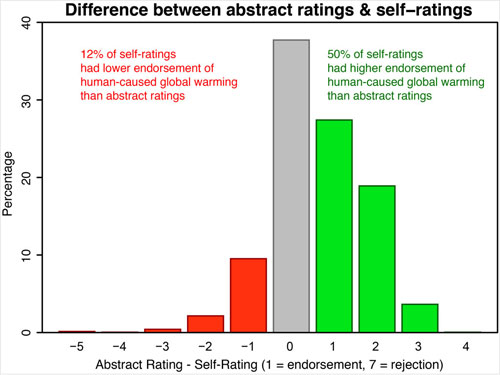
The conversation was about the Cook study. And apparently you can't tell how bad a study is even if it's atrociously bad. "From the start we would never be able to claim that ratings were done by independent, unbiased, or random people anyhow." http://www.hi-izuru.org/forum/...
Again, you meant to accuse me and NASA of apparently not being able to tell how bad a study is. And specifically, the conversation was about how the Cook study compared their own ratings to self-ratings done by the authors. Isn't it strange that all your supposedly "atrocious" rater problems actually caused the Cook et al. raters to underestimate the consensus rate compared to the authors' self-ratings?
Funny you should link the Zimmerman study - they surveyed 3145 respondents, but only used 77 of those to get the magic 97% number.
If you surveyed doctors about a topic involving heart surgery and only 77 out of 3145 of those doctors were actively practicing heart surgeons, wouldn't you be more interested in what those experts have to say? From Doran and Zimmerman 2009:
"In our survey, the most specialized and knowledgeable respondents (with regard to climate change) are those who listed climate science as their area of expertise and who also have published more than 50% of their recent peer-reviewed papers on the subject of climate change (79 individuals in total). Of these specialists, 96.2% (76 of 79) answered "risen" to question 1 and 97.4% (75 of 77) answered yes to question 2."
Doran and Zimmerman reported all the results in Fig. 1, which reveals a common (indeed, expected) increase in accuracy as one's subject expertise increases.
... The question asked was "Do you think human activity is a significant contributing factor in changing mean global temperatures?" Most skeptics and luke-warmers, including me, would answer 'yes' to that question. So the survey is essentially meaningless.
Since they show all their results in Fig. 1, and over 30% of the general public answered "no" to that question, it's not clear how Doran and Zimmerman 2009 was "essentially meaningless". Their survey revealed that even using such a broad definition, the general public has been grievously misled. Possibly by compulsive contrarians who don't have any real expertise, but who nevertheless have fun baselessly accusing scientists of dishonesty and fraud.
And remember, Anderegg et al. 2010 used a more precise definition. What regurgitated excuse "justifies" ignoring Anderegg et al. 2010?
Here's a much better discussion on consensus: https://judithcurry.com/2013/1...
If GiordyS and Jane Q. Public's accusations aren't baseless, why do they keep "citing" blog posts, while I'm citing peer-reviewed papers along with statements from NASA and many other scientific organizations?
GiordyS just linked a blog post which proclaims a "52% 'consensus'" because of a 2013 survey of the American Meteorological Society. Had GiordyS really just not read about the new 2016 AMS survey revealed different results?
"Specifically: 29% think the change is largely or entirely due to human activity (i.e., 81 to 100%); 38% think most of the change is caused by human activity (i.e., 61 to 80%); 14% thi
-
Re:10%. 90%
The conversation was about the Cook study. And apparently you can't tell how bad a study is even if it's atrociously bad. "From the start we would never be able to claim that ratings were done by independent, unbiased, or random people anyhow." http://www.hi-izuru.org/forum/...
Climate activists would be better off saying 'Yes that *particular* study IS crap' but you won't see that kind of plain honesty coming from the warmist camp. And no, you won't find much candor in the skeptic community either, although I think skeptics can afford to be more candid.
Funny you should link the Zimmerman study - they surveyed 3145 respondents, but only used 77 of those to get the magic 97% number. The question asked was “Do you think human activity is a significant contributing factor in changing mean global temperatures?” Most skeptics and luke-warmers, including me, would answer 'yes' to that question. So the survey is essentially meaningless.
Here's a much better discussion on consensus: https://judithcurry.com/2013/1...
-
An objective look
for people whose minds are not thoroughly entrenched.
-
Re: Climatology
Unlike you, science doesn't have agendas
How sweet. Also extremely naïve and a complete straw man. Science cannot have an agenda. It's a noun. However, people and institutions can have agendas which range from simply needing to pay their mortgage or gain tenure, to promoting a political position (activism). This is the basis of the complete misnomer that is the skepticalscience website. A real sceptic can be found here for example, or here. The former is the guy who debunked Michael Mann's statistical shenanigans that made the medieval warm period "disappear".
And Ted Cruz? He's a politician. Too slick by half. I doubt his authenticity. He has an agenda. -
Obvious steps we can take as a society
There are several ways we can use technology to promote effective climate action:
First, we need to put an immediate stop to the UAH and RSS satellite measurements of surface temperature, or at least publication of the results. None of our models is able to explain why the temperatures haven't continued to rise as precipitously as we expected after the 90's. The pause is an embarrassment. Ergo, the pause doesn't exist, and we don't want to hear any more about it. The science is settled, OK?
Second, we need to deal once and for all with this weird thing called "the internet", where people apparently are free to say things that we disagree with. A good start would be criminal and civil lawsuits against individuals who express skepticism of our climate agenda. This is already underway, as Michael Mann is suing Mark Steyn for his aspersions about the hockey stick. And others have proposed using the RICO laws to shut down other speech that doesn't toe the line. Pay no attention to the man behind the curtain, if you please. We are all very serious scientists and public servants, and it's the other side who are corrupted by dirty money. -
Re:"...need to be prepared..."
That's one data source.
NASA
On on this particular issue they are mostly discredited (for a whole host of reasons, don't know why, don't really care. Not really interested in this "click bait for the sheeple").quick google of "Ancient Egypt sea levels fell" gives
http://judithcurry.com/2011/07...
Which discredits one of those images.
There should be more considering it was falling sea levels which destroyed that once powerful empire.
-
Re:Improving data [Re:The Gods]
It looks to me like NOAA is really doing that. I am surprised they are switching their data set based on such a recent and controversial paper.
Here's a discussion at Judith Curry's site on the "pause buster" as it was dubbed: http://judithcurry.com/2015/06....
-
Re:Is this the un"adjusted" raw data?
but what evidence do you have that NASA has manipulated any of their work for political reasons?
The thing about NASA's surface measurements is that they come from sparse temperature stations that are badly compromised by encroached urban heat islands, various other changes, and declining numbers, and the sea observations are way more sparse. Add to this that NASA has made "adjustments" to the data about ten times over the past 30 years and each time, of the six possibilities, they have always managed without fail to cool the past and warm the present. The chance of this happening randomly from correcting random faults in the data is 1 in 6 = 1 in 60-million. In other words, they couldn't me more naked about cooking this data that a great deal of Climate Science depends on to match NASA's agenda (presumably to create an artificial temperature gradient to get more "crisis" funding from the US government). For example, if you compare the raw surface data for the US vs. the cooked data, you will find that the 1930's were actually warmer than today, whereas the cooked data shows the 1930's being cooler:
The thing about the RSS and UAH satellite data is that it is direct, full-coverage, and objective. The satellites whiz around the Earth several times a day, so every spot on the Earth is monitored pretty much in real time. This is most important for the oceans which cover 70% of the Earth where the surface observations are extremely sparse and large areas are extrapolated to conjure up quesionable numbers. Numbers that directly contradict the direct satellite observations. And other surface data sets for that matter.
NASA's cooking of the books for the surface data is generally unknown to the public, but this round of the next, the public might just catch on.
“He who controls the past controls the future. He who controls the present controls the past.” George Orwell, 1984
1) read this http://judithcurry.com/2014/07...
2) tell us whether Judith Curry is in collusion with the AGW fraud or not.
3) " they have always managed without fail to cool the past and warm the present"
"The most significant adjustment around the world, according to NOAA, is actually for temperatures taken over the oceans, and that adjustment acts to lower rather than raise the global temperature trend." http://www.factcheck.org/2015/... -
Re:Great. Let's sit here and wait for the next wav
Look at tetraethyl lead, the lead industry, and the scientists who discovered in the 1940s the horrible things TEL does to children, then read on why it wasn't banned until 1973.
Look at smoking, the scientists who started figuring out all the awful shit it does to the body, and the tobacco industry that spent 25 years fighting a systematic FUD campaign (and personal character attacks against them).
Now scientists have spent decades fleshing out the basic idea that Arrhenius articulated about 120 years ago and it's becoming increasingly a sign of lunacy to claim he wasn't right...
What was Arrhenius' estimated value for transient climate sensitivity to CO2 again?
There are many informed skeptics who understand the science, but don't believe we have enough information yet for drastic measures.
Yet just as smoking-causes-cancer denialism was the unbelievably stupid meme that Just Wouldn't Fucking Die because the tobacco industry kept funding it, and the leaded-gasoline-is-harmless denialism that was funded directly by the lead industry before that, now certain interests that want to burn and/or strip mine the word in the name of the Holy Lord's Next Quarterly Profit Report are funding a massive, systematic attack against any coherent action on climate change. And you people are falling for it. AGAIN.
What "coherent action on climate change" do you recommend, exactly? Not a single suggested mitigation will make a significant difference in the estimated (guesstimated) temperature by 2100. The one thing that would make a significant difference, if in fact there's a problem worth the effort, is a mass transition from coal to nuclear power worldwide (ESPECIALLY in China and India). However, apparently nuclear is anathema to the vast majority of climate alarmists and environmentalists, despite it being the safest power generation method in use by far.
Are we seriously expected to believe that 97% of the world's scientists are involved in some sort of massive scheme to... uh... steal grant money?
I think the majority of scientists involved are honest, if not doing a great job with the science. You should read Judith Curry's site for some rational discussion of the issue from a highly qualified climate scientist. As far as the way the science is being used to advocate social change, remember that the most effective lies contain a grain of truth...
Or that maybe damn near everyone who looks into what's going on realizes we really gotta do something about this crap?
Actually, that's not obvious at all. It is clear that more research is needed before taking drastic measures that will harm the poor around the world more than any other group. In the meantime, we should embark on win/win efforts such as a mass conversion from coal to nuclear energy. Coal power is bad from many perspectives, such as killing tens of thousands of people every year, increasing ocean acidification, and providing a rich source of organic mercury. Solar and wind are fine as long as they're cost-effective, but they aren't a good fit for base load power.
-
Re:Skating, not butthole surfing
Either it's sarcasm or you're an idiot, because it's easy to release carbon. What's hard is putting it back in the bottle.
No what's hard is convincing people that what was happening 18 years ago isn't happening now.
The IPCC AR5 notes the lack of warming since 1998:
[T]he rate of warming over the past 15 years (1998–2012) [is] 0.05 [–0.05 to +0.15] C per decade)which is smaller than the rate calculated since 1951 (1951–2012) [of] 0.12 [0.08 to 0.14] C per decade. IPCC AR5 weakens the case for AGW
OMG is that actually a negative warming in the range of possibilities reported by the IPCC?
No, that's cherry picking 1 range to reach a predetermined conclusion. I can show that oil, gold and beanie baby prices always go up, ALWAYS, if I pick the right start and end dates too. I have a lot more valid choices than you do though, because you had to pick that very narrow anomalous window in modern human civilization.
For more chuckles, let's look to XKCD:
XKCD ExtrapolationYou are also deliberately ignoring the melting of ice (by volume, not just area) and the acidification the oceans, which are absorbing CO2 at a faster than expected rate. Both of those factors slow the rise in atmospheric CO2 levels, just as ice melting in a glass slows the rate at which the temperature changes. The slower change in temperature does NOT mean there is less heat/energy in the glass/planet though. Once the ice is gone, for example, the drink's temperature will rise much faster than while the ice was melting.
-
Re:Skating, not butthole surfing
Either it's sarcasm or you're an idiot, because it's easy to release carbon. What's hard is putting it back in the bottle.
No what's hard is convincing people that what was happening 18 years ago isn't happening now.
The IPCC AR5 notes the lack of warming since 1998:
[T]he rate of warming over the past 15 years (1998–2012) [is] 0.05 [–0.05 to +0.15] C per decade)which is smaller than the rate calculated since 1951 (1951–2012) [of] 0.12 [0.08 to 0.14] C per decade. IPCC AR5 weakens the case for AGW
OMG is that actually a negative warming in the range of possibilities reported by the IPCC?
-
Re:This is interesting....
The IPCC says that. Others too
-
Re:The real junk science
All the article does is highlight a few carefully selected weather stations where the temperature records have been adjusted. It doesn't explain why the adjustments were incorrect. It also doesn't show what the unadjusted temperature record would look like if you took all the station data.
Luckily, somebody else did that: http://judithcurry.com/2015/02...
-
Re:How science screwed up the fat-heart disease li
Yeah, some skeptics have an interesting take on this colossal screw-up and have pointed out the parallels with the climate debate. (Example: http://judithcurry.com/2014/08... )
Many people seem to think that groups of scientists can not possibly make genuine, colossal, "obvious after the fact" screw-ups. If anyone suggests that they have made big mistakes, they are harangued with insults like "conspiracy theorist" or "denier". Yet these same (supposedly rational) people claim "big oil" is funding skeptics (a conspiracy theory) and "big food" must have been behind this spectacular failure (another conspiracy theory). Apparently they have never heard of systemic bias, group-think, or the madness of crowds.
Or cognitive dissonance.
For some reason they can imagine millions of people being wrong about religion but they can't imagine a small group of elite "I'll scratch your back if you scratch mine" scientists being wrong about science.
They can imagine their own bosses being complete ignorant ass-holes, but they can't imaging leading scientists being egotistical, arrogant fucktards who have no qualms bullshitting people.
They can imagine a "group-think", ass-kissing, brown-nosing, yes-men corporate culture, but can't imagine the same in academic circles.
They can imagine a CEO who would drive his own billion dollar company into the ground just because his ego is too big to listen to anybody else, but can't imagine a scientist being anything other than a perfect little angel. Apparently scientists don't have egos and are immune to the many psychological issues that normal human beings face.
Government could NEVER bias a scientist, because governments are completely disinterested entities that are only concerned about the long-term health and economic interests of their citizen. (Except when governments take bribes. That's the only time the above is not true.)
Unfortunately a few scientists have been known to take bribes from evil corporations. But that's really, really easy to explain: it's a simple and direct benefit that anybody can understand without thinking too hard. And that's the only thing capable of biasing a scientist: a simple and direct benefit that's really, really easy for people to understand.
But those are not real scientists.
Real scientists are completely immune to human nature. Except for the few bad apples (who are not real scientists), scientists are better human beings than the rest of us.
Either that or many people are romantic idealists whose eyes glaze over in a state of credulity whenever they indulge their childish fantasies about "scientists".
-
Re:Most americans don't understand
http://www.scientificamerican....
Don't be dumb.
Don't be a tool,
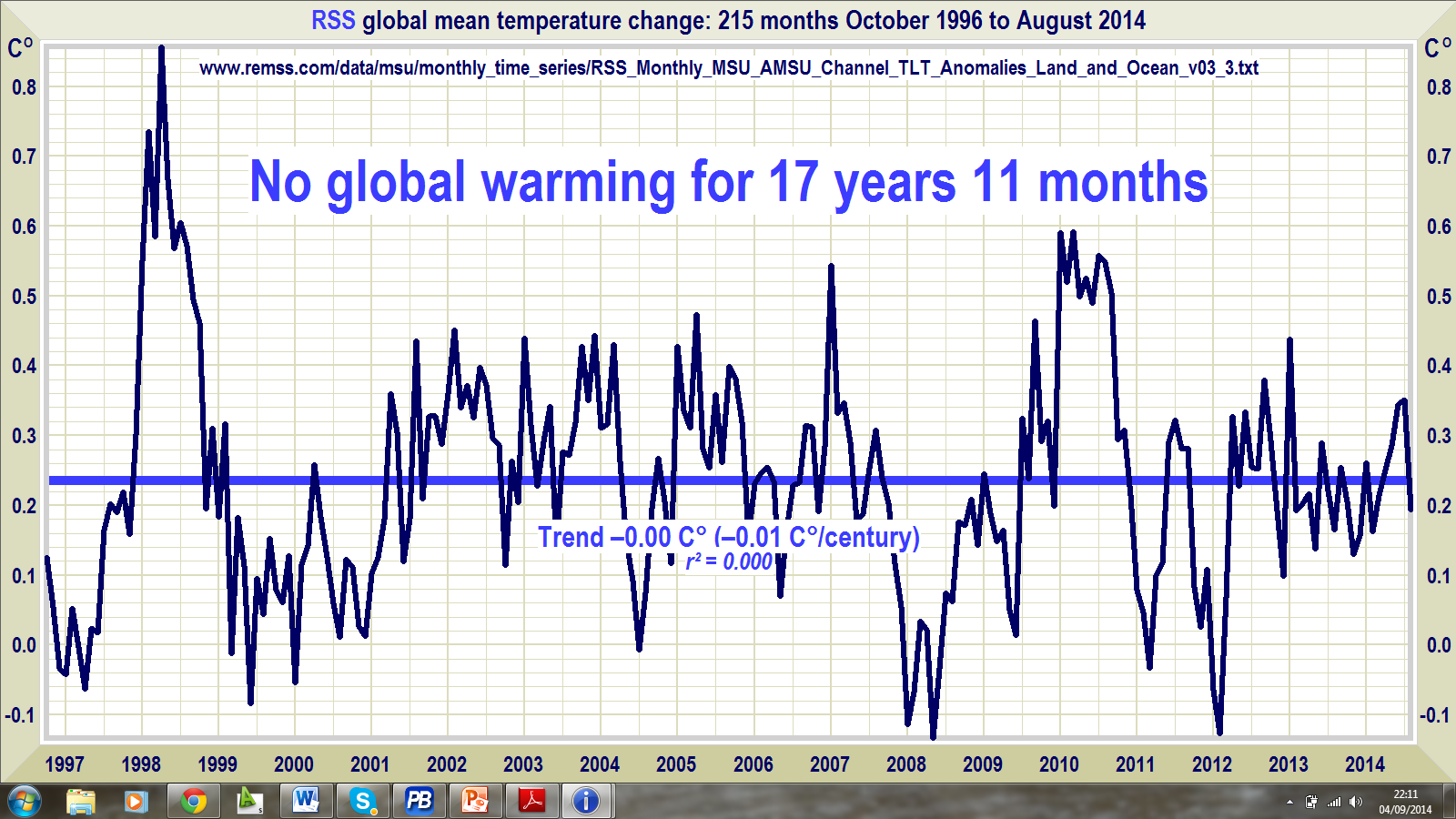
... last year "was not even close to be[ing] the warmest on record" according to data compiled by the two top satellite climate data sets: the Remote Sensing System (RSS) satellite data, which measure the lowest few miles of the earth's atmosphere, and data compiled by the University of Alabama at Huntsville (UAH).
ast year "was third-warmest, but barely," said UAH climate scientists Roy Spencer and John Christy.The year 2014 "was warm, but not special. The 0.01 degree Celsius difference between 2014 and 2005, or the 0.02 difference with 2013 are not statistically different from zero," Christy said.
Christy said that between 2002 and 2014, temperatures have warmed at a "statistically insignificant" rate of 0.05 degrees Celsius per decade.
RSS and UAH satellite data show there has been no global warming for more than 18 years. This period, which began in October 1996 and lasted for all of 2014, is referred to as "the Great Pause. Satellite Data: 2014 'Not Even Close' to Warmest YearIf you don't like satellite data,
The HadCRUT4 dataset (compiled by the Met Office and the University of East Anglia's Climatic Research Unit) shows last year was 0.56C (±0.1C*) above the long-term (1961-1990) average.
Nominally this ranks 2014 as the joint warmest year in the record, tied with 2010, but the uncertainty ranges mean it's not possible to definitively say which of several recent years was the warmest. 26 January 2015 - Provisional full-year global mean temperature figures show 2014 was one of the warmest years in a record dating back to 1850
and as far as the 18 years without warming,
[T]he rate of warming over the past 15 years (1998–2012) [is] 0.05 [–0.05 to +0.15] C per decade)which is smaller than the rate calculated since 1951 (1951–2012) [of] 0.12 [0.08 to 0.14] C per decade.
IPCC AR5 weakens the case for AGWeven the IPCC AR5 agrees.
-
Re:Translation
Near-term global surface temperature projections in IPCC AR5, IPCC AR5 weakens the case for AGW.
Uhm.. so that first link has the results being inside the projected range for multiple of models and reference points, and slightly outside in 2011-2012 for one of them. And that second link is not saying the same as you, it is disagreeing with these results strengthening the case for AGW (from >90% confidence to >95% confidence), as the first link is concluding, and is instead interpreting the outlier as weakening the confidence to slightly below 90%.
This is a good scientific discussion, but none of these are in any way shape or form saying what you are saying, that this means the models have failed. They are arguing if the confidence is close to 90% or above 95% !!
-
Re:Translation
-
Re:Stop trying to win this politically
I have a hard time trusting historical temperature records because they are not calculated every year in the same way. Furthermore, every single weather station is not audited to make sure that it is has the same conditions over time. For example, some stations have been moved without attribution.
This pollutes the ground data. The scientists try to compensate by disqualifying a set of stations which can change on a year to year basis and given that we are talking about a very small year to year temperature difference it is possible that the actual changes are due to which selection of stations are being averaged together.
You appreciate that I could just pick a different set of stations every year and show an averaged graph that could look like anything. I could show global cooling or a sin wave or... really any line that can be represented in a graph what so ever.
What I like about the sat data is that there are radically fewer sensors which means there is less opportunity for monkey business.
The only thing that is worrying about the sats is the way they're calibrated which also sometimes changes on a year to year basis which is again questionable. I'd rather look at a raw output of the system over time without modification and then see their suggested calibration. Absent that... I'm a little too paranoid about the whole thing to just take it on faith that everything was done properly.
You might find this interesting:
http://judithcurry.com/2015/01...Quote:
""Bottom lineBerkeley Earth sums it up well with this statement:
"That is, of course, an indication that the Earthâ(TM)s average temperature for the last decade has changed very little."
The key issue remains the growing discrepancy between the climate model projections and the observations: 2014 just made the discrepancy larger.""
Don't deny the pause.
It makes it hard to talk about the data. The pause is ongoing and if it continues... rejoice... the models were wrong. Really, at this point, you'd better hope your models are wrong or you'd better makes sure you buy inland real estate.
-
A Less Hysterical Take
Judth Curry a more reasonable Scientist:
"Berkeley Earth sums it up well with this statement:
That is, of course, an indication that the Earth’s average temperature for the last decade has changed very little.
The key issue remains the growing discrepancy between the climate model projections and the observations: 2014 just made the discrepancy larger."
-
Re:The epitome of alarmism
Omitting the ‘doubts, the caveats, the ifs, ands and buts’ is not a morally neutral act; it is a subtle deception that calls scientific practice into disrepute.
http://judithcurry.com/2014/12... -
The epitome of alarmism
A quote from Judith Curry's blog sums it up well;
"last week, the World Meteorological Organization (WMO), a supposedly scientific body, issued a press release stating that this is likely to be the warmest year in a century or more, based on surface temperatures. Yet this predicted record would be only one hundredth of a degree above 2010 and two hundredths of a degree above 2005 — with an error range of one tenth of a degree. True scientists would have said: this year is unlikely to be significantly warmer than 2010 or 2005 and left it at that."
http://judithcurry.com/2014/12... -
Re:Obviously.
Good science isn't political at all; it merely describes reality. Climatology, as groups like the IPCC present it, isn't good science. It's a bunch of fudge-factor-laced models and ignored observations tightly wound around a political agenda. Basically, ignore what you can't explain, place assumptions anywhere the data is incomplete, draw conclusions that don't match up to reality, and pretend it all makes sense because you have "consensus".
This.
I like science as much as anyone but the IPCC's actual predictive track record leaves me fairly underwhelmed.
The problem is that we need better data collection, more data collection, and a lot more work put into understanding the underlying mechanics of the system as a whole before we start drawing wide-reaching conclusions about the drivers of the whole thing
Yup. I've noted in my work that engineers tend to be more skeptical as a group in general. This probably sums up why;
http://judithcurry.com/2014/10... (long read but well worth it).
Basically the whole process is fixated on CO2 to basically the exclusion of all else. Suggesting anything else generally gets you ostracized. Oceans have only really entered the discussion recently and only because the models have been so bad. That's not the science I grew up with.
-
Re:What happens to that heat?
New research suggests that the upper layer of the ocean has warmed more than had been thought previously while the deeper ocean has cooled rather than warmed in recent years.
-
Re:Science creates understanding of a real world.
The 1998 starting date is always used by AGW deniers. Always.
Here is a "denier" graph using a starting date other than 1998. That was very easy to find. I suppose you will complain about the data set they are using. (The RSS data shows the least amount of warming.) Fair enough. Here's a "denier" graph showing where the trend lines hit zero for the various datasets. You will note that not one of them uses 1998 as a start point.
What if we take into account the margin of error, where we can't rule out a trend of zero? (from here)For UAH: Since March 1996: CI from -0.001 to 2.341
For RSS: Since December 1992: CI from -0.015 to 1.821
For Hadcrut4: Since November 1996: CI from -0.003 to 1.184
For Hadsst3: Since August 1994: CI from -0.014 to 1.666
For GISS: Since October 1997: CI from -0.002 to 1.249I don't see 1998 anywhere.
What about mainstream sources? Here is a link to the journal Nature that acknowledges the "mysterious" 16 year pause.
Judith Curry writes: "Depending on when you start counting, this hiatus has lasted 16 years. Climate model simulations find that the probability of a hiatus as long as 20 years is vanishingly small. If the 20 year threshold is reached for the pause, this will lead inescapably to the conclusion that the climate model sensitivity to CO2 is too large. Further, 20 years is approaching the length of the warming period from 1976-2000 that is the main smoking gun for AGW." -
Re:Science creates understanding of a real world.
Personally, I rarely stray from the IPCC reports and the temperature data. Most people are unaware of what the science actually says. It does not support many of the beliefs held by global warming activists.
Much research is done by scientists who don't identify as skeptics, but whose work supports what skeptics have been saying for a long time, such as this paper on climate sensitivity, or this one by Nick Lewis.
I recommend Judith Curry's blog as a good place to start if you are truly interested in engaging with skeptics and lukewarmers. (Judith Curry does "actual research" by the way.) -
Re:Science creates understanding of a real world.
I actually don't believe it is 100% natural. CO2 is a greenhouse gas, and more CO2 will tend to warm the climate. The problem is that climate scientists didn't stop there. They built climate models that multiply that heat an additional 3 - 4 times, turning the relatively benign warming from CO2 into dangerous warming. These "positive feedbacks" assumed in the models are unproven. There is no clear evidence that the earth is hypersensitive to CO2 heating and will react by amplifying that heat threefold. The latest climate sensitivity estimates are much lower.
If you are genuinely interested in hearing out the other side, Judith Curry's blog is a good place to start. -
Re:Science creates understanding of a real world.
If you are truly interested in moving beyond childish stereotypes of "deniers", you could start at Judith Curry's blog.
-
Re:Straight to the pointless debate
I'm sorry but you're going to have to prove that surface temperature measurements a "being adjusted after the fact to fit theory". A lot of people assert that but they never bother to seek out the scientific explanations for those adjustments. Here is a blog post about the reasons and methods for adjustments to the surface temperature record with cites to relevant peer reviewed papers about it. If you want to claim the adjustments to surface temperature records are invalid that is the information you need to refute.
-
Re:The GISS adjusted^^^ dataset
The study you linked to about overestimations basically makes the "only atmospheric warming" argument, which is what creates the illusion of "the pause."
The study I linked to makes no such argument. That is a straw-man. What the study shows is that surface temperature warming has been about half of what an average of all models projected. (Note that "surface temperature" is actually atmospheric temperature near the surface.) Regardless of whether there changes happening elsewhere, the models still got it wrong. That is the point. The models are flawed.
In case you weren't looking at the right one, it's this one specifically:
I admit that I had missed your second link. But this is hardly proof of anything. You brought us right back to the original issue: whether (and how) the datasets like GISS, HadCRUT etc. have been manipulated. It isn't valid to use that data as proof of itself. In order to demonstrate anything you have to compare it to something else. Like, for example... satellite data!
I can only assume your problem with the "97%" meta-study result was not considering those that didn't express a position on the issue in their abstract.
I don't know why you can only assume that. Criticism of that purported "study" are all over the place. Here are two examples from a climate scientist. And there are more. Many more. Which are very easy to find with any search engine. Probably the most relevant comment, which many of these criticisms state in various ways, is the following (yes, it's Monckton but pay attention to what he says, not who he is):
"The non-disclosure in Cook et al. of the number of abstracts supporting each specified level of endorsement had the effect of not making available the fact that only 41 papers -- 0.3% of all 11,944 abstracts or 1.0% of the 4014 expressing an opinion, and not 97.1% -- had been found to endorse the quantitative hypothesis, stated in the introduction to Cook et al. and akin to similar definitions in the literature, that 'human activity is very likely causing most of the current GW (anthropogenic global warming, or AGW)'."
-
Re:The GISS adjusted^^^ dataset
The study you linked to about overestimations basically makes the "only atmospheric warming" argument, which is what creates the illusion of "the pause."
The study I linked to makes no such argument. That is a straw-man. What the study shows is that surface temperature warming has been about half of what an average of all models projected. (Note that "surface temperature" is actually atmospheric temperature near the surface.) Regardless of whether there changes happening elsewhere, the models still got it wrong. That is the point. The models are flawed.
In case you weren't looking at the right one, it's this one specifically:
I admit that I had missed your second link. But this is hardly proof of anything. You brought us right back to the original issue: whether (and how) the datasets like GISS, HadCRUT etc. have been manipulated. It isn't valid to use that data as proof of itself. In order to demonstrate anything you have to compare it to something else. Like, for example... satellite data!
I can only assume your problem with the "97%" meta-study result was not considering those that didn't express a position on the issue in their abstract.
I don't know why you can only assume that. Criticism of that purported "study" are all over the place. Here are two examples from a climate scientist. And there are more. Many more. Which are very easy to find with any search engine. Probably the most relevant comment, which many of these criticisms state in various ways, is the following (yes, it's Monckton but pay attention to what he says, not who he is):
"The non-disclosure in Cook et al. of the number of abstracts supporting each specified level of endorsement had the effect of not making available the fact that only 41 papers -- 0.3% of all 11,944 abstracts or 1.0% of the 4014 expressing an opinion, and not 97.1% -- had been found to endorse the quantitative hypothesis, stated in the introduction to Cook et al. and akin to similar definitions in the literature, that 'human activity is very likely causing most of the current GW (anthropogenic global warming, or AGW)'."
-
Re:let me solve this right now
The physics are involved but pretty unambiguous, and we can (and have) confirmed this by satellite and atmospheric temperature observations.
-
Re:CAGW is a trojan horse
Ah, good news. It appears the methodology and code has now been made available. (Or maybe not? I haven't read through the whole thing yet.) See? Science in action! Now I can check for myself.