Slashdot Mirror
Domain: macworld.com
Stories and comments across the archive that link to macworld.com.
Comments · 1,081
-
Re:lockdown coming.
This, pretty much. The OS is set to, by default, spread FUD about apps not coming from the App Store.
Or, if John Gruber's claim is correct, the OS is set to, by default, spread FUD about apps coming neither from the App Store nor from identified developers
In effect, it offers all the security benefits of the App Store, except for the process of approving apps by Apple. Users have three choices which type of apps can run on Mountain Lion:
- Only those from the App Store
- Only those from the App Store or which are signed by a developer ID
- Any app, whether signed or unsigned
The default for this setting is, I say, exactly right: the one in the middle, disallowing only unsigned apps.
Being the default, it's as good as there being no other option, because users don't know enough to tell the difference.
Hopefully the dialog that pops up when you try to launch an app not in the category specified by the setting will also point you to the setting for changing that behavior. (That article also says the default is "App Store or identified developer.)
-
Re:lockdown coming.
"But what if you want to run an older app, or download a utility that was written by someone who hasn't paid Apple's $99 fee for a developer's license? If you're an administrative user, you can Ctrl-click on the App, choose Open from the pop-up menu, enter your OS X password, and tell Mountain Lion to trust this app in the future."
Or just fucking set "Allow applications downloaded from:" to "Anywhere". (At least according to Daring Fireball, the default setting is "Mac App Store and identified developers"; I'm curious whether that's also the default setting if you upgrade a machine, or if it defaults to "Anywhere" on an upgrade for the benefit of already-installed unsigned apps, or if it's using Quarantine so that it pesters you only for newly-downloaded apps. For that matter, I'm curious whether it's in the exec code, so that it vets all executable images, or if it's in Launch Services so that it only vets applications launched through LS.)
One step closer to all apps needing to come from the app store.
Or not. It might just be a heavier-duty version of the "warning when you first open a newly-downloaded application from the UI" stuff that's been there since at least Snow Leopard; the MacWorld article on Gatekeeper makes it look a bit like the latter.
-
Re:as a "corporate" user
The Sylus is easy as those have existed for quite a few years for iOS devices.
http://www.macworld.com/article/156560/2011/05/touchscreen_stylus_roundup.html
-
Re:EPIC
What on earth... why are all these trolls so angry?
Maybe it is not because Google will combine the privacy policies into a single one, but also all the users data across all its services?
Perhaps the move will no longer let you share individual services data, like sharing your Google+ data but withhold your Calendar?
If so, would you still be considering trolls the guys at EPIC? -
proximity triggered actions
Just have a look at http://sourceforge.net/projects/blueproximity/ (mac), http://www.daveamenta.com/products/btproximity/ (windows), http://blueproximity.sourceforge.net/ (linux). This will detect you when you walk by with your bluetooth device. You can trigger actions as desired when in range - http://hints.macworld.com/article.php?story=20091221173111783 . There is even a commercial alternative - http://themha.com/airlock/ .
-
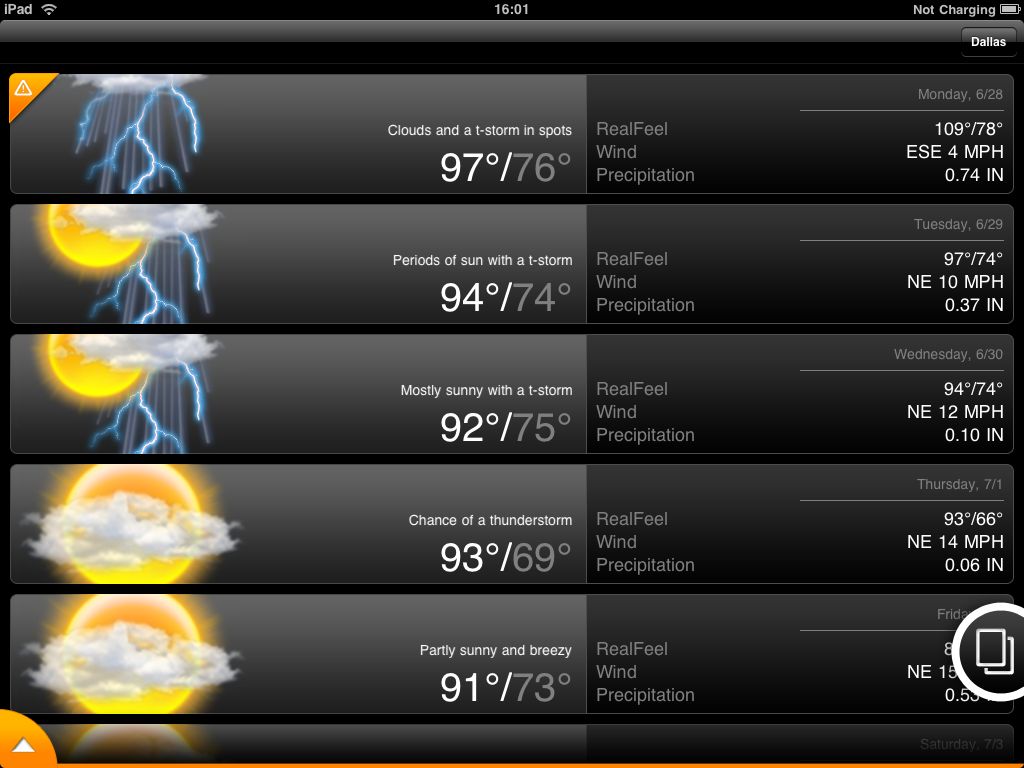
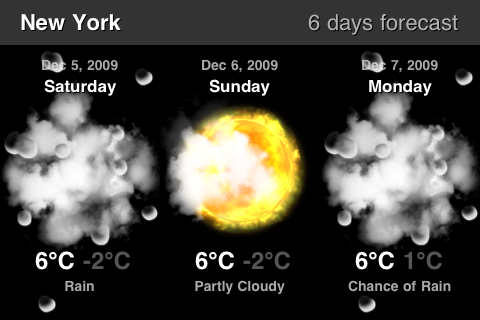
Here are a bunch of unique weather app designs
Challenge accepted. Weather app designs that don't look like Apple's:
And it keeps going with the unique designs.
All of these look just fine and aren't inconvenient.
-
Re:Samsung's weather widget
YESSIR, because the absolutely only way to design a weather app is to make it look exactly like the OS X dashboard widget from 2005. and your evidence is a Google image search showing a bunch of people who ripped off the OS X dashboard widget from 2005.
nobody could ever design anything different.
good job! *thumbs up*
-
Re:Is somebody paying for these articles?
In defense of Apple, if you use a blackberry, you have to pay shitloads of $$ for BES. So, if you are using Apple, they don't have a management solution, you should take the same $$ and buy your own iOS management solution, and there are plenty out there.
If you want to go with the Apple solution, now that Lion server is out, take a look at this:
http://www.macworld.com/article/160477/2011/06/osx_lion_server.html
-
Re:Stallman Was Right
-
Re:Recording
There are a number of stylus (stylii?) for the iPad, ones good enough to to draw cartoons, let alone write. I'd probably utilize the camera too though. Just don't let the professors know your filming, lest you give them stage fright.
-
Re:Some credit to Google
Ok not day one, but still in 2004: http://hints.macworld.com/article.php?story=20041110192454841
Not 2007. Not that it makes a difference, you're just nitpicking. Google have completely transformed several major applications - the search engine, the browser, online maps, and hosted email. Somehow, that never gets the kind of attention that Steve Jobs 'revolutions' do. Most people are not too old to remember pre Google search engines, web based email that used to give you 5-10 MB of storage with ads plastered all over an awful interface, and single process browsers that used to crash with all your open webpages, consumed insane amount of memory and were painfully slow.
-
Re:Seriously?
I expect most developers would have been using tethered devices, or emulators, not walking around with iOS 5 Beta on a normal-use device as their standard personal apps might not work well (or at all -- there are still popular apps that simply don't function on iOS5). So I wouldn't expect a developer release to have caught non-use battery drain issues at all.
-
Re:Cue Apple fans saying "That could NEVER happen"
The only difference now is that Apple is defining a sandbox profile for normal applications and forcing developers to use it if they want their application in the App Store. It is not a whitelist of applications, it's just a default security policy that applications must work with. This is like Microsoft requiring applications to work as non-Administrator users for the Designed For... certification, or a Linux distribution rejecting suid root apps from the default repository.
Well, it's more like a range of default security policies tailored to the application, but yes. Apple has created a series of multiple high-level sandbox profile options that your app can choose from, depending on what it needs to do. If you are selling your apps on the Mac App Store, Apple vets those options to ensure that they make sense based on what your application does. If you aren't selling your app on the Mac App Store, this does not affect you at all, though you are strongly encouraged to sandbox your app because doing so makes the platform more robust against viruses, etc. At that point, the onus is on you to make sure that the options you choose are sane.
The big thing that makes the 10.7 App Sandbox different from the prior incarnations is the addition of PowerBox. By moving the open and save dialogs into a separate (system-provided) application that has the ability to add entitlements (capabilities) to your application's sandbox on the fly, it means that your app can access the files that the user specifies, and nothing else (outside of your app's personal scratch space). This is a significant win for security, as it puts the user directly in charge of what files an application can access.
I could go on for a while about privilege separation and techniques for making your app more secure, but that's a bit out of scope for this discussion forum. Go read App Sandbox Design Guide if you want more details.
Also, according to MacWorld, the original deadline was November (Source: MacWorld). The news is that Apple pushed the deadline out by four months, not that Apple is going to require sandboxing. That story is so out of date that when I first heard it, I fell off my dinosaur.
-
Leave us not forget that which came BEFORE iTunes
SoundJam MP was, perhaps, the first genuinely useful MP3 application for the Macintosh. One could easily rip CDs to MP3, mix songs as one wished in playlists, and then burn them to CD.
Rip. Mix. Burn. Where have we heard that before?
It even had support built in for the few MP3 players of the time.
Review of an early incarnation of SoundJam.
And, the ObWiki entry .
Without SoundJam MP. there would likely have been no iTunes, as Apple bought SoundJam MP, filed off the serial numbers, slapped a coat of paint on it and called it iTunes V1.0.
Well, yeah, there still would have been AN iTunes. Apple would have just bought Audion .
So, while the iPod was indeed a seachange for the portable music player (cassette/CD/digital) of the era, without the software to support it as easily and as elegantly as SoundJam, er, "iTunes", it was the software that made the iPod the success it was and remains to this day.
-
Re:Hate to say it...
-
Only AT&T phones need to be bought unlocked
No phones will be unlocked until at least november, sold directly from apple initially.
That's what I thought at first as well, but not so!
Second, nor Verizon or Sprint are GSM.
No, but the iPhone 4S specifically can work with either GSM or CDMA providers.
It just so happens that both offer very nice unlock policies to let you use SIM cards in other countries:
90 days out for Verizon, 0 days for Sprint.
But that is not the best part, the best part is that you could get a subsidized phone from Sprint or Verizon and just pay the $200, then you get what is essentially an unlocked iPhone since you can use it with any GSM carrier you can buy a micro-sim from!
This means that people who travel a lot internationally are now much better off getting a Verizon or Sprint phone, and then using SIM cards overseas.
That leads me to think AT&T may finally loosen the locking restriction, after all what does it hurt them in the U.S. if you can switch out a sim card?
-
Re:I used to be a Firefox fan
The dev for pdf-mac stopped updating their code early in the 3.6 release cycle. There is a edit you can do to make the 1.2.0 version run in Firefox 7 but you need to run Firefox in 32 bit mode. http://hints.macworld.com/article.php?story=20110622163401497
-
Re:one other reasonSo you think someone is going to capture a large market share and force them to lower their margins, or even make them unprofitable. Ok, I disagree. See: Microsoft Windows versus OS X for an example of why I think that.
Apple has the highest market cap of any company right now. In order for them to be worth that, they can't just make more profit than each of their competitors. They have to make substantially more.
Umm... don't they? 7% of sales but 35% of profits in desktop OS. Also see 2/3rds of phone profits in 2Q 2011 for another example.
What's next, you're going to explain to me that Apple is poised to lose it's lead in tablets? If they do, which perhaps they will, I think you'll find they still have a healthy market for them, huge sales, and amazing gross margins. Even if Ice Cream Sandwich, or whatever cute name the next big Android OS opens up things to Android selling more tablets overall. -
Re:Driving users to the App Store
Don't be so sure that isn't coming. Apple is planning to do that for music with iTunes Match. Why not apps too? FWIW, if you bought a boxed copy of iLife '11, or it was included on a new Mac, the App Store will let you download it for free.
-
This is such a shame...
I think HP is being stupidly near-sighted by not continuing to invest in this. Even if HP wants to move towards the idea of 'enterprise integration', they could do what RIM is trying to do (belatedly) with the Playbook, and come up with a tablet for enterprise/industrial/OEM integration. I thought WebOS (and the Palm legacy) had the best basis to provide innovation/alternatives to the iPad; so far most of what we're seeing from Android has not been very inspiring.
Now I fully admit to being an Apple FanBoy, but I think real competition in designs, applications, hardware, etc, is good for everyone. Apple does not have the monopoly on good ideas, but HP's actions sure seem to imply that HP is unwilling to compete with Apple. See the arguments here, particularly the (timely) discussion of the venerable HP-35 calculator as a risk that paid off: http://www.macworld.com/article/161775/2011/08/why_cant_windows_pcs_catch_up_to_the_macbook_air_.html
-
Re:Learn your AVC's
Create a "copy as plaintext" service. Services: one of the many oft overlooked power-user features of OSX
-
Re:Who mentioned the iPad?
What I meant is that when I travel I can pick something up with out too much hassle and on a whim. Something less true of online music. Also, my CD can be bought in any region from anyone without restriction of geography, which is something that can't be said for most (all?) downloadable music stores.
Also, while music on CD may be watermarked, the watermark does not include your ID as a purchaser. Note, that "DRM-free tracks sold at the iTunes Store contain the name and Apple ID of the purchaser" (ref). -
Re:Breaks Jailbreak
Jailbreaking does not magically leave your phone wide open for attack.
I'll take Charlie Miller's word over yours. http://www.macworld.com/article/141506/2009/07/jailbreak_security.html?lsrc=rss_weblogs_iphonecentral
-
Re:Not this crap yet again!
1. It it was with so "*most* of it truncated" they still got details like- username and password.
http://www.macworld.com/article/158671/2011/03/google_streetview.html
"There's absolutely 0 new information here" - they got fined in court 100,000 euros, about $143,000 i.e. the nothing wrong line repeated so so many times is now 'old' -
Re:Clueless
http://www.macworld.com/article/133297/2008/05/solidcolors.html Last time I used OSX, it wasn't like you could pick an arbitrary background color. You had to do what the article describes. Now, if that's changed, then I am misinformed. But it's not like it was "Click here to chose an arbitrary color" easy on my Mac. Rather, you were presented with Apple's pre-defined selection of solid colors.
-
Re:Try again..
Ignoring your paranoid flamebait, someone should point out that there's plenty of other products like that, so I guess I will. Apple's iOS has a kill switch and Amazon removed 1984 and Animal Farm from all Kindles following a licensing dispute with the rights holders. And let's not forget the PS3 Other OS fiasco. Also, any DRM system that has to contact the master server to determine if a game is properly licensed (Steam, Spore's DRM, Games for Windows Live...) can have the same effect.
If it bothers you so much, jailbreak and pirate everything. No regulatory body has ever succeeded in stamping out a black market for which there was sufficient financial incentive; in this era of information, notoriety and ego will suffice instead, and have sufficed for the past thirty years, since the invention of the first copy prevention mechanism. Yar-har, fiddle dee-tee.
Eventually, the people who commission these systems will get the clue that a free culture is the best solution. Until then, just work around their silly unenlightened nonsense. But remember to pay them. They need to survive too. -
Re:Tools for OS X and Linux
If all you need to do is see the available networks and their signal strength/noise level on OSX you can just use the Airport command line utility, if you want to sniff there's always tcpdump.
-
Re:History repeats?
Apple doesn't hide rootkits in their software or media files.
Maybe not. But they were summoned to the US Senate to answer questions on privacy concerns over what they track & why they track it unencrypted.
Google, who is responsible for Android, was also called to those hearings. Apple sent a vice-president in charge of software development. Google sent a lobbyist. Apple voluntarily has already taken steps, and has promised to take further steps, to reduce both the amount of "tracking data", and to encrypt what data the user's phone does store. What has Google done/promised (I honestly don't know on that one)? But don't let facts available for nearly two months stop your rant.
Apple doesn't actively prohibit "rooting" of their devices.
I think you need to read the last 2 lines about possibly denying sevice on this page.
Yeah, EULAs always sound terrible. But point to me one instance of Apple actually doing that. [Crickets]
Apple doesn't pursue the iOS "hacker" community with legal threats, DMCA takedown notices, etc.
It has put the mechanisms in place to do so in the future though.
Again, the potential of doing it; but obviously Apple is just putting that in as a guard against an unforseeable "worst-case-scenario" threat. And again, please show me a single instance of Apple actually making good on any sabre-rattling. And didn't it get settled nearly a year ago that "Jailbreaking" was NOT illegal? Do you see Apple actively fighting that with signed bootloaders, security fuses, etc, like some Android Device manufacturers? So, your point, again?
Apple doesn't embrace DRM every day, and in every way (they DO have to put up with SOME DRM due to pressures from "content providers"; but it is obvious they chafe against it).
Apple dropped DRM from iTunes about 2 years ago. It could be argued that they bowed to pressure from their user base after the Sony rootkit and CD DRM fuss. I have not come across a DRMed CD for some years now because of the stink DRM caused.
ANYTHING "can be argued". But at least Apple's CEO published an Open Letter publicly decrying DRM. Has Sony? Howabout Google?
Apple doesn't infest its products with an OS (Windows 7) that has DRM from the driver-level up.
I'm mainly a Linux guy, I'm still using XP for some stuff but haven't played with Windows 7 much beyond setting up some laptops for colleagues - therefore I'm no expert on it. However, I am not aware of any restrictions on Windows 7 that stop you running non-DRMed formats on it exactly as you can do on previous iterations of Windows. I am led to believe that it provides a *platform* for DRM, again probably bowing to the same pressures from the RIAA that you said it was perfectly okay for Apple to have done during the early days of iTunes.
When Apple was starting out with iTunes, NO ONE would have signed up without DRM, and you (and everybody else) knows it. Even when iTunes had DRM on music, it was the weakest DRM possible. Individual songs weren't DRMed, per se; only Playlists were copy-restricted. NOTHING (but trust) prevented the user from deleting the Playlist, and recreating it, thus garnering another seven (then five) copies of a particular song. And let's not forget that iTunes also allows creating an Audi
-
Re:History repeats?
Apple doesn't hide rootkits in their software or media files.
Maybe not. But they were summoned to the US Senate to answer questions on privacy concerns over what they track & why they track it unencrypted.
Apple doesn't actively prohibit "rooting" of their devices.
I think you need to read the last 2 lines about possibly denying sevice on this page.
Apple doesn't pursue the iOS "hacker" community with legal threats, DMCA takedown notices, etc.
It has put the mechanisms in place to do so in the future though.
Apple doesn't embrace DRM every day, and in every way (they DO have to put up with SOME DRM due to pressures from "content providers"; but it is obvious they chafe against it).
Apple dropped DRM from iTunes about 2 years ago. It could be argued that they bowed to pressure from their user base after the Sony rootkit and CD DRM fuss. I have not come across a DRMed CD for some years now because of the stink DRM caused.
Apple doesn't infest its products with an OS (Windows 7) that has DRM from the driver-level up.
I'm mainly a Linux guy, I'm still using XP for some stuff but haven't played with Windows 7 much beyond setting up some laptops for colleagues - therefore I'm no expert on it. However, I am not aware of any restrictions on Windows 7 that stop you running non-DRMed formats on it exactly as you can do on previous iterations of Windows. I am led to believe that it provides a *platform* for DRM, again probably bowing to the same pressures from the RIAA that you said it was perfectly okay for Apple to have done during the early days of iTunes.
Just because you select a list of reasons why Apple are not evil does not mean they are not evil in other ways.
-
Re:In-App purchases
imdenify = Compensate (someone) for harm or loss: "insurance carried to indemnify the owner for loss"
AFAIK - nobody has paid lodsys yet.. compensation isn't in play.
if Apple caves, it sets a dangerous precendent.. the dollars are irrelevant. this is about priniple. @less than $6000 per million in income.. the "fee schedule" is designed to get devs to pay because $6k is nothing compared to 1M... BUT if Apple doesn't fight, EVERY SINGLE APP DEV with in app purchases is subject to infrigement. and nevermind the part where apple makes 30% off of in app sales.
seems the court is already on Apple's side: "As the Supreme Court has made clear, “[t]he authorized sale of an article that substantially embodies a patent exhausts the patent holder’s rights and prevents the patent holder from invoking patent law to control postsale use of the article.” Quanta Computer, Inc. v. LG Elecs., Inc., 553 U.S. 617 (2008)."
full text of the letter: http://www.macworld.com/article/160031/2011/05/apple_legal_lodsys_letter_text.html
what happens if you feed the stray cat in your neigborhood? you become the cats bitch. same thing if you feed the trolls.
-
Re:Mandatory ACLs
Is that a troll question, as in rhetorically expecting an answer in the negative?
Mac OS X has ACL built in:
http://hints.macworld.com/article.php?story=2005050120073947-dZ.
-
Re:Qubes OS
The admin account on Mac isn't ROOT though- you don't really need AV; you just need to not give your password to every app that ask for it. Keep update current, turn on your firewall, and check downloaded files before you open them http://www.macworld.com/article/49459/2006/02/leapafaq.html
-
Re:MicroSIM?
Apple first with USB? PCs had them a year before the iMac. Plus back in the day, the only portable music player that would dare use firewire was the iPod.
Apple Computer is the new Sony for proprietary f-you lock-in.
Are you still using your Apple Bus Mouse with an ADB connector?
-
Re:Business 101
The article itself states that they knew that iBooks was in development.
Where does it state that? Are you referring to this?
"Apple's iBooks was already in development when we talked to the company and it certainly must have known that the future plans would doom us to failure," the company said.
That doesn't state that the developer knew iBooks was in development, that states that Apple knew that iBooks was in development. Please take the time to comprehend what you are reading.
Amazon released the Kindle App in June of 2010. iBooks was released January 2010.
The iFlow reader? December 2010
Citation needed. Maybe you were looking at this link. Note the version being released as 4.1. How about you look a little deeper next time? Here is a MacWorld March 2009 review of three e-reader apps, iFlow reader being among them. iFlow Reader is likely older then that review date.
As well, iBooks was ANNOUNCED in Jan 2010, and RELEASED mid 2010, with either the iOS 4.0 release, or one of it's updates.So while it may not have been their intention when they STARTED the company & development, by the time of release they WERE competing with both. More specifically, they were competing with entrenched competition.
Absolutely false as shown above.
Your argument is invalid. Please spend 2 minutes doing research instead of believing everything the media tells you to.
If you're going to try to debunk someone and turn the phrase, you might want to make sure your information is accurate. That takes longer then 2 minutes. Once again, Your "facts" are false, and your argument is invalid. There was no entrenched competition from either Apple OR Amazon, and it would appear that iFlow beat them both to the iOS by more then a year.
-
Re:Great but
Each thunderbolt port serves 2 channels each channel having 10 Gbps available to it. So an external disk would happily coexist with an external display on the same port.
-
Mac security advice
You make a valid point, but Safari seems to auto-open certain "safe" files in the case of this crimeware kit: http://www.securitynewsdaily.com/new-malware-goes-after-mac-users-0747/
However, a huge amount of malware doesn't propagate by someone running an executable - these days it frequently uses exploits in browsers, Flash, PDF readers, etc. Simply visiting an infected website or opening a malicious PDF is enough to execute the malware on your machine. Exploit kits make it easy to set up a website that will try many exploits against the visitor, based on the browser and plugins they are using.
This infection model affects Mac, Windows, Linux, etc. While there are security architecture differences between OSs, the main reason Macs haven't yet got a big malware problem is that they haven't been targetted that much.
From something I wrote earlier - short version is that using Firefox/Chrome and a commercial antivirus on Macs is a good idea:
Here''s a survey of security experts, giving a fairly balanced view: http://news.cnet.com/8301-27080_3-10444561-245.html - they believe that the Mac is less attacked but less secure than Windows and that Safari is not very secure. Using Firefox or Chrome is probably a better bet on Mac. Chrome - http://blogs.techrepublic.com.com/mac/?p=667 - probably more secure than Safari, and it now does have Adblocking, Flash blocking and NotScripts (like NoScript but a bit painful to install.)
See http://www.readwriteweb.com/archives/apple_quietly_updates_mac_anti-malware_feature.php for some comments - the OS X actually has malware detection built in, showing that Apple thinks there is something to protect against. Mostly Trojans at present. Here's a list of OS X malware: http://www.iantivirus.com/threats/
ClamXav may be OK, but Clamav, the underlying tool, is generally nowhere near as good as a commercial antivirus based on tests â" see http://en.wikipedia.org/wiki/Clam_AntiVirus#Effectiveness for a summary.
On Windows I generally recommend Kaspersky, who have good heuristic / proactive detection of zero days (the average signature AV only detects about 40-60% of in-the-wild threats). They do have a Mac version: http://www.kaspersky.co.uk/kav-mac-latest-versions
Mac reviews mention Intego as good: http://theappleblog.com/2010/02/04/antivirus-software-on-your-mac-yes-or-no/ and http://www.macworld.com/article/51438/2006/06/antivirussw.html (old review but includes ClamXav). Sophos is a reputable tool on Windows, which has a free Mac version: http://nakedsecurity.sophos.com/2010/11/02/anti-virus-mac-free/
Due to the blended threats that attack first a PC and then your website, and increasing popularity of Macs particularly for web design, it's only a matter of time before a blended threat attacks Mac+websites.
-
Re:Double Slap
You should probably cut that in half or by two thirds to consider world wide distribution.
Meh, whatever. You can run a pretty good business selling $500 items with $250 markup to 15,000,000 people through your own retail storefronts.
It really helps to have a grasp of math when trying to put some of these numbers into perspective.
You might want to check your own math, there, Rotsky. I hear there's an app for that.
-
Re:Funny? Not really. Ironic? Maybe. True? Definit
Hey, look. Another Apple hater posting anonymously on Slashdot. Has anyone else noticed that they're always suspiciously anonymous?
Tons of companies had articles written about the impact that the Japanese tsunami would have on their supply chains. Even Slashdot posted an article about the impact on Sony's NGP. Guess what? In addition to the impact on people's lives, natural disasters also have economic consequences. But, of course, because you're bashing Apple, you're going to get moderated up on the new anti-Apple Slashdot.
I suggest you take a look at the Slashdot Sony NGP article where Slashdotters post "funny" comments like this saying that anything which hurts Sony, even devastating natural disasters, is good for the consumer. For you to pretend that Apple and its supporters are the insensitive ones is ridiculous, especially considering the help Apple offered to Japanese people affected by the disaster:
Japan Apple Store offers power, support, shelter
As the tragedy and aftershocks of the Japanese earthquake still unfold, one Apple Store employee offers an account of how Apple is doing its part to help.
On his personal blog, Web investor Kevin Rose posted an e-mail he received from a friend who works at an Apple Store in Japan. Rose’s friend, who wished to remain anonymous, explained how the store has been offering power strips and device charging cables to anyone who needed them. The store has stayed open late into the night teaching people how to check news on their devices or use the store’s free Wi-Fi to e-mail and FaceTime with loved ones.
Apple told both its retail and corporate staff that they could sleep at Apple stores. After the initial earthquake hit on Friday, senior managers ran out to stock up on food and drinks to prepare their stores as emergency shelters. Employees have been able to stay overnight in the store and even bring family, with one business team member’s mother walking 3.5 hours to get there. When she arrived, store staff greeted her with the kind of standing ovation that Apple Stores use for big product launches.
Apple corporate employees also told retail staff that, should they want to attempt to go home, Apple would cover the costs of food and transportation. Should employees find that they couldn’t make it home, Apple would also pay for a hotel.
Of course, stories of businesses pitching in during times of crisis are nothing new. Sony, for example, announced that it has donated 300 million Japanese yen, set up a disaster relief fund that employees can donate into, and donated 30,000 radios for relief efforts. But anecdotes like this, from citizens on the ground, offer a sliver of a silver lining to what is an increasingly dark cloud.
The only reason I'm bothering responding to this crap is that, as of this writing, you've somehow gotten +2 Insightful. Seriously, how do posts like yours get modded up? And the guy you were responding to who pointed out the over-the-top anti-Apple trolling gets modded down as a troll! This moderation system is completely, utterly broken and needs to be replaced. It's being exploited by people with an agenda.
-
Re:Better solution for Mac than TrueCrypt- File Va
That is unfortunately true but you can make TM actually back up your files and not the sparsebundle (which means it will back-up while you are logged in):
http://hints.macworld.com/article.php?story=20100123173425191
Sadly not something you could easily direct a normal person to do, as an encrypted laptop with an un-encrypted backup is the ideal situation for most users.
Also I would kind of worry how fast you could recover if you had tricked TM in that way, it seems like the process would be a lot more hands-on than normal as you would probably restore, set up FileVault in a new users, and then copy in the backed-up user directory into it. But if you know enough to get it to work you could get the data back out.
-
Re:Resolution?
I've written a few Java UIs, and none of the layout managers I've used gives terrific results for complex apps.
Java has a separate problem - it has a few stock layouts which are oversimplified and hard to get good results out of (but easy to use), and then it has other layouts which let you make really good reflowable UI - not any worse than manual pixel placement - but which are really hard to use correctly (GridBagLayout etc). There are some third-party layout managers that help there.
In any case, yes, reflowable dynamic UI places a higher burden on developer. But it's either that, or limiting hardware because of software issues, which is just silly. Note how all other modern UI frameworks promote layouts these days - Gtk, Qt, Android, WPF/Silverlight all do that. The case of WPF in particular is interesting, as, historically, Windows did the same thing iOS does, and all APIs required absolute positioning - if you wanted dynamic layout you coded your own; WPF changed that. So Apple is quite literally lagging behind here.
And the issue still stands for image intensive things like games, where arbitrary resizing doesn't always work. Even games on desktops usually only support a few well-known screen resolutions.
Actually, it's been a while since I saw hardcoded resolution lists in games, and quite often it's a simple UI deficiency (i.e. menu doesn't list the resolution, but game actually runs fine if you manually specify it in config file - as with Quake 2). Making a resolution-independent 3D game in particular is trivial, as the only thing you need to account for is screen width to height ratio. With 2D it's a bit harder, and the best decision is usually just "zoom out" (i.e. don't upscale the sprites), but still - Age of Wonders is a strictly 2D Windows game released in 1999 that runs just fine on my 1920x1200 display today - they get list of supported resolutions from OS, and they scale up their UI accordingly (and leave actual sprites unscaled).
I've lost you here. Are you talking about resetting System Font sizes on Windows?
I'm talking about changing the sizes of all UI elements. This affects not just text size, but the entire UI (in XP it did only for apps which correctly implemented it; in Vista/7, the OS will do bitmap scaling if the app doesn't properly scale itself). In Windows 7, this is called "Make text and other items larger or smaller" in the control panel. What this actually does is change the assumed DPI setting, such that all sizes calculated in points (or other device-independent units) become larger or smaller in pixel count.
Note that this is quite different from zooming - the latter only shows you a bigger image of what's under the cursor. With DPI change, the effect is as if you'd change to a lower resolution - everything is "just bigger" - but you don't get bigger pixels (except for apps for which OS does bitmap scaling). You can easily get that at 200% on a bigger monitor with everything working fine, and forget about zoom completely - that's how I've set it up for my mom.
The reason why a person with no vision impairment might want it is for when the screen is further away than usual - a classic example is TV. In my case, I have Mac Mini hooked up to a 42" TV panel, and OS X UI on that is quite hard to read from the couch because the text is so small. On the other hand, with Win7 running in Boot Camp on the same Mac Mini, I've simply jacked up DPI settings to 150%, and enjoy large readable text.
Curiously enough, there is actually a hidden global DPI/scale setting in OS X. But it's not officially supported, and it shows - if you change the setting to something other than the default, there will be UI bugs even in stock apps (as I recall I've seen some problems in the top menu even), so in practice it's not usable.
-
Re:No SDHC reader!
Not officially supported, but MacWorld reports it working
-
Re:This is one reason why I have an iPhone
Apple has let things slip through. Here's some examples:
http://www.macworld.com/article/152835/2010/07/iphone_flashlight_tethering.html > app allows tethering as a hidden feature to being a flashlight tool.
http://www.appleinsider.com/articles/10/06/02/flurry_modifies_data_collection_after_being_called_out_by_steve_jobs.html > Apple themselves being surprised that Flurry was collecting info on prototype versions of iOS...
There might be more - but in both these situations here are applications doing something that Apple didn't know they were doing and they were screened applications.
-
Re:The opposite???Idiot.
With reports of the Leap-A program infecting some Macs, it’s important to keep the news in perspective. While Leap-A has the potential for mischief, it’s not anything like a crippling Windows virus that periodically brings the rest of the computing world to its knees. More important, as explained below, this incident doesn’t expose a security hole in the Mac operating system. Rather, it’s a piece of malware that can be easily rebuffed by vigilant Mac user.
-
Re:What is the point of OSX server?
This happened to me on 10.5 server. In fact the whole fiasco was documented here.
-
Re:Apple needs to stand on it's own feet
From my perspective (and I'm no Apple user at all), essentially 90% of the design principles of ALL modern smartphones -- the clear focus on touch, the "physical" UI, the focus on detail, scrolling without scrollbars, zoom&pan, end-to-end integration of hardware and software -- can be traced back to the iPhone 1. This is not something that "design by committee" would normally come up with. I would think that very few people within Apple are directly responsible for these things [...]
Yes, well, all that is something "design by movie" could come up with. Minority Report - 2002 -> five years -> iPhone - 2007 Clearly the fact that they achieved these features in an attractive format and with a bearable price tag is an important milestone. But let's not get too excited about these ideas being devoid of design by committee, because it doesn't really take a wizard to figure out that emulating a human-to-machine interface that was successfully shown all over the big screens, all over the world - is a potentially very profitable idea.
-
Re:Even Moto can't get costs down
Actually, it was five years ago, and it did go this way:
On the operational side of the house, as you probably remember, we've historically entered into certain agreements with different people to secure supply and other benefits. The largest one in the recent past has been, we signed a deal with several flash [memory] suppliers back in the end of 2005 that totaled over a billion dollars, because we anticipated that flash would become increasingly important across our entire product line and increasingly important to the industry. And so we wanted to secure supply for our company.
—Tim Cook, Apple COO
That's just one example. I'm pretty sure they did the same for screens and lots of other important bits. Steve Jobs gets all the press but Mr. Cook is definitely pulling his weight.
-
Re:UNIX
Don't forget about services which allow a way to use functionality offered by one application from within another. OSX has a lot of nice geek features, making the hate directed against it here sometimes all the more baffling.
-
Re:UNIX
Which is the UNIX approach to dong things, which has worked out very well for a long time.
So how do you pipe iApps together to perform more complex tasks?
AppleScript and Automator
Instead of being limited to only stdin, stdout, and stderr, they let you pipe objects between apps and even let you put the end result as text to use with stdin on a command line tool and back again.
There are plenty of examples for both languages on how to do most scripting/piping tasks with not just iApps but most OS X applications.
Script editor even lets you compile your apple scripts and automations down to applications, which gives you the same functionality as a shell script starting with #!/bin/bash and being chmod +x
Here is a nice screen shot of the GUI Automator editor showing the apps it can put together, some actions in the app it has selected, and the methodology for putting together each bit of the script you want to do, coincidentally using an iApp.
For anyone who's good at Excel formulas or macros, Automator will be a snap. Similarly, anyone used to shell scripting will find Apple script just as easy.
-
Re:UNIX
Which is the UNIX approach to dong things, which has worked out very well for a long time.
So how do you pipe iApps together to perform more complex tasks?
AppleScript and Automator
Instead of being limited to only stdin, stdout, and stderr, they let you pipe objects between apps and even let you put the end result as text to use with stdin on a command line tool and back again.
There are plenty of examples for both languages on how to do most scripting/piping tasks with not just iApps but most OS X applications.
Script editor even lets you compile your apple scripts and automations down to applications, which gives you the same functionality as a shell script starting with #!/bin/bash and being chmod +x
Here is a nice screen shot of the GUI Automator editor showing the apps it can put together, some actions in the app it has selected, and the methodology for putting together each bit of the script you want to do, coincidentally using an iApp.
For anyone who's good at Excel formulas or macros, Automator will be a snap. Similarly, anyone used to shell scripting will find Apple script just as easy.
-
Re:Great, but...
When they abandoned Classic they made it so that a tremendous amount of software is no longer useable and will die out.
You can still run a lot of those Classic Mac OS X apps, here's some links for you:
Mac OS X Hints How to run Classic (pre OS X) apps on Intel Macs E-Maculation Classic Macintosh emulation website SheepShaver MacOS run-time environment for BeOS and Linux