Slashdot Mirror
Domain: manchester.ac.uk
Stories and comments across the archive that link to manchester.ac.uk.
Comments · 49
-
Re: "Supercomputer"...
It's not a standard chip - SpiNNaker Project - The SpiNNaker Chip.
-
Re:$7/core
According to their website, they had custom silicon designed and built. A basic box with these things has 4 CPUs on it, and each CPU has 18 cores onboard, complete with their own high-speed memory for data and instructions.
Check it out over here http://apt.cs.manchester.ac.uk...
-
But maybe not for long...
I wonder how long until we see a million ARM SpiNNaker? http://apt.cs.manchester.ac.uk...
-
University of Manchester
Gee, I sure love the University of Manchester.
They will surely save us from the evils of Microwaves and Sandwiches!Ban microwaves, use ovens and wood-burning stoves!
Ban sandwiches, eat dirt! -
Re:But Why?
Why did MIT ever own that many damn IPs in the first place?
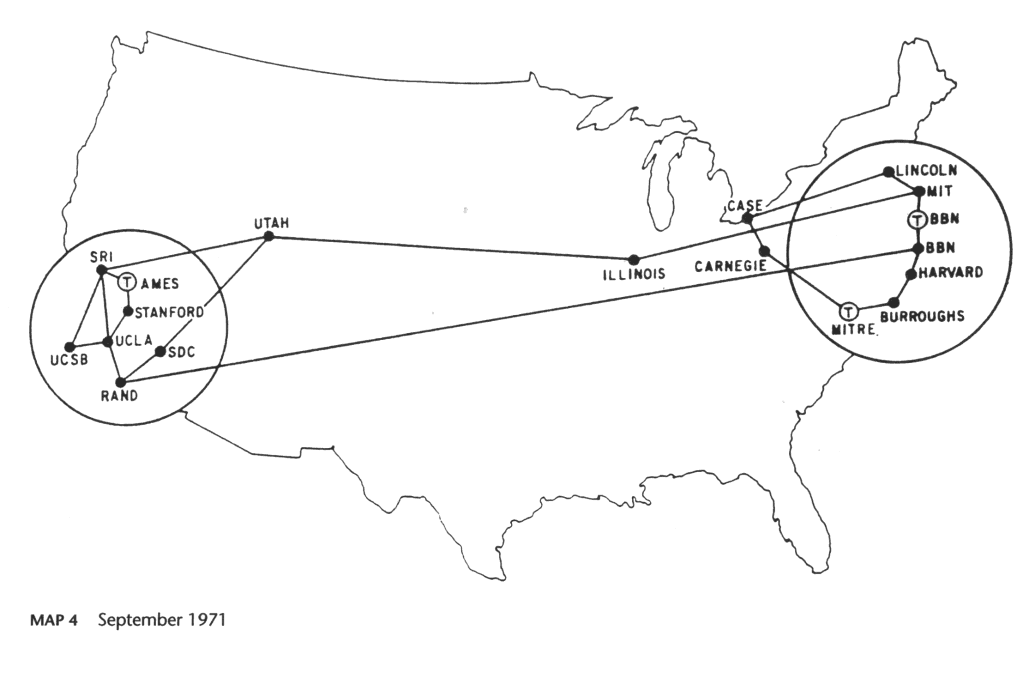
Because this was once the entire internet. Notice the "MIT" in the east coast circle, second from the top.
-
Re:Stack Overflow?
I turn 60 this year. And your problem is?
Either you're good at your job (and if you've been doing it for twenty-five+ years you almost certainly are), or you're not. If you're good and experienced, you won't have any troubled getting an interesting job at a high salary. In my present employment, I was specifically recruited to mentor (and teach software engineering discipline to) a group of good but inexperienced junior developers.
When I was starting out in this game, thirty years ago, the person who fulfilled the role I now have in the team I was then working in was Chris Burton, who, as an apprentice, worked on the build of the Manchester Mark One, and who (after his retirement) led the rebuild of it. He was one of the best software people I've ever worked with, and he was already in his sixties when I met him.
-
Re:Map projections
America fought to stop being oppressed colonies of the English crown (stuff the facade of being a united kingdom). You raise a good point though. In hindsight we should have allied with Scotland, which was a fellow oppressed colony. A two front war would have been a good strategy. It would also have taken advantage of the Franco-Scottish Auld Alliance - which is still in effect.
Scotland was never an oppressed colony - the Act of Union simply united two hereditary crowns that had previously been held by the same lineage. Far from being subject to colonialism, one of the main reasons why the Scottish parliament agreed to Union was that Scotland's economy needed to be bailed out from a financial crisis caused by rampant speculation by Scots in a failed colonisation attempt in (what is now) Panama. Scots continued to be disproportionately represented at the forefront of the British Empire, and Scottish businesses were involved in some of the most dubious activity (where do you think Jardine Matheson was based?).
-
Re:Map projections
America fought to stop being oppressed colonies of the English crown (stuff the facade of being a united kingdom). You raise a good point though. In hindsight we should have allied with Scotland, which was a fellow oppressed colony. A two front war would have been a good strategy. It would also have taken advantage of the Franco-Scottish Auld Alliance - which is still in effect.
-
Re:I find this statement amusing...
Its actually true. Shoot, how much bandwidth do you think actually connects one city with the next? Then then owners of those lines lease those out to your ISPs.
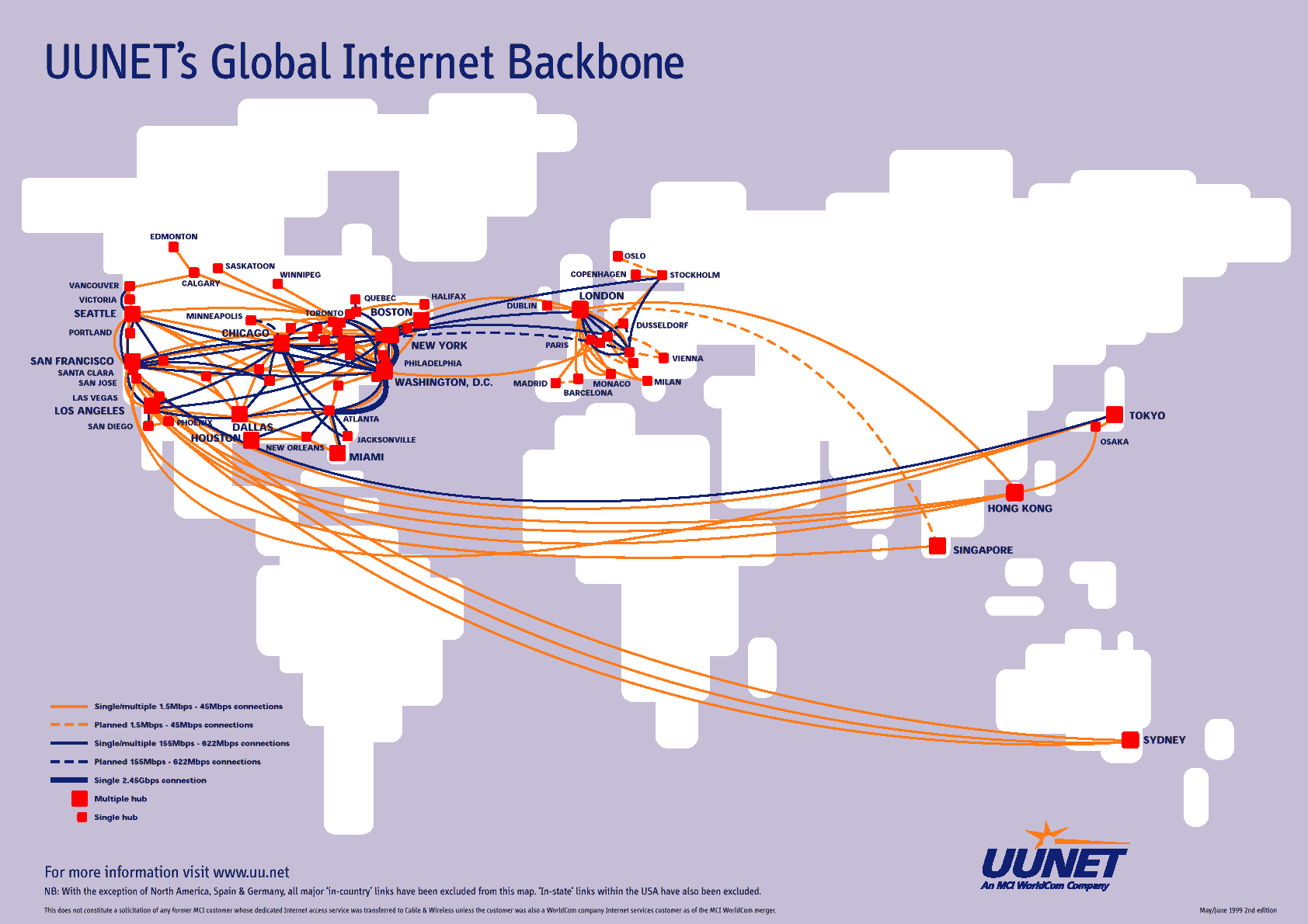
http://personalpages.manchester.ac.uk/staff/m.dodge/cybergeography/atlas/uunet_global_99_large.gif
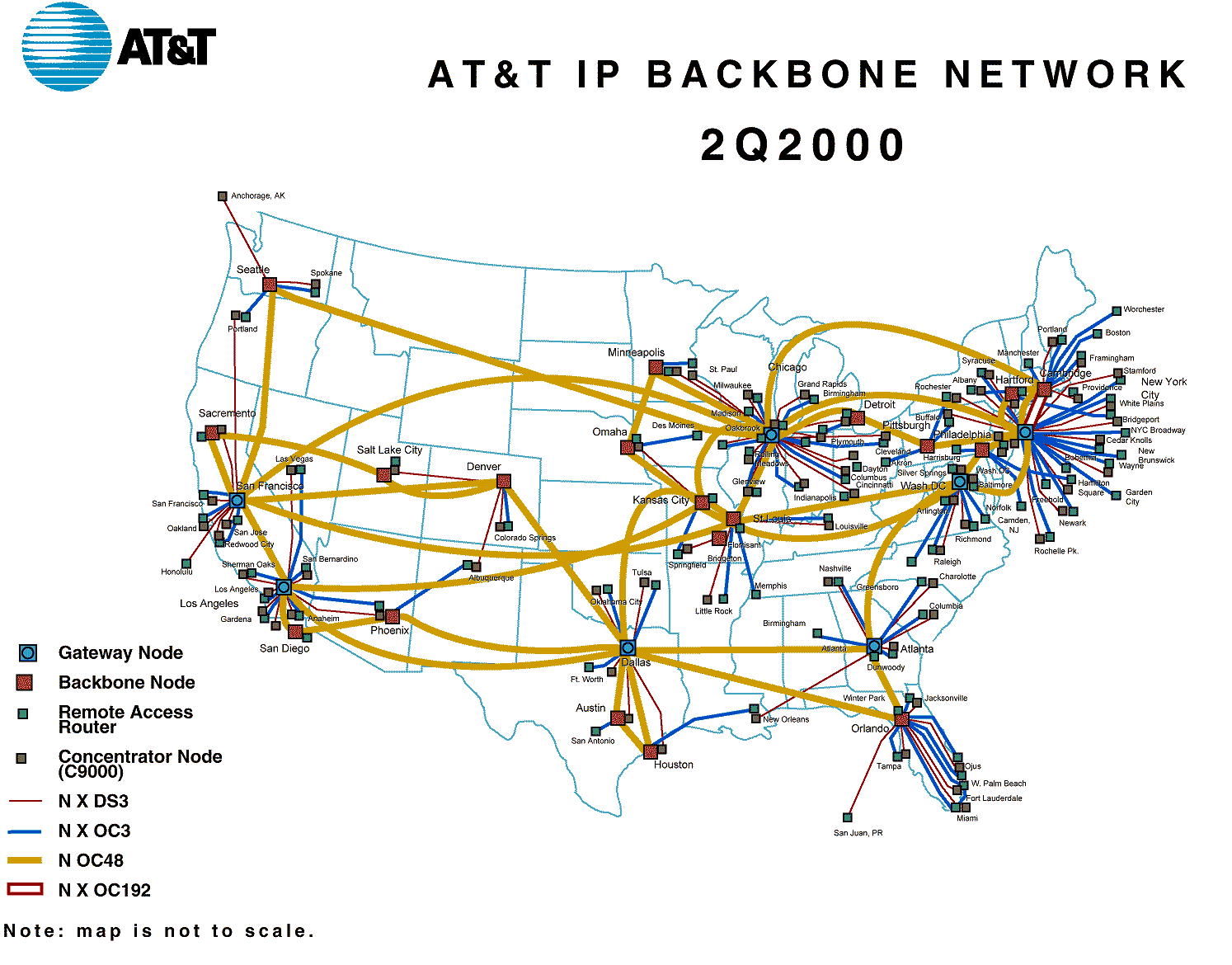
http://personalpages.manchester.ac.uk/staff/m.dodge/cybergeography/atlas/att_backbone_large.gif
According to that map, AT&T has one DS3 line going to Alaska. How fast is DS3?
http://www.lageman.com/bandwidth.htm
What do you think would happen if everyone in Alaska decided to stream 1080p video at once?
Granted, i don't know how old these maps are.
Fiber to the house is a silly idea. Just because you have fiber to the house doesn't mean that you have a fiber connection to every server in the world. Fiber to the house is like having a Ferrari, but being stuck in rushhour traffic. It doesn't matter how fast your car is if the roads are congested.
This fiber buildout needs to be between major hubs - you need more bandwidth between the major cities, and more bandwidth to the outlying areas.
Fiber to the house makes no sense if you are in a rural area, if your ISP only has a T3 or a DS3 connection to their provider.
Want to test this out? Go to someplace like SpeakEasy and do a bandwidth test. Especially those of you with FIOS or some ISP with a 20Mbps or faster connection. Do a speed test to a relatively close city. What do you get? Now try something on the other side of the country. Now go across the continent. Then start going overseas. Try servers in South America, Scandanavia, Eastern Europe, the Middle East. What kind of speeds are you seeing?
Even more so, try these speed tests at different times of day. What do you see?
The problem isn't the bandwidth to your house, the problem is the bandwidth connecting cities with each other.
-
Re:I find this statement amusing...
Its actually true. Shoot, how much bandwidth do you think actually connects one city with the next? Then then owners of those lines lease those out to your ISPs.
http://personalpages.manchester.ac.uk/staff/m.dodge/cybergeography/atlas/uunet_global_99_large.gif
http://personalpages.manchester.ac.uk/staff/m.dodge/cybergeography/atlas/att_backbone_large.gif
According to that map, AT&T has one DS3 line going to Alaska. How fast is DS3?
http://www.lageman.com/bandwidth.htm
What do you think would happen if everyone in Alaska decided to stream 1080p video at once?
Granted, i don't know how old these maps are.
Fiber to the house is a silly idea. Just because you have fiber to the house doesn't mean that you have a fiber connection to every server in the world. Fiber to the house is like having a Ferrari, but being stuck in rushhour traffic. It doesn't matter how fast your car is if the roads are congested.
This fiber buildout needs to be between major hubs - you need more bandwidth between the major cities, and more bandwidth to the outlying areas.
Fiber to the house makes no sense if you are in a rural area, if your ISP only has a T3 or a DS3 connection to their provider.
Want to test this out? Go to someplace like SpeakEasy and do a bandwidth test. Especially those of you with FIOS or some ISP with a 20Mbps or faster connection. Do a speed test to a relatively close city. What do you get? Now try something on the other side of the country. Now go across the continent. Then start going overseas. Try servers in South America, Scandanavia, Eastern Europe, the Middle East. What kind of speeds are you seeing?
Even more so, try these speed tests at different times of day. What do you see?
The problem isn't the bandwidth to your house, the problem is the bandwidth connecting cities with each other.
-
Re:UN takeover must be stopped?
The famed resiliency of the internet requires redundant connections, and economics by and large suppresses redundancy as inefficient except in cases where information is important enough to demand backup routes for the sake of guaranteed uptime.
Only at the local level. By the time you get to the backbone level, there's lots of redundancy because a single cable can't handle the traffic. And not all of those cables go along the same route. For example, this page shows some (admittedly somewhat dated) maps of portions of the Internet topology of Great Britain and parts of Europe.
-
Re:Too late
Certainly true in the uk, and its own hierarchy is well used. Companies tend to sit on
True there are people who abuse it, but generally you can be assured that if you are on for example ac.uk, it really is an academic institute you are on and not some fraudulent university.
-
Re:Interesting.
Freshmeat record: http://freecode.com/projects/balsaasync
Site: http://apt.cs.manchester.ac.uk/projects/tools/balsa/
Also useful: http://apt.cs.man.ac.uk/projects/tools/lard/ -
Re:Most important point not in summary
I'm totally out of my depth on this (so please forgive my ignorance...) but perhaps if I'm understanding properly we've already got a start on rectifying THz radiation.
-
nano devices for rectification
http://personalpages.manchester.ac.uk/staff/A.Song/research/BallisticRectifier.htm this is the only link I could find , I saw this topic some time ago - the ability to build nano structures may solve the rectification - I am sure there was another paper with a different device configuration but I'll never find the thread now - doesn't make this tomorrow but it means a lead on both ends
-
Re:Its the OS that is not secure
No, the internet is not secure.
Africa can be cut off with EASSy http://www.eassy.org/
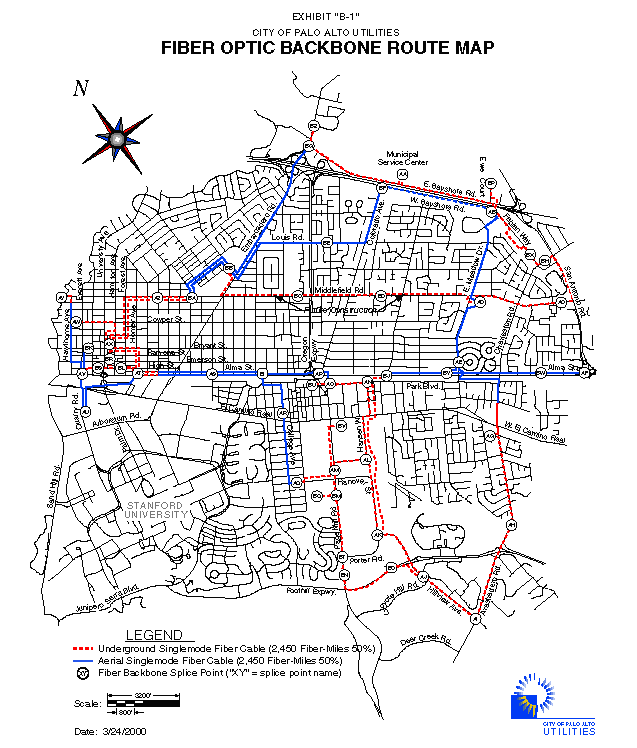
Or, if you want to disrupt Stanford (Palo Alto)
http://personalpages.manchester.ac.uk/staff/m.dodge/cybergeography/atlas/paloalto_fibre_largemap.gif
As far as I know, none of this stuff is "secure". And, I am sure that you can find fiber maps for your neighborhood as well.
-
Re:Viola-Jones?
They're using active appearance models that (AFAICT) work quite differently from the Viola-Jones method.
There's also an open source C++ implementation. -
Bullshit
His website: http://personalpages.manchester.ac.uk/staff/jay.kennedy
Here's the argument, as far as I can tell.
1. Plato's dialogues contain certain patterns.
2. These patterns could only have been put there intentionally.
3. These patterns show Plato was a Pythagorean.
4. Therefore Plato was many centuries ahead of his time.
Regarding the premise (1), sure, everything sufficiently complex will contain lots of patterns. The late Martin Gardner has written some articles about common statistical fallacies that may be relevant here (some are in Science: Good, Bad, and Bogus IIRC). The more data there is to sift through, the more likely one can find a certain complex pattern. He's mostly looking at the lengths and locations of certain sections, within sizeable bodies of text, so it's no surprise he came across certain patterns, especially lengths in fractions of 12, and appearances of "positive" or "negative" issues (e.g., beauty or disease). The existence of the patterns does not support (2), even though some examples have been found that fit the author's specifications fairly precisely. It would take deliberate work to avoid producing any such patterns in long written works (like the Symposium, one of Plato's longest dialogues, which is one of the author's targets), so the patterns hardly show intention. (I'm simply granting the author's premises about the correct way to represent the dialogues, whose exact contents are not entirely known, due to transcription errors, small gaps, etc.)
Nor does (2) support (3). Pythagoreanism was a cult combining mysticism, mathematics, and music, and Pythagoreans worked out the "circle of fifths" from which we get the common 12-note musical scale, and some other very basic Western music theory. We know independently that Plato was influenced by Pythagoreans. But Plato's writing something that happens to contain a few 12-based patterns hardly constitutes an allusion to, let alone an endorsement of, Pythagoreanism or any principle of it. And the author's calling the collections of issues that come up at these intervals "harmonic" or "disharmonic" (rather than, e.g. "relevant", "contrary", or any other way we might connect the given pairs or triples of issues the author mentions in the paper) hardly shows any musical allusion on Plato's part.
Finally, (3) does not support (4), the sexiest claim mentioned in the summary and press release (and on the author's website). If it did, we could just as well say the Pythagoreans anticipated the scientific revolution, etc. Well, in a nearly empty sense they did, just like Democritus anticipated early 20th-century atomic physics (although the former "anticipation" is more vague and tenuous). Some people thousands of years ago said a few things that turned out to be more or less right. This does not show they knew things not widely known until much later, because they lacked sufficient justification for their beliefs. If you speculate enough, as early scientist/philosophers tended to do, you will occasionally get something right. Big whoop.
So as far as I can tell, this paper (and the other writings available on his website) contains a terrible argument for an obviously false conclusion. (Disclaimer: although I'm a philosopher, I'm not an expert on Plato or any other ancients.) -
HogwashThe paper is here : http://personalpages.manchester.ac.uk/staff/jay.kennedy/Kennedy_Apeiron_proofs.pdf For people like me who thought he encoded hidden sentences in verses lengths or in punctuations location, it is very disappointing. The only "hidden" message revealed is that he puts values he think positive at the beginning of his texts and negative values at the end. There is no information in these hidden messages. Just regular literary "researcher" Dan-Browmnesque "message". Here is a quote
Side-by-side comparisons of passages at the same relative locations shows that concepts with neg- ative valuations within the dialogues, like disease, dishonesty, Hades, the body, difference, and negation, tend to cluster in definite ranges and at a definite locations, such as around and between the points ten and eleven twelfths of the way through the dialogues. Similarly, positive concepts, like the forms, virtue, the gods, goodness, justice, and the soul, tend to occur in distinct and equally definite ranges. These tendencies are never absolute, but the mixture of concepts in these ranges is clearly dominated either by more negative or by more positive concepts,
-
Similar thing happened to Inmos in the 70'sStrangely enough Inmos had a similar pollution problem caused by the local water company in south Wales:
What had actually happened, as we found out three months later, was that on Christmas Eve the engineers at the local reservoir decided to celebrate. They were supposed to stay on site, so what they did was to dump 100 times the standard level of chlorine into the water supply, then go off and have a Christmas party. That chlorine totally ruined our semiconductor plant. The result was that the Americans said, "These Brits don't know what they're doing. Get rid of them!". The semiconductor facility was taken away and put under the control of the Americans who were deemed to understand these things.
Seems the the Yanks can't defend themselves against this sort of thing either! http://www.cs.manchester.ac.uk/CCS/res/res33.htm/
-
Re:TLDR
Because he's talking about institutional sexism, which of necessity is a property of cultures (including geek/hacker culture).
See e.g. here.
-
Dr. Ennos actually prefers another theory
"My preferred theory is that they allow the skin to deform and thus stop blistering. That is why we get blisters on the smooth parts of our hands and feet and not the ridged areas: our fingerpads, palms and soles."
-
Re:Crazy
Exactly, tghese naysayers are comparing one insular, tiny nation with high population density to the gigantic, unpopulated North American areas.
I'm going to let the naysayers in on something here that nobody ever brings up: the cost of running fibre to your house is not the only cost involved in upgrading your internet connection. Your average large ISP has (or leases) a huge network backbone connecting all their major markets, and it is the backbone that is a huge cost. Sure, you might be in a major market with very high population density, but your internet connection is limited because it has to connect to the rest of this deserted country.
Since the population centers in the USA are spread far-apart, and in so many different directions, the ISPs are on the hook for much more infrastructure than it takes to connect the population centers in Japan. Not only does that mean you have to lay more cable, but it also means you have to make more branches (or users will complain of too much latency). Just take a look at this link: there are dozens of large US backbone providers, and Japan's largest provider is simple by-comparison (compare to PSINet or UUNET maps). Once it leaves the island, the Japanese networks don't care so much about performance, so the infrastructure is cheap.
Further, the concepts in Japan of NIMBY are much less powerful then they are in this country (not owning your own home and plot of land will do that to you). The people are used to doing what the government/businesses tell them is best, so there's little political impediment to progress. Here in the States, you have to grease every local and state board imaginable, and then HOAs take you to court whenever you want to expand services to an area. This is hardly an easy market to offer cutting-edge services at a low price.
-
Re:You are wrong
-
Re:What about the easy availability of guns ?
Yeah, the UK is just squeaky clean isn't it? http://www.medicine.manchester.ac.uk/aboutus/news/stabbings
Seriously, just because a gun isn't available doesn't mean people won't commit violent crime. -
Re:Same as always?
It sure is. I'm almost sorry I don't work in that area myself
-
Mathematics as Mental Science
In the same way that the other sciences are reproducible physical experiments mathematics consists of reproducible mental experiments.
Proofs give you the steps to reproduce the experiment.
To that end math tells us as much about the human mind (what is considered beautifull or elegant in mathematics?) as it does about the universe.
http://www.maths.manchester.ac.uk/~avb/micromathematics/downloads -
Re:Ireland in Peril
Some of these maps show more cables for Ireland, including some for the Republic of Ireland.
-
Re:Not that surprising
My daughter went to a school in Derbyshire and the "ICT" (that means computing in British Government Education Gobbeldy-gook) teacher insisted there were only two operating systems "Windows" and "Mac". She asked how come all the computers at home ran only Linux, but he insisted there was no such thing! I must say we have now moved her to another school. So there is a long way to go. On the other hand the School of Computing at the University of Manchester has started running a course on linux for teachers.
-
Needs to evolve into Computer Sciences (plural)
No, Computer Science isn't dead. It's simply grown too big to be covered by a single 'Computer Science' label.
Just as biology branched out into 'Life Sciences' it's about time Computer Science was broken into separate areas.
It used to be fine to have a single Computer Science course with one module in Law, another in Algorithms; one in AI, one in Databases etc.
These subjects are too big now; covering the full subject area in a single degree produces graduates who are classic 'jack of all trades, master of none.' -
Uranium, ores, and bacteria
First, wow, not to be rude but "Is uranium naturally radioactive" is a grade 6 science fact. You might want to look into brushing up a bit on your Science 101, if only so you can be more confident of choices you make based on science (and recognizing when things aren't based on such.)
Next, there are, well really were, natural reactors. Wikipidia has a short entry on this, a great webpage on it from the US Dept. of Energy, here's also a picture from Astronomy Picture of the Day showing what it looks like in a mine today. The article that first brought this to wide attention is "A Natural Fission Reactor" by George A. Cowan in Scientific American, July 1976. (Pages 36 - 47) (apparently not available online, visit your local library to read this fascinating article for free.)
Uranium ores are found all over the planet. Australia has 40% of known Uranium ores and is the largest exporter, the US West has 7 active mines, and Canada has 3 very large mines for both domestic use and export. Uranium ores are not always deep in the ground, surface mines are common, indeed there are places, including in the US, where rocks & soil sufficiently "hot" (in terms of emitted radiation, they're generally not warm enough to discern by touch) to harm folks in long term exposure can be found laying around on the surface.
However rocks are a rare, purely local danger, radioactively contaminated water is much more common & dangerous, and also Radon gas. Indeed there are parts of the US, for example Massachusetts, where radon gas detectors are routinely recommended for residential basements.
Finally, the University of Manchester has been doing research* on using bacteria to bioremediate radioactive materials, in short to use biological processes to convert dangerous radioactive compounds into less dangerous (but still radioactive) ones. These biochemical processes can't convert elements, no lead-to-gold, but they can "lock up" materials into less chemically active, or insoluble, forms. Doubtless discovery of bacteria already evolved to take advantage of highly radioactive environments will be of great advantage to their research.
* This is to an archived version of the University of Manchester website, the current website doesn't seem to have as widely informative a page.
-
Correction: Project is privately funded
From the summary: Other responses to the story show that at least many Slashdot readers are none too happy with research into telepathy being done with tax monies.
I made a comment about this the last time around, pointing out that despite the prevalent Slashdotter belief, this pseudoscientific research is privately funded. Here's a paste of what I said before:
I'm pretty sure there isn't any tax payer money involved. According to this page, the project is sponsored by a Portuguese group called the "Bial Foundation" (google translated link). A bit of googling turned up this
Here's another description:
Aims : To encourage the scientific study of Man, from both the physical and spiritual perspectives, by honouring, supporting and promoting the work and efforts of all those who seek out new paths along the route of Research, Science and Knowledge.
General Information : The Bial Foundation was created in 1994. Classified as an institution of public utility by the Portuguese Government, the Bial Foundation includes among its patrons the Portuguese President, the Portuguese Universities Rectors' Council and the Portuguese Medical Association.
(Granted, I'm a little dubious about the last sentence there) -
Re:Tax payer money at work
I'm pretty sure there isn't any tax payer money involved. According to this page, the project is sponsored by a Portuguese group called the "Bial Foundation" (google translated link). A bit of googling turned up this
Here's another description:
Aims : To encourage the scientific study of Man, from both the physical and spiritual perspectives, by honouring, supporting and promoting the work and efforts of all those who seek out new paths along the route of Research, Science and Knowledge.
General Information : The Bial Foundation was created in 1994. Classified as an institution of public utility by the Portuguese Government, the Bial Foundation includes among its patrons the Portuguese President, the Portuguese Universities Rectors' Council and the Portuguese Medical Association.
(Granted, I'm a little dubious about the last sentence there) -
Re:VAX 8600
And even that wasn't the first, I'm sure.
(I seem to remember aynchronous ARMs back in the last millennium (ARM3 days, I guess) but can't be 100% sure)
I think you're right. I remember hearing about Amulet a long time ago when Acorn was still around- here is the Wikipedia Amulet page, and here is the Amulet Group which still exists at Manchester's CS department. -
Not the first thoughCaltech MiniMIPS (1998)
A good survey paper listing other efforts (pdf warning).
And more details of the Manchester Amulet processors. Note that Amulet has ARM core.
-
take a look at MUCS-PCB & KiCAD
MUCS-PCB http://www.cs.manchester.ac.uk/apt/projects/tools
/ mucs-pcb/ --- look at other posts
Similar Ask Slashdot from 2001: "PC Board Design With Unix?" - http://ask.slashdot.org/article.pl?sid=01/02/09/05 30217
Note the differnce in tone: cordial, helpful, no 'me too' posts, no flames, only 8 comments in total
Ahh the good old days of
Just throwing this in cuz of the nasty, spiteful replies and for a fun look at the past: note the use of Unix vs. Linux, lol. -
I am for REAL, yo!... FOSS REAL
Re-post.
MUCS-PCB = FOSS autorouter (2-16 layers) [netlist in... gerber out] - over 20 years of development: started in 1985
KiCAD = FOSS complete EDA work-flow, with text save-files, so you can automate footprint and symbols creation (isn't this what BSDL files are meant for? -- how complex do you want your symbols)
http://www.cs.manchester.ac.uk/apt/projects/tools/ mucs-pcb/
http://www.lis.inpg.fr/realise_au_lis/kicad/
OK... above solution requires some upfront setup, but if you dont have the skill and time to code a few scripts, you should probably buy professional tools like DXP Designer or OrCAD.
Good luck. -
MUCS-PCB & KiCAD = FOSS PCB Heaven
MUCS-PCB http://www.cs.manchester.ac.uk/apt/projects/tools
/ mucs-pcb/
- multi-layer auto-router with Gerber Output
- input is a netlist... like the kind KiCAD's eeschema can create
problems: not for complex/high-speed designs (if u need BGA devices, matched-length traces/impedences, etc. you NEED high end tools like Altium's Protel DXP/Designer or OrCAD)
What problems did u have with KiCAD? I've done several hobbyist designs in KiCAD and it has met all my needs. It takes a while to get used to its quirky UI, but after that you can do a LOT with it.
KiCAD has a (very simple, alpha version) autorouter, Gerber 274x output, multilayer, full design flow, etc.
Also, its text-based files allow you to easily do complex editing (like changing all pad sizes for a given part) with a simple search-replace text tool (like the one found in the FOSS tool Scite http://www.scintilla.org/SciTE.html)
Good luck. -
Re:But wait...
ok so it probably was a myth, it was an amusing story when i studied there.
In any case it is now being demolished to make way for a new bigger building.
If your interested here are some links to imagesthe old building: http://www.manchesteronline.co.uk/ewm/001ewm/051_
d emolition/26.htmlduring demolition: http://www.aidan.co.uk/photo5041.htm
proposed new building: http://www.maths.manchester.ac.uk/
-
Where Dataflow works and where it dosen'tDataflow hardware has been around a long time, and it does not have a good track record. There was a dataflow machine research project at Manchester University in England from 1976 to 1995, but it is no longer active, at least according to this web page http://www.cs.manchester.ac.uk/cnc/projects/dataf
l ow.htmlThere have been many research machines, but no successful commercial products. Data flow techniques seem have had their greatest impact in two areas: compiler optimization and instruction scheduling inside the CPU. Many optimizations use SSA, or static single assignment. SSA means that any variable is only assigned a value once. Converting to SSA means that the code can be represented as a Directed Acyclic Graph (DAG), and this is useful for code generation. Dataflow is also implemented in hardware to enable parallelism and features like speculative execution in the pipeline.
Experience has shown that there is only so much parallelism that can usefully be exploited using either compiler or hardware based dataflow based techniques. This is not a good sign for this project, unless they are targeting primarily very parallel applications, for example DSP algorithms or image processing. Even so, other research groups have tried this and failed (or at least not succeeded). One is the RAW architecture at MIT: http://cag-www.lcs.mit.edu/raw/ Another example is iWarp, a CMU/Intel systolic processor. RAW is currently active, iWarp is over.
-
Difficult because heat generators are PCB mountedFor audio equipment, the big heat generators (the output driver FETs or transistors) can be physically removed from the Printed Circuit Board and mounted to the heatsinks. Connections are made with a couple wires. This is not possible with the major heat generators in a personal computer - the processor, bridge, video, and memory must be mounted on the PCB because of the speed of the signals going into and coming out of these components. Long runs mean delays and (more importantly) bad signal quality. Possible solutions are:
- use of heat transfer technology to migrate the energy from these components to the outside case / heatsinks
- a shift to a new technology, like totally asynchronous.
- a complete rethink of the "rectangular box" PC design and enclosed circuitry
Next problem is what you do with a very hot case. It's got to be placed where it can radiate the heat. I'm not sure, but crammed into a corner under a desk might not be the best place.
-
Difficult because heat generators are PCB mountedFor audio equipment, the big heat generators (the output driver FETs or transistors) can be physically removed from the Printed Circuit Board and mounted to the heatsinks. Connections are made with a couple wires. This is not possible with the major heat generators in a personal computer - the processor, bridge, video, and memory must be mounted on the PCB because of the speed of the signals going into and coming out of these components. Long runs mean delays and (more importantly) bad signal quality. Possible solutions are:
- use of heat transfer technology to migrate the energy from these components to the outside case / heatsinks
- a shift to a new technology, like totally asynchronous.
- a complete rethink of the "rectangular box" PC design and enclosed circuitry
Next problem is what you do with a very hot case. It's got to be placed where it can radiate the heat. I'm not sure, but crammed into a corner under a desk might not be the best place.
-
Re:The monkey man screeches
Um, I think virtual memory is an English invention: vide the Ferranti Atlas.
-
[Update the link] New University web site
Dear
Is there a chance you could update the link to the University of Manchester new web site? Indeed, following the merger of the University of Manchester with UMIST, the new website since Octobre 1st is http://www.manchester.ac.uk/, replacing the old http://www.man.ac.uk/, as indicated on top of the site.
I know it is not in your policy to edit posts once they have been submitted, but for future references, could the Related Link to the University be updated?
Thanks a lot,
Gilles
--
University of Manchester, UK
PhD student -
DNA?
I don't think this article means what most people reading it probably think it means.
How would such a machine replicate the DNA and RNA in the cells nucleus? There are 3 billion base pairs in human DNA. At 1000hz (roughly the speed at which an inkjet printer shoots ink drops) it would take 833 hours to produce the DNA in a single cell. Even if they are able to operate at 1mhz it would take about an hour per cell.
So, do they clone the DNA using a separate process and then just squirt one set of chromosomes into each nucleus or do they produce zombie cells that have no dna?
Reading the pre-lobotomized version of the article, we see that it doesn't print proteins at all but instead prints already duplicated cells into position. And the scaffold they refer to is not the flat substrate shown in the picture but is apparently a plastic lattice that holds the cells in position and then disolves in the body once the cells have joined to each other and the existing tissue.
-
Such a processor already exists
See here. Developed by Steve Furber and his team at The University Of Manchester
-
Original press release without Physorg spam.
Physorg's page is just the original press release with the original contact information removed and no link back to it. And really broken HTML apparently to prevent the browser from letting you select the story text as a bonus.
Physorg is useful as a place to find stories, but its "link trap" design is really getting annoying... if you're going to link them, at least include a link to the original story as well. -
Manchester or UMIST
The article linked to the wrong university website, the new one is here.
The University of Manchester is really still two universities, in the process of merger. As an ex Owens student, I'm intrigued as to whether it was their physics teams that found this or UMIST's down the road... Both good teams and I'm very proud they're still doing such good work. -
University Doesn't Exist
On 1 October 2004, The Victoria University Of Manchester and UMIST merged to form The University Of Manchester. The new site is here