Slashdot Mirror
Domain: motherjones.com
Stories and comments across the archive that link to motherjones.com.
Stories · 66
-
Google Helps Government Conduct Warrantless Searches, Alleges EPIC (tomshardware.com)
schwit1 quotes Tom's Hardware: The Electronic Privacy Information Center ("EPIC"), a civil liberties group based in Washington D.C., filed an amicus brief in the United States vs. Wilson case concerning Google scanning billions of users' files for unlawful content and then sending that information to law enforcement agencies.
EPIC alleges that law enforcement is using Google, a private entity, to bypass the Fourth Amendment, which requires due process and probable cause before "searching or seizing" someone's property.
As a private entity, Google doesn't have to abide by the Fourth Amendment as the government has to, so it can do those mass searches on its behalf and then give the government the results. The U.S. government has been increasingly using this strategy to bypass Fourth Amendment protections of U.S. citizens and to expand its warrantless surveillance operations further.
Google and a few other companies have "voluntarily" agreed to use a database of image hashes from the National Center for Missing and Exploited Children (NCMEC) to help the agency find exploited children.
More than that, the companies would also give any information they have on the people who owned those images, given they are users of said companies' services and have shared the images through those services. -
Why Hasn't The Gig Economy Killed Traditional Work? (npr.org)
An anonymous reader quotes NPR: In recent months, a slew of studies has debunked predictions that we're witnessing the dawn of a new "gig economy." The U.S. Bureau of Labor Statistics (BLS) found that there was actually a decline in the categories of jobs associated with the gig economy between 2005 and 2017. Larry Katz and the late Alan Krueger then revised their influential study that had originally found gig work was exploding. Instead, they found it had only grown modestly. Other economists ended up finding the same -- and now writers are declaring the gig economy is "a big nothingburger."
Arun Sundararajan, a professor at the NYU Stern School of Business and the author of The Sharing Economy: The End of Employment and the Rise of Crowd-Based Capitalism, remains a true believer in the gig revolution.... When asked about the onslaught of data contradicting his thesis, Sundararajan said the Bureau of Labor Statistics continues "to underestimate the size of the gig economy and in particular of the platform-based gig economy." The best BLS estimate of the number of gig workers employed through digital platforms -- whether full-time, part-time or occasionally -- is one percent of the total U.S. workforce, or about 1.6 million workers, as of mid-2017. Sundararajan argues that the survey questions the BLS used to gather this data were clunky and don't quite capture what's going on.... He believes work done through gig platforms can be more efficient than work done in a traditional company -- and that will spell the company's doom...
The dawn of a new gig economy has seemed plausible because the Internet has been dramatically reducing transaction costs. Search engines have made it incredibly cheap to find goods and services, compare prices, and get bargains. Social media and peer reviews have made it easier to determine if people are trustworthy. E-commerce has made it easier process payments. You can click a button on a mobile phone and instantaneously have GPS guide drivers right to you. But as big as these efficiency gains have been, a new economy based on crowds of people doing gigs through digital platforms -- as exciting or scary as that might sound -- still doesn't compare to one based on the efficiencies and stability of the good old-fashioned company. -
Jared & Ivanka: Couple 'Continues To Use' Private Messaging For White House Business, Top Democrat Says (thedailybeast.com)
Freshly Exhumed writes: Rep. Elijah Cummings (D-MD), the chairman of the House Oversight Committee, has revealed that senior White House advisor Jared Kushner's lawyer admitted in December that his client "continues to use" WhatsApp to conduct official White House business. The chairman also said that a lawyer for Ivanka Trump and Mr. Kushner told the committee late last year that they additionally used private email accounts for official White House business in a way that may have violated federal records laws. Mr Kushner's lawyer, Abbe Lowell could not say whether his client used WhatsApp to share classified information. Regardless, Cummings says the communications raise questions about whether Kushner and other officials violated the Presidential Records Act, which requires the president and his staff "take all practical steps to file personal records separately from Presidential records." As for Ivanka's use of a personal email account to conduct official business, her lawyer says she sent the emails before she was briefed on the rules.
If you're not familiar with WhatsApp, here's what you should know about it: "As of January 2019, more than 1.5 billion users in over 180 countries use WhatsApp, created in 2009 as an alternative to text messaging," reports USA Today. "Facebook acquired WhatsApp in 2014 to make a bigger play in the rapidly-growing messaging market, along with its own Messenger platform, which also boasts 1.5 billion users." The service features end-to-end encryption, meaning the sender and recipient are the only ones who can view the messages. -
The EPA's Bold New Idea Has Massive Implications For Public Health (motherjones.com)
An anonymous reader shares a report: For years, the Environmental Protection Agency's regulation of radiation, carcinogens, and other toxic chemicals has been based on the cautious scientific reasoning that considers even slight exposure to toxins potentially risky to public health. From that premise, the EPA has assessed a wide range of pollution, including lung-clogging particulate matter, Superfund cleanup, water treatment, radiation exposure, and risk assessments for carcinogens like benzene.
That time-honored approach may be changing because of easy-to-overlook phrasing within a paragraph buried in the proposed "Strengthening Transparency In Regulatory Science Rule," a regulation that will bar the EPA from considering a wide range of scientific studies in its rule-making. With a few sentences buried in the seven-page Federal Register text, the EPA is opening the door to a new scientific approach that -- in a worst-case scenario -- could further relax regulations because of the assumption that a little pollution is actually beneficial.
Some scientists have considered the implications of this paragraph and described a whole array of potential problems to Mother Jones. Because the paragraph is written in incredibly vague language, most scientists were unable to explain which pollutants or regulations were the prime targets. -
30% of America's Student Loan Borrowers Can't Keep Up After Six Years (cnbc.com)
The IRS recently ruled that under some circumstances employers can link their 401(k) matching contributions to the amount of an employee's student loan repayments -- making it easier for recent graduates to take advantage of this employer benefit. But that's one spot of good news in a sea of bad, according to one anonymous Slashdot reader: Two new articles criticize America's student loan policies (under both the Obama and Trump administrations). CNBC cites reports that within six years, more than 15% of student borrowers had officially defaulted, while 10% more had stopped making payments and another 4.8% were at least 90 days late. And for-profit colleges fared even worse, where nearly 25% of graduates defaulted, and a total of 44% faced "some form of loan distress."
These trends were masked by Department of Education reports which stopped tracking repayment rates after just three years (reporting defaults rates of just 10%), according to Ben Miller, senior director for post-secondary education at the left-leaning Center for American Progress. "Official statistics present a relatively rosy picture of student debt. But looking at outcomes over more time and in greater detail shows that hundreds of thousands more borrowers from each cohort face troubles repaying." -
Millennials Unearth an Amazing Hack to Get Free TV: the Antenna (wsj.com)
From a report on WSJ: Dan Sisco has discovered a technology that allows him to access half a dozen major TV channels, completely free. "I was just kind of surprised that this is technology that exists (alternative source)," says Mr. Sisco, 28 years old. "It's been awesome. It doesn't log out and it doesn't skip." Let's hear a round of applause for TV antennas, often called "rabbit ears," a technology invented roughly seven decades ago, long before there was even a cord to be cut, which had been consigned to the technology trash can along with cassette tapes and VCRs. The antenna is mounting a quiet comeback, propelled by a generation that never knew life before cable television, and who primarily watch Netflix , Hulu and HBO via the internet. Antenna sales in the U.S. are projected to rise 7 percent in 2017 to nearly 8 million units, according to the Consumer Technology Association, a trade group. Mr. Sisco, an M.B.A. student in Provo, Utah, made his discovery after inviting friends over to watch the Super Bowl in 2014. The online stream he found to watch the game didn't have regular commercials -- disappointing half of his guests who were only interested in the ads. "An antenna was not even on my radar," he says. He went online and discovered he could buy one for $20 and watch major networks like ABC, NBC, Fox and CBS free. -
A Third Of the Planet's Population Is Exposed To Deadly Heatwaves (motherjones.com)
An anonymous reader shares a report: Nearly a third of the world's population is now exposed to climatic conditions that produce deadly heatwaves, as the accumulation of greenhouse gases in the atmosphere makes it "almost inevitable" that vast areas of the planet will face rising fatalities from high temperatures, new research has found. Climate change has escalated the heatwave risk across the globe, the study states, with nearly half of the world's population set to suffer periods of deadly heat by the end of the century even if greenhouse gases are radically cut. "For heatwaves, our options are now between bad or terrible," said Camilo Mora, an academic at the University of Hawaii and lead author of the study. High temperatures are currently baking large swaths of the south-western US, with the National Weather Service (NWS) issuing an excessive heat warning for Phoenix, Arizona, which is set to reach 119F (48.3C) on Monday. The heat warning extends across much of Arizona and up through the heart of California, with Palm Springs forecast a toasty 116F (46.6C) on Monday and Sacramento set to reach 107F (41.6C). -
NSA Chief: Nation-State Made 'Conscious Effort' To Sway US Presidential Election (aol.com)
The head of the US National Security Agency has said that a "nation-state" consciously targeted presidential candidate Hillary Clinton's presidential campaign, in order to affect the US election. From an AOL article:Adm. Michael Rogers, who leads both the NSA and US Cyber Command, made the comments in response to a question about Wikileaks' release of nearly 20,000 internal DNC emails during a conference presented by The Wall Street Journal. "There shouldn't be any doubt in anybody's minds," Rogers said. "This was not something that was done casually. This was not something that was done by chance. This was not a target that was selected purely arbitrarily. This was a conscious effort by a nation-state to attempt to achieve a specific effect." Rogers did not specify the nation-state or the specific effect, though US intelligence officials suspect Russia provided the emails to Wikileaks, after hackers stole them from inside DNC servers and the personal email account of Hillary Clinton's campaign manager, John Podesta. At least two different hacker groups associated with the Russian government were found inside the networks of the DNC over the past year, reading emails, chats, and downloading private documents. Many of those files were later released by Wikileaks.Further reading: Quartz and MotherJones. -
Lawsuit Seeks To Block New York Ban On 'Ballot Selfies' (msnbc.com)
You have have the right to vote, but should you have the right to take a selfie at a ballot? According to ABC News, a federal lawsuit is challenging a New York state law that makes it a misdemeanor to show a marked election ballot to others: The lawsuit filed late Wednesday in Manhattan federal court seeks to have the law banning so-called "ballot selfies" declared unconstitutional. The lawsuit says publishing a voted ballot on social media can be a powerful form of political expression. It says that someone claiming they voted without photographic proof reduces the credibility of the individual. Attorney Leo Glickman, who filed the suit on behalf of three voters, says the lawsuit is consistent with claims made in Michigan, Indiana and New Hampshire, where similar laws have been struck down. In a separate report, Mother Jones' Kevin Drum explained the reasoning behind why a law against "ballot selfies" would exist in the first place: Just for the record, then, there is a reason for selfie bans in voting booths: it prevents vote buying. After all, the only way it makes sense to pay people for their votes is if you have proof that they voted the way you told them to. Back in the day that was no problem, but ever since secret ballots became the norm vote buying has died out. Selfies change all that. If I give you ten bucks to vote for my favorite candidate for mayor, I can withhold payment until you show me a selfie proving that you voted for my guy. -
The Washington Post Tracked Facebook's Trending Topics For 3 Weeks, Found 5 Fake Stories and 3 Inaccurate Articles (washingtonpost.com)
An alarming number of people rely on social media, including and especially Facebook, for news. Over the past few months, we have seen how Facebook's Trending Topics feature is often biased, and moreover, how sometimes fake news slips through its filter. The Washington Post monitored the website for over three weeks and found that Facebook is still struggling to get its algorithm right. From the report: The Megyn Kelly incident was supposed to be an anomaly. An unfortunate one-off. A bit of (very public, embarrassing) bad luck. But in the six weeks since Facebook revamped its Trending system -- and a hoax about the Fox News Channel star subsequently trended -- the site has repeatedly promoted "news" stories that are actually works of fiction. As part of a larger audit of Facebook's Trending topics, the Intersect logged every news story that trended across four accounts during the workdays from Aug. 31 to Sept. 22. During that time, we uncovered five trending stories that were indisputably fake and three that were profoundly inaccurate (Editor's note: the link could be paywalled; alternate source). On top of that, we found that news releases, blog posts from sites such as Medium and links to online stores such as iTunes regularly trended. Facebook declined to comment about Trending on the record. "I'm not at all surprised how many fake stories have trended," one former member of the team that used to oversee Trending told the Post. "It was beyond predictable by anyone who spent time with the actual functionality of the product, not just the code."The Post adds that "there's no guarantee" that it was able to catch every hoax, since it looked at Trending feature only once every hour. -
Trump Calls For Russia To Cyber-Invade the United States To Find Clinton's 'Missing' Emails (gawker.com)
Republican presidential nominee Donald Trump publicly called on the Russian hackers allegedly responsible for the recent leak of DNC emails to launch another cyber-attack on the United States, this time to hack emails from Hillary Clinton's tenure as secretary of State, according to reporters who attended the press conference Wednesday. (Alternate source: NYTimes, Quartz, and MotherJones) "Russia, if you're listening, I hope you're able to find the 30,000 emails that are missing," Trump said. "I think you will probably be rewarded mightily by our press."
Clinton came under investigation for her use of a personal email address while serving as secretary of state. After turning over to the FBI all correspondence about government business during her years in the State Department, Clinton revealed at a press conference last year that she had deleted about half of her emails that pertained to personal matters, like her daughter's wedding. Attorney General Loretta Lynch ultimately decided not to pursue criminal charges against Clinton. Update: Here's a video of Trump saying that. -
3 Years Ago, Microsoft Said Tech Should Fund K-12 CS Education. What Changed? (motherjones.com)
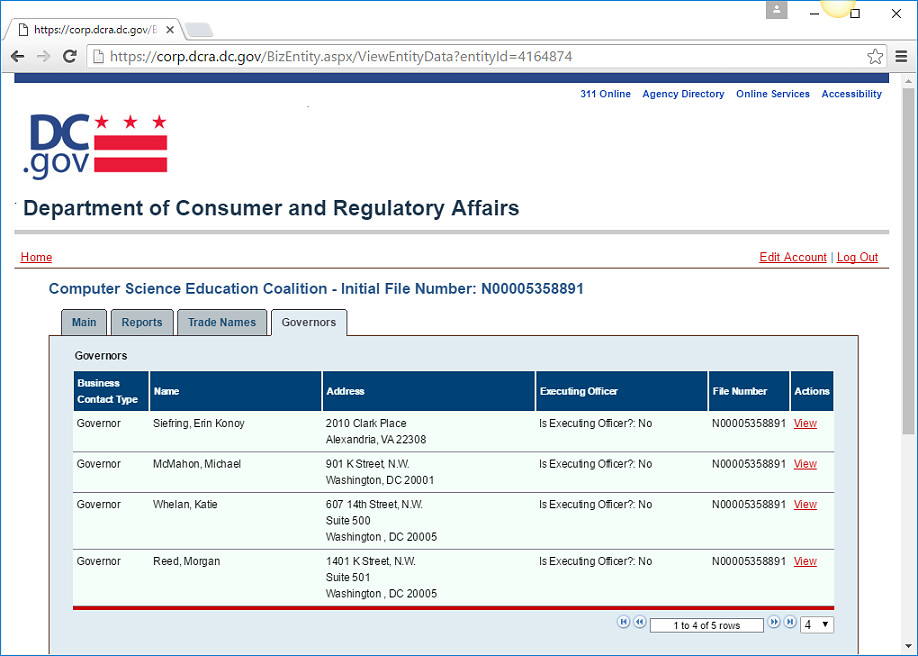
theodp writes: Last week, Microsoft and some of the biggest names in tech and corporate America threw their weight behind a Change.org petition that urged Congress to fund K-12 Computer Science education. The petition, started by the tech-backed CS Education Coalition (btw, 901 K Street NW is Microsoft's DC HQ) in partnership with tech-backed Code.org, now has 90,000+ supporters. But three years ago, Microsoft backed a very different Change.org petition that called for corporate America to foot the STEM education bill.
"While the need to expand high-skilled immigration is immediate," read the letter to Congress, "we also need to expand STEM opportunities in U.S. education. A positive proposal has emerged in Washington to create a national STEM education fund, paid for only by businesses using green cards and visas. This fund will help prepare Americans for 21st-century STEM jobs. The proposal is supported by a broad coalition [PDF] that includes Microsoft, GE, the National Council of La Raza, the National Association of Manufactures, and the National Science Teachers Association, to name a few."
The earlier petition, which wound up with 41,009 supporters, was started by Voices for Innovation, a self-described "Microsoft supported community" that says it's now "proud to support the Computer Science Education Coalition" as part of its efforts to "shape public policies for our 21st century digital economy and society." So, what changed? Well, Mother Jones did warn that what Microsoft promises and what it delivers for education isn't necessarily the same... -
Iraq's Mosul Dam Could Burst At Any Time (blastingnews.com)
MarkWhittington writes: The Mosul Dam, located near the city of Mosul in Northern Iraq, was started by Saddam Hussein in 1981 as a way to bolster his regime and provide power to the surrounding area. It was completed in 1986 and has since generated 3,420 gigawatt/hours per year. Unfortunately, the dam was built on an unstable foundation of gypsum and thus needs constant repairs to plug leaks and maintain its structural integrity. Even more unfortunately, such repair efforts have stopped since the Islamic State seized control of Mosul. The dam could burst at any time, as a consequence. The flood could kill a million people and render a million more homeless. Radio Free Europe reports that Italy's Trevi Group has been contracted to repair and maintain the dam, but it seems like there's a lot to catch up with. (Also at The Guardian and Mother Jones.) -
Why Car Salesmen Don't Want To Sell Electric Cars
HughPickens.com writes: Matt Richtel writes in the NYT that one big reason there are only about 330,000 electric vehicles on the road is that car dealers show little enthusiasm for putting consumers into electric cars. Industry insiders say that electric vehicles do not offer dealers the same profits as gas-powered cars, they take more time to sell because of the explaining required, and electric vehicles may require less maintenance, undermining the biggest source of dealer profits — their service departments. Some electric car buyers have said they felt as if they were the ones doing the selling. Chelsea Dell made an appointment to test-drive a used Volt but when she arrived, she said, a salesman told her that the car hadn't been washed, and that he had instead readied a less expensive, gas-powered car. "I was ready to pull the trigger, and they were trying to muscle me into a Chevy Sonic," says Dell. "The thing I was baffled at was that the Volt was a lot more expensive." Marc Deutsch, Nissan's business development manager for electric vehicles says some salespeople just can't rationalize the time it takes to sell the cars. A salesperson "can sell two gas burners in less than it takes to sell a Leaf," Deutsch says. "It's a lot of work for a little pay."
Jared Allen says that service is crucial to dealer profits and that dealers didn't want to push consumers into electric cars that might make them less inclined to return for service. Maybe that helps explains the experience of Robert Kast, who last year leased a Volkswagen e-Golf from a local dealer. He said the salesman offered him a $15-per-month maintenance package that included service for oil changes, belt repair and water pumps. "I said: 'You know it doesn't have any of those things,'" Mr. Kast recalled. He said the salesman excused himself to go confirm this with his manager. Of the whole experience, Mr. Kast, 61, said: "I knew a whole lot more about the car than anyone in the building." "Until selling a plug-in electric car is as quick and easy as selling any other vehicle that nets the dealer the same profit, many dealers will avoid them, for very logical and understandable reasons," says John Voelker. "That means that the appropriate question should be directed to makers of electric cars: What are you doing to make selling electric cars as profitable and painless for your dealers as selling gasoline or diesel vehicles?" -
Game About Killing Poachers Vies For Top Prize In Microsoft Student Tech Contest
theodp writes: GeekWire reports on a group of students from Nepal who will be competing for the $50K top prize in Microsoft's Imagine Cup student tech contest with a first-person shooter in which players track down and kill poachers. "Until and unless the player kills all the poachers," reads the description for Defend Your Territory, "he/she cannot progress to next level. To make the game more interesting, there will be lots of weapons and vehicles unlock." So, is this the inspiration Google needs to take their anti-poaching drone program to the next level? -
Google Diversity Report Straight Out of 'How To Lie With Statistics' Playbook
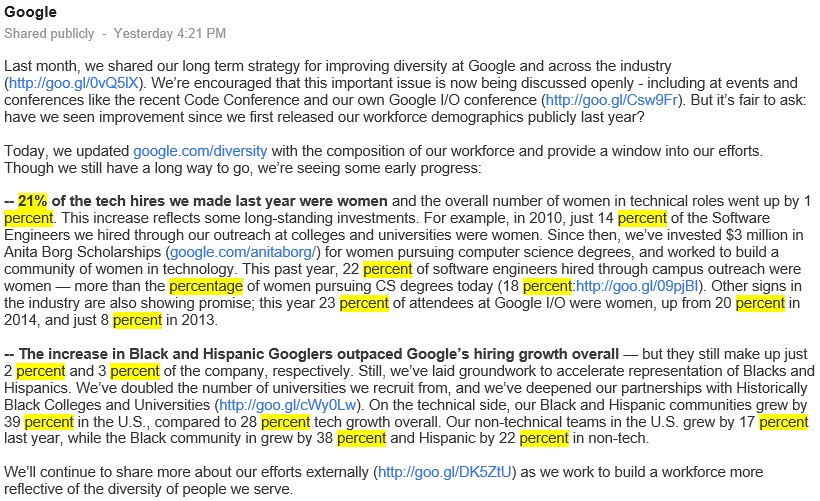
theodp writes: Among the books recommended by Bill Gates for beach reading this summer is How to Lie With Statistics, the published-in-1954-but-timely-as-ever introduction to the (mis)use of statistics. So, how can one lie with statistics? "Sometimes it is percentages that are given and raw figures that are missing," explains the book, "and this can be deceptive too." So, does this explain Google's just-released Diversity Report and the accompanying chock-full-o-percentages narrative (find-all-%-image), which boasts "the Black community in grew [sic] by 38 percent", while the less-impressive raw figures — e.g., the number of Google employees increased by 5,928, but the ranks of Black females only increased by 35 (less than 0.6% of the net increase) — are relegated to a PDF of its EEO-1 Report that's linked to in the fine-print footnotes? To be fair to Google, Microsoft, Twitter, Apple and Amazon didn't want people to see their EEO-1 numbers, either. -
Swallowing Your Password
HughPickens.com writes: Amir Mizroch reports at the WSJ that a PayPal executive who works with engineers and developers to find and test new technologies, says that embeddable, injectable, and ingestible devices are the next wave in identification for mobile payments and other sensitive online interactions. Jonathon Leblanc says that identification of people will shift from "antiquated" external body methods like fingerprints, toward internal body functions like heartbeat and vein recognition, where embedded and ingestible devices will allow "natural body identification." Ingestible devices could be powered by stomach acid, which will run their batteries and could detect glucose levels and other unique internal features can use a person's body as a way to identify them and beam that data out. Leblanc made his remarks during a presentation called Kill all Passwords that he's recently started giving at various tech conferences in the U.S. and Europe, arguing that technology has taken a huge leap forward to "true integration with the human body." But the idea has its skeptics. What could possibly go wrong with a little implanted device that reads your vein patterns or your heart's unique activity or blood glucose levels writes AJ Vicens? "Wouldn't an insurance company love to use that information to decide that you had one too many donuts—so it won't be covering that bypass surgery after all?" -
How 'Virtual Water' Can Help Ease California's Drought
HughPickens.com writes Bill Davidow And Michael S. Malone write in the WSJ that recent rains have barely made a dent in California's enduring drought, now in its fourth year. Thus, it's time to solve the state's water problem with radical solutions, and they can begin with "virtual water." This concept describes water that is used to produce food or other commodities, such as cotton. According to Davidow and Malone, when those commodities are shipped out of state, virtual water is exported. Today California exports about six trillion gallons of virtual water, or about 500 gallons per resident a day. How can this happen amid drought? The problem is mispricing. If water were priced properly, it is a safe bet that farmers would waste far less of it, and the effects of California's drought—its worst in recorded history—would not be so severe. "A free market would raise the price of water, reflecting its scarcity, and lead to a reduction in the export of virtual water," say Davidow and Malone. "A long history of local politics, complicated regulation and seemingly arbitrary controls on distribution have led to gross inefficiency."
For example, producing almonds is highly profitable when water is cheap but almond trees are thirsty, and almond production uses about 10% of California's total water supply. The thing is, nuts use a whole lot of water: it takes about a gallon of water to grow one almond, and nearly five gallons to produce a walnut. "Suppose an almond farmer could sell real water to any buyer, regardless of county boundaries, at market prices—many hundreds of dollars per acre-foot—if he agreed to cut his usage in half, say, by drawing only two acre-feet, instead of four, from his wells," say the authors. "He might have to curtail all or part of his almond orchard and grow more water-efficient crops. But he also might make enough money selling his water to make that decision worthwhile." Using a similar strategy across its agricultural industry, California might be able to reverse the economic logic that has driven farmers to plant more water-intensive crops. "This would take creative thinking, something California is known for, and trust in the power of free markets," conclude the authors adding that "almost anything would be better, and fairer, than the current contradictory and self-defeating regulations." -
Interviews: Malcolm Gladwell Answers Your Questions
A few weeks ago, you had a chance to ask Malcolm Gladwell about his writing and social science research. Below you'll find his answers to your questions. Genetics
by Anonymous Coward
Today, your continued belief in the Tabula Rasa myth seems increasingly outdated and contradicted by a wide variety of research from many notable evolutionary psychologists and genetics researchers. How do you continue to believe that intelligence and ability is not significantly genetic despite overwhelming evidence to the contrary?
Gladwell: I'm not sure where you got the idea that I'm a "Tabula Rasa" believer. believe me: as a life-long competitive runner, I'm only too aware of the large contribution innate differences make to performance. I guess I would just say that I find the environmental piece of the equation more interesting, from an analytical perspective, because its the portion that we, as a society, can do something about. In looking at things like the 10,000 rule, I've always been interested in the interaction between nature and nature--as in, what kind of effort and resources are necessary to express native ability?
How
by werepants
You have made a career out of writing books that popularize scientific findings - it seems like this is a task fraught with potential dangers, in terms of representing something that your readers misinterpret and misapply, or perhaps taking a published study and drawing an unwarranted conclusion yourself that attracts the ire of the original researchers. Certainly, much science journalism lately can be criticized for sensationalizing scientific results in the pursuit of better headlines, sometimes at the cost of being deliberately misleading. Can you expound a bit on the issues you've run into as a purveyor of scientific results, and explain how you balance the need for a faithful presentation of the source material with the desire to find something relatable and compelling enough to write a book about?
Gladwell: Its a good question. there is always a tension between specificity and accessibility. If you are writing for an elite audience--as an academic does--the line gets shaded to one end; if you are writing for a popular audience--as I do--the line gets shaded to the other end. There is no simply or easy solution as to how those two conditions ought to be balanced. Those who pretend that you can do both simultaneously--that is, represent the full complexity of an issue and also render it comprehensible to a mass audience--are smoking crack.
Sharpshooter fallacy
by i kan reed
The areas you work in focus on very small sample sizes: software billionaires, major cultural shifts, and cases where the most improbable result happened.
Within these areas, you've developed mental frameworks off of shared elements between each. This runs into a problem, the Texas Sharpshoot fallacy. You pick out some characteristics that are shared by the things you're looking at, and then the only available data to confirm your hypothesis is the data you extracted your predictions from.
How did you address this when researching your books?
Gladwell: Story-telling is an exercise in learning from case studies. Anthropology and field sociology are, for example, exercises in extrapolating from the specific. Economics, say, or experimental psychology are exercises in drawing conclusions from group observations. I think you need both approaches. I would never say that my books should be the last word on any subject. At the same time, however, anyone who tries to construct a world view entirely from collections of empirical data will miss something crucial about the human experience.
Opinion On Basic Income
by Scottingham
I'm curious to know what your take is on a basic income for all US citizens versus our current 'conditional' welfare system. What do you think short term and long term outcome would be? Would the increased tax burden on the upper classes result in a total collapse rendering a basic income useless? My personal opinion is that it is necessary given the increasing rate of job automation coupled with our increasing population size (not to mention aging). Am I delusional? If so, why?
Gladwell: I haven't studied this issue, I'm afraid. But you've piqued my interest!
Left-Right dichotomy vs Compass
by FreedomFirstThenPeac
As a statistician, I am seriously annoyed with the usual Left-Right dichotomy we see in most press articles. While I like the Political Compass I am a bit nervous of their clustering algorithm, and the questions they use to feed the analytics. Even more interesting is Johathan Haidt who has achieved some TED Talk fame describing a five-dimensional feature space (though he does try to reduce to two clusters - liberals and conservatives). So I pose a two part question, (1) do you think the public discourse is hampered by the popular press always reducing politicians and voters to "liberals" and "conservatives"? And if you are concerned, (2) what can we do to push back against such simplifications, especially here on Slashdot?
Gladwell: Great question! As an immigrant to the United States (from Canada) I've always been amazed at the extent to which Americans love to exaggerate their differences: that is, they dwell on the left/right distinction well past the point that that particular division serves as a useful descriptor. For example, I would be labeled, in American terminology, as well left-of-center. But when I have conversations with self-styled Republicans or Libertarians, I find myself with far greater areas of agreement with them than disagreement.
Long term effects of filter bubbles/silos
by An dochasac
There is a positive feedback between human confirmation bias and reliance on information sources which increasingly give us what we want (e.g. Google/Facebook "filter bubbles", Amazon "if you like this... you'll like that." Do you expect this to create more social balkanization and extremism or other social effects? Is there anything we can do to stop or slow this process?
Gladwell: I'm suspicious of those kinds of filters that claim to give us what we want based on what we previously wanted. the things that most interest me and capture my imagination are invariably those that depart--often dramatically--from my previous patterns of experience. Filter bubbles assume we are consistent in our beliefs and wants. But what is particular about humans, surely, is our capacity for inspired and radical inconsistency. Gorbachev reached a deal with Ronald Reagan; protestants in Northern Ireland made peace with the IRA. Are these the aspects of human experience that matter the most?
Recent religious topics
by werepants
I imagine that the different circles you run in might have dramatically different responses to the religious emphasis in your recent work. What kind of reactions (wanted and unwanted) have you gotten from your recent move towards Christianity?
Gladwell: A very small amount of cynicism. A very large amount of genuine and heart-warming support.
Increasing automation
by werepants
We've got dramatic and sudden changes forecasted in the use of automation in various industries. The trucking industry alone could change in a few short years with the advent of self-driving vehicles, leaving millions out of work. What kind of social impact do you foresee with these developments - do you think this kind of automation will be a fundamentally different kind of technological advance than our society has previously dealt with?
Gladwell: I'm a skeptic. We've been replacing human labor with machines for getting on to 200 years now. Someone needs to convince me why the current automation revolution is any different from the numerous automation revolutions that have come before. A lot of the scare mongering that occurs over this issue seems to me to come from people who aren't reading their history.
Writing & Research Methods
by Sonetta
Elaborate on what ways have technological advances altered or impacted your craft. In terms of research I imagine that you must have begun as a Journalist at the end of the card catalog era. Many research studies and books are available via internet yet you continue to frequent libraries, perhaps due to the types of items and information you find within the library. Further, first person interviews are a basis to your books. Explain the significance of the face-to-face or one-on-one and the technological tools which assist you with those interviews. Also, do you ever utilize pen and paper and notebooks? Gracias!
Gladwell: I'm old school. I still go to the library. I still use paper and pencil, as well as a computer. I still love the face to face interview. Then again, I don't believe that the tools a writer uses ultimately make that much of a difference. Its your effort and the quality of your thinking that matter!
Reduced lead leading to reduced crime?
by Paul Fernhout
In The Tipping Point you advance the argument that it was better policing against minor infractions that reduced crime. "Economist Steven Levitt and Malcolm Gladwell have a running dispute about whether the fall in New York City's crime rate can be attributed to the actions of the police department and "Fixing Broken Windows" (as claimed in The Tipping Point). In Freakonomics, Levitt attributes the decrease in crime to two primary factors: 1) a drastic increase in the number of police officers trained and deployed on the streets and hiring Raymond W. Kelly as police commissioner (thanks to the efforts of former mayor David Dinkins) and 2) a decrease in the number of unwanted children made possible by Roe v. Wade, causing crime to drop nationally in all major cities -- "[e]ven in Los Angeles, a city notorious for bad policing"."
However, it looks like the drop in crime is most closely correlated with the fall in environmental lead (mostly from reducing the used of leaded gasoline). Since other places have seen their crime rate fall without drastic changes in policing, what do you think of the lead and crime connection?
Gladwell: Yes. I find a lot of the lead arguments very convincing. If I were rewriting The Tipping Point today, I think I'd definitely add a discussion of the lead question to my consideration of the decrease in crime in the mid-1990's. That's the problem with a 15-year old book! -
How 4H Is Helping Big Ag Take Over Africa
Lasrick writes 4H is in Africa, helping to distribute Big Ag products like DuPont's Pioneer seeds through ostensibly good works aimed at youth. In Africa, where the need to produce more food is especially urgent, DuPont Pioneer and other huge corporations have made major investments. But there are drawbacks: "DuPont's nutritious, high-yielding, and drought-tolerant hybrid seed costs 10 times as much. While Ghanaians typically save their own seeds to plant the next year, hybrid seeds get weaker by the generation; each planting requires another round of purchasing. What's more, says Devlin Kuyek, a researcher with the sustainable-farming nonprofit Genetic Resources Action International, because hybrid seeds are bred for intensive agriculture, they typically need chemicals to thrive." -
The Disgruntled Guys Who Babysit Our Aging Nuclear Missiles
Lasrick writes This is a rather disturbing read about the troops who guard our nuclear weapons."'The Air Force has not kept its ICBMs manned or maintained properly,' says Bruce Blair, a former missileer and cofounder of the anti-nuclear group Global Zero. Nuclear bases that were once the military's crown jewels are now 'little orphanages that get scraps for dinner,' he says. And morale is abysmal. Blair's organization wants to eliminate nukes, but he argues that while we still have them, it's imperative that we invest in maintenance, training, and personnel to avoid catastrophe: An accident resulting from human error, he says, may be actually more likely today because the weapons are so unlikely to be used. Without the urgent sense of purpose the Cold War provided, the young men (and a handful of women) who work with the world's most dangerous weapons are left logging their 24-hour shifts under subpar conditions—with all the dangers that follow." -
Facebook Wants You To Vote Tuesday
theodp (442580) writes "Six years in the making, Facebook's get-out-the-vote tool — a high-profile button that proclaims "I'm Voting" or "I'm a Voter" — will on Tuesday give many of the social network's more than 150 million American users a gentle but effective nudge to vote. "If past research is any guide," writes Micah L. Sifry in Mother Jones, "up to a few million more people will head to the polls partly because their Facebook friends encouraged them. Yet the process by which Facebook has developed this tool — what the firm calls the 'voter megaphone' — has not been very transparent, raising questions about its use and Facebook's ability to influence elections. Moreover, while Facebook has been developing and promoting this tool, it has also been quietly conducting experiments on how the company's actions can affect the voting behavior of its users." Sifry adds, "There may be another reason for Facebook's lack of transparency regarding its voting promotion experiments: politics. Facebook officials likely do not want Republicans on Capitol Hill to realize that their voter megaphone isn't a neutral get-out-the-vote mechanism. It's not that Facebook uses this tool to remind only users who identify themselves as Democrats to vote — though the company certainly has the technical means to do so. But the Facebook user base tilts Democratic." So, it's probably worth mentioning again that Facebook caught flack last summer for deliberately experimenting on users' emotions without their consent. And just last June, Facebook CEO Mark Zuckerberg's FWD.us PAC put out a call for "pissed off Data Scientists" to data mine critical legislative districts and "growth hack" ways to motivate "registered voters who are registered Republicans who we think are likely to support immigration reform."" -
Imagining the Future History of Climate Change
HughPickens.com writes "The NYT reports that Naomi Oreskes, a historian of science at Harvard University, is attracting wide notice these days for a work of science fiction called "The Collapse of Western Civilization: A View From the Future," that takes the point of view of a historian in 2393 explaining how "the Great Collapse of 2093" occurred. "Without spoiling the story," Oreskes said in an interview, "I can tell you that a lot of what happens — floods, droughts, mass migrations, the end of humanity in Africa and Australia — is the result of inaction to very clear warnings" about climate change caused by humans." Dramatizing the science in ways traditional nonfiction cannot, the book reasserts the importance of scientists and the work they do and reveals the self-serving interests of the so called "carbon combustion complex" that have turned the practice of science into political fodder.
Oreskes argues that scientists failed us, and in a very particular way: They failed us by being too conservative. Scientists today know full well that the "95 percent confidence limit" is merely a convention, not a law of the universe. Nonetheless, this convention, the historian suggests, leads scientists to be far too cautious, far too easily disrupted by the doubt-mongering of denialists, and far too unwilling to shout from the rooftops what they all knew was happening. "Western scientists built an intellectual culture based on the premise that it was worse to fool oneself into believing in something that did not exist than not to believe in something that did."
Why target scientists in particular in this book? Simply because a distant future historian would target scientists too, says Oreskes. "If you think about historians who write about the collapse of the Roman Empire, or the collapse of the Mayans or the Incans, it's always about trying to understand all of the factors that contributed," Oreskes says. "So we felt that we had to say something about scientists."" -
Deaf Advocacy Groups To Verizon: Don't Kill Net Neutrality On Our Behalf
Dega704 sends this quote from Ars: No company has lobbied more fiercely against network neutrality than Verizon, which filed the lawsuit that overturned the FCC's rules prohibiting ISPs from blocking and discriminating against Web content. But the absence of net neutrality rules isn't just good for Verizon—it's also good for the blind, deaf, and disabled, Verizon claims. That's what Verizon lobbyists said in talks with congressional staffers, according to a Mother Jones report last month. "Three Hill sources tell Mother Jones that Verizon lobbyists have cited the needs of blind, deaf, and disabled people to try to convince congressional staffers and their bosses to get on board with the fast lane idea," the report said. With "fast lanes," Web services—including those designed for the blind, deaf, and disabled—could be prioritized in exchange for payment. Now, advocacy groups for deaf people have filed comments with the FCC saying they don't agree with Verizon's position." -
Computational Thinking: AP Computer Science Vs AP Statistics?
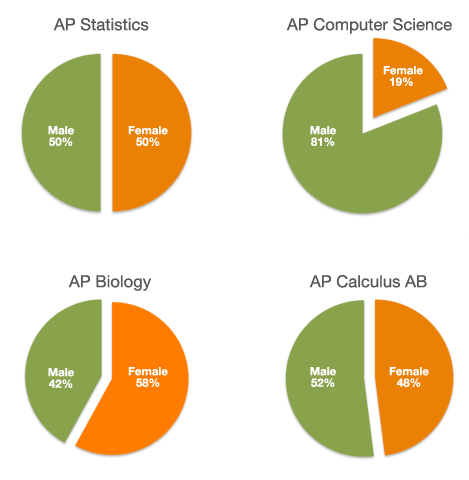
theodp writes: "What if learning to code weren't actually the most important thing?" asks Mother Jones' Tasneem Raja. "Rather than increasing the number of kids who can crank out thousands of lines of JavaScript, we first need to boost the number who understand what code can do." Computational thinking, Raja explains, is what really matters. So, while Google is spending another $50 million (on top of an earlier $40 million) and pulling out all the stops in an effort to convince girls that code and AP Computer Science is a big deal, could AP Statistics actually be a better way to teach computational thinking to college credit-seeking high school students? Not only did AP Statistics enrollment surge as AP CS flat-lined, it was embraced equally by girls and boys. Statistics also offers plenty of coding opportunities to boot. And it teaches one how to correctly analyze AP CS enrollment data! -
CISPA 3.0: the Senate's New Bill As Bad As Ever
Daniel_Stuckey writes: "CISPA is back for a third time—it has lost the 'P,' but it's just as bad for civil liberties as ever. The Senate Intelligence Committee is considering a new cybersecurity bill that contains many of the provisions that civil liberties groups hated about the Cybersecurity Information Sharing and Protection Act (CISPA). Most notably, under the proposed bill companies could not be sued for incorrectly sharing too much customer information with the federal government, and broad law enforcement sharing could allow for the creation of backdoor wiretaps. The bill, called the Cybersecurity Information Sharing Act of 2014, was written by Senate Intelligence Chair Dianne Feinstein (D-Calif.) and Sen. Saxby Chambliss (R-Ga.) and is currently circulating around the committee right now but has not yet been introduced. Right now, the bill is only a 'discussion draft,' and the committee is still looking to make revisions to the bill before it is officially introduced." -
WhatsApp: 2nd Biggest Tech Acquisition of All Time
Nerval's Lobster writes "Facebook CEO Mark Zuckerberg decided to drop a cool $16 billion on WhatsApp, a messaging service with 450 million users. It was a mind-boggling sum, even if you buy into Facebook's argument that WhatsApp (which will continue to operate as an independent subsidiary, at least for the moment) will soon connect a billion people around the world. But it wasn't the biggest tech acquisition of all time: that honor belongs to Hewlett-Packard, which bought Compaq for (an inflation-adjusted) $33.4 billion in 2001. Facebook's purchase of WhatsApp comes in second on the list, followed by Hewlett-Packard's purchase of Electronic Data Systems for $15.4 billion; Google's acquisition of Motorola Mobility for $13 billion, and Oracle snatching up Peoplesoft for $12.7 billion. In sixth comes Hewlett-Packard again, with its Autonomy buy in 2011 (for $11.7 billion), followed by Oracle's BEA Systems acquisition ($9.4 billion) and Microsoft seizing Skype ($9.0 billion). What do many of these highest-cost purchases have in common? Many of them didn't pan out. Hewlett-Packard's Compaq, Autonomy, and EDS acquisitions, for example, made all the sense in the world on paper, the tech giant eventually took significant write-downs on all three (Autonomy in particular was an outright disaster, resulting in a $8.8 billion write-off and widespread allegations of financial and management impropriety)." Update: 02/20 19:32 GMT by T : Of interest: Mother Jones has an interesting take on the seeming mismatch between Facebook's business model and the way the WhatsApp founders think about advertising. Hint: they hate it. -
Majority of Young American Adults Think Astrology Is a Science
Hugh Pickens DOT Com writes "Americans have always had a strange fascination with astrology. First Lady Nancy Reagan famously employed the services of an astrologer after the assassination attempt on her husband. Now UPI reports that according to a new survey by the National Science Foundation, nearly half of all Americans say astrology is either 'very' or 'sort of' scientific. Younger respondents, in particular, were the least likely to regard astrology as unscientific, with 58% of 18 to 24 years olds saying that astrology is scientific (PDF). What's most alarming is that American attitudes about science are moving in the wrong direction. Skepticism of astrology hit an all-time high in 2004, when 66 percent of Americans said astrology was total nonsense. But each year, fewer and fewer respondents have dismissed the connections between star alignment and personality as bunk. Among respondents in the 25 — 44 age group 49% of respondents in the 2012 survey said astrology is either 'very scientific' or 'sort of scientific,' up from 36% in 2010. So what's behind this data? The lead author of the report chapter in question, public opinion specialist John Besley of Michigan State University, cautions that we should probably wait for further data 'to see if it's a real change' before speculating. But, he admits, the apparent increase in astrology belief 'popped out to me when I saw it.'" -
Global-Warming Skepticism Hits 6-Year High
Hugh Pickens DOT Com writes "Chris Mooney writes at Mother Jones that a new study, from the Yale and George Mason University research teams on climate change communication, shows a 7-percentage-point increase in the proportion of Americans who say they do not believe that global warming is happening. And that's just since the spring of 2013. The number of deniers is now 23 percent; back at the start of last year, it was 16 percent (PDF). The obvious question is, what happened over the last year to produce more climate denial? The answer may lie in the so-called global warming "pause"—the misleading idea that global warming has slowed down or stopped over the the past 15 years or so. This claim was used by climate skeptics, to great effect, in their quest to undermine the release of the UN Intergovernmental Panel on Climate Change's Fifth Assessment Report in September 2013—precisely during the time period that is in question in the latest study. "The notion of a global warming "pause" is, at best, the result of statistical cherry-picking," writes Mooney. " It relies on starting with a very hot year (1998) and then examining a relatively short time period (say, 15 years), to suggest that global warming has slowed down or stopped during this particular stretch of time." Put these numbers back into a broader context and the overall warming trend remains clear. "If you shift just 2 years earlier, so use 1996-2010 instead of 1998-2012, the trend is 0.14 C per decade, so slightly greater than the long-term trend," explains Drew Shindell, a climate scientist at NASA who was heavily involved in producing the IPCC report. This is why climate scientists generally don't seize on 15 year periods and make a big thing about them. "Journalists take heed: Your coverage has consequences. All those media outlets who trumpeted the global warming "pause" may now be partly responsible for a documented decrease in Americans' scientific understanding."" -
Global-Warming Skepticism Hits 6-Year High
Hugh Pickens DOT Com writes "Chris Mooney writes at Mother Jones that a new study, from the Yale and George Mason University research teams on climate change communication, shows a 7-percentage-point increase in the proportion of Americans who say they do not believe that global warming is happening. And that's just since the spring of 2013. The number of deniers is now 23 percent; back at the start of last year, it was 16 percent (PDF). The obvious question is, what happened over the last year to produce more climate denial? The answer may lie in the so-called global warming "pause"—the misleading idea that global warming has slowed down or stopped over the the past 15 years or so. This claim was used by climate skeptics, to great effect, in their quest to undermine the release of the UN Intergovernmental Panel on Climate Change's Fifth Assessment Report in September 2013—precisely during the time period that is in question in the latest study. "The notion of a global warming "pause" is, at best, the result of statistical cherry-picking," writes Mooney. " It relies on starting with a very hot year (1998) and then examining a relatively short time period (say, 15 years), to suggest that global warming has slowed down or stopped during this particular stretch of time." Put these numbers back into a broader context and the overall warming trend remains clear. "If you shift just 2 years earlier, so use 1996-2010 instead of 1998-2012, the trend is 0.14 C per decade, so slightly greater than the long-term trend," explains Drew Shindell, a climate scientist at NASA who was heavily involved in producing the IPCC report. This is why climate scientists generally don't seize on 15 year periods and make a big thing about them. "Journalists take heed: Your coverage has consequences. All those media outlets who trumpeted the global warming "pause" may now be partly responsible for a documented decrease in Americans' scientific understanding."" -
Global-Warming Skepticism Hits 6-Year High
Hugh Pickens DOT Com writes "Chris Mooney writes at Mother Jones that a new study, from the Yale and George Mason University research teams on climate change communication, shows a 7-percentage-point increase in the proportion of Americans who say they do not believe that global warming is happening. And that's just since the spring of 2013. The number of deniers is now 23 percent; back at the start of last year, it was 16 percent (PDF). The obvious question is, what happened over the last year to produce more climate denial? The answer may lie in the so-called global warming "pause"—the misleading idea that global warming has slowed down or stopped over the the past 15 years or so. This claim was used by climate skeptics, to great effect, in their quest to undermine the release of the UN Intergovernmental Panel on Climate Change's Fifth Assessment Report in September 2013—precisely during the time period that is in question in the latest study. "The notion of a global warming "pause" is, at best, the result of statistical cherry-picking," writes Mooney. " It relies on starting with a very hot year (1998) and then examining a relatively short time period (say, 15 years), to suggest that global warming has slowed down or stopped during this particular stretch of time." Put these numbers back into a broader context and the overall warming trend remains clear. "If you shift just 2 years earlier, so use 1996-2010 instead of 1998-2012, the trend is 0.14 C per decade, so slightly greater than the long-term trend," explains Drew Shindell, a climate scientist at NASA who was heavily involved in producing the IPCC report. This is why climate scientists generally don't seize on 15 year periods and make a big thing about them. "Journalists take heed: Your coverage has consequences. All those media outlets who trumpeted the global warming "pause" may now be partly responsible for a documented decrease in Americans' scientific understanding."" -
FBI's Secret Interrogation Manual: Now At the Library of Congress
McGruber writes "The FBI Supervisory Special Agent who authored the FBI's interrogation manual submitted the document for copyright protection — in the process, making it available to anyone with a card for the Library of Congress to read. The story is particularly mind-boggling for two reasons. First, the American Civil Liberties Union fought a legal battle with the FBI over access to the document. When the FBI relented and released a copy to the ACLU, it was heavily redacted — unlike the 70-plus page version of the manual available from the Library of Congress. Second, the manual cannot even qualify for a copyright because it is a government work. Anything 'prepared by an officer or employee of the United States government as part of that person's official duties' is not subject to copyright in the United States." -
A Look at the Koch Brothers Dark-Money Network
An anonymous reader writes "The California attorney general and the state's top election watchdog named the 'Koch brothers network' of donors and dark-money nonprofits as the true source of $15 million in secret donations made last year to influence two bitterly fought ballot propositions in California. State officials unmasked the Kochs' network as part of a settlement deal that ends a nearly year-long investigation into the source of the secret donations that flowed in California last fall." -
Do Comments On Web Pages Ruin Science?
GregLaden writes "Last week Popular Science shut down comments on their web pages citing the damage being done to the public perception of science as their reason. Earlier research suggested this might be a good idea because trollish, negative comments can color the perception by readers of a news story. However, some have taken Popular Science's move to be anti-science, implying that science itself is positively affected by web and blog comments, as though these comments contributed to the science being done itself. Here, I take exception to this and suggest that while comments are important in relation to the public perception of science (which itself is important) blog and web commentary never, or only rarely, influences the process of scientific inquiry itself." -
Somebody Stole 7 Milliseconds From the Federal Reserve
An anonymous reader writes "Three to seven milliseconds before the fed moved interest rates, billions of dollars of trades were input that took advantage of the changed rates, reaping huge profits. According to a report at Mother Jones, 'Last Wednesday, the Fed announced that it would not be tapering its bond buying program. This news was released at precisely 2 pm in Washington 'as measured by the national atomic clock.' It takes 7 milliseconds for this information to get to Chicago. However, several huge orders that were based on the Fed's decision were placed on Chicago exchanges 2-3 milliseconds after 2 pm. How did this happen?'" -
How Much Should You Worry About an Arctic Methane Bomb?
barlevg sends this excerpt from an article at MotherJones: "It was a stunning figure: $60 trillion. Such could be the cost, according to a recent commentary in Nature, of 'the release of methane from thawing permafrost beneath the East Siberian Sea, off northern Russia... a figure comparable to the size of the world economy in 2012.' More specifically, the paper described a scenario in which rapid Arctic warming and sea ice retreat lead to a pulse of undersea methane being released into the atmosphere. How much methane? The paper modeled a release of 50 gigatons of this hard-hitting greenhouse gas (a gigaton is equal to a billion metric tons) between 2015 and 2025. This, in turn, would trigger still more warming and gargantuan damage and adaptation costs. ... According to the Nature commentary, that methane 'is likely to be emitted as the seabed warms, either steadily over 50 years or suddenly.' Such are the scientific assumptions behind the paper's economic analysis. But are those assumptions realistic—and could that much methane really be released suddenly from the Arctic? A number of prominent scientists and methane experts interviewed for this article voiced strong skepticism about the Nature paper.'" -
NRA Launches Pro-Lead Website
ideonexus writes "The National Rifle Association has launched a website defending the use of lead ammunition against scientists and environmental organizations who argue that lead bullets are poisoning the environment and tainting game meat with a known neurotoxin. The rise and fall of lead levels from gasoline and lead-based paint are strongly correlated to the rise and fall of crime rates in communities around the world." -
Senior Game Designer Talks About Game Violence, Real Violence, and Lead (Video)
William Volk may not be the world's oldest game designer, but he's up there. He started out as a play tester for Avalon Hill in 1979, and since then has worked for Activision and other major players in the game space. His current job is with PlayScreen, where he's working on their Word Carnivale iOS game, which is not violent at all. But over the years Volk has worked on slightly violent video games and has watched public outcries over video game violence since 1976. He's also tracked how much less violence we've seen since lead was removed from gasoline. (Editorial interjection: Aren't most remaining pockets of massive gun violence in cities where many poor kids grow up in apartments that have lead paint?) Due to technical problems during the interview, some of the conversation is missing, primarily about the recent spate of multiple murders. It seems, for instance, that Newtown shooter Adam Lanza was heavily into violent video games, which is sure to spark plenty of new discussion about how they affect players. But then again, as Volk reminded me in an email, "If people were influenced by video games, a majority of Facebook users would be farmers by now," a meme that has been floating around Facebook since last year, if not earlier. -
Billionaires Secretly Fund Vast Climate Denial Network
Hugh Pickens writes writes "Suzanne Goldenberg reports that conservative billionaires used a secretive funding route to channel nearly $120 million to more than 100 groups casting doubt about the science behind climate change, helping build a vast network of think tanks and activist groups working to redefine climate change from neutral scientific fact to a highly polarizing 'wedge issue' for hardcore conservatives. 'We exist to help donors promote liberty which we understand to be limited government, personal responsibility, and free enterprise,' says Whitney Ball, chief executive of the Donors Trust. Ball's organization assured wealthy donors that their funds would never by diverted to liberal causes with a guarantee of complete anonymity for donors who wished to remain hidden. The money flowed to Washington think tanks embedded in Republican party politics, obscure policy forums in Alaska and Tennessee, contrarian scientists at Harvard and lesser institutions, even to buy up DVDs of a film attacking Al Gore. 'The funding of the denial machine is becoming increasingly invisible to public scrutiny. It's also growing. Budgets for all these different groups are growing,' says Kert Davies, research director of Greenpeace, which compiled the data on funding of the anti-climate groups using tax records. 'These groups are increasingly getting money from sources that are anonymous or untraceable.'" -
America's Real Criminal Element: Lead
2muchcoffeeman writes "The cause of the great increase in violent crime that started in the 1960s and peaked in the 1990s may have been isolated: lead. This leads directly to the reason for the sharp decline in violent crime since then: lead abatement programs and especially the ban of tetraethyl lead as an anti-knock agent in gasoline starting in 1996. There are three reasons why this makes sense. First, the statistics correlate almost perfectly. Second, it holds true worldwide with no exceptions. Every country studied has shown this same strong correlation between leaded gasoline and violent crime rates. Third, the chemistry and neuroscience of lead gives us good reason to believe the connection. Decades of research has shown that lead poisoning causes significant and probably irreversible damage to the brain. Not only does lead degrade cognitive abilities and lower intelligence, it also degrades a person's ability to make decisions by damaging areas of the brain responsible for emotional regulation, impulse control, attention, verbal reasoning, and mental flexibility. Another thing that stands out: if you overlay a map showing areas with higher incidence of violent crime with one showing lead contamination, there's a strikingly high correlation." -
Richard Stallman Answers Your Questions
A while ago you had the chance to ask founder of the GNU Project, and free software advocate, Richard Stallman, about GNU/Linux, free software, and anything else. You can read his answers to a wide range of questions below. As usual, RMS didn't pull any punches. Capitalism and You
by eldavojohn
Your monkish lifestyle would leave most people who work in software screaming for a Lear Jet and you have stated "I've always lived cheaply ... like a student, basically. And I like that, because it means that money is not telling me what to do." Growing up in the United States, I have been served the koolaid of Capitalism several times and I have been taught that the inherent competition and struggle for money in all aspects of our lives make us the greatest country ever. I've read a lot of your comments on intellectual property reform and I can't help but feel that it just isn't compatible with capitalism. Have you ever had problems rectifying your stance on intellectual property with capitalism? Do you see any problems at all with no copyright or patent laws inside a capitalistic society?
RMS: First, I need to correct an apparent misunderstanding. I do not have a "stance on intellectual property", because that would mean using the term "intellectual property" in my thinking. I take pains never to do that, because that term is an obstacle to clear thinking. Every time it is used, it misrepresents the legal reality and spreads confusion.
I judge copyright law by its practical requirements and their practical effects. I judge patent law by its practical requirements and their practical effects -- totally different requirements and totally different effects. These two laws are different on every practical point; all they have in common is a very abstract idea which is of no practical significance.
I want to encourage clear thinking about copyright law. Separately, I want to encourage clear thinking about patent law. The first step in clear thinking about these laws is not to lump them together. In particular, never use the term "intellectual property", since it lumps them together.
I must not respond directly to a question that treats copyright law and patent law as a single issue. If I did, I'd be lumping them together and spreading the confusion I want to clear up.
However, I can split it into two separate questions.
First, copyright. Copyright is a legal restriction on certain kinds of use of works of authorship. The US has always had some sort of copyright law, but it has changed tremendously. The US has always practiced capitalism, but many sorts of works were, at some time in US history, not covered by copyright. Thus, we know it is possible to have capitalism without copyright.
However, I don't advocate simple elimination of copyright as a solution.
Works that are designed for use doing practical jobs must be free; however, simply eliminating copyright on those works would not have this result. In software, it would make things worse, because copyleft is based on copyright. Without copyright, programs could still be made nonfree using EULAs, tivoization, and nonrelease of source code, but we would no longer be able to prevent this using copyleft.
If we wanted to legislate to make all these works-for-use free, we would have to go further than just eliminating copyright on them. In an ideal world, we would do this, but I don't propose doing it now.
As for works of opinion and art, I don't think they must be free. I advocate some reforms of copyright for these works but I see no reason to abolish it.
Patent law is a totally different issue. A patent is an artificial monopoly on using a specified idea. There have been successful capitalist countries that didn't have a patent system. My expertise is in computing, so I campaign to eliminate patents from computing, where I know they are harmful. However, Boldrin and Levine present good arguments that patents do mostly harm in every field and that it would be better to eliminate patents entirely.
With any or all of these changes, we would still have capitalism; only some details would be different.
I feel like you have this admirable and altruistic quality where money isn't the ultimate driving force and when you speak to people who base their entire lives around money, there's a fundamental disconnect that is overlooked.
RMS: Arguments are always based on values. The free software movement is based on values of freedom and community -- that is where it differs from open source. People who don't share those values will simply not get it, no matter what I might say. Since that's inevitable, I don't worry about it. I do my best, and I persuade some, which is better than giving up and persuading none.
Re:Do you like being worshiped ?
by capt.Hij
This brings up a good point. Let me rephrase the question. Mr Stallman, you are regarded as a founding father of the free software movement, and your opinion on free software carries a lot of weight. Because of this you are put under a harsh spot light, and every little thing you do is magnified. For example, your comments about Steve Jobs immediately after his death were broadcast quite widely. To some people the timing showed a lack of taste and were seen as disrespectful.
RMS: Those people evidently were more concerned with forms of politeness that with substantive good and evil. Someone told me I should not criticize Jobs because he could not defend himself -- while thousands were lionizing him with the indirect support of Apple's PR machine. Compared to that, I was David against Goliath.
Because of your status in the free software movement your statement was used by some to smear the larger community. How do you feel about this kind of attention?
RMS: I stand by what I said about Jobs. Apple is your enemy, and if you don't recognize this and fight, you're being a chump.
If someone tried to spin my statement as something to be ashamed of, please fight back by arguing with his spin.
Have you given it much thought, and what kind of insight can you share about the situation you are in when your private and public mannerisms are misconstrued to be part of a larger group's views and outlooks?
RMS: I hope that a lot of the community shares my views of Jobs and Apple. I ask them to stand up and be counted.
Apple's favorable public image, including public admiration of Jobs for side issues, is a crucial asset in its war against our freedom. To tarnish its image, we need to speak loud and clear about Apple's wrongs. When Steve Jobs is praised for the elegant styling of the jails he designed, we must respond that it is wrong to put users in jail. Speak up and spread the word!
Role of the FSF
by ssam
It seems to me that in the early days of the FSF the main role was writing software. A huge chunk of that code is what makes up modern day free operating systems. A lot of it is class leading software (bash, gcc, emacs, etc). In the past few years it seems that the FSF is far more involved in campaigning than coding. Is this an accurate view of the situation? Is this intentional, and if so why? Should the FSF be trying to create a class leading web browser, for example.
RMS: In the first years of developing the GNU system, before Linux completed the system, not many people worked on free software. A few staff hired by the FSF made a big difference to our progress.
Once GNU/Linux caught on, lots more people got involved, so that the few people the FSF could hire were inevitably a tiny fraction of what the community did. Meanwhile, our other jobs became bigger and more important. For instance, once the DMCA made it illegal to release free software to handle common media formats, just writing free software was no longer enough, so we launched the DefectiveByDesign.org campaign. A year ago we launched our campaign against Restricted Boot, which is the way Microsoft perverts Secure Boot into an anti-security feature.
"Success" is not our goal; we're not here to win a race, we are here to win freedom. I didn't write GCC with the idea of making a "better" C compiler. I wrote it so there would be a freedom-respecting C compiler, and while I was at it, I did the best job I knew how. We didn't develop GNU to have a "better" operating system than Unix; we developed it so we could have a freedom-respecting operating system. It's the same today.
Thus, if we could raise money to hire a few software developers, we would spend it on projects that are more than technical improvements. For instance, it would make no sense to try to develop a web browser that is "better" in a merely practical sense. There is no reason to think we could outdo the Firefox developers in what they are good at, and it would be wasteful duplication to try.
Instead we are trying to do something that Firefox does not aim to do: protect the user's privacy from surveillance by web sites, and protect the user's freedom from nonfree Javascript code. A volunteer is working on our variant of Firefox, called IceCat, with changes for these purposes. We don't have funds for this, so would you like volunteer to help?
GNU visibility and factioning
by Digana
GNU is supposed to be a free operating system as well as a group of people working towards building this OS. To a casual observer, however, GNU does not appear very active.
RMS: I've decided to post new package releases in a more visible place in gnu.org.
Development of GNU is done by volunteers, so the level of activity is up to you. If you wish GNU were more active, join in the work on some GNU package that interests you. For instance, it would be useful to have more developers for LibreJS, which detects and blocks nonfree Javascript, and for IceCat.
Some of the most prominent and supposedly GNU packages, such as Gimp, Gnome, GTK+, and R are mostly GNU in name only. The hackers working on these projects have very little interaction with other hackers working on GNU projects and they very frequently espouse views contrary to GNU's philosophical aims. Thus to an outside observer, GNU does not appear to be a cohesive group of people working towards a common goal.
RMS: The GNU project is not as cohesive as I wish it were. To some extent, this is a consequence of an approach that was necessary. The only way to develop something as large as the GNU system through the work mostly of volunteers was to divide it into projects that could be implemented mostly independently by different people. The design of Unix lent itself to this. The fact that the GNU system incorporated programs such as X and TeX, that were developed by other people or groups that regarded the GNU Project as just a user, pushed in the same direction.
There is always a centrifugal tendency when many groups work mostly independently. It is often hard to persuade the developers of one component to do what improves the system as a whole rather than what will make their own component more useful and successful.
By 1990, when we started the HURD kernel, I expected that in a couple of years it would be working and we would integrate the GNU system. However, the HURD didn't work at all until 1996, and in the mean time the community began using GNU with Linux as the kernel. By the time we started using it that way, others had integrated the GNU/Linux combination, making various GNU/Linux distros.
The initial goal of GNU, to have a free operating system, has been achieved; the initial sharp focus on completing a free Unix-like system is no longer applicable. This doesn't mean our work is over; most GNU/Linux distros today contain nonfree software, and there are more things that we expect a system to do. We still need people to seek out and do the development jobs that need doing in order to win freedom for the users of computing.
My first step to make the GNU Project more cohesive was in 1999. In the 1980s and 90s, when I appointed someone as the maintainer for a GNU package, I took for granted that he would understand that his job was to manage a part of a larger project, and what that implied. In 1999 I realized this could not be taken for granted, so I began explaining this relationship to new maintainers and asking new maintainers to agree to it. However, the relationship with a few packages had already become distant.
Many GNU mailing lists being private further the public perception that GNU is not even actively producing software anymore.
RMS: Our main packages have public discussion lists, but that's a choice for the package maintainer to make. Feel free to suggest changes to the maintainer.
What can be done to remedy this situation? How can we strengthen GNU, make it reach out again to the people it's supposed to be freeing?
RMS: For the most part, this is up to you. When you start working on a new free program, do you propose making it a GNU package? Would you like it to be part of a coherent GNU Project? If so, please write to me.
How to reverse the aggregation problem?
by concealment
A problem with software and operating systems is what I call the "aggregation problem," which is that what we have now is an aggregate of past solutions to problems that may no longer exist. The stuff piles up, increasing complexity and decreasing the uniformity and effectiveness of the interface. At what point do software projects call for a top-down redesign? How can free software do this where industry cannot?
RMS: I don't have any solution to offer for this particular problem, other than the slow methods we are using now. Partly that's because I don't think this is the most important issue -- I think our freedom is more important than technical improvement.
However, this is not the only area in which more uniformity is desirable. Around 1990, I designed a protocol for configuring and building packages from source: you type `./configure; make install'. It would be nice if all free software packages supported this uniform interface, but they don't.
To help implement that uniformity, a GNU volunteer recently made it very easy to use Autoconf in Python packages, so that they can build and install using our uniform commands. If you maintain a program in Python, how about adding this support? Every user that isn't a Python programmer will be glad he can install your program without learning a special Python build method.
What project is using the wrong license?
by gQuigs
What free software project is using a license that doesn't actually match with it's mission - or hinders free software in other ways? In other words, if you could *magically* switch the license of one project - which would you choose and why? Examples: Move Mesa to GPLv3, Move Linux from GPLv2 to v3, Make android GPLv3, GCC - from GPLv3 to Apache.
RMS: If I could magically change one program to GPLv3, it would be Linux. One of the improvements of GPLv3 is that it blocks tivoization, and Linux is very frequently tivoized. (Many Android devices contain a tivoized copy of Linux.)
While we're talking about magic, I'd change the license of LLVM also.
Another program that is important to convert is LibreCAD. This is more than a fantasy: the developers of LibreCAD are working on replacing the old GPLv2-only code that they included, so as to switch to GPLv3-or-later. Would you like to help?
What do you think of non-free, non-software works?
by Shlomi Fish
Dear Dr. Stallman, In this Slashdot feature"Stallman is quoted here saying that game engines should be free, but approves of the notion that graphics, music, and stories could all be separate and treated differently (i.e., "Non-Free.")." However, this feature does not give a citation from you for that. To add to the confusion in a post to the Creative Commons Community mailing list, Rob Myers said:
"RMS's views on culture are coherent and consistent with his views on software. But he's treating game assets as a matter of functionality (software) rather than speech (culture). There is an issue with the latter not being free.."
So I'm a little confused. Do you approve of people using non-free licenses for cultural works, including the CC-by-nc, CC-by-nc-sa, CC-by-nd, and CC-by-nc-nd licenses? If so, when?
This is especially important given the fact that in the process for formulating the latest version of the Creative Commons licenses (4.0), there has been some requests to deprecate the non-commercial (nc) and/or no-derivatives (nd) options (which I doubt will happen, but is nonetheless some thing some people feel strongly about).
RMS: After some 12 years of stating my position in all my speeches on Copyright vs Community, and publishing transcripts, I'd expect interested people to have found it. But here it is.
Those works that are made for doing practical jobs must be free. This includes software, educational works, reference works, text fonts, recipes, and 3d-printer models for objects for practical use, as well as some other things.
Works of testimony and opinion, and artistic works, don't have to be free as in the four freedoms, but their users should have more freedom than now. I think people should be free to share them (noncommercial redistribution of exact copies), and to remix them. Putting DRM or EULAs on them should be banned too. I think all the CC licenses do these things, more or less, and I use CC-ND for my statements of my views, including this one.
Two of the nonfree CC licenses, CC-NC and CC-NC-SA, have a peculiar problem: they lead to making works which are orphan before they are born.
I call this a "peculiar problem" because I don't think these licenses are bad in principle. The problem is purely a matter of practical consequences, and it seems they should be avoidable, yet I can't see a way to avoid them. I hope one is found; in the mean time, I urge not using these two licenses.
Favorite hack
by vlm
Give me your best hack. Specifically something YOU did personally not hire / grad student. Hardware, software only (yes yes the GPL is cool but I'm looking for code or schematic or at least a description of something made out of source or solder) I can't put words in your mouth but the ideal answer would be something like "I'm particularly proud of the O(n) memory garbage collection routine in emacs implemented around '89 and how it worked was very roughly ..." or "I really like my homemade fully automatic automotive relay based routing system for my OH scale model railroad sorting yard" or "I built my own legal limit ham radio amplifier" almost certainly a different topic of course, but something of this form of answer.
RMS: I can't remember all the hacks that I was proud of, so I can't pick the best. But here's something I remember fondly. The last piece of Gosmacs code that I replaced was the serial terminal scrolling optimizer, a few pages of Gosling's code which was proceeded by a comment with a skull and crossbones, meaning that it was so hard to understand that it was poison. I had to replace it, but worried that the job would be hard. I found a simpler algorithm and got it to work in a few hours, producing code that was shorter, faster, clearer, and more extensible. Then I made it use the terminal commands to insert or delete multiple lines as a single operation, which made screen updating far more efficient.
Why FDR and Churchill?
by eldavojohn
During a Q&A Session a while back you were asked about people and movements near and dear to your heart and you said "I admire Franklin D. Roosevelt and Winston Churchill, even though I criticize some of the things that they did." I love World War II history and I also find myself in a love-hate situation with Churchill. Could you go into further detail about what specifics lead you to single out these two over leaders like Lincoln, Jefferson, Benjamin Franklin or even historical figures who have enabled information itself like Turing, Shannon, etc?
RMS: I like math, and I respect good mathematicians, but I don't admire them as heroes. The people I admire are those who fight for freedom.
Why did I mention Roosevelt and Churchill in particular? I didn't make a list of all the leaders I admire and then choose the ones I admire most. That would be a big job, and my memory does not lend itself to that, so I didn't try. I mentioned the people that came to mind.
I was thinking of leaders that fought against evil tyranny. Of the five leaders you mentioned, Roosevelt and Churchill had the hardest fight against the greatest evil. King George trampled the colonists' rights, and the Confederacy fought for slavery, but Hitler's genocidal empire was much worse.
If I were judging peacetime political leadership, I would not choose Churchill; perhaps Jefferson.
Stolen bag / laptop in Argentina
by Cigarra
What ever happened with the stolen bag and laptop? Did you get something back? Did you LOSE data (that is, was something not backed up)? Are you mad with the organizers / country that hosted the event?
RMS: My friends never found any sign of what was stolen. I lost some files, those which were outside the directories that I regularly backed up, but nothing really important.
I don't blame the speech organizers or Argentina in general for this theft. The reason I will never go to Argentina again has nothing to do with the theft. I announced it before I arrived in Argentina: I object to the requirement for visitors to give their fingerprints. I refuse to go to any country which has that policy, and I hope you too will refuse to go to any country that would demand your fingerprints.
Revolution OS ...
by i.r.id10t
Interviews with you comprised a big percentage of the documentary Revolution OS. If it were to be remade today, and the financial aspects ignored, what do you think would be different? If you were producing such a documentary today, what would you focus on?
RMS: I didn't make that movie, so how to make it was not my decision, and how to make one today would not be my decision. But I see some things that would have to be different.
Much attention was paid to business leaders of the open source bubble, which popped after the interviews. The movie ended saying how some companies' stock had gone down. If the movie were made today, those people and their commercial claims would probably not be in it. Also, I would not be found at a "Linux" event; shortly after that time, I concluded it was self-defeating to legitimize events that call the GNU system "Linux".
Other advocates
by SirGarlon
Who, other than yourself and the FSF, do you consider to be effective advocates for software freedom? Please name individuals if you can.
RMS: Eben Moglen and SFLC, Bradley Kuhn and the Conservancy, Frederic Couchet and APRIL, Via Libre, Alexandre Oliva, Octavio Rossell, Quiliro Ordoñez, are the ones that occur to me. I have probably forgotten many.
Open Source and Ethics in research?
by tsquar3d
RMS, I am a PhD student in computing and I have run up against an interesting problem. I consider FOSS to be at the core of my personal philosophy.
RMS: I have to point out that there is no "FOSS" philosophy. The term "FOSS" is a way of referring to two different philosophies: free software is one, and open source is the other.
When you want to refer to both philosophies, I recommend "FLOSS" rather than "FOSS". "FLOSS", or "Free/Libre and Open Source Software", gives the two equal visibility, whereas with "FOSS", "Free and Open Source Software", "Open Source" is more prominent. But you can't possibly agree with both of these philosophies, because they disagree at the deepest level. Your views might be one, or the other, or a mixture, or something else, but it can't be both of them at once.
See here for more explanation of the difference between free software and open source. To me it is not just a pragmatic issue, but an ethical one.
RMS: It sounds like your philosophy may be closer to the free software movement. We consider this an ethical issue, whereas the usual open source philosophy presents it as a practical issue alone.
Therefore, in my research, I use all FOSS software. Now, the problem arises when trying to justify my use of FOSS to colleagues and supervisors.
RMS: Why do you need to try to justify your _own_ use of free software? I'd expect you to decide, and follow your own decision, with no need to justify it to anyone else. Is there something I have misunderstood?
The time you need to argue is to convince other teachers and researchers to move to free software.
I have tried to make the case that it is an ethical issue, and have argued the merits of freedom and academia, however, I invariably am told "that's not an academic argument".
RMS: I suggest you respond "I'm a citizen first, and an academic second, so I care about ethical arguments as well as academic arguments."
This is incredibly frustrating and annoying to me as, in academic research, we are constantly being restricted by "research ethics" (e.g. the ethical treatment of subjects, plagiarism, etc.) and I am more than willing to bet that if a researcher objected to a methodology based on "religious principles" they would be excused.
RMS: I don't understand -- "excused" from what? I am not sure now what issue the argument is about. Are they criticizing you for your decision? If so, you don't need to be "excused", you just need to stand firm and proud. Or are you asking them for permission? There, too, standing firm is best, but it is trickier.
Or are you asking them to change their practices? That is good to try, but there is no guaranteed recipe for persuading others. I suggest telling them about the malicious features commonly found in nonfree software, to bring home to them that this is an important issue. Also, raise the issue publicly so as to build consciousness of the issue and search for allies. -
The New Ethanol Blend May Damage Your Vehicle
Hugh Pickens writes writes "About 80 percent of the gasoline consumed in the U.S. is blended with ethanol, primarily with a 10 percent mix of ethanol, generally derived from corn. Now Kate Sheppard writes that the Environmental Protection Agency has approved a new policy that will allow states to raise the blend to up to 15 percent ethanol (also known as E15), approved for use for cars and light trucks from the model year 2001 and later. A few weeks ago, AAA issued a statement saying that the EPA's new policy creates the 'strong likelihood of consumer confusion and the potential for voided warranties and vehicle damage.' AAA surveyed vehicle manufacturers, and found that only about 12 million of the 240 million vehicles on the roads today are built to use E15 gasoline. The EPA will require that gas pumps with E15 bear a warning sign noting the blend and that it is not recommended for cars older than the 2001 model year. But what happens if you accidentally use it? 'Nobody really knows what negative effects [E15 is] going to have on the vehicle,' says Brian Lyons, Toyota's safety and quality communications manager. 'We think that there needs to be a lot more study conducted to make sure there are no longer term effects on the vehicle. So far everything we've seen says there will be.' The concern is that repeated, long-term exposure could cause the higher-alcohol-content fuel to degrade engine parts like valves and cylinder heads — which could potentially cost thousands of dollars to replace. Gas station owners don't like it very much either, because they'd likely have to upgrade their equipment to use it. Nor are environmental groups big fans of the EPA's decision, arguing that increasing the use of ethanol can drive up food prices, and isn't the best means of reducing our reliance on foreign fuels. The ethanol lobby is the only group that really seems to like the new rule. 'We've force fed a fuel into every American's car that benefits a few thousand corn farmers and ethanol refiners at the expense of virtually every other American,' says Scott Faber." -
Pols Blur Line Between Data Mining, Cyberstalking
theodp writes "Mother Jones reports on Obama's Digital Gurus, the top-secret team of analytics engineers and scientists led by hipster CTO Harper Reed who work on text analytics, social network/media analysis, web personalization, computational advertising, and online experiments & testing from the campaign's Chicago HQ and satellite offices. For OFA (Obama for America), writes Tim Murphy, there is no such thing as Too Much Information. 'In terms of just the sheer amount of data that political candidates have on you,' says UNC Prof Daniel Kreiss, 'I think everyone finds it creepy.' Still playing catch-up to OFA in its data efforts is Team Romney, which reportedly hired former employees from places like Google Analytics, Apple, Ominture, and Overstock.com in an attempt to reverse engineer the Obama campaign's strategy." -
Pols Blur Line Between Data Mining, Cyberstalking
theodp writes "Mother Jones reports on Obama's Digital Gurus, the top-secret team of analytics engineers and scientists led by hipster CTO Harper Reed who work on text analytics, social network/media analysis, web personalization, computational advertising, and online experiments & testing from the campaign's Chicago HQ and satellite offices. For OFA (Obama for America), writes Tim Murphy, there is no such thing as Too Much Information. 'In terms of just the sheer amount of data that political candidates have on you,' says UNC Prof Daniel Kreiss, 'I think everyone finds it creepy.' Still playing catch-up to OFA in its data efforts is Team Romney, which reportedly hired former employees from places like Google Analytics, Apple, Ominture, and Overstock.com in an attempt to reverse engineer the Obama campaign's strategy." -
Pennsylvania Fracking Law Opens Up Drilling On College Campuses
PolygamousRanchKid writes with this news from MotherJones: "Last year, when Pennsylvania Gov. Tom Corbett suggested offsetting college tuition fees by leasing parts of state-owned college campuses to natural gas drillers, more than a few Pennsylvanians were left blinking and rubbing their eyes. But it was no idle threat: After quietly moving through the state Senate and House, this week the governor signed into law a bill that opens up 14 of the state's public universities to fracking, oil drilling, and coal mining on campus. Environmentalists and educators are concerned that fracking and other resource exploitation on campus could leave students directly exposed to harms like explosions, water contamination, and air pollution." -
Why Do So Many Liberals "Like" Mitt Romney On Facebook?
pigrabbitbear writes "Mother Jones reports that, 'In recent weeks, a host of liberal types have complained that their Facebook accounts have erroneously "liked" Romney's page, and some are floating the theory that the Romney campaign has deployed a virus or used other nefarious means to inflate the candidate's online stature. This conspiratorial notion has spawned a Facebook community forum, and its own page: "Hacked By Mitt Romney" (cute url: facebook.com/MittYouDidntBuildThat)' So what's going on? Is the Romney campaign engaging in some tech wizardry to hijack Americans' Facebook pages? Seems unlikely, but Romney did somehow manage to acquire millions of fake Twitter followers. But it looks like the Romney campaign isn't behind this one — Facebook and its mobile app is." -
Gadget Addiction or Work Intrusion?
Yesterday the NY Times ran a story about the worry in Silicon Valley of addiction to gadgets, and how it might affect stress levels and people's ability to focus. But today an article in the Atlantic takes issue with "gadget addiction," and instead highlights how workplace concerns are intruding more and more on employee's private lives, suggesting that the inability to put down your smartphone is merely a symptom, rather than a disease. "To elide that one of the reasons we spend so many hours in front of our screens is that we have to misses the key point about our relationship with modern technology. The upper middle class (i.e. the NYT reader) is working more hours and having to stay more connected to work than ever before. This is a problem with the way we approach labor, not our devices. Our devices enabled employers to make their employees work 24/7, but it is our strange American political and cultural systems that have allowed them to do so. And worse, when Richtel blames the gadgets themselves, he channels the anxiety and anger that people feel about 24/7 work into a different and defanged fear over their gadgets. The only possible answer becomes, 'Put your gadget down,' not 'Organize politically and in civil society to change our collective relationship to work.'" -
Nuclear Truckers Haul Warheads Across US
Hugh Pickens writes "As you weave through interstate traffic, you're unlikely to notice a plain-looking Peterbilt tractor-trailer or have any idea that inside the cab an armed federal agent operates a host of electronic countermeasures to keep outsiders from accessing his heavily armored cargo: a nuclear warhead. Adam Weinstein writes that the Office of Secure Transportation (OST) employs nearly 600 couriers to move bombs, weapon components, radioactive metals for research, and fuel for Navy ships and submarines between a variety of labs, reactors and military bases. Hiding nukes in plain sight and rolling them through major metropolitan centers raises a slew of security and environmental concerns, from theft to terrorist attack to radioactive spills. 'Any time you put nuclear weapons and materials on the highway, you create security risks,' says Tom Clements, a nuclear security watchdog for Friends of the Earth. For security, cabs are fitted with custom composite armor and lightweight armored glass, a redundant communications system that links the convoys to a monitoring center in Albuquerque, and the driver has the ability to disable the truck so it can't be moved or opened. The OST hires military veterans, particularly ex-special-operations forces (PDF), who are trained in close-quarters battle, tactical shooting, physical fitness, and shifting smoothly through the gears of a tractor-trailer. But accidents happen. In 1996, a driver flipped his trailer on a two-lane Nebraska hill road after a freak ice storm, sending authorities scrambling to secure its payload of two nuclear bombs; and in 2003, two trucks operated by private contractors had rollover accidents in Montana and Tennessee while hauling uranium hexafluoride, a compound used to enrich reactor and bomb fuel." -
Gates Paying Murdoch For System To Track U.S. Kids' School Progress
theodp writes "Discussing U.S. education in his 2012 Annual Letter, Bill Gates notes the importance of 'tools and services [that] have the added benefit of providing amazing visibility into how each individual student is progressing, and generating lots of useful data that teachers can use to improve their own effectiveness.' Well, Bill is certainly putting his millions where his mouth is. The Gates Foundation has ponied up $76.5 million for a controversial student data tracking initiative that's engaged Rupert Murdoch's Wireless Generation to 'build the open software that will allow states to access a shared, performance-driven marketplace of free and premium tools and content.' If you live in CO, IL, NC, NY, MA, LA, GA, or DE, it's coming soon to a public school near you." -
Ask Carl Malamud About Shedding Light On Government Data
If you've ever tried to look up public records online, you may have run into byzantine sign-up procedures, proprietary formats, charges just to view what are ostensibly public documents, and generally the sense that you're in a snooty library with closed stacks. Carl Malamud of Public.Resource.Org has for years been forging a path through the grey goo of U.S. government data, helping to publicize the need for accessible digital archives — not just awkward, fee-per-page access. (Mother Jones calls him a "badass.") Malamud has (with help) been making it easier to get to the huge swathes of data in government sources like PACER, EDGAR, and the U.S. Patent Office. He's got a new initiative now to establish a "Federal Scanning Commission," the task of which would be to assess the scope and outcomes of a large-scale effort to actually digitize and make available online as much as practical of the vast holdings of the U.S. government. ("If we were able to put a man on the moon, why can't we launch the Library of Congress into cyberspace?") Ask Malamud below questions about his plans and challenges in disseminating public information. (But please, post unrelated questions separately, lest ye be modded down.)