Slashdot Mirror
Domain: motorola.com
Stories and comments across the archive that link to motorola.com.
Comments · 605
-
Re:Used to do that for a living
Far as I can tell, no one really uses these numbers they just require everyone to fill out their timesheets. It's stupid really... It's not used for payroll. I figure only 5% of the IT workforce actually logs useful data, the rest is worthless. For example, I've logged 40 hours a week for months for nothing special.
I'm an engineer, and have worked in two shops which used time sheets for project tracking. The first one (a little place where the Dilbert factory approached unity) had about a gazillion categories in which to log time, with sub-categories and sub-sub-categories galore. Most people ended up putting in "40 hours misc" every week. The really conscientious ones might have actually broken that down by project. The numbers, of course, became gospel for estimation of future projects.
The second place had a bit better idea how a tracking system should be run, but a piss-poor implementation. The hours had to be manually logged into their "timeclock" program, which was slow and buggy. Later they went to an web-browser client that was even worse, taking 30-60 seconds just to move from one field to the next! The engineers actually rebelled against it, refusing to enter any times at all. And guess what? Turns out nobody really noticed...
BTW, at the first place I decided to track my own hours the right way. I found a program that let me define my own categories. Click a category and time automatically started accumulating until you clicked something else. (I think it was called 'timex' or 'xtime', circa 1990.) I set up a category for each of my projects, without all the extraneous crap the regular program had. I also set up a few categories for different sorts of interruptions. I used this program pretty religiously for about a year, and was kind of disturbed to find that only about 30% of my time was going into actual budgeted projects. Everything else was off-topic. I haven't tracked time as closely anywhere else, but subjectively it seems that this 30% figure is pretty universal.
-
As submitted to Mini-ITX.com:Power shouldn't be a concern, as the G3s we're talking about consume on par with Via's offerings, while probably winning on performance clock for clock. G4s are warmer, but no more than an average Celeron in the worst case. The CPU socket is actually a "MegArray," shared with the Mac Cube and certain other Apples, so upgrades and parts-bin finds may be interchangeable.
"Aside from the CPU and northbridge, the chips involved are standard components, and should be familiar to anyone who knows PCs. This is an early revision, not sporting evidence of Firewire (though there are some mysterious pin-headers lurking about) or RAID, but you can see a Via 686B handling sound and legacy ports, and the usual surface-mounts backing up the Ethernet and perhaps USB 2.0. What's that big one marked 'Radeon?'
"Obviously it's no alternative if Windows is your thing, but Linux is available -- in fact, it's the only option until AmigaOS 4 ships. Debian, SuSE, and Yellow Dog are known to run and have accepted patches for the platform (outdated product pages to the contrary; AmigaOnes have no relation to last-generation APUS hardware), and Gentoo is at least in-progress. Users who like their penguins cool *and* fast take note; benchmarks are thin on the ice right now, and RC5 numbers are by no means a good comparison, but the G3s were cranking those without an unfair boost from Altivec.
-
Re:me want
PhoneScoop is a good source for wireless phone news, all Nextel phones are iDEN/TDMA, manufactured exclusively by Motorola.
Verizon also does not offer a Bluetooth phone, and Sony-Ericsson has stopped making CDMA phones.
I don't miss any extra buttons.
I would prefer a dock for the mouse with a rechargeable battery
I will miss the USB ports on the keyboard, especially for connecting my camera or my JumpDrive.
That being said, I'll probably be getting them anyway.
I was disappointed that Jobs didn't introduce the iTMS for Europe at Expo. -
Re:elitist AND old fashionWow, you really ARE old fashoned aren't you?
WIRES?
We are talking about FREE broadband to a government subsidized facility.
No. We are talking about making further use of infrastructure that is already in place. if it's at all available, business offices are already going to have broadband.
And again you entirely miss the "free" part. If you are working to sustain an infrastructure, how the fuck is it "free?" Are the vegetables from my garden "free" because they "just sprang up from the ground?" Does my time not count because I am not on a corporate payroll? Does theirs not count because they are working for their community instead of AOL?
Our current focus is at New Englewood Terrace (NET), a 23 story, 303 unit development in the Englewood community in southwestern Chicago. We are about to close and start the redevelopment program. Our goal is to use NET as an "idea" building, to illustrate the values to residents of service enriched housing, neighborhood connections, and the potentials of smart buildings and neighborhoods.
More from don Samuelson.Bringing broadband to the building makes many things possible. Through the combination of vertical fiber, horizontal ethernet and wireless access points (WAPs), every unit/room at NET can have wireless broadband access to the Internet. Cisco Fellows have been key advisers. The broadband connection can also be helpful with building operating economics: replacing guards in part with surveillance equipment, optimizing energy costs, sensing, regulating and monitoring devices, etc.
Motorola has developed a series of Canopy products which allow NET to access a wireless broadband signal from up to 20 miles, distribute it within the building (via wires, wires/wireless, and wireless technologies), and through a smart antenna to distribute the signal for up to 2 miles from the building (where it can be further extended by wireless applications among buildings, and with wifi technoligies within buildings.
There are two remaining parts to our overall program. The first is to develop a neighborhood oriented ISP to provide connectivity to the system and all of the other provisioning, billing and service requirements. The second is to make sure that content is available that is relevant and meaningful to the interests of NET and Englewood customers. Some important research has been done in this area by the Children's Partnership and Contentbank.org.
Our perspective on the needs of neighborhood technology networks is shaped by the history of DSSA in government housing. In could just as easily come from a school, a library, a church, a community media center, a CTC or a community network. But it is important to note that there are 50,000 government housing projects in the U.S., 5,000,000 units of housing, 17,500,000 residents, in neighborhoods of 60,000,000. Service enriched and technology supported government housing developments could be important parts of any community network.
-
There's a fix already?!
"The Association said an upgrade to the A5/2 encryption algorithm, available since July 2002, addresses the security weaknesses highlighted by the Israelis."
Okay...The networks can issue new SIMs and update their switches. If they're soft switches, then it should be all the easier of an upgrade. Those of you who have GSM network operators (like Orange, BT, FT, T-Mobile), petition them to take this fix seriously. You pay for a service that they advertise as being secure. However, if you were worried about lawful conversation intercepts, there's already something in place to support this (refer to ETSI TS 101671). -
actually pretty easyCheck out my journal for some discussion of exactly how to do such a thing. The first bit of advice is that you should consider a microcontroller as the heart of the system. There are lots of good candidates out there: PPC, ARM, and MIPS devices are common. You might be able to find some x86 based devices as well.
Many of the current MCUs are ball grid array (BGA) devices, which make them pretty hard to work with if you're not a professional, but a few can be had in PLCC or QFP packages, which means you can get an adapter board or socket.
You can also buy preassembled demo/development boards (this is the route I'm taking) and wire-up anything the board doesn't include by hand. Most of the MCUs on the market will have 32-bit memory busses (though they may not support more that 25 or 26 address lines), so you can attach just about anything you want to them.
This is exactly the kind of thing that Steve Ciarcia (of Ciarcia's Circuit Cellar) used to do: building personal computers from microcontrollers. Most of his designs used Z80 based devices, which was fine back in the mid- to late-eighties. Now, however, you can do a fair bit better.
As for speed, I don't know exactly what you're looking for, but the ARM devices can be had in speeds from 50MHz to 400MHz, and the same is true of the PPC and MIPS devices. That may not seem like much, compared to a 2GHz Pentium, but it's really quite nice.
Some good resources: Digi-Key is a reasonable source for all sorts of parts, Atmel makes some nice MCUs, programmable logic, and Flash RAM, Cirrus Logic makes some ARM MCUs and networking chips (amoung other things), Sharp, Samsung, Motorola, and AMD all make nice MCUs, Cogent Computers builds some nice development boards, and EarthLCD has good prices on LCDs and has an ARM based board in the works.
-
CircuitCellar
What ya wanna do is subscribe to Circuit Cellar the magazine that is today what BYTE magazine was back in the z80 days. Full of articles on using modern, small processors to do "stuff". They also run some great Design Contests supported by various manufacturers that get you a development board and software (and generally extra chips!) for free.
These days, at the low end (less than 100 MHz), there is seldom a need to wire a processor up to much of any peripherals. For example, the motorola Coldfire processors are basically 200+ Mhz 68000 (e.g. 66Mhz with single-cycle instruction execution compared to the 68000's 4-10 cycle instructions) with just about any peripherals you might ever want onboard. Not really sufficient for a JRE, but not bad for just about anything else. Also, they're roughly $10 each in quantity. Many other manufacturers are making similar types of chips these days:
Hitachi processors
Rabbit Semiconductors
Zilog
One of the problems you'll have to deal with if you want to build your own systems is that Wire Wrap is simply unusable in this day and age. Not only is it impossible to find a socket for somthing like the 256-ball BGA that the coldfire comes in, or the more standard 144-pin QFP packages, the speeds make it unlikely you'll be able to use that technology successfully. I've built fine-pitch boards in my garage using photosensitive PCBs, but the best solution is something like PCBExpress or ExpressPCB and get 2 or 3 3"x3" double-sided boards for $60-$80. Even so, building high-speed systems is not for the amateur; laying out a system using PC-133 SDRAM is not something you want to do without a bit of up-to-date layout knowledge. Good luck, hope this gives you some pointers to get started with! -
Re:Digital Cable Card
Unfortunately, no, you can't get a PVR that can decode digital cable signals.
Each cable company codes their boxes with a unique identifier and encryption that prevents the end user from being able to do anything with the digital spectrum of channels without the cable company knowing it, because you need the box.
And even if some company were to come up with a card that was compatible with, say, a Motorola DCTxxxx, your cable company would most likely refuse to provide you with the necessary information to program your card, nor would they send a technician out to do it.
The digital cable is designed to require the box. And there is nothing that you, as a subscriber, can do about it, unfortunately.
-
New flat panels cheaper?
I used to want a plasma because the pictures was incredible...however Motorola is talking about a new carbon nanotube screen that will be cheaper than a plasma screen. Press release here. Maybe we'll have really nice tv's we can hang on the wall for a lot better price soon.
-
Re:"Rrropyright Rrrissues!"
In all seriousness, this could possibly be what the trademark issue is. Motorola uses this brand name for a line of digital public-safety radios.
-
'Astro' does indeed have trademark issues...
...because 'Astro' is, at the very least, a registered trademark for a series of Motorola digital radios and their corresponding voice/data network.
-
Sorry, 68HCS12 is not 8 bit
Bad style to reply to myself. But the 68HCS12 is not a (fast) 8 bit microcontroller, but instead a (bit fast) 16 bit microcontroller.
-
Re:Ham radio users
If it's more than a hobby, I can't help but think that you're doing the general public a disservice by requiring search and rescue team members to have an amateur radio license in order to communicate effectively.
It's not -that- hard, as a non-profit or even a loose-knit group, to get a commercial-band frequency allocation from the FCC, share a frequency with someone else, and/or borrow repeater space.
Then, people wouldn't need licenses. They could just volunteer, be assigned a radio, and do whatever needs done.
Besides, the radios are simpler. You can tell someone "Only use channel 1; push this button to talk" and they'll generally just get it. Compare this with a typically button-laden, accident prone HAM radio, and I think it's obvious which one Joe Search Bumpkin would be more comfortable using.
The stench of self-important bullshit surrounding your post, KD5SMV, reminds me of a brief conversation I had with with a member of a local "Emergency CB Relay" league.
You know the type. You'll be meeting with a group of them sometime within the next 30 days in a wooden shack with a large tower just outside. That you'll be talking about antenna farms and radio mods while they'll be discussing hot linears does not detract from the insipid inanity mutual to both hobbies. -
GSM on AT&T Wireless
I recently signed up with AT&T Wireless for cellular service when I was required to get a phone. AT&T had the lowest priced service plan with the most minutes: 300 nationwide minutes for $29.99, plus free nights and weekends. I ordered the Sony Ericsson t68i phone. I live in Indianapolis, IN, and I've found the service in the metro area to be pretty good. Unfortunately, my job requires me to drive to northern Indiana quite often, and as soon as I live the I-465 belt, I lose service. Service along I-69 and I-65 is so-so, but I've had several dropped calls for no apparent reason along these interstates. If I'm not on the interstate, I have no chance of getting reception. I've read that the t68 is notorious for poor reception. It has an internal antenna, which doesn't help matters. If I walk outside my house, I get two bars of service, but none indoors. Call clarity is excellent, when I have it. It seems that it is an all or nothing ordeal. A coworker of mine is on the same plan with AT&T, but has the Motorola t720. He is able to get reception in areas that my phone won't.
If you have no need to travel outside of the Indy area, I would recommend the AT&T service, just with a different phone model.
-
Re:APIs Are SeriousVagary,
You may be looking at the wrong devices. I recommend you take a look at Motorola's iDEN phones site--the J2ME implementation of various APIs in the phones are very complete and robust, including serial port interfaces, a half-dozen network protocols, crypto, interfaces to GPS hardware, etc. Yes, many of these are Motorola proprietary classes, but if you look at the MIDP 2.0 spec a lot of those proprietary features have become part of the general MIDP API.
Full disclosure: I work for Nextel. I also run their Developer Program.
-
Re:Disturbing...
And what choice do they have? It's either take the job or be unemployed and have no money food etc, and hope that your familiy can support you. (Welfare? doesn't exist of course)
What choice do they have? Lets see, they could work for Sun, Cisco, Microsoft, Motorola, Yahoo, Adobe, Hughes, EDS or Oracle, to name a few employers in India.
What makes you think that IBM are even looking for the best talent?
Whatever level of talent they require, they can't get away with paying a 'sweatshop wage' if they want to retain their people. They might be able to find inexperienced or untalented people to work for them at relatively low wages for maybe 6 months at a time, but once these employees get some experience at IBM under their belt, they will be able to command a much better price and will leave in short order.How much bargaining power in the job market do you think these Indian workers have?
you seem to be woefully misinformed about the Indian job market. The number one concern of employers is how to retain their employees for more that 6 months due to aggressive recruiting techniques and incentives from competitors. Check out Monster India, Naukri or Career India for a clue, or just look at the results for this Google search.
Krishna
-
M$ + Comcast =? reverse-engineering platform
The DCT2000 box would be nice to control with more than just their IR remote - it's got digital/analog cable RFin, TV RFout, probably an RF ADC/DAC, probably a RISC, RAM, serial, and other IO, probably MPEG2 HW, etc - and they go for less than $50 at eBay etc. The DCT2000 is also at the heart of the DCP501 home theater system - a nice pile of A/V gear to hack around. But I can't even find any tech specs published. Could the MS IPG SW be a starting point for hacking these cheap embedded video processors to some open source OS, like Linux, QNX or *BSD? Or is there already a solution for opening these devices to SW development, where the OSS community can compete with the MS offering thru innovation?
-
motorola a830
Moto A830 stacks up a little better IMO - Bluetooth, and removable storage (great for MP3s or videos). Can't wait for the 835
-
Re:5Ghz.. it is the future!
Yes, there are many technical advantages of 5Ghz compared to 2.4Ghz.
The problem is the health risk associated with these frequencies. When you reach these kind of frequencies, the wavelength is so low that organic tissue will be affected.
Here is a report from Motorola outlining the problems.
-
Re:Motorola sells lots of PowerPCs
The reason that Apple is so hot for the 970 is that it offers dual channel DDR memory -- quite a change from the 133mhz SDR that the G4 is limited to.
Obviously, you are mistaken.PowerQuiccIII/MPC8560 supports not only DDR memory, but two Ghz ethernet controllers and a RapidIO controller.
Apple likes to blame everyone except Apple for their problems. Motorola would have developed a new processor for Apple if Apple would have coughed up the dollars for a new pipeline design. Instead, Apple blames Mot for their speed problems while Apple haggles with IBM over how much to pay for a new chip design.
But what do you expect from Apple? Hardly the most honest company out there... Oh, sorry, I forgot, there are lots of people on slashdot these days who believe their 800Mhz G4 can beat any supercomputer. The G4 is fast, but not faster than, say, your E15000. And, sad to say, not as fast as what AMD or Intel have to offer. Sorry to burst your bubble.
-
Weird AnagramThe following suggests that Motorola is participating in some dark cryptology conspiracy. (all lower case to avoid
motorola processor
otorola processor - m
torola processor - mo
trola processor - moo
tola processor - moor
tola procssor - moore
tola procsor - moores
tola pocsor - moores r
tola pocor - moores rs
tol pocor - moores rsa
tol ocor - moores rsa p
tol oco - moores rsa pr
tol co - moores rsa pro
ol co - moores rsa prot
l co - moores rsa proto
l o - moores rsa protoc
l - moores rsa protoco
moores rsa protocol
Weird indeed... especially when condiering this one (search for RSA in the document)
-
Re:The question remains...
Not exactly, although this guy seems to have gotten a TCP/IP stack onto the same chip.
The MegaSquirt uses the Motorola MC68HC908GP32, which has only 512 bytes of RAM, so it's a bit tough to get much done (you try booting your linux system with "mem=512" sometime).
If you really want to run Linux on an embedded system, you might look into uClinux on a bigger processor.
-
Re:Now I'll wait to buy a MacThe PPC 970 only dissipates 19W at 1.2 GHz. 7455
Yeah but is anybody going to buy a 970 at 1.2 GHz?? The performance numbers folks want to exclaim for the the 970 are on the premise that it is run at 1.8 GHz and the power consumption at that speed is 42 W.
My hidden presumption in the above question is that it likely will be close to a year from now when there is a 970 based portable. I'm skeptical that Apple has the engineering resources to revamp the server, workstation, and portable lines in one swoop. Those first two are "dead in the water"; it is "Year of the notebook" more out of necessity than of choice.
The big win in the comparison above is likely the
In fact if you look at this press release from Moto: 7457 You'll see that the 7457 is less than 10 W at 1 GHz and has a
I'd be surprised to see very many "downclocked" or very conservatively clocked 970's when do hit the market. (IBM's slides say 1.4-1.8 GHz range). There is a performance gap to be closed and conservatively clocking isn't going to help that.
-
Re:Slashdotted
That'd only work if someone creates a an Apache-based Photoshop filter.
This is humorous, but the thing that makes the Photoshop filters on the Mac so fast (relative to their clockrate) is the use of the Altivec unit. Motorola has a PDF explaining how to use Altivec to speed up TCP/IP operations.
-
Re:Motorola "G5" already shipping
They're just not at all interested [motorola.com] in the desktop market anymore.
They may not be interested, but they still mention it on the parent of the page you cite:
Motorola Host Processors, Integrated Host Processors and Microcontrollers based on the PowerPC RISC architecture can power your notebook or desktop PC, workstation, or server, as well as high-end networking and telecommunications embedded applications.
-
Re:Motorola "G5" already shipping
Take a closer look. The G5 is the 85xx series. Moto is not shipping, and has not shipped, an 85xx series PPC.
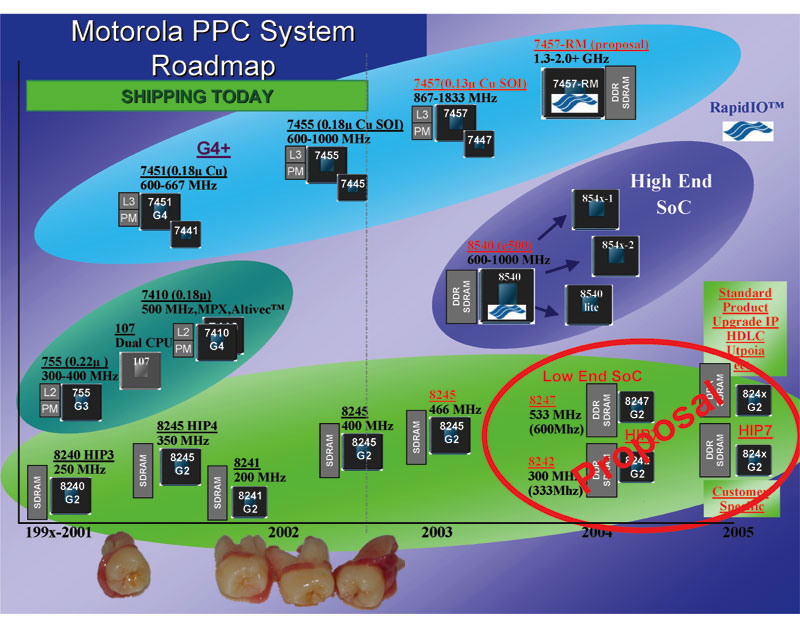
Take and even closer look... the 8540 was one of that guy's links. I really have to wonder about this... because a DDR-RAM controller is missing on the 7455, but is there on the 8540.
This bears some looking into! -
What ever happened to CHRP?
I think it was back in '95 or '96. IBM and Motorola were in development of dual-platform supporting processor called CHRP or Common Hardware Reference Platform.
The Common Hardware Reference Platform (CHRP) Specification describes a family of machines based on the PowerPC(tm) processor that are capable of booting multiple operating systems including Mac OS, Windows NT, AIX® and Solaris(tm).
Wouldn't that have been cool? What ever happened to that idea? Here's the old documentation.
It appears that IBM has some information on their site that is still recent, dated Sept. 2002. Weird. I'd love to have one of those machines. PowerPC 970? Forget about it. -
Motorola "G5" already shipping
Motorola's 5th generation of PowerPC host processors - the "G5" - have been shipping for quite some time.
They're just not at all interested in the desktop market anymore. -
Motorola "G5" already shipping
Motorola's 5th generation of PowerPC host processors - the "G5" - have been shipping for quite some time.
They're just not at all interested in the desktop market anymore. -
Motorola "G5" already shipping
Motorola's 5th generation of PowerPC host processors - the "G5" - have been shipping for quite some time.
They're just not at all interested in the desktop market anymore. -
The Phone That I'm Waiting For...
I'm waiting for the Motorola V600. It's due out later this year.
Big screen (65K colors), Bluetooth, J2ME, polyphonic rings, GPRS, and best of all, A NORMAL, USABLE KEYBOARD LAYOUT! -
Sometimes no other choice
As a business owner who currently has a new building under construction allow me to point out that sometimes "cube farms" are the only option. In the amount of square feet that I was able to afford I need to fit a certain amount of people. My choices were:
- Enough cubes to fit everyone
- Everyone get offices but we can have less employees than we need
- A cheaper office in a crappy location
I hate to go against the grain here, especially because I used to be a cube-dwelling programmer at my old job, but sometimes cubes are the best option for an employer.
That said, I did reserve an office for my programmer.
-
Re:No, the 970 produces more heat!
The 7457 is a cool looking chip for the PBs. It probably will end up in the 15" and 12" with the PPC 970 at 1.1v in the 17". The larger interior of the 17 would allow better heat dissipation.
The really interesting chip coming out of Moto next is the 7457-RM sometime next year. Its a G4 with a 200mhz bus on die Memory Controller and some other neat tidbits. Like all future Moto products there is some leaked info out there but not enough to really get much use.. -
Re:What would this do to portable fuel cells?
I'd be much happier carrying around ink cartridge (pen, not printer) sized plastic tubes of alcohol or hydrogen, as long as there are standard sizes. We've had AA, AAA, C, D and more for decades. I inderstand that portable devicees have their own special shape issues, but a single style of fuel cell would be a huge help.
Motorola developed an alcohol-based battery replacement in early 2000, but no word since then. -
"new" Linux-based PDA alternative: Motorola A760Greetings,
There is another contender in the Linux-based PDA arena: the Motorola A760.
It is also a GSM dual-band cellphone, supposedly coming out in late 2003.
I believe I read something on slashdot.org about it earlier, but can't find the URL. Here are other URLs with text on the device:
- Motorola press release;
- Geekstreet;
- I4U;
- BargainPDA;
ma2oliveira
-
Re:What they forget to mention:This seems to be the order of the day with mobile phones. The latest models from Samsung look and feel like a Fisher Price My First Cell Phone than something you'd actually want to carry around with you. A fellow I work with bought one, and I'm not exaggerating when I say it's looks and feels like the cheapest phone imaginable. My first comment was that he accidentally bought the non-working plastic display version.
Currently, I'm using a Motorola v60. It's made of metal (anodized aluminum) and is extremely solid in its construction. The only crummy thing about it is the antenna, which I had to get replaced (but they replaced it with a version that is more resistant to breaking). It can get the internet and do email, blah blah... but the key thing is that it's also a fantastic phone. I get great reception and sound, and never hear people complain about the quality of my signal. Sure you can't take an MPEG4 movie with it to email to your buddies while you listen to MP3s, but it's a great PHONE.
-
Re:NOT Ultra-Wide Band
So how does this differ to something like Motorola's Canopy? The difference appears that the base station radios may be used for other things (like voice). The Canopy stuff supports bit rates of about 4.3mbit per sector and delivers on that. A Canopy base station equipment costs about $8500 and that covers an area of about 2mi diameter in a fully deployed system but a single access point is about $1000.
-
Is it possible?
That the delay was caused by Apple putting the 7457 in them which does 1ghz with 512k L2 cache with less power? I know the 57 isnt in production yet but Apple and other big buyers have had samples for some time. So could Apple have put the squeeze on Moto for early chips and that was the cause of the delay? Not to mention the few 17" in stores are display models only and cant be turned on. Were the ones at Macworld working? anyone know the details?
Bueller? -
Re:Information...?
Why do posters keep saying posts are wrong without even checking if they are correct.
Read the companies own spec sheets: PowerPC 7455 (G4) 1gHz: 35.5 watts. Pentium III 1gHz: 45.2 watts.
Same clock speed, 10 watts less, STFU.
And no, there is no direct corelation between between "clock speed" and power consumption (if that were true, then why does the MC68000 at 16mHz use 28 watts and the Dragonball EZ (same architecture) use 950 mW?)
And let's not forget something as equally important as clock speed: data piplelines. The Pentium 4 has a 24 stage pipeline whereas the G4e has 7: in broad terms this means that while the p4 can work on 3 times the instructions concurrently, the G4 executes it's stack in a third of the time. -
motorola harmonycheck out the motorola harmony system. It looks like it's basically a private nextel (iden, 2 way + phone) system where you can use the handsets on both the private system and the public nextel network.
also, somebody already mentioned DECT, which is another great possibility. I believe there are lots of european GSM phones that have DECT built in too.
-
Re:It still looks ugly
So... pretty. Must... resist.
Indeed... what an ugly phone.
This is pretty . And get this... it is a great phone! I don't care that the web browser isn't the best, or that the screen is not color. It's a phone, a very good phone. I also have a good digital camera (PowerShot S200) and an OK computer (ThinkPad 600X). I prefer using the right tool for the job. Not a multi-tool that does nothing great, and everything so-so. -
Re:Consumer usage
That would be a huge waste of FPGA technology. You can use a 2$ microcontroler that contains a 15MHz CPU to control smart consumer electronics. The chips can be programmed in C. motorola You don't need specific chips anymore. FPGA implements massive parallelism. In what consumer electronics do you need massive parallelism? The 2$ microcontroler will be a lot easyer to program since it only does 1 instruction at a time and you don't need to worry about reconfiguring your chip hardware and sincronizing the different parts of the it like in an FPGA.
The only place in consumer electronics where an FPGA would be usefull would be in application where space is critical like in PDA, handhelds... There the FPGA could be reprogrammed to be used as different periferals. For example if you need a sound card voila the chip transform into one. Then later you need a modem and again it is programmed into the chip. It would save space by having one chip transforming into different chips. But I'm not even sure the gain would be that big compared to having one standard chip that contains, video card/modem/sound card modules that can be turned on and off. -
Re:Don't hold your breath about creating apps....
Nextel offers the capability to upload Java applications to their java-enabled Motorola phones here at their site.
They also have an OTA (over-the-air) feature to download the apps to all phones in your business/group/whatever collective you are in.
Motorola also has a Developer site which has a user support board with active Motorola people helping answer questions, etc. here at THEIR site
I'm not a java coder and have little desire to do so, but perhaps when I'm old and grizzly with nothing else to do I'll write my first "hello phone" j2me app
But I am glad java is on the phones, and I most certainly look forward to Linux. -
Motorolla's press release...
-
Re:crazy
PDAs typically use processors designed specifically for embedded environments. They're built from the ground up for low power consumption in preference to blazing speed. The PowerPC is exactly the opposite.
Really? That must be why most of Motorola's PowerPC chips find their way into mobile phones. Mobile phones obviously have completely different requirements to PDAs...
-
For the unintiated
I've alway been of the opinion project and processes methodologies are the last resort worthless middle management use to justify their existence. Leadership, aptitude and competence being fearsome skills they prefer to outsource.
Should your institution decide on that course - its a good idea to start with the founders of the "process" -
The CPU is more interesting than the PDA
The GPS PDA is one of the first devices to contain the new DragonBall MXL (MC9328MXL), according to this.
Its ARM9-based, is 150mhz and does 150mips. Doesn't sound like much, but its only US$10.30 in "low volumes". It has an MMU so it would run linux. I'd like a cheap, small, LART style computer with some useful IO (ethernet, serial ports etc) I can run linux on and generally hack about with. This seems like an ideal CPU (shame it doesn't have integrated ethernet though). -
Re:Jelly Belly!
I was just going to suggest that very thing! I live right down the street from the Wisconsin factory and have yet to stop by. I work at MotLabs -- if you're interested in a tour, I can look into it. Since there's research a-doings there, it might only be a factory tour, and I don't know anything interesting that's assembled in Schaumburg.
-
Re:Support...I would say that the DIY-EFI guys are chugging along nicely but last I checked their computer was pretty slow and old (68020 maybe?) and the person who actually designed and built it is suggesting the use of a 683xx series processor for a little more juice. He also has no A/D or D/A on his board, no counter hardware, et cetera.
Ultimately cars are pretty simple systems, the only bummer about them is that if you screw up you could permanently break something. That's harder than it seems though, cars will run with all kinds of suboptimal settings. Your timing can be off by as much as ten degrees and your car still run pretty close to properly, for example (which of course depends on how sloppy the engine is, amongst other things.) Your biggest problem is probably running lean. Fortunately there are many documents on the subject, and many many people have spent a LOT of time working on cars and understand them at a gut level. Some of them have even spent enough time programming fuel maps to be able to intuitively feel the relationships between the design of the engine and the amount of fuel and air to be delivered.
Hence the trick is to get all the right people together -- I don't have to tell you this -- But even *I* know a number of them. Hell, I even know a guy who does realtime x86 assembly for a living and has for years and years who is into cars; I'm sure there's lots of people out there like that though, I'm not trying to say I have the holy grail for this project in my hands or anything.
As for hardware, some of the most brilliant people I know are self-taught EEs. One of them owns/operates Pacific Neotek and makes the Omniremote software for palm pilots and the omniremote handspring module. He designed it himself, he reverse-engineered the palm IR hardware because palm claimed that there was no access to it in the way he was doing it... He's definitely both smarter and better-learned than I am
The 68332 is probably a better solution because it has 16 independent "channels" which can be used for timers or counters. Frankly if you could use one pin for each signal on the car that would just about be enough for most applications. For instance, my nissan has three signals on the crank angle sensor (1 degree, 90 degrees, and 0 degrees) (1,2,3), mass air flow (4), intake air temp (5), throttle position (6), AIV and EGR for smog(7,8), probably some kind of feedback from the electronic timing advance unit (9), an engine temp sensor (10), an O2 sensor (11), an exhaust gas temperature sensor (12), some transmission sensors for detecting gears (I think three (!) of them but we can build something small and simple and put that on one wire) (13)... That's all I can think of that the ECU is actually tied into at the moment. So without even multiplexing (most of those signals are voltage or resistance based and not timed or counted, with the obvious exception of the crank angle sensor and possibly the timing advance and as such can be multiplexed) we can handle enough signals for a fairly modern automobile. The newer version of my car has one more sensor (for knock detection) but that's probably just one more wire.
On the other hand, using the linux chip means we have a buttload of serial I/O and it also handles storage (like what, we're going to need more than 2mb storage for our image? only if we're horrendously inefficient) and we could break those out to less expensive microcontrollers to handle various aspects of engine control. PIC chips are the obvious suggestion because they are very well-known, but there are plenty of other possibilities of course (68HC11 anyone? $10 will get you all the parts you need to build a little development board.)
This isn't as hard as it looks at first, it can be done very inexpensively, and while there are obviously problems to be ironed out (or it would be done already!) it can definitely be done, and I think it's worth doing.
Reverse-engineering someone else's solution still doesn't solve the problem with someone else being in control of it and able to discontinue or raise the price, but it is better than nothing. There is a grassroots effort to reverse-engineer the Nissan 240SX ECU going on right now. Even if it bears fruit, though, it won't remove the need (even MY need) for a complete replacement since I want on-the-fly tuning and feedback, and it doesn't have OBD-II. (Only later models.)
-
Canopy
Check out Motorola's Canopy system.