Slashdot Mirror
Domain: msu.edu
Stories and comments across the archive that link to msu.edu.
Stories · 45
-
Cellphones As a Fifth-Order Elaboration of Maxwell's Theory (ieee.org)
schwit1 shares a report from IEEE Spectrum that reflects on the "Stages of Electronics" based on James Clerk Maxwell's theory: Now that the world has become addicted to portable electronics, billions of people have come to see the companies providing these gadgets as the most innovative, and the people who head those companies as the most exalted, of all time. "Genius" is a starter category in this discussion. But clever and appealing though today's electronic gadgets may be, to the historian they are nothing but the inevitable fifth-order elaborations of two fundamental ideas: electromagnetic radiation, the theory of which was formulated by James Clerk Maxwell in the 1860s, and miniaturized fabrication, which followed Richard Feynman's 1959 dictum [PDF] that "there's plenty of room at the bottom." Maxwell was a true genius. The history of science offers few examples of work as brilliant as unifying electricity, magnetism, and light as aspects of a single phenomenon: electromagnetic waves. As Max Planck put it, "in doing so he achieved greatness unequalled."
Vaclav Smil writes via IEEE: "As I pass the zombielike figures on the street, oblivious to anything but their cellphone screens, I wonder how many of them know that the most fundamental advances enabling their addictions came not from Nokia, Apple, Google, Samsung, or LG. These companies' innovations are certainly admirable, but they amount only to adding a few fancy upper floors to a magnificent edifice whose foundations were laid by Maxwell 152 years ago and whose structure depends on decades-old advances that made it possible to build electronics devices ever smaller." -
Researchers Develop Atomic-Scale Hard Drive That Writes Information Atom By Atom (techcrunch.com)
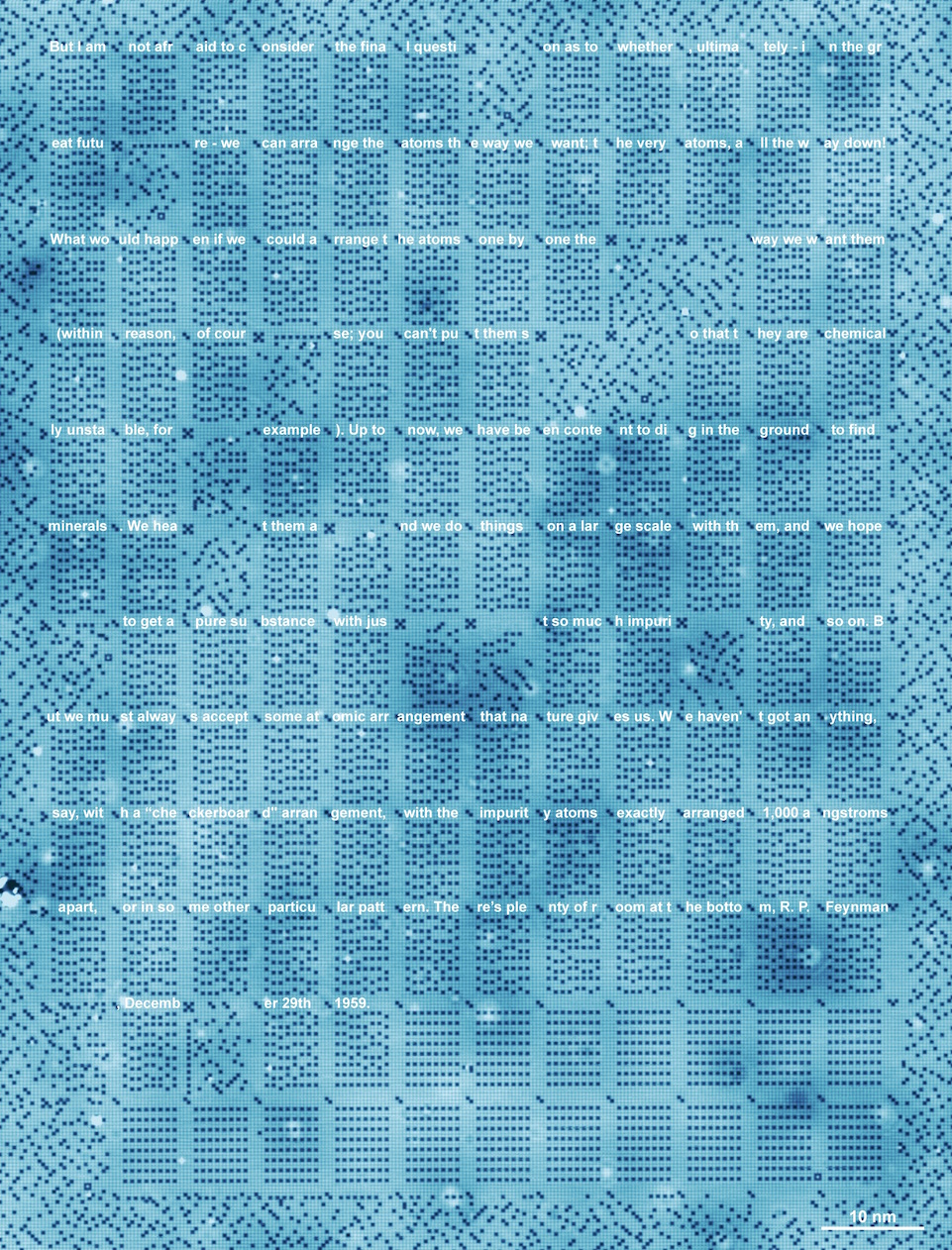
An anonymous reader quotes a report from TechCrunch: Researchers in the Netherlands have created a microscopic storage system that encodes every bit with a single atom -- allowing them to fit a kilobyte in a space under 100 nanometers across. That translates to a storage density of about 500 terabits per square inch. For comparison, those 4-terabyte hard drives you can buy today are about 1 terabit per square inch. That's because, unlike this new system, they use hundreds or thousands of atoms to store a single bit. "Every bit consists of two positions on a surface of copper atoms, and one chlorine atom that we can slide back and forth between these two positions," explained Sander Otte, lead scientist at Delft University of Technology, in a news release. Because chlorine on copper forms into a perfectly square grid, it's easy (relatively, anyway) to position and read them. If the chlorine atom is up top, that's a 1; if it's at the bottom, that's a 0. Put 8 chlorine atoms in a row and they form a byte. The data the researchers chose to demonstrate this was a fragment of a Feynman lecture, "There's plenty of room at the bottom" (PDF) -- fittingly, about storing data at extremely small scales. (You can see a high-resolution image of the array here.) The chlorine-copper array is only stable in a clean vacuum and at 77 kelvin -- about the temperature of liquid nitrogen. Anything past that and heat will disrupt the organization of the atoms. The research was published today in the journal Nature Nanotechnology. -
The Case Against E-readers -- Why Digital Natives Prefer Reading On Paper
HughPickens.com writes: Michael Rosenwald writes in the WaPo that textbook makers, bookstore owners and college student surveys all say millennials still strongly prefer reading on paper for pleasure and learning. This bias surprises reading experts, given the same group's proclivity to consume most other content digitally. "These are people who aren't supposed to remember what it's like to even smell books," says Naomi S. Baron. "It's quite astounding." Earlier this month, Baron published Words Onscreen: The Fate of Reading in a Digital World, a book that examines university students' preferences for print and explains the science of why dead-tree versions are often superior to digital (PDF).
Her conclusion: readers tend to skim on screens, distraction is inevitable and comprehension suffers. Researchers say readers remember the location of information simply by page and text layout — that, say, the key piece of dialogue was on that page early in the book with that one long paragraph and a smudge on the corner. Researchers think this plays a key role in comprehension — something that is more difficult on screens, primarily because the time we devote to reading online is usually spent scanning and skimming, with few places (or little time) for mental markers.
Another significant problem, especially for college students, is distraction. The lives of millennials are increasingly lived on screens. In her surveys, Baron was surprised by the results to the question of whether students were more likely to multitask in hard copy (1 percent) vs. reading on-screen (90 percent). "When a digital device has an Internet connection, it's hard to resist the temptation to jump ship." -
Using Multiple Forms of Media At Once Correlates With Depression, Anxiety
pigrabbitbear writes "A new study (abstract) from Michigan State University shows that media multitasking exhibits a strong correlation with social anxiety and depression. Importantly, the direction of causality remains to be seen: Does multi-tasking make us more anxious and depressed? Or, as the study's leader, Mark W. Becker, an assistant professor of psychology, put it in an email, 'are depressed and anxious [people] turning toward media multitasking as a form of distraction?' The results of this study aren't conclusive in that regard, he says. But they're an important step. 'While that question will not be easy to answer, it is worth pursing because the practical implications of the findings depend on the causal direction,' he said." -
Super Bacteria Create Gold
SchrodingerZ writes "With the price of gold skyrocketing in today's market, Michigan State University researchers have discovered a bacterium that can withstand high toxicity levels that are necessary to create natural gold. '"Microbial alchemy is what we're doing — transforming gold from something that has no value into a solid, precious metal that's valuable," said Kazem Kashefi, assistant professor of microbiology and molecular genetics.' The bacteria is Cupriavidus metallidurans, which is conditioned to be tolerant to heavy, toxic metals and to be 25 times stronger than most bacteria. When put into gold-chloride (a natural forming toxic liquid), the bacteria reproduces and converts the liquid into a gold nugget. The complete process takes about a week to perform. This experiment is currently on tour as an art exhibit called 'The Great Work of the Metal Lover.'" -
Michigan State Professor Helps Bring Broadband Internet To Rural Africa (Video)
Roblimo writes "Assistant Professor Kurt DeMaagd, of Michigan State's Department of Telecommunication, Information Studies, and Media, runs a program that brings broadband Internet to villages in Tanzania that have never known connectivity better than what they get with non-smart cell phones. Lots of students are involved, and Kurt (who was one of Slashdot's co-founders many years ago) believes the students get as much out of the project as the people in Tanzania who are its primary beneficiaries. Setting up not only computer networks but also satellite communications and solar arrays in areas where you can't zip on down to the local computer or hardware store for parts you forgot teaches how to work under adverse conditions, and how to plan in advance instead of winging everything at the last minute. But we'll let Kurt DeMaagd, who is an engaging speaker, tell the story himself in this long (8:12) video." -
Microbes Produce Power As They Clean Nuclear Waste
An anonymous reader writes "Researchers at Michigan State University (MSU) have isolated and explained the phenomenon that causes microbes to generate electricity while cleaning up nuclear waste. The team is hoping to use their findings to create a microbial fuel cell that is capable of generating renewable energy while it cleans up environments exposed to nuclear waste. The bacteria the team studied is a kind of geobacter that is covered in a coat of tiny, natural nanowires that protect the bacteria from the toxic materials. While completing the complex task of stabilizing radioactive spills, the bacteria simultaneously creates energy that can be harnessed and used as a zero-emissions power supply." -
College Students Lack Scientific Literacy
An anonymous reader writes with news of research into the scientific literacy of college biology students. Earlier studies found that students tended to "rely on mainly informal reasoning derived from their personal experiences," so the researchers derived a new instructional framework that explicitly taught principle-based reasoning. While the number of students who used this method did increase, more than half continued to use informal reasoning, which the researchers say points to a flaw in the way biology is taught (PDF). "Most college-level instruction presents students with complicated narratives about the details of key processes (e.g., cellular respiration), but does not explicitly reinforce the use of key principles to connect those processes. Therefore, students are understandably occupied with memorizing details of processes without focusing on the principles that govern and connect the processes. ... As a result, students may leave an introductory biology course with the ability to recite the reactions in the Calvin cycle but still believing that plants obtain most of their mass from the soil rather than from the atmosphere, that plants photosynthesize but do not respire, or that the mass of a decomposing organism will primarily return to the soil." -
College Students Lack Scientific Literacy
An anonymous reader writes with news of research into the scientific literacy of college biology students. Earlier studies found that students tended to "rely on mainly informal reasoning derived from their personal experiences," so the researchers derived a new instructional framework that explicitly taught principle-based reasoning. While the number of students who used this method did increase, more than half continued to use informal reasoning, which the researchers say points to a flaw in the way biology is taught (PDF). "Most college-level instruction presents students with complicated narratives about the details of key processes (e.g., cellular respiration), but does not explicitly reinforce the use of key principles to connect those processes. Therefore, students are understandably occupied with memorizing details of processes without focusing on the principles that govern and connect the processes. ... As a result, students may leave an introductory biology course with the ability to recite the reactions in the Calvin cycle but still believing that plants obtain most of their mass from the soil rather than from the atmosphere, that plants photosynthesize but do not respire, or that the mass of a decomposing organism will primarily return to the soil." -
Wales Supports Purging Porn From Wikipedia
Larry Sanger writes "Jimmy Wales recently took a bold position against pornography on Wikimedia Commons: 'Wikimedia Commons admins who wish to remove from the project all images that are of little or no educational value but which appeal solely to prurient interests have my full support.' Wales also restarted the "Commons:Sexual content" policy page. His basic complaint is that Wikimedia Commons hosts too much unnecessary porn, and he wants to get rid of it. He underscored his seriousness this way, stating that we can expect 'a strong statement' from the WMF soon: 'If the Wikimedia Foundation wants to declare that it is OK for Commons to be a porn host, they can do that, and I'll not be able to continue. That isn't going to happen, though, and in fact you should expect a strong statement from the Board and/or Sue in the next few days.'" (More, below.) Sanger continues: "This comes about a month after I originally posted my report about depictions of child sexual molestation on Wikimedia Foundation servers to the FBI, which Slashdot duly ripped to shreds (as only Slashdot can), and a little over a week after the FoxNews.com story. The latter coverage reported that one of my senators, and my representative to Congress, had forwarded the matter to the FBI's Assistant Director of Congressional Affairs. I'm happy to be able to congratulate Jimmy Wales for his good judgment on this, and I look forward to the larger Wikimedia community approaching these issues with a little more sanity." -
How Close Were US Presidential Elections?
Mike Sheppard writes "I'm a graduate student in Statistics at Michigan State University and spent some time analyzing past US presidential elections to determine how close they truly were. The mathematical procedures of Linear Programming and 0-1 Integer Programming were used to find the optimal solution to the question: 'What is the smallest number of total votes that need to be switched from one candidate to another, and from which states, to affect the outcome of the election?' Because of the way the popular and electoral votes interact, the outcome of the analysis had some surprising and intriguing results. For example, in 2004, 57,787 votes would have given us President Kerry; and in 2000, 269 votes would have given us President Gore. In all there have been 12 US Presidential elections that were decided by less than a 1% margin; meaning if less than 1% of the voters in certain states had changed their mind to the other candidate the outcome of the election would have been different." -
Creating Designer Isotopes
Roland Piquepaille writes "According to a Michigan State University (MSU) news release, 'Made-to-order isotopes hold promise on science's frontier,' nuclear physicists can now start a new career as isotope designers. These scientists can build specific rare isotopes to solve scientific problems and open doors to new technologies. The lead researcher says this approach has already given us the Positron Emission Tomography (PET) scan technology. He's now going further, saying that he wants to build objects 100,000 times smaller than the atomic nucleus. He calls this 'femtotechnology.' Also available are additional details and pictures of the tools used for this kind of research, picked from a 415-page design paper." Update: 05/11 14:30 GMT by SS: Readers have noted that the summary inaccurately portrays the scale of the 'femtotechnology.' The MSU researcher refers to "the capacity to construct objects on an even more minute scale, that of the atomic nucleus 100,000 times smaller." -
New Method To Detect and Prove GPL Violations
qwerty writes "A paper to be presented at the upcoming academic conference Automated Software Engineering describes a new method to detect code theft and could be used to detect GPL violations in particular. While the co-called birthmarking method is demonstrated for Java, it is general enough to work for other languages as well. The API Benchmark observes the interaction between an application and (dynamic) libraries that are part of the runtime system. This captures the observable behavior of the program and cannot be easily foiled using code obfuscation techniques, as shown in the paper (PDF). Once such a birthmark is captured, it can be searched for in other programs. By capturing the birthmarks from popular open-source frameworks, GPL-violating applications could be identified." -
Digital Life and Evolution
mrivorey writes "Discover Magazine has a story about The Digital Evolution Lab at Michigan State University. Scientists there have created virus-like computer programs that replicate, mutate randomly, and compete with each other... in other words, they evolve. Among such feats as learning to add and compare numbers, these digital life forms also once avoided scientists attempts at "killing" them, by playing dead. You can download the project yourself from SourceForge." We first mentioned this in early 2003, but it appears to have developed a good deal since then. -
Clarion Sci-Fi Auction
trickofperspective writes "To defray the cost of this year's session, following budget cuts at host school Michigan State University, the famed Clarion Science Fiction and Fantasy Writers' Workshop is holding an online auction of items donated by past alums. Bidding opens January 28th on items such as a signed limited edition of Neil Gaiman's American Gods, a signed, homeade galley of Cory Doctorow's upcoming Someone Comes to Town, Someone Leaves Town, and more." -
Clarion Sci-Fi Auction
trickofperspective writes "To defray the cost of this year's session, following budget cuts at host school Michigan State University, the famed Clarion Science Fiction and Fantasy Writers' Workshop is holding an online auction of items donated by past alums. Bidding opens January 28th on items such as a signed limited edition of Neil Gaiman's American Gods, a signed, homeade galley of Cory Doctorow's upcoming Someone Comes to Town, Someone Leaves Town, and more." -
Clarion Sci-Fi Auction
trickofperspective writes "To defray the cost of this year's session, following budget cuts at host school Michigan State University, the famed Clarion Science Fiction and Fantasy Writers' Workshop is holding an online auction of items donated by past alums. Bidding opens January 28th on items such as a signed limited edition of Neil Gaiman's American Gods, a signed, homeade galley of Cory Doctorow's upcoming Someone Comes to Town, Someone Leaves Town, and more." -
Learning a Foreign Language with The Sims
JavaTHut writes "The Journal Language Learning and Technology has a new article describing how The Sims can be modified to teach a foreign language. With this and other efforts at U.S.C. and M.I.T., could simulated immersion within video games become an effective way of acquiring a foreign language? Also of interest in the article are suggestions for using spatialized translation layers in foreign language songs and a Firefox extension for learning foreign vocabulary words." -
Japanese Balloon Battle
mw2040 writes "Slate reports on a little-known method used by the Japanese during WWII - hydrogen-filled paper balloons with deadly payloads floated without a guidance-system across the Pacific. Both amazing low-tech warfare and a cautionary tale about censorship during wartime. More links (even one for our neighbors to the North) (shamelessly stolen from the article)." -
Gimp 2.0 Pre 2 Released
Paul Kucher writes "A second preview of GIMP 2.0 has been released. From gimp.org: "Lots of bugs have been fixed since the last release and you are encouraged to try the new pre-release. It is now available from ftp.gimp.org or from one of the mirrors. Plug-in authors, please consider to port your GIMP plug-in to the 2.0 API. Now is a good time to do that." I have posted some screenshots here." -
Thoughts on the New Crop of Ogg Aware Players?
Steve Andre' asks: " Given the approaching season, I'm wondering if many have used and have opinions about the new Ogg Vorbis capable portable players out there. What I'd like to find is at least a CD/MP3/Ogg capable player which sounds good and doesn't do 'odd' things. What's it like out there? Can I finally roast my Ogg files and take them with me for a walk?" -
MIT Students Get an Education in Software Development
John Valenti writes "Philip Greenspun's Blog had an interesting entry for December 1: 'It turns out that most of the content editing and all of the programming work for OpenCourseware was done in India...'" -
The Rise of Cyber Bullying
santos_douglas writes "The Detroit Free Press has an article detailing the problems schoolchildren now face in the form of online cyber bullying. As if parents didn't already have enough to worry about! Examples include rumor spreading typically via text messaging, threatening emails, invasive pictures taken with camera phones, and the most extreme - creating entire websites to criticize/threaten/harass another student. The article suggests many tips for combating the problem - chief among them being the establishment of specific school policies. I suppose this is another example of an inevitable downside to the interconnected world. Mandatory Google search for your added reading pleasure." -
Online Epidemiology: RUSICK2
surfinbox writes "Forbes magazine print edition mentions Michigan State University's online epidemiology site called RUSICK2. If you get sick from a probable food bourne bug, log in to RUSICK2 and report where you ate and when. When they start to see a pattern, they can take action to prevent further illness. I love the RUSICK2 logo!" -
Online Epidemiology: RUSICK2
surfinbox writes "Forbes magazine print edition mentions Michigan State University's online epidemiology site called RUSICK2. If you get sick from a probable food bourne bug, log in to RUSICK2 and report where you ate and when. When they start to see a pattern, they can take action to prevent further illness. I love the RUSICK2 logo!" -
Corn-Based Plastic
SolemnDragon writes "CNN.com is offering up an article about the new corn-based plastic-like product being used at Wild Oats Natural Markets. The product looks like plastic, works like plastic... and then turns into compost. Dubbed the 'corn-tainer,' it's being used to serve foods, etc. Available only in the Pacific Northwest stores (of course) or you can make your own at home. And here's more info on Bio-plastic from MSU." Our older story. -
Study: Visual Basic use on the decline
santos_douglas writes "ZDNet news has this story on a study by market researcher Evans Data showing that 'professional' use of Microsoft's Visual Basic language is down significantly. The study pegs VB use at 52%, but of those surveyed 43% intend to switch soon. Of those 31% intend to use Java, and 39% C#, the remaining 30% are not described. The reason: '"As they leave Visual Basic 6.0 behind, developers are choosing languages that help them work more easily with emerging technologies such as wireless and Web services development," said Esther Schindler, senior analyst at Evans Data, in a statement.'" -
Tim O'Reilly Points Toward Next 'Killer App'
santos_douglas writes "Extreme Tech has this article in which Tim O'Reilly, the man behind every geeks favorite tech manuals, points toward four major leading indicators that will predict the next likely 'killer app' to emerge from the hacker community. They are: (1) Amazon.com web services (2) BARWN (3) Hardware hackers and (4) online gaming communities." -
Phreaking Not Dead Yet
santos_douglas writes "From Wired comes this article about an exploit involving weak voicemail passwords and automated voice recognition systems for accepting collect calls. The providers involved, SBC and AT&T, don't seem too concerned about their customers receiving tens of thousands in fraudulant charges from places like Saudi Arabia and the Phillipines." -
Warming Battle Over Online Taxes
mackertm writes "The NYT (free registration, blah blah) has an interesting story about the fight over Internet taxation. A coalition of states and some big clicks-and-mortar retailers are leading the charge to simplify the process of collecting taxes online. Amazon, Dell, and eBay are the biggest pure e-tailers resisting this movement. It's fun to see Amazon try and talk about how difficult it would be to implement taxes for all states, when it's already doing it for Target and Toys 'R Us." -
AMI Guy Talks About TCPA, Palladium, and Other BIOS Issues
We ran the "Call for questions" Monday, January 13, under the headline, Discuss BIOS and Palladium Issues With an AMIBIOS Rep. Note that Brian Richardson, AMI sales engineer, is a real engineer, not just a salesperson, and is also a staunch Slashdot reader who knows we have low tolerance for PR whitewashes around here. Brian's answers are real, not laundered, and he responded not only to the 10 questions we sent him but also to some he felt deserved answers even though they weren't moderated all the way up. Please note that in much of this interview he is speaking as "Brian Richardson, individual," and that his opinions do not necessarily reflect those of AMI's management. With that said, be prepared to learn a lot about the BIOS business, and how TCPA and Palladium relate (and don't relate) to it.Preface:
I thought it might be handy for the audience to know who's handling their questions ...
My name is Brian Richardson. I work for American Megatrends, Inc . (AMI). AMI is a privately held company located in Norcross, GA (just north of Atlanta). We employ approximately 400 people worldwide (about 200 in the United States).
I am a "BIOS Sales Engineer", responsible for handling technical issues related to selling and marketing the AMIBIOS8 , our latest BIOS code revision. This includes writing whitepapers, demonstrating products, answering technical sales questions, speaking at industry conferences and handling requests from the press that may require more than a passing knowledge of technology (like this one).
I started at AMI in 1996. I've been in this job for two years. Before that I wrote BIOS code for our notebook team and helped design our Software Quality Automated Testing (SQuAT) system. I also maintain several company intranets and our Bugzilla server, used for tracking bugs during BIOS development.
In spare time, I serve on the board of directors of Tech Corps Georgia. I also managed the Hardware section of linux.com (old articles are archived at linux.omnipotent.net).
This interview covers BIOS in general, but the questions have a heavy slant towards TCPA & Palladium. I'm sure I won't address everybody's TCPA related questions here. AMI has a "TCPA and AMIBIOS8" whitepaper at our website which discusses AMI's implementation. There are also links to other information on TCPA.
To answer some of the more unusual questions that didn't make it into the Top 10:
-
You use XOR to clear a register instead of a simple MOV instruction because of the instruction size (XOR uses a two byte opcode, MOV uses three bytes). The savings in space really adds up after a while.
-
We haven't finished 1394 boot yet, but we do have USB & USB 2.0 boot support
-
I don't know, I've never met Satan ... but I have been to WinHEC
Now on to the questions ...
1) On the Exclusionary Uses of TCPA
by the-banker
Is it (will it be) possible to use TCPA to effectively lock-out certain operating evironments from various services (software, media, etc) solely because the operating environment is not backed by a company, and has no mechanism for paying certification fees and licenses? Specifically, could TCPA be used against free OS's like Free/Open/netBSD and Linux to prevent those users from accessing the same content users of commercial OS's can?
Let me start out by reminding the audience I am not a security expert. I have been reading specs like a madman the past week, expecting such a question from the /. audience. I'm also not a professional TCPAadvocate ... my understanding of TCPA is in relation to what AMIBIOS must do to enable the TPM(a hardware component required by the spec). I'm going to refer toTCPA specifications & FAQ a lot, so verifying my answers will be an exercise left to the reader.
Your question brings up a lot of common issues people seem have with TCPA:
-
What does TCPA do?
-
What does AMIBIOS have to do with TCPA?
-
What is the licensing structure?
-
Can open-source software make use of TCPA?
-
Does this have anything to do with Digital Rights Management (DRM)?
Let's see if Brian can hash his way through these items in some sort of order ...
a) What does TCPA do? TCPA is an industry specification that defines mechanisms for "trusted" client/server interaction ("trust" and "security" are two different things).
TCPA works in a very similar fashion as other key-based security mechanisms (SSH, PGP, SSL). Transmissions are secured by hashing against a key. Keys tend to be very long (128 bits or more), so it is difficult for "bad people" to guess your key. In many mechanisms, the key also serves to identify the user (proof that they are who they say they are). This key is often contained in a file or some sort of removable media, like a smart card.
TCPA adds a few elements to this security scheme:
-
More keys and longer keys (some keys are 160 bits, most are 2048 bits)
-
A crypto-processor to speed key computations
-
Secure key storage on the system mainboard
-
Establish platform "trust". The two excerpts below are taken from the TCPA FAQ:
12. What do you mean by trust?
The ability to feel confident that the software environment in a platform is operating as expected. This is done by reliably measuring and reliably reporting (using aliasing) information about the platform.
Another such benefit is improved control of access to data. Previously such access has depended upon authorization or authentication. Now such access can also be linked to the state of the software in the platform. This enables the denial of access to data if rogue software, such as a virus, is introduced into a platform, because such introduction necessarily changes the software state of the platform.
The crypto-processor and key storage are provided by the Trusted Platform Module (TPM). A TCPA enabled system will have a TPM on the motherboard. This TPM can be disabled, as per TCPA specification, if the user wants to opt-out.
One concern is that TCPA is equivalent to a unique identifier on your computer, which causes a large number of privacy concerns. There's a large section of the FAQ (Item #13) that covers this topic:
The solutions support privacy principles in a number of ways:
1. The owner controls personalization.
2. The owner and user control the trust relationship.
3. Provides private object storage and digital signature capability.
4. Private personalization information is never exposed.
5. User keys are encrypted prior to transmission.
6. Supports multiple certificate authorities giving the user choice.
It is also important to know what the solutions are not:
1. They are not global identifiers.
2. They are not personalized before user interaction.
3. They are not fixed functions - it can be disabled permanently.
4. They are not controlled by others (only the owner controls).
b) What does AMIBIOS have to do with TCPA? The TPM requires initialization during BIOS POST. This allows what they refer to as "metrics" to be stored that help establish that the BIOS & OS can be trusted (i.e. haven't been h4x0r3d). Our "TCPA & AMIBIOS8" whitepaper has more information.
c) What is the licensing structure? There isn't one. From the TCPA FAQ:
10. What are the licensing and/or royalty arrangements for the technologies outlined by the TCPA specification?
The TCPA spec is currently set up as a "just-publish" IP model.
d) Can open-source software make use of TCPA? Yes. From the TPM FAQ:
18. Does the TCPA support open source systems?
Yes. The ability to use the TPM functionality is available to all developers of software. An open source project could determine to use TPM functionally today. The concepts of measurement, protected storage and attestation of measurements are fundamental concepts that hold true for any type of OS or application. The platforms that support TCPA today are not limited to only one OS and if open source developers provided applications that used the TPM functionality they would find support.
Remember ... SSH, GPG and SSL aren't any less secure because they're open-source. The whole point of key-based security is that you can't see the data without the key, even if you know the decryption mechanism.
e) TCPA & DRM? This question wasn't directly asked, but it's on everybody's mind ...
TCPA has been connected to proposed legislation that would require "content protection" on most digital media devices (including PCs).
While somebody could write a DRM application using the TPM, they could also write one without it. Non-DRM applications can be developed under TCPA. The example I thought of is an improved VPN for companies that are super-paranoid about their data (think about it ... 2048 bit keys, no hash load on the system CPU, ability to tie accessibility to a unique platform).
Adding TCPA & a TPM to a system doesn't automatically add DRM to a platform. Some application has to tie the TPM to the "media" being "protected". Merely adding TCPA to AMIBIOS doesn't constitute DRM:
Captain: What happen?
Mechanic: Somebody set up us the DRM.
Cats: How are you gentlemen !! All your BIOS are belong to us.2) Advantage
by TedCheshireAcad
What is the advantage to me, a Linux using consumer, to buying your product over those of your competitors?
First, the short answer: a proven and stable product based on nearly two decades in the PC industry, with support for the latest technology.
Now, the long answer: Let me give a little background on how BIOS gets onto your average motherboard. I know that's not what you asked, but it will explain product design and benefits to the end user.
AMI markets AMIBIOS directly to the motherboard manufacturer, who we see as the actual "BIOS customer". So many of our features are oriented to motherboard manufacturers or BIOS developer. The end result of using our codebase is to produce a stable BIOS for the motherboard manufacturer's customer (that's you, the end user).
You can break these down three major areas:
-
Code structure (ease of development, tools, source management, etc.)
-
Technology support (OS, chipsets, processors, peripherals, etc.)
-
Support after the sale
a) The "BIOS core" is a different code component from silicon support code. The same applies to our technology support modules (ACPI,USB, TCPA, ASF, SMBIOS, APM, etc.). This allows board developers to pick just the code they need for their system. An embedded Linux board for an industrial controller has different BIOS requirements than the typical "white box" motherboard (OS compatibility, supported hardware, power management, etc.).
AMI also developed a custom GUI to make BIOS development easier (Visual eBIOS, or VeB). Believe it or not, most BIOS development happens at the DOS prompt in x86 assembly code. We found it harder to get new engineers comfortable with DOS-based development (DOS is 22 years old, so is the average college graduate). VeB also incorporates source control, so engineers manage the code from the same place they edit the code.
b) Technology support is pretty broad. We have to work on new chipsets, technologies and devices while keeping backwards compatibility for older hardware we'd rather forget about. This involves a lot of work with hardware vendors (Intel, AMD, ServerWorks, nVIDIA, etc.), software companies (Microsoft, RedHat, etc.) and technical specification groups (there's one for most every acronym out there). As you might imagine, there's a lot of testing to make sure all these things play well together.
Technology support also applies to features that don't have cool three letter acronyms. One example of this is "Fast POST" (POST is Power On Self Test, BIOS execution from power-on to OS bootloader). There was customer demand to boot the PC faster. This pressure came from Microsoft for a better overall user experience (yes, the obvious joke is "boot speed doesn't matter when you don't have to reboot so often" ... but I'm taking the high road). So now Fast POST is standard in AMIBIOS8.
c) "Service after the sale" sounds like something you hear in a men's clothing store, but it applies to BIOS as well. Customers expect bugs to be fixed, new features to be added, and a voice on the phone when they can't quite figure out which bit goes where. Some customers develop using our source code (as a licensee), while others use our engineers to create their BIOS (as contractors).
That might have been more of a sales pitch than you were expecting (sorry). There's more product information at the AMIBIOS website.
3) Performance hit
by oliverthered
I assume that data pathways will be signable or encrypted in some way. What performance hit will the [operating system] take when using trusted system? e.g. How much extra data is added to form a signature, what methods are used for signing. and how will this benefit the end-user?
A: I assume this is in reference to TCPA, so I'll use what I know of that spec to answer the question.
Everybody who's used SSH or SCP has experienced computation overhead from data encryption. That's the main reason TCPA has the Trusted Platform Module (TPM). Along with storing keys, it had a dedicated crypto-processor to handle random number generation, hashing and digital signatures. Due to the size of a security key, these hash computations add overhead (overhead == delay).
In TCPA, the hash/generation stuff is offloaded to the TPM. Since this dedicated processor does the work, the main system processor doesn't have to. The TPM is also a function specific processor, meaning it's optimized for security tasks (translation: faster than your general purpose x86 CPU). This is a good thing, since most of the TPM keys are 2048 bits.
If you look at Transmeta's recent security press release, you see the same functionality. Although this story was reported as Transmeta releasing DRM, they are actually providing an integrated crypto-processor in the TM5800. This function-specific processor is accessible through an extension to the x86 instruction set (similar to MMX or 3DNow!). The difference between this & the TPM is how you access the functions.
Sidenote: does any open-source developer want to check if these extensions could be used to improve SSH, SCP or GPG performance?
The signing methods and potential benefits are outlined in the TCPA specification and FAQ.
4) Why are BIOSes closed source?
by mcelrath
Having recently had a lot of trouble with my laptop's BIOS, on an issue that I could most certainly fix if I had access to the code... I started wondering what benefit AMI and other vendors have by keeping BIOS code secret? I can think of none whatsoever.
An open-source TCPA BIOS might go a long way to alleviating the fears of the open source community, since we could see exactly what it is you're forcing on us. And hey, no doubt you'd get a few bug-fixing patches in return for your efforts.
So, is an open-source BIOS a possibility? (TCPA or otherwise)
Just to get this out of the way:
-
AMI isn't forcing anybody to take any product offering, TCPA or otherwise.
-
TCPA doesn't block open-source (see #18 in the TPM FAQ @ trustedpc.org).
-
The TPM Memory Present (MP) driver BIOS uses during POST isn't open-source (it's provided by the TPM manufacturer).
This was the focus of a linux.com article several years back. There's plenty of advantages to open-source, but there are two main reasons for closed source BIOS: Legal Restrictions & Economics.
The creation of an open-source BIOS isn't limited by the BIOS itself, but by the information required to create the BIOS. Let me take a second and explain how the BIOS works at a programming level. This may seem like a tangent, but it helps explain issues faced by open-source BIOS developers (just think of it as Good Eats for BIOS).
There's three major components of any BIOS:
-
Core Routines
-
Silicon Support Routines
-
Board Specific Routines
The core can be equated to the kernel of an operating system, except that it comprises a larger percentage of the codebase (both in functionality and actual code size). This is everything that's generic from one BIOS to the next.
Silicon Support applies to the chips on the board initialized by the BIOS (processor, northbridge, southbridge, I/O, flash). BIOS core routines will call silicon routines when hardware configuration is required. These routines are created according to an API, so swapping any of these code modules doesn't affect the structure of the core.
Board Specific Routines represent the motherboard manufacturer's configuration. If you look at motherboards from two manufacturers that use the exact same silicon components, you might expect the BIOS from one board to work on the other ... but you'd be wrong. The small hardware changes that differentiate Board Vendor A from Board Vendor B have a large impact on the BIOS. PCI Interrupt routing, chipset General Purpose I/O pins and other parts of vendor's "secret sauce" go into this BIOS layer.
"Fine," you say, "but what does this have to do with open-source BIOS?"
I'm sure you've noticed that there's a BIOS ready for a chipset the day it is announced. AMI and other BIOS companies don't just come along the day of the silicon release and slap a BIOS together. We work hand-in-hand with the chipset vendor for months before the release. They send us an alpha board, we boot it ... they send us a beta board, we add more features ... they send us final silicon, we validate it.
Now remember that this hardware isn't public when AMI gets it. AMI has to sign a has to sign a Non-Disclosure Agreement (NDA) to get a development board or advance specifications, which means we can't tell anybody what we know about the product. Vendor-supplied reference code (memory detection, bridge configuration, etc.) is also covered under NDA. AMI also signs NDAs to cover the motherboard manufacturer's confidential information.
So the BIOS that ends up on those motherboards is constructed using information we can't release to any party not covered by NDA. You might be able to understand how this doesn't fit into to the open-source model.
So an open-source BIOS developer has a big dilemma ... they need access to information, but legally can't include it in open-source code. Many chipset vendors provide information after their chipset is released, but not many board vendors hand out schematics. Reverse engineering might reveal this information, but some items controlled by the BIOS can damage the system if not set properly (data corruption, overheating, smoke, flame, etc.) ... so random bit flipping may not be the answer. And nobody wants to get into the legal issues of using disassembled code in place of reverse engineering.
I think the closing statement from the linux.com LinuxBIOS article still applies ... "The real question isn't if an open source BIOS will ever work on a handful of platforms, but if it will ever become viable for mass market across many platforms."
There's another issue that comes into keeping AMIBIOS source code closed (or for that matter anycommercial source code). This has to do with economics.
This is where I change hats from "AMI company representative" to "average techno-Joe". The next few paragraphs are my feelings, not necessarily those of my employer or anybody else on the planet.
I personally like the idea of open-source, and I use a lot of open-source programs at home and work (Mozilla, OpenOffice, RedHat, Mandrake, ClarkConnect, PostNuke, perl, php, Bugzilla). But I also buy and use regular closed-source programs (my DV editing and VCD/DVD authoring tools). The choice isn't whether or not the source is accessible, but if the tool fits my needs.
In either case, those programs are the product of somebody's time (in most cases, a large group of bodies). They're a conglomeration of people's ideas, a manifestation of their talents, and monetary investment (open-source isn't free to develop, somebody bought that computer hardware). Those people, and whatever company funded their efforts, have the choice to distribute their product anyway they choose.
If a company wants to go open-source, then they can't make money selling source or seat licenses. RedHat doesn't make money selling code, they make money selling a code package and support for that package. My company doesn't operate that way ... in the realm of BIOS, money is made licensing source and selling per-board licenses. That's the way every BIOS vendor makes money.
That doesn't mean there's no open-source within AMI (perl/php/PostNuke/apache intranets, Bugzilla bug tracking, ucLinux on our MegaRAC G2 management card). But the choice to go open-source is done product by product, company by company.
In an industry driven by innovation, many companies feel they loose competitive advantage by opening their source ... if everybody has access to their ideas, then why buy their product over another? That mentality may not fit well with open-source, but these inexpensive computers we currently enjoy are the product of market forces. If there was no profit in computing, would Intel and AMD even exist?
Thus ends my personal views ... back to the actual interview ...
5) Technical Explanation of BIOS Settings
by doppleganger871
I have been doing research on BIOS settings for many years, and I have found good articles on what the settings do, and how to tweak them for the best performance/stability mix. But, I would like to know if the BIOS manufacturer itself would be able to provide an in-depth manual of all the BIOS settings, and what exactly they do. All the manuals that come with motherboards are very short on explanations, and I would like to see someone within the company actually explain to us hardware enthusiasts the down 'n dirty, nitty gritty, dirt under the rug, needle in a haystack type of information that we could use to make our computers run the absolute best they can. Because, as we all know, optimizing software and firmware is a lot cheaper than upgrading parts.
A: I wish I had a great answer for this. Despite my verbose nature, there's not enough room in this interview to discuss every setting that is or will be in the BIOS. Some of the basic settings are covered in BIOS setup manuals, and a few websites do a good job of explain the ugly details. The problem is that those "cryptic" options change for every chipset on the market.
We're always looking at product improvements, and that includes documentation. Our setup manual is a generic template, designed for the motherboard customer as a starting point for their manuals. The "chipset specific setup information" is part of a new documentation effort within AMI (we talked about in meetings this week).
Outside of that, optimizing settings for a specific combination of board, memory and processor is still trial and error (tweak, reboot, benchmark, swear ... tweak, reboot, benchmark, swear ...). I don't know if better documentation will change that.
6) "Trusted" computer
by michael
A few related questions:
a) Isn't the goal of "trusted computing" to allow entities other than the owner of the computer to control what the owner does with his/her hardware? For example, "trusted computing" applied to music implies that the music publisher gains control over what the computer owner can do with the music data files. Isn't this the exact opposite of "trust" as that word is normally used - a trusted computer is one that can't be trusted by the computer's owner to perform the tasks asked of it, because other entities have veto power over the computer's actions?
b) Companies like AMI have repeatedly claimed that they aren't part of Palladium. However, isn't it true that without AMI's trusted BIOS (and all the other components necessary to build a "trusted computer"), Palladium wouldn't work? Why does AMI think they shouldn't be held responsible for enabling Palladium and similar schemes?
c) In what way does AMI benefit, financially or otherwise, from introducing a BIOS designed to make the computer it is installed in less useful to the purchaser of the computer? Please avoid saying that this is "optional"; AMI wouldn't create this BIOS if it wasn't intended to be used.
A: Let's take these in order ...
a) The Goal Of Trusted Computing: Despite the fact my company is a TCPA member company, the concept of trusted computing wasn't created by AMI (we're not even a founding member).
As far as the goals of the specification, I'm not the designated defender of TCPA. I'll let theTCPA speak to their own goals. You seem to automatically equate "trust" to DRM, but that's not what I get from reading the specifications and related materials (see part (e) of my answer to the first question).
b) Palladium & AMIBIOS: You are correct in understanding that Palladium will require some amount of BIOS support. The reason we keep saying "we're not a part of Palladium" is because Palladium doesn't exist in the marketplace ... it's a Microsoft initiative being developed under guarded care in a small circle of developers. It's not a public specification like TCPA, so our role in this scheme is unknown. My understanding is that we'll get a specification from Microsoft whenever they're ready to involve the BIOS developers, but I don't know under what terms it will be made public (my Magic 8 Ball says "Ask Again Later").
c) Financial Benefit: Yes, there is a financial benefit to supporting a technology that our customers ask for ... they continue to be our customers. Not every customer has asked for TCPA yet, but enough large customers have asked to make it financially reasonable. Keep in mind that this is just one more feature we offer, which the customer may or may not want to take.
So when a customer (or customers) comes to AMI and says "Our next motherboard will support TCPA, and we need a BIOS module", AMI has two choices:
-
Say yes, develop the code, make the customer happy
-
Say no
If we select option #2 (for whatever reason), our customer has one of two responses:
-
"No problem, we licensed your code ... we'll add the support ourselves."
-
"Too bad, you have a competitor who offers this support ... it was nice doing business with you."
Option B is an obvious downer, because customers give us money. Money can be exchanged for goods and services, like food ... and I find food to be an important part of a nutritious breakfast.
Option A presents another series of problems. Yes, we kept the customer, but now we have a forked version of our code floating around. If only one customer wants this feature, then it's not a big deal. If twenty customers want this feature, then there's twenty code forks. They're still our customers, so they expect support ... and this is a support nightmare.
Our decision to develop a TCPA option was driven by sufficient demand for the technology. We're not the only company in the marketplace offering TCPA. Phoenix, our largest competitor, has been working on TCPA for quite sometime. IBM is already shipping notebooks with TPM hardware (which run Linux, according to LinuxCare Labs). If AMI customers don't ship TCPA, they we spent time developing a feature nobody wanted (it wouldn't be the first time, but that's happens in cutting edge development), but we have customer goodwill because we're responsive to their needs. It's the same in our eyes as developing support for a chipset ... if nobody likes the chipset, then they don't buy the code to support it.
What we have done by choosing TCPA over any number of proprietary security solutions is present an option that isn't closed to third parties. If we enable TCPA on a board and you want to make use of it, read the spec and develop accordingly.
7) Hardware vendors
by cybermace5
Since a BIOS is only part of a motherboard: what steps will hardware vendors have to take, in order to incorporate your BIOS? Will they have to adhere to certain hardware design rules or controls in order to maintain the TCPA? Is there going to be a licensing procedure for hardware manufacturers?
A: Hardware vendors don't have to do much for AMIBIOS to support TCPA. The TCPA code module gets included as an add-on. The hardware manufacturer has to obtain a TPM to place on the motherboard, but that's available from a third party vendor.
The TCPA specification doesn't mandate licensing (see point #10 in the TCPA FAQ). It's not an AMI specification, so it's not our job to check for compliance. Third-party labs will most likely perform platform certification based on TCPA specifications.
8) Windows override
by Forkenhoppen
I have a question; on previous occassions on VIA hardware I've owned, I've noticed that occasionally, Windows will enable a feature even though I have turned it off in the BIOS.
My question is this; if I have TCPA disabled in my BIOS, will Windows drivers abide by this? Or will they still be able to use aspects of the BIOS originally put in place for use by TCPA even though I have it shut off?
What plans are in place to keep a Windows driver from hijacking TCPA-related information for it's own purposes?
A: A lot of that depends on how the motherboard vendor implements the TPM disable option mandated by the TCPA specification.
The TCPA specification has many options for disabling the TPM. It can be a BIOS setup question, jumper or software driven. The first two would be really hard to override in software (unless there's a robotic hand attached to the USB port). The third option could present a software override, but you would have to reboot to have the TPM enabled at power-on to set proper "root of trust" (you can't just turn it on midstream, since a TCPA system is supposed to hash the BIOS & bootloader).
9) TCPA & Palladium
by ignipotentis
Perhaps you can clarify the differences between the two (TCPA & Palladium). After reading up on both of them, i still find that they seem to be pretty much the same, just marketed differently.
A: From the information that's been made public concerning Palladium, I can try to elaborate on this. As I understand it, the major differences are listed below:
-
Curtain Memory
-
Control of Specification
-
Intellectual Property (IP) Rights
The last two points are pretty self explanatory. Palladium it not a public specification, there may be licensing issues. TCPA is a public document created and reviewed by a number of different companies, with no licensing demands.
The first point is technical in nature. Here's how the Microsoft's Palladium FAQ describes "curtain memory":
The ability to wall off and hide pages of main memory so that each "Palladium" application can be assured that it is not modified or observed by any other application or even the operating system
This type of mechanism doesn't exist in TCPA, and would probably require some sort of support at the chipset level (which means it couldn't be implemented using current northbridge hardware). The total system impact isn't known, and it's any body's guess what this does to application development.
10) What do you think about Linux BIOS?
by lanner
At first, I was going to ask you about how you have cooperated, if at all, with the Linux BIOS project. After all, you often have historically cooperated with Microsoft and Novell. What are you doing to help Linux?
But then it occurred to me, if Linux BIOS was successful, it would put AMI out of the BIOS software development business. Linux BIOS is a competitor of AMI.
What is your personal perspective about Linux BIOS, and what does AMI think about it?
A: There's a lot of overlap with question #4 here. But there are two points I'd like to touch on:
-
Cooperation with Microsoft, Novell & Linux
-
Perspective on LinuxBIOS
a) Saying that we "cooperate" with Microsoft and Novell is misleading. AMI creates AMIBIOS for maximum hardware and software compatibility. For years, Microsoft and Novell were the primary OS vendors used by our customers. Microsoft also drives many PC specifications, and the majority of our customers use Microsoft operating systems. Development and testing are focused based on customer demand.
In the past few years, that situation has changed. Novell isn't a major consideration for our customers, but we still test compatibility. Linux is demanded by more customers, and our testing efforts have been increased to match that demand. We test RedHat, SuSe, Mandrake, Xandros, Lindows and FreeBSD by default (along with various beta distros).
Microsoft is still key to our testing and development (we test everything back to Win98). Customers still need that "Designed for Windows" sticker. But Linux is a major focus in our testing and development ... not just because we develop for compatibility, but because our customers ask for it by name.
b) In some areas, people see LinuxBIOS as competition to the other BIOS vendors.
-
As far as the source licensing (open vs. closed), see my answer to question #4.
-
In features, LinuxBIOS does some things that our BIOS doesn't (mostly in the areas of cluster management) ... AMI has advantages over LinuxBIOS as well (boot from USB/USB2, JPEG graphics as boot logo, broader chipset support, ACPI/APM power management, etc.).
-
LinuxBIOS was developed for a specific application, but has broadened ... AMIBIOS aims to offer broad support in many market segments.
-
AMIBIOS has been tested against a larger number of system configurations, works with a larger variety of hardware, and has a longer product history.
I'm not sure how others at AMI feel about LinuxBIOS, but all I have to say is "go for it". There's some neat stuff coming out of that project, and it's interesting to see what they've accomplished. Competition in the market is what makes technology improve ... one notch better than the last thing, one step ahead of the next guy.
Thus ends the interview. Thanks to Slashdot for the opportunity, and thanks to the readers for wading through the text.
-
-
Howl-o-ween
qaz submits a story about a remote-controlled graveyard. Supposedly this site is another computer-controlled setup, but it's not responding at the moment. Still looking for a pumpkin carving pattern (the Ellen Feiss pattern is nice too)? Or perhaps you'd prefer yet another punkin-chunking machine, a new model which has several news stories about it: here and here. And if spooky stories are more your style, everything2 is running a scary story contest (see last year's for ideas). -
New Royalty-Free Fonts for Scientific Writing/Publishing
stotterj writes: "Writing anything up in science almost always means changing fonts a lot to use all the characters necessary for formulas and units (times, symbol, arial). This is annoying. People at STIX Fonts are putting together a universal font set that already has the special characters built in and can be used from writing to publishing. The fonts that result from the project will be made available for free." The site says that "In particular. the STIX project will create a TeX implementation that TeX users can install and configure with minimal effort." The licensing for these fonts (discussed in the FAQ) will allow free use, but not modification. -
Document Formats For Software Release Manifests?
Lt. Wuff asks: "I work in the QA/testing realm. My second biggest headache (QA being treated like the unwanted bastard child of software development being the biggest) is poor documentation of a given deliverable. If I don't know what's coming, I really can't plan the testing. Along the same lines, there really needs to be a way to get a quick glance at a release and know where it's at and what it's doing. Release notes tend to chase the development and are only somewhat useful for test planning. I'm not sure home many people here use something like a release contents document in their development/testing cycle, but I'm a huge fan of using them to control scope, manage expectations and allow me to plan testing. It's a quick glance at the release that anyone can understand. I've got a pretty bland format that assumes that the people are using some issue tracking software and I'm looking for others (i.e. developers) who use something like this to share ideas with." -
The Hacker Ethic And Linux Kernel 2.4
-
Mixing Law And Computer Science Degrees?
Janthkin asks: "I'm finishing my BS in computer science this year, and I'm looking for some advice. Grad school is a given: I want a master's in computer science. However, I'm also very interested in pursuing a career in law. Given the number of high- (and low-) profile cases we've seen just in the last year or so involving technology in general, and computers in particular, it seems reasonable to believe that a lawyer with significant computer knowledge would do quite well, much as the medical doctors with law degrees do. Anyone out there have experiences (personal or otherwise, finanacial or not) to share that might help me decide what to do?" -
Slashback: Universities, Piecemiel, Yakkin'
What will They think of next? Easier to start with what They've thought of previously. For instance: How is Steven King's online book experiment going? And speaking of Them, where lies the trend in The War Between The Pitiful RIAA and the Splendid Universities? And when will They realize that I don't want to talk into my address book, even if that's a PDA? Those people have a lot to answer for.Allegedly U.S. $299, allegedly end-of-year, allege, allege. Good news for those of us equipped with the quaint alternative to Palm Computing's organizers, even if less than impressed by most combination PDA / phone attempts -- InaneBoy writes: "Handspring's got a bunch of pictures and details of their new 'Visor Phone' Check it out! Super-keen!"
Of course, hemos is right -- there's a reason that most phones aren't as wide as your average PDA. This one looks like a reasonable -- if expensive -- way to combine the two items, especially if it will work with the combination mic / speaker earbud things. (But shouldn't the people making Springboard modules be a little busier with my GPS reciever?)
Plus, many colleges have declined to ban copying machines, tape recorders and ethernet. carlocius writes: "It appears that my college, Michigan State University, just handed Metallica and Dr. Dre another loss in their attempt to get Napster blocked on large Universities. MSU's administators stated that the Acceptable Use Policy of the university already covers copyright issues and there is no reason for Napster to be banned before a trial. GO STATE!!!"
Likewise, jellings writes: "The University of Pennsylvania joined the ranks of leading universities who are refusing to shut down access to the Napster on their campus, according to an article from the university press. U Pres. Judith Rodin said that "banning the Internet service would go against the University's educational mission by denying students freedom of inquiry and expression" and pointed to the Digital Millenium Act for further justification, saying that limiting access is not her responsibility ("Internet service providers cannot be held accountable for illegal activity on their networks if they are unaware of the activity"). Although the awareness of the activity of the issue may be questionable, it is certainly good to see a big U not yielding to the demands of Dr. Dre & Metallica ..."
The list of schools refusing to buckle under keeps growing; campus admins and sysadmins seem justifiably adamant about letting their policies be dictated by corporate vulture groups. Bandwidth reasons may be another story entirely, though.
Of course, not everyone has the awesome power of ResNet behind them ... ca1v1n writes: "The awesome power of the record labels has come through again. The Offspring have cancelled their plans to distribute their next album for free, after legal action and the threat of a lawsuit from Sony music. Yahoo! news has the scoop. So much for protecting the artists' interests."
An enquiry into establishing a curve of electronic book sales ... Triumphant former astronomy student jamie points out this CNN story on the continuing book experiment by Stephen King, who is still selling his novel online. Here's a telling snippet:
...since the first installment's release July 24, the percentage of readers paying for their downloads has dropped from 76 percent to less than 70 percent for the second installment. Part three goes up on Monday.
jamie points out that 70 "but he's giving us part 3 anyway. The more telling figures: 172,004 people had paid for part one and 74,373 people had paid for part two."maomoondog pipes in: "Apparently, King's company is upset that too few of the downloads are being paid for. Stephen King comments on the progress here. Personally, I'm impressed that 70% of the downloads are being paid for. With as low a per-item cost as a text download is, the author should really clean up in this sort of arrangement."
If you're one of the 172,004, liked the story, but are not part of the 74,373, please consider joining the second group on jamie's behalf, because as he says: "It's actually not a bad story and I want to see how it ends :)"
-
Is Napster Too Invasive?
Kyle Thomson asks: "I just left a Q&A with Hank Barry, C.E.O. of Napster (at University of Michigan). At the end, in a personal Q&A, he said that the banning of people was up to the artists, and that Napster fully complied with all requests. I then questioned him on the quick and easy ability to rejoin Napster. He said that 'the new version of Napster sprinkles bits around the hard drive. The only way to get back on is to buy a new computer.' So that leads me to the question of how invasive is Napster if it is leaving information everywhere on a hard drive?" What exactly does "sprinkling bits around the hard drive" really entail. I can see how this could mean "sprinkling random keys in your registry" but I admit to being a bit concerned by the actual description. Can anyone shed some light on this mechanism? Is it really as invasive as it sounds? -
U.S. DOJ Moves To Block MCI/Sprint Merger
Janthkin writes: "It seems the U.S. isn't going to allow MCI and Sprint to merge after all, so they WON'T be creating 'a telecommunications and Internet giant, one that would carry more data traffic than any other carrier and that would have left the U.S. long-distance market with only two major competitors instead of three.' (Text from the Standard story here). CNN coverage here." The U.S. side of the merger is not completely ruled out, but this seems a strong blow against it. -
Let the Simpsons be Your Free ISP
Anthony Fuentes writes "Looks like Homer and company are getting into the free ISP business, click here for details. Offer applies to win32 users only." Probably because Homer uses Windows - and Internet Explorer, of course, because that's the only browser you can use with this service. -
Free Red Hat 6.0 CDs
Anthony Fuentes writes "You can pre-order the GPL Redhat 6.0 CD at LSL for $0.00. " This looks legit- shipping looks like about $8 for UPS, but it does appear to be a free CD, so if you aren't blessed with a T1, check this out. -
Quickies Backwards R Us
Things have been a bit crazy: server troubles, spent some quality time in the ER after the gf got in accident (she's fine), and unusually stressful 'biz stuff (note:in utopia everyone pays their bills ontime instead of leaving us with a nearly empty checking account, a massive looming bandwidth bill, and all these unpaid invoices? I seem to be balding at an accelerated rate :) As for the images on port 81 of flotsam, I'm sorry about that- those of you behind firewalls will be glad to know that the new server will be in soon and hopefully the dust can settle. Allright, some quickies already: Toddius Maximus wrote in to tell us that Performance Computing has started a bi-monthly Linux Section Anthony Fuentes sent us an Interview with John Carmack webslacker sent us a nice little article on Pixar if you're curious what Steve Jobs' other company is up to. Wouldn't be quickies without Star Wars: James McP sent us linkage to a wired story about a Star Wars fan site featuring toy based mini movies, webslacker noted the new 12" Star Wars figures, and Dave Lowe sent us Star Wars Parody Music More cool movie stuff: patowic noted that Bruce Cambell (of Army of Darkness/Evil Dead fame) has his own web page, which features a sound bite archive And some Slashdot media sightings: Duke of URL noted that the recent Katz/Littleton stories got a mention on Suck. RKemp noted that The Economist noticed too. nene noted that an article about Slashdot appeared in Der Standard (although, with a name like that, its no surprise that it ain't English :) -
Stanley Kubrick Dies
Anthony Fuentes wrote in to tell us that Stanley Kubrick is dead. The director of so many amazing movies including The Shining, Clockwork Orange, Dr. Strangelove, and of course 2001: A Space Odyssey. He truly was a genius. He'll be missed. -
Quake Source in Late 99?
Anthony Fuentes writes "According to this .mp3 interview with John Carmack (@37:15), he is planning to release the source to quake in late 1999. Doesn't sound like he has completely committed, but cool none the less. " -
Use Netscape Mirrors People!
Jamie Zawinksi wrote in to tell me to tell everyone to lay off Mozilla.org and try one of the many mirrors- the huge demand has crippled the machine. Hit the link below to get a decent list of com and edu mirrors. Update:Couple of neato things, A screenshot of NS5 was sent in by Christopher Blizzard, and an insider who requested anonymity sent us a picture from this mornings big event, wrote "The main three people in this picture are Jim Barksdale, Jamie, and Tara Hernandez. Tara is manager of the build team. Just to the left of JimB is Jim Roskind, who led the Java-ectomy." Thanks guys.ftp://odin.appliedtheory.com/pub/mirrors/mozilla/
http://www.gbnet.net/public/mozilla/
ftp://ftp.landfield.com/mozilla/
ftp://ftp.epix.net/pub/mozilla/
ftp://netscape.primehost.com/pub/ftp.mozilla.org/
ftp://wuarchive.wustl.edu/packages/www/mozilla/
ftp://ftp.muc.muohio.edu/pub/mozilla/
ftp://ftp.bogalusa.com/mozilla/
ftp://sod.off.net:211/pub/mozilla/
ftp://mirrors.javanet.net/pub/mirrors/mozilla/
ftp://ftp.tux.org/pub/net/mozilla/
ftp://ftp.cache-world.com/mirror/mozilla.org/
ftp://powermike.com/powermike.com/pub/ftp.mozilla.org
ftp://ftp.tos.net/pub/ftp.mozilla.org/
ftp://pfaffben.user.msu.edu/mozilla/
ftp://ftp.shuttle.org/mozilla/
ftp://mirror.neosoft.com/pub/mozilla/
http://www.us.inside.net/mozilla/
ftp://ftp.cise.ufl.edu/pub/mozilla/
http://sunsite.utk.edu/ftp/netscape-source/
ftp://mirror.tummy.com/pub/mozilla/
ftp://ftp.one.net/pub/mozilla/
ftp://ftp.mindwell.com/pub/mirrors/mozilla/
ftp://ftp.ntr.net/pub/mozilla/
ftp://ftp-netscape.connectnet.com/pub/netscape/source/
ftp://mozilla.meer.net/mozilla/
ftp://ftp.inetdev.org/mirrors/mozilla/
ftp://ftp.yggdrasil.com/mirrors/site/ftp.mozilla.org/pub/