Slashdot Mirror
Domain: nasa.gov
Stories and comments across the archive that link to nasa.gov.
Comments · 16,365
-
Breaking News
Breaking News:
SCO has announced that is has claim to all IP related to supernovae. SCO claims it bought the rights to view and reproduce all supernovae images from NASA back in 1996. Another suit, targetted against the Catholic Church is insurance in case there really is a God that created the supernovae. If so, then God will be part of a future lawsuit.
Being that NASA uses UNIX computers to do much of it's work, SCO is also including IBM, Novell, Dennis Ritchie and Ken Thompson as defendents in the filings.
Further updates as we get them. -
Re:Accuracy (Goes past Mars too...)From Science Magazine
If the spin axis of 1950 DA is fixed near our direct rotation pole solution, solar pressure and asteroid perturbations could counter the Yarkovsky effect so that the probability of a collision in 2880 would be comparable to that of the initial detection case of 0.33%. Thus, the impact probability currently lies in the interval from 0 to 0.33%, where the upper bound will increase or decrease more rapidly as physical knowledge improves than as ground-based optical astrometry accumulates. We are unable to calculate a reliable, specific collision probability, because the trajectory uncertainties are dominated by unmeasured or poorly determined systematic physical effects.
And don't forget it goes out past Mars, too! For more calculation fun, of course, don't forget
- Galactic tide
- Numerical integration error
- Solar mass loss
- Solar oblateness
- 61 additional asteroids [not included in their model]
- Planetary mass uncertainty
- Solar radiation pressure
And a wacky idea I've had floating around for a while:
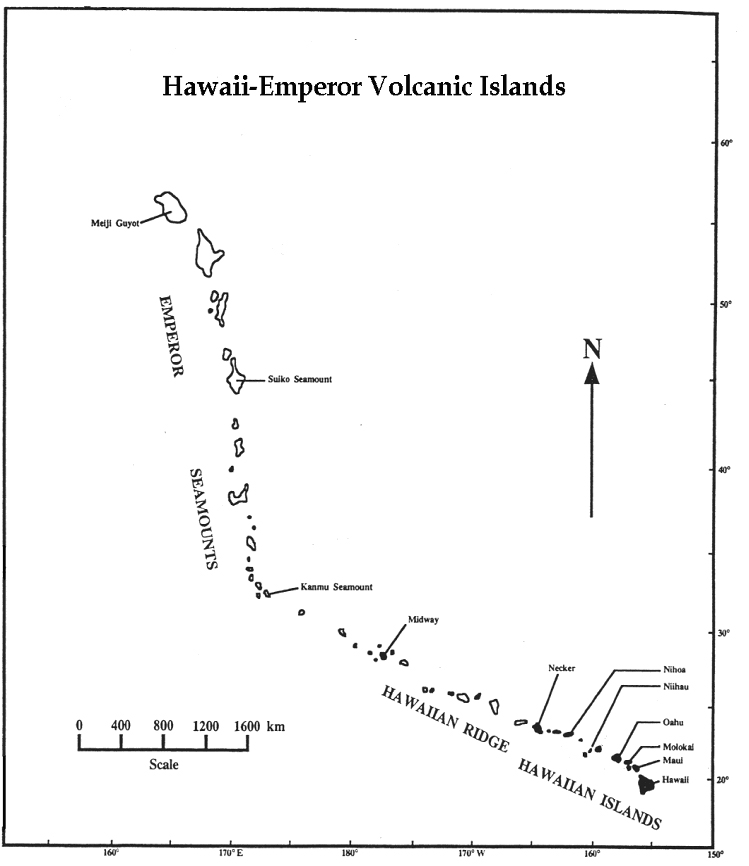
Could the "hole" which produced Hawaii be the result of an ancient impact? Then the Hawaiian Islands, the Hawaiian Ridge and the Emperor Seamounts are just a record of the Pacific plate drifting over that impact site, which is still bubbling...
And if you accept that, what produced the "sudden" left turn in the volcanic chain? Did the Pacific plate go "bump"?
-
cool robot of the week
Did anyone else go to NASA's cool robot of the week to see if it was listed? Why isn't it?
-
Re:Uhm...
Depends. Some craters are huge. Look at the Barrington Meteor Crater in Arizona. While that one is fairly recent (about 49,000 years), there's lot of other identifed that are significantly older. -
The link is to complex?
The link was to complex to be included here? They look pretty regular to me. You've maybe heard of the A tag? Was it Great Archaeological Sites, Exploring Mars, Earth As Art, or Archimedes' Lab; _OR_ did you just want some traffic to your site?
-
Re:90 Percent?Nothing that major has been observed since. There was a spectacular near miss, though. This object skipped off the atmosphere in Aug., 1972, starting over Utah and leaving the atmosphere over Alberta. I was a fetus when it passed over my parents' house.
But if I were you, I'd be more worried about the small stuff.
-
Re:Here it is
-
Re:GPS systems: One, two or none?
This is an interesting line of questioning for a couple of reasons.
First, when Selective Availability was active, people did work up means of getting military-level accuracy and better by using things like differential GPS. (See also a project by NASA. There are many other references from the geophysical sciences community.) It was safe, at least then, because the time needed to get a good position fix was on the order of hours. That rate is fine for geophysics.
Second, part of the political and strategic thinking about GPS was to put assets in orbit so they might serve as a target instead of ground-based systems. That is, the mindset at the time was very much one of fighting a nuclear war. The problem of that was in part seen as one of releasing a cataclysm if the nuclear option was exercised. So, it was thought, if juicy enough targets were put in space, an adversary could use a nuclear weapon to destroy those to press the point of their seriousness home without committing to a direct attack and its devastating retaliation. I imagine that was also true of communications satellites.
The USA actually did conduct some atmospheric tests to measure effects of high altitude nuclear blasts. While the results are classified and these were conducted before satellites were widely used, the possibility of nuclear attack is taken seriously enough that designs for military satellites, including GPS, undergo testing for nuclear hardening.
-
Black Hole PowerIt is possible to use a black hole as a generator, though Hawking radiation is not an effective way to do it. There are two ways to extract energy from a black hole:
- Matter radiates away approximately half its mass as it falls into the black hole due to the intense acceleration. While this is incredible efficient (50% mass to energy conversion compared to less than 10% for matter-antimatter reactions), it is released as high energy x-rays or gamma rays which may be difficult to use.
- Many black holes release huge amounts of energy as magnetic fields, heating up the gas that surrounds them. Here's article at NASA where that's been observed and another one from Los Alamos.
-
Re:I Agree - We should go metricAlso the earth's day speeds up and slows up according to its distance from the Sun to conserve angular momentum. And tides (in both the ocean and crust) also change the earth's angular momentum. In fact, tides cause the day to get gradually longer over time. See here for more complete info.
-
Measurments NASA converted
Oops looks like someone forgot to do NASA approved public relations unit conversion. So let me take a stab at it...
Mars Mass =~ 6.4185E21 VWB's (VolksWagen Bugs)
Orbital Distance (near) 5.9602E9 FbF's (Football Feilds)
Orbital Distance (far) 43.887E9 FbF's
Data Collection* =~ 127E-3 LoC's (Library's of Congress)
Enjoy the bliss of understanding with "real world" reference units
That lame scientific crap can be found here
* denotes a number pulled out of my ass
-
Re:Air traffic biggest concern
Anyway, in the end, the idea of flying relays has been promoted innumerable times -- and it never happens.
Counterexample: geo-synchronous satellites. -
Re:Sorry
I know molecular biology and I know that there is *no* way that nucleic acid will be able to remain intact in space, exposed to vacuum, temperature extremes and radiation.
Bacteria - which contain nucleic acids, obviously - can survive on the moon. Viruses are even simpler and hardier.
-
Beagle 2
I think that, out of all the missions the article mentions, Mars Express is the most exciting. This mission, which is backed by the European Space Agency (rather than NASA, as the article implies), carries the British-built Beagle 2 lander, targeted at looking for evidence for Martian life, past and present. Beagle 2 (named after Charles Darwin's ship) is far more sensitive than the old Viking Missions, which were the first (and so far, the only) missions to look for life. It's worth noting that the more-recent Pathfinder mission was a proof-of-concept for the two upcoming Mars Exploration Rovers, which are for geological surveys rather than life searches.
One partcularly cool feature of Beagle 2 is its "Mole", which can crawl across the surface (at 1cm/s) and burrow imto the ground or under boulders. The Mole will be able to take samples from locations which the Viking landers couldn't reach; these samples may provide conclusive evidence that life once existed on Mars.
Mars Express, carrying Beagle 2, is due to blast off from the Baikonur Cosmodrome in Kazakhstan on June 2. Fingers crossed!
-
Beagle 2
I think that, out of all the missions the article mentions, Mars Express is the most exciting. This mission, which is backed by the European Space Agency (rather than NASA, as the article implies), carries the British-built Beagle 2 lander, targeted at looking for evidence for Martian life, past and present. Beagle 2 (named after Charles Darwin's ship) is far more sensitive than the old Viking Missions, which were the first (and so far, the only) missions to look for life. It's worth noting that the more-recent Pathfinder mission was a proof-of-concept for the two upcoming Mars Exploration Rovers, which are for geological surveys rather than life searches.
One partcularly cool feature of Beagle 2 is its "Mole", which can crawl across the surface (at 1cm/s) and burrow imto the ground or under boulders. The Mole will be able to take samples from locations which the Viking landers couldn't reach; these samples may provide conclusive evidence that life once existed on Mars.
Mars Express, carrying Beagle 2, is due to blast off from the Baikonur Cosmodrome in Kazakhstan on June 2. Fingers crossed!
-
Beagle 2
I think that, out of all the missions the article mentions, Mars Express is the most exciting. This mission, which is backed by the European Space Agency (rather than NASA, as the article implies), carries the British-built Beagle 2 lander, targeted at looking for evidence for Martian life, past and present. Beagle 2 (named after Charles Darwin's ship) is far more sensitive than the old Viking Missions, which were the first (and so far, the only) missions to look for life. It's worth noting that the more-recent Pathfinder mission was a proof-of-concept for the two upcoming Mars Exploration Rovers, which are for geological surveys rather than life searches.
One partcularly cool feature of Beagle 2 is its "Mole", which can crawl across the surface (at 1cm/s) and burrow imto the ground or under boulders. The Mole will be able to take samples from locations which the Viking landers couldn't reach; these samples may provide conclusive evidence that life once existed on Mars.
Mars Express, carrying Beagle 2, is due to blast off from the Baikonur Cosmodrome in Kazakhstan on June 2. Fingers crossed!
-
Picture of Earth and Moon from Mars
The picture has already been referenced by
Beware this is just a distraction, with all eyes towards Mars, Venus is planning a sneak attack! -
Mars is nearly airless, peopleThe atmospheric pressure on Mars is only 7-10 millibars. (Earth is about 1000 millibars.)
Despite telescope pictures of "Martian windstorms", Pathfinder's wind sock didn't move much. Those "windstorms" are drifting clouds of very fine dust, more like air pollution than sandstorms.
Wind-powered travel on Mars doesn't look promising.
-
Re:Why not the high-tech solution ?Your paranoia is amusing.
NASA has a program in development. The prototype has already flown.
It's called the AERCam Sprint.
-
Re:Junk the Shuttle -- and ISS while you're at it.
One example: the ISS (which is an utter joke compared to Skylab or Mir) was placed into a rapidly-decaying orbit not because that was a good idea (it isn't) but because the shuttle could get there.
Skylab was intended for exactly three missions, with no intention of resupply or re-use. The vehicle itself had severe problems -- one solar panel tore off at launch -- which limited its usefulness (the first mission ended up being largely wasted on rescuing the station). Mir was no picnic, either -- there was a major fire, and the collission with a resupply ship. The ISS has, so far, been comparatively problem-free.
Skylab's orbit was not that high -- roughly 270 miles -- in any case it was launched in 1973 and crashed to Earth only six years later, in 1979. The ISS's current altitude is 242 miles. I can't find any orbital data on Mir, but the space shuttle got there, too, and it didn't take more than a few years to crash back to Earth after maintenance ended.
Most of the satellites that are "launched" by the shuttle suffer from the design constraint that they have to fit into the friggin' bay AND have room for the accompanying boosters that will put them into their real orbit once the shuttle lets them out. Again, the shuttle can't go high enough for real deployment.
I don't know what you mean by "real orbit", but the shuttle deployed Hubble at an altitude of 368 miles and has visited it several times since. No current manned vehicle can go much higher than this; and none can reach geosynchronous orbit. Shuttle deployment is not a good idea for commercial satellites, but it makes sense for large, multi-billion-dollar one-shot spacecraft (like Hubble) because if something goes wrong there is an option to bring it back to Earth or do on-orbit repair.
The safety record sucks.
The claimed accident rate of one-in-400 is clearly off. The demonstrated accident rate of 2-in-113 is not atypical of comparable launch vehicles, such as Soyuz. It's even more impressive given that the shuttle system is intended to be reusable, while Soyuz is launched new each time.
It's a white elephant without a mission
Its mission has been and always will be to service the ISS.
It's very tempting to look at any complicated system that has problems, and say, "Bah, this is useless, let's start over". The reality is that experience gained using the shuttle and the ISS is crucial to the continued exploitation of space.
Space flight is a risky business and will continue to be so. There is no guarantee that a new system with untested hardware will be any safer. -
Re:Junk the Shuttle -- and ISS while you're at it.
One example: the ISS (which is an utter joke compared to Skylab or Mir) was placed into a rapidly-decaying orbit not because that was a good idea (it isn't) but because the shuttle could get there.
Skylab was intended for exactly three missions, with no intention of resupply or re-use. The vehicle itself had severe problems -- one solar panel tore off at launch -- which limited its usefulness (the first mission ended up being largely wasted on rescuing the station). Mir was no picnic, either -- there was a major fire, and the collission with a resupply ship. The ISS has, so far, been comparatively problem-free.
Skylab's orbit was not that high -- roughly 270 miles -- in any case it was launched in 1973 and crashed to Earth only six years later, in 1979. The ISS's current altitude is 242 miles. I can't find any orbital data on Mir, but the space shuttle got there, too, and it didn't take more than a few years to crash back to Earth after maintenance ended.
Most of the satellites that are "launched" by the shuttle suffer from the design constraint that they have to fit into the friggin' bay AND have room for the accompanying boosters that will put them into their real orbit once the shuttle lets them out. Again, the shuttle can't go high enough for real deployment.
I don't know what you mean by "real orbit", but the shuttle deployed Hubble at an altitude of 368 miles and has visited it several times since. No current manned vehicle can go much higher than this; and none can reach geosynchronous orbit. Shuttle deployment is not a good idea for commercial satellites, but it makes sense for large, multi-billion-dollar one-shot spacecraft (like Hubble) because if something goes wrong there is an option to bring it back to Earth or do on-orbit repair.
The safety record sucks.
The claimed accident rate of one-in-400 is clearly off. The demonstrated accident rate of 2-in-113 is not atypical of comparable launch vehicles, such as Soyuz. It's even more impressive given that the shuttle system is intended to be reusable, while Soyuz is launched new each time.
It's a white elephant without a mission
Its mission has been and always will be to service the ISS.
It's very tempting to look at any complicated system that has problems, and say, "Bah, this is useless, let's start over". The reality is that experience gained using the shuttle and the ISS is crucial to the continued exploitation of space.
Space flight is a risky business and will continue to be so. There is no guarantee that a new system with untested hardware will be any safer. -
They've already sortof done this
The Deep Space 2 probe did exactly this, if you count 2 as a "cluster". Too bad the mission failed.
-
Old Idea
Kinda weird, but the article claims that "While working as a 2002 summer intern at NASA Langley, team leader David Minton initiated the idea to study a "Mars Tumbleweed" for the class project." Well, that'd be all great and everything if JPL hadn't already come up with the idea: Exploring Mars: Blowing in the Wind?. The JPL article is dated August 10, 2001.
Someone probably should have told David Minton about Jack A. Jones' research at JPL. "Jack A. Jones...is leading JPL's research into various inflatable machines for exploring space. JPL's Inflatable Technology for Robotics Program aims to create rugged, all-terrain vehicles and other devices with low mass and low-packing volume." -
Re:Been done since the 1960s at JPL
Found it here. Clever, inexpensive out-of-the-box thinking. Answers to most questions above (location, steering) can probably be solved with undue complication. Compliment this with ARES Mars Airplane, conceived at Langley which could easily follow tumbleweed travels.
Go State, Langley & JPL! -
Re:Been done since the 1960s at JPL
Found it here. Clever, inexpensive out-of-the-box thinking. Answers to most questions above (location, steering) can probably be solved with undue complication. Compliment this with ARES Mars Airplane, conceived at Langley which could easily follow tumbleweed travels.
Go State, Langley & JPL! -
Re:Been done since the 1960s at JPL
Found it here. Clever, inexpensive out-of-the-box thinking. Answers to most questions above (location, steering) can probably be solved with undue complication. Compliment this with ARES Mars Airplane, conceived at Langley which could easily follow tumbleweed travels.
Go State, Langley & JPL! -
Re:Been done since the 1960s at JPL
Found it here. Clever, inexpensive out-of-the-box thinking. Answers to most questions above (location, steering) can probably be solved with undue complication. Compliment this with ARES Mars Airplane, conceived at Langley which could easily follow tumbleweed travels.
Go State, Langley & JPL! -
worth a closer lookExcellent. Finding one of these is worth zillions of galaxies, quasars, and the like.
Even if it doesn't have liquid water, gasious oxygen, or solid land, then it can still focus as the fulcrum of our local jump point.
-
this picture sucks
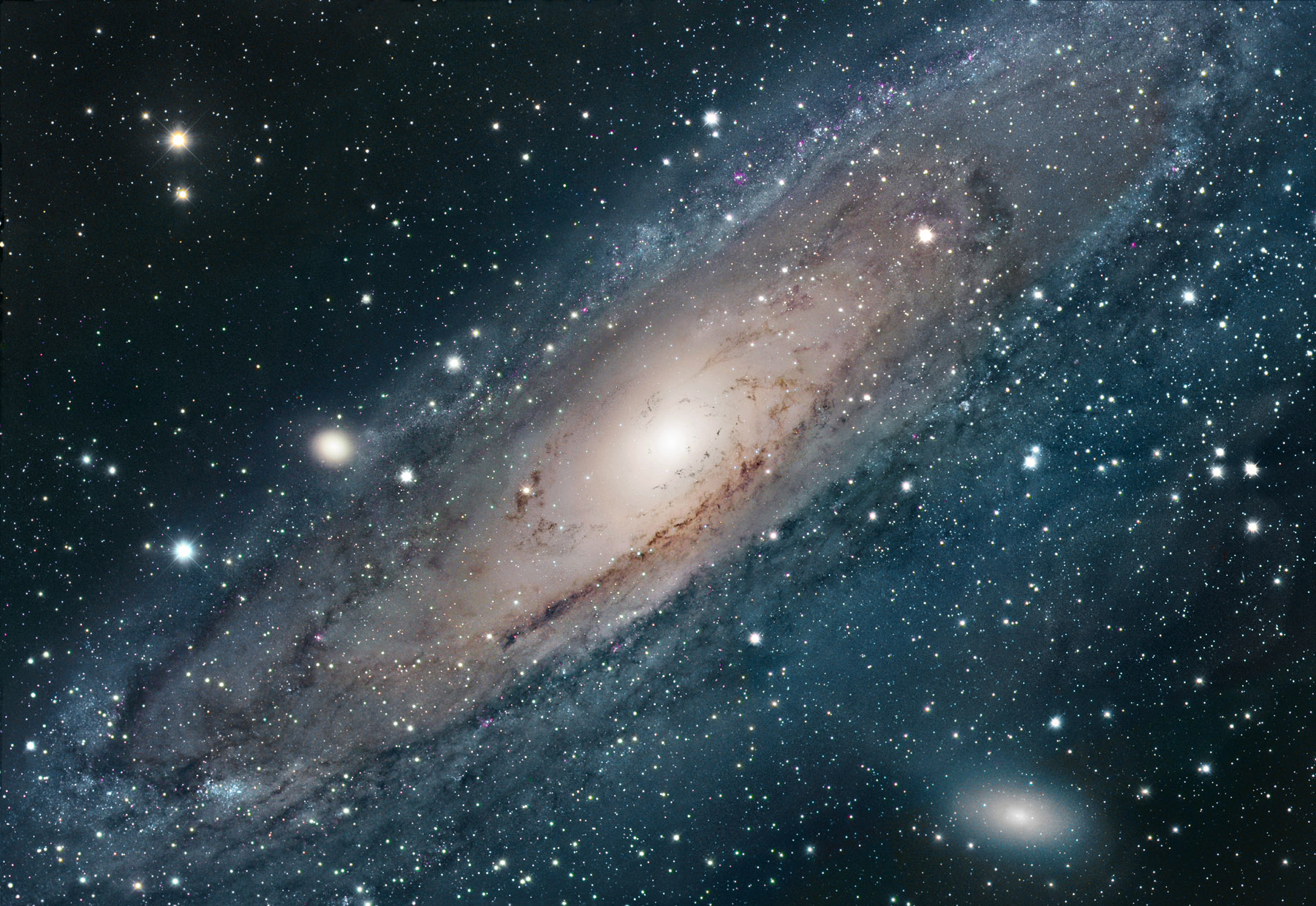
This photo doesn't impress me. Take a look at this shot of M31, our closest neighbor galaxy at 2 Million light years away. Andromeda is made up of around 10^11 stars. Now that's impressive. The solar system is so darn small-scale.
-
Re:Very nice.
if you want the full resolution tiffs (and jpgs too) look at the jpl site:
jupiter and moons
earth and moon
itty bitty earth and jupiter
-
Re:Very nice.
if you want the full resolution tiffs (and jpgs too) look at the jpl site:
jupiter and moons
earth and moon
itty bitty earth and jupiter
-
Re:Very nice.
if you want the full resolution tiffs (and jpgs too) look at the jpl site:
jupiter and moons
earth and moon
itty bitty earth and jupiter
-
Not the first far-earth pictures
NASA has been doing cool pictures from far away for a while. Two that are worth looking at:
Solar System Family Portrait
This one is nice, but earth is really only about 4 pixels, so you can't see all that much detail.
Saturn in shadow
This is a nice shot of Saturn by the Galileo probe, taken with about half the planet in shadown. Read the write-up there, it's kind of cool. -
Not the first far-earth pictures
NASA has been doing cool pictures from far away for a while. Two that are worth looking at:
Solar System Family Portrait
This one is nice, but earth is really only about 4 pixels, so you can't see all that much detail.
Saturn in shadow
This is a nice shot of Saturn by the Galileo probe, taken with about half the planet in shadown. Read the write-up there, it's kind of cool. -
Re:Turn it over to the private sector...
itty bit of history... Buran shuttle
-
Re:Why is it bad?The following is an abridged and edited version of my full rant on the subject, available on my home page.
The following promises were made to us in the early days of the Shuttle: all these promises have failed to materialize.- The Shuttle is not a `space truck'.
It's more of a space Chevy pickup. When I think of trucks, I think of semis--things capable of carrying huge loads over long distances. The Saturn V rocket, the reliable workhorse of the Apollo program, could launch over 250,000 pounds to low Earth orbit or even put men on the moon. The Shuttle, by comparison, can only put 58,000 pounds into low Earth orbit and cannot reach higher orbits. Saturn V rockets made the 250,000-mile trip to the moon not once but several times, while the highest the Shuttle has ever gone is a meager 385 miles (335 nautical miles) during STS-82.
In fact, the Shuttle is so sharply limited that it rarely deploys a satellite directly. Instead, the satellite is mounted to yet another rocket, carried to low orbit in the Shuttle cargo bay, and the second rocket then kicks it into proper orbit. I don't understand the logic: we launch the Shuttle into orbit so we can have astronauts risk life and limb - The Shuttle is not reusable.
Endeavour cost $2.1 billion (source) and each launch costs $450 million (source) per mission. Most of that expense is taken up in refurbishing the Shuttle afterwards, where so much of the Shuttle is disassembled, inspected, replaced and reassembled that it's fair to declare it ``rebuilding'' instead of ``refurbishing''.
More than this, not one single flight component of the Shuttle--not one!--has met its original flight rating. For example, the Shuttle's main engines were originally rated for 27,000 seconds of thrust (about 55 flights). After that time, the engines would have to be replaced. This design goal has not been met. As Nobel Laureate Richard Feynman wrote in the official report on the Challenger disaster, ``[t]he engine now requires very frequent maintenance and replacement of important parts, such as turbopumps, bearings, sheet metal housings, etc. - Twenty-six launches per year?
Between maintenance, rebuilding and inspections, it's not uncommon for a given shuttle to only go up once a year. In Columbia's case, its final mission was its twenty--eighth flight in twenty--two years of service, and its second since 1999. We are nowhere near 26 launches per year per Shuttle; we aren't even close. - Cheap?
Hardly. Each launch costs $450 million. Even if the fleet were capable of 26 launches per shuttle per year, there's no way we could afford it. Instead of costing one hundred dollars to put a pound into orbit (as we were promised by NASA in the 1970s), it costs $7,750 ($450 million per flight, divided by 58,000 pounds of cargo). A 7,650%-cost overrun per flight can be read one and only one way: an engineering failure.
By comparison, the Saturn V rocket could put a pound into orbit for $3,500, and a Russian Proton-M for $2,062.
If the official NASA line of $450 million per flight isn't mind--boggling enough - Ten vehicles?
The first shuttles cost $1.7 billion. Endeavour cost $2.1 billion
- The Shuttle is not a `space truck'.
-
Re:Misleading /. title
Are those air tunnels not capable of producing the amount of friction / heat necessary to simulate re-entry?
No. When the Columbia broke up, it was travelling at "12,500 mph (Mach 18.3) at an altitude of 207,135ft".
It's probably possible build a wind tunnel to simulate a 12,500 MPH wind and simulate the atmosphere at 207,000 feet for an object as big as the orbiter, but it will be very expensive and difficult to build in our political climate. -
Old News...
This has been known about for quite some time! Astronomy Picture of the Day from more than 3 years ago featured this crater. Slashdot Science has been quite sucky lately!
-
Re:This isn't absolutely horrid...
Actually, I think that wind tunnel was made to burn villages. As I recall, it was specifically built to debug warbirds and not for the advancement of aeronautic science as you imply. There is plenty of documentation... so you don't have to take my word for it, maybe I'm misremembering the details.
Try this excellent wind tunnel site clicky and see if I am wrong. -
Re:Chicken LittleThe sky is falling! The sky is falling!
Wait a little longer and the sky will fall.
-
Re:"MAJOR" contracts needed?
Well, the larger one is actually the largest wind tunnel in the world, for one thing. I used to work right across a field from it, and it's pretty damned big.
For a feel for just how big it is, go to this page. Look at the second picture from the top (the one with the fans) and see if you can spot the people. Also look at the first picture and realize that, while that may be a model and not a real aircraft, it is a full-size model. It's also helpful to know that the thing is electrically-powered, and it has its own electric substation right at one of the entrances. In fact, I am a first-hand witness of how much juice it uses -- I was a systems admin for the building across the field from it, and though I'm sure it's all supposed to be isolated and everything, there were definitely times when they'd turn it on and *PHOOOM*, our servers would crash. (We couldn't afford UPS protection, sadly.)
-
Re:I�m surprised.
Actually you can test higher than mach 5. The building I worked in at Ames had a gun tunnel in the basement That tested the shuttle among other things. It would shake the whole building when it went off.
-
This is sort of an intended result
Right next to the big tunnel (well, the closest office building anyway) is the NAS group -- Numerical Aerodynamic Simulation. Their goal from their founding was to replace wind tunnels as much as possible with CFD (computational fluid dynamics).
It sounds like things are working out the way they were intended to. It's not that wind tunnels will completely disappear, but we'll be able to use them to cross-check portions of computational results.
And don't forget: wind tunnels can't test everything, even ones that can fit full-sized planes. So for many things computation is better than what would otherwise be possible. -
just to clarify...not 100 meters
The flow path is in a vertical loop, and while the building to contain one may be 100 meters high, the throat (venturi) is no where near that diameter. Anything more than 10 meters channel size is a very dramatic exercise, and can only be run for short periods of time.
The world's largest is only 80 X 120 ft. -
Re:HmmTwo out of six...
Atlantis, Discovery, Enterprise, Endeavor, Challenger and Columbia.
Technically correct - Enterprise, OV-101, is listed as being a "space shuttle" - but is not equipped for orbital flight: it was purely a test vehicle, for testing the adapted 747 shuttle transporter's characteristics, and practising landings at a dry lake bed and Edwards AFB. (It's now owned by the Smithsonian as an exhibit.) Only the other 5 you list have been into orbit, with the original two now listed as being "retired"; Endeavour was ordered in 1987 as a replacement for Challenger, but incorporates a crew module built in 1982.
Trivia for you: Enterprise was originally supposed to be named Constitution, but a letter-writing campaign by Trek fans convinced the government to change it...
-
Re:Mission Duration.
Actually, the original poster was wrong. It clearly states under the "Platform" section of the site that the ARES is an "autonomous powered airplane", and one of the artist renditions shows blue exhaust from some kind of jet propulsion (not that an artists rendition is worth much, but I doubt they would allow much artistic license in this case).
-
Check out...the test flight.
Cool stuff! This mission looks very workable. It is too bad that it's a one-shot flight.
-
Re:Needless to say...
Pat Moran isn't an intern. I know, because I used to work at that very NASA site. It's been a while, but I think he works at the NAS division of NASA. (Here's a profile of the division.) I probably bumped into him at a few meetings, since the the NAS building was across the parking lot from my building.
Anyway, not only does NASA's Ames Research Center use a bunch of open-source software, but they've been using it for a long time. When I got there in 1994, everything in my building that wasn't a Mac was all Unix stuff, with gcc, emacs, X11, etc., etc. (Well, except for a few old Symbolics LISP machines, and a MicroVAX that one guy couldn't bear to get rid of.) Mostly SGI and Sun equipment.
In fact, we had exactly ZERO Windows machines in a building of more than 100 people. That changed when someone came up from NASA JPL and brought a Windows machine with him. He kept wanting to connect to our printers, etc., and we couldn't help him unless he could speak lpd or Appletalk. (I was a systems admin.) Supposedly NASA JPL is (or was then) the oddball NASA center because it didn't use lots of open-source software. But then, it's also supposed to be basically 100% contractors instead of NASA employees.
Of course, that could all have changed, since I left there in 1997, but they have had a pretty good record of using open-source software.
Not only that, but they've been a good Internet citizen as well. For a while, one of the root DNS servers was at NASA Ames Research Center, and I think it may have been in the NAS building. (In fact, I think NASA may still have one of the root nameservers. I remember talk of them giving it up, but I don't know if that every happened.)
By the way, the paper was about releasing (some) NASA-developed software as open source. And that's not a new idea. For example, the batch-queueing system PBS was developed for the very same division of NASA (NAS) and released as open-source. And (before that?) was another batch-queueing system developed by NASA and released to the public, called NQS.
-
Re:Needless to say...
Pat Moran isn't an intern. I know, because I used to work at that very NASA site. It's been a while, but I think he works at the NAS division of NASA. (Here's a profile of the division.) I probably bumped into him at a few meetings, since the the NAS building was across the parking lot from my building.
Anyway, not only does NASA's Ames Research Center use a bunch of open-source software, but they've been using it for a long time. When I got there in 1994, everything in my building that wasn't a Mac was all Unix stuff, with gcc, emacs, X11, etc., etc. (Well, except for a few old Symbolics LISP machines, and a MicroVAX that one guy couldn't bear to get rid of.) Mostly SGI and Sun equipment.
In fact, we had exactly ZERO Windows machines in a building of more than 100 people. That changed when someone came up from NASA JPL and brought a Windows machine with him. He kept wanting to connect to our printers, etc., and we couldn't help him unless he could speak lpd or Appletalk. (I was a systems admin.) Supposedly NASA JPL is (or was then) the oddball NASA center because it didn't use lots of open-source software. But then, it's also supposed to be basically 100% contractors instead of NASA employees.
Of course, that could all have changed, since I left there in 1997, but they have had a pretty good record of using open-source software.
Not only that, but they've been a good Internet citizen as well. For a while, one of the root DNS servers was at NASA Ames Research Center, and I think it may have been in the NAS building. (In fact, I think NASA may still have one of the root nameservers. I remember talk of them giving it up, but I don't know if that every happened.)
By the way, the paper was about releasing (some) NASA-developed software as open source. And that's not a new idea. For example, the batch-queueing system PBS was developed for the very same division of NASA (NAS) and released as open-source. And (before that?) was another batch-queueing system developed by NASA and released to the public, called NQS.
-
Mission Duration.
This seems like an bad idea. The Mars Flier is a glider, which means it will have a very limited time aloft. 90 minutes from drop to landing in Earth's thick atmosphere - How long in Mars's thin atmosphere? I hope they train the on board computer to catch a few thermals here and there, otherwise this is a waste. A better idea would be a balloon or dirigible. These can stay aloft for days, weeks even. (Ultra long duration balloons could carry a lot more intstumentation than a glider. Theoretically, a balloon could even land, sample, and relaunch.
Nasa really needs to have another stunningly successful mission, like the pathfinder mission. Spending million of taxpayer dollars for a 90 minute glider mission will make them look bad.