Slashdot Mirror
Domain: nasaspaceflight.com
Stories and comments across the archive that link to nasaspaceflight.com.
Comments · 215
-
Re:Highlights from TFA, and Apollo 13 details
The early shuttle era equipment IS Apollo era equipment.
Every console had to be be more or less rewired between every Apollo mission to accommodate the new/different equipment on the back end and to meet the unique objectives of every mission. MOCR1 and MOCR2 were wired identically, the idea was if you smoked a console or lost a whole room the controller(s) could move to the other control room and continue working.
During the shuttle era the consoles were no longer completely rewired each mission as they more or less standardized on equipment. Eventually all of the hard-wired consoles were replaced with PC's running UNIX (they used Alpha's for a long time, now Linux - Red Hat unfortunately) and of course all the equipment in the server rooms interface with those. The serial networks are now being slowly replaced with IP based equipment. Now that the shuttle is gone the elimination of the serial equipment is increasing.
Another note, the video monitors on the old consoles were HDTV's of their day. Sure they were black and white, but they had more scan lines, nobody that worked on those is on shift at the moment for me to ask but I think they were in the 800 lines range, that's part of why the original Apollo landings were broadcast from a news camera pointed at a monitor instead of from a direct feed - commercial television equipment wasn't designed to work with the video signals we used then.
There is still just a little bit of Apollo era equipment in use today. The drawings of the projection system hint at the mirrors that bounce the projector images to the screen. In MOCR 2 the original mirrors are still used, but they're mostly for tourist and occasional use, the ones in FCR1 were replaced with Mylar mirrors a couple of years ago. The Apollo era mirrors were incredibly thick and NOT safety glass. One of the workers that was sent to remove the ones for FCR1 was one of the same workers sent to install them 40 something years earlier. The telecom frames from the Apollo era are still in use and actively maintained, there's just not as much frame now as their used to be.
More trivia - the communications keysets on those old consoles belonged to the VIS system - which stood for Voice Intercommunications System. That was replaced by DVIS which was Digital Voice Intercommunications system. DVIS in now all but replaced by DVICE, Digital Voice Interface Communications Equipment. They still call all of them keysets. I showed my daughter one of the VIS keysets and asked if she knew what that round thing was for. She had no clue. I explained to her that's how they used to make phone calls.
-
Re:Build the damn thing in LEO!
Why does everything have to be the size of a sardine can?
Because they aren't there for a luxury cruise, that's why.
The module shown is so cramped because of payload restrictions for the launch vehicles. Why can't they send up a handful of these into LEO and assemble the spacecraft there?
Ummm.... That is the plan. To assemble it at ISS, at least for the prototype. But you are forgetting that it takes a lot of propulsion to move these things around in space... your mission costs are hugely impacted by having a more massive deep space module. It's not the cost of putting it into LEO that is the expensive part. It's all the propellant and propulsive capability and RCS/power systems needed for a larger module. Or, if you have a smaller module with the same size propulsion system, that means you can go a lot more different places (instead of just a tiny near Earth asteroid 10m in diameter, you could explore a sizable 300m diameter one, perhaps, which aren't as common) and/or do the mission a whole lot faster. The idea is to see what the smallest feasible module is, since that means you can go do your mission faster and with less money. I say, the sooner the better!
Or, if you CAN afford one twice as large, why not instead use the extra money for a lander (or SEV) or to do two missions?
Here's a much more informative article: http://www.nasaspaceflight.com/2012/03/dsh-module-concepts-outlined-beo-exploration/
-
Re:3 days to ISS?That is BS. IANARS, but the orbit that supply- or crew-vehicles sent to the ISS are launched on is probably the equivalent of a Geostationary Transfer Orbit, except that you want to end up in the low-earth-orbit of the ISS instead of the geostationary one. This means that they are launched more or less on an elliptic orbit, with the high point of the ellipse intersecting with ISS's circular orbit. At this high point, you do a 'circularization burn', after which you are at the same height and same speed as the ISS. I am for sure skipping over some details, such as orbital inclination, but there is no fundamental reason why you can not launch at exactly the right time so that you are really close to the ISS just after this burn.
One reason why it takes several days might be due to launch inaccuracy: there are always small errors in the orbital parameters just after launch, so you probably want to allow for some time to adjust the orbit with small burns. Another reason might be procedural, you might want to do some potentially dangerous checks of your vehicle before you come close to the ISS. As an example of how short a rendezvous can be, the Russians recently launched and docked a Progress freighter in six hours (instead of the usual 2 days), they plan on doing this in future with the manned Soyuz.
-
Re:I can already see a crash coming...
You can read about it on the web. Here let me help you. Or are you looking for proprietary information that China and their competitors would dearly love to get ahold of?
Option B would be nice.
Anyhow, I'm not referring to people talking about things that they've heard or that have been press-released. I'm talking about inside information that no one but the insiders know about - more specifically, information related to cost cutting and/or time saving with increased safety risk. There isn't information about that out there on the web or, you know, there wouldn't be any safety issues. My point stands.
-
Re:I can already see a crash coming...
You can read about it on the web. Here let me help you. Or are you looking for proprietary information that China and their competitors would dearly love to get ahold of?
-
Re:Wait, what?
No, you can't. Interorbital will gladly take your money, but they will not launch anything. The keep throwing new launch dates, but no actual hardware flying. See this thread for details: http://forum.nasaspaceflight.com/index.php?topic=18780.0
-
Re:most pertinent question
-
Re:Here are the environmental threats
That's some pretty impressive fearmongering on the part of the Environment Texas group, but if you read the actual letter from the Texas Parks and Wildlife Department you'll see their supposed "objections" are actually fairly minor concerns and recommendations that they'd like SpaceX to address. If anything they're as concerned or more concerned about litter from the up to 10,000 spectators that might go to see launches than they are about the complex itself.
-
More information on Skylon, TPS etc
If you're interested, there is a good lecture by Alan Bond here which addresses almost everything:
http://www.youtube.com/watch?v=2G-HPHNrrLQ?t=4m30s
There is a lot of very informed and interesting discussion on the nasa spaceflight forums thread:
http://forum.nasaspaceflight.com/index.php?topic=24621.600
There are many other sources of information but at least one collection is here:
https://www.facebook.com/pages/Reaction-Engines-Skylon-Spaceplane-Fans/105055779583747
-
Much better article
NASAspaceflight has a much better article than TFA. Go read it, if you're interested in details and facts.
-
Re:Launch window
There was a Atlas V scheduled to go up on the 5th, but that's now bumped up to the 3rd. I read over at NASASpaceFlight that Falcon 9 has a launch window approximately every three days from the Cape to ISS. Spaceflightnow.com has a worldwide launch calender; you can see how many times this flight has been delayed. It was originally scheduled for June 6th of last year, so it'll be just a day shy of 11 months behind schedule, if there aren't any further reschedules.
-
Not so gutted Re:A Museum Piece now...
Actually, Discovery serves as the "Vehicle of Record" among the retired shuttles. Atlantic & Endevour have donated a lot more parts to the SLS program.
“If using components off of the orbiters can help that happen, then we’re all for that, so I think we came to a good compromise in the sense of pretty much leaving Discovery as the vehicle of record. We didn’t take as much out of Discovery, but then we are taking out of Endeavour and Atlantis those components so that we can help SLS, so I think it was a good compromise between the programs.”
http://www.nasaspaceflight.com/2012/03/vehicle-record-sls-discovery-mps/
-
Space Shuttle Computers
GPC - General-Purpose Computers - "Five identical general-purpose computers aboard the orbiter control space shuttle vehicle systems. Each GPC is composed of two separate units, a central processor unit and an input/output processor. All five GPCs are IBM AP-101 computers. Each CPU and IOP contains a memory area for storing software and data. These memory areas are collectively referred to as the GPC's main memory."
GPC-4 issue awakens crew - July 2011
General-Purpose Computers - NASA -
Re:So, how much for one of the engines?
Not only that, but when NASA runs out of SMEs for the SLS rocket, they will have to come up with a new engine at huge expense, put it through a testing regime, and more or less redesign the rest of the rocket as a whole new vehicle anyway.
Not quite. Once the stock of RS-25D engines left over from the space shuttle program are used up, they'll be replaced by RS-25Es, a cheaper one-time-use version of the space shuttle main engine. They may need to produce two more sets of the 25Ds before the E's are ready, though. They're reusing the old shuttle engines on a disposable rocket for two reasons: they're already a man-rated design, and the engines themselves are already paid for.
Interesting note, Discovery's engines, at least, may make it to museum some day; looks like they're being earmarked for ground test structures, rather than flight.
-
Re:The ocean frontier - not
How about something with higher value for the mass, like knowledge? To throw out a crazy example, here's my scenario of a university on Mars.
To summarize, you already start with a manned settlement that primarily science-focused. In other words, there's already someone burning money on closely related areas. The university idea is a value-add on top of that big expenditure.
Replace some of the lower skilled jobs with students who effectively learn the equivalent of a master's degree in a limited selection of fields (basically something like astrogeology or engineering with a focus on Mars-based applications where being on the surface of another planet would actually give a learning edge over being on Earth). So in addition to whatever that colony generates in terms of scientific output, you'd also have some people with degrees of considerable value, perhaps several hundred thousand to a million dollars per graduate.
And once the cost of bringing people to Mars drops low enough, you'd see paying customers. Ultimately, the goal would be to generate enough business from students and research to fund the settlement. That along with permanent residents effectively turns it into a colony. -
Re:This
They are up there already. Actually not being able to make the flight in March would be more of a problem as one of them (Dan Burbank) is due to return to earth at the end of March. References: http://www.nasaspaceflight.com/2012/01/dragon-slips-spacex-determined-return-us-crewed-access-leo/ http://en.wikipedia.org/wiki/Expedition_30
-
Re:Uh, yeah
I think this calls for a "pics or it didn't happen". Sorry, some nuclear engines on a drawing board somewhere amount to nothing if they're never built.
The Rover/NERVA program accumulated 17 hours of operating time with 6 hours above 2000 K.
Still waiting on this one. I'll believe it when it happens.
Lets see. The Falcon 9 has made 2 launches without any major issues. The dragon capsule has done 1. In med feb., they will be launched for doing cargo to the ISS.
OSC is everybody else's equipment put together. Not likely to fail except for the parts that OSC actually built. And considering that they are not carrying a climate sat, I suspect that they will do just fine.Last I heard, they were planning on scrapping the ISS in a couple of years and letting it fall back into the atmosphere because there's no funding, since we need to spend all our money on wars.
Currently slated for 2020, though extensions are being sought for 2025 or later.
put together a space shuttle. Flown a probe OUT of the solar system. Put up multiple space stations.
These don't count, they're all from 40 years ago. When are the NASA-cheerers going to stop talking about the accomplishments of our grandparents like they're recent news? The ancient Romans did some really impressive things too, but you don't see the Italians running around talking about how great their aquaduct-building expertise is or how advanced their volcanic-ash concrete is.
The shuttle was from the 70s'. That is true.
HOWEVER, the probe that JUST went out of the solar system was launched 40 years ago. But New Horizons which launched in 2006 and will hit pluto in 2015. It is moving MUCH faster than voyagers and will leave the solar system around 2029 (i.e. a relatively short 23 years compared to the nearly 40 years for voyager).
Skylab was put up in the 70's. ISS in the 90's (actually, mostly 00's). Bigelow has 2 inflatable 'space stations' up there based on the work from NASA (more like coffins). If CONgress will quit screwing up, NASA will back Bigelow and other private space companies and get multiple space stations up there.
The problem is NOT NASA. It is CONgress. And for the last 20 years, it is the neo-cons that are NASA and their ability to accomplish things. THey are the ones that gutted NASA over and over. -
You are posting on the wrong site
The best one would be
But some other good sites would be
1) bigelow aersopace
2) space ref
3) The Space Review
And that should get your started. -
Re:Space ninjas
Without gravity, we'd die. That's only part of what kills me about the whole manned space settlement concept. I love reading sci-fi where we live on lot's of planets and in space stations, but the fact is we're made of meat grown in a biological soup unique to Earth.
Not sure how this received +5, Insightful. Yes, we need gravity, but we do not need Earth's gravity to survive. If a person is comfortable with the idea of never returning to earth they can live just fine with less gravity. How much less is up to debate and difficult to test since space provides zero gravity and earth provides 1g and that's all we've had to test with for extended periods of time. How much gravity do humans need was asked before, and it seems we could get by with somewhere around 40%.
So living on lots of planets is very plausible, as long as they provide a reasonable amount of gravity. Fortunately most planets do provide a reasonable amount of gravity: out of the 9 planets in our solar system, 7 provide sufficient gravity. -
Re:You Want Fries With That?
I think I came across it in one of the SpaceX threads on http://forum.nasaspaceflight.com/
It may be third hand, or outdated information though. -
CCDev-2 is key
A little more quietly, there are four companies now with NASA funded manned space-flight programs: SNC, Boeing, Blue Origin and SpaceX.
http://www.nasaspaceflight.com/2011/08/nasa-ccdev-2-partners-reveals-progress-milestones/
Once people start flying on any of these vehicles then it opens up more possibilities moving forward. This is the real space race.
-
Re:So why not land in the US in an emergency?
Actually, I remember reading an English language "how to handle a Soyuz capsule landing in your backyard" manual, IIRC it was published somewhere on nasaspaceflight . It was written in such a manner that it could be given out to local administration, should the capsule land in an unplanned area by accident.
Nevertheless, it was quite an interesting read - how to help the cosmonauts open the capsule with a special wrench mounted on the outside of the capsule, to watch out for automatically deployed boom antennas, etc.
Looks like the manual is also included in this article: http://www.spaceref.com/news/viewnews.html?id=815
-
Re:Does it need to be attached to the space statio
The answer for why this needs to be attached to the space station is because it's making use of Dextre, the very large/expensive/awesome robotic arm attached to the ISS. The initial experiments may also likely need a human finely controlling the robotic arm or conducting extra-vehicular activities to set things up. There's some more details in this article.
It also wasn't mentioned in the summary, but a big part of why this is so challenging is that the tech is ultimately intended for satellites which weren't immediately designed to be refueled. There's a -lot- of old satellites out there with their fuel supplies winding down, and this could be potentially useful for quite a few of them.
-
Not the first failure due to a frozen LOX valve
I worked on the American Rocket Company's proof of concept hybrid launch vehicle in 1989, which went under various names in the press, but the working name in house was Single Engine Test One (SET-1).
SET-1 failed on the pad at VAFB, also due to a frozen LOX valve. There's a good account of the Oct 1989 vehicle accident attached to the Original Post here. I'll summarize from my experience.
All of the engine testing took place at Edwards AFB, where the humidity was approx 10% on average. At Vandenburg, humidity was more like 100% during cryo fill/drain operations in the mornings. I suspect that similar condensation and freezing problems affected the Copenhagen Sputnik valve.
After two days of dry-run fill/drain ops, there was a nice casing of ice around the 4" gate valve that separated the He-pressurized LOX tank from the polybutadeine rubber fuel cast into the combustion chamber, so it only opened about 10% of full -- just enough to ignite the engine but not enough to produce any effective thrust.
The LOX valve failure was listed as the "cause," but it was only the proximate cause, and could have been predicted and/or mitigated. But a number of other contributing factors (human error, subcontractor interference from competing companies, and design shortcomings) led to the thrust vector control fuel, 60% hydrogen peroxide, pooling in the flame bucket and catching fire. As a result, the outside of the vehicle caught fire, and eventually the whole thing became a burning mess on the pad, sending a huge black cloud of smoke over Santa Maria, CA.
The proof of concept failure was the direct cause of the failure of the AMROC startup. I joined in Feb 1989 when the staff was about 50. By the time of (company President and chief inspirational figure) George Koopman's death in July, the staff was four times as large. By the end of the year, the company was only 25 people, and closed its doors a year or so later, selling its IP to Westinghouse, which then transferred it to SpaceDev. So some of the work we performed did prove useful, eventually. And we succeeded in proving that hybrid rockets were "safer" than solid -- during SET-1 development, some Rocketdyne folks down the road at EAFB dropped a solid rocket section from a crane. The resulting explosion killed 2 people iirc. The SET-1 accident caused only $2000 of minor damage to the pad at Edwards.
I was a young engineer just out of college. It was an awesome experience to work at a startup like that, and I have dozens of entertaining stories to tell as a result, and learned many lessons I used regularly over the next two decades. I'll never forget it.
-
Re:Fusion powered propulsion exists!
And theoretically, you can get to 0.01c with solar sails. The original calculation is a bit screwy since it assumes a solar sail with mass including payload of 1 kg per square kilometer. But it ignores the effects of the Sun's gravity well. Acceleration deep in a gravity well and for which the vehicle escapes the gravity well results in more delta v than acceleration outside of a gravity well. This is called the Oberth effect. Further on down, someone cites a researcher who supposedly came up with a beryllium sail that could achieve 0.03c.
-
Details from press conference
The Fox article is a little sparse on info, so for the curious, there was some pretty good liveblogging (live-foruming?) of the press conference here. You can see official details (and a neat video) on SpaceX's site here.
Looking through the forum and the website, here's a summary of all the most interesting stuff:
- Falcon 9 (F9) able to lift much more than estimated with engine upgrades, Falcon Heavy (FH) estimates upgraded
- FH: 3 nine-engine cores attached to each other
paying development costs internally, strong commercial + gov customer interest - FH will arrive at Vandenberg pad in 2012, launch in early 2013
- testing upgraded engines now at McGregor facility
- estimating 117K lbs (53mt) to orbit for FH, possibly >120K lbs
- double payload of Shuttle and Delta IV Heavy
- launching from Vandenberg and Cape Canaveral
- once in full operation expecting ~10 F9 flights a year, ~10 FH flights a year
- increasing rate of engine production to 400 each year (currently 50/year)
- FH price sets new world record at $1000/lb
- first rocket in history to feature propellant crossfeed, allowing for earlier separation of emptied side boosters (== much more efficiency)
- multi-engine-out capability for more reliability
- meets published NASA human rating standards, not sure yet about "unpublished" standards
- lower cost than current EELVs could save DOD alone $1.7B-$2.2B each year
- could do Mars sample return mission in a single flight
- payload to Mars 1/4 LEO payload, so 30K lbs to Mars
- could go to Moon or NEO with only 2 launches
- could do lunar flyby with a single launch of Dragon capsule
- in response to Q&A, mentioned follow-up design capable of >150mt (Saturn V was 119mt)
As an aside, it'll be quite fascinating to see what impact this has on the heavy-lift debate currently going on in Congress. For those unfamiliar with it, Congress is currently trying to pressure NASA to spend several billion dollars of its funding over several years into building a 70mt rocket from shuttle-legacy components/infrastructure. It's now looking like SpaceX will build a rocket with nearly the same capability using its own funding, which will be ready to launch several years before the Congress-mandated rocket. Hmm.
-
Re:reality has to take precedence over PR
Hindsight is a wonderful thing, isn't it? It's oh so easy for us to second-guess the people making the decisions AFTER something happens.
Learn yourself some history:
‘A manager came by my room and asked me if I was concerned about an 18 degree launch,’ recalled Ebeling. ‘I said ‘What?’ – because we’re only qualified to 40 degrees. I said ‘what business does anyone even have thinking about 18 degrees, we’re in no man’s land, we’re in a big grey area.’
Ebeling called his O-ring task force team to assemble in his office, given the O-rings had never been tested below freezing, but now the estimated temperatures the exposed SRBs would experience were some 18 degrees colder.
‘We discussed what might happen below our 40 degree qualification temperature and practically to a man we decided it would be catastrophic,’ added Ebeling.
..
A formal presentation would have to be made, two hours after speaking with Lovingood and just 15 hours before launch, via a teleconference at which Thiokol would need to given their reasoning for a no launch decision – a power contractors held, but were scared to make given the effects on the Shuttle schedule.
Thiokol engineer Roger Boisjoly – one of two specialists (the other being Arnie Thompson) on the SRB joint seals – grabbed anything he could from his office to show how the temperature would lead to a failure of the SRB’s O-ring and the destruction of the Shuttle.
‘Unfortunately in our rush we didn’t have time for a dry run at what we’d present to NASA,’ noted Boisjoly. ‘I had no idea what my colleagues would present and I had no idea what I’d bring to the meeting.’
Thiokol engineers still managed to give what they believed to be compelling evidence that the low temperature would slow down the sealing of the O-ring primary and secondary seal, leading to hot gas leaking out of the joints and an explosion on the launch pad as soon as the SRBs ignited.
‘The entire Thiokol group recommended no launch,’ remembered Ebeling, as they recommended a minimum launch temperature of 53F (11C). The expected rubber stamping of that recommendation was expected from NASA on the other end of the teleconference. However, they would be proven wrong.
-
Re:Reuse shuttle parts?
> Let's just ask Elon what a Falcon XX will cost instead.
A rocket closely resembling the Falcon XX was actually part of the analysis, and was one of the two designs which scored well. The initial analysis assumed a traditional government acquisition process though, which of course negates many of SpaceX's advantages, although we'll presumably see an analysis incorporating SpaceX's proposed fixed-cost acquisition in the next NASA report to Congress (due in a couple months).
I assume the reason the shuttle-derived rocket was chosen as the main "design reference" is because it more closely fits what Congress asked for.
Also, here's what Elon Musk estimates a SpaceX-built heavy lift rocket will cost (compared to the $12B+ for the current NASA design):
Based on a roughly evenly split $10 billion budget for heavy lift, with half for the boost stage and half for the upper stage, "we're confident we could get a fully operational vehicle to the pad for $2.5 billion--and not only that, I will personally guarantee it," Musk says. In addition, the final product would be a fully accounted cost per flight of $300 million, he asserts. "I'll also guarantee that," he adds, though he cautions this does not include a potential upper-stage upgrade.
-
Re:This is Jupiter Direct
First off, NASAspaceflight has a much more thorough article on this, which I highly recommend reading.
From what I've seen over on the NASAspaceflight forums (where the DIRECT project first came together), most of the DIRECT proponents are pretty frustrated with this new proposal. One of the main goals of DIRECT was to require as little development as possible before NASA could have an operational heavy-lift launcher, using existing SRBs, lower- and upper-stage engines, external tanks. Also, the DIRECT plan was to develop the J-130 ASAP, capable of lifting 75mt without an upper stage, before NASA proceeded with the J-246, which would add an upper stage
This new plan perhaps satisfies recent demands by the House better, but at much higher cost and probability of program failure. Instead of requiring as few new developments as possible, it requires development of 5-segment solid rocket boosters, development of the J-2X upper-stage engine, and also requires concurrent development of the upper stage. This is a recipe for failure, particularly when you consider how many times NASA has failed at developing new solid rocket boosters, new engines, and new rockets in general, without a single success over the past 30 years.
-
Re:This is Jupiter Direct
First off, NASAspaceflight has a much more thorough article on this, which I highly recommend reading.
From what I've seen over on the NASAspaceflight forums (where the DIRECT project first came together), most of the DIRECT proponents are pretty frustrated with this new proposal. One of the main goals of DIRECT was to require as little development as possible before NASA could have an operational heavy-lift launcher, using existing SRBs, lower- and upper-stage engines, external tanks. Also, the DIRECT plan was to develop the J-130 ASAP, capable of lifting 75mt without an upper stage, before NASA proceeded with the J-246, which would add an upper stage
This new plan perhaps satisfies recent demands by the House better, but at much higher cost and probability of program failure. Instead of requiring as few new developments as possible, it requires development of 5-segment solid rocket boosters, development of the J-2X upper-stage engine, and also requires concurrent development of the upper stage. This is a recipe for failure, particularly when you consider how many times NASA has failed at developing new solid rocket boosters, new engines, and new rockets in general, without a single success over the past 30 years.
-
more information in this article
-
Re:Thought ExperimentThe first thing I want to note here is that we already know we can land a golf ball on the Moon for much less than a million dollars. Just make it part of a larger payload as happened with Apollo 14.
Cost In Todays Dollars Of 1960's moon program: $170,000,000,000
It's considerably lower if you use the GDP deflator as your measure of inflation. PPI shows similar values over this time frame. Also you need to recall that there's a vast amount of development (Mercury and Gemini programs), unmanned exploration (21 unmanned missions in the 60s prior to manned Apollo missions), and Skylab (which wasn't a lunar program) in that price tag. These are high fixed costs which aren't represented well by taking total costs and dividing by number of launches.
If they had launched 30 rockets instead of 15, you'd have seen a considerable decline in per launch cost simply because the vast development costs would have been shared over twice as many launches. When I did the calculation some time ago, I got $91 billion for Apollo (including the fleets of unmanned probes in the early to mid 60s) in 1994 dollars. Using GDP deflator, that comes to roughly $125 billion in today's dollars. If one looks at the funding for the actual Apollo project, you see that costs peaked in 1966 (see last table in link). Rushing R&D lead to tremendous costs before the first guy stepped onto the Moon.Maximum Payload of Saturn V rocket: 272,000
(170,000,000,000 / 15) / 272,000 = $41666 per lunar poundAccording to Wikipedia, payload to LEO was 262,000 pounds and to trans lunar injection was 100,000 pounds. So using your numbers you get roughly $110k just to shoot mass past the Moon. You still have to burn propellant to get into lunar orbit and to land on the Moon (with no benefit from an atmosphere as would be the case with Earth or Mars). So price tag would be higher than you claim.
There are various places for improvement. For example, Earth to LEO costs are much lower than the $40k per pound cited above. Russian program can do it for roughly $2-3k per pound. SpaceX claims that they can support similar prices once they have the Falcon 9 going at high launch frequency. While some payloads such as people and delicate electronics can't afford to pass through the van Allen belts many times or have to travel quickly, it remains that there are a lot of payloads that don't have these issues. Solar-electric (and later nuclear-electric) propulsion provides an efficient though slow means of getting from LEO to lunar orbit. Landing on the Moon will still require some sort of high thrust to weight rocket (such as a chemical rocket).
Finally, there are opportunities for in situ resource utilitization (or ISRU), that is, using local resources at your destination. They can range from the very simple (such as moving soil around and extracting oxygen from regolith for propellant and breathing) to manufacture of local tools using metals and ceramics mined from the Moon. For example, one could make a golf ball with mostly local materials (though it would obviously be a challenge to make a golf ball with similar properties to a terrestrial golf ball), completely negating the need to fly in a golf ball from Earth.
Point is that we can't use the cost of Apollo to make accurate estimates of cost of doing things today. Access to space is a lot cheaper, but done via smaller sized rockets. There are different challenges that need to be addressed. We also have a variety of means to fly in space much more efficiently than a chemical rocket. Materials research has also improved a bit so our spacecraft would be a bit lighter and our electronics systems far more capable than Apollo era spacecraft. -
Re:The ride is not worth it, yet.
The figures I've seen for SS2's delta-V range from 1,400 to 2,000.
The high end is correct. I did the calculation (the cost of getting to orbit from my post is incorrect, Rei above is correct on the delta-v required for orbit) for SS1 and got 2,250 m/s total (including the contribution from the carrier plane) which is around a quarter what you'd need to get to orbit. With a higher ISP engine (say kerosene/lox) and a higher mass fraction, you can achieve orbit.
Now, getting that factor of four more delta-v (plus the other side of the coin, a thermal protection system that can dissipate the additional energy) may well require a complete redesign of the SS2. But Scaled Composites has demonstrated that it has a team that can do complete redesigns. And by the time any orbital vehicle has come along, Virgin Galactic will have demonstrated that they can handle such vehicles with things like logistics, flight, reliability, fast turn-around, etc. And that they can make money or at least run a loss-leader effectively. -
Something like the classified NOSS???
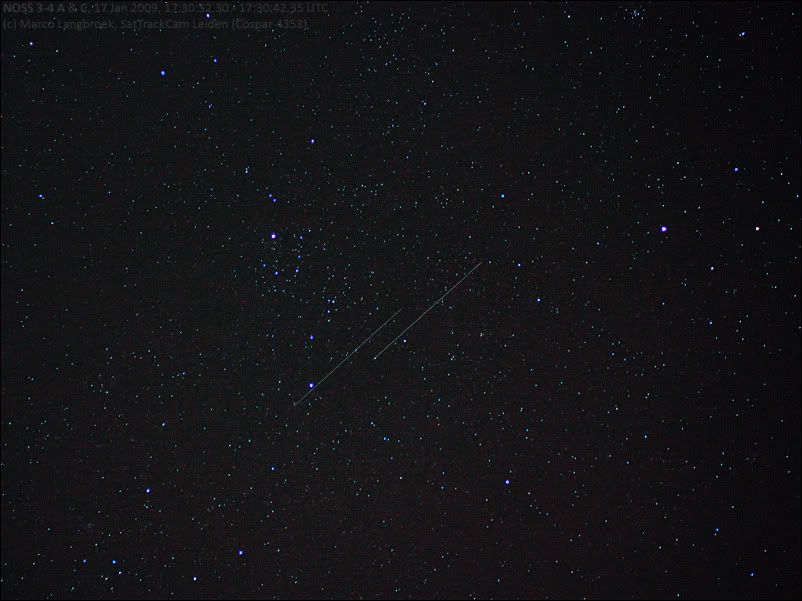
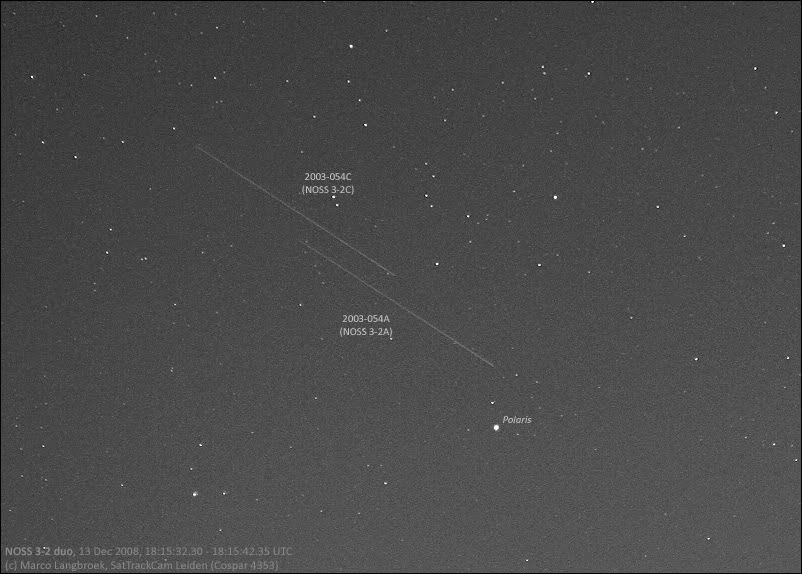
The US Navy has quite some experience (decades, actually) with formation flying with their NOSS (Naval Ocean Surveillance System) SIGINT satellites (http://www.satobs.org/noss.html). The old one flew in tight triangular formations of three (quite a sight to see), the newer ones do it with two. They serve to pinpoint ships based on their radio communications.
Also, the Chinese appear to be experimenting with a similar concept (http://www.nasaspaceflight.com/2010/08/china-launches-military-satellite-yaogan-weixing-10/).
Here are two pictures I shot of two of the newer NOSS formations, NOSS 3-4 launched in 2007 and NOSS 3-2 launched in 2003:
http://i19.photobucket.com/albums/b176/marcoaliaslama/satellites/170109NOSS3_4.jpg
http://i19.photobucket.com/albums/b176/marcoaliaslama/satellites/131208NOSS3_2.jpg -
Re:I saw $18M for the price-tag...
It would seem that the $18 million was to draw the picture & maybe a mockup or two.
Actually, there's a fair bit more of that Boeing will have to accomplish if they want the full milestone-based payments, if you look at the Space Act agreement they signed with NASA:
http://www.nasa.gov/centers/johnson/pdf/444144main_NNJ10TA03S_boeing_saa.pdf
Boeing/Bigelow ($18M): trade study and down-select between pusher-type and tractor-style LAS, system definition review, Abort System Hardware Demonstration Test, Base Heat Shield Fabrication Demonstration, Avionics Systems Integration Facility demonstration, CM Pressure Shell Fabrication Demonstration, Landing System Demonstration (drop test and water uprighting test), Life Support Air Revitalization demonstration, AR&D hardware/software demonstration, Crew Module Mockup demonstration. It also explicitly mentions that the capsule is designed for Atlas, Delta, and Falcon 9 launch vehicles
Although the crew capsule has been receiving most of the attention, if anything the escape system is the more difficult and costlier part to develop. Although the Russians have extensive experience with them, nobody in the US has built a capsule-based escape system since the 60s or 70s. SpaceX, Boeing, and Blue Origin are also working on developing novel "push-based" (rather than the typical tractor-based) escape systems, and I'm curious if they'll end up consolidating their efforts if Congress doesn't come through with sufficient commercial crew development funding.
Finally, I don't think anybody's yet posted the video of the CST-100 (it's somewhat rudimentary, but does the job of depicting the basic architecture):
-
Re:Augh.
Some information on SSME production from the beginning of the year. I recall mention on the same forum that not too many years ago, three engines were produced, supposedly nearly from scratch.
Reading between the rumours, restarting SSME production would not be the proverbial long tent-pole in a Shuttle-derived launch vehicle program. -
Article written before launch; more details
First off, while the article is a good one, it was actually written before launch. After the launch, there have been some intriguing details, particularly the fact that NOBODY outside of the classified world has been able to actually locate it in the sky. Normally amateur skywatchers are pretty good at locating satellites after they've launched, but apparently not in this case. Here's two possible explanations for this:
* the X-37B is testing low-visibility features, possibly either a stealthy payload shroud, low-visibility solar panels, or some other sort of camouflage/stealth system
* One possibility posited by Jim Oberg (the article author) elsewhere is that this may be the first test ever of an atmospheric orbital plane change, a technique desired since the 90s or earlier, where a spaceplane uses its wings to dip into the atmosphere while travelling at hypersonic speeds to alter its trajectory. The X-37B apparently doesn't have a high enough L/D ratio to perform an extreme plane change (e.g. near-equatorial to polar), but it may be able to alter its trajectory enough to make it damn hard to track from the ground.Now, some people have been asking why a reusable spaceplane would be useful to the US Air Force. Some possibilities:
* The atmospheric plane change capability mentioned above, which would allow the Air Force to deploy satellites into trajectories unknown by those observed. One major problem with satellites is that other countries typically know when they'll be overhead, so they just make sure that anything they're trying to hide doesn't occur during those hours.
* If you add a retrieval arm or some other docking interface, you can potentially use the craft to alter the trajectory of existing satellites
* Although the X-37B was launched on an expendable Atlas V rocket, the Air Force recently put out a solicitation for proposals for a first-stage Reusable Booster System utilizing a technique known as boost-back. With boost-back, after the booster boosts the payload and/or 2nd stage, it then does a 180 and boosts/glides back to a landing strip so that it can be easily reused. Lockheed Martin tested a secretive prototype of such a system (which they dubbed "Revolver") a couple years ago. If you combine such Reusable Boosters with a beefier successor to the X-37B, you have a rapid-launch reusable "surge" capability long desired by the Air Force. Such a surge capability could be useful when you need to quickly launch many satellites, such as when you need to deploy many satellites over a particular region in wartime or many of your satellites are knocked out by anti-satellite weapons or solar storms. Currently the Air Force has to wait for several weeks or months per satellite.For anybody interested in watching video of the launch (a rather beautiful launch of the Atlas V rocket), you can find it here: http://www.youtube.com/watch?v=AdCpuv9RCwE
Also, for those who are interested in finding out more, there's a lot of good discussion with plenty of current and former space professionals (including some posts by Jim Oberg, the author of the submission article) over at this NASASpaceFlight.com thread on the X-37B: http://forum.nasaspaceflight.com/index.php?topic=21122.285
-
Re:The big secret is the re-entry ablative spike
I asked about it elsewhere, and it's probably just an air data boom, often used on test aircraft. Here's an image of one on the Space Shuttle:
-
Re:The big secret is the re-entry ablative spike
Actually, it is an air data boom used in atmospheric testing. I have been following the X-37B too and I do not recall ever seeing mention about a re-entry ablative spike a.k.a an aerospike. The following is from http://forum.nasaspaceflight.com/index.php?topic=5364.msg560226;topicseen#new discussing your post: Re: X-37 to fly on a Atlas V in 2010 Reply #472 on: 03/14/2010 08:30 PM I came across the following slashdot comment about the X-37 having an "ablative spike" (which seems to be in the WK2 photos). Anybody know anything more about this, if the comment below is nonsense, or if ablative reentry spikes have been tested in the past? http://slashdot.org/comments.pl?sid=1582228&cid=31473292 Logged Jim Night Gator Full Member ***** Offline Posts: 3869 Location: Cape Canaveral Spaceport Re: X-37 to fly on a Atlas V in 2010 Reply #473 on: 03/14/2010 09:03 PM Quote from: neilh on 03/14/2010 08:30 PM I came across the following slashdot comment about the X-37 having an "ablative spike" (which seems to be in the WK2 photos). Anybody know anything more about this, if the comment below is nonsense, or if ablative reentry spikes have been tested in the past? There is no such thing on X-37. It is just some B S by someone incorrect Does the shuttle have one? Yes it did, it is a air data boom. Very common on new aircraft configs undergoing flight test. http://images.jsc.nasa.gov/luceneweb/fullimage.jsp?searchpage=true&keywords=enterprise&textsearch=Go&hitsperpage=30&pageno=2&photoId=S77-28140
-
Re:We don't have the whole picture.
What no one has discussed, either in the pro Constellation crowd or those against, is what the propulsion package will be for Flexible Path.
Oh, there's been plenty of discussion about it, just check out the forums over at http://forum.nasaspaceflight.com/
The options are pretty much as follows:
Earth to LEO:
* COTS/CCDev (Atlas V, Delta IV, SpaceX, Orbital, etc.)
* DIRECTLEO to Lagrange/Moon/asteroids/Mars/etc
* Earth Departure Stage, typically based on LH2/LO2, like the ULA's ACES or whatever DIRECT uses
* hypergolics
* using in-orbit refueling (either direct refueling or propellant depots) with either LH2/LO2 or hypergolics
* VASIMRThe point behind the new plans for NASA is that many of these ideas will be developed and tested in parallel, and the ones which work better in practice will be used for actual missions.
-
Re:Secretive Space Plane?
So no this project is not secret. It is an USAF project being handled by DARPA, but it is not secret.
There are many different types of secret (and let's not even start on the different types of Secret). In this case, the minimum details are known, but nobody outside of the classified world actually knows what technologies will be tested on the X-37B or what it'll be doing during its up to 270 days in orbit, and no interviews are permitted.
On a side note, another cool semi-secret project is the Lockheed Martin Revolver, which is generally thought to be a prototype of a flyback first-stage booster. This means that the first stage can come back and land after it boosts the rest of the rocket up, allowing for it to be easily reused.
http://www.flightglobal.com/blogs/hyperbola/2010/03/lockheed-trademarks-revolver-f.html
Some interesting patents: http://forum.nasaspaceflight.com/index.php?topic=12755.msg556730#msg556730 -
Re:NASA had plans...
Look up "Ares V Base Heating Issue" sometime.
Geesh, Google comes up with ONE hit on that.
At least you could've just put in the link http://forum.nasaspaceflight.com/index.php?topic=19247.0 -
Re:libertarian
Most, nearly all of the rockets that NASA uses have been built and designed on what is called a cost-plus contract.
I was told ("Jim" here apparently has worked with payload integration for one of the EELVs (Atlas-series, I think), so it is an argument from authority) that the rockets developed under the EELV program, Delta IV and Atlas V, were developed with a combination of private and DoD funds with no "cost plus" contracts involved.
Further, these vehicles are owned by the United Launch Alliance, a private entity. Why it's relevant to the above quote? Turns out that NASA launches a lot of its unmanned payloads on these rockets (other choices include Ariane 5 and Soyuz) rather than on the Shuttle (which currently is used solely for the ISS aside from a recent Hubble repair mission). -
This is actually an awesome thing
For those of you who are wondering about this and not just using it to blast Obama/dems with ever breath,
then read the last 10 pages of the Direct forum.
In a nut shell, Boeing, et. al. will be building Direct and offering it for commercial space. Yes, SpaceX, Orbital, and even the EELVs will have their role in space. HOWEVER, direct will now be allowed to be developed by Boeing and offered for commercial launches. Once that happens AND they have 2 launches per year via commercial, it will drop the price per launch. And what commercial space will be interested in this? Well Bigelow figures VERY prominently in this. That is why we are seeing them suddenly get active. That is also why they shifted their schedule to have station in 2015. Basically, we are about to see a MASSIVE expansion into space, but via the commercial world. Think of the railroads for USA in the mid 1800's.This is not the end of America's human flights. It is the FINALLY the beginning of it. Most importantly, it will remove Space from politicians hands like W's who said that we were going to the moon and the provided next to ZERO funding for it. Heck, only in 2007 and 2008 did NASA budget increase. Prior to that it was being cut.
NASA will instead do what it does best; high tech RD as well as getting all parties to connect well (ignoring a mars probe).
Windbourne. -
Typical journalism
This article is just typical "journalism".
1) Find an actual story written by someone who knows
2) Respit it badly so that it fits with your editorial "guidelines" (in this case: bash the Obama administration) and doesn't make it look too much like plagiarism
3) Confirm your source by just asking the author you ripped off. He now is your "insider" and since it seems he actually had his info from the white house contrary to you can now also say in your article "according to White House insiders": makes it sound more serious.
4) ?
5) ProfitThe move is probably actually a good thing: it's about not spending everything on creating a launcher (Ares I) that would only get us to LEO and mean we'd have to scrap ISS and refocus on creating a heavy lift vehicle that reuses as much as possible stuff that's already flying.
-
Re:After the naming contest what would you do?
i dont think that there has been any reason to separate the shuttle from the SRB's/fuel tank...ever.
I think the friends and family of the Challenger astronauts would strongly disagree with you on that one.
And even the ARES system doesnt allow for NASA to "pull" the crew module form the unlaunched SRB.
Wrong! Orion has a launch abort system that will pull the Orion away from the ARES in the event of a catastrophe. Also Apollo had a launch abort system that would pull the crew module away from the launcher in the event of a catastrophe. Even the Soyuz craft have them.
As for payload expendability, yes it would be a loss, but losing a multi-million dollar cargo would not have the impact that losing a crew would have. Rockets blow up all the time; payloads are lost regularly. It's not that big a deal. -
Re:What happened during stage separation?
$1.6B for the satellite? - wow.
The US Department of Defense is the only organization I've ever seen complain about launch costs being too low. Namely, they're willing to pay much more for a launch in order to insure the payload makes it. From what I understand, the cost above is a bit on the expensive side, but not the most expensive satellite that the DoD has put up.
Only if the costs are proportional, though, right? If one can do 7 Delta IV launches for the cost of 1 Ares V launch, then there *is* a strong argument. Costs ought to be figured out to probably 2040 or so and include Mars mission capability.
My view is that yes, they probably can do 7 Delta IV Heavy launches for the price of a Ares V launch. Plus they can launch unmanned payloads now. We could be launching lunar missions now, not ten or twenty years from now.
So, if the Ares V can put 70 tons on the Moon you'd need to go to a 14:1 ratio?
The Ares V has two efficiencies in its favor. First, it can launch directly to lunar transfer orbit (LTO). Using a Delta IV Heavy or equivalent requires assembly and fueling in low Earth orbit. So in the long run with appropriate infrastructure for the Ares V and the Delta IV Heavy, 14:1 ratio may well be accurate. And there is as I mentioned in a previous post some economy of scale in payload size. Even so, it may well turn out that the Delta IV Heavy (and Atlas V Heavy) would be cheaper in the long run.
As I mentioned above, the Delta IV Heavy could be launching now for lunar mission support. Even with the relatively crude Apollo-era Lunar Module "truck" that delivers 5 tons of payload to the Moon for the cost of say 5 Delta IV Heavy launches, that means that you could have significant activity on the Moon by the time Ares V hypothetically would be developed.
Further, and this is a key point that I don't think most heavy lift advocates understand, by buying a lot of 20-25 ton payload launches from multiple commercial launch providers, the US would be providing considerable incentive for larger commercial vehicles. Recall after all, that commercial launch has only recently gone to this payload range. I don't see a 180 ton payload vehicle in the cards, but easily 40-50 ton vehicles, maybe more, by the time Ares V would hypothetically come about. Incremental investment in commercial space launch is in my view far superior to NASA competing with commercial launch.So why did the NASA study conclude the Ares I was 2x safer than a Delta IV solution? Just BS for the sake of perpetuating the program?
As far as I can tell, yes, that was bullshit. Whether it was intentional or not, the ESAS has a number of biases in favor of Ares I type vehicles. Overestimates of the safety of the SRBs (and to an extent other solid rocket motors including those used on the Atlas V Heavy) by what appears to me to be a factor of ten are only one of the problems. There's also apparently lowered standards for vehicles that depend on solid rocket motors for the first stage. Inaccurate mass numbers for the EELVs. Thrust oscillation (despite it being a problem for all solid rocket motors including the Space Shuttle) was completely ignored. And they treated crew escape from a complete solid motor rupture as being just as easy to escape from as the equivalent failure from a liquid propellant stage, even though the latter is more survivable due to slower combustion speed and lower heating of the escape vehicle (in particular, no melting parachute).
I'd like to see NASA
-
Re:Awe-inspiring next generation technology...
The sad part is that the estimated cost per launch for the Ares I is going to be $1-$2 billion, making it more expensive per launch than either the Shuttle or Saturn V.
{citation needed}
Sure. There's a nice discussion here.
Basically, NASA's own current estimate of the development cost for Ares I + Orion is $35-$45 billion (the cost estimate seems to climb every few months), with development finishing 2017-2019. Current plans after that are for three launches a year (2 ISS flights and 1 crewed lunar flight), and if you take into accounts the annual fixed and per-flight costs it comes out to an additional $800 million a year (including the cost of the standing army of maintenance personnel, which costs ~$2 billion a year). Amortizing the development cost over an expected 20 year lifespan for the Ares I and combining that with annual costs gives the $1-$2 billion a launch figure.
-
It's Been a Bad Week For NASA
This will not go over well in Huntsville. In fact, it already hasn't.
"Republican Senator Richard Shelby launched a preemptive strike on President Barack Obama's blue ribbon space panel ther day before its due to release its final report, calling the committee's findings "worthless." Shelby, a staunch defender of NASA's Marshal Space Flight Center In Huntsville, Alabama, said in a Senate floor speech that the committee failed to consider safety when it ranked various rocket options for the White House to consider. "Without an honest and thorough examination of the safety and reliability aspects of the various designs and options for manned space flight, the findings of this report are worthless," said Shelby."
Senator Shelby, obviously a noted rocket expert, contradicts former Shuttle astronauts Sally Ride and Leroy Chiao. Undoubtedly he astronaut safety at every step of the process with little regard to politics while they as former astronauts were completely unconcerned with it.
Speaking of unconcerned, apparently President Obama is exactly that in regards to NASA. New NASA Administrator Charles Bolden hopes to meet with Obama before end of year on agency future.
On top of all of that, it seems that Altair, the lunar lander from the Constellation project has been defunded.
-
Re:How can you...
Do you know anything about the process that led to the space shuttle? Yes NASA solicited design bids--many design bids. Not just from the usual suspects (Boeing, Rockwell, Lockheed, North American, etc., etc.) but also from surprising sources such as Chrysler (they had a neat SSTO design). NASA, contrary to your suppositions, does not do everything in house. In fact, even the launches are technically operated by ULA, a joint effort by Lockheed Martin and Boeing.
Well yes, NASA collected a large number of competitive design proposals for the space shuttle, many of them quite innovative. It then tossed them out and picked a contractor which would build the design the folks at NASA Marshall had in mind:
http://www.astronautix.com/lvs/shuttle.htm
Following the usual charade of competitive bidding, NASA picked the same prime contractor as for X-15 and Apollo, who could be trusted to build precisely the vehicle NASA had in mind. North American Rockwell was selected to build the orbiter, with its Rocketdyne Division making the main engines. Thiokol was selected on political grounds for the solid rocket boosters. Martin Marietta would build the External Tank, but at the government Saturn IC factory at Michoud.
It's worth noting that pretty much the exact same thing happened with the current (like to soon be past) architecture. NASA spent about a year soliciting innovative competitive proposals from a number of companies, such as t/Space, Lockheed Martin, and Boeing, and then selected the most promising proposals for further study. Then the new administrator Michael Griffin came in, threw out all the competing studies, ran his own 2-month study which (surprise!) said that Griffin's own design from a couple years prior was the best one, and then essentially made NASA the prime contractor for what's now known as the Ares I rocket.