Slashdot Mirror
Domain: noaa.gov
Stories and comments across the archive that link to noaa.gov.
Comments · 2,602
-
Re:Cleaner fuel cells?
Water is one of the key Greenhouse gasses
-
Re:Global Warming is Awesome!
I was more wondering how the average is calculated
Oh, sorry, I misunderstood you.
I downloaded the datasets once and started looking at them, and figuring out an "average" is tough. Here's one map from NASA that gives some idea of Germany but I'm sure there are others.
There are so many complications. Some averages are only for land, others try to take into consideration land and oceans. Of course, ocean temperature records don't go back as far, and in some cases involved a ship dropping a bucket into the ocean and sticking a thermometer in the bucket.
Then of course there are thermometers that disappear over time, and urban heat islands, and heat islands from improved irrigation.
I pretty much gave up trying to understand how to average out the temperature record, and now I just look at the satellite record and consider it more accurate (of course, that only goes back to the 70s, but you can't have everything). -
Re:Climate Change
The climate constantly changes, always has, always will; so say what you really mean.
OK. The best models we have of climate suggest that anthropogenic gasses emitted into the atmosphere (most importantly carbon dioxide) have the same effect as naturally occurring gasses, and the current best estimate for the warming effect of carbon dioxide is that is causes between 1.5 C and 4.5C average global temperature rise per doubling of concentration.
The effect has been known for over a hundred years. It explains why the Earth is not frozen.
There has been no warming for over 18 years in RSS data,
If you cherry pick the right data. Here you go: https://www.ncdc.noaa.gov/temp-and-precip/msu/time-series/global/lt/nov/1mo
The satellite measurements are somewhat inconsistent. http://www.theguardian.com/environment/climate-consensus-97-per-cent/2015/mar/25/one-satellite-data-set-is-underestimating-global-warming
-
Re:Yet more lies
It has to be the deep ocean because measurements of shallow ocean temperatures have not shown any excess warming.
What are you talking about? There has been lots of warming in the upper ocean. It is clearly shown at this NOAA page on ocean heat content.
Since heat only moves from a warmer object to a cooler object, the heat will never exit from the ocean until the atmospheric temperature drops.
Since over 90% of the heat energy from global warming goes into the oceans it only takes a slight change in how much goes into the ocean for major changes in atmospheric temperatures. For example 2015 is about to set a new temperature record because El Nino has reduced the amount of heat going into the ocean leaving more of it in the atmosphere.
I doubt it was much warmer during the Holocene Thermal Optimum than it is now. Most of the science I've seen says the temperatures may have been similar.
-
Re:Screw your gun rights
NWS lists U.S. lightning fatalities here. 26 so far this year, although the figures seem to be several months delayed and the date on #26 has a typo. 1 in 700,000 per year get hit, from this. In contrast, there are 1 in 19,000 per year odds that you will be murdered, and about 69% of those involve firearms.
Uh, you really didn't do well on that one. Perhaps it's your mindset that needs adjustment?
-
Re:At My Door
The point is the oceans are rising at a rate of about 3mm per year, not likely to swamp anything expectantly, and if it does happen the reactors will have been at cold-halt status for decades.
Records and research show that sea level has been steadily rising at a rate of 0.04 to 0.1 inches per year since 1900.
This rate may be increasing. Since 1992, new methods of satellite altimetry (the measurement of elevation or altitude) indicate a rate of rise of 0.12 inches per year. Is sea level rising?
-
Re:Sea-level threat?
> "CO2 production may have leveled off. If so all that does is change the curve of rising CO2 to linear from exponential."
It's certainly not "exponential", which would be a much faster CO2 increase than linear. Maybe you meant "logarithmic". But, looking at the most recent NOAA/ESRL charts, the CO2 rise still looks pretty close to "linear". GHG time-series plots So, while there very likely is an anthropogenic component to this rise, it is a very steady rise, evidently independent of recent changes in man-made production and recent temperature fluctuations (1998 Nino etc), suggests it is some kind of buffered response, which tends to smooth out natural and man-made variances (as Mother Nature likes to do). So I think that would make it harder to assert that man-activities are "dominating" climate change, causing immediate catastrophes, as the MSM are telling us every day.
> " What they are actually measuring is the microwave emissions of oxygen molecules in the atmosphere not temperatures directly. "
There are no devices which read temperature "directly". Temperature is a mathematical abstraction (established by the Zeroth Law of Thermodynamics) for explaining and modeling thermal energy transfer ("heat") and thermal equilibrium. To see this, allow me to paraphrase your criticism of satellite measurements to measurements based on "thermometers", which you claim are a more "straightforward" way to measure temperatures:
What "thermometers" are actually measuring is the expansion of mercury or alcohol in a capillary tube, or changes in electrical properties of thermocouples, or IR emissions, not temperatures directly. From there they have to make adjustments for the different kinds of "thermometers" around the world, sensor deterioration over time, temperature bias due to urban 'heat-island' effect, data corruption because of clouds, high elevations and other reflections from the surface. After all of that they finally calculate a temperature for the rather "noisy" condition of the atmosphere near the surface the surface of the earth (upper-air measurements are much less noisy), and increased probability of misreading or instrument failure, multiplied by the total number of instruments in use around the world
So the advantage of the satellite based instruments is clear. There is only one set of instruments (per satellite) to "fiddle" with, and it's all automated, free of human errors and judgment. In fact, the global trends measured by two independent satellites, RSS and UAH, which both show a slightly increasing temperature trend of approx. 1C per century, consistent with the milleniums-old slow rise in temperature since the last ice age. (RSS trend is slightly higher, likely due to the fact that it is integrating over a slightly different band of latitudes between 85S and 85N)
> "The forcing from increased CO2 happens immediately but the warming takes time."
No, the warming by CO2 forcing as defined by IPCC is immediate: T-change = climate-sensitivity x CO2-forcing.
IPCC climate sensitivity> " Over 90% of the heat from global warming goes into the oceans and a small change in how much is going in the oceans from things like El Nino/La Nina can have significant effects on atmospheric temperatures."
"Heat" is precisely defined term in physics and is strictly used to denote the transfer of thermal energy from a warmer body to a colder body. So the oceans can only be "warmed" from a warmer body. The idea that a cooler body can "warm" a body that is already at a higher temperature is a violation of the 2nd law of thermodynamics.
> "A greenhouse gas that absorbs an IR photon is more likely to emit another IR photon than transfer the thermal energy to surrounding molecules. "
The likelihood of molecular collision over IR emission is comple -
Re:Sea-level threat?
"Since 1992, new methods of satellite altimetry (the measurement of elevation or altitude) indicate a rate of rise of 0.12 inches per year. "Is sea level rising? 60 feet would take 500 years at the present rate.
-
Re:Not the first time
The trend in regards to sea-level rise is more like 0.12 inches per year; If their feet are getting wet it's not because of sea-level rise.
That's not the trend. That's the current rate of rise. If you look at the article you linked to, you'll note that the trend is that the rate is increasing. Further, the current rate also doesn't account for things that have not happened yet, - like the potential loss of major ice sheets like the Amundsen sea, which according to http://www.nature.com/news/ant... could lead to a sea level rise of 6 meters (though I think that has been recently revised downwards).
Further the sea level rise figure you quoted is a global average. The seas can and will rise faster in some places than in others. -
Re:Not the first time
The trend in regards to sea-level rise is more like 0.12 inches per year; If their feet are getting wet it's not because of sea-level rise.
-
Re:To higher ground?
Sea-level rise is between 1 - 2.5 mm
The world's 48 poorest countries will need to find around $US1 trillion ($A1.39 trillion) dollars between 2020 and 2030 to achieve their plans to tackle climate change - and those plans should be a priority for international funding, researchers say. Developing world needs $1t for climate change.
Sure we'll just get out a checkbook and send our share to the world's most corrupt governments, and they'll in turn hire Halliburton to come in build some shit for a 50% kickback.
-
Re:To higher ground?
I think the point of the article is that climate change has already started to have serious affects on some people and over time it will affect more..
Please explain how this:
Records and research show that sea level has been steadily rising at a rate of 0.04 to 0.1 inches per year since 1900.
This rate may be increasing. Since 1992, new methods of satellite altimetry (the measurement of elevation or altitude) indicate a rate of rise of 0.12 inches per year. Is sea level rising?could possibly have any physical effect on anybody? Seriously 1/10s of an inch per year, one and a quarter inch over the last century! This is a case of Haters are going to Hate, so everybody climb on the climate change gray-train!
-
Re: How to Extort Money from Rich Nations
That's actually true - but still a bold-faced lie by omission:
"Et tu, Brute?"
Records and research show that sea level has been steadily rising at a rate of 0.04 to 0.1 inches per year since 1900.
This rate may be increasing. Since 1992, new methods of satellite altimetry (the measurement of elevation or altitude) indicate a rate of rise of 0.12 inches per year. Is sea level rising?
A sealevel rise of 1 to 3 millimetres per year isn't going to inundate anything for millennia.
-
Re:James Hanson
Hmm... I'm using NOAA's terminology:
https://www.ncdc.noaa.gov/data...Projections works. I'll keep the nominal difference in mind.
-
Re: Refugees? Not so much.
That tide gauge wasn't installed until 1993. I found one for Kwajalein Atoll that's been there since 1947. It does show sea level rise of around 6 inches. There are several big dips in the sea level that appear to correspond to El Nino years when the winds push water toward the Eastern Pacific.
-
Re:AGW deniers...
That tide gauge wasn't even installed until 1993. I found one for Kwajalein Atoll that's been there since 1947. It does show sea level rise of around 6 inches. There are several big dips in the sea level that appear to correspond to El Nino years when the winds push water toward the Eastern Pacific.
-
Re:AGW deniers...
Here's the tide gauge for Kwajalein Atoll in the Marshal Islands. It looks like it was put in in 1946 or 1947. Since then there's been over 6 inches of SLR in the Marshalls. 6 inches vertical rise means many feet of horizontal spread. When your maximum elevation is about 6 feet all it takes is a large king tide or major storm surge to wash over the islands.
In looking at the graph it has dropped quite a bit in the past year. I believe that is because of the El Nino which pushes more water toward the Eastern Pacific. If you look back in the graph there were big drops in the 1997/1998 and 1982/1983 which also were strong El Nino years.
-
Re:Refugees? Not so much.
So... if you were to plant one on the Oregon Coast, you'd end up with a 6' tall base and a 1' tall statue atop that.
This of course does not count what it would take to anchor the whole shebang to bedrock so that tidal erosion doesn't knock it over and bury it.
-
Re:Climate has never not been changing.
Because the raw unaltered field data is unavailable,
Have you looked here. They certainly haven't thrown out the original raw data. That's the base starting point for any adjustments they make.
You may not trust climate scientists but have you ever considered the size of the conspiracy that would be required to perpetrate such a fraud? At least thousands of scientists over the whole world for at least the past 30 or 40 years? If they're that good at it you might as well give up.
I don't disagree that Mann has a prickly personality but the trial has nothing to do with his science. It's about Steyn accusing Mann of "molesting" the data in an obvious comparison to Jerry Sandusky who was also at Penn State. Discovery in the trial won't find any evidence of scientific malfeasance just as all of the other investigations of Mann and the Climategate emails found essentially nothing.
The paywalls on scientific papers is unfortunate but if nothing else you can go to the libraries of most research universities and read them. Even if they're behind paywalls.
-
Re:Climate has never not been changing.
So I consider surface station data both temporally and spatially sparse, subjected to manipulations that are less than forthright and in ways that are mathematically dubious.
I don't get that you would think the adjustments to surface temperatures are less than forthright. They are well documented in the relevant papers about the adjustments.
Here is a NOAA page on their temperature data.
This page at Berkeley Earth describes their data set and some of the adjustments.
As far as the sparseness of some regions of the globe goes we don't care so much what the actual temperature is globally as much as we care about how it's changing over time. If the global temperature is derived in a consistent manner then it's probably a reasonable representation of temperature change.
Satellites because of their orbital inclination don't cover the polar regions at all and have to deal with issues of observation angle for near polar readings. Also they have to make adjustments for clouds and high elevations messing up their readings.
I don't disbelieve the satellite readings, I just don't see any good reason to trust them over the surface measurements, particularly over the time period since the satellites went up (1979) when the surface systems have also been improved to higher standards.
-
Re:Climate has never not been changing.
By the way, as a further set of datapoints, I'd have a look at this NOAA report with a list of months with greatest deviations from the previous global average.
You'll note that 8 of the top 10 of them occurred in the past 5 years. And this report is from September, so once October is included, it will likely be 9/10 of the most significant upward deviations occurred in the past few years.
One October data point is not the news. The issue is that data point taken in context of the larger and well-established trend.
-
Re:Why this is wrong
Actually, there would be measurements of sea surface temperatures over many decades. This is done for good reason.
Even before meteorology was a science, people had a good reason to want to know sea surface temperatures. They affect fishing, which is a source of money and food. In shipping routes, it would affect when they might see ice on the waters, which is a hazard. Sea surface temperatures were measured then. I'm aware of data sets going back to the 17th century. You can easily get this data online for free.
Today, ships still do measure sea surface temperature, in addition to buoys. This data is of particular interest in tropical regions because of the importance to hurricanes. Measurements are done as water is cycled through the engine rather than lowering a bucket overboard to sample the water. For that reason, there is a positive bias to the raw observations during the past several decades. As a result, the temperature record is actually revised downward in recent decades to counteract the observation bias. Despite what some people think, adjustments to the data to remove biases work both ways. Not all are upward. Also, global sea surface temperature data generally comes from the many satellites in orbit. This data set only goes back a few decades, but it's a great data set.
-
Re:Why this is wrong
Actually, there would be measurements of sea surface temperatures over many decades. This is done for good reason.
Even before meteorology was a science, people had a good reason to want to know sea surface temperatures. They affect fishing, which is a source of money and food. In shipping routes, it would affect when they might see ice on the waters, which is a hazard. Sea surface temperatures were measured then. I'm aware of data sets going back to the 17th century. You can easily get this data online for free.
Today, ships still do measure sea surface temperature, in addition to buoys. This data is of particular interest in tropical regions because of the importance to hurricanes. Measurements are done as water is cycled through the engine rather than lowering a bucket overboard to sample the water. For that reason, there is a positive bias to the raw observations during the past several decades. As a result, the temperature record is actually revised downward in recent decades to counteract the observation bias. Despite what some people think, adjustments to the data to remove biases work both ways. Not all are upward. Also, global sea surface temperature data generally comes from the many satellites in orbit. This data set only goes back a few decades, but it's a great data set.
-
Re:Science is Settled
... warmer weather is expected to weaken cyclonic activity, not make it stronger. Until about the end of the century, anyway.
No, read your own link: "It is likely - in my opinion - that manmade global warming has indeed caused hurricanes to be stronger today."
I've answered the more important question of "how much stronger?" by repeatedly showing Jane a paper by Prof. Judith Curry which concludes that "the increasing trend in number of category 4 and 5 hurricanes for the period 1970-2004 is directly linked to the trend in sea-surface temperature".
And once again, Grinsted et al. 2012 helps to answer the question of "how much stronger?" by measuring hurricane surges back to 1923 using tide gauge instruments. This yields a homogeneous record of empirical observations which is totally independent of models and confirms that "warm years in general were more active in all cyclone size ranges than cold years." (By the way, measuring instruments like tide gauges and thermometers aren't proxies.)
Jane, years ago I said that it's not clear how global warming will impact hurricane frequency because of factors like wind shear. I also said that hurricanes (overall, Cat 1+) might not be more frequent in the future for the same reason. That's also what Dr. Landsea's 2010 abstract said: [Dumb Scientist]
I know. You just proved my point: you were contradicting yourself. [Jane Q. Public, 2015-10-28]
No, those links show that I've been consistently agreeing with Dr. Landsea and the IPCC when they say that hurricanes (overall, Cat 1+) might not be more frequent in the future because of factors like wind shear. But once again, the IPCC and Dr. Landsea also agree that "the most intense cyclones" are different. That's why the "global" box at the bottom center of Fig. 14.17 has two metrics which go in different directions: Cat 1+ (metric #1) and just Cat 4/5 (metric #2). Again, that's what I've been saying for years, along with the IPCC and Dr. Landsea:
"... future projections based on theory and high-resolution dynamical models consistently indicate that greenhouse warming will cause the globally averaged intensity of tropical cyclones to shift towards stronger storms, with intensity increases of 2-11% by 2100. Existing modelling studies also consistently project decreases in the globally averaged frequency of tropical cyclones, by 6-34%. Balanced against this, higher resolution modelling studies typically project substantial increases in the frequency of the most intense cyclones, and increases of the order of 20% in the precipitation rate within 100 km of the storm centre.
Jane
-
Re:Science is Settled
... warmer weather is expected to weaken cyclonic activity, not make it stronger. Until about the end of the century, anyway.
No, read your own link: "It is likely - in my opinion - that manmade global warming has indeed caused hurricanes to be stronger today."
I've answered the more important question of "how much stronger?" by repeatedly showing Jane a paper by Prof. Judith Curry which concludes that "the increasing trend in number of category 4 and 5 hurricanes for the period 1970-2004 is directly linked to the trend in sea-surface temperature".
And once again, Grinsted et al. 2012 helps to answer the question of "how much stronger?" by measuring hurricane surges back to 1923 using tide gauge instruments. This yields a homogeneous record of empirical observations which is totally independent of models and confirms that "warm years in general were more active in all cyclone size ranges than cold years." (By the way, measuring instruments like tide gauges and thermometers aren't proxies.)
Jane, years ago I said that it's not clear how global warming will impact hurricane frequency because of factors like wind shear. I also said that hurricanes (overall, Cat 1+) might not be more frequent in the future for the same reason. That's also what Dr. Landsea's 2010 abstract said: [Dumb Scientist]
I know. You just proved my point: you were contradicting yourself. [Jane Q. Public, 2015-10-28]
No, those links show that I've been consistently agreeing with Dr. Landsea and the IPCC when they say that hurricanes (overall, Cat 1+) might not be more frequent in the future because of factors like wind shear. But once again, the IPCC and Dr. Landsea also agree that "the most intense cyclones" are different. That's why the "global" box at the bottom center of Fig. 14.17 has two metrics which go in different directions: Cat 1+ (metric #1) and just Cat 4/5 (metric #2). Again, that's what I've been saying for years, along with the IPCC and Dr. Landsea:
"... future projections based on theory and high-resolution dynamical models consistently indicate that greenhouse warming will cause the globally averaged intensity of tropical cyclones to shift towards stronger storms, with intensity increases of 2-11% by 2100. Existing modelling studies also consistently project decreases in the globally averaged frequency of tropical cyclones, by 6-34%. Balanced against this, higher resolution modelling studies typically project substantial increases in the frequency of the most intense cyclones, and increases of the order of 20% in the precipitation rate within 100 km of the storm centre.
Jane
-
Re:Why should we care about faked data?
And I keep reading articles like this one where it shows that NOAA has stealth-edited the temperature data,
Nothing stealth about it. You just have to read the original papers about it. They're not that hard to find. For example "THE U.S. HISTORICAL CLIMATOLOGY NETWORK MONTHLY TEMPERATURE DATA, VERSION 2" which gives an overview of adjustments that were made. You can find references at the end if you want to dig deeper.
-
Re:Scientists and media both happy
If they were interested in NOAA data then they could have just surfed over to the NOAA website: http://www.ncdc.noaa.gov/data-... . What they are looking to get access to are personal emails. For what purpose? All of the data and processes are freely available. If you have an objection to the science then take it up in the literature. No need for a witch hunt.
-
Re:Who cares?
hmmm, interesting read
http://response.restoration.no...
While it's true that these areas have a higher concentration of plastic than other parts of the ocean, much of the debris found in these areas are small bits of plastic (microplastics) that are suspended throughout the water column. A comparison I like to use is that the debris is more like flecks of pepper floating throughout a bowl of soup, rather than a skim of fat that accumulates (or sits) on the surface.
That is precisely the problem, because the plastic breaks down into tidbits and some of the really nasty toxic ones become indistinguishable from the food that fish eat. Further to that sockeye salmon and other Oncorhynchus and fish everywhere are starting to show up with bellies full of plastics http://www.npafc.org/new/publi...
Naturally the ocean gyres are slowly churning the plastics into smaller and smaller pieces and they are also breaking into bits on shorelines of islands and the continents. So it is not as if there is a great garbage dump out there but the truth is that there is a level of ongoing human caused pollution that is will eventually do permanent damage to much more than the ocean's key ecosystems.
The alarmist videos and Fox News style environmental news shows do not show the real extent of the problem. They are not scientifically sound and are not really informing the public about the real problem with the world dominating petro industrial complex. Unfortunately the real problems are much more insidious and hidden as the quote I appended coming from your link clearly indicates.
Perhaps it is far better instead to scare the shit out of people with videos like this one. Hopefully the extent of the real damage going on will finally be recognized by J. Q. Public, before another Bush league petro president takes over the reigns of power.
Even Obama has stated that a lack action to change our attitudes towards the abuse of our shared environment by not being able to halt the dismissal of science, largely by the rich industry lobbies in Washington, is one of the greatest regrets he will have when he surrenders the reigns of power. Truth is it does not matter who becomes the President anymore the government is now run by the industry lobbies not the people and certainly not by truth!
-
Re:Who cares?
hmmm, interesting read
-
Re:What? CO2 inconsistent?
the global warming that hasn't happened for 18 years.
Yeah, right. 2014 was the globally hottest year on record. The first three quarters of 2015 were the hottest on record, even for land mass and water separately. The graph shows an undisputable upward trend for (at least) the last 20 years.
-
Re:Global warming has been changed to Climate Chan
I am a physicist, a real expert on stuff like that, and I know that the global temperature has not increased for almost 20 years.
Really? NASA Link for Average Global Temperature since 1884
Have you read this Scientific American article from 2010?
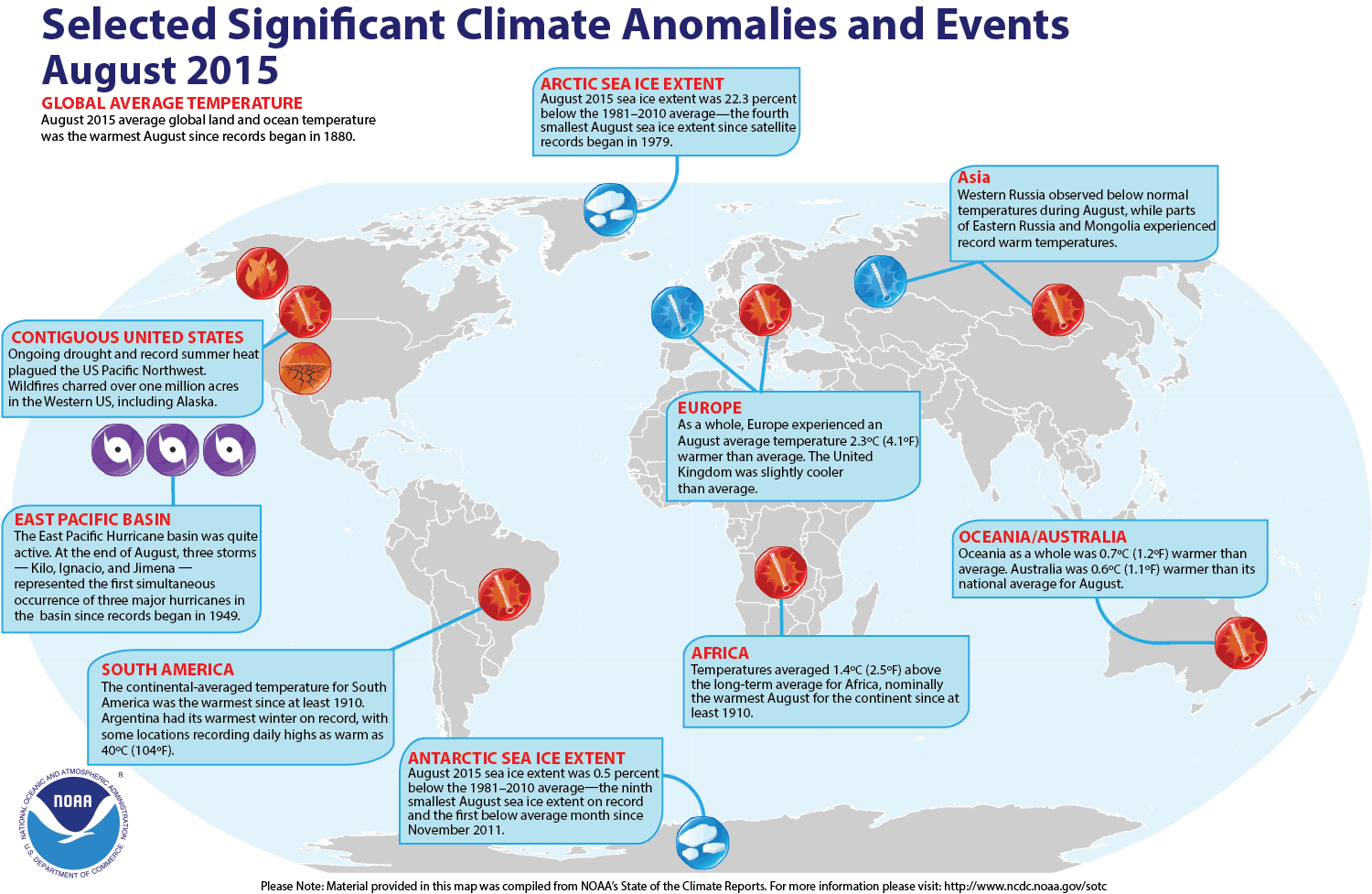
Or maybe you haven't seen this NOAA Graphic that says, "August 2015 average global land and ocean temperature was the warmest August since records began in 1880."
-
Re:Science is Settled
Unusual weather in the Phillipines this year is generally due to El Nino, which is a weather phenomenon, not climate. However, tropical storms are an exception and are unpredictable any great time in advance.
The current status of the Phillipines, due to the El Nino, is drought, not wetness. Absent said tropical storm, that is.
Also, warmer weather is expected to weaken cyclonic activity, not make it stronger. Until about the end of the century, anyway.
The upshot is: you don't seem to know what the hell you're talking about. -
Re:How about you answer the question?
As promised, are this year's high temperatures due only to El Nino with "nothing particular" connecting them to anthropogenic global warming? If that's true, it should be easy to confirm by comparing this El Nino to past El Ninos. This graph (backup) shows global mean surface temperature (GMST) during just El Ninos in recent decades (excluding Pinatubo). It has a positive slope. If this year's high temperatures are due only to El Nino, why are El Nino years getting warmer at about the rate projected by the IPCC? Once again, ocean heat content (OHC) reveals much more of the cumulative radiation absorbed over the last few decades than GMST does.
In response to a request for peer-reviewed literature, Lonny Eachus quotes from the same opinion piece that "Jane Q. Public" quoted above without linking. Will Lonny Eachus admit that he wasn't quoting peer-reviewed literature, despite the clear request? [Dumb Scientist]
You neglect to mention that before that, I cited IPCC's own statement on the matter. Are you also going to claim IPCC's comments aren't based on peer-reviewed papers? For example, will you now claim that their summary is not based on peer-reviewed science? You really can be an idiot sometimes. And the more you try to prove somebody wrong, the more idiotic you have tended to get. [Jane Q. Public, 2015-10-25]
No, you repeated the same IPCC link I gave you hours earlier and (innocently?) misrepresented it while calling Eric Holthaus a "bozo":
I'd be fascinated to read peer-reviewed literature saying CC will cause fewer Cat 4/5 hurricanes. Doubt it exists, but may have missed it. [Eric Holthaus]
IPCC, you bozo: http://ipcc.ch/pdf/assessment...
"it is likely that the global frequency of tropical cyclones will either decrease... or remain
That's one.Eric Holthaus asked about Cat 4/5 hurricanes, but Jane/Lonny Eachus couldn't/wouldn't answer the actual question. Instead, Lonny called Eric a "bozo" and desperately tried to deflect attention away from Cat 4/5 hurricanes. Ironically, Lonny's quote should have been a clue that answering an imaginary question about the frequency of all hurricanes (Cat 1+) isn't the same as answering Eric's actual question about Cat 4/5 hurricanes because those have the maximum wind speeds and rain rates which will "likely increase".
Prof. Adam Sobel answered Eric's actual question with TS.26 on p. 108 here, which is also Fig. 14.17 on p. 1250 of Ch. 14.
The "global
-
Re:How about you answer the question?
In response to a request for peer-reviewed literature, Lonny Eachus quotes from the same opinion piece that "Jane Q. Public" quoted above without linking. Will Lonny Eachus admit that he wasn't quoting peer-reviewed literature, despite the clear request?
Dr. Landsea's 2011 opinion piece doesn't contradict his 2010 paper, but Jane's use of "AFTER" suggests he doesn't agree. If Jane thinks Dr. Landsea's 2011 opinion piece contradicts his 2010 paper, couldn't Jane just ask Dr. Landsea if that's the case?
Again, in Jane's quote above Dr. Landsea ironically says that if the "hot spot" were actually missing as Jane/Lonny insists, that would just imply that "there would be much more energy available for hurricanes to tap into."
-
Re:Weather of Climate?
There is a secular warming trend upon which the ENSO cycle is superimposed. The secular trend is global warming. Global warming trains the boxer. El Nino throws the punches: https://www.ncdc.noaa.gov/cag/...
-
Wow, slashdot commenters can not RTFA
From the article
"However, it is now recognized (Black 1992) that the maximum sustained winds estimated for typhoons during the 1940s to 1960s were too strong. The strongest reliably measured tropical cyclones were both 10 mph weaker than Patricia...". -
What could go wrong?
Toxicity
Quaternary ammonium compounds can display a range of health effects, from mild skin and respiratory irritation up to severe caustic burns on skin and gastro-intestinal lining (depending on concentration), gastro-intestinal symptoms (e.g., nausea and vomiting), coma, convulsions, hypotension and death. They are thought to be the chemical group responsible for anaphylactic reactions that occur with use of neuromuscular blocking drugs during general anaesthesia in surgery. Quaternium-15 is the single most often found cause of allergic contact dermatitis of the hands.
-
Re:there are plentyIt would've helped, if you summarized the predictions here. But let's see...
As far as I can determine, this prediction's time is still in the future and thus it simply could neither have come true nor failed yet. From the abstract (emphasis mine):
We expect global mean temperatures in the decade 2036-46 to be 1-2.5 K warmer than in pre-industrial times under a 'business as usual' emission scenario.
Sorry, I do not see anything predicted in this document at all. It is lengthy, so I may have missed it. Would you mind clarifying — and adding references to the particular pages, where the successful prediction is made?
Thank you.
-
Re:there are plenty
I wonder, if you are slow, or am I so unclear... Did you not see the requirement for pairs of links? One to a prediction, the other — to its confirmation?
- Prediction in the year 2000: http://www.ncbi.nlm.nih.gov/pu...
- Confirmation in the year 2013: http://www.nature.com/ngeo/jou...
- Prediction in 1967: http://www.gfdl.noaa.gov/bibli...
- Confirmation in 2013: http://www.pnas.org/content/11...
-
Re:Alarmists - wrong on global warming since 1978!
How delusional do you actually have to be to say something like this when August was the hottest month of the hottest summer of the hottest year (so far) on record?
HOW FUCKING DELUSIONAL DO YOU HAVE TO BE?
But please tell us where NCDC/NOAA/etc are wrong.
https://www.ncdc.noaa.gov/temp... -
RIP coral reefs
I'm guess they didn't go out of their way to use BP-2-free sunscreen...
-
Re:Editors suck at their jobs
-
Re:3 Trees
Really? Because a whole bunch of other people did dendochronotic analysis of over 150,000 trees across the whole of the northern hemisphere, correlated that with ice cores, tundra boreholes, fossil lake shorelines and loesses across the whole world and found no such thing.
Interestingly, they did find evidence of an incredibly intense solar flare around 774 AD that correlated with an astronomical event recorded in the AngloSaxon Chronicle and a massive volcanic eruption in 1783 AD that caused killing fogs of sulphurous acid across Europe and North America, but, well, that's science for you.
-
Re:Holy Fuck
> most of the country doesn't have records predating 1978-79, because there was no one taking measurements
Apart from all those trees, lakes, glaciers, tundra and ice sheets, you mean...
-
Hurricane count
Can we just have science instead of hysteria?
OK. Here's a summary of number of hurricanes and tropical storms, as of 2011 (about the latest good data I can find):
www.ncdc.noaa.gov/sotc/tropical-cyclones/201113I'm not sure I can distinguish a trend from the noise.
But on the other hand, I haven't ever seen a prediction telling me that I should be able to see the trend. Here's what NOAA says:
www.gfdl.noaa.gov/global-warming-and-hurricanes"It is premature to conclude that human activities--and particularly greenhouse gas emissions that cause global warming--have already had a detectable impact on Atlantic hurricane activity."
And here what the Center for Climate and Energy Impacts says:
www.c2es.org/science-impacts/extreme-weather/hurricanes"It’s unclear whether climate change will increase or decrease the number of hurricanes, but warmer ocean surface temperatures and higher sea levels are expected to intensify their impacts."
-
Hurricane count
Can we just have science instead of hysteria?
OK. Here's a summary of number of hurricanes and tropical storms, as of 2011 (about the latest good data I can find):
www.ncdc.noaa.gov/sotc/tropical-cyclones/201113I'm not sure I can distinguish a trend from the noise.
But on the other hand, I haven't ever seen a prediction telling me that I should be able to see the trend. Here's what NOAA says:
www.gfdl.noaa.gov/global-warming-and-hurricanes"It is premature to conclude that human activities--and particularly greenhouse gas emissions that cause global warming--have already had a detectable impact on Atlantic hurricane activity."
And here what the Center for Climate and Energy Impacts says:
www.c2es.org/science-impacts/extreme-weather/hurricanes"It’s unclear whether climate change will increase or decrease the number of hurricanes, but warmer ocean surface temperatures and higher sea levels are expected to intensify their impacts."
-
Greenland mass loss:
http://www.arctic.noaa.gov/rep...
(Data from Grace satellite measurements, by NOAA)
-
Re:"...need to be prepared..."
Perhaps check the thread, you are not the first person to ask this:
http://www.ncdc.noaa.gov/paleo... -
Re:"...need to be prepared..."
-
Re:NASA?
NHC forecasters consider a very large number of models when making hurricane forecasts. Many of these aren't run by NOAA. Here's an old list: http://www.nhc.noaa.gov/modelsummary.shtml. NHC has used the NOGAPS model for a long time. NOGAPS is a global model developed and run by the US Navy. If a NASA model can make useful predictions, NHC forecasters will certainly use it.