Slashdot Mirror
Domain: npr.org
Stories and comments across the archive that link to npr.org.
Stories · 667
-
Hellfire Missile Mistakenly Shipped To Cuba
HughPickens.com writes: NPR reports that a Hellfire missile that was supposedly shipped to Europe for military exercises in 2014 somehow ended up in Cuba. It's still a mystery as to how the missile reached Cuba but the incident has "confounded investigators and experts who work in a regulatory system designed to prevent precisely such equipment from falling into the wrong hands." According to sources, Lockheed Martin sent the missile to Europe for a NATO training exercise — and on its return, it ended up on a plane to Havana, where it was impounded. A US government official familiar with the situation calls it a "dummy" missile that lacks a warhead or guidance system. Originally designed to be launched from helicopters, Hellfire missiles have also been used to arm drone aircraft in recent years — one was credited with killing "Jihadi John" in a US operation. Since the missile arrived in Cuba in 2014, U.S. requests for its return have gone unheeded. -
Turning Around a School District By Fighting Poverty (npr.org)
New submitter gomezedward40 writes: Through her unconventional focus on addressing poverty, Superintendent Tiffany Anderson has been credited with rapidly improving the school district of Jennings, Mo. NPR reports: "The school district of 3,000 students has taken unprecedented steps, like opening a food pantry to give away food, a shelter for homeless students and a health clinic, among other efforts. 'My purpose is to remove the challenges that poverty creates,' she says. 'You can not expect children to learn at a high level if they come in hungry and tired.' That unconventional approach has had big results. When Anderson took over in 2012, the school district was close to losing accreditation. Jennings had a score of 57 percent on state educational standards. A district loses accreditation if that score goes below 50 percent. Two years later, that score was up to 78 percent, and in the past year rose again to 81 percent, Anderson says. She points to a 92 percent 4-year graduation rate, and a 100 percent college and career placement rate." -
US Budget Bill Passes With CISA Surveillance Intact (npr.org)
An anonymous reader writes: Early on Friday, the U.S. Senate approved the 2,000 page 'omnibus' budget bill that allocated $1.15 trillion in government funding. Later in the day, President Obama signed it into law. Because the budget bill was so important, many other pieces of unrelated legislation were tacked onto it, including the Cybersecurity Information Sharing Act, a bill notable for giving the government increased internet surveillance powers. Civil rights activists and tech experts largely consider it a "privacy disaster," and several lawmakers voted against the budget bill solely for CISA's inclusion. Senator Ron Wyden (D-OR) said, "Unfortunately, this misguided cyber legislation does little to protect Americans' security, and a great deal more to threaten our privacy than the flawed Senate version. Americans demand real solutions that will protect them from foreign hackers, not knee-jerk responses that allow companies to fork over huge amounts of their customers' private data with only cursory review." Corporations in the U.S. will now have "legal immunity when sharing consumers' private data about hacks and digital breaches." The full omnibus is available online (PDF). The CISA provisions start on page 1,728. -
Gigster Wants To Be the Uber of Software Development (techcrunch.com)
HughPickens.com writes: Josh Constine writes at TechCrunch that a company named Gigster is trying to bring the Uber business model to software development. Simply: a user sends them an idea, Gigster passes it on to developers who sign up to build software, and when it's done they send back a functioning app. After converting product requirements into a development plan, they let their group of remote developers start hacking away at the code. It has already resulted in a dating app for Muslim millennials, a way for citizens of the developing world to buy electricity, and has over fifty more projects in the pipeline. The entire development process goes through their app, and they charge a flat fee rather than an hourly rate. Gigster developers who satisfy customers can earn karma points and qualify for higher-paying contracts. One major caveat: Gigster will still own the code to the app it designs for you, and it "leases" the software to you. They say they want to be able to reuse certain components on other projects. -
Museum of Political Corruption Planned For New York (npr.org)
McGruber writes: In Albany, NY, Bruce Roter has secured approval to build the Museum of Political Corruption, dedicated to the state's long history of scandal. In the last decade alone, more than 30 state officeholders have either been accused or convicted of wrongdoing. On Monday, the former Assembly speaker, Sheldon Silver, was found guilty of taking nearly 4 million dollars in bribes and kickbacks. He was convicted on charges of conspiracy, fraud and extortion. The former Senate majority leader continues to face separate corruption charges in court. "I tell people, quite frankly, I want to institutionalize corruption," Roter says. "I want to put it in this museum. I want it to be laughed at, and I want people to learn about it." New York leads the list of states Americans view as having the most political corruption, according to a poll by New Jersey's Monmouth University. -
Maybe You Don't Need 8 Hours of Sleep After All (theatlantic.com)
schwit1 writes: You've heard of the Paleo diet, but the next big thing in health may well be the Paleo sleep schedule. A UCLA researcher studied three hunter-gatherer and hunter-farmer groups -- the Hadza in Tanzania, San in Namibia, and Tsimane in Bolivia, "who live roughly the same lifestyle humans did in the Paleolithic," as NPR reports -- and determined our ancient ancestors may not have slept nearly as much we thought, and may have actually slept less than modern Westerners. "People like to complain that modern life is ruining sleep, but they're just saying: Kids today!" Jerome Siegel tells the Atlantic . "It's a perennial complaint but you need data to know if it's true." Siegel found that members of the three aforementioned groups sleep between 5.7 hours and 7.1 hours per night. That's less than is recommended for our health, yet the groups seemed very healthy indeed. (And if you're feeling insomniac, some earlier Slashdot stories about sleep are also pretty thought-provoking.) -
Houston's Gifted Education Program Biased Against Blacks and Latinos
tiberus sends an NPR report investigating the fairness of gifted and talented programs in Houston schools. Analysts believe black and hispanic students are at put at a disadvantage because of the way in which the program is run. Quoting: Donna Ford, at Vanderbilt University, thinks that put Isaac at a disadvantage. She's been researching gifted education for decades, and when it comes to Houston's program she says, "I think it's a clear case of segregation, gifted education being segregated by race and income." Houston school leaders asked Ford to take a close look at their enrollment in the program, and she gave it a failing grade. "Racial bias has to be operating, inequities are rampant. Discrimination does exist whether intentional or unintentional," she told the school board in May of this year. Ford found that both Hispanic and black students are underrepresented in gifted programs and that black students are missing out the most. She also found that about half the seats in those programs go to higher-income students, even though the majority of the district is poor. -
The Man Who Invents Languages For a Living
An anonymous reader writes: David J. Peterson is fluent in eight languages: English, Spanish, French, German, Russian, Esperanto, Arabic and American Sign Language, but it is the languages he's created that gives him notoriety. He created Dothraki, Giant, and High Valyrian for Game of Thrones, Shiväisith for Thor: The Dark World, and four different languages for the TV show Defiance. Peterson recently sat down with NPR to talk about inventing languages for a living, and offers some advice on how to make your own. -
VW Fiasco Puts Ethics In Engineering Under the Spotlight, CEO Steps Down
szczys writes: By now you've heard that VW has been accused of doctoring the software in their small diesel models to sidestep emissions standards. The thing that hasn't been talked about is engineering ethics. An algorithm in the code detects when the vehicle is under test conditions and causes it to perform differently. This couldn't have been accomplished by just one person. Brian Benchoff looks at the conditions leading up to the scandal and discusses the engineering ethics involved. Automotive engineers are held to a higher standard because mistakes and cut corners can kill people. This kind of suspected deceit goes well beyond concerns of environmental damage. Willing ethics violations challenge our trust of the engineering as a whole. Volkswagen‘s chief executive Martin Winterkorn has announced he is stepping down. -
"Happy Birthday To You" Now Public Domain
New submitter Duckman5 writes: As mentioned on multiple occasions, the popular song "Happy Birthday To You" has recently been the subject of a lawsuit between a couple of documentary filmmakers and Warner/Chappell Music. The judge in the case, George H. King, has finally issued his ruling and according to NPR and the LA Times, that song is finally in the public domain. Warner is still apparently "considering our options," so this may not be the end of it, but it seems to be a turn in the right direction. Also at the Washington Post, among many others. -
Why Biking Injuries and Deaths Are Spiking In the US
HughPickens.com writes: NPR reports that more and more adults across the U.S. are strapping on helmets and hopping on bikes to get to work. Unfortunately, between 1998 and 2013, the rate of bicycle-related injuries among all adults increased by 28 percent, from 96 injuries per 100,000 people in 1998-1999, to 123 injuries per 100,000 people in 2012-2013. And while the death rate among child cyclists has plummeted in the past four decades, the mortality rate among cyclists ages 35 to 54 has tripled. Dr. Benjamin Breyer isn't sure what's driving the surge in accidents among Generation Xers and baby boomers, but one reason could be what's known as the Lance Armstrong effect. "After Lance Armstrong had all of his success at the Tour de France, a lot more people were riding, and there were a lot more older riders that took up the bicycle for sport."
The most recent National Household Travel Survey showed that the vast majority of the increase in bicycling between 1995 and 2009 came from Americans older than 25, with the biggest increases coming in the oldest groups. That has meant more men in their 50s and 60s on road bikes, riding at high speeds, Breyer says — a recipe for serious injuries. Though a rapidly growing share of older people would like to ride, American cities built during the last 60 years don't make it easy for most people to do so. At the end of the day, reducing cycling accidents may boil down to something simple: Making sure that bikers know the rules of the road — and that drivers know how to deal with bikers. -
New Cellphone Surveillance Safeguards Imposed On Federal Law Enforcement
Earthquake Retrofit writes: The NPR website has an interesting story that the Justice Department says it will beef up legal requirements for using cell-site simulators. It includes a rare picture of the device and refers to them as dirt boxes. From the story: "Under the new policy, federal investigators will be required to get a warrant from a judge demonstrating probable cause, in most domestic criminal probes. Agents will need to explain to judges how the technology is being used. And they'll be directed to destroy volumes of bystanders' data 'no less than once daily.' 'This policy is really designed to ... try to promote transparency, consistency and accountability, all while being mindful of the public's privacy interest,' said Deputy U.S. Attorney General Sally Yates." -
"McKinley" Since 1917, Alaska's Highest Peak Is Redesignated "Denali"
NPR reports that the Alaskan mountain which has for nearly a century been known officially as Mt. McKinley will revert to the name under which it's been known for a much longer time: Denali. President Obama is to "make a public announcement of the name change in Anchorage Monday, during a three-day visit to Alaska." Interior Secretary Sally Jewell's secretarial order of August 28th declares the name change to be immediately effective, and directs the United States Board on Geographic Names "to immediately implement this name change, including changing the mountain's name in the Board's Geographic Names Information System and notifying all interested parties of the name change." -
Federal Court Overturns Ruling That NSA Metadata Collection Was Illegal
New submitter captnjohnny1618 writes: NPR is reporting that an appeals court has overturned the decision that found the NSA's bulk data collection to be illegal. "Judges for the District of Columbia court of appeals found that the man who brought the case, conservative lawyer Larry Klayman, could not prove that his particular cellphone records had been swept up in NSA dragnets." The article clarifies that due to the recent passage of new laws governing how metadata is collected, this is of less significance than it would have otherwise been: "If you remember, after a fierce battle, both houses of Congress voted in favor of a law that lets phone companies keep that database, but still allows the government to query it for specific data. The three-judge panel of the United States Court of Appeals for the District of Columbia still decided to take on the case, because that new program doesn't begin until 180 days after the date that law was enacted (June 2, 2015.)" On top of that, the injunction from the earlier ruling never actually went into effect. Still, it seems like an important ruling to me: a government agency was willfully and directly violating the rights of the Americans (and international citizens as well) and now it's just going to get shrugged off? -
Idaho Law Against Recording Abuses On Factory Farms Ruled Unconstitutional
onproton writes: An Idaho law that made it illegal to record and document animal abuse or dangerous hygienic practices in agricultural facilities, often referred to as an 'ag-gag' law, was ruled unconstitutional by a federal judge on Monday. The judge concluded that the law restricted constitutionally protected free speech, and contradicted "long-established defamation and whistleblowing statutes by punishing employees for publishing true and accurate recordings on matters of public concern." Idaho is just one of several states to pass this type of law, which allow food production facilities to censor some unfavorable forms of speech at their convenience. Under the Idaho statute, an employee that witnessed and recorded an incident, even if it depicted true and life-threatening health or safety violations, could be faced with a year in jail and fines of up to "twice the economic loss the owner suffers." In his ruling (PDF), the judge stated that this was "precisely the type of speech the First Amendment was designed to protect." This decision has raised questions about the constitutionality of these types of laws in other states as well, and it's likely that there will be more legal battles ahead. -
US Wins Math Olympiad For First Time In 21 Years
An anonymous reader writes: The U.S. won the International Mathematical Olympiad for the first time in 21 years. Gender diversity is brought up in this NPR article because the eight team members on the U.S. team were all male, but they made a point to mention that of the top 12 people participating in the U.S. Math Olympiad, 2 are female, which is better than last year when there were no females in the top 12. "I will say that it's not really a super-great spectator sport, in the sense that if you are watching them, it will look like they are thinking," Po-Shen Loh, a professor at Carnegie Mellon University and head coach for Team USA says. "Although I will assure you that inside their heads, if you could spectate, that would be quite a sport." -
Berkeley Breathed Revives Bloom County Comic Strip After 25 Years
cold fjord writes: Just as it was needed then, it is needed now (more than ever). NPR reports, "Fans of the well-loved comic strip Bloom County are celebrating ... cartoonist Berkeley Breathed issued the first panels of his satirical strip in decades. Breathed won a Pulitzer Prize for his work on Bloom County back in 1987; two years later, he quit producing it. ... It's unclear whether Breathed will syndicate his new work in newspapers; he recently recalled how an editorial dispute with a publisher had a direct role in his decision to quit cartooning in 2008. His Facebook postings, Breathed said earlier this month, are "nicely out of reach of nervous newspaper editors, the PC humor police now rampant across the web ... and ISIS." When Bloom County went idle in 1989, it was one of several clever and inventive comic strips, such as Calvin and Hobbes and The Far Side, that were beloved by fans and yet were also comparatively short-lived. Today, devoted fans are treating its return as a small miracle." — The Washington Post adds, ""Honestly, I was unprepared for it," Breathed tells me of the public outpouring. "It calls for a bit of introspection about how characters can work with readers and how they're now absent as a unifying element with a society. "There is no media that will allow a Charlie Brown or a Snoopy to become a universal and shared joy each morning at the same moment across the country," Breathed continues. 'Maybe the rather marked response to my character's return is a reflection of that loss. A last gasp of a passing era.'" -
"Happy Birthday" Hits Sour Notes When It Comes To Song's Free Use
vivaoporto writes: NPR reports that "Happy Birthday to You", one of the most recognized songs in the English language, is the subject of a class action complaint over the validity of its copyright. The publisher Warner/Chappell Music owns the copyright to the "Happy Birthday" song and anyone who wants to use the song must pay a licensing fee. How did Warner/Chappell get the rights? "This is where it gets complicated," says Jennifer Nelson. She is working on a documentary about the song and paid for the rights to use it. Now she's suing Warner/Chappell to get her money back, arguing it's part of the public domain. "I think it's going to set a precedent for this song and other songs that may be claimed to be under copyright, which aren't," says Newman. The Courthouse News Service have more information about the pending suit. -
NYC Asks Google Maps For Fewer Left Turns
An anonymous reader writes: Members of the New York City Council have sent a letter to Google asking that its Maps navigation system provide users an option to "reduce left turns." Pedestrian safety is the issue they're trying to improve. In the U.S., a quarter of all accidents involving pedestrians happen while a vehicle is making a left turn. "The first cause of death for New York City children under 13 is not gangs, it's not poverty, not violence. It's being hit by cars and trucks. This is the time for the city to reach out to the private sector, so they can help us to provide information to drivers about where you should avoid making left turns." The council members are also asking for an option that would let truckers stay on known truck routes, hoping that would prevent the problems that arise when big-rigs wander onto streets not large enough to safely accommodate them. -
How the Red Cross Raised Half a Billion Dollars For Haiti and Built 6 Homes
An anonymous reader points out an investigation from NPR and Propublica into how the Red Cross spent the $500 million in relief funds they gathered to help Haiti after the country was devastated by an earthquake in 2010. They found "a string of poorly managed projects, questionable spending and dubious claims of success." While the organization claims to have built homes for 130,000 people, investigators only found six permanent homes they could attribute to the charity. The Red Cross admitted afterward that the 130,000 number included people who had attended a seminar on how to fix their own homes.
"Lacking the expertise to mount its own projects, the Red Cross ended up giving much of the money to other groups to do the work. Those groups took out a piece of every dollar to cover overhead and management. Even on the projects done by others, the Red Cross had its own significant expenses – in one case, adding up to a third of the project’s budget." The Red Cross raised far more money for Haiti than any other charity, but is unwilling to provide details on where the money went. In one case, a brochure that extolled the virtues of one project claimed $24 million had been spent on a particular area — but residents of that area haven't seen any improvement in living conditions, and are unable to get information from the Red Cross. The former director of the Red Cross's shelter program said charity officials had no idea how to spend the money they'd accumulated. -
Building Amazon a Better Warehouse Robot
Nerval's Lobster writes: Amazon relies quite a bit on human labor, most notably in its warehouses. The company wants to change that via machine learning and robotics, which is why earlier this year it invited 30 teams to a "Picking Contest." In order to win the contest, a team needed to build a robot that can outpace other robots in detecting and identifying an object on a shelf, gripping said object without breaking it, and delivering it into a waiting receptacle. Team RBO, composed of researchers from the Technical University of Berlin, won last month's competition by a healthy margin. Their winning design combined a WAM arm (complete with a suction cup for lifting objects) and an XR4000 mobile base into a single unit capable of picking up 12 objects in 20 minutes—not exactly blinding speed, but enough to demonstrate significant promise. If Amazon's contest demonstrated anything, it's that it could be quite a long time before robots are capable of identifying and sorting through objects at speeds even remotely approaching human (and thus taking over those jobs). Chances seem good that Amazon will ask future teams to build machines that are even smarter and faster. -
Future of Employment: How Susceptible Are Jobs To Computerization?
turkeydance writes: What job is hardest for a robot to do? Mental health and substance abuse social workers (found under community and social services). This job has a 0.3 percent chance of being automated. That's because it's ranked high in cleverness, negotiation, and helping others. The job most likely to be done by a robot? Telemarketers. No surprise; it's already happening. The researchers admit that these estimates are rough and likely to be wrong. But consider this a snapshot of what some smart people think the future might look like. If it says your job will likely be replaced by a machine, you've been warned. -
The Demographic Future of America's Political Parties
HughPickens.com writes: Daniel McGraw writes that based on their demographic characteristics the Democratic and Republican parties face two very different futures. There's been much written about how millennials are becoming a reliable voting bloc for Democrats, but there's been much less attention paid to one of the biggest get-out-the-vote challenges for the Republican Party heading into the next presidential election: The Republican Party voter is old—and getting older and far more Republicans than Democrats have died since the 2012 elections. By combining presidential election exit polls with mortality rates per age group from the U.S. Census Bureau, McGraw calculated that, of the 61 million who voted for Mitt Romney in 2012, about 2.75 million will be dead by the 2016 election. About 2.3 million of President Barack Obama's voters have died too but that leaves a big gap in between, a difference of roughly 453,000 in favor of the Democrats. "I've never seen anyone doing any studies on how many dead people can't vote," laughs William Frey, senior fellow at the Brookings Institution who specializes in demographic studies. "I've seen studies on how many dead people do vote. The old Daley Administration in Chicago was very good at that."
Frey points out that, since Republicans are getting whiter and older, replacing the voters that leave this earth with young ones is essential for them to be competitive in presidential elections. "Millennials (born 1981 to 1997) now are larger in numbers than baby boomers ([born] 1946 to 1964), and how they vote will make the big difference. And the data says that if Republicans focus on economic issues and stay away from social ones like gay marriage, they can make serious inroads with millennials." Exit polling indicates that millennials have split about 65-35 in favor of the Dems in the past two elections. If that split holds true in 2016, Democrats will have picked up a two million vote advantage among first-time voters. These numbers combined with the voter death data puts Republicans at an almost 2.5 million voter disadvantage going into 2016. -
Closing This Summer: Verizon To Scoop Up AOL For $4.4 Billion
MojoKid writes with this excerpt from Hot Hardware: We learned this weekend that AOL's dial-up business still has over 2 million customers who pay on average just under $21 per month for service. Regardless of how strange that seems to those of us that salivate over the prospects of gigabit Internet, folks are still clinging to 56k modems are adding millions to AOL's bottom line. However, also recall that AOL has a massive digital advertising platform with a heavy focus on the mobile sector and also owns a wealth of popular web destinations including Engadget, TechCrunch, and The Huffington Post. With this in mind, it shouldn't be too surprising that Verizon has offered AOL a marriage proposal. Verizon is acquiring AOL for an estimated $50 per share, which brings the total value of the transaction to $4.4 billion. Here are stories from The New York Times, NBC News, and NPR on the proposed sale, which it's worth noting isn't yet final, and is subject to regulatory approval. -
Led By Zuckerberg, Billionaires Give $100M To Fund Private Elementary Schools
theodp writes: AltSchool, a 2-year-old software-fueled private elementary school initiative started by an ex-Googler, announced Monday a $100 million Series B round led by established VC firms and high-profile tech investors including Mark Zuckerberg, Laurene Powell Jobs, John Doerr, and Pierre Omidyar. AltSchool uses proprietary software that provides students with a personalized playlist lesson that teachers can keep close tabs on. Currently, a few hundred students in four Bay Area classrooms use AltSchool tech. Three more California classrooms, plus one in Brooklyn, are expected to come online this fall, plus one in Brooklyn. "We believe that every child should have access to an exceptional, personalized education that enables them to be happy and successful in an ever-changing world," reads AltSchool's mission statement. For $28,750-a-year, your kid can be one of them right now. Eventually, the plan is for the billionaire-bankrolled education magic to trickle down. AltSchool's pitch to investors, according to NPR, is that one day, charter schools or even regular public schools could outsource many basic functions to its software platform. -
Feds Say It's Time To Cut Back On Fluoride In Drinking Water
An anonymous reader writes: Federal health officials Monday changed the recommended amount of fluoride in drinking water for the first time since 1962, cutting by almost half the maximum amount of fluoride that should be added to drinking supplies. The Department of Health and Human Services recommended 0.7 milligrams of fluoride per liter of water instead of the long-standing range of 0.7 to 1.2 milligrams. The change is recommended because now Americans have access to more sources of fluoride, such as toothpaste and mouth rinses, than they did when fluoridation was first introduced in the United States,' Dr. Boris Lushniak, the deputy surgeon general, told reporters during a conference call. -
Does Lack of FM Support On Phones Increase Your Chances of Dying In a Disaster?
theodp writes "You may not know it," reports NPR's Emma Bowman, "but most of today's smartphones have FM radios inside of them. But the FM chip is not activated on two-thirds of devices. That's because mobile makers have the FM capability switched off. The National Association of Broadcasters has been asking mobile makers to change this. But the mobile industry, which profits from selling data to smartphone users, says that with the consumer's move toward mobile streaming apps, the demand for radio simply isn't there." But FEMA Administrator Craig Fugate says radio-enabled smartphones could sure come in handy during times of emergency. So, is it irresponsible not to activate the FM chips? And should it's-the-app-way-or-the-highway Apple follow Microsoft's lead and make no-static-at-all FM available on iPhones? -
NSA Worried About Recruitment, Post-Snowden
An anonymous reader writes: The NSA employs tens of thousands of people, and they're constantly recruiting more. They're looking for 1,600 new workers this year alone. Now that their reputation has taken a major hit with the revelations of whistleblower Edward Snowden, they aren't sure they'll be able to meet that goal. Not only that, but the NSA has to compete with other companies, and they Snowden leaks made many of them more competitive: "Ever since the Snowden leaks, cybersecurity has been hot in Silicon Valley. In part that's because the industry no longer trusts the government as much as it once did. Companies want to develop their own security, and they're willing to pay top dollar to get the same people the NSA is trying to recruit." If academia's relationship with the NSA continues to cool, the agency could find itself struggling within a few years. -
Oops: World Leaders' Personal Data Mistakenly Released By Autofill Error
mpicpp writes in with this story about a mistake that saw personal details of world leaders accidentally disclosed by the Australian immigration department. "With a single key stroke, the personal information of President Obama and 30 other world leaders was mistakenly released by an official with Australia's immigration office. Passport numbers, dates of birth, and other personal information of the heads of state attending a G-20 summit in Brisbane, Australia, were inadvertently emailed to one of the organizers of January's Asian Cup football tournament, according to The Guardian. The U.K. newspaper obtained the information as a result of an Australia Freedom of Information request. Aside from President Obama, leaders whose data were released include Russian President Vladimir Putin, German Chancellor Angela Merkel, Chinese President Xi Jinping and British Prime Minister David Cameron. The sender forgot to check the auto-fill function in the email 'To' field in Microsoft Outlook before hitting send, the BBC reports." -
Scientists Create Permanently Slick Surface So Ketchup Won't Stay In Bottle
HughPickens.com writes Much of what we buy never makes it out of the container and is instead thrown away — up to a quarter of skin lotion, 16 percent of laundry detergent and 15 percent of condiments like mustard and ketchup. Now Kenneth Chang reports at the NYT that scientists have just solved one of life's little problems — how to get that last little bit of ketchup (or glue) out of a bottle. Using a coating that makes the inside of the bottle permanently wet and slippery, glue quickly slides to the nozzle or back down to the bottom. The technology could have major environmental payoffs by reducing waste. Superhydrophobic surfaces work similar to air hockey tables. Tiny peaks and valleys on the surface create a thin layer of air between the liquid and the coating. The air decreases friction, so the liquid almost levitates above the surface, just like the hockey puck floats above the table. LiquiGlide's approach is similar, but it uses a liquid lubricant, not a gas. "What could be a solution that provides sort of universal slipperiness?" says Dr. Varanasi. "The idea we had was, Why not think about trapping a liquid in these features?" Dr. Varanasi and Mr. Smith worked out a theory to predict interactions among the surface, the lubricant and air. Essentially, the lubricant binds more strongly to the textured surface than to the liquid, and that allows the liquid to slide on a layer of lubricant instead of being pinned against the surface, and the textured surface keeps the lubricant from slipping out. "We're not defying physics, but effectively, we are," says Smith. -
SOTU: Community Colleges, Employers To Train Workers For High-Paying Coding Jobs
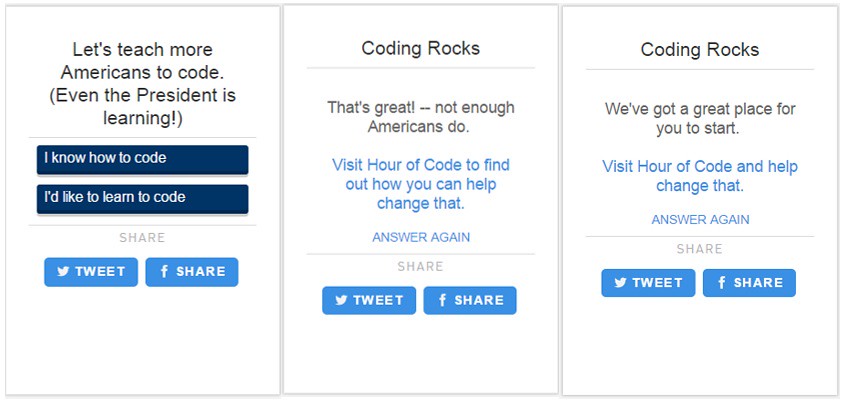
theodp writes: Coding got a couple of shout-outs from the White House in Tuesday's State of the Union Address. "Thanks to Vice President Biden's great work to update our job training system," said President Obama (YouTube), "we're connecting community colleges with local employers to train workers to fill high-paying jobs like coding, and nursing, and robotics." And among the so-called "boats" in the new "River of Content" that the White House social media folks came up with to enhance the State of the Union is a card intended to be shared on Twitter & Facebook which reads, "Let's teach more Americans to code. (Even the President is learning!)." President Obama briefly addressed human spaceflight, saying, "I want Americans to win the race for the kinds of discoveries that unleash new jobs – converting sunlight into liquid fuel; creating revolutionary prosthetics, so that a veteran who gave his arms for his country can play catch with his kid; pushing out into the Solar System not just to visit, but to stay." He also called once more for action on climate change. Politifact has an annotated version of the transcript for more background information on Obama's statements, and FiveThirtyEight has a similar cheat sheet. -
Librarians: The Google Before Google
An anonymous reader writes NPR has an article about the questions people ask librarians. Before the internet, the librarian was your best bet for a quick answer to anything on your mind. "We were Google before Google existed," NYPL spokesperson Angela Montefinise explains. "If you wanted to know if a poisonous snake dies if it bites itself, you'd call or visit us." The New York Public Library in Manhattan recently discovered a box of old reference questions asked by patrons and plans to release some in its Instagram account. Here are a few of the best:- I just saw a mouse in the kitchen. Is DDT OK to use? (1946)
- What does it mean when you dream of being chased by an elephant? (1947)
- Can you tell me the thickness of a U.S. Postage stamp with the glue on it? Answer: We couldn't tell you that answer quickly. Why don't you try the Post Office? Response: This is the Post Office. (1963)
- Where can I rent a beagle for hunting? (1963)
-
Technical Hitches Delay Orion Capsule's First Launch
According to NBC news, "A series of delays held up the maiden launch of NASA's Orion capsule on Thursday, adding some extra suspense to the first test of a spacecraft that's designed to take humans farther than they've ever gone — including to Mars." The much-anticipated launch, which had been scheduled for launch 7:05 a.m. Florida time, is to boost into orbit — empty — an instance of the Orion crew capsule intended to be part of a manned mission to Mars. As of shortly after 9 a.m. eastern time, troubleshooting has been in progress on the Alliance Delta 4 launch vehicle's hydrogen fill and drain valves in attempt to make the launch within today's launch window, which extends to 9:44 a.m. Besides the technical problem with those valves, the launch was delayed by wind, as well as by a boat that strayed into a restricted area. (Shades of the stray-boat delay in October for Orbital Science's ISS delivery launch.) Friday and Saturday have been designated as backup dates. Update: 12/04 15:03 GMT by T : The launch has been scrubbed. -
Interviews: Adora Svitak Answers Your Questions
Recently, you had a chance to ask child prodigy, author and activist, Adora Svitak, about education and women In STEM and politics. Below you'll find her answers to your questions. Question
by phantomfive
In your talk you said that kids deserve high expectations. What help do you have to reach your high expectations? What should kids do who don't have the same help?
Adora: A lot of people will say things like "kids this young aren't mature enough to handle this kind of content," with "this kind of content" meaning anything serious or controversial. Since I was a young age, my parents didn't tolerate that kind of closed-mindedness about what their daughters could or couldn't "handle"; they invited us to sit at the "adults' table," and we had the opportunity to discuss current events with family friends. They expected that our age wouldn't preclude us from developing opinions and having causes we believed in. Kids in families with more conservative definitions of what it means to be a child should find high expectations from other places--teachers, mentors, role models--and give those high expectations in turn to peers.
Child prodigies
by Anonymous Coward
To what extent do you believe child prodigies are merely products of their environment?
Adora: To clarify, I've never thought of myself as a child prodigy (contrary to how my Wikipedia page might describe me). I think that everyone's a little bit a product of their environment. My environment happened to be saturated in good literature; I remember having many, many more books than clothes. My parents and babysitters read to my sister and me all the time. I loved writing and found it to be intuitive. In that sense I credit a lot of the development of my abilities to my environment.
Microaggressions
by Kohath
Do you believe in microaggressions? Why or why not? Is a belief in microaggressions helpful or harmful? To whom is it helpful? Who should worry about microaggressions? Who shouldn't? How can someone be certain they are innocent of committing microaggressions? If someone is accused of something like committing microaggressions, are there two sides that must be considered, or only one?
Adora: I never heard of microaggressions as something to be "believed" in or not, I take it fairly for granted that they exist (particularly since I've seen them). There's a great video on YouTube called If Asians Said the Stuff White People Say that does an excellent job of outlining some of the ones folks hear every day. As someone who's half-white, half-Asian (and looks predominantly Asian) I often hear questions like "where are you from? Like, where are your parents from?" Knowing about microaggressions is very helpful, because it allows us to avoid accidentally perpetuating racist or sexist commentary. If someone is accused of committing microaggressions, it's entirely possible that there intentions were good and something hurtful was said accidentally, but that doesn't negate their responsibility to hear the offended party's response so they know how to avoid microaggressions next time.
I Don't Get It
by Tablizer
After seeing my development job outsourced to India in the early 2000's during an IT slump, I have no compulsion to steer my daughter into STEM. I hope she finds a career that she grows into and does well, STEM or not. STEM is in demand at this spot in history, but I've learned the hard way it's subject to fads, bubbles, age discrimination, H1B's, and outsourcing. Please tell me, why push women into such risk? I suspect it's lobbyists trying to get cheaper IT labor for their plutocrat bosses by flooding the market. Feel welcome to convince me otherwise.
Adora: STEM (science, technology, engineering, and math) is an extraordinarily broad set of disciplines, and like any set of disciplines, has some areas with more job opportunities and some with less. It's not inherently more risky than any other group of fields to study. Women are no less equipped to handle the "risk" that comes with STEM.
What can be done to get more women into CS?
by squisher
Hi, I'm the "typical" white male in CS gradschool. My subjective view is that CS has one of the lowest number of women compared to other STEM disciplines. I'd estimate that typically there are about 5% tops in classes or at conferences. For various reasons I think that this situation is a shame for the community and society as a whole. What do you think can be done to improve this? Thanks!
Adora: The low numbers of women in STEM should be considered a national shame. One huge problem that prevents more women from either going into CS or continuing with it is "brogramming" culture, especially in Silicon Valley startups, that promotes a macho, objectifying attitude toward women that puts "bros before hoes" (see: ousting of Whitney Wolfe from Tinder after she was harassed by another co-founder there, or Uber's CEO threatening a female journalist) and creates toxic workplace cultures. We need more programs like Girls Who Code and Black Girls Code to give young women a leg up in a supportive environment.
Happy thoughts
by Anonymous Coward
Hi Adora! Looking through any debate on gender issues is somewhat demoralizing, as there seems to be little focus on resolving the underlying issues. What do you think could be done to help people cooperate rather than yelling at each other?
Adora: Creating more opportunities for traditionally underrepresented groups to have their voices heard is incredibly important. Another thing I really like is the idea of "safe space," where groups can talk freely in the knowledge that what they say will not be used against them in any way.
Did TV make us do it?
by mrex
How much credence to you give to the theory recently put forward in a recent NPR Planet Money piece, ascribing the absence of women specifically in the computing industry to 1980s media representation of geeks and computer worker lifestyles?
Adora: My answer to this question is strongly related to my answer to the previous question about bringing more women into CS. I feel that the stereotype of CS as the domain of pasty geeks sitting around laptops in basements is honestly less harmful to the future of women in CS than the implicit or explicit discouragement of young women from entering industry that happens because of insensitive/sexist comments by professors or folks in the work world. -
Montana Lawmakers Propose 85 Mph Speed Limit On Interstates
HughPickens.com writes AP reports that Montana lawmakers are drafting bills that would raise the daytime speed limit on Montana interstate highways from 75 to 80 and possibly as high as 85 mph. "I just think our roads are engineered well, and technology is such we can drive those roads safely," says Art Wittich. He notes that Utah, Wyoming, and Idaho have raised their speed limits above 75, and they haven't had any problems. Drivers on German autobahns average about 84 mph. State Senator Scott Sales says he spent seven months working in the Bakken oil patch, driving back and forth to Bozeman regularly. "If I could drive 85 mph on the interstate, it would save an hour," says Sales. "Eighty-five would be fine with me." A few years ago Texas opened a 40 mile stretch on part of a toll road called the Pickle Parkway between Austin and San Antonio. The tolled bypass was supposed to help relieve the bottleneck around Austin but the highway was built so far to the east that practically nobody used it. In desperation, the state raised the toll road speed limit to 85 mph, the fastest in the nation. "The idea was that drivers could drop the top, drop the hammer, crank the music and fly right past Austin," says Wade Goodyn. "It's a beautiful, wide-open highway — but it's empty, and the builders are nearly bankrupt." -
Alva Noe: Don't Worry About the Singularity, We Can't Even Copy an Amoeba
An anonymous reader writes "Writer and professor of philosophy at the University of California, Berkeley Alva Noe isn't worried that we will soon be under the rule of shiny metal overlords. He says that currently we can't produce "machines that exhibit the agency and awareness of an amoeba." He writes at NPR: "One reason I'm not worried about the possibility that we will soon make machines that are smarter than us, is that we haven't managed to make machines until now that are smart at all. Artificial intelligence isn't synthetic intelligence: It's pseudo-intelligence. This really ought to be obvious. Clocks may keep time, but they don't know what time it is. And strictly speaking, it is we who use them to tell time. But the same is true of Watson, the IBM supercomputer that supposedly played Jeopardy! and dominated the human competition. Watson answered no questions. It participated in no competition. It didn't do anything. All the doing was on our side. We played Jeopordy! with Watson. We used 'it' the way we use clocks."" -
Undersized Grouper Case Lands In Supreme Court
An anonymous reader writes The Supremes have decided to hear a case regarding whether groupers are 'tangible articles' under the Sarbanes-Oxley law. The issue is that the crew of the Miss Katie was caught with undersized fish. A marine fisheries officer wrote them a ticket and put the fish in a box that the captain was ordered to turn in when he got ashore. Rather than do this, they threw out the undersized fish and replaced them with bigger ones. Prosecutors, rather than charging them with offenses of catching undersized fish (which would have resulted in a fine and a small jail sentence), went after them under the Sarbanes-Oxley law which forbids the destruction of "any record, document, or tangible object" and which could result in a 20 year prison sentence, though the prosecutor only asked for two years on this one. Lawyers are arguing over whether "tangible object" here is something that could contain records, or whether it's any object whatsoever that might be evidence. So far in comments, many of the conservative justices, including Roberts, Alito and Scalia, have expressed skepticism as to whether this would lead to overcriminalization for petty crimes and would give prosecutors undue leverage given all the things Sarbanes-Oxley can apply to. They also question whether this was intended in the law, given that "tangible object" was listed in a context including documents and records and appears to have been only contemplated in terms of servers, DVDs, or other tangible objects that might contain documents or records. Meanwhile, Kagan and Kennedy appear amenable to a more literal reading of the statute, given that groupers are in fact touchable and that makes them "tangible objects" under the ordinary meaning of those words. -
New Atomic Clock Reaches the Boundaries of Timekeeping
SonicSpike sends an article from NPR about a high-tech clock being built at the University of Colorado Boulder. It's more precise than any clock before, able to keep perfect time for five billion years. "At the heart of this new clock is the element strontium. Inside a small chamber, the strontium atoms are suspended in a lattice of crisscrossing laser beams. Researchers then give them a little ping, like ringing a bell. The strontium vibrates at an incredibly fast frequency. It's a natural atomic metronome ticking out teeny, teeny fractions of a second." But this precision leads to a problem: the relativistic differences between keeping the clock on the floor versus hanging it on the wall now introduce more significant fluctuations than the clock itself. "Tiny shifts in the earth's crust can throw it off, even when it's sitting still. Even if two of them are synchronized, their different rates of ticking mean they will soon be out of synch. They will never agree. The world's current time is coordinated between atomic clocks all over the planet. But that can't happen with the new one." -
Ask Slashdot: Where Do You Stand on Daylight Saving Time?
New submitter gbcox links to this article about how the switch between Standard Time and Daylight Saving Time can be dangerous, but writes Personally, I favor year 'round DST — I like the extra sunlight in the evening... but regardless, I just wish we'd pick one and stop futzing with the time twice a year. As it is right now, we only have about 4 months of standard time as it is... is it really worth the effort to switch the clocks for only four months? I think not. Where do you stand? If you have a strong opinion, it would be nice if you start your subject line in comments with "For it!" or "Against it!" If you think that the yearly clock-shifting is a good idea, when do you think each shift should occur? For those not keeping score, tonight is the switchover time for most Americans. -
Solving the Mystery of Declining Female CS Enrollment
theodp writes After an NPR podcast fingered the marketing of computers to boys as the culprit behind the declining percentages of women in undergraduate CS curricula since 1984 (a theory seconded by Smithsonian mag), some are concluding that NPR got the wrong guy. Calling 'When Women Stopped Coding' quite engaging, but long on Political Correctness and short on real evidence, UC Davis CS Prof Norm Matloff concedes a sexist element, but largely ascribes the gender lopsidedness to economics. "That women are more practical than men, and that the well-publicized drastic swings in the CS labor market are offputting to women more than men," writes Matloff, and "was confirmed by a 2008 survey in the Communications of the ACM" (related charts of U.S. unemployment rates and Federal R&D spending in the '80s). Looking at the raw numbers of female CS grads instead of percentages, suggests there wasn't a sudden and unexpected disappearance of a generation of women coders, but rather a dilution in their percentages as women's growth in undergrad CS ranks was far outpaced by men, including a boom around the time of the dot-com boom/bust. -
NPR: '80s Ads Are Responsible For the Lack of Women Coders
gollum123 writes: Back in the day, computer science was as legitimate a career path for women as medicine, law, or science. But in 1984, the number of women majoring in computing-related subjects began to fall, and the percentage of women is now significantly lower in CS than in those other fields. NPR's Planet Money sought to answer a simple question: Why? According to the show's experts, computers were advertised as a "boy's toy." This, combined with early '80s geek culture staples like the book Hackers: Heroes of the Computer Revolution, as well as movies like War Games and Weird Science, conspired to instill the perception that computers were primarily for men. -
NPR: '80s Ads Are Responsible For the Lack of Women Coders
gollum123 writes: Back in the day, computer science was as legitimate a career path for women as medicine, law, or science. But in 1984, the number of women majoring in computing-related subjects began to fall, and the percentage of women is now significantly lower in CS than in those other fields. NPR's Planet Money sought to answer a simple question: Why? According to the show's experts, computers were advertised as a "boy's toy." This, combined with early '80s geek culture staples like the book Hackers: Heroes of the Computer Revolution, as well as movies like War Games and Weird Science, conspired to instill the perception that computers were primarily for men. -
Developers, IT Still Racking Up (Mostly) High Salaries
Nerval's Lobster (2598977) writes Software development and IT remain common jobs among those in the higher brackets, although not the topmost one, according to a new study (with graph) commissioned by NPR. Among those earning between $58,000 and $72,000, IT was the sixth-most-popular job, while software developers came in tenth place. In the next bracket up (earning between $72,000 and $103,000), IT rose to third, with software development just behind in fourth place. As incomes increased another level ($103,000 to $207,000), software developers did even better, coming in second behind managers, although IT dropped off the list entirely. In the top percentile ($207,000 and above), neither software developers nor IT staff managed to place; this is a segment chiefly occupied by physicians (in first place), managers, chief executives, lawyers, and salespeople who are really good at their jobs. In other words, it seems like a good time to be in IT, provided you have a particular skillset. If those high salaries are in Silicon Valley or New York, though, they might not seem as high as half the same rate would in Omaha, or Houston, or Raleigh. -
Pentagon Reportedly Hushed Up Chemical Weapons Finds In Iraq
mr_mischief writes "Multiple sources report that the US found remnants of WMD programs, namely chemical weapons, in Iraq after all. Many US soldiers were injured by them, in fact. The Times reports: "From 2004 to 2011, American and American-trained Iraqi troops repeatedly encountered, and on at least six occasions were wounded by, chemical weapons remaining from years earlier in Saddam Hussein's rule. In all, American troops secretly reported finding roughly 5,000 chemical warheads, shells or aviation bombs, according to interviews with dozens of participants, Iraqi and American officials, and heavily redacted intelligence documents obtained under the Freedom of Information Act." -
Scientists Coax Human Embryonic Stem Cells Into Making Insulin
First time accepted submitter kwiecmmm writes A group of Harvard scientists reported that they have figured out how to turn embryonic stem cells into beta cells capable of producing insulin. This discovery could cure diabetes. From the article: "'It's a huge landmark paper. I would say it's bigger than the discovery of insulin,' says Jose Olberholzer, a professor of bioengineering at the University of Illinois. 'The discovery of insulin was important and certainly saved millions of people, but it just allowed patients to survive but not really to have a normal life. The finding of Doug Melton would really allow to offer them really something what I would call a functional cure. You know, they really wouldn't feel anymore being diabetic if they got a transplant with those kind of cells.'" -
Diners Tend To Eat More If Their Companions Are Overweight
BarbaraHudson writes: A University of Illinois study (abstract) that shows that people tend to eat more in the presence of an overweight person. From the article: "The test involved a sample of 82 college coeds who were observed helping themselves to a simple pasta and salad meal. Each of the coeds were themselves of normal weight. The students first required to watch what they believed was a fat woman serving herself some of the food. The fat woman was actually an actress wearing a fat suit.
After observing the "corpulent" woman serve herself, the students were allowed to come forward and serve themselves pasta and salad. On average, the coeds each served themselves more pasta than the "fat" woman had selected while taking less salad than she did. When the same study was performed with the actress appearing sans the fat suit, researchers observed that students ended up eating more salad than pasta. The conclusion was simple: people may consume more unhealthy food and eat less healthy food when in the presence of an overweight person." As anyone on a diet will tell you, a waist is a terrible thing to mind. Weight control is a lot more complex than the article makes it seem, though some will welcome the opportunity to blame someone else. -
Why Atheists Need Captain Kirk
New submitter anlashok writes: Atheism and science face a real challenge: To frame an account of science, or nature, that leaves room for meaning. According to this article, atheists have pinned their flag to Mr. Spock's mast. But they need Captain Kirk. Quoting: "I'm pro-science, but I'm against what I'll call "Spock-ism," after the character from the TV show Star Trek. I reject the idea that science is logical, purely rational, that it is detached and value-free, and that it is, for all these reasons, morally superior. Spock-ism gives us a false picture of science. It gives us a false picture of humankind's situation. We are not disinterested knowers. The natural world is not a puzzle. ... The big challenge for atheism is not God; it is that of providing an alternative to Spock-ism. We need an account of our place in the world that leaves room for value." -
When Scientists Give Up
New submitter ferespo sends a report from All Things Considered about the struggle for scientific funding in today's political and economic environment. "Federal funding for biomedical research has declined by more than 20 percent in the past decade. There are far more scientists competing for grants than there is money to support them." It's a tough situation for new scientists trying to set up labs. In addition to all of the scientific work they do, it's essentially a full-time job in addition to that to maintain funding. The reviewers who decide which projects receive funding are risk-averse to the point where innovative research is all but off the table. The consequences of this are two-fold: not only are we giving up on the types of research that led to so many of today's marvels, but many promising young scientists are giving up on the field altogether. -
Anti-Ebola Drug ZMapp Makes Clean Sweep: 18 of 18 Monkeys Survive Infection
Scientific American reports, based on a study published today in Nature, that ZMapp, the drug that has been used to treat seven patients during the current Ebola epidemic in West Africa, can completely protect monkeys against the virus, research has found. ... The drug — a cocktail of three purified immune proteins, or monoclonal antibodies, that target the Ebola virus — has been given to seven people: two US and three African health-care workers, a British nurse and a Spanish priest. The priest and a Liberian health-care worker who got the drug have since died. There is no way to tell whether ZMapp has been effective in the patients who survived, because they received the drug at different times during the course of their disease and received various levels of medical care. NPR also has an interview with study lead Gary Kobinger, who says that (very cautious) human trials are in the works, and emphasizes the difficulites of producing the drug in quantity. -
The American Workday, By Profession
An anonymous reader writes NPR has created an interesting visualization of workday data from the American Time Survey. It shows what the typical working times are for each profession. You can see some interesting trends, like which professions distribute their work throughout the day (firefighters and police), which professions take their lunch breaks the most seriously (construction), and which professions reverse the typical trends (food service). "Still, Americans work more night and weekend hours than people in other advanced economies, according to Dan Hamermesh and Elena Stancanelli's forthcoming paper (PDF). They found that about 27 percent of Americans have worked between 10 p.m. and 6 a.m. at least once a week, compared with 19 percent in the U.K. and 13 percent in Germany."