Slashdot Mirror
Domain: nsf.gov
Stories and comments across the archive that link to nsf.gov.
Comments · 420
-
NSF Grant
http://www.nsf.gov/funding/pgm_summ.jsp?pims_id=5527 might buy you some time, and allow you to hire a "partner".
-
Re:Or maybe, since temps have flatlined since '99,
When you can't respond to data - attack the messenger.
Sorry, but that says something about you, not my link
PS: The sun being the largest influenser of earth's climate isn't "well-debunked" at all. On the contrary actually.
http://www.nsf.gov/news/news_summ.jsp?cntn_id=115207&org=OLPA&from=news
-
funded by the National Science Foundation
Here is their grant and proposal abstract from the NSF. It sounds like they did exactly what they'd proposed to do- not every grant meets that metric! Theirs is a 3-year grant for a total of $386927.
There was a cute line in their FAQs:
Q. Were the tests IRB approved?
Yes, they were approved. No SSNs were harmed during the writing of this paper.
-
Why Not Indeed?
Why isn't thesandbender posting a loaded question to
Why isn't samzenpus passing along ridiculous material without bothering to look at whether it's a troll?
Why isn't dynasoar posting a reply with a link to NFS's summaries of federal research budgets 1955 to present?
http://www.nsf.gov/statistics/nsf08315/content.cfm?pub_id=3880&id=2
"The US government has little experience with commercial enterprise."
WTF? The US government controls the very basis of commercial enterprise, the economy. It exists in large part to support commercial enterprise. Very few high level legislative officials haven't been directly involved in operating a commercial enterprise.
-
Re:Of course
-
Re:I was scanned in LAX--- Relaxed? Or not?
Well, if someone enters the scanner socked, locked and ready to rock, hopefully the millimetre scanner detects something appearing or weighing in at 1,397 mm...
Butt, on the other hand, the mm scan could be useful for detecting collapsed, polymer truncheons/batons and daggers that otherwise would be/might be found in a luggage scan. And, the mm scan can detect mules (drugs carriers) who've been surgically invaded to carry cocaine under their skin. Sure, drug-sniffer dogs can do this, too, but the mm scan might find people who have the scars from previous runs, and help DEA get a bead on their asses and their handlers, too. I imagine this database producing TONS of information to be added to the government/s' arsenal...
http://www.visualanalytics.com/
http://www.visualanalytics.com/products/visuaLinks/vlFeatures/placements/Starburst.cfm
http://www.visualanalytics.com/products/visuaLinks/vlFeatures/index.cfm -
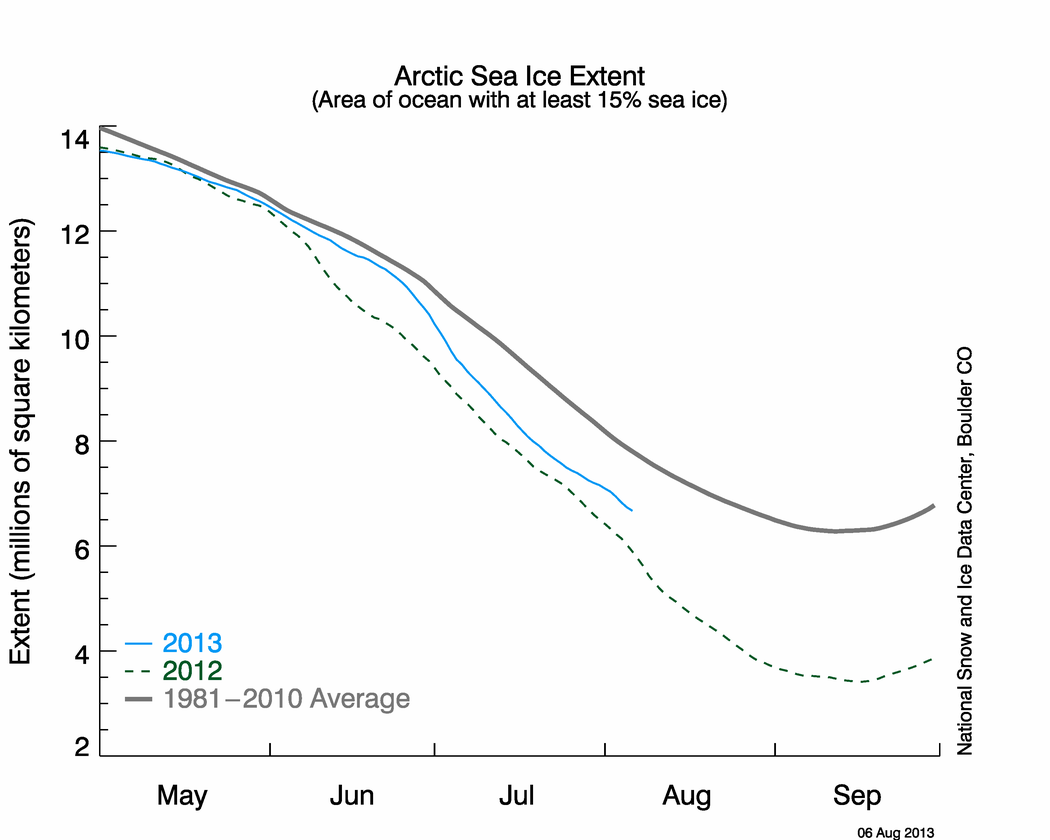
but it's not just one thingHas the global sea ice decline stopped?
The planet has not shown substantial warming for a decade now. The Gore Effect seems to be holding. Some glaciers are advancing . And the Arctic Sea ice appears to have halted its decline, if only temporarily.
-
The Private Sector
Note that he didn't say "government R&D". I take that to mean that some of that 3% will be government spending (which Obama can increase directly) and some of it will be private (which Obama can increase through various incentives).
According to the NSF, R&D versus GDP is now about 2%, and was 2.8% as late as 1992. So a goal of 3% is actually only a 50% improvement, and only slightly better than levels we've actually achieved in the past.
One thing that's bothered me for some time: corporations seem to be less and less interested in investing in R&D to develop new products. Instead, they spend it on advertising to push the products they already have. Or else they spend huge sums to acquire companies whose products look promising.
Big Pharma is extremely addicted to both strategies. (Notice all the drug commercials and news about mergers.) And yet when anybody complains about drug prices, they point to the need to earn back their R&D costs. If only that were true!
Any, the O guy is right: this is not something we can afford to skimp on. Science and technology have always been important to both our economy and our sense of WTF we are. The way we've let them slip is both shameful and short-sighted.
-
R&D, The Facts
According to the NSF:
In 2007, the US spent $368 billion on R&D, 2.6% of GDP.
Of that spending, $245 billion was from private industry and $98 billion was from the Federal Government (there was other, smaller, spending by non-profits and non-Federal goverment).
Overall R&D spending by the United States far exceeds that of all other countries, although a few (such as Japan, South Korea, and Sweden) exceed the US on R&D to GDP ratios. Sweden is highest at 3.73%. France only has 2.11% and the UK only has 1.78%.
-
Re:Yes
I wait until the games I want are on the bargian shelves then buy them (or cheap on Steam).
Nothing to add here but "me, too".
Diablo 3 may cause me to break this trend,
Little to add here but "me, too", although in this case it's because my girlfriend's super-excited about it and wants me t'play.
Okay, okay, a little to add: Sometimes I'll buy an older game bundled with new expansions, such as when Warlords came out for Civ IV. But in general, I wait for games to discount.
Aside from the cost advantage, you get the benefit of other people's hindsight. Once the hype is long-faded and games' replay values are established, it's easy to get a real handle on what's worth playing.
This isn't a new trend, either. I recall Scott Kurtz noting it years ago, in the context of gamer parents. I'd speculate that it's due, in part, to just that: the first generation of hardcore gamers is getting older, making babies, and getting smacked upside the head with limited entertainment budgets.
In addition, the last ten years or so have made home computers less of a luxury. Home computers have found their way into a lot more homes in every income category. Damn it, I didn't plan to have to do any research for this reply. I'd suggest that lower-income households keep a sharper eye out for bargain entertainment.
If this trend manages to continue (the current economic climate may dampen or halt it, hopefully temporary-like), I think we'll find that games will find it profitable to adjust pricing downward to grab more buyers. It's a classic economic case for maximizing profits.
-
Re:Great Idea
The open source movement is exactly what should be funded
They are numbnuts: http://www.nsf.gov/news/index.jsp?prio_area=5
For those to lazy to click a linkThe National Science Foundation (NSF) is an independent federal agency created by Congress in 1950 "to promote the progress of science; to advance the national health, prosperity, and welfare; to secure the national defense..." With an annual budget of about $6.06 billion, we are the funding source for approximately 20 percent of all federally supported basic research conducted by America's colleges and universities. In many fields such as mathematics, computer science and the social sciences, NSF is the major source of federal backing.
-
NSF REU
I believe that many National Science Foundation funded Research Experience for Undergraduates programs will take exceptional high school students.
-
Re:Possible Concerns
The Government has done this because private corporations are not willing to pay for something you just give away free to the public
The one counter-example are private Universities, which do spend their own money on publicly available basic research.
(source) total basic research spending in universities in 2001 was $20.8 billion. $12.9 billion came from the Federal government, and $7.8 billion came from non-Federal sources.
Institutional funds (e.g. university endowments) are the largest source of non-Federal university basic research spending, followed by industry and state/local funding.
Basic research, of course, pales in comparison with the $250 billion total amount of US R&D done (source).
-
Re:Ice...for now.
The Comprehensive Environmental Evaluations for IceCube are available online for free. If you feel that there is something in there that requires attention or if there is something there that people have previously objected to in the case of oil rigs then you really should mention that.
Ok--you called my bluff. I really don't feel like wasting my time reading through a 10 MB PDF. Especially if it's from the NSF. Another dumb government agency that has everything to benefit from saying there are science-type problems which need more study--like oil drilling, global warming, etc... They are not an unbiased agency.
If you read the full CEE there, you should be able to know why. I suggest you read section 5.3 alone, if the whole document is daunting, since that describes the environmental effects and that section is followed by a description of procedures taken to mitigate those.
I started reading section 5.2. I gained consciousness a few moments ago at the end of the first paragraph. I won't argue that this has more or less of an impact than an oil rig. That was never my argument.
-
Re:Ice...for now.
The Comprehensive Environmental Evaluations for IceCube are available online for free. If you feel that there is something in there that requires attention or if there is something there that people have previously objected to in the case of oil rigs then you really should mention that.
If you read the full CEE there, you should be able to know why. I suggest you read section 5.3 alone, if the whole document is daunting, since that describes the environmental effects and that section is followed by a description of procedures taken to mitigate those.
Again, if there is something to complain about, you will have to point it out, and then these environmentalists you speak of will have to explain why they only object to those things when the subject is an oil rig. But asking people to explain why they aren't complaining about something without explaining why they should just makes no sense in my book. -
at the grad-school level, it's actually opposite
Foreign grad students in science/engineering are hugely skewed towards male, making the gender bias look worse than it'd be if you only considered US citizens/nationals.
Looking at these stats from 2006, science/engineering grad students overall were 57% male, 43% female in 2006. But among U.S. citizens and permanent residents, it was 52% male, 48% female---nearly parity. This was offset by holders of temporary student visas being 67% male, 33% female.
-
Re:Air gap + Sneakernet
Portable harddrives to move the data?
http://www.nsf.gov/discoveries/disc_summ.jsp?cntn_id=111420
This thing will generate 28000 TB of data per hour! Imagine the number of grad students it would take to transfer all those hard drives back and forth.
-
Re:Not so sure its the first
Blue Waters will be the first to deliver a sustained petaflop on "real-world" applications, meaning various scientific simulations. Specifically, the program solicitation required prospective vendors to explain how their proposed systems would sustain a petaflop on three types specific types of simulations, one each in turbulence, lattice-guage quantum chromodynamics, and molecular dynamics.
Granted, Roadrunner was the first machine to deliver a petaflop on the Linpack benchmark (though certainly IBM's own implementation of it). The benchmark does nothing more than set up and solve a system of linear equations. Roadrunner solved a system of 2,236,927 equations (in other words, it had a 2,236,927-by-2,236,927 coefficient matrix) in 2 hours.
But Blue Waters is planned to deliver a petaflop on applications that normally don't sustain >80% of theoretical peak; these applications are lucky to get near 20%.
-
Re:the fire is in war
Somehow I don't think it's cost effective (leaving out the whole humanitarian costs like thousands of dead people):
Iraq War: $550 billion
NSF Budget for same period: $28.6 BillionWhich do you think is the better investment?
-
Re:Excellent
Why is parent modded funny? It's an actual idea to combat global warming.
Probably not a good idea, but still.
-
Re:Won't ever happen
The grant is from the NSF, not the DoD which implies it is more scientific in nature.
Chuckle. I wish.
The friking NSF has been pouring tens of millions if not hundreds of millions of dollars into research grants on Trusted Computing and related stuff to lock down.... oops I mean to secure... computers and the internet.
Here, take a look. That is a "Trusted Computing" search of currently active NSF research grants. I count over $36 million right there alone. Not to mention that it's likely some relevant projects slipped past that simple search, and not to mention the fact that NSF computer-related grants have been primarily directed to Trusted Computing for quite some years now.
Hell, if you do a search of NSF funding (not merely computer related funding but a search of ALL NSF funding) you get 152 documents found in 578 documents searched. That is more than 26% of ALL searched documents hitting on Trusted Computing. It seems that Trusted Computing is likely the #1 "science research" item on the NSF agenda.
Between the government initiative to secure the National Information Infrastructure against Terrorist Cyber Attack, and the influence of corporate interests, the NSF and other government agencies have become pipelines for pouring grotesque sums of money into developing and pushing Trusted Computing.
The things going on towards Trusted Computing stuff can sound like a bad conspiracy theory, but there is really nothing secret or theoretical about it. It's all publicly admitted. There are more than a hundred companies publicly members of the Trusted Computing group - pretty well every computer-related company you can name. The CPU manufacturers (Intel AMD Motorola), the BIOS makers (phoenix AMI), all the major players (Microsoft IBM Sun HP), motherboard makers, the major PC brands, the wireless and networking companies, harddrive makers, virtually every significant company in the computer industry.
And the public NSF grants for it, linked above. And the public Homeland Security effort and money for "securing" the internet, and other other US government agencies, and policy initiatives suggesting a requirement for all government computer purchases to be Trusted Computing compliant - and get this - I've seen these initiatives literally STATE one of the purposes of the requirement being to bootstrap the market for such computers - explicitly STATING the purpose of huge government purchases of Trusted Computers being to establish a large and secure market demand for them so that computer companies can/will invest in mass producing Trusted Computers, in order to establish the supply of Trusted compliant computers to the general public market. I think the military did in fact adopt a policy requiring their purchases to be Trusted Compliant, but I'd have to double check on that. Ahh, I just googled, yes I was right. U.S. Army requires trusted computing.
The European Union is perhaps even more gung-ho on it than the US. They have been having all sorts of EU conferences on creating a new Information Society and securing the internet to enable that new Information Society. A google on EU "Information Society" "trusted computing" gets 18,800 hits. 23,400 hits if you search for EU "information society" DRM. There are countless published documents from these EU Information Society projects stating and detailing their desire and efforts to lock down computers and lock down the internet, for law enforcement reasons and copyright/commerce reasons a
-
Re:Won't ever happen
The grant is from the NSF, not the DoD which implies it is more scientific in nature.
Chuckle. I wish.
The friking NSF has been pouring tens of millions if not hundreds of millions of dollars into research grants on Trusted Computing and related stuff to lock down.... oops I mean to secure... computers and the internet.
Here, take a look. That is a "Trusted Computing" search of currently active NSF research grants. I count over $36 million right there alone. Not to mention that it's likely some relevant projects slipped past that simple search, and not to mention the fact that NSF computer-related grants have been primarily directed to Trusted Computing for quite some years now.
Hell, if you do a search of NSF funding (not merely computer related funding but a search of ALL NSF funding) you get 152 documents found in 578 documents searched. That is more than 26% of ALL searched documents hitting on Trusted Computing. It seems that Trusted Computing is likely the #1 "science research" item on the NSF agenda.
Between the government initiative to secure the National Information Infrastructure against Terrorist Cyber Attack, and the influence of corporate interests, the NSF and other government agencies have become pipelines for pouring grotesque sums of money into developing and pushing Trusted Computing.
The things going on towards Trusted Computing stuff can sound like a bad conspiracy theory, but there is really nothing secret or theoretical about it. It's all publicly admitted. There are more than a hundred companies publicly members of the Trusted Computing group - pretty well every computer-related company you can name. The CPU manufacturers (Intel AMD Motorola), the BIOS makers (phoenix AMI), all the major players (Microsoft IBM Sun HP), motherboard makers, the major PC brands, the wireless and networking companies, harddrive makers, virtually every significant company in the computer industry.
And the public NSF grants for it, linked above. And the public Homeland Security effort and money for "securing" the internet, and other other US government agencies, and policy initiatives suggesting a requirement for all government computer purchases to be Trusted Computing compliant - and get this - I've seen these initiatives literally STATE one of the purposes of the requirement being to bootstrap the market for such computers - explicitly STATING the purpose of huge government purchases of Trusted Computers being to establish a large and secure market demand for them so that computer companies can/will invest in mass producing Trusted Computers, in order to establish the supply of Trusted compliant computers to the general public market. I think the military did in fact adopt a policy requiring their purchases to be Trusted Compliant, but I'd have to double check on that. Ahh, I just googled, yes I was right. U.S. Army requires trusted computing.
The European Union is perhaps even more gung-ho on it than the US. They have been having all sorts of EU conferences on creating a new Information Society and securing the internet to enable that new Information Society. A google on EU "Information Society" "trusted computing" gets 18,800 hits. 23,400 hits if you search for EU "information society" DRM. There are countless published documents from these EU Information Society projects stating and detailing their desire and efforts to lock down computers and lock down the internet, for law enforcement reasons and copyright/commerce reasons a
-
Re:Ok I understand the problems of our current set
How about cutting wellfare in half and have ten times the money.
Eh? Spending on welfare (TANF) is a very small part of the budget, $16.5 billion. At a population of 301 million, that's $54.80/year/person, fifteen cents a day per person. The base defense budget - not including war funding - is more than $481 billion, $1598/person/year, $4.38 per day per person. U.S. military spending makes up the bulk of world military spending. We could cut ours in half and still enormously outspend all potential adversaries.
Conservative politicians like to conflate "entitlements" all together, which includes not just welfare but medical spending (prices for which are driven up by the for-profit model and by drug patents, both of which are made possible by government action), veterans affairs and military retirement payments (which should be properly counted under defense), and Social Security spending.
The NSF's budget is $6.065 billion, $20.15/year/person, about five and a half cents a day per person.
-
Its not for the WH cutting the NSF budget
or related ones. I looked it up, the WH keeps requesting small increases to the NSF... http://www.nsf.gov/about/budget/ and they request specific amounts for projects only to see them whacked http://blog.wired.com/wiredscience/2007/12/us-budget-spell.html
Now I know, there are going to be the standard cry-about-Iraq-because-if-not-Iraq type crap totally ignoring the fact that just a small percentage of earmarks wasted on works named after LIVING congressmen could pay for any number of our own pet projects.
The money has always been there, Congress has the final responsibility for directing it correctly. Iraq is a very good excuse to spend money how they want while pointing "SEE SEE SEE SEE" elsewhere. In other words, one negative about Iraq that people ignore is that its mere existence allows Congress to waste money because they can always lay claim to the fact that Iraq consumes more.
without Iraq the money would be just as unavailable as it is today. This situation will not change until neither Democrats or Republicans are dominant.
-
NSF Science & Engineering Visualization Challe
Don't forget the NSF's Science & Engineering Visualization Challenge. This contest is to encourage people to communicate science using images and media. Check out the contest winners from the past few years.
-
Re:US science is dying?Sure has. US is number one, see here:
The United States has the largest share of all internationally authored papers of any single country, and its researchers collaborate with counterparts in more countries than do the researchers of any other country.
U.S.-based authors were represented in 44% of all internationally coauthored articles in 2003 and collaborated with authors in 172 of the 192 countries that had any internationally coauthored articles in 2003.
And here:
US ranked #1 at 3 times the number of papers than any other countries, and 5 times greater in number of citation (five times!)
Doing almost 50% of World's research isn't bad considering we have only 5% of the World's population. Guess that anwers my previous question: at 25% of World's population China was bound to discover something of use sooner or later... -
Federal Cyber Service: Scholarship for Service
It's not EXACTLY what you asked for, but another alternative is Federal Cyber Service: Scholarship for Service (SFS). Their goal is to "increase the number of qualified students entering the fields of information assurance and computer security...". Their "scholarship track" provides "funding to colleges and universities to award scholarships to students in the information assurance and computer security fields. Scholarship recipients shall pursue academic programs in information assurance for the final two years of undergraduate study, or for two years of master's-level study, or for the final two years of Ph.D.-level study. These students will participate as a cohort during their two years of study and activities, including a summer internship in the Federal Government. A limited number of students may be placed in National Laboratories and Federally Funded Research and Development Centers (FFRDCs)."
-
Hmmmn,
You can patent human DNA sequences.
Chances are, I have a bit of one of a patented DNA string within my own DNA.
I wonder how long it'll be until Monsanto or someone else sues me because of my very existence...
"Je pense, donc, je suis poursuivi en justice"? (Google translation: I speak Spanish, not French.
-
the actual article
Coondoggie's link is unnecessarily pointing at a newtworkworld copy-and-paste of the NSF's original article which is here.
-
Re:Good coverageThe *real* reason that they're spending $60M is to make sure that some fuel doesn't contaminate an acre or so of land.
Hey, each shot is only 60% of the National Science Foundation's annual budget. Why not? The NSF's 2008 budget request is for 6.43 billion dollars. But hey, what's a few orders of magnitude between friends? -
Like corn cobs?
I wonder if this is similar to the charcoal briquetting technique shown about a year ago with corn cobs and natural gas. http://www.nsf.gov/news/news_summ.jsp?cntn_id=108390/
-
Beat me again!
I submitted this yesterday, it was probably already in the firehose. I saw it at New Scientist, where I followed some links to Professor Wang's press release.
Yes, that's really his name. Here is his research group's home page.
-mcgrew -
Re:Your taxes do pay for the research
Ah, how does your data compare to the NSF's data? The NSF has companies paying for $35 billion worth of R&D research in 2005. Also keep in mind that its costs a company 500 million to 1 billion in clinical trials *after* a new drug has been found, which in itself is extremely risky. I'd rather have greedy cold hearted money men deciding how best to spend this nation's wealth on drug research than some government bureaucrat who doesn't get fired if he blows a few billion on a really stupid idea. http://www.nsf.gov/statistics/infbrief/nsf07335/
-
Re:Design decisions vs. 20/20 hindsight
National Science Foundation Survey shows people are scientifically ignorant:
http://www.nsf.gov/statistics/seind04/c7/fig07-06.htm
That is a horrible graph (should be properly labeled), but it shows the percentage of correct respondents in the US and Europe.
Note that only a little over 55% answered correctly that it takes the Earth a year to go around the Sun, and fewer than 80% know the Earth actually goes around the Sun, rather than vice-versa. -
Re:Proper EthanolMaking our ethanol out of the leftover waste materials is probably the only way ethanol will ever take off in this country. Who needs ethanol when you can go directly to hydrogen, and not just from crops.
Microbes churn out hydrogen at record rate -
Robbing Arecibo to pay for ALMAThe NSF Astronomy Division convened a "Senior Review" http://www.nsf.gov/mps/ast/ast_senior_review.jsp to try and see where money could be saved to pay for the enormous operating costs of ALMA http://www.alma.nrao.edu/ which is the Atacama Large Millimeter Array. ALMA will be an array of some 64 12-meter antennas operated at an elevation of 5000 m (16,000+ ft). ALMA is a collaboration between the Europeans, Japan, Chile and the US.
Arecibo was a loser in the Senior Review; something has to give to pay for ALMA operations!
-
The section of the NSF reportSorry for the long post, but this section of the NSF report has more information than the Times article.
Note that there is a report due in December on the cost of decommissioning the telescope and that Cornell is working with the Puerto Rican government to find ways to fill in the funding gap.
* National Astronomy and Ionosphere Center (NAIC)/Arecibo - Cornell acted quickly to implement the first of the Senior Review's recommendations to reduce the base operating budget to $8M over the next three years, by modifying the operating mode for astronomy observations, increasing the fraction of time for survey work, and limiting the number of receivers supported and the number of hours for astronomy observations. They also eliminated 30 FTEs, or 25% of their staff. Not all of these savings are realizable immediately, since personnel termination costs must be covered and the observatory requires basic maintenance to ensure safety of operations. By FY 2010, the full $2.5 million savings identified by the Senior Review will be recovered into the AST base budget and available for other uses.
Cornell has said that it will cease operations of the planetary radar in October 2007 to meet these budget reductions. We have recently learned that, in fact, they are maintaining the capability to operate the planetary radar, although on a less frequent schedule. In conversations with NASA management, it has been made clear that NASA has no intention of resuming support of the planetary radar, which they terminated in FY 2006.
With NSF's encouragement and support, Cornell and Arecibo staff are actively pursuing partnerships with the Puerto Rican government, local businesses, and academic institutions to provide additional operations support by 2011. We recently visited Puerto Rico, held a town hall for the Arecibo community, and met with commonwealth officials, business leaders, representatives from the universities and concerned citizens. We clarified the Senior Review recommendations and NSF's role in supporting the observatory and helped foster discussions among the many parties interested in maintaining the observatory as a viable operating facility for scientific research, education, and public outreach. The meetings were very positive with many expressions of a desire to work together to identify creative solutions to obtaining additional support. Many challenges face Cornell in preparing a plan for sustained long-term support from non-AST sources. I am optimistic that such a plan can be put together. NSF has informed Cornell that a concrete plan for operations in 2011 and beyond must be in place by spring of 2009. It is at that point that NSF must set the FY 2011 budget and so make a decision about the long-term future of Arecibo.
Nonetheless, in order to plan responsibly, and weigh the various options, we have to understand the cost of closure to be weighed against other options. As recommended by the Senior Review, NSF is also engaging an engineering firm to carry out a study of the cost of decommissioning the observatory facility. The study will explore a variety of possible endpoints, ranging from complete deconstruction and restoration of the site to its natural state to securely 'mothballing' the facility. The results of this study will be available in December 2007 and will serve as critical input to our planning for the long-term future of the observatory. This is part of responsible lifecycle costing, and should not be regarded as indicating that any final decisions have been made.
-
NSF even worse
NSF entire budget in FY07 was ~37% of NASA's budget (16B vs 5.9B). Of that 5.9B
$215M went to astronomy. ~56% of that $215M went to facilities like NRAO, NAIC, Gemini and NOAO.
NSF has a much better track record than NASA in terms of ROI it's just not as sexy.
While I'd love to see NASA's budget increased I'd prefer to see NSF's increase.
http://www.nsf.gov/about/budget/fy2007/tables.jsp#tables
Belthize -
Researchers at the National Science Foundation?While the NSF may want credit, they are mainly a funding organization without any actual research staff. The work was done at the Center of Integrated Nanomechanical Systems, which is hosted by UC Berkeley. The work was done by people at UCB and LBNL.
A great job of PR! Hopefully, there is really something to it. At the moment, it seems that they have set up a million dollars of high vacuum cryo equipment (I'm guessing) and transmitted audio from one side of the room to the other. You can "rent" web access to their paper for two days for $25 from the ACS. So much for taxpayer-funded open source literature...
-
Awesome!
At that scale, you can actually see the radio waves...
-
Re:Science AND TECHNOLOGYSure, it is nice to know a President's stance on Stem Cell Research and the accelerating rate at which National Science Foundation budgets are being cut... It is true that Congress usually allocates less for the NSF than the President's Budget requests, and sometimes there are earmarks and other conditions.
But during the 2000s, the total NSF budget has tended to increase at a rate of about 5% per year. So I don't know why you are talking about NSF budget cuts.
FY2001 - $4,426.12
FY2002 - $4,789.30
FY2003 - $5,309.95
FY2004 - $5,577.85
FY2005 - $5,472.82
FY2006 - $5,581.17
FY2007 - $5,917.16
[source] -
Research funding: by sourceHave a look here, table 1.
http://www.nsf.gov/statistics/infbrief/nsf07311/ Source of funding for 2005 (S&E funding sources at colleges and universities; US aggregate)
Fed. Govt: 29.2 Billion USD
Industry: 2.2 Billion USD
Raw data is available at webcaspar.nsf.gov but I am not sure if you have access. -
Re:We need sci education for EVERYBODY
"... or tell if they got the right change."
I've actually started to notice when a cashier knows enough to count out my change correctly. Years ago, that was the standard of competence for a cashier, and I was annoyed when it wasn't met.
I've been seeing the same sort of thing in other areas, over a period of years. Others obviously have, too, including media writers and editors. I see small bits of evidence for that every day. An article mentions x MW (thermal) from a reactor, and the story is picked up by other publications, but modified to x MW of heat. That's a vote by the succeeding publications that 'thermal' may not be understood.
A 2001 NSF survey showed that about half of Americans didn't know that the earth revolved around the sun, and took a year to do so. But this stuff changes, and all hope is not lost. Though there is both good and bad news in NSF's Science and Engineering Indicators 2006 (the most recent available) Chapter 7: Science and Technology: Public Attitudes and Understanding at:
http://www.nsf.gov/statistics/seind06/c7/c7s2.htm
which is a very interesting read. There are spreadsheets in the appendices, etc. This is the best reference I know of. -
Re:IT IS NOT A THEORY!!!
Competing theories are GOOD. I'm not sure MOND is really a direct competitor to string theory, but the more ideas the better.
MoND is not a competitor for string theory. It was a competitor for the dark matter, until the discovery of this: Direct Detection of Dark Matter in Galaxy Collision. Now it's just another bad idea in the dustbin of science history.
The main competitor for string theory is called "Loop Quantum Gravity", which is easy enough to google for more information. It's also possible that ordinary "supergravity" might work, though most physicists are not too hopeful about that one.
-
Re:Bias?
While I'm sure women do work as hard, I'm fairly sure the statistics show they do not work as long.
Here's a couple of citations for that:
http://www.bls.gov/opub/ted/2007/jul/wk1/art01.htm
http://jada.ada.org/cgi/content/full/135/5/637 (specific to dentists)
http://www.nsf.gov/statistics/infbrief/nsf06302/
I'm pretty sure there are a lot more, but there's some term for this I can't recall that would probably turn them up. -
Silica Gel reducing friction in fault zones?
My favored culprit for drastic friction reduction during faulting is lubricating Silica Gel; finely crushed quartz in the active fault zone reacts with water forming fluidic silica gel. There is excellent laboratory evidence of silica gel lubrication in simulated fault zones (see Mineral Gel May Reduce Rock Friction to Zero During Earthquakes, http://www.nsf.gov/news/news_summ.jsp?cntn_id=100325. All that is needed is field evidence, and I think I have it.
-
Percentage of foreign S&E grad students
http://www.nsf.gov/statistics/infbrief/nsf07312/
Foreign graduate students make up 29% of all enrolled graduate students in science and engineering (S&E) fields.
First-time, full-time enrollment of Computer Science is 56% foreign, Engineering is 51% foreign, Math is 39% foreign, Biology is 23% foreign, Social Sciences are only 21% foreign. -
Re:I think it's good1. I think if you make the selectivity stringent enough, you'll find that you are mostly targeting kids smart enough to make that decision for themselves.
2. Dropping out _is_ a valid option. Remember, it's "free". *Minimal strings attached*.
3. Does anyone have an idea of how tight the market is for science and engineering majors? Especially materials, comp sci and EE. Domestic enrollment rates are falling through the floor year on year. There's a great number of hidden disincentives in the current system from pursuing a science or engineering degree -- grade inflation, for example. Consequently CS enrollment, for example, has been dropping 5-10% YoY since 2000. I'm reasonably sure similar drops are being registered Math, Stats and hard Sciences, and in all engineering but Biochemical (cybernetics/systems bio/mol bio) and possibly Materials.From 1983 peak of about 441,000 students, undergraduate engineering enrollment declined to about 361,000 students by 1999, an 18 percent drop, before rebounding to 421,000 in 2002 (appendix table 2-10 Microsoft Excel icon). Graduate engineering enrollment peaked in 1993 at 128,000, declined to 105,000 by 1999, and then rebounded past its former peak to an all-time high of 140,000 in 2002
To put that in freaking proportion, the number of students attending college doubled from 1967 to 2000. So as a proportion of the college-going proportion, engineers are dropping to the bottom. Also the number of foreign-born graduate students in Engineering is at a solid 20-30%, masking a huge drop-off in domestic numbers there, too.
Plus these falling numbers come at the peak of a college-age baby boom! More people are going to college now (2003-10) than ever before. And you can't argue that this generation will have as much, if not more need, for scientists, engineers and math/stat guys than possibly ever before.
So IMHO the more incentives in this direction, the merrier. -
NSF is already doing this
http://www.nsf.gov/cise/cns/geni/
"With support from the Directorate for Computer and Information Science and Engineering (CISE), researchers are working together to design a bold new research platform called GENI, the Global Environment for Network Innovations. As envisioned, GENI will allow researchers throughout the country to build and experiment with completely new and different designs and capabilities that will inform the creation of a 21st Century Internet." -
Re:Are these machines actually used?
In fact, a lattice QCD problem was one of the model problems for the Track 1 proposals. Proposers had to "provide a detailed analysis of the anticipated performance of the proposed system on the following set of model problems...A lattice-gauge QCD calculation in which 50 gauge configurations are generated on an 84^3*144 lattice with a lattice spacing of 0.06 fermi, the strange quark mass m_s set to its physical value, and the light quark mass m_l = 0.05*m_s. The target wall-clock time for this calculation is 30 hours." Full details here.
This is a Big F-ing Problem that does in fact require Big F-ing Computers to solve. To meet the target time would require at least a petaflop of sustained performance; hence the inclusion of this problem in the call for proposals. The other model problems came from CFD and molecular dynamics, and there was a wide range of smaller required problems as well.
Now, none of this explains how these machines will really be used, or to what end. Nevertheless, I can vouch for such large machines being used under heavy load to solve very large problems. Poke around any of the national supercomputing labs' websites, and you should be able to find at least plenty of news releases, if not papers.
Here are some quick samples:
- ASC at Lawrence Livermore National Lab (home of BG/L, Top500 #1)
- NCCS at Oak Ridge National Lab (home of Jaguar, Top500 #2)
- Sandia National Lab (home of Red Storm, Top500 #3)
- NERSC at Lawrence Berkeley National Lab