Slashdot Mirror
Domain: oecd.org
Stories and comments across the archive that link to oecd.org.
Comments · 349
-
Re:Illegals
Literally 5 seconds of googling "vaccination rates"...
-
Re:Solar flare
Easy one, a solar flare takes us all back to zero.
No, for those interested:
http://www.oecd.org/governance...There is a worst case reality based assessment starting around page 24.
-
Re:Only?
Guess what, it hasn't had a noticeable effect on unemployment rates, rather it leads to increased wages over time as increased productivity as a result of more capital (automation) being able to be used by people to accomplish more.
This is true for some, but not nearly all, workers. The fields directly related to automation such as programming are in high.demand and have seen wages grow, but this is not the case for jobs requiring less education. As automation becomes more and more commonplace, it means there's fewer and fewer jobs available for those doing manual tasks. In fact, if you look at OECD statistics such as labor compensation per hours worked, you'll note that the rate of increase in wages is in fact dropping. In the case of the US for example, the rate of growth has dropped from 6.53 % annually in 2000 to just 1,32 % in 2016. It's since come up a little bit from there to 2,7 % but when you combine this with inflation and a rising cost of living, real wages are actually falling now in the US (and many other western countries) because the rather modest wage growth is not matching these. The same trend can be observed elsewhere in the developing countries, including the euro area.
This shouldn't be that hard to understand in practice. Take something like invoicing, or any other job that doesn't require a high amount of skill but has been critical in employing many, many people on the office side of things. While I was studying I used to work such a job during the summers especially. Back then the office side team consisted of nearly 30 people as the job involved a lot of manual tasks, including scanning paper invoices, manually entering information about what's being paid so that the books are in order, matching the invoice with its existing purchase order etc... With electronic invoicing increasing at a rapid pace, these tasks are quickly becoming more and more automated as the systems learn to pre-fill this information and you can use less and less people in the process. Now, as this happens and companies cut the number of workers in these tasks, productivity per person indeed goes up. One person can easily do what in the past took 5, as the most time consuming parts of the process have been cut out. But do you think this means the companies end up increasing the wages of the remaining staff? Because that is not happening. There's simply no need to do that. The tasks themselves have in fact gotten easier to do, as now all the guys overseeing electronic invoicing have to do is check that the software hasn't missed anything. Since the goal of implementing these systems is to cut costs by cutting labor costs by reducing staff, it makes no sense for companies to then eat up their savings by bumping the salaries of the remaining workforce. It's not like the requirements of the job have gotten any more difficult. With less and less of such jobs available, the competition for the remaining spots will become fiercer and fiercer as automation proceeds to become more commonplace. With many more people wanting to do these jobs than there are jobs, oversupply means the wages will not grow and may even fall. Why pay more when so many people are willing to do it for slightly less?
No, this time won't be different. The luddite fallacy remains a fallacy.
The end-point of this development is cutting humans off the loop entirely. In 20 years, most data entry jobs will be gone, autonomous vehicles will make a lot of drivers unemployed. Manufacturing and logistics are already being automated at a high pace both in the West and in Asia. And so on. The more advanced automation and AI becomes, the less need there will be for humans across the board. The luddite fallacy rests on the notion that companies will forever pre
-
Re:how do you manage?
In the long run, Medicare will probably be gradually extended to cover everyone, which will give us Single-Payer by default.
The problem isn't that the U.S. doesn't have a single-payer system. Lost in the debate over Obamacare was the fact that in 2006, U.S. government spending on health care (i.e. excluding private and insurance spending) was higher than Canada's on a per capita basis. If a single-payer system was the panacea people thought it was, the U.S. government was already spending enough on health care to replicate Canada's single-payer system pre-Obamacare. Obama could have just duplicated Canada's system and prices exactly and set that up here, converting all existing government medical expenditures (like Medicare) over to the new system. And if it were more efficient, it would supplant the existing system via natural economic evolution.
It's still the case today, but people are so enamored with the idea that a single-payer system will solve all our woes that they don't bother actually looking at the data. The problem is something (or somethings) else driving up health care costs here. -
Re:And that way, you never will.
US has a nasty way of not enforcing overtime -- many people are in the office 10-11 hours a day,
Most people working in offices are exempt from overtime regulations. This gives people the flexibility of working "10-11 hours a day" and then taking Friday off. So, far from being "nasty", this is a good thing.
The "Fair Labor Standards Act" (and its European equivalents) is a nasty piece of legislation that hurts employees.
-
Re:From those two
Health care works pretty well for the purpose of UBI, outside of the US. Of the developed countries, only the US lacks public health care. Given the results on a population basis, as well as the actual cost as part of GDP (the US is 50% higher than #2) the non-US approach seems to be dramatically better.
-
Re:EU has always been tough on US companies.
Disposable income is just income minus taxes. Even at $26,000, that still doesn't reach the $32,000 that people in Mississippi makes after taxes (2016 data).
Actually I made a mistake earlier, Spain and Italy aren't the poorest. Latvia, Greece and Poland are even worse off. -
Re:That stucks
From the link in the other response to my post, what dumbass wants to live in a place where the cost of medical procedures averages 60% higher than the most expensive other 12 OECD countries? Countries where you are "mandated to pay for those with unhealthy lifestyles" have much lower spending per capita.
If you're "careless with your lifestyle" and need an appendectomy because you appendix bursts, of which you don't have much control over, it'll cost you $5,004 in Canada and $7,962 in USA for the same procedure (figures from 2007)
C-sections in Canada cost 4,820, USA costs 7,449. Because "unhealthy lifestyles" contribute to the orientation of your baby during delivery?
I'm not even picking the cheapest country, Germany, Finland, France and Sweden are cheaper than Canada. Australia is similar to Canada.
https://www.oecd.org/unitedsta... -
Re:That stucks
No country has free medical care. The only difference is in how it's managed and paid for. The U.S. uses a combination of government programs, private insurance, and personal funding. A lot of countries use government programs and personal funding. So in countries with "free" health care, it's not free, you are paying for it via your taxes.
As for the hypothesis that it's the lack of government-funded health care which drives up prices in the U.S., in 2009 prior to Obamacare passing, the U.S. government was already spending more per capita on health care than any country except Norway, Luxembourg, and the Netherlands. If government-funded health care were truly the solution, the U.S. government was already spending enough to copy Canada's health care system wholesale before Obamacare was even proposed. The problems with the U.S. health care system are deeper and more complex than "it's because you don't have a government-funded system." -
Re:Pseudo-universities the problem
There seems to be the presumption that school standards are falling, but if you look at PISA results, there isn't any evidence for it, and if anything, standards are gradually rising.
Actually if you look at the PISA website they only provide data for about ten years, there are no error bars and the jitter from year to year seems large suggesting that if they did include error bars they would be so large that they would indicate that there is no way to see any trend. In addition, Canada, the UK and the US all show that they have only been in PISA since 2000 so I have no idea where you get 30 years of PISA data from.
The tests are clearly designed to have minimal reliance on knowledge so that they can be administered across multiple countries with different curricula. They appear to test basic intelligence without much reliance on knowledge and basic intelligence should not change much over time regardless of education. The final nail in their coffin though is that one of their test questions is wrong: it suggests that the size of an impact crater only depends on the size of the object causing it when it actually depends on the mass and velocity.
On the counter side, there is plenty of evidence of declining school standards. Employers are requiring degrees for jobs that never used to require them (if they were not there would not be a demand for these pseudo-universities). The UK has extended some undergrad science degrees, particularly physics, from 3 years to 4 years because of declining school standards and their intake requirements have gone from B's and C's at A-level to A's and A*'s. Over the past few years in Alberta they have removed any mention of any linear algebra from the high school maths curriculum (the word vector does not appear anywhere in the syllabus) and complex numbers have been dropped - and these were not replaced by anything else, the curriculum was just cut. -
Re:lies
. This is purely statistics.
Sort of. There is an issue of definition as well as culture that could influence infant mortality rates. That is different than X number of people with Y disease.
As an example, the US and Canada are two countries which register a much higher proportion of babies weighing less than 500g, with low odds of survival, resulting in higher reported infant mortality. Does it really mean that health care in the US is worse because we have more preterm babies and try save their life? The EU varies between 5-10% while the US has 1 in 10. Why the difference? What was the EU priority for pre-term babies before 2015 and what is causing their increased preterm births (the Born too Soon link)? That isn't a simple statistical analysis. Even if the WHO uses numbers from the country itself. This is kind of the problem whenever statistics are applied across countries. The different definitions and culture influence what those numbers mean and rarely is it ever an apples and apples comparison.
-
Re:lies
Correct. The OECD disagrees with this data from 2017. Although, it is true, that the United States is lagging behind 75% of other countries in terms of life expectancy. There is an issue.
-
Re:I don't know how to feel about class actions
There's a nice table of median income on Wikipedia. The US is not #1, but it's quite close to the top. Of course, the US is a big place. If you are comparing similarly-populated areas, then there are parts of the US that are far, far richer than any place in Europe.
The richest European country is Luxembourg, with 600,000 people and $52,000 in median household income. Fairfax County, Virginia, with 1.1 million people, is at $115,000. Meanwhile, the poorest countries in the EU, Spain and Italy, are around $20,000, and the poorest state in the US, Mississippi, is at $40,000. Even when you look at disposable income instead of median, the data still agrees.
So I think it's safe to say the US is richer than Europe as a whole. -
Re:overpaid, underperforming
Sigh. The average teacher working time in the US per year is 1900 hours per the OECD; which yields an hourly rate of $32. Facts are a pesky thing.
Statutory working time for teachers in the US is 1600 hours according to the OECD, not 1900 hours, yielding an hourly salary of $37.50 (that's slightly less than you get from the number of working days). However, it is unclear whether teachers even reach that, since they don't even reach statutory in class hours.
and must concur with your statement that you and your family have "the lowest test scores and lowest IQs."
Reading and reasoning aren't your strength apparently. You're confusing averages and individual performance. On average education majors have some of the lowest IQs among college majors, which is why on average they earn less and why the Brookings study is bullshit. Furthermore, those statistics apply to US degrees and are another symptom of America's broken education system; they don't apply to my family.
I can see why you are bitter.
I'm not bitter, I'm angry, there is a difference. I'm angry that people like you promote screwing over both American kids and American tax payers. And don't try to fool people: you have a personal stake in this, whether you admit it or not.
-
Problem isn't funding
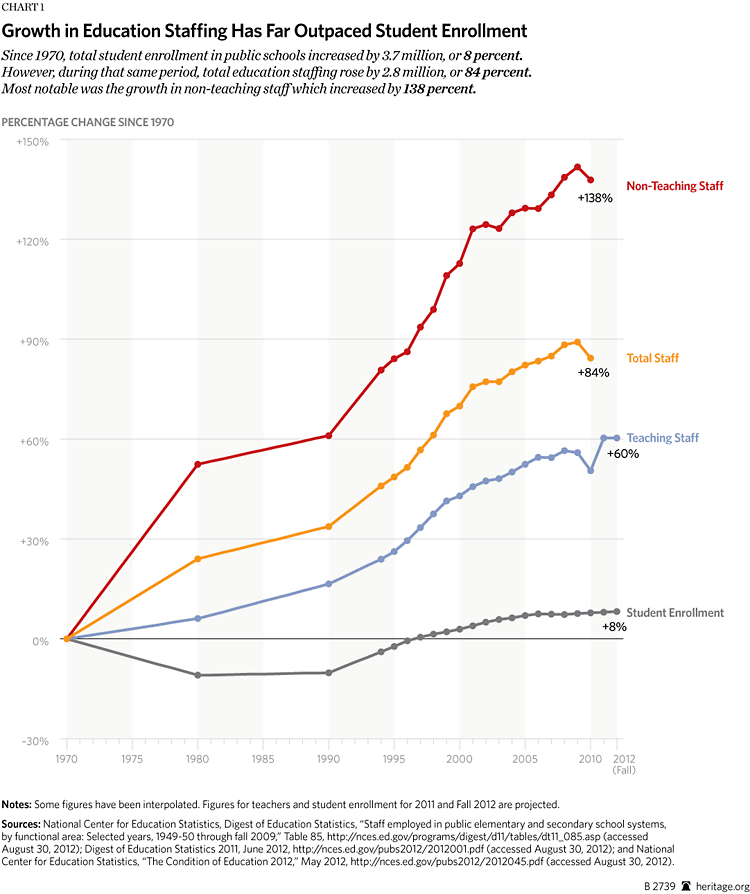
U.S.public spending on education is already the second-highest of any OECD country. The problem isn't funding. The problem is most of the increase in education funding over the last 50 years has gone to ballooning non-teaching administrative staff.
It's the administrators who control the school budget. Any time education funding is increased, they sop it up by raising their own pay and benefits and hiring more administrators, while passing a token amount down to teachers. Every time education funding is cut, they send it straight to the teachers, so they'll generate news stories about how they had to buy paper and pencils for their students out of their own wallet, to pressure legislators into increasing education funding even more. I even crunched some numbers from the Dept. of Education website a few years ago, and dividing the salary + benefits by the number of teachers yielded an overall average pay for teachers over $100,000/yr. There's no way that's possible. What probably happened is administrators shifted some of their pay and benefits into the teacher category, to try to hide how much of the school budget they were sopping up.
The problem isn't funding, it's how the funds are spent. -
Statistics from Bloomberg and the OECD
Most importantly, maybe this time "shills" aren't that wrong...
According to Bloomberg, Italians are the world's healthiest people: https://www.weforum.org/agenda...
And according to the OECD, Italians are the slimmest people in west, and the third-slimmest among the developed countries: https://www.oecd.org/els/healt...
And I sincerely doubt that either of the two is on Barilla's payroll.
-
Statistics from Bloomberg and the OECD
According to Bloomberg, Italians are the world's healthiest people: https://www.weforum.org/agenda...
And according to the OECD, Italians are the slimmest people in west, and the third-slimmest among the developed countries: https://www.oecd.org/els/healt...
And I sincerely doubt that either of the two is on Barilla's payroll.
-
Not sure if it is for Pasta, but...
According to Bloomberg, Italians are the world's healthiest people: https://www.weforum.org/agenda...
And according to the OECD, Italians are the slimmest people in west, and the third-slimmest among the developed countries: https://www.oecd.org/els/healt...
And I sincerely doubt that either of the two is on Barilla's payroll.
-
Not really that much
Latest estimate is that 54% of the world's population lives in cities. That's over 4 billion people. So $3 billion spent on surveillance works out to less than 75 cents per person.
Of course most of that spending is skewed towards developed countries. But even there, the OECD accounts for about 18% of the world's population, or 1.37 billion. 68% of them live in cities, or 930 million. So $3 billion represents about $3.20 per OECD citizen, or 0.017% of the average OECD government spending of $18,496 per citizen. -
Re:Most of my friends work Seattle Hundreds...
Are you being sarcastic or joking?
The average work year is 1783 hours.
https://stats.oecd.org/Index.a...
The average travel time to work in the United States is 25.4 minutes, according to the U.S. Census Bureau. Let's make that 30 minutes to include time to walk from the parking lot.
Some fields work over time often. Some fields work overtime occasionally. But most jobs are 45 hours or less.
Increasingly people work from home 1-2 days a week so you can drop the travel time for them.
-
Re:Or
The more likely explanation is that people just don't have the disposable income they used to, in fact, it has been declining for years.
With the exception of Russia and Greece, the inverse of your claim seems to be what economists hold to be true.
https://data.oecd.org/hha/hous... -
Re:Socialist Utopia
Should we mind that entirely made up tax rate?
The Danish income tax is just around the EU average. E.g. in 2013, the average single Dane paid an effective income tax of 38%, compared to 31% in the US, 49% in Germany or 56% in Belgium. (Source: OECD)
(Many people in the above mentioned countries will react with disbelief when they see these numbers, but then, it really shouldn't surprise anyone that OECD understands the tax systems of the respective countries better than most citizens.)
Incidentally, that Belgian average tax rate of 56% is the same as the Danish marginal (and thus also maximum) rate.
Maybe you're thinking of the OECD "tax burden" (total tax revenue, including VAT and fees, as a percentage of GDP), which is sometimes brought up by politicians campaigning on tax cuts? But even that is only 46%, and while it is indeed (barely) the highest in OECD, it's also a largely meaningless number, as revenue-neutral changes to the tax system can have significant impact on it. (E.g. in Denmark, people pay taxes on welfare checks. If instead we did like most countries and just paid out equivalent tax-free – but smaller – checks, the OECD tax burden would drop an estimated 4% points, and six OECD countries would suddenly be ahead of us.)
-
Re:Wait, what?Schools are vastly over-funded. The U.S. spends more on education per student than any country except Switzerland. While a few states dip into the $7k/yr per student range you give, the national average is over $12k/yr per student.
Total expenditures for public elementary and secondary schools in the United States in 2013â"14 amounted to $634 billion, or $12,509 per public school student enrolled in the fall (in constant 2015â"16 dollars).
(Discrepancy with the OECD stats is due to being from different years, and the OECD stats including post-secondary non-tertiary education, while the NCES stats are for only K-12).
Spending per student has about doubled in inflation-adjusted dollars over the last 40 years. and tripled since the 1960s. It peaked around 2007, and the people trying to get even more money put into education have been abusing that by using 2007 as the start of their spending graphs.
Where is all the money going? I don't have time to find it again, but the Education Department's own stats are contradictory. If you take the amount of spending it lists in teacher non-salary benefits, and divide it by the number of teachers they give, it ends up something like $50k/yr per teacher. What's going on is the number of non-teaching administrators has exploded since 1970, far outpacing the growth in number of students. These administrators have been hiding it by shifting some of their salary expenses into those of teachers in the stats. Every time education receives a spending increase, the administrators sop up most of it and let only a trickle get through to teachers. Every time education receives a spending cut, these administrators pass it all on directly to the teachers and students, while protecting their own jobs and salaries. As a result, the teachers are constantly complaining of not having enough money despite the huge increases in education spending over the decades. -
Re: A good first step.
In high taxes places like the UK and Sweden everyone earning a decent hourly rate incorporates. Even though personal taxes are high the corporate ones are low.
http://stats.oecd.org/index.as...
The Trump tax cut cut the US corporate rate from 35% to 21%
https://en.wikipedia.org/wiki/...
That's competitive with the Swedish rate of 22% or the UK rate of 19%.
Also it could be argued that forcing people to leave money in a company encourages them to use it in ways that generate more money - it's sort of like an ISA in the UK which is exempt from income tax and capital gains tax. At least until you draw the money out. ISAs are used for retirement savings - if you put shares in them you don't get hit for taxes until you cash out.
https://en.wikipedia.org/wiki/...
And of course if you let people use their money to generate more money by having low tax rates, they'll eventually end up paying more tax than if you took their money away and gave it to the government which will spends all the money it gets and more.
The government needs to pass the Marshmallow Test!
-
Re: Don't kill the goose laying the golden eggs?
US taxes overall are way below average http://www.oecd.org/tax/revenu...
Even just looking at corporate taxes they are the same as the OECD average, but the social security and payroll taxes are less. -
Re:right
US taxes overall are way below average http://www.oecd.org/tax/revenu...
-
Re:Yes. Yes it is.
So you mean to tell me that you didn't go so far as drilling down into the methodology section by country? If you had you would have found the (i) link to this document in Sweden's row noted as "New Income Definition Since 2012":
TERMS OF REFERENCE OECD PROJECT ON THE DISTRIBUTION OF HOUSEHOLD INCOMES 2017/18 COLLECTION
TRR: current transfers received, including transfers from social security (including accident and disability benefits, old-age cash benefits, unemployment benefits, maternity allowances, child and/or family allowances, all income-tested and means-tested benefits that are part of social assistance, including quasi-cash transfers given for a specific purpose such as food stamps); transfers from employment related social insurance; as well as cash transfers from both non-profit institutions and other households.
TRP: current transfers paid, including direct taxes on income and wealth, social security contributions paid by households, contributions to employment-related social insurance, current transfers paid to both other households and non-profit institutions. Taxes on realised capital gains should be excluded from wealth taxes when possible. [Values for transfers paid should be reported in the OECD questionnaire with a negative sign].
And of course there are formula showing the addition of TRR components and subtraction of TRP components.
TD:DR?
-
Re:Yes. Yes it is.
Oh dear, irony levels have hit maximum. I suggest that you read a bit more carefully. Yes, the claim that you quote is made in the article that you link to. But is it true?
Well, in the article that you link to they provide a link to the underlying dataset from the OECD that they used. The link is actually the part that you bolded in your quote. Let's follow that link to http://stats.oecd.org/Index.as... and continue reading.
You need to click the sidebar pull out on the right-side to get the metadta description:
It contains a number of standardised indicators based on the central concept of “equivalised household disposable income”, i.e. the total income received by the households less the current taxes and transfers they pay, adjusted for household size with an equivalence scale.
So no, they explicitly do NOT take into account taxes and include social benefits. This is a flat-out lie in the article that you have linked to. Perhaps you should read a little deeper instead of TL;DR + TSOTWTSWS...
-
Re:Makes sense considering human nature
Actually it does, since loans to small business were a cornerstone of the 11th five year plan and it's continued until this day. Need capital to launch a small business that will employ a few dozen people? The Chinese Government will back it. Banks do hate it, because they have to offer the loans (because they are owned by the Government), but the loans are there. Two members of my family have used such small loans in the last 7-8 years to build successful small businesses, paid back the loans, and now employ just under 100 people between them.
-
Re:REAP YOUR TAX CUTS MY FELLOW AMERICANS!
If I do some googling with Duck Duck Go I find
https://duckduckgo.com/?q=corp...
Trump's Council of Economic Advisers say it will boost growth by 3-5%, which means Trump will go down in history as the Next Reagan. But then, as Mandy Rice-Davies put it "Well, they would say that wouldn't they?"
http://uk.businessinsider.com/...
Then there's this, another right wing think tank
https://www.americanactionforu...
The U.S. is mired in a slow economic recovery, and is projected to continue growing at about a 2 percent annual rate for the next 10 years.
The U.S. corporate tax is grossly out of step with the rates of its developed country competitors, and is the only nation to have increased its rate on net since 1988.
A large body of economic research has documented the anti-growth effects of the U.S. corporate tax, with the Organization for Economic Cooperation and Development (OECD) concluding that it is the most harmful form of tax on per capita Gross Domestic Product (GDP).
Reducing the corporate tax rate would lead to higher investment, faster productivity growth, faster economic growth and higher wages, which would offer a higher standard of living for U.S. workers.Here's the OECD paper.
https://www.oecd.org/officiald...
This paper examines the relationship between tax structures and economic growth by entering indicators of the tax structure into a set of panel growth regressions for 21 OECD countries, in which both the accumulation of physical and human capital are accounted for. The results of the analysis suggest that income taxes are generally associated with lower economic growth than taxes on consumption and property. More precisely, the findings allow the establishment of a ranking of tax instruments with respect to their relationship to economic growth. Property taxes, and particularly recurrent taxes on immovable property, seem to be the most growth-friendly, followed by consumption taxes and then by personal income taxes. Corporate income taxes appear to have the most negative effect on GDP per capita. These findings suggest that a revenue-neutral growth-oriented tax reform would be to shift part of the revenue base towards recurrent property and consumption taxes and away from income taxes, especially corporate taxes. There is also evidence of a negative relationship between the progressivity of personal income taxes and growth. All of the results are robust to a number of different specifications, including controlling for other determinants of economic growth and instrumenting tax indicators.
Now the OECD report is credible.
And it doesn't really seem all that unreasonable for the US to cut corporation tax rates given it has the highest tax rate in the OECD.
E.g.
http://stats.oecd.org/index.as...
In fact in best Laffer curve fashion you can make an argument that high tax rates encourage US corporations to have complex tax structures like Double Irish with a Dutch Sandwich. Reducing the corporate tax rate from 35% to 22% makes it somewhat more competitive. A bit of Trumpian bullying of the likes of Apple and Google combined with a tax cut might cause them to start paying US taxes instead of paying Dutch, Irish or UK ones.
I can see you don't like Trump of the GOP and to be honest I've got mixed feelings about them myself. Still you c
-
Re:REAP YOUR TAX CUTS MY FELLOW AMERICANS!
If I do some googling with Duck Duck Go I find
https://duckduckgo.com/?q=corp...
Trump's Council of Economic Advisers say it will boost growth by 3-5%, which means Trump will go down in history as the Next Reagan. But then, as Mandy Rice-Davies put it "Well, they would say that wouldn't they?"
http://uk.businessinsider.com/...
Then there's this, another right wing think tank
https://www.americanactionforu...
The U.S. is mired in a slow economic recovery, and is projected to continue growing at about a 2 percent annual rate for the next 10 years.
The U.S. corporate tax is grossly out of step with the rates of its developed country competitors, and is the only nation to have increased its rate on net since 1988.
A large body of economic research has documented the anti-growth effects of the U.S. corporate tax, with the Organization for Economic Cooperation and Development (OECD) concluding that it is the most harmful form of tax on per capita Gross Domestic Product (GDP).
Reducing the corporate tax rate would lead to higher investment, faster productivity growth, faster economic growth and higher wages, which would offer a higher standard of living for U.S. workers.Here's the OECD paper.
https://www.oecd.org/officiald...
This paper examines the relationship between tax structures and economic growth by entering indicators of the tax structure into a set of panel growth regressions for 21 OECD countries, in which both the accumulation of physical and human capital are accounted for. The results of the analysis suggest that income taxes are generally associated with lower economic growth than taxes on consumption and property. More precisely, the findings allow the establishment of a ranking of tax instruments with respect to their relationship to economic growth. Property taxes, and particularly recurrent taxes on immovable property, seem to be the most growth-friendly, followed by consumption taxes and then by personal income taxes. Corporate income taxes appear to have the most negative effect on GDP per capita. These findings suggest that a revenue-neutral growth-oriented tax reform would be to shift part of the revenue base towards recurrent property and consumption taxes and away from income taxes, especially corporate taxes. There is also evidence of a negative relationship between the progressivity of personal income taxes and growth. All of the results are robust to a number of different specifications, including controlling for other determinants of economic growth and instrumenting tax indicators.
Now the OECD report is credible.
And it doesn't really seem all that unreasonable for the US to cut corporation tax rates given it has the highest tax rate in the OECD.
E.g.
http://stats.oecd.org/index.as...
In fact in best Laffer curve fashion you can make an argument that high tax rates encourage US corporations to have complex tax structures like Double Irish with a Dutch Sandwich. Reducing the corporate tax rate from 35% to 22% makes it somewhat more competitive. A bit of Trumpian bullying of the likes of Apple and Google combined with a tax cut might cause them to start paying US taxes instead of paying Dutch, Irish or UK ones.
I can see you don't like Trump of the GOP and to be honest I've got mixed feelings about them myself. Still you c
-
US excels at being generous. Russia, deadly.
The US is both the most generous country in the world in terms of official foreign aid giving, and it also has the most generous private NGO givings. What Russia does with all that money behind closed curtain is to breed tonnes and tonnes of Anthrax so that even they have trouble handling the Anthrax properly.
It helps to have the correct perspective so we don't ask stupid questions.
-
The U.S. is actually one of the best places to own
The U.S. has one of the lowest home price to income ratios in the developed world. If it's dumb to own a home in the U.S., it's super-dumb to own one elsewhere in the world.
It sounds more like you bought more home than you could afford. I spent almost a year shopping for a home, and the one I finally bought was in a nice area I liked, in decent shape, but the price was depressed because the owners had been trying to move for years so the house had been "on the market" for a really long time in MLS. After I bought it, even after mortgage and expenses, I was still able to sock away 20%-25% of my income in savings/investments. I like living here, there's no HOA, I pay someone half the HOA fees I normally saw when shopping to rake the leaves and maintain the lawn (though I'm considering doing it myself because I could use the exercise - why pay for a gym membership when there's work to do around the house), and I'm handy enough to do most of my own repairs. -
Re:Don't be mistaken
That's the misguided grade-school reasoning used to get support for the ACA. Yes the U.S. healthcare system is screwed up. But it wasn't the private insurance system which screwed it up. A salient point the media ignored in the buildup to the ACA was that (1) U.S. government spending on healthcare was almost as much as private spending, and (2) the government alone was already spending more per capita on health care than Canada. i.e. Government healthcare spending was just as much to blame for the high prices as the private healthcare system. If a single-payer system like Canada's was truly the answer, it could've been duplicated with the complete elimination of the private health insurance system and a slight reduction in taxes.
Middlemen can help or hurt a system. The value they add is in adding fluidity, reducing risk (they take on some of the risk themselves), and consolidating work (eliminating duplicated effort). The retail merchandise market is rife with middlemen. They're the ones doing the market analysis and guessing how much of a product needs to be shipped to each geographic area. They place the orders with the manufacturer, and arrange for transportation. They add value by doing their best to minimize the delta between supply and demand for each region. If you eliminated these middlemen, it would result in more undersupply (shortages for a product, resulting in buyers having to waste time and money going to other stores in search of the product) and more oversupply (excess inventory, resulting in having to hire more transportation to ship the products to areas with shortages, increasing overall costs), and increased costs due to the duplicated effort of every manufacturer selling competing products having to do these regional market analyses.
But a system only requires a certain number of middlemen layers to achieve maximum efficiency. Beyond that, middlemen needlessly increase prices (the value they add is less than the cost they charge). But for something as widescale and varied as healthcare, I'm extremely dubious of the contention that the optimal number of middlemen for that system is zero. I can see a social argument for single payer (I actually agree with the notion that basic healthcare should be a human right), but the economic arguments for it never made sense. -
Re:Don't be mistaken
Sure with death panels and less than stellar services.
Countries with single-payer health care have better medical outcomes and longer life expectancy.
-
Re: Inequality is meaningless
That America is continuing to prop up the rest of the socialist world by continuing to be the only country besides Japan which has people that actually do something?
Interesting claim, I'd love to see the stats that support it. Don't worry I have them here: https://data.oecd.org/lprdty/g... Spoiler: USA is near the bottom of the OECD in similar pattern to health, education, corruption, quality of life etc etc. Sorry to burst your bubble dude, the USA has money, but most of that is held by only handful of your citizens. For the rest, you are effectively a third world country on pretty much all metrics.
-
Re:Why is this necessary?
Calling it Virtue Signalling seems accurate though when taken with the 1st post. AC asked, "If solar and wind are as cheap without subsidies as recent stories claim, why do countries need to set targets like this?" Which would lead to the pointlessness of the law, so with the definition from Wikipedia "Virtue signalling is the conspicuous expression of moral values done primarily with the intent of enhancing standing within a social group." it start to sound like this is just political pandering, and with the last part of the definition from Wikipedia "the term has become more commonly used as a pejorative characterization by commentators to criticize what they regard as empty, or superficial support of certain political views, and also used within groups to criticize their own members for valuing outward appearance over substantive action." then we can easily see that if the question by AC is grounded in fact than it is Virtue Signalling. If on the other hand we can say that none of this is cheaper, and the laws are necessary to improve the environment, but even this simple site https://www.skepticalscience.c... says that CO2 turnover is at least 500 years if we stopped 100% now. More likely 1000 years, so it seems more like it is Virtue Signalling since it would be pointless. Now, if the goal was to improve air quality for people and animals in/near cities and power plants I could easily get behind this. http://www.oecd.org/env/the-co...
-
Re:Oh boy, where to start
Er, the GBU-43 MOAB costs less than $200,000. You were only off by a few orders of magnitude. But don't feel bad, it's still more accurate that the rest of your post.
For comparison, the US government alone gives more than $10,000,000,000 - $10 billion - in food, shelter, job training programs, etc, mostly through US AID. This does NOT include military aid (the other $10-$15 billion).
Private organizations give another $70,000,000,000 - yes, $70 BILLION - in aid, mostly food, clothing, and medicine.
Source: OECD US dataIf the US were imperialist, why doesn't it control any of the foreign nations? Why don't US companies get all the profitable contracts in places like Iraq or Afghanistan? Are you claiming the US is imperialist, but so bad at it that after it conquers a country, it lets the French, Germans, and Chinese get all the benefits and doesn't know how to stop that?
-
Re:100+ year olds in Japan?
It's not only rice, and not only fish. It's pasta too, for example. The Italians have just been named the healthiest people in the world by Bloomberg ( https://www.weforum.org/agenda... ) and the slimmest among western countries by the OECD ( https://www.oecd.org/health/ob... ), besides notoriously having an extremely high life expectancy.
Carbs-eaters seem to have health statistics on their side. Probably the research paper should have specified which kind of carbs are supposedly bad (sugar?), instead of being so generic.
-
No, it doesn't make sense at all
"Carbohydrates" is too generic, they need to specify which ones.
Italians, who eat massive amounts of pasta (hence carbs), have just been named the healthiest people in the world by Bloomberg's Global Health Index: https://www.weforum.org/agenda...
That's not enough. The Japanese, who eat massive amount of rice (carbs again), have the highest life expectancy on the planet: https://en.wikipedia.org/wiki/...
So I'm highly skeptical of this new "research", unless they meant "sugar", and not carbs in general. I'm also curious to know who might have financed it. And I'm surely not going back to mcdonald's anyways.
-
Re: Mo ...
Looks like the pacific islanders and middle east comprise the top 20. http://www.telegraph.co.uk/tra... and as far as measured data it's Mexico http://www.oecd.org/els/health... and according to this list http://gazettereview.com/2016/...
-
Re:You got fired...
So, when there is no strong economic incentive and no social norms to push women away from CS (assuming there ever was), you can expect around 15% of CS majors to be female. Unless you think the women are more free and equal in Iran and China of course.
How about we reverse it? Why is Sweden and the US considered to be countries with no societal pressure on women? The proportion of female engineers in Sweden even 30 years was much lower than now ( https://www.oecd.org/edu/ceri/... ). So you've basically proven my point that women have no problems at all with technical aptitude, it's the society that forces them away.
-
Re:Lets assume TFA is correct
which country contributes most to aid?
That's what I thought bitch. http://www.oecd.org/dac/stats/...
-
Re:And that's a good thing?
But in the USA, we all aspire to move to the big end of town.
Everyone aspires to moving up, it's just whether you allow others an equal opportunity to also move up too. America out of all western nations seems to be one of the worst at this https://www.oecd.org/eco/growt...
-
Re: I wonder if...
RTFS:
Norwegians pay high levels of income tax -- an average of 40.2 percent
Sure, they pay a lot - but nearly HALF of that goes back to the Government in income tax alone. Yes, you earn more - and you get to give that right back.
Plus you have the third most expensive beer in Europe, trailing two Swiss cities. In general, Norway is incredibly expensive to live in, nearly 50% more expensive than the EC/EU28 average. You have to earn more, because you pay more across the board - taxes, food, and all other expenses.
Just like if you're an engineer in San Francisco, you tend to earn more than if you're an engineer in Detroit. Companies HAVE to pay you more because the cost of living is so much higher. They couldn't hire ANYONE if they paid Detroit-level salaries for San Francisco living.
-
Re: Not true (for the US)
similar to Japan, Ireland, and Italy
Actually, people in Italy and Japan work 60 to 70 hours less a year according to your own source. If you accept that as 'similar', then the US is also similar to:
- Lithuania and Estonia (these were Sovjet states less than 30 years ago)
- Turkey
- Hungary
All these places have a minimum wage of below 500 EUR/month.Furthermore:
- Italy isn't doing too well economically. Southern Italy in particular isn't really a shining example.
- Japan has a cultural problem of overworking: https://en.wikipedia.org/wiki/...
Ireland is probably the only real odd one out here.I'm pretty sure there is a lot more nuance to this than just the simple aggregate numbers. I'm going to go ahead and guess that there is also a huge difference in 'working hour inequality': In some countries working 2 or 3 jobs just to make ends meet is a fairly common thing ( https://toughnickel.com/findin... ). In Northwestern Europe that is a completely foreign and backwards concept.
Finally, your source explicitly states that comparisons such as yours and mine cannot be made reliably:
"The data are intended for comparisons of trends over time; they are unsuitable for comparisons of the level of average annual hours of work for a given year, because of differences in their sources and method of calculation." ( https://data.oecd.org/emp/hour... ) -
Re:women just aren't interested
Sorry for moving goalposts, but have you asked in scientific way. Just asking, because in my workplace men show very little interest in contributing to OSS, even though our shop is mostly OSS.
You're asking the wrong question. The primary reason women are underrepresented in OSS is that they are underrepresented in software development. And that's not a workplace issue because it starts long before women enter the workplace.
http://www.oecd.org/newsroom/e...
In that case, can I as you not to hinder those who do see this as a problem?
While I don't doubt your good intentions, you are causing harm. That's why you should be not just "hindered" but strongly opposed.
-
Re:Wrong Question!
People that currently work to afford drug and alcohol addictions would now have no need to work, so society as a whole gains a dependent class at the expense of those who want to produce.
The thing is, people whop work just to get money to fund an addiction are most likely working jobs that are going to be gone anyway in the next couople of decades. That is, someone working a warehousing or a fast food job just to be able to afford booze is not going to be able to find work in the future regardless because automation is already making such jobs obsolete and is only going to keep going.
Those that want to produce will simply stop producing when they can't receive the fruits of their labor because it's going to a massive welfare state.
Bullshit. The very poiint of this story for example is to point out that the people who can work will not work any less under UBI because you still get more money if you work rather than just being on the UBI. The incentive to work if you can and those raise your standard of living is still there,
If Socialist utopias worked, Venezuela would be a paradise right now instead of the hellhole it is. Massive amounts of people would be fighting to get into Cuba, China, Russia, the DPRK, and all of the other "Socialist (also known as communism without so many government guns)" countries.
Ah, this argument again. I live in Finland, you know, one of those 'socialist' that offers free healthcare and education with tax money. We have an extensive welfare system already and are also trialing UBI to replace/modernize the wellfare system to make it more flexible. Other countries that have similar systems include but are not limited to: sweden, norway, denmark, Germany, France, etc And last I checked, the US has a social security system also funded by taxes.
There's some sort of weird american myopia, in which the only alternatives seem to be an massive oligarchy á la Russia or modern day US where the top 0,1 % is doing insanely well, the next 9,9 % are doing alright and then the middle and low-income classes are going down, or a 3rd world hellhole. This is just one giant strawman and the age old 'no social policies can ever work because the soviet union' -argument which is utter BS. The advanced European economies have been working as de facto socialist states for the better part of half a century, yet somehow conveniently we are always ignored in these conversations even though we've been far more successful in the implementation of these policies than the 3rd world countries that you just listed. We outperform the US in basic education and health, people are happier, there's less violent crime, less corruption etc. Quoting the study on happiness:
The USA is a story of reduced happiness. In 2007 the USA ranked 3rd among the OECD countries; in 2016 it came 19th. The reasons are declining social support and increased corruption (chapter 7) and it is these same factors that explain why the Nordic countries do so much better.
But sure, keep looking at Venezuela if it makes you feel good.
They are not doing so, they are all trying to get to the most free countries in the world with Capitalist economies (closest representations at least) and representative democratic Governments.
We have both a capitalistic system (a capitalistic economy does not prevent strong social policies) and a multi-party representational democracy. And if I had to choose, I'd much rather stay here (on in any other
-
Re:Of Course
This doesn't make any sense - unless I'm completely missing your point. US government spending is lower than most countries with more 'socialist' labour laws. Including France, Germany, UK and most of Scandinavia. https://data.oecd.org/gga/gene...
The worldwide average salary is dragged way down by countries with much worse labour rights than the US (e.g. none), not by those with better labour rights.
-
Re:The Republicans will never....
It would be nice if the government would live on collected taxes alone. BUT, there's deficit spending and on top of that, occasional money printing by the central bank to buy government debt. The debt increases won't stop until the system breaks. And no one knows where that is, but spending money helps senators and representatives hold onto their jobs, so they won't stop until they find out. Admittedly, US government debt is slightly over 100% of GDP but Japan's is up around 240 percent. Their historical chart is interesting. I suppose they'll find the limit before we do.
After the US went off the gold standard in 1971, and went to pure paper (fiat), the sky became the limit.