Slashdot Mirror
Domain: pixar.com
Stories and comments across the archive that link to pixar.com.
Comments · 207
-
Re:Don't want you to read my personal stuff
"Mine!" --seagulls from Finding Nemo movie/film.
-
Re:Will this fill a gap in free software?
I wouldn't be surprised if Pixar created a Blender plugin for it themselves. They recently released the Renderman for Blender plugin, so it's not out of the realm of possibility.
-
Re:Will this fill a gap in free software?
Renderman is not open source. It would probably be released under a modified Apache license as per their first major piece of open source OpenSubDiv: http://graphics.pixar.com/open...
-
Re:Will this fill a gap in free software?
Will this fill a gap in free software?
It is just a format description for working on scenes in different DCC packages.
The announcement is their "intent" to release it as open source by summer 2016. Currently no code has been released and no licence can be read.
They said it will be "Open Source" which does not mean "Free Software". What it usually means is that the contribution is there to benefit Free Software, Proprietary Software and Open Source Software. If you want *just* to benefit "Free Software" then create a *better* implementation under a Free Software license rather than trying to subsume the work of Open Source contributors under the Free Software banner. This is about working together and collaborating, not about your '4 freedoms' ideology.
It will most likely be under an Open Source license like OpenSubdiv, again it is about Open Source not about Free Software.
-
Re:Pixar
See RenderMan
-
Re:Youtube?
Yes, they are so strict about commercial use they don't even allow non-profit orgs to make money off it.
According to the ncr faq:12. Can Non-Commercial RenderMan be used to create content by cultural, religious, or other 501c(3) non-profit organizations that generate revenue through entrance or member fees, service charges, subscriptions etc?
If a fee is charged to access content that is created by Non-Commercial RenderMan, then that usage falls into the category of commercial use. We appreciate there are borderline situations so please contact us at rendermansales@pixar.com if you require additional clarification. -
Re:25 Years of RenderMan
I don't think Pixar actually used the name "RenderMan" until the late '80's, but they do count their earlier work as part of it now (http://renderman.pixar.com/view/brief-introduction-to-renderman).
-
25 Years of RenderMan
It's just good talent retention. If your software is free to learn on... people will learn on it. Which increases your talent pool.
I don't see retention or recruitment as a problem for RenderMan, which has been around since "The Wrath of Khan." and "Young Sherlock Holmes."
-
Re:3-D
Did you see the Pixar short film Day & Night shown before Toy Story 3D? That's what I call advancing the storytelling process. The film explored the 3D technique in a way that was not possible with cinematographic idioms developed for 2D.
-
Re:This is microsoft trying to help kill open sour
where I worked on making movies they were compiled.
-
Any 5 year old will tell you...
... that a jackalope is easily recognizable from his debut in Pixar's Boundin' short.
-
Re:Shorts
It was "Cars".
And, in case you haven't seen: they're all here. -
Re:Stop motion moviesRay tracing is great for static scenes. But movement is the key to games that require this much detail, and so each frame should not be beautifully rendered framebuffers, but a mix of several framebuffers over the span of one frame. No, no, no! Mixing several framebuffers together gives you *lousy* motion blur. You'll get severe artifacts from each pixel using the same set of uniform samples in the time domain -- very fast moving objects can appear cloned in multiple places, for example.
Honestly, ray tracing has been getting motion blur right since 1984. Not to mention that it can even simulate the effect of camera shutters. -
primary expert?
Carmack is knowledgeable of 3D rendering in general, but that doesn't mean he's an expert on ray tracing specifically, and I found nothing in the article to indicate that he is. He appears to be unaware of a large body of research into the acceleration structures and optimization techniques commonly employed by modern ray tracers (Kd-trees, Bounding-interval heirarchies, MLRTA, packet tracing). He correctly claims that ray tracing is not used much by movie studios, but fails to identify one of the main reasons why this is so: ray tracing is not a memory parallel algorithm, and therefore does not perform well rendering scenes that can't fit in main memory on any one computer (citation). This isn't an issue at all for games. Carmack doesn't seem to be aware of the real drawbacks of ray-tracing either (other than a vague notion that it's "really slow", probably based on naive implementations of an algorithm that's been around for almost thirty years), such as the cost of re-building the acceleration structure when something in the scene moves. Can his sparse voxel octree data structure be updated or re-sorted quickly?
I think the parent poster was correct to call attention to the emperor's apparent lack of clothes. Just because Carmack has had a huge influence on interactive 3D gaming doesn't mean his statements should be accepted without scrutiny.
-
Re:What do the people that make the software say?
Take a look at http://graphics.pixar.com/, they sure are producing a lot of papers about ray tracing if that isn't a technique they are using.
Abstract from Ray Tracing for the Movie 'Cars' (pdf warning)
This paper describes how we extended Pixar's RenderMan renderer with ray tracing abilities. In order to ray trace highly complex scenes we use multiresolution geometry and texture caches, and use ray differentials to determine the appropriate resolution. With this method we are able to efficiently ray trace scenes with much more geometry and texture data than there is main memory. Moviequality rendering of scenes of such complexity had only previously been possible with pure scanline rendering algorithms. Adding ray tracing to the renderer enables many additional effects such as accurate reflections, detailed shadows, and ambient occlusion.
The ray tracing functionality has been used in many recent movies, including Pixar's latest movie 'Cars'. This paper also describes some of the practical ray tracing issues from the production of 'Cars'. -
Re:What do the people that make the software say?
Take a look at http://graphics.pixar.com/, they sure are producing a lot of papers about ray tracing if that isn't a technique they are using.
Abstract from Ray Tracing for the Movie 'Cars' (pdf warning)
This paper describes how we extended Pixar's RenderMan renderer with ray tracing abilities. In order to ray trace highly complex scenes we use multiresolution geometry and texture caches, and use ray differentials to determine the appropriate resolution. With this method we are able to efficiently ray trace scenes with much more geometry and texture data than there is main memory. Moviequality rendering of scenes of such complexity had only previously been possible with pure scanline rendering algorithms. Adding ray tracing to the renderer enables many additional effects such as accurate reflections, detailed shadows, and ambient occlusion.
The ray tracing functionality has been used in many recent movies, including Pixar's latest movie 'Cars'. This paper also describes some of the practical ray tracing issues from the production of 'Cars'. -
Re:graphics company?!Actually Pixar uses raytracing as well... Digital effects supervisors throughout the industry choose RenderMan because it delivers the most comprehensive set of rendering features available:
- Advanced ray tracing architecture
- Global illumination, and photon mapping
-
Re:Raytracing is not the holy grail of graphics
Actually Pixar has switched to Ray Tracing. Cars was ray traced [PDF]. Skimming through the whitepapers on the Pixar site, it's clear ray tracing was also used extensively in Ratatouille.
Even so, what Pixar is doing in feature films isn't particularly relevant to real-time ray tracing on mobile devices.
-
Re:Raytracing is not the holy grail of graphics
Actually Pixar has switched to Ray Tracing. Cars was ray traced [PDF]. Skimming through the whitepapers on the Pixar site, it's clear ray tracing was also used extensively in Ratatouille.
Even so, what Pixar is doing in feature films isn't particularly relevant to real-time ray tracing on mobile devices.
-
Re:Hawaiian ShirtsOn that note, the original article said: "Quick, name one executive's bio photo that shows him or her wearing a billowy floral shirt? Zzzt! "
Well, one of the well-known executives at my company has been known to do such: John Lasseter.
-
Re:Ray tracing is so wrong...Like?
(I'm genuinely interested. Got some links for further reading?) The algorithms currently used by all the graphic cards are perfectly fine, with the help of shadow mapping, ambient mapping, reflection mapping and all sort of tricks that let you generate a plausible image, even if it is not "physically accurate". All the auxilliary maps can be efficiently generated on the fly.
Even in non-realtime renderings (ie: pixar movies) ray tracing is used VERY sparingly in very special situations when it cannot be avoided. They use a completely different approach wich (again) is based mostly on maps. See the papers on http://graphics.pixar.com/ and especially http://graphics.pixar.com/Reyes/paper.pdf
BTW the software from pixar was used for most cg you ever saw in movies. See https://renderman.pixar.com/products/whatsrenderman/movies.html for a list.
I really think that most enthusiasm for ray tracing comes from people who saw some ray-traced animation on the amiga 15 years ago and have not bothered to find out if something better is available. -
Re:Ray tracing is so wrong...Like?
(I'm genuinely interested. Got some links for further reading?) The algorithms currently used by all the graphic cards are perfectly fine, with the help of shadow mapping, ambient mapping, reflection mapping and all sort of tricks that let you generate a plausible image, even if it is not "physically accurate". All the auxilliary maps can be efficiently generated on the fly.
Even in non-realtime renderings (ie: pixar movies) ray tracing is used VERY sparingly in very special situations when it cannot be avoided. They use a completely different approach wich (again) is based mostly on maps. See the papers on http://graphics.pixar.com/ and especially http://graphics.pixar.com/Reyes/paper.pdf
BTW the software from pixar was used for most cg you ever saw in movies. See https://renderman.pixar.com/products/whatsrenderman/movies.html for a list.
I really think that most enthusiasm for ray tracing comes from people who saw some ray-traced animation on the amiga 15 years ago and have not bothered to find out if something better is available. -
Re:Ray tracing is so wrong...Like?
(I'm genuinely interested. Got some links for further reading?) The algorithms currently used by all the graphic cards are perfectly fine, with the help of shadow mapping, ambient mapping, reflection mapping and all sort of tricks that let you generate a plausible image, even if it is not "physically accurate". All the auxilliary maps can be efficiently generated on the fly.
Even in non-realtime renderings (ie: pixar movies) ray tracing is used VERY sparingly in very special situations when it cannot be avoided. They use a completely different approach wich (again) is based mostly on maps. See the papers on http://graphics.pixar.com/ and especially http://graphics.pixar.com/Reyes/paper.pdf
BTW the software from pixar was used for most cg you ever saw in movies. See https://renderman.pixar.com/products/whatsrenderman/movies.html for a list.
I really think that most enthusiasm for ray tracing comes from people who saw some ray-traced animation on the amiga 15 years ago and have not bothered to find out if something better is available. -
Luxo, III ?Researchers at Cornell University have created a so-called Nano-Lamp...
-
Re:because
"what would squirrels walk on if there weren't above-ground power lines?"
And what the birds land on? -
Re:I don't understand?I find that for all the advances nVidia and ATI have made over the years, 3D gaming visual quality is still inferior to cinematic quality 3D rendering... I would prefer if nVidia and ATI actually focused on bringing cinematic quality 3D rendering to gaming, instead of just claiming they do
Clearly, you misunderstand how cinematic 3D is rendered
Desktop GPUs will always be inferior to cinematic 3D, simply because cinematic 3D is rendered at a rate of several frames per day by a multi-million dollar farm of computers, while desktop GPUs must deliver dozens of frames per second all by itself.
A peek at what it took to render The Incredibles:
- 1024 Intel Xeon processors
- 2TBs (two terabytes) of memory
- 60TBs (terabytes) of disk space
And again -- even this much hardware generated images measured in frames per day -- nowhere near the ~24 frames per second you'd want for real-time imaging. In fact, according to pixar.com it takes 6 - 90 hours to render one frame.
-
No, but...
Does this mean new donald duck episodes may include luxo?
No, but all future Luxo Jr. shorts will have subliminal messages in the background. -
You can't buy Pixar, period
Pixar is majority-owned by one particular black-turtleneck-wearing shareholder who happens to be CEO. So unless he's willing to sell, you can't buy Pixar.
Since this is a stock-for-stock deal, Steve would have to be reasonably sure that the Disney stock he'd be getting would appreciate faster than the Pixar stock he'd be giving up. So I'm sure he'd talk things over with Pixar's "talent" to make sure that they'd be willing to stay and work under Disney before selling. -
Re:Not surprising. That's what Jobs does.
Keep in mind that when Steve Jobs left Apple the first time, he went off and founded Next Computers, which came out with a remarkable Unix-based GUI. He captured the public's imagination with the Next cube but made a couple of strategic errors such as initially restricting the product to the educational market. A reporter asked him how an ordinary person could acquire a Next cube and Jobs famously replied, "Enroll."
Jobs also co-founded Pixar Animation Studios, the premier animation film company that has created such blockbusters as Toy Story and The Incredibles.
Then when Jobs returned to Apple, taking over from a string of lackluster bean counter executives, he inspired the company to produce some world class products such as the iPod and the iMac. The iPod is the must have product of 2005, and the Mac laptops are at the top of their class.
I'd say Steve Jobs is more than just a showman, though clearly he loves the limelight. Microsoft is the white bread, corporate standby that does the heavy lifting on corporate and consumer desktops but is otherwise an uninspired market follower, not a market leader. -
Re:My guess...
Well, let me turn the tables and ask you this...
If Cars was destined to be a winner at the box office, up there with Toy Story 2, Finding Nemo, and The Incredibles, then why is Jobs in negotiations with Disney right now?
If Jobs knew he had gold on his hands, why wouldn't he be waiting to talk to Disney?
It's interesting that the trailer for the film lists the original release date as "November 2005," but the film got pushed back to mid-2006. Films generally don't get pushed back because everything is going well.
And you're right, it's totally my opinion, and I could be flat-out wrong (there's a first-time for eveything!). I'm just trying to read between the lines. -
Re:My guess...
Well, let me turn the tables and ask you this...
If Cars was destined to be a winner at the box office, up there with Toy Story 2, Finding Nemo, and The Incredibles, then why is Jobs in negotiations with Disney right now?
If Jobs knew he had gold on his hands, why wouldn't he be waiting to talk to Disney?
It's interesting that the trailer for the film lists the original release date as "November 2005," but the film got pushed back to mid-2006. Films generally don't get pushed back because everything is going well.
And you're right, it's totally my opinion, and I could be flat-out wrong (there's a first-time for eveything!). I'm just trying to read between the lines. -
Steve owns 50% of Pixar
Last time I checked, Steve Jobs was not one of the bigger shareholders, so he would get little out of the deal, except to cede control of the one place which he can guarantee will allow Apple to sell movies via iTMS.
Steve Jobs personally owns more than 50% of Pixar (See the Annual Report) I'm not exactly sure why Jobs is not listed among Pixar's insider roster. I'm guessing it has something to do with the fact that Steve's shares have never actually been traded. Or maybe he's got a very good accountant and a healthy fear of the IRS. Who knows.
Anyway, as far as motivation goes, I'd wager "Billions and billions of dollars" would explain it. -
Re:silly rumors...You (and the NYT) are correct. My apologies. I read their statement, I just didn't believe it. And the first place I looked to verify their claim didn't show Jobs as a major stockholder any longer.
I had to look at the latest Pixar annual report to get it, but yes, Steve Jobs owns 51% of Pixar.
That'll teach me to rely on data from Yahoo! Finance.
Still, the question remains: Why would Steve want to cash out and remove his control over the one company that he can guarantee will allow Apple to sell movies over the web? Does he have a need for $4B in cash (assuming Pixar would sell for $8B, about a 30% premium to it's current valuation)? Pixar stands to have its stock increase rather strongly, depending on what the specifics of their next distribution arrangement are.
The only reason I can imagine for Steve to sell off his Pixar holdings is that he felt that the stock was overpriced, and unlikely to grow to those levels in the forseeable future. Unless he has a pressing need to raise billions in cash, that is. Or maybe some company is waving a ridiculously large price under his nose. Disney would be the first choice, but their finances don't appear to be able to support a really large price for Pixar (e.g., double their current price), and it's just silly to think that they would be thinking about abandoning their in-house studio until Chicken Little proves or disproves that they can still make animated movies.
Somehow I don't see either of those things as real possibilities. Steve would be giving up an awfully huge impact in the media content industry, which would cascade through Apple's iTunes businesses -- Steve Jobs comes to the table as a media mogul himself when he talks with other content producers about licensing issues. How much money would he have to get to make the loss of that clout palatable?
But I CAN see the NYT spinning speculative stories just to sell papers. Whenever you see a "news" organization trafficking in rumors instead of reporting the news, you ought to be a little suspicious of their motives, especially in these times when print media is finding it more and more difficult to sell their product (due to competition from TV and the internet, as well as a shrinking demographic of those who read instead of watching or listening to get their news, or who don't bother to get the news at all).
-
My guess...
Is that this is all about timing.
Based on the early reviews I'm reading, Chicken Little is not going to flop. It's not going to be the rousing success that Disney is hoping for, but it looks like it's going to be a base-hit for the company. And it's going to give Disney that much-needed leverage in their negotiations with Pixar. "Look, we can make passable 3D CG films without you!"
Pixar, OTOH, is set to release their first "flop" next year. Cars will probably make the same amount of money as Chicken Little, but because it won't be the box-office smash that previous Pixar films were, it's going to be trumpeted in the press as Pixar's first major misstep. Pixar has said that they are intentionally going after a younger audience with this film, and it shows; the promos look like they are straight out of Fischer-Price. As a parent, these are the kinds of kiddie film I fear most; a 90 minute root canal for the mind. Without catering to the adult audience, they are going to lose huge marketshare.
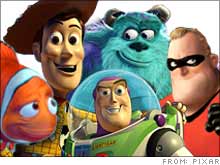
But Jobs already knows this. Look at the Pixar image in the CNN/Money photo. Notice any franchises missing?
A Bug's Life was also aimed at a younger audience. But it was Pixar's second feature film, and was a base-hit for them. It was before they really established their reputation as a blockbuster powerhouse, so it was forgivable. But whenever you see promotional material for Pixar nowadays, does it ever include Flick? Almost never.
Cars looks to be aimed at an even younger audience than ABL. The characters are less varied than any other movie Pixar has done (they're all, well... cars; how many variations of a car are there? Or should I say, How many interesting variations are there? Not many). And following up Finding Nemo and The Incredibles is no small feat; the movie definitely has its work cut out for it.
Back to my point... Steve Jobs knows that the next movie is going to be a sleeper. They are going to exit the Disney deal with a fizzle, not a bang. Not that it will be a terrible movie, but Cars is definitely going to deflate Pixar's reputation. Therefore, if Jobs is going to cut some kind of deal with Disney, he needs to do it now while Pixar is still coasting on the reputation of its previous movies, because it will probably be 2008 (or later) before Pixar can release a feature that will redeem them from the upcoming Cars debacle. -
Re:Proofs they rushed it
Probably through some Disney contract, huh?
no
Pixar's Office of the President consists of Steve Jobs, chairman and chief executive officer, Ed Catmull, president, Simon Bax, executive vice president and chief financial officer, John Lasseter, executive vice president of creative, Sarah McArthur, executive vice president, production, and Lois Scali, executive vice president and general counsel.
Furthermore, those Pixar Shorts have been free downloads for years. (Though they do seem to have been cut short along the way)
Steve Jobs probably have some contacts in Disney, that see things his way... -
Re:AutoCAD is too far up MSs back end...Maybe it's more accurate to say that most of the large scale Maya deployments are on Linux. You know, at real studios doing real work.
The proliferation of windows-first/only plugins is pretty obviously a sign of the small scale of studios using Maya on windows. If Autodesk were to drop the Linux version of Maya we'll probably be seeing a lot of the big studios, if not all of them, dropping Maya.
-
Re:Apps?Last I heard, Pixar at least uses Maya, which is proprietary but gives out some pretty good crippleware for free (the "learner's edition" has a full featureset but watermarks rendered output.
In fact, Pixar has released a couple of its own plugins
It, incidentally, runs on Windows, Mac, Red Hat and SUSE.
Of course, they don't use it exclusively. I was delighted to notice that one of the heros showed briefly in The Incredibles had a POV-Ray logo on his costume. POV-Ray is halfway open-source (not GPL, modification allowed only for the purpose of porting or adding to the feature set), but it's much better for still images than animation because it renders frame-by-frame (see povray.org for more and some very shiny examples)
-
Re:Apps?
Pixar makes Renderman, I would assume they use it too as it's been ported to Linux.
-
Re:Another notch...
If you're thinking about companies that'll buy up SGI rather than just kill them off, don't forget that other Jobs' company with a focus on software rendering products. They've been known to also be big consumers of SGI stuff when they're putting together a new demo reel every couple of years.
-
Re:Another notch...
If you're thinking about companies that'll buy up SGI rather than just kill them off, don't forget that other Jobs' company with a focus on software rendering products. They've been known to also be big consumers of SGI stuff when they're putting together a new demo reel every couple of years.
-
Re:Another notch...
If you're thinking about companies that'll buy up SGI rather than just kill them off, don't forget that other Jobs' company with a focus on software rendering products. They've been known to also be big consumers of SGI stuff when they're putting together a new demo reel every couple of years.
-
Boy, is Disney QUICK!
Considering the fact that the only decent returns they have had on animated movies recently have all come from Pixar, one would think that it would take less than 10 years for them to figure this one out!
-
Re:DLP!
Yep! Also, any movies that DLP showing is a must see like Pixar movies. Even movie trailers look awesome!
-
Re:How do they do this?
Often some combination of Maya on the front-end with lots of custom scripts is used to generate RIB data which is rendered by a RenderMan interface compliant renderer. You won't get PRMan (Pixar's implementation) very cheaply, but there some other good implentations. You may still be able to dig up a copy of the Blue Moon Rendering Tools (BMRT) somewhere. RenderDotC has a resolution limited evaluation version. There's also Aqsis and which is GPL, but I haven't used it so I can't really speak on its quality or how complete it is. Pixie is another GPL renderer which seems pretty cool. All of them can run on Linux.
Part of the reason that RenderMan renderers are so popular is that they let you write custom shader scripts which they interpret to shade and deform the geometry. It's kind of the equivalent of GPU pixel and vertex shaders (which are partly inspired by RenderMan, by the way.)
If you want books, Advanced RenderMan is excellent. (My copy is well worn.) The RenderMan Repository has some examples and some good basic information on RenderMan. They also have a nice collection of PDF's of the course notes from the RenderMan SIGGRAPH courses over the years. Those typically have chapters by folks from the studios describing how they accomplished certain effects. I highly recommend it for getting the flavor of the the thing. Lastly, there's the RenderMan spec itself from Pixar, though I certainly wouldn't recommend it as an introduction to all this.
My suggestion to start trying this stuff out would be too Google for RIB export scripts/plugins for Blender (I know they exists, but I don't use Blender), grab one of the GPL renderers out there and pick up a copy of Advanced RenderMan to start learning the shading language. Good luck! -
Re:Too Fast?
...incidentally, what happened to the Emotion Engine?
It was just a MIPS processor, a faster version of what the N64 had.
By the way, Sony said the movie that the PS2 could render games in realtime like was Toy Story. I imagine they will say the PS3 can render.... The Incredibles, maybe? (Although we already know how "good" the PS2 can render The Incredibles already)
(On a side note, Nintendo is boasting their system will render games something like Cars...) -
Re:They've come a LONG way
You can find his bio here.
Always remember, google is your friend.
SiO2 -
Re:Piracy boom?-Sound quality is WAY better (8.1 digital)
That is not specific to digital cinema, and there is no reason why 35mm cannot meet or beat anything any other system comes up with. DTS has succcessfully separated the sound and picture in 35mm (as well as 16mm and 70mm) presentations. Their latest processor, the XD10, has support for 10 channels.
-No Flickering (the shutter runs at 24fps which is low enough to notice)
There aren't many, if any, theaters running single bladed shutters. A double-bladed shutter giving a refresh rate 48Hz is the norm. And, depending on what kind of shutter you have, the shutter is usually open a larger percentage of the time than it is closed, reducing flicker. If you really want, you can always get a triple-bladed shutter for a nice 72Hz refresh rate, but then you have to watch your light output.
if you look real hard at some text on screen you can actually see pixels.. but considering how much sharper the image is, who cares
I do. I don't go to the theater to look at visible pixels. I can get that at home. Fortunately, 4K resolution (which is enough to make the pixels invisbly small at normal viewing distance) seems to be the direction things are headed these days. Sony was demoing 4K equipment at ShoWest this year. And with digital intermediates starting to be done at 4K the source material is there.
The biggest area where video projection still falls behind film is dynamic range. Side-by-side comparsions make this abundantly clear. While projector manufacturers are sturggling to eek out a little bit more on their contrast ratios, print stocks like Kodak's 2393 (aka "Vision Premiere", used most recently for prints of "The Incredibles") can deliver 10,000:1 contrast. Yes, really. The max density is so high it's not just dark grey, it's really, truly, black. Video systems have a lot of work cut out to catch up to that.
-
Re:high quality animation
Renderman for OS X.
-
Re:Real world stories
Well, theres Apple, of course. And Pixar. And the Virginia Tech supercluster, and the majority of genetic research/biotech labs, like the Whitehead Institute, BioGen and Genentech. Then there's Staples corporate headquarters. Those are the ones I know of off the top of my head.
-
Re:Right tool for the right job
I make no claims about having more or less knowledge than you - but if you have some deep seated complexes - that is your problem.
"What do you think that the whole world is stupid and is going to ignore software that's better than Photoshop just out of spite?"
I am finding it hard to break the logic of your sentence. What are you trying to say?
If you are saying I am condemning the use of Photoshop over Gimp then I guess you don't read my posts.
I wrote:
I don't deny however that Photoshop itself is an extremely professional state-of-the-art software and that in many fronts it still beats Gimp (as I keep hearing: CMYK / Pantone profiles).
But there is much more to Gimp than people are vaguely aware.
Now you stating Linux is useless for running office software AND
Saying Gimp is a poor replacement for also
Also, I do not believe Gimp on Windows is a valid test either. Cygwin ports are horrible. It's like me trying to judge Macromedia Dreamweaver from its Linux port on Wine.
Conclusion, your experience and knowledge (or lack of thereof) is only evident by the lameness of your statements. Give it up Bozo, dont get all wound up pressing the submit twice. Next thing you will be having palpitations.