Slashdot Mirror
Domain: psu.edu
Stories and comments across the archive that link to psu.edu.
Comments · 1,138
-
Re: Will it be enough to help the Native American
Solar panels are incredibly toxic to make
Bullshit.
and have horrible efficiency
They have the HIGHEST efficiency in converting sunlight - the primary source of energy for all electricity generation that isn't nuclear, tidal or geothermal (with the latter two being negligible contributors to anything on Earth at the moment) - compared to any other pathway through which sunlight ever became electricity, be it wind, oil, gas or coal.
They never pay off the emissions
They do, in a year or so.
a d toxic chemicals required to make them
That's not even a thing for them.
let alone anything beyond that, before needing to be replaced
-
Re:Why not turn plastic into ... plastic
isoenergetic conversion has to be better.
Unless you buy into the idea that we're going to run out of oil sometime soon, which seems to come up quite often.
-
Re:I never thought of that!
You don't know what you're talking about.
Well, I beg to differ.
Concentrators work.
In a limited set of geographic locations with mostly direct insolation. For most of the world, they're completely useless.
That crippled their adoption because everyone wanted the cheapest panel solution possible, not the most efficient possible, for their rollouts.
Efficiency can be measured in various ways (thermodynamic? economic? raw material utilization?), and economy of operation is of paramount importance. Whatever different pet peeve you have with current installations is probably because you're not the one who has to pay for it.
If you're not factoring in the cost of replacing cheap panels in 15-20 years
Make that 25-30 years at least.
and are agog at the 2x~ price of such efficient collector panels
Make that more like half the price of what you're paying today. (Not sure what's an agog, though.)
Also, you don't seem to understand how far Mars is away from Earth, relative to Melbourne Australia.
Wut?
-
Re:Honest question...
The real problem is storage. Conversion is satisfactorily solved by using just a single crystalline silicon junction - it's the *economically* optimal solution for now (and economics is the #1 factor here). Some people hope that in the future, some kind of nantennas could improve over them. It seems unlikely today that other types of semiconductor junctions will beat crystalline silicon on price (amortized over its lifetime - the lifetime of c-Si is crazy good, and that's *old* equipment).
-
Re:Clouds
-
Re:Daily Bullshit
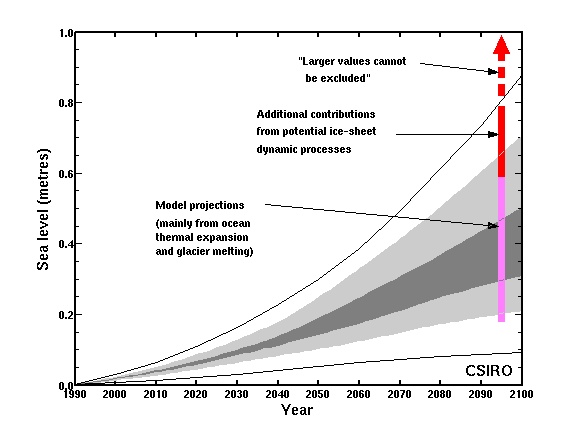
BOO WE'RE ALL GOING TO DIE MOTHERFUCKER THE OCEAN LEVEL IS GOING TO RISE A WHOLE 5 INCHES IN THE NEXT 500 YEARS!
I feel like you have severely underestimated the sea level rise. However, the more important thing is that areas of arable land will begin shifting locations or disappearing from parts of the planet. This will inevitably result in hunger, famine, death, conflict and mass migration. If you don't like the balance of immigration in your country now then how will you feel after a hundred million people start migrating because their country became a total wasteland because you didn't give a shit?
We're not all going to die but a lot of people and ecosystems will die. The global ecosystem will be ruined and you, one of the people responsible, refuses to take any responsibility for your part in it.
-
Re:Post is very misleading about actual article
Re: "Higher-level reasoning simply looks like confusion from the outside
There is no "agenda" at play other than to understand the landscape of the debate. In the world of tracking scientific controversies, identifying the arguments and claims is the mundane precursor to actual independent thought.
Re: "There is *no* known mechanism that allows the rest mass of an electron to change. If there were, we would have found it. It has been shown to remain constant with over 8 decimal digits."
This argument is not well thought out. The physics of quasars is not understood, and you do no service to anybody pretending as though you can tell us what it cannot be. The mainstream is constantly reminding us of how luminous and energetic these objects are, based upon their inferred redshift, so whatever point you are trying to make, you should think more deeply about it.
Re: "If quasars were ejected as electron severely deficient then they would be very much attracted to whatever ejected them, because electrostatic attraction is over 20 orders of magnitude stronger than gravity."
There is a long history of speculators who have formerly claimed that they can reason with electrostatics principles at astrophysical scales. This is one of the anti-patterns which I document online (so you will now be documented with the others).
Astrophysical plasmas are not at all like electrostatics. Electrostatics is the science of charge distribution between solids such that electrons are confined to isolated conductive mediums, but are both immersed within a larger non-conductive medium. In a plasma, the charged particles are free to move throughout the medium. The solid state - e.g., little tiny pebbles like our Earth - is exceptionally rare in space, so the situation plays out very differently. It turns out that there actually are regions of space which are notably more conductive than the broader interstellar medium. We call them Birkeland currents, and they can even act as ion sumps, pulling upon the ambient charged particles surrounding them. We could even use the term "accretion". Laboratory plasma physicists might use any of a variety of terms to describe these processes (Marklund convection or the Lorentz force or the Biot-Savart Law, etc). But, you will absolutely fail if you try to use electrostatics to reason your way to these behaviors. If you need to see more discussion of this, then read this.
Part of the problem here is what happens to an electrostatic discharge when it encounters a plasma double layer. The double layers are the real difficulty which you face when you try to mix these toolsets. In nature, plasmas form into complex structures: sheets, cells, filaments, and even hub-and-spoke connectors which can link the filaments into networks. An electrostatic discharge will rarely penetrate a plasma double layer. If you need something to look at to understand this, then consider the case of a sprite encountering the ionosphere: The ionosphere is the plasma double layer, and the sprite cannot penetrate this structure. In fact, you could make the case that the sprite is a discharge from the top of the storm to the ionospheric double layers. Since these layers basically separate Earth from space, you could fairly state that the sprites are sort of like "lightning to space." But, planetary scientists so disliked that phrase that they invented the term "sprite" (which in folklore is known as a devilish fairy that misleads people).
So, notice that the very first structure we encounter when we go into space is a plasma double layer.
-
So how is this different from wax applied to fruit
Does this work better than wax applied to apples and other fruit? There is a paper on wax coating avocado's from 1997
http://citeseerx.ist.psu.edu/v...
So I'm not clear what this new company is bringing to the table - does wax (lipids) extracted from peels contain other beneficial compounds.
-
Genetic extinction
Species die when they lose habitat and their numbers fall below a certain threshold. At that point, they become inbred and lose vitality, then perish. This is happening to the Tasmanian Devil:
Once abundant throughout Australia, Tasmanian devils are now indigenous only to the island state of Tasmania.
and
Approximately 600 years ago, the devil went extinct on Australia’s mainland, which is thought to be due to its predation by dingoes and indigenous Australians.
-
Re:Completely unsubstantiated headline.
From the article, paragraph 3:
However nothing that exists or is in development can store energy as well, and as cheaply, as compressed air.
Pretty straightforward comparison to everything else, which includes batteries and pumped hydro.
The scholarly article that is the primary reference does not directly compare Wind/CAES to Wind/Battery, but the long-term costs per GW for a CAES plant vs a battery farm are very likely in favor of CAES due to the extremely low cost of storage. The GW storage of a large salt mine are tremendous, and don't cost more if you add more storage (because almost all the costs are in the pumps/generators outside).
-
Re: Sounds like a good idea
That's probably because you bought a toy solar panel to match it. But even back then, you could have bought a non-toy one.
-
Re:Lab demonstrations leave a lot to be desired
Typical good quality crystalline silicon solar cells lose as much as 1% per year in efficiency, and lose as much as 15% efficiency in the first few months of deployment.
Not necessarily, really. One might argue that making them look "good as new" even after two decades really should be the next goal for the PV industry.
-
Re:Variable fonts?
Haven't browsers had variable fonts since the introduction of CSS?
No, and they still haven't. What they call variable fonts is just a packaging hack -- more than one typeface in the same file.
What I expected was the implementation of an algorithm that will stretch the letters instead of "justifying" (filling up with spaces). That was done in western typography since Gutenberg.
Something like kashida in Arabic, but less dramatic. I know that this kind of microtypography was supported in LaTeX since at least a decade. Is stuff like this supported in CSS? Will it ever be?
-
Re:Cause or effect?
Nobody blocks multicast.
To be clear, every ISP blocks multicast transport between Internet AS's except in a very few special circumstances, and typically it is not routed within networks as well. It isn't that you can't bill for it, it is the inherent danger of multicast, and also multicast routing doesn't scale well.
Some end-user ISPs are considering using highly controlled multicast ABR to efficiently deliver live content to their own subscribers, but it is unlikely that multicast will ever be distributed across the Internet.
Multicast can be used to efficiently deliver popular non-live content as well (for example, see this paper).
[FWIW I was involved in a multicast ABR trial]
-
Re:Not a fix for diveristy
Besides which, all the "skills" and "requirements" HR has are bullshit. There's a century of research on it, thousands of studies. The only things that matter in predicting job performance are:
1. IQ
2. integrity (adds about 25% to IQ predictive validity)-both easily, quickly and cheaply testable. Adding other requirements adds very little, and then only for work sample and "structured interviews" (which are nothing like regular interviews, it amounts to administering certain IQ tests in person) and these cost much more than simple tests.
Resume, education, references, job knowledge tests, peer ratings, even job tryouts combined all are less predictive of performance than IQ alone.
In particular: experience, education and interviews add practically nothing to IQ score alone in predicting job performance. Age adds slightly less than nothing.
Everything about how hiring is done now is totally wrong, and it costs literally tens of trillions in lost wealth - worse, it costs several percent a year in GDP growth rate. Most of the people with high-paid, powerful or creative jobs today need to be replaced, and most of the smart people today are in jobs far below what they should have.
-
Re:Heh
You could learn COBOL, and be employed forever.
-
Re: vancomycin-resistant enterococci
I'll take "things that never happened" for $590, Alex.
Detection of Vancomycin-Resistant Enterococcus Spp. (VRE) from Poultry
BENEFITS OF DIETARY ANTIBIOTIC AND MANNANOLIGOSACCHARIDE SUPPLEMENTATION FOR POULTRY which says: The specific vanA gene cluster that encodes for vancomycin resistance has been isolated from Enterococcus faecium in farm animals destined for human consumption (Bates et al., 1994; Klare et al., 1995).
-
Re:huh
I would say the difference is that these Nordic countries have decided as a society that they want to support people like themselves and their families.
It could be that the populations of those countries are largely homogeneous. There was a study that found that trust in government was much lower in racially heterogeneous areas (PDF warning) when examining communities in the U.S.
Even if a population is racially and culturally heterogeneous, I suspect that if there's a strong external enemy that it would override infighting among the subgroups. I don't know how well that applies in the case of Cuba, etc. though as there were a lot of people that tried to flee Cuba for the U.S. and Venezuela has seen a large outflux of people in the last year. However, I think the U.S. is too diverse for a common enemy like that to exist.
Another explanation is that the U.S. might just be too damned big. The Scandinavian countries are quite a bit smaller. About 40% of U.S. states have more people than Denmark, Norway, or Finland and about 20% of states are bigger than Sweden. I suspect that even if you did have a racially homogenous population, that it would start to drift culturally once you reach that size, especially given the wide variety in geography. -
Re:Subsidies are the solution...
-
Re:Yep, problems all around
NAFTA doesn't allow you to use food regulations to ban or add tariffs to products. If they meet the agreed-to standards per NAFTA guidelines (and rBST was not considered) then you cannot place a tariff on the product. Canada may have higher milk standards, but per the NAFTA treaty they cannot add tariffs on milk. Canada is actually violating NAFTA.
-
New Horizons Data Rates
One of the system requirements of the New Horizons telecommunication system is a minimum post-encounter end-of-playback data rate of 600 bps. From "The RF Telecommunications System for the New Horizons Mission to Pluto":
A 16 bit control register is used to provide 65532 possible downlink data rates, from a minimum of 6.3578 bps to a maximum of 104.167 kbps. The relation between control word setting n and the data rate is BitRate = (5 MHz) / (12 * (n + 1)) where n is between 3 and 65536, inclusive. The fine spacing of data rates about the expected post-encounter playback rate of 1 kbps gives the mission operations team a great deal of flexibility to take advantage of late improvements in the space segment and ground segment system performance.
The "improvements" to which they refer would likely be in coding techniques developed after the New Horizons design was frozen (or after its last software update) or, less likely, improvements in the noise temperature or antenna gain of NASA's Deep Space Network receiving system.
So they expect to have a data rate of approximately 1 kbps, want at least 600 bps, and can use down to 6.3578 bps if absolutely necessary.
-
Re:Great experiment!
An "experiment" that's been tried a thousand times over. Cap prices below market prices and you get a shortage. Cap prices above market prices and you get a surplus. Supply & demand 101, econ 101, common sense 101, operating a lemonade stand 101.
https://en.wikipedia.org/wiki/...
https://www.e-education.psu.ed... -
Re:Not clean
Chemicals used in production are certainly dangerous and quite nasty.
They always are. You can go back into the jungle if you don't like our civilization.
Panels have limited life
-
Look at the effort involved in making Nickel 63
http://citeseerx.ist.psu.edu/v...
These look like good things for deep space missions, but where else would you find a good use for them, that solar couldn't do more effectively? -
Re:Semi-infinite... just like petro, apparently.
Actually that's completely wrong and easily disproven by anybody who can google: https://www.e-education.psu.ed...
-
Re: An interesting prospect, but also an edge cas
Skeptical science dot com? You might as well have posted from dailykos or Fox News for all those biased jerks are worth reading.
My comment stands. Oceans have continued to rise at same slow pace since last ice age (despite false claims from faked up pseudo science web sites).
Its a pop science, not pseudo-science site. Its accurate, but simplified, and its widely respected in the scientific community as a reliable and accurate public science site.
However. You want actual papers huh?
http://www.pik-potsdam.de/~ste...
http://www.meteo.psu.edu/holoc...
http://www.meteo.psu.edu/holoc...
http://science.sciencemag.org/...
http://www.pnas.org/content/pn...I'm sure theses others, but those where just some of the references off the *very* page you dishonestly try to handwave as 'pseudoscience".
You can't just throw mud like that at widely respected sources of information without at least justifying who so much of the scientific community is wrong, but random AC on the internet is right
-
Re: An interesting prospect, but also an edge cas
Skeptical science dot com? You might as well have posted from dailykos or Fox News for all those biased jerks are worth reading.
My comment stands. Oceans have continued to rise at same slow pace since last ice age (despite false claims from faked up pseudo science web sites).
Its a pop science, not pseudo-science site. Its accurate, but simplified, and its widely respected in the scientific community as a reliable and accurate public science site.
However. You want actual papers huh?
http://www.pik-potsdam.de/~ste...
http://www.meteo.psu.edu/holoc...
http://www.meteo.psu.edu/holoc...
http://science.sciencemag.org/...
http://www.pnas.org/content/pn...I'm sure theses others, but those where just some of the references off the *very* page you dishonestly try to handwave as 'pseudoscience".
You can't just throw mud like that at widely respected sources of information without at least justifying who so much of the scientific community is wrong, but random AC on the internet is right
-
Re:Global Warming Alarmism
Since you sound almost rational, you do know that the sea level has been rising at a roughly constant rate since the end of the last Ice Age?
It hasn't, if you look at figure 4.31 on this page. You notice a rapid rise in sea level after the end of the glacial period, followed by a leveling off of sea level rise. Natural forces would eventually turn that into a slow sea level fall as we descended into the next glacial period. Instead sea level rise is now accelerating due to anthropogenic factors.
I agree the earth is warming, it has been warming since the last Ice Age.
No, it hasn't "been warming since the last Ice Age", global temperatures have, in fact been declining since they peaked about 7,500 years ago.
We don't really know if the rate of warming is unusual, but judging by HADCET, it would appear that the period since 1800 has seen temperature rises over decades that are not unusual.
Yes we do, anthropogenic forces have inverted the direction of the climate change (see previous point), and I doubt any actual climate experts would agree with your amateur assessment of the HADCET data.
As to CO2, yes the fossil fuel emissions do hang around in the atmosphere, and so CO2 has increased. But, the greenhouse effect is due to CO2 is small, and easily overwhelmed by changes in water vapor and albedo.
I'm sorry, but that's also wrong. Water vapour concentrations are determined by air temperature so increases in CO2 concentration cause a feedback effect that also increases the greenhouse effect of water vapour by increasing air temperature and therefore also increasing the amount of water vapour as well. While Albedo may have the potential be larger than CO2 forcings, current measurements do not show a significant change in the earth's albedo.
The albedo effect is the dominant part of the equation, and none of their computer models account for changes in albedo in the future.
I sincerely doubt the veracity of a claim that none of the computer models account for changes in albedo. Can you prove this claim? Because this 2014 paper claims to be examining the accuracy of surface albedo feedback in 11 different models. It seems it would be difficult to do that if none of the models accounted for surface albedo feedbacks.
It kind of seems like everything you think you know about the climate and climate modelling is wrong. You might want to go back and check your sources, if they are telling you things that aren't true, you need to find better sources.
-
Re:Needed for cows! No really!
For those who don't know, methane is a much (20x) "stronger" greenhouse gas (and that's not even counting the smell).
Yeah, for those who don't know:
At room temperature and standard pressure, methane is a colorless, odorless gas.
Can We Reduce Cow Methane Emissions By Breeding Low-Emission Cattle?
Carbon, Methane Emissions and the Dairy Cow
The ruminant animal is unique because of its four stomach compartments: reticulum, rumen, omasum and abomasum.
The rumen is a large, hollow muscular organ where microbial fermentation occurs. It can hold 40 to 60 gallons of material and an estimated 150 billion microorganisms per teaspoon are present in its contents. The function of the rumen as a fermentation vat and the presence of certain bacteria promote the development of gases. These gases are found in the upper part of the rumen with CO2 and CH4 making up the largest portion.
The proportion of these gases is dependent on rumen ecology and fermentation balance. Typically, the proportion of carbon dioxide is two to three times that of CH4, although a large quantity of CO2 is reduced to CH4.
Approximately 132 to 264 gallons of ruminal gas produced by fermentation are belched each day. The eructation of gases via belching is important in bloat prevention but is also the way CH4 is emitted into the atmosphere.
Here's an idea. Let's invent a small device that measures water, and then toss it into the nearest lake, to see what it finds.
Man, that's a lot of water!
There are journals these days that would even publish your final report.
-
Re:Dystopian Sci-FiFirst off, that's correlation, not causation, which is a big issue in genetics. See below.
Second, the effect is slight.
Third, as I said, brain development happens in utero. Changing genetics to rewire the brain of an individual you want to influence is nonsense.I have no doubt that further studies would reveal specific genes that could be manipulated to entirely change the behavior of a person.
It's an understatement to say it's tough to quantify human behavior (hence the misleading study saying DRD4 is a risk-causing gene), but lets take it for granted you can tell if a person is going to have the desired behavior.
The necessary experiment to prove causation between a gene and a behavior would be to implant a bunch of twins, one with the gene manipulated, one without, and see if that causes the effect.
As it's human behavior, you would need to do it in humans.
These experiments, needless to say, have not been done for that or any other gene. They WILL not be done either for the foreseeable future. Ethics are a major barrier to even developing the tech to manipulate human embryo DNA in utero.
Even if you doubt that's much of a barrier, it's still going to be ruinously expensive to get enough women to give birth to intentionally mutated twins OR cover it all up.
And that's if you have a short list of genes you know correlate to the behavior rather than just stabbing in the vast genome.
In short, yes, experiments COULD theoretically prove genes AFFECT certain behaviors. But that's not going to happen barring a ton of money, time, miraculous technology that is not on the horizon yet, and serious ethical violations by an army of scientists.
There's a reason we're nowhere on curing schizophrenia. -
Carbon dioxide correlates with Temperature
Bullshit. Water is the major greenhouse gas in the atmosphere.
Correct. And water goes into the atmosphere in the form of evaporation, and leaves the atmosphere in the form of precipitation. This is known as "weather". It's the major factor accounted for in climate science.
CO2 makes up only 4% or greenhouse gasses, and of that 4%, only 4% is attributed to man.
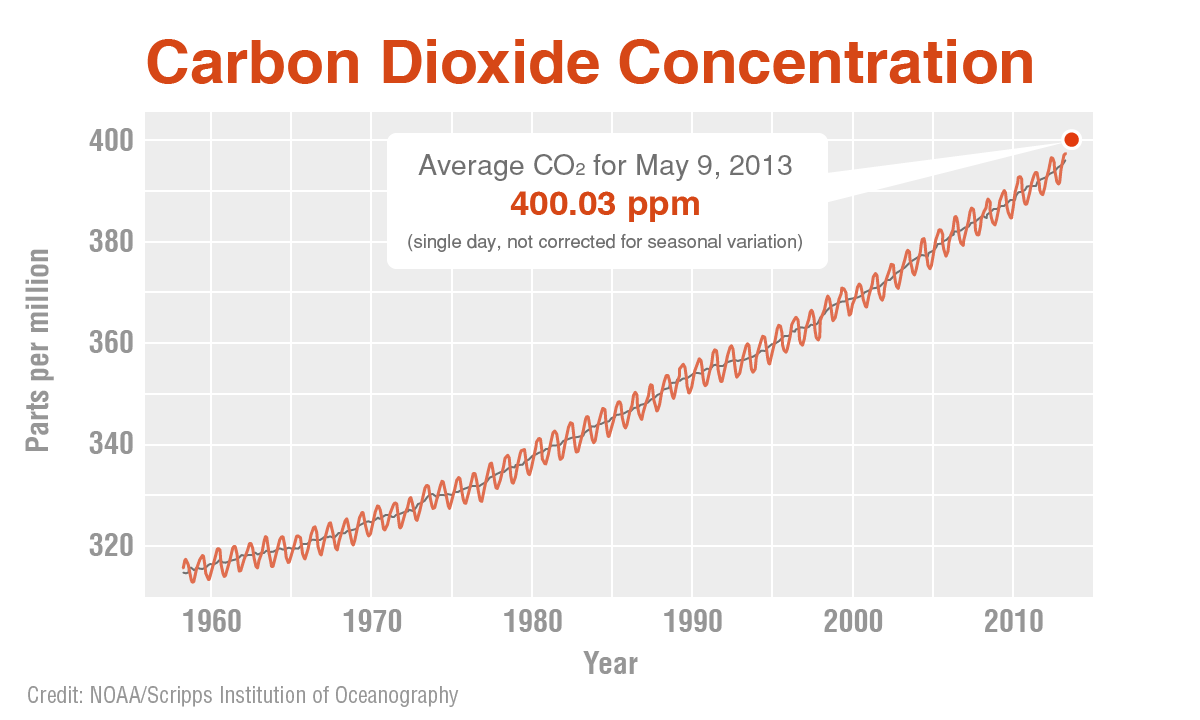
Basically: wrong. Here's the graph of measured change in carbon dioxide since 1958: https://climate.nasa.gov/syste...
The rise is a lot more than "4%".
It's not a mystery why CO2 and temperatures have shown no correlation.
Again: wrong. Here's a graph of carbon dioxide and temperature over the last fifty years: https://www.e-education.psu.ed...
And here's a graph of carbon dioxide and temperature over the last four hundred thousand years: http://www.dokimiscience.com/u...
Your claim "no correlation" is silly. Get some facts before posting, Mr. Coward.
But it's not politically expedient to point out the obvious.
But it does seem to be politically correct to post false facts if you're an anonymous coward.
-
Real men, water, contaminants
> Real men drink their water with as much contaminants as humanly possible, because real men are not pussies!
But they might *become* pussies because of that
- https://en.wikipedia.org/wiki/...
- http://agsci.psu.edu/aec/resea...
- https://www.ncbi.nlm.nih.gov/p...
- https://www.naturodoc.com/libr...I know, I know: real men don't "do" science. Science is for pussies!
Thank you for your post and for its fine double irony. Now tell me: Did you see this second level? Then I must bow in awe before you!
-
Re:Global problem
See, here's the thing. People like to throw out "it's unconstitutional" like the arm-chair lawyers they are. Except of course, if it were, we have a 3rd branch of government to check the executive for this very purpose. And that 3rd branch took DACA into consideration and thought it to be perfectly within the Executive's powers.
You may personally disagree and Congress-critters may personally disagree. But that doesn't make your opinion any more valid than, say, 8 Supreme court justices (half of which are conservative, originalists when it comes to the Constitution rather than "living document" types).
It should be noted that when Obama tried to expand DACA, it was shot down and halted by the Judicial. Which seems to indicate the expansion was indeed executive over-reach.
I'll quote the Supreme Court:
"[W]e recognize that an agency’s refusal to institute proceedings shares to some
extent the characteristics of the decision of a prosecutor in the Executive Branch
not to indict—a decision which has long been regarded as the special province of
the Executive Branch, inasmuch as it is the Executive who is charged by the
Constitution to “take Care that the Laws be faithfully executed.”"A good source on the justification of the Executive (and btw, Deferred Action for immigration goes back to around 1972 and was exercised by just about every Administration since then) authority to pick-and-choose who to prosecute for action can be found:
https://pennstatelaw.psu.edu/s...
Again. You may not personally agree. But stating "it's Unconstitutional" as if you were some legal authority with vast Constitutional knowledge is fairly ridiculous.
-
Re:The problem was the pseudo-science
Is you daughter growing up in isolation? If not then your conclusions don't really amount to much.
http://citeseerx.ist.psu.edu/viewdoc/download?doi=10.1.1.627.1904&rep=rep1&type=pdf.
That's just one study, of hundreds. Of course it doesn't refute your refutation of his anecdote, but it addresses the underlying point that there really are difference.
-
Re:That's how "Look-Say" made illiterate generatio
Turns out that (unless you learn two or more languages as a child) the neural structures that make kids little language acquisition machines literally die off, in several stages (at the ends of age ranges called "critical periods") as the neurons that weren't used by the language learned are "pruned". Once this has happened, learning a new language isn't impossible. But it's more like recovering from a stroke.
This is total bullshit.
-
Re: Meanwhile in the lithium refinery in china.
Again: sorry, sorry and re-sorry. I am certainly not the kind of person ignoring others, easily misjudging or not adequately understanding their positions.
You may want to reconsider your approach then, as your manner of behavior doesn't fit very effectively with your professed belief in yourself.
I am not trying to justify my behaviour, but bear in mind that I answered your first reply after having written other two answers (+ not having too much time/planning to do that + as already said, not liking this kind of discussions too much). Also bear in mind my solid background on this front what makes kind of difficult to take certain statements too seriously. Hopefully, you will understand my position.
Understand? Sure, I understand a lot of things. This should not be construed as condoning, approving, or otherwise endorsing. It is merely a matter of comprehension.
In fact, if anything, my understanding likely differs from yours considerably. I think you believe you know more than you really do, and with your dislike are getting inclined towards intemperance and hastiness rather than moderate yourself based on wisdom and prudence.
It's not an uncommon sentiment, but that just means you should be more aware of it.
I took a quick look at the paper you were referring (this one, download the cached version because the NASA links don't seem to work) and it doesn't show any surprising to me result.
The NASA link worked for me, perhaps you had some other problem, or perhaps it was some transient error. I couldn't say.
Bear in mind that what we call (toxic) pollutants (e.g., the referred NOx) are very dangerous, what means that they provoke cancer in open space.
We're not talking about what is called "toxic" pollutants, or even "pollutants at all" as if you remember, your statement was:
CO2 is not harmful for human health (perhaps it might not be too good in very high doses, but this is an extremely unlikely scenario).
When in fact, medical evidence points to you being mistaken, as it can be harmful. Even beyond your qualifier's limits to cover.
Getting highly concentrated doses of virtually anything might be unhealthy, but this isn’t enough to say that certain substance is toxic.
Again, we're not talking about whether or not it is toxic, per se, but the issue of it being harmful.
Which it can be. That doesn't even fit under "not be too good" not that I know what you meant by that or the ambiguous statement of very high doses, but harmful on its own, due to its effects on the body.
Also note that I did expressly clarify in my first comment that, under exceptional circumstances CO2 might be somehow problematic (as everything else under extreme conditions).
Good for you, but as I noted, it's not simply of problematic, such as I might consider it as a matter of suffocation. So it's more than simply "not too good", but actual, medical effects that can be detrimental in themselves.
And do note, that while being on a space station may be unique (for now), there are not too dissimilar issues within other spaces that human beings are frequently found. It may be desirable to rethink our building and enclosed vehicle designs.
(BTW, if you do that with something like a car, the other pollutants, most likely CO, would kill you before that you could start feeling the indicated CO2 effects).
There are many things that are more harmful than others, we still recognize that harm can occur.
I couldn't find in that paper any reference to words like "bone", "cognitive" or "kidney" (= you aren't too honest and/or don't know what you are talking about; an idea which was pretty clear in my mind since the very first sec
-
Re: Meanwhile in the lithium refinery in china.
Again: sorry, sorry and re-sorry. I am certainly not the kind of person ignoring others, easily misjudging or not adequately understanding their positions. I am not trying to justify my behaviour, but bear in mind that I answered your first reply after having written other two answers (+ not having too much time/planning to do that + as already said, not liking this kind of discussions too much). Also bear in mind my solid background on this front what makes kind of difficult to take certain statements too seriously. Hopefully, you will understand my position.
I took a quick look at the paper you were referring (this one, download the cached version because the NASA links don't seem to work) and it doesn't show any surprising to me result. Bear in mind that what we call (toxic) pollutants (e.g., the referred NOx) are very dangerous, what means that they provoke cancer in open space. Getting highly concentrated doses of virtually anything might be unhealthy, but this isn’t enough to say that certain substance is toxic. Also note that I did expressly clarify in my first comment that, under exceptional circumstances CO2 might be somehow problematic (as everything else under extreme conditions).
The basic conclusions of this paper are summarised in table 2 (page 19) which includes a very descriptive list of situations (good work, Mrs. Law! Sorry again
In summary, it seems a study only relevant under very specific conditions (= maximising the performance of astronauts), which doesn’t seem applicable anywhere else and, in any case, is certainly very far away from representing even the starting point for claims on the lines of "CO2 is bad for human health". No, it is certainly not. It isn't enough under normal atmospheric conditions and not even for very concentrated doses (inside an actual greenhouse). Taking a very high dose of CO2 (or anything else like water or oxygen) cannot be good, but this is evident and doesn't convert it into bad not even watch-your-dose material; just in don't-get-completely-crazy-and-start-living-24hours-with-a-high-CO2-concentration-because-you-might-get-headaches material. Anyone claiming that CO2 is bad for your health is plainly a liar. In any case, I do apologise again for my very far from ideal behaviour. Hopefully, this will be enough to finish this chat. -
Re:Perfect Tomato?
This is the perfect tomato for human health. This research extends to tomatoes the same concept Norman Borlaug used to optimize the production of wheat and rice in the 60s. You know, the Green Revolution that legitimately kept the world from starving itself to death and decreased warfare. There are major health benefits from consuming tomatoes in any form, and this research increases production and descreases costs in a way that will increase tomato availability.
-
Re:We already have an optimal swarm intelligence
I was talking about real prediction markets, not as use in training NNs with virtual prediction markets. I can't think of any situation where this would even make sense... but maybe?
I might have been a bit hasty in my informal impossibility argument, as it were, but my line of thought was like this:
- The claim is that a prediction market can act as well as the best participant of that market, i.e. have zero regret.
- This should hold irrelvant of what the inputs are, whether the inputs are predictions by people or by other simpler algorithms.
- If the claim were true, you could dump a lot (and I mean an extreme amount) of comparatively simple algorithms into a virtual prediction market, and by the claim, the market would act just as well as the very best algorithm of the lot, producing a super AI.
- Since we don't have such super AIs in the real world, the claim must be wrong (and it is, because of the log(N) term).
More generally, if prediction markets were to have zero regret compared to the best expert, every kind of ensemble method would be easy. Just dump the individual methods into a prediction market and you'd get at least as good performance as the best individual method. The prediction market algorithm is the same irrespective of whether its inputs are by people or by computer algorithms, after all.If anything Swarm AI is a prediction market, but with equal waiting for every "expert, and no reward feedback mechanism to promote the accurate and remove the inaccurate players.
Perhaps surprisingly, it's often hard to do better than nonadaptive methods. See for instance the Variance method of An empirical comparison of algorithms for aggregating expert predictions. Then again, I have no idea what particular algorithm Swarm AI uses; it may be a bad nonadaptive method.
-
Maybe hitch a ride? (was Re:Two Words)
Nice post. Your 3am back of the envelope calculations inspired me to do a few of my own.
I googled around a bit, to see if hitching a ride on any of the numerous Coriolis-driven boundary gyres in the world's oceans would be feasible.
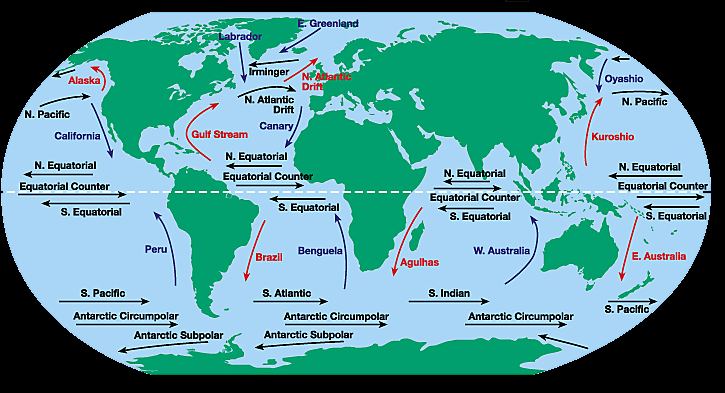
Based on my own BotE calculations, the UAE team might be planning to hitch a ride on the Western Australia boundary gyre. This gyre flows north along the west coast of Australia at an average annual velocity of of
Once they reached the equator, they might need some force to get to the North Equatorial gyre (but only for a few hundreds of klicks, not thousands), whose average annual velocity of
I'm thinking that if the Coriolis forces in the ocean are replacing a significant chunk of the propulsive force that you calculated as necessary, then the overall cost per liter would be quite a bit lower. In fact, it would be significantly lower than desalinization.
-
Re:$24 question
Not my pension fund.
And your statement would be true w.r.t. the market as a whole but IPOs have an inordinate number of small investors.
There's actual academic research on the subject, first hit on a quick search: http://citeseerx.ist.psu.edu/v...
-
Re:Translation...
Fantastic summary!
The elephant in the room is that Silicon doesn't scale past 5 GHz. Everyone knows about it but no one in the commercial sector is interested in doing anything about it.
Hell, even back in 2007 SiGe was proposed to get up past 50 GHz.
What's really freaky is that a close friend of mine was playing with 1+ GHz CPUs in the (late) 70's. I guess we'll never have those 100 GHz Gallium Arsenide CPU's anytime soon
-
Delegated vs Federated logins
Relevant 60 second read: http://sites.psu.edu/ntsh/2010...
-
'Open' version of the Big 5 available - IPIP-NEO
The problem is that the 5 'clusters' in the Big 5 aren't all that informative, they are aggregations of more specific traits, which can be wildly different than the score for the category and the others within the category. In grad school, I did a systematic survey of personality assessment instruments ( Personalysis, Myers-Briggs, etc.). The IPIP-NEO was the only one that passed the sniff test for internal and external validity, especially over time. Just carefully read the definitions and the supporting pages that explain what is going on.
You can take the 300 question one, and look at your own results: "The IPIP-NEO (International Personality Item Pool Representation of the NEO PI-R) " at http://www.personal.psu.edu/~j...
"This is the official website for the International Personality Item Pool (IPIP). The site includes over 3,000 items and over 250 scales that have been constructed from the items. New items and scales are developed on an irregular basis. The items and scales are in the public domain, which means that one can copy, edit, translate, or use them for any purpose without asking permission and without paying a fee.
Over the past 15 years or so, I have taken it at intervals, also taken the results and reviewed them with friends to get their insights. What it doesn't do, is it doesn't predict. And there are no assumptions about how it plays out between individuals with different traits. -
It's Gobi desert...
A rain shadow desert.
Any "countries where that rain would otherwise have landed" already got most of the moisture out of the air, which is why that place is a desert.Cloud seeding is part of Chinese plan to build a Green Great Wall to stop the spread of the desert and the sandstorms.
Which seems to be doing something, at least in the sense that it is apparently lowering the water table in the areas where trees are planted.Or that is at least what the opposition to the forestation program claims, suggesting instead simply fencing off the area and "nurturing the land by the land itself".
How would that create trees in areas which were "treeless in the last several thousand years", or how would temporary fencing off prevent sandstorms (even should grassland work that way) once the fences are removed and the grasslands are once again used for cattle grazing... the article doesn't mention that.
Then again, water levels have been dropping long before forestation project started. And trees are supposed to keep the water in the ground...On the other hand, Epoch Times is more than a little a Falun Gong paper.
I.e. Whatever Chinese government does is wrong. While whatever Falun Gong does might get them arrested and "reeducated" by the government. Or harvested.In any case, weather modification is being done in order to provide water for the Green Wall in the area which got desertified as the water from Shiyang River was used for irrigation upstream decades ago.
-
Re:sorry, it's not that simpleNot surprising that Greenpeace says stupid shit. They're the ones who had the war on chlorine.
Greenpeace, the international environmental advocacy group, launched the first salvo in 1991 with its call to phase out completely "the use, export, and import of all organochlorines, elemental chlorine, and chlorinated oxidizing agents (e.g. chlorine dioxide and sodium hypochlorite)." As Greenpeace's Joe Thornton explains, "There are no uses of chlorine which we regard as safe."
And when they get a wild idea, it often passes on to other environmentalist organizations.
It makes good sense to prioritize environmental protection. Unfortunately, good sense is conspicuously absent in current efforts to ban the use of chlorine. Greenpeace calls for a "chlorine-free society." Support also comes from other environmental organizations. George Coling of the Sierra Club states ". . . the debate is no longer whether to phase out these chemicals, but how" and Tim Eder, of the National Wildlife Federation notes, "When it comes to (these chemicals) you don't make them, produce them, or dispose of them . . . you just get rid of them!" We should be wary of their claims, for they suggest political opportunism, not sound science.
-
Re:75% of california's poeple are brain dead
The trees are fine. All this talk about trees is because the Califronia taxpayers will not build new infrastructure for farmers.
So you are telling me that the US Forest Service wants to build new irrigation projects for farmers. Here's the link to the actual forest service report. http://www.fs.fed.us/news/rele...
Here's photos of dead trees perhaps you'll claim photoshopped by the USDA? The Farmers? So they can implement the ultimate non-sequitur solution? http://www.fs.usda.gov/main/ca... So the warmer than normal temperatures and drought conditions have enabled bark beetles to infest and kill more trees, and you think this is a plot by farmers to build new irrigation projects that will have zero impact on the situation.
This is the logic that says - "Honey, the car broke down, so I'm buying a new furnace and computer."
What happens is the warmer and dryer conditions don't kill off the beetles, so they infest the trees and kill them. Under normal circumstances, they wouldn't do that. We have a similar issue near me with the Emerald ash borer, a beautiful green critter that has been devastating forests. As in miles of dead trees. http://ento.psu.edu/extension/... http://buffalonews.com/2016/06...
EAB isn't based on drought or temps, just accidentally introduced and no local predators. But no, the trees are not fine.Neither are teh ones in Cali. They're dead, Jim!
-
Re:Not much use
Compose used to by default be mapped as AltGr in Linux distros.
For me on Kubuntu AltGr+;,e (ie hold AltGr [aka "right alt"] whilst pressing semi-colon, then press e) gives me é (that's e-acute), AltGr+',e gives me ê (that's e-circumflex).
On MS Windows it used to be that you could hold alt and then type a code number _using the keypad_ for the character, so Alt+0233 (using NumPad) would give you é. Not sure if it has to be right-alt again but don't think it does.
http://symbolcodes.tlt.psu.edu... has a good synopsis.
-
Re:The anti-science sure is odd.
did you not know the Minoan Warm Period, Roman Warm Period and Medieval Warm period were warmer than today?
No, because globally, they were much colder (see fig 2).
Vikings farmed in Greenland
And now it's easier than ever before.
wine grapes could be grown as far north as York in England.
There's many commercial vineyards there today, and even further north.
Now the graves of the Vikings are under 'permafrost'
Wrong, there hasn't been permafrost at those sites for a long time.
You talk about 'nutters' yet seem to be defending a position for which you don't even understand even the basic counter evidence
I've yet to see you present any, only oft-repeated claims that you obviously have never bothered to check for yourself.
I would hope you would look at the statement of the leaders of the CAGW movement
You seriously expect us to accept a bunch of out-of-context quotes as evidence of some global conspiracy? The only "agenda" it proves is that of the people who set up the website.
"Anti-science" means people who deliberately ignore the huge amounts of collected scientific evidence, and continue to spout provably incorrect claims with no evidence of their own. "Nutters" usually follow this by attempted FUD about the reliability of all the evidence against them, inevitably resulting in global conspiracy claims. You certainly qualify for both terms.
-
Re:700 million metric tons of CO2 Equivalent
The only solution is to cut back on meat consumption, but Cargill won't be issuing that in a press release any time soon.
One way to make massive improvements would be to return much of middle america to its prior state:
Overall, methane emissions from bison, elk, and deer in the pre-settlement period in the contiguous United States were about 70% (medium bison population size) of the current emissions from farmed ruminants in the U.S.
That's right, when there was so much food running around the country that it was considered a nuisance, they actually farted out less methane than what we see now. Most of the nation's food is grown in California, so we could convert most of the Midwest back to Bison range (nobody wants to live there anyway) and reduce our GHG dramatically by simply not raising beef at all. Cows are especially egregious producers of Methane.