Slashdot Mirror
Domain: qsl.net
Stories and comments across the archive that link to qsl.net.
Comments · 193
-
Re:Won't work
http://hackaday.com/2010/03/31...
http://hackaday.com/2013/03/14...
http://hackaday.com/2013/03/18...
http://www.extremetech.com/com...
https://www.avforums.com/threa...
Most any WiFi firmware artificially limits the radio -> http://www.qsl.net/kb9mwr/proj...
http://www.ilounge.com/index.p...
Whoa, your car has hidden features? https://www.youtube.com/watch?...
Extra cores on your CPU? No way! http://www.bit-tech.net/hardwa...
Cripple phone features? Oh noes! https://www.techdirt.com/artic... https://www.techdirt.com/artic...
More than one HAM radio have been found to be subject to software tweaking for improvements in scan speed and frequencies covered.-> https://www.youtube.com/watch?...
Got a RAID card? Some of them can be crossflashed to gain features BTW. Or you can pay thousands to the manufacturer for some features (*cough*PERC*cough*) http://www.servethehome.com/ib...
Gains can be had by flashing custom firmware to your DVD\BD RW drives but I didn't feel like spending any time past a cursory search to find this. http://binflash.cdfreaks.com/ http://www.rpc1.org/viewtopic.... http://dvrflash.rpc1.org/
Firmware being used in external HDD has also been found to be crippled vs a standard drive, this didn't used to always be the case....
Here's one that's just an upgrade with features the manufacturer didn't include (see also ANY Jailbreaking post ever)
http://lifehacker.com/find-out...
http://lifehacker.com/5942229/...
http://www.digitaltrends.com/p...Oh look, your camera now supports RAW? Thought that was only for pro cameras not P&S pocket models...
I could go on and on with examples but suffice it to say yeah it DOES happen and it happens fairly often. It happens most often with system that have a full OS, often Linux, where a firmware flash can give you all sorts of features (OpenWRT or Tomato anyone?) but it also happens in cameras, lab bench tools, TVs, stereos, and just about anything else that is driven by software. Want more turbo boost in your car? Software baby! Want that printer to register an empty toner cartridge sooner? No problem!
Tired now, think I've made my point?
-
Re:uhhhhh
They'll find your proxy. They'll figure out what the interface is on the next hop. Then they'll hunt that interface.
Yes, multistage/multi-transmitter foxhunts are a thing too. http://www.qsl.net/n2ki/HVDFA/...
-
Re:Encryption across radio waves is illegal?
The Computer Fraud and Abuse Act assertion is absurd. I can not see in any way that this could result in a violation of that. (It could be used as a tool as part of OTHER activities that are violations, but its use in and of itself would not be a violation.)
However, the "ham" part of the name indicated that it was probably using an amateur radio (ham) service. This service requires operators to be licensed, and has its own rules very different from that of the ISM bands.
In many cases, ham bands and ISM bands overlap. The ham bands sometimes extend outside of the frequency range of the ISM bands, and also licensed ham operation is subject to different rules than ISM devices. Key differences:
1) Licensed amateur radio operators can use MUCH higher power levels than ISM devices. They can legally interfere with ISM devices (although doing this is frowned upon by most hams) - In most of the ISM bands, the military is the primary user, amateur radio is secondary (In some areas, military radars operate in the ham/ISM bands. IIRC there was an interesting situation a few years ago where no one could use certain brands of garage door openers near a military base because the big radar was interfering.), ISM devices are tertiary. Lower-class users must accept interference from higher-class users and can't interfere with them. http://www.qsl.net/kb9mwr/proj...
2) Operating under Part 97 (ham) rules instead of Part 15 (ISM) rules means that you can't use encryption for the purposes of obfuscating dataI suspect that something about this device made it require operation under Part 97 rules to function, but encryption is a no-no under such rules. Also, it seems like they intended to sell this/encourage its use by unlicensed operators despite the device being a Part 97 device.
-
ham radio
I was thinking when the cellphones go down in major disaster,
http://www.qsl.net/n/n0drc/Oth... -
Standing on the Shoulders of Giants
This idea has been around for a very long time:
http://servv89pn0aj.sn.sourced...
Green Bay Professional Packet Radio - probably has done the most work in this area.
http://www.qsl.net/n9zia/Amateur Radio packet radio has been around since the late 80s. There's a new approach being tested as a wireless WAN on HF.
http://uspacket.org/network/in...Yes, you do need a license, but encryption is not allowed on any amateur frequencies - unless it's the control channel for a ham satellite. ARRL tried to get an exception for ARES to transmit HIPAA data via packet encrypted, but FCC denied the petition. Anyone with a receiver and the Fldigi software can listen in.
-
Volunteers?
In a particular case like this, it may be possible for much of the transport work to be done by volunteers from the local ham community.
W2CXM's Force12 antenna was entirely put up by volunteers. This isn't exactly a small antenna - http://www.qsl.net/w2cxm/pics....
-
Re:Try the NSA
They like collecting stuff
Na, amateur radio transmissions are some of the most boring conversations known to man (and I am a ham radio operator). No sex, drugs and rock and rock - no eavesdropping. Besides, we're mostly harmless.
Back to the topic. Because the bands are proscribed, ie, there are frequencies that are just CW (and phone or digital or whatever), it would seem an easy job to just record a band for a while to grab some samples. Use a software defined reciever (to allow for easy scripting), work the grey line in your area. Even if your software isn't tuned well yet, I would hazard a guess that it is smart enough to detect CW vs. radio noise. Use that to start and stop the file. You probably don't need WAV, that's sort of overkill for CW. Even cruddy ol MP3 ought to give you more than enough headroom for further processing.
-
Re:These days, most enginineering is software
There are about 3 antenna designers in the world. The rest use cookbook http://www.qsl.net/n1bwt/contents.htm methods. I exaggerate, but only a little.
-
Re:It's dead either way, why not try this?
To say that you're not using real sources would be an understatement. The middle one is someone's entertaining list of things that they think will go extinct, offered more as comedy than anything else. The first is a 7-year-old interview with someone in Quatar, which just got Ham Radio around then, who offers no sources to substantiate his statement. And you seem to be assuming that the retirees cited by ARRL will all die and not be replaced, and the emergency groups will find something else to do, which makes no sense. But you are also relying on ARRL which has not presented any substantive survey on this issue.
QRZ, unlike ARRL, operates an online callbook, and thus can actually count the number of hams in many nations. Their survey is here. You need something with at least that much data to be taken seriously.
-
"Data Encryption Is Legal" N2IRZ - CQ, Aug. '06
http://www.qsl.net/kb9mwr/projects/wireless/Data%20Encryption%20is%20Legal.pdf
"Just like Dorothy returning to Kansas, it turns out we've been able to do it any time we wanted to. Data encryption for our intended purposes is already permitted under Part 97 of the FCC rules. We just hadn't realized it. Read on for the details. "
-
Re:National Traffic System
By separate channels I think you mean net frequency and side channels to pass traffic? What do you mean by RTS/CTS in NTS?
Yes, in the NTS the net is controlled by the net control station (NCS), but the actual message-passing is done on a side frequency, without the direct involvement of the NCS. In this way, the NCS does not have to handle all of the traffic handled by the network, so its workload is much less. The workload of message-passing is shared among the other stations in the network (principally by the regional net representatives, a task that can be rotated among stations in the network), and is performed largely in parallel to network control functions, which increases time efficiency.
By RTS/CTS I meant the code symbol(s) sent by those wishing to join the net. While in operation the NCS periodically sends open requests to join the network ("QNI"), then stands by for responses. Stations wishing to join the net then send a short signal (usually a single Morse character, often the first letter of their call sign suffix). The NCS then repeats the signal of the station it authorizes to transmit, and that station then begins its transmission.
This is akin to beacon transmissions in a modern wireless digital network, followed by a contention-access period (CAP); during the CAP the stations send their RTS signal (the single Morse character), and the NCS sends a CTS signal by repeating the character. The station authorized to transmit then does so.
-
Re:Horray for Antares
-
Re:where do you store it?
The US Postal Service has similar rules, except their limit is 108 inches, IIRC. I once exploited that fact to ship a 10m X-Beam antenna to an island in the harbor of Charlotte Amalie, St. Thomas, USVI. It consisted of a bundle of 1/2 inch PVC pipes with 1/2 inch copper pipes inside. The thing was _just_ under the combined 108 inches. The clerk saw me in line with that and yelled out, "Nuh uh!" - I looked at her and said, "Uh uh!". Sure enough, it arrived in one piece after being shipped there and brought across to the island on a little USPS dinghy.
-
If you'd like this service for free....
Just add an easement to your city's antenna tower permits that will allow people to put in ham radio repeaters with autopatches.
Individuals will pay for their own transceivers for free (as they have for about a century) and hams will move traffic that can be done simplex to other frequencies.
There are a dozen repeaters in reach of my commute to work. There are naturally in places that don't flood and hams generally have great battery backups connected to them. Further, they don't require the phone systems to work at all. I can reach any ham in the city with mine, no phone line involved.
Folks that are good at this may in fact be near you already:
http://www.qsl.net/races/links.html
And these folk can get you started:
-
No reason to stop playing...
Get an amateur radio licence, and build your own encoder:
-
The Auto-Alarm
One of the under-appreciated technologies to result from the Titanic disaster was the development of the auto alarm: An automatic receiver that continuously monitored the calling frequency (500 kHz) for a specific alarm signal to be sent by ships in distress.
Prior to this time, an operator trained in Morse code reception was required to be on duty or, failing that, a "wireless watcher," a deck officer trained to listen for the distinctive three-dits-three-dahs-three-dits of the SOS call. However, the wireless watcher system had obvious flaws (e.g., other duties of the deck officer taking him away from the receiver), and so an automatic system was desired. The trick was doing it with 1920s technology.
It was decided early on in the development of the auto alarm that having a detector able to correctly decode "SOS" with sufficient sensitivity and selectivity (i.e., without false detections during a night of reception of multiple simultaneous and possibly interfering signals, lightning crashes, etc.), and at different rates and fidelity (recall that the SOS signal would be sent by hand, by a person likely to be under high stress) was beyond the technology of the day. Instead, a second, simpler, signal was invented -- a signal specifically for detection by the auto alarm. This signal was defined to be a series of four or more dashes, each four seconds long, with a space of one second between them. (Clocks provided in the radio rooms were required to have a sweep second hand, and a pattern of 4 on, 1 off dashes was printed around the circumference of the clock to aid the timing of the operator.) Alarm bells were placed over the bunks of both the Radio Officer and the ship's Master.
When the radio officer went off watch, he turned the auto alarm on. Should an auto alarm signal be received, the bells would go off (not unlike a fire bell and, a foot over your head, very impressive at 2 AM, I can assure you), and the operator would then climb off of the ceiling, go to the radio room, turn off the auto alarm, and monitor 500 kHz to see what's going on.
In an actual emergency, the radio officer on the ship in distress actually sends the auto alarm signal first, then sends the SOS signal. (The SOS signal, by the way, is sent as a single character, with no spaces between the letters -- di-di-dit-dah-dah-dah-di-di-dit, not di-di-dit-space-dah-dah-dah-space-di-di-dit.) This mp3 file, of an actual disaster (the fire on the MS Prinsendam, PJTA, in 1980), has this clearly audible: The recording starts with a long series of auto alarm tones, followed by the SOS call at about the 2:30 mark.
Those of us with a logical bent would find the design of these auto alarms to be a study in stone-knives-and-bear-skins analog computing. This document gives one some idea of the requirements. It would be a good task for an engineering student project.
-
Re:I hope that's incredibly illegal
Click here, become a felon.
-
Re:I knew it was too good to be true.
Hmm.. When you put it like that, I'm surprised the Iranian government hasn't already implemented this technology.
How do you know?
-
Re:Call your union rep
Wifi devices generally transmit in the low milliwatt range; compare this with the power used by a typical public safety trunked system (800MHz not 2.4GHz):
http://www.qsl.net/n9zia/gbtrunk.html
http://w8msp.com/Oakland.html
You are probably being hit with plenty of UHF/microwave radiation when you walk near a police station. Not only that, but your body will absorb more energy at 800MHz than 2.4GHz (the specific absorption rate at 800MHz is higher than at 2.4GHz), so you should be more concerned about your exposure to radiation from public safety systems than from wifi. -
Re:Commodore 64
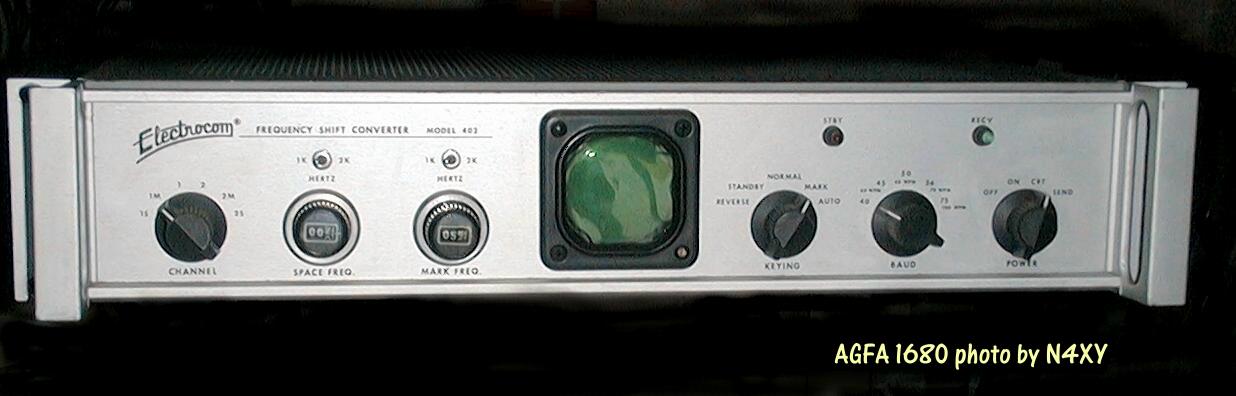
Purchased a Commodore 64 and the tape drive at Sears. Learned some about Basic programing but never enough to encourage me to learn other programing languages. Overall experience was great, Eventually I sent for a interface device that would connect the Commodore 64 to my ham radio and decode Radio Teletype over the air called ACT?. I thought for that time the program that came with the interface the graphics were excellent. I believe the RTTY program had a 'cross-hair' tuning indicator, much like a oscilloscope used on RTTY Terminal Units that used vacuum tubes: http://www.qsl.net/n4xy/Images/Electronics/Ham_Radio/RTTY/rtty_electrocom-402_fsk_tu.jpg
I believe the Radio Teletype interface device for the Commodore 64 was a Microlog AIR-1: http://img6.imageshack.us/img6/3343/photo11t.jpg Image courtesy of antiquekid3 posted on The Vintage Computer Forums December 8th, 2009, 05:47 PM
-
Commodore 64
Purchased a Commodore 64 and the tape drive at Sears. Learned some about Basic programing but never enough to encourage me to lean other programing languages. Overall experience was great, Eventually I sent for a interface device that would connect the Commodore 64 to my ham radio and decode Radio Teletype over the air called ACT?. I thought for that time the program that came with the interface the graphics were excellent. I believe the RTTY program had a 'cross-hair' tuning indicator, much like a oscilloscope used on RTTY Terminal Units that used vacuum tubes: http://www.qsl.net/n4xy/Images/Electronics/Ham_Radio/RTTY/rtty_electrocom-402_fsk_tu.jpg
-
Re:Value of CW
NOW, the rule explicitly defines the "mode" as "1A0", and explicitly says it has to be "plain text". It doesn't quite go as far as stipulating morse code, but I think I read a non-binding FCC opinion someplace where they basically said occasional adhoc prosigns are OK as long as they're published SOMEWHERE and your intent isn't to conceal what you're sending, but hex-encoded UTF8 and any kind of binary-encoded file is absolutely beyond the pale.
You are quite incorrect.
In the definitions: (1) CW. International Morse code telegraphy emissions having designators with A, C, H, J or R as the first symbol; 1 as the second symbol; A or B as the third symbol; and emissions J2A and J2B.
Nowhere does it say it has to be "plain text". There are restrictions on the code used (International Morse Code, 5 level Baudot, etc...), and restrictions on the content, but "plain text" is not one of them. Perhaps you are thinking of 97.113(a)(4) which prohibits: "(4) Music using a phone emission except as specifically provided elsewhere in this section; communications intended to facilitate a criminal act; messages encoded for the purpose of obscuring their meaning, except as otherwise provided herein; obscene or indecent words or language; or false or deceptive messages, signals or identification; "?
UUencoding is not an encoding for the purpose of obscuring the meaning of a message. If you encrypted those files before uuencoding, then you would be breaking the rules, but otherwise, no.
As for sending binary files being "beyond the pale", sorry, still incorrect. There is an international network of packet and pactor based systems that do this on a regular basis, using an encoding that is much more obscure and complex than UUencoding. It's called Winlink 2000. It is, for all intents and purposes, an extension of email to ham radio, and you can send doc and pdf and all kinds of binary files as attachments to those email messages. There is no FCC rule prohibiting this.
As for your recollection of the old rules, I recall nothing that would have been a hot-button issue for the FCC in sending files via computer-generated CW, as long as the control op was sitting there controlling it.
In a way, I can see why they clamped down a bit. At the time I didn't have the RF or digital electronics background to know it, but I now know that turning a carrier on and off is neither instantaneous nor consequence-free, and when you do it fast enough, you're basically bit-banging de-facto AM via PWM and square-wave artifacts that's going to splatter over a MUCH wider chunk of spectrum than a carrier being slowly turned on and off by a straight key.
What you call "splatter" is what we technical people call "bandwidth". Yes, a 200 wpm CW signal has a higher bandwidth than a 10 wpm signal, but I don't seem to find any limit to the CW speed being used. I do find a limit of 300 bauds for data, but I don't believe that applies to CW. There were, and probably still are, people who manage 60 to 80 wpm manually. There is a woman who has a record more than 1700 wpm using software.
As for how fast the carrier is turned on and off, that is a function of the TR switching in the transmitter. You can have bad key clicks at 5 wpm, too.
-
Re:Safecast
http://www.radiationnetwork.com/ (scroll down for details on Geiger counter model numbers)You ought to participate here
http://enenews.com/
(wtf seems down at the moment??)I used a CDV-700
(with the DU sample on the side)
http://www.civildefensemuseum.com/cdmuseum2/radkits/cdv700.html
Then I soldered together one of these.
Dollar Store Digital Geiger Counter Hack
http://www.pskl.us/wp/?p=289
Then pick a spot and do 10 minute tests.The drawback is I wasn't measuring the "floor" before 3.11 so I have no low floor to compare against, but the best I can tell it's trending down currently, and if anything I am building my own floor.
I now have been measuring the floor long enough that I can tell which way the overall situation is trending. I started in the 850's June and it's currently down in the 550's October, we most assuredly got dusted by something.
Things I learned from all this?
I will never be able to detect hot particles with this equipment.
Stay away from the RAIN, as it brings the shit down out of the sky onto the ground, just like a water truck keeps a dusty road muddy and dust free.
If you have a whole house air filter which was installed before 3-11 I highly suggest you change it, when I tested mine it was literally a hot object, and let me just say that was an eye opener.
There's also some software that you could use if you can't find the dollar store pedometer parts. also, most pedometer's are similar so if you know electronics, it's a simple matter to modify from pedometer to pedometer.
There are a few others out there now helping people with analog meters.
http://www.imagesco.com/geiger/geiger-counter-accessories.html
http://www.instructables.com/id/Ustream-your-Geiger-Counter/step2/Free-Counter-Software/Some other CDV-700 mods
http://home.comcast.net/~prutchi/index_files/cdv700pro.htmFree Counter / Scaler Software
David Honigâ(TM)s free âoeCDV Counterâ program
http://www.anythingradioactive.com/CDVCounter/help.html (wtf 404 for the software, no problem use the guide there and download from our ham radio friends who wisely have us covered. http://www.qsl.net/k/k0ff/CDVCOUNTERZIP/CDVcounter-zip/There are some charging money for counting software, I don't know about these, they look legit, I guess it comes down to your own abilities and what you want.
http://www.geigercounters.com/Software.htm
http://www.blackcatsystems.com/GM/page3.htmlOpinion: If I lived in Japan, I would have sold everything and done anything to leave months ago.
Hopefully someone will mod this up so you (and others) don't miss the information.
-
Re:The best part
You can target the jammers =) like a great glowing radio beacon.
Maybe. Maybe not.
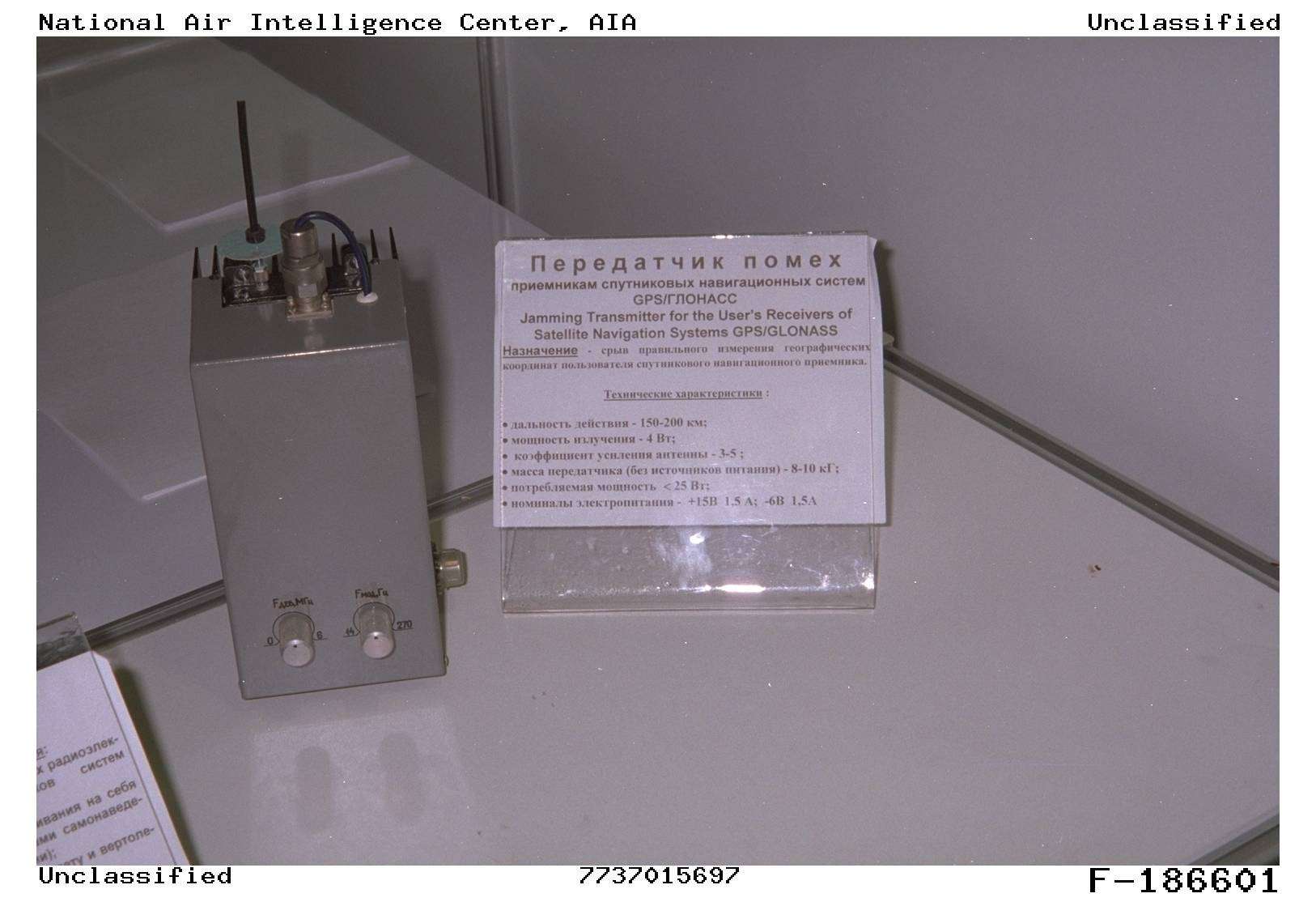
Depends on where your jammers are. These things are cheap and easy to deploy and floating beacons these days, costing less than few hundred dollars. Army has them too. See http://www.jammerall.com/products/Portable-GPS-Jammer-(GPSL1%7B47%7DL2).html and http://www.qsl.net/n9zia/wireless/pics/gpsjam-7.jpg
And a bunch of them scattered around make it very difficult to target. Further more, while you are wasting your million dollar missiles on hundred dollar jammers, you are giving away the location of your missile platform (be it air, surface or sub surface).
-
Re:HAM
Here is the website for the amateur radio operators of Egypt organization
Their call signs are - SUA-SUZ, 6A-6B, SSA-SSM
And wikipedia says theres about 113, really easy for the police and security forces to lock down.
http://en.wikipedia.org/wiki/Amateur_radio_callsigns_of_the_Middle_East -
Ricochet did this a decade ago
Ricochet did this in the 900MHz band using spread spectrum a decade ago, for wireless Internet access. They put up little nodes on street light poles, using a deal where the municipality got free data access. It worked fine, but only delivered dial-up speeds, so it was overrun by DSL and cable. Even back then, getting around narrowband interference was no big deal.
-
Re:Cost
Ocean platforms are pretty expensive. Launching satellites is much less so. There are quite a few ham radio satellites, for example: http://www.qsl.net/w8dro/.
-
Re:Mobile crossband repeater
"due to FCC regulation of wattage allowed for handheld transcievers, antenna size, and even vehicle groundplane"
There is no such thing for amateur radio transcievers.
However, there's a practical limit of around 5 watts for handhelds dictated primarily by thermal management and battery power available in that form factor. Mobile rigs have a nice big car battery backed by an alternator to run off of. (Running directly off of a car battery for extended periods is not advised - starter batteries do not like being deep cycled.)
A useful thing when traveling is to build a J-pole antenna from twinlead. J-poles have pretty good gain, and are normally NOT a compact antenna, however if constructed from twinlead, you can roll it up and just hang the end off of something when you want to use it. Plenty of variants on this available from Google, including http://www.qsl.net/wb3gck/jpole.htm and http://larc.hamgate.net/pocketJpole.htm
-
some links
IANAHRO, but the topic is interesting. I was snooping around and I found this link which discusses equipment and antennas and has some relevant videos. This site has some info on the various ham bands that might be relevant. It mentions that the sun spot cycle is a problem right now for long distance communications that bounce of the ionosphere. From that site it looks to me like the 20 meter (14mhz) and 40 meter (7 mhz) bands are your best bet. I wouldn't want to have to rely on repeaters on mountain tops. I'd get myself a Yaesu FT-817 and plan to rely on the busy 20 meter band to bounce the call for help off the ionosphere. I'd also look into using an amateur radio satellite. Even though you only get one 15 minute window every 24 hours it's better than nothing. It seems most of those satelites work in the 2 meter band. So an FT-817 would also cover it. But it seems that a small dish antenna might be your best bet to transmit to the satellite. A yagi would probably be easier to pack though. You might also look into a helium balloon or kite aerial antenna. A very cool/geeky way to maybe get above the mountains. I wouldn't want to rely on having to summit a mountain when you have an emergency. I would assume we are talking about something like a broken leg or worse. Despite all these budget communication options if you really value your life and have some money I would go with renting a satphone.
-
Re:VHF HT and portable Yagi
Icom V8 and a j-pole made out of twin lead.
http://www.qsl.net/wb3gck/jpole.htm
http://www.icomamerica.com/en/products/v8/
Bring fishing line and a slingshot, get the antenna up in a tree.
Under $200USD and easy to pack.
-
Motorola has been doing this for years.
Motorola has been doing this with devices, even pre-cell phone revolution. Look at their old pager lines - i.e. the Pronto, Bravo, etc. They used to let providers "lock down" the pager with a programming PIN. Want to change the capcode? You need the PIN. Put the PIN in too many times, and you have to replace the code plug, which meant factory service. (Essentially, you had a dead pager.) See here: http://www.qsl.net/kb9mwr/projects/pager/pagerpw.txt
-
Re:Become a ham because it's fun, not just for emc
RACES is for governmental communications performed by amateur volunteers. ARES (Amateur Radio Emergency Services) and SKYWARN in most areas have nothing to do with RACES. And, I am a Deputy RACES officer here in the Pittsburgh, PA area and never had to submit to any extensive background checks or disclosure of any of my personal information. It's up to the served agency who appoints their RACES officers... and if they require what an individual beleives is too much, you simply say no thanks and volunteer for another service like amateur radio comms for the Salvation Army, Red Cross, your local municipality, the National Weather Service or the National Traffic System where volunteers practice in the art of receiving, relaying and delivering health and welfare messages.
-Dave, KB3FXI
You might get an opportunity to help out in a disaster, but if your main goal is to help out in emergencies, get trained in CPR, Search and Rescue and other such, but don't count on being a ham to put you in the "Most needed" category.
Here's another thing to think about: In the U.S., RACES is the de facto organization within the amateur radio community for providing disaster relief and emergency services. In addition, Federal law prohibits RACES stations (or those stations performing RACES duties) from contacting non-RACES stations (97.407). Most government agencies require extensive background checks, including disclosure of your SSN and other personally-identifiable information, to participate in RACES, and your appointment is at the whim of the RACES coordinator. So in effect, you're asked to give up quite a bit of personal information if you want to contribute your efforts to disaster relief. (In fact, in most areas of the country, to participate in WX nets you must have a RACES appointment.)
-
Re:Become a ham because it's fun, not just for emc
In the U.S., RACES is the de facto organization within the amateur radio community for providing disaster relief and emergency services.
ARES [Amateur Radio Emergency Service] is another, and in many areas the two have a unified command structure for ease of organization. i.e., you register as an ARES station, and you are also registered as a RACES station. For example, this is the case in my home state of North Carolina.
In addition, Federal law prohibits RACES stations (or those stations performing RACES duties) from contacting non-RACES stations (97.407).
During periods when RACES has been activated (i.e. during an emergency). Stations participating in RACES may not contact stations not participating in RACES. This is because during a declared emergency when the airwaves become restricted, the only stations that may operate are those participating in RACES or ARES activities in coordination with their local emergency organizations. This should not be interpreted to mean that during non-emergency periods, stations that are registered in ARES/RACES may only communicate with other stations registered in ARES/RACES. That's simply not the case. Except during a declared emergency, any licensed amateur operator may communicate with any other licensed amateur operator within their respective authorized bands and modes. However, if an amateur operator wants to operate during such times that RACES is in effect, they must register as an ARES/RACES station. In North Carolina, all amateur operators are encouraged to register in ARES/RACES.
Most government agencies require extensive background checks, including disclosure of your SSN and other personally-identifiable information, to participate in RACES, and your appointment is at the whim of the RACES coordinator. So in effect, you're asked to give up quite a bit of personal information if you want to contribute your efforts to disaster relief. (In fact, in most areas of the country, to participate in WX nets you must have a RACES appointment.)
I don't know what area you're in, but that is not the case across the board. The NC ARES registration form asks for name and contact info, call sign, class, operating bands and modes, EMCOM classes taken, and whether or not your station can operate without commercial power. No SSN or background check required. And as I said before, registration in ARES is registration in RACES, in North Carolina. As a licensed operator, you've already given personally-identifiable information to the FCC to obtain your license. The ARES registration form doesn't ask for much beyond that.
In recent years, the Department of Homeland Security has instituted a requirement for all amateur operators participating in ARES/RACES, to have completed some EMCOM courses - namely, IS-100, IS-200, and IS-700. These are all available for free online, but registering for them does require the submission of your SSN, as that is how the DHA keeps their records. However, the SSN is not shared with your local EC or ARES/RACES chain of command.
-
Re:Become a ham because it's fun, not just for emc
You might get an opportunity to help out in a disaster, but if your main goal is to help out in emergencies, get trained in CPR, Search and Rescue and other such, but don't count on being a ham to put you in the "Most needed" category.
Here's another thing to think about: In the U.S., RACES is the de facto organization within the amateur radio community for providing disaster relief and emergency services. In addition, Federal law prohibits RACES stations (or those stations performing RACES duties) from contacting non-RACES stations (97.407). Most government agencies require extensive background checks, including disclosure of your SSN and other personally-identifiable information, to participate in RACES, and your appointment is at the whim of the RACES coordinator. So in effect, you're asked to give up quite a bit of personal information if you want to contribute your efforts to disaster relief. (In fact, in most areas of the country, to participate in WX nets you must have a RACES appointment.)
-
Re:Morse code is faster
World record, according to "The Art and Skill or Radio Telegraphy" is 75.2wpm. "words" are 5 characters. This guy texted about 2.2 characters per second, the morse record is 6.3 characters per second.
-
Re:KC2UFO
Link to the club page at qrz.com, and their homepage.
Kinda makes me ashamed to be a ham.
-
Re:idiocy? Incompetence?
Because people still insist in using their old and silly date format everywhere. dd.mm.yy, dd/mm/yy, mm/dd/yy.
There's an international format called ISO 8601, which is accepted in almost every country around the world. yyyy-mm-dd with 4 digits for the year.
If such a date format would be common, nobody would even think about using only 2 digits (or less) to save a date. And no, 2010 wouldn't be interpreted as 2016. It would be wrong from the very beginning if somebody wants to interpret a BCD number as a hex number.
Implementation of the ISO 8601 Standard Around The World, including Europe, Germany, USA.
-
I've used SRTM data for radio coverage profiling
Big thanks to NASA for this data, I've used it with the Splat! tool for radio path profiling to generate maps and estimate height above average terrain (HAAT). I've been using these maps to show what the approximate footprint is for amateur radio repeaters. See this example for a 90W 440Mhz repeater on top of the Empire State Building.
-molo
-
Re:"Edge of Space" is 100 km
100Km is about 328,000 feet. That's why Space Ship One had a tail number of N328KF.
Also, the North Texas Balloon Team and the South Texas Balloon Project routinely (with launches approximately annually) send balloons with video cameras to altitudes in excess of 100,000 feet. Those are just the two balloon projects I'm familiar with. I am sure there are others because it's not particularly hard to do.
So, this is pure ho-hum to me. Let me know when they've done it a couple of dozen times.
-
Shortwave propagation
To me, the most interesting point of this discovery is that it should improve our understanding of shortwave radio propagation.
It has always frustrated me that the same space program that is producing the data needed to understand the physics needed to make accurate, day-to-day predictions of ionospheric propagation -- a hundred-year-old mystery -- is also the same space program that replaced commercial HF communication with satellites, greatly reducing the economic value of such predictions (and, therefore, the science funding to make them). So now that we have the ability, we no longer have the desire . . . unless one is an amateur radio operator, and it's harder to think of an entity lower on the economic value chain than that.
The most difficult path for shortwave links is one that passes near the magnetic poles, like the path from Southeast Asia to the US East Coast that passes over the north magnetic pole. Energy from the solar wind couples into the Earth's magnetic field; in particular, charged particles are directed parallel to the field. This is great for propagation over most of the planet; however, near the poles the magnetic field becomes vertical and these particles are directed perpendicular to the ground, where they form a ring of radio wave attenuation and refraction in the upper atmosphere that closes this path for many days out of a given month. To open this path there has to be minimal energy coupling from the solar wind, and there is very little understanding of when this will occur. Even the best propagation prediction software (e.g., VOACAP and Proplab Pro) is based on statistics, giving one the probability of a given path being open.
This discovery should add to our understanding of how and when these paths will open. Until then, we have to survive on "Space Weather" web sites like these, and turn on a radio to see for ourselves what the day brings.
(Those interested in an accessible introduction to HF propagation can check out K9LA's propagation site.)
-
Re:Some ideas.
Pixie radio transceiver (obviously you could trivially modify it to work on different frequency bands, and/or at such low power levels that it would be irrelevant in terms of any band use / licensing restrictions given that you'd be operating on exempted frequencies or power levels or both).
http://www.al7fs.us/AL7FS2.html
http://www.qrparci.org/content/view/40/55/
http://www.qsl.net/we6w/text/pixie.html
http://www.qsl.net/wa4chq/radio.htmlOther resources you should look at:
http://www.circuitcellar.com/index.html
http://amasci.com/
http://scienceclub.org/kidproj1.html -
Re:Some ideas.
Pixie radio transceiver (obviously you could trivially modify it to work on different frequency bands, and/or at such low power levels that it would be irrelevant in terms of any band use / licensing restrictions given that you'd be operating on exempted frequencies or power levels or both).
http://www.al7fs.us/AL7FS2.html
http://www.qrparci.org/content/view/40/55/
http://www.qsl.net/we6w/text/pixie.html
http://www.qsl.net/wa4chq/radio.htmlOther resources you should look at:
http://www.circuitcellar.com/index.html
http://amasci.com/
http://scienceclub.org/kidproj1.html -
Re:Quit Whining
From wikipedia:
The theme of the manifestos is how to avoid the 'object-relational impedance mismatch'...
Electrical impendance mismatch between balanced and unbalanced lines is handled by an autotransformer, a balun, short for balanced-unbalanced. What we need, obviously, is an object-relational transformer, an obre, if you will.
-
Re:HAM Radio
More updated Iranian ham listing: http://www.qsl.net/ep2fm/EPcallholders.htm
-
Re:HAM Radio
WTF is "after the age of HAM"?
Was completely and totally outlawed after the 79 revolution.
The original poster does not realize that they started licensing again, and mere decade ago went from a whopping 3 licensees to 15 licensees in the entire country. I have no more recent figures. Perhaps the slashdot understatement of the week to say they are not quite up to Japanese levels of licensing (licenses as a percentage of the general population)
http://www.qsl.net/oh2mcn/ep.htm
73 de n9nfb
-
Re:Cable? Why?
... the ocean might simply be good at blocking transmissions.
The ocean isn't just good at blocking transmissions. It's ridiculously good at blocking radio waves. If you work the math on this page, you can see that your basic WiFi transmission (at 2.4 GHz) will experience an attenuation of almost 1700 dB/meter! At that rate you'd get far less than a millimeter of penetration.
Even the lowest frequency short wave bands (1.8 MHz) get 46 dB/meter attenuation. It starts to get possible to receive RF when you get down in the kHz range but of course, your data rate goes to hell.
For underwater communications under a couple hundred meters or so you can use an acoustic modem. Even then, your best data rate is going to be on the order 2400 baud or less.
If you want high speed underwater communications, you gotta use a cable.
-
Re:This is why
What we ought to be asking for is for some clever engineering
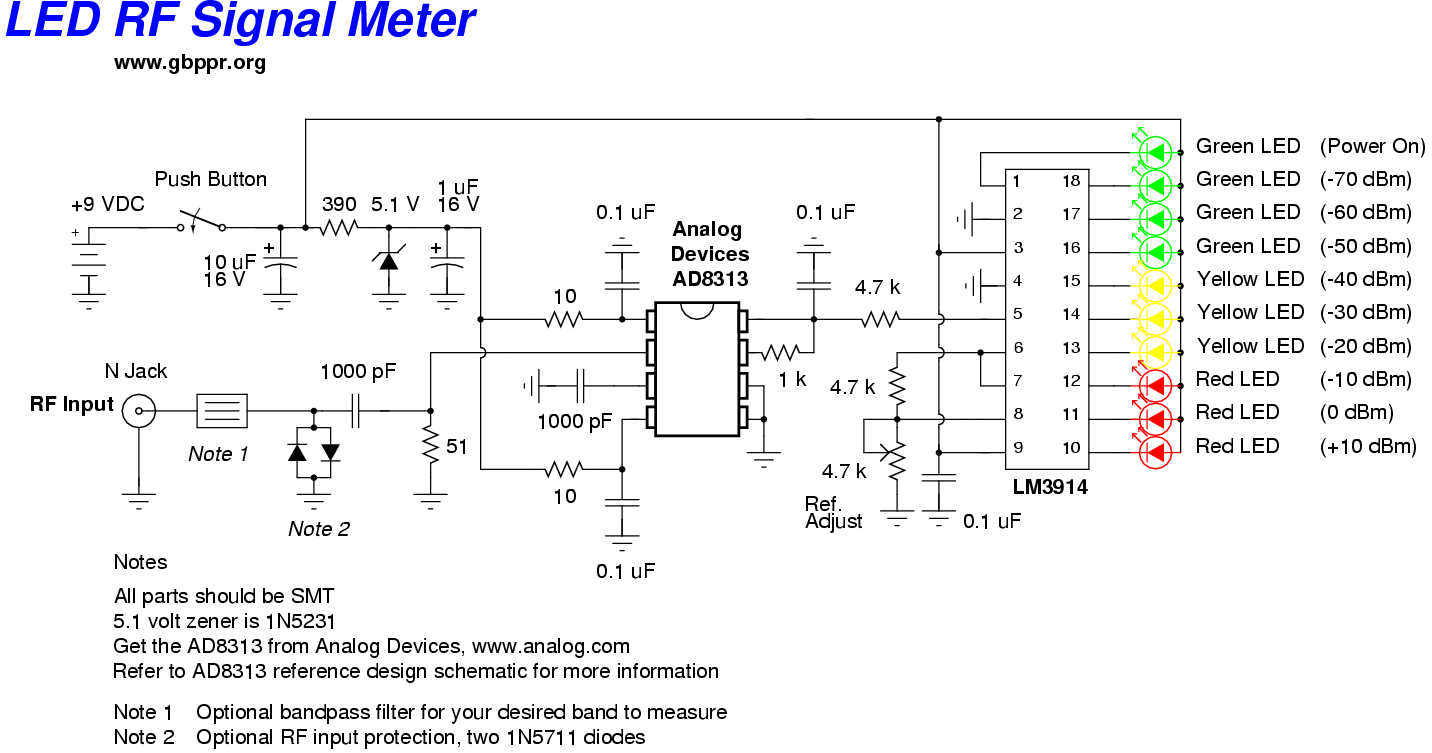
Already done, and cheaply. Just purchase an R.F. field strength meter, a common tool for those in amateur radio and radio communications in general. There are a wide variety of models and price-points.
They are relatively simple and cheap to build yourself, especially for frequencies under 500mHz. Here's a rather fancy LED-bar indicator design with plenty of sensitivity and good to ~2gHz that won't break the bank found in a Google search:
http://www.qsl.net/n9zia/wireless/pics/LED_sig_meter.png
Strat
-
Re:Opportunity
Let's just hope they don't hit a lighthouse en route, as it were.
-
Re:Just get a better antenna!
You can also try SPLAT! (which stands for Signal Propagation, Loss And Terrain). You can download SPLAT! from KD2DB's Web page, at http://www.qsl.net/kd2bd/splat.html. It's licensed under the GPL, Version 2.
-
Re:Null modem cables? Any ideas how to start?I used to do tech support on a group of machines that only had floppy drives. Here's how I installed NT on them when I rebuilt them:
- Copied the NT i386 CD to a machine. We'll call this the server. The i386 directory needs to be in a FAT16 partition on the machine.
- Hooked the server to the client machine (that had no CD) with a "laplink parallel cable"
http://en.wikipedia.org/wiki/LapLink_cable
- Booted both machines into DOS 6.x, either via installed-dos or from DOS boot disks.
- Used the DOS applications INTERLINK (on the client) and INTERSERVER (on the server) to connect them together. You can read more here:
- Used the DOS XCOPY command or the freeware XXCOPY utility to copy the i386 directory from the server to the client
- Rebooted the client with my DOS book disk and ran setup
Message me if you need more.