Slashdot Mirror
Domain: questioncopyright.org
Stories and comments across the archive that link to questioncopyright.org.
Comments · 68
-
Re:That's, for better or worse, for a court to dec
Without copyright law, someone else could grab my novel and start printing/selling their own copies of it.
You should look into Creator Endorsed.
Only asshole people will buy from a rip-off publisher. But asshole people will also elect a government that will enact things like a DMCA, so they're going to screw society either way as long as they have the government stick to wield. Not having the government-enforced copyright also eliminates problems like this Samsung* one, so you get multiple benefits from that strategy. It's risk-management, not risk-avoidance.
* guess whose phones I won't be buying again in the future?
-
Re: No Foul play...
No, it means he wants shit for free and doesn't care if artists or their heirs get paid.
Your fallacy is strong with this one. Creator-endorsed is a much more civil system - copyright isn't the only way to get paid. It may be one way to get paid more, but that gets paid for with lives of innocents (and no, profit reduced from a hypothetical does not make one a victim).
-
Re:Cartels
-
Re:Cartels
-
Re:Copyright itself is problematic for technology
Well, then what is the solution? How would you pay the authors, musicians and photographers?
"How will the cotton get picked?" Even if we don't have a better solution now, in light of the lack of a clear market for such solutions, that's still no justification for doing what we know to be a wrong thing.
But Creator Endorsed looks like a good pass at a replacement system.
-
Re:Is this a serious OS?
Just in case you're not a troll, just really misinformed and confused: almost every point you make is either an argument against a straw man, makes no sense or is simply based on false assumptions. I'll just pick a few examples:
I've been fighting this battle for many years now, regularly presenting significant amounts of evidence in favor of copyfree software. Calling me a "troll" is akin to calling Copernicus a "witch" for presenting evidence that Earth orbits the sun!
And then you go off to say that that's worse than making income (what exactly any of this has to do with income is anyone's guess) through legitimate contracts. Which are enforced by government force. Can you see how that argument makes no sense whatsoever?
Here you are exhibiting total ignorance of the subject matter. You need to study philosophy of law, as well as basic economics.
Making income is an accomplishment - it means you are providing something so valuable to other people that they are willing to compensate you for it. If someone else could provide the same or better value at same or lower price, the buyers would go there instead. Giving away software / code / etc that other people find useful and use is an accomplishment as well, and under certain circumstances it provides more benefits (attention, patches, donations, etc) than selling the software would have. Developers have a Right to choose how they distribute their code (and it is their own, added code that constitutes the value in question).
Freedom of contract is a Natural Right - meaning that we observe its necessity independently of whether it is recognized by any state. Contracts have existed since the dawn of civilization (ex. public oaths), and civilization is impossible without some way of holding people accountable for their promises. Contracts will continue to exist (and be insured and enforced by non-monopolistic DRO's) long after governments as you know them will rot away on the ash-heap of history.
Copyright, on the other hand, is a relatively recent invention of very dubious necessity. It started in the 1600s largely as a censorship mechanism, to suppress dissident literature and reward the loyal propagandists of the state. In spite of its sustained legislative approval, economic evidence for benefits of copyright remain very scarce, and much can be said as to its harm.
"Implicit contract" based EULA's and software licenses are more dubious still. They are completely different from real (explicit consent) contracts, and don't stand the slightest test of logical scrutiny. If GPL is legally valid, then so is any "fine print" attached to anything you may come across! How would you feel if you were to find a dollar bill on the street, put it in your wallet, and then get sued by me for not following the terms of the "license" scribbled on that bill, stating that your wallet now belongs to me?!
You seem to think that the GPL equates copying with theft. Where did you get this idea?
The fact that it drags people to court (which can cost them hundreds of thousands of dollars) for mere copying. And:
"Microsoft and Apple can't steal parts of the code and use it in their OSes legally." -- RedHackTea
That would be a great argument against using the GPL. That is, if the GPL indeed had something to say about how software can and can't be used. Which it doesn't.
Modification is a form of
-
Re:Small correction - not hosting
because in your theory he has no particular right to the fruits of such labor because it's bits on a disk instead of, say, a piece of hardware like your the expensive computers and smartphones middle-class users use to view the content, right?
Tell us about this computer of mine. Do I own the hard disk? If I own the hard disk, can I use it how I see fit? Can I arrange the bit patterns in any way that I want? If I own it, I surely can.
Now, then, it sounds like you'd like to use an armed gang to prevent me from arranging the bit pattern on my hard drive in a way that replicates a bit pattern that your bother came up with. In my country (the US), as an example, you'd like to use that armed gang to prevent 300 million people from using their property in that way, if they so choose.
You either have to make an argument that I don't own my hard drive but that your bother does own his bit pattern (that imaginary property is superior to real property, abrogating the entire basis for Western civilization) or you have to claim that you'll willing to take away the property rights of hundreds of millions of people to pad the business plan of one man. Because if real property rights don't exit, surely imaginary ones don't either.
Clearly it's wrong. Find a better business model (I suggest Creator Endorsed as a morally sound option) but whether you personally know of a sound business plan that will allow your brother to make money on that work or not doesn't justify taking away the property rights of millions or billions of people by force for his private benefit.
-
Re:Obligatory
The only annoying part is that you don't like the fact that someone else has told you what you can do with their code
It's not annoying in any direct instinctive sense that is unexamined by higher reasoning. I never closed-source-forked anything in my life, and probably never will. Most people just ignore licensing as irrelevant voodoo - I sure wish I could... But GPL is a political weapon, and it needs to be treated accordingly.
[...] I generally use the BSD license for my own projects [...]
Thank you very much! 8-)
I think the GPL is a valid license
If GPL is a valid (in ivory-tower philosophy of law), then so is every other "intellectual property" law and every "implicit contract", including the Post-It note on my forehead saying that by seeing my face girls agree to kiss me.
the linux kernel is an excellent example of when it is the right choice (in my opinion).
You're obviously entitled (have a negative Right) to your opinion, but I don't think this position would withhold much logical scrutiny.
Linux being GPL has hurt the software industry overall, GPL being a speed-bump on the road to greater symbiosis between proprietary and free code. If Linux had been copyFREE, the time that was wasted rewriting code to liberate it from GPL (by authors of both proprietary and copyFREE projects) would have gone to more beneficial endeavors instead. Microsoft would have had far, far more competition, since Linux would level the playing field and give small start-ups a major boost. Lower barrier to entry means more developers (who are not immaterial beings and have bills to pay) are stimulated to jump in and offer their enhancements, bringing money into the industry if they're successful. More competition means more innovation, flexibility, and higher standards.
The pragmatic "ethics be damned, I just wanna mooch code!" argument for GPL has lost all validity. In pretty much every category other than the kernel (the most complex piece that has the greatest lock-in) we are gradually seeing copyFREE projects exhibiting a competitive advantage. Even among online encyclopedias, the dominant project's content is not copyLEFT! You cannot just keep coming back to the Linux vs FreeBSD example - look at the total body of evidence.
Even more important than the pragmatic argument against GPL is the moral argument. Civilization is handicapped when it tries to operate on subjective laws, like GPL to satisfy one interest group or SOPA to satisfy another, with the groups always fighting each-other to get their hands on the guns of legislation. Law must be objective and grounded in reason. The idea of "implicit contracts" is nonsensical when you try to apply it consistently. When people claiming to act toward the goal of freedom act through irrational loopholes, they only empower the tyrants to use those same irrational loopholes to their advantage.
When you solve a problem through government-backed violence, which is what GPL ultimately rests on, you fail to solve this problem through reason. Without copyLEFT, the free software culture would have evolved differently, with much smarter ways of persuading developers to share their code. And, without copyLEFT, more people would question copyright as well.
Let's think about where the GPL hurts most. [...]
GPL hurts the most when people arguing against "intellectual property" (or any other irrational abuse of government power) are rightfully called hypocrites for using the same weapon in their favor!
--libman
-
Re:Obligatory
People touching the source code of ANYTHING are rarer than unicorns.
Does that include furry unicorns? They're everywhere!
Seriously, I read code all the time. A good coder will do a lot more reading than writing, which is especially true of C and other non-obvious lower-level programming... OpenBSD code is a great epic read (skip the perl).
The majority of computer end-users are illiterates regarding anything related to computer stuff.
They still benefit from using open source components in various ways.
Even if only 0.1% of users will review the code, in most cases that's enough people to blow the whistle if there's a backdoor, etc. Of course proprietary software can be disassembled / virtualized / memory-dumped / and analyzed in a variety of ways, and I'm sure that most Microsoft software has had more eyeballs on it than most FLOSS software, but with equal popularity open source has the advantage.
Non-devs also benefit from being able to rent a coder from a freelancer site (usually in Outsourcistan, India) to conduct a security audit or make a change for them. Again, modding proprietary software is possible, and in many cases is easier than most people think (and even than its developers would have wanted), but still a bit more ugly and expensive.
With a "time-limited hybrid source" arrangement, you get the best of both worlds. The proprietary developer would hand over the code to a reputable third party, which would build the binaries for distribution while keeping the code safe till its due date. The dev would be able to sell it like any other piece of proprietary software and possibly profit from his innovations while they're fresh, but with the added advantage that the users would eventually get the code. The dev wouldn't be able to hide any surprises (excluding in BLOBs or brilliant feats of obfuscation), and the users would know that they would eventually be unencumbered in making any modifications they wanted.
Perhaps this is how intellectual monopolies should be phased out...
--libman
-
Re:What do you think of non-free, non-software wor
Thanks for the message. Can you cite all that?
Indeed, I have my sources available:
- For the FSF's position on works of opinion: http://www.gnu.org/licenses/license-list.html#OpinionLicenses
- A more extended talk about the subject of copyright by Stallman himself: http://www.gnu.org/philosophy/copyright-and-globalization.html#opinions
- And several complaints that have been raised because of his seemingly incongruent position: http://questioncopyright.org/remix_stallman and http://news.cnet.com/8301-13505_3-10318343-16.html
-
Re:Hoping for a light GPL-free desktop
Nothing could be further from the truth. I prefer copyfree software for philosophical reasons. Copyleft is not really free software - it is open source software with legal threats and anti-capitalist propaganda attached.
Notice how anyone critical of GPL gets "(Score: -1)", regardless of the substance of their arguments... This is making Slashdot look like a commie cult! Having a freer license is one of Haiku OS's greatest accomplishment, which needs to be recognized. They could have gone the easier route and borrowed code from Linux and other GPL projects, but they didn't.
So big kudos to the Haiku OS team for trying to create a Linux competitor in the market segment where the pure copyfree stack is rather weak: user-friendly desktop clients, netbooks, tablets, etc (although FreeBSD + E17 might be gaining ground as well).
--libman
-
Re:For what
Come in handy for what?
Being able to download files that are hard to get elsewhere.
Piracy?
Are you saying everything linked on PirateBay is "pirated"? Is everything you write bullshit?
-
Re:Really?
Coming soon: Officially-licensed porn of every Disney character!
Firstly, "officially-licensed" would quickly lose its meaning and appeal under a compulsory licensing scheme. If you look at Creative Commons stuff (where all relevant uses are "officially-licensed") the equivalent phrase appears to be "creator endorsed" (which is 'better' in many ways, as it involves the creator rather than a mere licensor). Also, it would be interesting to see if current copyright laws could be used to stop porn of Disney characters... particularly given the expression/idea divide. Plus once the works are out of copyright, it ceases to be an issue (and most Disney characters are based on public domain ones, so you can do what you like with them).
Compulsory licensing eliminates any control over how a work is used or presented.
And? Maybe I wasn't clear (I'm not a great writer), but a large part of my original post was emphasising that this "need for control" is a bad thing. It has crept into copyright over the last 100 or so years, and has no real place there, being responsible for much of the evils that copyright has caused. If I build a house or a table, I don't get any control over how it is used once I've sold it, why should a creator have control over their work once published? Yes, of course they should receive fair compensation for the use, but control?
From my understanding, most European copyright law has a separate section for "moral rights" including the protection from degrading or defamatory use. I'm all for keeping that (and, if anything, strengthening it), but that's not the same thing as control - that's part of defamation law.
Compulsory licensing is also unlikely to actually improve competition. The arbitrator (or whatever entity decides what's "fair") adds yet another layer of bureaucracy, easily swayed by overstatements (and understatements) of value. Think of the value, according to the RIAA, of a pirated song. Contract negotiations would be even longer and more expensive, because the owner couldn't back out, so they have to continue investing time and people to dealing with the negotiations.
As discussed above, State-run licensing does exist, and does seem to function (at least on a small scale). A large part of it is that it eliminates the contract negotiations entirely - one doesn't need a contract if one can go straight to a readily available licence. But yes, there is the big issue of valuing work (which is partly why most copyright laws long-abandoned a requirement of something being artistic). It will be interesting to see if anything happens with the UK's Digital Copyright Exchange, if it ever gets set up...
Perhaps the simplest way to get around this is just to cut back copyright to 5 years, restrict it to artistic works and give up on licensing? Only something like 5% of US-registered copyright works are commercially viable after 5 years, and copyright covers considerably more stuff than is ever registered - it wouldn't have a major affect on the vast majority of copyright owners...
-
Re:What A Disgusting And Vile Statement
Oh bugger off. It's time to abolish copyrights.
http://levine.sscnet.ucla.edu/general/intellectual/againstfinal.htm
-
Re:I'm not surprised
Other niches are served somewhat less well because those who would be capable of producing software have no need for it, and those who need it aren't capable of writing it.
The solution is rather simple. If you know enough people who need a particular software but can't make the software themselves (artists, musicians, authors, etc) make a donation pool. The first developer who will create the software will get the donation pool but the software is free (both open source and free of charge). The cost for each client are minimal (like 10$) but the pay for the developer will be good (if 1000 people donate each 10$ that's 10000$ for the developer). The end product is a free software which the developer can continue to make money (with support and additional features).
The alternative is to wait for a commercial developer and then each client has to pay a high price for a copy.
Here is an example (not a software but a movie) http://questioncopyright.org/sita_distribution
-
Re:The viewpoint from two worldsNo, the original intent was to keep the state given monopoly to publish books.
The government wanted to abolish the Stationers' Company a relict of the former government that had the monopoly on printing and publishing books (and to censor the books as well). But the publisher lobbied the government under the disguise to protect the authors for a copyright law because they had older works and the money to buy the copyright of new works to publish them. The authors didn't had any choice to sell the copyright because the publisher were the only one with the printing presses, which were quite expensive. This new copyright law was later just taken over in the US constitution.
As I told before, the copyright was invented by the publisher for the publisher. Furthermore, there is no evidence what so ever that a copyright actually promotes the creation of new works. Last, the vast majority of creators don't see any cent out of copyright.
Don't believe me? Go inform yourself.
-
Re:The viewpoint from two worlds
But until then, artists need to eat. I'm not saying that the current means of achieving that is equitable or fair, but it sorta-kinda works, in that works of art are produced and that you don't see masses of dying artists on the 9 o'clock news.
How does it "sorta-kinda works" if the creator of music get's 1% of the sale of the CD? Right now the vast majority of creators don't see anything from copyright. Sure, if you get famous like the Beatles or Rolling Stones you get rich. But how many bands are actually rich? 1% or 2% of the bands out there. The rest are getting no cent out of copyright.
We have a kind of Replicator now, why 80% to 90% of the worlds population must still starve, because a book is more expensive then what they are making in a month? Why we are not releasing all works, abolish copyright? Only because of the 1% to 2% of creators that are getting rich or because of the RIAA/MPAA/GEMA and other organizations that are making billions without creating new works?
I'm not talking about the Rolling Stones, the Beatles, the big bands and not about Hollywood. I'm talking about ever body else, the 99% of the creators out there.
But please, go to your local bands and just ask them how much money they make from selling CDs and if they are worse of if people are downloading their songs for free. Proof me wrong.
Please inform yourself: The Surprising History of Copyright; http://questioncopyright.org/
-
Re:The truth about copyright
Not a conspiracy theory, just history taken from primary and secondary sources. See http://questioncopyright.org/promise#history .
Counterfeiting money is unrelated to copyright: see http://questioncopyright.org/faq#counterfeiting .
-
Re:The truth about copyright
Not a conspiracy theory, just history taken from primary and secondary sources. See http://questioncopyright.org/promise#history .
Counterfeiting money is unrelated to copyright: see http://questioncopyright.org/faq#counterfeiting .
-
Re:Copyrights and patents must be abolishedNo it's not unrealistic. Copyrights have nothing to do with protecting of the work of the author. The fast majority of authors and musicians will never see a dime out of copyright. The only party that have a profit out of copyright are the big publisher that take over the rights of the creator and get a state monopoly on his work. Which is not surprising, because copyright was invented by the big publisher back in the 1710 with the Statute of Anne. From Wikipedia
As the world's first copyright statute it granted publishers of a book legal protection of 14 years with the commencement of the statute.
The act is not granting legal protection for the author of a book but for the publisher because only the publisher had the big expensive printing presses back in the 18 century. Before that the only publisher in Britain was the Worshipful Company of Stationers and Newspaper Makers. It holed the sole right to publish books and was empowered to seize "offending books" that violated the standards of content set by the Church and State.
300 years later we don't use printing presses anymore, now the author can be the publisher and we finally can get rid of copyrights. For more information please visit http://questioncopyright.org/
-
The truth about copyright
Was copyright invented by writers and artists, to protect themselves?
No. Actually, it was invented by publishers, to preserve an information ownership monopoly based on a government censorship policy.
Do musicians, writers, and artists depend on copyright to earn a living?
The vast majority of musicians, writers, and artists will never see a dime of copyright royalties in their lives.
Is copying a copyrighted work the same as stealing it?
If I steal your bicycle, now you have no bicycle. If I copy your song, now we both have it.
Would creativity dry up without copyright?
If there had been no worthwhile or enduring artistic work produced before copyright, this would be a more plausible argument. But the world before modern copyright was hardly a barren cultural desert: Homer, Chaucer, Shakespeare, J.S. Bach, Li Bo, Leonardo Da Vinci, Michelangelo...Inform yourself on http://questioncopyright.org/faq, as a bonus you can download a free movie Sita Sings the Blues
-
The truth about copyright
Was copyright invented by writers and artists, to protect themselves?
No. Actually, it was invented by publishers, to preserve an information ownership monopoly based on a government censorship policy.
Do musicians, writers, and artists depend on copyright to earn a living?
The vast majority of musicians, writers, and artists will never see a dime of copyright royalties in their lives.
Is copying a copyrighted work the same as stealing it?
If I steal your bicycle, now you have no bicycle. If I copy your song, now we both have it.
Would creativity dry up without copyright?
If there had been no worthwhile or enduring artistic work produced before copyright, this would be a more plausible argument. But the world before modern copyright was hardly a barren cultural desert: Homer, Chaucer, Shakespeare, J.S. Bach, Li Bo, Leonardo Da Vinci, Michelangelo...Inform yourself on http://questioncopyright.org/faq, as a bonus you can download a free movie Sita Sings the Blues
-
Re:Let's look at this differently ...
IANAL, or an expert on the GPL, but let's just imagine the students had instead created a Linux distro in binary-only form, and didn't offer the source code as well. Or maybe they ripped off part of the kernel, mashed it into a binary and called it their own proprietary kernel, and relicensed it under new terms. Theoretically, I'm sure there's some way of constructing a contrived scenario that would illustrate the point.
If Linux copyright owners sent a takedown notice to some students even if they were violating the GPL, I would think they were assholes too. Fortunately, most copyright violations of the GPL are handled amicably by the FSF and other groups, even when it's a large company violating the copyright.
The point isn't whether these students could have ended up infringing Linux, but rather that copyright protection is a double-edged sword. Without it, idiots and their lawyers wouldn't be able to pester students whose goal is to learn and play, and Linus wouldn't be able to stop Microsoft from stealing his code.
-
Brown does not represent all composers.
Considering how many great composers lived and wrote before copyright was even invented or could affect them (*cough* J.S. Bach *cough*), it would make more sense to call this "one composer's view of copyright". Especially given how much every composer -- Brown included -- is indebted to other composers.
http://questioncopyright.org/minute_memes/all_creative_work_is_derivative
(See the embedded video there.)
-
Re:In other news
"Copying is not theft.
Stealing a thing leaves one less left
Copying it makes one thing more;
that's what copying's for."Source: http://questioncopyright.org/minute_memes/copying_is_not_theft
-
Copyright should be completely eliminated
-
This is about trademark, not copyright.
No matter what word the Vatican used, this is fundamentally about trademarks, not copyrights.
Trademarks are about identity: they prevent impersonation. Identity protection is exactly the Vatican's concern here. They don't want other groups pretending to be the Catholic Church. (There remain interesting questions as to who has the right to decide what the Catholic Church is, as with any religion or other affinity group, but that's an inherent property of identity itself.)
This case is not about copyright, in any case, since copyright isn't about identity. When people illegally share music, for example, they don't remove the original artist's name and replace it with their own. Copyright is not about credit or attribution; it's about the sharing itself. That's why it's called "copyright" instead of "creditright".
Lumping these two unrelated concepts together under the term "intellectual property" just leads to confusion. And the copyright lobby is very happy to benefit from this confusion, since people have a strong moral attachment to accurate crediting. For example, see http://questioncopyright.org/promise#plagiarism-vs-copying for a blatant example of the RIAA trying to confuse copyright violation with plagiarism -- that is, confuse unauthorized sharing with identity theft.
Now, if the Vatican were claiming a monopoly right on the Bible, that would be a copyright issue. But they're not, of course, because the Bible is in the public domain everywhere.
-
See also the BookLiberator, a more compact design
See also the BookLiberator, a somewhat more compact cube-in-cradle design, that's also easy to build. Although soon you won't have to build your own: we're prototyping a manufacturable, flat-packed kit to sell from our online store; see questioncopyright.org/bookliberator for more about the project. It should be ready next year.
None of which is to detract from Reetz's accomplishment, of course. This renaissance in personal book scanners is going to make it easier for all of them, in the long run, especially as we can share the same open source software among all the scanners.
-
Re:i wonder...
It isn't like the "free enforcement" really helps companies offer their product for less compared to the model you propose.
It does help companies offer their product for less than they would if they had to pay the true costs of propping up their business model.
Also, just how much money even gets spent on copyright enforcement?
The cost isn't entirely monetary. We also subsidize the copyright lottery by giving up our rights, and by giving up the works and technical innovations that could be created if not for copyright. What is the value of being able to create backup copies of DVDs? What is the value of the ghost works that are never released or created? I'm not sure how to put a number on that, but whatever that cost is, we're paying it.
I agree that the civil enforcement does cost society something in terms of court costs, but that also costs the plaintiff quite a bit of money as well, so it isn't like there is a huge financial handout going on.
Er... sure there is. If I give you $10,000 to buy a car, and you choose a $20,000 model and pay the difference out of your own pocket, that doesn't mean I didn't give you $10k. Your cost doesn't cancel out my cost.
I still think the subsidy argument is a red herring - it isn't like that money goes towards actually making creative works for sale.
Actually, in effect, it does. Money is fungible. Every dollar a company doesn't have to spend propping up their business model is an extra dollar they can spend on production. There's ultimately no difference between (1) giving a company $10,000 to pay for production and letting them pay for enforcement on their own, (2) giving a company $10,000 for enforcement and letting them pay for production on their own, and (3) giving them $10,000 worth of enforcement services for free and letting them pay for production on their own.
If a company that relies on selling copies had to pay the true cost of maintaining its position as the sole provider of copies, it would have to pass those costs on to the consumer in the form of higher prices for each copy. The cost we all pay for copyright law -- in terms of dollars spent on enforcement as well as lost rights and works -- results in lower prices per copy. That's a subsidy.
-
Re:Bide your time
Oh lord, do we have to bring out the copyright infringement is not theft brigade again?
-
Re:Enforcing artificial scarcity is a poor strateg
Where did I lie? I just stated facts and my opinion.
I was essentially trying to show you that prices were always high and it has nothing to do with piracy. Do you understand this simple fact?
You also need to understand that piracy is not theft. It's copyright infringement which has a completely different meaning.
Here.I could explain why I pirate and why I buy when I buy but, I think you missed it, I wasn't trying to justify anything.
I was just saying that you're wrong. -
Re:illegal file-sharing?
I found this quite ironic when I went to see if they had any other images like that http://questioncopyright.org/cm/images/
-
Re:illegal file-sharing?
quite right. piracy is not theft
-
Uh, Use Google?
Here's a good article explaining how Google makes plagiarism detection easy: http://questioncopyright.org/node/4 There was a story a couple years ago about one of these plagiarism detection services, Turnitin, getting sued for copyright infringement... does anyone know if that went anywhere? http://education.zdnet.com/?p=953
-
Re:I hate to say it...
If you think the Slashdot crowd hasn't been making any sensible arguments (either pro or con) on the issue of copyright, well, there *are* people elsewhere who do make well-reasoned argument not based on ad hominem attacks but on the disastrous consequences of overly strong copyright laws.
Why don't you go read what they have to say and decide for yourself whether the copyright laws as they stand currently are worth defending?
If you want to make sure that you get all your arguments from a proven liberal (I don't know which side of the political spectrum the QuestionCopyright guys associate themselves with), you can always read what Lawrence Lessig has to say.
-
Re:Lock these criminals up for life not 2 years
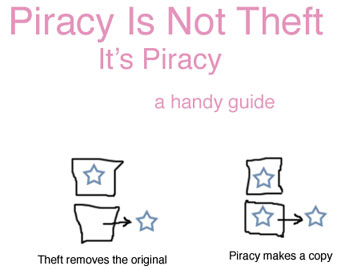
Piracy is not synonymous with theft. Here's a visual aid showing the key distinction.
-
Re:Who is this guy, & why does he not want to
Quote (emphasis mine): "For those that say "hah i got you zomgn00btard, I don't buy, I just download it from my bit torrents"....great you are STEALING."
Nitwit.
http://www.questioncopyright.org/cm/images/piracy-is-not-theft.jpg
Have fun paying high prices for something you'll never truly own. I only know a few people who have such a backwards view on filesharing as yourself. They're all above the age of 40, so I'm hoping that you and any others who can't understand such a simple difference will all be dead and gone within my lifetime.
I think I'll go out to eat tonight with the money I saved from downloading a movie this week instead of buying it. Then I'll watch the movie. I guess you'll just have to eat your stupid $20 plastic disc instead of food. Be sure to do that after you watch the movie, though (being a good little MPAA tool, you wouldn't consider ripping the DVD).
Good day to you.
-
Use proportional tax + public buyout option.
The author is quite right that there should be a carrying cost to copyrights and patents. But take it one step farther: Make the annual registration fee a percentage of an owner-declared total value; then give the public the option to buy out the owner by paying that total value.
For example, I declare my novel to be worth $100,000. My registration fee that year will be $2000 (I'm just using 2% as an example). But at any time during that year, anyone can come along and pay me $100,000 to liberate the work into the public domain, as a mandatory transaction. I've declared the price, so it's a fair price by definition. Each year at re-registration time, I can change that total value, moving it either up or down, to reflect changes in the market value of my work. But having done so, I'm obligated to allow liberation for the declared price at any given time.
Note that this transaction is not a sale of the copyright or patent, it's a liberation. Sales can still take place, as before, and a private sale could be for more or less than the declared public value (because the buyer might want to preserve the monopoly, rather than liberate the work). All the market dynamics that copyrights and patents formerly had, they would still have.
This proposal is described in more detail in http://www.questioncopyright.org/balanced_buyout/ -
Re:Sweet!
The explicitly stated purpose of copyright is to encourage the creation of new works
That's a nice myth, until you read this:
Yet a close look at history shows that copyright has never been a major factor in allowing creativity to flourish. Copyright is an outgrowth of the privatization of government censorship in sixteenth-century England. There was no uprising of authors suddenly demanding the right to prevent other people from copying their works; far from viewing copying as theft, authors generally regarded it as flattery. The bulk of creative work has always depended, then and now, on a diversity of funding sources: commissions, teaching jobs, grants or stipends, patronage, etc. The introduction of copyright did not change this situation. What it did was allow a particular business model -- mass pressings with centralized distribution -- to make a few lucky works available to a wider audience, at considerable profit to the distributors.
[...]
The first copyright law was a censorship law. It had nothing to do with protecting the rights of authors, or encouraging them to produce new works. Authors' rights were in no danger in sixteenth-century England, and the recent arrival of the printing press (the world's first copying machine) was if anything energizing to writers. So energizing, in fact, that the English government grew concerned about too many works being produced, not too few. The new technology was making seditious reading material widely available for the first time, and the government urgently needed to control the flood of printed matter, censorship being as legitimate an administrative function then as building roads.
[...]
The system was quite openly designed to serve booksellers and the government, not authors. New books were entered in the Company's Register under a Company member's name, not the author's name. By convention, the member who registered the entry held the "copyright", the exclusive right to publish that book, over other members of the Company, and the Company's Court of Assistants resolved infringement disputes.
This was not simply the latest manifestation of some pre-existing form of copyright. It's not as though authors had formerly had copyrights, which were now to be taken away and given to the Stationers. The Stationers' right was a new right, though one based on a long tradition of granting monopolies to guilds as a means of control. Before this moment, copyright -- that is, a privately held, generic right to prevent others from copying -- did not exist. People routinely printed works they admired when they had the chance, an activity which is responsible for the survival of many of those works to the present day. One could, of course, be enjoined from distributing a specific document because of its potentially libelous effect, or because it was a private communication, or because the government considered it dangerous and seditious. But these reasons are about public safety or damage to reputation, not about property ownership. There had also been, in some cases, special privileges (then called "patents") allowing exclusive printing of certain types of books. But until the Company of Stationers, there had not been a blanket injunction against printing in general, nor a conception of copyright as a legal property that could be owned by a private party.
That's right. Too many works were being created, so they instituted censorship to curb and control the flow of enlightening material to their subjects. Then privatized that, and copyright grew from there as a self preserving reaction, after their initial monopoly had been dissolved. It was nothing more than a shameless attempt to continue that monopoly, at the cost of damaging our culture.
-
Re:OLPC is tanking"Copyright law is a great evil in society"? And it is. It's not zealotry to say so, it's perfectly reasonable. http://questioncopyright.org/
-
Re:10,000 abacuses? How about 10,000 Linux install
And illegal does not mean wrong. In this case, the law is deeply wrong, so they were wrongfully fined. The law does not determine right and wrong. Copyright should be abolished. http://questioncopyright.org/
-
Re:Opt Out!?
No, since copyright law itself is evil, making it as awkward as possible to opt-out of sharing is lessening the evil while staying within the law.
http://questioncopyright.org/ -
Re:Just for the record, I am too...downloading music that you don't have permission to is wrong. No, it's just illegal. http://questioncopyright.org/
-
Re:Trust your students
While I agree with your comment in general, I do not agree with your characterisation of people who oppose copyright as "anarchists". I think it is a bad term for a number of reasons.
- People who are opposed to one law are not necessarily opposed to all law or the concept of law in general.
- Copyright is a monopoly and is at odds with the principles of laissez-faire capitalism and is a remnant of the monarchical laws of England, laws that the Constitution was meant to protect the citizens of the US from.
- Information is not land and should not be territorialised as such.
- Copyright violates your First Amendment right to Free Speech, especially if you view information as speech (who is to say what I can and cannot sing in public or anywhere?).
- Copyright may have originally been conceived as a form of censorship.
For these reasons and many others, people who oppose copyright cannot be considered "anarchists". In fact, calling such people anarchists would be similar to claiming that Thomas Jefferson was an anarchist, especially since, according to his writings, he would have been right along side the people calling for the abolishment of copyright.
Other than that, I have one other point of contention: He is a university professor and an adult. I am certain that he will not take his questions verbatim from Slashdot. Even if he did, there are enough trolls and *AA sympathisers to balance the viewpoint somewhat. From the comments I have read, it appears that there are quite a few people who think Mr. Taylor will be reasonable -- an astonishing thought considering his employer and position.
-
Re:As much as i hate the RIAA....
How about recordings that are 15+ years old, in which the author if he is still alive is nowhere to be found.
There are a lot of songs that I heard when I was very young that are IMPOSSIBLE to find in any store. These musicians made a connection with society and profited from it. That is a great thing. But at some point we have to be reasonable and acknowledge that people should be able to hear the music that they made popular by listening to it. And if the author is not there to sell it, we should be able to put it in a P2P.
The biggest problem is that the RIAA has you convinced that the current law is the only alternative. And they do that to keep control of a distibution business that has been made obsolete by the internet. In the good old days publishers indeed did a lot of work. Wether printing press or makling tubes. Distributing intelectual works was capital intensive. That is not the case today. And there are people out there that know of much better alternative to the copyright law.
In other words the disjunctive of prohibiting P2P sharing or allow criminal activity is false. There is a third option and it is FIX copyright law. And that is the option RIAA does not want you to think about.
I suggest you read
http://questioncopyright.org/proportional_registra tion
Althought the whole site is good to read. -
It's not stealing.
When someone steals your bicyle, now you have no bicycle.
When someone copies your song, now you both have it.
That's a pretty important difference!
http://questioncopyright.org/ -
Re:Anyone else feeling less bad about pirating?
First of all, you can't clear your name legally. Many people have suggested buying these CDs used, but if you do that you still have gained. By waiting to pay for them, the street value of the CDs dropped while you got free use out of the music. Furthermore, even if you go purchase all the albums new or from iTunes, it does not clear you legally for downloading. If the RIAA subpoenas your IP address and sues you, presenting your receipts and stacks of CDs will not help you one iota. You can't undo what is done. (You do increase your legal risk by keeping your mp3 collection, but realistically if it just sits on your hard drive the risk is minimal at this point.)
Therefore, this comes down to primarily a moral issue. I encourage you to do some research and decide where you stand on the issue of copying music. It's not the same as stealing, and there isn't really a good analogy to describe it in terms of physical real-world items. I think most people would agree that copyright has been extended way beyond its intended purpose, and that artists do not get a good deal from the recording industry.
Personally, I take this further - I have no moral issue with freely copying and listening to recorded sounds, and I think the recording industry does more harm than good for the promotion of excellent music. Like you, I did feel guilty about copying at first. However, I discovered that my guilt was based on things I had been told, and not based on anything I believed.
I try to support artists by attending concerts and buying merchandise. I'll buy t-shirts and occasionally a special edition CD. If you can buy directly from the artists they will see more of the money.
http://questioncopyright.org/ has some good reading material to get you thinking. -
Re:separation of the web
Upholding copyright law IS doing evil, jackass. http://questioncopyright.org/
-
Question Copyright.
Methinks the time is ripe to question copyright.
-
Spell out goals before choosing optimizations...
On a discussion list at http://questioncopyright.org/, I wrote this in response to this paper:
Just scanning the paper, I found it hard to tell what goals he thought
we should be optimizing for. Production of new, original works?
Production of original and derivative works? Does the ability to copy
have a value in itself, and is that value factored into the equations?
Without a clear statement of goals, it's hard to see how these kinds
of calculations mean anything for policy.
It looked to me -- and I only scanned, so I could be mistaken -- that
he thinks we should be optimizing for "production of new works". If
so, that's a massive assumption that will affect everything about the
outcome of his calculations... yet (I would argue) it's not the right
goal.
Wish I had time to do a more thorough analysis of the paper, and perhaps a critique if my fears above were to prove correct...
-Karl Fogel