Slashdot Mirror
Domain: shrinkthatfootprint.com
Stories and comments across the archive that link to shrinkthatfootprint.com.
Comments · 63
-
Re:Fukushima
Two days in Spain, three days in Italy, five days in Brazil or Mexico...that's assuming all would be covered from the vehicle. With a residential solar installation, it probably wouldn't.
-
Re:More than enough power in an EV to do so
The average American home uses 10,399 kWh in a year
That's because an average American home is crap when it comes to efficiency.
Since all that additional electricity consumption happens overnight, if every house has an EV then suddenly the peak electricity consumption period switches from mid-day to overnight. And the lower electricity prices people are expecting to pay to recharge their EV evaporates. Moreso if there's significant solar power generation in the grid. Since solar provides electricity only during the day, the electricity during night to charge all these EVs will have to come from generators the power companies can spool up to meet the overnight demand spike.
Have you considered the possibility of charging *during the day*? It almost makes too much sense to store the surpluses, doesn't it? And consequently it makes too little sense to charge overnight. Thus no "overnight demand spike" is necessarily bound to happen.
Storing solar power in batteries for overnight use is not cost-effective unless solar generation exceeds 100% of daytime consumption.
Sooner or later, this excess generation is going to happen if the cost of solar generators becomes so low that using them pays off even despite not using their full output. Even in Germany (which is quite bad for solar power!), for example, the prices auctioned in 2018 for new solar installations where around 45 Euros/MWh. In some other places, the same figure is below $20/MWh already. At these levels, you soon have to ask yourself what to do with the stuff you can't consume around noon in any other way.
It makes no sense to run other power generators during the day just so you can store solar power in batteries for use during the night, when you can just use the solar power directly during the day (avoiding battery losses) and run the other power generators during the night.
It makes no sense to make this argument since you have to charge those vehicles *somehow*, and considering that most of the charge will be used for driving anyway, "[using] the solar power directly during the day (avoiding battery losses)" makes no sense since you can't drive directly on solar power, or nuclear power, or whatever source of electricity you're using, unless catenary wires or some other similar infrastructure is involved. (Which it won't be for personal vehicles.)
Meaning you're going to be paying the highest electricity rates to charge your EV, not the lowest. Modding me down doesn't change this truth. The same truth that lets your EV battery power your home for more than a day, also means the power pricing peak will invert when every home has an EV charging overnight.
That's assuming that everyone makes the irrational decision to charge during the most expensive period. That's a strange assumption to make.
-
Re:Cutting Emissions
Are there still people here who believe in this "long tailpipe" nonsense?
Start reading. Or, if you just want a cheat sheet for the US: here and here.
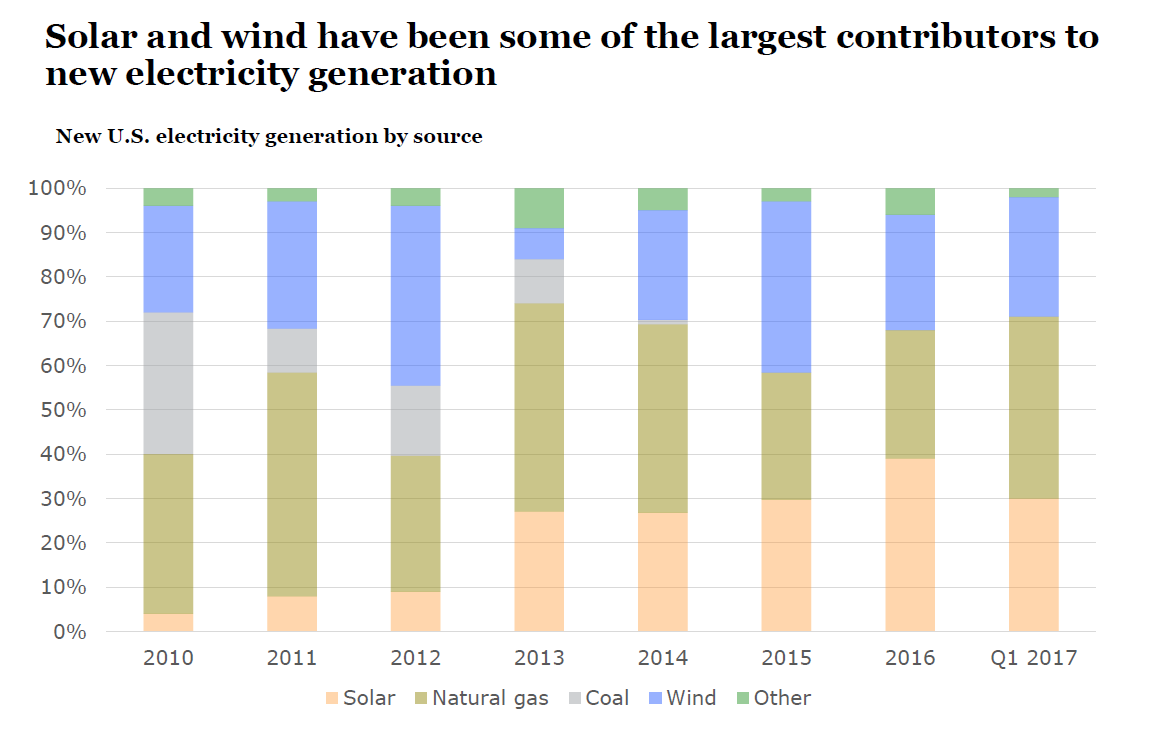
Here's where the US grid has been heading. Here's where it's going. So note that using, say, 2012 data above actually downplays the improvements of EVs vs. ICEs. Same story with the energy used in battery manufacture (which has been falling in almost direct correspondence to battery prices)
If I was wrong in my assumption that you're an American (most people who ask this question turn out to be), let me know where you're from and I'll give you data appropriate to your location. For example, major EU countries.
-
Re:Meanwhile, in America
And to see which people are the least interested in fighting it
-
Re:Meanwhile, America met CO2 goals.
You silly troll. http://shrinkthatfootprint.com... Americans are far worse.
-
Re: Agreed
That doesn't really help much using less % of coal, when you use multiple times more electricity than most places. You still end up the dirtiest.
Also liar liar pants on fire, show you sources for that garbage.
-
America is the bigger problemChina is still catching up to US levels.Since America uses so much more electricity than other countries you are still the worst coal electricity users.
You already know Americans produce more CO2 from coal powered electricity than Chinese people.
Chinese coal plants produced 3,573 MT of CO2 in 2017 American coal plants produced 1,056 MT of CO2 in 2017
Per person America (less than 1/4 China's population) produces more CO2 from coal plants than China does...much more...OOPS.
Then on top of that America is the biggest user of natural gas. And America too, is the far biggest oil user.
It's no wonder your CO2 emissions are so much more than every one elses.
-
Re:One problem with the direction we're goingWhat's not being shown is that since you use so much more electricity than other countries that you are still the worst coal electricity users.
You already know Americans produce more CO2 from coal powered electricity than Chinese people.
Chinese coal plants produced 3,573 MT of CO2 in 2017 American coal plants produced 1,056 MT of CO2 in 2017
Per person America (less than 1/4 China's population) produces more CO2 from coal plants than China does...much more...OOPS.
Then on top of that America is the biggest user of natural gas. And America too, is the far biggest oil user.
It's no wonder your CO2 emissions are so much more than every one elses.
-
problem is not the direction, but way too slow
You really just need to be more like the rest of the world and use less electricity.
Cut back to the 1st world average and shut off all your coal in one go.
Don't worry, you will still be entitled to more electricity than Chinese and Indian people. -
Re:Only if they don't burn any themselves
how come you are not modded up fully? Seriously, you have hit the bullseye. Oil companies have pumped it out, but the vast majority of the CO2 is not from the pumping, but from the burning for cars, electricity, heat, etc. As such, they should chase car makers and utilities first before going after oil companies.
Yes Windy, using it by people.
Cars:- Ford's F150 is America's best selling vehicle.
In Europe it's all tiny cars at the top.Electricity:- America uses double to triple the electricity Europeans use.
Good to see you finally realising it's not oil companies making you use oil, it's just entitled people doing what comes naturally.
-
Re:Good
Looks like your power costs could do with a little skyrocketing.
-
Re:I dropped a word and you dropped your link...
The US is lowering its coal and China increased it's coal by 0.4%, congratulations. But then why does America still use more coal powered electricity per person then China? This site tracks coal plants and if you look at you will see that
Chinese coal plants produced 3,573 MT of CO2 in 2017
American coal plants produced 1,056 MT of CO2 in 2017
Since China has 4.2 times as many people (over a billion extra people). America uses far more coal powered electricity per person,despite people like you claiming they are clean. (ie the only reason China's coal use is bigger is because China is a much bigger country than America.)
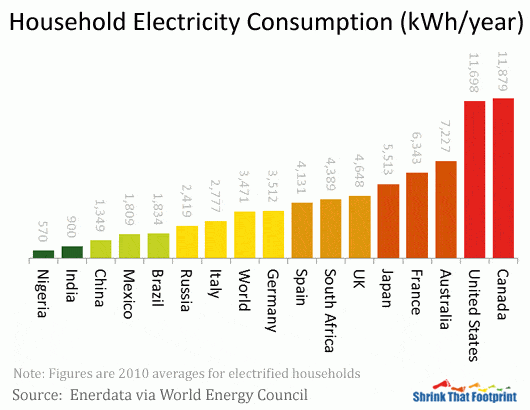
Could it be because American households use 8x as much power as Chinese households, 3x the world average?No electricity consumption doesn't necessarily spell carbon emissions, but in the case of America is most certainly does. Don't feel too bad, the overlap of ignorance and self-righteousness entitlement is quite high. You are not alone.
I didn't even add in all the extra natural gas you use as well, it only gets worse for you.How about you go fuck yourself instead. Pull your head out from your ass and try to understand actual reality.
Take a look in the mirror, because ignorant people like you are a much bigger problem than coal is. -
Re:Time for other countries to step up
American households waste an extreme amount of electricity. You could cut back from your current more than 3 times the world average to say Australian levels of just twice the world average, and drop a massive amount of coal. Maybe even enough to drop down to China's levels.
But you just don't want to do it. It's far easier to just complain about other people catching up.Rather than stop to think why you are so far ahead in the first place.
-
Re:Time for other countries to step up
Who cares what direction you are heading in if you are not moving fast enough to make a difference? 25 years you have been moving 'in the right direction' and what is the result? You are still twice as bad as China.
Per capita an America uses more coal powered electricity than a Chinese person does. Due to the fact Americans use so more electricity!
-
Re:Carbon taxing is worthless
Even if they cant choose to use solar or gas to heat water or cook. (they usually can)
They still get to decide how much electricity to use. Rich people levels or be a little less wasteful. -
Re: Umm, right
Hey look American households use 10 times as much electricity as Chinese households, who would have guessed?
-
Re:Anyone with own roof & discipline can go of
I can run my basics for 4-5 days off the battery and overcast alone(2KWh/day avg)
The electricity consumption of the average Canadian household is 11,879 kWh/yr, or 32.5 kWh/day. You're able to live off the grid with your system because your electricity consumption is 1/16th that of the average Canadian home. Your electricity consumption is 21% the world's household average, and 40% the household average for the thriftiest OECD member nation (Mexico, which has a 46% poverty rate).
Any typical household in the developed world would have to make serious and drastic compromises to their lifestyle to live off a system such as yours. -
What can you do to help?
Since part of this is caused by an increase in agriculture, a big one is to eat less meat. This doesn't mean be a complete vegetarian, but just eat less meat and more non-meat options. The acreage used for meat as a food is much much higher than the same for most vegetarian options https://www.nrcs.usda.gov/Internet/FSE_DOCUMENTS/stelprdb1097070.pdf and this also helps shrink one's carbon footprint http://shrinkthatfootprint.com/food-carbon-footprint-diet. Given that many meat substitutes are cheap, this can pay off nicely. Moreover, in the US now there are many more genuinely tasty vegetarian options than there used to be both in terms of store-bought items and in terms of available high quality recipes. I remember when I was a little kid and we went to my vegetarian aunt's for Thanksgiving, and it was awful. The situation now is very different.
-
Re:Shocking energy usage in the us...
We live in homes about twice the size of yours.
-
Re:Leftist
Science isn't leftwing or rightwing. Science supports a lot of things, but one of the things science does, is force people to prove their points. The process of Politics is a separate process. Science should be left to scientists, not politicians. I'm sick of people selectively remembering "science" when it is politically expedient.
Case in point, all the left wing loons that are blaming two hurricanes on Trump's election and global warming. Where were they the last 10 years or so, when hurricanes were practically none existent, where they citing the lack of hurricanes on Global Cooling?
And I don't see any Coastal Elitists volunteering for living in 3rd world conditions to lower their own carbon footprint. They want their coal fired electricity to power their Teslas, releasing more carbon than if they drove a SUV (exaggeration to make a point) . http://shrinkthatfootprint.com...
Science shows what is, not what ought to be. It shows what is possible, not what is capable.
-
Re:Not bad
The thing is that we consume a lot less electricity in Germany.
Your houses are also about half the the size of the US. http://shrinkthatfootprint.com...
-
Re:Not badAverage house size by country correlates strongly to electrical consumption per capita with the US, Canada and Australia generally high in both regards. Average house size in Germany is half of what it is US. http://shrinkthatfootprint.com...
If you consider house size to be a component of quality of life, then Germany is taking quite a hit on quality of life to get those lower electrical consumption numbers.
-
Re:Electric cars are as clean as the electricity u
Electric cars are fine and dandy, but we still need to produce electricity to power them. Where will that come from? Solar and wind would be the best source as they pollute the least; nuclear is a good option if you're using more modern plant designs. Natural gas might actually be worse in terms of CO2 emissions. Coal would be the worst case scenario; the smoke contains all sorts of pollutants not emitted by modern gasoline engines.
Precisely spot on. Couldn't resist posting that guess what the majority of electricity in India is produced by? coal is 60% of all electricity in India. This actually makes co2 pollution worse than efficient gas engines, or hybrids. Not that it isn't the right move, but they need to couple it with a serious push in green energy or the only thing they will be helping is particulates and smog in the cities, co2 emissions could worsen.
-
Re:Prove your case
Due to efficiencies of scale the worst coal power plants to EV systems are still likely to be twice a pollutant efficient as a ICE vehicle.
Citation needed. That also isn't a particularly meaningful comparison since only about 1/3 of US power comes from coal. It's quite possible to power an EV entirely with non-fossil fuel sources.
Yes I am using hyperbole and I would welcome someone with enough time to disprove me.
No thanks. You made the claim. Cite your source and prove your case. Don't ask us to do your homework for you.
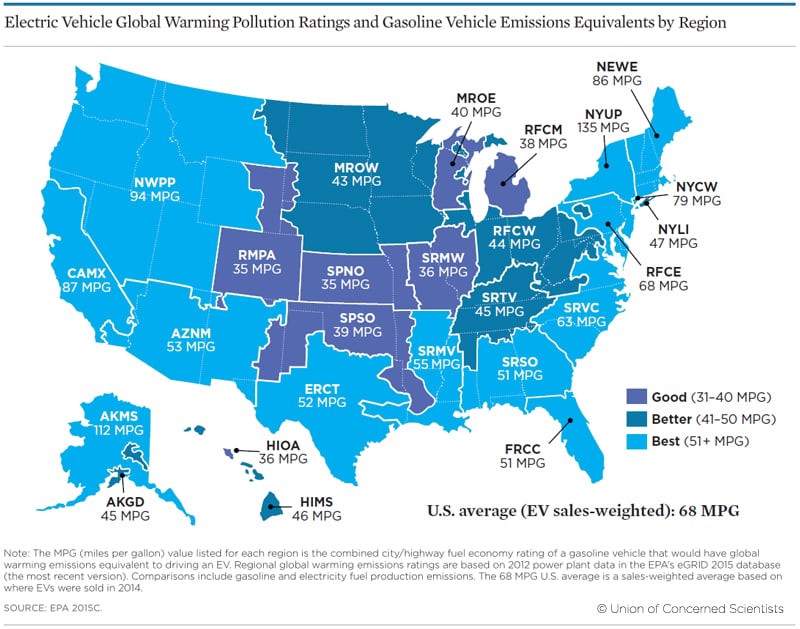
It depends on region. First about half the emissions come from manufacture with EV having a slightly larger foot print so keeping any current vehicles in service is much better than simply throwing them away. Second in the USA electric vehicle emissions as Gallons/mile equivelant range from the mid 30s to well over 100. Where I live (Midwest USA) it's around 38-42 mpg equivelant so buying an electric car is worse than buying a hybrid and about the same as buying a fuel efficient gas vehicle, the gas vehicle likely has a slightly smaller manufacturing footprint as it's lighter and lasts just as long, so efficient gas vehicles are probably better. Good source here
-
Re: Wow
That is cleaner than most cars. Plus, coal is rapidly becoming extinct, so why do you keep bringing it up?
The emissions from a coal plant powering a Tesla are less than most cars' emissions for the same number of miles. In the US, the Tesla works out to the equivalent to 40 mpg, in other countries it can go into three digit mpg equivalent. This will only improve over the course of the years as the "dirty" power plants are replaced with nuclear, solar, wind, hydro, or worst case, nat gas.
-
Re:Renewable energy can work.
Air conditioning does not use that much power.
http://shrinkthatfootprint.com...
22% of electrical use in the US is cooling
Almost 1/4 of all household power consumed is just to cool the place down.
That is a lot.
-
Re:Thats really cheap
First US usage of power is about 4 times higher per household than Germany, possibly due to Germans mostly not having or using AC in the warmer months. This makes summer the power usage low in Germany. In the US the summer months are the usage high.
http://shrinkthatfootprint.com...
https://www.eia.gov/electricit...The government (ie taxpayers) subsidize the tune of 20 billion Euros per year and rising (hiding the actual cost)
http://www.bloomberg.com/view/...
http://www.greentechmedia.com/...
http://www.seia.org/research-r...German prices per kwh are higher (~.34 per kwh) vs US (~.15) mostly due to tax/tariff on energy, and regulatory procedures related to the infrastructure payments of solar and other renewables. The prices are rising so fast the government has had to begin a more restrictive path on new solar.
https://www.eia.gov/electricit...
https://www.cleanenergywire.or...Based solely on price per kwh and predictable capacity, solar is awful. More specifically awful for germany, because of geography and weather trends.
http://www.forbes.com/sites/qu...This unpredictability is causing massive new production plants using coal. This is a reult of shutting down nuclear and building solar which only generates an average of >10% of potential capacity. Altogether the solar plan's end result is not bringing them closer to meeting their climate pollution goals.
https://carboncounter.wordpres..."when the wind suddenly stops blowing, and in particular during the cold season, supply becomes scarce. That's when heavy oil and coal power plants have to be fired up to close the gap, which is why Germany's energy producers in 2012 actually released more climate-damaging carbon dioxide into the atmosphere than in 2011. If there is still an electricity shortfall, energy-hungry plants like the ArcelorMittal steel mill in Hamburg are sometimes asked to shut down production to protect the grid. Of course, ordinary electricity customers are then expected to pay for the compensation these businesses are entitled to for lost profits."
-
Re:Actually it doesn't matterPeople in Europe and Japan have substantially smaller houses. To many people, that's a major hit in quality of life.
Compare top countries by house size:
http://shrinkthatfootprint.com...
To top countries by CO2 emissions per capita:
-
Terrible, terrible idea
India electric cars pollute CO2 at 20 mpg equivelant. I guess it would be good for particulates at street level, but electrics pollute greenhouse gasses 2-2.5x more than fuel efficient diesels or 2.5-3x more than hybrids. If they get off coal by 2030 it would be good, a terrible mistake otherwise.
-
Re:Probably 15.0 kW, not 150
No. Typical usage in Europe is MAYBE 4kWh/year. Notice the difference between kW and kWh, please. They are very different - kW is power, kWh is energy. See: http://www.energylens.com/arti... for an explanation. You can find energy use for several countries at http://shrinkthatfootprint.com... Having said that, there is no way that 150kW powers only 10 houses. Louisiana uses more energy per household than any other state in the US (probably due to air conditioning): 15270 kWh per year (the average in the US is 10908 kWh). So, in Louisiana, a home is using (15270kWh/year)/(8765.81 hours/year) = 1.74 kW of power at any given time, on average. That means that a 150kW heliostat should power about 86 homes in Louisiana - during the time when the array is functioning (daytime, with some lag for heating up and cooling off). So, the article is not very useful, because it's not telling us how many kWh/day this heliostat produces. My guess is that they either got a decimal point wrong, or that 150kW measures the amount of solar power being CAPTURED, not the amount of power being GENERATED as electricity.
-
Re:Anti-Tesla Rhetoric!
I couldn't find stats for the US, for some reason the government doesn't seem to publish this particular data in an easily digestible form, but compare with the EU: http://shrinkthatfootprint.com...
About 1/3rd of electrical energy is consumed by homes.
-
Re:I see theyre using the Step 2 profit model
Sure
All you have to do is quadruple your electricity prices, put in a battery system in your home to capture the "clean energy", pay more for the electric car and there you are.
lets see
http://shrinkthatfootprint.com...
Want to talk about a war on poverty, you might as well start dropping bombs on them.
-
Re:Won't someone think of the birds.
I can't say what the environmental impact of massive wind generation will be. Altering the atmospheres transport systems is certainly going to have an effect what, well what it will be is hard to tell.
I can say this the effect of quadrupling energy costs
http://shrinkthatfootprint.com...
Isn't going to be good for the human environment.
-
Re:Does This Make Sense?
It varies based on your electricity source.
That isn't the best article, but the chart makes it very clear how much this varies. Be aware that in many states in the US, you can choose your power provider. So if you really care, pick a power provider who uses mostly renewables. -
Re:The answer has been known for over 10000 years.
Sure compare a mileage efficient desist to a standard gass guzzler SUV and you are right. Most of the world including the USA fares poorly compared to efficent gas and diesel. In fact half the USA does worse with electrics than efficient diesels while the majority of china is worse and nearly all of India.
-
Re:The answer has been known for over 10000 years.
How about the energy required to strip mine coal, transport it (sometimes half way around the world), gasify it, burn it, use internal combustion to change it to electricity, step up the voltage, transport the electricity across the grid, step it back down, power the charger used to charge the battery, the losses that occur charging the battery, then the losses the internal resistance and leakage currents of the battery produce then the losses in the inverter/moror drive circuits? electrics pollute more than efficient gas for 80% of the worlds population
-
Re:The answer has been known for over 100 years.
-
Re:The answer has been known for over 100 years.
^source here
-
Re:The answer has been known for over 100 years.
nope electrics pollute more. But then again don't believe an electric car fanboy site with references, chose to disbelieve in facts and science instead.
-
Re:Just recycle the energy!
Electric and hybrid cars are better for the environment, and they already employ technology to charge the batteries with energy that would otherwise be wasted as heat (for example, the braking systems.)
It is not outrageous to explore ways of capturing energy from the flexing of the tires that also would otherwise be wasted as heat. As I see it, the challenge for Goodyear would be to show that the process is efficient enough to be worth adding to the tire design.
Electric and hybrid cars are only better for the environment when they aren't coal powered. Electric and hybrid sports cars and SUVs are obviously not very good for the environment as say a lighter more moderately powered car that will do the job adequately.
http://shrinkthatfootprint.com... this site is very very pro electric so if anything they are likely bias toward electrics. However in India and China a regular gas automobile pollutes less CO2/mile than an electric. In the USA it takes a fuel efficient gas car but you still pollute less CO2/mile. If you happen to live in some European countries then yes electrics are actually better. However about 80% of the world lives in areas where electrical generation is so polluting electric cars are actually worse. -
Re:Coal power cars make little sense
Its misleading to specify torque at zero rpm, your power is zero because there is no movement.
What does movement have to do with anything? Do you even know what torque is? Here, let me help you with that. In a nutshell, it's force. There's all kinds of forces in the world that don't result in movement. Lucky for you. You're sitting in a chair, aren't you? Demonstrating an instance of force without movement all by yourself. Amazing, isn't it. Forces get applied before movement starts.
nice try lol. You must be homeschooled or something. With no movement the static force gives no acceleration - might as well say a section of a tree trunk is providing thousands of pounds of thrust and make a free energy machine. Or gear down a hobby servo motor ten billion times and 'prove' you can generate more torque than any tesla with a 1.5V AAA battery. Or you may realize you lack a basic grasp of physics. Electric motors have higher torque than internal combustion motors of a similar size only at lower speeds.
All of the above cars you mention can beat the tesla in some or many of what people would call performance specifications, such as acceleration...
Tesla P85D 0-60 mph 3.2 s Audi S8 0-60 mph 3.9 s Yes, the sports cars can beat it. It's a SEDAN. A five door liftback sedan. For crying out loud... And for the record, the curb weight of the Audi is 4685 lbs. The curb weight of the Model S is 4647 lbs. The Model S is lighter than the gasoline car in the same class and price bracket.
The tesla 60 gets a 0-60 of 5.9 seconds but acceleration isn't the only performance metric. The 208 (60) to 270 (85D) mile range puts it at the bottom of the list. Handling and braking are also important - its a fact you can get a comparable performing vehicle for less money if you forgo electric.
Efficency isn't hard to see - in the case of pollution its co2/distance. coal power to charge your battery isn't going to be any better for the environment than economy fossil fuel cars. Its not my opinion, a simple google search would show you this if you took off your fanbois goggles.
Really? Truly? Sorry, those links are probably too hard for you. They require you to calculate the efficiencies yourself by dividing. Here, let me help you.
2012 Coal 33.8% 2012 Internal Combustion 32.8%
Coal is more efficient. Not a lot, but it is. It's definitely not radically worse, or even slightly worse. So shifting from petroleum to coal for transportation is a gain, made better by the fact below about the efficiency of electric motors in transportation applications.
Lmao you have no idea - your link shows the power plant effciency, not the transmission losses, charging losses or the efficiency of the electric vehicle. By that logic gas vehicles are 100% efficient as they require no power plant for recharging. http://shrinkthatfootprint.com... you can get the same or better emissions with a economy gas car and far better co2/mile emissions from a modern diesel vehicle, in the vast majority of locations that people live around the entire planet, and at less than half the cost. Not to mention that site is highly biased toward electric cars and if anything have overestimated things. People would buy them if they got the crazy subsidy electric vehicles get, if you could get one new for 5-10k usd instead of 15-20k usd people would line up around the block.
-
Re:Sweet, sweet karma
http://shrinkthatfootprint.com... So explain to me why electric cars get 25-30mpg in co2 emissions when many economy cars to better for half or one third the cost? The FACT is electric cars are bad for the environment. Further, if you mean http://www.eia.gov/tools/faqs/... Canada, yes I always suspected them of being turrest's. It dosent make sense to buy electric today when 10 years from now things will be marginally different - major power plant installations take decades. cars last less than 10 years on average - replacing those tesla -s batteries is gona be a 20k paycheck before subsidy. Then again you must care more about dogma than actual impartial facts.
-
Re:Coal power cars make little sense
Sorry but you have been misled.
http://shrinkthatfootprint.com...
http://www.greencarcongress.com/2015/01/20150128-corsa.html
With common fossil fuel cars getting 150-200g/km co2. There are thousands of credible sources just look. My opinion means nothing the facts are facts. -
Re:Deliberate
Here are a few references on the high cost of nuclear power:
http://thinkprogress.org/clima...http://thinkprogress.org/clima...
Each of these articles has multiple links to additional references.
For France, electricity is not cheap ($0.19 kwh) compared to the US ($0.12 kwh).
http://shrinkthatfootprint.com...
http://en.wikipedia.org/wiki/E... -
Re:Are renewable energy generators up to task ?
Lets use some German numbers. They have an installed solar capacity of 38.124 GW. In January 2014 they produced about 800GWh of electricity. With even 5 hours of sunlight they should have produced 5.8TWh. That means that the actual production is only 14% of installed capacity. The average household electricity usage in Germany is 3,612KWh/r. With a 20% premium for heating in winter we come up with 12 KWh/day. So you would need 12,000/10 watts/square foot / 5 hours / 12% efficiency = 50,000 square feet of panel. That is a lot of pannel.
-
Re:Solar Panels
I will use Germany figures as that is what I have access to. The yearly average use of electricity is 3,471Kwhrs/yr. Daily use is average 9.6KkWh. The potential energy is water follows the following formula 1000 kilograms of water (1 cubic meter) at the top of a 100 meter tower has a potential energy of about 0.272 kWh. Since the house is a lot shorter than 100m lets use 10m which means for ever cubic meter of water on the roof you get 0.0272kWh. To store half a day's energy you would need 9.6/2/.0273 = 176 cubic meters of water which weighs 176 metric tonnes. You better have a very strong roof.
-
Re:I don't know what they are doing to burn coal n
http://shrinkthatfootprint.com...
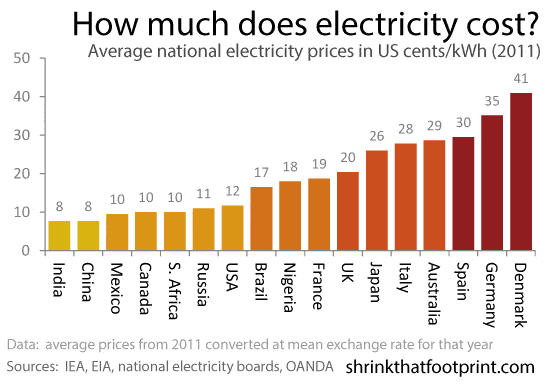
Denmark pays a whopping 41 cents per kilowatt hour.
OUCH !!!!!!!
3.5 times the avg cost in the U.S.
It really doesn't take much for other energy sources to beat that. Going out on a limb here I suspect renewables could be cheaper by just not being subject to whatever it is they do that makes their current energy sources ridiculously expensive.
As with many things i Denmark, most of this is taxes (approx. 75%). The rest is the actual cost of producing the energy.
The coal-based plants in Denmark are very efficient and they produce many tons of acid and all sorts of chemicals from the emissions from the plants, before letting it out into the atmosphere.As a side-story, the government recently cancelled a very popular funding-arrangment that made it very popular to install a local (6KW) solar plan on your roof. The ones who installed it in time, now have free electricity.
-
I don't know what they are doing to burn coal now
http://shrinkthatfootprint.com...
Denmark pays a whopping 41 cents per kilowatt hour.
OUCH !!!!!!!
3.5 times the avg cost in the U.S.
It really doesn't take much for other energy sources to beat that. Going out on a limb here I suspect renewables could be cheaper by just not being subject to whatever it is they do that makes their current energy sources ridiculously expensive.
-
A Little Lesson for the dogmatic
I read the summary and realized I knew nothing about the economics of electrical production in Denmark. So I looked
http://shrinkthatfootprint.com...
Denmark pays an avg and whopping 41 cents per kilowatt hour.
OUCH !!!!!!!
Say what you will about their plans but at those prices they are not overly concerned about delivering a cost effective product.
-
Re:Really?
And Germany pays three times what the US pays for electricity http://shrinkthatfootprint.com...
If the US's cost suddenly tripled, I guarantee you that rooftop solar wold take off. I looked at it, and even with a 20% subsidy from Uncle Sam, I couldn't make the numbers work. But if electricity went up even 20% in cost, it would become worth it with the 20% subsidy. Without a subsidy, electric cost would need to go up 40% to make it worth it to me.


.png)